Thursday, December 25, 2025
Home Blog Page 4682

Supreme Leader outlines environmental policy

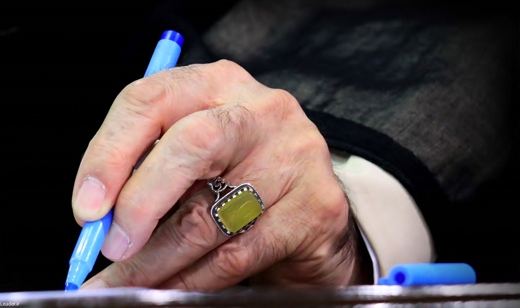
Leader

Supreme Leader of the Islamic Revolution Ayatollah Seyyed Ali Khamenei on Tuesday outlined a 15-point general environmental policy for the country.

Under Article 110 of Iran’s constitution, creating an integrated national environment system, managing vital resources in a coordinated and systematic fashion, criminalizing  environmental degradation, compiling an environmental atlas, strengthening the environmental diplomacy, developing green economy, institutionalizing the environmental culture and ethics are the main topics of Supreme Leader’s general environmental policy.

Several months ago, Ayatollah Khamenei urged Iranian authorities to try to tackle the country’s environmental problems through detailed, accurate planning.

The Supreme Leader described land grab and acquisition of mountainous land as deplorable, adding land and mountain reclamation is a crime and those committing such crimes should be prosecuted.

Water and land degradation are the biggest environmental threats in Iran to overcome. This requires stricter policies and laws to protect land.

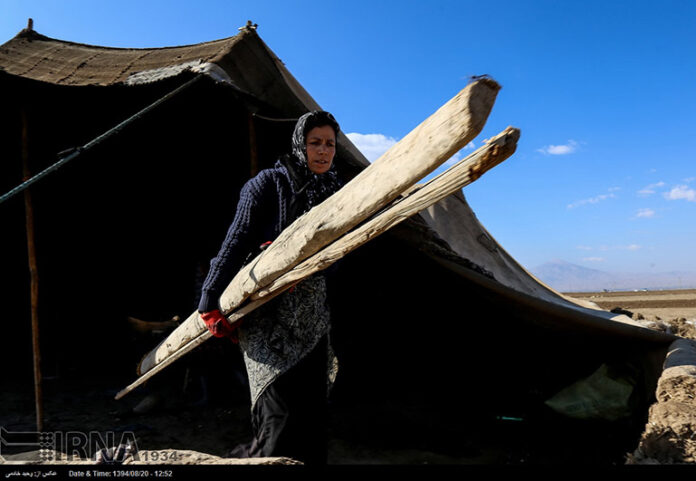
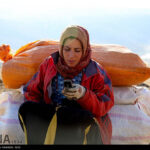
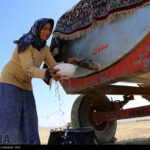
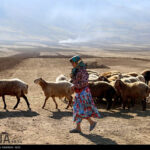
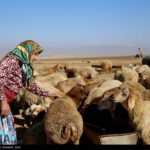
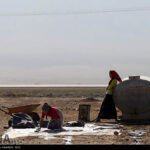
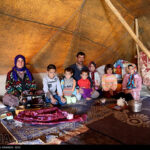
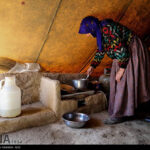
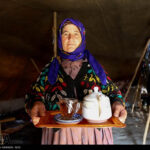
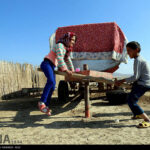
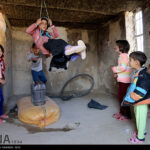
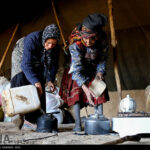
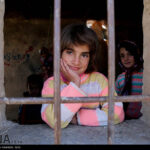
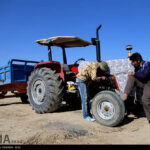
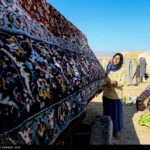
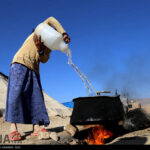
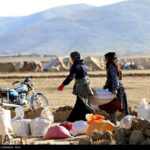
Trips across deserts by nomads in northeastern Iran (PHOTOS)

Nomads0

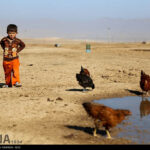
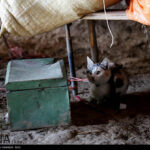
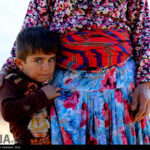
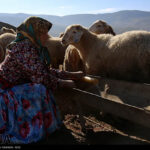
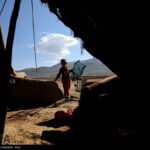
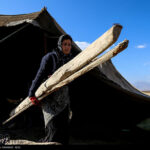
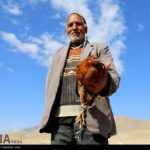
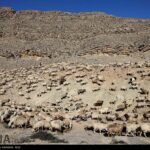
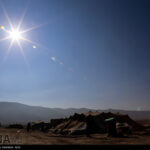
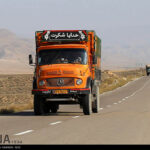
Nomads based in deserts in the northeastern Iranian province of North Khorasan live in tents all year through. In winter, 120 Kurdish-speaking nomadic families in the towns of Maneh and Samalqan travel 100 km west to get to a region called Maraveh Tappeh in Semnan Province.

The following are snapshots of their trips published by the Islamic Republic News Agency:

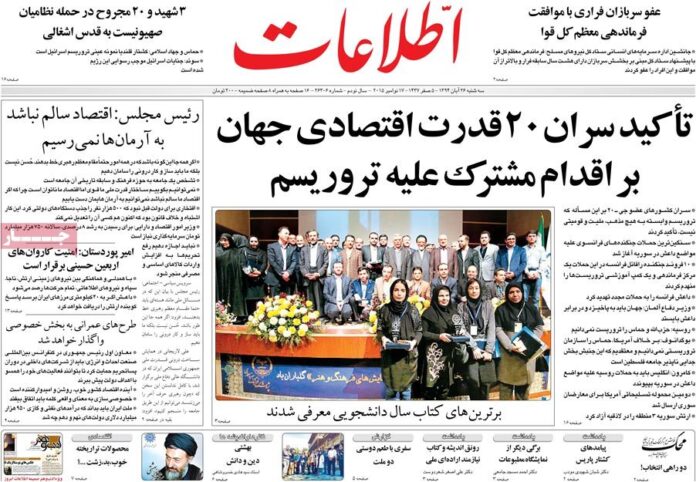
A look at Iranian newspaper front pages on Nov. 17

Iranian Newspapers Headlines

What the court heard in a ninth hearing in the corruption trial of Babak Zanjani along with the comments of the parliament speaker about the illegal measures the Ahmadinejad administration took, and those of the interior minister about Iran’s red lines in dealing with IS terrorists dominated the front pages of Iranian newspapers on Tuesday. Also on the cover of reformist-leaning dailies were the comments of the Expediency Council chief on the upcoming elections.


Ettela’at: G20 leaders have underlined joint action against terrorism.

It came as French fighter jets launched Paris’ heaviest attacks against IS positions in Syria.

And the terrorist grouping threatened to attack France again.


Abrar: Abbas Araghchi, a deputy foreign minister, has said foreign firms will be able to sign deals with Iran a day after implementation of the Joint Comprehensive Plan of Action has begun.

Abrar: The Ahmadinejad government acted against the law by hiring 500,000 new civil servants, said Parliament Speaker Ali Larijani.
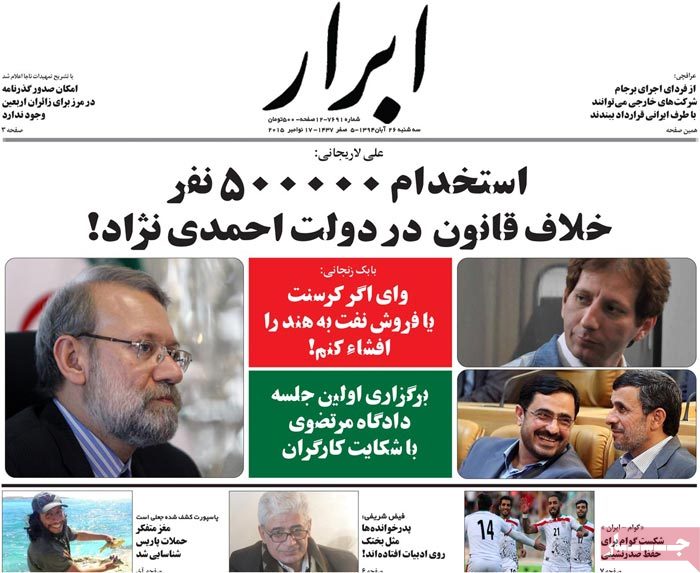
 

A look at Iranian newspaper front pages on Nov. 17


Abrar-e Eghtesadi: Iran will be the region’s second largest economy in 2016.

Abrar-e Eghtesadi: In the absence of government action, the foreign currency crisis of 2011 may repeat itself.
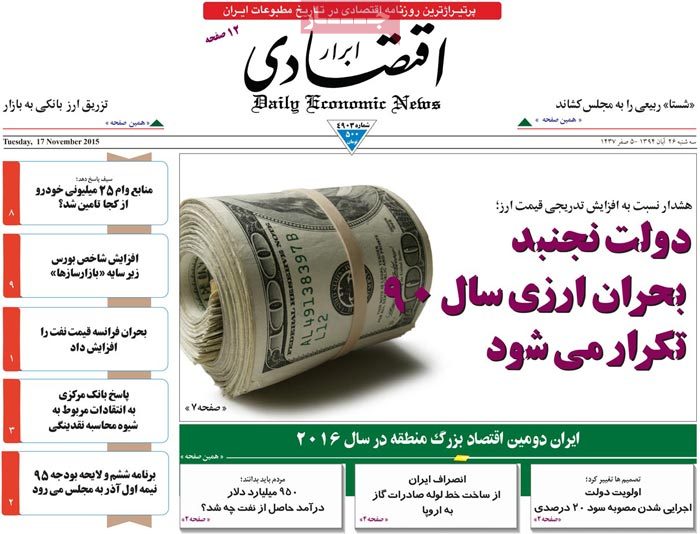
 

A look at Iranian newspaper front pages on Nov. 17


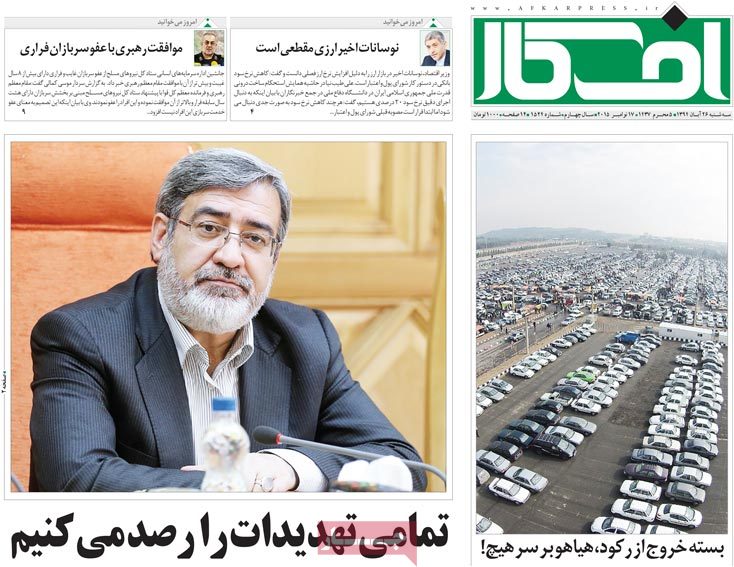
Afkar: The economy minister has said fluctuations in foreign currency rates are temporary.

Afkar: The interior minister has said that his ministry monitors all threats.
 

A look at Iranian newspaper front pages on Nov. 17


Aftab-e Yazd: Apples and Oranges!

In a bid to secure enough signatures to question Foreign Minister Zarif, a minority of MPs are drawing a comparison between the Algiers Agreement and the Joint Comprehensive Plan of Action.


A look at Iranian newspaper front pages on Nov. 17


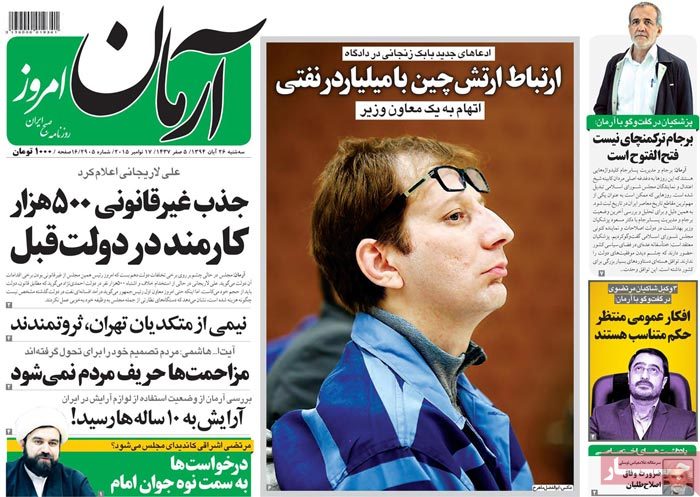
Arman-e Emrooz: Babak Zanjani [a young billionaire who is on trial for corruption] has claimed he has been in contact with the Chinese Army.

He has also implicated a deputy minister in the corruption case.

Arman-e Emrooz: More than half of street beggars in Tehran are rich.
 

A look at Iranian newspaper front pages on Nov. 17


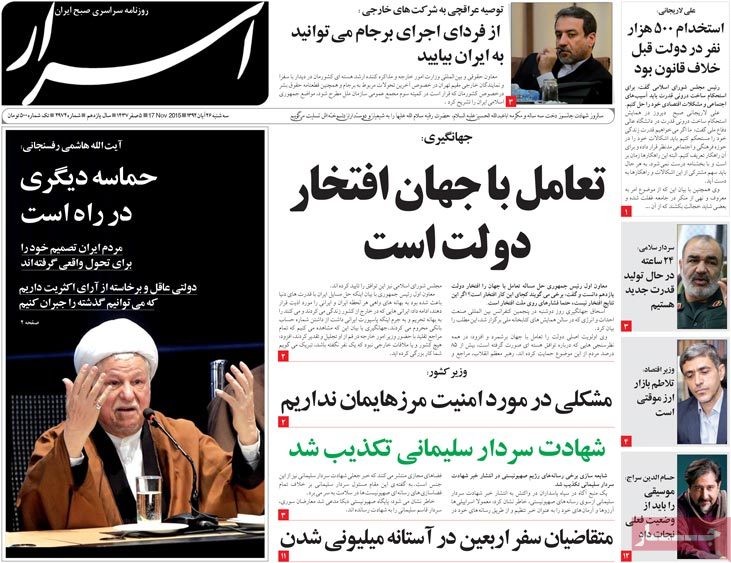
Asrar: “Another epic is around the corner; the Iranian people have made up their mind to bring in genuine change,” said the chairman of the Expediency Council.
 

A look at Iranian newspaper front pages on Nov. 17


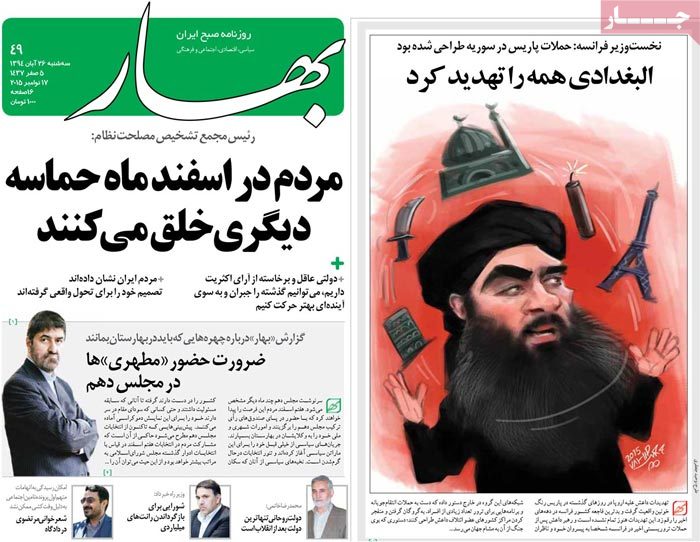
Bahar: The Iranian people will make another epic in the upcoming elections in 2016, said the chairman of the Expediency Council.

Ayatollah Akbar Hashemi Rafsanjani said, “We have a prudent representative government in office; we can make up for the past and head for a better future.”
 

A look at Iranian newspaper front pages on Nov. 17


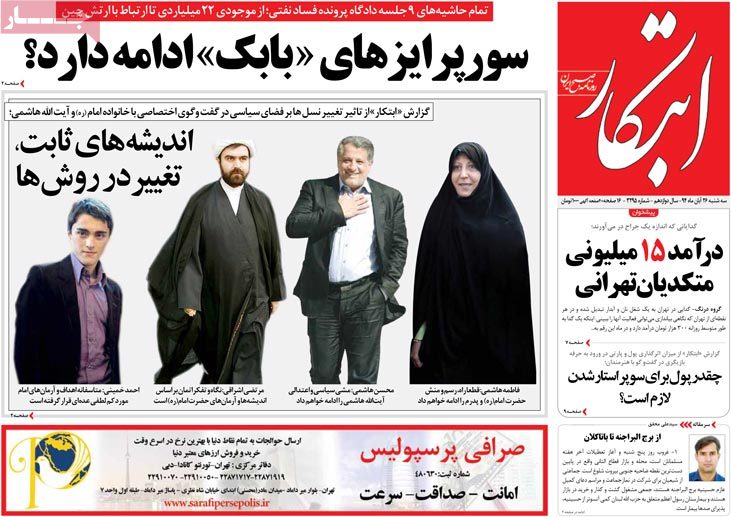
Ebtekar: Will Babak Zanjani continue to spring surprises on us?

A look at all the claims made in the last nine hearings of the young billionaire from statements that he has $22 billion in cash to his ties with the Chinese Army.
 

A look at Iranian newspaper front pages on Nov. 17


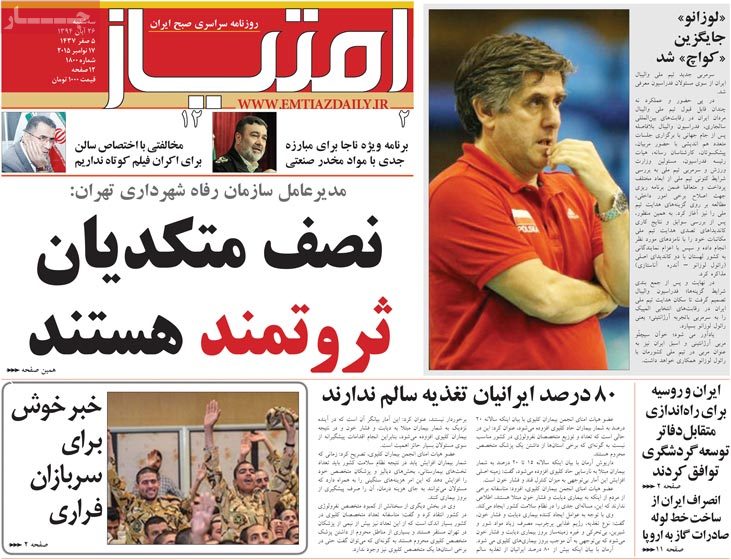
Emtiaz: Raul Lozano has replaced Slobodan Kovac as the head coach of the Iranian national volleyball team.

Emtiaz: Up to 80 percent of Iranians have unhealthy diets.
 

A look at Iranian newspaper front pages on Nov. 17


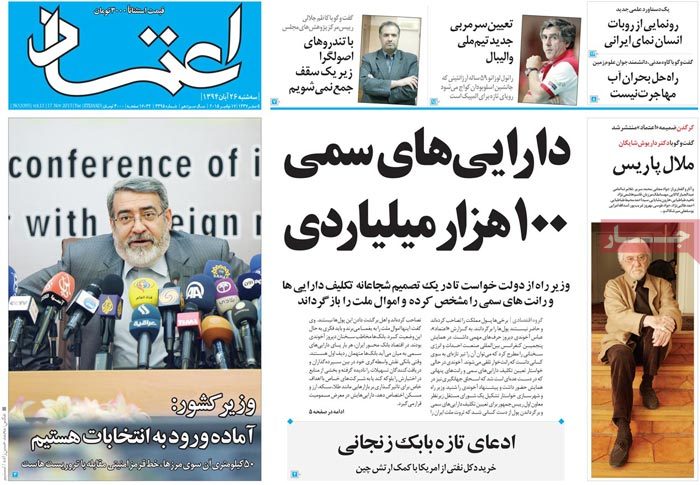
Etemad: The interior minister has said that his ministry is ready to organize the upcoming elections.

Abdolreza Rahmani Fazli further said terrorists would cross our security red lines if they came any closer than 50 km to the Iranian border.
 

A look at Iranian newspaper front pages on Nov. 17


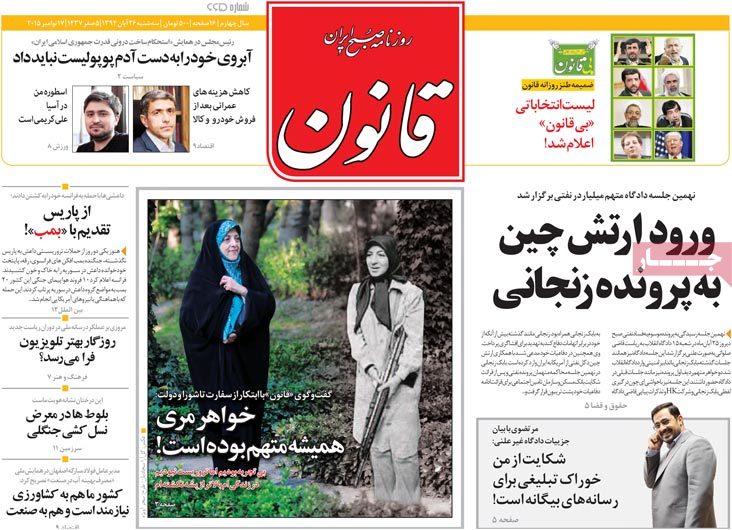
Ghanoon: One should not trust a populist with their reputation, said Parliament Speaker Ali Larijani.
 

A look at Iranian newspaper front pages on Nov. 17


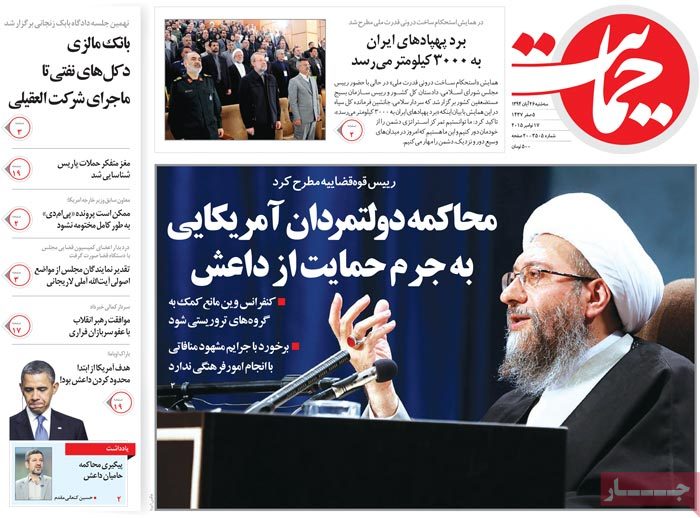
Hemayat: US statesmen should be put on trial for supporting IS, said the Iranian judiciary chief.

Ayatollah Sadegh Amoli Larijani also called on participants in Vienna talks on Syria to prevent the flow of aid to terrorists.

Hemayat: Iranian drones have a range of 3,000 km.
 

A look at Iranian newspaper front pages on Nov. 17


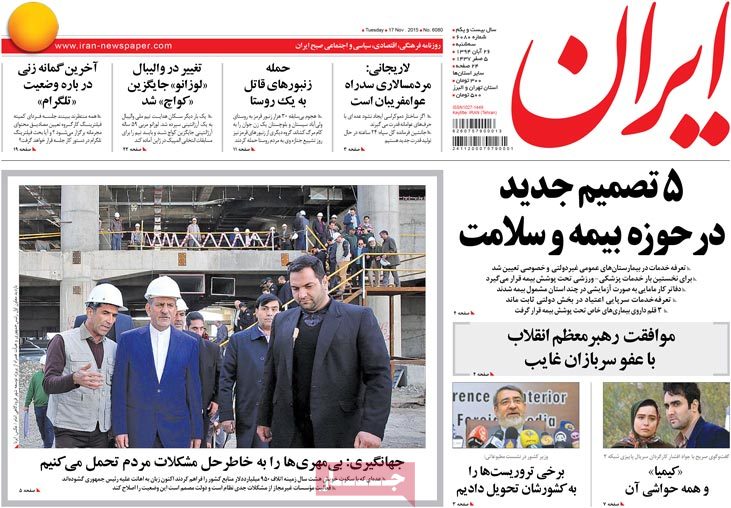
Iran: The interior minister has said that Iran has repatriated a number of terrorists to their country of origin.
 

A look at Iranian newspaper front pages on Nov. 17


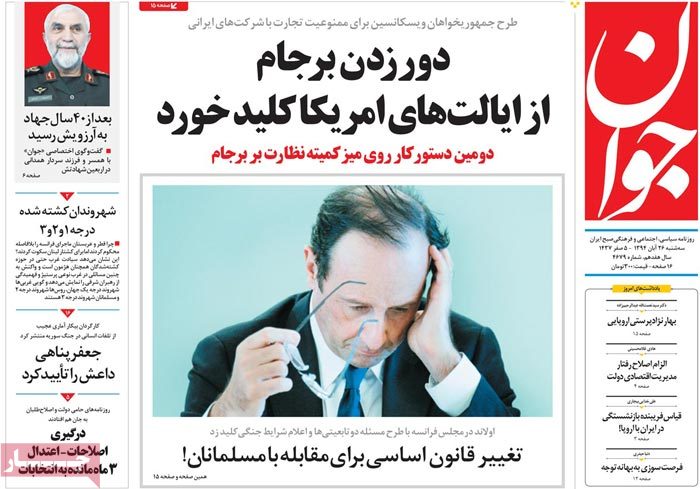
Javan: The move to skirt the Joint Comprehensive Plan of Action started in American states.

Wisconsin Republicans have introduced a bill to ban trade with Iran.
 

A look at Iranian newspaper front pages on Nov. 17


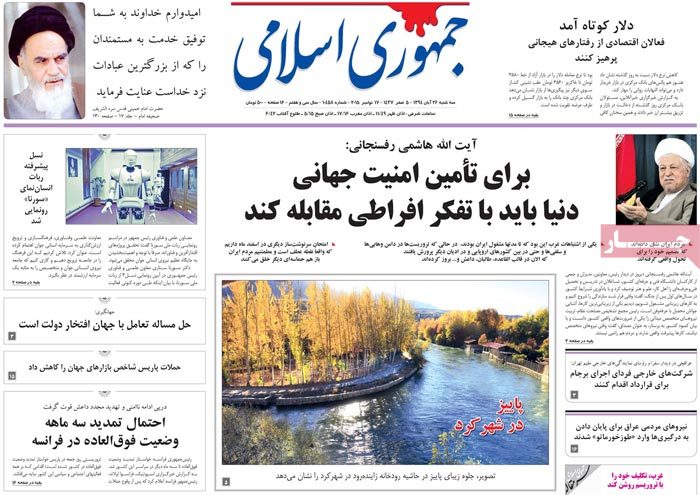
Jomhouri Islami: To ensure global security, the world needs to take on the extremist ideology, said the chairman of the Expediency Council.

Jomhouri Islami: The administration takes pride in settling the problems standing in the way of interaction with the rest of the world, said the first vice-president.
 

A look at Iranian newspaper front pages on Nov. 17


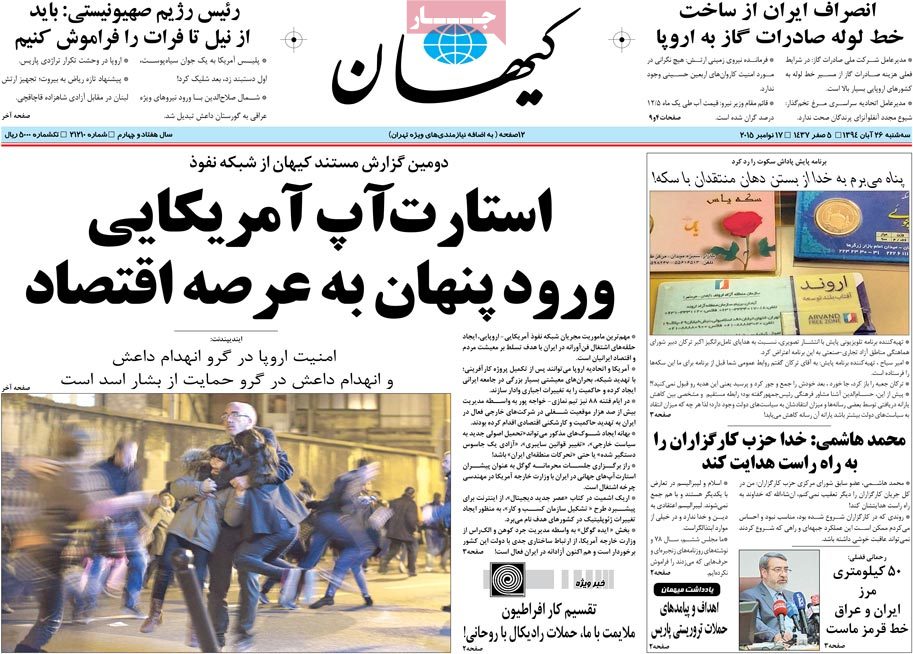
Kayhan: Iran has decided to back away from a pipeline project to export natural gas to Europe.
 

A look at Iranian newspaper front pages on Nov. 17


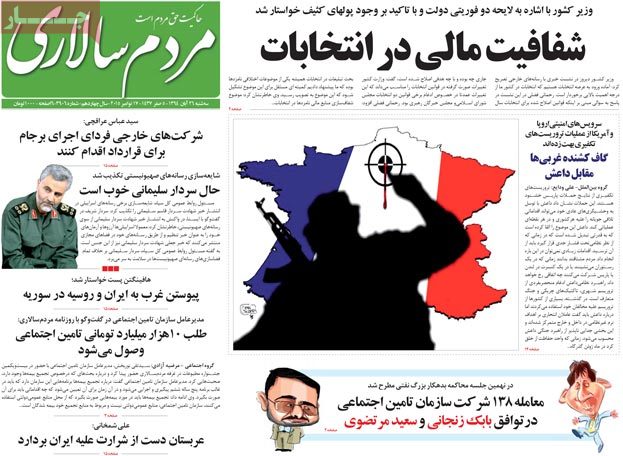
Mardomsalari: The secretary of the Supreme National Security Council has urged Saudi Arabia to ditch its evil attitude toward Iran.
 

A look at Iranian newspaper front pages on Nov. 17


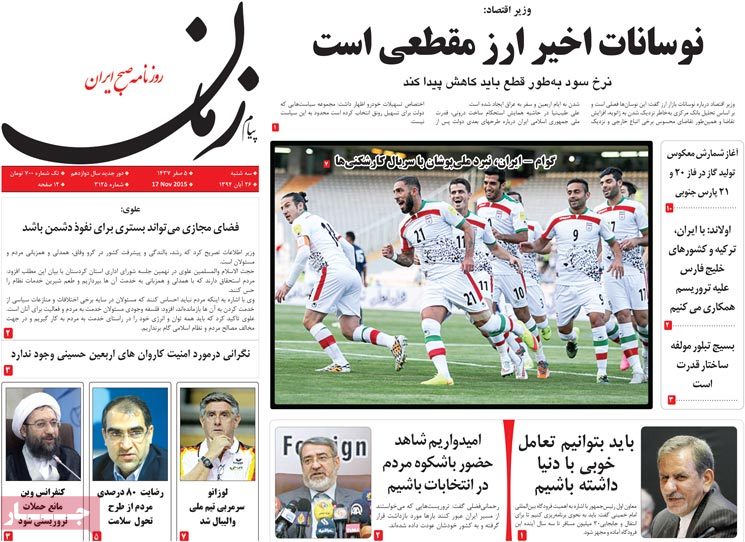
Payam-e Zaman: Up to 80 percent of Iranians are satisfied with the Healthcare Transformation Plan, said the health minister.
 

A look at Iranian newspaper front pages on Nov. 17


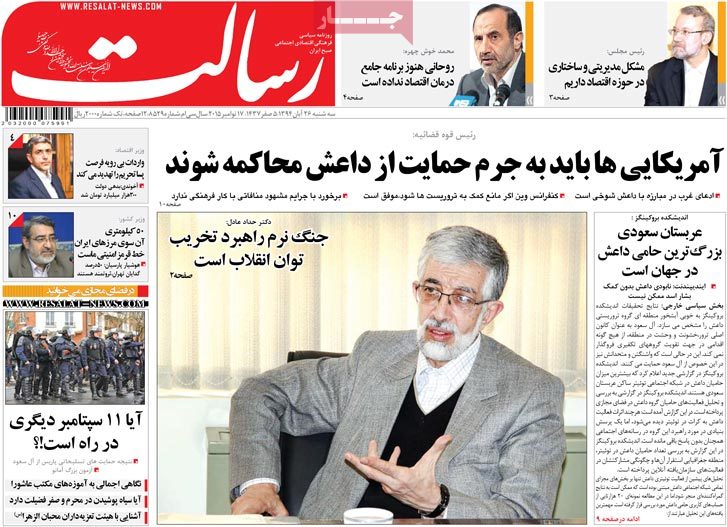
Resalat: President Rouhani has yet to present a comprehensive plan to resuscitate the national economy, said Mohammad Khoshchehreh, an economist.

Resalat: Unchecked imports will pose a threat to opportunities that are bound to arise in the post-sanctions era, said the economy minister.
 

A look at Iranian newspaper front pages on Nov. 17


Rooyesh Mellat: Iran’s nuclear talks could serve as a model for efforts to ease tensions in Syria, said the Spanish prime minister.
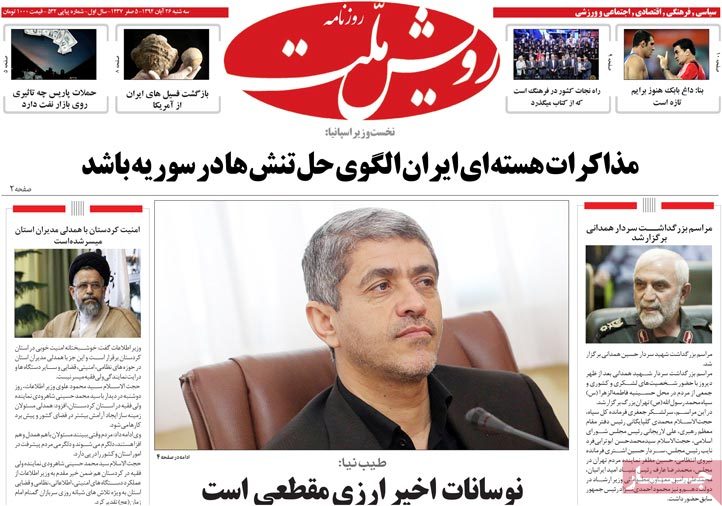
 

A look at Iranian newspaper front pages on Nov. 17


Setareh Sobh: Despite obstructions, Iran will take on Guam in the 2018 World Cup qualifiers on Tuesday.
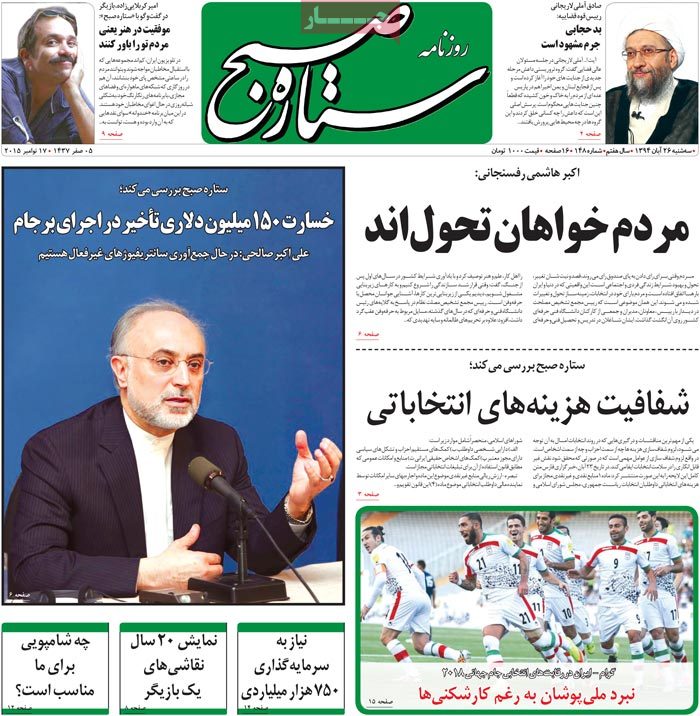
 

A look at Iranian newspaper front pages on Nov. 17


Shahrvand: “We are here to solve the problems; we won’t lose our temper,” said the first vice-president.

Eshagh Jahangiri further said that 85 percent of the public support the nuclear deal.

“What happened to the $950 billion in oil revenues the previous government earned?” the vice-president asked.
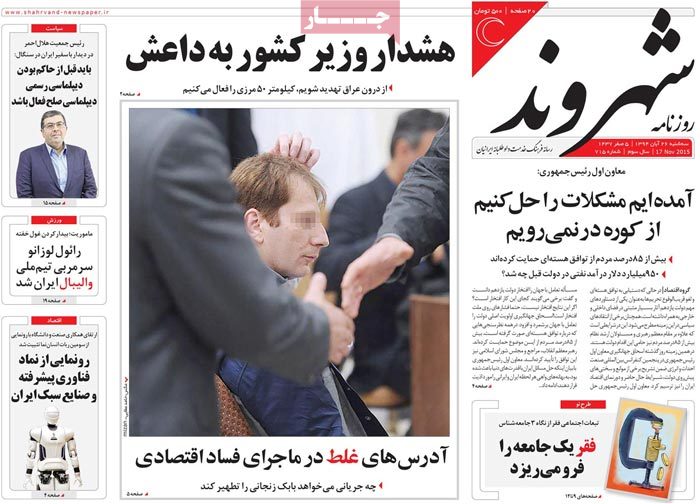
 

A look at Iranian newspaper front pages on Nov. 17


Sharq: The general is alive, said Brigadier General Sharif in reaction to rumors that Major General Ghasem Soleimani [the commander of IRGC’s Quds Force] has been martyred.

Sharq: Details of a deal between Zanjani and [Saeed] Mortazavi [both on trial for corruption] were revealed in a court hearing yesterday.
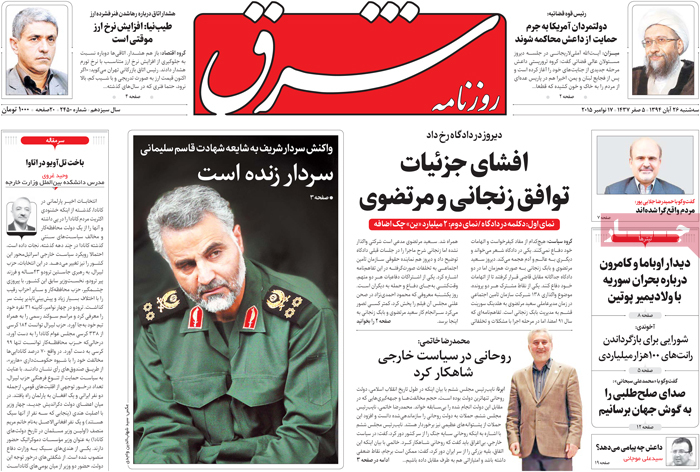
 

A look at Iranian newspaper front pages on Nov. 17


Taadol: To secure eight percent growth, the country needs $ 250b in investment, said the minister of finance and economic affairs.


 

A look at Iranian newspaper front pages on Nov. 17


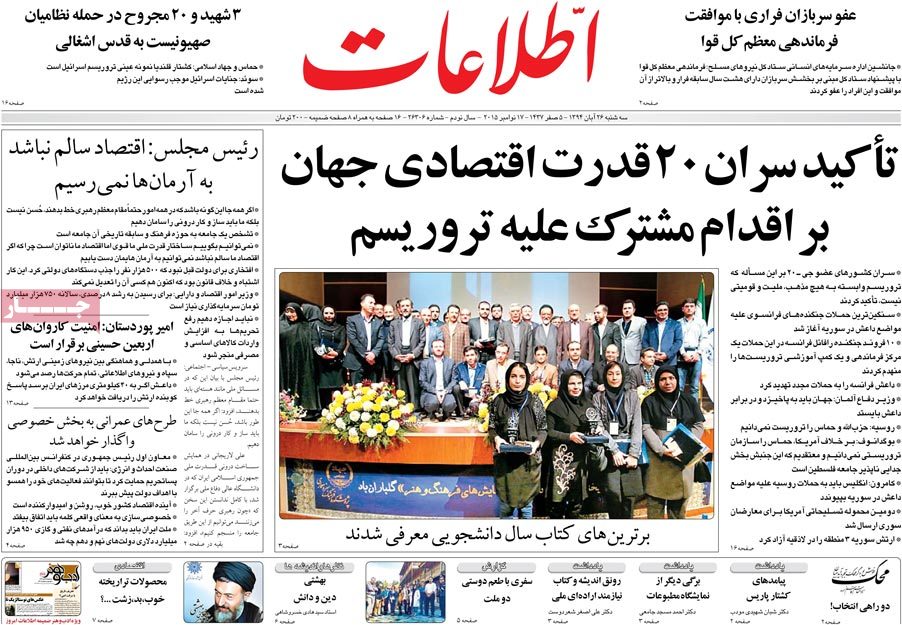
Highlights of Ettela’at newspaper on Nov. 17

ettelaat17

 G20 leaders have underlined joint action against terrorism.

It came as French fighter jets launched Paris’ heaviest attacks against IS positions in Syria.

And the terrorist grouping threatened to attack France again.

 Draft dodgers have been forgiven following the Supreme Leader’s go-ahead.

The commander in chief of the armed forces has pardoned those who have dodged conscription for eight years or more.

 An attack by the Israeli military against Beit ul-Muqaddas has left three Palestinians martyred and 20 others wounded.

Hamas and Islamic Jihad have denounced the killings as jarring examples of Israeli terrorism.

 “In the absence of a healthy economy, we won’t be able to secure our goals,” said the parliament speaker.

Ali Larijani further said under the previous government as many as 500,000 people were hired by state institutions and that practice was wrong and against the law.

 The commander of the Iranian Army’s ground forces has said that convoys of mourners [who travel to Iraq to take part in Arba’een mourning ceremony] will be secure.

If IS moves to within 40 km from the Iranian border, it will draw a crushing response from the Iranian Army, Brigadier General Pourdastan said.

 The private sector is to be entrusted with development projects.
The first vice president has hailed the prospects of the country’s economy as bright and promising.
 Top student authors of the year have been named.

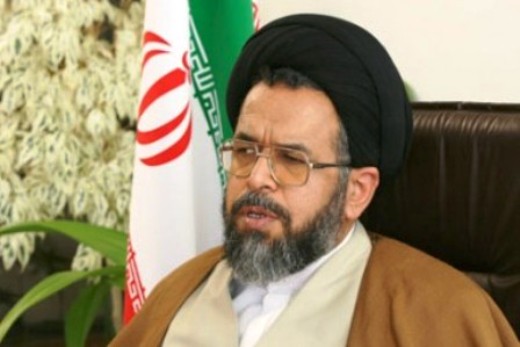
Iran busts 10 terrorist cells: Intelligence minister

Iran's Intelligence Minister Seyyed Mahmoud Alavi

Iran has uncovered and disbanded 10 terrorist groups since mid-October, the Intelligence Ministry has said.

Intelligence Minister Mahmoud Alavi made the comments while addressing a group of scholars in the western province of Kurdistan Monday.

The Islamic Republic has “vigilantly” obstructed any move by terrorists using the country’s “intelligence dominance.”

He went on to hail the Iranian nation’s support for Iran’s intelligence community, noting that efforts to fight terrorism “are not enough on their own” unless people contribute to investigations.

Alavi made the remarks in the wake of the deadly Paris attacks that left 132 people dead and many more injured.

Following those attacks and earlier deadly bombings in Beirut, Alavi said Sunday that the recent incidents “are a serious alert to us too and should be subjected to expert attention.”

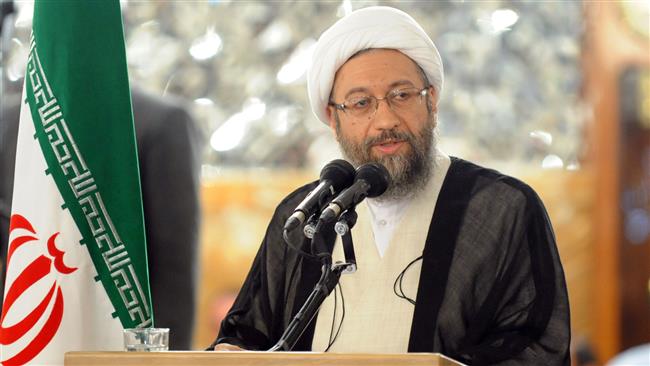
US must face trial on IS creation: Iran judiciary chief

larijani

The judiciary chief has condemned the recent terrorist attacks in Lebanon and France, stressing that US statesmen should stand trial for the creation of IS.

“US statesmen should not only be reprimanded but they should stand trial for supporting terrorist groups and creating IS,” Ayatollah Sadegh Amoli Larijani said Monday.

He added that Western countries, particularly the US, and all countries in the region which support IS should be held accountable for recent terrorist crimes.

He lashed out at Western countries and their reactionary allies in the region for supporting IS, al-Qaeda and other terrorist groups.

“The Europeans and Americans must stop exporting terrorists to the region,” Amoli Larijani said, warning that terrorism will come back to haunt Western countries that backed it.

[…]

JCPOA implementation to follow PMD closing: IAEA envoy

81841556-70307602

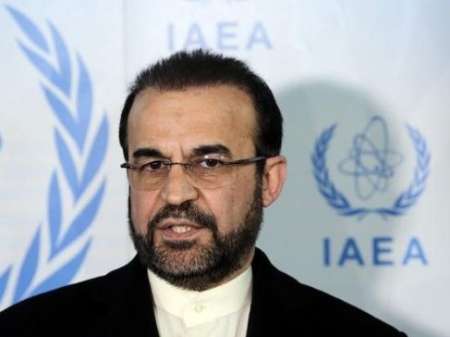
Tehran has conditioned its implementation of the Joint Comprehensive Plan of Action (JCPOA) on the closure of the issue of possible military dimension (PMD), Iran’s representative to the International Atomic Energy Agency (IAEA) said.

In reaction to remarks by a former US official that PMD will not be closed, Reza Najafi said Article 14 of the nuclear accord stipulates that P5+1 has to present a resolution to the IAEA Board of Governors on December 15 to close the PMD issue.

“They know that the condition for the implementation of JCPOA is the closing of the issue of PMD,” he said.

He expressed regret that certain circles follow Western sources in claiming that the IAEA chief inspected Iran’s military site in Parchin or that inspectors interviewed Iranian nuclear scientists.

“These were misleading reports and contrary to the roadmap,” Najafi said, adding, “There was neither an inspector in Parchin nor an interview with a nuclear scientist.”

Iran’s army ready to smash ISIL moves: Commander

139403191404041135457504

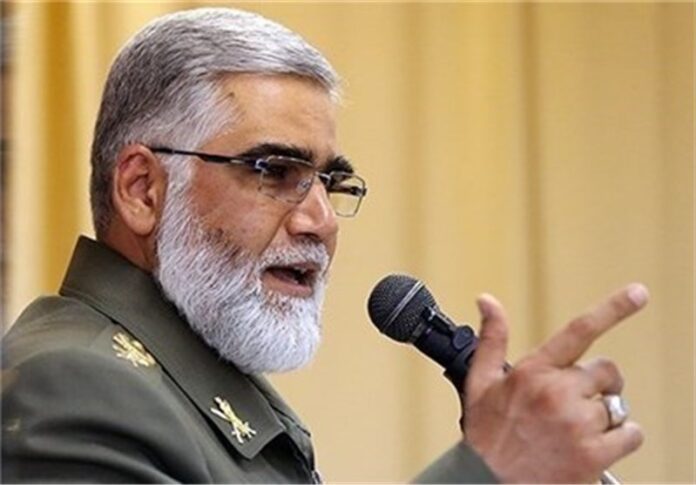
Commander of the Army’s Ground Forces Brigadier General Brigadier General Ahmadreza Pourdastan warned the ISIL terrorist group that its arrival in areas any closer than 40 km to the Iranian borders will draw Iran’s crushing response.

Speaking to reporters on Monday, the top commander stressed that the Iranian armed forces’ harsh reaction awaits the ISIL terrorist group, which he said has announced plans to target Russia and Iran after a recent string of deadly attacks in Paris.

“The enemy’s measures will be foiled before it reaches the (Iranian) borders, and IS should know that its merest mistake will face Iran’s harsh and crushing response,” the general added.

He said there will be full security for the Iranian pilgrims who want to travel to Iraq on Arba’een, adding the Iranian armed forces, including the Army, IRGC and Police have coordinated efforts to do whatever necessary to ensure security.

The Arba’een mourning ceremony is one of the largest religious gatherings in the world.

It marks the 40th day after the martyrdom anniversary of the grandson of Prophet Muhammad (PBUH), Imam Hussein (AS).

[…]

The rise and fall of ISIS, causes and circumstances

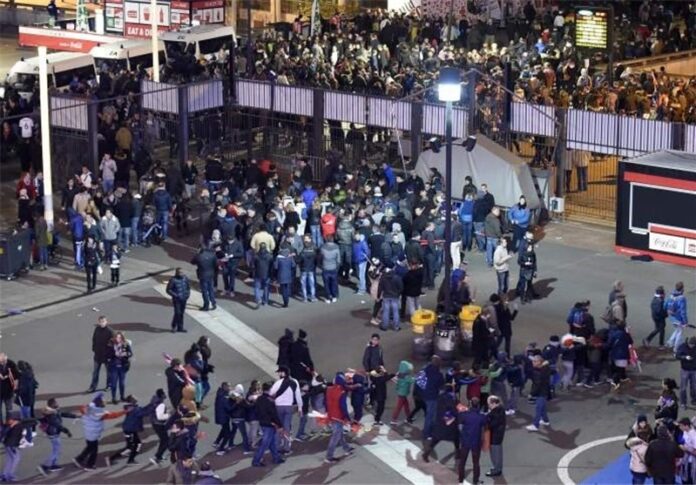
Paris Attacks

The terror attacks in Paris late Friday were just the tip of the iceberg whose scope is highly likely to be expanded in the future. The enormity of the attacks clearly shows that security and military approaches alone will not work when it comes to the elimination of terrorism.

Atwan
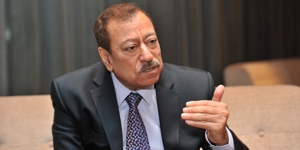
Abdel Bari Atwan

Abdel Bari Atwan, a prominent Arab writer, has described the terror attacks in Paris as the tip of the iceberg, saying that to understand terrorism [better], people should pause to think about the reasons why such a phenomenon has emerged.

The fact of the matter is that this phenomenon is the direct result of military interventions, weakened central authority in [certain regional] countries, and efforts to redraw the Middle East map in line Western interests and plans, he added.

Tasnim News Agency on November 15 published the remarks of Atwan, who is the editor-in-chief of Rai al-Youm, an Arab world digital news and opinion website, on six main reasons behind coordinated terror attacks by ISIS. The following is the translation of part of what the Iranian news agency quoted Atwan as saying in an article originally titled Europe in shock; six key reasons behind ISIS attacks:

In less than two weeks, ISIS carried out more than four terrorist attacks – including exploding a Russian passenger plane, attacks on two security and military training bases [in Baghdad], suicide bombings in Dahiyeh, a crowded suburb of Beirut, and multiple Paris attacks – which have been unprecedented in a decade in terms of scope, psychological impact, and human losses.

Six main reasons behind terrorism  

To understand terrorism, why it has emerged and how its power has grown, we need to take into account and analyze the following six points:

First: Constant contempt for Arab and Muslim nations

Second: Disillusionment of millions of illiterate, jobless youth who are not living in the present and have no promising future

Third: The West’s support for the corrupt, dictatorial governments of Arab countries

Fourth: Military interventions which began in Iraq and extended to Libya, Syria and Yemen

Fifth: Racial and sectarian classifications which have turned into the main bone of contention in regional civil wars

Sixth: Promotion of a Takfiri mindset through modern social communications media by ISIS. It is worth mentioning that ISIS has over 50,000 Twitter accounts with its sympathizers releasing as many as 100,000 tweets on a daily basis.

West still in a state of denial about its role in helping terrorism [to grow]

Most, if not all, Western countries are not willing to admit that these reasons are a factor [in the emergence of ISIS] and that they have had a role in preparing the ground for terrorism – which is a dangerous phenomenon – to grow. But the fact of the matter is that terrorism is a phenomenon which has been created as a result of military interferences and efforts to redraw the Middle East map simply to introduce Israel as the regional heavyweight.

The bloody attacks which were carried out in Paris by militants using suicide vests and rifles serve the interests of ultra-rightist parties and groups and their racist policies against more than 30 million Muslims in Europe who are mostly living in France, Germany and Italy.

When such a situation leads to acts of violence and retaliatory attacks, it will trigger confrontation, and the specter of fear, horror and instability will haunt the world. That will most likely be more horrific than Friday’s attacks in Paris in terms of magnitude.

The West should not rely simply on military and security solutions

The Western governments are expected to look for solutions – other than security and military approaches – to counter the destructive phenomenon of terrorism. To that end, they are expected to focus – more than anything else – on their Middle East policy, because those who detonated train stations in Madrid and London held up their reaction to the [US-led] invasion and occupation of Iraq and the killing of millions of people there as reason behind the acts of terror they committed.

Furthermore, ISIS has in a statement claimed responsibility for the Paris attacks, saying that the attacks were launched in response to the bombardment of its positions [by the anti-ISIS coalition of which France is a member].

All things considered, we are not saying that security solutions should be dispensed with, because all governments are entitled to defending the interests of their people and eliminating any terrorist activity which poses a threat to their countries. What matters more is the fact that elimination of threats should come with a well-thought-out attitude toward terrorism, and not policies which are adopted based on superficial reactions.

Bashar Assad’s thinly veiled criticism of France

The condolence message of Syrian President Bashar Assad to his French counterpart [in the wake of the Paris attacks] is believed to have come with a kind of reproach. “What France suffered from savage terror [on Friday] is what the Syrian people have been enduring for over five years,” said Assad in his message.

It sounds as if Assad was asking whether his warnings that some signs should be thoroughly studied had been heeded.

What unfolded in France on Friday was a sort of terrorist act which does not distinguish between nations, religions and faiths. It is where the real threat of this phenomenon lurks, something which makes it all the more necessary [for us] to study terrorism from different angles. After all, what we witnessed in Paris is likely to be the tip of the iceberg.

Iran’s FM on diplomacy, domestic politics and future (PART TWO)

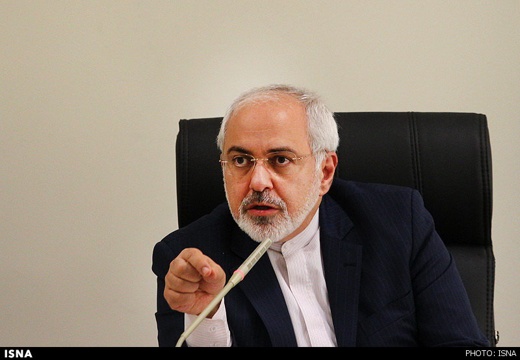
Zarif-Iran FM

Iran’s foreign minister says any measure he takes comes with a price for him. The head of Iran’s diplomacy machine weighs in on what the opponents of the Joint Comprehensive Plan of Action (JCPOA) have done to counter his efforts at home, and says that the Worriers [opponents of the president’s policy of moderation and interaction] have one main objective: “to attack the diplomatic team of the Rouhani administration”.

For the Worriers simply “attacking” is important; and the content of JCPOA, the stroll with the US secretary of state in a Geneva street, or the unplanned handshake with US President Barack Obama on the sidelines of the UN General Assembly are merely what they need to use as a pretext to target the most powerful part of the eleventh government: the Foreign Ministry and the diplomat at its helm.

Mohammad Javad Zarif has had different firsts during his two years in office, among them the appointment of the first spokeswoman of the Foreign Ministry and appointment of the Islamic Republic of Iran’s first female ambassador. Zarif has appeared in parliament to defend his performance more than all of his predecessors in post-Revolution Iran. He has held more than 50 meetings with his US counterpart.

Conducting an interview with Zarif is ironically an easy, tough task. It is easy since there are multiple questions – thanks to a barrage of criticism unleashed by his opponents – to ask him about, and it is tough since his response to a seemingly simple question may play into the hands of his opponents to launch a torrent of fresh attacks against the foreign minister.

Sharq daily’s Maryam Yousefi was given face time with the foreign minister on the day he was expected to induct the new spokesman of his ministry. Her questions covered a wide range of issues including the Worriers, their threats and JCPOA and Zarif answered all of them despite his busy schedule. The following is PART TWO of the full translation of what Zarif said in the interview (PART ONE):


Have measures of some countries like Turkey or the Saudi-led war in Yemen helped Iran secure more clout and bargaining power?

Yes, at the same time, some regional countries have undermined their roles in the region by adopting wrong policies. All these factors have contributed to Iran playing a more powerful role in the region. Of course, Iran’s role is intended to bring security to the region and reassure our neighbors that they should not be worried about Iran. Those who seek to stoke war and dispute in the region should be concerned, because they cannot pursue such a policy anymore.

If regional countries are in pursuit of peaceful relations and want to live in peace and avoid interfering in other countries’ affairs, we tell them that Iran’s policy is completely in keeping with that goal.

Let’s go back to JCPOA and the debates surrounding it at home. A JCPOA Oversight Commission is to be formed soon at the Supreme National Security Council. Its make-up and how it is supposed to be set up have provided a new excuse to the Worries [President Rouhani’s opponents] as far as the implementation of JCPOA is concerned. Has the Foreign Ministry proposed a list of commission members?

It’s for the Supreme National Security Council to make a decision in this regard. As a member, the Foreign Ministry will contribute to the decision-making process.

Under the Supreme Leader’s guidelines and decisions by parliament and the Supreme National Security Council, the Foreign Ministry has a duty to follow up on JCPOA. The negotiations that my colleagues and I held in Vienna were aimed at setting the stage for the implementation of JCPOA and we will forge ahead with our efforts to that end.

Does it mean that as the head of the nuclear negotiating team you have not proposed anyone as member of the JCPOA Oversight Commission?

No, I have made no suggestions about the composition of the commission. It’s a decision that the Supreme National Security Council must make and we will contribute to the process. We have not said anything about who should be named to the commission.

The number of threats against you by your opponents from across the political spectrum is on the rise. For example, you have been threatened to be impeached, buried in cement, or even be tried. There are even reports that you have been threatened with assassination. Is that true?

Maybe someone else has heard this threat, I haven’t. I think it’s unlikely of our friends and those who are critical of the government’s policies to get involved in such measures.

What was said in parliament over the past weeks was natural. We hear such remarks again and again. There have been some threats, but an assassination threat is unlikely to have been made.

How far do you think the opponents of JCPOA will go?

In a society where there are differences of opinion, disagreement is quite natural. We view the Supreme Leader’s word as final and we think that after he presented a framework for the implementation of JCPOA and approved the agreement in principle, all focus should be centered on its implementation to make the most of the deal.

Time and again, I have said that debating the strengths and weaknesses of JCPOA is history. [On a scale of 0-100], we might give a score of 5 or 95 to the nuclear deal. Whatever score we give to JCPOA, either 5 or 95, it’s time to tap into its positive aspects. Otherwise, the score of JCPOA will be zero, in other words, we will get zero, because the outcome will be zilch.

Regardless of factional leanings and interests, JCPOA is a national and not a factional matter; it belongs to the Leader and the whole nation, and it has to be used to advance our national interests.

The resistance-based economy relies on domestic potential and interacts with the rest of the world. In its implementation, our foreign policy can help people overcome their pocketbook issues. JCPOA creates such an atmosphere and we all need to make efforts to that end.