Saturday, December 27, 2025
Home Blog Page 4359

President: Iran Committed to Helping Muslims on Request

Hassan Rouhani

Iran will rush to help the Muslim people at any place if they ask for assistance in dealing with the terrorists, because it is considered as a duty, President Rouhani said in a gathering of Azeri clerics, held in Baku on Sunday night.

He also reminded the Muslim clerics of their heavy responsibility to save the Islamic society from intellectual deviation and try to portray the true image of Islam to the world.

The president then reiterated Iran’s support for peace, security and fraternity among the nations, stressing that all Sunni and Shiite Muslims are brothers and members of a same family.

President Rouhani, who is in Baku to attend a trilateral meeting with his Russian and Azeri counterparts, also had a meeting with a group of Iranian nationals residing in the Republic of Azerbaijan on Sunday night.

During the meeting, the president briefed the audience on the latest steps that Iran and Azerbaijan have taken to broaden ties.

The main decision following the high-profile meetings with the Azeri officials was partnership in the construction of the International North-South Transport Corridor (INSTC) and in a project linking Iran’s border city of Astara to the northern city of Rasht, President Rouhani added.

Earlier in the day, top officials from Iran and Azerbaijan signed six Memoranda of Understanding (MoUs) and agreements to promote mutual cooperation in a range of fields.

Iran’s Judiciary Confirms Execution of Iranian Academic over Espionage

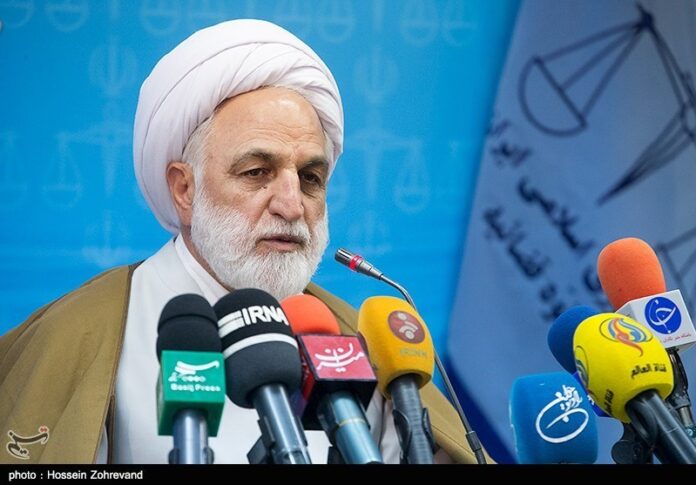
Ejei

Speaking at a weekly press conference in Tehran, Ejei said that Amiri, who had access to classified data, had had links with Iran’s archenemy, the US, and provided critical information to the enemy.

He explained that Iran maintained a close watch on him, was informed of his connection with the US intelligence bodies, and knew how the US had arranged for him to go to Saudi Arabia and leave the Arab country in a special way, Tasnim reported.

Ejei dismissed the media reports that Amiri had initially received a jail sentence or was to be sent into exile, saying the spy had been sentenced to death by the court of first instance, which was later upheld at the court of appeals.

The convicted criminal surprisingly missed an opportunity for expressing remorse even after the top court upheld the conviction and was still trying to pass wrong information from inside the prison, the Spokesman went on to say.

Ejei stressed that Amiri’s initial death sentence had been reviewed by an appeal court and that he had access to a lawyer.

Earlier on Saturday, Amiri’s family informed a foreign-based Persian TV channel of the execution, which had reportedly taken place on Wednesday morning.

Amiri, who worked for Malek Ashtar University, disappeared in 2009 while on a religious pilgrimage to Mecca, Saudi Arabia, only to reappear a year later in a set of online videos filmed in the US.

He then walked into the Iranian interests section at the Pakistani Embassy in Washington and demanded to be sent home, as reported by Associated Press.

In interviews, Amiri said he had been kidnapped and held against his will by Saudi and American spies, while US officials said he was to receive millions of dollars for his help in understanding Iran’s nuclear program.

Iran and South Korea Ink Water Treatment Deal

877e41aa-dc5f-4bf9-b968-6a14a991f060

One document was signed between South Korean Deputy Minister of Environment Lee Min-ho and Iran’s Deputy Energy Minister Rahim Maydani and two others by National Water and Wastewater Engineering Company of Iran with South Korea’s K-Water and Daelim companies, IRNA reported.

“The Koreans have valuable experiences in the field of environmental technology and water and wastewater management. Hence, these MoUs were signed with the aim of transferring experiences, facilitating investment in Iran and manpower training,” Maydani said.

Lee said his visit was a follow-up to South Korean President Park Geun-hye’s tour of Iran in May to enhance cooperation between the two countries.

“Developing water and wastewater systems is one of Iran’s priorities and we hope to help Iranian companies with further development of these technologies,” Lee said, according to IRNA.

Iran faces an acute water shortage and water scarcity poses the most severe human security challenge in the country of more than 80 million.

The problem has cropped up after years of excessive damming of rivers, bad irrigation practices, drought and climate change. Wasteful consumption by residents and farmers has been draining most of the country’s reserves.

Agriculture accounts for about 90 per cent of water consumption in Iran where much of it is being wasted.

Iran and South Korea signed a number of agreements in the fields of oil and gas, railroads, tourism, and technology when President Park visited Tehran with representatives of 236 companies and organizations.

Iranian President Hassan Rouhani said then the two sides had agreed to increase their bilateral trade from the current $6 billion per year to $18 billion in the coming years.

The Export-Import Bank of Korea has introduced a $15 billion financial package support for local businesses dealing with Iran. The Korea Trade Insurance Corporation also seeks to sign a deal worth 5 billion euros for export financing support with Iran, according to South Korean media reports.

Last week, Korean media said companies will be able to carry out business with Iran in euros as early as next month.

Financial transactions are currently conducted in the local won currency between the two countries because US sanctions prohibit dollar-based trade with Iran.

The euro-based payment system will allow Korean financial institutions to make monetary transactions in euro via European banks as intermediaries, news reader and mobile content distribution platform Pulse reported.

On Sunday, Iran’s Mehr news agency said a South Korean company had announced readiness to finance a petrochemical project in the Islamic Republic.

The unnamed company and two Japanese financiers are ready to provide funds for the construction of a new ethylene unit at Bandar Imam Petrochemical Complex in Mahshahr, Mehr quoted its deputy managing director Mohammad Qoli Younesi as saying.

Iran, Russia map out rival to Suez Canal

22ede7c7-0995-4bd8-949d-4b07f1f2d49e

A major project to foster trade connectivity through a less trodden path straddling a promising market is about to feature prominently in discussions when presidents of Iran, Russia and Azerbaijan meet in Baku on Monday. 

The International North-South Transport Corridor (NSTC), a multi-model route to link India and the Middle East to the Caucasus, Central Asia and Europe, is being nurtured for significantly reducing costs and travel time and boosting trade.

“Our talks will focus on a flagship project – the International North–South Transport Corridor with a total length of 7,200 kilometers,” Russian President Vladimir Putin was quoted as saying on Friday.

“It aims to provide the best possible opportunities for transporting transit cargo from India, Iran, and the Persian Gulf states to Azerbaijan, the Russian Federation and further to northern and western Europe,” he said.

The NSTC concept was formalized by India, Iran and Russia in 2000 but it has not taken off in a big way yet. Western trade sanctions on Russia and Iran in recent years have provided a new impetus to put steam on the project.

Both Iran and Russia as well as Azerbaijan are seriously dependent on oil revenues which have sharply fallen due to the price collapse. The new transit route offers them a unique alternative to diversify their economy.

22ede7c7-0995-4bd8-949d-4b07f1f2d49eIt also helps them as well as India and other regional countries reduce their dependence on traditional markets in the West where there is currently not much demand.

The corridor, instead, offers access to growing untapped markets in Asia, Africa and Latin America.

The ship, road and rail route connects India’s Mumbai to the Iranian port of Bander Abbas and further to Baku in Azerbaijan as well as Astrakhan, Moscow and St Petersburg in Russia before stretching to northern Europe and Scandinavia.

Besides Iran, India and Russia, countries that are on board to integrate into the transit network include Armenia, Azerbaijan, Belarus, Kyrgyzstan, Kazakhstan, Ukraine, Turkey, Tajikistan, Oman, Syria and Bulgaria.

“We believe that this cooperation serves the interests of the peoples of Iran, Azerbaijan, and Russia and, of course, the interests of the entire region,” Iranian Foreign Minister Mohammad Javad Zarif has said.

According to Zarif, the countries were discussing the “final details” of the project.

Dry runs of the route were conducted in 2014, from Mumbai to Baku and Astrakhan via Bandar Abbas. Results showed transport costs had been reduced by $2,500 per 15 tonnes of cargo.

For trade, India currently uses maritime transport to link with Russia. From St. Petersburg, the cargo has to sail around the entire western part of Europe and the Suez Canal which takes around 40 days to reach Mumbai.

According to the Russian Railways Logistics, the new route cuts the time just to 14 days and eliminates the need to pass through the Suez Canal, which is not only overloaded, but also very expensive.

The NSTC project also opens a window for alignment with Silk Road Economic Belt, a brainchild of Chinese President Xi Jinping to establish new trade and transport links with Central Asia and Europe.

50cec35b-5b14-43a8-b332-ba708af2d710China says the plan would boost growth and improve infrastructure to fulfill an “Asia-Pacific dream.” Observers also see it as part of Beijing’s ambitions to redraw the geopolitical map of Asia, which have ruffled feathers in the US.

The Silk Road Economic Belt vision also provides Beijing a counterbalance to Washington’s “pivot to Asia” strategy of focusing more military and other assets on the region.

For Iran, both the NSTC and Silk Road projects are a boost to the country’s “Look East” policy.

In an interview with Azerbaijan’s state news agency Azertac on Friday, Putin expressed hope that a free trade zone can be established soon between Iran and the Russia-led Eurasian Economic Union.

“Iran is Russia’s longtime partner. We believe that bilateral relations will benefit from the reduction of tensions around Iran following the comprehensive agreement on the Iranian nuclear program,” Putin said.

The Russian leader said trade with Iran had grown by 70 percent to $855 million over the first five months of 2016. Overall trade between the two countries now stands at about $1.6 billion.

Russia’s government said last year it had agreed joint projects with Iran worth $40 billion.

A Look at Iranian Newspaper Front Pages on August 7

Iran Newspaper front pages

Almost all newspapers on Sunday covered the national Journalists’ Day and the remarks made by various government officials in praise of the role of reporters and journalists.

They also highlighted the trilateral meeting due to be held between Iran’s President Hassan Rouhani and his Russian and Azeri counterparts in Baku.

The opening ceremony of Rio 2016 Olympics and the parade of Team Iran also received great attention.

The above issues as well as many more are covered in the following headlines:


Abrar:

1- Letter to Heads of Iran’s Judiciary, Gov’t, and Parliament: Why Oil Ministry Insists on Questionable IPC Model?

2- Trump: Obama Is Lying about Payment of $400m to Iran

3- Zarif to Head Economic Delegation in Visit to Latin America

A Look at Iranian Newspaper Front Pages on August 7


Aftab-e Yazd:

1- Reformists Call on Rouhani to Form Legal Committee Given the Increased Attacks against Gov’t

2- We Talk in Swiss Style, But Behave Like Africans: Cleric

3- Ahmadinejad Has 6 Cases in the Parliament: Reformist Politician

4- Reformist Media Are Left Alone; On Journalists’ Day, Aref Visits the Conservative Tasnim, Nobakht [VP] Visits the Conservative IRIB, and Nahavandian [Rouhani’s chief of staff] Goes to Government’s News Agency

A Look at Iranian Newspaper Front Pages on August 7


Arman-e Emrooz:

1- Putin and Rouhani to Hold Talks: New AK-47 Weapons Arrive in Iran

2- Payment of Money for Export of Gas! New $250m Trouble Caused by Ahmadinejad

3- Impact Factor of Influential Conservative Media Has Decreased: Conservatives Warn Conservatives

4- We’re in State of Economic War: Reformist Figure

A Look at Iranian Newspaper Front Pages on August 7


Asrar:

1- Attacks against President Rouhani Are Unprecedented in Iran’s History; Government Doesn’t Have as Many Official Tribunes as Its Opponents: First VP

2- Moderates Don’t Use Lies and Swear Words in Response to Radical Attacks: Rouhani’s Chief of Staff

3- Beginning of Water Diplomacy between Tehran and Kabul: Top Security Official

4- Problems of Reporters in Iran Are Fundamental: Vice-Speaker

5- On Giving Permissions to Concerts, We Act Based on Leader’s Fatwa: Culture Minister

6- Opposition of Police to Fashion Shows

A Look at Iranian Newspaper Front Pages on August 7


Ebtekar:

1- Some Want to Imply that Investment in Iran Is Risky; Stonewalling in Favour of Enemies

2- Larijani in Ceremony to Commemorate Journalists’ Day: Media’s Vigilance to Reinforce Iran’s Security Foundation

A Look at Iranian Newspaper Front Pages on August 7


Etemad:

1- Deputy Oil Minister on Case of Babak Zanjani: No One Knows Where the Money Is

2- We Should both Criticize and Appreciate Rouhani: Sociologist

  • Without Rouhani, We Would Be Expecting the Fate of Venezuela
  • Rouhani’s Re-Election Is His Opponents’ Nightmare

3- Venice Architecture Award Given to Late Iranian Painter Parviz Kalantari

4- A Report on People’s Interest in Reading Newspapers: Day of Journalists without Audience

A Look at Iranian Newspaper Front Pages on August 7


Ettela’at:

1- Iran’s Establishment Behaved Wisely on Nuclear Deal: Parliament Speaker

2- Media Professionals Appreciate Zarif’s Efforts in Foreign Policy

3- First VP: Government Welcomes Free Flow of Information in Media

A Look at Iranian Newspaper Front Pages on August 7


Hemayat:

1- Parliament Speaker Urges Foreign Ministry to Pursue West’s Stonewalling in JCPOA Implementation

2- Filtering of Pornographic Websites Not against Human Rights: Iran’s Prosecutor-General in Reaction to UNHRC

3- Pre-Marriage Genetic Counselling to Become Obligatory

4- Winners of Islamic Human Rights Award: West’s Abuse of Human Rights to Put Iran under Pressure

A Look at Iranian Newspaper Front Pages on August 7


Iran:

1- Rio Olympics Start with Strict Security Measures: Parade towards Honour

2- Syrian Kurds Liberate Syria’s Manbij; ISIS’s Main Route to Turkish Border Blocked

3- Give Logical Responses Even to Harshest Criticisms: Rouhani’s Chief of Staff to Reporters

A Look at Iranian Newspaper Front Pages on August 7


Jame Jam:

1- Rouhani to Visit Azerbaijan Republic; Baku Summit, a Model for Regional Cooperation

2- Editorial by IRIB Chief Ali Asgari: Reporters Are Warriors of Soft War

A Look at Iranian Newspaper Front Pages on August 7


Javan:

1- Obama’s Remarks When Aleppo Is Fully Surrounded: Syria Is Turning My Hair Grey

2- Critics’ Letter to Trio Government Bodies: Stop Plunder of Iran’s National Assets in Oil Contracts

A Look at Iranian Newspaper Front Pages on August 7


Jomhouri Eslami:

1- Authorities’ New View of Media’s Role

  • First VP: Media Should Be a Place for Saying and Listening, Not a Place for Psychological War against Other Parts of Society
  • FM Zarif: Diplomacy and Media Are Tied Together

2- Legal Member of Iran’s Nuclear Negotiating Team: Airbus and Boeing Deals to Be Implemented Soon

3- Saudis Confess to Their Defeat in Yemen

4- Trilateral Meeting between Rouhani, Putin, and Aliyev in Baku

A Look at Iranian Newspaper Front Pages on August 7


Kayhan:

1- Danger of Long-Term Commitments in Last Year of Rouhani’s Term: A Look at Repercussions of a Number of Questionable Accords

2- 71st Anniversary of Hiroshima Bombing: 60 Seconds of Silence for Massacre of 140,000 People!

3- Senior Government Official: Foreign Banks Don’t Cooperate with Iran Even for Import of Soya!

4- ISIS Is a Product of US, Not the Shiite-Sunni Conflict

A Look at Iranian Newspaper Front Pages on August 7


Khorasan:

1- World’s Eyes on Iran’s Olympic Team; Bild Describes Zahra Nemati as Champion of Opening Ceremony

2- Cyberspace Official: Telegram Is Ready to Transfer 1,000 Servers to Iran

3- Government’s Performance in Past 1,001 Days: Promises More than Actions

A Look at Iranian Newspaper Front Pages on August 7


Resalat:

1- Businessman: Government’s Economic Executives Have Conflicting Opinions

2- Ex-FM: Support for Axis of Resistance Is Iran’s Honour

3- Washington Doesn’t Show Mercy towards Its Allies: Trust in US Is Expired

A Look at Iranian Newspaper Front Pages on August 7


Roozan:

1- First VP: Obscene Remarks Are Made against President Rouhani

2- 80% Increase in Iran’s Oil Exports in Post-JCPOA Era

A Look at Iranian Newspaper Front Pages on August 7


Shahrvand:

1- Increase of Corruption in Absence of Media: First VP

2- Job Security Is the Best Gift to Reporters: Culture Minister

3- A Report on What Happened in Rio Olympics’ Opening Ceremony: From Volleyball Players’ Strike to Norm-Breaking Flag Bearer of Iran

A Look at Iranian Newspaper Front Pages on August 7


Shargh:

1- A Report on a Scenario for Eliminating Rouhani

2- They Have Put Pillars of Islamic Revolution against Each Other: First VP

3- Turkish Ambassador to Tehran: We Had No Doubt about Iran’s Support

A Look at Iranian Newspaper Front Pages on August 7


Vaghaye Ettefaghieh:

1- People’s Protest at Deadly Roads: High Rate of Death in Road Accidents

2- Guardian Council Member: Actions against Violations of Electoral Law Are Fruitless and Slow

A Look at Iranian Newspaper Front Pages on August 7

President Rouhani Lauds Iran-Russia ‘Strategic’ Ties

Rouhani10

“Relations between Iran and Russia is moving toward a strategic level and we have good cooperation on different regional and international issues,” President Rouhani told reporters before leaving Tehran’s Mehrabad Airport for the Azeri capital of Baku on Sunday morning.

He further pointed to a trilateral summit between Iran, Russia and Azerbaijan later on Monday, saying that the International North-South Transport Corridor (INSTC) is the main issue to be discussed in the meeting.

The INSTC is a multipurpose route for the transit of goods between Iran, Russia, Europe, India and Central Asia via shipping lines, railroad and land routes.

The Iranian president said the summit between the three countries, which is the first of its kind, will help develop relations between neighbors and enhance stability and security in the region.

President Rouhani and his Russian and Azeri counterparts, Vladimir Putin and Ilham Aliyev, will hold trilateral talks on Monday on various issues, including trilateral cooperation in commerce, energy, telecommunications, environmental issues, fight against terrorism, transportation, and the transit of goods.

During his two-day visit to the Azeri capital, Rouhani is also slated to hold a separate meeting with Putin and exchange views on issues of mutual interest.

A number of ministers and high ranking officials are to accompany President Rouhani in the official visit.

The upcoming summit will follow an April meeting among the Iranian, Russian and Azeri foreign ministers in Baku.

In that gathering, Iran’s Mohammad Javad Zarif, Russia’s Sergey Lavrov and Azerbaijan’s Elmar Mammadyarov discussed a range of issues, including ways to settle conflicts in the Nagorno-Karabakh region.

Iranian Cleric Surprises Europeans by Playing Billiard and Bowling

57320429

While playing bowling and billiard is usually frowned upon by many Islamic scholars, a young cleric from Iran’s north-eastern city of Mashhad has attracted lots of attention after finishing as runner-up in a local tournament and attending games in Germany’s Stuttgart and France’s Paris. 


Here is IFP’s translation of a report by ISNA:


Bowling and billiard are among the most widespread sports in Iran; however, despite their growing popularity, there are still many voices of disagreement here and there that make every attempt to limit the boundaries of these sports, particularly billiard.

Although many people think that playing billiard and bowling are against the principles of Islamic jurisprudence, according to the fatwas of many Islamic jurists, they are not haram (contrary to Islamic jurisprudence) as long as you do not place bets or gamble.

57320435Ahmad Soltani is an Iranian cleric with two children who has a strong liking for sports, especially bowling and billiard.

He has already referred to the offices of Ayatollah Seyyed Ali Khamenei and other scholars to make sure that these sports are not in contradiction to Islamic jurisprudence.
Soltani, who has created a precedent in the community of clerics for bowling and billiard, referred to the once-forbidden chess games and argued, “The Federation of chess was established in Iran and chess tournaments are widely held from time to time although it was once strictly prohibited in the country. We should not forget that the federation of billiard and bowling has been established as well.

He pointed to the recent statement by one of the scholars of Qom to corroborate his claim and said, “Ayatollah Hossein Khorasani, a member of the Society of Seminary Teachers of Qom and also a member of the Assembly of Experts, paid a visit to the bowling and billiard club of Mashhad and openly announced that these sports are permissible based on the Islamic jurisprudence.”

Soltani also noted that he has finished second in provincial games in 2014. In the same year, he also took part in billiard tournaments in Stuttgart and Paris, where he had attended joint exercises with Europeans as well.

57320431“My attendance in those tournaments was very interesting for Europeans. They were surprised to see a cleric from Iran freely playing billiard and bowling,” he said, stressing that he himself had paid the expenses of his trips.


Billiard and Bowling Strengthen Relations between Clerics and the Youth

“A lot of my friends and relatives questioned my presence in these sports and criticized my activities; however, my family has always been supportive,” Soltani said, noting that bowling and billiard, as two intellectual and physical exercises, are pretty helpful for reinforcing one’s concentration ability.

57320433Soltani referred to exercising as a necessity for everyone and added, “I hold a firm belief that people should never be ashamed of doing physical exercises in the society just because of their career types.”

In Iran, one of the main objectives of religious scholars is to train the youth and make them familiar with Islamic rules and principles.

“Although it was quite shocking for the youth to see a cleric in his robe and turban holding a billiard cue at hand, I have managed to cultivate good relations with the young generation in the very same club without much effort,” he said.

Soltani underlined that the young generation, by nature, usually shows strong resistance to Islamic teachings; however, if you befriend them and convey the concepts of Islam in their own language, they will definitely welcome that.

“In the club, they feel more comfortable to share their problems and Islamic issues with me,” he added.

He pointed to the presence of Haji Hassani, the international Quran reciter who was martyred in Mina Crush, as a young man in the club and said, “He used to visit the club and play bowling with me. We should not be strict with the young generation.”

“In a meeting with Iranian Parliament members I brought up the issue of billiard and bowling. It took them by surprise to know that I am a player; however, they were supportive.”

57320428Doing exercises is of utmost importance among the community of Islamic scholars. Seminary students are obliged to pass several sporting courses; therefore, most seminaries are equipped with sports complexes.

Afghanistan’s Security Is Iran’s Core Policy: Zarif

cae94923-97f2-403b-a9d4-28d6ac3f5cee

In a meeting with Afghanistan’s National Security Advisor Mohammad Hanif Atmar in Tehran on Saturday, August 6, Zarif added that the Iranian and Afghan people enjoy cordial relations.

“Afghanistan is a friend neighbour of the Islamic Republic of Iran and progress and security of this country are regarded as Iran’s progress and security,” the Iranian minister said.

He urged the two countries to further strengthen cooperation in all sectors.

Zarif pointed to an order by Leader of the Islamic Revolution Ayatollah Seyyed Ali Khamenei about schooling for all Afghan children in Iran and said, “This issue indicates that we believe in Afghanistan’s progress and development at the highest level.”

In a meeting with Chief Executive Officer of the Afghanistan’s government, Abdullah Abdullah, in January, Ayatollah Khamenei ordered that all Afghan children in Iran be permitted schooling regardless of their residency status.


Chabahar Project Positive Sign of Iran-Afghanistan Cooperation

The Afghan official, for his part, said the Chabahar agreement – recently signed among Iran, Afghanistan and India – is a positive sign of the beginning of fundamental cooperation between Tehran and Kabul.

The Chabahar agreement was signed in the presence of Iranian President Hassan Rouhani, Indian Prime Minister Narendra Modi and Afghan President Ashraf Ghani in Tehran on May 23 to establish a strategic transit and transport route connecting the three countries.

Chabahar is located in the Gulf of Oman on the border with Pakistan. It is Iran’s closest and best access point to the Indian Ocean.

The port will be a game changer for regional connectivity, especially for Afghanistan, which can find an assured and reliable alternative access to India via sea.

Hanif Atmar also said Afghanistan attaches great importance to bolstering cooperation with Iran and called on all regional countries to improve close cooperation in the fight against terrorism and extremism.

The Afghan security official is in Tehran for a two-day official visit to meet with senior Iranian officials. He held talks with Secretary of Iran’s Supreme National Security Council Ali Shamkhani earlier on Saturday.

No Hitch to Developing Iran-Pakistan Banking Relations: Zarif

2640892a-80f6-43c0-9090-ef095a109782

In a meeting with Pakistani Foreign Secretary Aizaz Ahmad Chaudhry in Tehran on Saturday, the Iranian minister added that enhanced economic ties between the two countries hinge on boosting banking cooperation.

“Pakistani banks are capable of speeding up their cooperation without any concern,” Zarif said.

He pointed to good relations between Tehran and Islamabad and urged the two sides to further strengthen their cooperation in all sectors, particularly in economy.

The Iranian minister further stressed the importance of fighting terrorism and extremism and said Daesh and al-Qaeda terrorist groups are common threats to the two countries.

The Iranian minister’s remarks came as the United States and the European Union continue with some acts of obstructionism in the implementation of last year’s nuclear agreement, known as the Joint Comprehensive Plan of Action (JCPOA), clinched between Iran and six global powers.

The nuclear deal envisages Tehran scaling back its nuclear program in return for the lifting of all nuclear-related sanctions on the Islamic Republic.

However, months after the agreement went into effect on January 16, the US and the European Union continue to maintain some sanctions on Iran, scaring off companies from resuming trade with the country.

European banks have balked at the idea of resuming transaction with Iran, fearing punitive US measures. US Republicans, meanwhile, are pushing through three anti-Iran bills in the Congress.

Iran has stressed that developing ties with its neighbouring countries are among its priorities.


Iran, Pakistan Improving All-Out Relations: Chaudhry

Chaudhry, for his part, said Tehran and Islamabad are improving their relations in all sectors.

He added that Pakistani firms are keen to cooperate with Iran and noted that his country attaches great importance to bolstering economic ties with the Islamic Republic.

Iran to Gain 9% Share of Global Fermentation Industry by 2025

Pharma Biotech Fermenters_tcm11-8337

Seyyed Abbas Shojaosadati, the Secretary of Fermentation Industry Working Group at the Biotechnology Development Headquarters of Iran’s Science and Technology Vice-Presidency, stressed on the growing position of fermentation industry in the world and said, “Currently, the share of fermentation industry in the global market is the huge and noteworthy amount of $180bn,” he underlined.

According to a report by IRNA, as translated by IFP, Shojaosadati said that the enzymes in food and detergent industries are among the fermentative materials that have gained a good place in the global market.

“Following a comprehensive study about the future of fermentation industry in 2025, we came to know that it has a bright promising future,” he emphasized.

“If the industry grows as much as 6 to 7 per cent by 2025, it would have a $300bn share of the global market, which is a quite impressive figure.”

“If we are to realize the goals set by the Biotech Development HQ, we should increase the country’s share to 9%.”

Based on the government’s extensive research in this field, authorities are advised to encourage investment in the industries that contribute to the enhancement of Iran’s share in the global market, he went on to say.

Shojaosadati noted that the government has embarked on a process of examining the reasons for the failure or progress of the country’s industries.

He described the fermentation industry as a high-tech one and said, “Since high-tech industries generally grow at a snail’s pace in Iran, we cannot expect a high growth rate here.”

Fermentation is a metabolic process that converts sugar to acids, gases, or alcohol. Humans have used fermentation to produce food and beverages since thousands of years ago. It is also used for food preservation in which the organic compounds with containing large molecules are broken into compounds with smaller molecules.