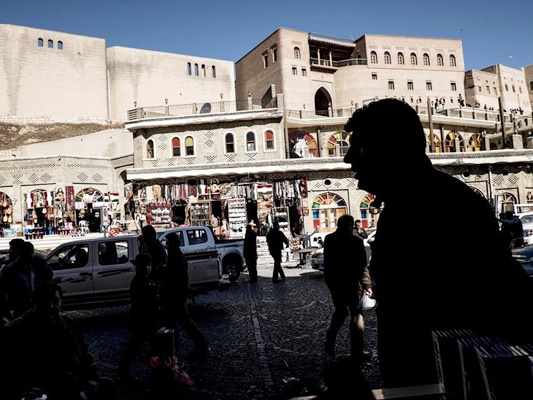
According to a report by the French newspaper Liberation, after ISIS advanced on the borders of Iraqi Kurdistan in 2014, the international coalition strengthened its collaboration with the authorities of Erbil, the Kurdish capital, which has become an essential partner in the war against terrorism, being the obligatory passage of diplomats, humanitarian activists and journalists since, especially at the time of Mosul battle.
Meanwhile, the regression of civil freedoms in this autonomous region has been far from being a concern for all these foreigners. During a recent visit to Arbil, François Hollande, the President of France, spoke of “the values of freedom, respect and human dignity”, saying that he was honoured by the collaboration between France and Iraqi Kurdistan against terrorism; a speech addressed to the Kurdish “President” Masoud Barzani, whom Paris welcomed with great pomp on February 21 at the Élysée Palace. Barzani is a “president” whose second term has ended a year and a half ago, calling into question the legitimacy of his elected assembly; a “president” in whose name the freedoms of the Iraqi Kurds are repressed.
The PUK and the KDP – two prominent Kurdish parties – are assimilated to mafia groups by Soran, a Kurdish professor. “I have friends who joined them; now they have a house, a big car, everything! In exchange, they go so far as to kill people for their party.”
Meanwhile, behind the front, a part of the Kurdish population demands its basic human rights: Access to electricity, water, and a decent wage.
Some protesters, like Soran, call for taking up arms. Others no longer dare to protest after having received a number of death threats and having seen their friends arrested by the security forces and then fleeing to Europe without a word.
“The fashionable Kurdish speeches on democracy … are only duplicitous market goods, successfully sold to Western countries,” said Aras Fatah, Kurdish sociologist and journalist.
“More international investment will be attracted to Iran if our financial statements and cost and benefit reports are prepared based on the International Financial Reporting Standards (IFRS),” noted Rasoul Khezri, an Iranian lawmaker.
While unemployment has contributed to social harms in Iran, more jobs could be created by making investment in production sector, he added, according to a Farsi report by ICANA.
“Iran’s economic authorities have to remove the barriers to investment in this area through proper management.”
“Banks and insurance agencies must apply the IFRS to clarify the situation of Iran’s banking and insurance industries,” he added.
“Economic clarification requires proper financial disclosures: it is to be considered as an important parameter in the development of Iran’s international economic and banking relations,” Khezri noted.
“Economic development requires comprehensive coordination between trade and economy sectors,” he added.
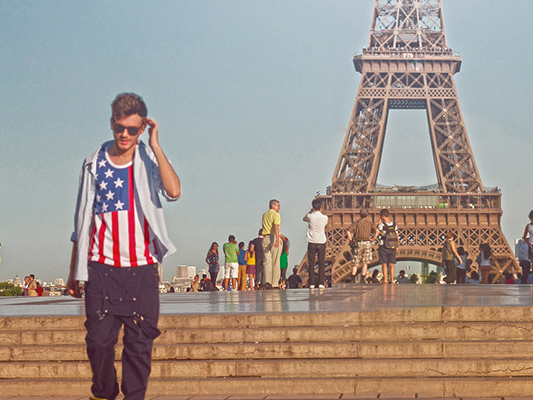
The call for an end to the visa-free regime for US citizens comes after Washington failed to agree visa-free travel for citizens of five EU countries – Bulgaria, Croatia, Cyprus, Poland and Romania – as part of a reciprocity agreement. US citizens can normally travel to all countries in the bloc without a visa.
The vote urges the revocation of the scheme within two months, meaning Americans will have to apply for extra documents for 12 months after the European Commission implements a “delegated act” to bring the change into effect, The Independent reported.
“Saudi Arabia has cast covetous eyes on Malaysia,” Iranian MP Mohammad Javad Abtahi said, according to a Farsi report by ICANA.
“Riyadh is pursuing the Wahhabi economic and ideological goals there.”
He went on to say that Saudis intend to form an economic, ideological front among the Muslim people living in East Asia in order to recruit Takfiri forces, and achieve further financial resources.
“It was predictable that Malaysia would be the first destination of Saudi Arabian King’s East Asia tour,” he noted.
“Saudi Arabia, however, has now its eyes on India and Indonesia as its next conquests, so that their Muslim population comes under the domination of Wahhabism.”
He assimilated Malaysia to a progressive dragon is south-eastern Asia with considerable industrial assets.
“As the majority of Malaysians are Muslim, it is regarded by Saudi Arabia as a special target for Wahhabi aims,” he added, pointing that Riyadh is to open Wahhabi schools in Malaysia, as it did in Peshawar, to promote Wahhabism in the Far East and south-eastern Asia.
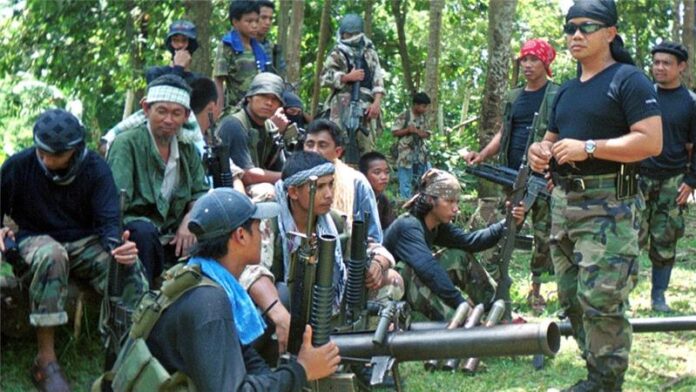
“Saudi Arabia had earlier infiltrated into the East Asia through Abu Sayyaf terrorist group, a former ally of Al-Qaeda. Now, the ISIS will be given a specific operational space thanks to Saudi plans.”
“During a meeting with Mahathir Mohammad, the founder of modern Malaysia, I found that he was seriously concerned about the Saudi influence over this country,” Abtahi mentioned.
“The 680-million-dollar bribe paid by Riyadh during the Malaysia elections led to a turn in Jakarta’s positions against Iran, worrying many Iranian students in this country,” he added.
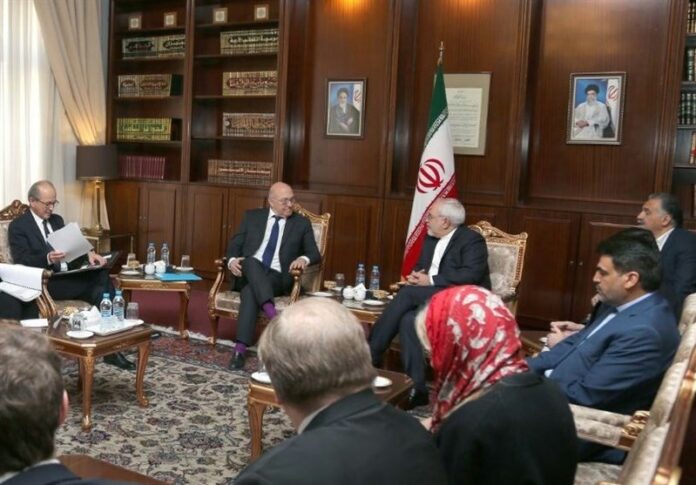
“We regard France as an important economic and political partner,” Zarif said in a meeting with French Minister of Finance Michel Sapin in Tehran on Saturday.
Lauding Iran and France’s move to hold joint economic commissions, the foreign minister expressed Tehran’s determination to enhance relations with Paris in all fields.
He also highlighted the Iranian market’s potential and the workforce available in the country, hoping for broader joint investment in the automotive industry.
Sapin, for his part, expressed French politicians and companies’ willingness to use opportunities for closer bilateral ties with Iran.
France seeks cooperation with Iran together with the European Union, the French minister added.
Economic ties between Iran and France gained momentum after coming into force of the Joint Comprehensive Plan of Action (JCPOA), a nuclear agreement between Iran and the Group 5+1 (Russia, China, the US, Britain, France and Germany), in January 2016.
During a January 2016 visit to Paris by Iranian President Hassan Rouhani, Tehran signed a major contract with Airbus worth about $27 billion to buy 118 planes.
Also in January 2016, Iran Khodro, the Middle East’s biggest carmaker, and French carmaker PSA Peugeot Citroen signed an agreement over a joint-venture to produce cars, worth 500 million euros ($545 million).
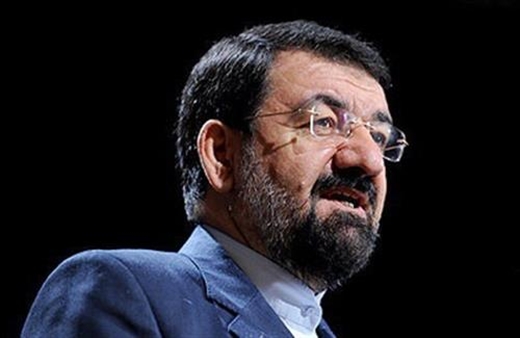
“Our problem is not with Arabs, but with their despotic rulers who serve Israel,” Major General Mohsen Rezaei said in a Saturday Farsi post in his Twitter account.
“People of Saudi Arabia and the UAE are thirsty for democracy,” he added.
Riyadh and Kuala Lumpur “expressed serious concerns over the Iranian interference in the internal affairs of countries in the region,” as the Saudi king wrapped up his lavish trip to Malaysia on the first leg of a month-long Asia journey.
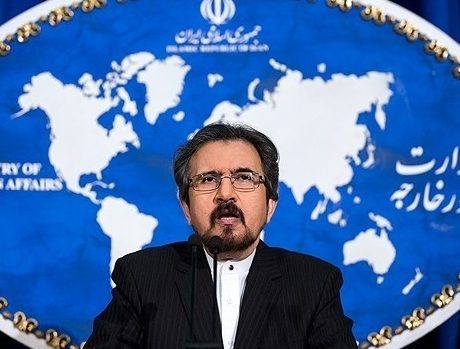
Iran’s Foreign Ministry spokesman Bahram Qassemi on Thursday rejected those accusations as “delusional,” saying they are in line with Saudi Arabia’s “improper, totally false, and targeted campaign, which is being waged at a very high cost” against the Islamic Republic.
“The cultural influence and presence of a country has roots in its history, culture and civilization and is an inherent, cultural and quite natural and popular issue, which is basically not achievable through any military, economic and even political leverage,” Qassemi said.
“The principled policy of the Islamic Republic of Iran, as an effective and peaceful country, is based on mutual respect and non-interference in the affairs of other countries,” he said.
Iran’s policy, he added, is also based on “coexistence and cooperation with all neighbors and countries of the region and the world in order to strengthen stability, security and peace and a relentless fight on terrorism.”
Qassemi further stated that Iran’s “advice to all Islamic countries is that they should analyze regional and global situations with more vigilance and care and avoid being drawn into disputes, which are against the principle of friendship and peaceful relationship.”
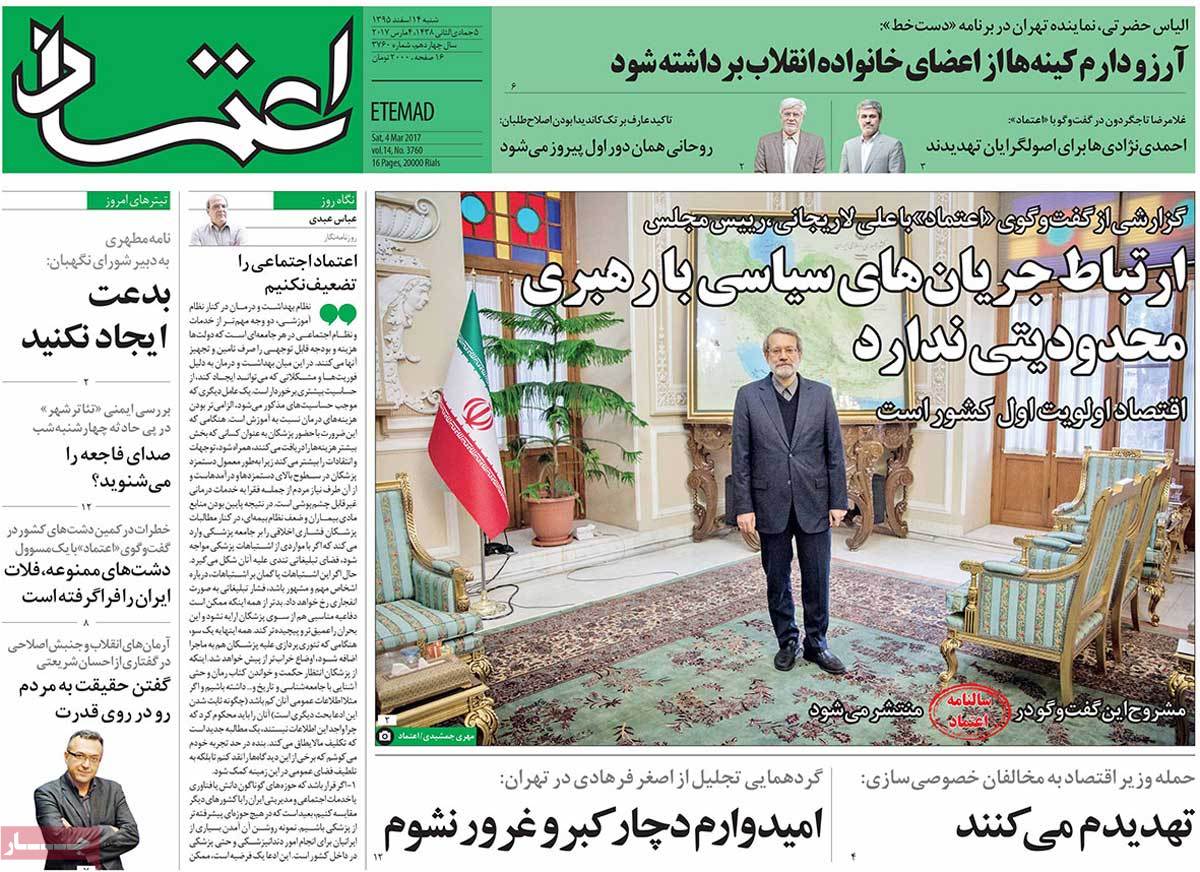
Newspapers today widely covered the reactions to a bill approved by Iranian Parliament that legalizes salaries as high as nearly $6,300 for executives.
The disclosure of Trump cabinet’s ties with Russia and the possible resignations in his justice department also received great coverage.
Iranian President Hassan Rouhani’s meeting with his Turkish president and the remarks he made on the sidelines of the Economic Cooperation Organisation (ECO) Summit in Islamabad were among other top stories today.
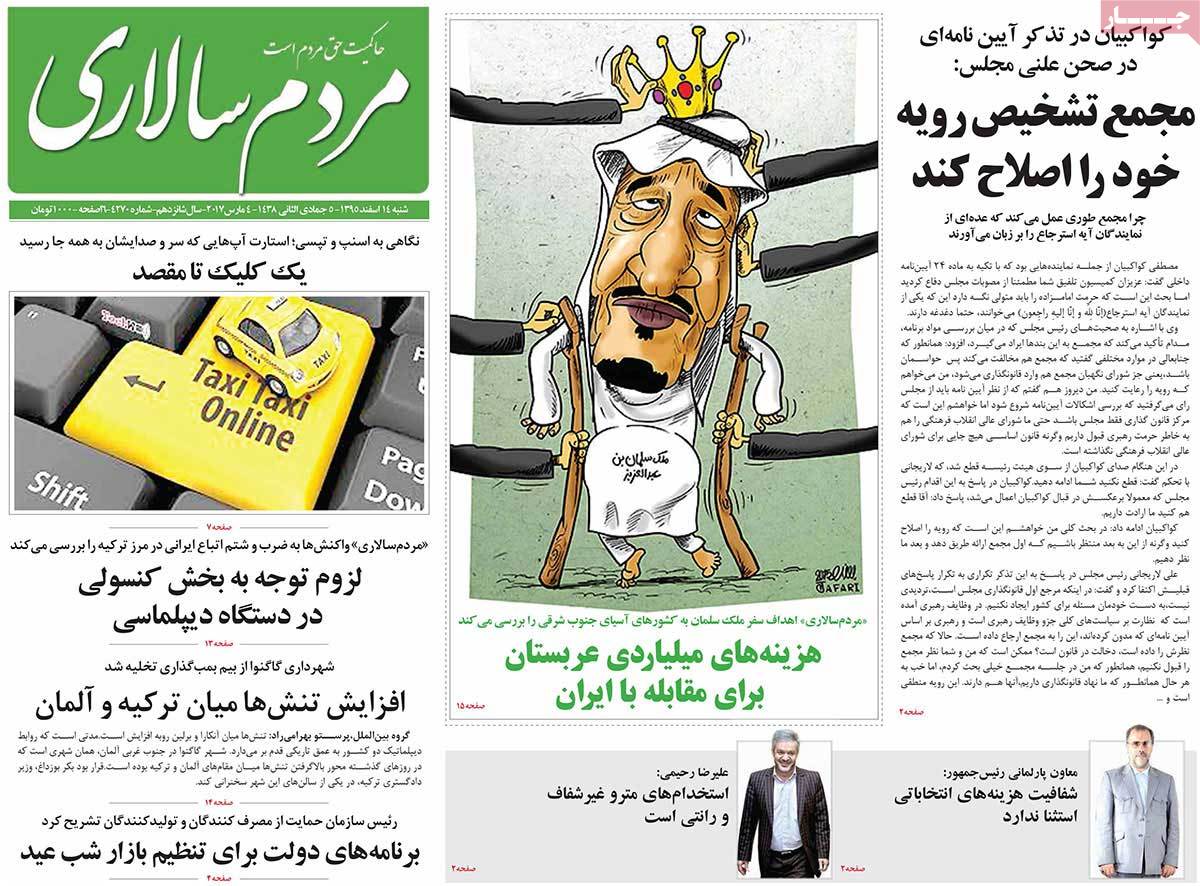
Newspapers also covered the ongoing visits by Saudi Arabia’s King Salman to Southeast Asian countries.
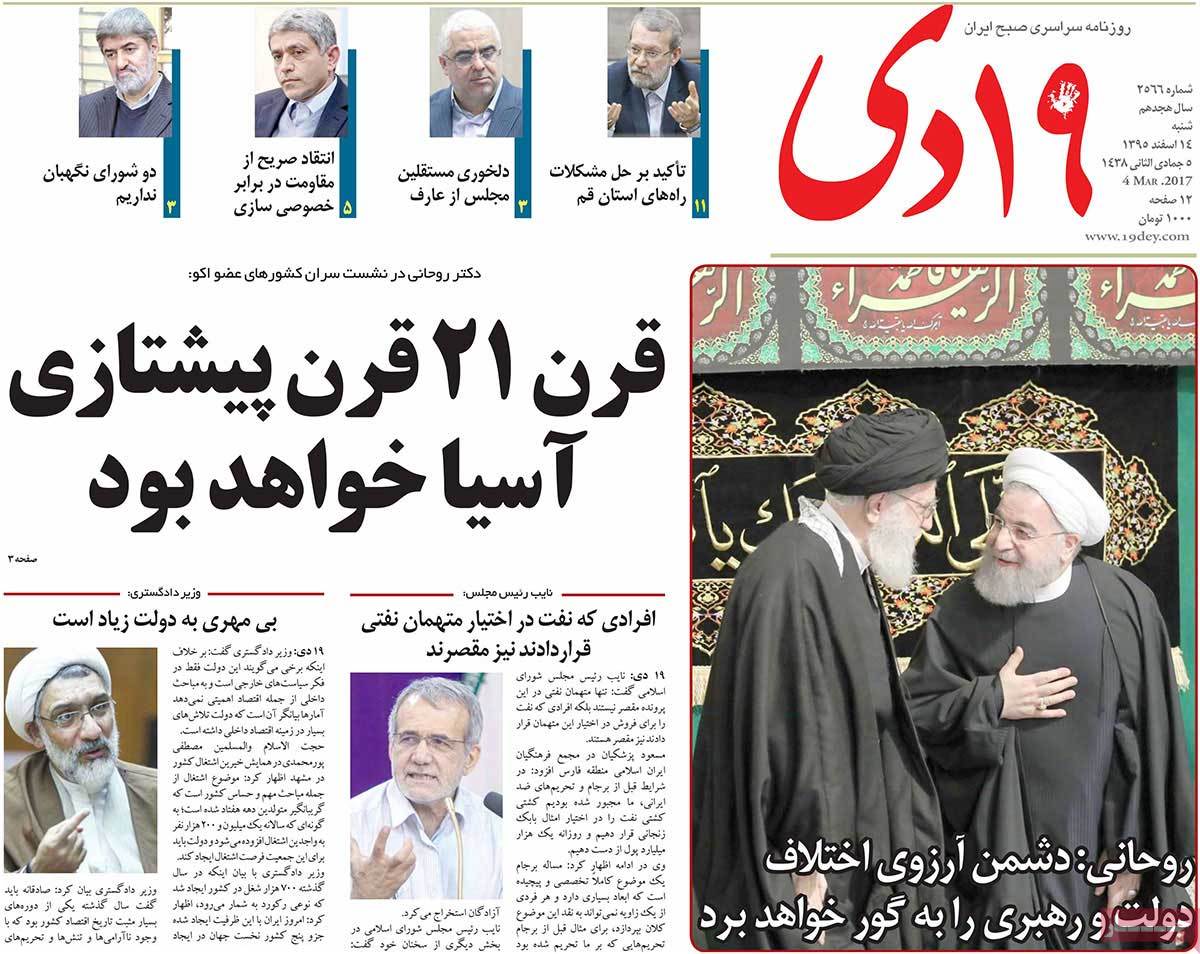
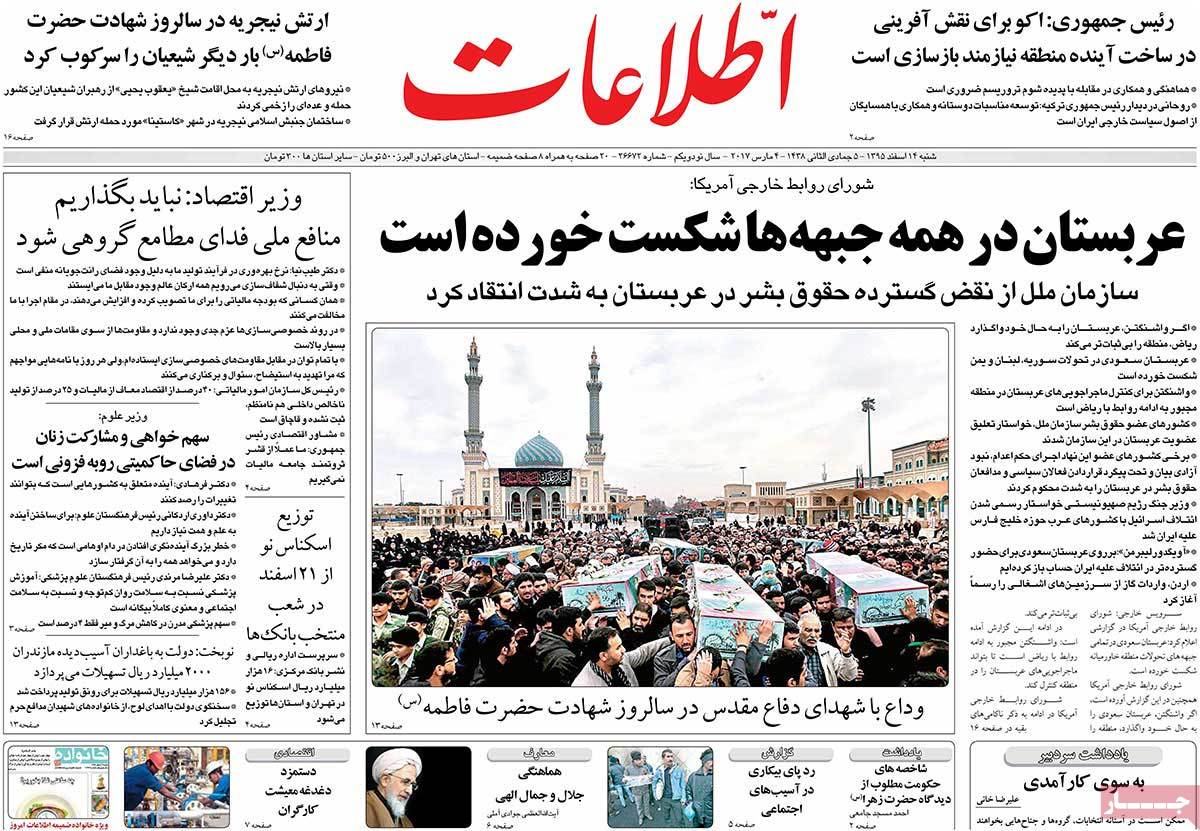
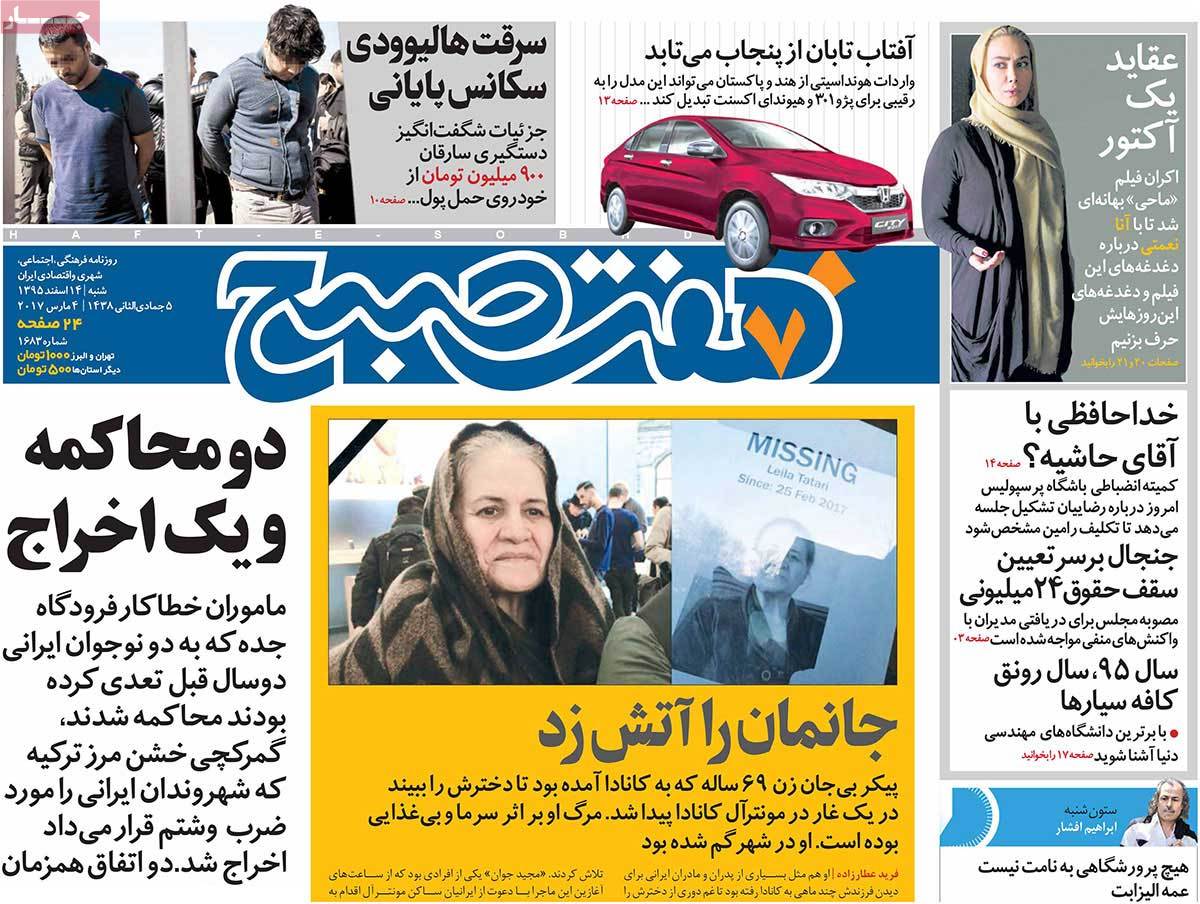
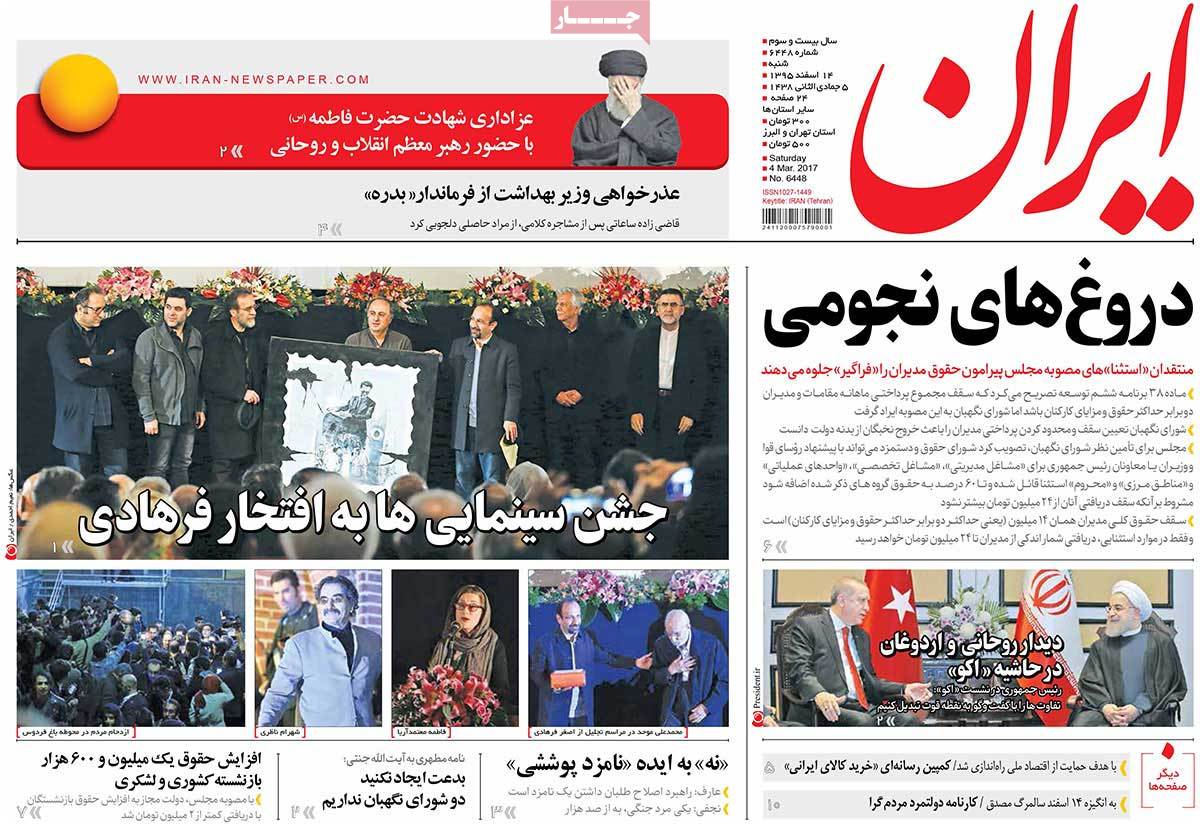
The above issues, as well as many more, are highlighted in the following headlines and top stories:
19 Dey:
1- Iran President in ECO Summit: Asia to Be Pioneer in 21st Century
2- Rouhani: Enemies’ Dream about Leader-President Conflict Won’t Come True
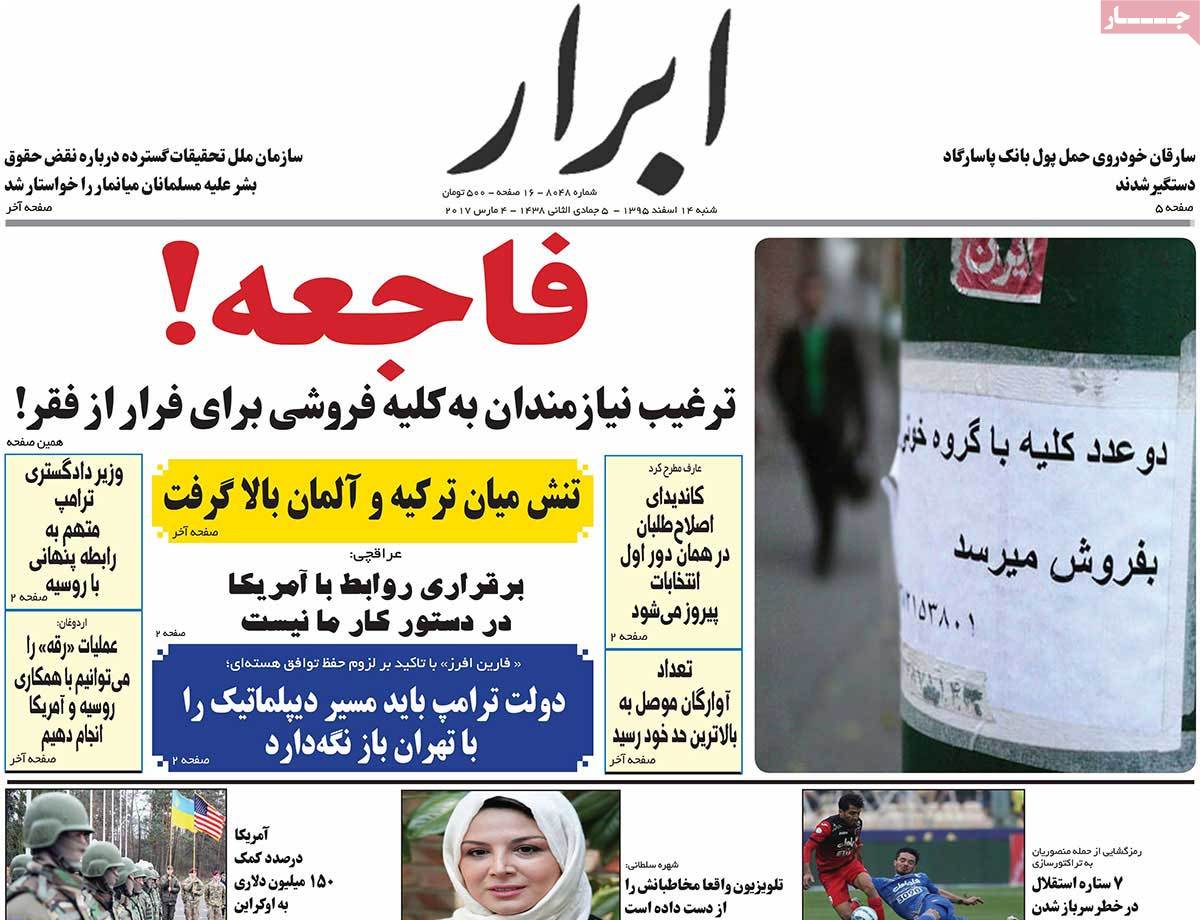
Abrar:
1- Deputy FM: It’s Not on Iran’s Agenda to Establish Ties with US
2- Foreign Affairs: Trump Should Keep Open Diplomacy Channel with Iran
3- Number of Displaced Mosul Residents at Highest Level
4- Erdogan: We Can Conduct Raqqa Operation in Cooperation with Russia, US
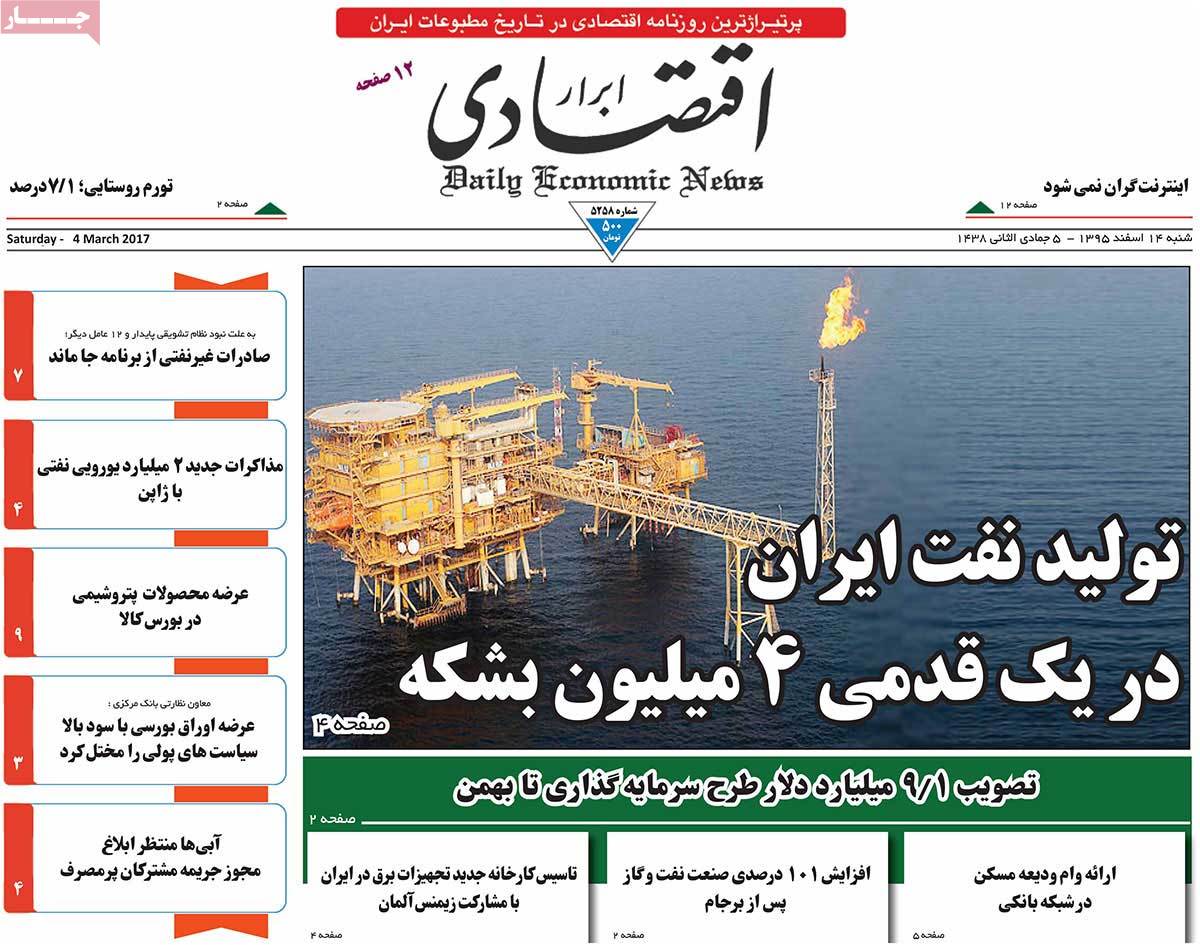
Abrar-e Eqtesadi:
1- Iran’s Oil Output Close to 4m bpd
2- Iran’s €2-Billion Oil Talks with Japan
3- 101-Percent Expansion in Iran’s Oil and Gas Industry after JCPOA
4- Iran, Germany’s Siemens to Launch Joint Power Factory
Afkar:
1- Putin Nominated for Nobel Peace Prize
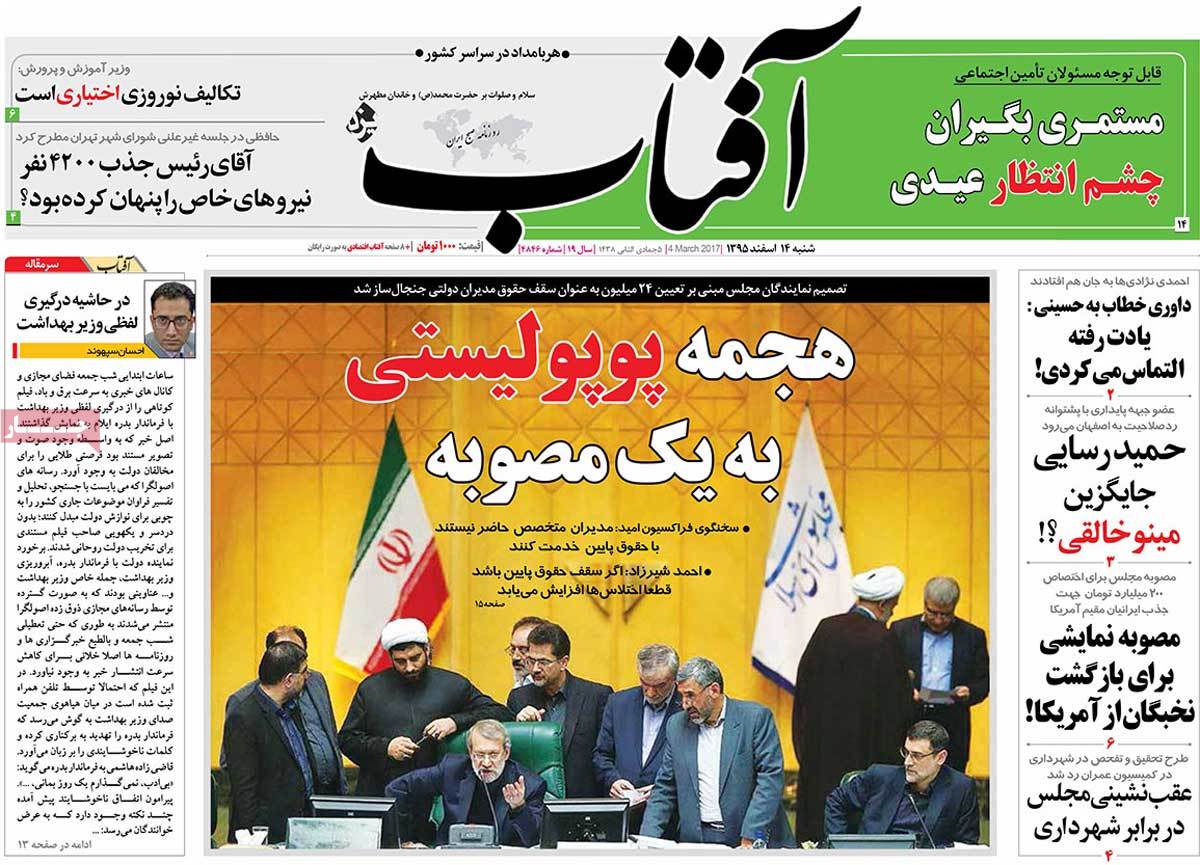
Aftab-e Yazd:
1- MPs’ Decision to Set $6,300 as Maximum Salary for Executives Sparks Controversy
2- Iran Parliament’s Bill to Allocate $52m to Return Iranian Elites Living in US Is a Show
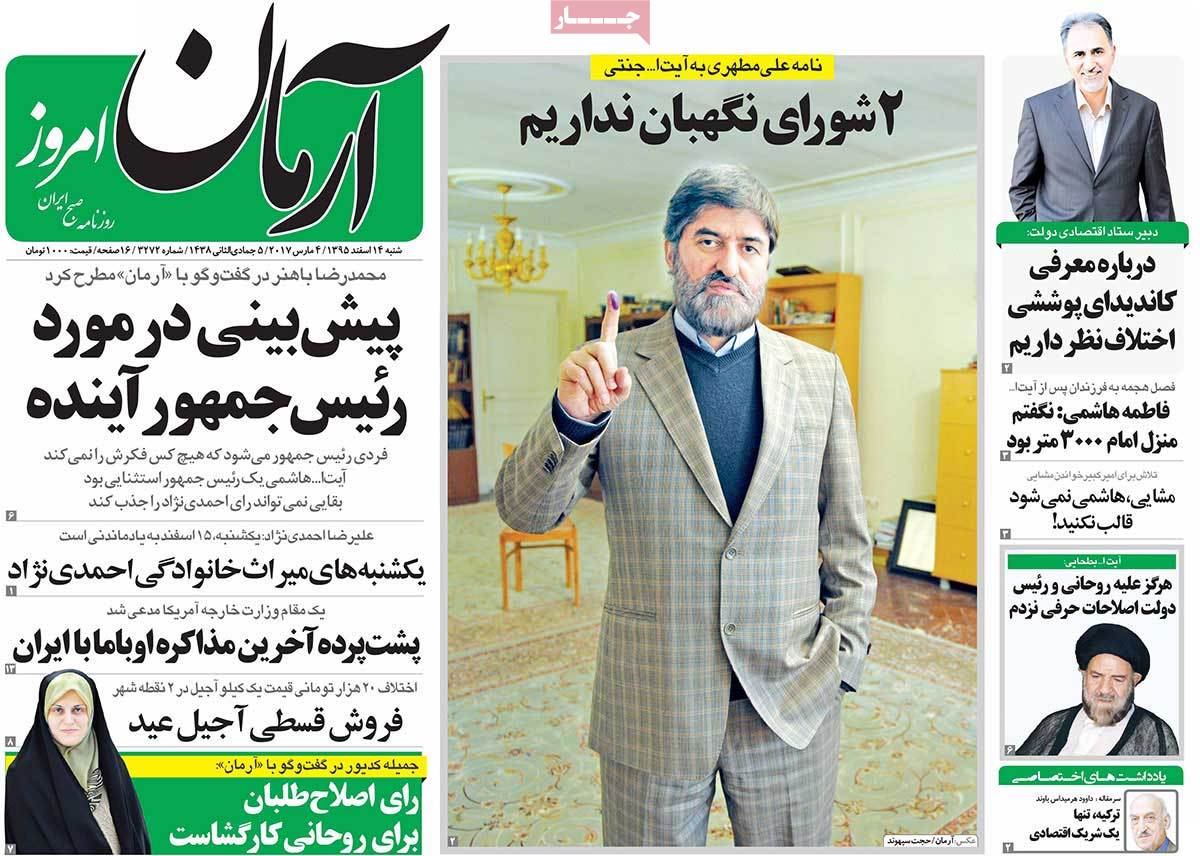
Arman-e Emrooz:
1- We Don’t Have 2 Guardian Councils: Vice-Speaker Writes to Ayatollah Jannati
2- State Dept. Official: Secrets behind Obama’s Last Negotiation with Iran
Etemad:
1- Larijani: No Limit to Political Groups’ Contact with Iran’s Leader
2- Asghar Farhadi in Appreciation Ceremony in Tehran: I Hope I Won’t Become Stuck-Up
Ettela’at:
1- US Council on Foreign Relations: Saudi Arabia Has Failed in All Fronts
2- UN Harshly Criticizes Saudi Arabia for Human Rights Violation
3- Nigerian Army Once Again Oppresses Shiites
Haft-e Sobh:
1- Iranian Old Woman Dies of Cold, Hunger in Canada Where She Came to Visit Daughter
Iran:
1- Iranian Cinema Holds Celebration in Honour of Farhadi
2- Rouhani and Erdogan Meet on Sidelines of ECO
3- Iranian President: We’ll Turn Differences to Strengths through Dialogue
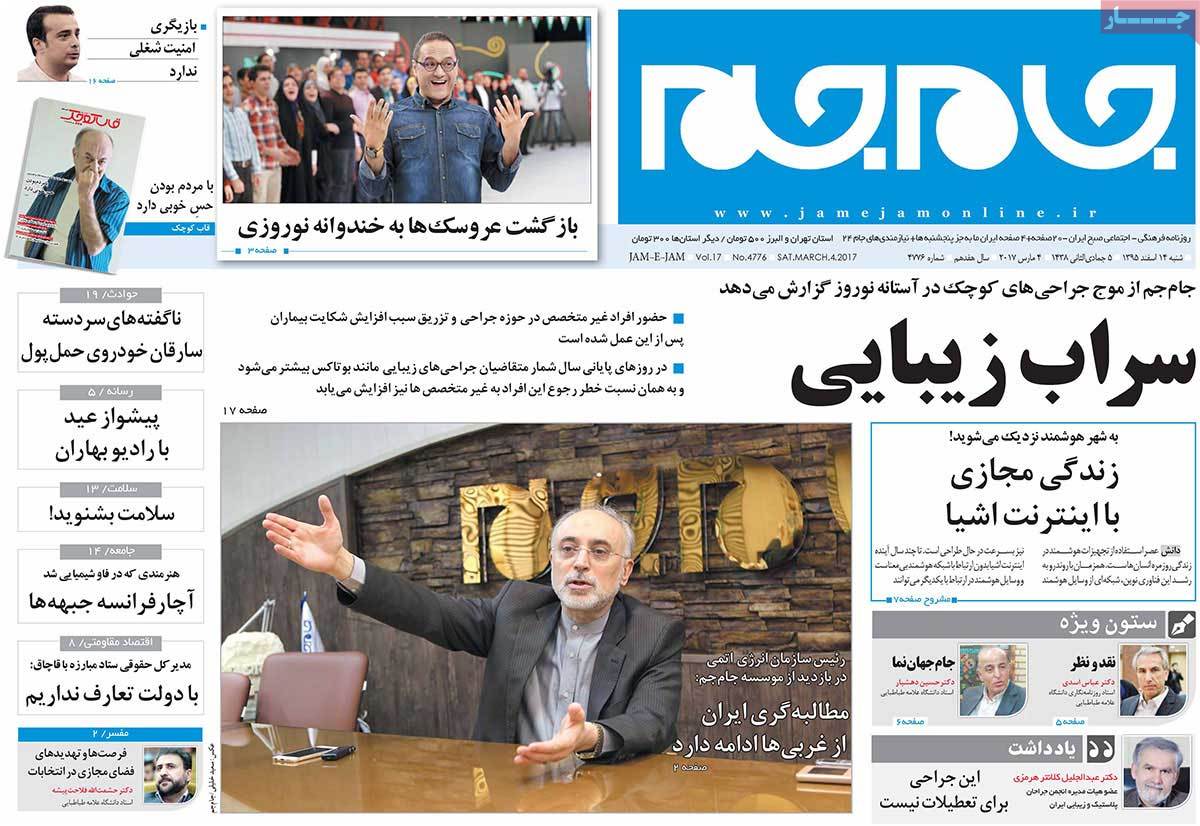
Jame Jam:
1- Nuclear Chief: Iran Continues Demanding Its Rights of Westerners
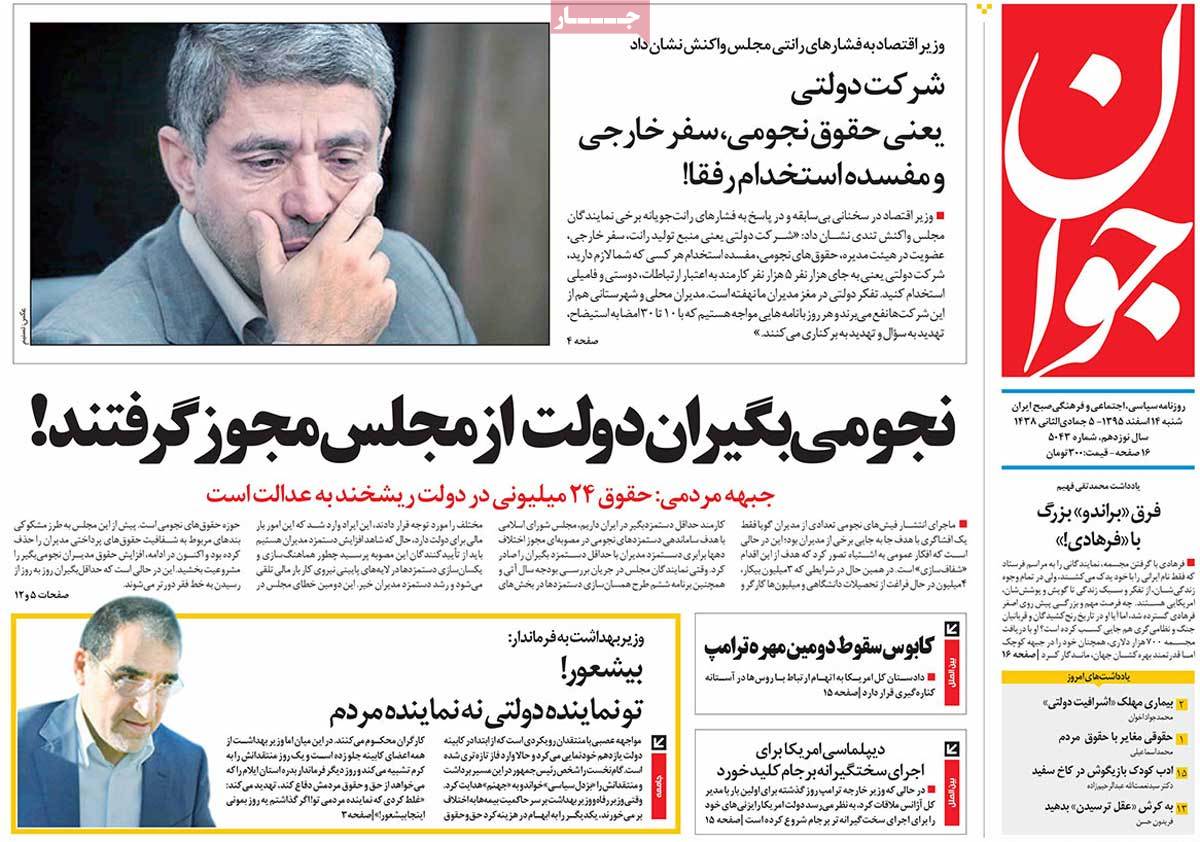
Javan:
1- US Attorney General on Verge of Resignation over Ties with Russia
2- Difference between the Great Brando and Farhadi!
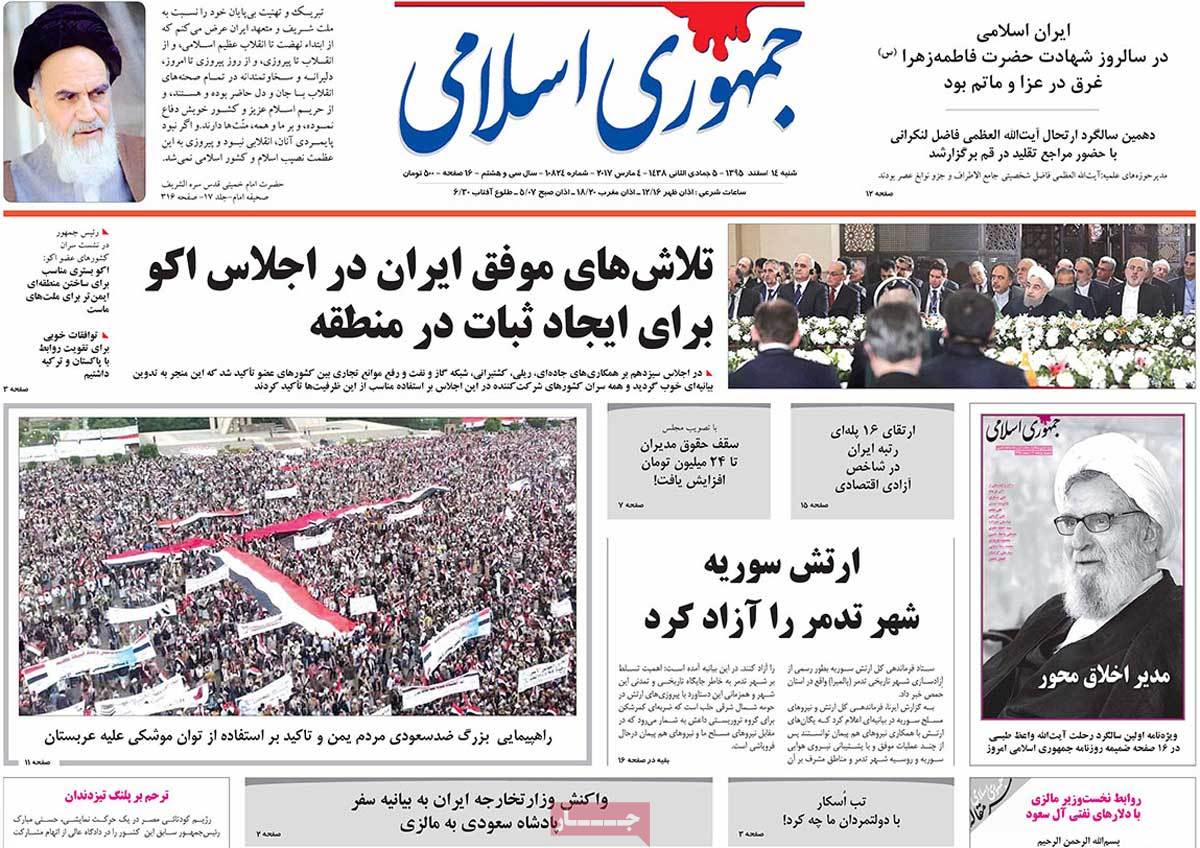
Jomhouri Eslami:
1- Iran’s Successful Efforts in ECO Summit to Create Stability in Region
2- Syrian Army Liberates Palmyra
3- Yemenis Hold Anti-Saudi Rallies, Underline Use of Missile against Riyadh
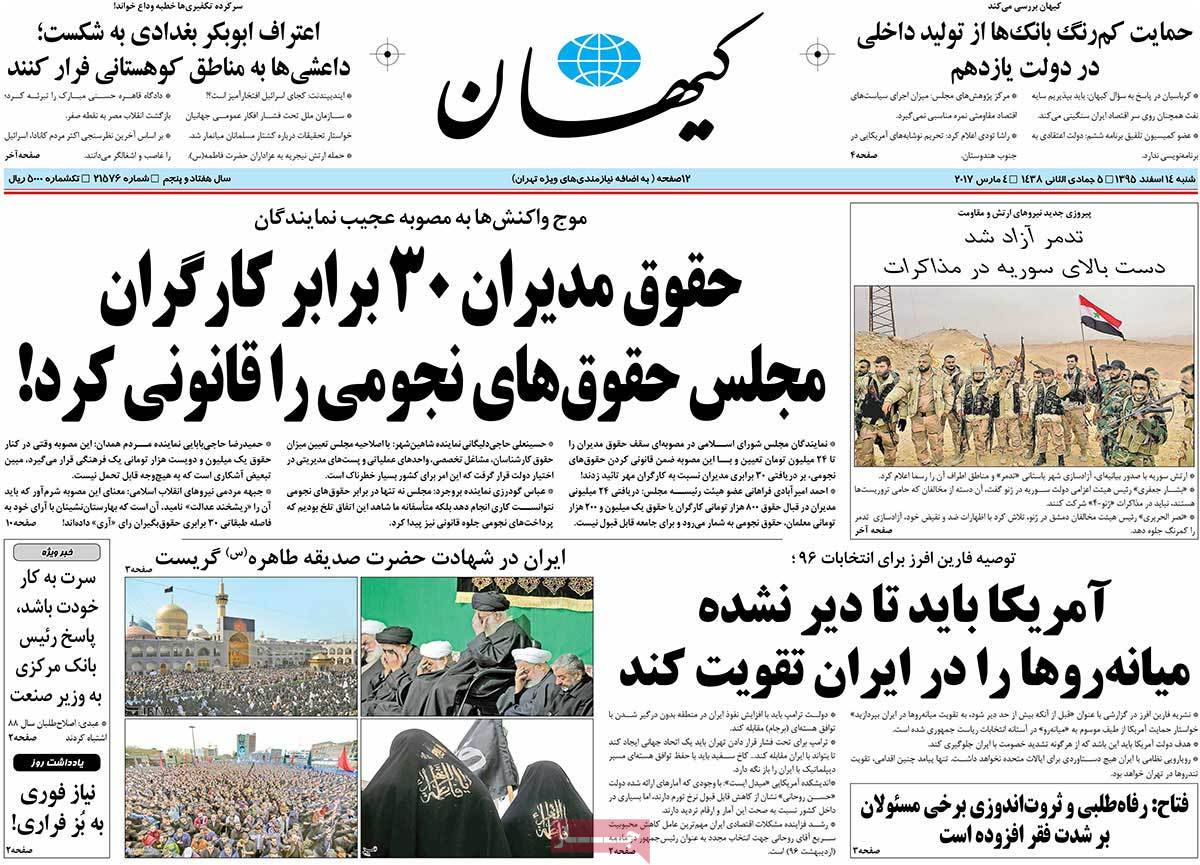
Kayhan:
1- Wave of Reactions to Parliament’s Strange Bill: Majlis legitimises astronomical salaries; Executives can receive 30 times more than workers
2- ISIS Leader Admits Defeat; Terrorists Escape to Mountainous Areas
3- Foreign Affairs: US Should Reinforce Moderates in Iran for May Election before It’s Too Late
Mardom Salari:
1- Saudi Arabia Spends Billions to Counter Iran: A Report on King Salman’s Southeast Asia Tour
Resalat:
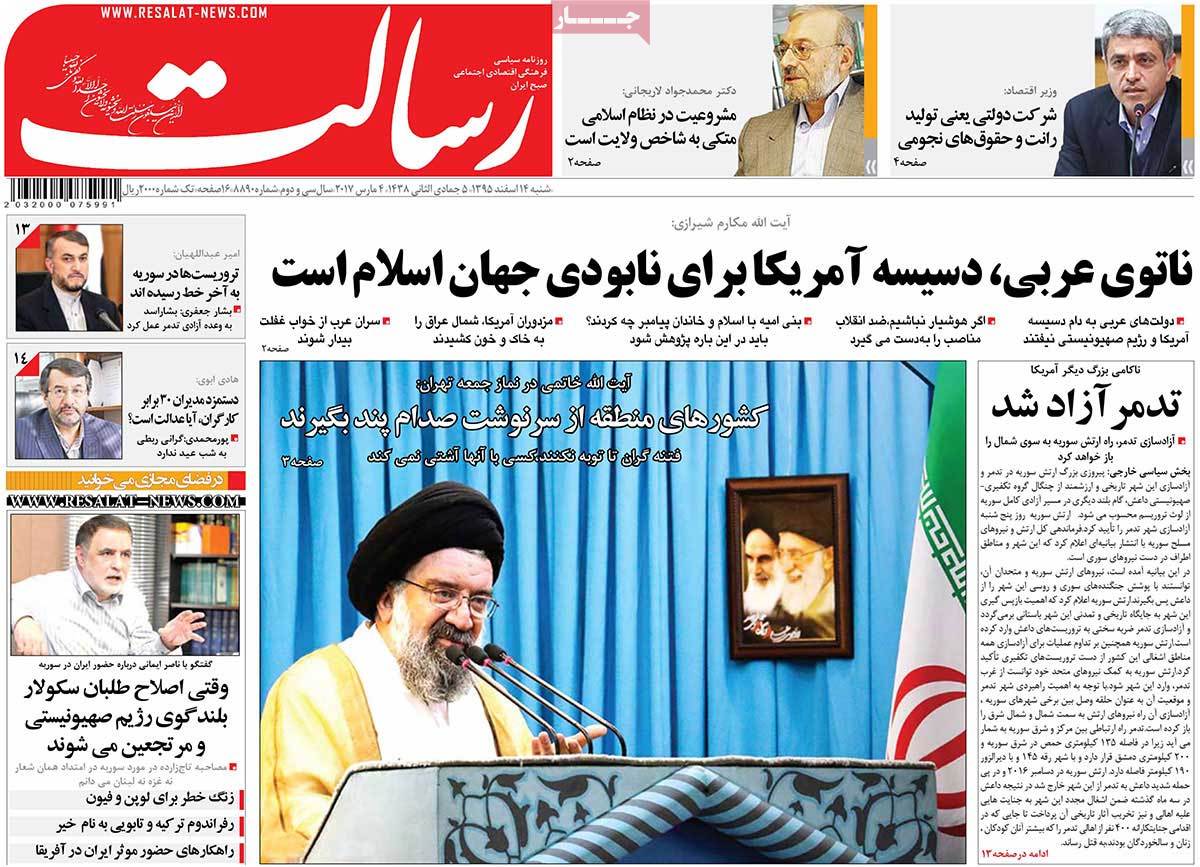
1- Ayatollah Makarem Shirazi: Arab NATO Is US Plot to Destroy Muslim World
2- Ayatollah Khatami: Regional Countries Should Take Lesson from Saddam’s Fate
Setareh Sobh:
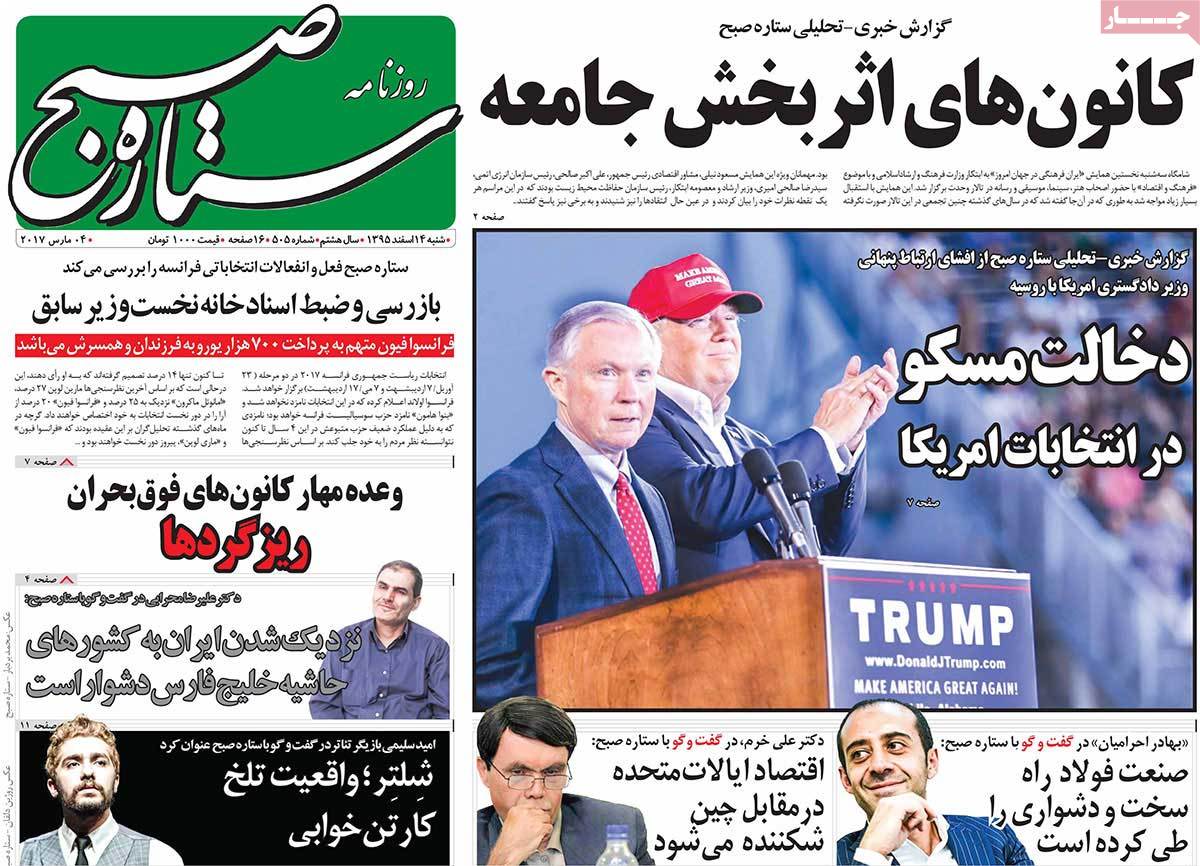
1- French Ex-PM, Presidential Candidate Accused of Paying $700,000 to Wife, Children
2- US Economy to Become Fragile vis-à-vis China: Analyst
Shahrvand:
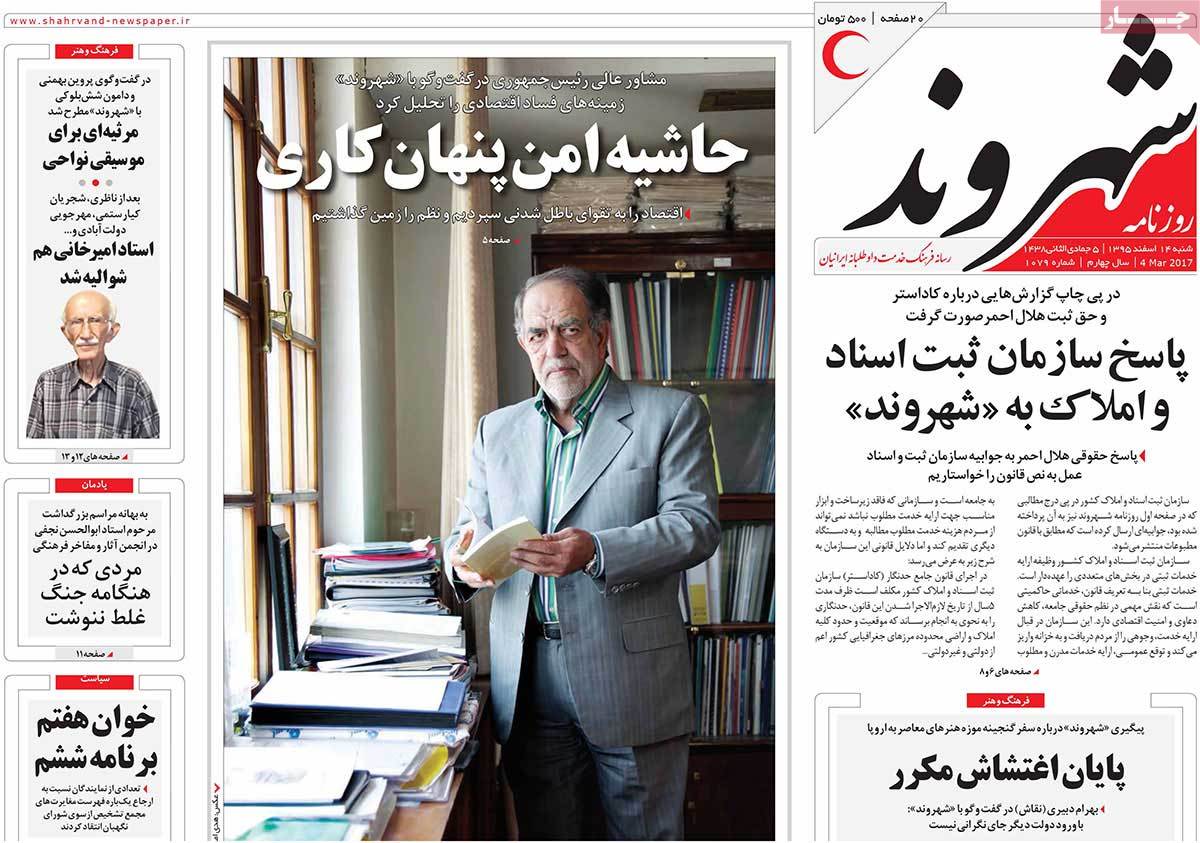
1- Iranian Calligrapher Amirkhani Receives Chevalier Order in French Embassy
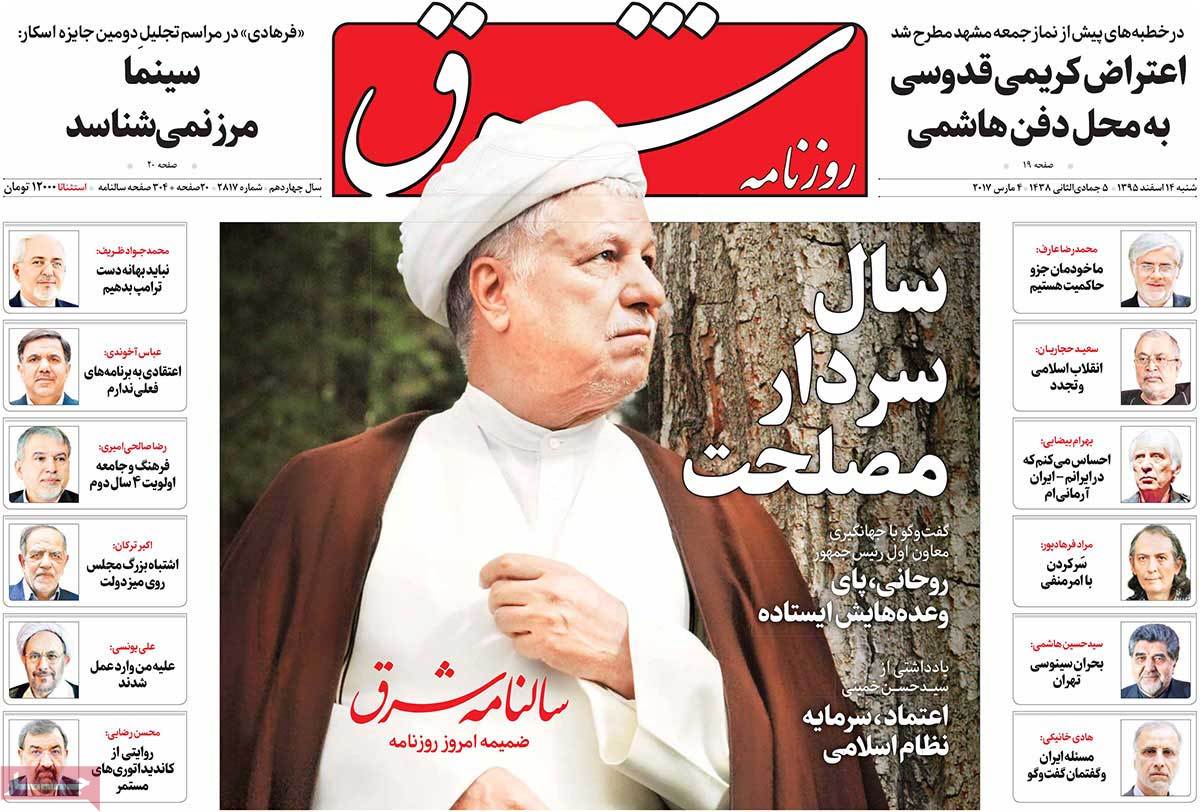
Shargh:
1- Farhadi in Appreciation Ceremony: Cinema Knows No Border
Vatan-e Emrooz:
1- Astronomical Salaries Repeated! Widespread protests against parliament’s bill that legalises astronomical salaries for executives
2- Culture Minister: 6 Ministers Pursuing Issue of ‘Clash of Clans’!
3- Trump’s State Dept. Shut Down: Atlantic’s Report about Chaotic Situation of US Diplomacy Apparatus
The most beautiful hotel in Iran? Iran's oldest hotel might also be the country's, if not the region's, most beautiful. The Abbasi, which opened in the 1700s, represents authentic Persian design.
Here is CNN’s account of Abbasi Hotel and its ‘unique’ beauty:
Flick through almost any travel magazine these days and you’re bound to come across an article hailing Iran as the next big destination.
Prompting the spike in interest in the Islamic Republic is recent geopolitical wrangling in the shape of a nuclear deal with world powers that has ended some longstanding sanctions.
But while the country is trying to modernize its tourism industry in the face of increasing visitor numbers — 5.2 million came in 2016 and more are expected in 2017 — its more traditional offerings still have the potential to charm.
None more so than the Abbasi Hotel, an opulent if careworn establishment located in the ancient city of Isfahan.
It’s a place like no other.
Isfahan has its fair share of historical wonders (some which are UNESCO World Heritage sites), but in many ways the Abbasi has become a tourist attraction in its own right.
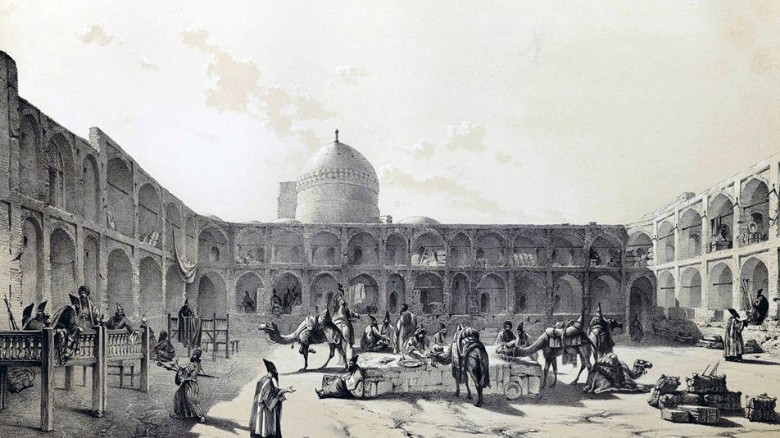
Built around 300 years ago, under the Safavid dynasty reign of Shah Sultan Hossein, it was originally used as a pit stop for merchants traveling the ancient Silk Road.
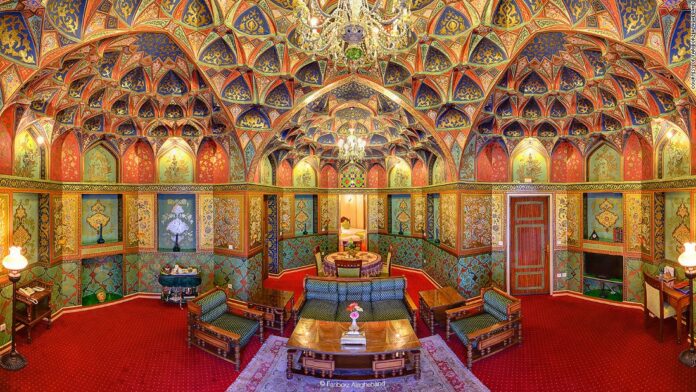
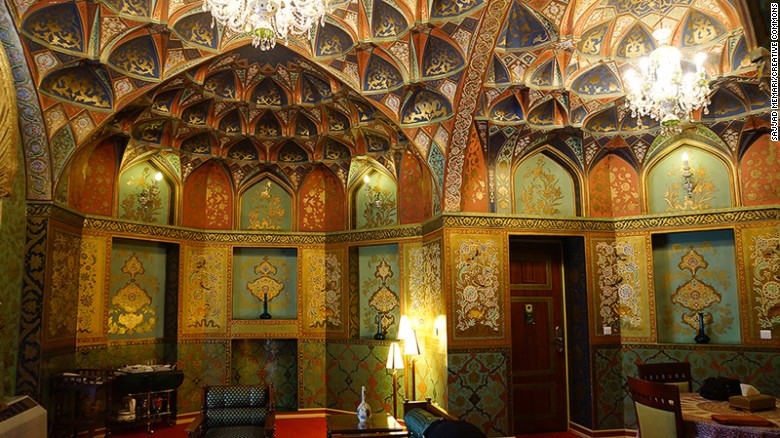
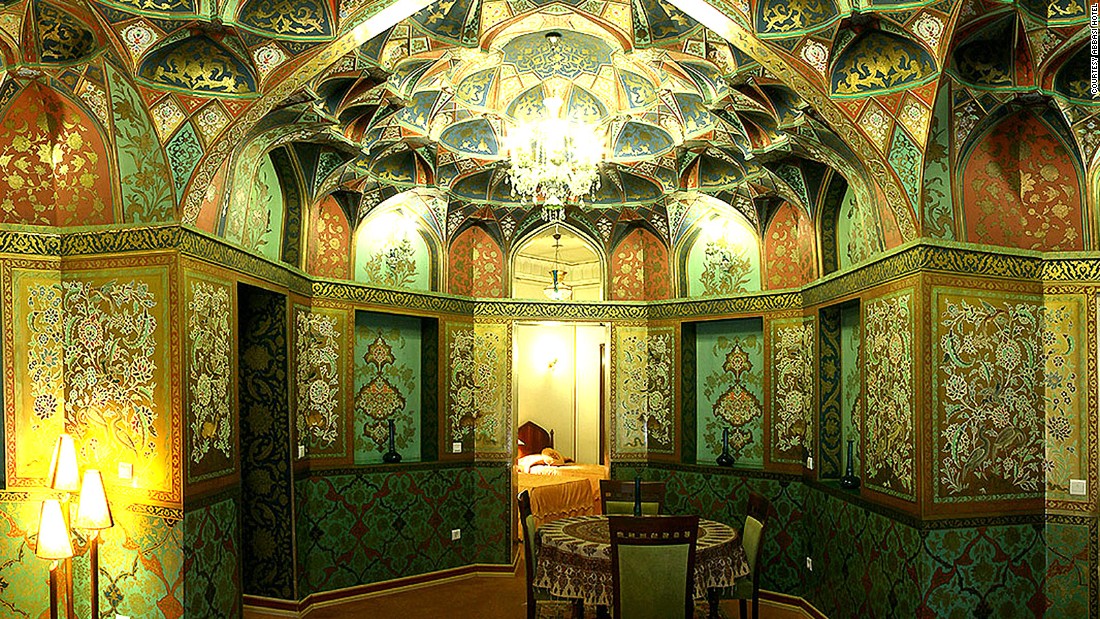
The Abbasi’s Qatar and Safarvid suites (pictured here) are its most atmospheric rooms.
Uniquely and Beautifully Persian
The complex provided shelter not only for traders but also for the camels and horses they used to help transport their goods.
The years, decades and centuries that followed took their toll on the old caravanserai (during the early 1900s it was used as a military complex) and it started to fall into disrepair.
In the 1950s French archaeologist André Godard, working in Iran at the time, took it upon himself to fight for its restoration.
Soon after that, the Abbasi became what it is today: a 4-star hotel drenched in an ancient past.
The Abbasi may not have an abundance of modern amenities. There are no state-of-the-art gym or in-room cappuccino machines (although it does have great Wi-Fi), but that adds to its charm.
In a globalised and franchise-dominated world, the Abbasi is unique.
This hotel is all about atmosphere. Moreover, it’s uniquely Persian.
Even the Abbasi’s ceilings are Instagram-worthy.
“I’d highly encourage anyone traveling to Iran to stay here as it’s an experience of a lifetime,” says general manager Jamal Zandi.
He’s not really exaggerating.
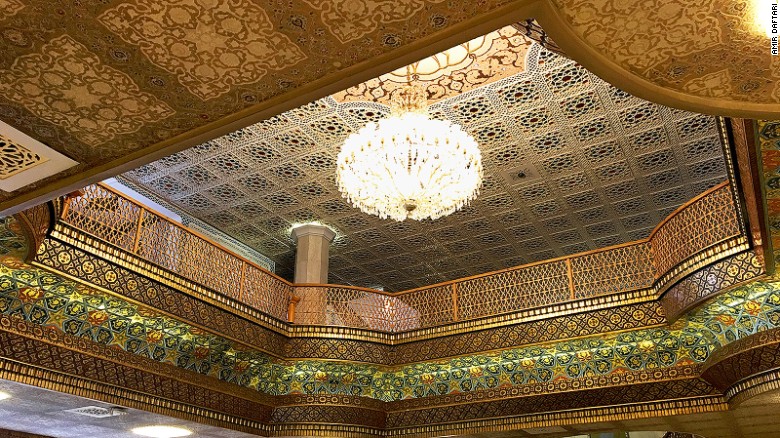
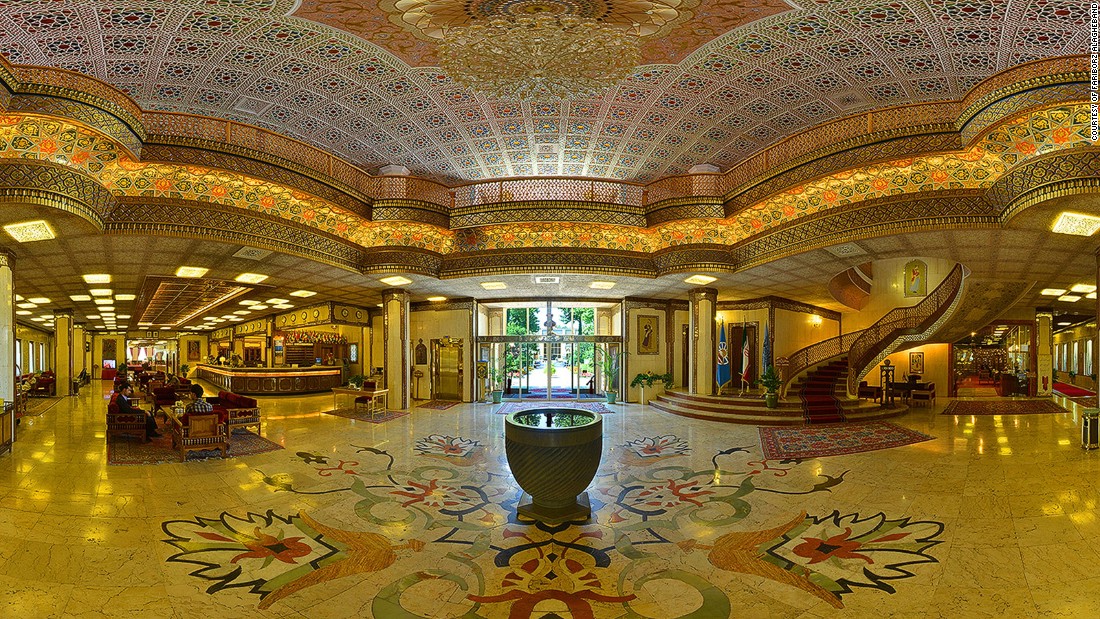
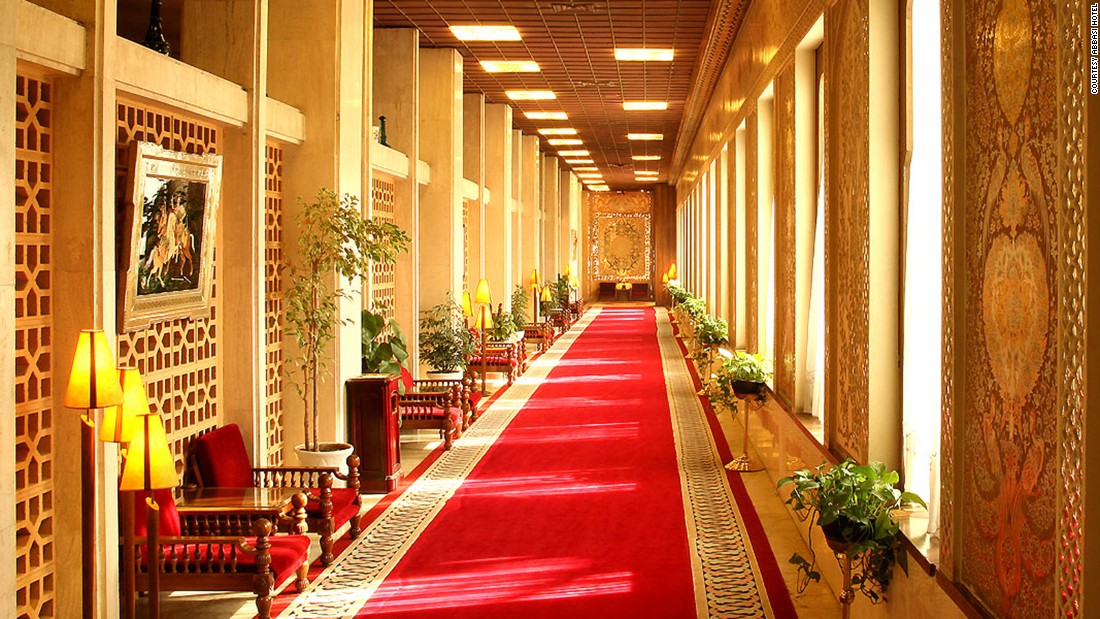
Hallways are lined with authentic miniature paintings, the ceiling of the lobby is finely detailed and the dining areas adorned with beautiful mirror work, glittering chandeliers, and exquisite colourful wall motifs often associated with romantic notions of “the orient.”
An array of emerald greens, jasmine blues and deep golds inevitably make visitors reach for their cameras as soon as they walk in.
The Abassi was once a stop for Silk Road traders.
The hotel has around 225 rooms, including 23 suites, and is divided between the hotel’s old wing and new wing.
Built in the 1970s, the rooms in the new wing are rather characterless — it seems that the re-creation of the hotel’s original look and feel was not a priority at the time of construction and the rooms are bland in colour and nondescript.
Guests who get to stay in the old wing, especially the Qajar and Safavid suites, are in for a treat. These rooms have been superbly restored and are decorated in an elegant traditional style without being overloaded.
At about $350 a night, they’re relatively pricey.
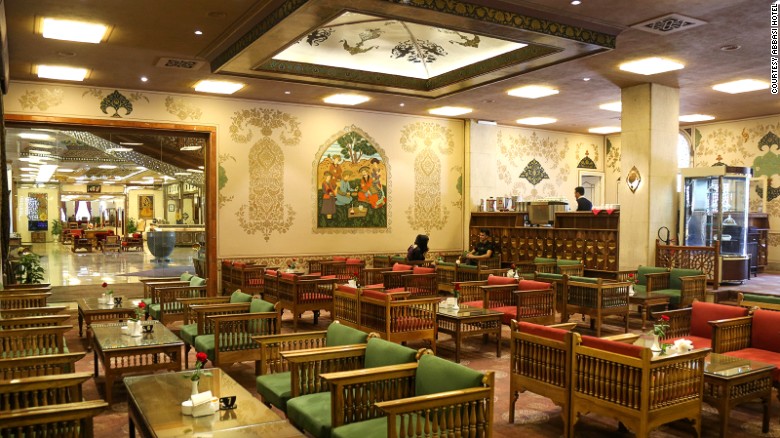
Abbasi Hotel has six restaurants — including a coffee shop, traditional teahouse and breakfast hall.
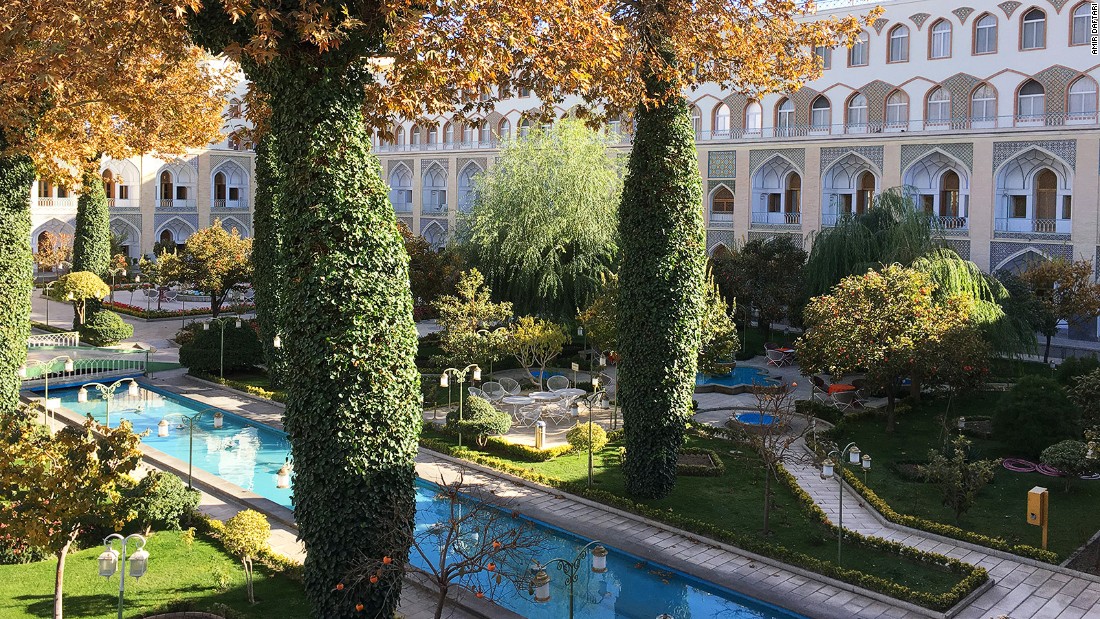
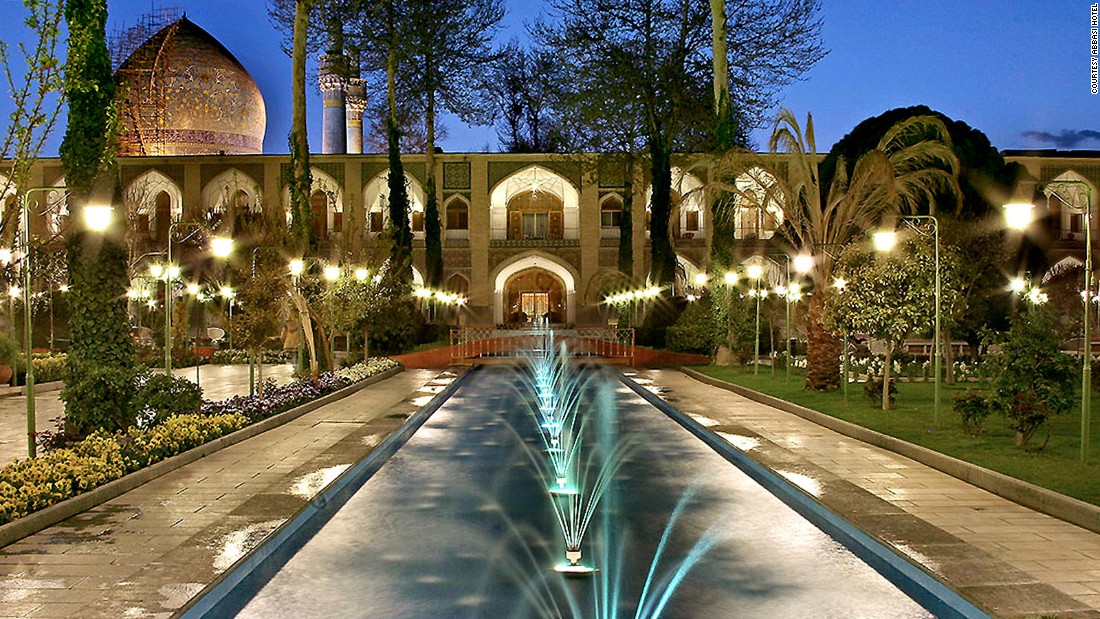
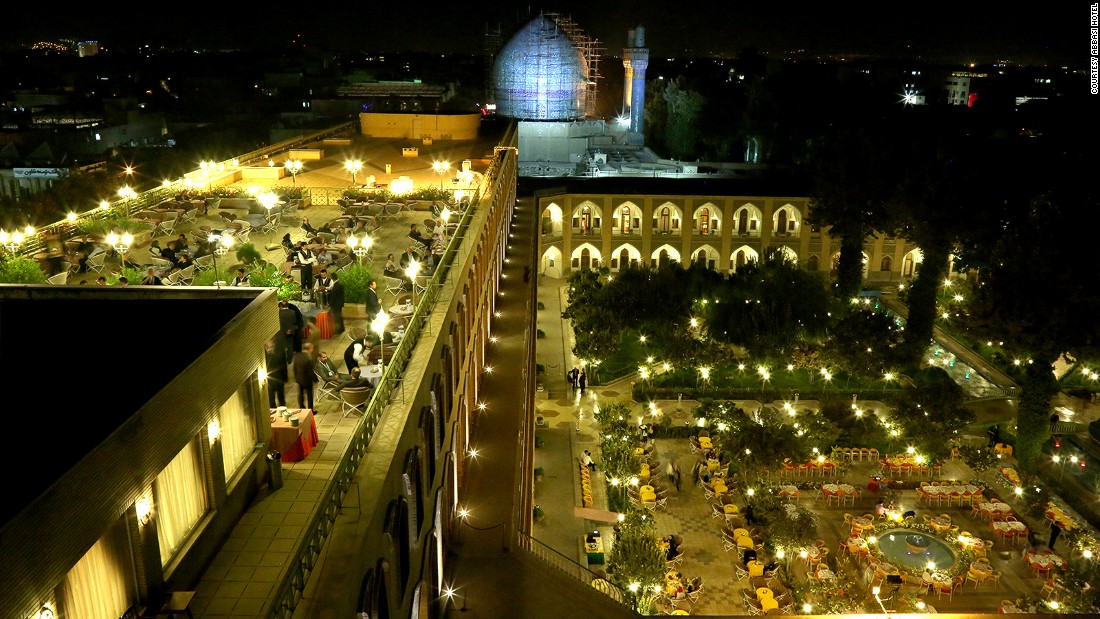
What really makes the Abbasi particularly special is its open-air courtyard.
It’s a large, beautiful, well-maintained Persian garden, complete with little fountains, brook-lined avenues, bright flower beds and quince-laden trees.
People spend their time drinking tea, reading a book or just hiding away from the hustle and bustle of the city in this oasis.
The courtyard restaurant is famous for an Iranian dish called Ash-e Reshteh, a thick type of noodle soup filled with all types of beans and herbs.
“Many Iranians think a visit to the Abbasi for its soup is an essential part of coming to Isfahan,” says Arian Aghamardi, a frequent guest at the hotel. “Nothing better to warm you up on a cold day.”
It was winter when CNN visited, yet the garden was still green and beautiful. It can only be more spectacular in the spring.
Times are clearly changing in Iran and new hotels are appearing on the scene.
Old wing: The hotel now houses more than 200 rooms including 23 suites. The newly designed rooms aren’t as characterful as the rooms in the old wing, especially the Qajar and Safavid suites.
While the US still has its sanctions in place, a situation unlikely to change under new President Donald Trump, hotel groups headquartered outside America have already started to move in.
The French Accor group became the first in 2016. Others are following, including the UAE’s Rotana and Spain’s Melia. It’s expected that by 2018 Iran will have six different international brands.
But anyone visiting Esfahan and staying elsewhere would be missing out if they didn’t at least stop by the Abbasi and take a look around.
It’s guaranteed to be one of the best memories of any stay in Iran.
Abassi Hotel-Isfahan
1 of 10
Safavid Suite: Arguably the most stunning room in the hotel, the two-bedroom Safavid Suite was inspired and named after one of the most significant dynasties in Iranian history.
An ancient Silk Road pit stop: The Abbasi Hotel is located in the ancient city of Esfahan. It was built under the reign of Shah Sultan Husayn of the Safavid dynasty and offered a pit stop for merchants traveling the ancient Silk Road. Here is a stitched panorama photo of the hotel lobby.
Aliqapu Hall: With lavish ornaments and delicate engravings, Aliqapu Hall is a venue for ceremonial feasts. Its design was inspired by the music room in Ali Qapu Palace -- also in Isfahan.
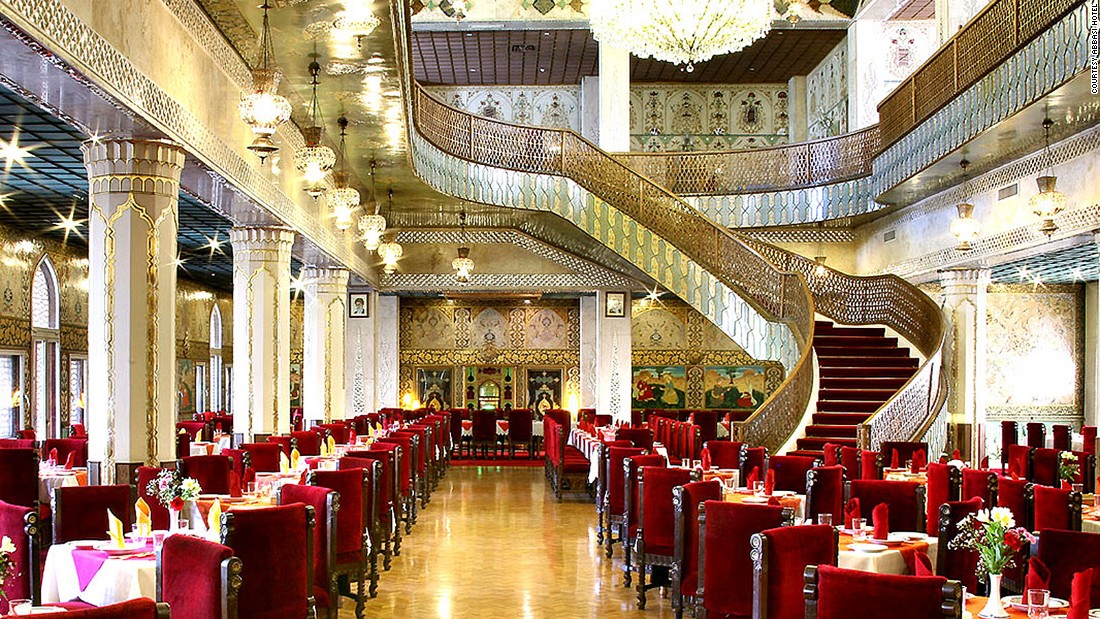
Chehelsotoun Restaurant: One of six dining options in Abbasi Hotel, Chehelsotoun is covered with murals in both Safavid and Qajar styles and decorated with chandeliers and lanterns.
Darius's throne: Sitting up to 400 diners, Chehelsotoun's chairs are modeled after a throne depicted in stone carvings in Persepolis, an ancient city and world heritage site in Iran.
An attraction in its own right: Even for non-guests, a visit to the Abbasi Hotel will be a memorable highlight of a trip to Iran.
Other restaurants: In addition to more formal restaurants, the Abbasi Hotel boasts a traditional teahouse, a coffee house and a breakfast hall (pictured here).
Zarrin Hall: The event space, decorated in gold leaves and green paint, is available for seminars, conferences and ceremonial receptions.
The revamp: The centuries-old hotel had started to fall into despair until French archaeologist Andre Godard decided to restore it in the 1950s.
Cheshmandaz Restaurant: The courtyard eatery is famous for an Iranian dish called Ash-e Reshteh, a thick type of noodle soup filled with all types of beans and herbs. "Many Iranians think a visit to the Abbasi for its soup is an essential part of coming to Esfahan," says Arian Aghamardi, a frequent guest at the hotel.
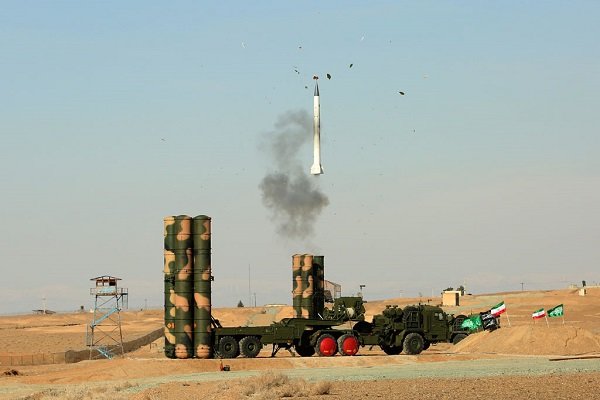
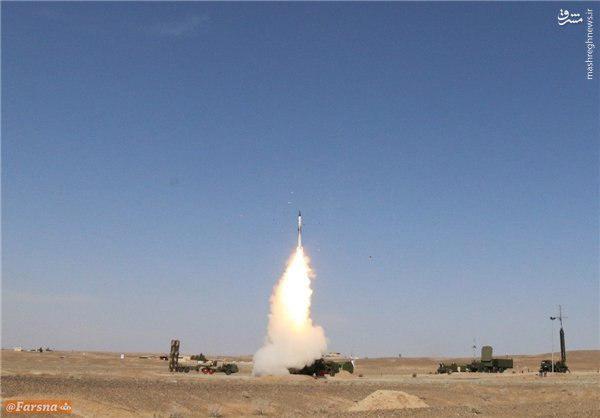
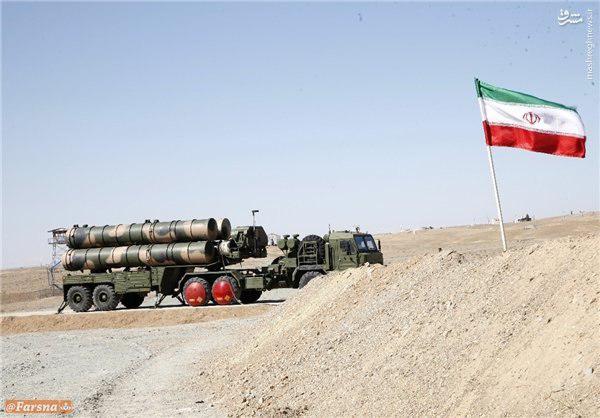
According to a Farsi report by Fars News, the missile defence system was tested in a drill codenamed ‘Damavand’ attended by top officials and generals.
Russia concluded the supply of its S-300 surface-to-air missile defence systems to Iran back in October 2016 after years of dispute.
Moscow was committed to delivering the systems — which are used to target tactical and ballistic aircraft and projectiles — to Tehran under an $800-million deal in 2007.
However, Russia banned the delivery of the systems to Tehran back in 2010, citing the fourth round of the UN Security Council sanctions, which bars hi-tech weapons sales to the Islamic Republic.
Moscow’s refusal to deliver the systems prompted Iran to file a complaint against the relevant Russian arms manufacturer with the International Court of Arbitration in Geneva, Press TV reported.
In April 2015, Russian President Vladimir Putin lifted the ban on the delivery of the S-300 and Moscow subsequently signed a new contract to supply Iran with the systems by the end of that year.
Months later, Tehran dropped the lawsuit after Moscow agreed to fulfill its commitments under the 2007 accord.