Thursday, April 23, 2026
Home Blog Page 3956

Iranian, Russian, Iraqi Deputy FMs Hold Trilateral Meeting

Iranian, Russian, Iraqi Deputy FMs Hold Trilateral Meeting

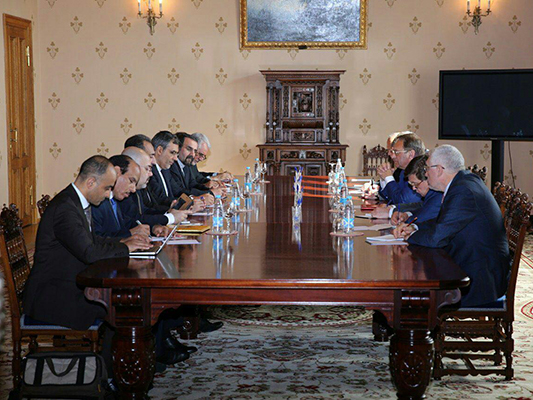
During their Wednesday meeting in Moscow, Iranian Deputy Foreign Minister for Arab and African Affairs Hossein Jaberi Ansari, his Iraqi counterpart Nizar Khairallah, and Russia’s Mikhail Bogdanov discussed the latest regional developments and the fight against terrorism in Iraq and Syria.

The three diplomats referred to the necessity of maintaining the territorial integrity of regional countries, the fight against terrorism, and the exclusive right of Syrian people to decide their future as their common stances.

They also highlighted the need for settling the ongoing crisis in Syria based on a political solution.

Iran Hopes Venezuela Vote Would Restore Peace

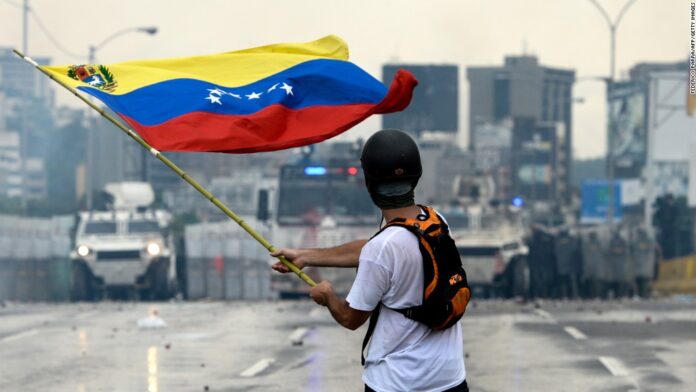
“The Islamic Republic of Iran supports the democratic processes originated from the Venezuelan nation’s will aimed at resolving the country’s issues in a peaceful and legal way,” Bahram Qassemi said in a Wednesday statement on the recent developments in Venezuela.

“Iran hopes that the recent election held in the country would lead to the restoration of peace and stability and prepare the grounds for national dialogue and reconciliation in Venezuela,” he added.

The Iranian spokesman also voiced Iran’s opposition to any foreign interference in Venezuela’s internal affairs, and underlined the necessity of respecting other countries’ sovereignty and independence within the framework of international law.

Qassemi rejected the US administration’s unilateral sanctions against Venezuela, and said, “As proven in similar cases in the world, we deeply believe that any use of sanctions as an instrument for exerting pressure on independent countries and nations in a bid to weaken and create a gap in their resolve is a pointless and inefficient move.”

The US Treasury Department slapped sanctions on Venezuelan President Nicolas Maduro Monday, sending a clear signal of the Trump administration’s opposition to his government.

The move came a day after Maduro declared a sweeping victory in a vote that will allow him to further consolidate his power over the crisis-torn nation.

Iran to Snap Back Nuclear Program If JCPOA Breached

jcpoa-Iran to Snap Back Nuclear Program If JCPOA Breached 1

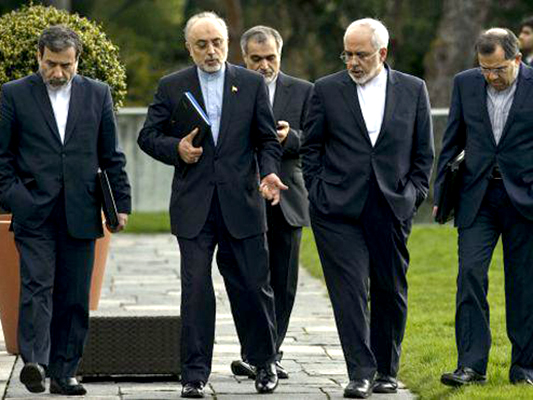
Head of the Atomic Energy Organization of Iran Ali-Akbar Salehi and Iranian Deputy Foreign Minister Abbas Araqchi have separately expounded on Tehran’s plan to respond to Washington’s breach of, or possible withdrawal from the nuclear agreement signed between Iran and six world powers.

In an interview with the Persian-language Hamshahri daily, Salehi said Iran had the foresight to envisage the necessary measures during the nuclear talks capped by the JCPOA. He said Iran had planned the precautions required to roll back the agreement if the other sides reneged on their commitments.

“We have envisaged the necessary measures to go back, even beyond the points where we were in the past,” said Salehi.

He stressed that any violation of the deal will do Iran not harm.

“We hope the other side won’t make a mistake, but if somebody makes a mistake, we won’t be responsible,” he noted.

Iran’s nuclear chief then warned the West and the US against breaching the JCPOA.

“They shouldn’t try to test us. One of their ploys is to make us angry and provoke our feelings,” said Salehi.

He then touched upon a suggestion by some Iranian experts to pull out of the JCPOA in response to Washington’s breach of promises.

“Why should we tear up the JCPOA? It is the US that is simmering with rage! We are reaping the benefits of the deal. They are worried and upset. We should act wisely and not be overcome by emotions. Iranian officials have taken all considerations into account and will act in accordance with national interests and political wisdom.”

In the meantime, Araqchi told Iran’s state TV that Tehran will remain committed to the JCPOA as long as its interests are secured.

“We’re not dependent on the JCPOA, so it’s not that we’ll try to keep it at any price. We have said this both in local and foreign meetings. If we don’t benefit from the deal, we’ll pull out of it,” Araqchi stressed.

He further said the sanctions have jeopardized Iran’s interests, “but not the major interests.”

“Of course, this is my viewpoint. It is up to the supervisory board and senior officials to decide on whether or the sanctions have endangered our interests.”

The member of Iran’s nuclear negotiating team said Tehran has prepared its scenarios to respond to the US violation of the JCPOA are ready.

“Our reactions to any kind of action are ready. We’re not playing in the enemy’s field, nor will we hurt ourselves. We will respond with the tools we have in different places. Our reaction will not simply be limited to the JCPOA domain. Iran is a powerful country, has maintained and will maintain its elements of power. The United States’ passing laws to impose sanctions on Iran shows that Iran is a powerful country both in the region and in the international community.”

He then touched upon a recent meeting of the committee tasked with monitoring the implementation of the JCPOA as well as Washington’s breaches of promises in the committee’s statement.

“There was no consensus on whether or not Washington had violated the deal. We announced that we were not satisfied with the result of the committee’s work and that we would report the issue to Tehran. And now we’re waiting for the supervisory board’s decision.”

Araqchi then commented on the time that Tehran might return to its past nuclear activities if it is confirmed that the US or any other party to the JCPOA has violated the deal.

“The timeframe would be based on a plan the Parliament has wanted us to present in line with the ‘Proportionate Action’ legislation. The Atomic Energy Organization of Iran (AEOI) has clear plans on that, too. We have a clear scenario on when and how to return to our previous or even beyond our previous activities.”


A Look at Iranian Newspaper Front Pages on August 2

Newspapers today widely covered the short meeting between Iranian Foreign Minister Mohammad Javad Zarif and his Saudi counterpart Adel al-Jubeir in the Turkish city of Istanbul. During the short encounter, the two sides shook hands and had a brief conversation.

A decision made by the Iranian committee tasked with monitoring the implementation of a nuclear deal between Tehran and world powers to counter the US violation of JCPOA also received great coverage. The 16-article decision was made by the committee chaired by President Hassan Rouhani.

The speculations about President Rouhani’s next cabinet line-up also remained a top story today. Rouhani will swear in on Saturday in the Parliament, and he will then have two weeks to propose his ministers who need to receive a vote of confidence by the lawmakers.

The above issues, as well as many more, are highlighted in the following headlines and top stories:


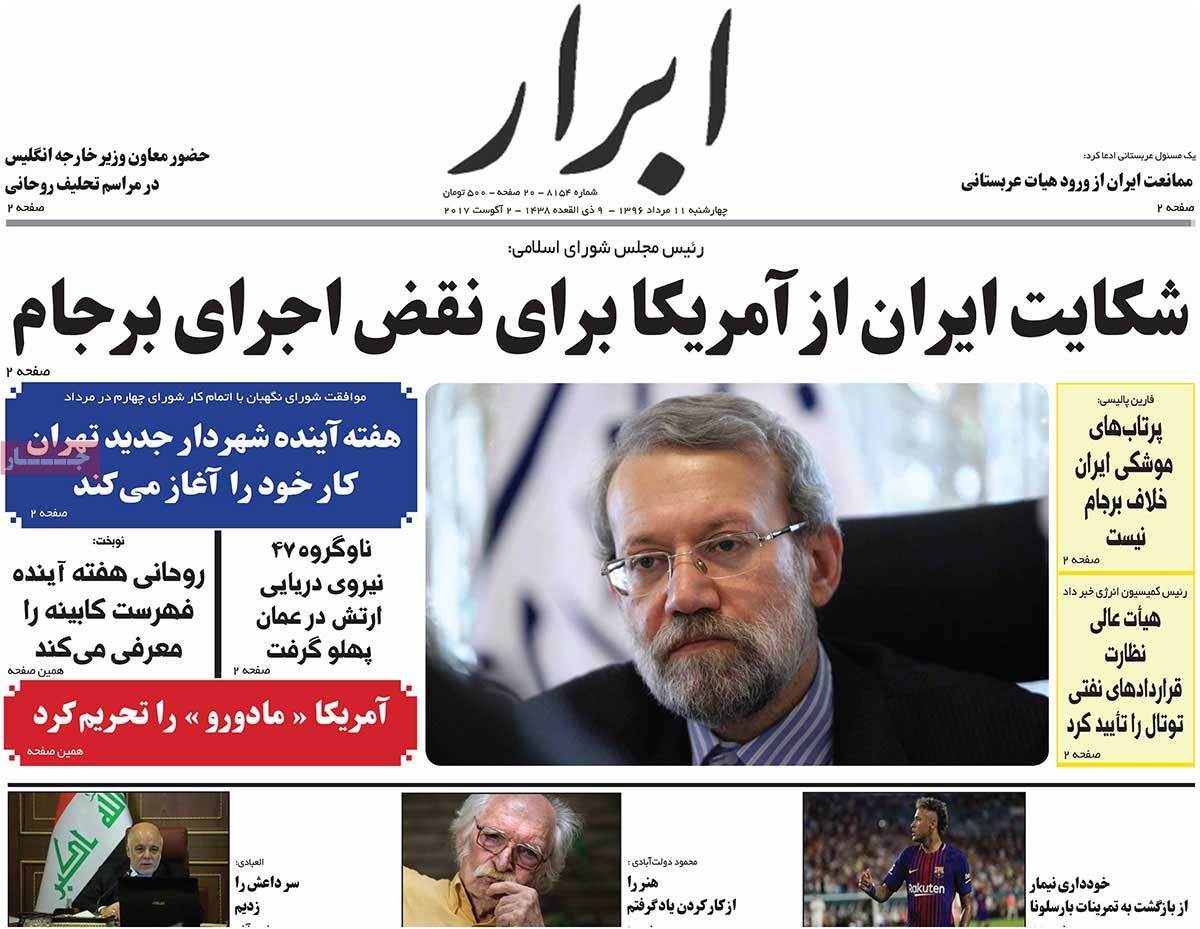
Abrar:

1- Parliament Speaker: Iran Files Complaint against US for Violation of JCPOA

2- Gov’t Spokesman: Rouhani to Propose His Cabinet Members Next Week

3- British Deputy FM to Attend Rouhani’s Inauguration Ceremony

4- Board Tasked with Monitoring Oil Deals Approves Total Contract
A Look at Iranian Newspaper Front Pages on August 2


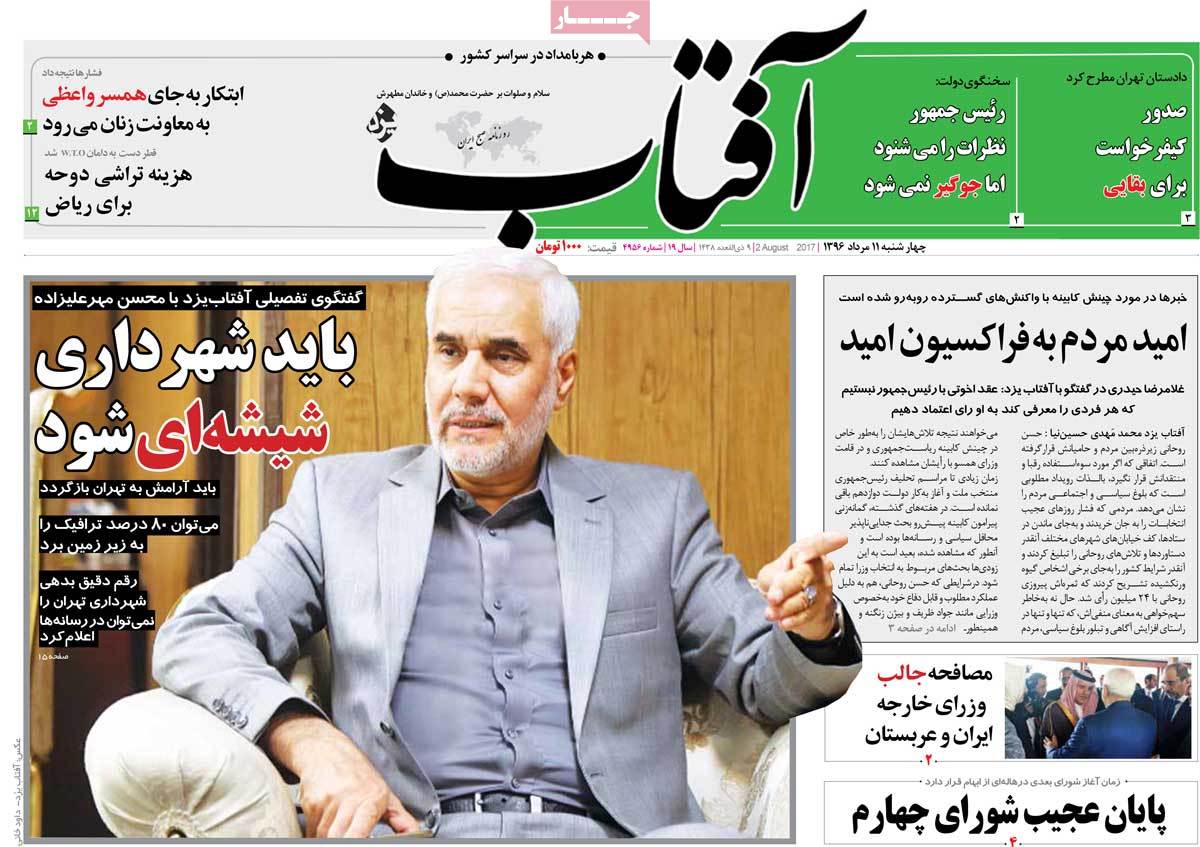
Aftab-e Yazd:

1- Gov’t Spokesman: Rouhani Will Listen to Opinions, but Won’t Be Influenced

2- Municipality Should Become Transparent: Reformist Figure
A Look at Iranian Newspaper Front Pages on August 2


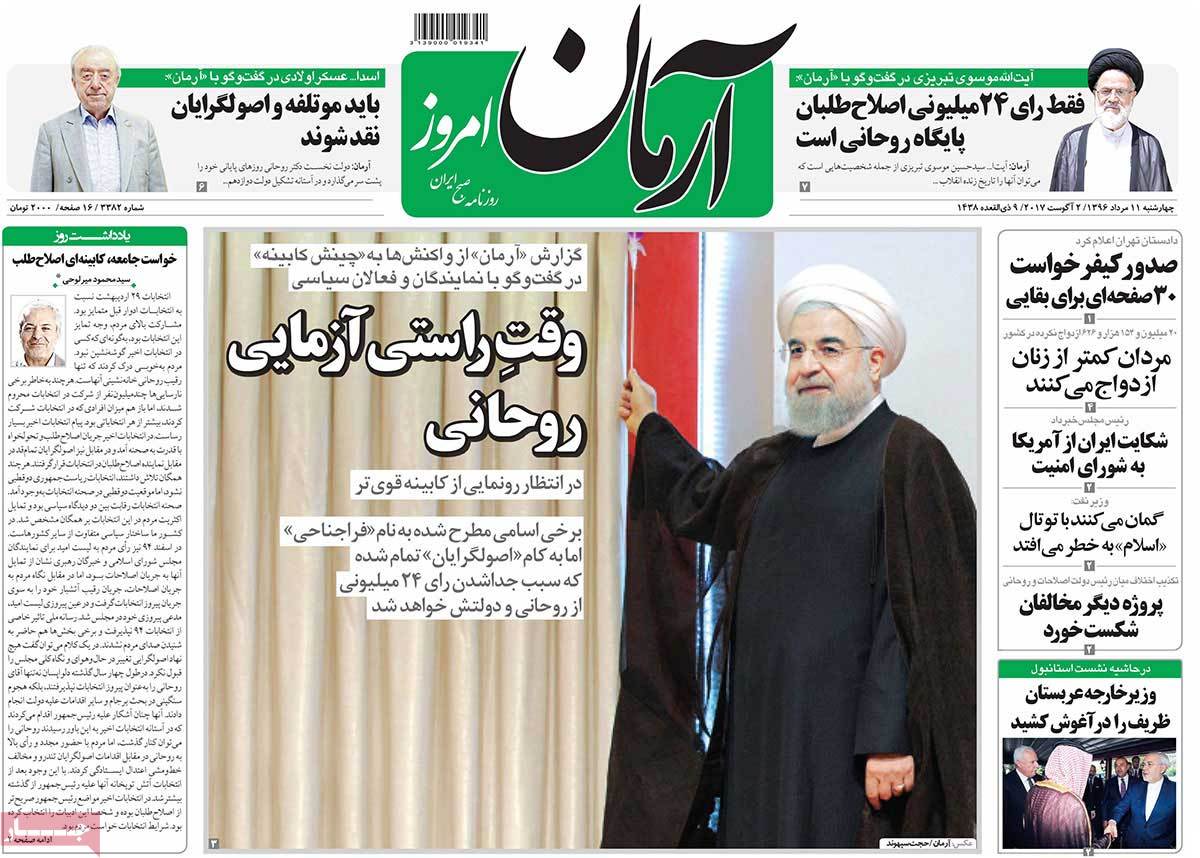
Arman-e Emrooz:

1- Time to Verify Rouhani: Reactions to Cabinet Line-up

2- Senior Cleric: 24 Million Reformists Form Rouhani’s Base

3- Tehran Prosecutor: 30-Page Petition against Ahmadinejad’s Aide Baqaei

4- 20,154,626 Singles in Iran: Men Get Married Less than Women
A Look at Iranian Newspaper Front Pages on August 2


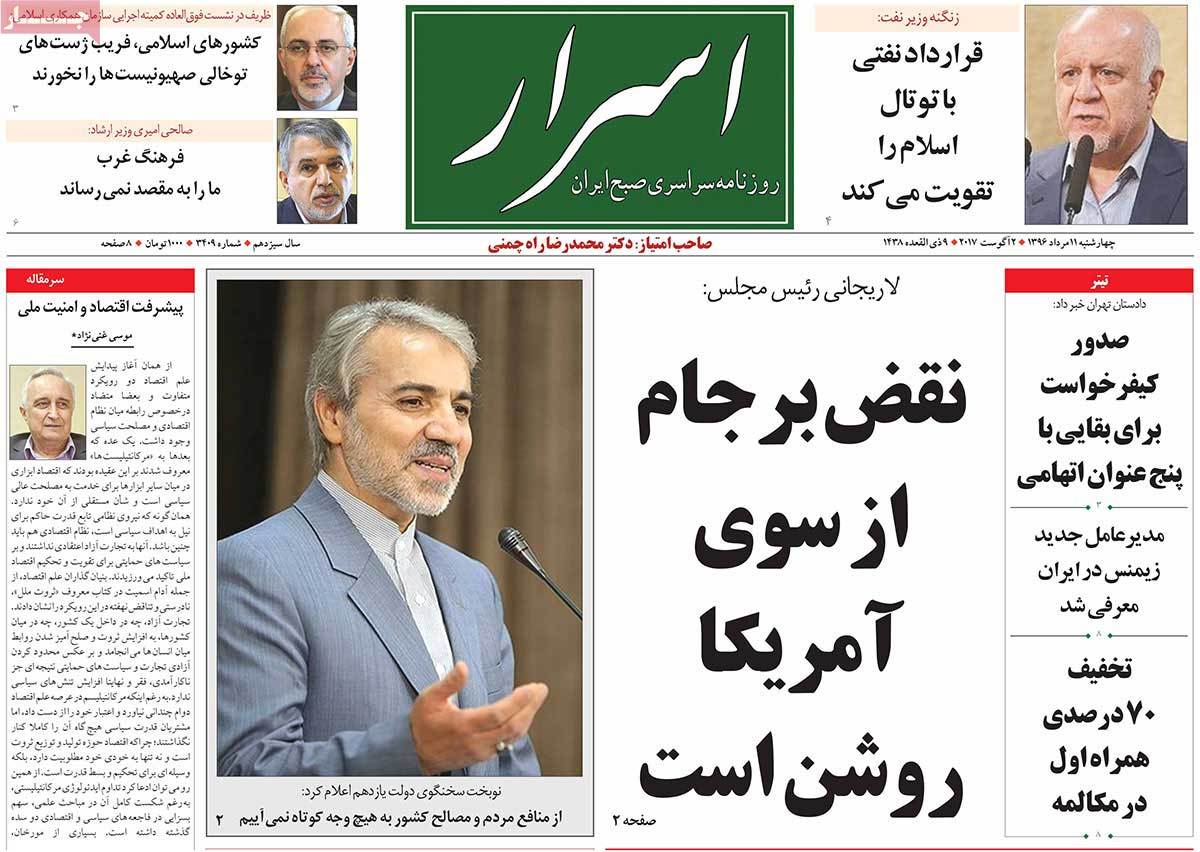
Asrar:

1- Oil Minister: Deal with Total to Reinforce Islam

2- Zarif: Muslim States Should Not Be Deceived by Zionists’ Hollow Gestures

3- Siemens Appoint New CEO in Iran
A Look at Iranian Newspaper Front Pages on August 2


Ettela’at:

1- 16 Decisions Made by Iranian Committee to Counter US Provocative Moves

2- US-Led Coalition’s Fighter Jets Massacre 60 Civilians in Syria’s Deir ez-Zor
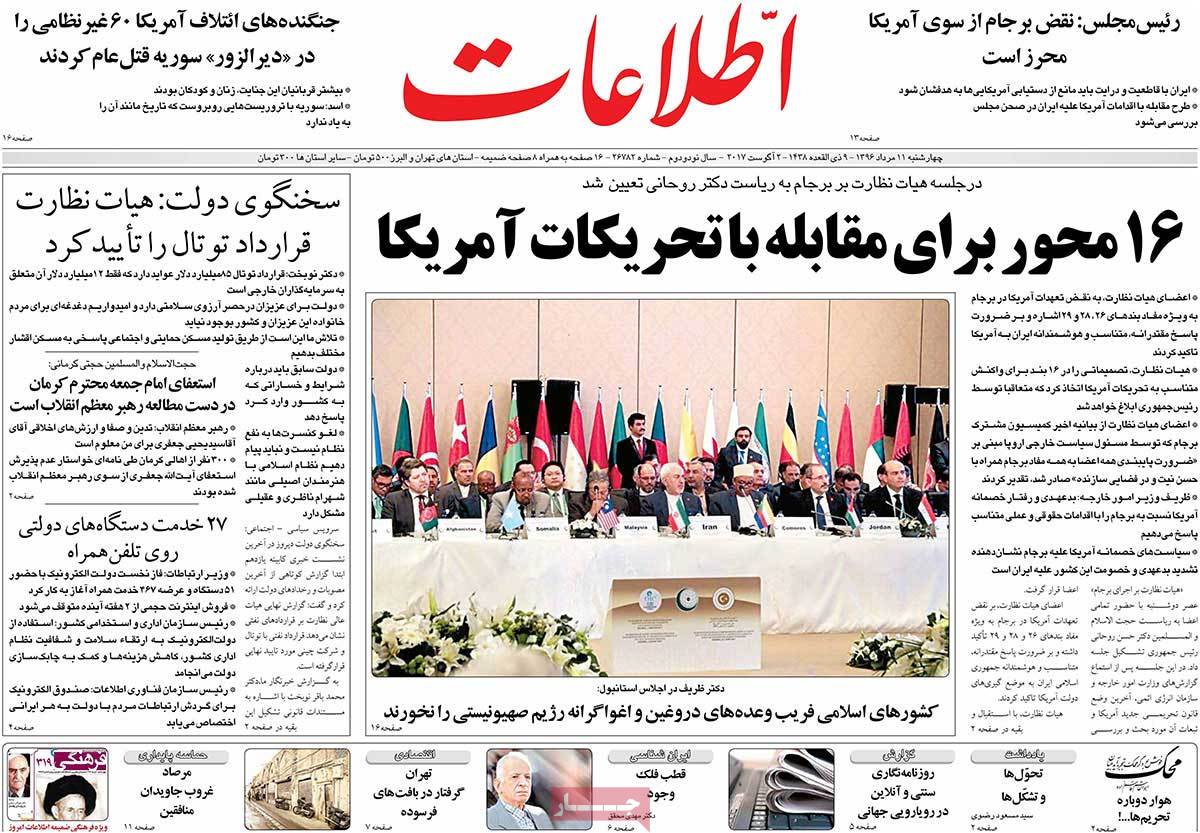
A Look at Iranian Newspaper Front Pages on August 2


Haft-e Sobh:

1- Unexpected Meeting in Istanbul: Controversies Surrounding Zarif-Jubeir Meeting
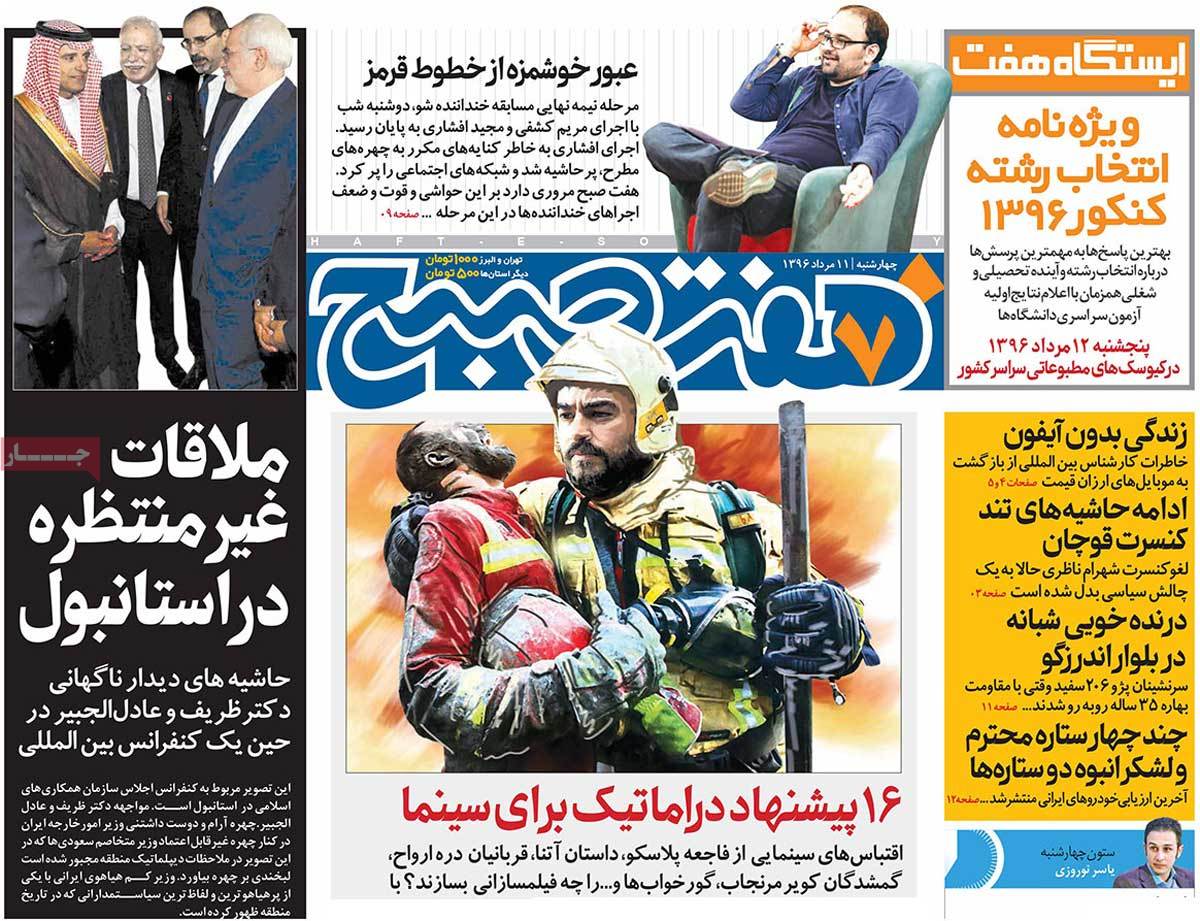
A Look at Iranian Newspaper Front Pages on August 2


Iran:

1- First VP: I’ll Pursue National Dialogue to the End

2- Armenian President Hails Tehran-Yerevan Good Ties

 A Look at Iranian Newspaper Front Pages on August 2


Javan:

1- CNN: North Korea Can Target 48 US States

2- 16 Decisions to Counter US Violation of Iran Nuclear Deal

3- Most Indebted Government in History: Rouhani’s Gov’t Has $60bn Debts
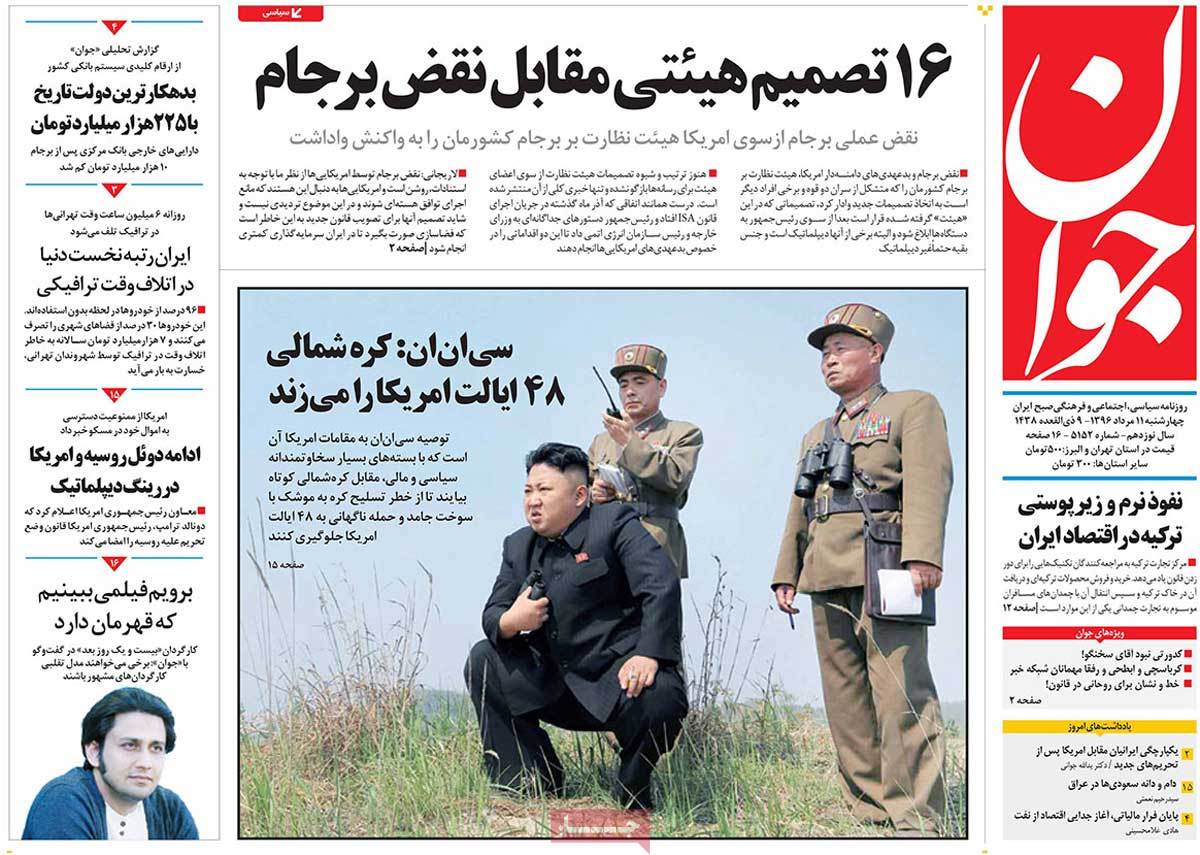
A Look at Iranian Newspaper Front Pages on August 2


Jomhouri Eslami:

1- Iran No Longer Needs to Import Gas from Turkmenistan

  • Oil Minister Opens New Gas Pipeline in Northern Iran

2- Iran’s Reciprocal Decisions to Counter US Hostile Moves
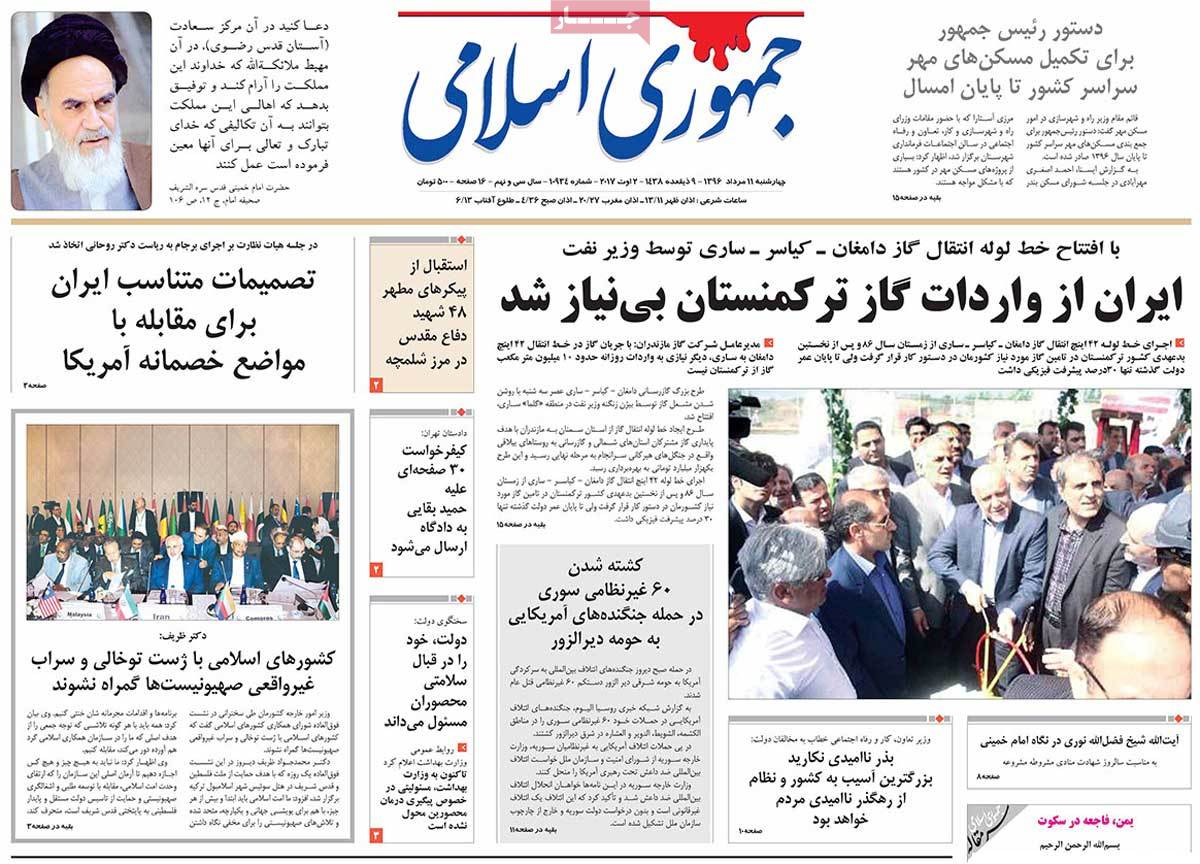
A Look at Iranian Newspaper Front Pages on August 2


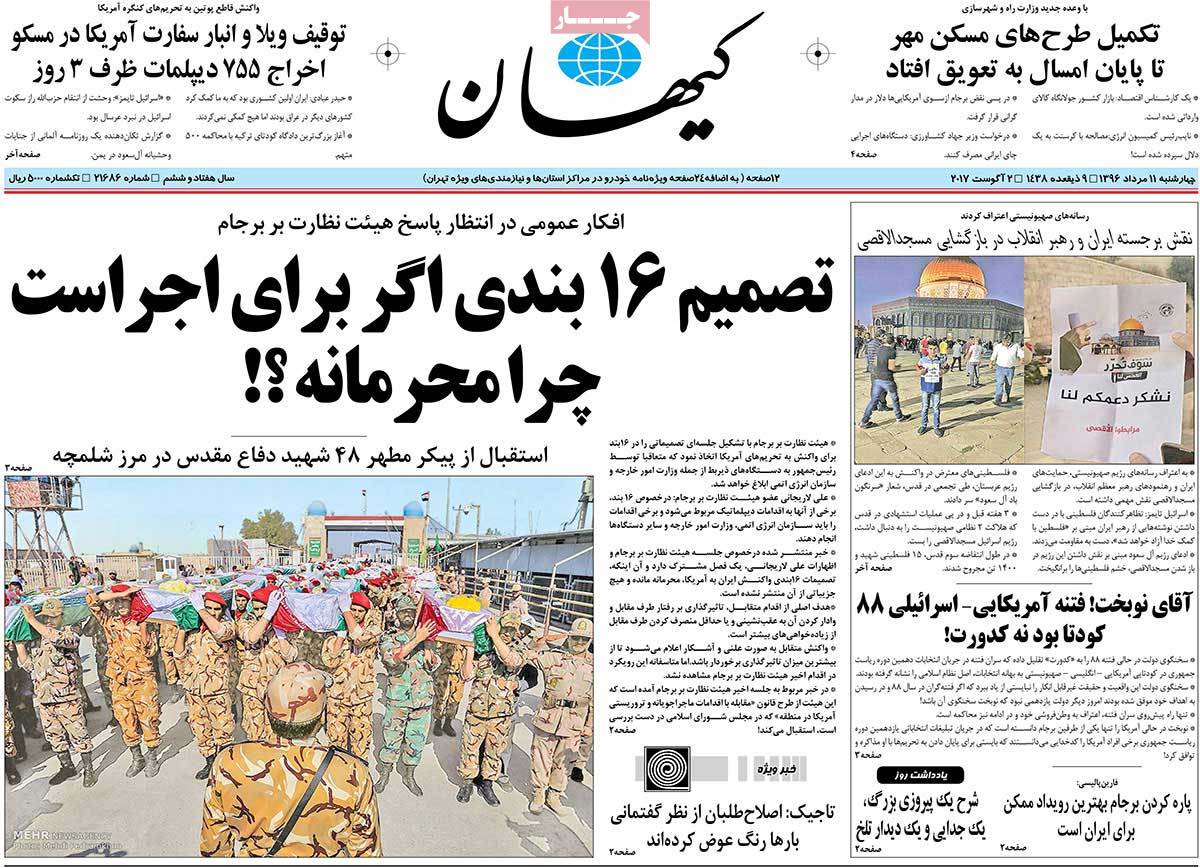
Kayhan:

1- People Waiting for Response by Committee Tasked with Monitoring JCPOA

  • If 16-Article Decision Is to Be Implemented, Why Is It Secret?

2- Zionist Media Admit: Prominent Role of Iran, Ayatollah Khamenei in Reopening of Aqsa Mosque

3- Putin’s Decisive Reaction to US Congress’ Sanctions

  • US Embassy’s Properties Confiscated
  • 755 US Diplomats Deported in 3 Days

4- Mr Nobakht! 2009 American-Israeli Sedition Was Coup, Not a Tiff!
A Look at Iranian Newspaper Front Pages on August 2


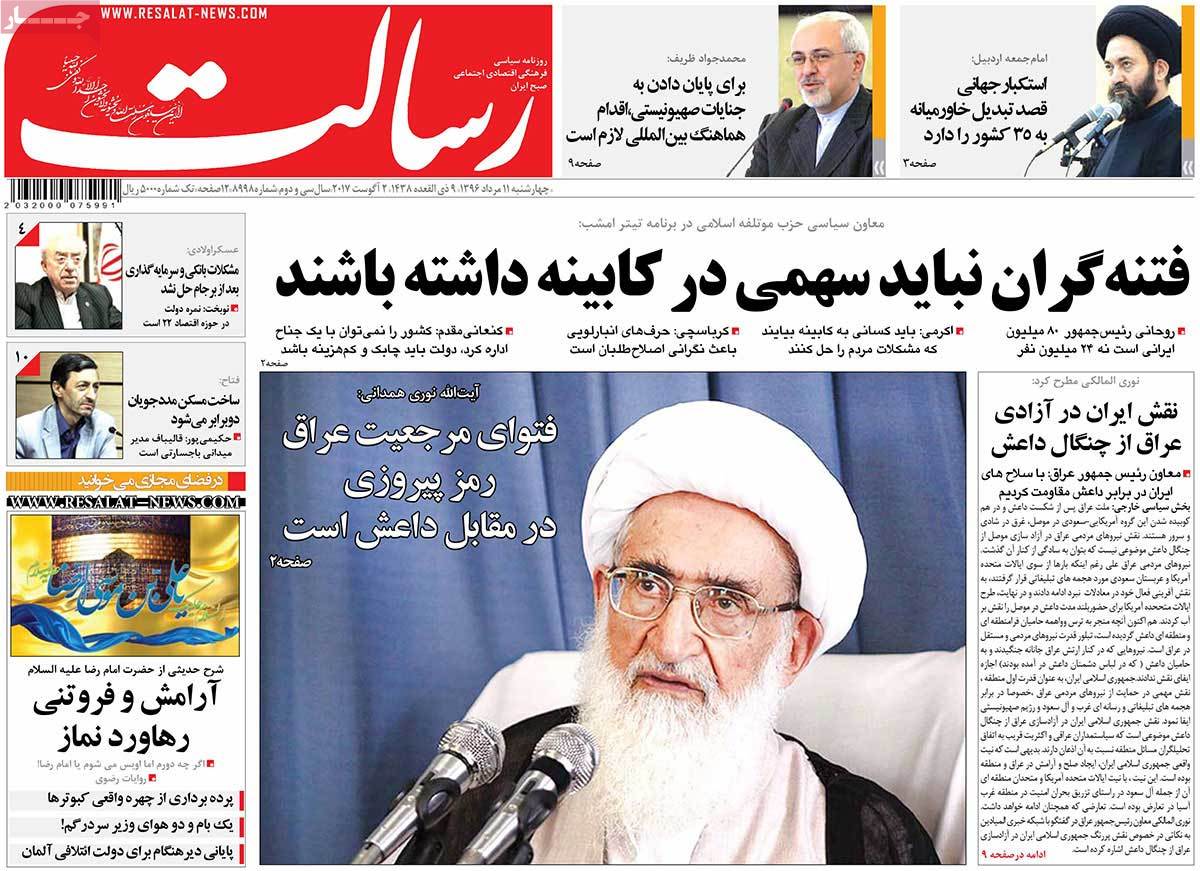
Resalat:

1- Iraqi Clerics’ Fatwa Key to Victory over ISIS: Senior Cleric

2- Senior Conservative: Those Involved in 2009 Sedition Shouldn’t Be Part of Cabinet

3- Iraq Ex-PM Hails Iran’s Role in Liberation of Iraq from ISIS

4- Zarif: Coordinated Int’l Measure Needed to End Israeli Crimes
A Look at Iranian Newspaper Front Pages on August 2


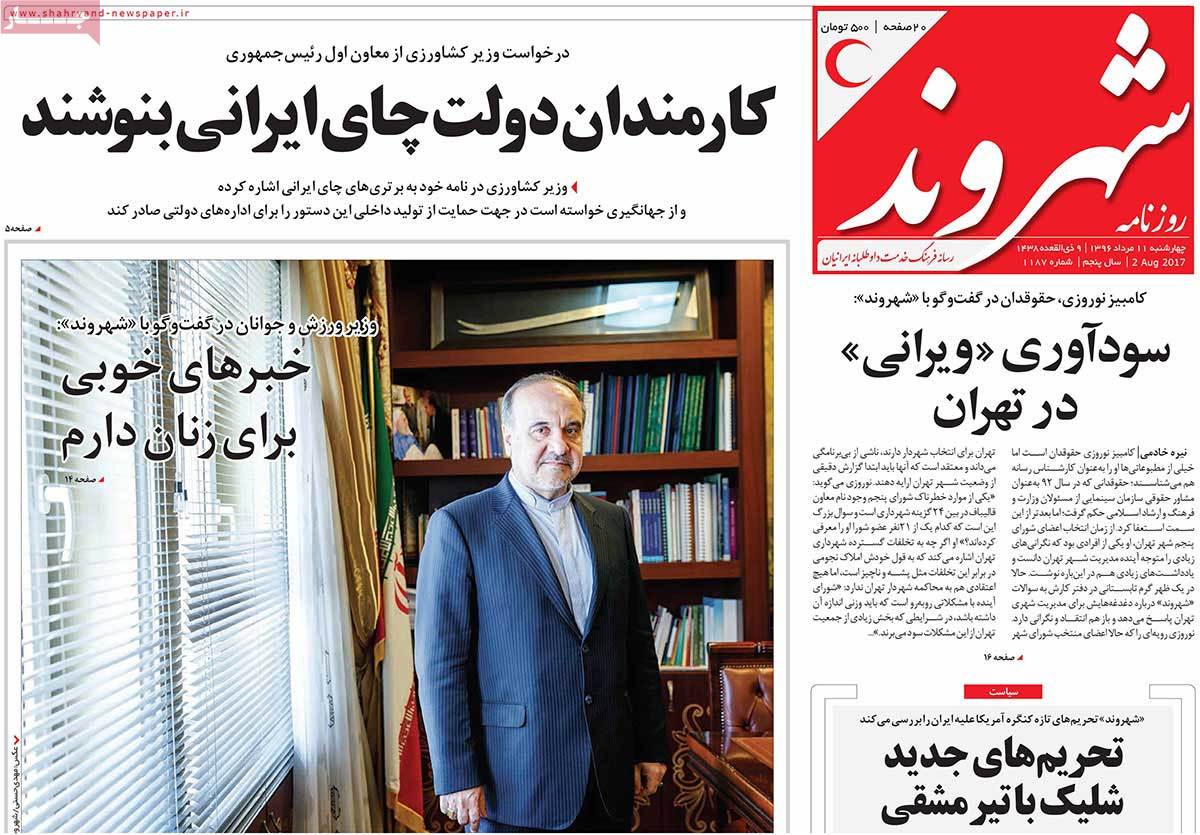
Shahrvand:

1- Agriculture Minister Urges First VP: Civil Servants Drink Iranian-Made Tea

2- Sports Minister: I Have Good News for Women
A Look at Iranian Newspaper Front Pages on August 2


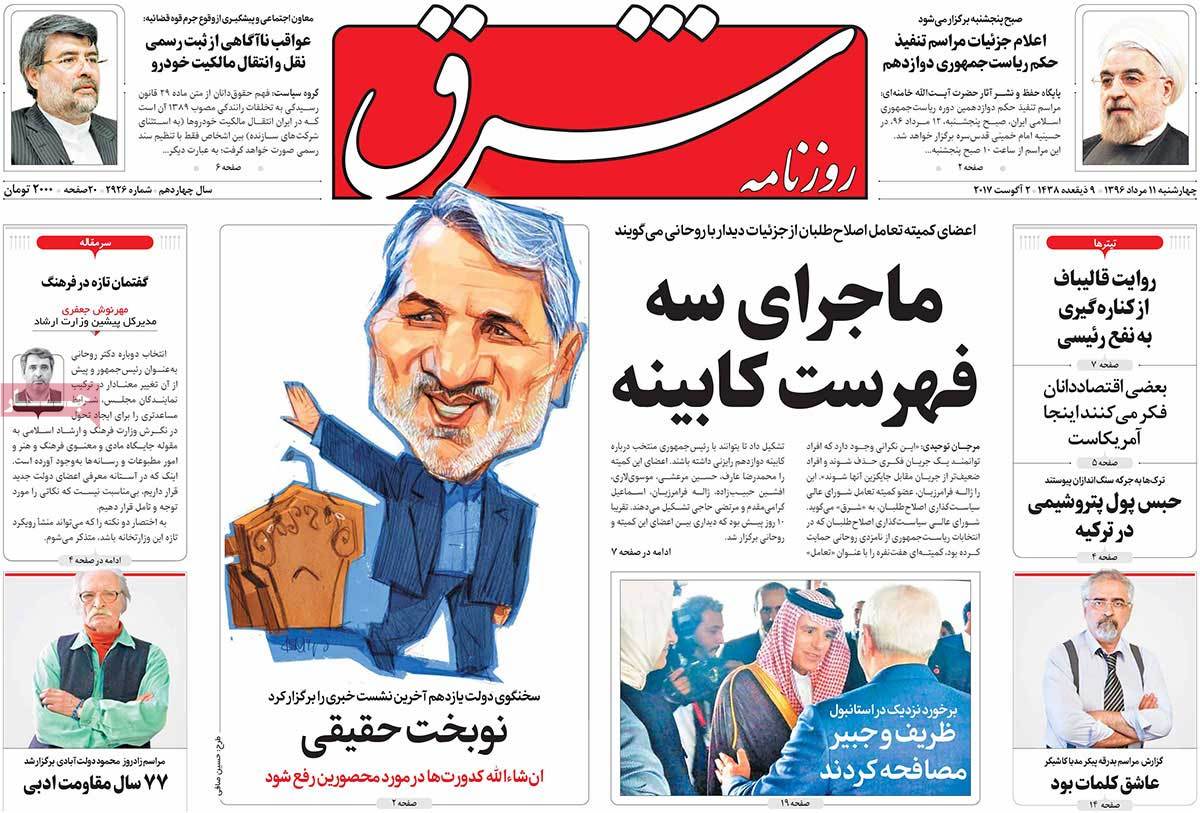
Shargh:

1- Gov’t Spokesman: We Hope Squabble with Those under House Arrest Would End

2- Close Encounter in Istanbul: Zarif, Jubeir Shake Hands
A Look at Iranian Newspaper Front Pages on August 2


Some Names in President Rouhani’s New Cabinet Revealed

Despite rumors that Oil Minister Bijan Namdar Zanganeh would not stay in office in Rouhani’s second term, he was appointed as the nominee for the cabinet post in a meeting of the high-ranking officials of the current administration on Tuesday night.

Minister of Cooperative, Labor and Welfare Ali Rabiee was also appointed as Rouhani’s nominee for the same position.

Speaking to reporters on the sidelines of the last cabinet session on Wednesday, Vice-President for Women and Family Affairs Shahindokht Molaverdi announced that three women would be on the new cabinet list.

Vice-President for Legal Affairs Majid Ansari also told reporters that he would not stay in office in Rouhani’s second term.

Justice Minister Mostafa Pour-Mohammadi, who had also attended the last cabinet session, said an experienced judge would replace him.

President Rouhani is slated to take the oath of office at an open session of the parliament on Saturday, August 5.

The inaugural ceremony will be held after the endorsement of Rouhani’s presidency by Leader of the Islamic Revolution Ayatollah Seyed Ali Khamenei.

Following the swearing-in ceremony, the president will have two weeks to submit his new cabinet to the parliament for a vote of confidence.

In Iran’s presidential election on May 19, Rouhani garnered 23,549,616 votes from a total of 41,220,131 ballots. The runner-up, Ebrahim Raisi, secured 38.5% of the votes.

No sitting president in Iran has failed to win a second term since 1981.

During the previous presidential election in June 2013, Rouhani had emerged victorious by winning 50.7 percent of a total of over 36 million votes. He had won more than three times as many votes as his closest challenger.

Iran to Show Coordinated Response to US Violation of JCPOA

shamkhani

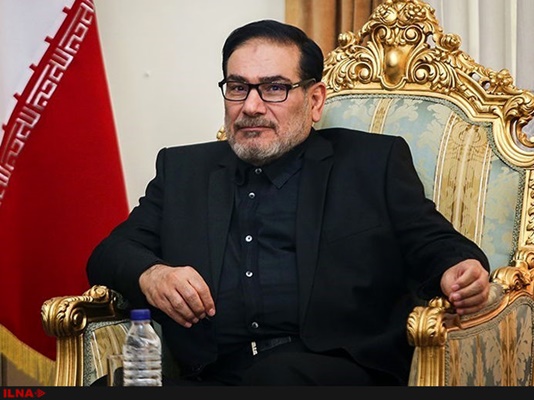
“Iran’s countermeasures against the US lack of commitment to the JCPOA will be coordinated and [conducted in] parallel [with one another],” Secretary of Iran’s Supreme National Security Council Ali Shamkhani said on Wednesday.

He was referring to the agreement, called the Joint Comprehensive Plan of Action (JCPOA), by its acronym.

The comments come as the US is about to impose a new round of sanctions against Iran over its national missile program. The draft sanctions law, which also targets Russia and North Korea, has passed the US Congress and needs President Donald Trump’s signature to become law.

Senior Iranian authorities, including President Hassan Rouhani, have vowed a decisive response to the planned sanctions, which they argue are in violation of both the spirit and letter of the JCPOA.

Iran and the P5+1 group of countries — the US, the UK, France, Russia, and China plus Germany — inked the deal in July 2015. It lifted nuclear related sanctions on Iran, which, in turn, put certain limits on its nuclear work.

The United Nations nuclear watchdog has invariably certified Iran’s commitment to its contractual obligations since January 2016, when the deal took effect. The US, however, has prevented the deal from fully yielding. Washington has refused to offer global financial institutions the guarantees that they would not be hit by American punitive measures for transactions with Iran.

“A host of retaliatory measures in the legislative, technical, nuclear, economic, political, defense, and military areas, have been devised by the body monitoring the JCPOA, which will be pursued in a coordinated way and in parallel with each other,” Shamkhani added.

He added that “the US’s arrogant policies could only be confronted through dependence on national power and capabilities,” Shamkhani said.

Shamkhani further said the current US administration’s “lack of perceptiveness and creativity” in its attitude towards Iran serves as an opportunity for the Islamic Republic’s diplomatic apparatus.

The nuclear agreement has not reduced US enmity towards the Iranian nation, he said, noting that one of the reasons behind Washington’s disappointment at the current status quo is its failure to change Iran’s principal regional policies under the post-JCPOA circumstances.

The official further said the Iranian nation has an inalienable right to develop its missile might, which serves as a deterrent in the face of threats, stressing that the country’s defense capabilities are not up for negotiations.

Iran Denies Reports on EU Commissioner’s Visit to Tehran

“The report is totally false and Mr. Andrus Ansip, the European Commissioner for Digital Single Market, has not had any visit to Iran, either in personal capacity or as an EU official,” Qassemi noted in a statement on Wednesday.

The statement came after media reports claimed Ansip had arrived in Tehran on Thursday (July 27), without making a noise in the media and without receiving the official welcome, usually in the hands of foreign diplomats.

Certain Iranian media outlets further claimed the visit was so unexpected that his arrival in Iran, via Imam Khomeini International Airport, caused problems that kept him for several hours at the airport.

“In the absence of coordination, officials of the Iranian Ministry of Foreign Affairs did not have enough time to prepare the reception protocols and the European official had to spend three hours at the airport,” the media reports added, raising speculations about Ansip’s economic mission in Iran.

The European Commission is the institution with executive power in the European Union and Ansip is the Vice-President responsible for the Single Digital Market.

Trump in a Hurry to Scrap Iran Nuclear Deal: Analyst

Political commentator Hossein Yari has, in a Farsi analytical piece published in the Basirat news website, weighed in on US President Donald Trump’s stance on the nuclear agreement signed between Tehran and six world powers known as the Joint Comprehensive Plan of Action (JCPOA). The following is the full text of the article:

Key developments have unfolded regarding the JCPOA over the past few days. Each of these developments can trigger a new row over the agreement. The meeting of a joint committee tasked with reviewing the JCPOA, the agreement between the US Congress and White House over fresh sanctions on Iran, the removal of US Secretary of State Rex Tillerson from the team reviewing the JCPOA and the like are all issues which should be simultaneously studied and analysed at this juncture. In this respect, the following points are worth mentioning:

  1. Reports on the recent meeting of the committee reviewing the JCPOA show that although representatives of the Iranian Foreign Ministry expressed their objection to the P5+1 group’s point men, the objection was not strong enough to be regarded as an official criticism of Washington’s blatant violation of the JCPOA. In other words, Iran’s envoys only expressed their dismay over US measures. Experience over the past two years shows that the US does not care about the dismay expressed by the representatives of Iran and even other members of the P5+1 group. To officially announce that Washington has breached the deal would be different from a diplomatic dismay which simply suggests the US has failed to comply with some of the provisions of the JCPOA.
  2. At last, as it was predicted, the US House of Representatives and Senate reached agreement on the imposition of new sanctions on Iran, Russia and North Korea. The spokesperson for the White House also defended the sanctions and confirmed the US government will approve the sanctions. Therefore, the imposition and implementation of the new sanctions (in the form of non-nuclear sanctions) against our country is sure to happen. Although Trump claims the new bans have been slapped on Iran over non-nuclear issues and not over the JCPOA, it goes without saying that such a claim is not legally and logically acceptable. The imposition of the sanctions amounts to an attempt to disrupt the normalisation of Iran’s economic ties with other countries in the era following the conclusion of the JCPOA. In addition to the sanctions, the US Treasury continues to make efforts to sabotage banking transactions between Iran and other countries (especially major banks). Such circumstances leave no doubt that the US has contravened the JCPOA. Now it is time our country’s (Iran) foreign policy and diplomacy apparatus, especially the domestic committee tasked with reviewing the JCPOA, announced Washington’s flagrant violation of the agreement and opted to reciprocate the US move. Of course, the necessary measures have been envisaged, but now it is time they were implemented.
  3. US Secretary of State Rex Tillerson, who has recently corroborated Iran’s compliance with the JCPOA, has been removed from the committee reviewing the JCPOA at the Trump administration! In other words, the US president has removed the number one man in the US diplomacy and foreign policy apparatus from the trend of reviewing the JCPOA. Some news sources, including the CNN, speak of Tillerson’s possible resignation as Secretary of State in the near future. The news sources have mentioned Tillerson’s differences with Trump over the JCPOA as one of the most important reasons behind his possible resignation. But what is the nature of these differences?

If we refer to the not-too-distant past and take a look at the US secretary of state’s stances on the JCPOA, we will realize that Tillerson had some of the toughest positions on the agreement. At the time when Trump stepped into the White House, Tillerson said in a hearing session held at the Senate to confirm his competence that the JCPOA needed to be revised. His remarks received so much coverage that Defence Secretary James Mattis had to speak of Washington’s compliance with the nuclear deal. Later on, Tillerson repeatedly described the JCPOA as a bad deal for the US. So, we cannot consider Tillerson as a pro-JCPOA figure! He is regarded as one of the opponents of the deal.

Still, it seems a key bone of contention between Trump and Tillerson over the JCPOA is related to how they deal with the issue in a legal context. Trump seems to be in a hurry to scupper the JCPOA and, in this regard, has not calculated the legal mechanisms and political repercussions of such a move. Still, Tillerson, as secretary of state, believes such a move should be taken step by step. Anyway, the dismissal of Tillerson shows Trump’s extremist approach in countering the nuclear deal with Iran.

  1. Now there is no room for turning a blind eye to Washington’s breach of the JCPOA. Our President and foreign minister, too, have confirmed that the US has violated the spirit and letter of the JCPOA. At the moment, it is all the more necessary to give a tough and crushing response to the US by virtue of the mechanisms envisaged in the JCPOA document and, more importantly, by virtue of two key documents (a statement by Leader of the Islamic Revolution Ayatollah Seyyed Ali Khamenei after the JCPOA was ratified and a statement by the Iranian parliament). In this equation, the potential of Russia, China and even some European countries should be tapped into. At this sensitive juncture, European countries also admit that the US has breached the JCPOA. Hence, Federica Mogherini, who is in charge of the committee tasked with reviewing the JCPOA, as well as other European officials has a tough test ahead. Now it’s high time the European Troika clarified its straightforward position on the US contravention of the JCPOA and stop blowing hot and cold on the issue. It is noteworthy that European countries have, so far, been unable to get a good mark in this respect.

When the Iran Sanctions Act (ISA) was being renewed, European leaders knew that US had pledged not to renew the law, but they did not describe the move as an example of the Obama administration’s violation of the JCPOA. Moreover, European countries have done nothing vis-à-vis the US Treasury’s repeated breaches of promises when it comes to the normalization of trade and banking relations with Iran. Now, at a time when European countries also admit that the US has contravened the JCPOA, we should wait and see what their next move will be in confronting the White House.

Moderates’ Political Future Hinges on Rouhani’s Cabinet Line-up

Reformist political activist Abdollah Nasseri has, in an editorial published in the Persian-language Arman-e Emrooz daily, argued that President Rouhani’s next cabinet should represent the civil society who supported him in the May election.

Nasseri says the political future of moderates and reformists in Iran hinges on the way Rouhani will form his cabinet.

The text of the analytical piece follows:


The recent presidential election was undoubtedly one of the most fabulous elections in Iran’s history as voters from two generations that took shape following the 1979 Islamic Revolution and had political understanding actively took part in it.

Moreover, although the bulk of the news on the election was carried via the cyberspace, traditional media such as the state radio and TV, the press, news agencies and even Friday Prayer leaders and their sermons played a determining role as well.

However, in the May 19 presidential election, the civil society took shape through social media, so much so that it overshadowed all conventional media which could influence the trend of the voting. That’s why we witnessed a unique election where a well-established civil society rallied behind Hassan Rouhani. The huge number of votes cast on Election Day, not to mention the voters who did not get the opportunity to cast their ballots due to long lines at polling stations, stood at around 27 million. The president should know that this huge number of votes represented the demands of the two Iranian generations.

The demands are basically political, social and economic ones. So, irrespective of the gender, average age and any claim of a share, if Rouhani’s second Cabinet is not efficient, consistent and coordinated unlike the first one, definitely it will affect the political future of all elements influencing the ballot boxes. Therefore, we may not witness major social changes because we believe regardless of which person and camp has won the election, a massive turnout could serve as a strong national and international backup for the country.

So, if Mr. Rouhani’s second cabinet line-up is similar to that of the first one, in which differences of opinion led to deviation from the president’s programs in some areas, the performance of the president and his cabinet over the next four years will not only affect upcoming elections, but fail to result in any logical development in terms of consolidating national foundations and narrowing social and generation gaps. If this trend continues, it will incontrovertibly influence the political future of officials, especially at a time when social media are so powerful in disseminating information and dominating the public opinion.

The president seeks to show the 24-million strong community of his supporters that he will fulfil his pledges, which requires an efficient cabinet. Of course, “efficient” has a specific meaning here. It means Cabinet members should agree to the president’s discourse. Another point worth mentioning is that the president himself announced that a considerable number of the Cabinet members had not supported him in the election.

Therefore, the twelfth cabinet should not only agree to President Rouhani’s discourse, but should also account for the demands of the voters. If we accept that women and youth contributed heavily to Rouhani’s election win, these two strata of society should be present in managerial posts to run the country. Of course, that does not mean that voters are claiming shares, but that the society is ready to see the Cabinet taking shape.

In other words, as Mr. Rouhani believed, the grassroots support behind him was the result of moderates and reformists’ information dissemination and election campaigns. Naturally, the Cabinet should be the representative of such a society. The Cabinet is not a joint stock company, but should exactly represent the civil society which has rallied behind the president.

Iran Exporting Hand-Made Batik Shawls to Neighbours

Batik, a technique of wax-resist dyeing, is used in crafting these totally handmade shawls in Osku, East Azarbaijan Province.

The applied wax resists dyes and therefore allows the artisan to colour selectively by soaking the cloth in one colour, removing the wax with boiling water, and repeating if multiple colours are desired.

The silk used in these unique shawls are also woven in Osku.

Here are Mizan’s photos of the process of making batik shawls: