Tuesday, May 5, 2026
Home Blog Page 3950

Iran Ready to Enhance Cooperation with Gambia

Iran Ready to Enhance Cooperation with Gambia

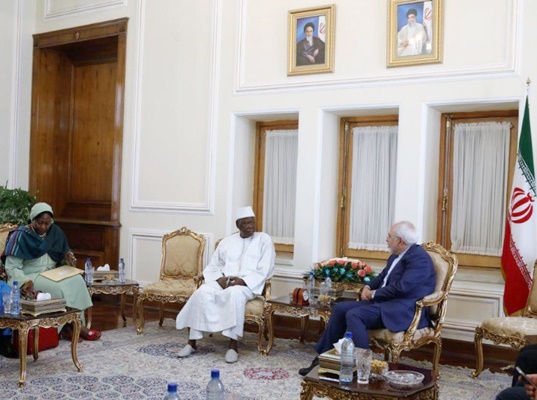
During the Monday meeting, Sanneh underlined the need for promotion of mutual cooperation between Iran and The Gambia.

He said both countries have governments that are just going to start their work, and thus new plans should be implemented to develop these collaborations.

“There are very good grounds for Tehran-Banjul cooperation in the fields of agriculture, technology, health, and investment in economic infrastructures,” he added.

Zarif, for his part, voiced Tehran’s preparedness to start a new chapter of cooperation with The Gambia in such fields as agriculture, health, technology, power plants, and fight against extremism and terrorism.

Elsewhere in the meeting, Zarif also received the Gambian president’s written message for Iranian President Hassan Rouhani.

Iran FM Holds Talks with Grand Mufti of Caucasus

Iran FM Holds Talks with Grand Mufti of Caucasus

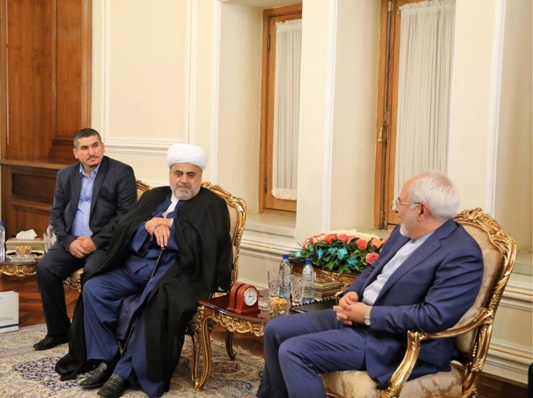
During the meeting, Zarif referred to the frequent meetings between Iranian and Azerbaijani presidents, and hailed Tehran-Baku outstanding bilateral relations.

“The development and stability of Azerbaijan Republic is of great importance to us, and Iran considers it as its own development and stability,” he went on to say.

Sheikh ul-Islam Pashazadeh, for his part, referred to Azerbaijan’s good ties with the Islamic Republic of Iran, and praised Zarif’s efforts to strengthen the relations.

“We will endeavour to reinforce the relations more than ever,” he added.

‘Riyadh Can’t Continue Bombing Yemen Forever’

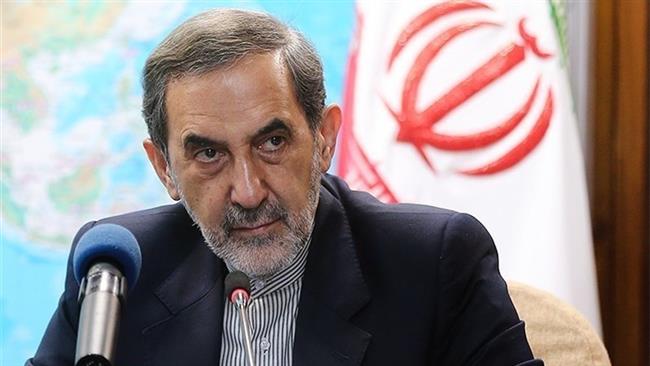
Ali-Akbar Velayati, a senior international advisor to Iran’s Leader, has expressed regret that international organizations are not fulfilling their responsibilities regarding Yemen.

Speaking on the sidelines of his meeting with Danish Deputy Foreign Minister Jonas Bering Liisberg, Velayati said Saudi Arabia cannot go on bombarding Yemen forever.

He further called on the international community to stop remaining indifferent toward Riyadh’s aggression against Yemen.

Velayati also said that he was confident the resistance of Yemeni people will ultimately bear fruit.

According to a Farsi report by Al Alam News Network, he then touched upon the calamities of Yemeni people.

“They are under siege and suffering from pharmaceutical and food shortage. They are under Saudi bombardments round the clock for no good reason,” he noted.


Iranian Pilgrims’ Security Must Be Ensured

Elsewhere in his remarks, Velayati said it falls upon Riyadh to ensure the security of Iranian pilgrims and to respect them.

“This has been among Iran’s key preconditions as agreed by Saudi Arabia.”

He said the Saudi government is duty-bound to guarantee the security of the holy shrines and pilgrims.

“So far, there have been no problems as far as I know.”

“Iran has shown that it is very sensitive about the security of its pilgrims, and we hope Saudi Arabia, too, will be sensitive about its responsibilities, and rethink its policies, especially its interference in some Arab countries like Yemen,” said Velayati.

Saudi Arabia Using Biological Bombs in Yemen: Sources

At a time when Yemen is under siege by Saudi Arabia from the air, sea and land for more than two and a half years, the sufferings of Yemeni people are growing in the face of the international community’s unprecedented silence.

According to a Farsi report by Al-Alam News Network, part of the catastrophic situation in Yemen is related to the outbreak of diseases. The last epidemic was that of cholera which has so far afflicted hundreds of thousands of people and claimed thousands of lives.

In addition to cholera, meningitis has also broken out in Yemen, afflicting dozens of people so far, say sources close to the World Health Organization.

According to Yemeni hospital sources, the Riyadh regime is using biological bombs in its attacks on different parts of the country. The use of internationally banned weapons in Yemen has resulted in the outbreak of several diseases.

A large number of Yemeni people have come down with meningitis, says a hospital source in the Yemeni capital, Sana’a.

As Saudi Arabia continues to attack and destroy medical centres and prevent pharmaceuticals and medical aid from getting in while pressing ahead with its devastating siege of Yemen, the number of meningitis-sufferers is increasing while hundreds of thousands of women and children have lost their lives to cholera.

Meningitis is an acute inflammation of the protective membranes covering the brain and spinal cord, known collectively as the meninges. The inflammation could be caused by viruses or bacteria, or less frequently, by certain medicines.

It is one of the most dangerous diseases that the people of a community may contract.

Iran Planning to Raise Women’s Legal Age of Marriage

Iran Planning to Raise Women’s Legal Age of Marriage

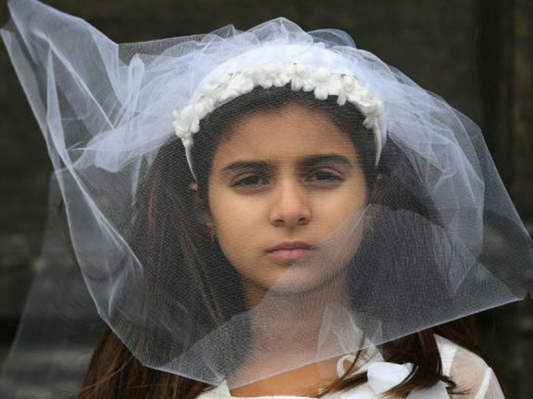
Iranian lawmaker Fatemeh Zolqadr said the Iranian Parliament, in coordination with the country’s Vice-Presidency for Women and Family Affairs, has decided to compile a plan to raise the legal age for women’s marriage in Iran and set a number of restrictions to prevent child marriage.

According to a Farsi report by ICANA, she went on to say that the issue of modifying the marriage age of Iranian women was raised in a meeting held last Iranian year (ended mid-March 2017) between the cultural faction of the Iranian Parliament and a number of the country’s top clerics.

Iran Planning to Raise Women’s Legal Age of Marriage
‘Child Marriage’ cartoon by Ehsan Ganji / Shahrvand Newspaper

The MP said a senior Iranian cleric, Ayatollah Nasser Makarem Shirazi, has also consented to raising Iranian women’s marriage age.

“This comes as opposition is still being voiced by some in the country against the plan. Nevertheless, the issue has not yet been done away with.”

She said meetings are being held to further discuss the subject and follow ups are being done to this end, adding this plan needs time to produce favourable results.

“In the first step, women’s marriage under the age of 13 is required to be prohibited under any circumstances. This is because, unfortunately, some Iranian girls are [currently] still being allowed by their fathers to marry under this age. Such a permission is given by their fathers out of poverty or due to their addiction. In such cases, usually no complaint is lodged in Iranian courts to enable us to prevent their occurrence.”

Zolqadr stressed that certain restrictions are required to be put on women’s marriage age, for child marriage would eventually lead to divorce and cause social harms.

Iran Not to Let Foreigners Inspect Its Military Sites: IRGC General

Asked by reporters about recent media reports that the US administration is pushing for inspection of Iranian military sites, General Hajizadeh said, “The answer is clear: we will not give them such a permission.”

His comments came after AP quoted senior US officials as saying in late July that the Trump administration is pushing for inspections of Iranian military sites in a bid to test the strength of the Joint Comprehensive Plan of Action (JCPOA), a nuclear agreement between Iran and the Group 5+1 (Russia, China, the US, Britain, France and Germany).

Elsewhere in his comments, the top commander said the IRGC, the top military force in the region, supports the Iranian administration to help it confront the United States’ excessive demands.

He also warned that the US is seeking to “disarm” Iran with different tactics such as imposing sanctions, mounting pressure and waging psychological warfare.

Rouhani’s Inauguration Show of Iran’s Diplomatic Prowess

Morteza Saffari Harandi, who sits on the Parliament’s National Security and Foreign Policy Commission, says foreign dignitaries took part in the oath-taking ceremony of President Hassan Rouhani at a very high level.

“The most unprecedented presidential swearing-in ceremony at the highest diplomatic level, not only in the Middle East but in the whole world, was held on August 5 at the Iranian Parliament in Tehran,” he said.

He said President Hassan Rouhani’s inauguration ceremony turned into a show of Iran’s diplomatic prowess at a time when certain countries seek to promote Iranophobia by spending millions of dollars.

He highlighted that representatives from international organizations were also present in the ceremony along with diplomatic delegations from different countries.

The lawmaker then touched upon the nuclear deal signed between Tehran and six world powers known as the Joint Comprehensive Plan of Action (JCPOA).

“The signature of the JCPOA was an event which torpedoed Washington’s Iranophobia campaign, but [US President Donald] Trump seeks to challenge this diplomatic success by violating the spirit of the JCPOA,” he said.

He said at a time when Washington is breaching the JCPOA, the presence of diplomatic delegations in Tehran shows world countries are lining up against the US in support of the JCPOA.

He said Iran has secured a special status in international relations while Trump’s regional friends have got nowhere even after the high-profile Riyadh meeting.

Iran, Renault Sign Biggest-Ever Car Deal

The value of the agreement, which was signed after 10 months of negotiations, would be €660 million.

Based on it, Renault would team up with Iran’s Negin Khodro and the Industrial Development and Renovation Organization (IDRO) to produce the latest versions of Symbol and Duster brands of the French automaker from 2018.

“Sixty percent of the shares of the partnership would belong to Renault and the rest to Iran,” the domestic media quoted IDRO Chairman Mansour Moazzami as saying. “From the total of 40 percent of Iran’s shares, 20 percent would belong to IDRO and the remaining to the private sector (Negin Khodro).”

Iran’s IRNA news agency reported that the agreement also envisaged the establishment of an engineering and sales center in Iran.

Moazzami further emphasized that Renault would be obliged to export 30 percent of the manufactured items which he said would include cars and parts.

The official further added that the agreement with Renault included a second phase which was yet to be finalized and concerned production of cars in Iran from 2019.

Renault’s key rival PSA had also signed a deal with Iran’s biggest automaker Iran Khodro in June 2016 to produce 200,000 Peugeots a year in the Islamic Republic. It had signed another deal with Iran Khodro’s chief competitor SAIPA to produce a similar number of Citroen cars.

Iran’s overall car production is expected to reach two million cars a year by 2020, up from 1.2 million in 2016.

A Look at Iranian Newspaper Front Pages on August 7

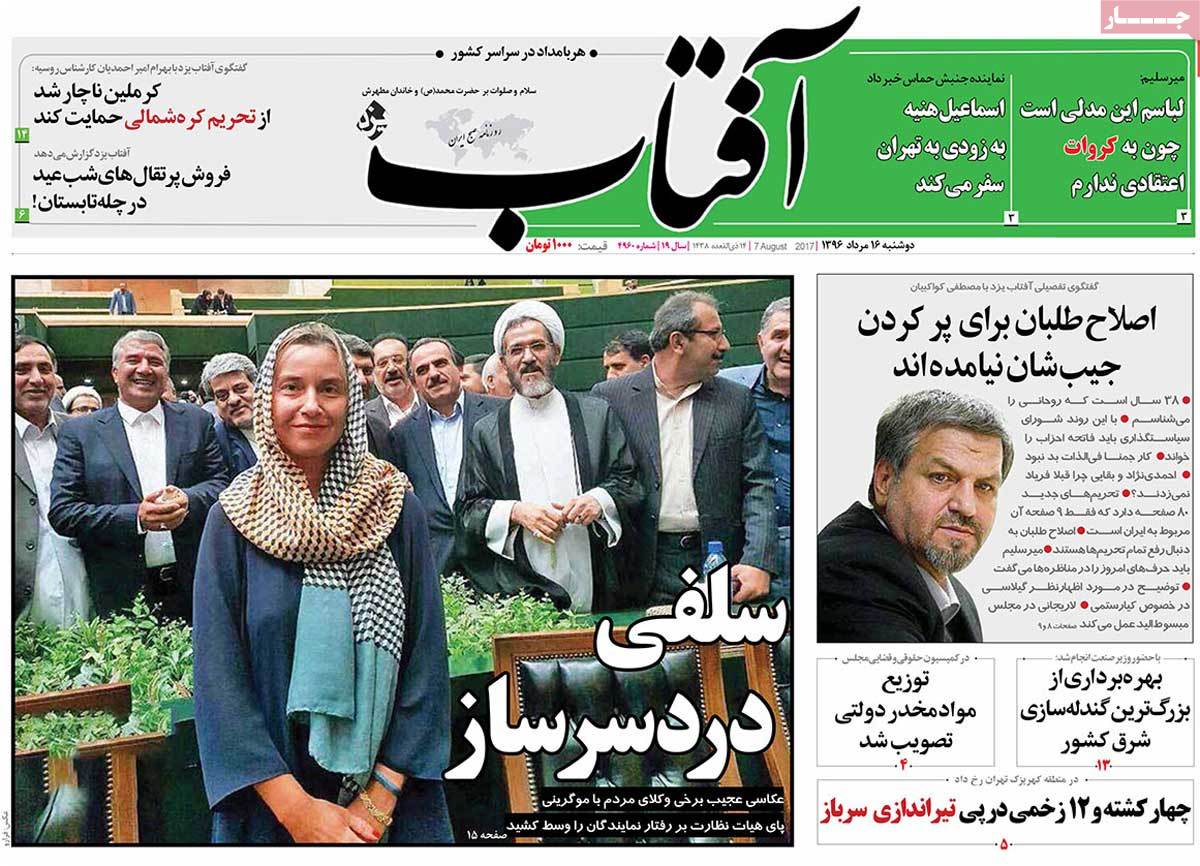
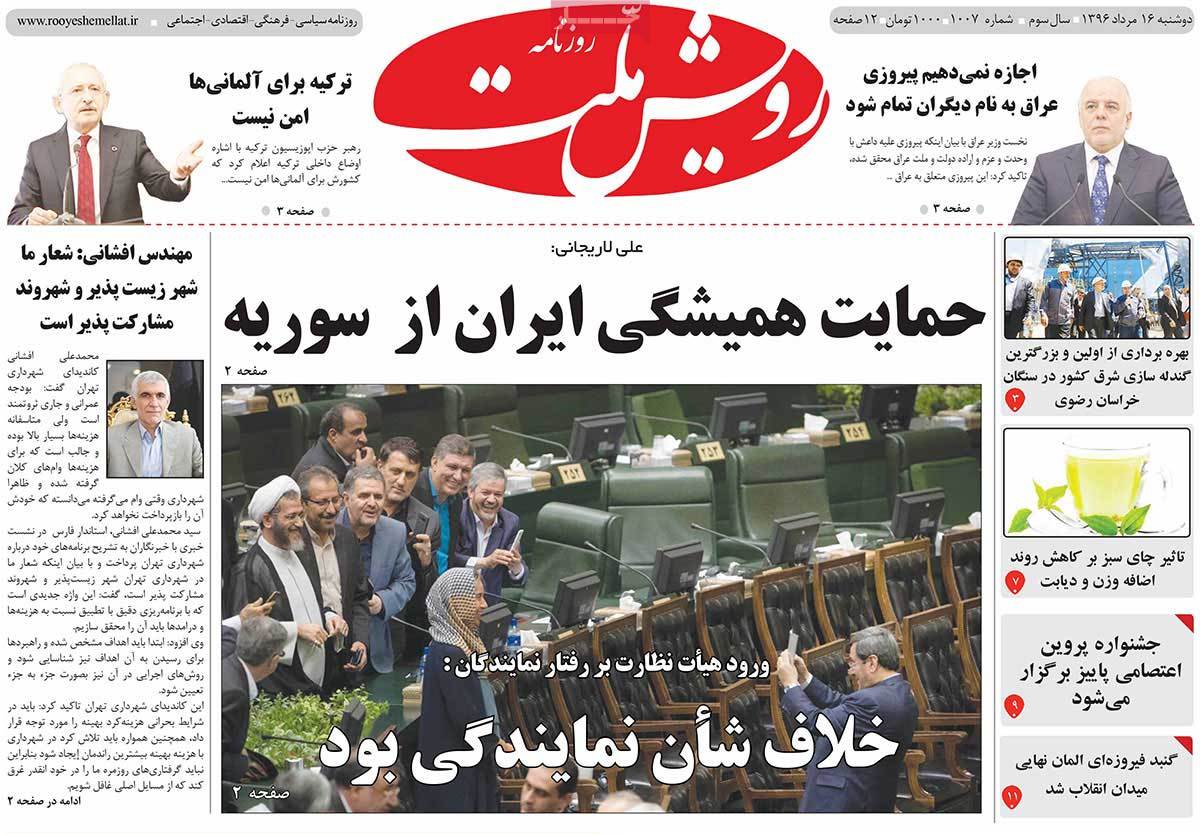
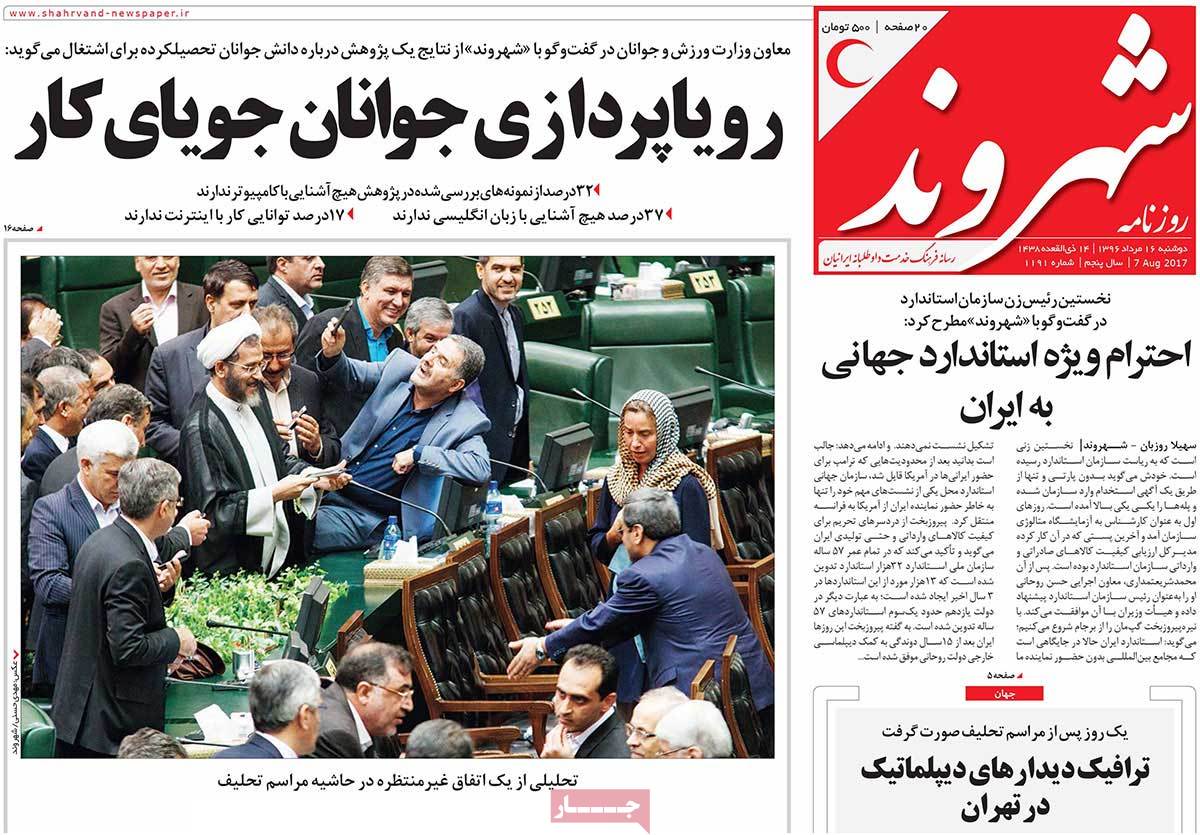
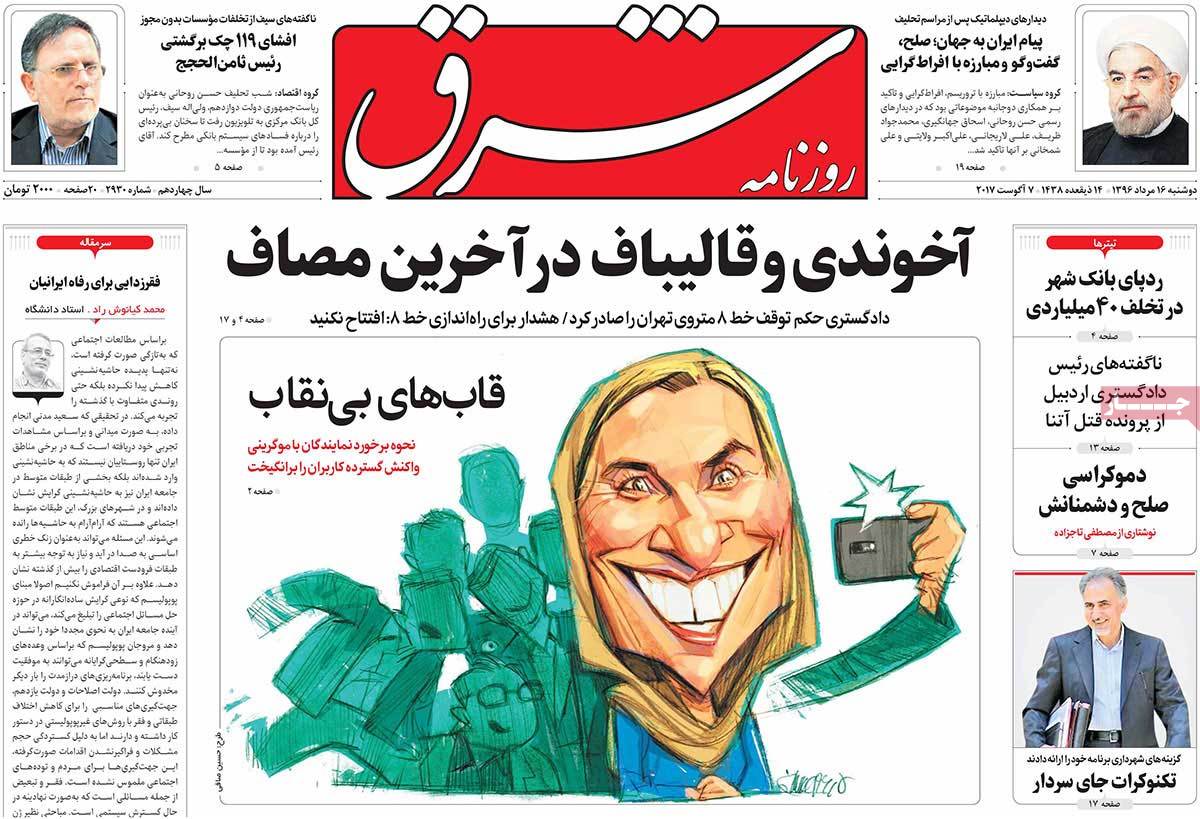
The top story in Iranian newspapers today was the controversial selfies a number of Iranian lawmakers tried to take with EU Foreign Policy Chief Federica Mogherini amid President Hassan Rouhani’s inauguration ceremony.

The diplomatic meetings of President Rouhani and Foreign Minister Mohammad Javad Zarif with high-ranking foreign officials also received great coverage.

The above issues, as well as many more, are highlighted in the following headlines and top stories:


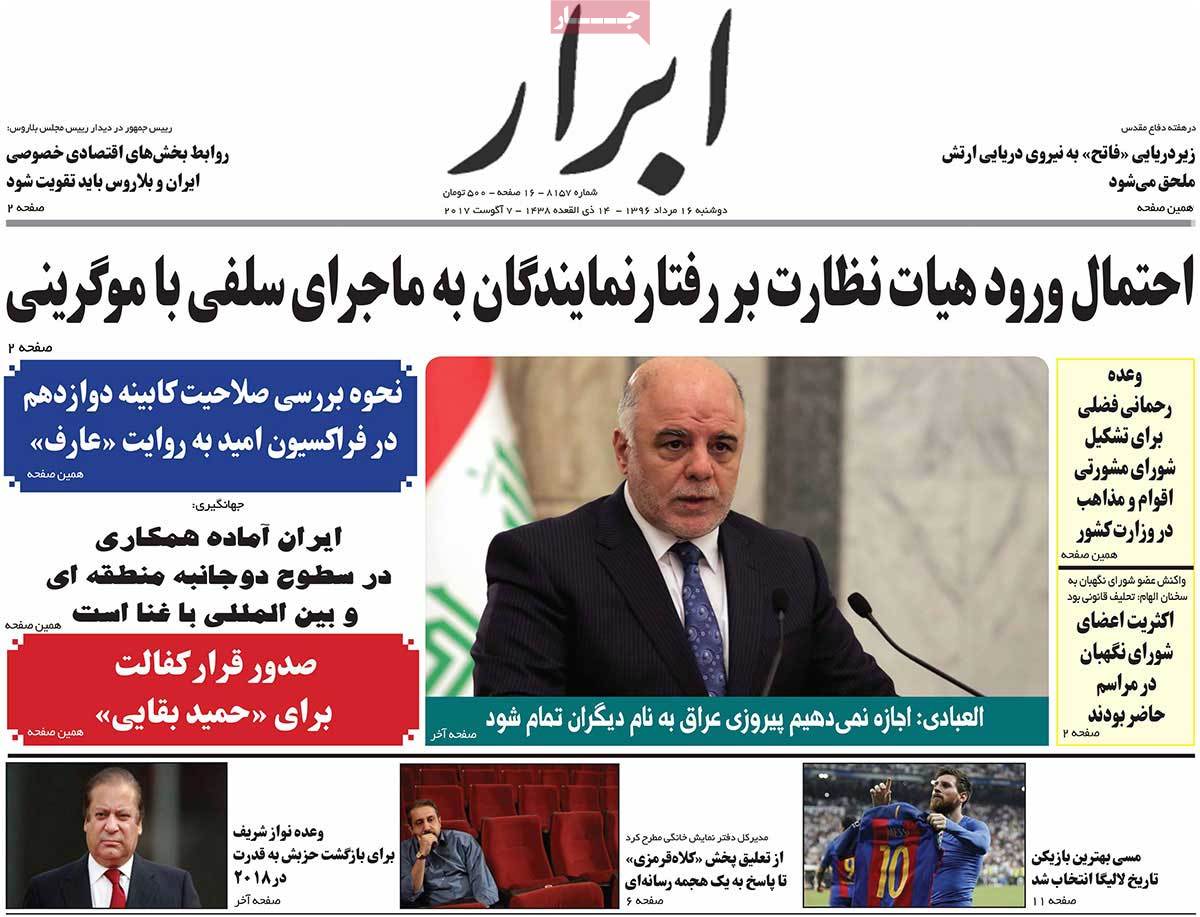
Abrar:

1- Iraqi PM: We Won’t Let Others Claim Iraq’s Victory

2- First VP: Iran Ready to Have Regional, Int’l Cooperation with Ghana

3- Interior Minister Vows to Form Advisory Council for Ethnicities, Religious Minorities


A Look at Iranian Newspaper Front Pages on August 7


Aftab-e Yazd:

1- Troublesome Selfie

  • Iranian MPs’ Strange Photos with Mogherini Spark Controversy

2- Mirsalim: This Is How I Dress up as I Don’t Believe in Wearing Tie

3- Hamas Representative: Haniya Will Soon Visit Tehran

4- Reformists Not Seeking to Earn Money from Politics: MP

5- Government’s Distribution of Narcotics Approved by Parliamentary Commission


A Look at Iranian Newspaper Front Pages on August 7


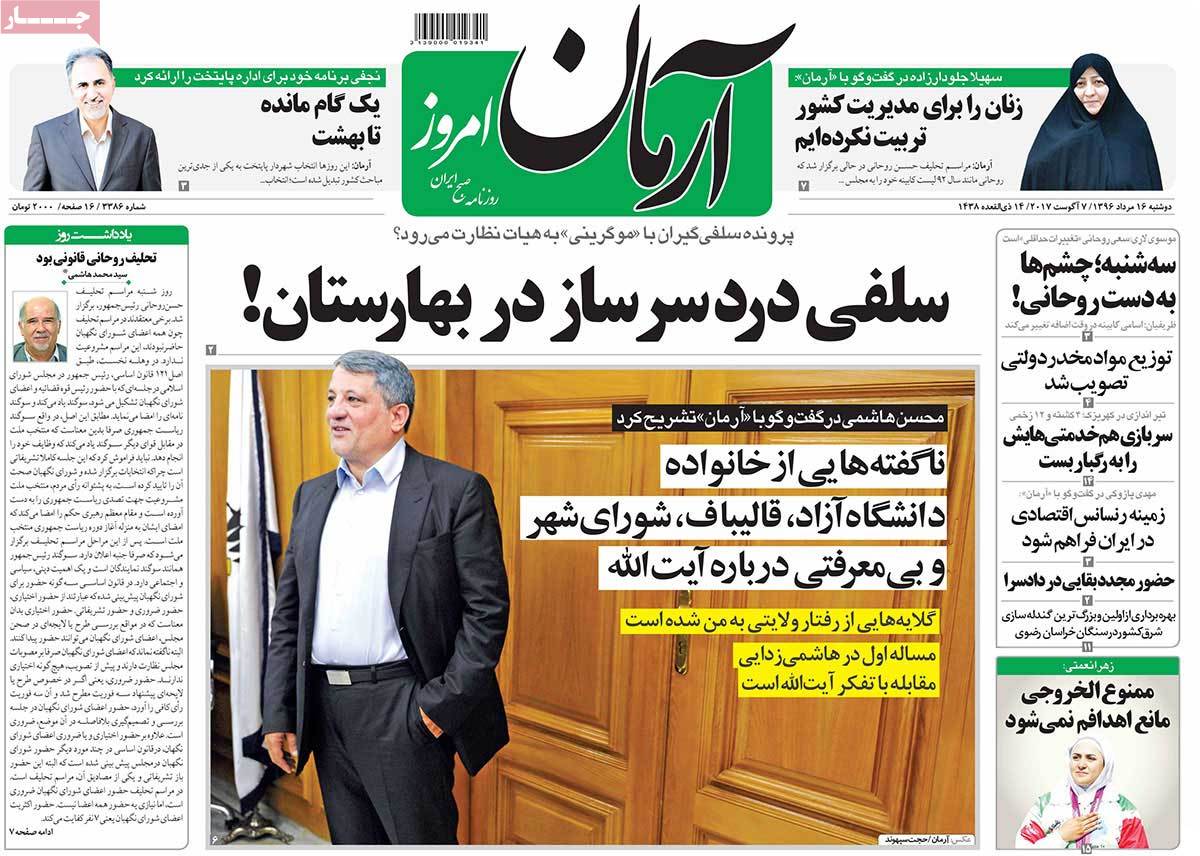
Arman-e Emrooz:

1- MPs’ Selfie Stirs Controversy: Will They Be Punished for Taking Selfie with Mogherini?

2- We’ve Not Trained Women for Governing the Country: Female MP


A Look at Iranian Newspaper Front Pages on August 7


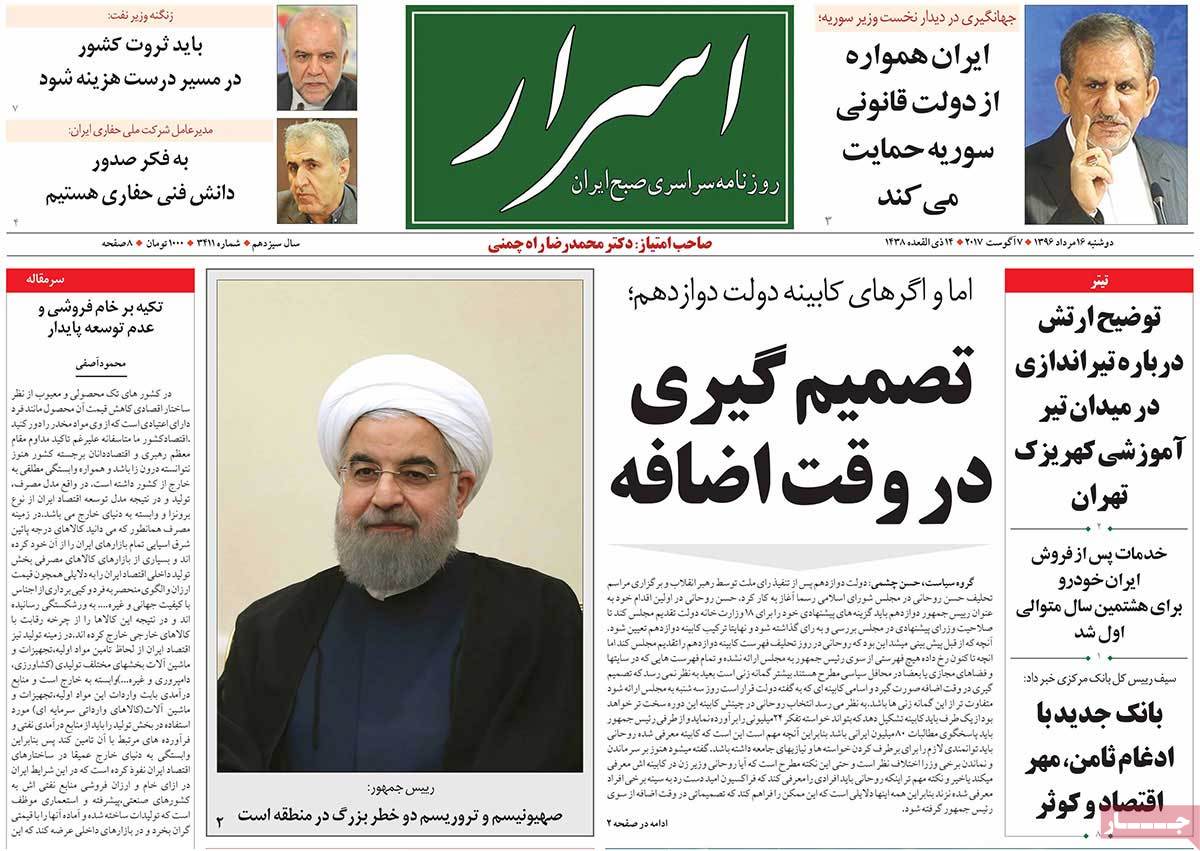
Asrar:

1- First VP: Iran to Always Support Syria’s Legitimate Gov’t

2- Iran Seeks to Export Its Technical Knowledge of Drilling


A Look at Iranian Newspaper Front Pages on August 7


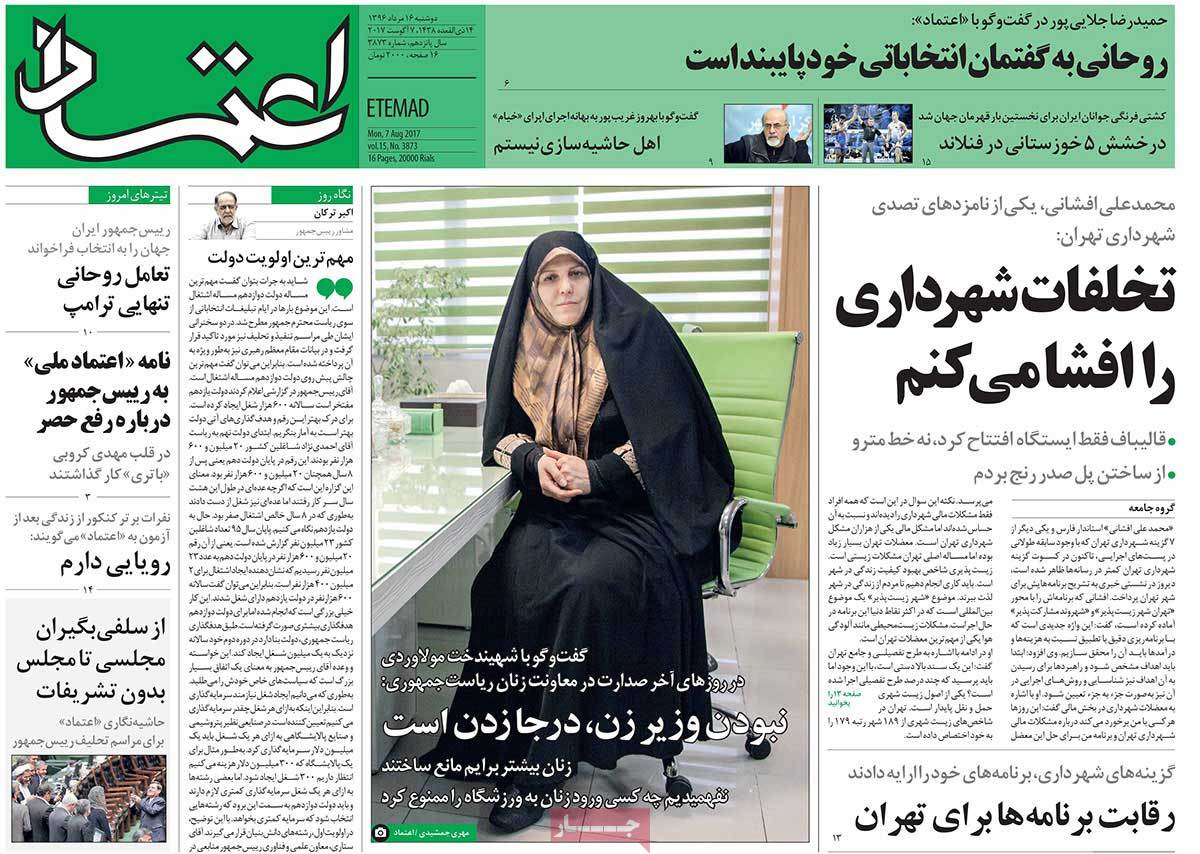
Etemad:

1- Not Appointing a Female Minister Is Stagnation: VP for Women Affairs


A Look at Iranian Newspaper Front Pages on August 7


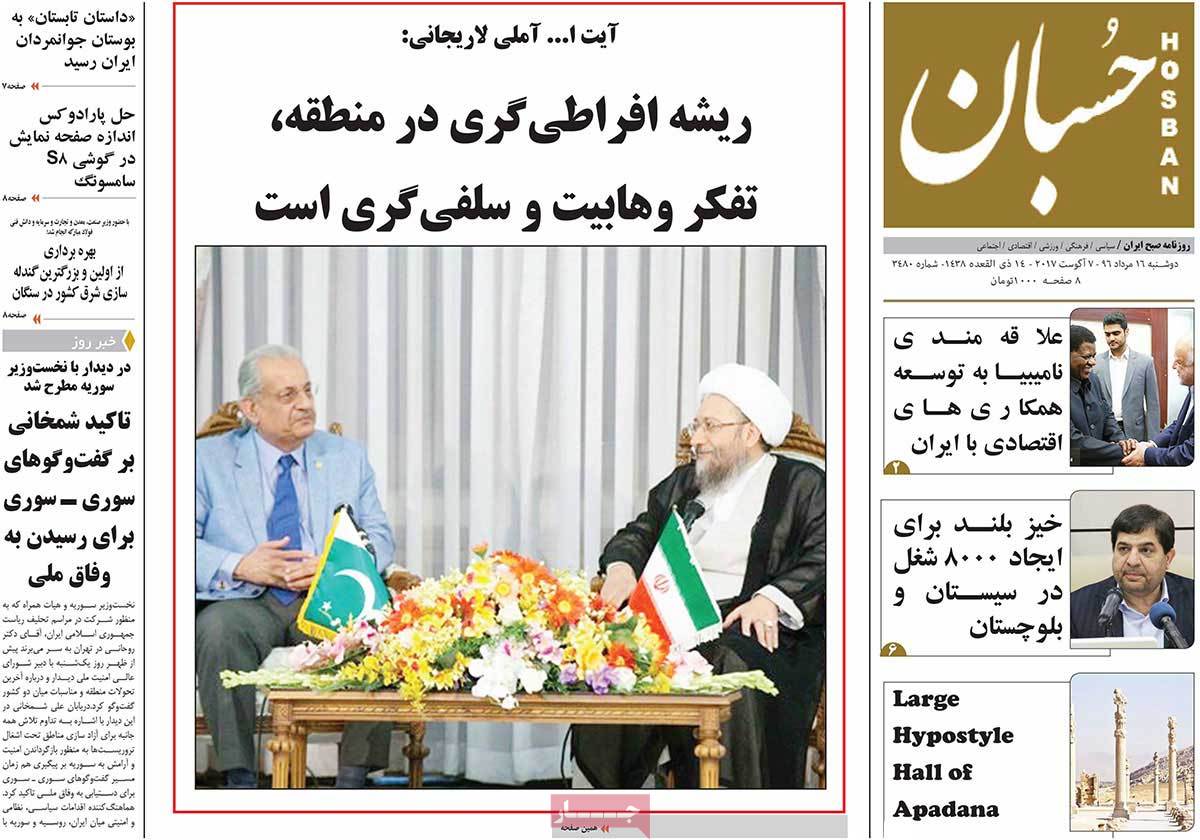
Hosban:

1- Judiciary Chief: Wahhabism, Salafism Roots of Extremism in Mideast

2- Iran’s Shamkhani Underlines Syrian-Syrian Talks for Achieving National Reconciliation


A Look at Iranian Newspaper Front Pages on August 7


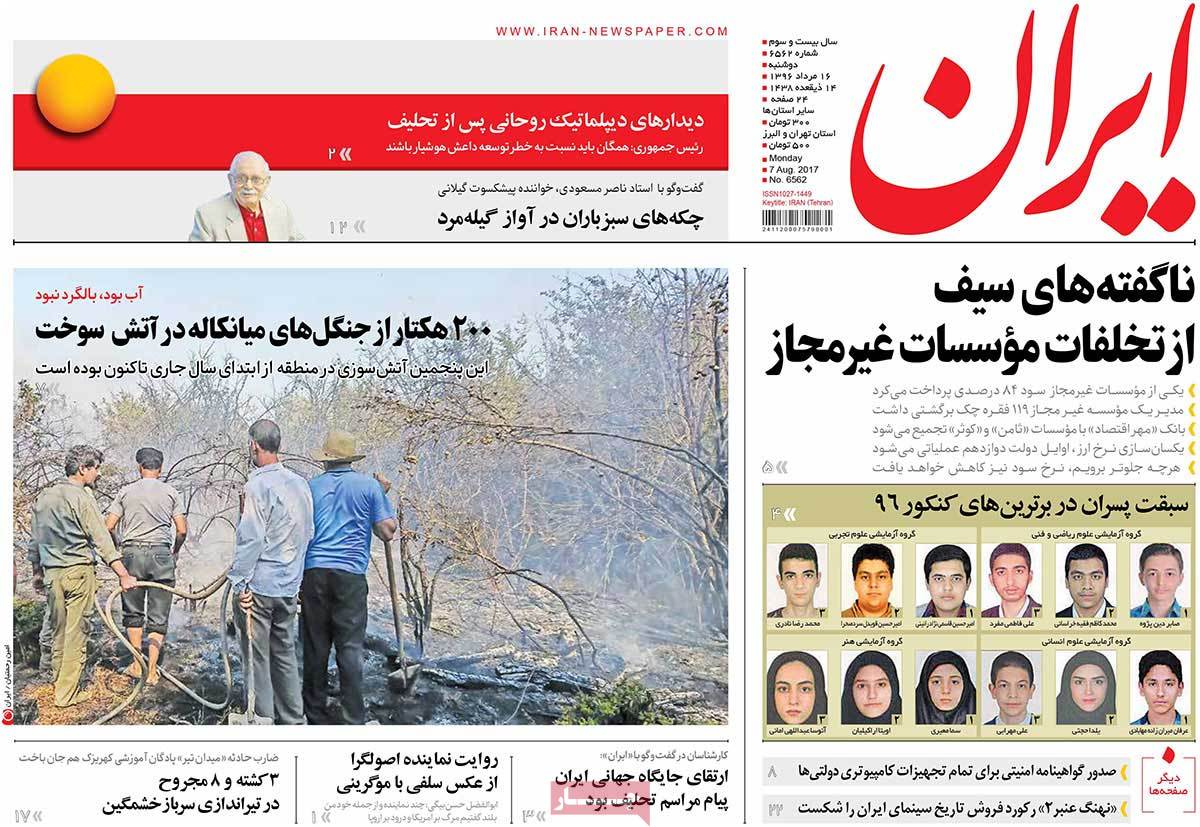
Iran:

1- No Water, No Chopper: 200 Hectares of Miankaleh Forests Burn

  • Fifth Fire in Region in Past 5 Months

2- Rouhani’s Diplomatic Meetings after Inauguration

3- President: We Should All Beware of Danger of ISIS Expansion

4- Experts: Message of Inauguration Ceremony Was Promotion of Iran’s Global Standing


A Look at Iranian Newspaper Front Pages on August 7


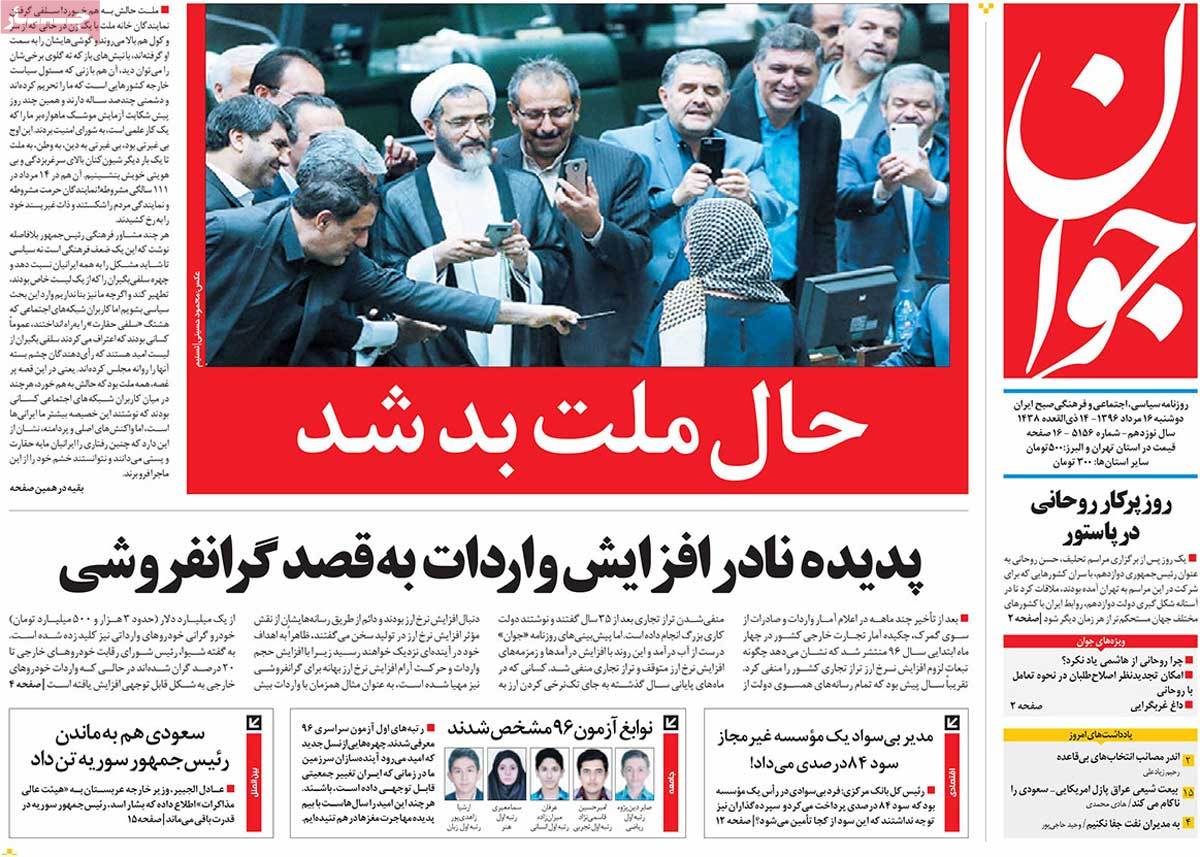
Javan:

1- Iranian Nation Feeling Bad

2- Rare Phenomenon of Increased Imports Aimed at Selling at Higher Prices


A Look at Iranian Newspaper Front Pages on August 7


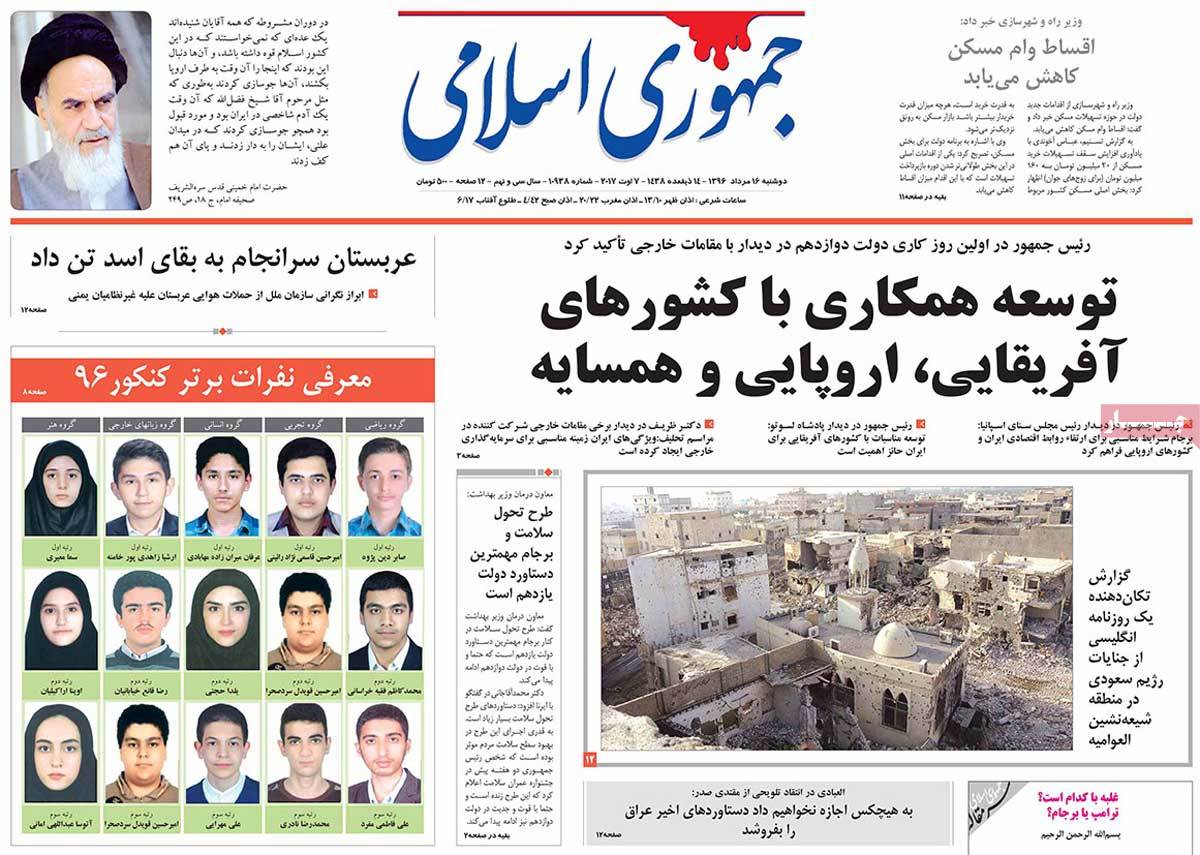
Jomhouri Eslami:

1- Rouhani Underlines Expansion of Cooperation with Africa, European, Neighbouring States

2- British Daily’s Shocking Report of Saudi Crimes in Shiite-Majority Al-Awamiyah


A Look at Iranian Newspaper Front Pages on August 7


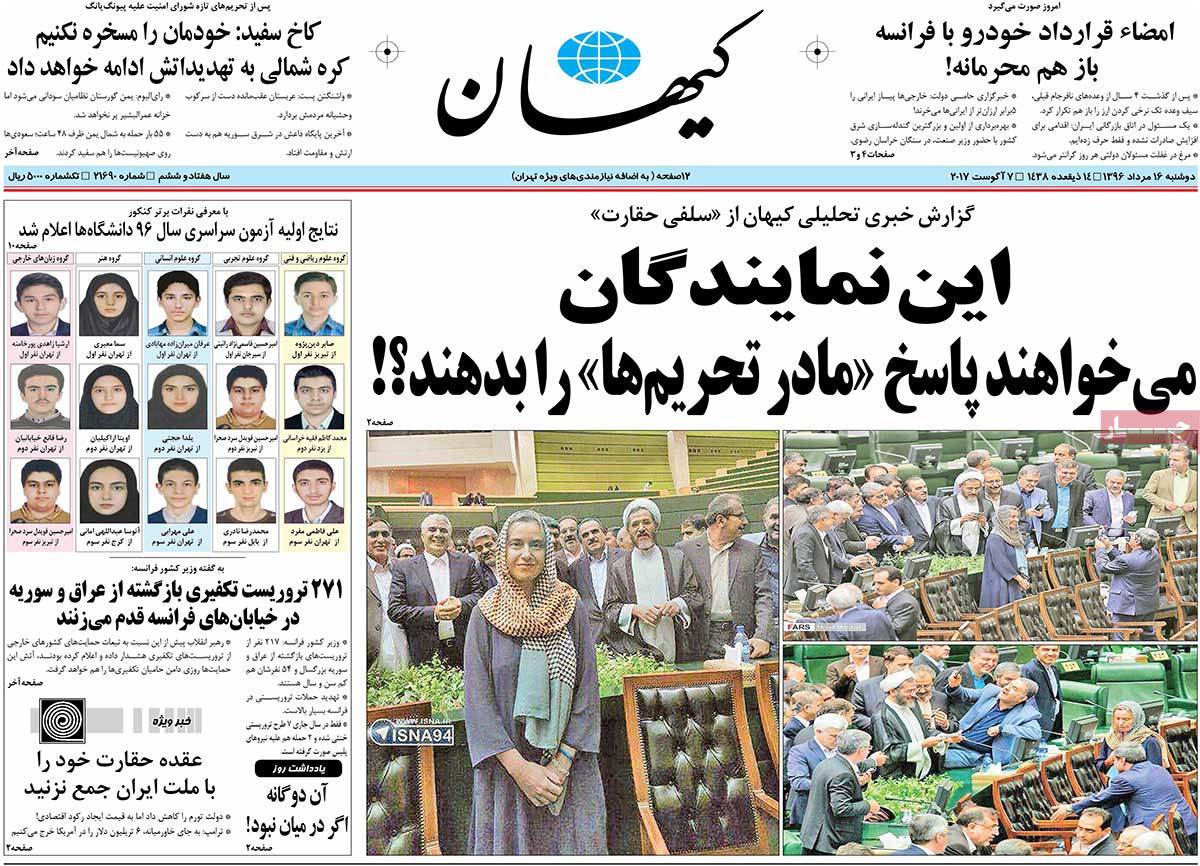
Kayhan:

1- Selfie of Humiliation

  • Are These MPs Ones Who Want to Give Response to ‘Mother of Sanctions’?

2- Iran to Sign Car Deal with France Today, Again Secretly!


A Look at Iranian Newspaper Front Pages on August 7


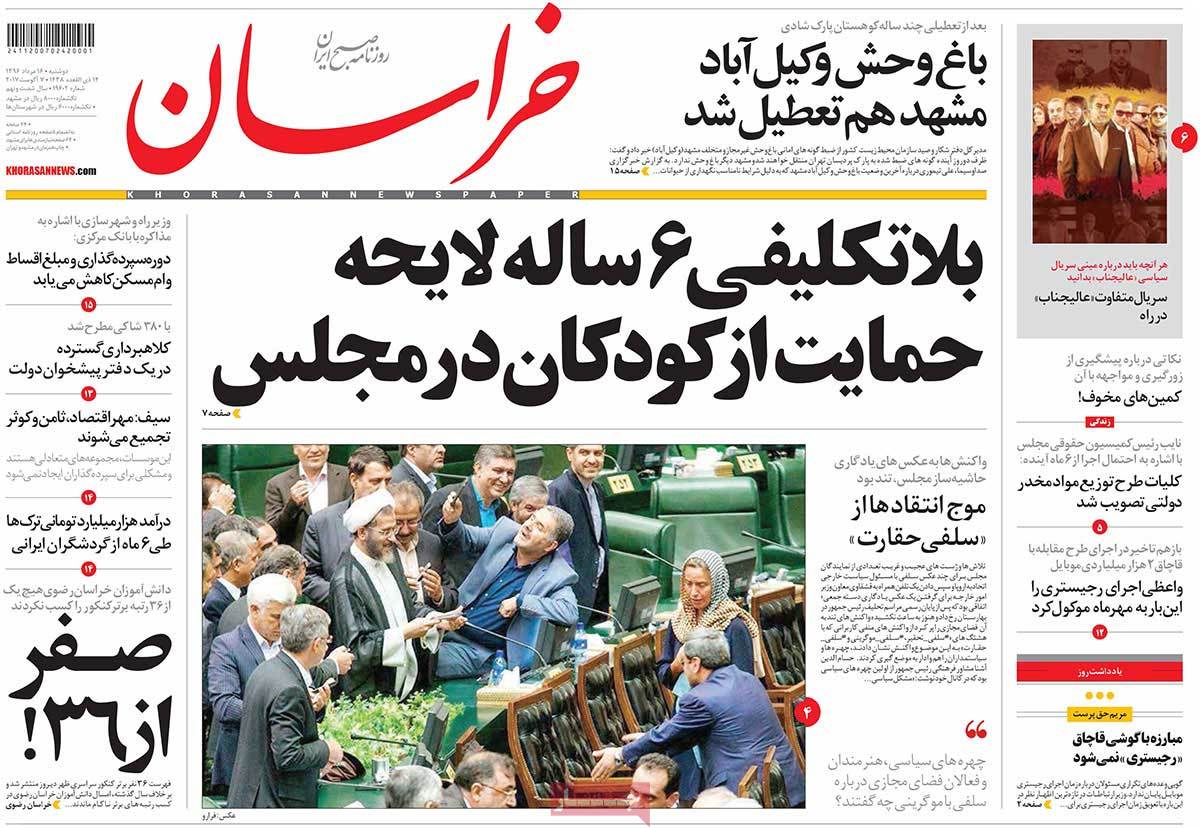
Khorasan:

1- Selfie of Humiliation Widely Criticized

  • Harsh Reactions to MPs’ Controversial Photo with Mogherini

2- Turkey Earns 10 Trillion Rials [$265m] in 6 Months Thanks to Iranian Tourists


A Look at Iranian Newspaper Front Pages on August 7


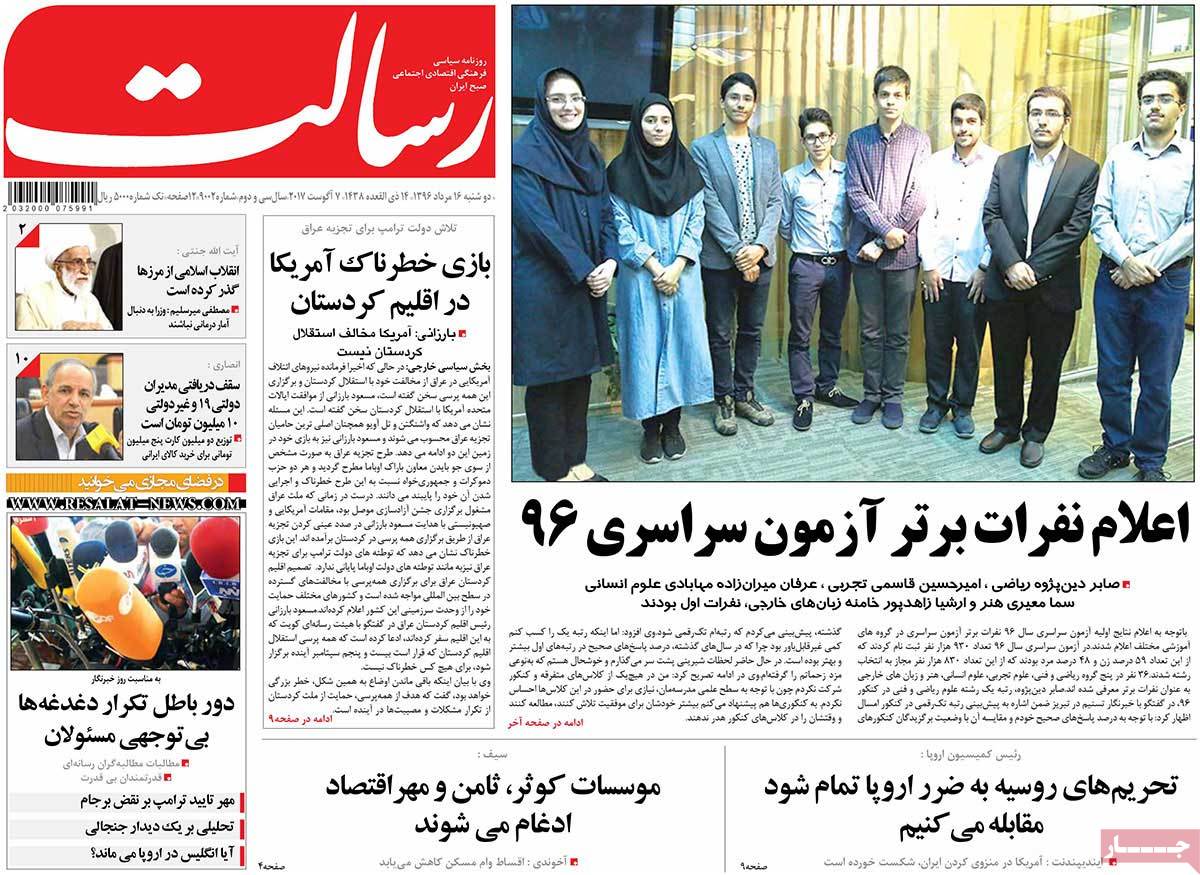
Resalat:

1- Europe to Counter US Sanctions If They Harm EU-Russia Ties

2- Iran’s Islamic Revolution Has Crossed Borders: Ayatollah Jannati


A Look at Iranian Newspaper Front Pages on August 7


Rooyesh-e Mellat:

1- Larijani Vows Iran’s Everlasting Support for Syria

2- Board Monitoring MPs’ Behaviours: Selfie with Mogherini below MPs’ Dignity


A Look at Iranian Newspaper Front Pages on August 7


Shahrvand:

1- Young Iranians Daydreaming about Finding Job

  • Research Shows 32% of Them Don’t Know How to Work with Computer
  • 37% Have No Familiarity with English Language
  • 17% Don’t Know How to Work with Internet

2- World Standard’s Special Respect for Iran: First Female Chief of Standard Org.


A Look at Iranian Newspaper Front Pages on August 7


Shargh:

1- Frames without Masks: Huge Controversy over MPs’ Selfie with Mogherini

2- Rouhani’s Diplomatic Talks after Inauguration

3- Iran Sends Message of Peace, Dialogue, Fight against Extremism to World: Rouhani

4- Last Clash between Urban Development Minister, Tehran Mayor

  • Municipality Warned against Opening New Subway Line to Imam Khomeini Airport


A Look at Iranian Newspaper Front Pages on August 7


Iran’s Missile Program Not Violating UNSC Resolutions

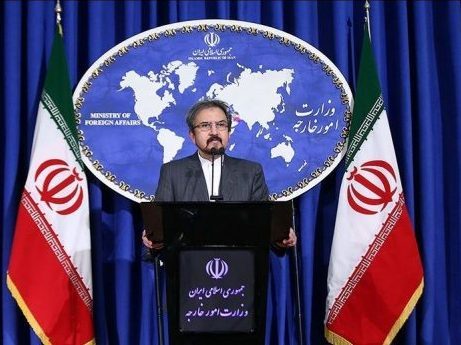
Bahram Qassemi

“The issue of the Iranian missile [program] is an entirely defensive and deterrent matter and in no way contravenes Resolution 2231,” said Foreign Ministry Spokesman Bahram Qassemi in his weekly press briefing on Monday.

Resolution 2231 was adopted by the UNSC in July 2015 to endorse a nuclear agreement between Iran and six other countries, the so-called P5+1.

The UNSC document terminated the provisions of seven previous UNSC resolutions against Iran, some of which had imposed restrictions on Iranian missile activities. Such activities are not prohibited under the newer document, which merely calls on Iran “to refrain from any activity related to ballistic missiles designed to be capable of delivering nuclear weapons.”

Iran says it has no such warheads and no such missiles. It has put its nuclear program under enhanced international monitoring as part of the nuclear deal. And Iranian compliance with the deal has been consistently verified by the International Atomic Energy Agency (IAEA). Yet, the United States, a party to the agreement, has attempted to portray Iranian missile tests as a violation of the resolution.

While it has failed to get other countries on board, in main part because the text of the resolution is unambiguous, Washington has not stoppedclaiming that the Iranian missile program breaches Resolution 2231.

Such claims, Qassemi said in his Monday presser, were “unwarranted” and were “often made because of… [the accusers’] ill will toward Iran’s might, particularly its defensive power.”

Responding to a question about the potential violations of the nuclear deal by the US, Qassemi said Iranian decisions on whether violations had occurred rested with the high-level Supervisory Board that has been formed to monitor the implementation of the deal, officially known as the Joint Comprehensive Plan of Action (JCPOA).

He said decisions in that regard were technical and the Supervisory Board would be making relevant comments in the due time.

Iran and the P5+1 countries (Russia, the US, the UK, China, Britain, and France) reached the JCPOA on July 14, 2015 and began implementing it in January 2016.

Iran has been complaining that the US, under the administration of its new president, has been seeking to sabotage international trade with Iran. This is while according to the deal, the US must “refrain from any policy specifically intended to directly and adversely affect the normalisation of trade and economic relations with Iran.”

The US has also imposed sanctions on Iran over the country’s missile activities, including most recently on July 28.

Qassemi said that Iran and the US harbored mistrust of one another and that the recent measures adopted by Washington further deepened Tehran’s mistrust.

‘Banking difficulties persist’

A reporter asked Qassemi what measures had been taken to end banking restrictions on Iran.

He explained that certain difficulties still existed because of various technical and political reasons.

“Problems with big banks are still there,” he acknowledged, adding that “active economic diplomacy” was needed to facilitate banking transactions involving major banks.

‘Iran not delaying Saudi delegation’s visit’

The Iranian Foreign Ministry spokesman also rejected media reports that Iran has been behind a delay in the planned trip by a Saudi Arabian delegation to the country to visit the sites of Saudi Arabia’s former diplomatic perimeters.

He said visas had been issued for the Saudi delegates long before, and they were scheduled to arrive on a private jet. A permit had been issued for the flight at short notice but the Saudis could not be immediately notified because there were no direct communication channels, hence the delay, Qassemi said.

“They can travel to Tehran whenever they decide to,” he said of the Saudi delegates. “There is no prohibition on their visit.”

Iran, in the meanwhile, was awaiting the issuance of visas for its own delegation, which he said was due shortly.

Saudi Arabia severed its diplomatic relations with Iran in January 2016. Saudi Arabia had just executed a prominent Shia cleric back then, and protests were staged in front of the Saudi diplomatic premises in the cities of Tehran and Mashhad over the killing. A number of individuals attacked the two perimeters while they were vacant and caused some damage.

The attackers were arrested by Iran and received prison terms. But relations have remained tense.

‘Iran holds superior status in region’

Qassemi said the huge turnout by foreign officials in the recent inauguration ceremony of President Hassan Rouhani signified “the world’s new approach toward Iran.”

Senior representatives, including presidents and prime ministers, from 105 countries and nine international organizations took part in the inauguration ceremony on Saturday.

Qassemi said the participation of that many officials was “a clear signal of the defeat of the policy of Iranophobia. And one could say we hold a superior position in the region.”

‘Sadr entitled to his opinion’

Qassemi was asked about a recent visit by Iraqi cleric Mudtada Sadr to Saudi Arabia and anti-Iran remarks he reportedly made after the trip.

The Iranian spokesman said trips by Iraqi figures were an internal Iraqi matter.

He added that Sadr could express his opinions, but, “one should not take seriously the comments he has made about Iran.”

He said mistakes might have been made in reporting or translating Sadr’s remarks and said he hoped no such things had actually been said.