Friday, April 24, 2026
Home Blog Page 3879

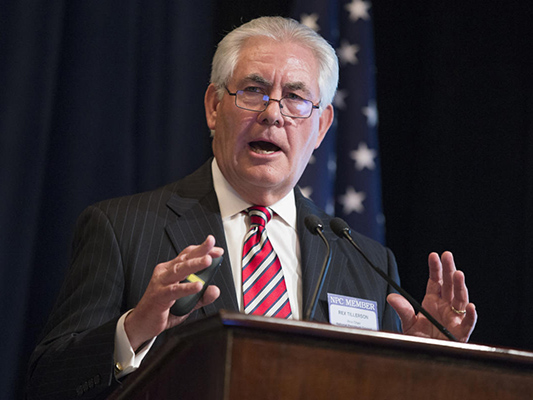
“Tillerson’s New Plan Aimed at Depriving Iran of JCPOA Benefits”

Rex Tillerson-US Double Standards towards “Inhumane” Sanctions

Iranian parliamentarian Mohammad-Javad Jamali Nobandegani blasted the new plan put forward by Tillerson, saying that it aims to maintain the Iran nuclear deal, also known as the Joint Comprehensive Plan of action (JCPOA), and at the same time adopt tighter measures vis-à-vis Iran.

“Such decisions show the United States’ failure to put in place a well-organized diplomacy because at a certain time they announce they will stay in the JCPOA, and at another time say they will tear it up,” said the MP, according to a Farsi report by ICANA.

He said one of Washington’s policies against Iran has been to deprive the country of the benefits of the JCPOA.

“Iran has always made good on its commitments under the JCPOA, but they (US authorities) haven’t done anything in that regard, and seek to dampen the positive effects of the nuclear deal,” the lawmaker said.

He said the US uses topics such as the Middle East security, Iran’s alleged support for terrorism, the country’s missile industry, etc. as pretexts, saying, “It should be acknowledged that everybody knows that the Takfiri ISIS terrorist group was created and is supported by the US.”

The legislator underlined that the Americans seek to disintegrate and create insecurity in the Middle East.

“This comes as Iran has always contributed to regional peace and stability and has even offered advisory assistance to countries such as Syria and Iraq at their own request and has helped safeguard the territorial integrity and security of those countries,” The MP said.

He said history has not forgotten that it was the United States, not Iran, that used atomic bombs.

“By seeking pretexts, the Americans want to reduce the international community’s negative reactions against themselves and decrease any further political-social costs of taking more actions against our country,” Nobandegani added.

Mojtaba Zonouri, another Iranian MP, said withdrawal from the JCPOA will have costs for the US in the international community, so Tillerson’s new plan is a strategy to prevent this and to take Europeans on board with taking hostile actions against Iran.

Lawmaker Jalal Mirzaee also underlined that the new plan presented by Tillerson and the US Congress aims to set the stage for taking Europe on board with adopting hostile actions against Tehran over issues not related to the JCPOA.

Tehran to Host Int’l Exhibition on Mining Investment

The annual event is one of the largest of its kind in mines and mining industries in the Middles East, which presents the latest technologies and equipment, services, machineries for mines and mining industries in exploration, excavation, processing, production and export, IRNA report.

It also aims to introduce investment opportunities in Iran for mining companies worldwide.

Minex is organized by the Ministry of Industries, Mining and Trade, in cooperation with Iranian Mines and Mining Industries Development and Renovation Organization, and Geological Survey & Mineral Explorations of Iran.

The event is sponsored by Iran Stone Association, Foundry Association of Iran, Iranian Tunneling Association, Iron and Steel Society of Iran, Iranian Geophysical Society, Molybdenum Producers and Exporters Association, Iranian Metallurgy Engineers Association, Iran Ferroalloys Association, Association of Iranian Heavy Machinery for Construction, Mining and Roads, and Iranian Producers & Exporters of Mineral Products Association.

Some 200 domestic and 55 foreign companies from 15 countries are expected to attend this year’s event.

Iran is home to 68 types of minerals with more than 37 billion tons of proven reserves and 57 billion tons of potential reserves.

According to the United States Geological Survey, Iran holds the world’s largest zinc, ninth largest copper, 10th largest iron ore, fifth largest gypsum and barite and 10th largest uranium reserves.

Overall, Iran is home to more than 7% of global mineral reserves.

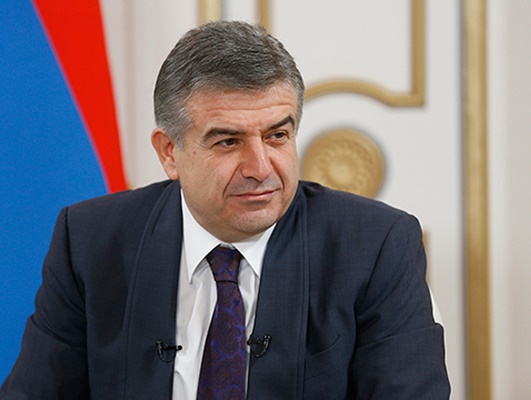
Armenian PM to Visit Tehran on Monday

The Armenian official is planned to hold talks with Iranian President Hassan Rouhani, VP Jahangiri, and Parliament Speaker Ali Larijani.

According to a report by Armen Press, Karapetyan will also visit Ararat Sports Club, where he will meet with the Armenian community, including business leaders.

In an interview on August 1, Karapetyan described Iran-Armenia relations as “exemplary and unique”, adding that “The friendship between the two neighbours is so firm that it is just necessary to further develop and deepen them by maintaining the commonalities uniting us for centuries. This is the reliable base and stronghold of our relations.”

Iran at GITEX 2017: Latest Software Achievements on Display

GITEX

TalebiExplaining the activities of Vesta and its participation in GITEX 2017, the CEO of the company said, “Vesta Information Technology Company was launched in 2007 to develop a technology to improve the level of human well-being. Vesta began its activities to focus on designing and developing software.”

Talebi added that by utilizing their experience and the ability of a highly-motivated, dedicated and professional team of experts, the company succeeded in achieving its goals.

“We introduced ourselves as one of the leading technology companies in the field of IT and succeeded in providing services and products tailored to the needs of the customers. In 2016, we signed a contract with a foreign country to carry out e-learning in the healthcare sector of Iran. By sealing this contract, we further believed in our abilities, and it made us look at the international market.”

According to Talebi, Vesta’s products are as follows:

  • Electronic Learning Management System: Organizing Training Courses Electronically
  • Contents of Electronic Courses: Appropriate E-contents for Organizations and Universities
  • Digital Library System: Management of Traditional and Digital Library Affairs

Talebi also underlined that it is the first time Vesta will be present at the GITEX, saying that the main reason for the presence of Vesta at GITEX is to consult with other foreign partners on how to create collaborative partnerships.

“Currently, our target markets are Middle-Eastern countries and neighbours of Iran. The Iranian companies active in the field of information and communications technology are not doing well compared to their counterparts abroad. As the economy of Iran used to be state-oriented in previous years, unfortunately, most companies preferred to produce a product or service and then sell it to government agencies and institutions. As a result, when the government does not have funds, companies will not have a customer!”

The CEO of Vesta further mentioned that there are companies operating in the B2C domains who have achieved success, but the number of these companies are less than those active in the B2B field.

“ICT analysts predict a good perspective for this sphere in Iran, but in order to achieve this, reforms must be made,” highlighted Talebi.

Finally, he concluded that the Iranian market, with a population of 80 million and a majority of young and educated people, has a great potentiality for production and even consumption. But it is important to know where we are capable of making products and where we’d better be a mere consumer.

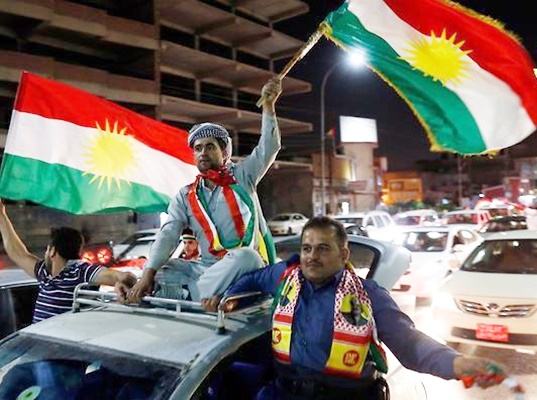
‘Those Favouring Kurdistan’s Secession Ignore Potential Dangers’

‘Those Favouring Kurdistan’s Secession Ignore Potential Dangers’

The Political Desk of the Persian-language news website Alef has, in an article, criticized the viewpoints of some Iranian analysts who believe the secession of Iraq’s Kurdistan region is a reasonable move .The highlights of the analytical piece follow.

There is an old story that a man was driving home from work at dusk when he found out that his vision was getting blurred. He could barely see the road. He pulled over only to realize a bitter reality: He was going blind. He called his wife and told her what had happened. Saddened and dejected, the man raised his hand to put on his forehead when he realized there was something on his eyes. He had forgotten to take off his sunglasses! And that was the reason he could barely see after sunset!

This story is similar to that of the folks who, these days, without paying attention to what is going on around them, draw on the hackneyed clichés of the 20th-century Cold War and make comments that are mind-boggling!

In fact, each science is like the glasses used to help us see in a better way. However, each science is useful in the right place. Sunglasses are supposed to be used by day. If they are used at night, they will not only be useless, but blur the vision and keep us from seeing the reality.

In the case of Masoud Barzani, the president of Iraq’s Kurdistan Regional Government (KRG), who seeks Kurdistan’s secession from the country, we are witnessing some academics making recommendations which show they have, intentionally or unintentionally, turned a blind eye to realities on the ground and only offer theories.

As a case in point, one of the folks has suggested we should help Kurds in their secession drive in other countries as they are an Iranian ethnic group! They believe such a move is in line with the re-creation of the idea of a Greater Iran!

Such a superficial vision is really surprising as such a way of thinking can be generalized to other ethnic groups of Iranian origin, and such reasoning can lead to questions.

Another person has said that Iraqi Kurds have the right to secession!

In the 21st century, see what we Iranians are coming to! The people we have designated as lecturers at our most prestigious universities are individuals who strongly support racism!

What special features has this lecturer seen in Kurds that he is only supporting the rights of Kurds from among Persians, Turks, Kurds, Arabs, the Baluch, Turkmens, etc.?

Or maybe he is going to turn to other ethnic groups in the future!

How is it that a secession drive by a person such as Barzani, who has been involved in so much corruption and has violated the basic rights of people in northern Iraq including, Kurds, Turkmens, Izadis, and Arabs, is now seen as a move to restore the rights of an ethnic group?

Does this gentleman look at the whole world through the sunglasses of ethnic groups’ rights? Or did he simply want to say something different?

It is regrettable that these gentlemen speak of homeland and dignity from dawn to dusk, but ignore the fact that Barzani and his clique have an eye on Iran’s territory and in their imagination regard large parts of our country, from Azarbaijan, [Iran’s] Kurdistan and Ilam to the western coast of the Persian Gulf as their illusory territory.

Haven’t these gentlemen seen the maps of weather forecast programs broadcast by TV channels said to be run by Barzani and his cronies?
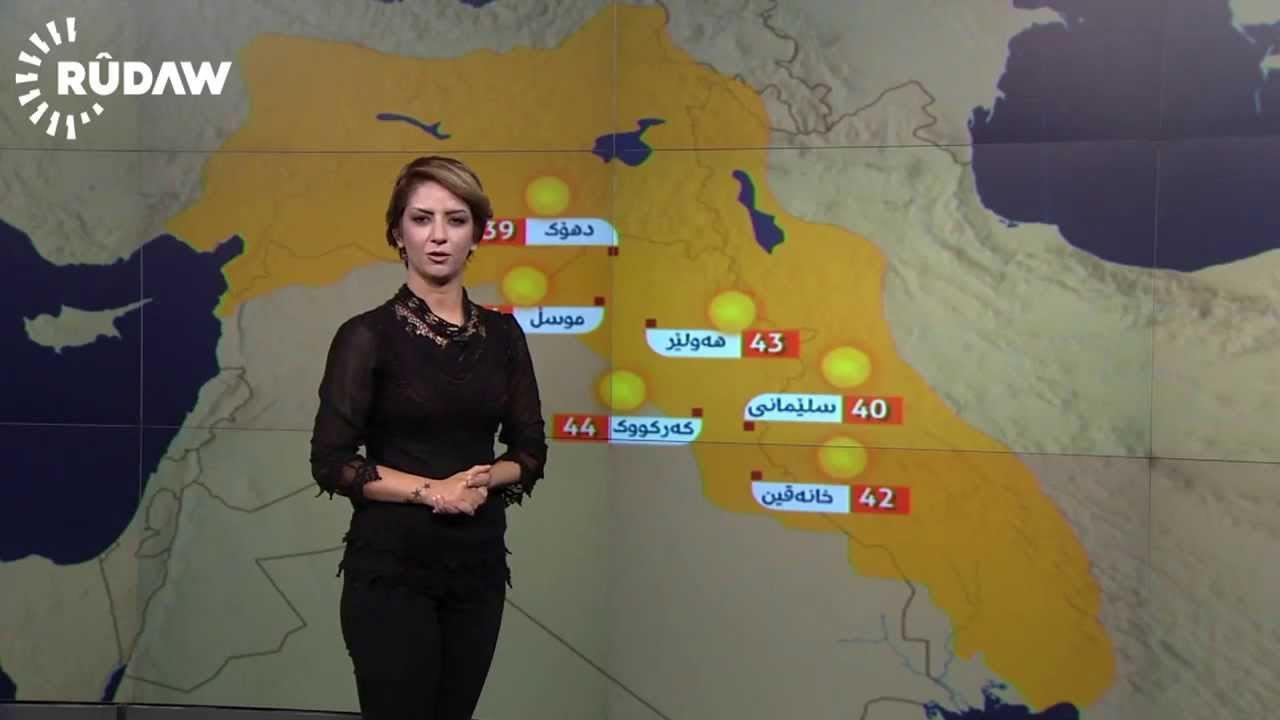
 

‘Those Favouring Kurdistan’s Secession Ignore Potential Dangers’


The most important issue in northern Iraq is democracy and the rights of minorities. Barzani is violating the rights of other minorities in northern Iraq under the pretext that the rights of a group of Iraqi people are trampled underfoot.

Now, this is the question: If a racist government is allowed to emerge in the Middle East, and if Barzani turns into a second Kim Jong-un or Saddam Hussein, what repercussions will it have for the Arabs, Turkmens and even Kurds living in northern Iraq and neighbouring countries?

Dear brother and distinguished university professor;

Instead of being purely idealistic and offering destructive solutions, you’d better look into developments and the consequences of events with more insight and not further fuel the flames of racism and apartheid with superficiality.


A Word with Respected Fellow Countrymen

Although we are witnessing the violation of ethnic and religious minorities in today’s world, in fact no word should be said about the rights of Turks, Persians, Kurds, Arabs, the Baluch, Shiites, Sunnis, Jews and Buddhists. Although all cultures and languages and identities are equally important and are the heritage of humanity, they do not constitute the permission to establish a racist government and contravene the rights of other peoples in the region.

In today’s modern world, only one set of rights should be recognized, and that is “human rights.”

Those in the West who claim to be supporters of this idea have selective definitions for “rights” and “human” and never accept that “one equals one.” The European and US-style “humans” are a far cry from those in Africa and the Middle East!

There are some people who should get their heads out of old books and hackneyed theories and look around them with open eyes.

Take the year 2009 and the Middle East map, for example. A quick look at this map will reveal the status of people’s rights. Foreigners have already changed the Middle East map.

Should they be allowed to do whatever they can via a handful of puppets?

Barzani and his associates know well that they are not welcome by the people in northern Iraq due to their extensive economic corruption and rente-seeking, and that they must leave power if they don’t get the chance to create a new crisis. Leaving power will also set the stage for the violations, embezzlements and extensive misappropriation by their dynasty to come to light. So, by intentionally creating a crisis, they have practically compromised the rights of the people in northern Iraq to secure their partisan interests.

In fact, if we look at the issue through the prism of philanthropism, we cannot remain passive, and we are duty-bound to stand by the people in northern Iraq, so that they will be able to negotiate this dangerous historical turn. Of course, regardless of the humanitarian aspect of the issue, we should bear in mind that we will be a neighbor of the Kurdistan region for good, and we are not immune to the fire burning in an area adjacent to us and we should not remain passive.

From Iran’s standpoint, what is of special importance is that Barzani has an eye on our country as well, and as soon as phase one of his secession drive is done, he will need to create a new crisis which would go beyond his territory’s borders in order to buy time, win the support of ultra-regional powers and strengthen his global status. Indubitably, the next crisis would constitute violation of the territorial integrity of its neighbouring countries, especially Iran. We have given lives to defend the territorial integrity of our country. So, it is obvious that we will not allow unimportant individuals such as Barzani to play with our national pride and the country’s existence. We will be able to douse the flame which is beginning to burn in our neighbour’s home with proper management and the least cost before it spreads to our own home.

Therefore, we will deal with anybody who has an eye of greed on our soil and will tackle them the same way we countered ISIS in Iraq and Syria.

To sum up, the flame that Barzani has ignited will, sooner or later, subside like that of Saddam Hussein and ISIS, but shame will remain on the faces of those who are natives of this country, but whose injudicious words play into the hands of the enemy.

A Look at Iranian Newspaper Front Pages on October 8

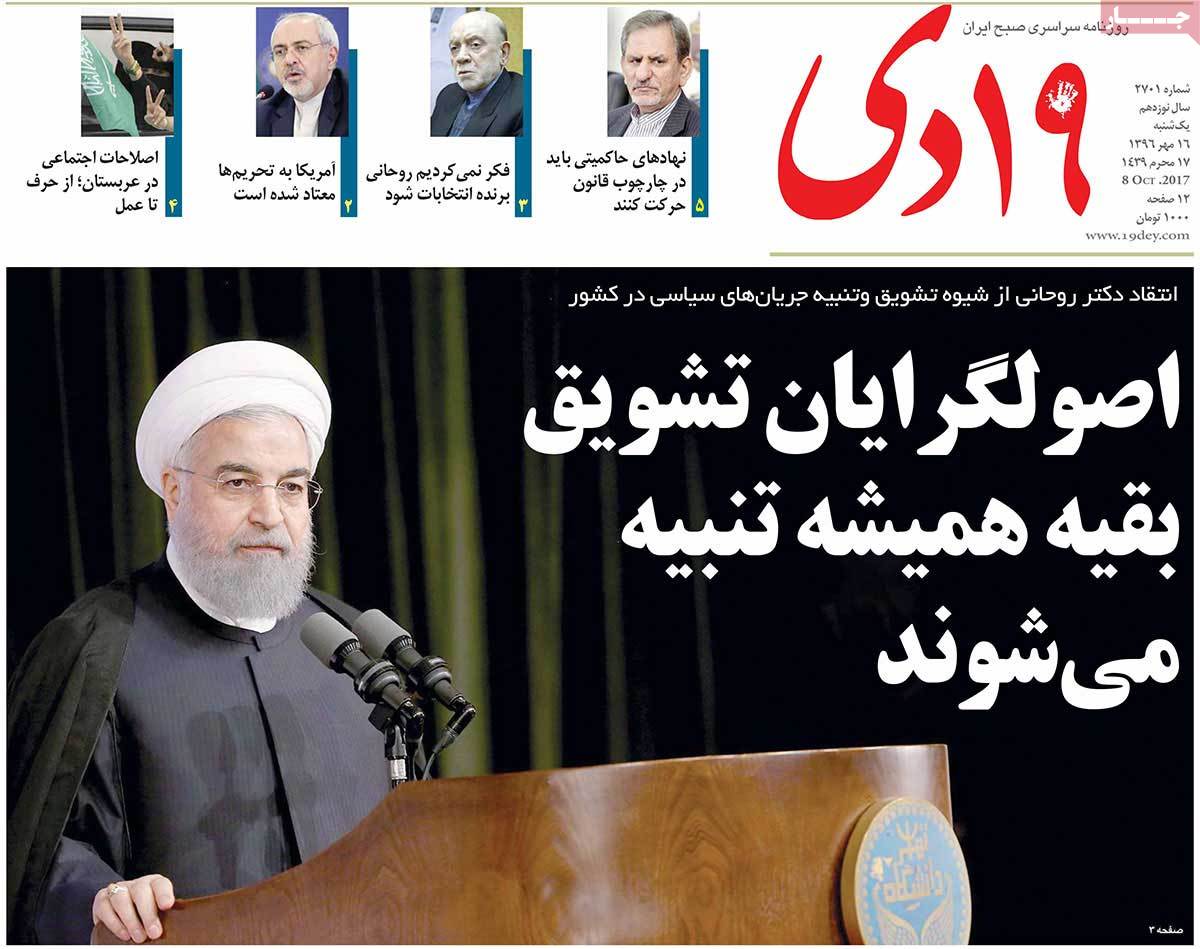
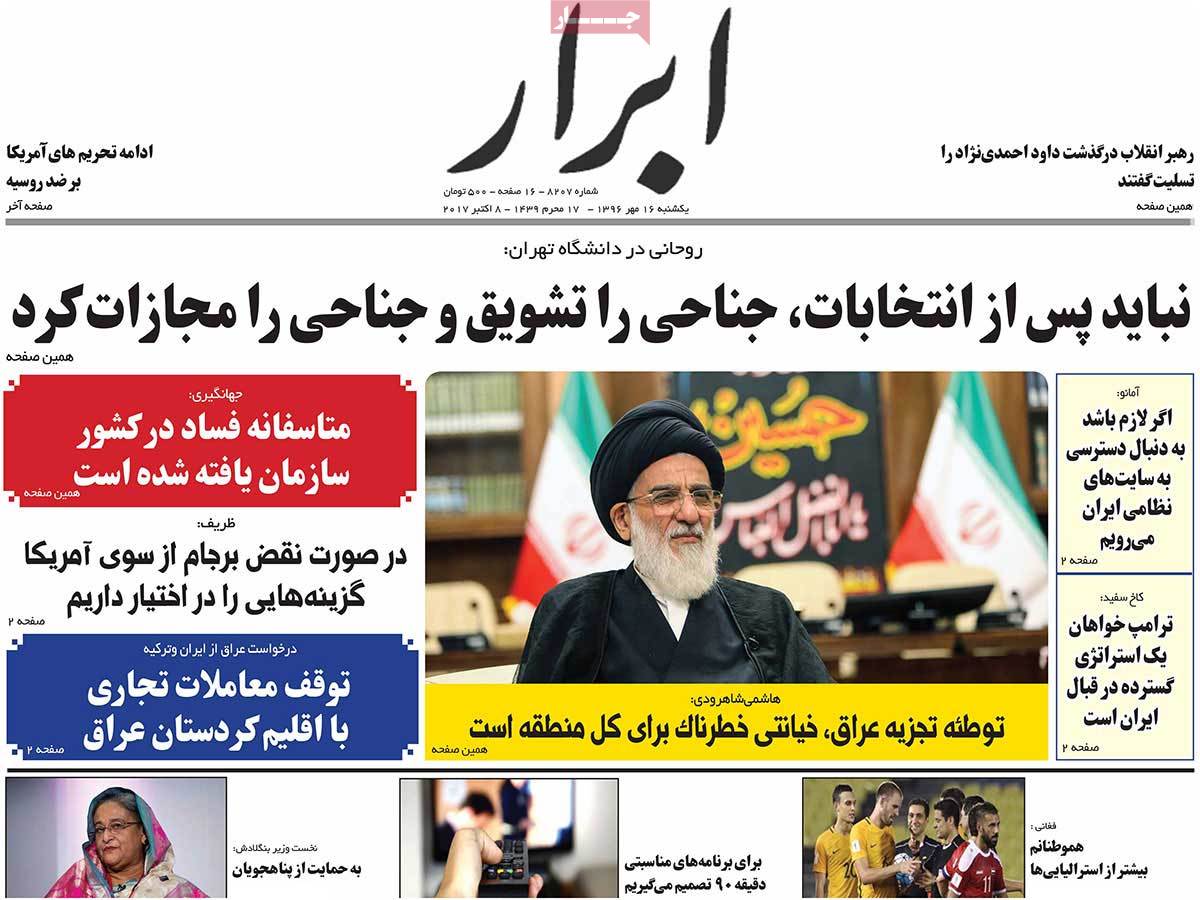
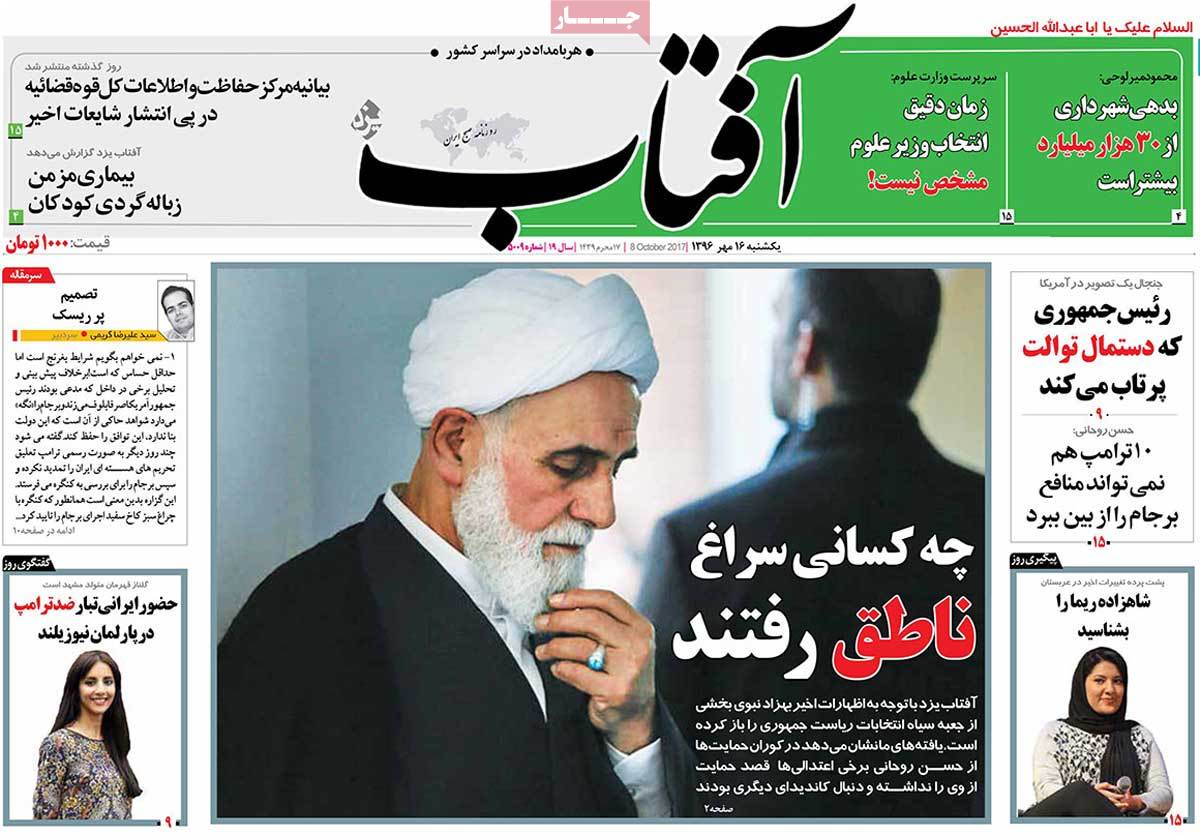
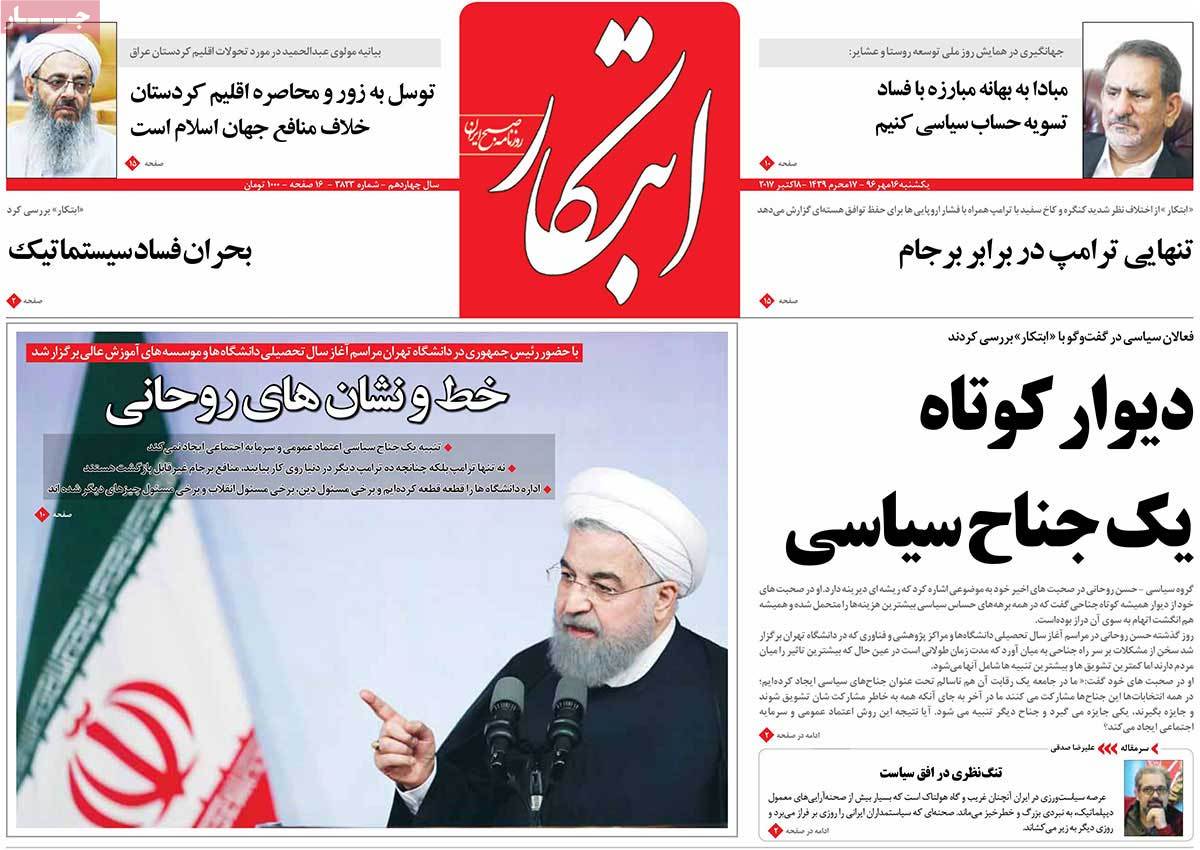
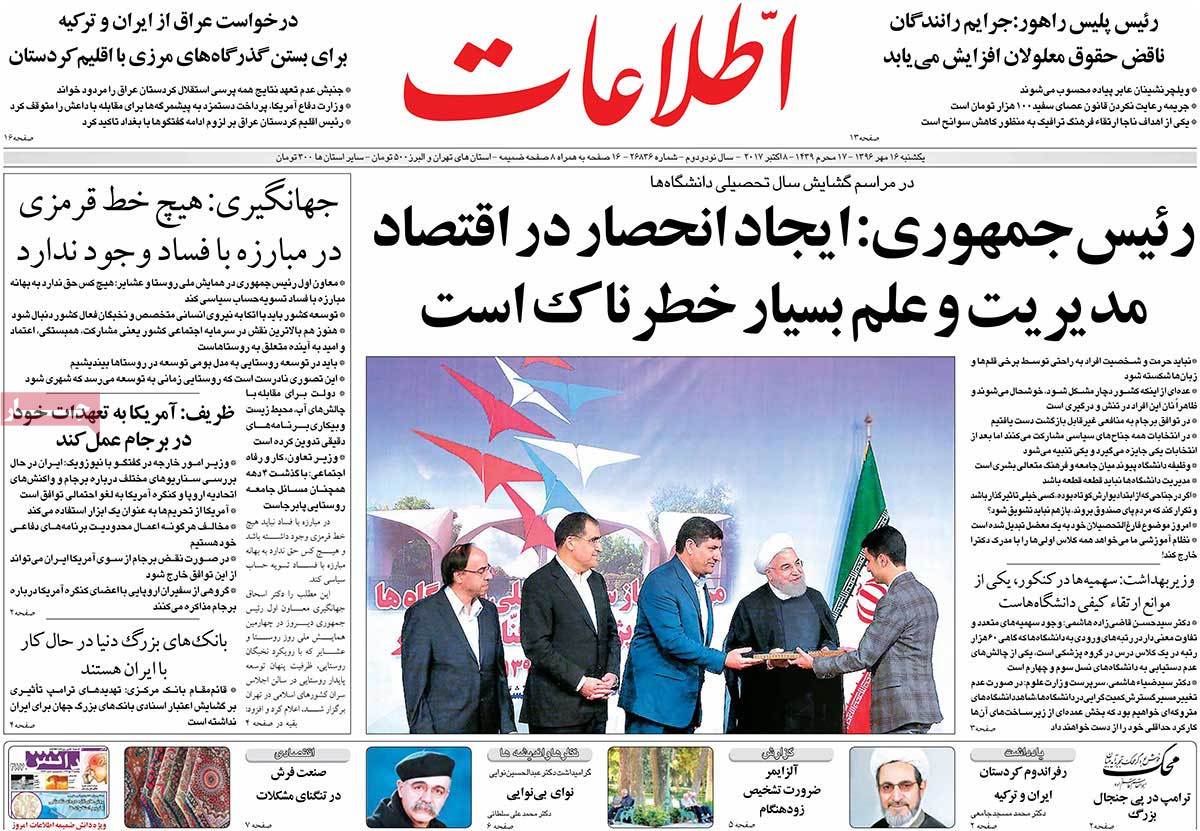
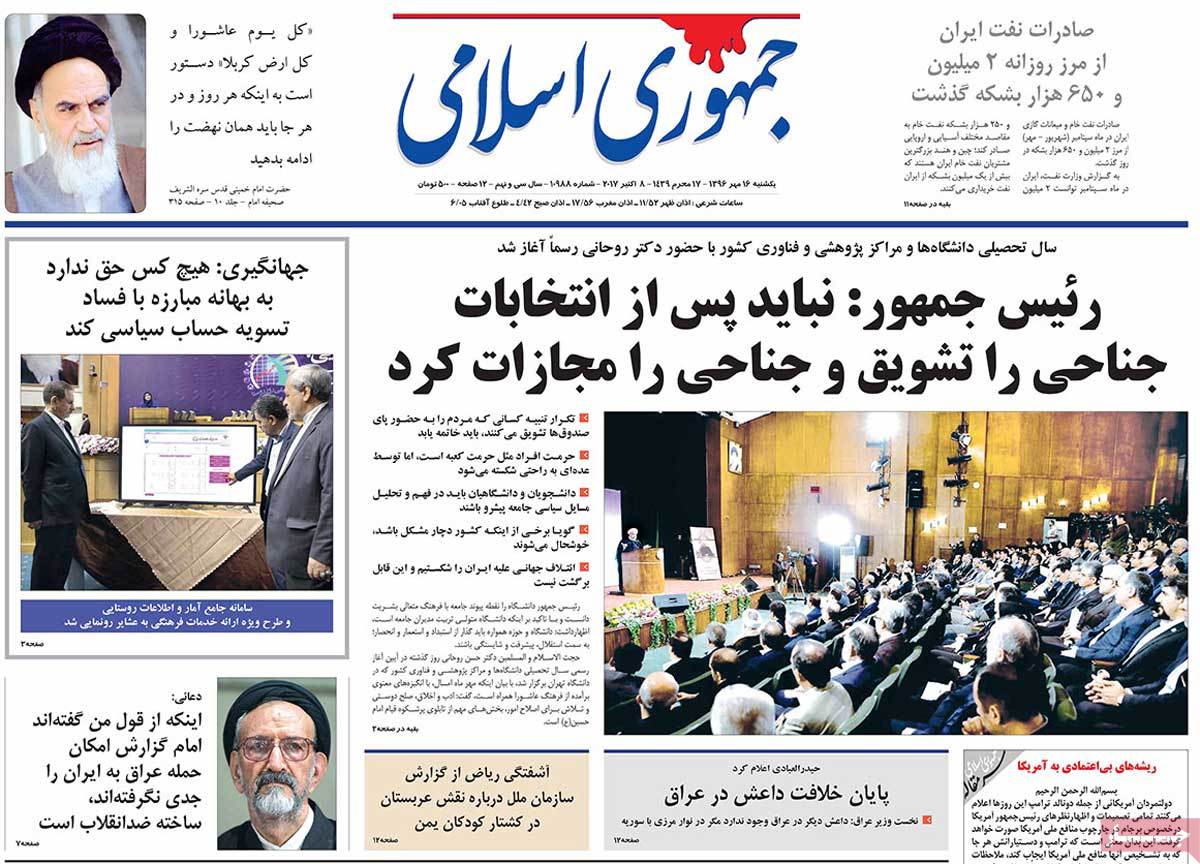
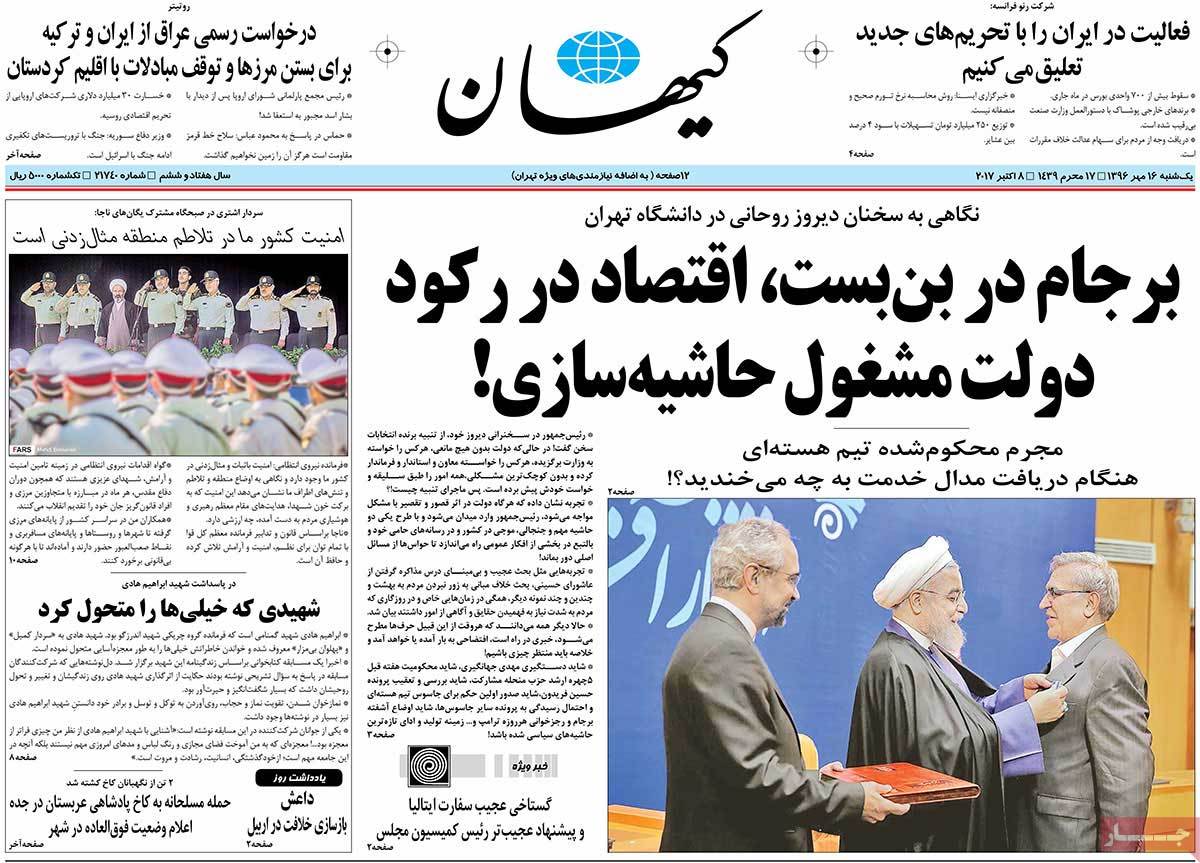
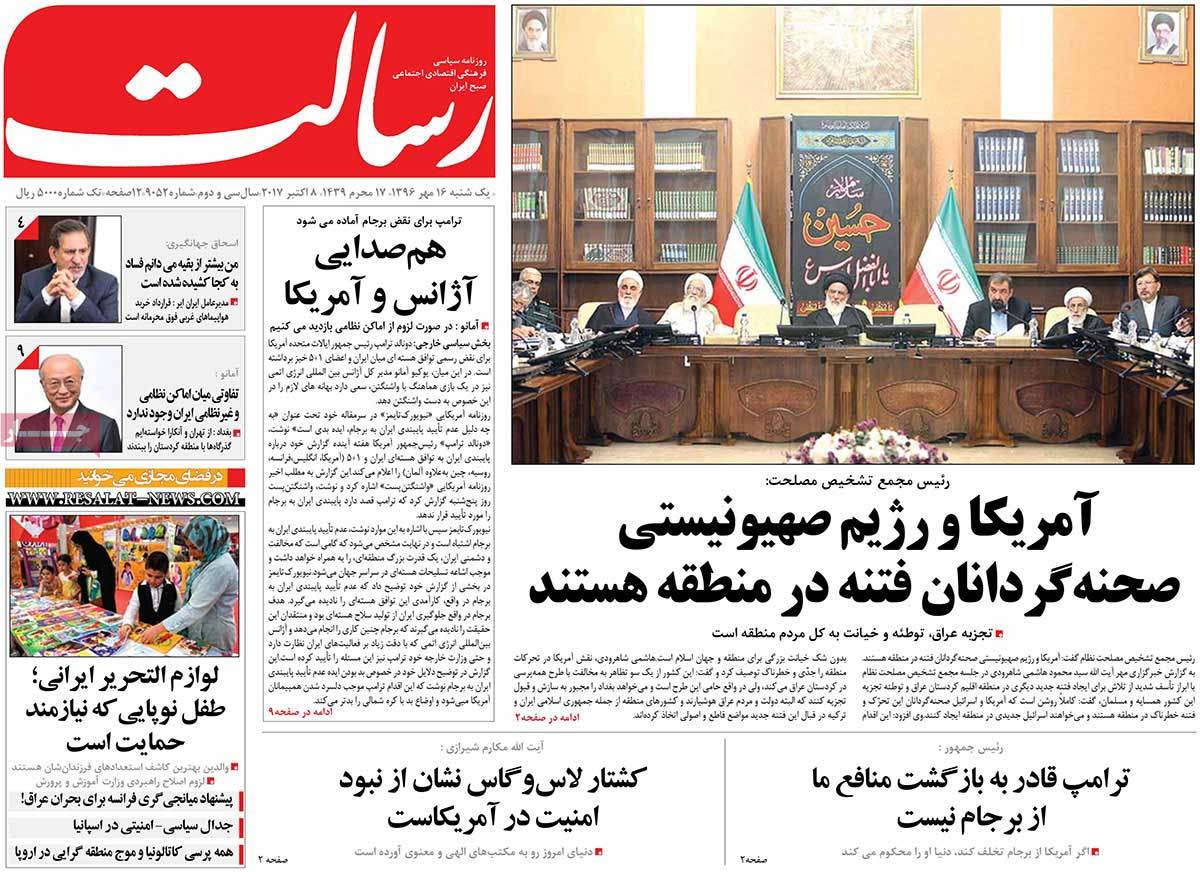
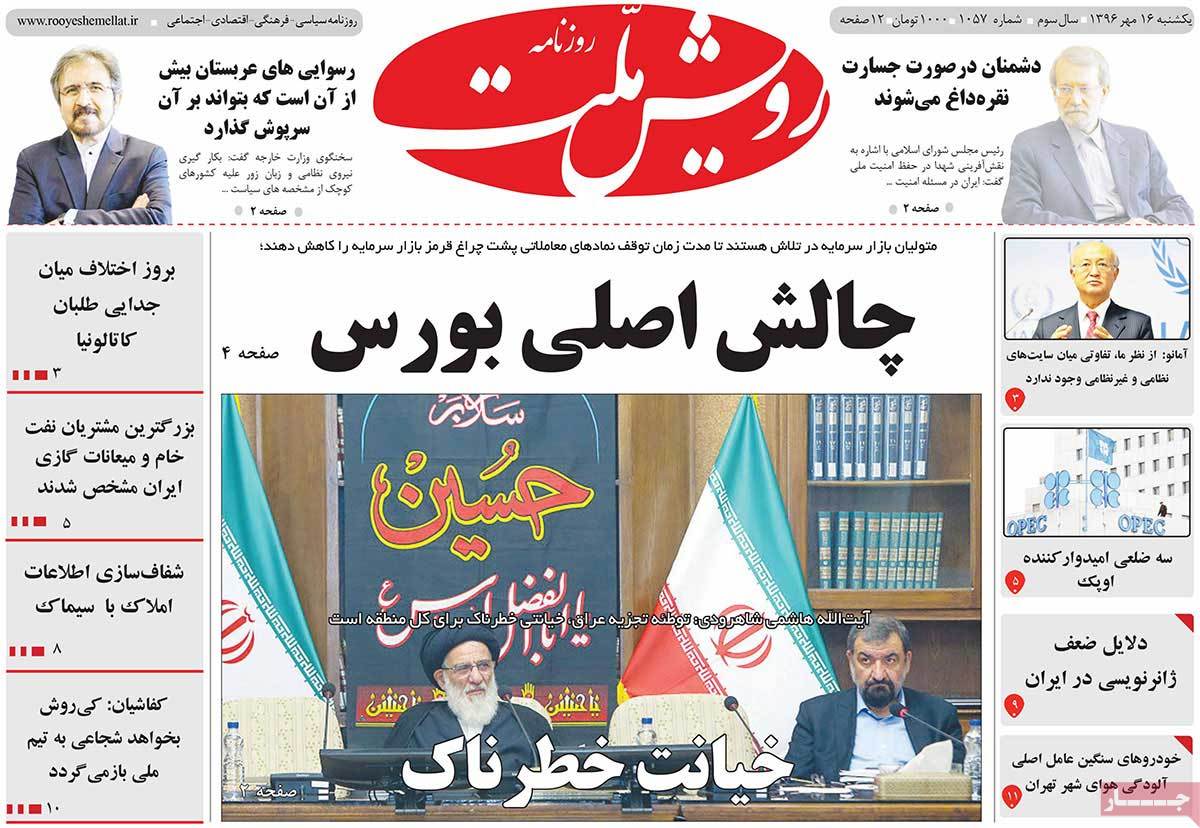
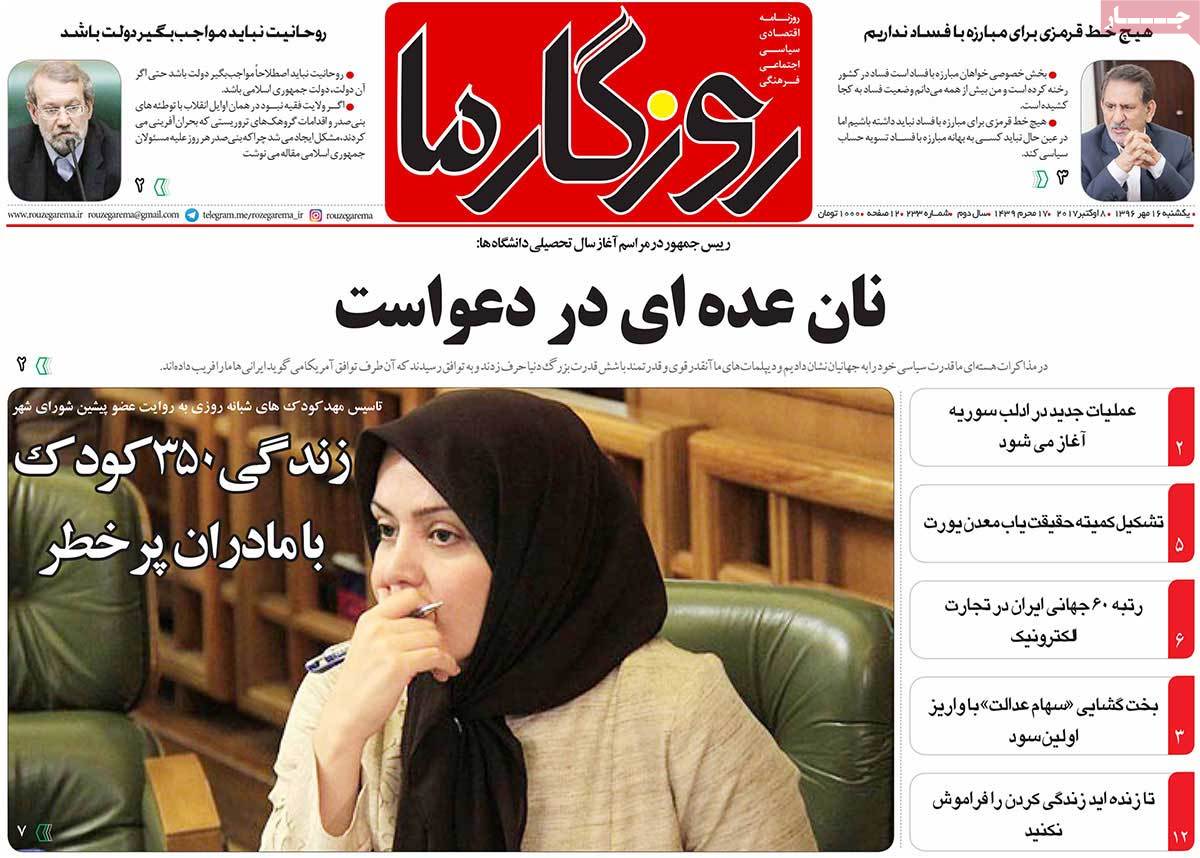
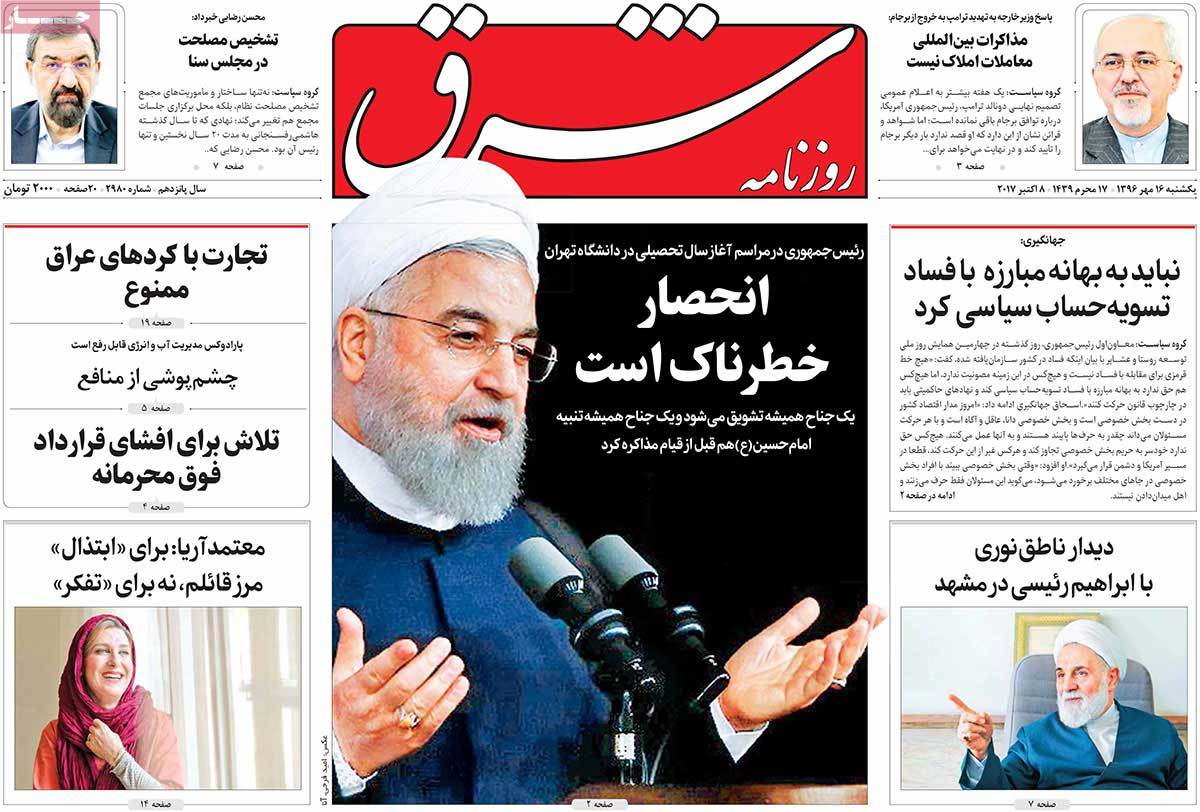
Newspapers today widely covered the remarks made by Iranian President Hassan Rouhani in an address to a group of university students in Tehran. Reformist papers highlighted Rouhani’s criticism of fresh restrictions imposed on former president Mohammad Khatami and the pressures on reformists in general, while conservative media highlighted, and criticized, his comments about the benefits of JCPOA, the nuclear deal between Iran and world powers.

Among other top stories were discussions about a possible change of Iran’s Constitution to realize a parliamentary system of government, the arrest of First Vice-President Es’haq Jahangiri’s brother, and ways to resolve the country’s economic problems.

The above issues, as well as many more, are highlighted in the following headlines and top stories:


19 Dey:

1- Rouhani Criticizes the Way Iran’s Political Camps Are Rewarded, Punished

  • Conservatives Always Rewarded, Others Always Punished

2- Zarif: US Addicted to Sanctions


A Look at Iranian Newspaper Front Pages on October 8


Abrar:

1- Zarif: Iran Has Options in Case in Case US Violates Nuclear Deal

2- Iraq Asks Iran and Turkey to Stop Trade with Iraqi Kurdistan Region

3- Amano: IAEA to Inspect Iran’s Military Sites If Necessary


A Look at Iranian Newspaper Front Pages on October 8


Aftab-e Yazd:

1- Rouhani: Even 10 People like Trump Won’t Succeed in Destroying JCPOA Benefits

2- Acting Science Minister: Exact Time of Introducing New Minister Not Clear!


A Look at Iranian Newspaper Front Pages on October 8


Ebtekar:

1- Iranian Sunni Cleric: Using Force, Blockade on Kurdistan Region against Muslim World’s Interests


A Look at Iranian Newspaper Front Pages on October 8


Ettela’at:

1- Rouhani: Creating Monopoly in Economy, Management, Science Very Dangerous

2- Zarif Urges US to Implement Its Commitments as per Iran Nuclear Deal


A Look at Iranian Newspaper Front Pages on October 8


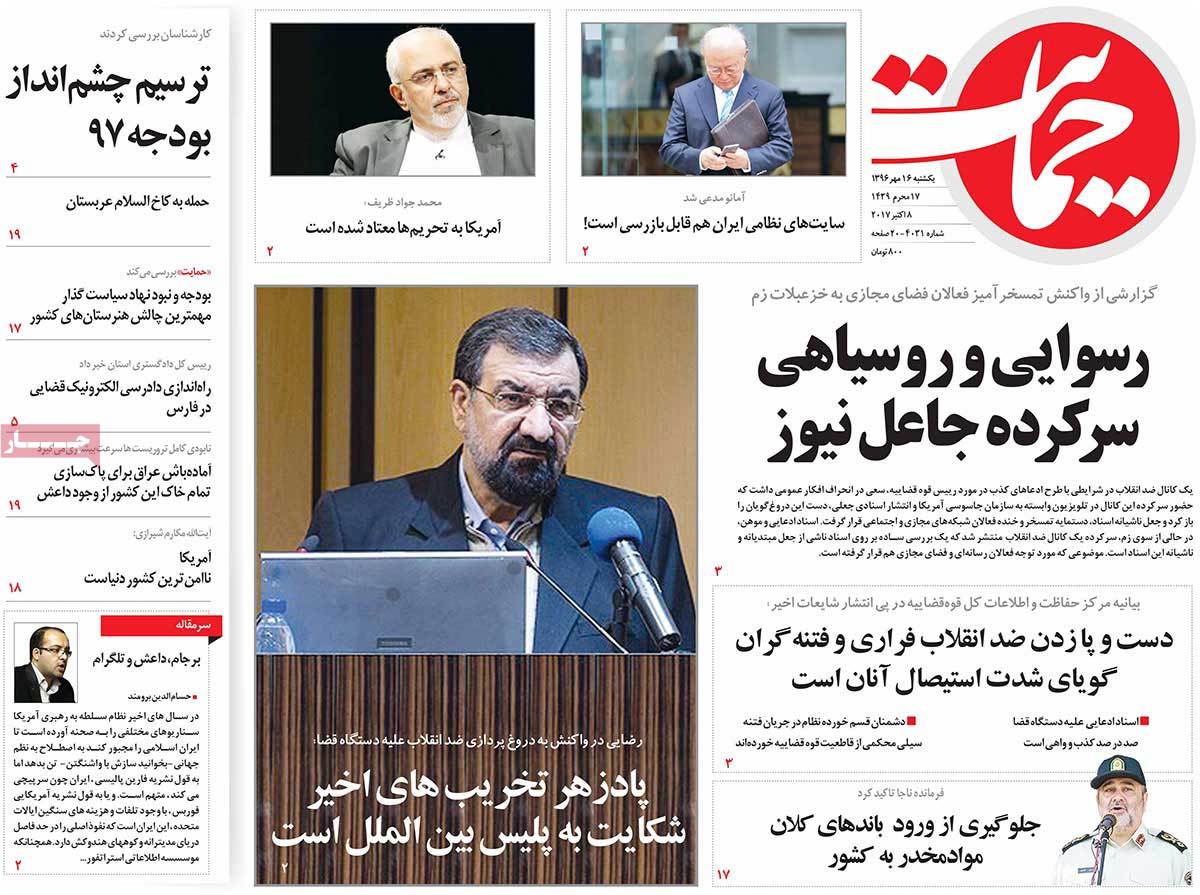
Hemayat:

1- Judiciary Called on to File Complaint with INTERPOL against Those behind Recent Rumours


A Look at Iranian Newspaper Front Pages on October 8


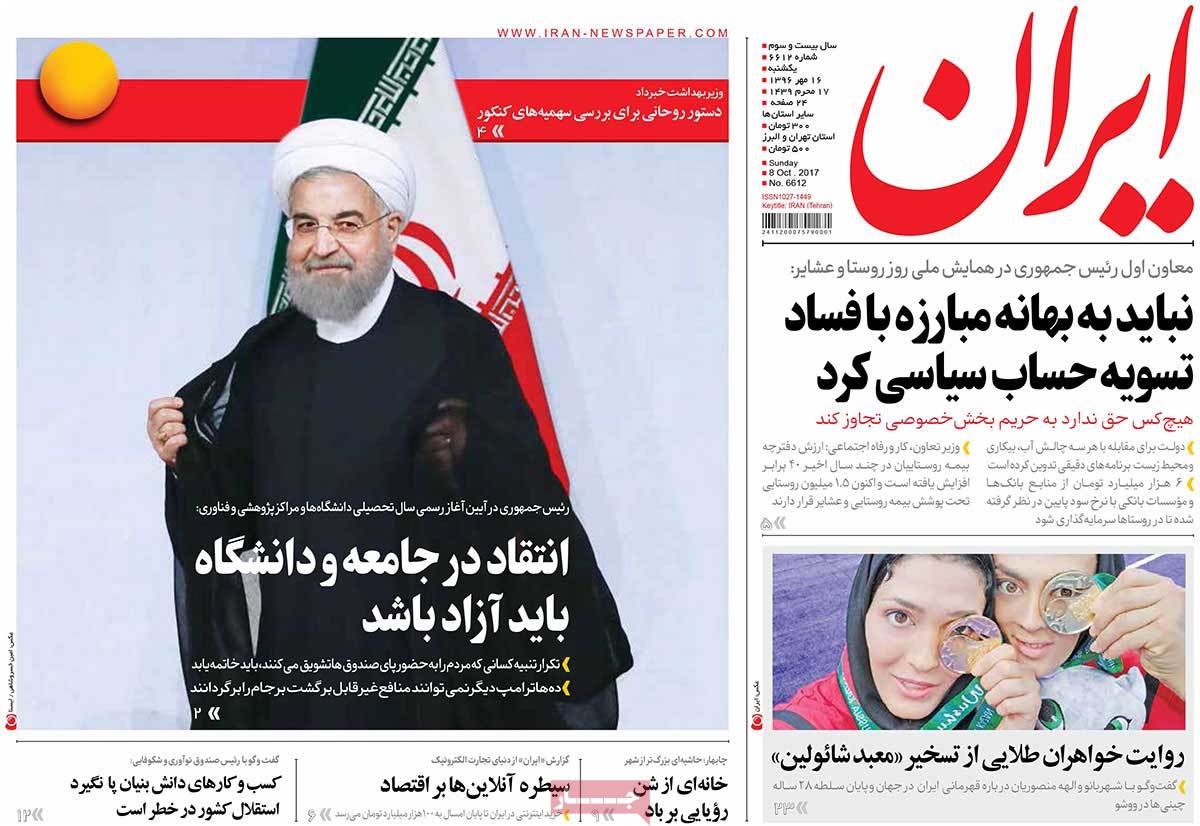
Iran:

1- Rouhani: University Students, People in Society Should Be Free to Criticize


A Look at Iranian Newspaper Front Pages on October 8


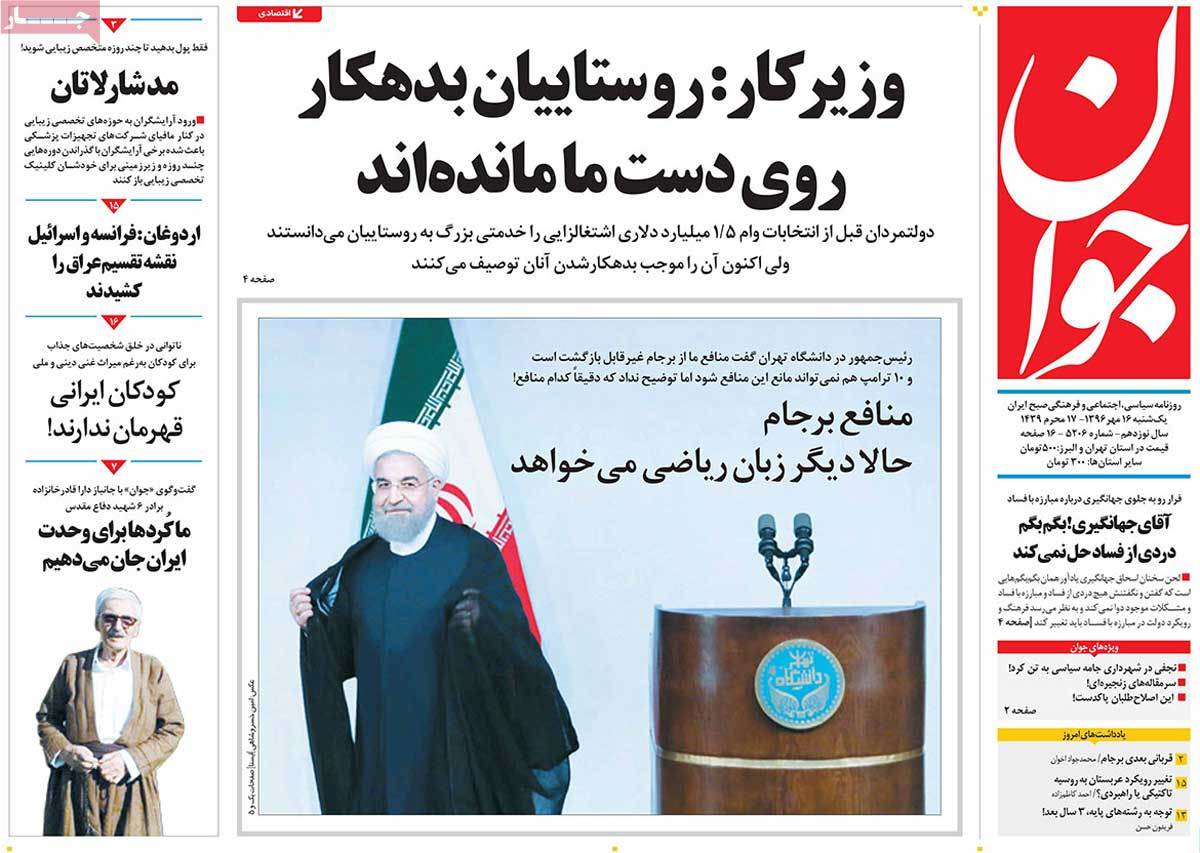
Javan:

1- JCPOA Benefits Now Need Knowledge of Math!

  • Rouhani Said Trump Can’t Reverse JCPOA Benefits, but Didn’t Explain What Benefits?!

2- Erdogan: France, Israel Hatch Plot of Disintegrating Iraq


A Look at Iranian Newspaper Front Pages on October 8


Jomhouri Eslami:

1- Iran’s Daily Oil Exports Exceed 2.650 mcm

2- Iraqi PM Declares End of ISIS Caliphate in Iraq


A Look at Iranian Newspaper Front Pages on October 8


Kayhan:

1- A Look at Rouhani’s Remarks

  • JCPOA in Deadlock, Economy in Recession, Gov’t Busy with Trivial Affairs

2- Renault: We’ll Suspend Activities in Iran If New Sanctions Imposed


A Look at Iranian Newspaper Front Pages on October 8


Resalat:

1- US, Israel Organizing Sedition in Region: Ayatollah Hashemi Shahroudi

2- Iran Air CEO: Deals for Purchasing Western Planes Super-Confidential


A Look at Iranian Newspaper Front Pages on October 8


Rooyesh-e Mellat:

1- Iran Foreign Ministry: Riyadh’s Scandals Too Numerous to Be Covered


A Look at Iranian Newspaper Front Pages on October 8


Roozegar:

1- Larijani: Clerics Shouldn’t Receive Their Salary from Gov’t

2- Iran Ranks 60 Worldwide in E-Commerce


A Look at Iranian Newspaper Front Pages on October 8


Shargh:

1- Iran FM’s Response to Trump’s Threats: Int’l Deal-Making Different from Real Estate

2- Rouhani: Monopoly Is Dangerous; One Party Always Rewarded and One Always Punished


A Look at Iranian Newspaper Front Pages on October 8

Putin Rejects Saudi King’s Demand for Putting Pressure on Iran

Putin Rejects Saudi King’s Demand for Putting Pressure on Iran

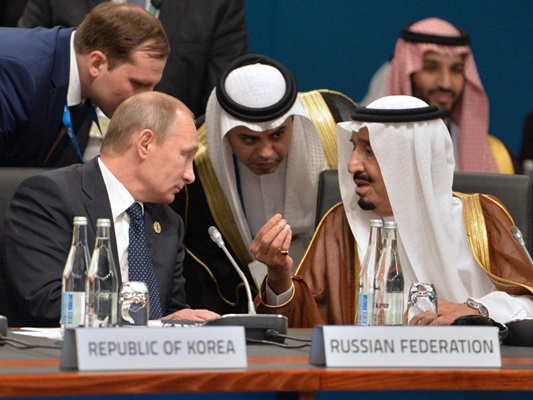
Political analyst Rahim Nemati has, in a short article published in the Persian-language Javan daily, weighed in on Saudi King Salman bin Abdulaziz’s trip to Russia, the first trip by a Saudi monarch to Russia in nine decades. The analyst says during the visit, Putin has refrained from making a deal with the Saudi King over Iran despite his insistence.

In his article, Nemati refers to the agreements reached by the two sides at the meeting, including the continuation of oil cooperation between the two countries, construction of companies manufacturing weapons and Kalashnikov ammunition, the setting up of an investment fund worth $1 billion to implement Russia’s economic projects, the conclusion of a preliminary agreement on the purchase of S-400 systems and signing a deal on space cooperation.

In return for giving all the economic concessions to Putin and confirming his special status, King Salman had a demand as well. He demanded that Russia puts pressure on Iran to, as he put it, “stop the country from meddling in Arab countries’ internal affairs.”

Over the past few years, Saudi authorities have regularly made this claim. In fact, Saudi officials take every opportunity, from interviews with reporters to official forums, to repeat such allegations. When meeting Putin, the Saudi King took the chance to repeat his demand, but did not know that Iran is something that Putin would not make deals on.

If he had remembered Netanyahu’s trip almost a month earlier, he would have realized that he shouldn’t have made such a demand because the Israeli prime minister made the same demand during his trip, but did not receive a positive answer from Putin and returned to Tel Aviv with frustration.

Iran Leader Right about Washington’s Untrustworthiness: US Academic

Cole, a Professor of History at the University of Michigan, has talked about Iran Leader’s warnings against trusting the US and how Trump is now reneging on his country’s promises.

Here is the full text of his analytical piece released on his personal weblog:

Trump appears likely to attempt to derail the Iran nuclear deal (the Joint Comprehensive Plan of Action [JCPOA]), next week. The deal curbs Iran’s nuclear enrichment program and prevents it from using the program to do more than create fuel for power plants. Trump will argue that the sanctions relief Iran obtained from the United States and the United Nations for signing the agreement in summer of 2015 is undeserved. The deal is monitored by the International Atomic Energy Agency of the UN, which reports Iran to be in compliance. Since the Republican Congress did not want the deal, preferring war with Iran, it set up its own certification process every 90 days. The US congressional “certification” is not part of the deal, which was concluded between Iran and the UN Security Council plus Germany (representing the European Union).

Trump will decertify Iran on grounds of its missile program and “terrorism,” which are not part of the deal in the first place. The US accuses Iran of terrorism for supporting Hezbollah in Lebanon (which the Lebanese cabinet has designated its national guard for the south) but never accused the Israelis of terrorism for illegally invading and occupying Arab territory and then kicking families out of their homes and terrorizing them. If Israel hadn’t behaved that way in Lebanon there likely would be no Hezbollah.

Cole, a Professor of History at the University of MichiganThe JCPOA closed off all the avenues for Iran to produce a nuclear weapon, something [Ayatollah Seyyed Ali] Khamenei forbade anyway. It reduces the number of centrifuges to 6,000, it caused the planned Arak heavy water reactor to be abandoned and bricked in, it required the casting of uranium enriched to 19.5% for the medical reactor in a form that does not allow further enrichment. The US got everything in this deal, Iran got bupkes. Iran was not trying to make a bomb anyway. [Ayatollah] Khamenei repeatedly gave fatwas (binding legal opinions) against nuclear weapons as incompatible with Islamic law and values, since they kill masses of innocent civilians.

The rest of the world will just ignore Trump and the hawks on Capitol Hill. Europe, Russia and China are eager to do business with Iran, a country with the population of Germany and the gross domestic product of Poland that is virgin territory for foreign investment. European governments are already putting in place plans to protect European firms that invest in Iran from any attempted US Department of Treasury sanctions.

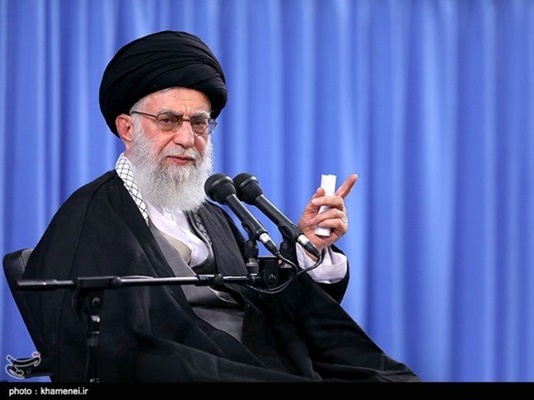
The erratic mood swings of Washington will come as no surprise to Iran’s Leader (he isn’t called the “supreme” leader in Persian–that is Western journalistic propaganda). Ayatollah Ali Khamenei has been a consistent critic of negotiations with the United States on the grounds that it is a warmongering inconsistent imperialist power, which will always go back on its word and find some pretext to inflict harm on Iran.

[Ayatollah] Khamenei said as nuclear talks kicked off in 2014, “I have said before … I am not optimistic about the negotiations. It will not lead anywhere, but I am not opposed either . . . What our foreign ministry and officials have started will continue and Iran will not violate its (pledge) … but I say again that this is of no use and will not lead anywhere.”

He added, “The nuclear issue is an excuse for America to continue its animosity. Now, the American spokesmen are bringing up the issues of human rights and missiles.”

Remember, this speech in Tabriz was at the start of serious negotiations in early 2014. It now seems prophetic.

At the time, the Brookings Institution made fun of [Ayatollah] Khamenei. Suzanne Maloney wrote that on the eve of the talks, “Iran’s supreme leader Ayatollah Ali Khamenei delivered one of his trademark jeremiads against Washington. His remarks were laced with suspicion and indifference to the ostensible purpose of the dialogue, the resolution of the nuclear impasse, and they underscore the challenge of devising a detailed, rigorous agreement that can withstand the brunt of the entrenched rancour from Iran’s highest authority.”

I don’t mean to pick on Brookings, which tilts liberal and where I have friends, or on Ms. Maloney, who was writing in a different era. But [Ayatollah] Khamenei had some reason for his suspicions, and he did not actually display “entrenched rancour” toward the negotiations. He just was under no illusions that even if they succeeded they would mean the end of US attempts to overthrow the Iranian government again, as it did in 1953.

His “trademark jeremiad” turns out to have been perfectly sensible. […] The US does promote “war” and “poverty” when they suit the American political elite and business classes. The US is the major reason for which 4 million occupied Palestinians can be crushed under the jackboot of the Israeli far right and driven into poverty. The US adventuristic invasion and occupation of Iraq destabilized the region. US covert operations, from coups to drone strikes, have spread turmoil. (On the other hand the USAID has done good work in malaria elimination and US inventions have made millions of lives easier).

Iran entered into the negotiations on the grounds that sanctions would be lifted. Those sanctions were harming the country’s economy and putting lives at risk (Iran Air’s fleet of planes was aging e.g.). While international sanctions have been lifted, the GOP Congress has ratcheted up sanctions, as [Ayatollah] Khamenei foresaw. Many European firms are afraid of US sanctions and so have not invested in Iran. Iran gave up a major deterrent tool (a nuclear program serves to discourage invasion plans even if no bomb is actually assembled) and got almost nothing for it.

Now, Trump and far right hawks like Sen. Cotton intend to see if the US can renege on the deal entirely, essentially unsigning it and reversing its commitments.

The only reason for reneging on the JCPOA is to prepare the way for a war of aggression against Iran.

Iran is three times bigger geographically, much more rugged, and 2.5 times as populous as Iraq. For anyone who is too young to remember that one, let us just say it did not go well, cost a lot of money and lives, and produced no tangible benefit for the US public.

As for [Ayatollah] Khamenei, he also observed after the JCPOA was signed, “Today, even the diplomatic officials and those who were present in the [nuclear] negotiations reiterate the fact that the US is breaching its promises, and while speaking softly and sweetly [to Iran], is busy obstructing and damaging Iran’s economic relations with other countries . . . The JCPOA, as an experience, once again proved the futility of negotiations with the Americans, their lack of commitment to their promises and the necessity of distrust of US pledges.”

It isn’t surprising that [Ayatollah] Khamenei feels this way. What is dangerous is that with Trump at our helm, the whole world may come to view the United States in this light, and nothing could be more damaging to US national security.

IRGC to View US Troopers as ISIS Terrorists Anywhere in World: Commander

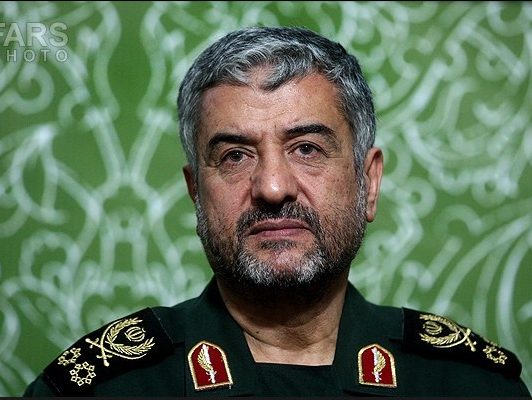
Mohammad-Ali Jafari

IRGC Chief-Commander Major General Mohammad Ali Jafari referred to the reports about the US government’s “stupid” move to designate IRGC as a terrorist organization, and said, “If such reports prove true, the IRGC will consider the US army to be synonymous with ISIS terrorists anywhere in the world, particularly in the Middle East.”

Addressing a group of senior IRGC commanders on Sunday, General Jafari pointed to the “Countering America’s Adversaries Through Sanctions Act”, which was signed into law by Trump in August and allows the president to impose fresh sanctions against Tehran, and said, “If the US administration implements the CAATSA, the Islamic Republic of Iran will view it as Washington’s unilateral withdrawal from the nuclear deal.”

He also reiterated that in case the Act is implemented, the US must move its regional bases outside the striking range of Iranian missiles, which means 2,000 km away from Iran’s borders.

He stressed that if new sanctions are imposed on Iran, the chance for any interaction will be lost forever. “These sanctions will complete the experience of JCPOA for us: Iran will then become confident that dialogue for US is an instrument of pressure and hostility not interaction or problem solving.”

General Jafari further noted that if Americans are taking such measures in order to ultimately take Iran to the negotiating table on regional issues, they have chosen a totally wrong path.

“The Islamic Republic of Iran seeks to resolve regional issues in a place other than the negotiating table, as there is nothing to talk about and there is no side to negotiate with.”

“The US behaviour towards Iran proved that we cannot set our foreign policy only based on the nuclear deal,” he added.

“The Americans should know that the Islamic Republic of Iran will use the Trump administration’s stupid behaviour as an opportunity to enhance its conventional missile, regional, and defensive programs,” General Jafari underlined.

The IRGC Commander’s remarks came after the Financial Times reported that Trump is expected to designate IRGC as a terrorist organization next week as part of a new hardline strategy against the Islamic Republic.

A senior US administration official said the US president, who is poised to decertify JCPOA next week, will not seek the re-imposition of broad sanctions that would risk collapsing the 2015 accord.

But Trump is expected to announce new measures against Iran, including the prospect of additional targeted sanctions, the designation of the IRGC as a terrorist organization and the adoption of a tougher stance on Iranian proxies in Syria, Iraq and Yemen, according to a person briefed on the matter.

‘France after Mediating between Iran, US to Secure Its Missed Interests in Syria’

Speaking in a Farsi interview with ICANA, Iranian MP Mohammad Javad Jamali Nobandegani said France is still influential in Lebanon and Syria due to its long-time presence in the Middle East in the past.

“In the early days of Syria crisis, the French officials mistakenly thought the government of Bashar Assad would fall; so, they decided to turn to the opposition armed groups in Syria and even hosted some of their conferences,” he said.

Nobandegani, who is a member of the Iranian Parliament’s National Security and Foreign Policy Commission, went on saying “unfortunately the French couldn’t play a neutral role in the Syrian crisis.”

Following the active diplomacy of Iran and Russia to resolve Syrian crisis, the French have decided to step into the fray and take some concrete steps to correct their wrong decision, he added.

He referred to the Astana talks on Syria crisis and said although the Astana Process has not managed yet to completely remove the tensions, the presence of the regional states in the talks decreased the conflicts in some areas and also led to the eradication of ISIS terrorists in some other areas of the war-torn country.

“Feeling they are lagging behind other countries, the French have decided to take a more active role in Syria crisis.”

He also referred to the recent remarks made by Syrian President Assad about the reconstruction of Syria and said as Assad has stressed, those states which have had a positive role in Syria are put on priority to take part in the construction projects.

“This is another reason why the French have decided to take a positive step in resolving Syria crisis,” he concluded.

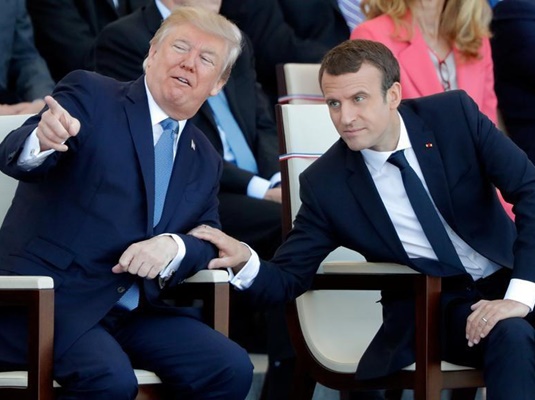
Back in September, French President Emmanuel Macron said he wanted to play a mediation role between Iran and the United States to ensure that Tehran was involved in finding a political solution in Syria.

“If we don’t resolve the Syrian problem with Iran around the table, then we will not have an efficient response because Iran today is among the powers that have an influence on the ground,” Macron said at the time.