Friday, December 26, 2025
Home Blog Page 3852

Rouhani’s Gov’t to Open Up Iran’s Political Atmosphere: ICT Minister

Mohammad Javad Azari Jahromi

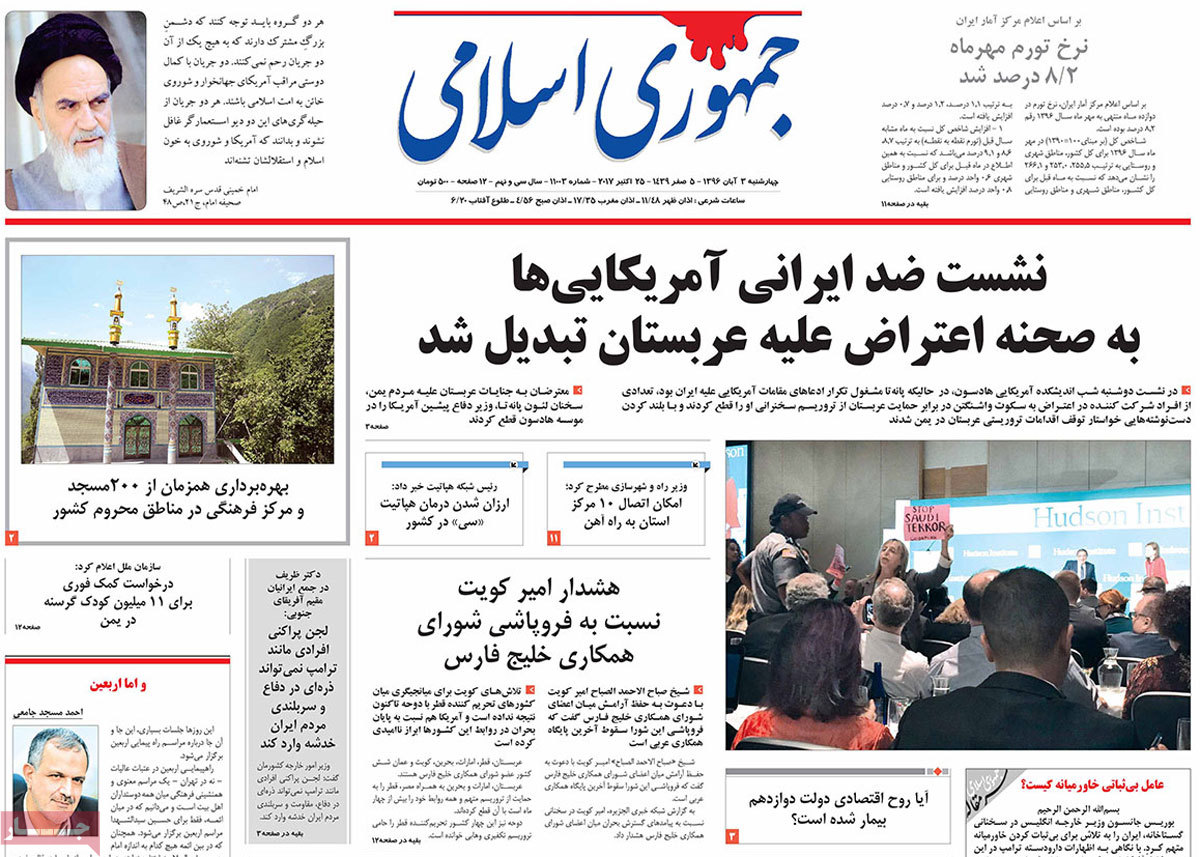
Minister of communications and information technology, Mohammad-Javad Azari Jahromi, says all institutions of the Islamic establishment see eye to eye when it comes to countering counter-revolutionary elements operating in the virtual space.

However, he said, the necessity of tackling counter-revolutionary elements should not turn into a pretext to label political opposition as counter-revolutionaries and block the country’s political landscape. He said the government intends to open up the country’s political atmosphere.

Touching upon anti-revolutionaries’ activities in the cyberspace, he said, “Counter-revolutionary elements seek to create public discontent, and we shouldn’t further fuel that.”

The ICT minister then touched upon recent remarks by judicial officials regarding Telegram and counter-revolutionary channels.

“Comments by the country’s prosecutor general, who said he didn’t want to block the cyberspace, are promising. All constituents of the establishment have the same opinion on counter-revolutionaries’ activities in the cyberspace in the country, and they cannot afford to see this space be used for acting against people’s mental security and spreading hate and lies,” the minister noted.

“We all agree that anti-revolution channels which hatch plots and disrupt people’s mental security and their investments in the country mustn’t be allowed to work, and we are seriously working to limit their activities.”

He said we are also dealing with numerous cases where people have come to the ministry and asked it to tackle anti-revolution activities.

“The enemy should know that the administration (the executive branch) and the Judiciary do not have differences in this regard and have the same opinion.”

Azari Jahromi’s comments came after a channel in the Telegram messaging app started raising false allegations against the country’s top officials, particularly the Judiciary Chief Ayatollah Sadeq Amoli Larijani. The counter-revolutionary channel’s activities have sparked controversy in Iran over the need to restrict the activities of such online services.

Village of Hir; Iranian Capital of Cornelian Cherry

The village can be reached after passing through narrow roads, valleys and steep paths. After walking through this road, the sound of Nineh Roud river, along with the mass of cornelian cherry trees, beats your fatigue.

Hir is the capital of Iranian cornelian cherries, which has many fans in Iran. Hir produces about 90% of Iran’s cornelian cherry and is considered to be the capital of this fruit. In the harvest season, many people from this village and the city of Alamut pass through the narrow roads to have a share in the distribution of this fruit.

Here are Mehr New Agency’s photos of this beautiful village:

Iranian-Made Neuronavigation System Enters Service

Iranian neurosurgeons can now use an indigenous neuronavigation system to perform their operations.

“The apparatus which plays a key role in removing brain tumours using new methods … has recently been installed at the neurosurgery room of the Qaem hospital in [the northeastern city of] Mashhad,” said Hamid Etamad Rezaei, the director of the neurosurgery team at Mashhad University of Medical Sciences.

According to a Farsi report by IRNA, he said the device made by Iranian experts around six years ago measures up to international standards.

Rezaei, a sub-specialist in neurosurgery, added the neuronavigation system is used to track the locations in question without surgeons having to break the skull open. The procedure will make it possible to remove brain and pituitary tumours, treat brain conditions and conduct sampling of tissues from deep parts of the brain, he added.

The neurosurgeon said the apparatus can also be used in operations on the spine.

Measures are underway to buy and install two other state-of-the-art apparatuses used in neurosurgery, including a modern microscope and a device used to control nerves in different parts of the patient’s body during the operation, he further said.

Iran Has Been Unfairly Maligned: FM Zarif

In his article released by The Atlantic on Monday, October 9, Zarif has also lashed out at world powers for their interference in the Middle East, stressing that such interventionist policies have wrought a fractured region.

What follows is the full text of the article title “Iranian Foreign Minister: Foreign Meddling Has Wrought a Fractured Middle East”:

Iranians live in a troubled and unstable region. We cannot change geography, but our neighbourhood was not always so stormy. Without delving too far back into history—although as an ancient peoples our memories are measured in millennia, not decades or even centuries—it’s safe to say that our region began to experience insecurity and instability when foreign, indeed completely alien powers, arrived and began interfering. The discovery of oil, a drug the West soon became addicted to, only strengthened colonial power projection into our region, and subsequently Cold War rivalry—both major factors in the US and U.K. decision to overthrow the legitimate and democratic government of Iran in 1953—provided the fodder for further meddling by foreign powers and superpowers.

Today, what that meddling has wrought is a fractured Middle East. Steadfast allies of the West, rather than considering the plight or aspirations of their own peoples, spend their wealth arming themselves, sending to the West the riches their natural resources provide. They spend billions more of that wealth spreading Wahhabism—a medieval ideology of hate and exclusion—from the Far East to the Americas. They support organized non-state actors who wreak havoc through terror and civil wars. In the case of Afghanistan, Saudi Arabia and the UAE went as far as officially recognizing the Taliban as the government—becoming two of only three countries in the world that did so. The US, meanwhile, turned a blind eye to the ideology and funding that led to the creation of al-Qaeda—and its more recent offshoots of ISIS, Nusrah, Ahrar al-Sham, Jaish-al-Islam, Boko Haram, al-Shabaab, and the list goes on—and to the worst terror attack on American soil since Pearl Harbor. The US military presence in the region now aims to counter not just threats to America’s own interests, but also supposed threats to the very same allies that have supported the kind of terror now being visited on the cities of Europe and the United States.

These allies of the West—throughout their brief history as nations hostile to my country—pounced on Iran in the aftermath of our Islamic Revolution, which freed us from a dictatorship not unlike theirs and allowed us to set our own course in history, independent and peaceful but allied to neither East nor West. While we voluntarily set aside a domineering role in the region, they funded, armed, and supported Saddam Hussein’s invasion of Iran. His eight-year war against us resulted in nothing but death and destruction, including the first battlefield use of chemical weapons since World War I—by Saddam against our soldiers, as well as against civilians—which was met with  deafening silence by the international community.

We Iranians, punished for having the gall to declare ourselves free of domestic tyranny and foreign dominance, were denied even the most basic defensive weapons, even while missiles rained down on our cities to the cheers of our Arab neighbours. One of those neighbours, Kuwait, a major funder of Iraq’s war on us and the facilitator of its oil sales, shortly afterward became the victim of Saddam’s ambitions itself. Yet in the interest of regional peace and stability, we chose to support Kuwait’s sovereignty in the face of Iraqi invasion, despite Saddam’s offer to share the spoils with us; he even sent his fighter jets to Iran, ostensibly for safe-keeping, but really in an attempt to lure us to his side. Our leadership firmly rejected this offer despite the hostility, both overt and covert, some Persian Gulf states had shown us since the revolution. We preferred for our Persian Gulf neighbours to remain stable, functioning, independent countries, rather than enjoying the certain but brief satisfaction of seeing them receive their just deserts.

Arab affairs are Iran’s business. And we are not shy in admitting that non-Arab affairs are their business. How can they not be?

Today, some of those states—especially Saudi Arabia, the UAE and, as a result of their expensive lobbying campaigns, the US—claim Iran is interfering in Arab affairs and spreading insecurity throughout the region. Ironically, though, it is they who have waged war on their fellow Arab nation of Yemen, invaded Bahrain, embargoed their kin in Qatar, funded and armed terror groups in the war in Syria, and supported a military coup against an elected government in Egypt, all the while denying the most basic freedoms to their own restless populations. Iran, meanwhile, being stronger and older as an independent state than any of its neighbours, has not attacked another country in nearly three centuries. Iran doesn’t and won’t interfere in the internal affairs of its neighbours.

Still, Arab affairs are Iran’s business. And we are not shy in admitting that non-Arab affairs are their business. How can they not be? We share borders, waters, and resources; we fly through each other’s airspace. We can’t not be interested in how our neighbours affect the part of the globe where we make our homes.

Our interest in our region’s affairs, though, is not malevolent. On the contrary, it is in the interest of stability. We do not desire the downfall of any regimes in the countries that surround us. Our desire—in principle and practice—is that all the nations of the region enjoy security, peace, and stability. Unfortunately, this is not the desire of some of some of our neighbours, whose untried leaders cherish the delusion of regime change in Iran, and support terrorist groups that seek to overthrow our government or create fear for the sake of wounding the nation. Our neighbours do this even while saying that Iran’s influence is spreading—especially since the conclusion of the nuclear agreement of 2015.

Iran’s influence, though, has spread not at the purposeful expense of others, but as a result of their and their Western allies’ actions, mistakes, and wrong choices. After the downfall of the Taliban in Afghanistan and Saddam Hussein in Iraq, it was inevitable that Iran, which had housed those countries’ refugees and provided asylum to their political figures, would have greater “influence” with the friends who took over than would those who supported and financed the atrocities of the Taliban and Saddam Hussein against their own people. It was not Iran that prevented a churlish Saudi Arabia from opening an embassy in Baghdad for a decade after the fall of Saddam, nor was it Iran that insisted on war with Yemen or an embargo of Qatar.

Qatar, a country that we differ with on a number of serious issues, is a neighbour we do not want to see unstable. Nor do we want to see its independence questioned while it suffers under the thumb of its bigger Saudi brother. Since we could not allow its besiegement and suffocation, we have provided it with much-needed ports and an air corridor. We similarly showed immediate support for the democratically elected government of Turkey, which also differs from us on some issues, when it suffered a coup attempt. We brought our influence to bear in Lebanon, a troubled land where a unity government was formed after two years of objections by Saudi Arabia, which seemingly preferred the instability of infighting and sectarian divisions in the Levant to a functioning, successful state.

In Syria, we came to assist the people when, in the guise of mass protest following the Arab Spring, terrorist groups—including some aligned to al-Qaeda and Daesh [ISIS] —took up arms to seize power and establish a monstrous terrorist state characterized by mass and bloody beheadings. Some of the terror groups have at some point been directly or indirectly funded and armed by some of our neighbours, and in some cases by the United States itself. The millions of Syrian refugees fleeing their homes are not fleeing a man, a sect, or a government; they are fleeing war and terror. But no country has done more than Iran in the fight against Daesh [ISIS] and in preventing the formation of an anti-Islamic caliphate from Damascus to Baghdad.

The millions of Syrian refugees fleeing their homes are not fleeing a man, a sect, or a government; they are fleeing war and terror.

Iran prioritized getting an agreement to solve the unnecessary nuclear crisis, precisely in order to prevent further instability in the region by eliminating one serious point of contention with Western powers. This, we hoped—and one would expect—would also benefit all our neighbours. Still, we did not neglect the other crises affecting the region, and on numerous occasions we offered plans, cease-fires, and negotiations to bring about an end to armed conflict. Almost all our offers fell on deaf ears—American and Arab alike. But just as we cannot and do not want to exclude major countries like Saudi Arabia from the regional stability equation, neither can we be excluded, for the instability of one nation affects the stability of all.

After the resolution of the nuclear crisis, our neighbours could have moved to increase trade and investment with us. They could have accepted our long-standing offer—repeated several times before and after the nuclear deal—to discuss a regional security arrangement. But they did the opposite: They doubled down on their hostility toward Iran and Iranians, and have done everything they can—from lobbying campaigns, to extreme flattery of the US president, to refusing to even engage with us—to perpetuate the fallacy that Iran is the root of all problems in the region and must be confronted (or to use the popular Washington term, be “pushed back” against), before it destabilizes the entire world.

It is in this atmosphere—and mindful of our 20th-century experience with a neighbour that waged an eight-year war against our people while virtually the entire world took the side of the aggressor—that we endeavour to have a working defensive capability. It is because of the hostility shown to us since the Islamic Revolution, from within our own region and from the West, and because of the West’s refusal to sell us any defensive weaponry that might deter a future Saddam, that we have developed an indigenous capability. It includes missiles, which require testing to ensure that they perform as designed, and which are now accurate to within seven meters. (This kind of accuracy, incidentally, would be entirely unnecessary for a nuclear payload, which can miss an intended target by tens or even a hundred kilometres and still rain death and destruction on a wide area. But accuracy is absolutely crucial in striking military targets or specific terrorist camps while avoiding civilian or non-combatant deaths.) We purposefully excluded our defensive military capability from negotiations for the Joint Comprehensive Plan of Action (JCPOA), as the nuclear deal is formally known, precisely because Iran will never abrogate its right to defend its citizens or delegate that right to an outside party. It is not intended as leverage or a bargaining chip in future negotiations. No party or country need fear our missiles, or indeed any Iranian military capability, unless it intends to attack our territory or foment trouble through terrorist attacks on our soil.

Saudi Arabia spends over $63 billion on defence annually, ranking 4th in the world behind only the US, China, and Russia. The UAE, a country with less than 1.5 million citizens, ranks 14th, with over $22 billion in annual defence spending. Iran doesn’t even make the list of the top 20 spenders: Its $12 billion puts it in 33rd place. It is hardly ramping up to be the new hegemonic bully in the neighbourhood. Our goal is not to have the biggest or best-equipped military, or to possess trillions of dollars’ worth of weapons, but to have the minimum materiel required to deter and to counter threats and armed attack. Our biggest asset for stability, security, and independence is our people, who—unlike the citizens of some US allies in the region—choose their government every four years.

Iranian “aggression” is a myth.


We patrol the waters of the Persian Gulf—so named by Westerners centuries ago given that its longest shore by far is Iran’s—because Iran’s right to defend its territory from sea attack or subterfuge cannot be questioned. (Presumably, likewise, the US Coast Guard and Navy have not stopped patrolling the Gulf of Mexico, or the Atlantic and Pacific seaboards.) If there are accusations warranted about “provocative behaviour” in the Persian Gulf, Iran is surely the party to make them. US warships and aircraft carriers the size of cities routinely bear down on Iranian naval vessels in waters that are only 10 kilometres wide in some parts. No one should expect us to ever forfeit our rights in this important waterway, which is central to our economic and national-security interests.

The Iran-phobia perpetuated by some of our neighbours—which in the age of rule by political neophytes has become a kind of hysteria—is now influencing the outlook of the US This is true of the nuclear agreement and is evident more generally in the kind of open hostility toward Iran President Trump expressed in his 2017 UN speech. But the evidence for “bad behaviour” by Iran is non-existent. Iranian “aggression” is a myth, easily perpetuated by those willing to spend their dollars on American military equipment and public-relations firms, and by those promising to protect American interests rather than those of their own people. In the end, they serve neither.

The successful implementation of the nuclear deal—by Iran, at least—is proof of Iran’s good will and peaceful intentions. If we had hegemonic ambitions, an agreement would never have been reached. The JCPOA can in fact be a model for the diplomatic resolution of crises, and for peaceful outcomes in regional disputes. Rather than look at its shortcomings—for in any deal or bargain, there are shortcomings from the perspective of either side—it would behove other countries beyond to look at its benefits. For there are also benefits for all sides, including for our immediate neighbours.

New leaders in Saudi Arabia and the UAE, exhibiting the impetuosity of inexperience—as well as the hubris bred through a supremely sheltered and privileged upbringing—have embraced an aggressive regional stance. Fearing shame or failure, they may find it difficult to back down. But insisting on the wrong course won’t make it right. Vietnam should have taught that to America, and Afghanistan to the former Soviet Union. Our regional trouble should be teaching that to our neighbours. The right approach is not difficult to uncover—it just requires open eyes, an open mind, respect for the opinions and positions of others, and a willingness to engage and search for a mutually acceptable solution to any problem. We Iranians pledged to do that with six countries when we restarted negotiations on the nuclear issue in 2013. Even if one or more of the parties abrogates the deal without reason, or refuses to fully implement its side, the approach itself was the right one. Any failure, in the end, will not come from an inherent defect of the agreement, but from a lack of good faith that will only globally discredit the defectors.

Iran will continue on its own path of dialogue, mutual respect, and understanding.

But in thinking about how to move past regional stalemates—especially with regard to the spread of terror—it might be useful for our neighbours and their Western backers to take another, more careful look at past Iranian initiatives. Iran proposed a “Dialogue Among Civilizations” in 1998, well before 9/11 and before any notion of a “clash of civilizations” took hold among the general public. In 2013, President Hassan Rouhani proposed a “World Against Violence and Extremism” (WAVE), before Daesh [ISIS] became a household name. Both initiatives accurately diagnosed the enabling social, cultural, and global conditions that have encouraged the formation and spread of extremist violence—conditions that are too often forgotten in otherwise laudatory pledges to eradicate the scourge.

While clearly such forces as Daesh [ISIS] and its offshoots need to be defeated and their false promises exposed, a meaningful restoration of peace and stability to the Persian Gulf region hinges on the promotion of mutual understanding and regional security cooperation, which some of our neighbours have so far rejected. But there’s no reason we can’t cooperate. The ancient Persian game of chess requires either a winner, a stalemate, or surrender by one opponent in the face of defeat. It is a magnificent game, but it is just a game. In the real world, other outcomes are possible—there can be a “win-win” solution that doesn’t result in defeat for any side. To achieve this outcome, we should be erecting a working regional mechanism rather than laying more bricks in the wall of division. We can start with a regional dialogue forum, something Iran has always been—publicly and privately—in favour of.

Such a forum should naturally be based on respect for the sovereignty, territorial integrity, and political independence of all states; the inviolability of international boundaries; non-interference in others’ internal affairs; the peaceful settlement of disputes; the impermissibility of threats or use of force; and the promotion of peace, stability, progress, and prosperity in the region. A forum based on these principles could eventually develop more formal nonaggression and security cooperation arrangements between all the parties, ensuring that the Persian Gulf does not remain a synonym for implacable troubles.

Iran will in the meantime continue on its own path of dialogue, mutual respect, and understanding. In that vein, in early October I held successful top-level meetings in Qatar and Oman, followed by a summit with Turkey in Tehran, addressing issues of paramount importance to the peace and stability of our neighbourhood. It should be everyone’s fervent hope that we can have similar interactions with our other neighbours.

Iran Rejects New Yorker’s Account of Zarif-Tillerson Meeting

Iran Rejects New Yorker’s Account of Zarif-Tillerson Meeting

An informed Iranian source has told the Tabnak news website that “the meeting between Iran and the P5+1 group on the sidelines of the UN General Assembly was not an initiative suggested by the US, and the session was not chaired by Tillerson, so the Americans were in a weak position at this meeting and they were fully impressed by the consensus of the members and the statements of Iran’s foreign minister.

This source also added that the New Yorker’s account of the meeting is not well-defined and can be called the reversal of reality. This narrative is an attempt to make up for the US Secretary of State’s passivity at this meeting.

“While FM Zarif stated the positions of the Islamic Republic very strongly, Tillerson just read a few phrases that were written for him on a paper and then kept silent!” underlined the source.

“The report and the narrative of this American media is to promote and strengthen Tillerson’s position against Donald Tramp rather than undermining Iran’s position as in the past days, there were signs of a disagreement between Tillerson and Trump that undermined the Secretary of State’s position in the US government.”

The source also noted that the New Yorker was striving for the reinstatement of Tillerson in the US State Department.

Iranian Foreign Minister Mohammad Javad Zarif and US Secretary of State Rex Tillerson met each other for the first time during a late September meeting of the P5+1 group on the sidelines of the UN General Assembly in New York.

Following the meeting, the New Yorker magazine reported that “Tillerson let the other diplomats —representatives of Germany, France, Russia, China, the United Kingdom, the European Union, and Iran — speak first. When Zarif’s turn came, he read a list of complaints about the Trump Administration and its European partners.”

After Zarif’s remarks, the New Yorker claims, “Tillerson, peering down over his reading glasses, spoke in a deep Texas drawl that evoked a frontier sheriff about to lose his patience.”

“No one can credibly claim that Iran has positively contributed to regional peace and security,” Tillerson was quoted as saying.

New Yorker described Tillerson as “an imposing man” who “is stocky, and has a head of swept-back gray hair and a wide mouth that often droops in a scowl.”

“Turning to Zarif, he [Tillerson] went on to say that Iran had funded groups like Hezbollah, the Lebanese Islamist militia; it had backed Bashar al-Assad, the murderous Syrian dictator; and it had sent its Navy into the Persian Gulf to harass American ships. The fault for all this, Tillerson said, lay in the nuclear deal, known as the Joint Comprehensive Plan of Action, which curtailed Iran’s nuclear-weapons program but not its aggressive actions in the region.”

“For Tillerson, it was an emblem of the previous Administration’s overly lenient foreign policy, which sought to promote America’s priorities through consensus, rather than through the frank display of power. “Lifting the sanctions as required under the terms of the JCPOA has enabled Iran’s unacceptable behaviour,” he said, according to the report.

The report further quoted Tillerson as saying, “The real problem was that Iran had been attacking Americans since 1979, when Iranian students seized the US Embassy in Tehran and held fifty-two diplomats for more than a year.”

“The modern-day US-Iran relationship is now almost forty years old,” he went on to say, still looking at Zarif. “It was born out of a revolution, with our Embassy under siege—and we were very badly treated.” He accused Iran of sponsoring a number of attacks in Lebanon in the nineteen-eighties and in Iraq more recently, which together killed hundreds of American citizens. “The relationship has been defined by violence—against us,” he said, as claimed by the New Yorker.

Film Festival in Dallas Features Several Iranian Animations

Film Festival in Dallas Features Several Iranian Animations

The event was organized by ‘Sheed Film’ company and was performed in collaboration with the French DreamLab Company and Iran’s Institute for the Intellectual Development of Children and Young Adults, according to a Farsi report by Asr-e Iran news website.

At the event, which was held for one evening, animations made by Iranian directors were screened free-of-charge for the audience with the motto ‘Finding a Friend like Me’.

This was the first time that such an event was held for Iranian children in the United States, and it is said that ‘Sheed Film’ wanted to evoke sympathy and develop friendship among Iranian kids and help them get acquainted with each other.

It was also aimed at inviting children from other countries to watch Iranian animations.

The show kicked off on Sunday, October 8, in Angelika Film Centre Plano, Dallas. Films like “The Fox Who Went after the Sound” directed by Fatemeh Goodarzi, “Black or White” directed by Mohammad Ali Soleimanzadeh, “Scarecrow’s Heart” directed by Gholam-Reza Kazzazi, “Cloud Goats” directed by Hamid Karimian, and “The Kind Moon” directed by Nazanin Sobhan Sarbandi were screened at the event.

The ‘Sheed Film’ authorities have announced that they sought to support all Iranian and world-known Persian-language films by selecting valuable works in order to make the foreigners familiar with the culture and art of Iran and Persian-speaking people, and also maintain the relations and links between Iranians abroad, especially the younger generation.

Iran’s Foreign Ministry, IRGC United against Enemies: Commander

Iran’s Foreign Ministry, IRGC United against Enemies: Commander

IRGC Chief-Commander Major General Mohammad Ali Jafari noted on Monday that the foreign ministry and the IRGC are coordinated in declaring their stances against enemies of the Islamic Republic even if they express the positions in different ways.

Speaking in a ceremony also attended by Iranian Foreign Minister Mohammad Javad Zarif in Tehran, General Jafari said the enemies of the Islamic Republic are well aware that all officials in Iran’s Establishment are unanimous in defending the country’s values, causes, national power, and defensive capabilities.

Zarif, for his part, referred to IRGC as an honour for the country, and a guarantee for defending Iran, survival of the 1979 Revolution, and protecting the country’s borders.

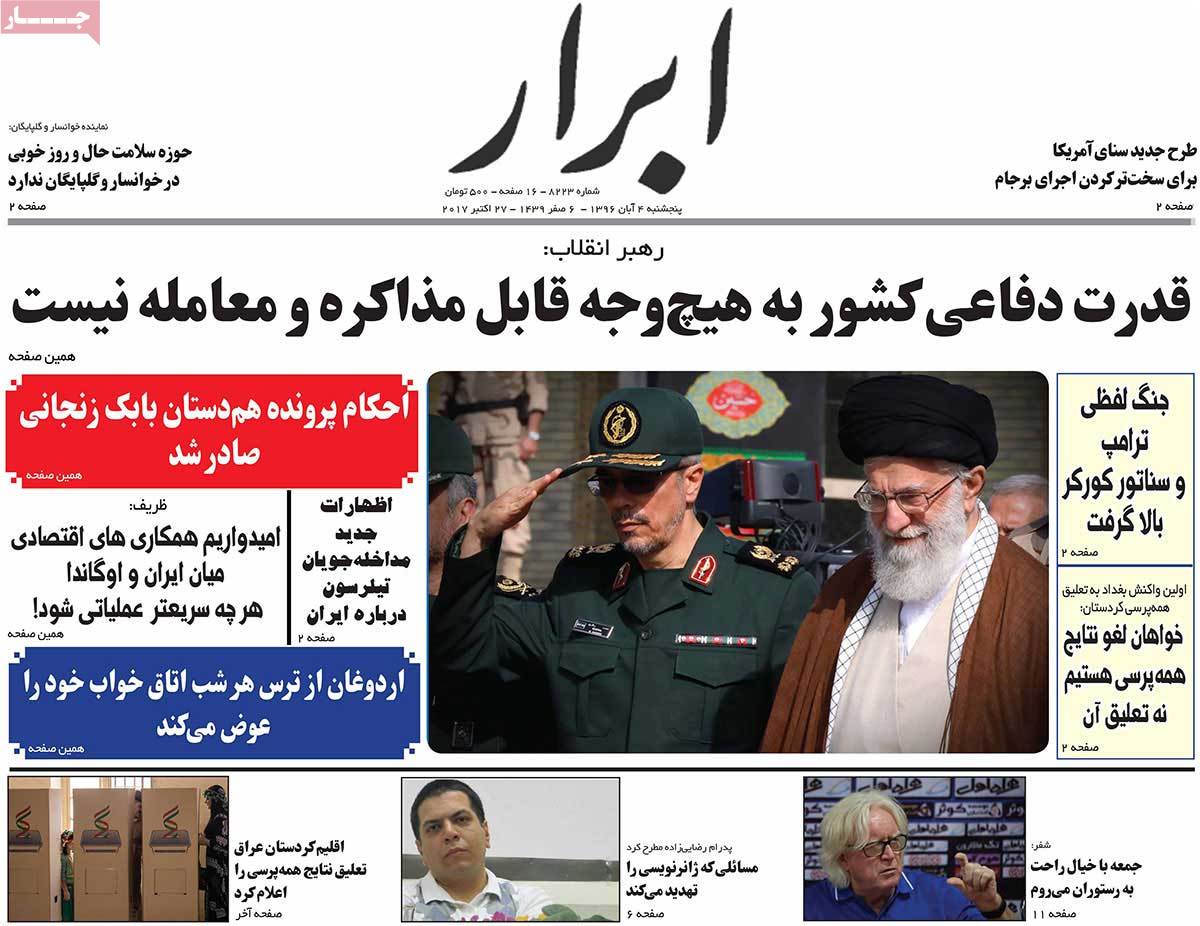
He further reiterated that Tehran will take reciprocal measures against a potential “strategic mistake” by US President Donald Trump to designate the IRGC as a terrorist organization.

“Some measures have been thought out in this regard and will be taken at the appropriate time.”

“The policy of Trump’s administration has been to deprive Iran of the JCPOA’s benefits, but through our policies, we will not allow the US to make such a move. We have been successful so far in this regard and will respond [to US actions] with proper measures in the future,” the top Iranian diplomat pointed out.

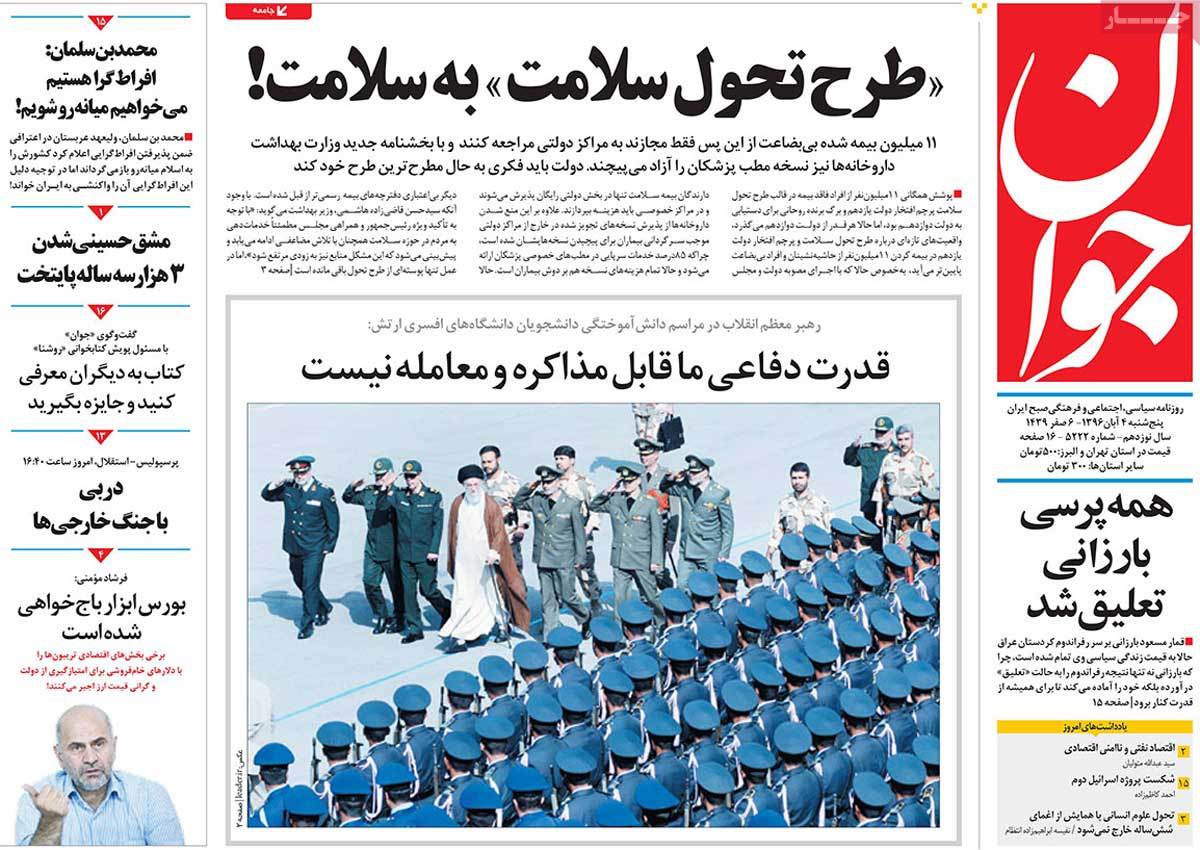
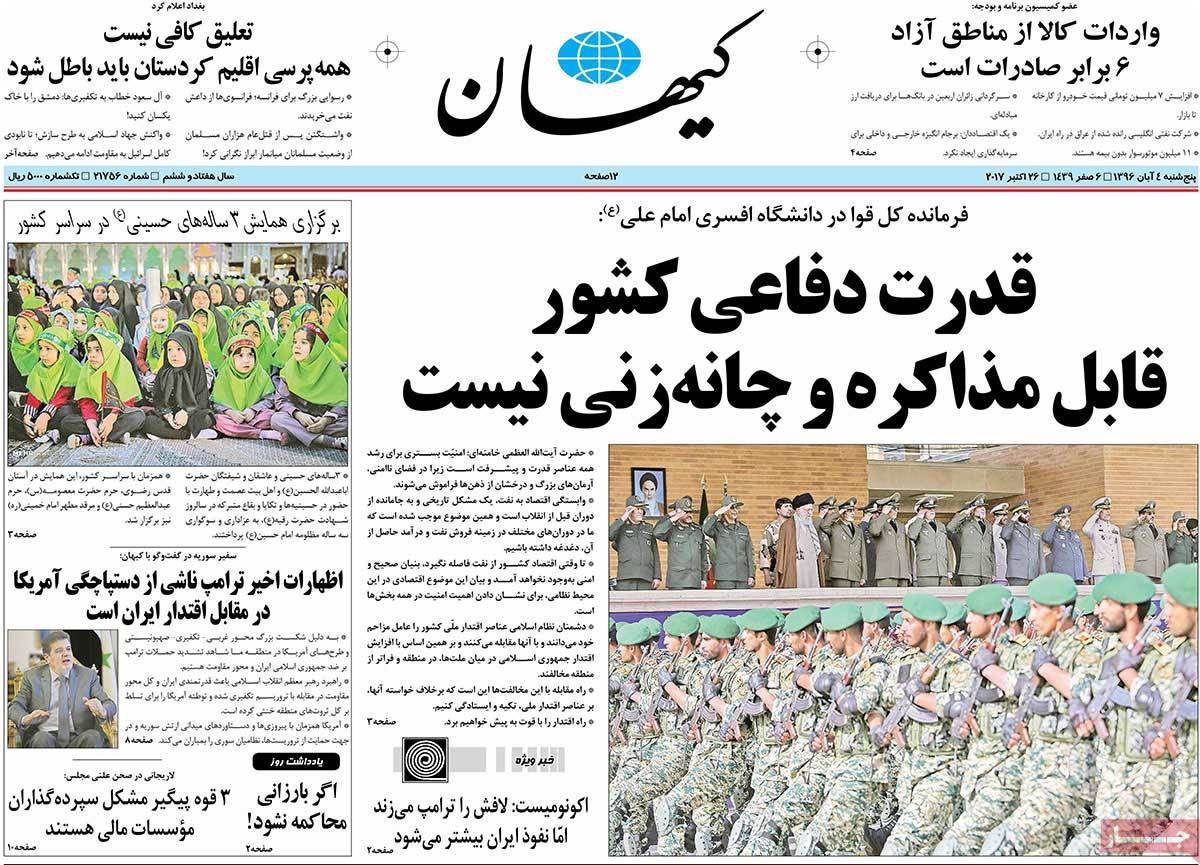
Zarif said Iran had repeatedly announced that its defensive power was not negotiable, adding that it has been even specified in the JCPOA that Iran would not negotiate on its defensive power.

Earlier on Sunday, the IRGC chief commander had noted that Iran would treat US troops like ISIS terrorists if the IRGC was designated as a terrorist organization by the US.

Iran’s reaction came a few days before the US president’s expected announcement of a final decision on his Iran strategy.

Trump is reportedly planning to “decertify” on October 15 the nuclear agreement, known as the Joint Comprehensive Plan of Action (JCPOA), reached between Iran and the P5+1 group of countries in 2015.

According to media speculations, the US president plans to declare that the nuclear deal is not in the national interest of the United States and kick the issue to a reluctant Congress. He is also expected to designate the IRGC as a terrorist organization.

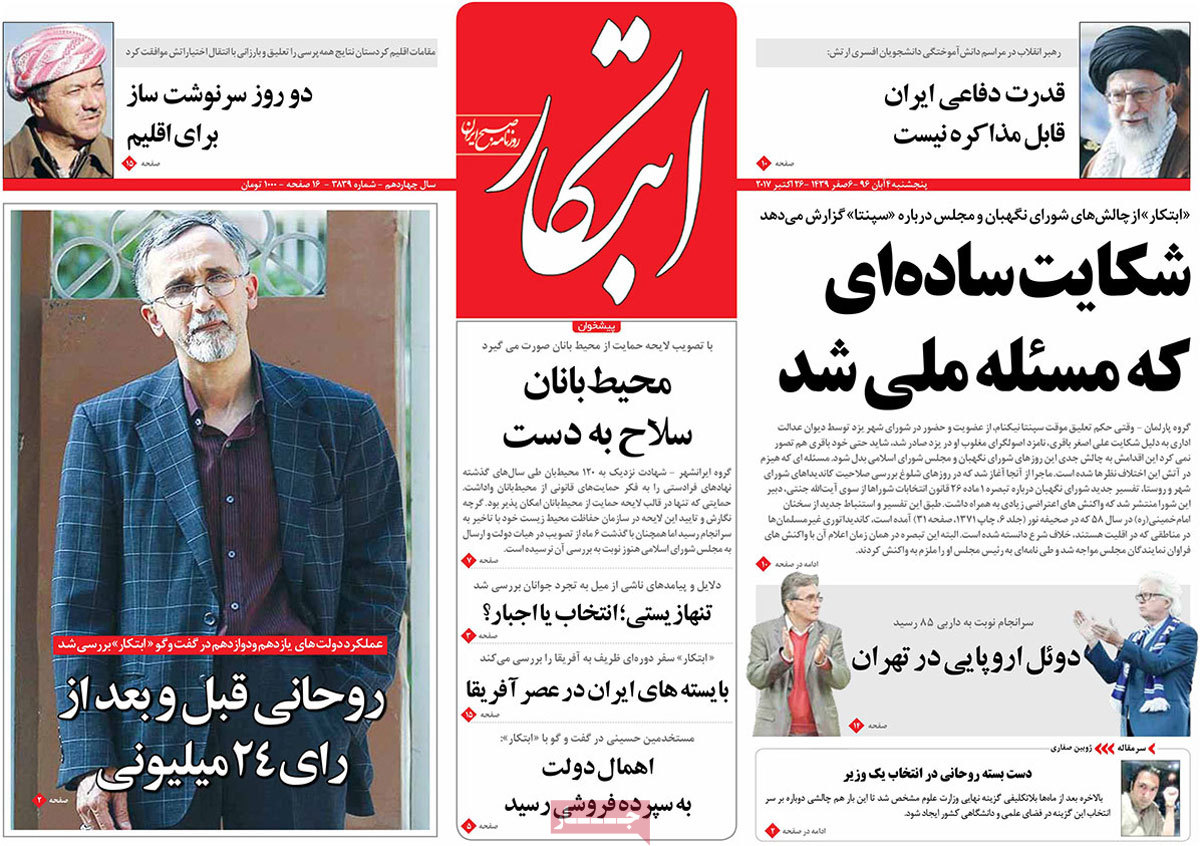
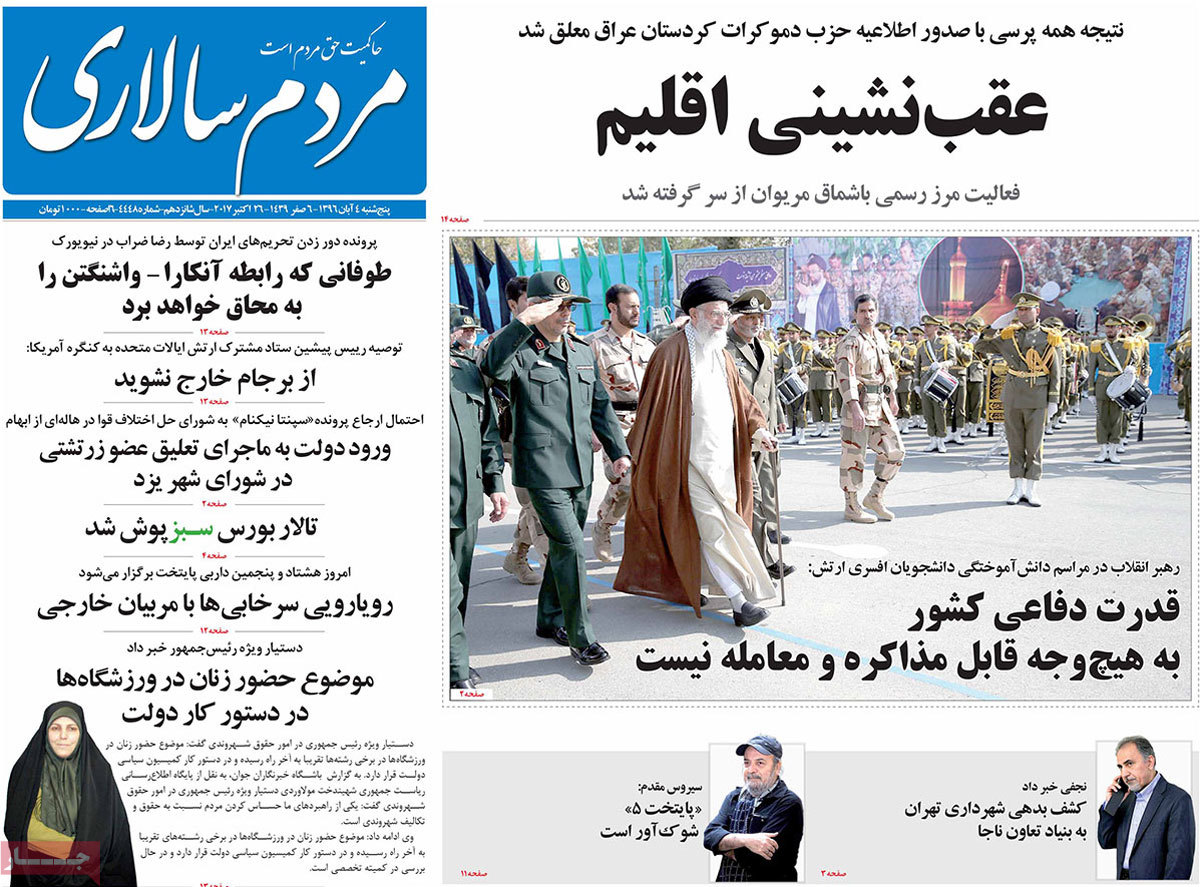
Is Barzani Ready for Conditional Suspension of Kurdish Referendum?

One of Iraq’s three Vice Presidents, Osama al-Nujaifi, who has recently met in Sulaymaniyah with Masoud Barzani, said the seccessiont referendum in the Kurdistan region was a wrong decision taken unilaterally.
“Al Arabiya website quoted al-Nujaifi as saying that Barzani has voiced his readiness to suspend the referendum in return for the lifting of sanctions against the Kurdistan region and the start of negotiations,” wrote Entekhab news website in a Farsi report.
This comes as Erbil and Baghdad are still at odds amid consequences of the referendum in Kurdistan region.
Recently, Iraqi Vice Presidents Ayad Allawi and Osama al-Nujaifi met with Barzani in Sulaymaniyah and reached a four-point agreement on initiating talks and lifting sanctions on the Kurdistan region. However, Baghdad considered the agreement non-binding stressing that it would never recognize the referendum.
Under such circumstances, al-Nujaifi says that Barzani is ready to ignore the separation referendum results if the talks open, and the sanctions are removed.
Meanwhile, Hayman Hurami, the political adviser at the office of the Kurdish Region’s President, has referred to the meeting of the speaker of the Iraqi parliament with the president of the Kurdistan region and wrote on his Twitter page that Barzani has informed al-Jabouri he is ready for talks with Baghdad and the central government without any preconditions.
However, the spokesman for the Iraqi government Mohammed Saeed al-Sahhaf has called for guarantees from the Kurdish region government to adhere to maintaining unity in the country.
The Shiite coalition in Iraq, in turn, has criticized the visit of the country’s parliament speaker to Erbil and his meeting with Barzani, describing it as disappointing.
Another Iraqi Vice President, Nouri al-Maliki, has strongly rejected any dialogue and reconciliation between Baghdad and Erbil before cancelling the results of the plebiscite.

‘Iran-France Business Ties Promoted after Nuclear Deal’

“Relations between Iran and France have expanded in various fields including auto industry, aviation industry, part-making, environment, sewerage, agriculture and so on,” said Mohammad Reza Najafi-Manesh, a board member of Iran-France Chamber of Commerce.

According to a Farsi report by Tasnim, he said Iran and France have long-time relations and added given the promising opportunities created in the post-JCPOA era, the two sides hope they can take more advantages of the current economic and political capacities to expand bilateral ties in all fields.

Najafi-Manesh said France has already made huge investments in research on agriculture and animal husbandry in Iran.

He also said at present Iran is seeking to take advantage of France’s latest scientific findings in agriculture and animal husbandry.

The Iranian official noted that exchanging the latest scientific findings with other countries in the mentioned fields will lead to further productivity and income.

Iran’s West Azarbaijan Province Exports 20 Tonnes of Grapes

Grapes

“This year, 20 tonnes of grapes harvested in West Azarbaijan, worth $15 million, have been exported to Russia, Azerbaijan Republic, Turkmenistan, Afghanistan, Ukraine and Iraq,” head of the Agriculture Organization of the province, Esmaeil Karimzadeh, said on Monday.

According to a Farsi report by the Mehr News Agency, he said West Azarbaijan is the fifth largest producer of grapes across Iran, adding the province is ranked first in terms of the quality of its grape.

“Grape is the second major fruit of the province involving 30,000 workers directly and 30,000 other indirectly in harvesting and packaging.”

He went on saying this year 176,265 tonnes of grapes have been harvested in the province. “Out of the harvested grapes, over 20,000 tonnes are stored but the rest are sent to the domestic and foreign markets.”


38% Decrease in Grape Harvest in West Azarbaijan

Karimzadeh said about 30,000 tonnes of the harvested grapes in the province are exported to foreign markets and the rest, about 60,000 tonnes, are used in supplementary industries.

“Meanwhile, about 40,000 tonnes of grapes are turned into raisins and the rest are allocated for household consumption,” he said.

Karimzadeh referred to a 38-percent decrease in this year’s grapes harvest because of icy weather and added, “There are over 52 types of grapes in the province but the main grapes are seedless white and seedless red grapes harvested in Sardasht region.”

He called on the government to support the grape harvesters in the province and added marketing still remains one of the main challenges for the grape harvesters.

“Absence of a government representative for setting the price as well as the presence of dealers in exporting markets are the main problems in the grapes markets,” he added.