Friday, December 26, 2025
Home Blog Page 3828

Iraq’s Role in Washington’s Anti-Iran Strategy

The Persian-language Fararu website has, in an analytical piece, discussed Washington’s scheme to chip away at Iran’s leverage in the region. The highlights of the article follow.

There have been different analyses of the strategy of “reducing Iran’s influence in the region” pushed by Washington in recent days following US Secretary of State Rex Tillerson’s  visit  to Saudi Arabia. Many experts have warned Iranian diplomatic and military officials against the current situation in Iraq as well as Washington and Riyadh’s activities in that domain. There is also concern that Iraq will turn toward the United States and Saudi Arabia in a calculated process.

Amid Tillerson’s visit to Saudi Arabia and his meeting with Iraqi Prime Minister Haider al-Abadi, Riyadh expressed its willingness to enhance economic relations with Baghdad. Therefore, economic means has been used along with political and diplomatic measures to advance the US’ strategy.


Scheme To Divide Iran, Iraq

During his trip to Saudi Arabia, Tillerson called on forces of the Iran-backed Popular Mobilization Units to return to their homes. However, the Iraqi premier’s office, in a statement, rejected Tillerson’s demand and strongly criticized his remarks.

But other developments are unfolding against the same backdrop. Movements by influential Iraqi Shiite leader Muqtada Sadr are among those developments.

After several high-profile meetings with leaders of the regional countries in recent months, Sadr sat down with Jordan’s King Abdullah last Monday.

Jordan announced in a statement that the centerpiece of the talks during the Jordanian king’s meeting with Sadr was the necessity of boosting trade and economic ties between Amman and Baghdad.

Still, the Associated Press has described the meeting as a step toward efforts to contain Iran’s influence in the Middle East.

Jordan is an ally of Saudi Arabia and has misgivings, like Riyadh, over Iran’s influence in the region.

Muqtada Sadr’s meeting with the king of Jordan took place hours after King Abdullah met Iraqi Prime Minister Haider al-Abadi, and no further details have been released on that.

Sadr had already travelled to Saudi Arabia, the United Arab Emirates and Egypt in mid-summer as well. All these three countries are critical of Iran’s behaviour in the region.

After meeting the Saudi crown prince, Sadr stressed that he has the same viewpoints as Mohammed bin Salman. He described Saudi Arabia as a “powerful father of Arab nations” which tries to establish peace in the region.

Muqtada Sadr is also opposed to the activities of the Popular Mobilization Units. He had earlier stressed the need to dismantle the group, saying the existence of such troops outside the framework of the government will lead to major problems and negative consequences.

Muqtada Sadr’s Change of Heart

Now, the question is, “What role do Muqtada Sadr and Haider al-Abadi play in the US strategy?”

University professor Ali Bigdeli has weighed in on the issue in an interview with Fararu.

“The US and Saudi Arabia are seeking to decrease Iran’s political and military influence in the region and somehow clip Iran’s wings. To that end, they have even made efforts to decrease Iran’s influence on Hamas,” said the analyst.

“Two and a half months ago, Haider al-Abadi announced in his first trip to Saudi Arabia that ‘I’m an Arab before being a Shiite, and I won’t repeat the mistake that Hafez Assad made in
Syria,  and [won’t set foot in] the path his son treaded whereby he left the Arab world’. But Abadi underlined that under the current circumstances, he cannot leave the situation he is in,” said Bigdeli.

“On the other hand, during Abadi’s recent trip to Saudi Arabia, US Secretary of State Tillerson announced that the Popular Mobilization Units (Shiite forces close to Iran) must return to their homes. In my idea, he wouldn’t make such remarks without Abadi’s green light. A strategy must have been worked out based on which Tillerson makes such comments before the Iraqi premier rejects them,” the analyst noted.

“The US strategy, in the first place, is to turn the Iran issue into an international phenomenon, so that the world public opinion would be prepared to counter Iran. The US has always adopted this strategy. It did the same thing regarding the nuclear crisis. The behaviour of the US and diplomatic trips to the US and even the meetings and conferences held in the country all suggest that the public have been galvanized into bothering Iran from inside, and promote Iranophobia outside Iran,” he added.

“This means the US has defined its international strategy as ‘Iranophobia’ and its strategy for inside Iran as ‘bothering Iran.’ The initiative has just gotten off the ground, and Iranian politicians should not take it lightly. This strategy is very serious. They want to see Iran not have even one friendly country around it. A look at Iran-Afghanistan relations shows efforts are underway to fuel enmity between the two countries,” he noted.

As a first step to create an enemy, says Bigdeli, they have turned to Iraq.

“They will not be able to take Iraq out of Iran’s influence any time soon, but they are making the preliminary arrangements for it. One of the United States’ concerns is that the Popular Mobilization Units may turn into a powerful military institution in the country. If that happens, the US will not be able to do anything. This will be dangerous for Saudi Arabia, too. So, They want to stop the activities of the PMU before it becomes a stable, powerful entity, and as Tillerson puts it, its forces should go back to their homes,” says the commentator.

On Muqtada Sadr’s role in this scenario, the analyst said, “Muqtada Sadr’s influence in Iraq is fading due to Iran’s power. Large numbers of  Muqtada Sadr’s supporters have joined the Popular Mobilization Units, and Muqtada Sadr’s status and dignity are on the wane. Maybe that is one of the reasons behind his leaning toward Saudi Arabia. On the other hand, he is among the people who would like to see the Popular Mobilization Units decrease their activities in Iraq,” he says.

“The same goes for some other figures and groups in Iraq. Even some members of the Islamic Dawa Party are distancing themselves from Iran.”

“The Popular Mobilization Units has what it takes to become even stronger than the Lebanese Hezbollah movement,” he says.

Bigdeli believes Abadi is a very skillful player and will turn toward Washington in Iraq’s future developments. He will also seek to reinforce the Iraqi army to contain further influence by the Popular Mobilization Units.

“Abadi is very close to the US … and has very close relations with Washington. He is very much different from Nouri Maliki and is able to continue on his current path.’

“Abadi is a smart politician. He knows he should move step by step. He cannot put the Popular Mobilization Units aside all of a sudden. What is important is that the message [to do so] has been sent by Tillerson,”

Baghdad Rejects Kurdistan’s Offer, Urges Annulment of Referendum Results

“We will accept nothing but the annulment of the referendum and respect for the constitution,” Abadi’s office in Baghdad said in a Thursday statement.

The Kurdistan Regional Government (KRG) announced on Tuesday that it will freeze the results of the September 25 referendum and called for an immediate ceasefire and a cessation to all military operations in the northern region.

Baghdad Rejects Kurdistan's Offer, Urges Annulment of Referendum Results

The KRG also proposed open dialog with Baghdad based on the Iraqi constitution.

The announcement came shortly after the parliament in the autonomous Iraqi region of Kurdistan announced that legislative and presidential elections that were delayed due to the ongoing political stand-off with Baghdad would be held in eight months.

The development comes after weeks of simmering tensions between Baghdad and the Kurdistan Regional Government over the referendum which was held in defiance of the central government in Baghdad.

Much of the international community, particularly Iran and Turkey, opposed the vote, warning that the referendum would further complicate the security situation in Iraq that has been grappling with Daesh militancy in its north and west for the past three years.

Following the vote, the central government in Baghdad shut down flights in and out of the region and ordered a halt to its independent crude oil sales.

The Kurdish region further slipped into political uncertainty after Iraqi forces captured the disputed city of Kirkuk last week. The city and its surroundings, rich in oil and populated by Kurds, Arabs and Christians, have been at the heart of a long-running row between Erbil and Baghdad.

Gorran, the main opposition party to KRG President Masoud Barzani, issued a statement on Sunday, calling for the resignation of the Kurdish leader, who has held the region’s presidency since 2005. The opposition party said Barzani was responsible for the turmoil that followed the referendum.

Last week, Iraq’s judiciary also issued arrest warrants for three senior Kurdish officials, who were allegedly behind the contentious plebiscite. Iraqi Supreme Court has already ruled the referendum unconstitutional.

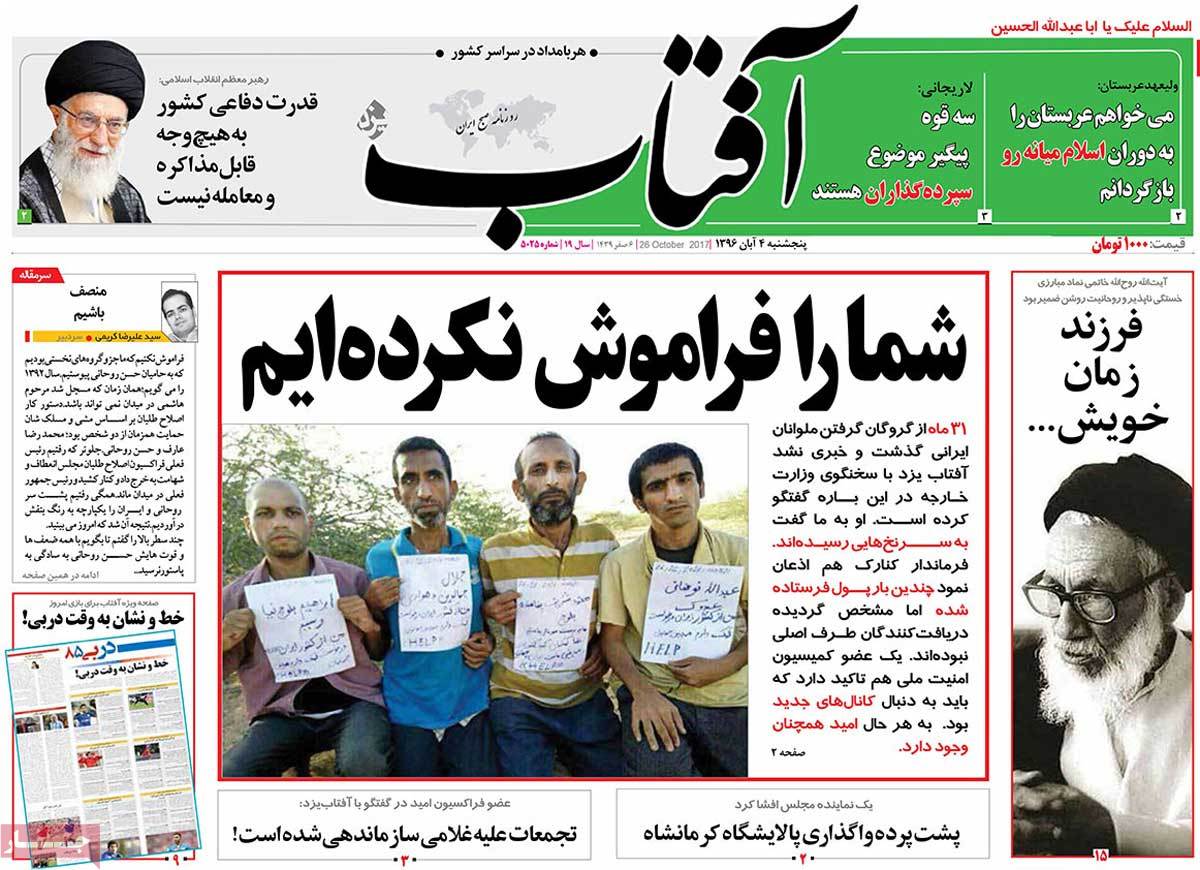
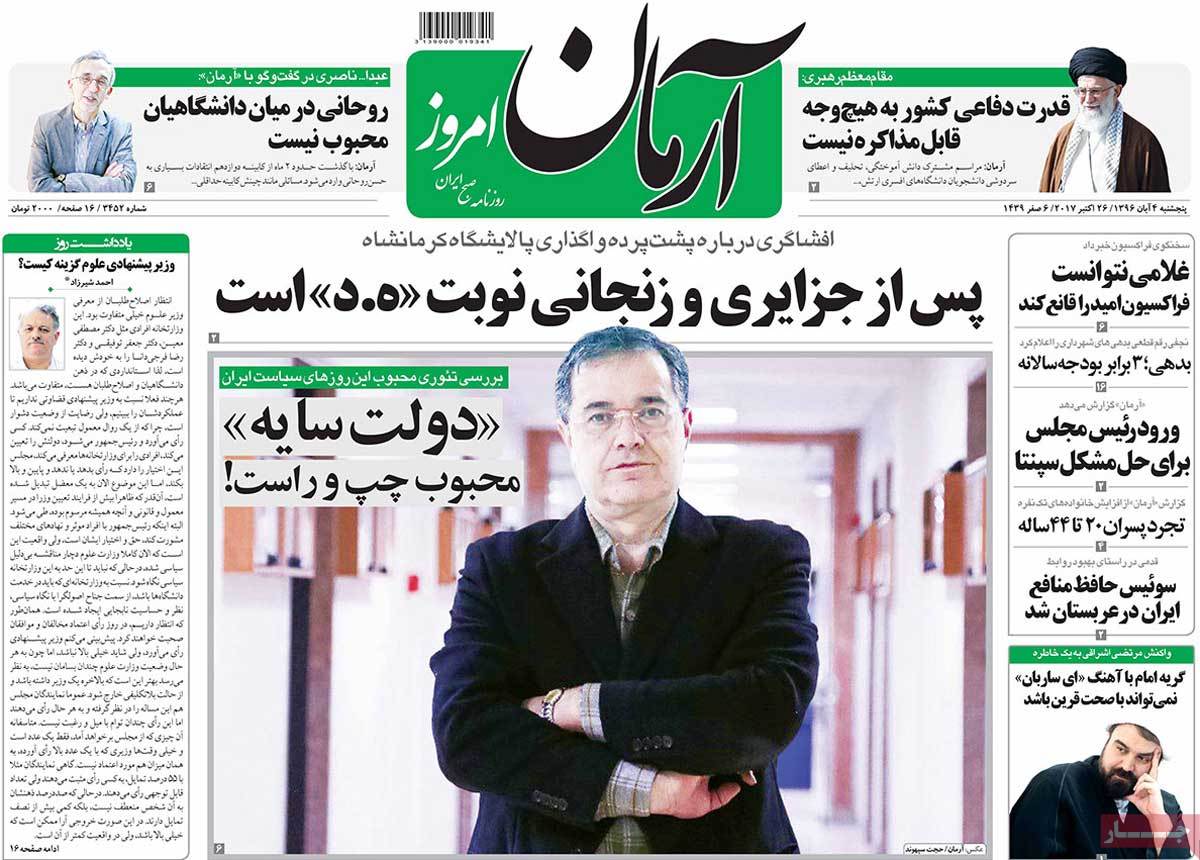
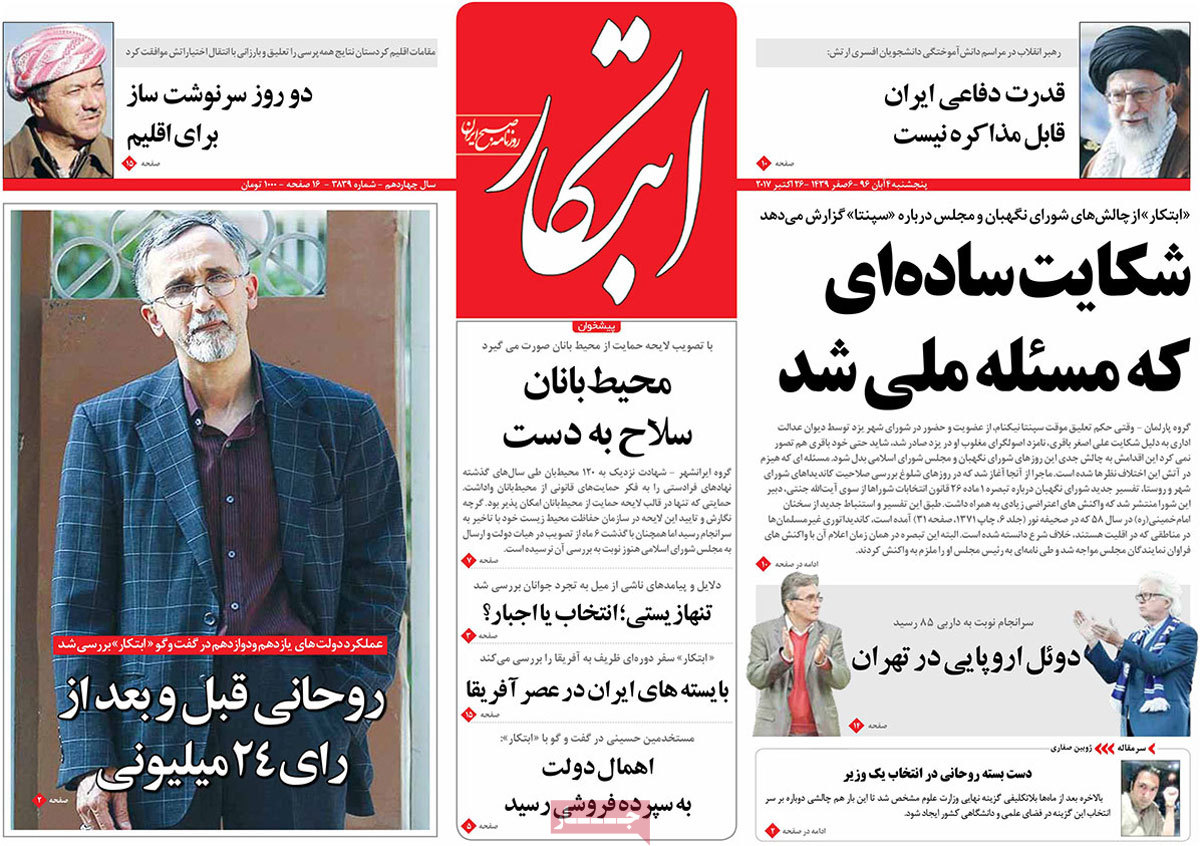
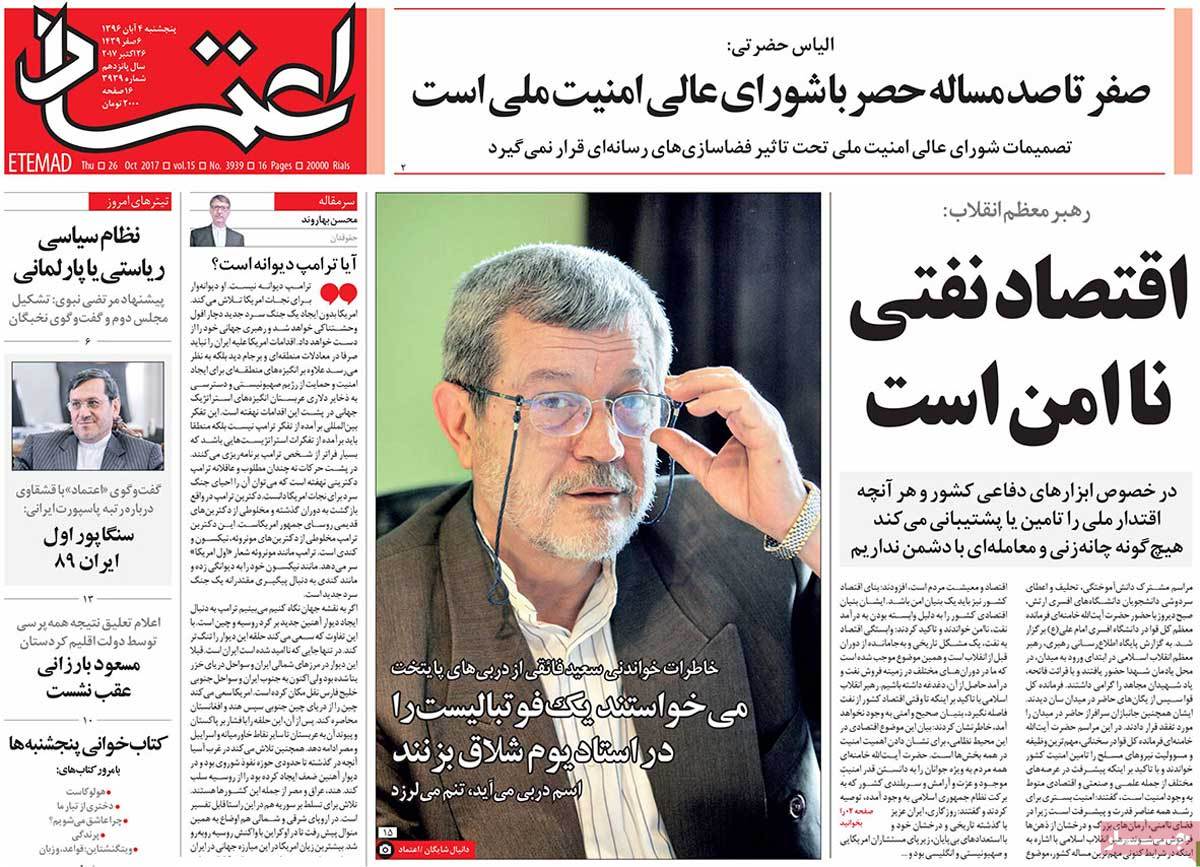
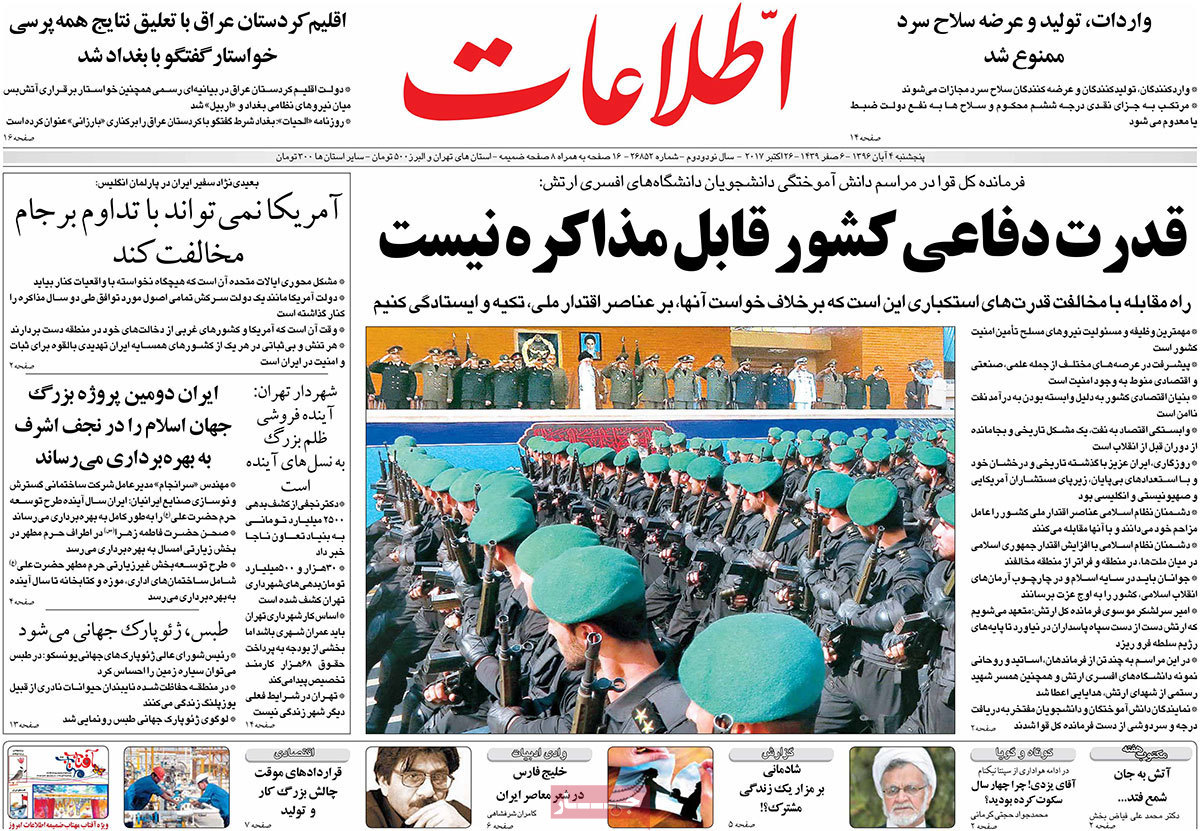
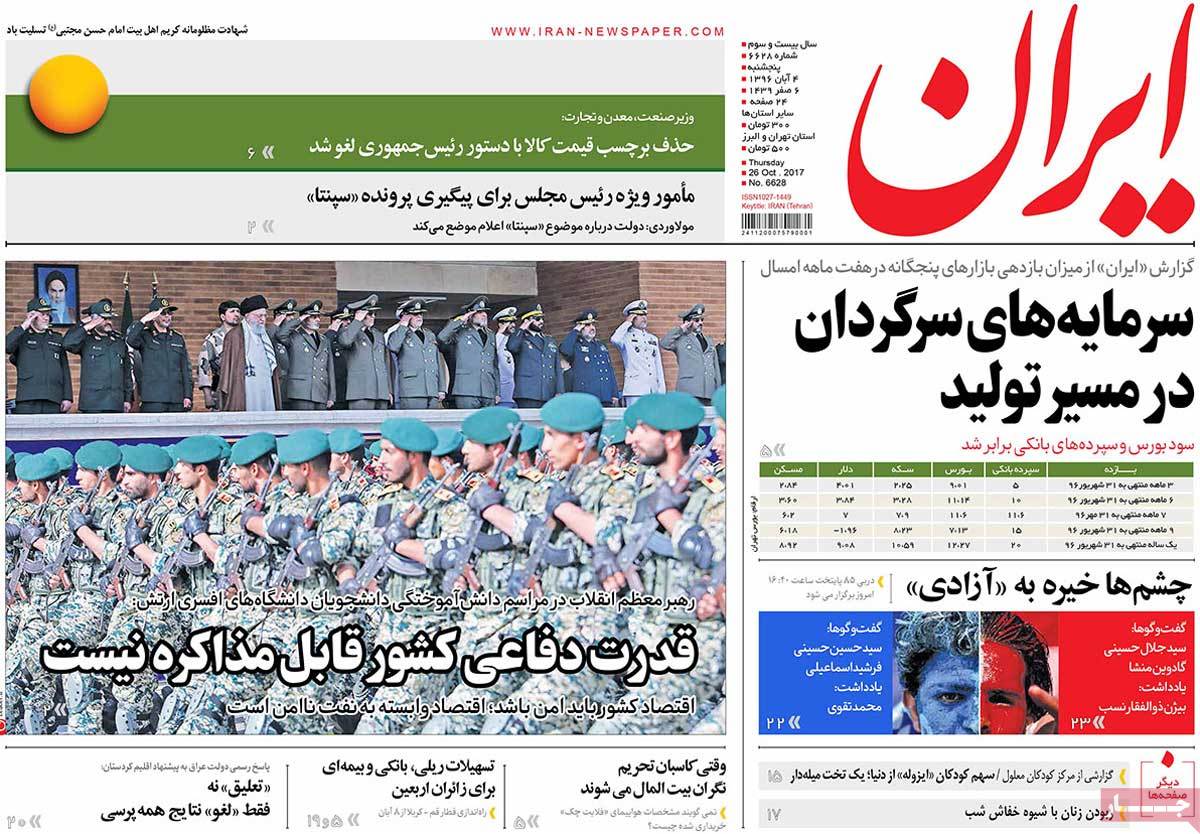
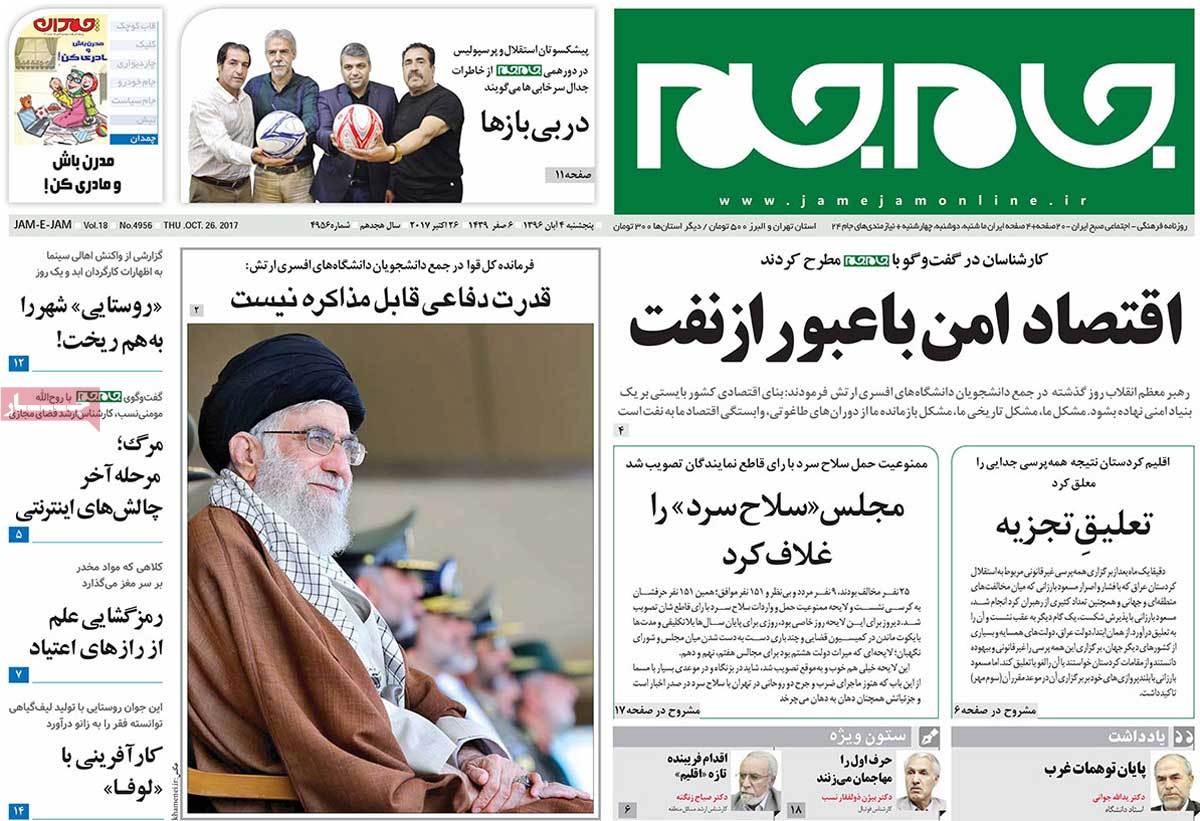
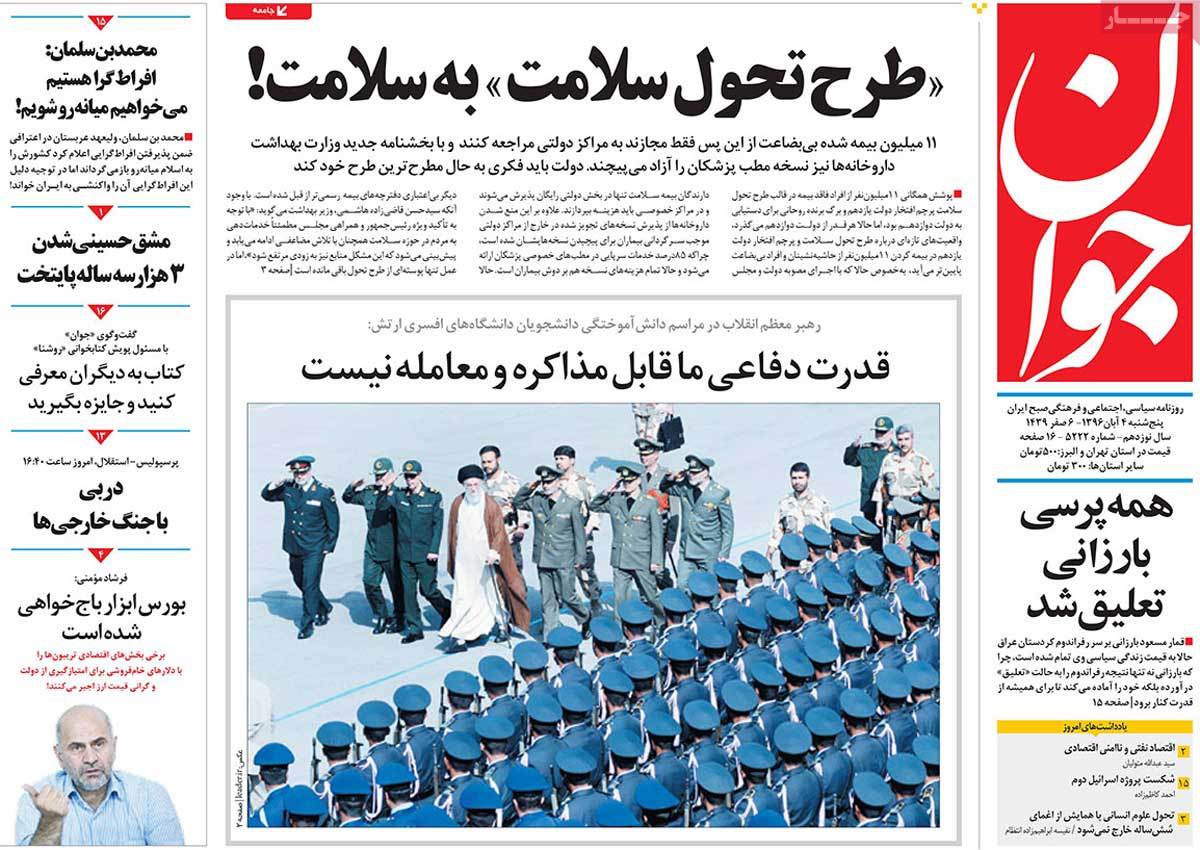
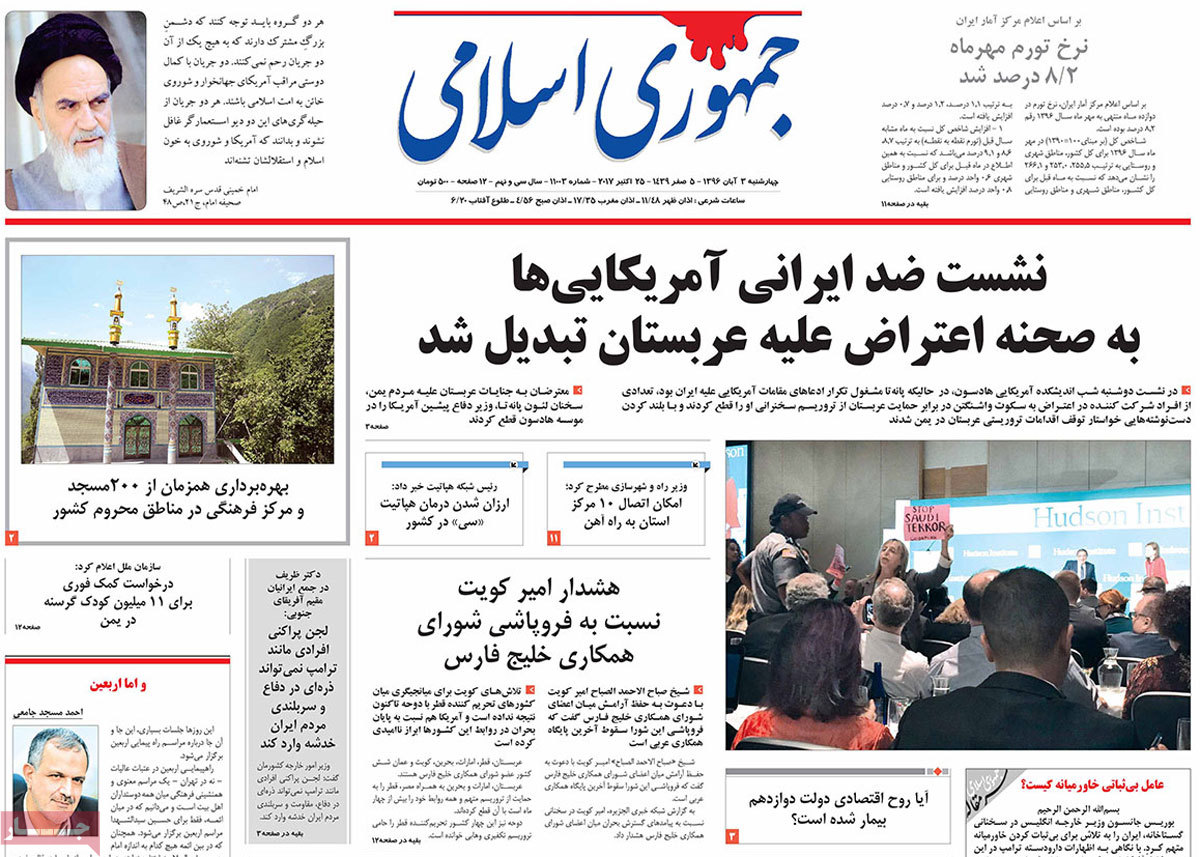
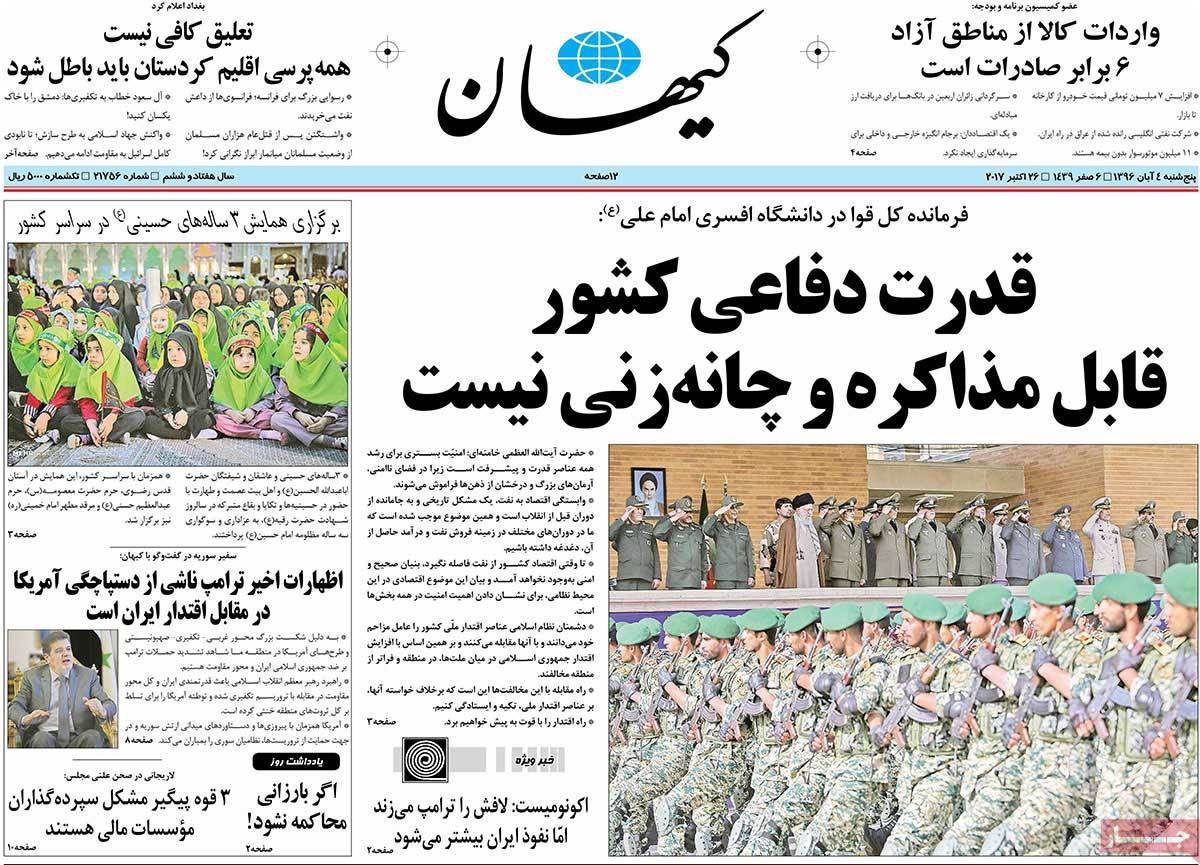
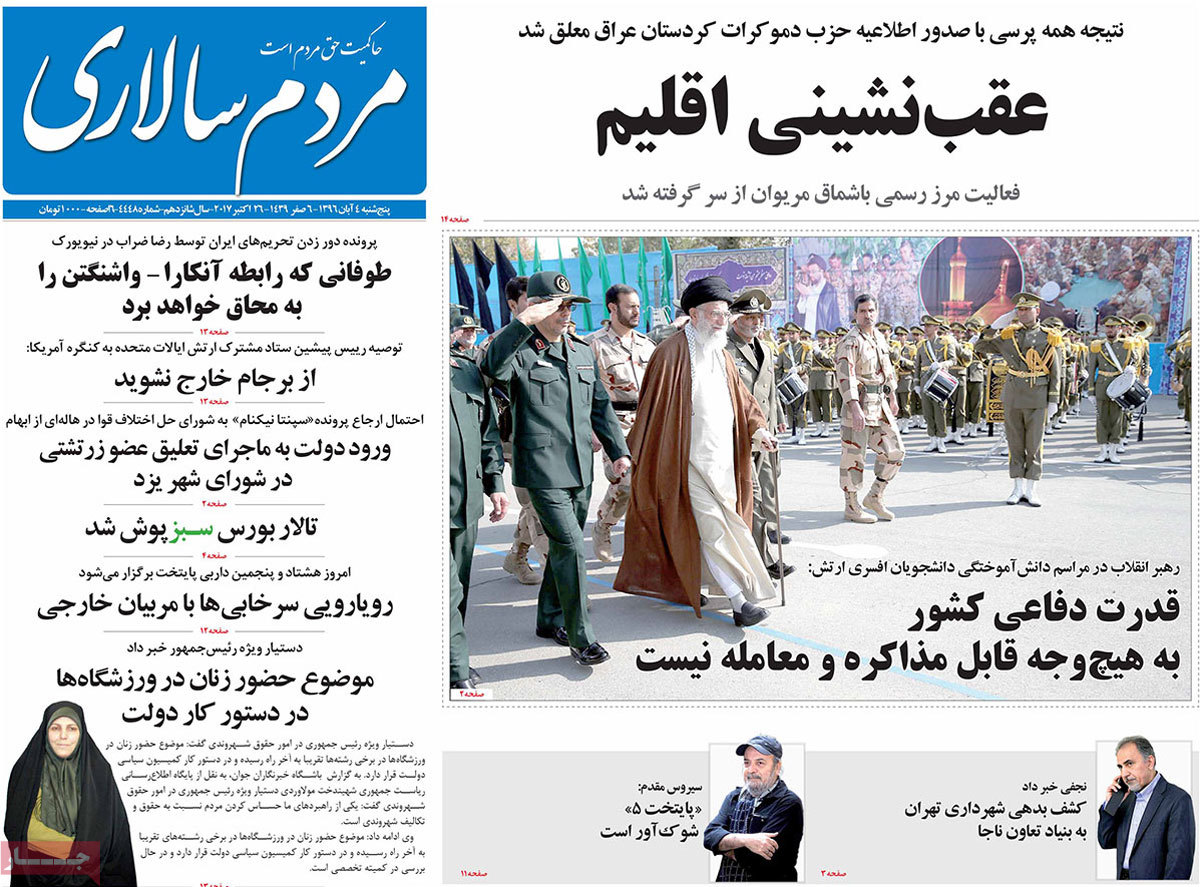
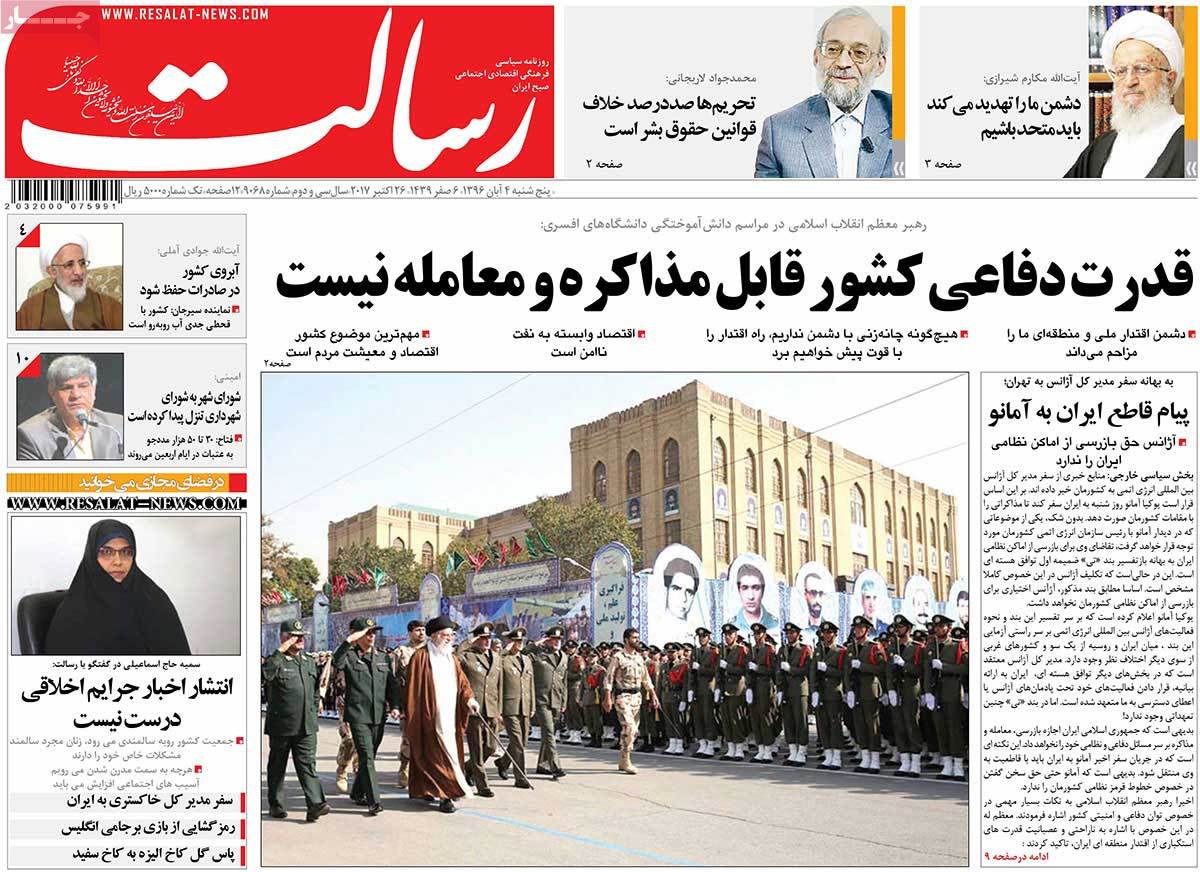
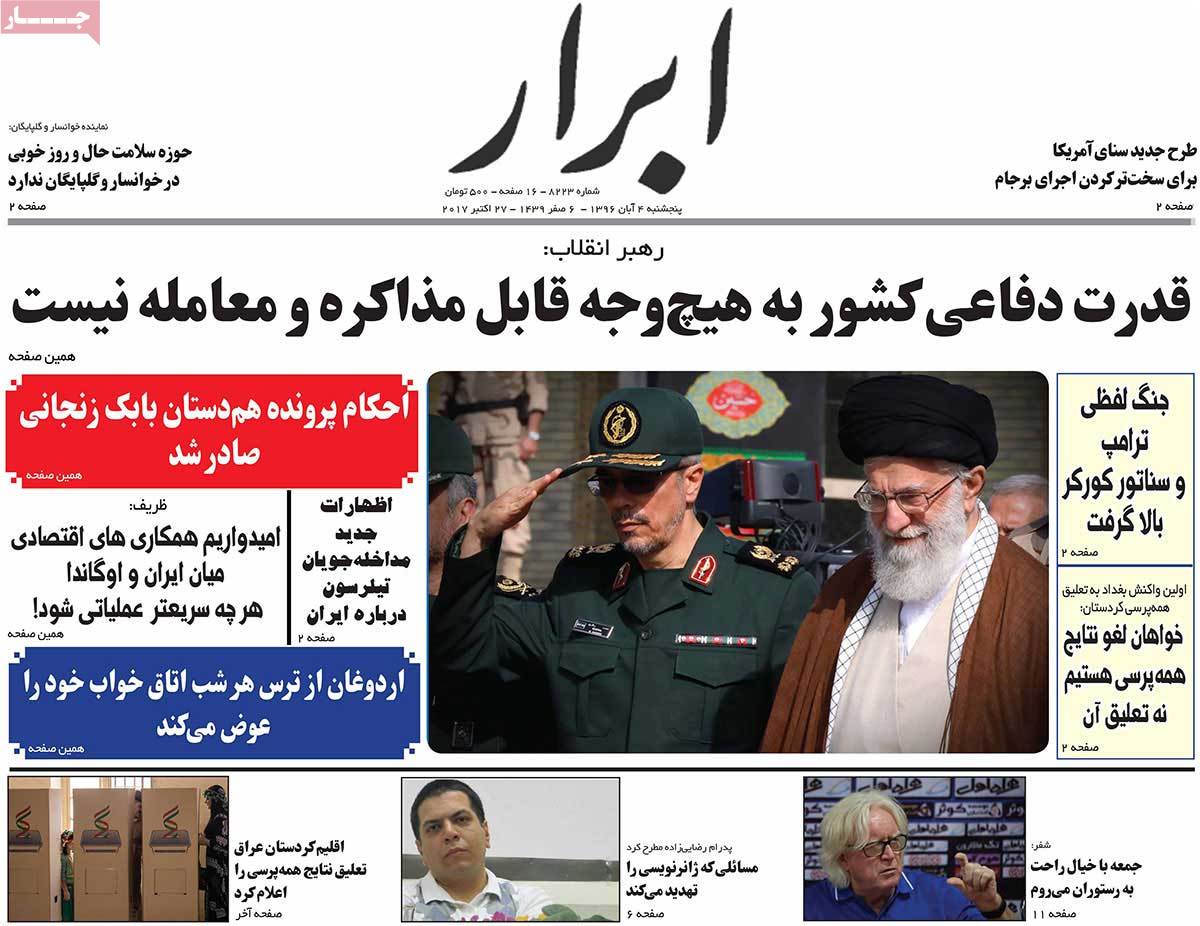
A Look at Iranian Newspaper Front Pages on October 26

Newspapers today widely covered the remarks made by the Leader of Iran’s Islamic Revolution Ayatollah Seyyed Ali Khamenei who once again stressed the country’s defensive power is not open to negotiation or bargaining.

The visit of Iraqi Prime Minister Haider al-Abadi to Tehran and the latest developments surrounding the Iraqi Kurdistan region, particularly its offer to suspend the results of its independence referendum, also received great coverage.

Several papers also highlighted the 85th Tehran derby between Iranian football giants Persepolis and Esteghlal, which will be held on Thursday afternoon.

The above issues, as well as many more, are highlighted in the following headlines and top stories:

Abrar:

1- Trump-Corker’s War of Words Escalates

2- Erdogan Changes His Bedroom Every Night Out of Fear

3- US Senate’s New Plan to Make JCPOA Implementation More Difficult

4- Baghdad’s First Reaction to Suspension of Iraqi Kurdistan’s Referendum

  • We Want Annulment, Not Suspension, of Results

A Look at Iranian Newspaper Front Pages on October 26


Aftab-e Yazd:

1- Saudi Crown Prince: I’ll Return Saudi Arabia to Moderate Islam

A Look at Iranian Newspaper Front Pages on October 26


Arman-e Emrooz:

1- Analyst: Rouhani Not Popular among Universities

2- Switzerland to Represent Iran’s Interests in Saudi Arabia

A Look at Iranian Newspaper Front Pages on October 26


Ebtekar:

1- Duel of European Coaches in Tehran: Persepolis, Esteghlal to Play Derby 85

2- Iraqi Kurdistan Officials Suspend Referendum Results

  • Two Fateful Days for Iraqi Kurdistan Region

A Look at Iranian Newspaper Front Pages on October 26


Etemad:

1- Iran Leader: Oil-Dependent Economy Is Insecure

2- MP: SNSC Responsible for House Arrest of Opposition Leaders

3- Masoud Barzani Backs Off

A Look at Iranian Newspaper Front Pages on October 26


Ettela’at:

1-Iran Ambassador to London: US Cannot Oppose Continuation of JCPOA

2- Iran Inaugurates Muslim World’s Second Largest Project in Iraq’s Najaf

3- Import, Production, Distribution of Cold Weapons Prohibited

A Look at Iranian Newspaper Front Pages on October 26


Iran:

1- All Eyes on Azadi Stadium: 85th Tehran Derby to Be Held Today

2- Iran Leader: Defensive Power Not Negotiable

A Look at Iranian Newspaper Front Pages on October 26


Jame Jam:

1- Leader: Iran’s Defensive Power Not Open to Negotiation

2- Iran Parliament Bans Carrying Cold Weapons

A Look at Iranian Newspaper Front Pages on October 26


Javan:

1-Goodbye RouhaniCare

2- Barzani’s Independence Suspended

A Look at Iranian Newspaper Front Pages on October 26


Jomhouri Eslami:

1- Inflation Rate Stands at 8.2% in Last Month

A Look at Iranian Newspaper Front Pages on October 26


Kayhan:

1- Iran’s Defensive Power Not Open to Bargaining: Ayatollah Khamenei

2- Trump’s Recent Remarks Show US Baffled by Iran’s Power

A Look at Iranian Newspaper Front Pages on October 26


Mardom Salari:

1- Reza Zarrab’s Case to Deteriorate Ankara-Washington Ties

2- Former US Commander Advises US Congress against Withdrawing from JCPOA

A Look at Iranian Newspaper Front Pages on October 26


Resalat:

1- Ayatollah Makarem Shirazi: Enemy Threatens Us, We Should Be United

2- Iran Human Rights Chief: Sanctions Totally against Human Rights Laws

3- Iran’s Strong Message to Amano: IAEA Not Allowed to Inspect Iran’s Military Sites

A Look at Iranian Newspaper Front Pages on October 26


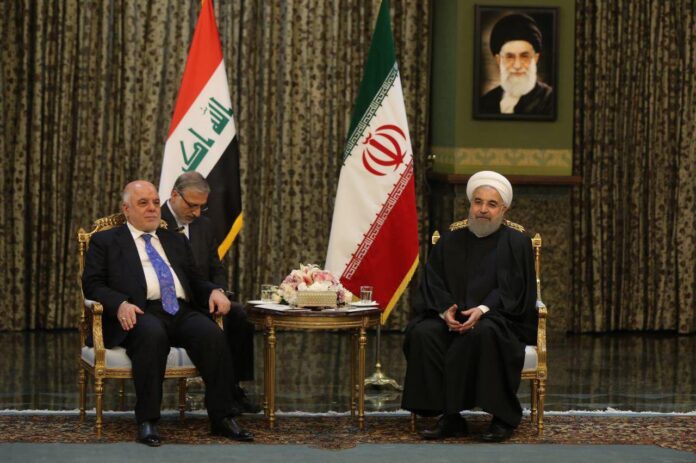
Iranian President, Iraqi PM Hold Talks in Tehran

During the meeting, Rouhani said the Islamic Republic has always been and will be standing next to the Iraqi nation and government in fight against terrorism.

Rouhani also stressed that boosting unity and solidarity and preserving the territorial integrity of Iraq is of great importance to Iran.

Rouhani hailed the endless sacrifices made by the Iraqi people and officials, and also the wise views of the top Iraqi Shiite clerics in resolving the problems and crises in the country.
The Iranian president referred to the will of the two governments to develop relations and collaborations, saying that Tehran and Baghdad can expand ties in all sectors including economy, trade, investment, science and technology.

Rouhani further underscored that the Iraqi nation is gradually resolving its security issues and domestic problems, and efforts must be made to rebuild Iraq and develop the country’s regional relations.

“The Islamic Republic of Iran is fully ready to contribute to the reconstruction and development of Iraq, along with its government and nation,” noted Rouhani.

The Iranian president also added that boosting bilateral relations with the aim of developing trade and economic ties, as well as facilitating the issuance of visas, is a must in expanding relations between the two countries.

Speaking about the victories of the Iraqi government and nation against the terrorist groups, especially ISIS, Rouhani pointed out that “fortunately, the Iraqi army and people were able to overcome these problems by showing solidarity and making many sacrifices.”

“Providing security and improving stability in Iraq makes the Iranian government and nation very happy. The Islamic Republic of Iran regards Iraq’s security as its own security and the security of the region,” emphasized the president.

On the issue of Kurdistan region, Rouhani said the fight against terrorism and secessionist approaches that hurt the territorial integrity and national unity of the country should be continued, and Tehran supports the central government of Iraq.

“Iran has not only never sought to dominate the region, but has been a major advocate of security and has been at the forefront of the fight against regional terrorism. Today, we see no reason for more disagreements and tensions between the countries of the region.”

For his part, the Iraqi premier said that Tehran and Baghdad are enjoying deep friendship at the moment and should work together to boost the ever-expanding ties.

“The Iraqi government and nation have been able to win major victories by improving their abilities to fight the terrorists and preserving their unity,” said Abadi, pointing out that terrorism and terrorist tendencies today are a challenge and threat to all.

“Disputes and conflicts in the region provide conditions for the interference of others in the affairs of the regional countries; therefore, we must take steps to resolve the disagreements and develop cooperation among the countries of the region,” Abadi went on to say.

Abadi, who is in Tehran with a high-ranking delegation at the last leg of his regional tour, earlier met with the Leader of the Islamic Revolution Ayatollah Seyyed Ali Khamenei.

During the meeting, the Leader threw his weight behind the expansion of ties between Tehran and Baghdad in various fields.

He also expressed his support for the efforts made by the Iraqi government to develop relations with the neighbouring and regional countries, but warned Baghdad against trusting the United States.

The Americans themselves created ISIS, but now that the Iraqi government and people have inflicted a heavy defeat on terrorists, they pretend to be a part of this important development, Ayatollah Khamenei noted.

“Of course, there is no doubt that whenever they find the opportunity, they will deal a blow to Iraq again,” the Leader underlined.

Iranian Cleric Turns Out to Be Lionel Messi’s Second Lookalike

The cleric seems to be the second lookalike of the Argentinian genius footballer.

Reza Parastesh, Lionel Messi’s first Iranian ‘double’, travelled to Barcelona earlier this week with the objective of meeting his idol. Parastesh, 25 years old, was at Camp Nou on Saturday for Barça’s La Liga game against Malaga.

The fan of the Barcelona star had a huge banner on him with the following message: “Today there are two Messis in the stadium. Will we see each other?#makemydreamareality.”

Iranian Cleric Turns Out to Be Lionel Messi’s Second LookalikeParastesh had been out and about in the Catalan city, drawing lots of attention.

It was the same story at Camp Nou, with many supporters wanting their photograph taken with Messi’s Iranian double.

Many people had even thought he was actually Messi.

Now the question is that whether this cleric would also go to Camp Nou to meet with the legendary Messi. Maybe, we must wait until the World Cup 2018 in Russia to see this happen!

5,000 Kurdish Forces Join Iraqi Army in Nineveh Province

The Executive Secretary of the Patriotic Union of Kurdistan, Salih Gargari, confirmed the report on Wednesday telling the local media that the forces that the Kurdish Democratic Party of Iraq, led by Masoud Barzani, had formed in the Ministry of Peshmerga Affairs for the Arab regions in Nineveh plains, Zammar, Sinjar, and Snune have now joined the Iraqi Army with all their weapons.

He underlined that “these 5,000 troops were organized and armed by the Ministry of Peshmerga Affairs,” writes IRNA in a Farsi report.

The Iraqi army and the federal police have been advancing towards Kirkuk governoratesince last Monday to enforce the parliamentary and constitutional laws of the country to reinstate the federal government in the regions that had been undertheir control before the appearance of ISIS 2014.

During the operation, they quickly dominated all the disputed areas in the provinces of Kirkuk, Nineveh, and Diyala.

Terrorist Group Smashed by IRGC in Northwestern Iran

According to the public relations department of the IRGC’s Hamze Sayyid al-Shohada Base, the terrorist team had infiltrated into Chaldoran region in the northwestern province of West Azarbaijan on Wednesday night and killed two local residents.

The IRGC ground forces in the region launched an operation after the attack, chasing the terrorists and killing all four of them in an armed clash, it added.

The IRGC forces seized weapons, communication equipment and ammunition from the terrorists, the statement said.

There has been a surge in the number of the counter-terrorism operations the IRGC has launched in recent months.

The IRGC is tasked with protecting the country’s northwestern and southeastern borders.

Iran-Uganda Medical Centre Opened in Kampala

The medical centre was opened in a ceremony attended by Iranian Foreign Minister Mohammad Javad Zarif and Ugandan President Yoweri Museveni.

The Islamic Republic of Iran started the construction work in Kampala over 6 years ago and then handed it over to Uganda’s government.

Iran-Uganda Medical CentreThe costs of equipping the hospital have been covered by Iran’s Association of Muslim Doctors without Borders and Iranian private doctors.

The hospital’s land belongs to Ugandan police and thus, Iran’s Red Crescent Society could not take up the construction work, thus handing over the gay-sauna-nice.com to Doctors without Borders, Mehr reported.

The medical centre comprises 50 hospital beds constructed on a $4 million budget in Kampala within four years. Iran’s private sector has taken up the investment in equipping the hospital.

Iraqi PM, Iranian First VP Discuss Regional Developments

During the Thursday meeting, Jahangiri congratulated the Iraqi prime minister on the latest victories of the Iraqi nation and government in fight against terrorist groups and said the Islamic Republic of Iran has always stood by the Iraqis in their fight against terrorism.

“We will continue to stand bythem during the future reconstruction era,” the Iranian official was quoted as saying in a Farsi report by IRNA.

“The achievements were made with the efficient management of Iraqi officials as well as the prudent role played by the top religious leaders and the sacrifices made by the Iraqi forces,” he noted.

He described the ties between Iran and Iraq as ‘excellent’ and ‘exemplary’, saying the ties are deeply rooted in the long-time religious, civilizational and historical commonalities between the two sides.

The Iranian officials called the recent secession vote in Iraqi Kurdistan region “a great sedition” and said the plight could have spread to other parts of the region if the Iraqi officials had not prudently stopped it.

For his part, Abadi referred to the challenges that the region is facing including the presence of terrorist groups,adding that the challenges have paved the way for several wars leaving many people dead.

He stressed that all regional efforts should be focused on preventing the collapse of the whole region and called on the regional states to establish ties and pursue common regional interests.

The Iraqi prime minister also said his country is preparing for the last stage of its military offensive against ISIS and added fortunately the recent victories in fight against terrorism have led to further unity among the Iraqis.

“Fight against terrorist groups requires cooperation among all regional states” he said.

Abadi also referred to the illegal secession referendum in Iraqi Kurdistan region and said, “We are after a unified Iraq and fortunately, with the international support, we have managed to prevent the secession of Kurdistan region.”

Iran Leader Warns Iraq about Trusting US

Speaking in a Thursday meeting with Iraqi Prime Minister Haider al-Abadi in Tehran, Iran’s Leader expressed his support for the efforts made by the Iraqi government to develop relations with the neighbouring and regional countries.

However, the Leader warned that “never trust the United States.”

Ayatollah Khamenei added that the Americans themselves created ISIS, but now that the Iraqi government and people have inflicted a heavy defeat on terrorists, they pretend to be a part of this important development.

“Of course, there is no doubt that whenever they find the opportunity, they will deal a blow to Iraq again,” the Leader underlined.

The Leader of the Islamic Revolution also voiced his support for the Iraqi government’s actions to defend its sovereignty and territorial integrity, and called Iraq a pivotal and important country in the Arab world.

Ayatollah Khamenei noted that the unity of the various ethnic groups and the support of the Iraqi government for the popular forces and the brave and believing Iraqi youths led to the recent victories against the terrorists and their backers.

He also threw his weight behind the expansion of ties between Tehran and Baghdad in various fields adding that, “As a result of the efforts and courage of the Iraqi people, you (PM Abadi) and other Iraqi officials, the attention of the regional nations is drawn to the successes of Iraq.”