Thursday, December 25, 2025
Home Blog Page 3656

Iran Blasts US for Non-Compliance with NPT

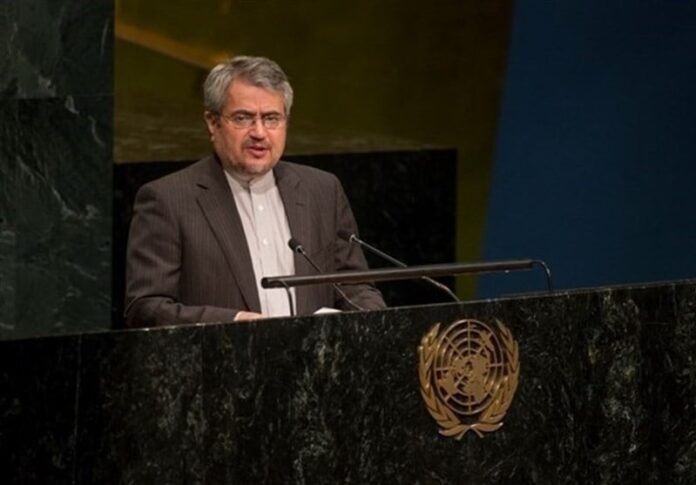
Addressing the United Nations Disarmament Commission in New York on April 2, Gholam Ali Khoshroo denounced the US government for failing to honor its NPT commitments.

“The statement by a certain nuclear-weapon State that it wants more nuclear weapons to remain at the ‘top of the pack’ indicates that such extremely irresponsible policies will continue,” the Iranian envoy deplored.

In February 2017, US President Donald Trump expressed a desire for America to be an unparalleled military power, saying he wants to build up the US nuclear arsenal to make it “top of the pack.”

The following is the full text of Khoshroo’s comments:

In the name of God, the Most Compassionate, the Most Merciful

Madam Chair,

I would like to begin by congratulating you and other bureau members on your election. I also assure you of the full support and cooperation of my delegation.

Likewise, I associate myself with the NAM statement delivered by Indonesia.

Madam Chair,

This cycle of the Disarmament Commission begins at a time when we are faced with two alarming trends: New nuclear arms race and new nuclear arms modernization race. To prevent further detrimental effects of these trends on the international peace and security, they need to come to an end.

We should not allow the monstrous shadow of the threat of these inhumane weapons on our life to continue indefinitely. We should consume them all before they consume us all. This indeed is our collective responsibility, as it relates to security of each and every one of us.

However, it is obvious that the Nuclear-Weapon States have a particular and heavier responsibility. Besides legal obligation, they have ethical and moral responsibility too. They cannot and should not continue to stubbornly insist on such obscured and unrealistic strategies as deterrence. They cannot seek their security at the price of insecurity of others.

Non-compliance of these States with their explicit legal obligations and unequivocal commitments to eliminate all their nuclear weapon arsenals have clearly proved the lack of their genuine political will in fulfilling their obligations.

The statement by a certain nuclear-weapon State that it wants more nuclear weapons to remain at the “top of the pack” indicates that such extremely irresponsible policies will continue.

Consequently, we need to redouble our efforts in confronting such bullying policies. While the adoption of the Treaty on the Prohibition of Nuclear Weapons in 2017 was a step forward in this direction, we should continue our strong call for the early commencement of negotiations in the Conference on Disarmament on a Comprehensive Nuclear Weapons Convention.

Against this backdrop, efforts in current cycle of the Commission should be focused on adopting recommendations on nuclear disarmament and non-proliferation of nuclear weapons.

This of course should be complemented by our efforts in pursuing the second agenda item of the Commission that is related to preventing an arms race in outer space.

To ensure that, as the common heritage and province of all mankind, outer space is explored and utilized exclusively for peaceful purposes, preventing an arms race therein is a must not an option.

In any case, the work of the Commission should be guided by the urgency, high priority and prime importance of realizing a nuclear-weapon-free world.

We attach great importance to this issue in the Middle East, where decades long regional and international efforts to establish a nuclear-weapon-free zone, proposed by Iran in 1974, is impeded so far by the stubborn objection of the Israeli regime.

Therefore, compelling Israel to join the non-proliferation treaty without any condition and as a non-nuclear weapon party, and to place all its nuclear facilities and activities under the IAEA comprehensive safeguards, should be an important element of the relevant recommendations of the Commission.

Madam Chair,

Recalling the strong calls for the full implementation of the Joint Comprehensive Plan of Action (JCPOA) by all its participants, I wish to stress that it definitely is essential for its continued relevance and continuity.

On its part, and as verified and confirmed by the IAEA, reflected in its 10 consecutive reports to date, Iran has fully implemented all its nuclear related commitments under the JCPOA.

However, the current irresponsible and destructive approach, policy and practice of the US regarding the JCPOA has seriously challenged its continuity. US actions are in contradiction with the letter, spirit and intent of the JCPOA, particularly its paragraphs 26, 28 and 29, through which, it is firmly committed, inter alia, to “make best efforts in good faith to sustain this JCPOA and to prevent interference with the realization of the full benefit by Iran of the sanctions lifting”; to “make every effort to support the successful implementation of this JCPOA including in their public statements”; and to “refrain from any policy specifically intended to directly and adversely affect the normalization of trade and economic relations with Iran inconsistent with their commitments not to undermine the successful implementation of this JCPOA.”

As we have stated time and again, the JCPOA is not a one-sided road. Therefore, implementation by Iran of its commitments could continue only if all other parties continue implementing their commitments fully, effectively and unconditionally. It is obvious that Iran will react proportionately to any continued significant non-implementation of the JCPOA commitments by one of its participants.

I have to stress that the JCPOA cannot be renegotiated or altered. IAEA is the sole authority to verify Iran’s commitment under the JCPOA. Iran continues to provisionally apply the Additional Protocol to its Safeguards Agreement and according to the latest IAEA report, the Agency “has conducted complementary accesses under the Additional Protocol to all the sites and locations in Iran which it needed to visit.”

Continuation of this situation is dependent on the continued unconditional implementation of the JCPOA by other parties, in particular the US. Iran cannot and will not continue to save the JCPOA at any cost. Definitely, it is undoable.

The international community should not allow the US administration to continue to mock and undermine the JCPOA. It is not in the interest of multilateralism and to prevent it is a collective responsibility.

I thank you Madam Chair.
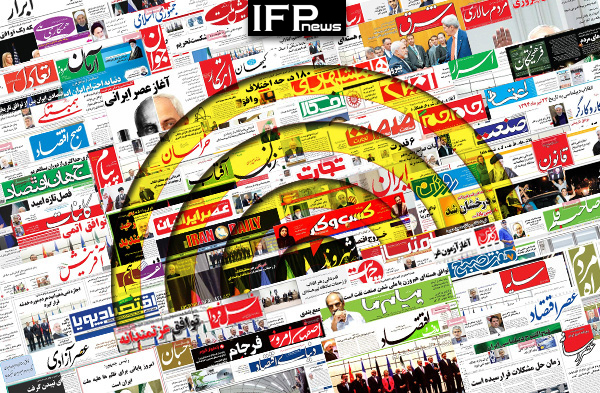
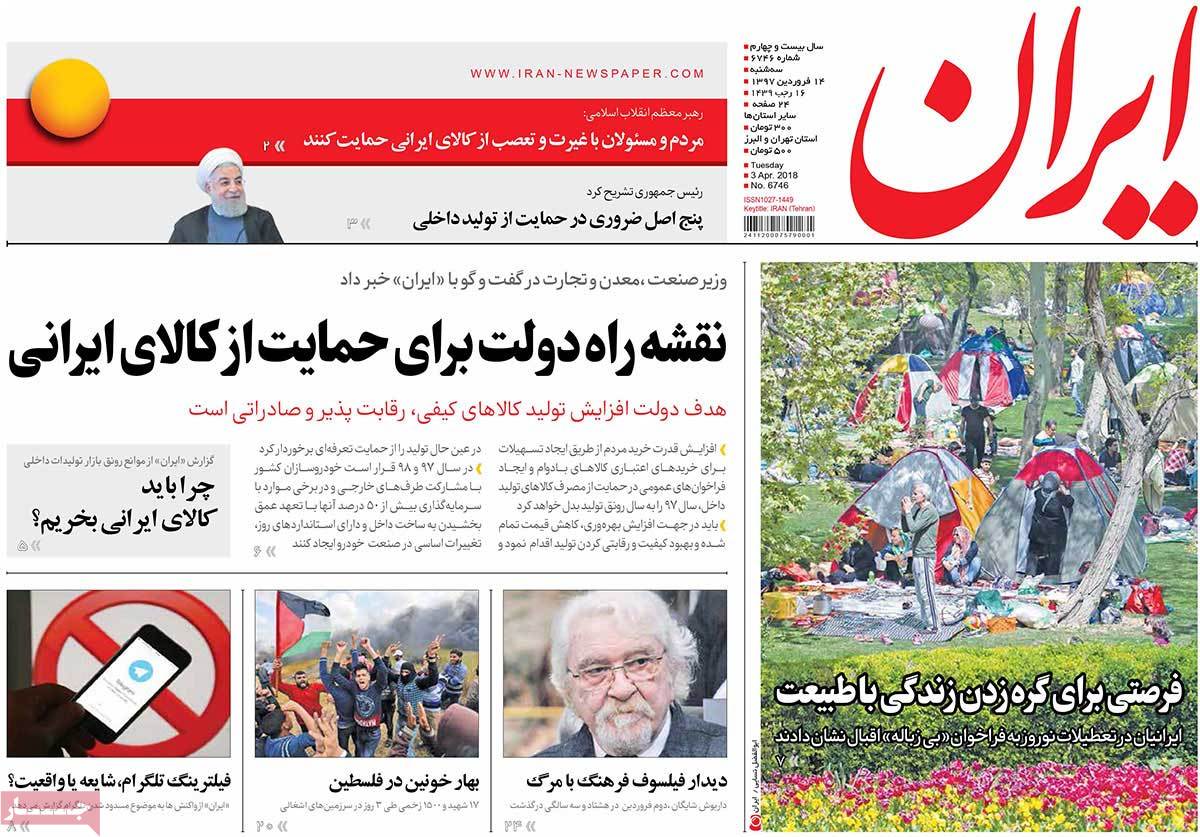
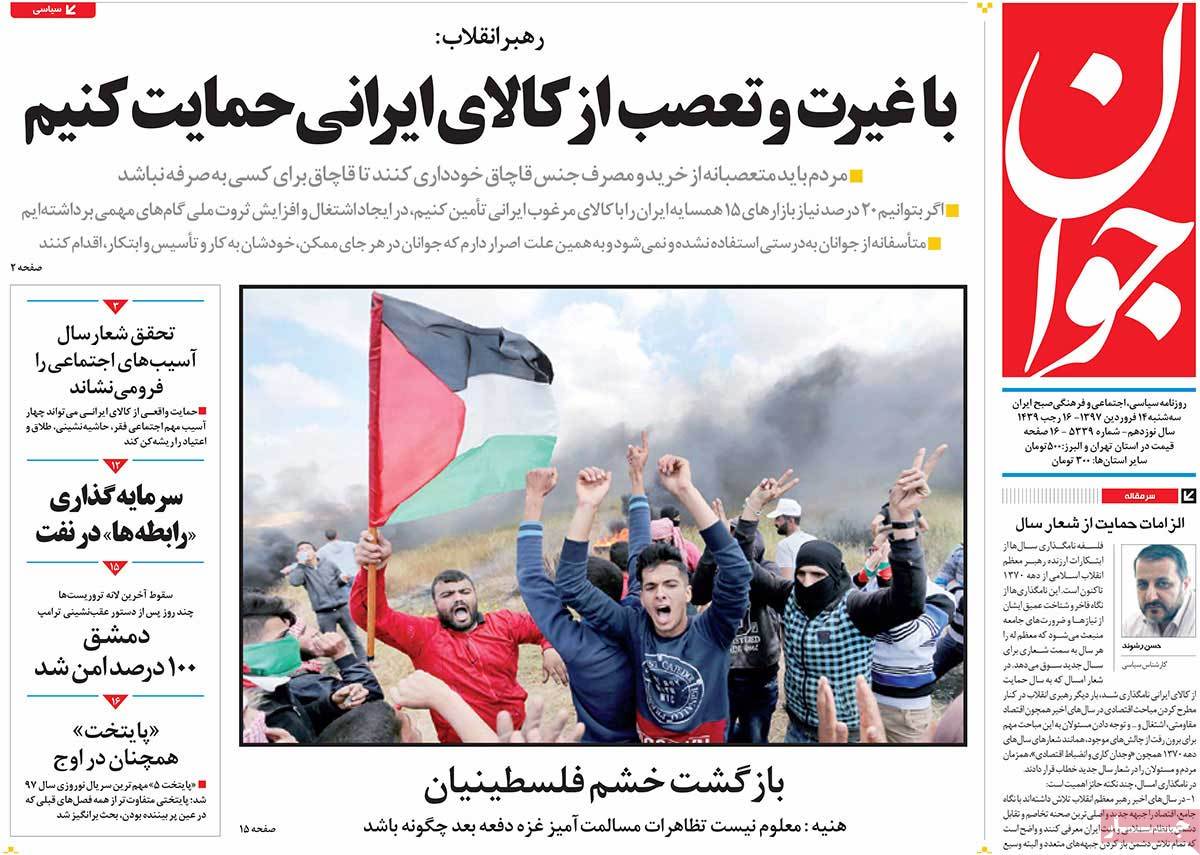
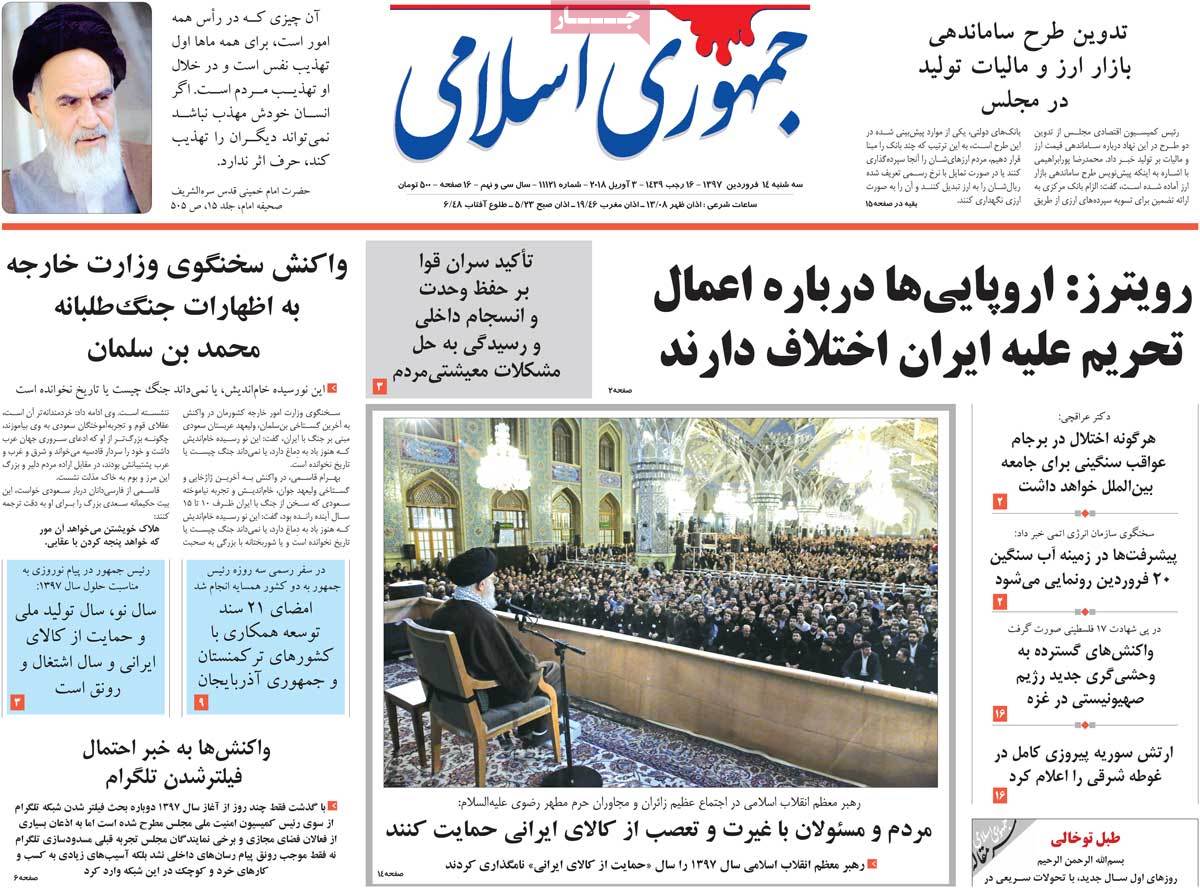
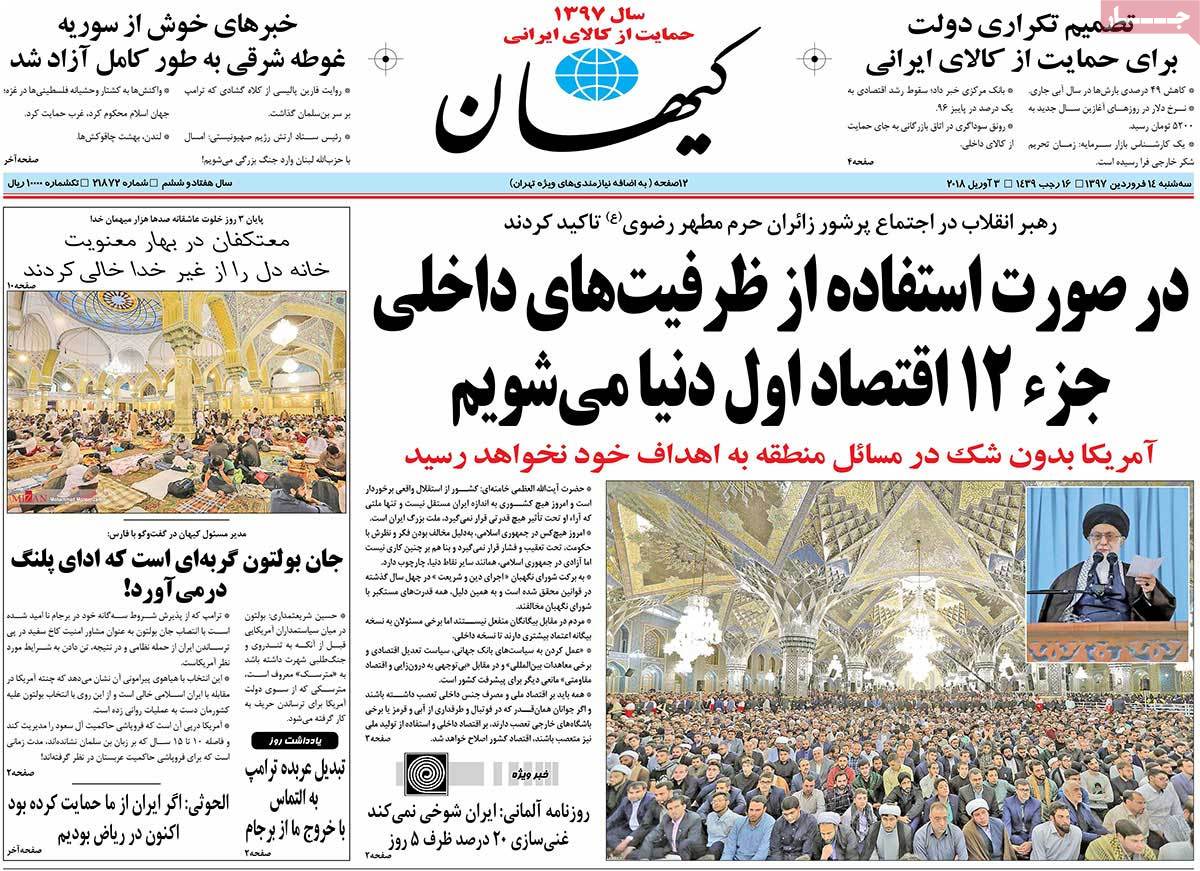
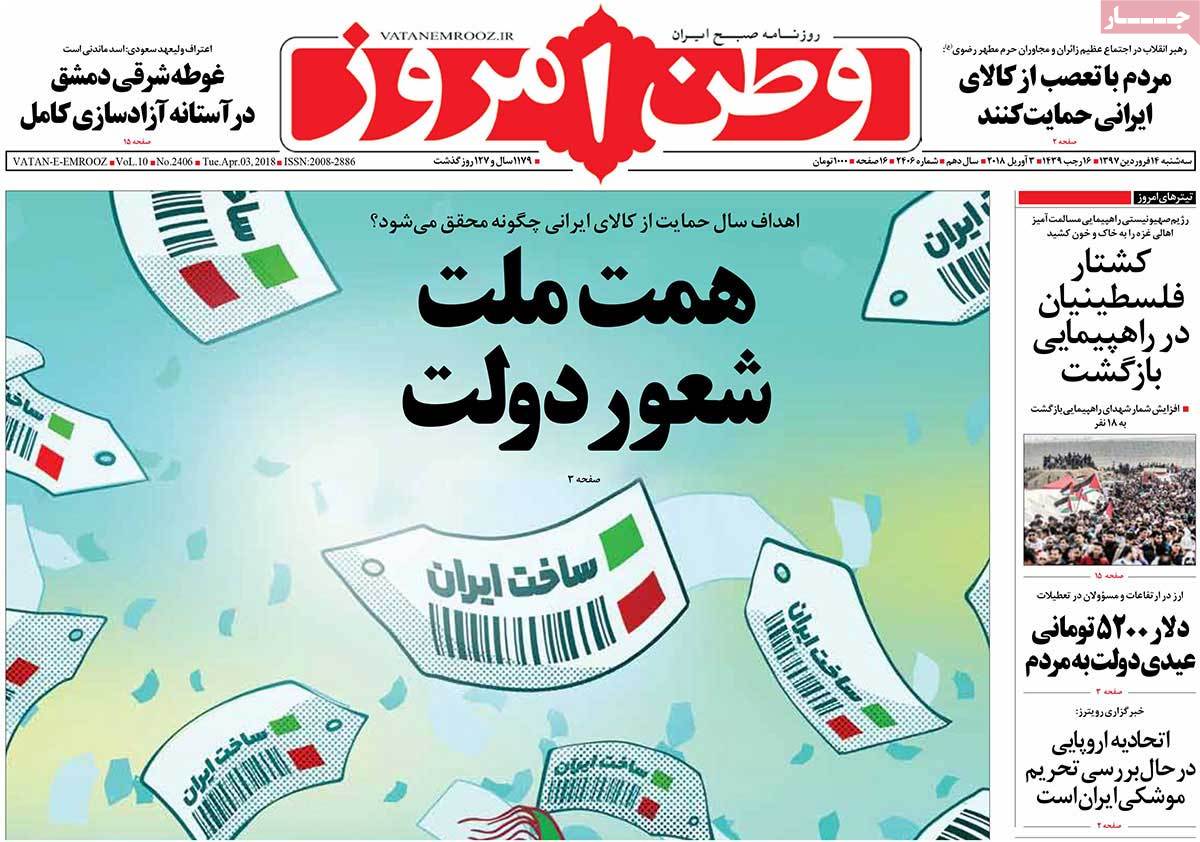
A Look at Iranian Newspaper Front Pages on April 3

A Look at Iranian Newspaper Front Pages on November 18

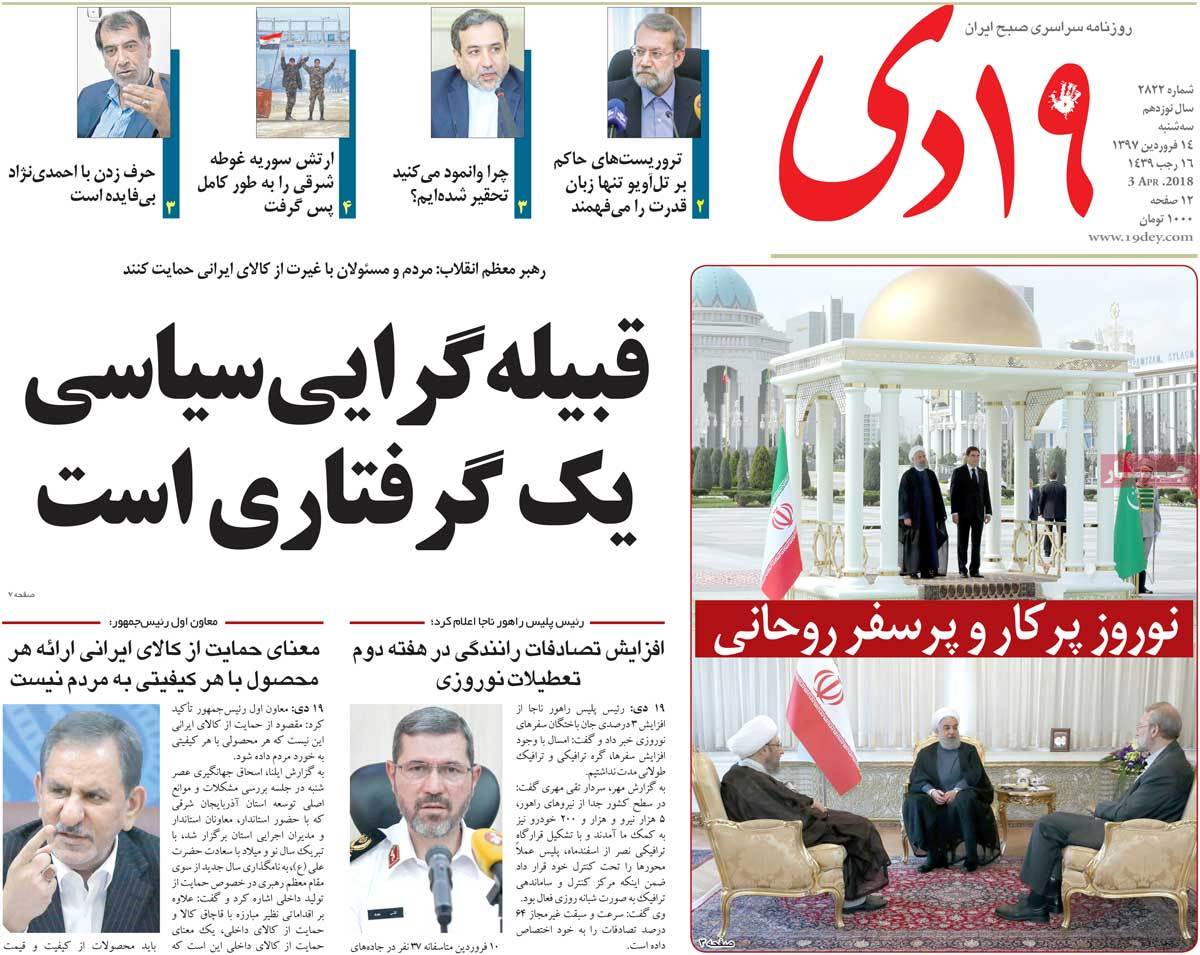
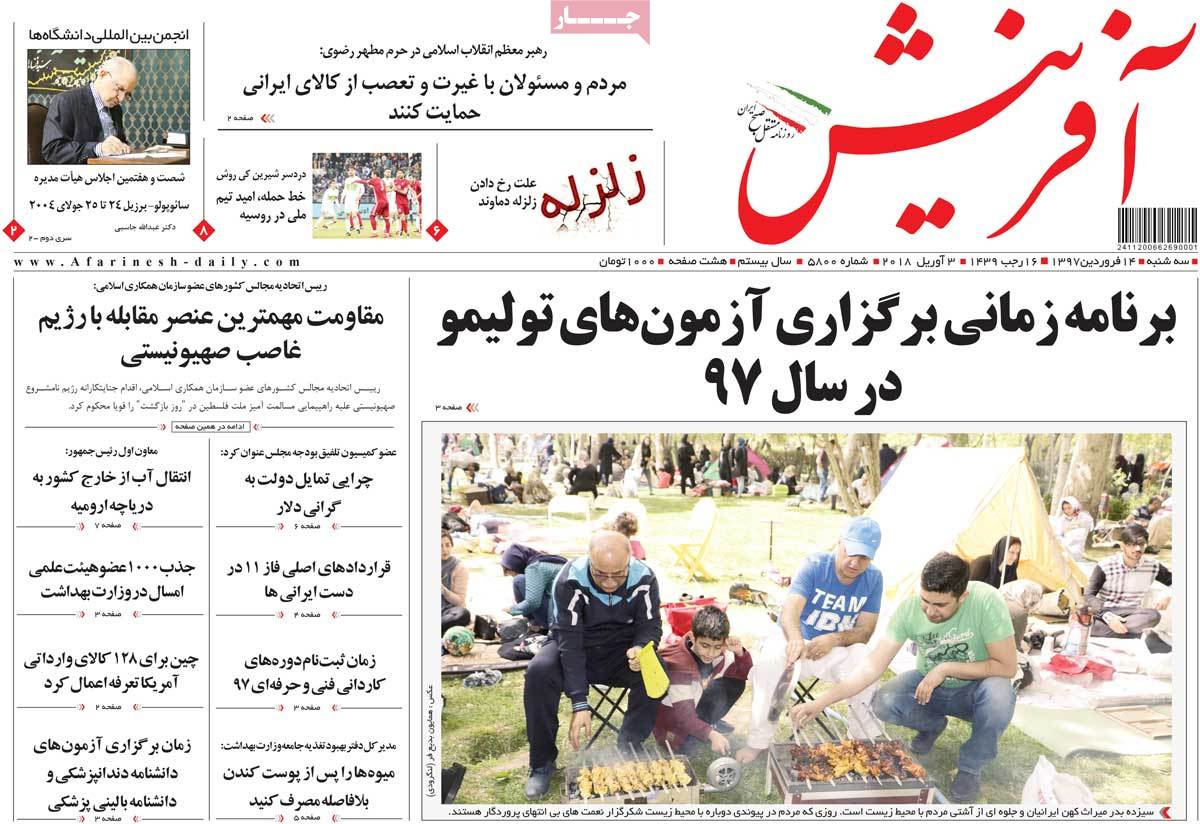
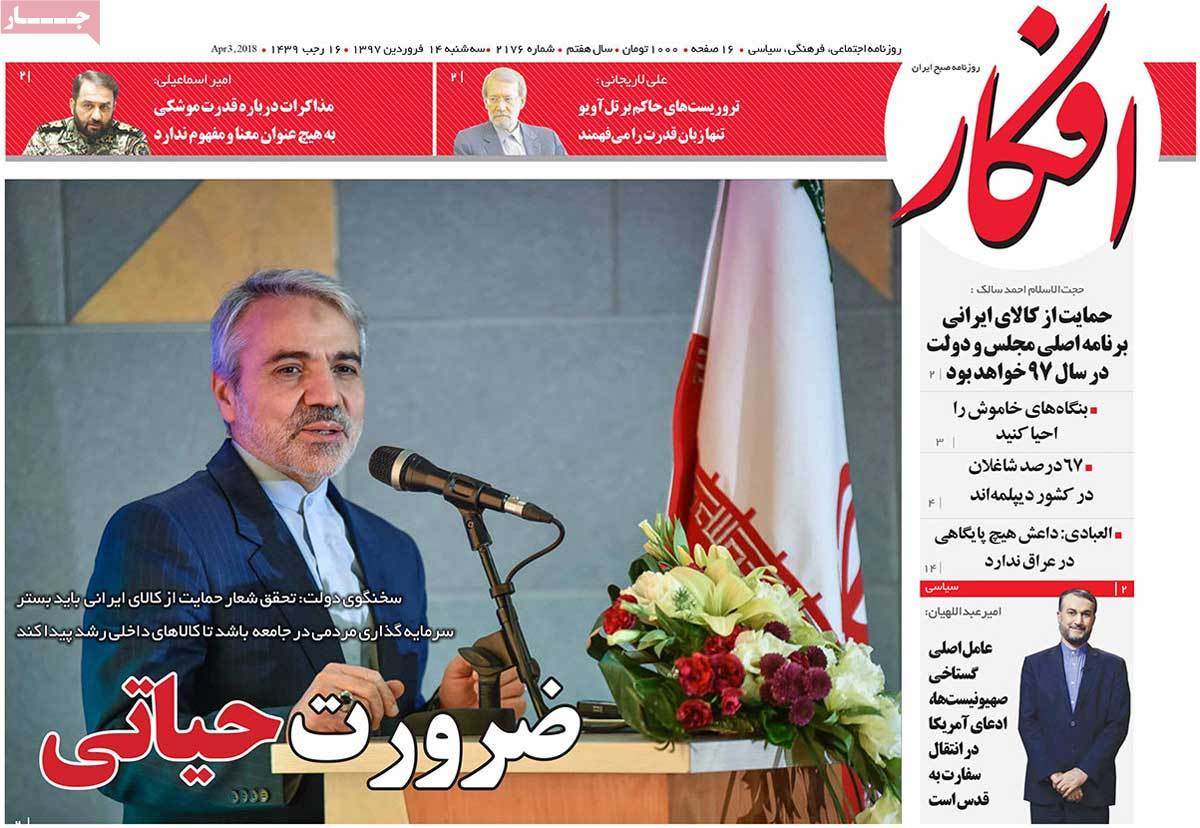
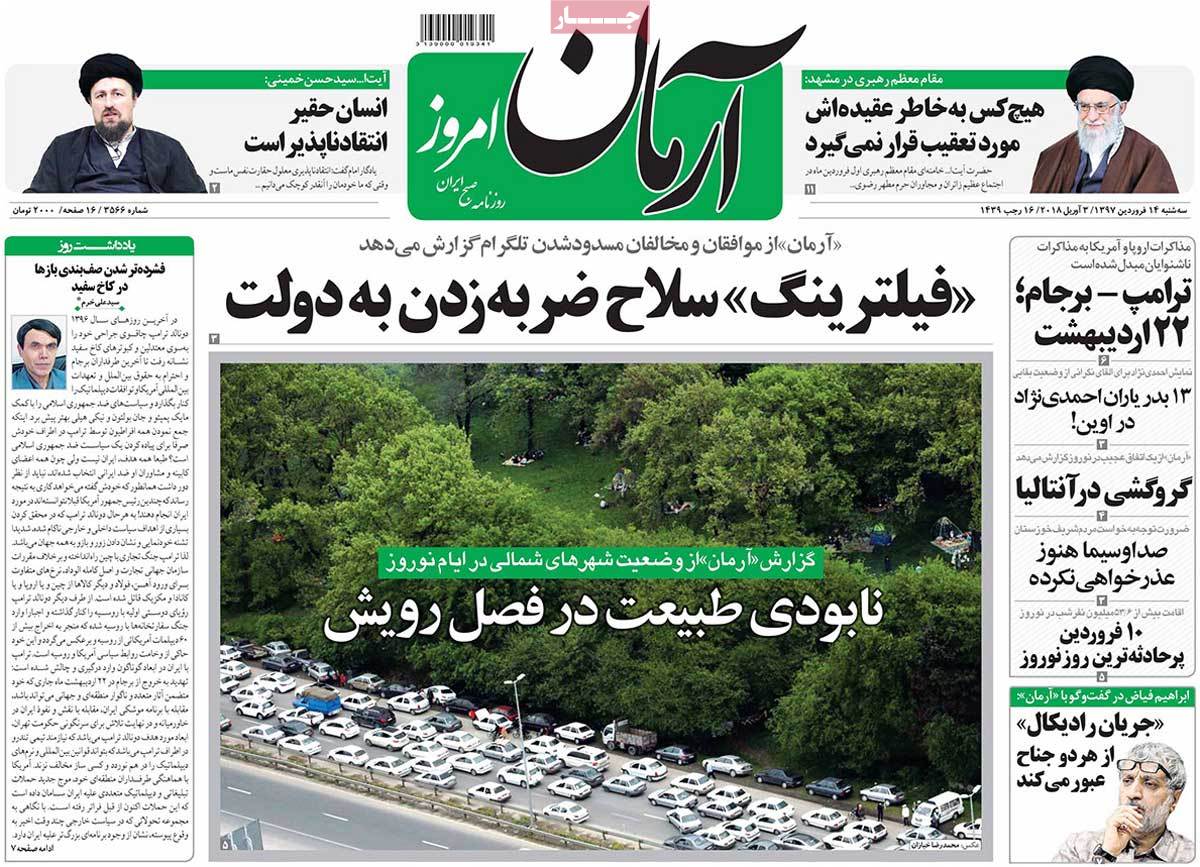
On the first working day after the New Year (Nowruz) holidays in Iran, almost all newspapers dedicated their top headlines to the name of the New Year, “Year of Support for Iranian Products”, and the call made by the Leader of Iran’s Islamic Revolution Ayatollah Seyyed Ali Khamenei for a strong support of domestic production.

The sharp rise in the dollar rate during the Nowruz holidays also received great coverage and was used by several papers to attack the government of President Hassan Rouhani.

The Israeli regime’s slaughter of Palestinian people during their recent peaceful protests was among other top stories covered in today’s papers.

The above issues, as well as many more, are highlighted in the following headlines and top stories:


19 Dey:

  • Iran Leader: People, Officials Must Support Iranian Products
  • Larijani: Terrorists Ruling Tel Aviv Know No Language but Aggression
  • Rouhani’s Nowruz Very Busy, Full of Trips
  • First VP: Supporting Iranian Products Doesn’t Mean Offering Any Product with Any Quality

A Look at Iranian Newspaper Front Pages on April 3


Afarinesh:

  • Iran’s Larijani: Resistance Most Important Element to Counter Zionist Regime
  • Iran First VP: Water to Be Transferred from Abroad to Save Urmia Lake
  • China Imposes Tariffs on Import of 128 US-Made Goods

A Look at Iranian Newspaper Front Pages on April 3


Afkar:

  • Iranian General: Talks on Missile Power Totally Meaningless
  • Conservative MP: Iran Parliament, Gov’t to Prioritize Supporting Iranian Products
  • Vital Necessity
  • Gov’t Spokesman: Growth of Iranian Products Needs People’s Investment in Society
  • US Claim about Embassy Relocation Main Cause of Zionists’ Impudence

A Look at Iranian Newspaper Front Pages on April 3


Arman-e Emrooz:

  • Iran Leader: No One Prosecuted for His Belief
  • Imam Khomeini’s Grandson: Humble Human Beings Not Needless of Criticism
  • Trump-JCPOA, May 12
  • EU-US Talks Have Turned into Those of Deaf People

A Look at Iranian Newspaper Front Pages on April 3


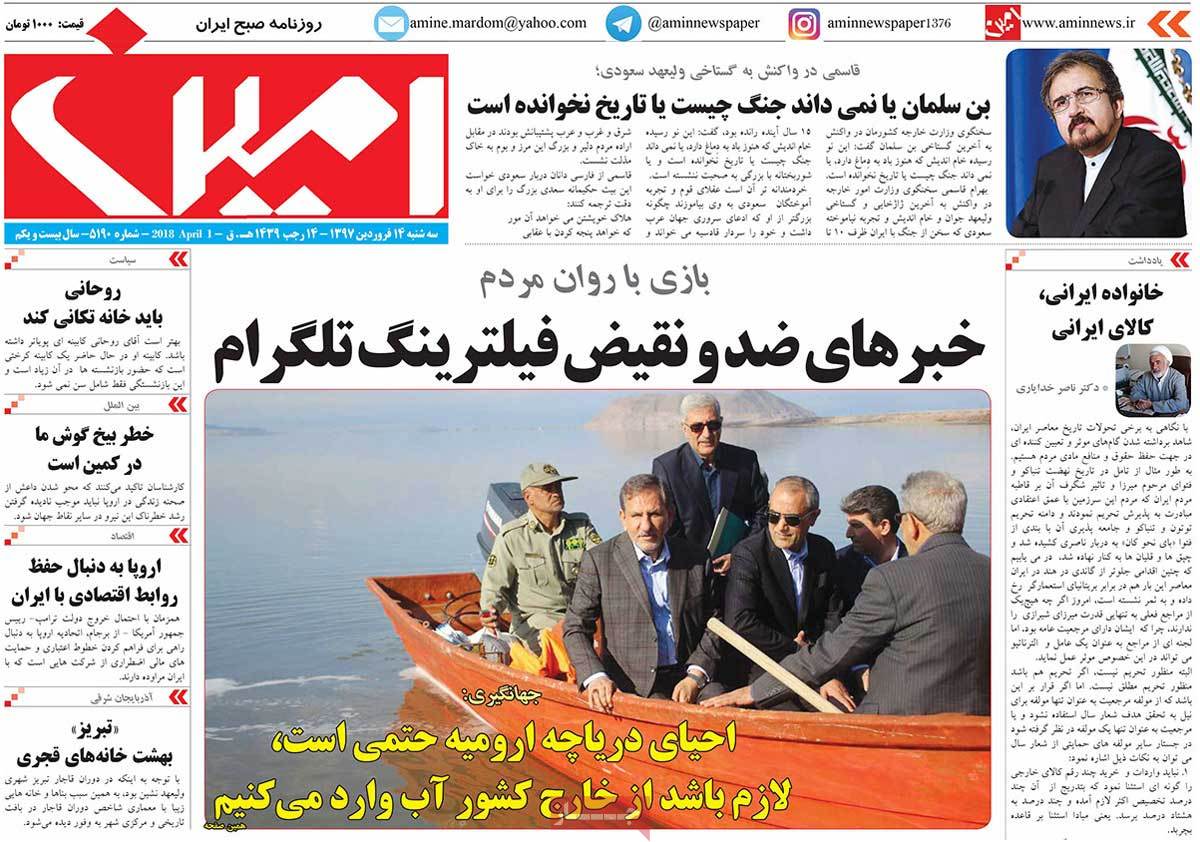
Amin:

  • Iran: Bin Salman Either Doesn’t Know What War Is or Has Not Studied History
  • Getting on People’s Nerves: Conflicting Reports on Blocking Telegram

A Look at Iranian Newspaper Front Pages on April 3


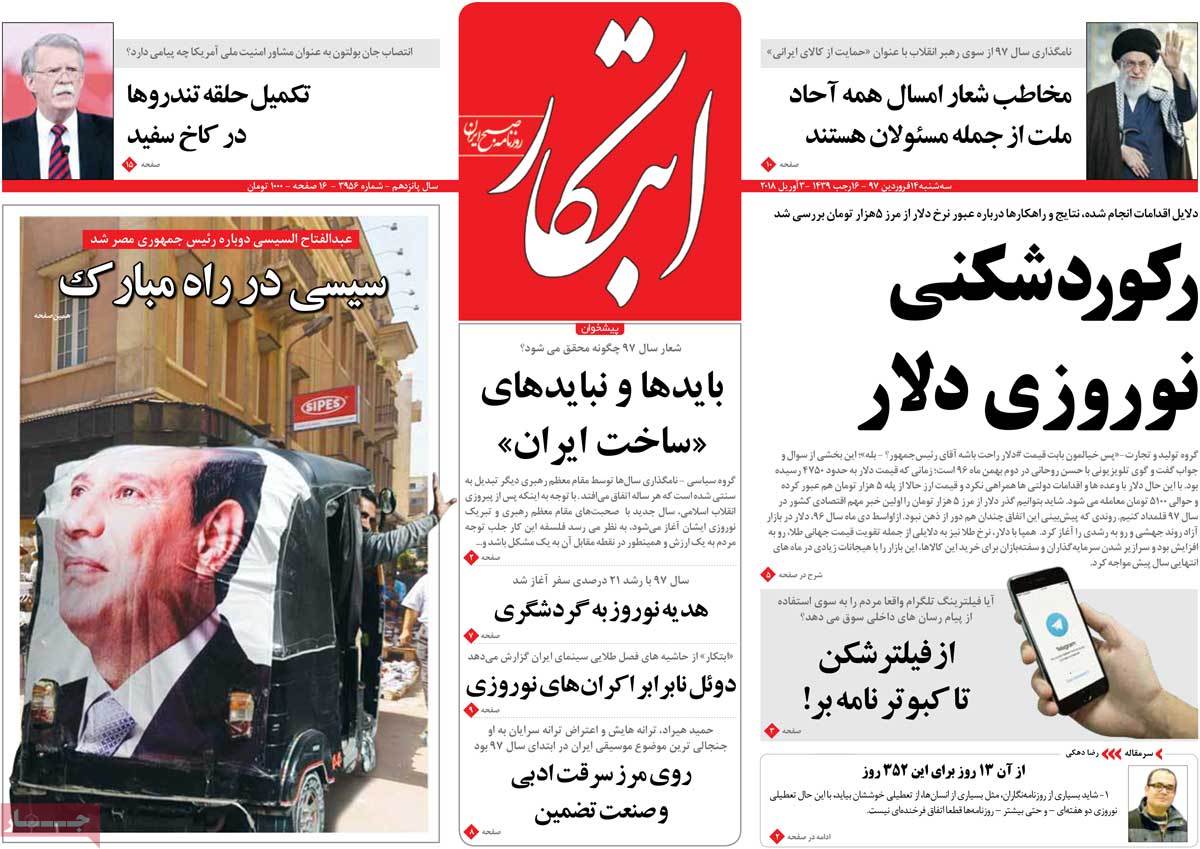
Ebtekar

  • Sisi Treading on Morsi’s Path
  • Egyptian General Re-Elected as President
  • Dollar Rate in Iran Breaks Records during Nowruz Holidays!
  • A Report on Reasons for Strange Dollar Fluctuations
  • Iran Leader Names New Iranian Year as “Year of Support for National Production”
  • All People Including Officials Invited to Campaign

A Look at Iranian Newspaper Front Pages on April 3


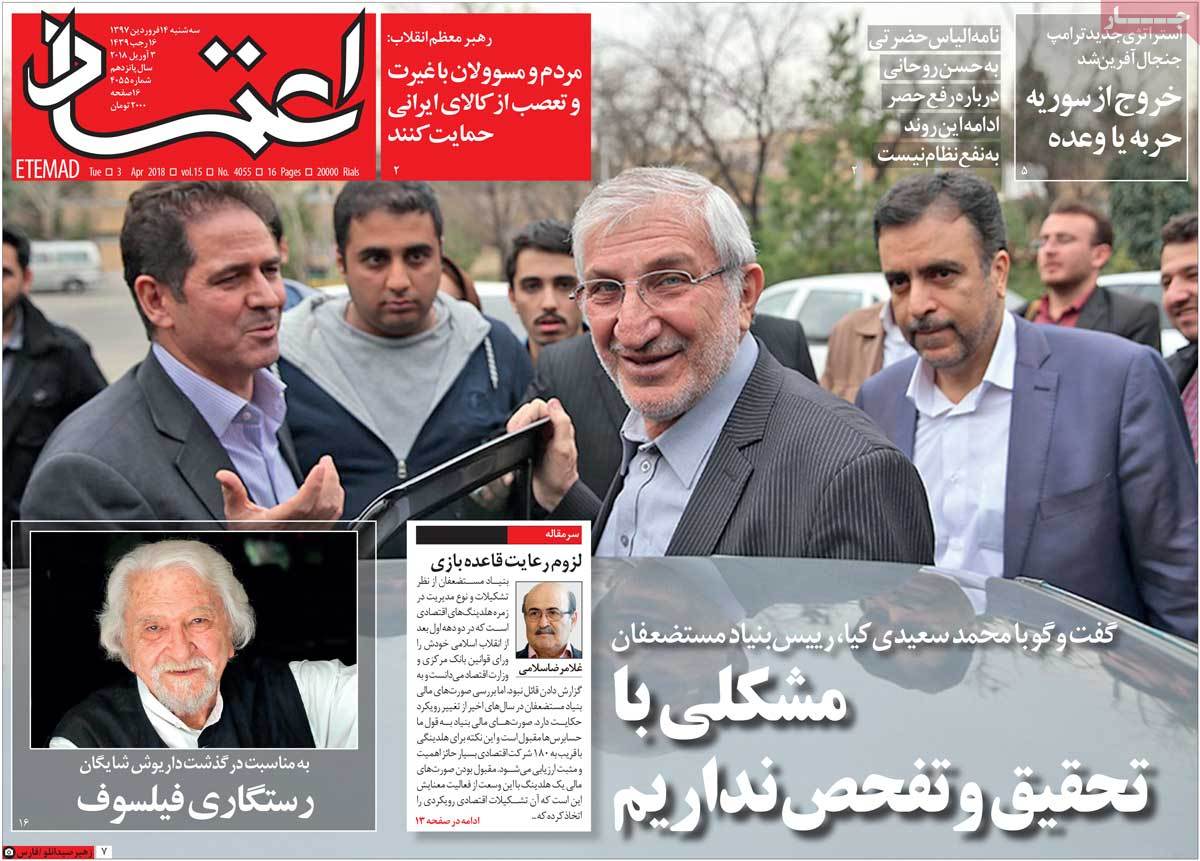
Etemad:

  • Withdrawal of US Troops from Syria: New Deceit or Promise?
  • Trump’s New Strategy Sparks Controversy

A Look at Iranian Newspaper Front Pages on April 3


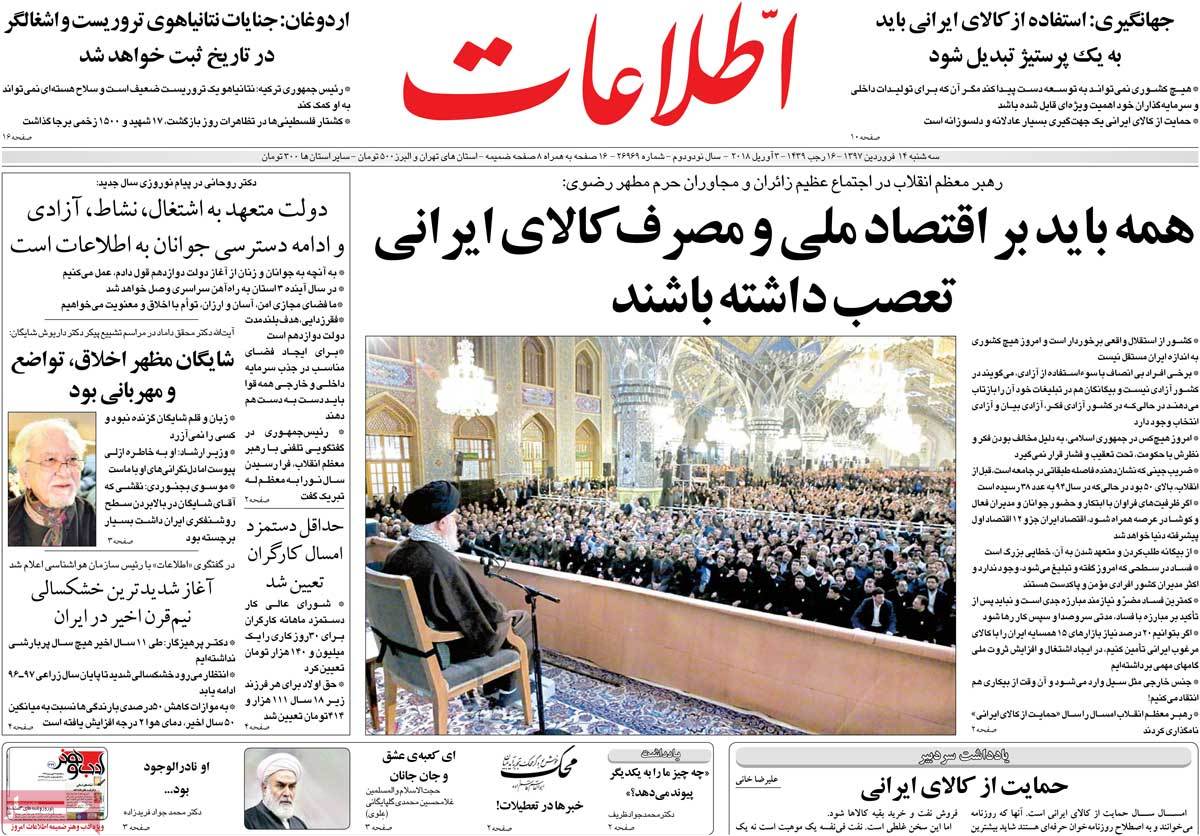
Ettela’at:

  • Use of Iranian Products Must Turn into Prestigious Move: First VP
  • Erdogan: Netanyahu, A Terrorist and Occupier Whose Crimes Will Be Remembered
  • Iran Leader: Everyone Must Feel Duty-Bound to Use Iranian Products

A Look at Iranian Newspaper Front Pages on April 3


Iran:

  • Industry Minister Outlines New Roadmap to Support Iranian Products
  • Gov’t Resolved to Increase Production of High-Quality, Competitive Goods for Export
  • Time to Tie Nature to Life: Iranians Welcome “No to Littering” Campaign in Nowruz

A Look at Iranian Newspaper Front Pages on April 3


Javan:

  • Iran Leader: Prejudice Needed in Supporting Iranian Products
  • Damascus 100% Safe
  • Last Stronghold of Terrorists Falls after Trump’s Withdrawal Order
  • Return of Palestinians’ Rage
  • Haniyeh: Not Clear Where Next Peaceful Rallies Would Go

A Look at Iranian Newspaper Front Pages on April 3


Jomhouri Eslami:

  • Reuters: Europeans Divided over Imposing Sanctions against Iran
  • Parliament Working on Plan to Organize Forex Market

A Look at Iranian Newspaper Front Pages on April 3


Kayhan:

  • Iran Leader: We’ll Become One of Top 12 Economies If Domestic Potential Used
  • Government’s Worn-Out Decision to Support Iranian Products
  • Good News from Syria: Eastern Ghouta Fully Liberated

A Look at Iranian Newspaper Front Pages on April 3


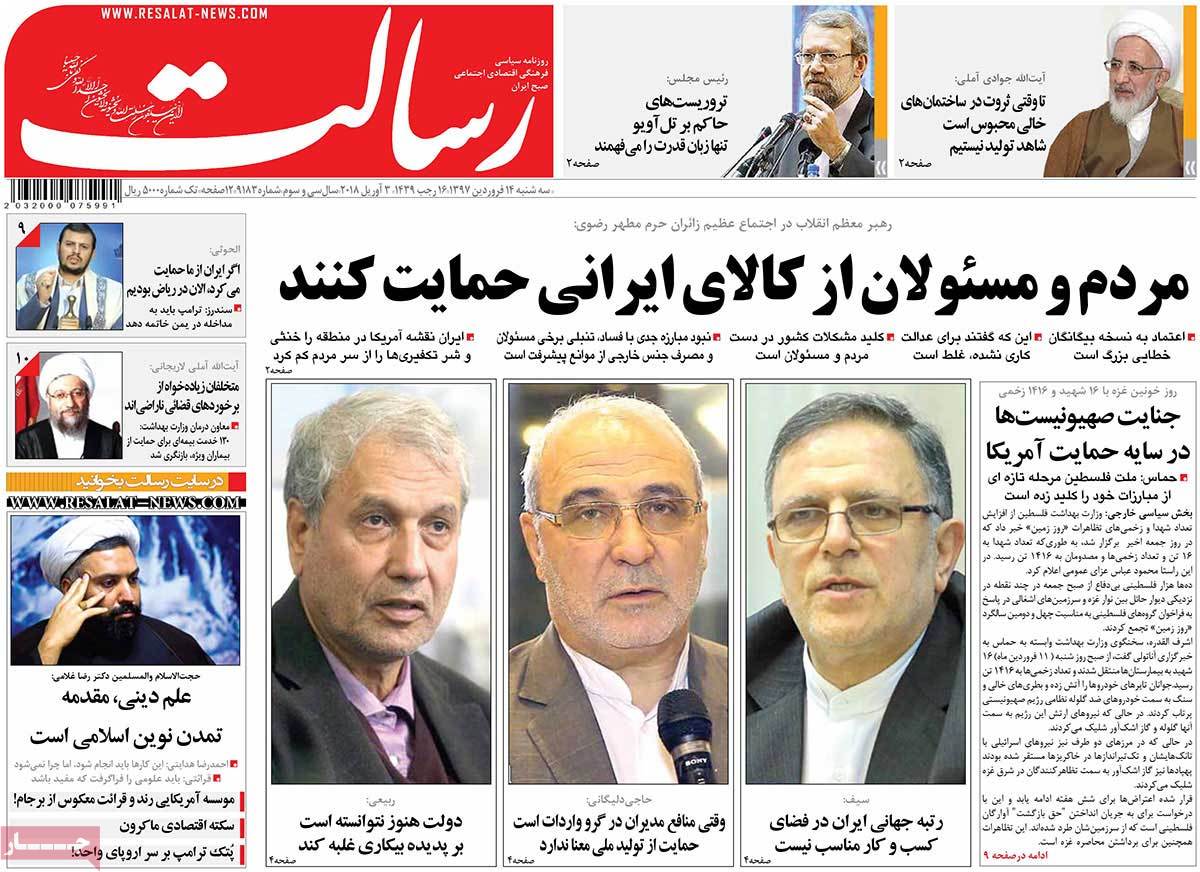
Resalat:

  • Zionists Committing Crimes with US Support
  • Hamas: Palestinian Nation Just Started New Phase of Its Struggles

A Look at Iranian Newspaper Front Pages on April 3


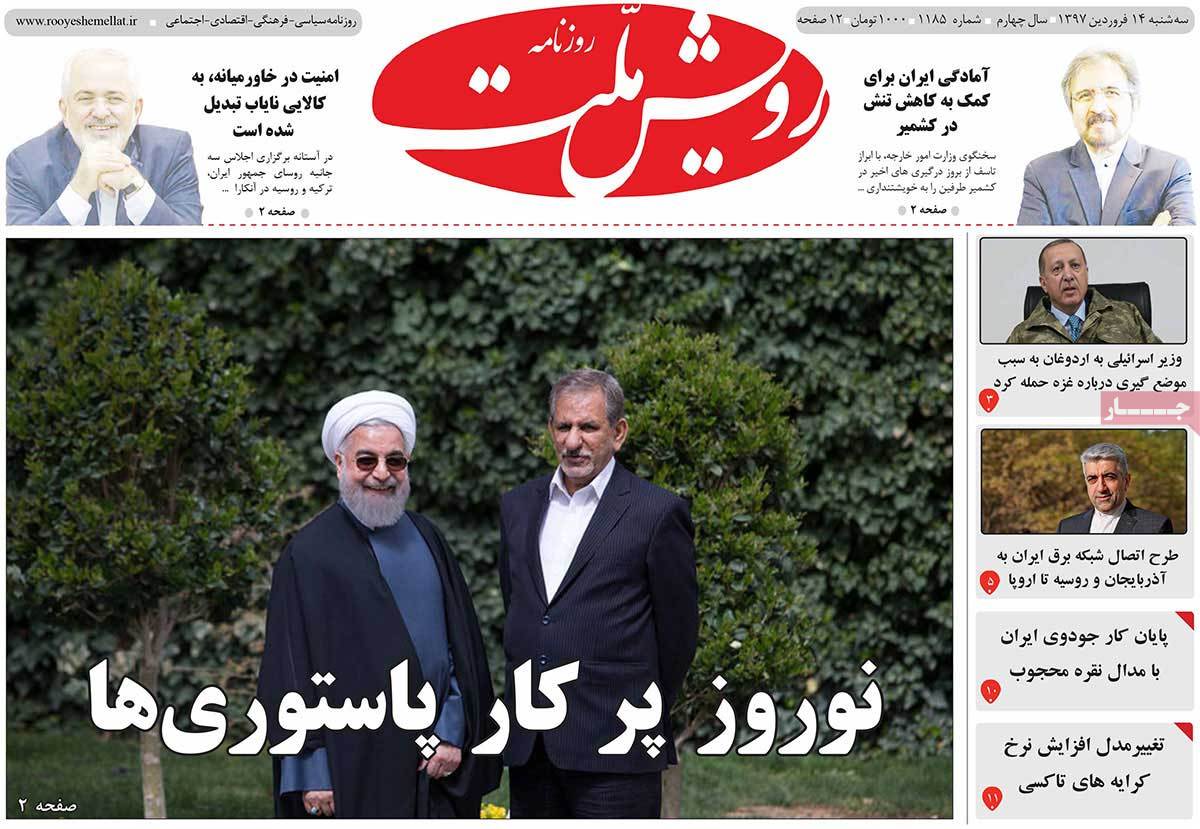
Rooyesh-e Mellat:

  • Zarif: Security in Mideast Has Turned into Scarce Item
  • Iran Ready to Ease Tensions in Kashmir

A Look at Iranian Newspaper Front Pages on April 3


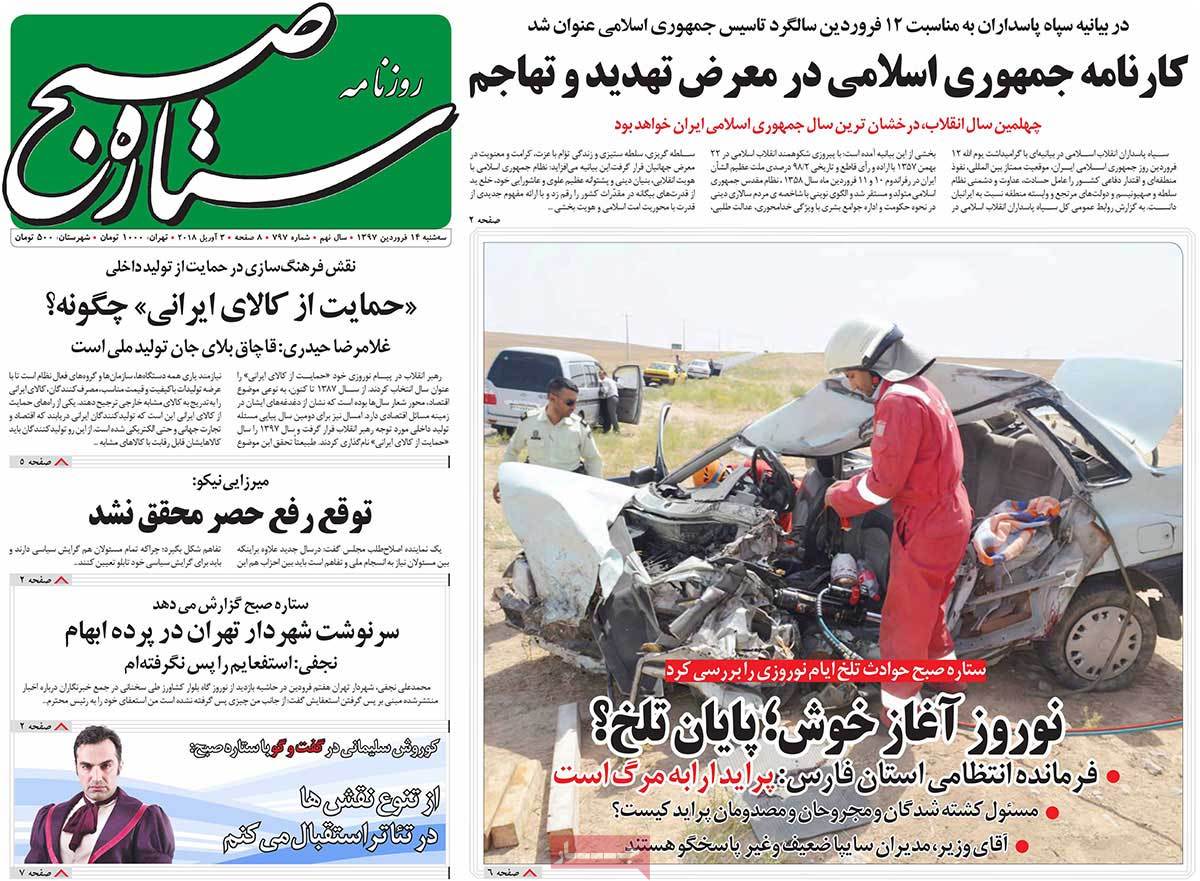
Setareh Sobh:

  • Tehran Mayor’s Fate Unclear
  • Najafi Says He Won’t Take Back His Resignation

A Look at Iranian Newspaper Front Pages on April 3


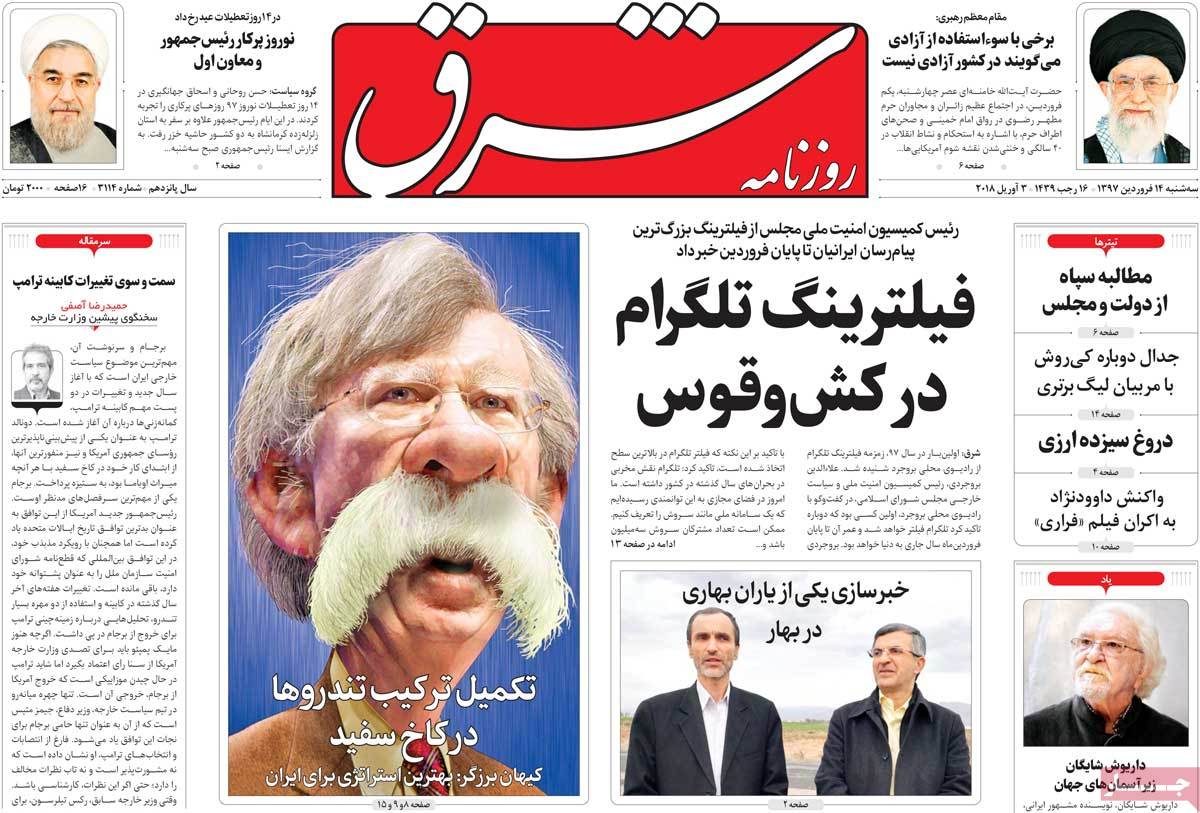
Shargh:

  • Rouhani, Jahangiri Spend Very Busy Nowruz

A Look at Iranian Newspaper Front Pages on April 3


Vatan-e Emrooz:

  • Government’s Gift for Iranian People on Nowruz: IRR 52,000 for $1
  • Forex Rate at Highest-Ever Level, Officials on Vacation!
  • Slaughter of Palestinians during Return Rallies
  • Israel Turns Palestinians’ Peaceful Protests into Bloodbath

A Look at Iranian Newspaper Front Pages on April 3

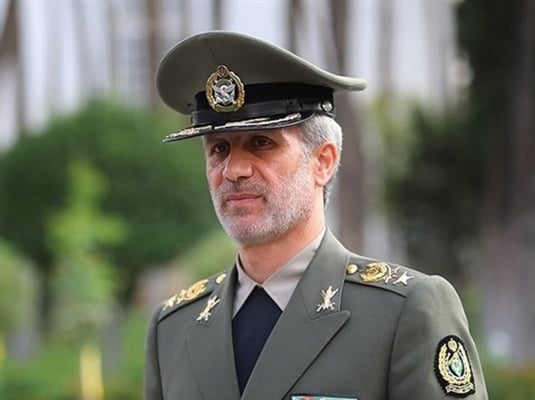
Iran’s Defence Minister in Russia to Attend Security Conference

No Obstacle to Development of Strategic Arms in Iran: DM

Brigadier General Amir Hatami is scheduled to sit down with his Russian counterpart Sergei Shoigu and deliver a speech on the first day of the event, reported the Persian-Language Islamic Republic News Agency (IRNA).

The Iranian defence chief, who is in Moscow at the invitation of his opposite number, will also meet some of the defence ministers and officials attending the conference.

Russian President Vladimir Putin and UN Secretary General Antonio Guteres are reportedly planned to address the conference during the opening ceremony.

A host of issues will top the agenda of the two-day event, including the defeat of the ISIS terrorist group: its impacts and the prospects for regional peace, global security in a multi-centred world; Europe security: cooperation or confrontation, the humanitarian situation in the Middle East, regional security in the Middle East and North Africa, reconstruction after conflict, soft power as a tool to pursue political-military objectives; Asia: dimensions of regional security and responsibilities of the defence agencies in the region, responding to threats and challenges.

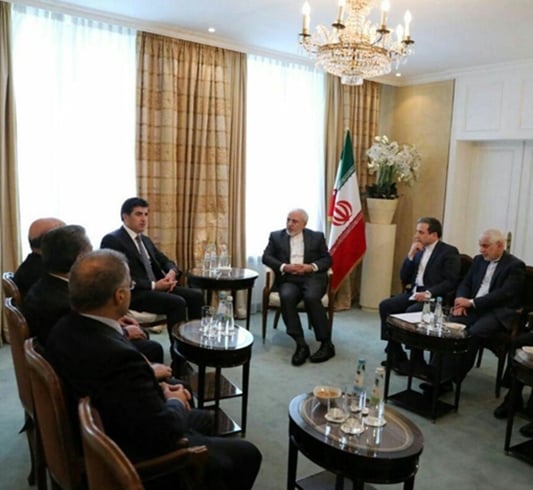
Iran FM Condoles with KRG PM over His Brother’s Death

“The news of the sudden passing of your beloved brother brought [us] sadness,” Zarif wrote in a message on Tuesday.

“I convey my condolences to you and other members of his family and all the people of the [Kurdistan] region on the disaster and ask God to embrace him and grant patience to you and other family members,” he said.

The 51-year-old Dilovan Barzani, son of the late Idris Barzani, died of a heart attack in Erbil on Monday.

Masoud Barzani, the former KRG President, is the brother of Idris Barzani.

He held no official position but was considered a prominent figure, taking part in events across the Kurdistan Region as a representative for the Kurdish premier, Kurdistan24 news website reported.

A funeral and mourning period of three days, beginning Tuesday, will be held in the town of Pirmam in Erbil.

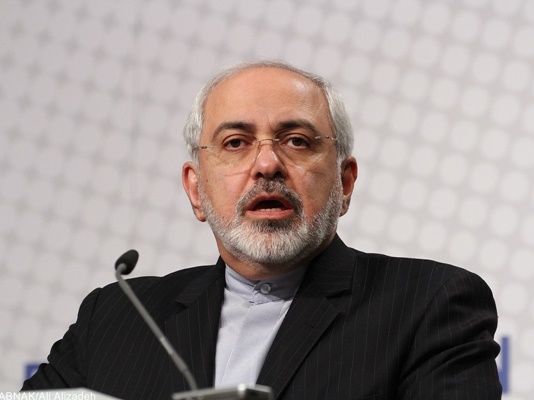
Iran Won’t Compromise on Cause of Palestine: FM Zarif

Mohammad Javad Zarif wrote in an article published by the Turkish Yeni Safak newspaper that Iran has not submitted to pressure in its support for the Palestinian nation.

“Before the victory of the Islamic Revolution [of Iran] in 1979, Iran was one of the few countries to have cordial relations with the Zionist regime [of Israel]. Moreover, the ousted regime of the Shah (the former Iranian dictator) played a key role in paving the way for the conclusion of the Camp David agreement between Egypt and the Zionist regime. This could not easily be accepted by most Iranians, who regarded the cause of Palestine as their own,” the top diplomat noted.

He underlined that Iranian authorities will never compromise on the issue of Palestine.

“The first thing that revolutionary people did after the victory of the Islamic Revolution was to hoist the Palestinian flag over the embassy where Zionist diplomats used to reside. Because the Revolution and its leaders always regarded the cause of Palestine as their own, they made no compromises over the issue from the outset, and in that path, they tolerated pressure, blockades and even proxy or direct wars,” said Zarif.

He highlighted that the Islamic Republic of Iran regards the sufferings of Palestinians, like those of all Arab, friendly and neighbouring countries, as its own.

Zarif said Iran believes its security and stability is contingent upon those of the region.

“However, some tried to turn the Arab world into an arena for settling old scores and showing their greed,” he added.

He said Iran is of the conviction that its security and stability depend on those of the Middle East, especially on the security and development of the country’s neighbours.

“This is an issue which should be of top priority for everybody,” he said.

Accordingly, said Zarif, Iran has on numerous occasions called for the conclusion of a joint security pact which is based on dialog, common principles and confidence-building mechanisms, so that it could steer the country out of the “dark tunnel in which the potential of all countries is eroded.”

The top diplomat said Iran has announced time and again that it stands ready to work with all sides to protect the principle of good neighbourliness as well as joint security and interests.

“All regional countries are responsible before their nation, before history and before the future generations; and there is every possibility that the minimum requirements which could end this long chain today may no longer exist in the future. Foreign powers influential in the region have always chosen the option of war, and, through constant warmongering, have left no room for the emergence and manifestation of peace,” Zarif noted.

“They backed the Saddam Hussein’s regime to [help it] attack Iran and Kuwait; then they fought him to topple him. They supported al-Qaeda and the Taliban in Afghanistan, then waged a war to drive them out. Likewise, they supported another version of the same groups to use them as tools to destroy Syria, and to begin occupying Syria under the pretext of combating extremist groups,” the Iranian foreign minister said.

He said the Zionist regime’s war against Lebanon, the occupation of Palestinian territories, repeated violation of the Syrian airspace and the current war on Yemen are taking place with the help of Western munitions.

“Now one should ask … what effect regional developments have had, and will have on the world,” Zarif pointed out.

“One can say the policies adopted over the past half a century has brought the world to a point which could be called the critical condition.”

He then said it looks like the world has reach a stalemate today.

“As historical rules and the sciences which form the foundation of international relations have failed to manage these relations, the Middle East region, too, is gradually turning into a geographical expanse which does not enjoy the minimum security and is engulfed by the falmes of different types of racial, ethnic, religious, nomadic and tribal conflicts,” said the foreign minister.

“Security in the Middle East – which is like a large house bringing together nations with a lot of common ground and few differences – has become a rare commodity. Let’s not forget that Arabs, Turks, Persians, Kurds and other nations in the region have a common history, a single culture, languages with similarities, and customs and traditions that are driven from one another and have become intertwined throughout the history, and [the nations] have believed each other,” said Zarif.

He said some differences of opinion in some areas are natural. At the same time, he said, “Why should we ignore all the commonalities that we have and bring to the fore the logic of confrontation, which will only result in more mothers getting clad in black and further fuel the flames of the grudges that could rekindle the wars of the Jahiliyya era? Today, we don’t want to see long-running and bloody wars of Jahiliyya once again.”

“In order to prevent a repeat of this part of history, we should look into one another’s eyes and decide to settle our differences at the negotiating table, not in the battlefield. This does not mean we will forget our divisions, but we do not want the differences to tarnish friendships.”

“The Islamic Republic of Iran’s objective of putting forward the idea of re-engineering the region is to ensure that the common interests of all regional countries are guaranteed while respecting differences of opinion. In fact, the basis of this re-engineering is to prevent powerful countries from dominating other countries. This way, the small countries in the region will have the opportunity to contribute to issues and can safeguard their interests,” the top diplomat said.

“The joint security of ours and our neighbours’ with which we have land and sea borders is based on compliance with joint principles whose documents are designated by the UN, principles such as sovereignty, not threatening to use force, the peaceful settlement of crises, respect for countries’ sovereignty over their territories and frontiers, refraining from interference in the domestic affairs of countries, and the right to self-determination.”

He said the ensuring of “this common security” requires serious efforts for confidence-building, e.g., announcing planned military exercises, transparency in military moves, reducing the costs of weapons and mutual military meetings. We can set foot on this path with simpler measures such as urging more tourism cooperation among our countries, joint investment and joint ventures in the field of nuclear security, and managing crises,” part of Zarif’s article read.

The top diplomat said Iran remains ready to honestly extend a hand of friendship to Middle East countries.

“This approach is not a show, but is Iran’s strategic option; the reason is that Iran believes our commonalities are far more that the differences that emanate from some unsubstantiated concerns and transient interests which may not be of top priority in the coming years. Meanwhile, if we don’t try to make peace, the generations to come will not get a chance to look into one another’s eyes and hold talks,” the foreign minister noted.

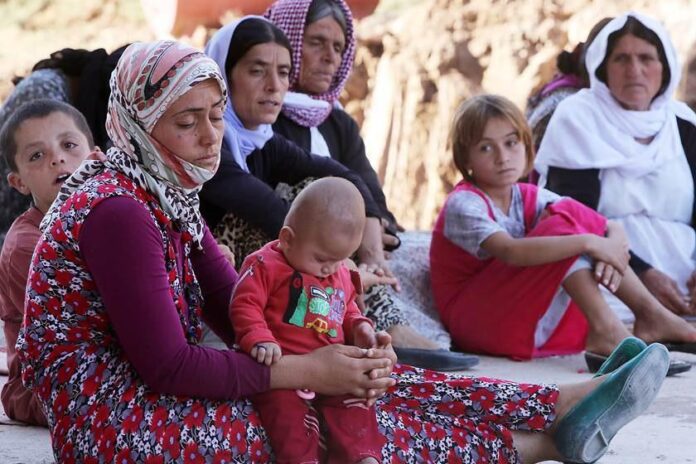
Over 3,000 Yazidi Women Abducted by ISIS Still Missing

“We are still unaware of the fate of 3,100 Yazidi women and girls who were abducted by ISIS and we are searching to find them,” Vian Dakhil said.

Dakhil, the only Yazidi in the Iraqi parliament, made the statement in a talk with Kurdish news agency Rudaw on Saturday, the Persian-language IRNA reported.

More than 6,000 members of the religious minority were taken captive by ISIS when the Syria-based terror group captured large swathes of Iraq in a lightning offensive.

The liberation of last urban strongholds of the group effectively marked an end to the self-proclaimed caliphate established in 2014.

Currently the group has lost most of its holdings in Syria, controlling only small pockets near the Iraqi-Syrian border.

Dakhil said many of the Yezidis women have been transferred by ISIS fighters to cities in Syria, Turkey and Iraq.

“ISIS is present inside Baghdad. Some of the abducted girls and women have been transferred to Baghdad and other Iraqi provinces,” she claimed.

She claimed that Yazidis are still being bought and sold in Syria and Turkey.

Dakhil said the Iraqi government has earmarked three billion Iraqi dinars ($2.5 million) to pay ransoms to secure release of Yazidi women and girls.

The lawmaker also said over 500 Yezidi women and girls once held captive by ISIS will soon be sent to Germany to go through rehabilitation programs.

Over 1,200 Yazidi women have so far been sent to Germany.

After using rehabilitation services, the former captives are free to decide whether they would prefer to stay in Europe or return to Iraq.

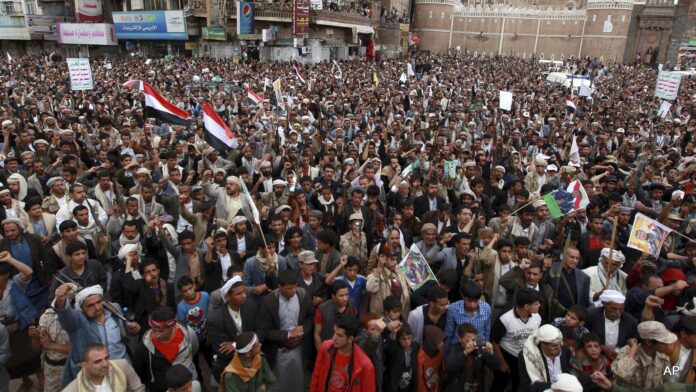
Rallies Held to Condemn Saudi-Paid Mercenary’s Abuse of Yemeni Woman

The Yemenis unanimously blamed the United Nations Security Council for similar crimes carried out against women in the impoverished nation.

“In a huge rally organized in the capital Sana’a by the Women’s National Committee of Yemen, the demonstrators strongly condemned the abuse of a Yemeni woman by a Saudi-paid mercenary from Sudan in al-Khukha region south of Hudaydah city,” a Farsi report by Fars News Agency said, quoting Ansarullah Media Centre.

In a statement, the committee underlined that the Sudanese mercenaries also known as Janjaweed who are fighting in Yemen as part of the Saudi-led coalition are notorious for their “unethical and heinous crimes” including abusing women and disgracing Yemeni families.

The Janjaweed are militias that operate in western Sudan and eastern Chad. Using the United Nations definition, the Janjaweed comprised Sudanese Arab tribes, the core of whom are from the Abbala (camel herder) background with significant recruitment from the Baggara (cattle herder) people. This UN definition may not necessarily be accurate, as instances of members from other tribes have been noted.

The Women’s National Committee of Yemen also urged the UN agencies advocate women’s rights to issue a statement condemning the notorious crimes carried out by the Saudi-paid mercenary in Yemen. It also called for an international probe into the crime to put on trial the perpetrator.

Meanwhile, Ministry of Endowments and Guidance in Yemen organized a rally in the capital to condemn the brutal crime by the Saudi-paid mercenary.

During the rally, demonstrators vehemently slammed the move saying it stands in stark violation of all ethical and humanitarian principles. They also blamed the UN for the crimes carried out by the Saudi-led coalition in Yemen and called for the trial of the perpetrators.

The demonstrators urged the United Nations Security Council to put an end to the brutal siege imposed by Saudi Arabia on Yemen as well as its mercenaries’ inhuman crimes in the impoverished country.

Meanwhile, a number of non-governmental organizations in Yemen issued separate statements blaming the UN for the inhuman situation underway in the country. They also called on the international community to step into the fray and protect human rights, freedom and dignity.

Political coalitions in Hudaydah province also condemned the crime and said it disgraced not only the family of the abused woman but all Yemenis. The coalitions invited all Yemenis to take part in rallies to be organized in the province in protest to the crime. They urged all youths in Yemen to take arms against Saudi-led coalition.

Saudi Arabia has been leading a deadly campaign against Yemen from the air, land, and sea since March 2015 in an attempt to reinstate former president Abd Rabbuh Mansur Hadi, a staunch ally of Riyadh, and to undermine the Houthi Ansarullah movement. Since nearly three years ago, the Houthis have been running state affairs and defending Yemeni people against the Saudi aggression.

The UN has described the situation in Yemen as the “world’s worst humanitarian crisis.”

The war, which has so far killed thousands of people, has also taken a heavy toll on the country’s infrastructure, destroying many schools and factories.

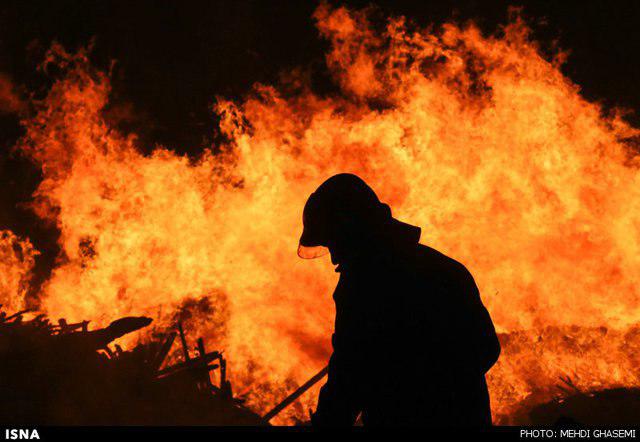
Fire at Iranian Tea House Kills 11, Injures 6 (+Video)

The fire broke out shortly after the midnight, when a former worker of the tea house poured gasoline on it and set the shop on fire in retaliation for his dismissal, according to eyewitnesses.

Mojtaba Khaledi, Iran’s emergency services spokesperson, said the fire killed 11 and injured 6, the Persian-language ISNA reported.

The injured included three firemen, head of Ahvaz Fire Department Atashpad Torabpour said.

Colonel Ali Qassempour, an Ahvaz police commander, said “personal disagreements” were behind the incident.

Qassempour said the incident was under investigation and several suspects were arrested by the police forces by Tuesday morning.

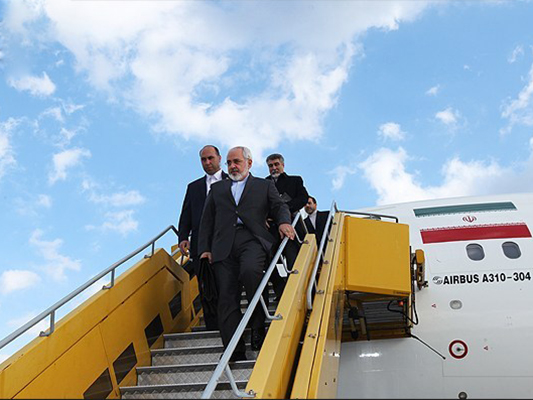
Iran FM to Visit Turkey, Azerbaijan, Nakhchivan

In a statement on Monday, Bahram Qassemi said Zarif will travel to Turkey’s capital Ankara on Tuesday to discuss the Syria conflict and the Astana peace process.

“In Ankara, the foreign minister and his Turkish and Russian counterparts will attend a ministerial meeting on Syria. Exploring the latest developments in Syria and following up on the agreements made in Astana will be topics of discussions among the three foreign ministers,” he said.

Qassemi said Zarif will also accompany President Hassan Rouhani in a meeting of heads of governments of Iran, Turkey and Russia.

“During the [ministerial] meeting, the agenda of the meeting of the three presidents will be discussed,” Qassemi said.

On Thursday and Friday, Zarif will be in Azerbaijan’s capital of Baku to attend a mid-term ministerial conference of members of the Non-Aligned Movement, Qassemi said.

On Friday afternoon, the foreign minister will make a trip to the Nakhchivan Autonomous Republic upon the official invitation of the region, headded.

During his stay, the spokesman said, Zarif will meet with high-ranking officials of Nakhchivan.

Iran Calls for Restraint in Latest Kashmir Escalation

In a Monday statement, Bahram Qassemi called for restraint and said Iran is ready to help ease tensions in Kashmir.

“The Islamic Republic of Iran supports every move in line with the interests of the Kashmiris and is ready to take effective steps to reduce tensions, if the sides make a request,” he said.

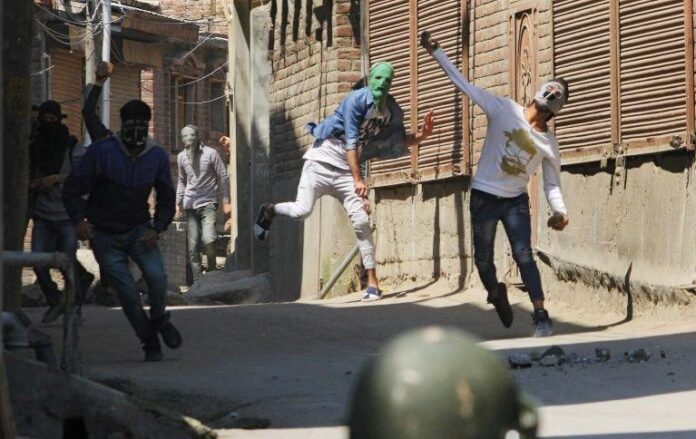
Fierce gun battles between Indian forces and suspected separatist militants in the Indian-controlled Kashmir has in recent days left 20 people dead.

People staged a strike in the region on Monday, after deadly anti-New Delhi protests and clashes between the army and pro-independence militants.

In recent years, the people of Kashmir have been faced with a massive crackdown by hundreds of thousands of Indian military and paramilitary troops deployed to the region to stifle dissent.

The Himalayan region is divided between India and Pakistan. Most Kashmiris on the Indian side want either independence or a merger with Pakistan.