Wednesday, April 22, 2026
Home Blog Page 3499

Italy Prevents Iranian Artist from Taking Part in L’Aquila Reconstruction

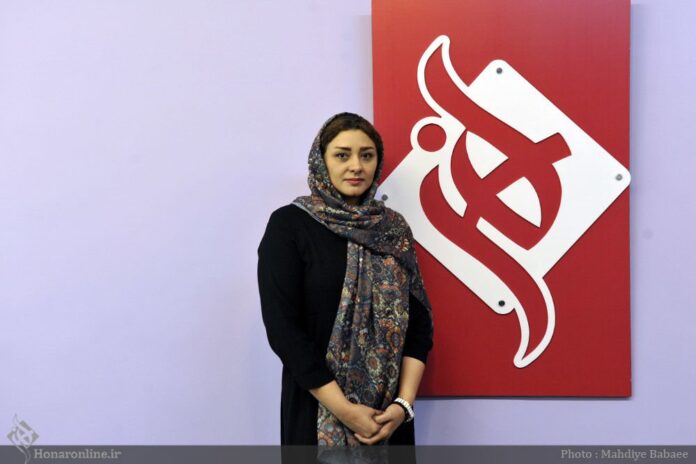
Maleki is among the graphic artists who were picked up from across the world to take part in the international “Rebirth” project to reconstruct the Italian city of L’Aquila, which had been destroyed in a 2009 earthquake.  

She was set to represent the Islamic Republic in the project but has missed the chance so far due to the Italian embassy’s decision to deny her a visa, a report by Honar Online said.

The Rebirth project is a public effort to reconstruct the city of L’Aquila. The participating artists are set to design a monument for the city to replace the cathedral church of L’Aquila, which was destroyed during the earthquake.  

“The project is based on cultural exchanges. Eight artists from five countries – China, Finland, Italy, France and Iran – have been picked up to implement the project under the supervision of one of the most famous architects in the world,” Maleki said.

Elaborating on her design selected for the project, she said it is a combination of Iranian traditional painting and mythology.

“L’Aquila means eagle in Italian. That’s why I’ve used a portrait of an eagle in my design. The portrait of the eagle used to be among the main themes of our national flag in the past. Lotus is another symbol which I’ve used in my design. The flower is widely viewed as the symbol of growth and perfection. It is in line with the main message of the Rebirth project,” she said.

Carmel says she has also used a portrait of an Achaemenid guardian, a lion as the symbol of power and a horse as the symbol of health and happiness.

She cited Iran’s presence in the project as a significant development and said “I’ve used ancient Iranian symbols to show that all of the symbols used in today’s world are deeply rooted in our ancient culture.”

Italy Prevents Iranian Artist from Taking Part in L'Aquila ReconstructionReferring to the obstacles to the implementation of her design, Maleki said it takes nearly 15 days to implement it. “Most of the graphic artists have warmly welcomed my design. China’s representative in the project told me that my design addresses the souls of people.”

Maleki says she has used cyan colour as the symbol of Iran. “I’ve tried to use ancient Iranian elements because it was highly significant for me to highlight Iran’s status in the project.”

The Iranian artist then referred to the problems created for her to visit Italy to take part in the project and said the Italian embassy in Tehran has refused to issue her visa so far even though she had the official invitation at hand.

“That’s why I have failed to take part in the international project so far. The approach of the Italian embassy towards this international event is very strange to me because the project is directly connected with the cultural and historical identity of the country,” she said.

According to Maleki, the mishandling of the issue reveals the Italian embassy’s indifference to diplomacy and the cultural relations among the nations which can promote peace and friendship in the world.

“Unfortunately due to the mismanagement of the Italian embassy, I missed the chance to attend the opening ceremony of the Rebirth project held on August 18. Other artists from around the world have expressed their protest against the embassy’s mishandling of the issue, calling it an insult to the status of artists. So far, 70 artists have signed a letter of protest to the Italian embassy in Tehran,” she noted.

Maleki also said during the early stages of the project implementation, she faced many problems because she was not present there.

The preliminary stages of the project, according to Maleki, lasted until August 30 and “unfortunately, I couldn’t take part in the event despite my hard efforts. Now, the Italian embassy says I may be able to take part in the rest of the project which will last until 2019.”
Iranian, French Diplomats Discuss Syria Crisis in Paris

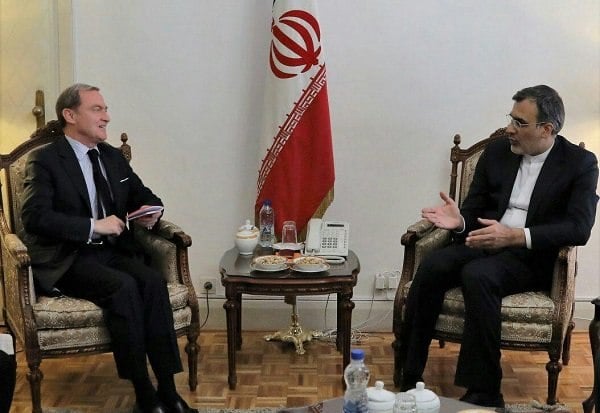
During the Thursday talks in Paris, the two officials discussed regional issues, the latest developments in Syria, and ongoing efforts to end the crisis as quickly as possible.

Jaberi Ansari, who arrived in the French capital on Wednesday night after a visit to Brussels, also met the diplomatic advisor of the Elysee palace, and the Secretary General of the French Foreign Ministry on Thursday afternoon.

Earlier in the day, Jaberi Ansari also attended a working breakfast at the residence of the Islamic Republic of Iran in Paris with the French heads of France-Iran parliamentary friendship groups, Delphine Oand and Philippe Bonnecarrère.

The Iranian and French officials exchanged views on bilateral relations and cooperation between the two countries.

Iran Slams France’s Double Standards on Terrorism

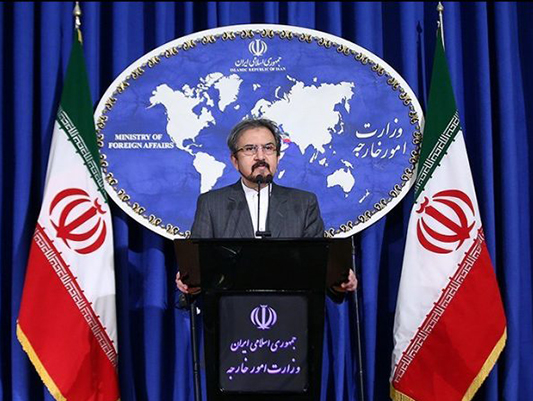
Bahram Qassemi

In a statement on Thursday, Qassemi said that no country would ever remain silent when it comes to its national security, territorial integrity, and any form of aggression against its people and land.

His comments came in reaction to the remarks made by the French Foreign Ministry, which expressed concern about the actions of the Islamic Republic of Iran against terrorists in northern Iraq.

In response to a question asked by IRIB news agency, Qassemi rejected such statements saying that the Islamic Republic of Iran had earlier given the Iraqi government and Iraqi Kurdistan authorities warnings about the terrorist moves and destabilising acts of the terrorist group targeted by Iranian missiles last Saturday.

“This terrorist group recently martyred 11 Iranian citizens, and the Iranian nation at least expected their government to punish them and take decisive actions in order to put an end to such operations.”

Iran has repeatedly and explicitly warned that it takes serious action against terrorism and promotion of violence in all its forms along its borders, and will insist on this principled policy, he went on to say.

Qassemi slammed the French government’s silence over the previous terrorist attacks against Iran’s security and territorial integrity, which were orchestrated from inside the Iraqi territory, and urged Paris to adopt realistic approaches in this regard.

He stressed that terrorism should be condemned in any form and anywhere in the world without any political considerations, and rejected the adoption of double standards and arbitrary approaches towards the territorial integrity and national sovereignty of other countries.

On Saturday morning, Iran fired several missiles at the headquarters of the Kurdistan Democratic Party of Iran (PDKI) and Iranian Kurdistan Democratic Party (KDP-Iran) near Koya district, southeast of Erbil.

At least 16 terrorists were killed and 40 others were injured in the attacks claimed by the IRGC.

A Look at Iranian Newspaper Front Pages on September 13

A Look at Iranian Newspaper Front Pages on November 19

A top story in all papers today was remarks made by Iranian President Hassan Rouhani in a Wednesday cabinet session, during which he said the US is in its worst conditions ever, as almost all its allies have distanced themselves.

Also a top story was increasing criticisms of US President Donald Trump inside the US, and the possible candidacy of former US Secretary of State John Kerry for presidency.

The above issues, as well as many more, are highlighted in the following headlines and top stories:


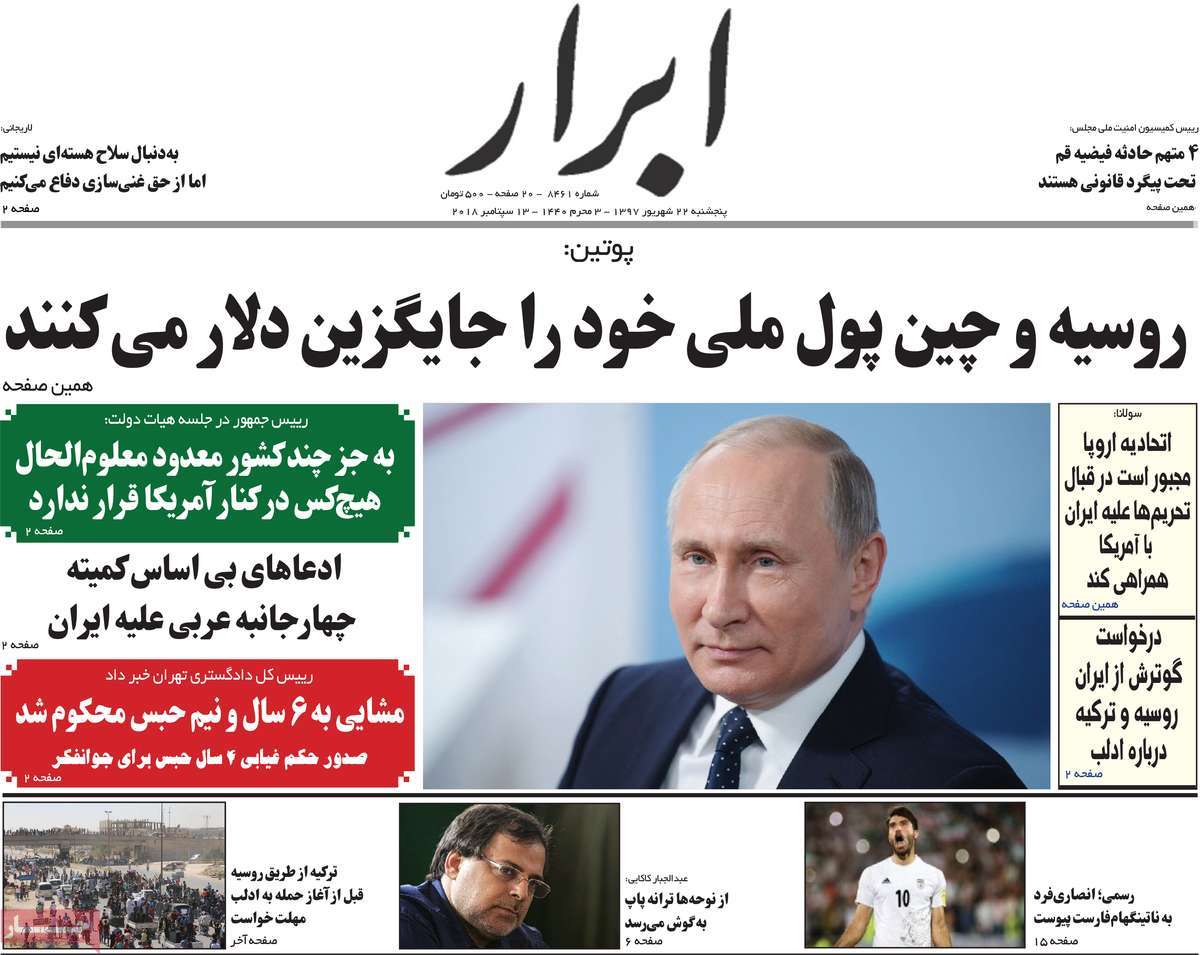
Abrar:

1- Putin: Russia, China to Replace US Dollar with Their National Currencies

2- Baseless Accusations Raised by Arab Quartet Committee against Iran

A Look at Iranian Newspaper Front Pages on September 13


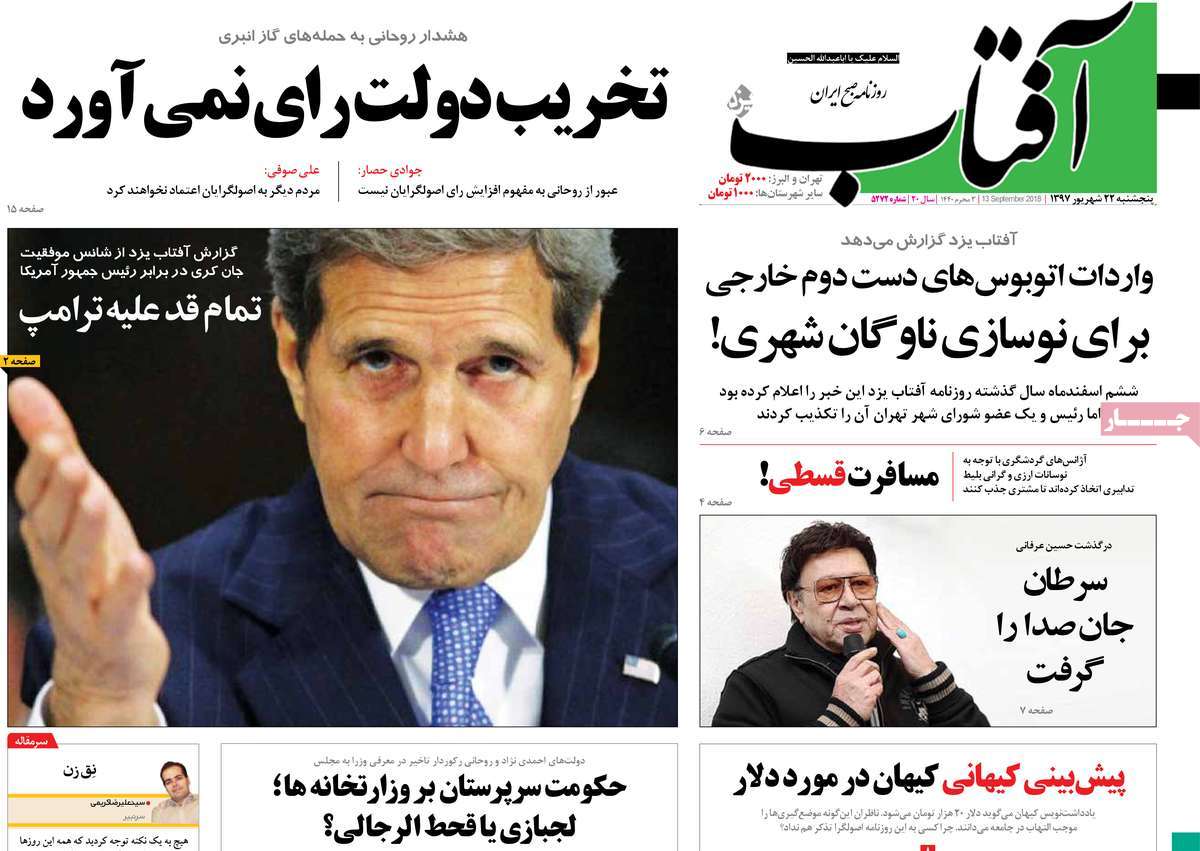
Aftab-e Yazd:

1- Rouhani Warns Those Attacking His Gov’t: Such Attacks Won’t Help You Win Votes

2- Kerry to Stand against Trump, Run for Election

A Look at Iranian Newspaper Front Pages on September 13


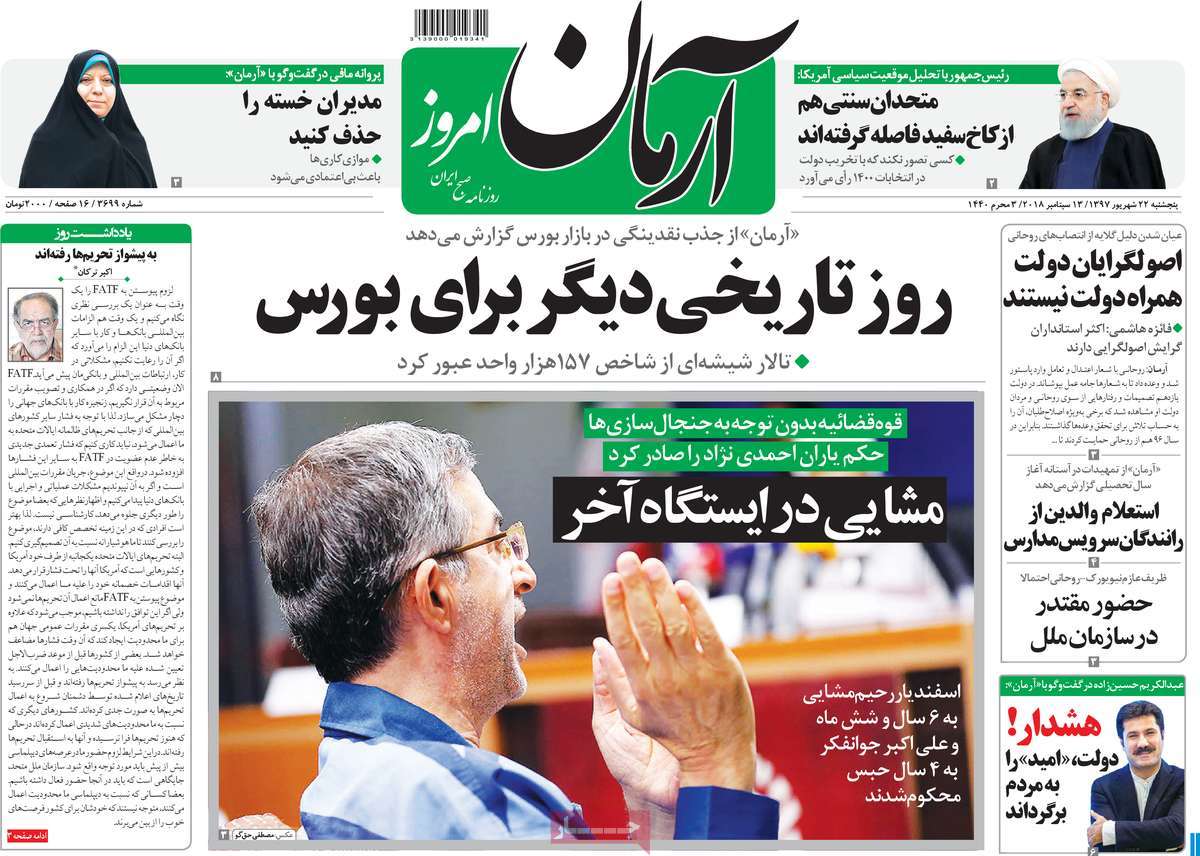
Arman-e Emrooz:

1- Rouhani: White House’s Traditional Allies Have Distanced Themselves from US

A Look at Iranian Newspaper Front Pages on September 13


Donya-ye Eqtesad:

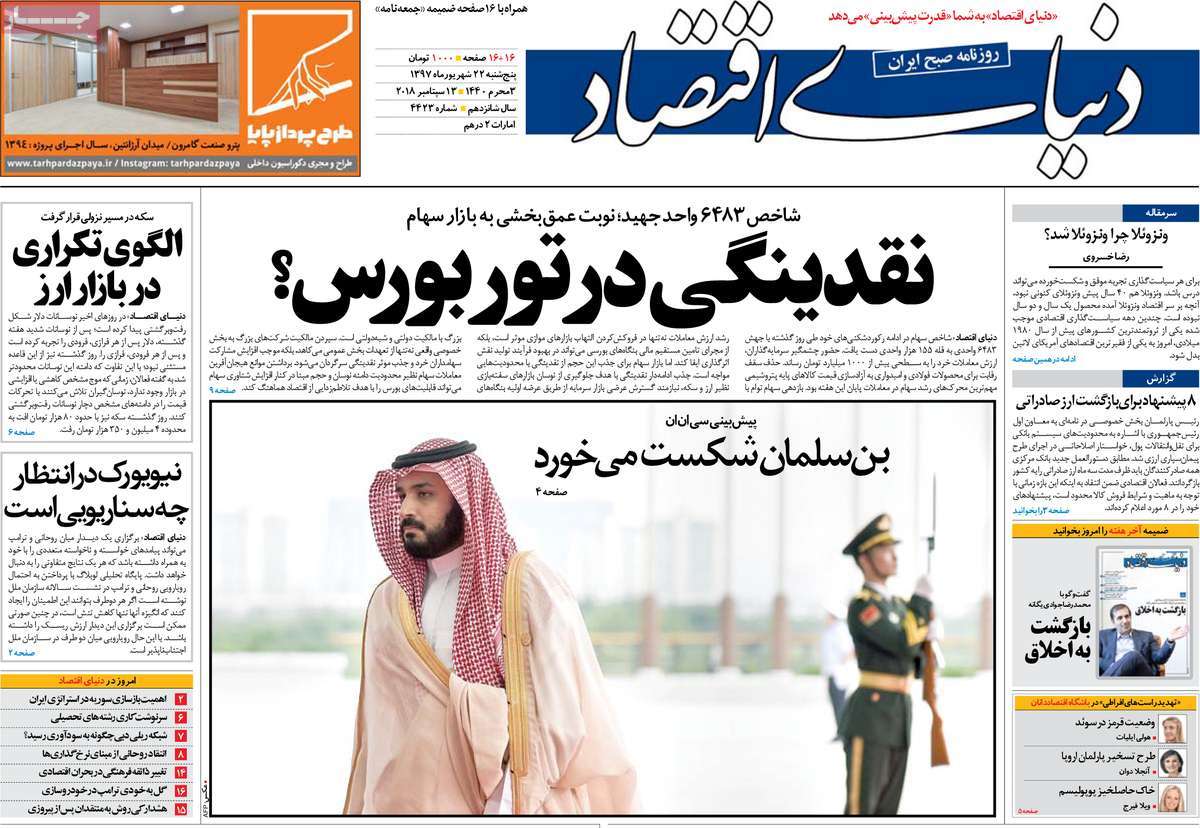
1- CNN Predicts Bin Salman Will Fail

A Look at Iranian Newspaper Front Pages on September 13


Ebtekar:

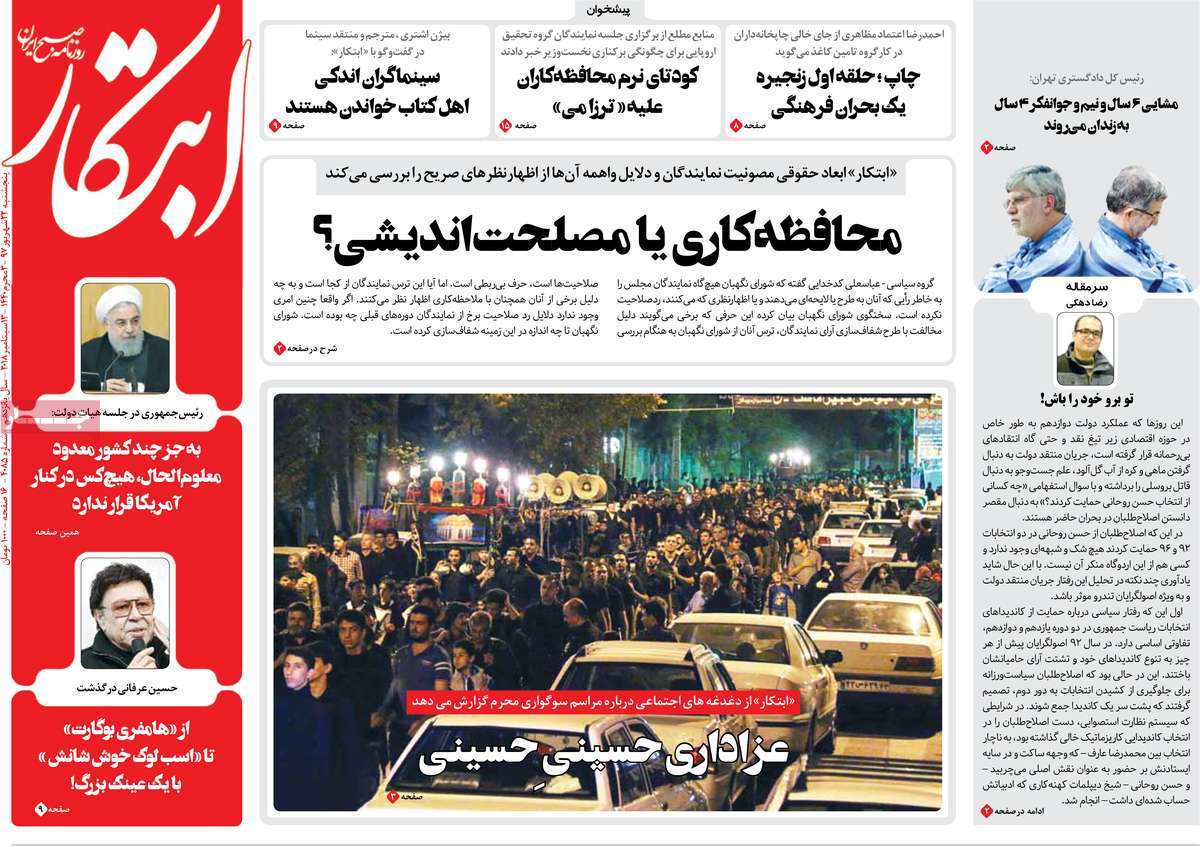
1- Conservatives’ Soft Coup against May

2- Rouhani: Except for a Number of Countries, No One Standing by US

A Look at Iranian Newspaper Front Pages on September 13


Etemad:

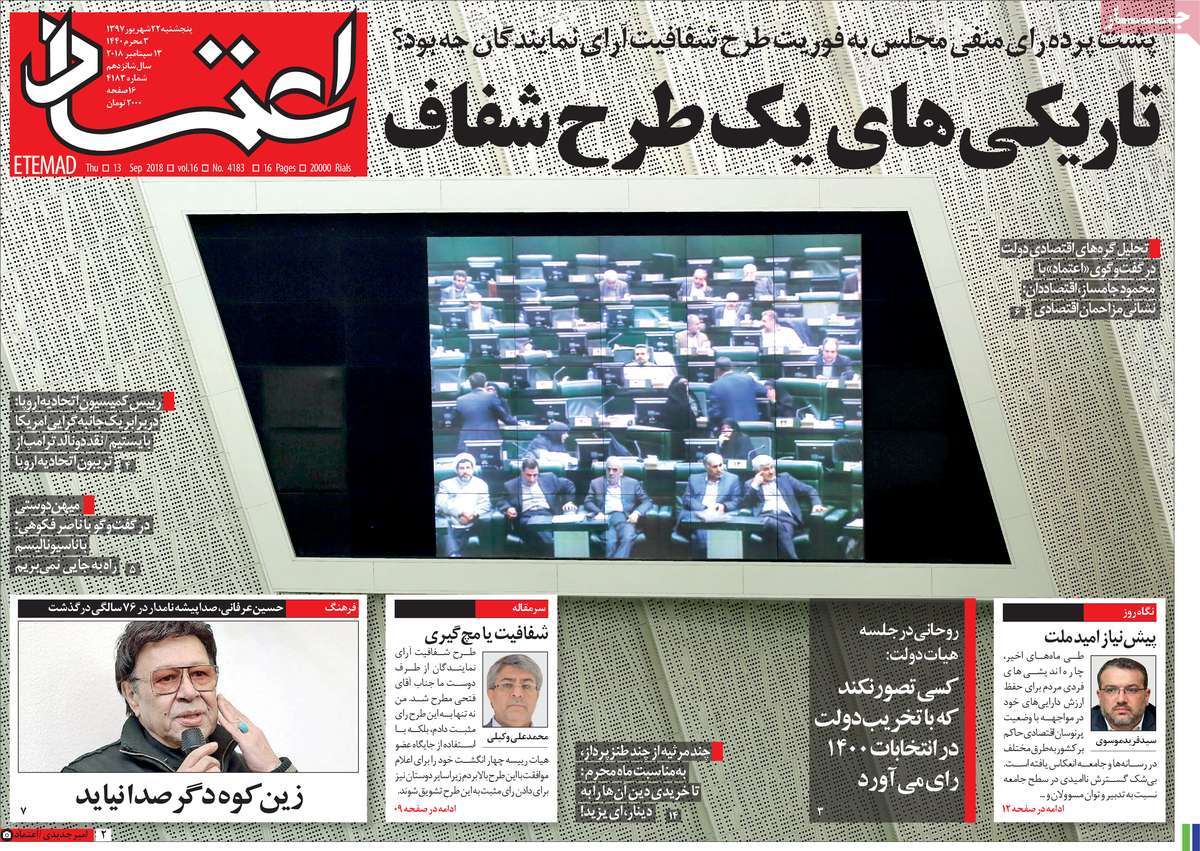
1- European Commission Chief: We Must Stand against US’ Unilateralism

A Look at Iranian Newspaper Front Pages on September 13


Ettela’at:

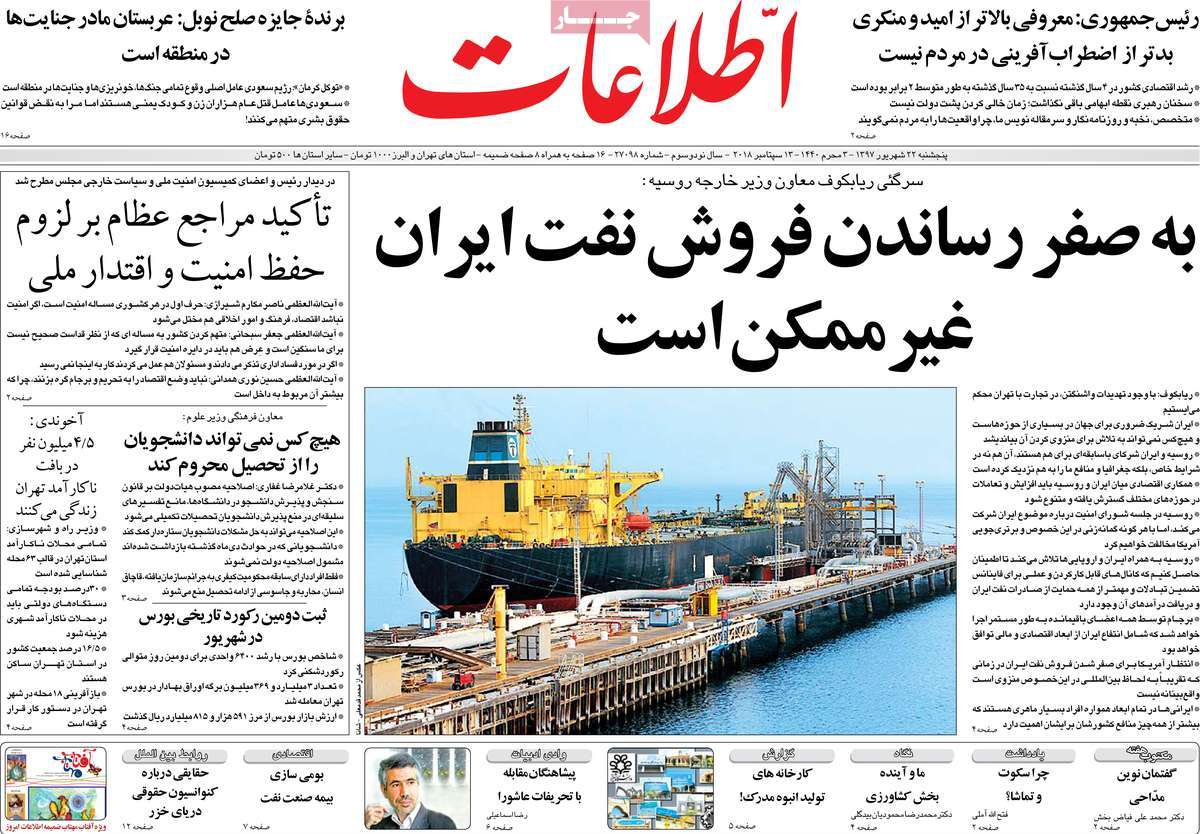
1- Ryabkov: It’s Impossible to Drive Iran’s Oil Exports to Zero

2- Nobel Peace Prize Laureate: Saudi Arabia Mother of All Crimes in Region

3- Tehran Stock Exchange Market Sets New Historic Record

A Look at Iranian Newspaper Front Pages on September 13


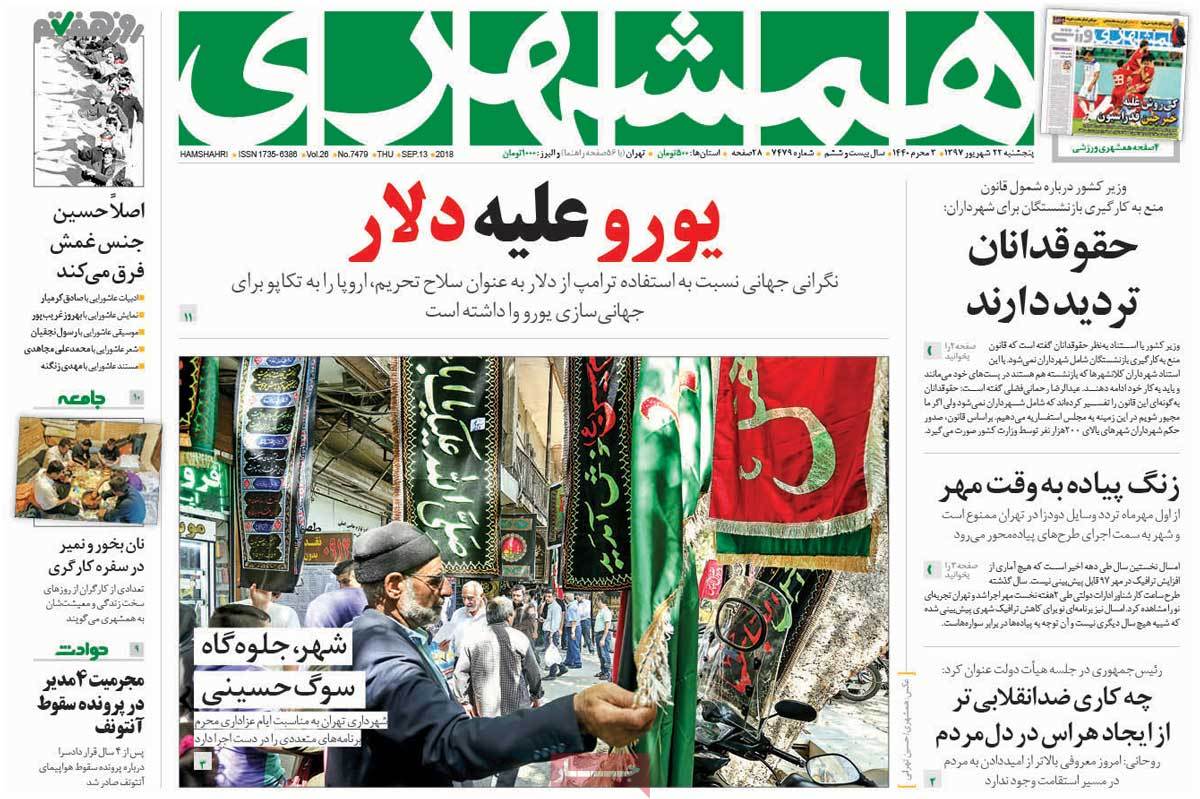
Hamshahri:

1- Euro against Dollar

  • EU Trying to Globalize Its Currency amid Concert that Trump May Use Dollar as Weapon of Sanction

2- Tehran Municipality Has Various Plans for Muharram Mourners

A Look at Iranian Newspaper Front Pages on September 13


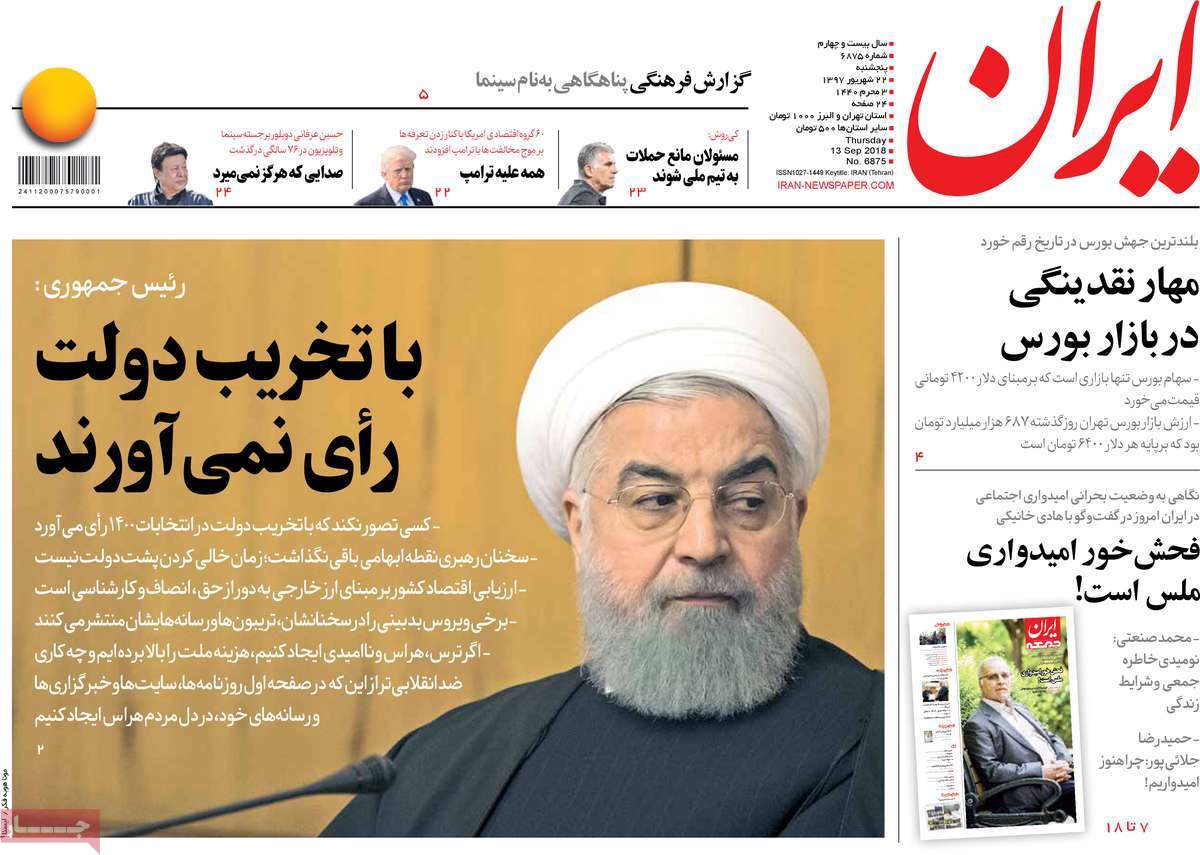
Iran:

1- Everyone against Trump: 60 US Economic Groups Increase Criticisms against Trump

A Look at Iranian Newspaper Front Pages on September 13


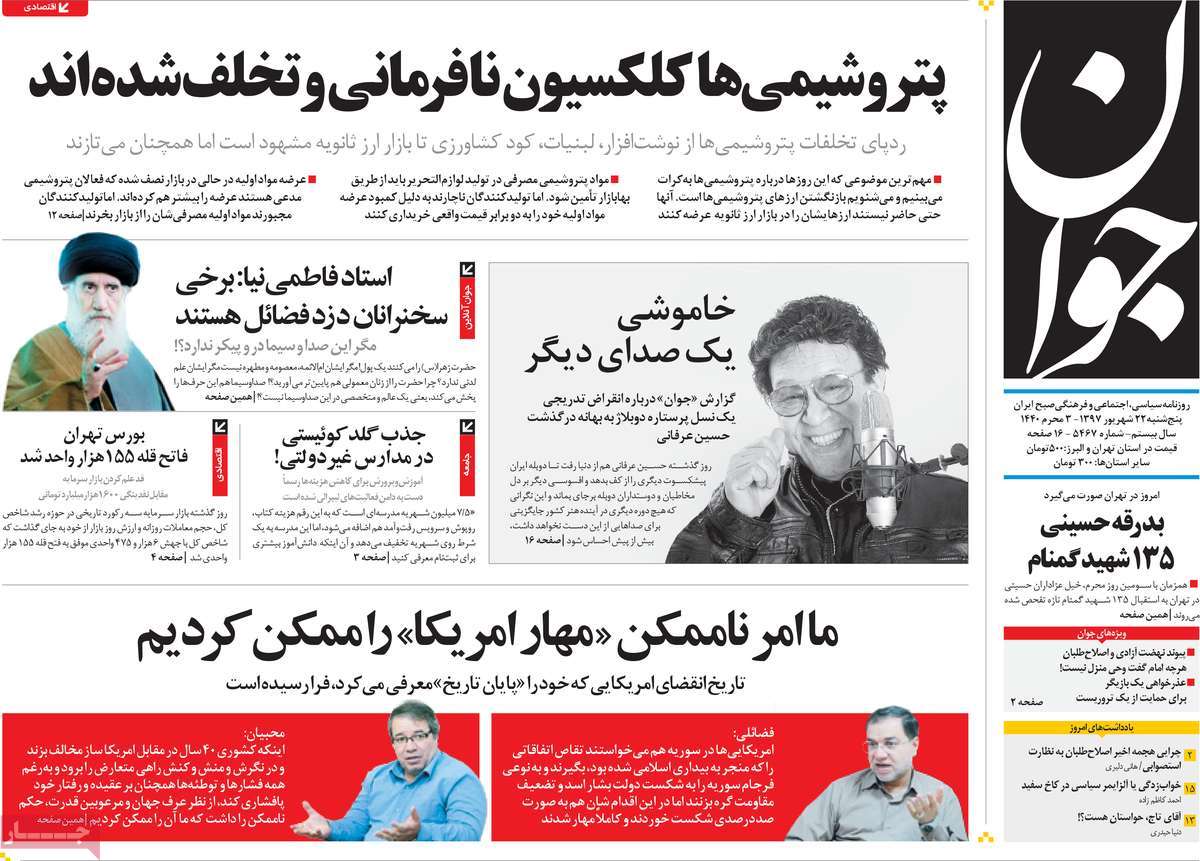
Javan:

1- Index of Tehran Stock Exchange Market Rises to 155,000 Units

2- Renowned Iranian Voice Actor Hossein Erfani Dies

3- Containing US Seemed Impossible, but We Made It Possible

A Look at Iranian Newspaper Front Pages on September 13


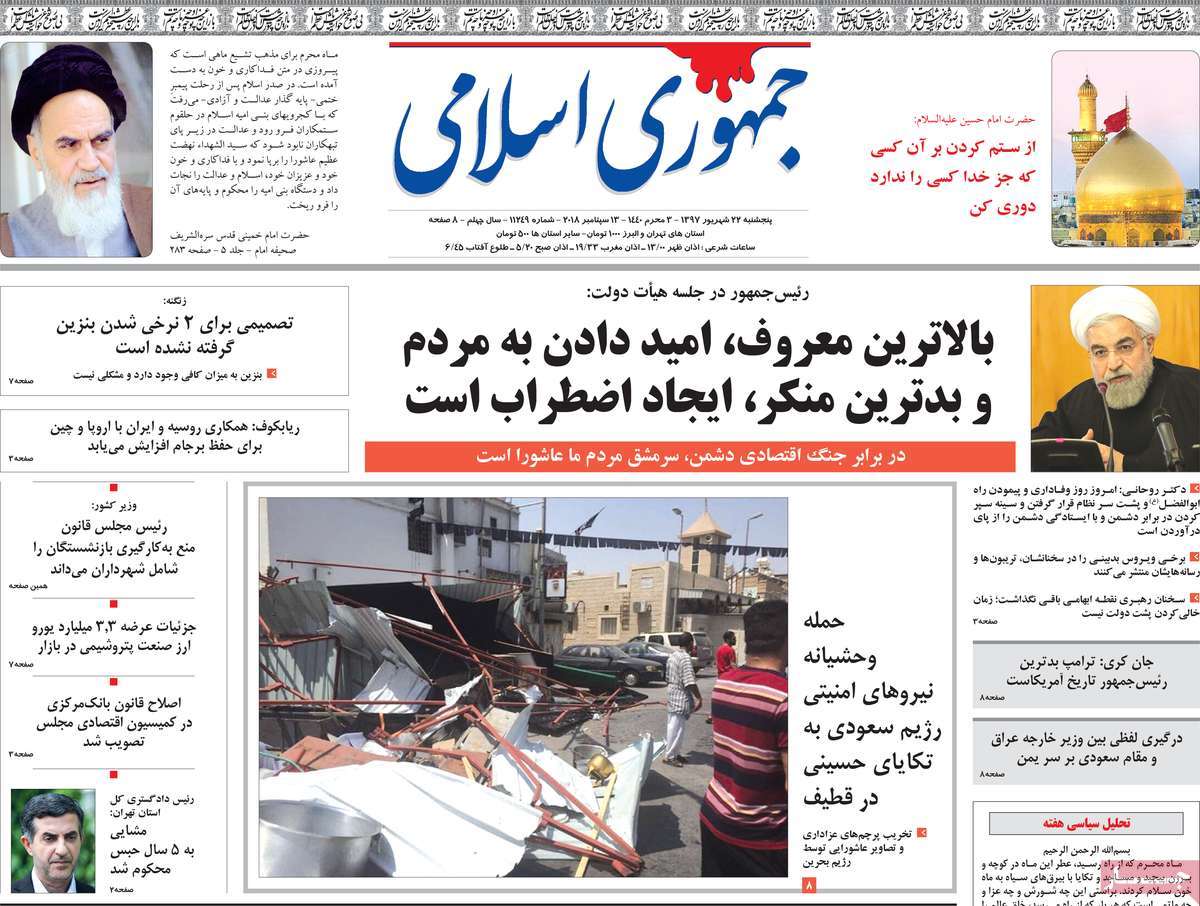
Jomhouri Eslami:

1- Ryabkov: Iran, Russia to Increase Cooperation with EU, China to Keep JCPOA

2- Saudi Regime’s Security Forces Launch Brutal Attacks on Shiite Mourners in Qatif

A Look at Iranian Newspaper Front Pages on September 13


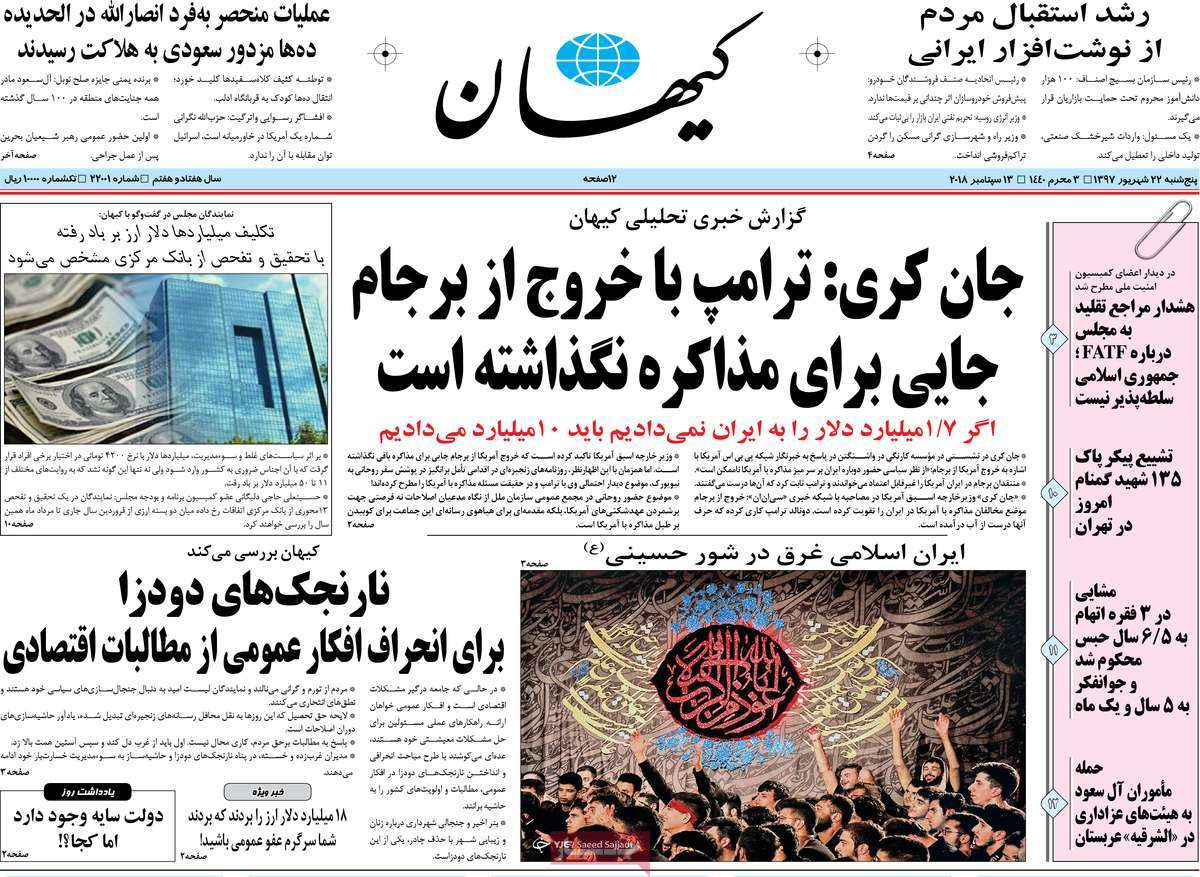
Kayhan:

1- Kerry: Trump Has Left No Room for Negotiation after Exiting JCPOA

2- Increased Popular Support for Iranian Stationary

A Look at Iranian Newspaper Front Pages on September 13


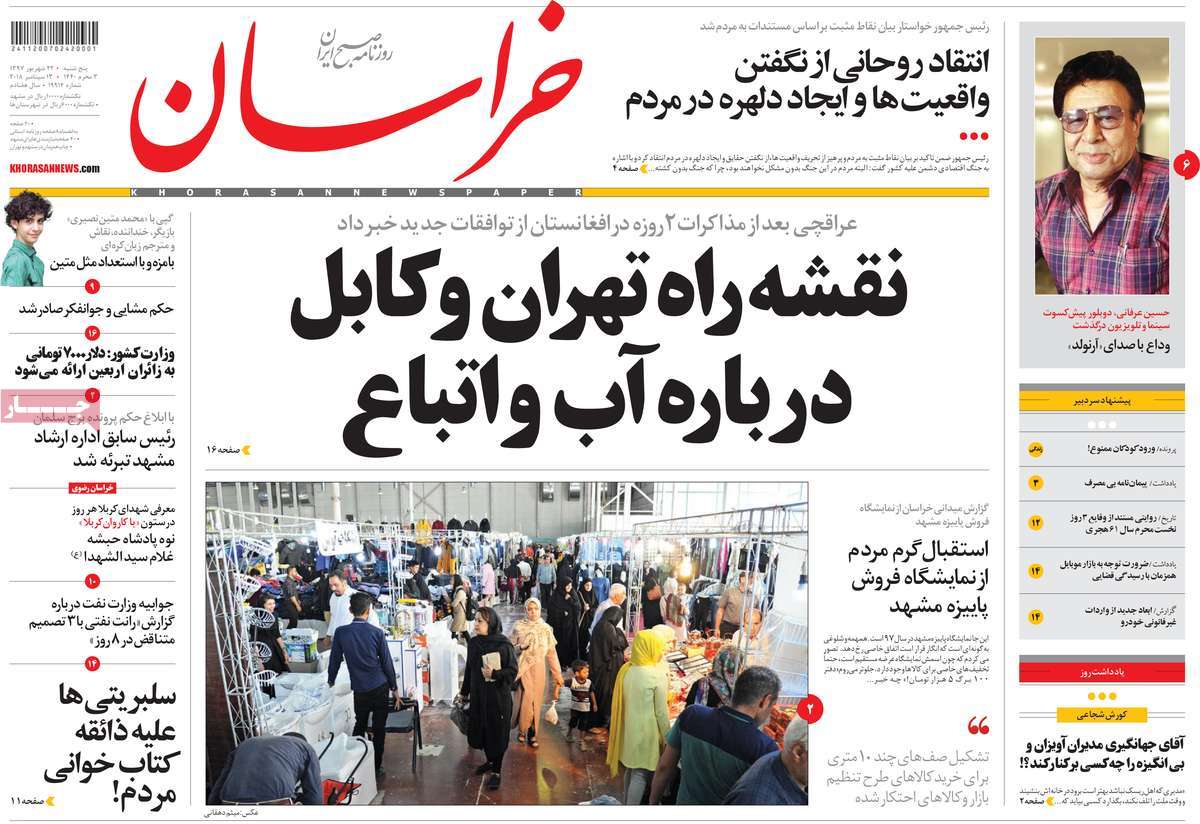
Khorasan:

1- Rouhani Criticizes Those Who Don’t Tell People the Realities, Cause Public Anxiety

2- Tehran, Kabul Discuss Roadmap for Water Dispute, Afghan Immigrants

  • New Deals Reached in Araqchi’s Two-Day Negotiations

A Look at Iranian Newspaper Front Pages on September 13


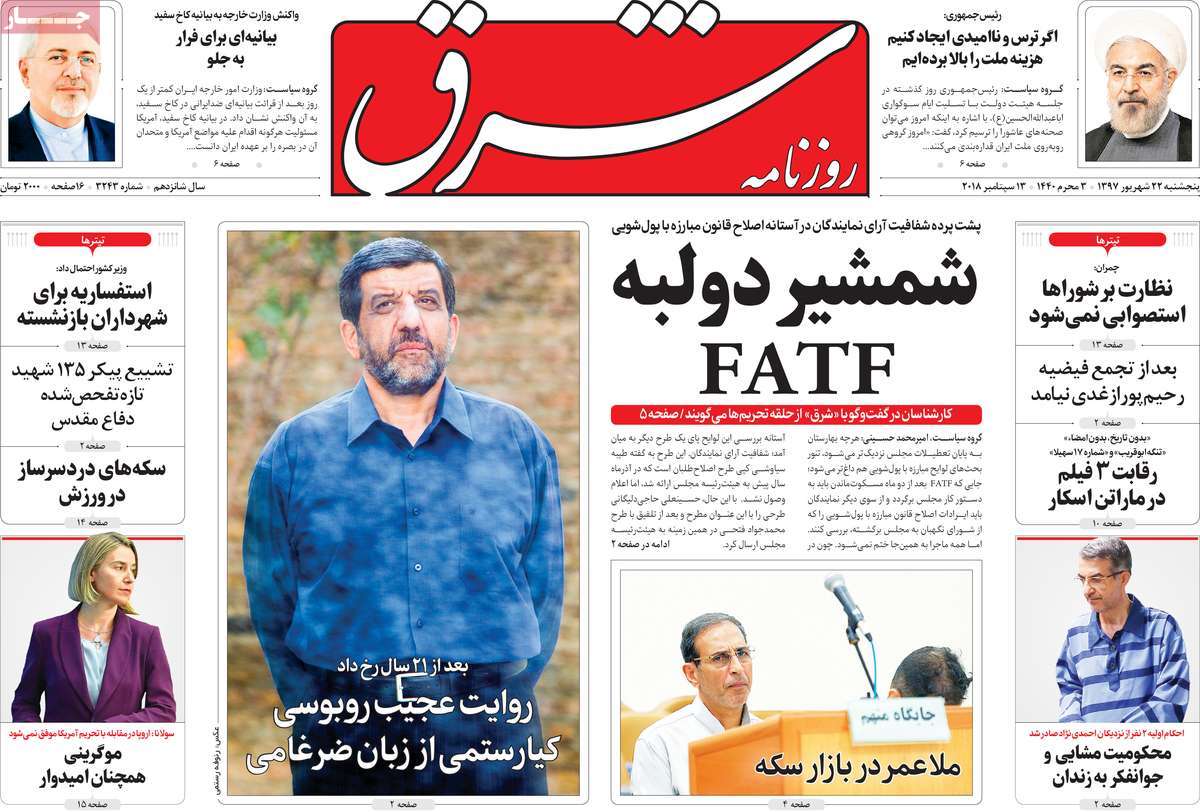
Shargh:

1- Double-Edged Sword of FATF

2- Iran Raps White House’s Statement on Basra Unrest as ‘Fleeing Forward’

3- Mogherini Still Hopeful

  • Solana: EU Won’t Succeed in Countering US Sanctions

A Look at Iranian Newspaper Front Pages on September 13


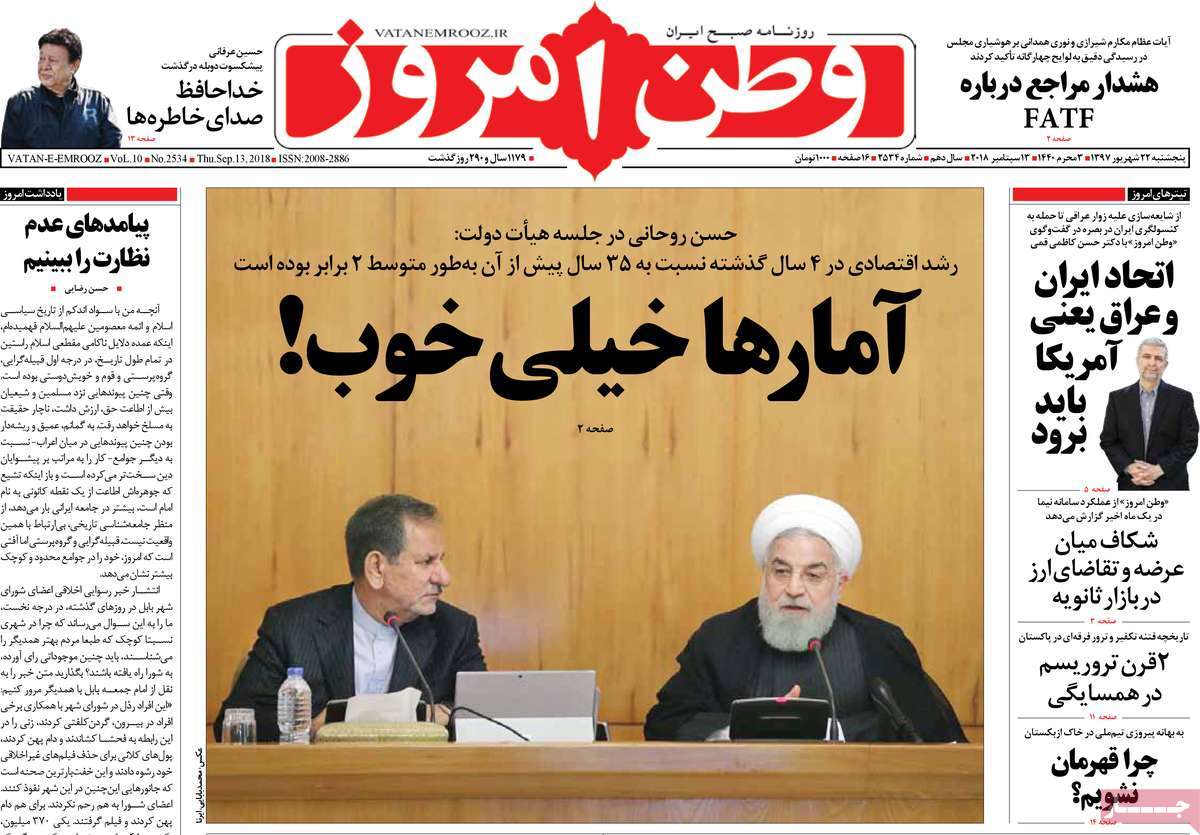
Vatan-e Emrooz:

1- Top Clerics Warn about FATF

2- Statistics Very Good!

  • Rouhani: Iran’s Economic Growth Rate in Past 4 Years Two Times Greater than Past 35 Years

A Look at Iranian Newspaper Front Pages on September 13

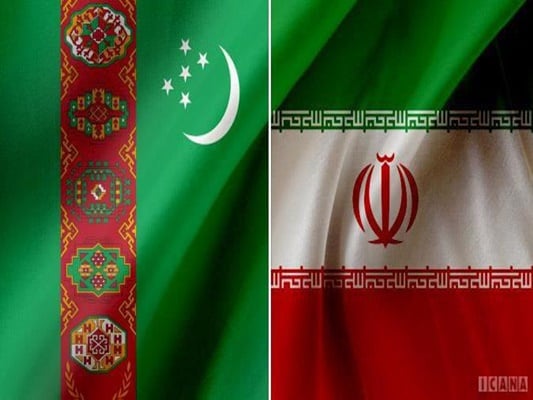
Iran, Turkmenistan to Boost Mutual Trade to $60b

He made the remarks on Thursday, while elaborating on the outcome of his day-long trip to Turkmenistan.

During his trip, the Iranian official sat down with a number of senior Turkmen authorities.

“Although it was a short trip, it had good results, and I hope ground will be prepared as soon as possible for the promotion of cooperation and for extensive interactions between the two countries and the Iranian and Turkmen nations,” he said.

Vaezi said his trip came in line with realizing the objectives envisaged during a recent meeting between the presidents of both countries.

“Very important issues were brought up during the meeting with the Turkmen president, and all of those issues as a whole can serve as a road map for the objectives of both countries and both presidents’ goals,” he noted, as reported by the government’s official website, dolat.ir.

He said among the objectives is the enhancement of bilateral economic ties to around $60 billion.

“With the road map getting prepared, the two countries will have close cooperation in the ten years to come in the fields of industry and trade, transportation and technical and engineering services.

Vaezi stressed that some of the agreements already reached by the two countries will be implemented as well.

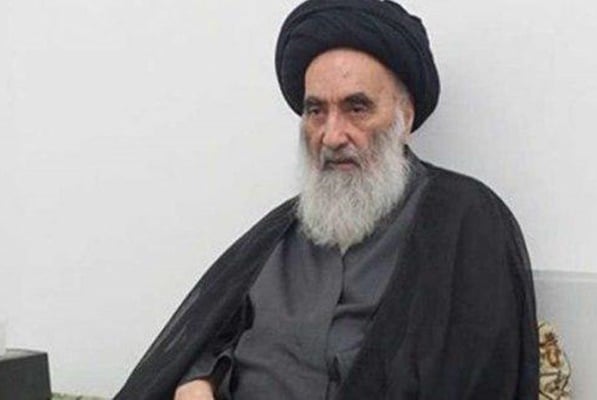
Iraq’s Top Cleric Opposed to Premiership of Former Officials

Some media reports had earlier quoted a number of Iraqi lawmakers as saying Ayatollah Sistani has explicitly named a number of politicians and expressed his opposition to their candidacy for premiership.

However, a source close to Ayatollah Sistani’s office said the media reports on his interference in Iraq’s politics are absurd, a report by Kurdpress said.

“Ayatollah Sistani has never explicitly expressed his opposition to the candidacy of any politician for premiership,” the source said, speaking on condition of anonymity.

According to the source, in direct or indirect talks with various politicians who asked for his advice, the top cleric pointed out that he would not put his weight behind any party or independent candidate who used to be in power before.

“Ayatollah Sistani also said most Iraqis do not any more trust such politicians to fight against corruption and to build a bright future for the country,” he said.

The top cleric also said that if there is a new, competent, qualified and determined candidate who sticks to the guidance offered by him in July, he would establish connection and offer his solutions in line with the national interests of Iraq; otherwise, the source said, he would continue to boycott the politicians and stand behind the oppressed people of Iraq.

Earlier, Sabah al-Saedi from the Sairoon Alliance said he was informed that the top Shiite cleric had refused five of the proposed names for the premiership.

Saedi added that Haider al-Abadi, Nouri al-Maliki, Hadi al-Amiri, Falih Alfayyadh and Tariq Najm “have no luck in holding a premiership post in the next Iraqi cabinet.”

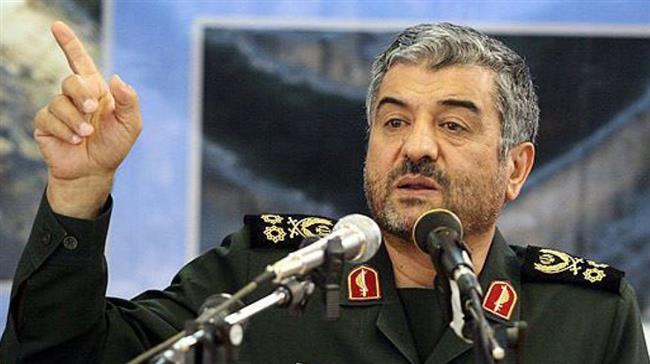
Attack on Terrorists in Iraqi Kurdistan Sends Message to Iran’s Enemies: IRGC

“IRGC’s recent revenge against the terrorists conveys a highly meaningful message to the enemies, particularly those superpowers who think they can impose their evil plots us an bully us,” Major General Mohammad Ali Jafari said on Thursday.

Thanks to its intelligence and command work and the deployment of precision-guided missiles, Ja’afari said the IRGC managed to target a gathering of terrorists in the Iraqi Kurdistan region in revenge for their deadly attacks on Iranian security forces in Iran’s Kordestan Province.

“This capability sent a very decisive message to all enemies,” said the senior general, warning “those who have forces, bases and equipment within a 2,000-kilometer radius around Iran” against any potential attack on the country’s soil.

The IRGC on Sunday confirmed that it had fired seven short-range missiles at a gathering of terrorist commanders in Iraq’s semi-autonomous Kurdistan region.

Following wicked actions taken by terrorist groups affiliated with the global arrogance from the Kurdistan region against Iran’s border areas in recent months, the IRGC decided to counter and punish the aggressors, the IRGC said in a statement.

On Wednesday, Chairman of the Chiefs of Staff of the Iranian Armed Forces Major General Mohammad Baqeri said the US had been provoking Iraq-terrorists over the past year to launch assaults on Iranian soil despite an earlier promise not to do so.

The Iranian general said Baghdad and the Kurdistan Regional Government (KRG) should not allow the establishment of such anti-Iran bases and rather extradite the remnants of “criminal” elements to Iran or deport them.

Foreign Ministry spokesman Bahram Qassemi also said Iran will not follow a policy of appeasement when it comes to its security issues and the violation of its sovereignty by terrorist elements.

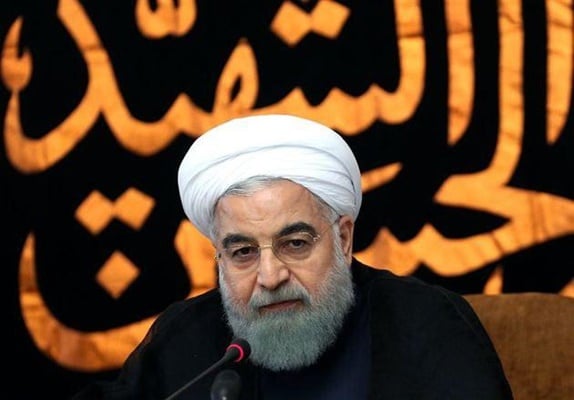
Iranians Inspired by Imam Hussein in Confrontation with US: Rouhani

Speaking in a cabinet session on Wednesday, Rouhani said Iran faces an economic war imposed by people who respect no rule, but Iranians hold exemplar morale and take Imam Hussein as their model.

Rouhani was referring to Hussain bin Ali, a grandson of Prophet Muhammad who was martyred by Yazid bin Muawiyah’s army in the Iraqi city of Karbala in 7th century AD after he refused to accept the former to attain the caliphate.

According to a report by the government’s official website (dolat.ir), Rouhani also said the US is sidelined in the international arena and is in its worst conditions in years.

He said pundits inside the US are overwhelmingly opposing the US administration and the country’s traditional allies are distancing themselves from Washington.

“We are in war against the history’s aggressors. Today, people have stood against the Iranian nation who have no political and intellectual backers, except for a few countries, and have created the worst conditions inside their country,” he said.

Russia Says US’ Bid to Cut Iran’s Oil Exports to Zero Not Feasible

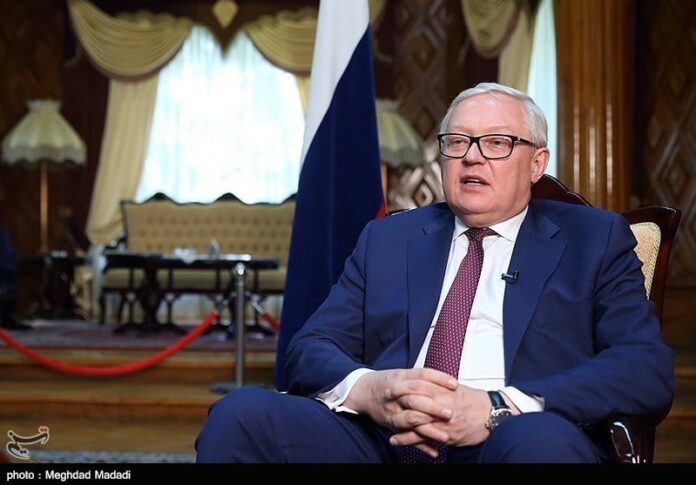
Speaking in an exclusive interview with the Tasnim News Agency in Tehran, Sergei Ryabkov expressed that the vast majority of the national community believe that JCPOA should be preserved for many reasons such as political and economical ones, adding that the United States has become nearly isolated regarding the idea of stopping Iranian oil export.

“We have some progress and you’re right that we are taking very intense contacts both with Iranian friends but also with European colleges with our Chinese partners with others who are inclined to look into this from the perspective of continuation of the deal and using benefits of the deal all this should be preserved, strengthened and protected against the US effort to defeat the deal all together,” Ryabkov said.

“We are doing this through different channels and then different levels including at a very practical level with involvement of businesses, including bankers. The Russian government is looking into it in a very proactive manner. The bilateral channel with Iran is working, we have expansion of trade and cooperation despite the US threats and we will do so, also in future we will stay firm. Collectively with involvement of Iran we are working with E3 and European Foreign Service to ensure there are channels that are workable to finance, to ensure transactions and most importantly to protect Iranian oil export and channels for Iran to receive revenues from oil export.”

“This is the central element of our efforts, there are specific ideas to this end that are being discussed,” he said, noting, “I don’t believe we should now enter into a great deal of detail of what is going on because this is working progress but moreover there is not necessarily any need for us to disclose all of our plans right in the middle of this political fight to sustain the deal and preserve it, but I give you my word that we are doing this very seriously and, yes we have a very tight timeline, which is more or less a month and half before November, but I’m very convinced that we would be able to deliver within this period.”

“So the JCPOA hopefully would be continuously implemented by all remaining parties including in the aspect of Iran getting economical and financial benefits from staying within the deal,” he reiterated.

As regards the US efforts to near Iran’s oil export to zero, the Russian diplomat said, “I don’t think it’s possible altogether. I don’t believe most importantly that this is realistic for the US to expect when the US stays almost isolated internationally on this particular issue.

The vast majority of the national community believes that JCPOA including in the aspect of Iranian oil export should be preserved for political reasons, for economic reasons, for the reasons of stability on the world energy market and also for the sustainability of the international system in the aspect of non-proliferation, it’s very unfortunate that there are politicians and in a few other capitals who completely disregard all this considerations while talking on their policies towards Iran. Russia stays very firm, we reject unilateral sanctions of US, as a matter of principle we ourselves became subjects to numerous rounds of US sanctions, it only strengthens our resolve to find ways how to not just defeat our enemies in a broader sense but also to ensure that in a broad and what I believe is a truly multipolar world, there is such a thing as democracy in international relations where there is no single power that dictates its will to all others.”

Pointing to Swift system and Russia’s central bank’s proposal to introduce parallel international payment system, Ryabkov said, “I truly think that this is a long overdue, this is something that should [have been] done long ago, we nationally have stablished a payment system which is called “Mir” and we believe that in a given situation arrangements could be made to allow different countries to become parties of this. We would also welcome any efforts to ensure that swift is modernized in the way that it is not just a simplified element of the world financial architecture that can easily be adjusted according to political preferences of one country or another one.”

“The degree of the general sustainability of international financial and payment system against voluntary measures taken for political reasons somewhere, in this case particularly the US, should be enhanced, this degree should be much higher than it is now and there are ways to do it, one of the most obvious ways is to diversify payments to use more payments in the national currencies. We are doing so in our trade transactions with Iran and other countries and I think the understanding of the necessity to hedge against political risks emanating from the US, this understanding also grows elsewhere including in Europe.”

Iran, Europe Hold Talks on Yemen, Syria Crises in Brussels

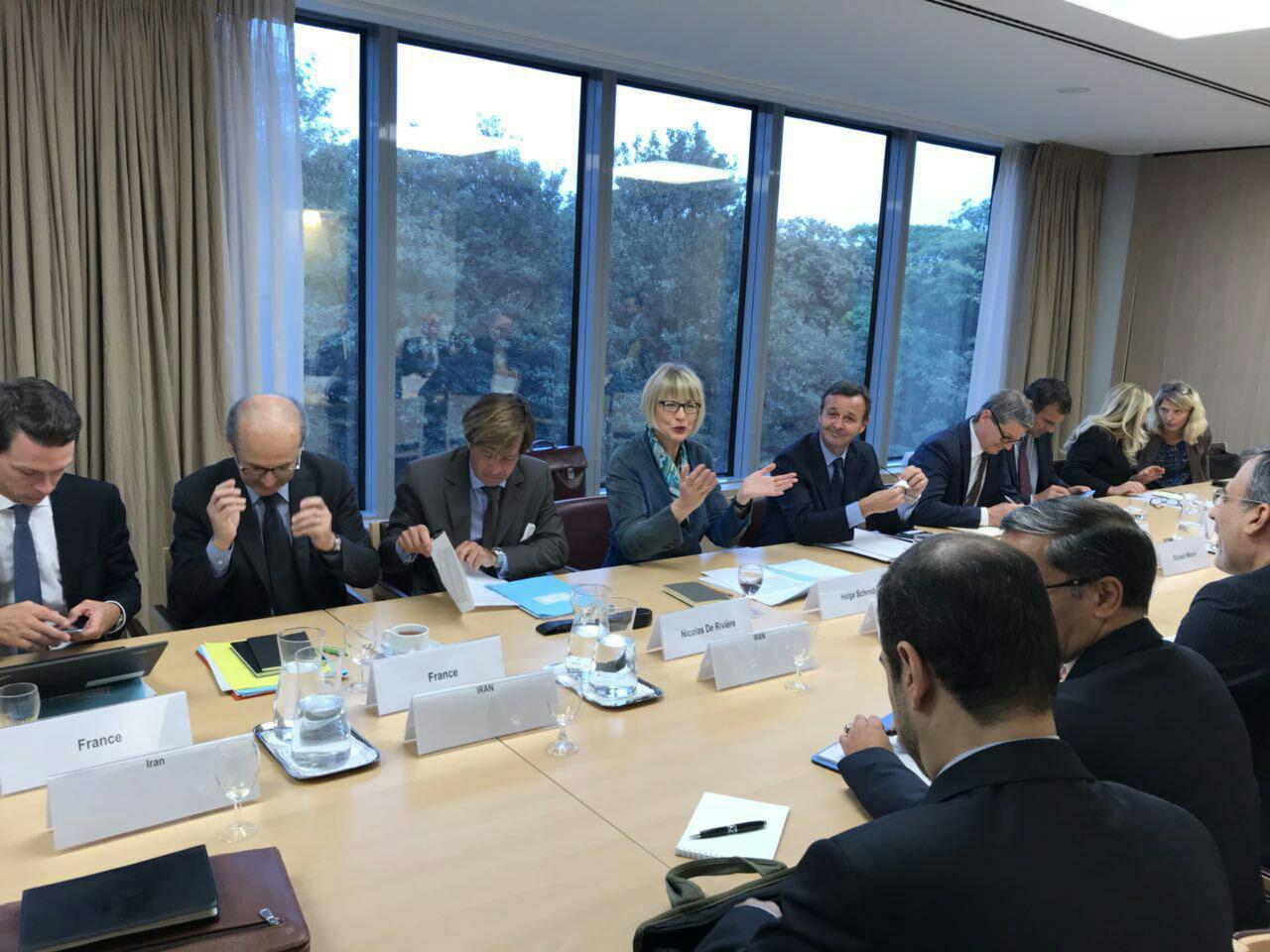
Hossein Jaberi Ansari, a senior assistant to Iran’s foreign minister for political affairs, sat down with Secretary General of the European External Action Service Helga Schmid in the Belgian capital, Brussels.

During the Wednesday talks, the two sides exchanged views on regional developments, particularly the situation in Syria and Yemen as well as the ongoing efforts to put an immediate end to the crises in the two countries.

Jaberi Ansari also took part in a joint meeting with Schmid and diplomats from Germany, Italy, Britain and France. The talks focused on the crisis in Yemen and ways of helping end the imposed war on the Yemeni nation and containing the ongoing major human disaster in the country.

Following the Yemen talks, the Iranian official also briefed the European diplomats on the outcome of the recent negotiations between, Iran, Russia and Turkey on the process of bringing back peace to Syria.

The meeting was attended by as the director generals of German, British, French, and Italian foreign ministries.

Iran, Europe Hold Talks on Yemen, Syria Crises in Brussels