Thursday, January 15, 2026
Home Blog Page 3420

Hamas Asks Iran to Condemn US Resolution at UNGA

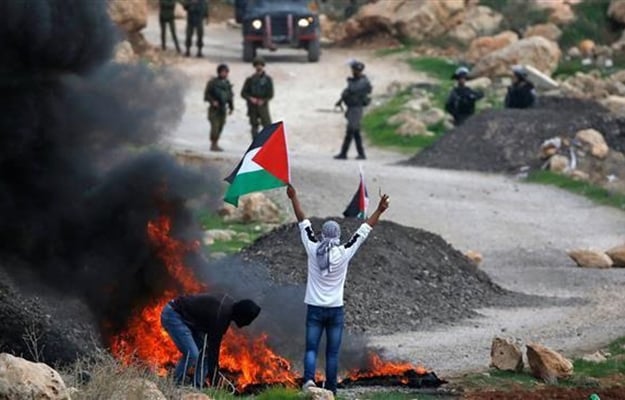
Palestinian demonstrators clash with Israeli forces after a protest against Israeli land seizures for Jewish settlements, on November 30, 2018 in the village of Mughir, north of Ramallah. / Photo by AFP

Haniyeh made the call in a Monday phone conversation with Iranian Foreign Minister Mohammad Javad Zarif.

During the talks, the Hamas chief referred to the US attempts to introduce the draft resolution at the United Nations General Assembly to condemn the Palestinian resistance movement, and called on the Islamic Republic of Iran to express its opposition to the move.

For his part, the Iranian top diplomat underlined Tehran’s support for the rights of the Palestinians.

He also expressed regret that the policies adopted by certain regional states have emboldened the US to not only violate the international rights by moving its embassy from Tel Aviv to Jerusalem al-Quds, but also to introduce a draft resolution against Palestine’s Islamic resistance at the United Nations General Assembly.

Zarif assured Haniyeh that the Islamic Republic will do its best to unite other Islamic and progressive states at the General Assembly to prevent the ratification of the US-drafted resolution, which stands in contradiction with the UN Charter.

The UN General Assembly is set to vote Tuesday on the draft resolution that would reportedly condemn the resistance movement “for repeatedly firing rockets into Israel and for inciting violence.”

US diplomats held talks with their EU counterparts in the assembly to win their backing for the draft resolution.

Iran Backs Upcoming Yemeni-Yemeni Talks in Stockholm

Iran Appoints Female Ambassador to Denmark

The full text of the Iranian Foreign Ministry’s statement on Yemeni-Yemeni talks in Stockholm is as follows:

Ahead of the Yemeni-Yemeni talks to be held in Sweden under the supervision of the United Nations, the Iranian Foreign Ministry welcomes and offers its support for the talks and calls on all Yemeni sides to have constructive and responsible participation in the talks. The Ministry also wants all the Yemeni sides to take trust-building measures, preparing the ground for achieving a comprehensive agreement to put an end to the suffering of Yemenis and the brutal blockage on them.

At the onset of the conflict and the brutal aggression on Yemen, the Islamic Republic of Iran proposed a comprehensive approach to resolve the crisis as a four-point peace plan, which included an immediate cessation of war, delivery of humanitarian aid, beginning of Yemeni-Yemeni talks, and establishment of an all-inclusive government in Yemen.

Iran now once again stresses that there is no way out of the Yemen crisis other than a political solution based on Yemeni-Yemeni talks. The Iranian Foreign Ministry calls on the international community to play a key and serious role, including by exerting pressure on the exporters of arms to the aggressors to facilitate the peace process in Yemen and let the Yemeni people decide their country’s fate free from the outsiders’ interference.

The warmongers have not achieved any of their political and hegemonic goals after four years of bitter war and destructive aggression against Yemeni people. The campaign has only led to the collapse of economic resources and infrastructures of Yemen, deaths of thousands of women and children and other oppressed but resilient people of Yemen and a total humanitarian catastrophe in the country.

The Islamic Republic of Iran’s Foreign Ministry seizes the opportunity here to express its readiness to establish cooperation with the international community to immediately resolve the Yemen crisis.

It also underlines the necessity of facilitating the process of delivering humanitarian aid to Yemen, and maintains that it is the world’s historic responsibility today to make efforts to end humanitarian crisis and catastrophe in the Arab country.

Iranian Children Must Be Protected against Sanctions: UN

Philip D. Jaffé, a member of the United Nations Committee on the Rights of the Child, has expressed regret over the impact of US sanctions on supplying medicines, especially for children, saying that the interests of children in Iran should be protected against sanctions.

“I am sorry for the impact of these sanctions on supplying medicines to the Iranian people, especially children and patients suffering from special diseases,” said Jaffé, who is also the director of the Interfaculty Centre for the Rights of the Child at the University of Geneva.

In response to a question about Iran’s actions in this regard, Jaffé said “I think Iran, like any other country, is aware of the importance of this issue, and the country’s officials will do anything necessary. This issue is internationally important, and any country that does not care should be punished with heavy penalties.”

“I hope that with international cooperation, inequalities would be overcome and children’s rights be protected through formulating new plans.”

Iranian Children Must Be Protected against Sanctions: UN
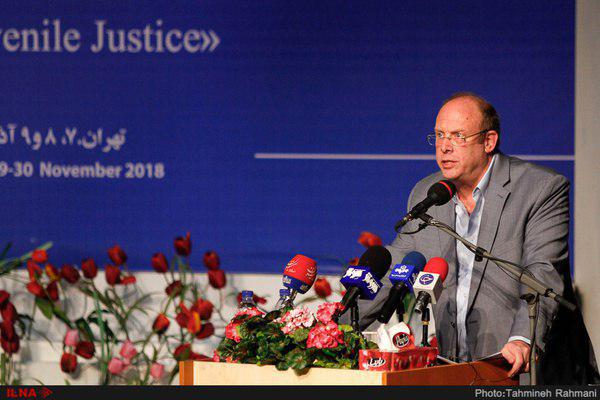
Philip D. Jaffé, a member of the United Nations Committee on the Rights of the Child, addressing a meeting in Tehran in late November, 2018 / Photo by ILNA

Earlier, President of the Academy of Medical Sciences of Iran Alireza Marandi said the US has endangered the lives of many Iranian patients by imposing “unjust” food and medicine sanctions against Tehran.

The US reinstated sanctions against Iran’s oil and banking industry on Monday, following its withdrawal from the 2015 nuclear deal and pledges that Washington will place maximum pressure on Iran.

Humanitarian supplies are formally exempted from sanctions, but the banking sanctions practically deter any kind of trade with Iran.

In 2011, the last time the US was tightening anti-Iran sanctions, Washington’s pressure led to severe shortages of life-saving medicines and food staples, as foreign banks and companies were avoiding transactions with Iran for fear of being penalized.

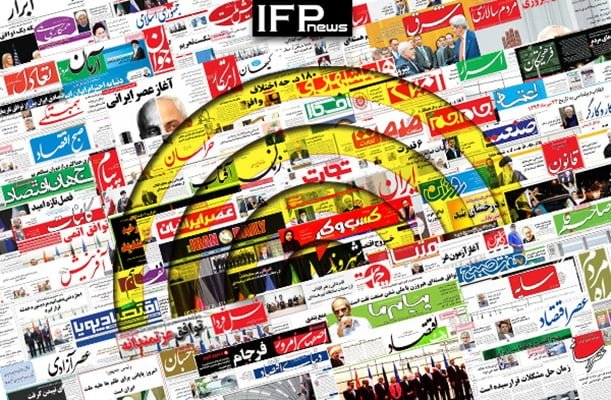
A Look at Iranian Newspaper Front Pages on December 3

A Look at Iranian Newspaper Front Pages on November 19

Almost all papers today covered the recent claims made by the US and the UK regarding Iran’s missile tests, and Tehran’s response to the allegations.

Also a top story was a deal between the US and China over their trade war, based on which the two sides are going to observe a 90-day ceasefire.

The Parliament’s bid to impeach Foreign Minister Mohammad Javad Zarif over his comments about ‘rampant’ money laundering in Iran also remained a top story in Iranian papers today.

The above issues, as well as many more, are highlighted in the following headlines and top stories:


Abrar:

1- UK Foreign Secretary Claims Iran’s Missile Test Violated UNSCR 2231

2- Erdogan: I Don’t Believe Bin Salman’s Account of Khashoggi’s Murder

3- Merkel: Russia Shouldn’t Block Ukraine’s Ports
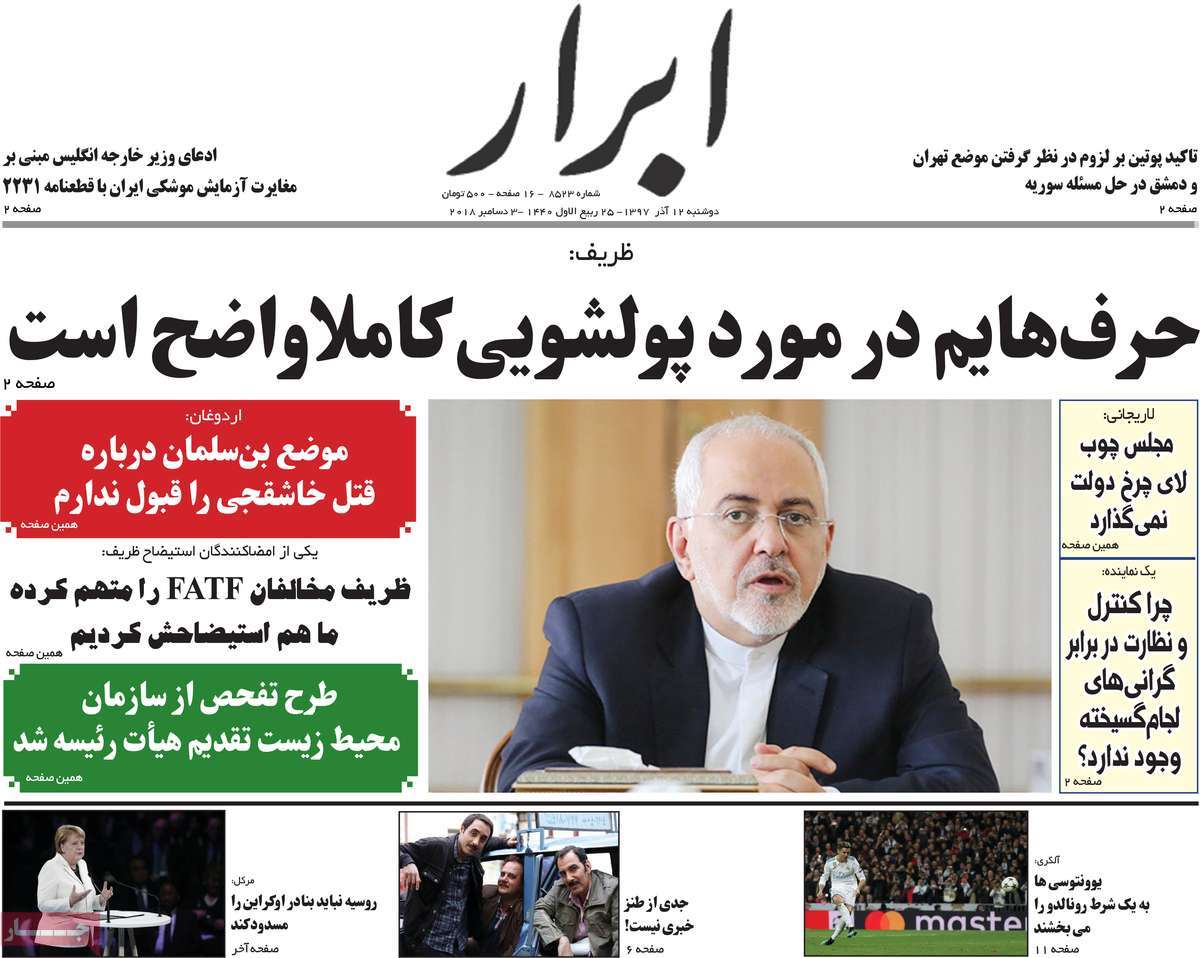
A Look at Iranian Newspaper Front Pages on December 3


Aftab-e Yazd:

1- On Rallies in France [Editorial]
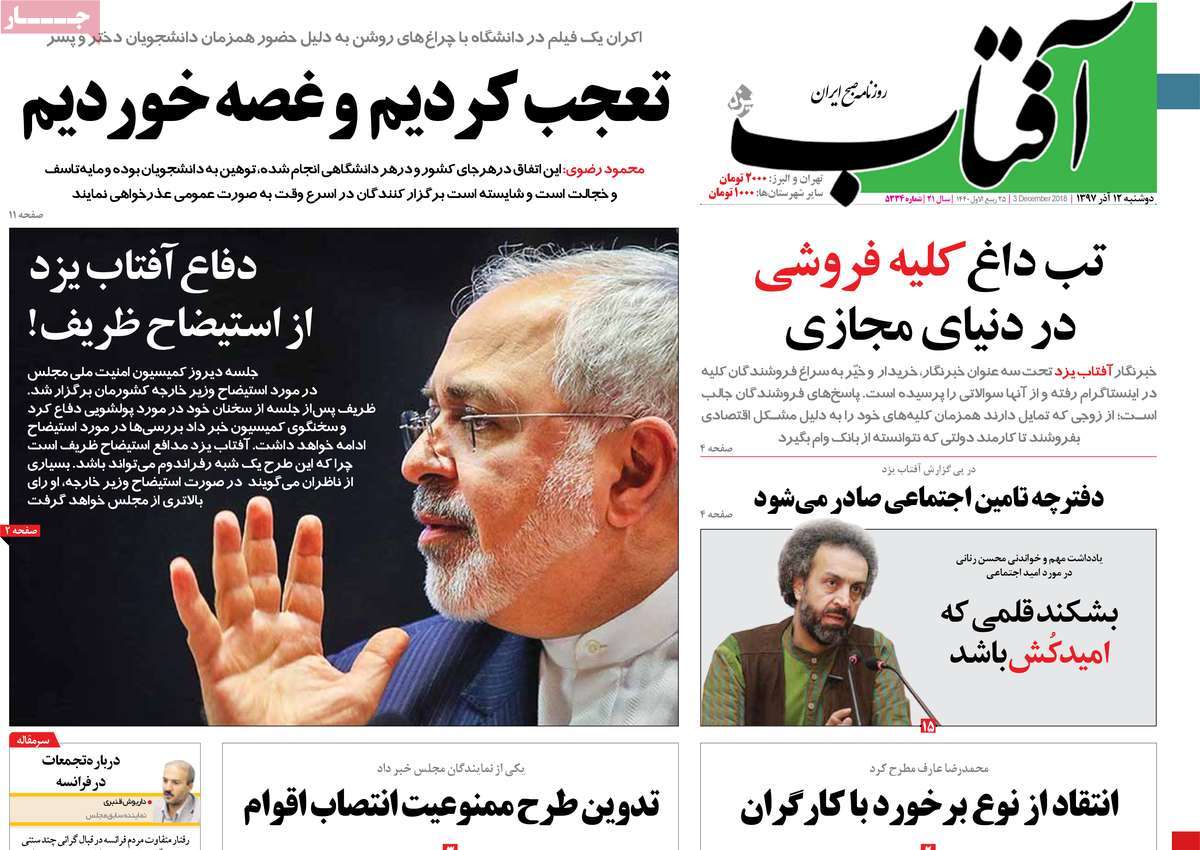
A Look at Iranian Newspaper Front Pages on December 3


Arman-e Emrooz:

1- Four Lawmakers Back Off from Bid to Impeach Zarif

  • FM: My Remarks about Money Laundering Totally Clear

2- Tehran Mayor Hanachi Swears to Fight Corruption, Promote Culture in Tehran
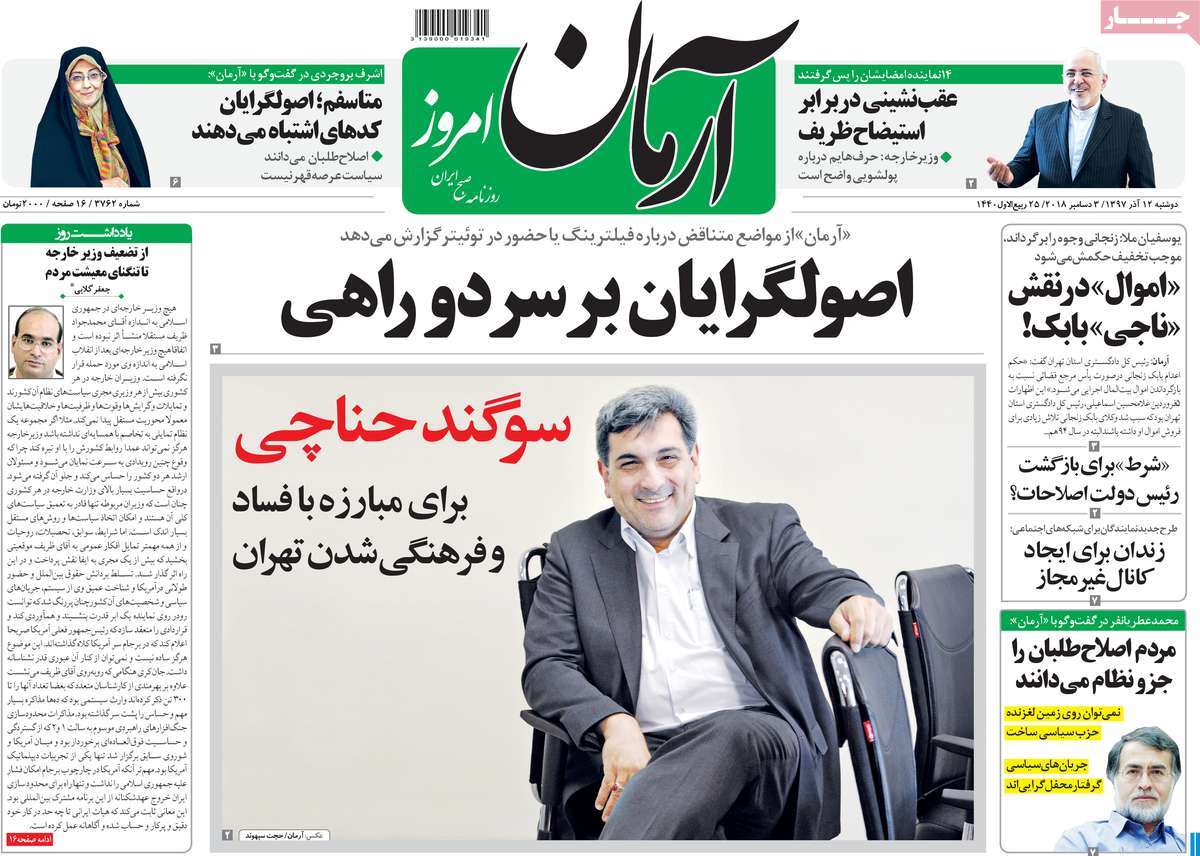
A Look at Iranian Newspaper Front Pages on December 3


Donya-ye Eqtesad:

1- Expert Panel Discusses Tehran-Riyadh Relations

2- 90-Day Truce in Trade War

  • Reaction of Tehran’s Stock Exchange Market to US-China Deal
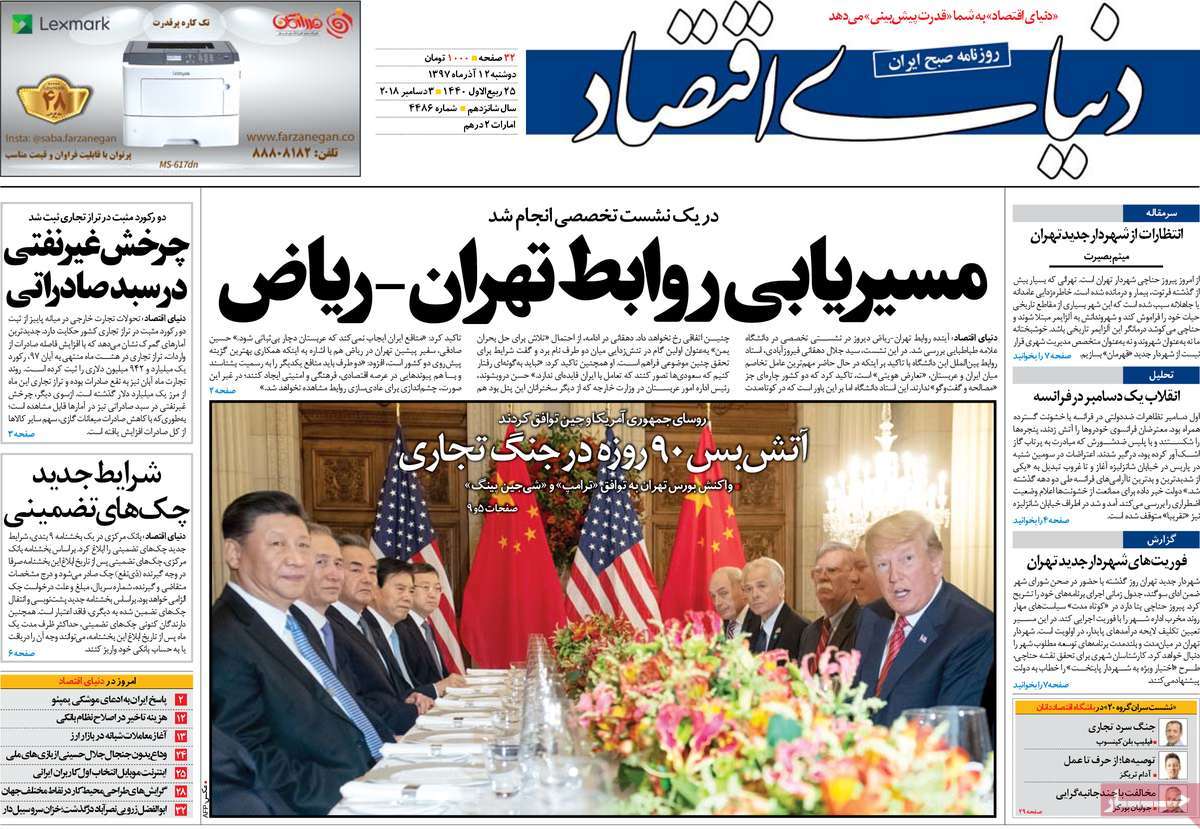
A Look at Iranian Newspaper Front Pages on December 3


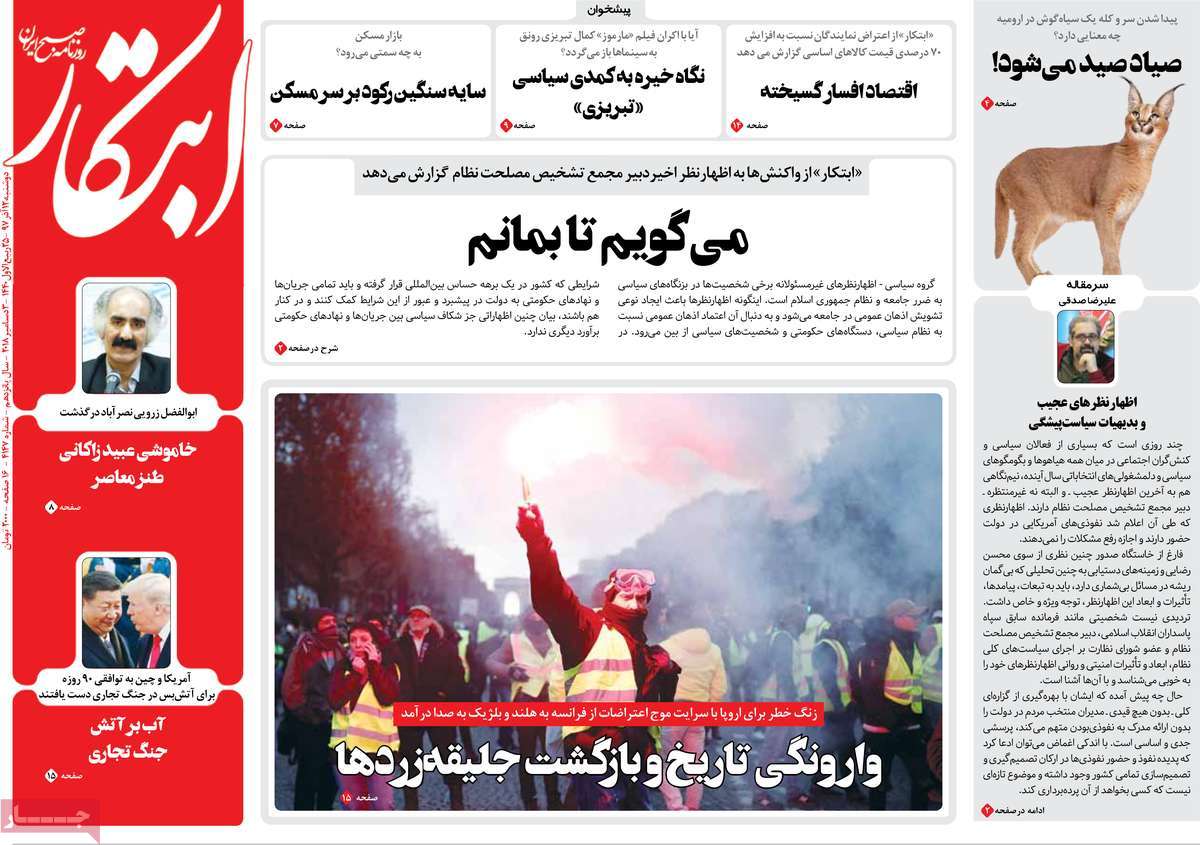
Ebtekar:

1- Fire of Trade War Extinguished for 90 Days

2- Return of Yellow Vests

  • Alarming Situation for Europe as Protests Dragged to Netherlands, Belgium
A Look at Iranian Newspaper Front Pages on December 3


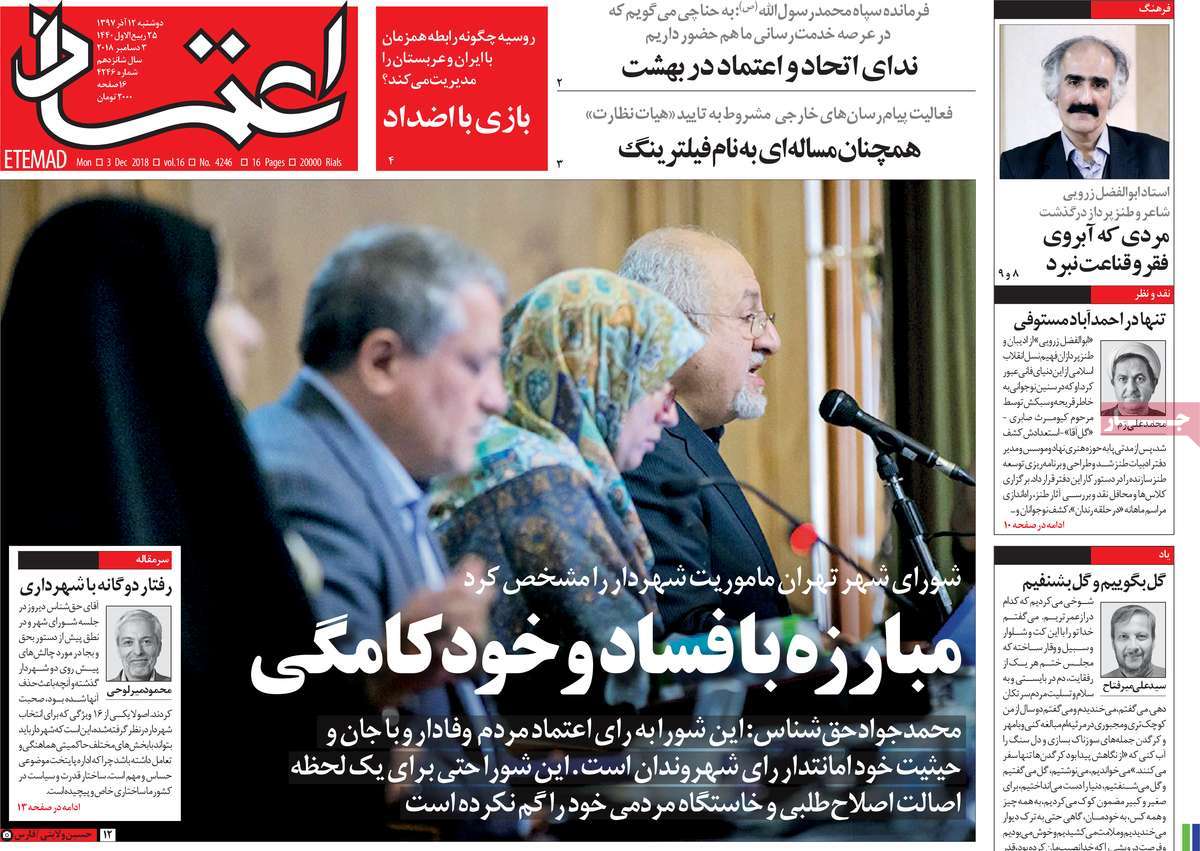
Etemad:

1- How Russia Is Managing Its Ties with Iran, Saudi at Same Time?
A Look at Iranian Newspaper Front Pages on December 3


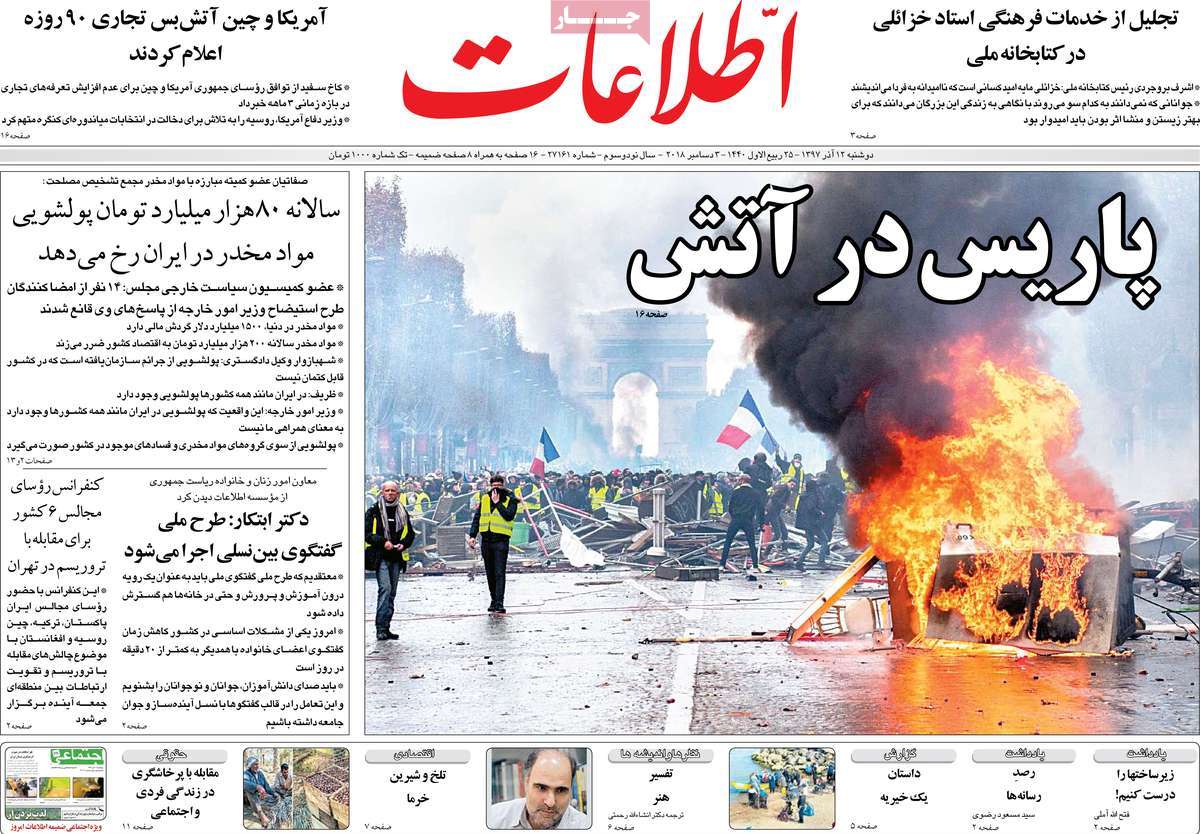
Ettela’at:

1- Paris on Fire

2- Tehran to Host Anti-Terror Conference of Parliament Speakers from Six Countries
A Look at Iranian Newspaper Front Pages on December 3


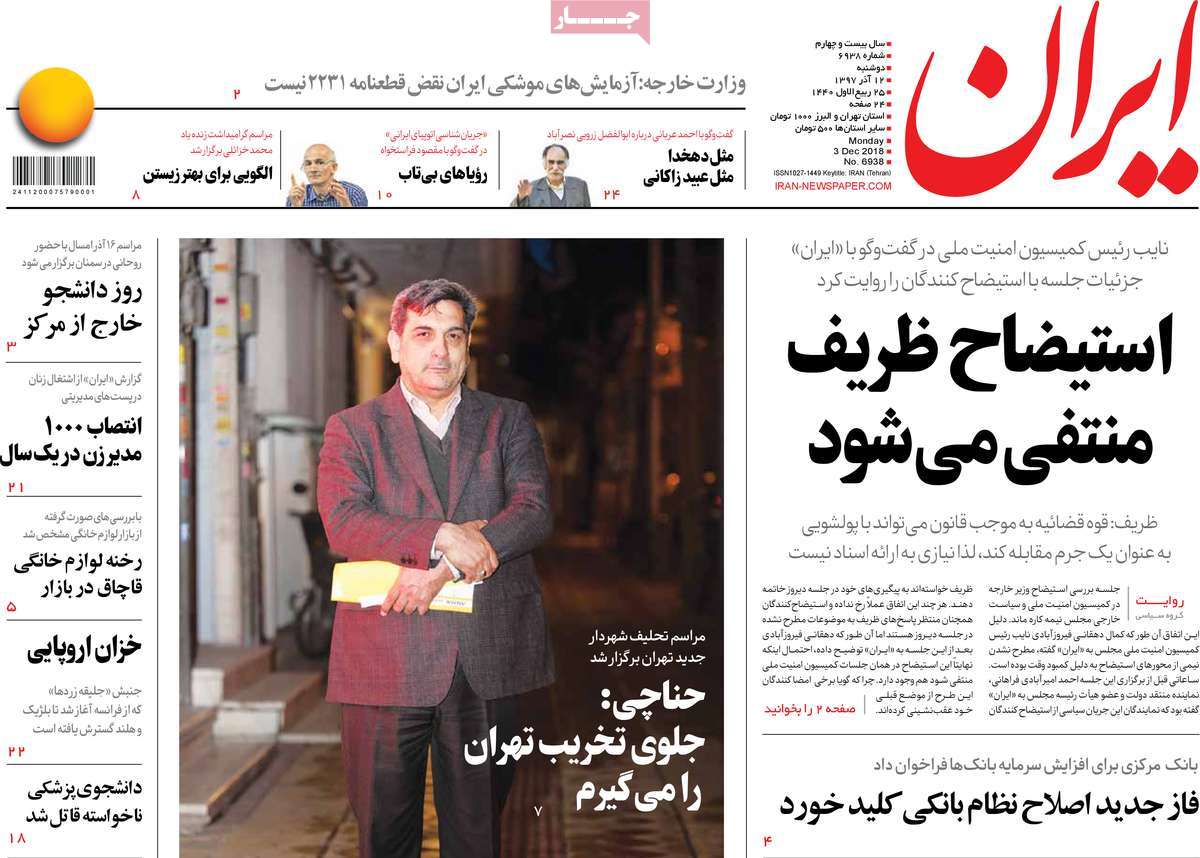
Iran:

1- Iran’s Missile Tests Not in Violation of UN Security Council Resolution 2231: MFA

2- Rouhani to Visit Semnan University on Students’ Day

3- 1,000 Women Appointed to Executive Position in One Year
A Look at Iranian Newspaper Front Pages on December 3


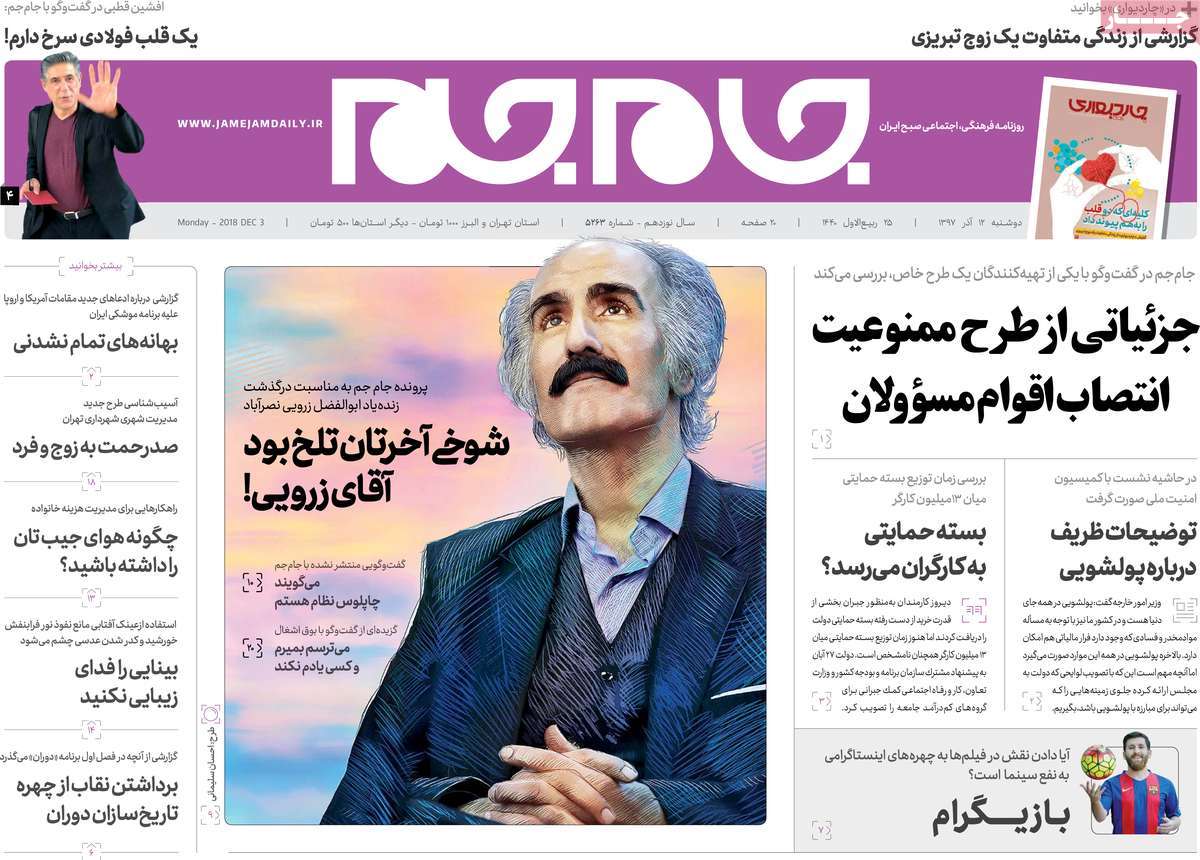
Jame Jam:

1- Unending Pretexts: US, European Officials Make New Claims against Iran’s Missile Program
A Look at Iranian Newspaper Front Pages on December 3


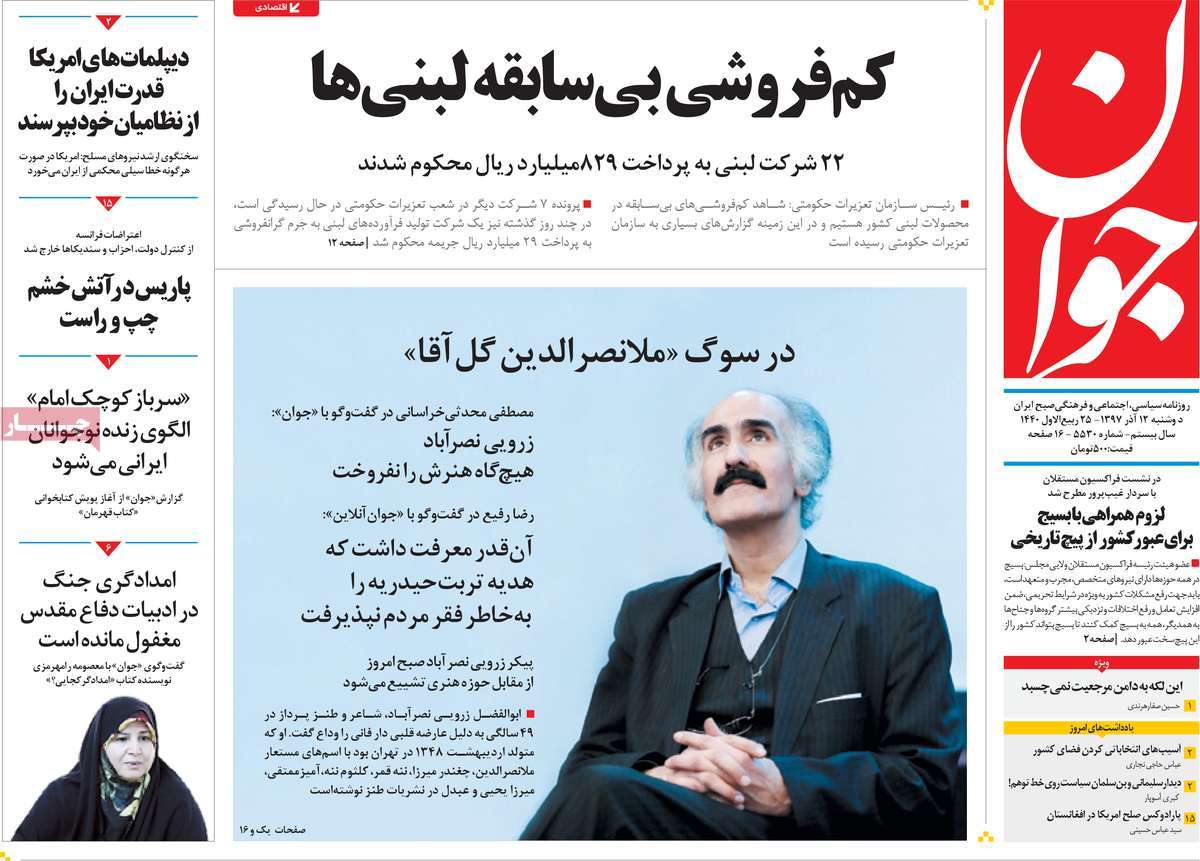
Javan:

1- US Diplomats Had Better Ask Their Generals about Iran’s Power

  • Armed Forces Spokesman: US to Be Dealt a Heavy Blow If It Makes Any Mistake

2- Left, Right-Wingers Set Paris on Fire: France Protests Out of Control of Gov’t, Parties
A Look at Iranian Newspaper Front Pages on December 3


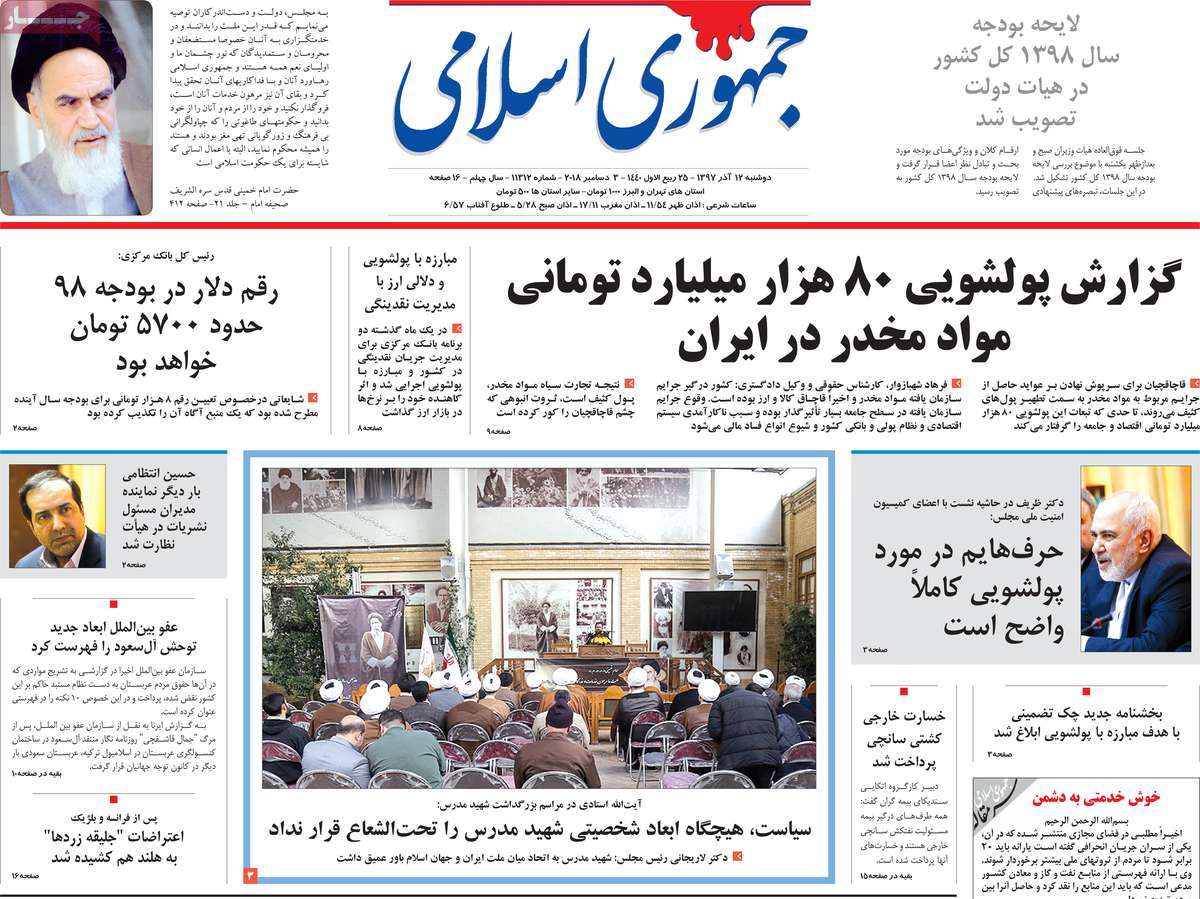
Jomhouri Eslami:

1- Amnesty Int’l Enlists New Aspects of Al Saud’s Brutality

2- Belgium, Netherlands Join France ‘Yellow Vest’ Protests
A Look at Iranian Newspaper Front Pages on December 3


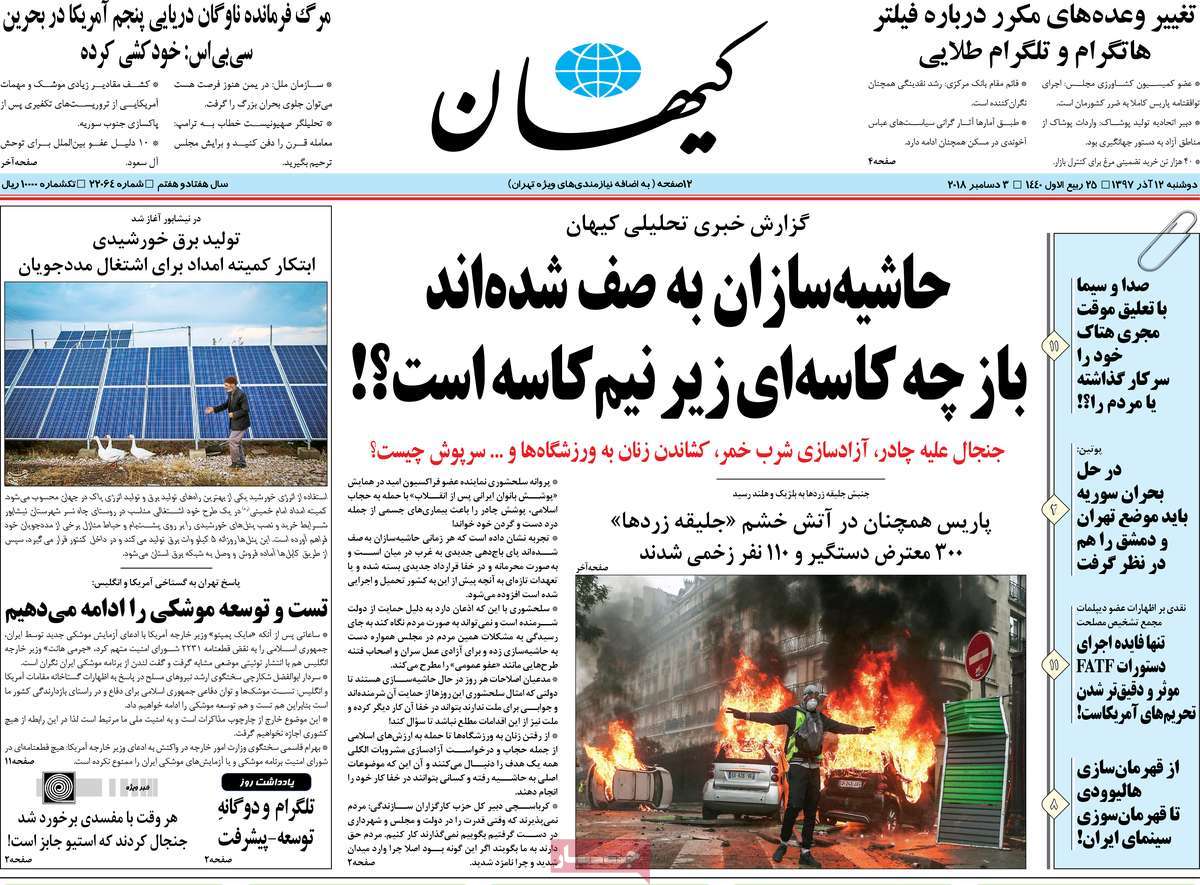
Kayhan:

1- Death of US Navy Admiral in Bahrain; CBS Says It’s Suicide

2- Tehran’s Response to US, UK’s Rude Remarks: We’ll Continue Testing Missiles

3- Putin: Stances of Tehran, Damascus Should Also Be Considered in Settling Syria Crisis

4- Adopting FATF Standards to Only Increase Effectiveness, Accuracy of US Sanctions

5- Paris Still on Fire: 300 Yellow Vest Protesters Arrested, 110 Wounded
A Look at Iranian Newspaper Front Pages on December 3


Khorasan:

1- Iranians Being Deported from Georgia without Any Reason

2- The Guardian Reveals Shocking Details of Sexual Exploitation in MKO Camps
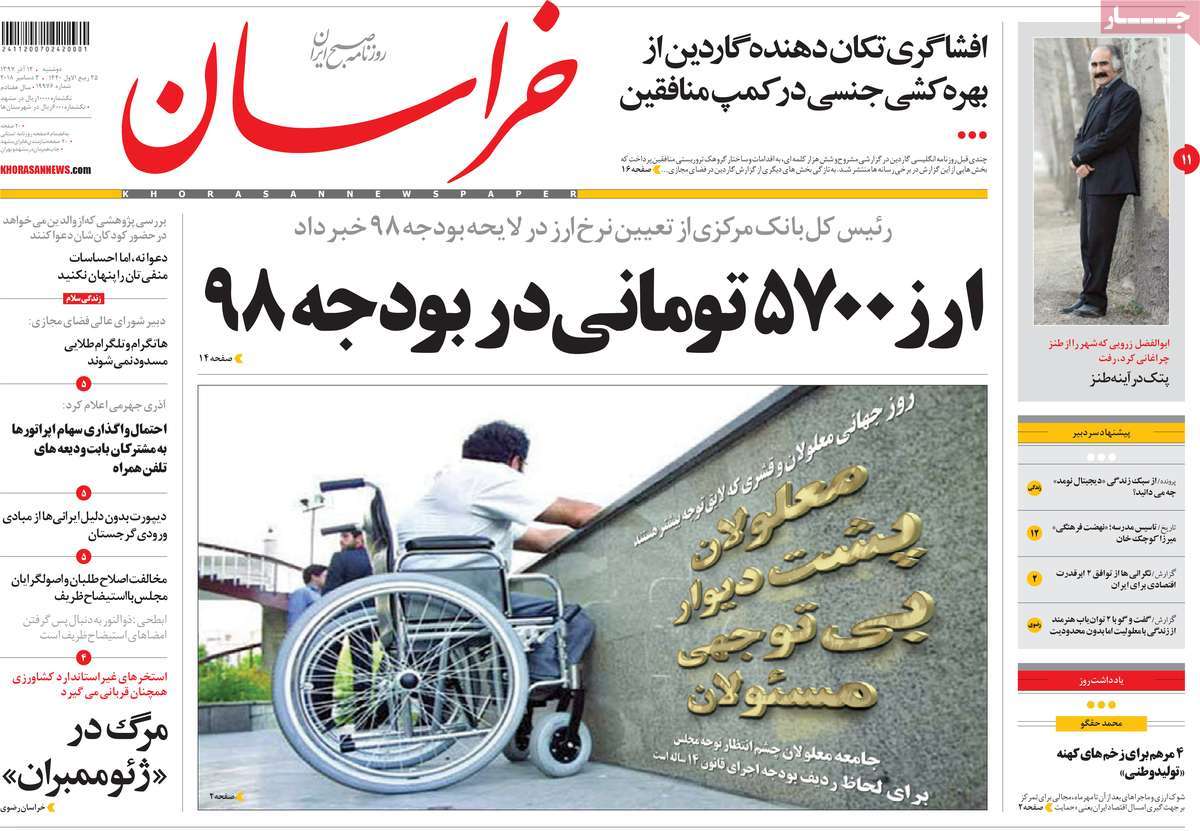
A Look at Iranian Newspaper Front Pages on December 3


Setareh Sobh:

1- New Psy-War against Iran: Pompeo Says Iran’s Missile Test Violates JCPOA
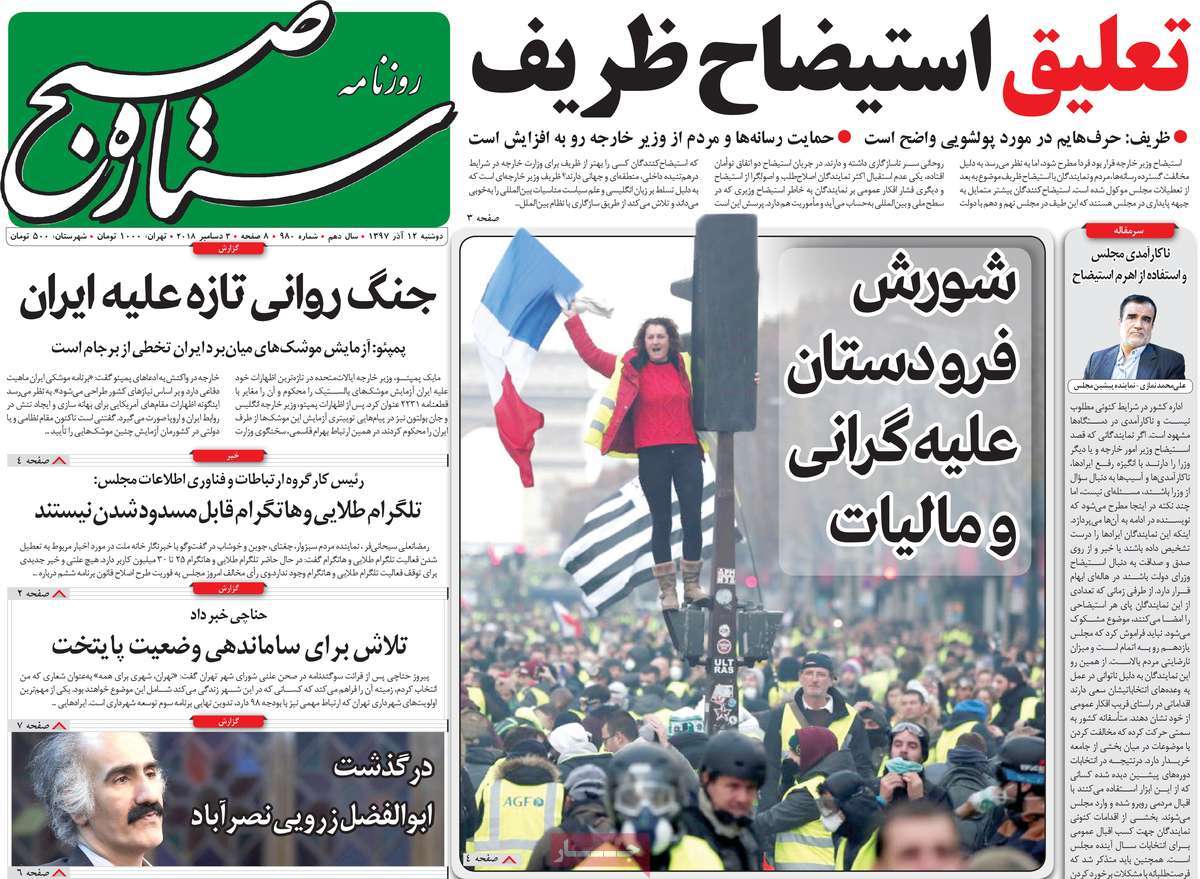
A Look at Iranian Newspaper Front Pages on December 3


Shahrvand:

1- From North to South with Train: Benefits of Iran’s New Railway
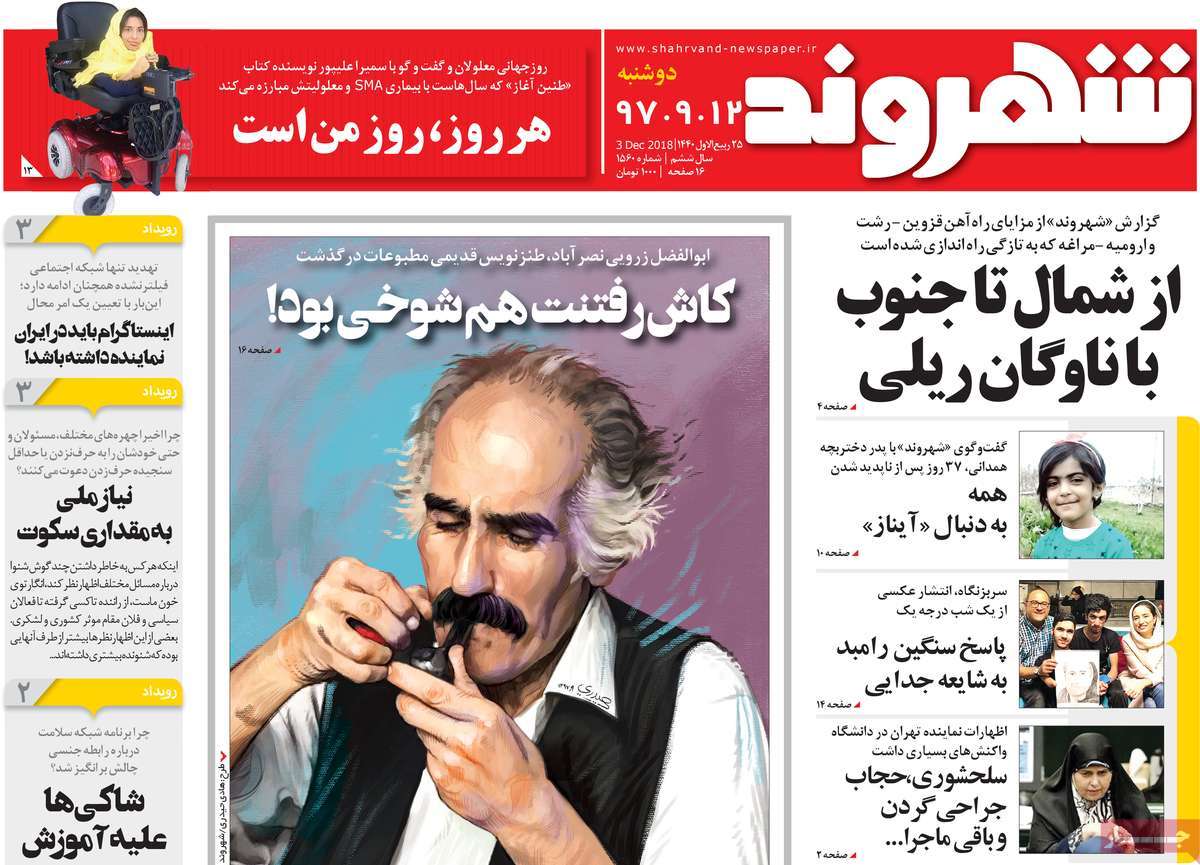
A Look at Iranian Newspaper Front Pages on December 3


Shargh:

1- Five Forex Dealers Accused of $150-Million Money Laundering
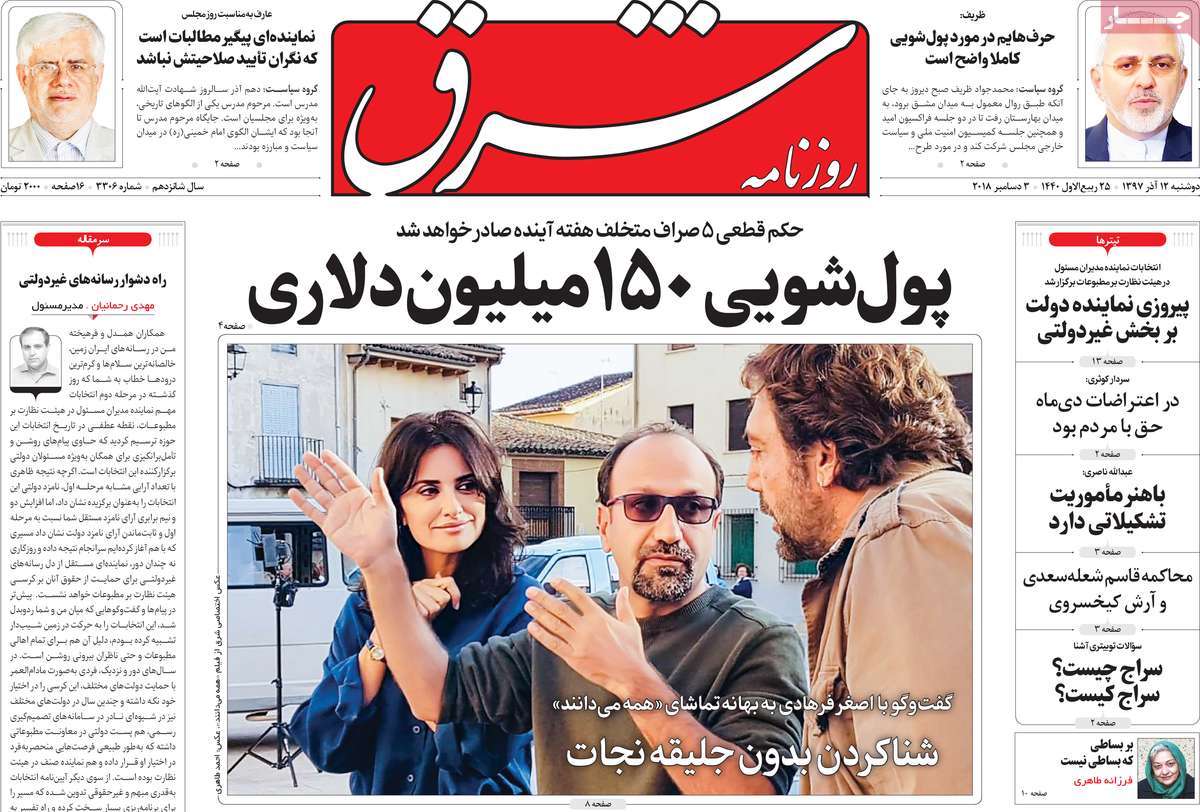
A Look at Iranian Newspaper Front Pages on December 3

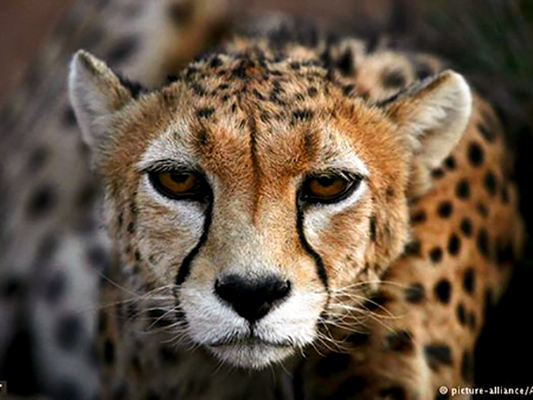
Iran Stepping Up Efforts to Save Asiatic Cheetahs

Issa Kalantari said the Department of Environment is following up on the issue of breeding cheetahs through Royan Institute.

“We are doing our best to revitalise the Asiatic cheetah through tissue culture with the help of the research institute,” he said, adding that the project to save the highly-endangered species is funded by the DoE.

The Asiatic cheetah also known as Iranian or Persian cheetah, the fastest animal in the world, is a critically endangered cheetah subspecies surviving today only in Iran.

The Asiatic cheetah survives in protected areas in the eastern-central arid region of Iran, where the human population density is very low.

The cheetah is one of the most important cats-like canivorans in the world. Less than 50 of this animal are remaining in wildlife.

The only remaining population of the Asiatic cheetahs is scattered in Iran, and if these 50 ones face extinction, a valuable species will be destroyed forever in the whole world.

People around the world mark day of cheetahs annually on December 4. These beautiful animals have paced and graced human existence for thousands of years.

‘Iran Not to Ask for Anyone’s Permission for Missile Tests’

“Missile tests and the overall defensive capability of the Islamic Republic are for defense [purposes] and in line with our country’s deterrence [policy]…We will continue to both test and develop missiles,” Brigadier General Abolfazl Shekarchi said on Sunday, adding, “This issue is outside the framework of any negotiations and is part of our national security. We will not ask any country’s permission in this regard.”

Iran assured regional countries that the Islamic Republic casts no eye on the interests of other countries, the commander said and added that such measures are only in line with boosting the country’s deterrent and defense power.

Shekarchi made the remarks in reaction to an earlier allegation by US Secretary of State Mike Pompeo in a post on his Twitter account, claiming that Iran has “just test-fired a medium range ballistic missile” in violation of the United Nations Security Council Resolution 2231.

Pompeo condemned what he described as “growing” Tehran’s “missile testing and missile proliferation,” and called upon the Islamic Republic to cease these activities.

UN Security Council Resolution 2231 enshrined the 2015 international nuclear agreement, officially known as the Joint Comprehensive Plan of Action (JCPOA), from which Washington has withdrawn under the pretext that it should have included Iran’s missile program as well.

Under the deal, reached between Iran and six major powers — the United States, Britain, France, Germany, Russia and China — Tehran agreed to put limits on its nuclear program in exchange for the removal of nuclear-related sanctions.

Earlier on Sunday, Iranian Foreign Ministry Spokesman Bahram Qassemi rejected Pompeo’s claims against Iran’s missile capabilities, saying the program is defensive and does not violate the international agreement on Tehran’s nuclear program.

“Iran’s missile program has a defensive nature and is designed according to the needs of the country,” Qassemi added.

Iran’s Defense Minister Brigadier General Amir Hatami also said on Sunday that the Islamic Republic is currently one of the world’s topmost missile powers despite being subject to severe sanctions during the past 40 years.

“Today, Iran is among the world’s topmost powers in building missiles, radars, armored vehicles and unmanned aerial vehicles (UAVs),” the Iranian defense minister said in an exclusive interview with IRNA, emphasizing that the country’s defense power is meant to send the message of peace and friendship to other nations.

Elsewhere in his remarks, the senior spokesman of the Iranian Armed Forces pointed to recent US threats about the possibility of military action against Iran and said, “We are giving this warning that in case of any strategic error by the US and its allies in the region, they will receive such a strong slap in the face from the Islamic Republic that will make them regret [what they have done] forever.”

Shekarchi added that American officials speak about military action against Tehran after they suffered repeated defeats at the hands of the resistance front.

He emphasized that individuals with low experience have come to power in the United States who “are not aware of the Islamic Republic’s defensive and deterrent power and capability.”

The Iranian military official then urged American officials to ask US military commanders in the Persian Gulf and the Strait of Hormuz about Iran’s deterrent power before taking a stance.

US State Department’s director of policy planning and head of Iran Action Group Brian Hook said on Thursday that military action against Iran could be possible should the United States’ sanctions against the country fail to curb Tehran from threatening Washington’s interests.

“We have been very clear with the Iranian regime that we will not hesitate to use military force when our interests are threatened,” Hook said, adding, “I think right now, while we have the military option on the table, our preference is to use all of the tools that are at our disposal diplomatically.”

His comments came a day after Leader of the Islamic Revolution Ayatollah Seyyed Ali Khamenei said Iran is not seeking war with any country, but the Armed Forces should develop their capabilities to deter any potential aggressor.

“That reality – alongside the need for the country to address the areas where it is lagging behind – necessitates additional and extraordinary diligence in all spheres, including the naval power,” the Leader said on Wednesday.

Tehran to Host Six-Nation Conference on Fight against Terrorism

Iranian Parliament Speaker Ali Larijani attends a conference with his counterparts from Pakistan, China, Russia, Afghanistan, and Turkey in Islamabad on December 24, 2017

During the conference, which is to be held Friday and Saturday (December 6 and 7) in Hotel Azadi in Tehran, several issues will be discussed, including fight against terrorism, past experiences, current strategies, adoption of new and efficient regional approaches, expansion of communications, strengthening regional cooperation, and restoring peace and multilateral development in the region.

On Saturday, Pakistan’s parliament speaker as the first head of the inter-parliamentarian gathering will hand over the leadership of the conference to his Iranian counterpart after delivering a short speech.

Iran’s Parliament Speaker Ali Larijani and his counterparts from the participating states will also deliver speeches during the conference.

The first conference of Parliament speakers attended by delegates from the six countries was held last year in Islamabad.

‘Iran to Maintain Scientific Growth despite US Sanctions’

COVID-19 Punishes Those Who Sanctioned Iran’s Oil: First VP

In an address to the closing ceremony of an international congress on stem cell and regenerative medicine in Tehran, Jahangiri said Iran has made great achievements in various areas thanks to the hard attempts by professors, researchers and the growing number of students in modern technologies.

The Iranian official then referred to the US “brutal” sanctions against Iran and added the US is seeking to hamper Iran’s progress “but we should turn the threats into opportunities.”

He underlined that any scientific development should be peaceful and humane. “The Islamic Republic has never been after developing unethical and destructive sciences.”

Jahanngiri referred to the nuclear program of Iran and said despite international bodies’ reports on peaceful nature of Iran’s program, the enemies are still seeking to level baseless accusations against the country.

For a brief review of Iran’s achievements in various fields of science and technology, check the book “Science and Technology in Iran: A Brief Review

He also noted that many researchers outside Iran are interested in holding cooperation with the Islamic Republic and the government has prepared the ground for such cooperation. “In stem cell, Iranian researchers have achieved considerable growth.”

He called on all Iranians scientists living across the world to expand their ties with their fellow compatriots, saying the government will do its best to remove any obstacles in the way of their cooperation.

The first vice president also said Iran extends the hand of cooperation to all scientific centers in the world and welcomes their investments in the country.

Grape Grown in Iran’s Malayer Registered Globally

The GIAHS is an initiative of the Food and Agriculture Organization (FAO), aimed at identifying, introducing and protecting global agricultural heritage, says Mohammad Kazemi, the representative of the people of Malayer in the Parliament.

He said FAO representatives visited Malayer on November 15 to look into the possibility of registering its grapes as part of GIAHS. Then, the final examinations were conducted on December 1, and the permission to register the crop was finally issued.

“This major event added to the honours of the town of golden grapes,” said the lawmaker.

Located in Hamadan province, Malayer is referred to as the city of “The Golden Bunches of Grapes” and is known to many for its high-quality grape syrup, raisin, and sultana. The raisin and sultana produced in Malayer are among the best ones in Iran and account for part of Hamadan’s exports annually.

Malayer has around 10,500 grape orchards, more than 10,100 of which are currently fertile and yielding crops, giving the town a unique status in the country.

Most of the grapes produced in Malayer are used to make raisins and sultanas. There are also many types of grapes that are grown there to be used as fresh fruit.

A top provincial agricultural official says there are some 73 hectares of grape orchards in Hamadan province.

“Thirty percent of the orchards are located in Malayer, and between 50 and 60 percent of the grapes in Hamadan province are produced in Malayer,” says the official.

What follows are Mizan News Agency’s photos of grape harvest in Malayer and the process of producing raisin and sultana:

A Look at Iranian Newspaper Front Pages on December 2

A Look at Iranian Newspaper Front Pages on November 19

Several papers today discussed the Iranian Parliament’s bid to impeach Foreign Minister Mohammad Javad Zarif, arguing that it will definitely harm the country’s national interests.

Also a top story was the G20 Summit in Argentina, where Saudi Crown Prince Mohammed bin Salman was sidelined, and only greeted by Russian President Vladimir Putin.

Other top stories included the recent decline in the US dollar rate as well as the advanced Sahand destroyer unveiled by the Iranian defence ministry.

The above issues, as well as many more, are highlighted in the following headlines and top stories:


Abrar:

1- Putin Reiterates Call for Maintaining Iran Nuclear Deal

2- DM: Iran Spiritually Supporting Yemen

3- Xinhua: Zarif Calls for End of Yemen Crisis through Iran’s Four-Point Plan

A Look at Iranian Newspaper Front Pages on December 2


Aftab-e Yazd:

1- Plan of Left-Wingers for Next Presidential Election

  • Aref; A Reliable Option

2- Will ICT Minister Azari Jahromi, Former IRIB Chief Zarghami Compete for Presidency?

A Look at Iranian Newspaper Front Pages on December 2


Arman-e Emrooz:

1- Iran to Launch Cloud Seeding Project

2- It’s Awful Idea to Impeach Zarif [Editorial]

A Look at Iranian Newspaper Front Pages on December 2


Donya-ye Eqtesad:

1- Bin Salman’s Troubles at G20 Summit

  • Macron to Prince: No Never Listen to Me

A Look at Iranian Newspaper Front Pages on December 2


Ebtekar:

1- Impeachment and Zarif’s Untold Stories

A Look at Iranian Newspaper Front Pages on December 2


Etemad:

1- Central Bank Trying to Compensate for Past Mistakes

2- Speaker: Gov’t, Parliament Have Consensus

3- Global Solidarity with Palestinian Nation: UNGA Approves 6 Anti-Israel Resolutions

4- Aref: Plan to Impeach FM Zarif Not Favourable at All

A Look at Iranian Newspaper Front Pages on December 2


Ettela’at:

1- Parliamentarians: Zarif’s Impeachment Not to Serve National Interests

2- First VP: Iran Not to Seek Unethical, Destructive Technologies

3- OPCW Conference Fails after US Stonewalling

4- Paris Protests Now in Brussels

A Look at Iranian Newspaper Front Pages on December 2


Hamshahri:

1- Foreign Investment in Iranian Stock Exchange Markets Now Possible

  • Iran Admitted to Int’l Stock Commission

A Look at Iranian Newspaper Front Pages on December 2


Iran:

1- Dollar Rate Keeps Decreasing in Iran

2- Yellow Vests Hold Protest Rallies in Paris for Second Consecutive Week

A Look at Iranian Newspaper Front Pages on December 2


Jame Jam:

1- Sahand, Most Advanced Indigenous Warship in West Asia

A Look at Iranian Newspaper Front Pages on December 2


Javan:

1- Protests Spread to Heart of Europe: Third Week of Protests in Paris

2- Bin Salman Isolated in G20 Photo Diplomacy

A Look at Iranian Newspaper Front Pages on December 2


Jomhouri Eslami:

1- Advanced Destroyer Sahand Joins Iran Army’s Fleet

2- Protests in London, Baghdad against Yemen War

A Look at Iranian Newspaper Front Pages on December 2


Kayhan:

1- US Dollar Rate Less than IRR 110,000

2- No Need for Germans to Guarantee Benefits of Iran Nuclear Deal!

3- Street War in Paris: Yellow Vest Protesters Back

A Look at Iranian Newspaper Front Pages on December 2


Khorasan:

1- Iran Has 13 Million Singles Who Are Older than Appropriate Age of Marriage

2- Fortification of Champs-Élysées

A Look at Iranian Newspaper Front Pages on December 2


Setareh Sobh:

1- Only Putin Greeted Bin Salman!

2- Iranian Economy under Scrutiny of Experts

A Look at Iranian Newspaper Front Pages on December 2


Shahrvand:

1- Great Gift to Zarif

  • Analysts: Impeachment against National Interests, Beneficial for Him

A Look at Iranian Newspaper Front Pages on December 2


Shargh:

1- Unimpeachable Minister: Some MPs Once Again Seeking to Impeach FM

2- Analyst: JCPOA Was a Stone in Middle of a River

3- Chief of Bush Clan Dies

4- Why Bin Salman, Putin Are Dear to Trump [Editorial]

A Look at Iranian Newspaper Front Pages on December 2