Wednesday, April 8, 2026
Home Blog Page 3360

Iran Turns Dream into Reality by Unveiling Its Own Cryptocurrency

This dream began when the country learned that it was going to face new economic sanctions with the United States and instead of carrying foul like most countries would, it took it as an opportunity and it has now taken what most economic analysts see as the boldest economic step any nation can make.

Another factor that has occasioned this move is that the country was recently removed from the Society of Interbank Financial Telecommunication, popularly known as SWIFT; hence making it nearly impossible for it to operate its import and export business. This could cripple the economy of this nation; thus informing the need to develop alternative strategies of moving money.

After the swift disconnect, the governor of the Central Bank of Iran Abdolnasser Hemmtai said in a statement “The regulator has already begun the work of looking for an alternative after the Swift Disconnect.”

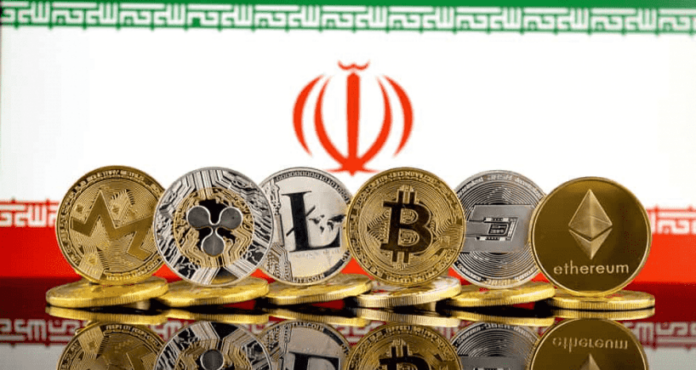
The Islamic Republic announced the cryptocurrency, named “Payman”, on January 29 during the Annual Electronic Banking and Payments System whose theme was “Blockchain Revolution.”

This cryptocurrency will use a ledger technology which will work by allowing a network of computers to verify transactions between parties other than use a third-party entity to validate them.

Payman will be issued by the central bank and will be backed up by Rial. According to reliable sources, it is not yet confirmed whether the digital currency will be implemented in large scale, but what is certain is that it will be used by citizens to make payments locally.

According to Yashar Rashedi who is a Blockchain developer at Radfa, a local digital currency firm, this central bank-issued currency will not match giant cryptocurrencies such as Bitcoin due to its centralized nature, but its presence will have an impact on the market. He further states that the currency might not enjoy widespread use from the general public, but it will offer a host of beneficial features for developers and startups who were used to centralized bank APIs.

The rolling out of this cryptocurrency will be done in phases. First, it has been released as a rial-backed digital currency which will be used to enhance payments between Iranian institutions and banks based on the crypto space. Later, it will be released as a primary method of paying for goods and services by the general public.

Some critics argue that this new development will not help Iran make payments with other countries, but crypto experts suggest that it is a move that might build a strong foundation for the Islamic country to join the hyped Blockchain-based international payments systems which are regarded as the best alternative for SWIFT.

The Iranian authorities have stated that the virtual currency will be governed by the Central Bank and will be built on a privately-owned Blockchain that cannot be mined.

Although Iran will face many stumbling blocks in the implementation of the currency, crypto fanatics believe that embracing cryptocurrency will create a conducive environment for rapid economic growth.

If you want to invest in a Middle East business that sells banner stands or any other product that you feel will speed up business growth especially in Iran, you need to arm yourself with knowledge on how you will run block-chain-based transactions.

The benefits Iran will get from this move are immense, but the question of whether it will be implemented remains to be seen.

Contribution of Technology to Success of Online Casino

Digital technology has infiltrated education, the business world, and the gambling industry. Who would ever have thought online casinos would become a reality?

You can access a casino online and play the same games available in their physical locations. Some factors have contributed to the success of gambling online.

  1. Rise of mobile

Smartphones and mobile devices have changed the way people do things. For instance, you no longer have to queue at the ATM to get money only to go and queue again to pay for your pizza. Today, you can easily order food and make payments through apps installed on your mobile devices. Isn’t that amazing?

Pizza delivery is not the only thing that mobile has facilitated. Mobile devices have so much to do with the gambling industry. Today, all you need to gamble is some money on you, internet connection and a casino app to enjoy gambling wherever you are and at any time. It has opened opportunities for the industry as new gamblers have been motivated by this convenience to join.
Developers have even created mobile versions of the online slots making it even more accessible to mobile users.
  1. Virtual reality (VR)

VR is one of the most exciting and addictive emerging technology today. It also has a significant role to play in the growth of online casinos. Companies are incorporating VR in their online slots attracting even more gamblers. VR has changed the experience of gambling which has, in turn, made it hard to abandon.

  1. Convenience

It is evident that the convenience that comes with online slots is what is making online casinos attractive. If you are a gambling enthusiast, you can imagine the joy of being able to be in a casino on the go. You can do it while in the comfort of your bed, during your lunch breaks, as you travel and so on. People are often burdened with working having no extra seconds left on them to do the things they love.

The online casino has ensured that the market gets a steady supply of this form of entertainment wherever they are. You no longer have to drive for hours to get to the traditional casino’s location to have a spin.

  1. Mobile payment apps

Do you know what else is motivating the casino industry? The mobile payment apps. I mean, for you to play and get rewards, money has to be wired. If not for tools like PayPal, this would not have been possible. It has a significant contribution to the success of the online casino. Money is required to keep it going.

Technology has made almost everything possible, the beauty of it is that it comes with convenience too. The casino industry has been one of the biggest beneficiaries of technological advancement. As time goes by, more development is expected. The future is bright for the industry!

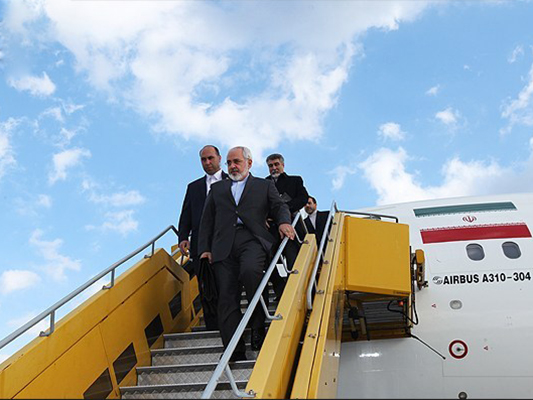
Iran FM Zarif to Visit Lebanon Sunday

Mohammad Jalal Firouznia made the announcement on Thursday, saying the Iranian foreign minister is likely to attend a ceremony commemorating the 40th anniversary of the victory of the 1979 revolution.

Zarif would be the first foreign minister to visit Lebanon following the formation of Lebanon’s new government.

Lebanese political factions agreed on January 31 on the formation of a new government, breaking a nine-month deadlock.

The new government — headed by Prime Minister Saad Hariri — includes 30 ministers from most Lebanese political factions, which have been in talks after the country held in May 2018 its first parliamentary elections in nine years.

According to a statement by Lebanon’s presidency, Finance Minister Ali Hassan Khalil from Parliament Speaker Nabih Berri’s Amal party, and Foreign Minister Gebran Bassil, who leads President Michel Aoun’s Free Patriotic Movement, have retained their positions in the new cabinet.

Lebanon’s Hezbollah resistance movement has chosen Jamil Jabak as the new health minister, despite the fact that he is not a member of the movement.

IRGC Unveils Underground Missile Factory, New Ballistic Missile

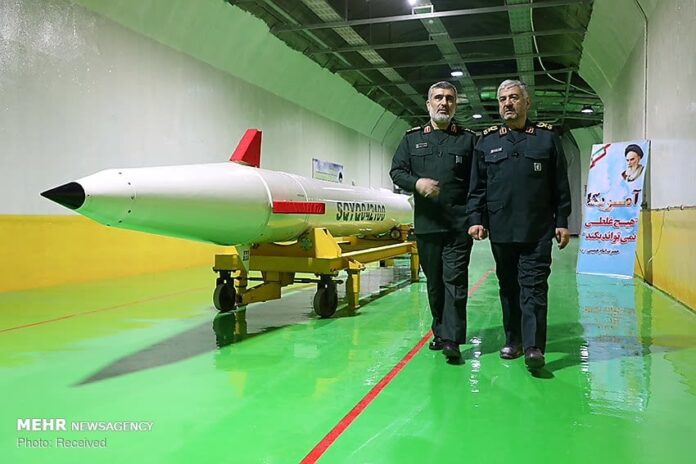
IRGC Chief Commander Major General Mohammad Ali Jafari and Aerospace Commander Brigadier General Amir Ali Hajizadeh visit the IRGC's underground missile plant in a photo released on Feb. 7, 2019 / Photo by Mehr News Agency

Speaking in the ceremony, IRGC Chief Major General Mohammad Ali Jafari said the unveiling meant to convey a message.

“Unveiling this missile production city deep in the earth is a response to rants and raves of westerners who believe they can limit us with sanctions and threats and stop us from [pursuing] big goals,” he said.

The IRGC chief stressed Iran’s missile power is non-negotiable.

“Iran’s defence power is deterrent and for protecting national security and it is not swappable or negotiable,” he said.


IRGC Unveils Underground Missile Factory, New Ballistic Missile
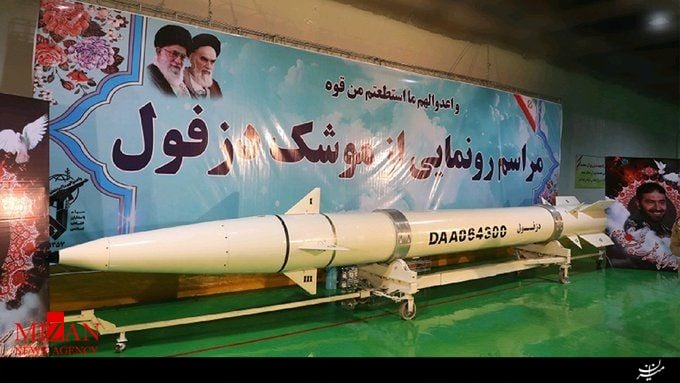
A Photo of Iran’s newly-unveiled missile Dezful

New Missile Put on Display

Speaking in the ceremony, the IRGC chief said all of Iran’s ballistic missiles are pinpoint accurate, and missile experts are now focusing on making missiles lighter, quicker to produce and easier for mass production.

The head of IRGC’s Aerospace Division Brigadier General Amir Ali Hajizadeh said in the ceremony that the new missile, called Dezful, is an improved version of the Zolfaghar missile that has a range of 700 kilometres.

The new missile has a 1,000-km range, and its explosive power has been doubled, he said.

“The explosive forces of this missile have been doubled [comparing to] Zolfaqar, due to the materials used in its warhead,” he said.

In recent months, the EU has stepped up criticism of Iran’s missile program, requesting talks on limiting it.

Iran has mainly ignored such requests.

US Animosity Towards Iran Outcome of Its Independence, Support for Palestine: Nasrallah

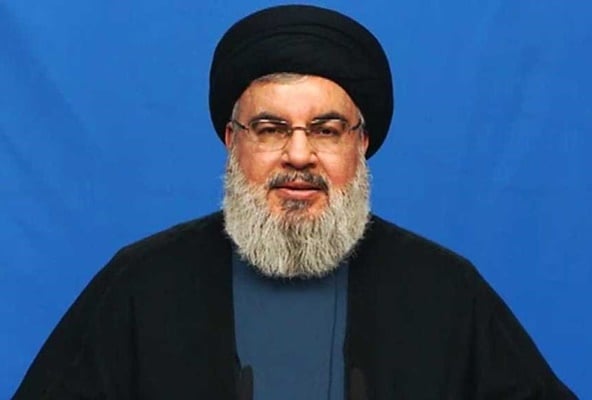
Addressing a ceremony commemorating the 40th anniversary of the victory of the Islamic Revolution in Beirut on Wednesday, Seyyed Hassan Nasrallah said the revolution was the starting point of a new era in the region.

The revolution toppled the US-backed regime of Mohammad Reza Pahlavi, the worst dictatorship in the region, if not the worst one in the world, he said.

The main reason behind US animosity towards Iran is the country’s independence and homegrown power, he said.

The second reason, Nasrallah said, is Iran’s position on regional developments, particularly its support for the Palestinian nation.


Revolution’s Achievements

Nasrallah said the Pahlavi regime had made Iran a client state, as thousands of American advisors were in charge of affairs in the country.

But the revolution managed to expel the US and its advisors from Iran, he said.

Nasrallah said the post-revolution Iran has become a major producer of science, being among top ten countries in the world.

Iran has made great progress in high-tech fields such as the nanotechnology and medical equipment, Nasrallah said.

In the defence sector, the pre-Revolution Iran was a major purchaser of expensive US equipment, he said.

However, after the revolution, over 90% of Iran’s military equipment are homegrown and the country exports over $5 billion worth of weaponry.


Regional Crises Part of US War

Nasrallah said the crises in the region are not part of an Israel-Iran war or a Saudi-Iran conflict.

The Hezbollah chief said Saudi Arabia is in no position to engage in a war with Iran by itself, and it’s merely a tool used by the US in its battle against Iranian.

Conflicts in the region are part of either Israel’s war against regional nations, started in 1948, or the US war against Iran, started in 1979.


US Will Be Defeated

The Hezbollah chief said the US and Israel have suffered numerous defeats in their confrontation with Iran since the 1979 revolution, and eventually they will be crushed.

“The clashes in the region will continue and might take other forms, but you should know that Iran is the most powerful country in the region and the resistance axis is in its best form,” he said.

“The US must make more withdrawals and pull out of the region. Israel should experience greater fear and defeats,” he said.


Mideast Governments Ought to Befriend Iran

Nasrallah urged regional governments to befriend Iran, saying the country is ready to lend a helping hand and promote Muslim unity in the region.

The Lebanese leader said some Arab government are trying to vilify the Iranian government, while they are the worst governments in the region.

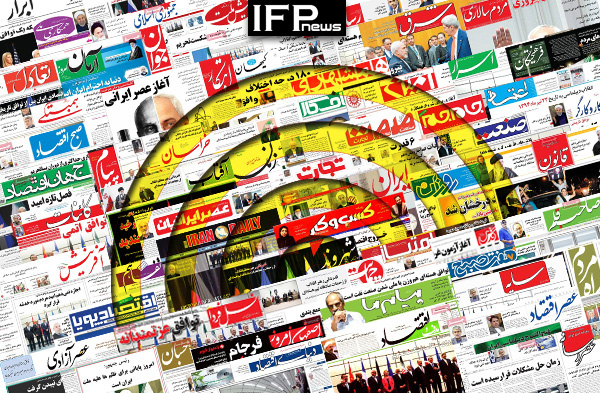
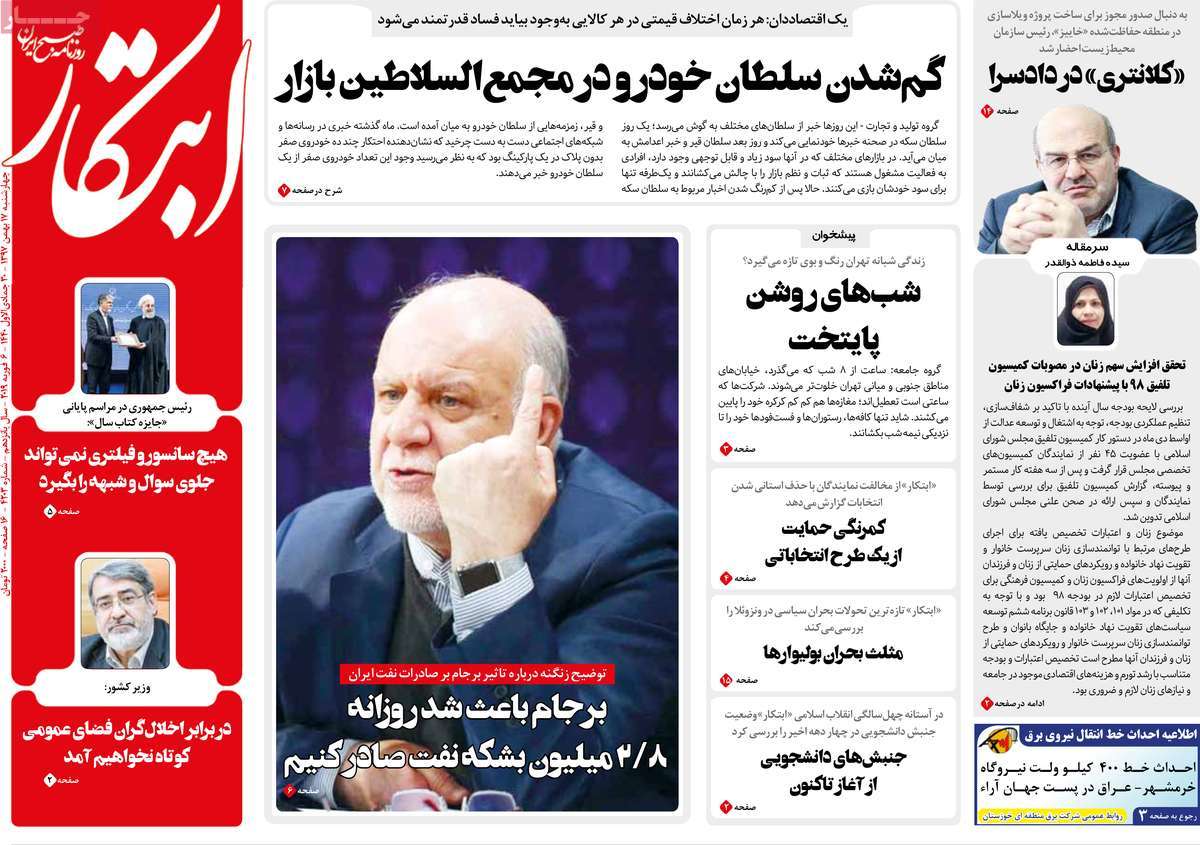
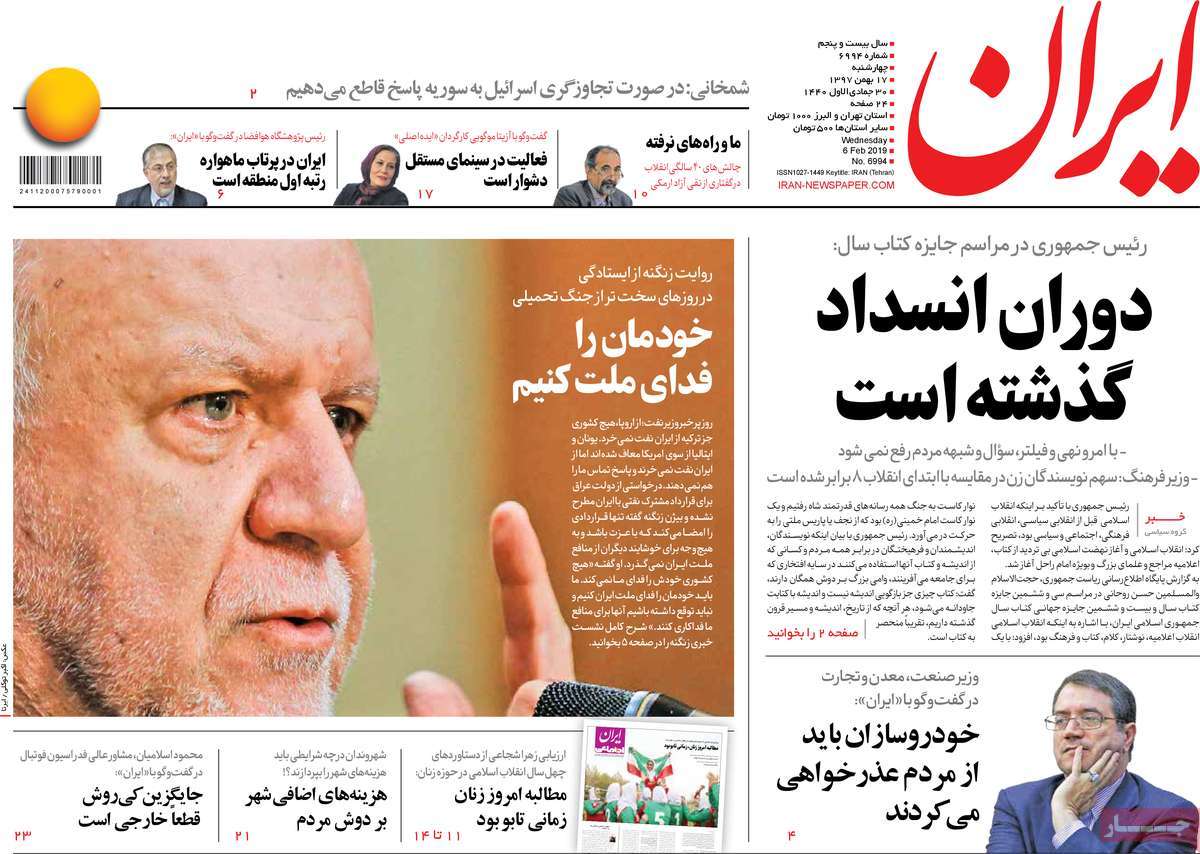
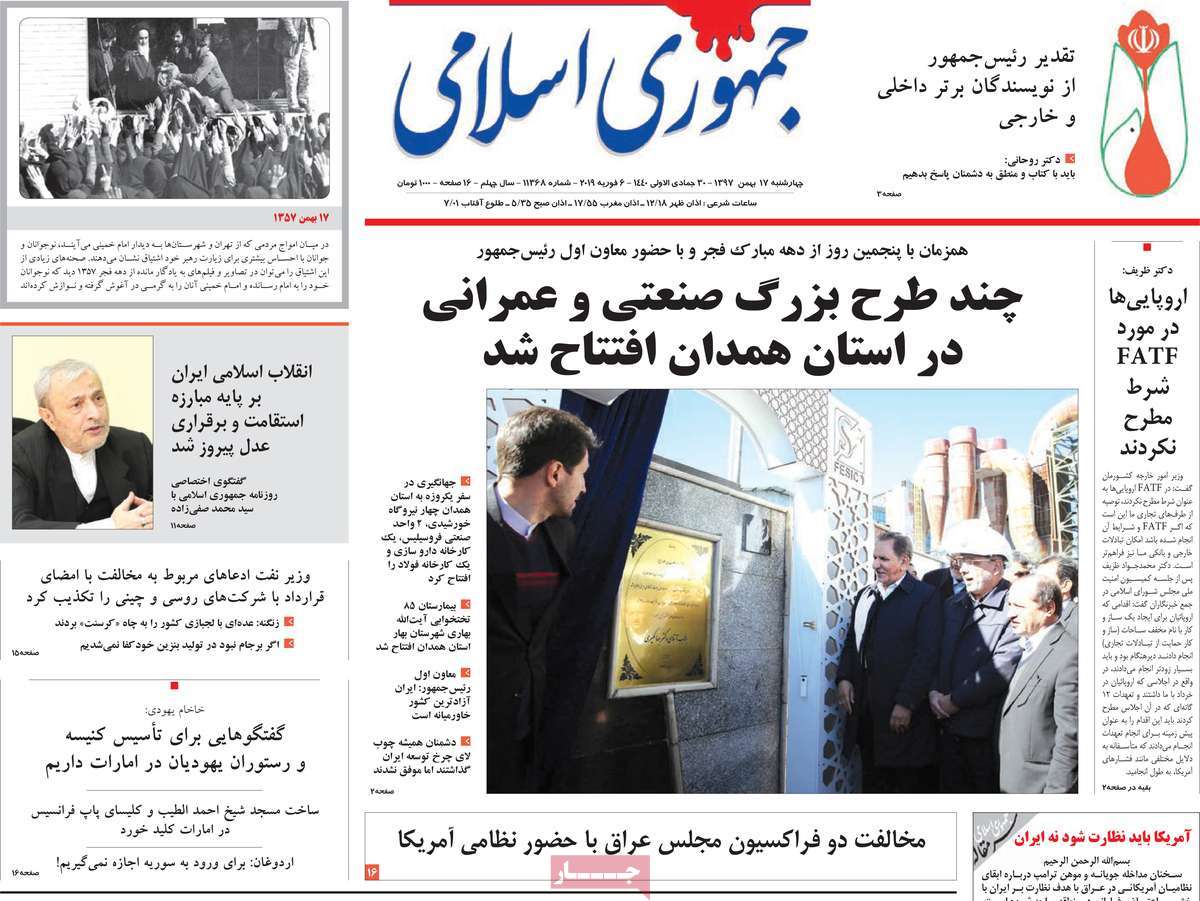
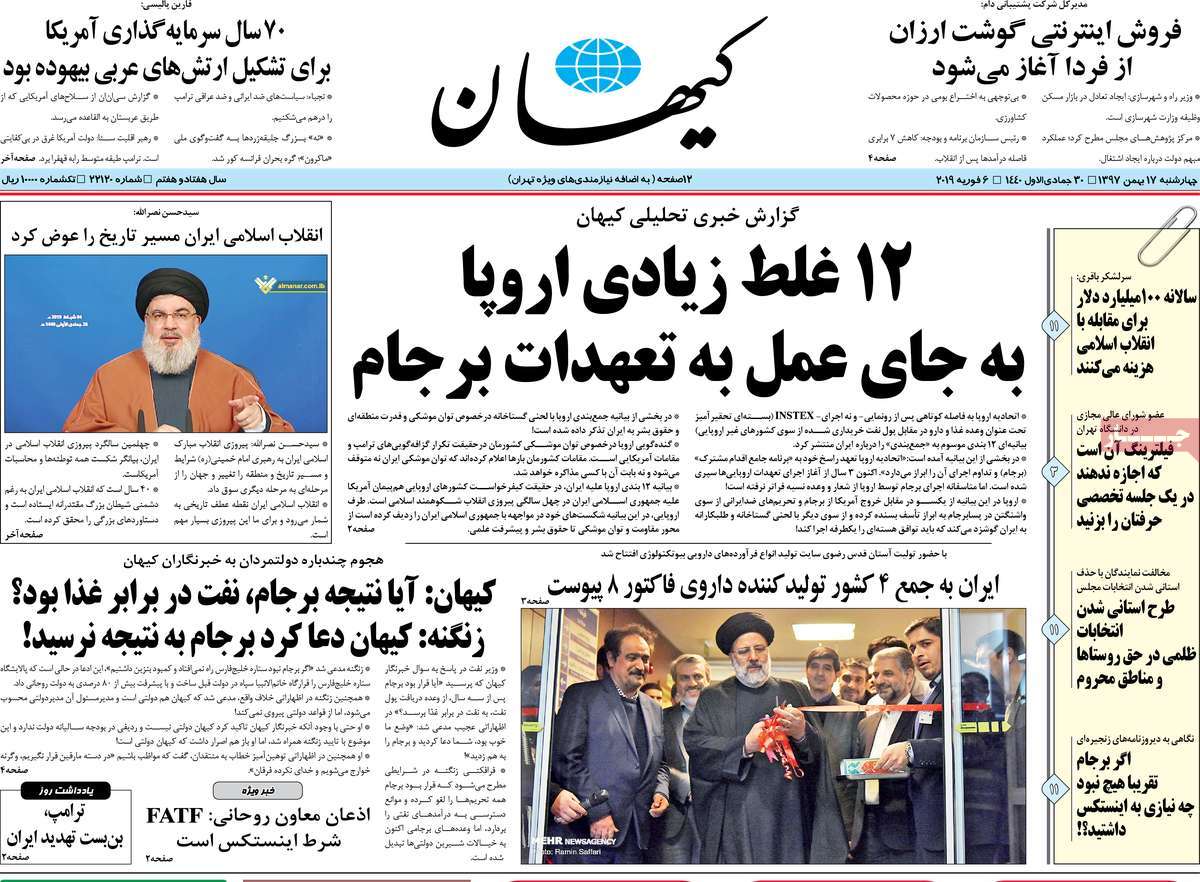
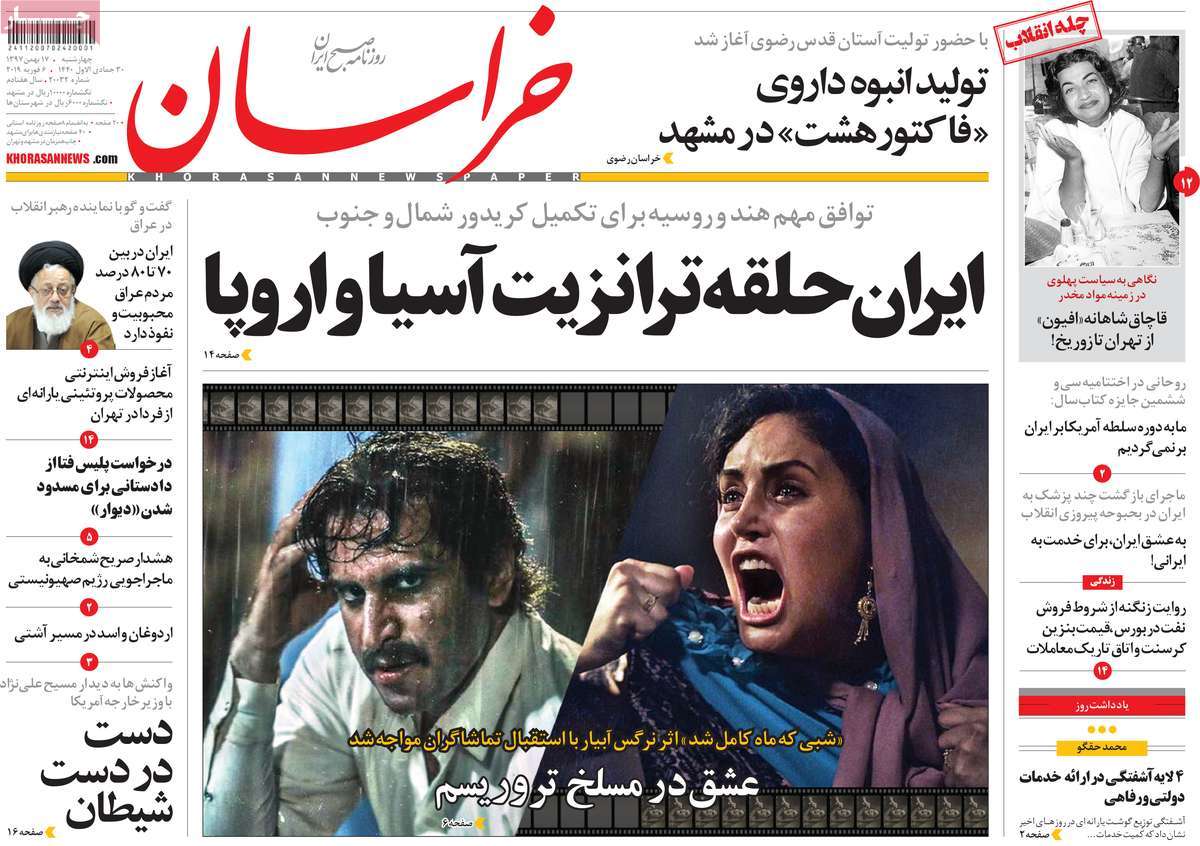
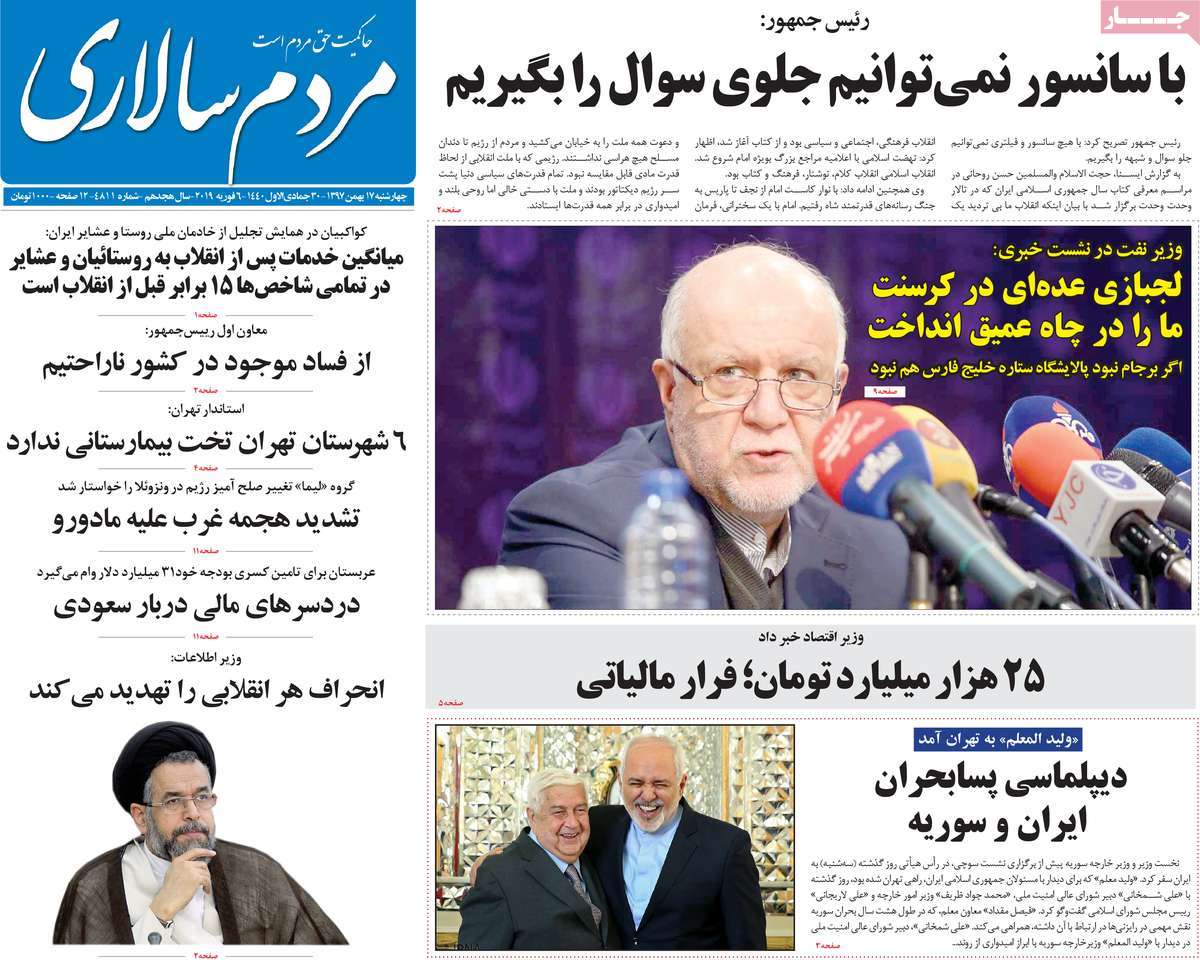
A Look at Iranian Newspaper Front Pages on February 7

A Look at Iranian Newspaper Front Pages on November 5

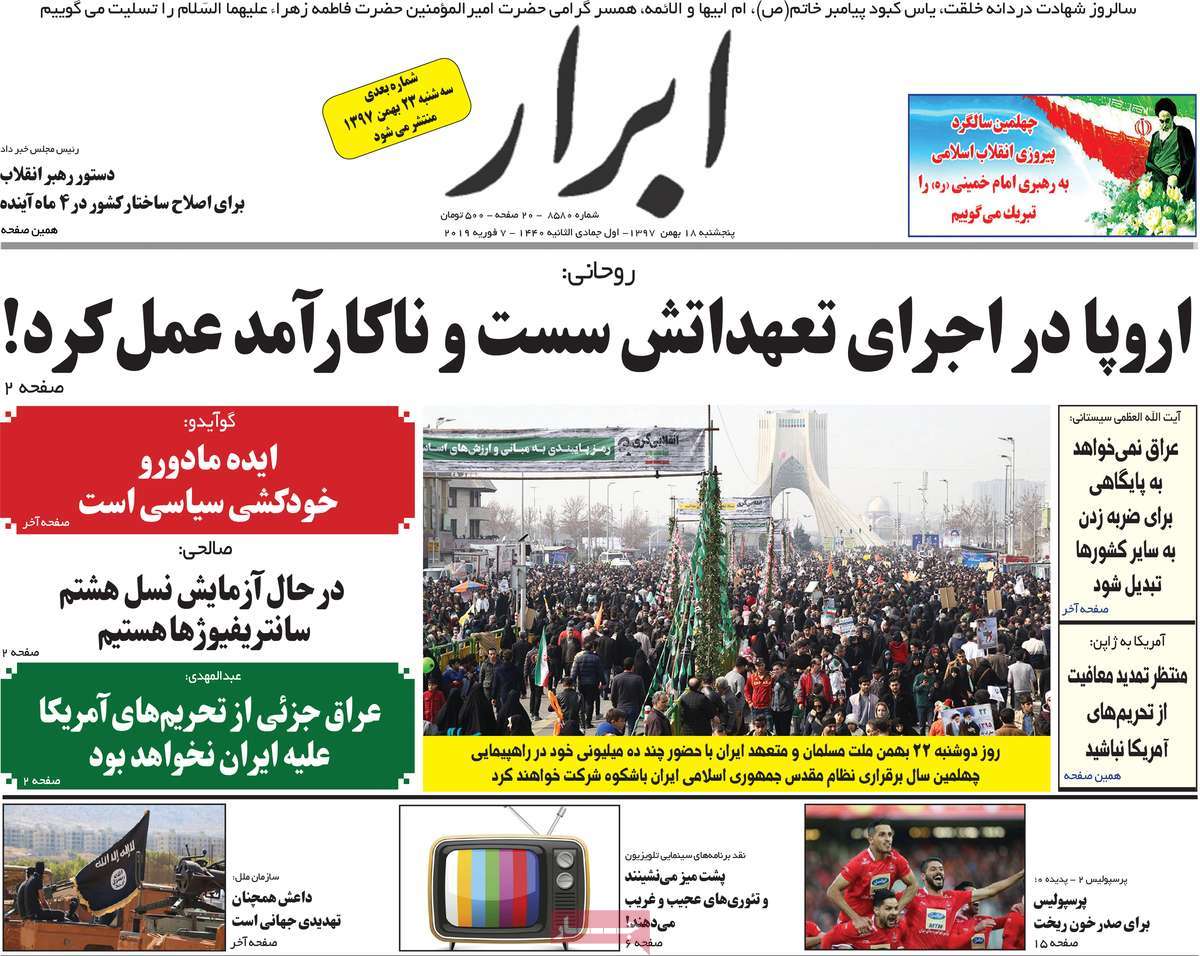
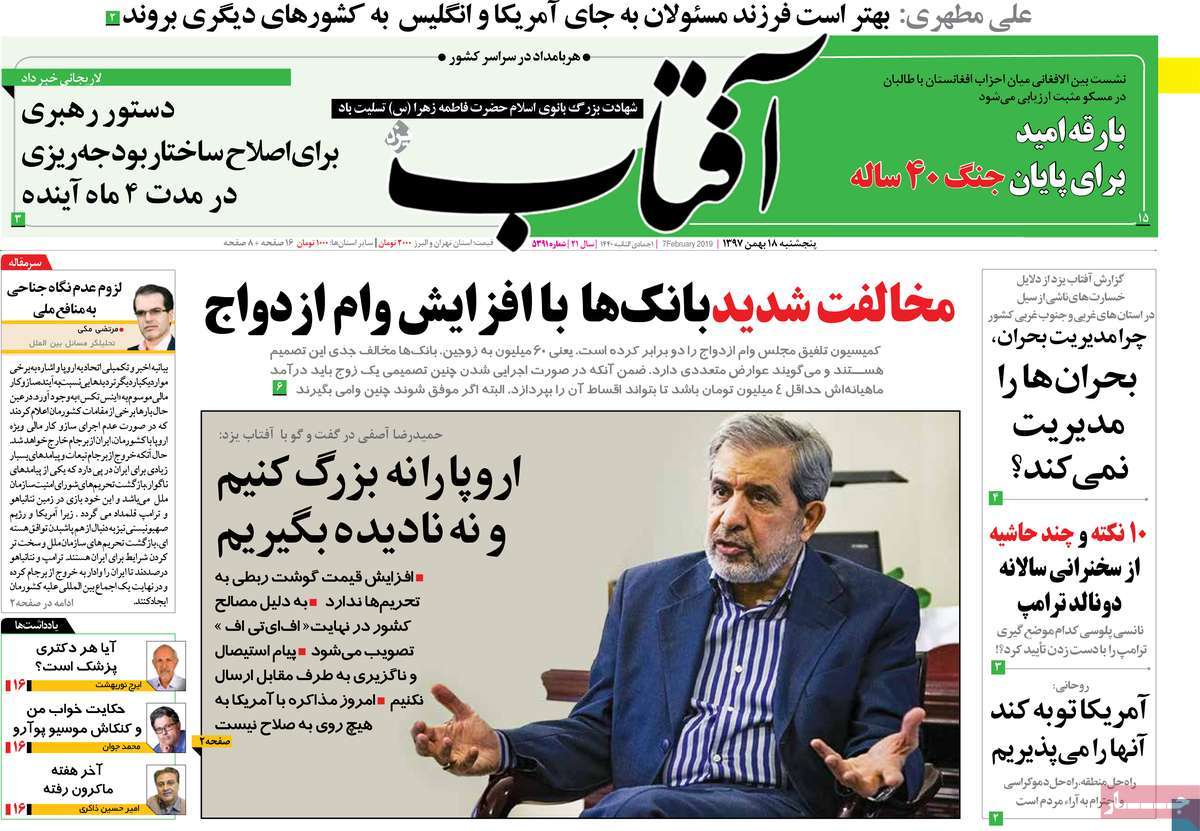
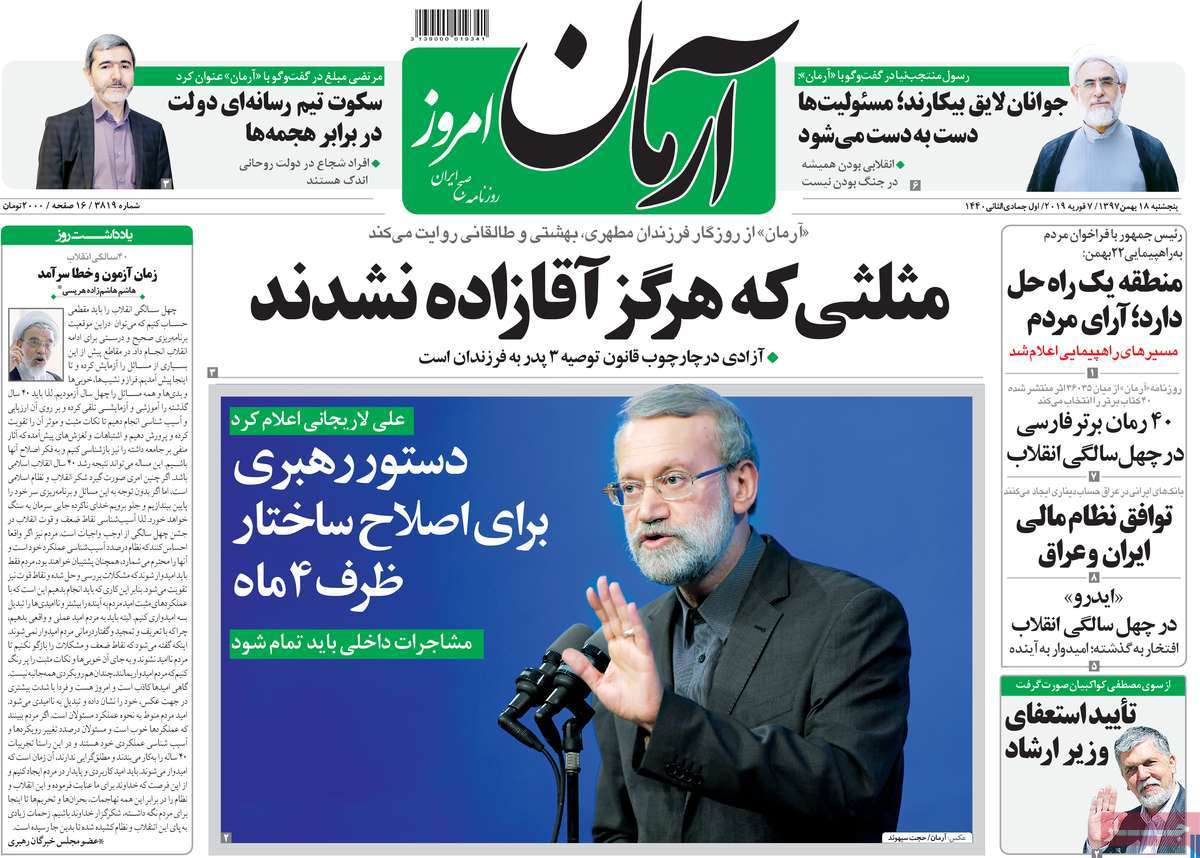
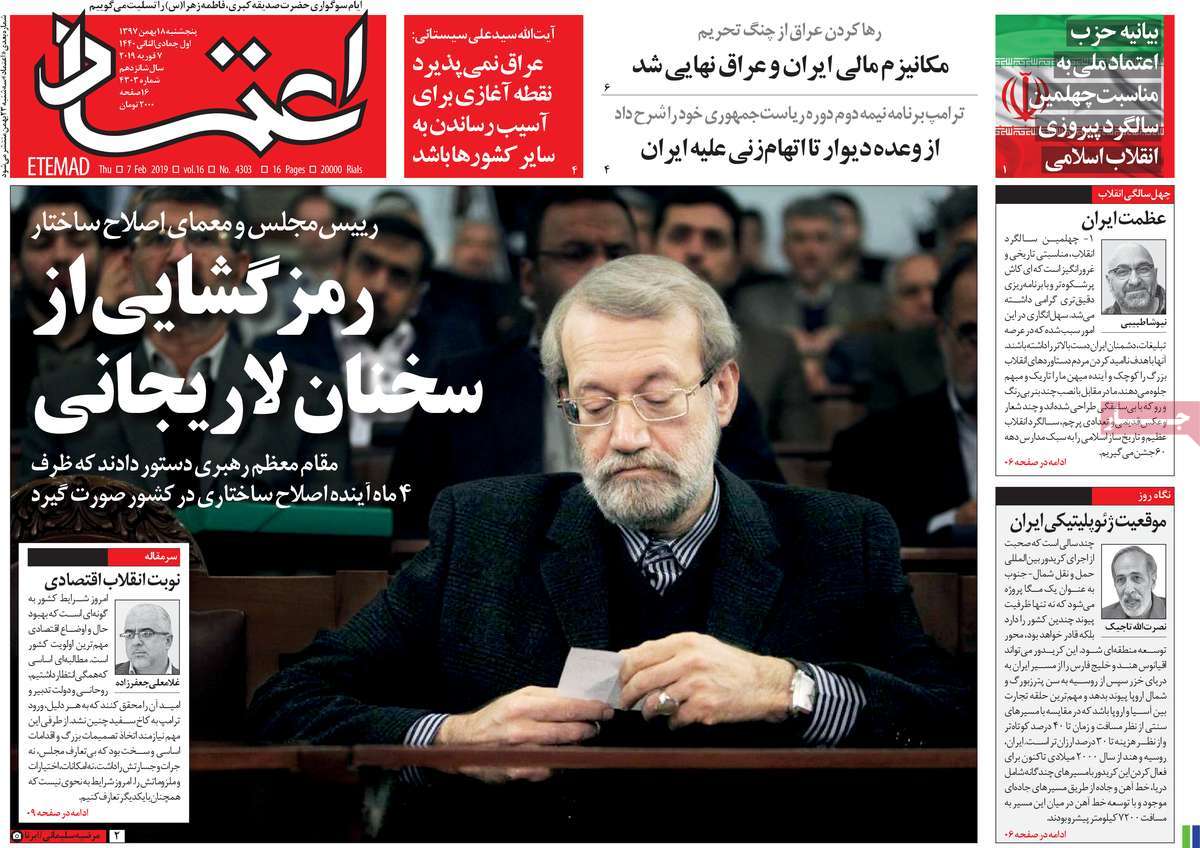
A top story in almost all papers today was the remarks made by Parliament Ali Larijani about the Leader’s call for “structural changes” in the country within a four-month period. However, another lawmaker later claimed the Leader has called for changes to the country’s budget bill, and not the country’s structure.

Iraq’s reaction to US President Donald Trump’s vow to use its bases in the Arab country against Iran also remained a top story today, with many papers covering top Iraqi Shiite cleric Ayatollah Ali al-Sistani’s opposition to Trump’s words.

President Hassan Rouhani’s comment that Tehran would embrace closer ties with the US if the latter repents also made the headlines today.

The above issues, as well as many more, are highlighted in the following headlines and top stories:


Abrar:

1- Europe Was Weak in Implementing Its Commitments

2- Iraq Won’t Be Part of US Sanctions against Iran: PM

A Look at Iranian Newspaper Front Pages on February 7


Aftab-e Yazd:

1- Banks Strongly Opposed to Increase in Amount of Marriage Loan

2- We Should Neither Overestimate, nor Ignore Europe: Ex-Diplomat

3- Beam of Hope for Ending 40-Year War in Afghanistan

4- Iran Would Accept US If It Repents: Rouhani

A Look at Iranian Newspaper Front Pages on February 7


Arman-e Emrooz:

1- Leader Calls for Structural Changes in Four Months: Larijani

2- Competent Youth Unemployed While Jobs Exchanged between Old Officials: Reformist

3- Rouhani: Ballot Box Only Solution to Regional Crises

4- Iran, Iraq Agree on Financial System

A Look at Iranian Newspaper Front Pages on February 7


Etemad:

1- Iran, Iraq Finalize Financial Mechanism

2- Trump Makes Accusations against Iran in His State of Union Speech

3- Iraq Not Launch Pad for Harming Other Countries: Ayatollah Sistani

A Look at Iranian Newspaper Front Pages on February 7


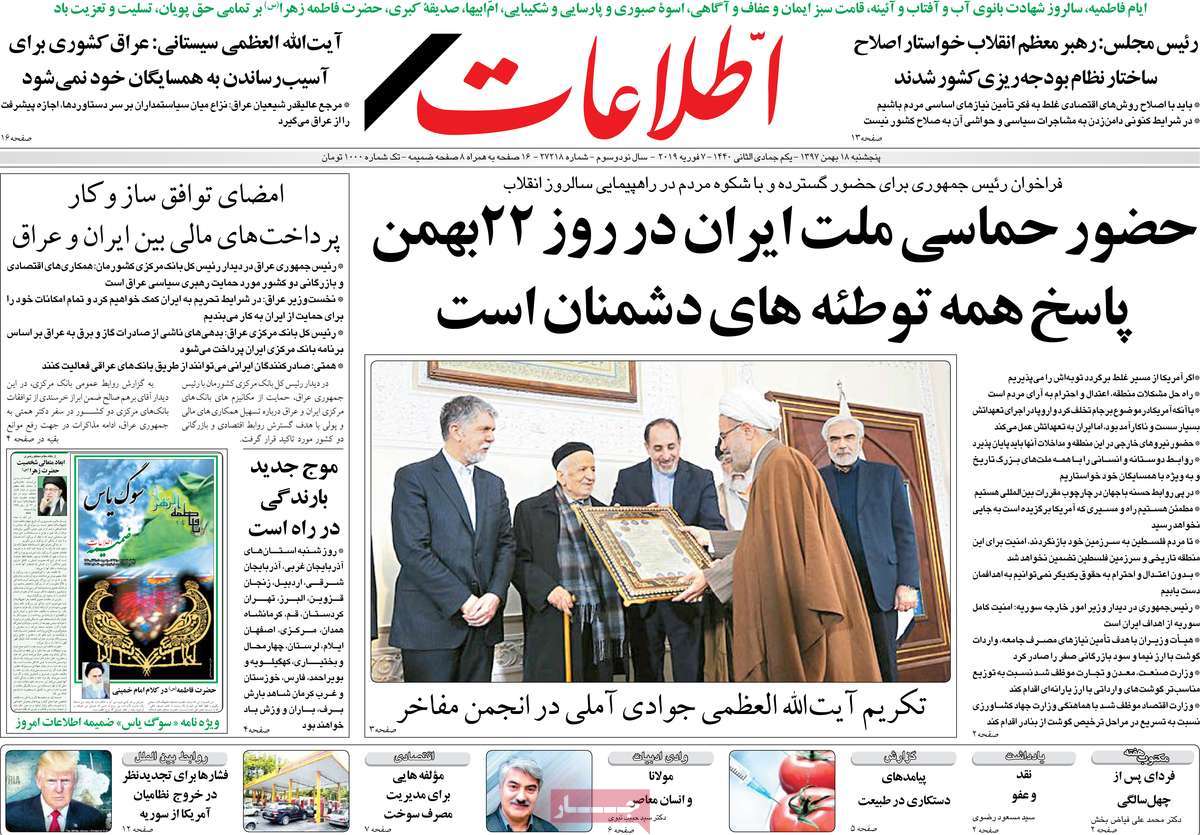
Ettela’at:

1- Iranians to Show Epic Turnout in 22 Bahman (Revolution Anniv.) Rallies

2- Iraq Not to Turn into Country for Harming Its Neighbours: Ayatollah Sistani

A Look at Iranian Newspaper Front Pages on February 7


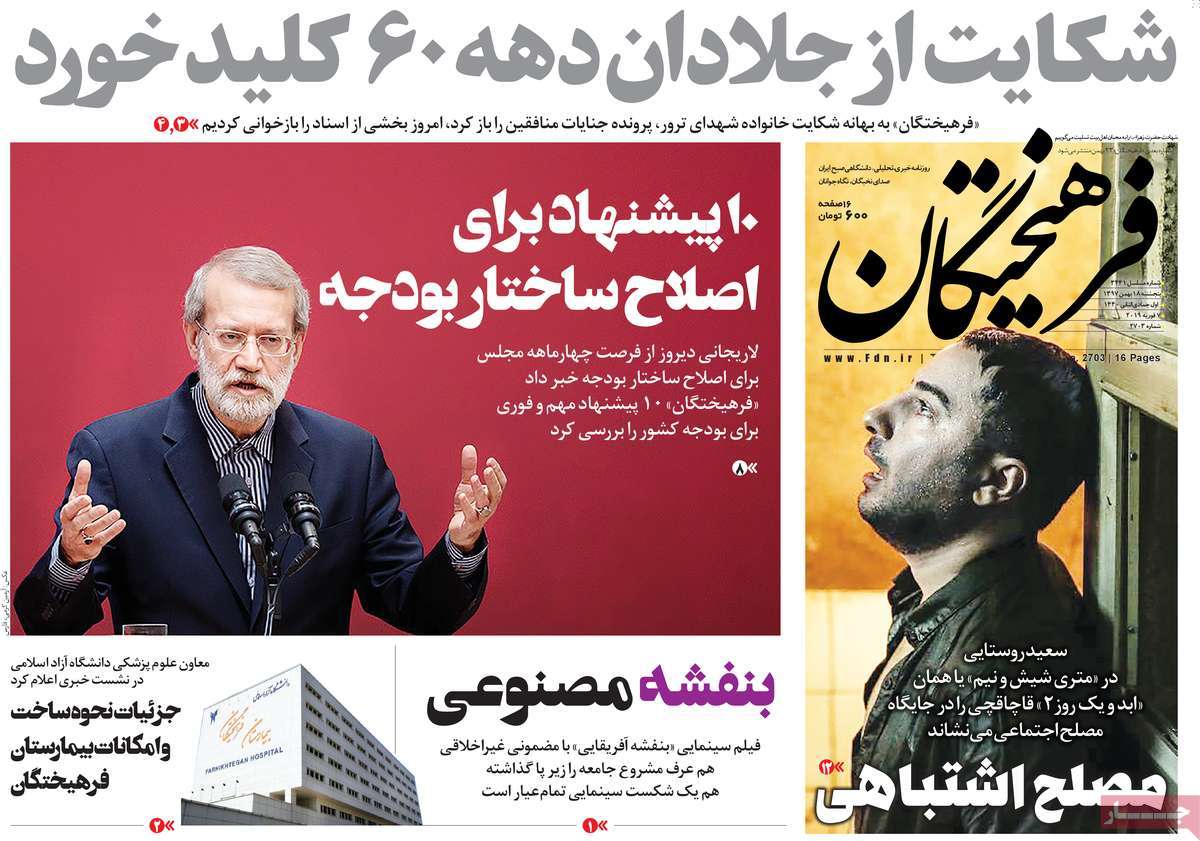
Farhikhtegan:

1- Families of Victims of MKO Attacks in 1980s File Lawsuit against Them

A Look at Iranian Newspaper Front Pages on February 7


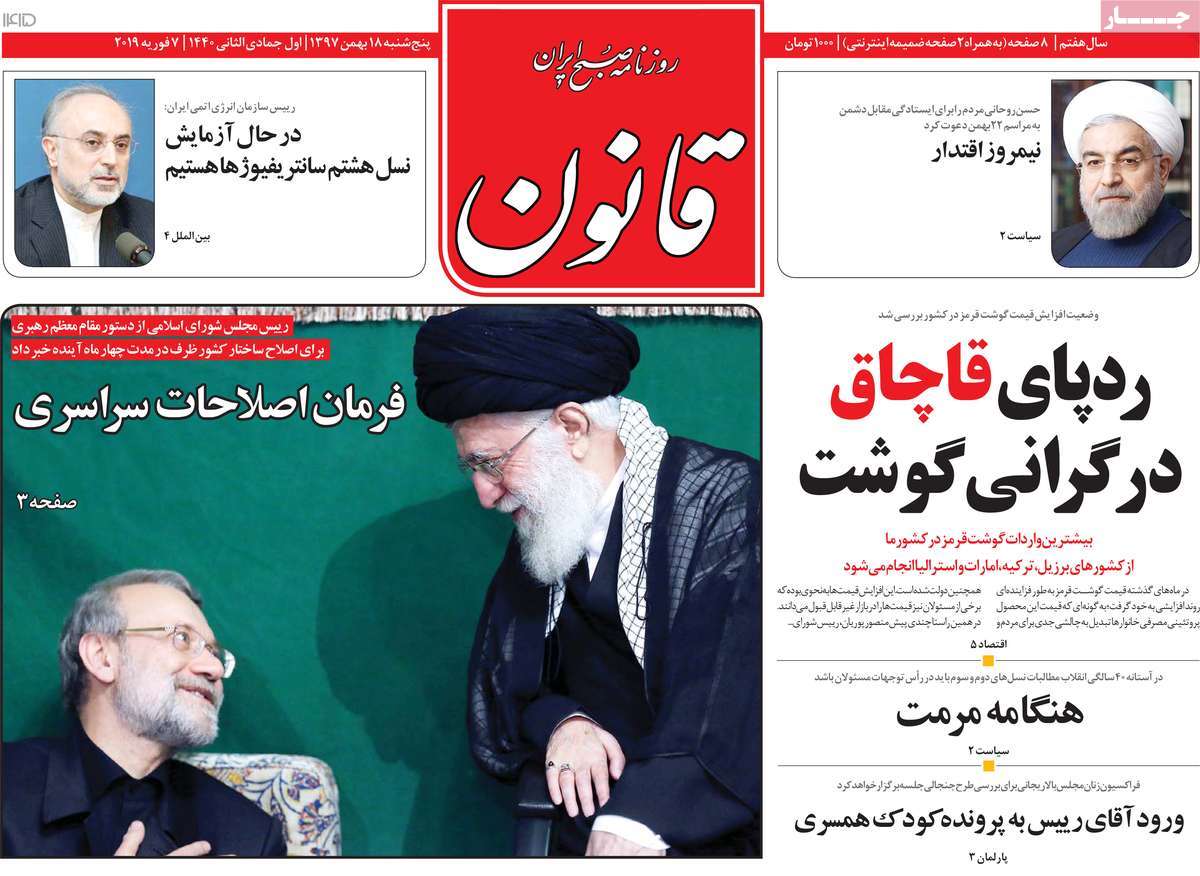
Ghanoon:

1- Iran Leader Gives Order for Widespread Reforms

2- Smuggling Might Be Cause of Soaring Meat Prices in Iran

3- Iran Testing IR-8 Centrifuges: Salehi

A Look at Iranian Newspaper Front Pages on February 7


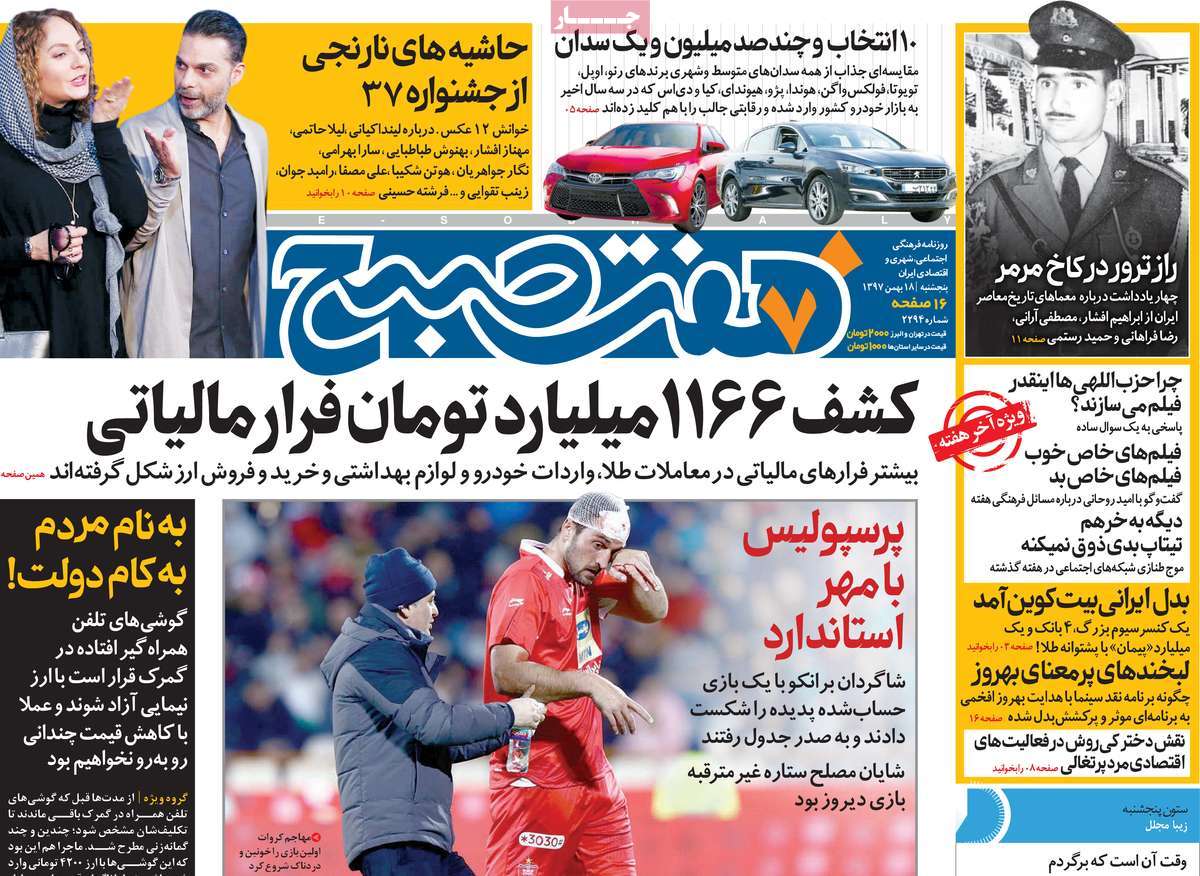
Haft-e Sobh:

1- Here It Comes Iranian Version of Bitcoin

* Big Consortium, 4 Banks, Gold Reserves behind “Payman”

A Look at Iranian Newspaper Front Pages on February 7


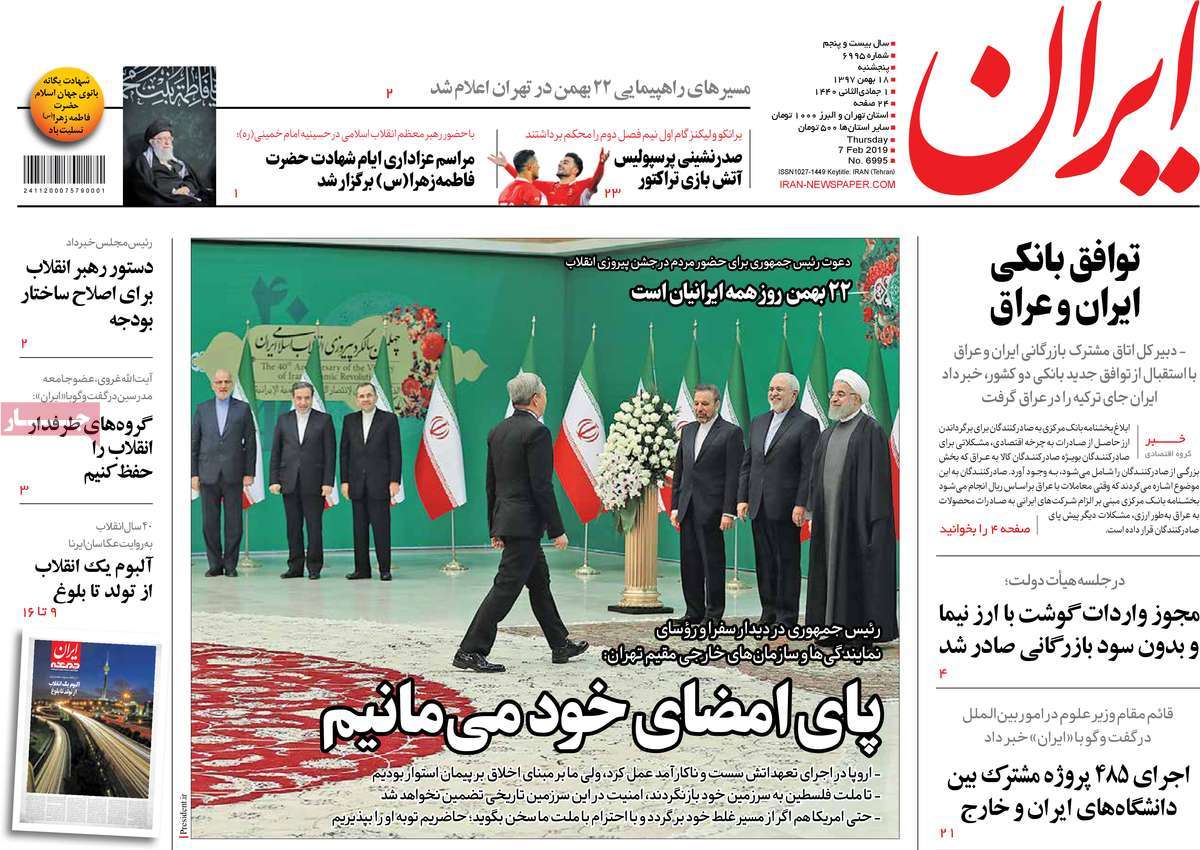
Iran:

1- Banking Deal between Iran, Iraq

2- Iranian Universities Implementing 485 Joint Projects with Foreign Counterparts

3- We’ll Stick to Our Signature: Rouhani in Meeting with Foreign Envoys

A Look at Iranian Newspaper Front Pages on February 7


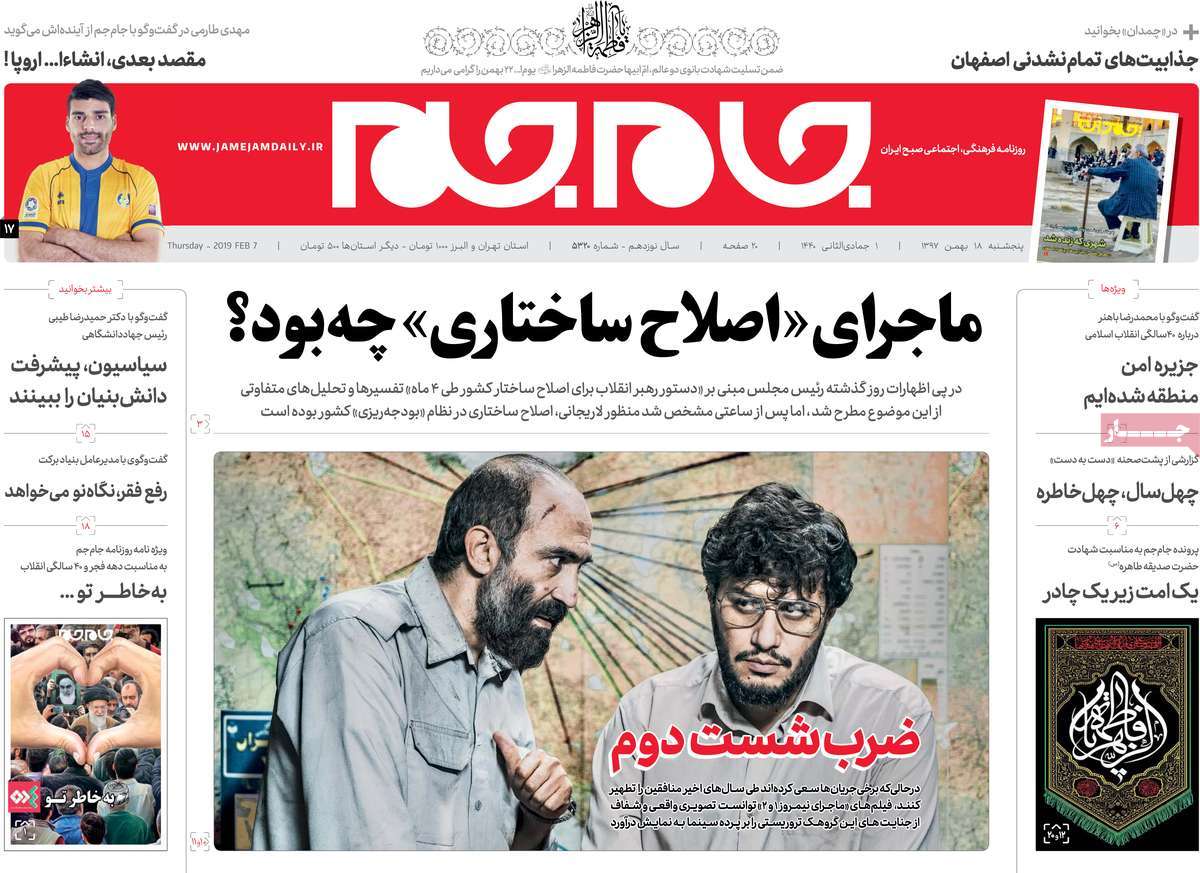
Jame Jam:

1- Larijani’s Comments about “Structural Changes” Called by Leader Spark Controversy

2- Iran Now “Safe Island” of Region: Conservative Figure

A Look at Iranian Newspaper Front Pages on February 7


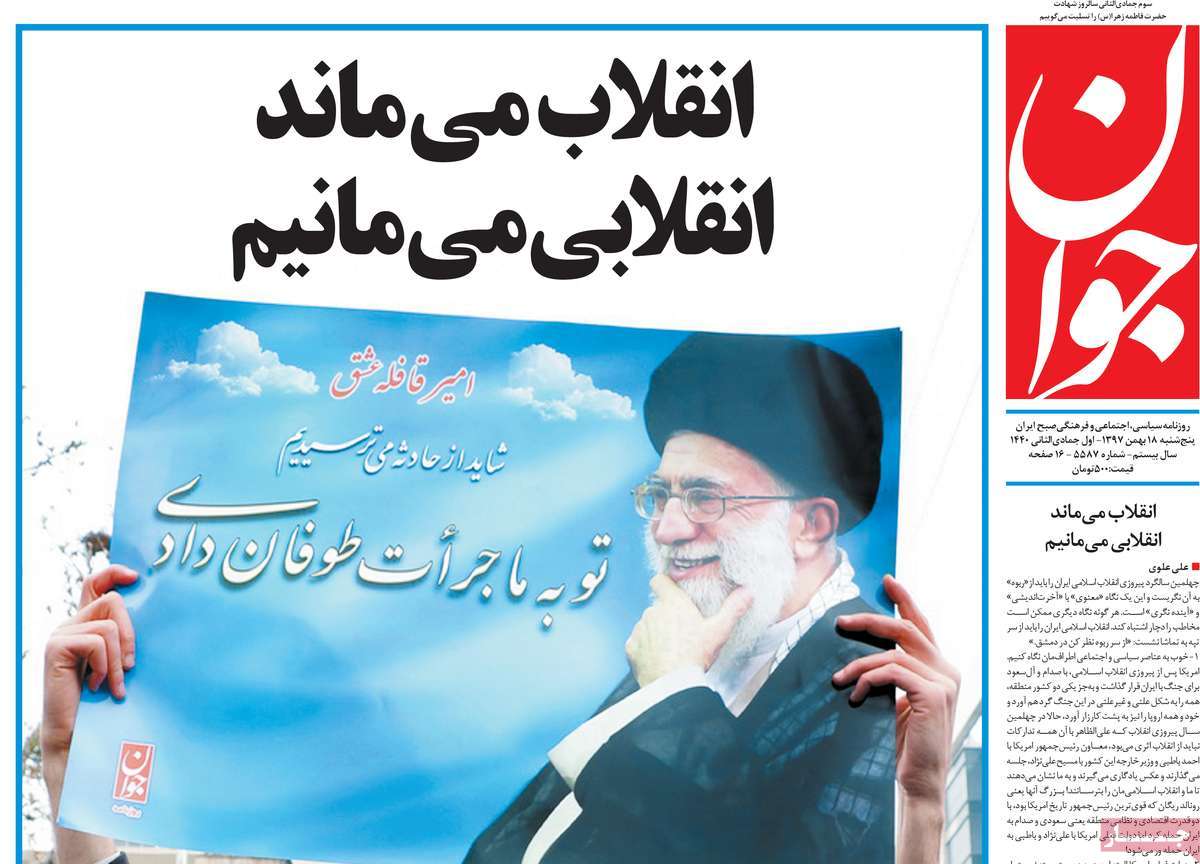
Javan:

1- Revolution Will Survive, We’ll Remain Revolutionary

A Look at Iranian Newspaper Front Pages on February 7


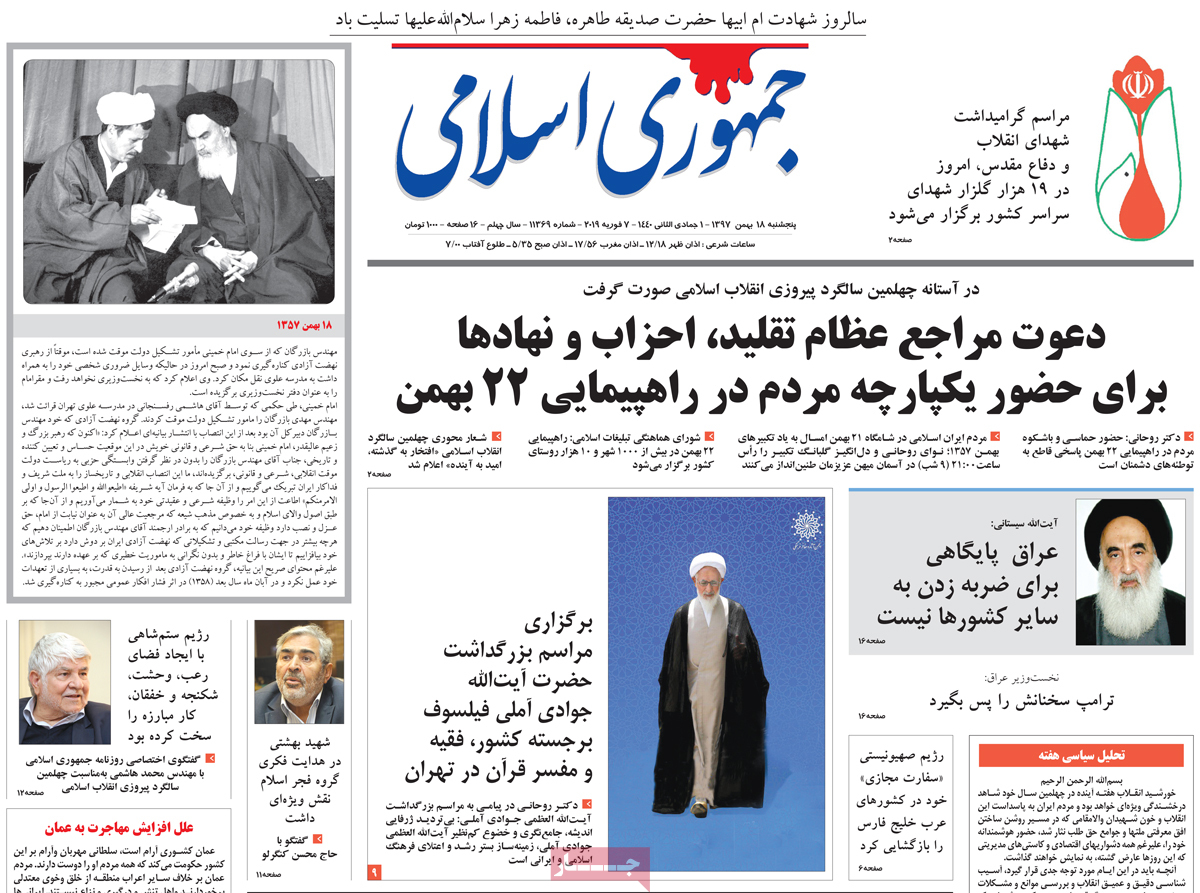
Jomhouri Eslami:

1- Top Clerics, Parties, Bodies Call for People’s Participation in Feb. 11 Rallies

2- Trump Must Take Back His Words: Iraq PM

A Look at Iranian Newspaper Front Pages on February 7


Kayhan:

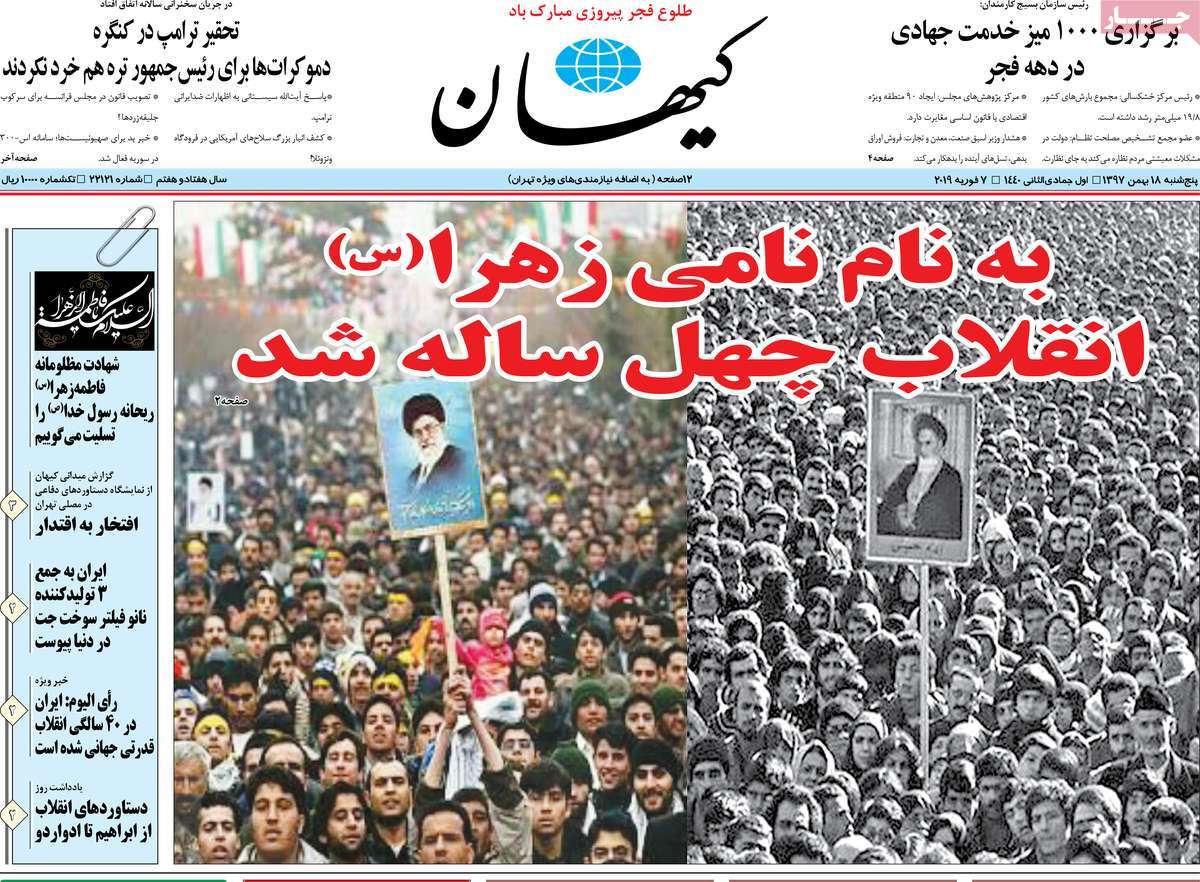
1- Iran Celebrates Fortieth Birthday

2- Trump Humiliated in Congress: Democrats Don’t Pay Any Attention to Trump

A Look at Iranian Newspaper Front Pages on February 7


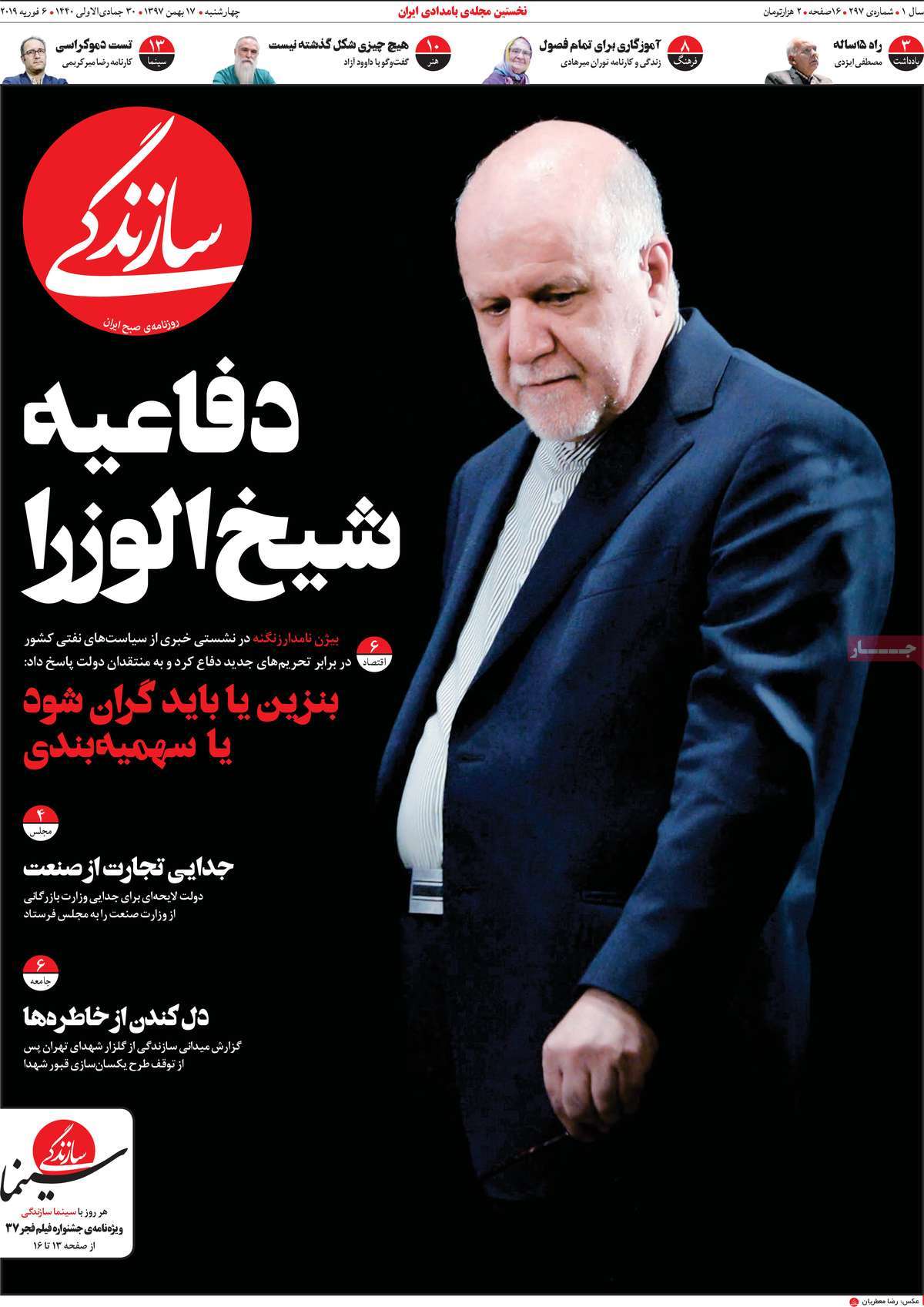
Sazandegi:

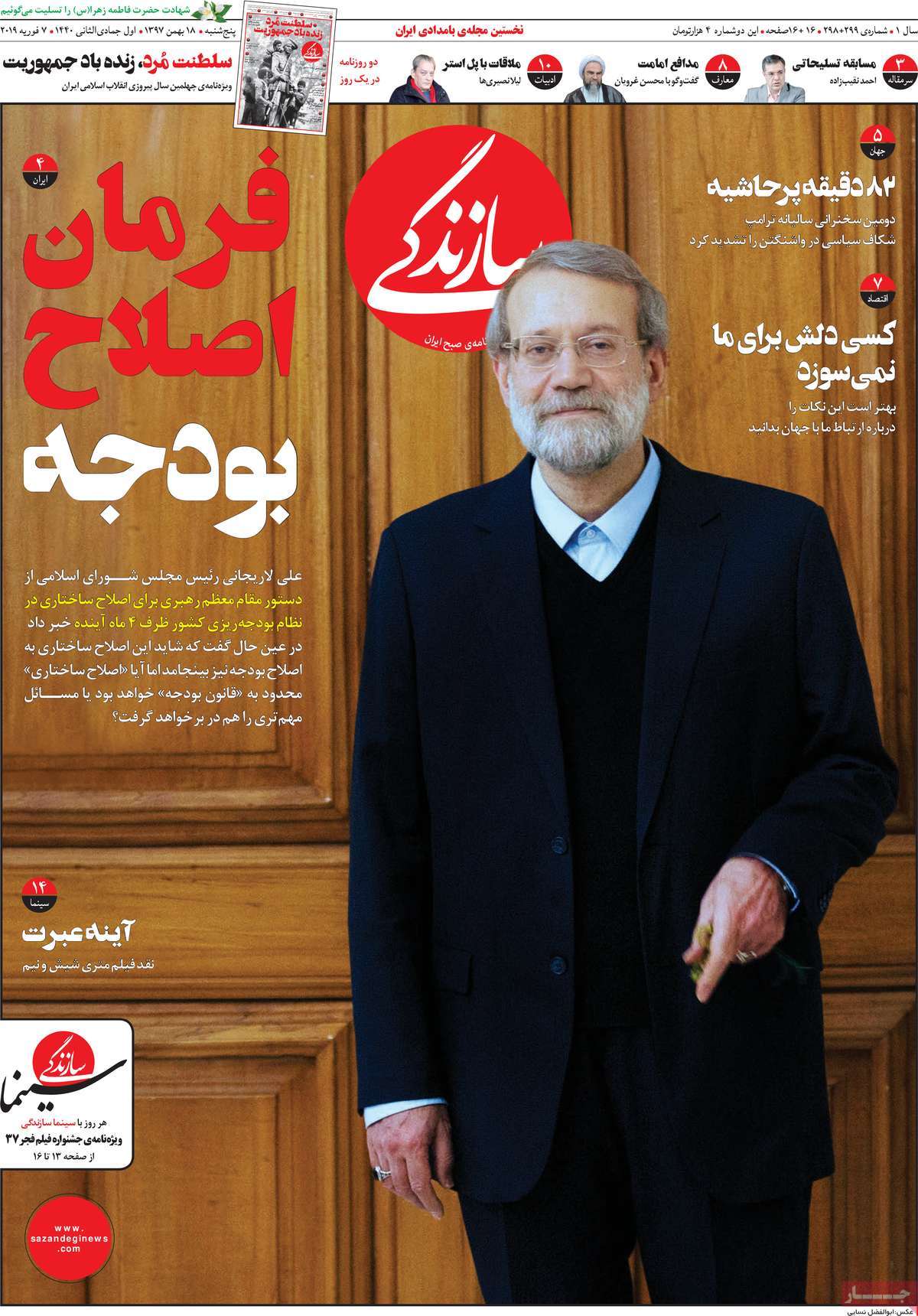
1- Iran Leader Orders Officials to Revise Budget Structure

2- 82 Controversial Minutes: Trump’s Second State of Union Speech Deepens Political Gaps in US

3- Monarchy Dies: Long Live Republic of Iran [Featured Reports on 40th Revolution Anniv.]

A Look at Iranian Newspaper Front Pages on February 7


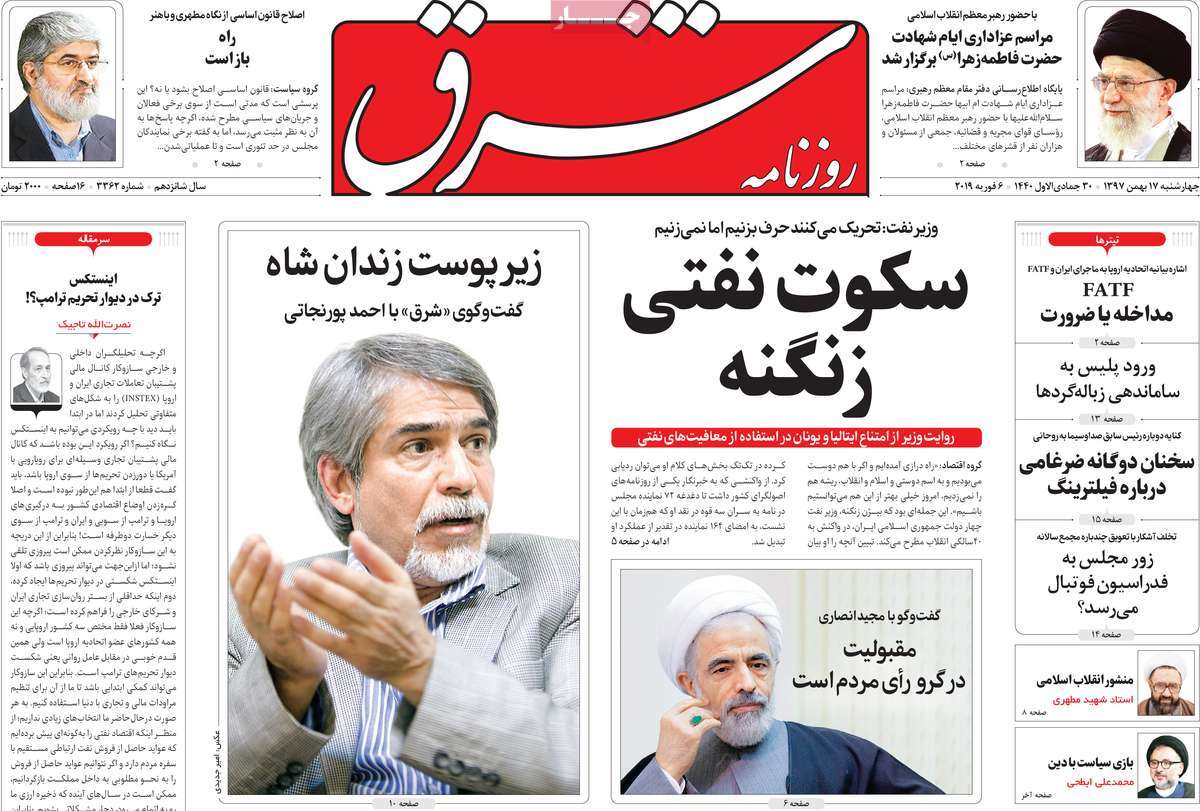
Shargh:

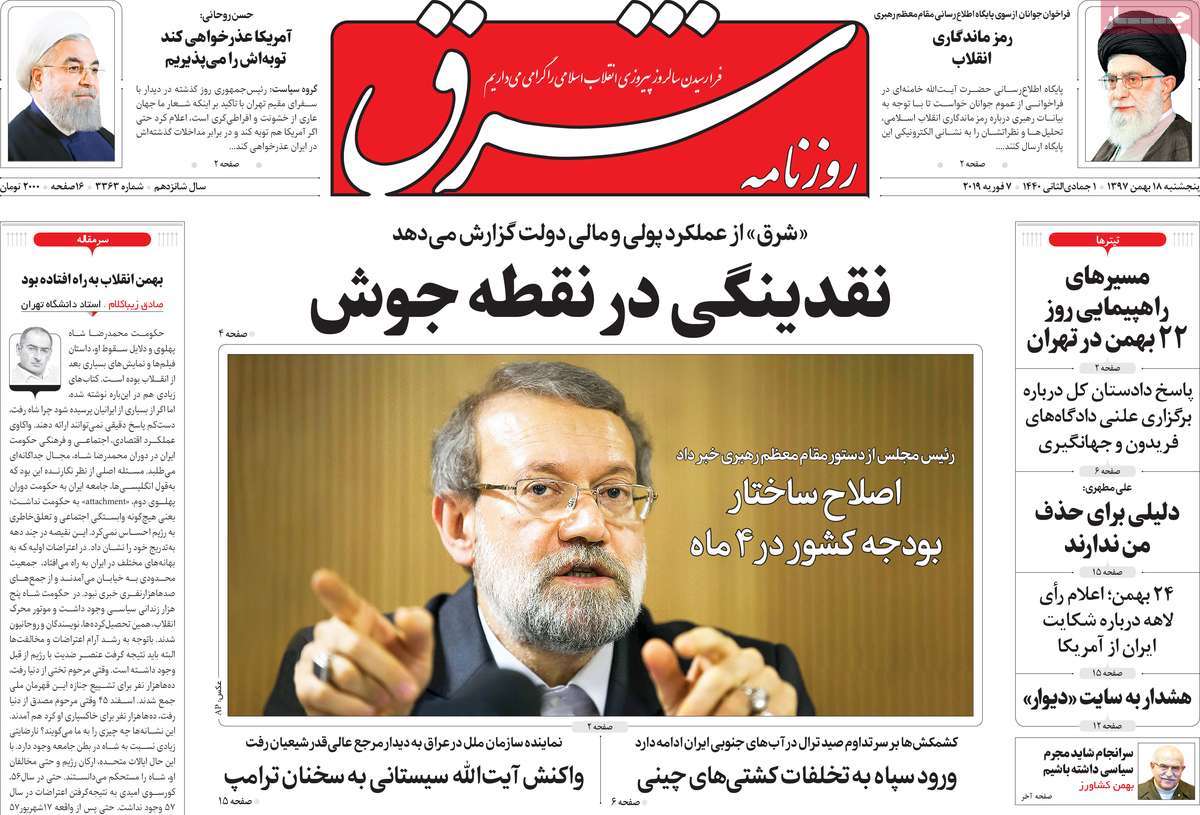
1- IRGC to Deal with Chinese Ships’ Offences

2- UN Envoy for Iraq Meets with Top Shiite Cleric Ayatollah Sistani

2- Iran to Accept US’ Repentance If It Apologizes: President

A Look at Iranian Newspaper Front Pages on February 7


Vatan-e Emrooz:

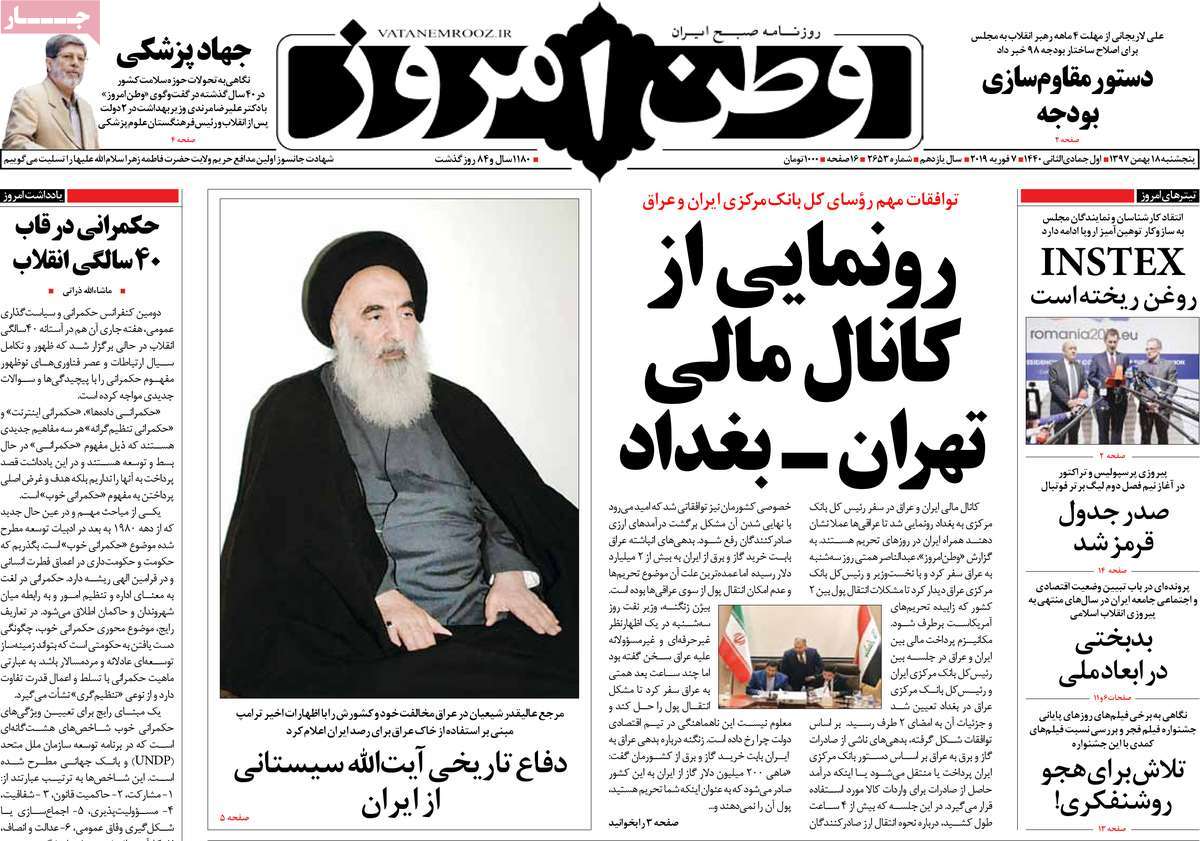
1- Tehran, Baghdad Launch Their Financial Channel

2- Ayatollah Sistani’s Historic Defence of Iran

3- Iranian MPs, Experts Continue Criticizing EU’s Insulting Mechanism

A Look at Iranian Newspaper Front Pages on February 7

Israeli Company Claims Syria Activated S-300 System

ImageSat International (iSi) said on Tuesday images show three of the four S-300 launchers belonging to the long-range surface-to-air missile systems are in an upright position in the town of Masyaf in the western Syrian province of Hama.

“Due to the current regional tension and the detected erection of the launchers, it is possible that the mentioned activity indicates an increase of the operational level and alertness,” the company said.

It cited specific concern after noticing that only one of the launchers had been camouflaged.

“This situation is rare and raises question marks about the operational level of the whole battery and specifically of the covered and folded launcher,” it noted.

At the request of Damascus, Russia and Syria have maintained close defensive cooperation in battling terrorists in the Arab country.

The cooperation has flown in the face of Israel’s efforts at undermining Syria’s defences, with the regime repeatedly targeting Syrian military positions.

Last September, a Russian Il-20 reconnaissance aircraft was shot down and all the 15 servicemen on board were killed during Israeli airstrikes in the northwestern Syrian province of Latakia.

Moscow held Tel Aviv responsible for the downing and ordered the delivery of the S-300 defence systems to Syria.

A month after the systems arrived in Syria, Russian Deputy Foreign Minister Sergei Vershinin told Russia’s Sputnik news agency that the delivery would be followed by additional steps, without providing any further details.

He also issued a veiled warning to Israel, saying Russia hoped the Tel Aviv regime would exercise “good judgment” on the shipment of the S-300 batteries to Syria.

Terrorism in West Asia Result of US’ Wrong Policies: Iran

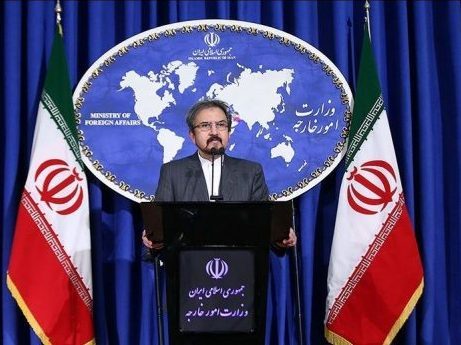
Bahram Qassemi

“Terrorism in the West Asia region is the result and unholy child of misguided policies of the US and some of the country’s allies in the region in recent years and decades,” Qassemi said in a Wednesday statement.

They have used these policies as a tool to implement their strategies, including the creation of Al-Qaeda and ISIS and other extremist and terrorist groups, the Iranian spokesman said, adding that such policies have imposed crises, tensions and long-term instability on this region.

“Trump is falsely accusing Iran of supporting terrorism while it is clear to everyone that Iran, the biggest victim of terrorism in recent decades, has paid considerable material and spiritual costs in its tireless and real fight against this scourge, which is demonstrated in its major and undeniable role in defeating ISIS in Iraq and Syria,” he said.

Pointing to the fact that religious minorities, including the Jewish people, are freely living in Iran and have independent representatives in the Iranian parliament, Qassemi said, “Several decades after the World War II, the Western governments still feel indebted to Zionists. This is while the cultured Iran has been a cradle of toleration, peaceful coexistence and ethnic and religious diversity and has hosted nearly all divine religions.”

“This old and well-rooted culture is a major characteristic of Iranians,” he said.

“The Jewish religion has always been hailed by the Islamic Republic of Iran like other Abrahamic religions, and has a high status according to the Constitution. But one cannot deny that the inhumane and criminal moves of the Zionist regime under the name of the Jewish religion have tarnished the image of Jews in the world,” he said.

Pointing out that Iranians are these days celebrating 40 years of their popular resistance with dignity and might on the occasion of the 40th anniversary of the victory of the Islamic Revolution, Qassemi said that “the Islamic Republic of Iran has held more elections than any other country in the region, including allies and close partners of the US which have dictatorial and authoritarian systems.”

“Undoubtedly, the Islamic Republic of Iran is the outcome of a popular revolution and is based on a democratic system.”

“Empty, illusionary and illogical allegations of the US president against the people and the Islamic Republic of Iran’s Establishment will fall short of covering up the crimes being committed by the US and its allied dictatorships promoting violence and extremism under the US support, which have massacred the suppressed the people of the region,” he said.

Qassemi’s comments came in reaction to Trump’s State of the Union address on Tuesday, during which he called Iran “the world’s leading state sponsor of terror,” and said the Islamic Republic “chants death to America and threatens genocide against the Jewish people.”

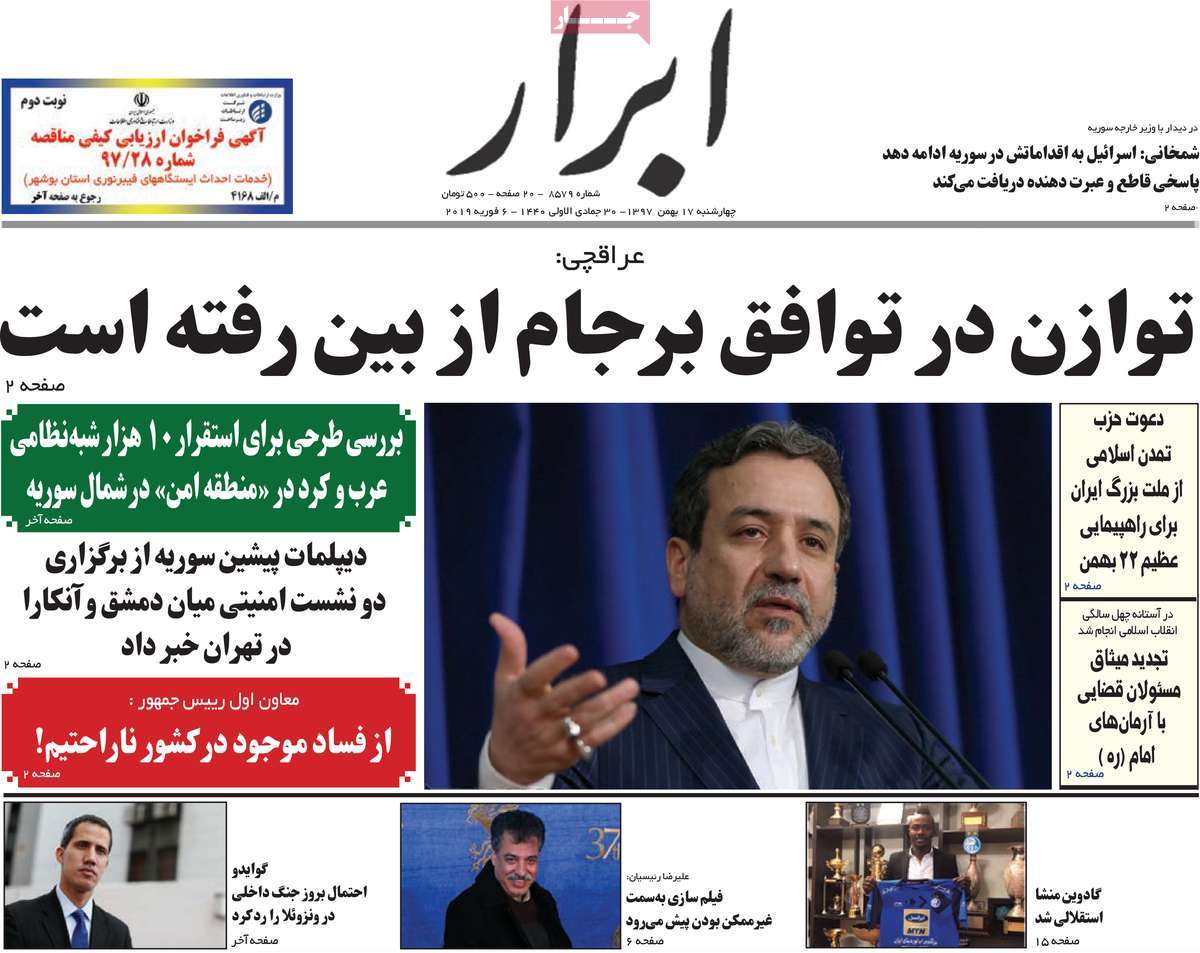
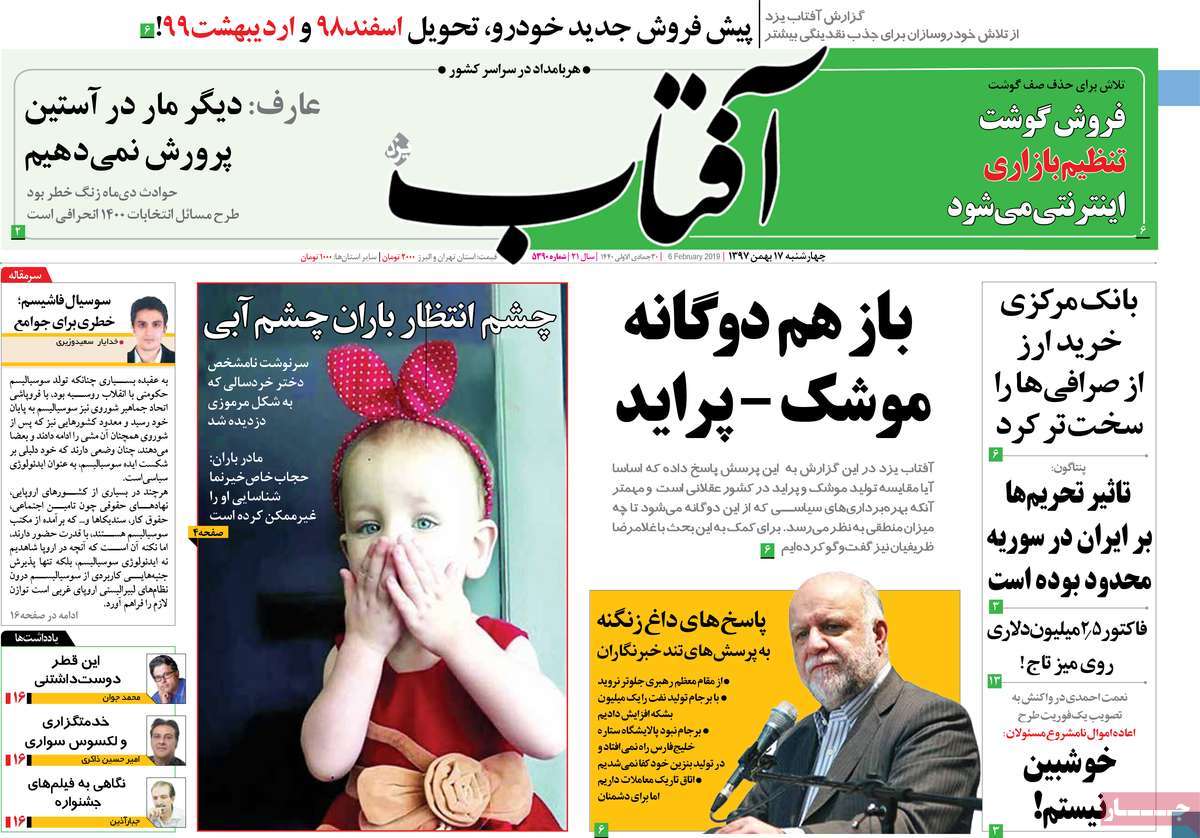
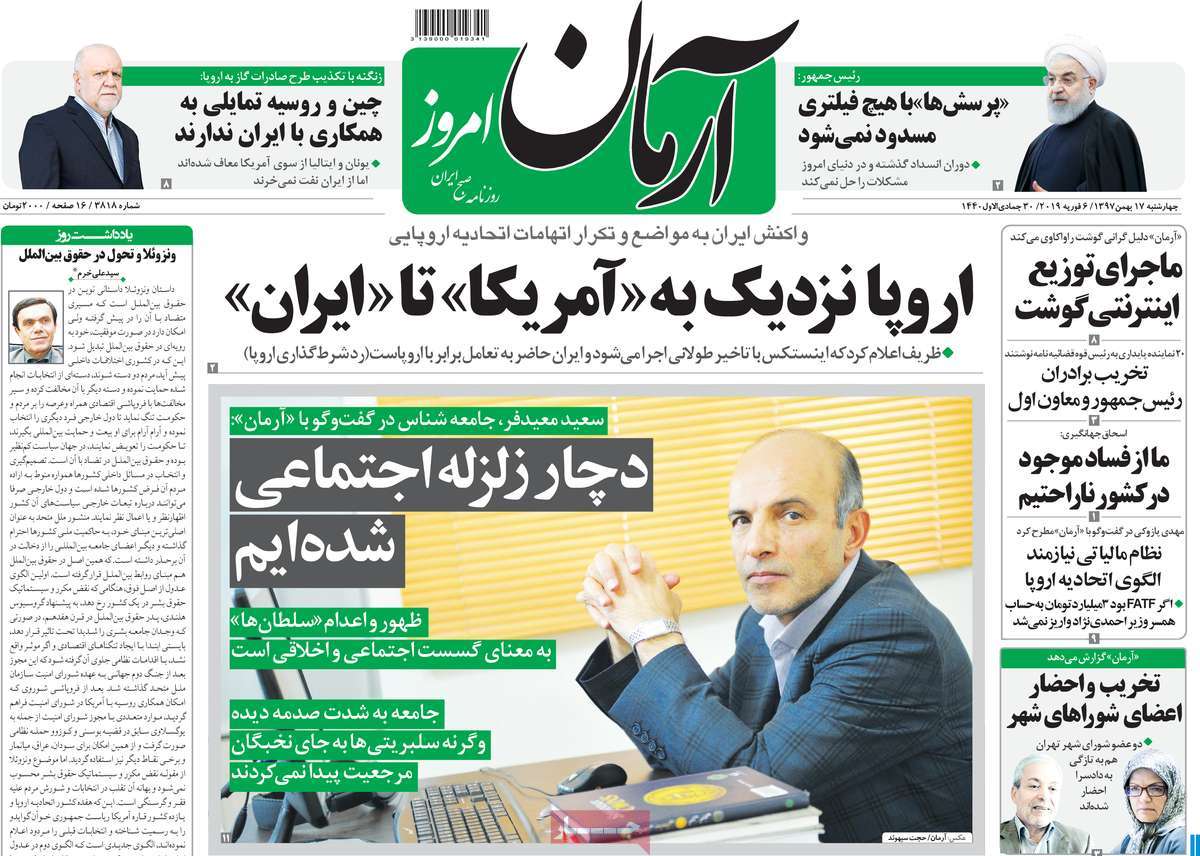
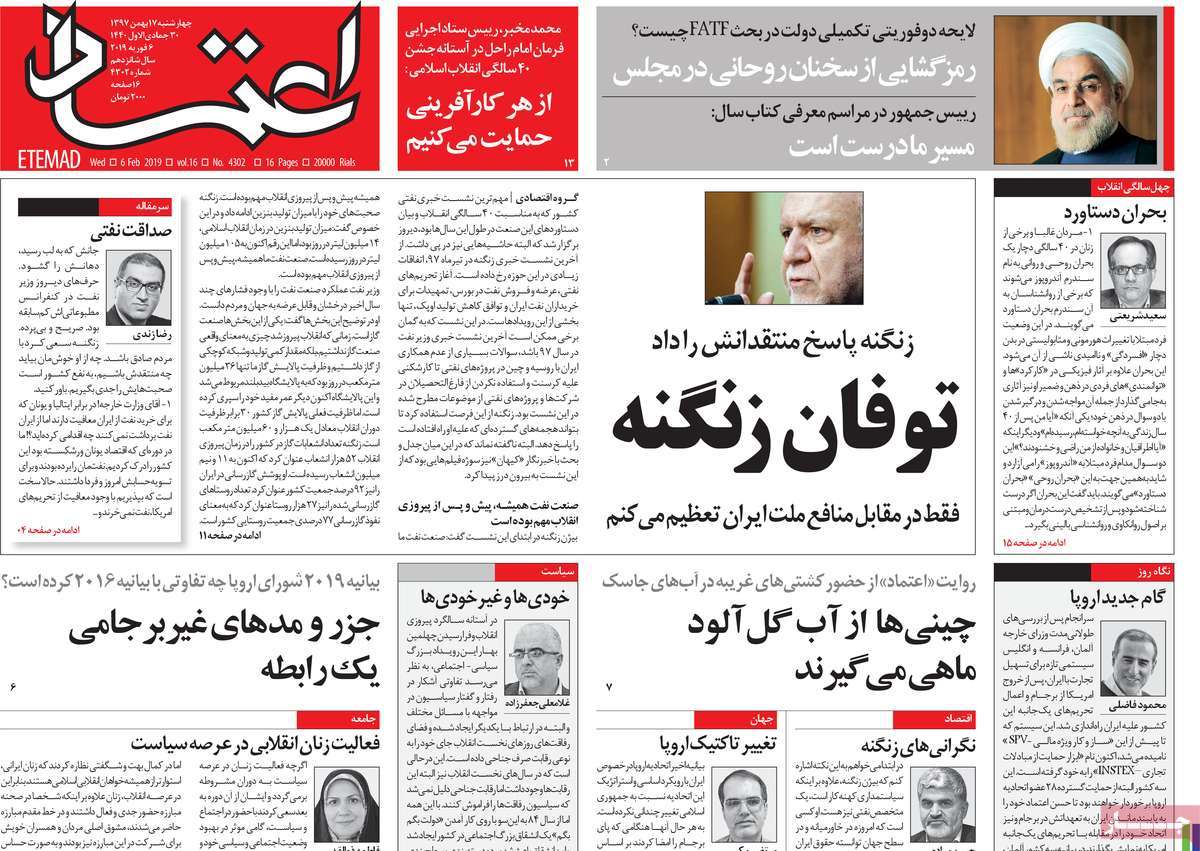
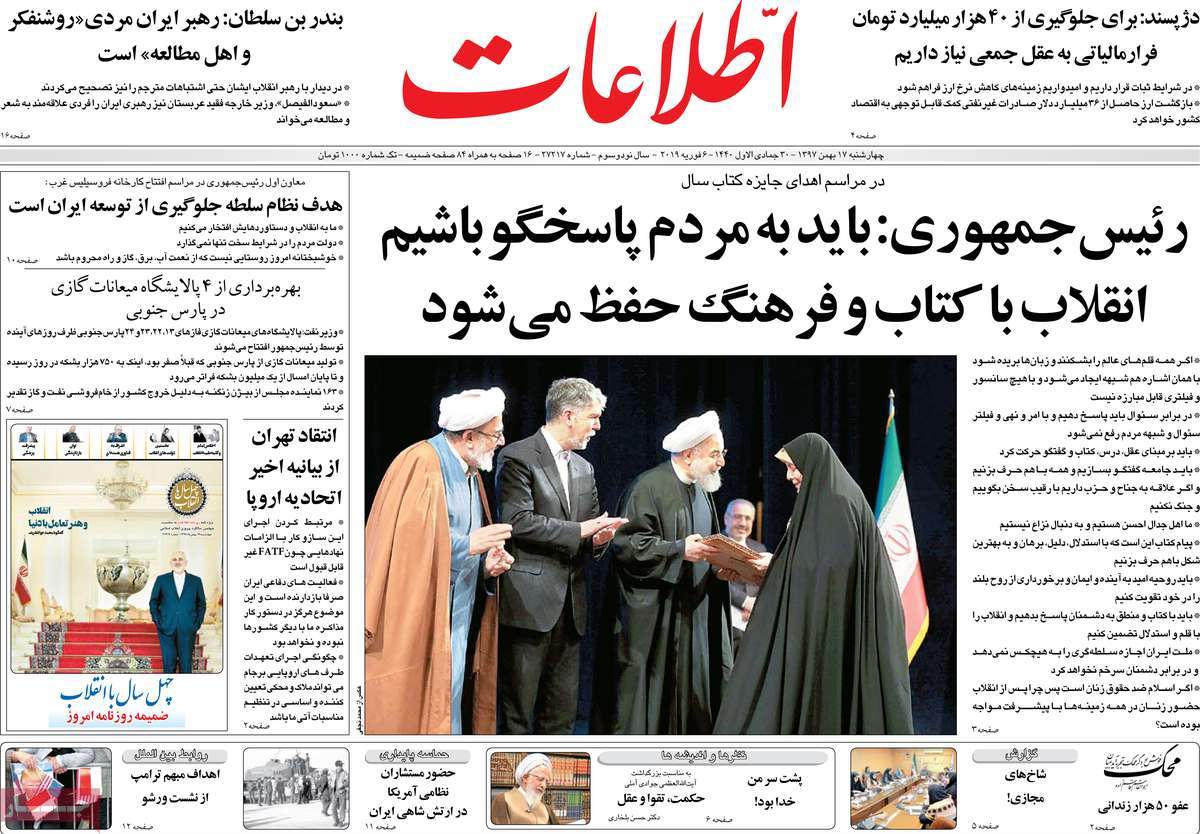
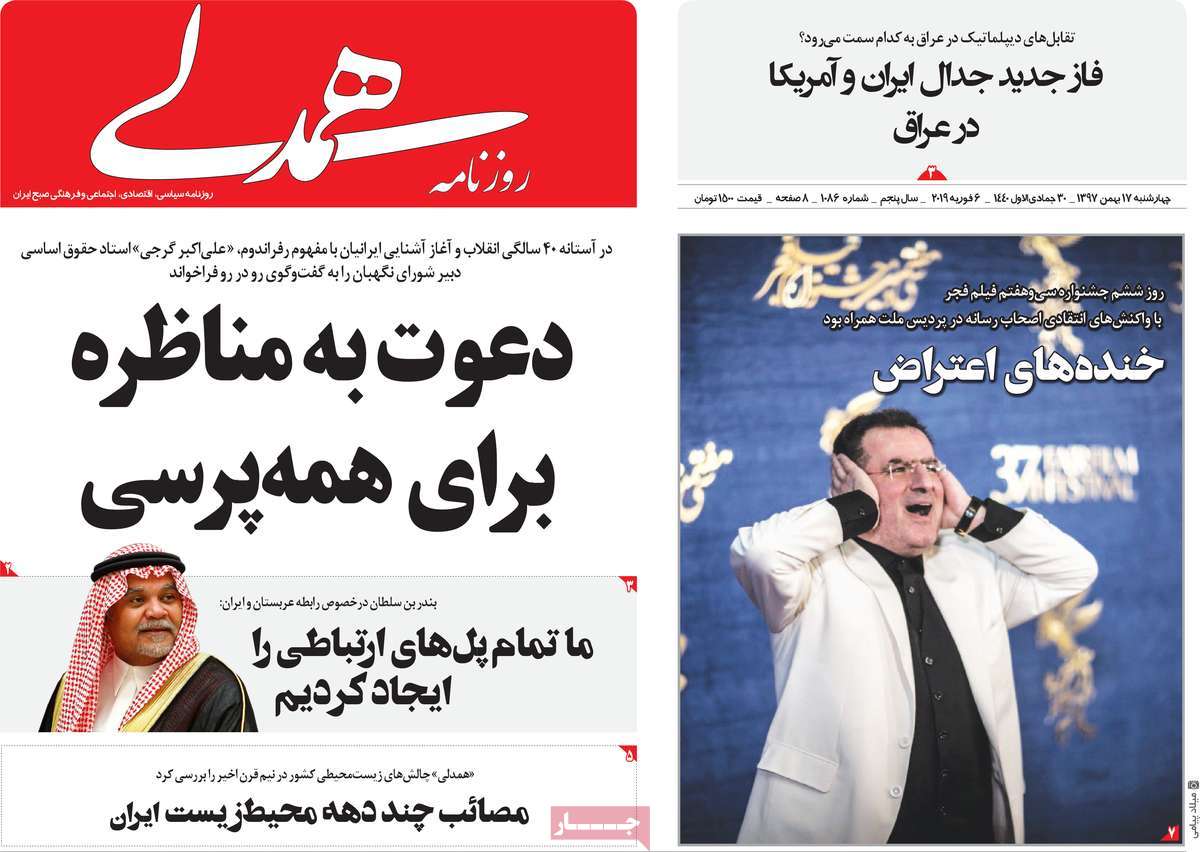
A Look at Iranian Newspaper Front Pages on February 6

A Look at Iranian Newspaper Front Pages on November 19

A hot topic of Iranian newspapers today was controversies surrounding the registration of Europe’s special mechanism to protect Iran-EU trade from US sanctions, known as INSTEX.

The trip of Syrian Foreign Minister Wallid al-Muallem to Tehran, which came after the signing of major economic deals between Iran and Syria during a visit of Iran’s First Vice-President Es’haq Jahangiri to Damascus, caught considerable attention in Iranian media.

The above issues, as well as many more, are highlighted in the following headlines and top stories:


Abrar:

  • Balance in JCPOA Disrupted: Araqchi
  • Syria, Turkey Held Two Security Meetings in Tehran: Ex-Syrian Diplomat
  • Guaido Rejects Possibility of Civil War in Venezuela

A Look at Iranian Newspaper Front Pages on February 6


Aftab-e Yazd:

  • Pentagon: Impact of Sanctions on Iran Has Been Limited
  • Oil Minister’s Hot Answers to Journalists’ Serious Questions
  • JCPOA Enabled US to Increase Oil Production by 1m Barrels
  • Without JCPOA, Persian Gulf Star Refinery Could Not Be Launched, We Couldn’t Become Self-Sufficient in Petrol Production

A Look at Iranian Newspaper Front Pages on February 6


Arman-e Emrouz:

  • Questions Cannot Be Censored: President
  • Even China, Russia Unwilling to Cooperate with Iran: Oil Minister
  • Europe Closer to US than Iran

A Look at Iranian Newspaper Front Pages on February 6


Ebtekar:

  • Triangular Crisis of Bolivarians: Review of Latest Political Developments in Venezuela

A Look at Iranian Newspaper Front Pages on February 6


Etemad:

  • Chinese Catching Fish in Troubled Waters [Chinese Fishing Vessels Near Persian Gulf]
  • Ups and Downs of Iran-Europe Relations

A Look at Iranian Newspaper Front Pages on February 6


Ettela’at:

  • Revolution to Be Kept by Books, Culture: President
  • Iran Leader Is Intellectual, Bookish: Bandar bin Sultan
  • Tehran Criticizes EU’s Recent Statement

A Look at Iranian Newspaper Front Pages on February 6


Hamdeli:

  • New Phase of Iran-US Standoff Starts in Iraq
  • We’ve Created Communication Bridges [for Ties with Iran]: Bandar bin Sultan

A Look at Iranian Newspaper Front Pages on February 6


Iran:

  • Iran to Give Decisive Response If Israel Attacks Syria: SNSC Secretary
  • Iran Holds Top Rank in Region on Satellite Launch: Official

A Look at Iranian Newspaper Front Pages on February 6


Jomhouri Eslami:

  • President Rewards Top Iranian, Foreign Writers
  • Europeans Set No Condition on FATF: Zarif
  • We Won’t Get Permit for Entering Syria: Erdogan
  • Two Iraqi Parliamentary Factions Oppose US Military Presence in Iraq

A Look at Iranian Newspaper Front Pages on February 6


Kayhan:

  • 70 Years of US Investment in Forming Arab Armies Futile: Foreign Policy
  • Iran Joins Four Countries Producing Factor VIII Drug

A Look at Iranian Newspaper Front Pages on February 6


Khorasan:

  • India, Russia Agree to Complete North-South Corridor

A Look at Iranian Newspaper Front Pages on February 6


Mardomsalari:

  • Saudi Arabia to Receive $31-Billion Loan to Address Budget Deficit
  • Syrian FM Comes to Iran: Post-Conflict Diplomacy of Iran-Syria

A Look at Iranian Newspaper Front Pages on February 6


Sazandegi:

  • Oil Minister Defends Iran’s Oil Policies amid New Sanctions

A Look at Iranian Newspaper Front Pages on February 6


Shargh:

  • Oil Minister: Italy, Greece Refused to Use Oil [Sanctions] Exemptions
  • Is INSTEX Crack on Wall of Trump’s Sanction?

A Look at Iranian Newspaper Front Pages on February 6

Iraq Allows Iranian Traders to Open Accounts in Its Banks

“According to an agreement reached with the Central Bank of Iraq, Iranian exporters can operate through Iraqi banks, and in this regard, Iranian banks can have dinar-denominated accounts in Iraqi banks,” he said.

On Tuesday, Iran and Iraq agreed on a payment mechanism that will enable the two neighbors to do business in the face of US sanctions on Tehran.

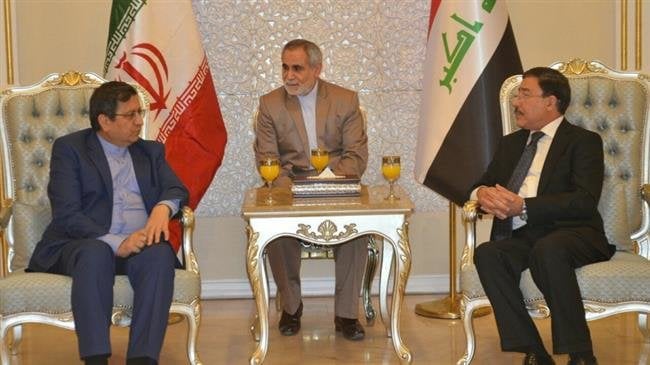
The mechanism was discussed in a meeting between Hemmati and his Iraqi counterpart  Ali Mohsen Ismail al-Alaq in Baghdad and the details were signed off on a document Tuesday night.

Hemmati met Iraqi bank directors, members of chambers of commerce and traders on Wednesday, saying the two sides had reached “good agreements.”

“According to the agreement, the Central Bank of Iran will have euro- and dinar-denominated accounts in Iraqi banks and gas and oil exchanges will be carried out via these accounts,” he said.

“Iraqi companies can also open accounts in Iranian banks and do trade in dinars,” said Hemmati who also announced that he agreed with a request for Iraqi banks to open branches in Iran.

“Therefore, with these agreements and the blessing of the Iraqi prime minister, banking relations between Iran and Iraq will be much stronger, and the expansion of trade relations between the two countries will take shape on this basis,” he added.

Hemmati arrived in the Iraqi capital on Tuesday to discuss banking relations and a payments backlog related to Iran’s gas and electricity exports to the Arab country, he wrote on his Instagram account.

Iraq is Iran’s biggest trade partner, but their relations are increasingly coming under pressure from the US which imposed unilateral sanctions on Tehran in May after abandoning an international nuclear agreement.

On Tuesday, Minister of Petroleum Bijan Zangeneh summed up the tricky situation.

“Every month, $200 million worth of Iranian gas is exported to Iraq which does not pay it, saying you are under sanctions. At the moment, we have $2 billion owed by Iraq for the gas and electricity sold to the country,” he said.

“We had an oil swap from Kirkuk. After the sanctions, the Iraqis stopped that too,” Zangeneh told a news conference in Tehran.

The swap deal was agreed at the end of 2017, under which Iraq was about to truck 60,000 barrels per day (bpd) of crude oil to Kermanshah in western Iran. Iraq’s southern Basra port would receive the same amount of crude from Iran either by tanker or pipeline.

The Iraqis made several batches of shipments but stopped them prior to Washington’s sanctioning of Iran’s oil sector on November 5.

Nevertheless, Iraq relies on Iran for electricity and consumer goods and trade ties are still strong.

Gas imports from Iran generate as much as 45 percent of Iraq’s 14,000 megawatts of electricity consumed daily. Iran transmits another 1,000 megawatts directly, making itself an indispensable energy source for its Arab neighbor.

Basra was hit by violent protests which spread to other cities last summer, partly because of a halt of Iranian electricity exports.

Iranian officials have said the country is pushing forth with a 2025 vision plan to raise its exports to Iraq to $20 billion a year despite US pressures on Baghdad to keep Tehran at arm’s length.

Foodstuff, livestock, construction material and plastic products constitute the bulk of Iran’s exports to Iraq. Iranian vehicles and food items are a ubiquitous sight in Iraq.