Tuesday, December 23, 2025
Home Blog Page 3359

Iran Urges Pope Francis Not to Remain Indifferent to US Sanctions

Pope Francis meets US President Donald Trump and his wife Melania during a private audience at the Vatican, May 24, 2017. / Photo by Alessandra Tarantino, Reuters

Seyyed Mostafa Mohaqqeq Damad, the head of the Department of Islamic Studies at the Iranian Academy of Sciences, asked the Pontiff in a letter to speak out against the sanctions imposed by a large Christian country against the Iranian nation.

Despite reports by the International Atomic Energy Agency (IAEA) which for 12 times confirmed Iran’s compliance with the nuclear deal, “the US president unilaterally withdrew his country from the deal,” Mohaqqeq Damad said in the letter.

“As you know the principle of sticking to on one’s commitments is highly respected in all religions. The US president has also gone further by making bitter decisions which are directly hurting the Iranian nation. The sufferings which are to be inflicted on the Iranians are no secret anymore and they are not restricted to the shortage of food and medicine,” the letter said.

He said the human conscience can never accept the suffering of children, the elderly, pregnant women and other vulnerable groups of the society.

“Such inhumane decisions put these people in trouble and they may even lose their lives due to severe shortage of basic commodities. Regrettably the decisions are being made by the leader of a country which is mostly Christian-populated and its people follow the instructions of the prophet of peace, friendship and love.”

“It is more regrettable that the decisions are made in an era during which you hold the leadership of the world’s Catholic Christians and are highly respected by the followers of other religions,” he noted.

The letter comes as the Trump administration is going to re-impose the US sanctions on the Islamic Republic on November 5.

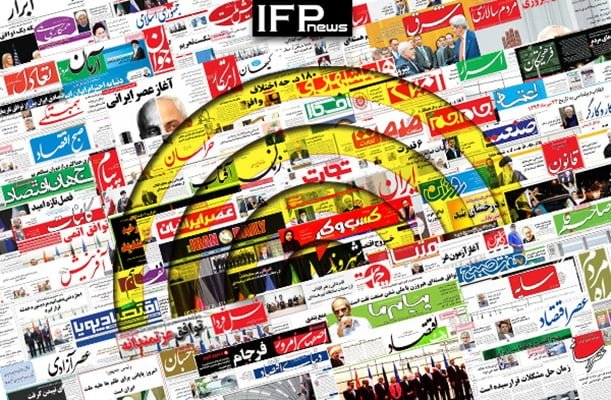
A Look at Iranian Newspaper Front Pages on November 4

A Look at Iranian Newspaper Front Pages on November 19

Newspapers today widely covered the comments made by the Leader of Iran’s Islamic Revolution Ayatollah Seyyed Ali Khamenei about the failure of US policies towards Iran in the past four decades.

The top story, however, was the re-imposition of the US sanctions on Iran and the meme the US president tweeted about it, which sparked widespread reactions on social media.

The first leg of the final match of AFC Champions League between Iran’s Persepolis and Japan’s Kashima Antlers, which ended in a 2-0 defeat for the Iranian side, also received great coverage. Several particularly covered the broadcast of the match for Iranian schoolchildren across the country, which was realized after a rare decision by the Education Ministry.

The above issues, as well as many more, are highlighted in the following headlines and top stories:


Abrar:

1- Iran Foreign Ministry: Re-imposition of Sanctions Ethical, Political Failure for US

2- Zarif Holds Phone Talks with Mogherini, German, Danish, Swedish FMs

  • EU’s Financial Mechanism to Be Officially Established in Coming Days
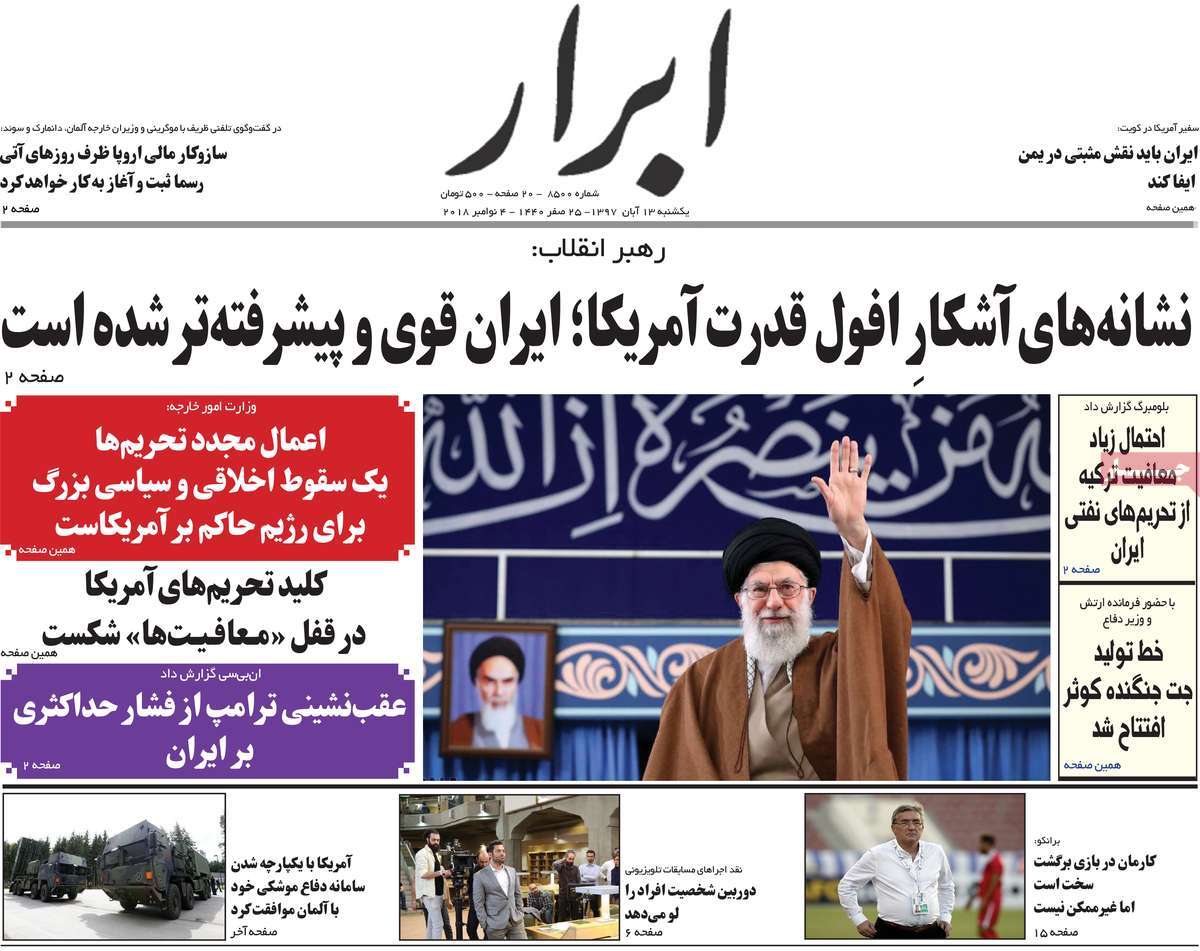
A Look at Iranian Newspaper Front Pages on November 4


Afkar:

1- Army Chief: Iran’s Mass Production of Kowsar Jet Shows Sanctions Futile

2- Iran DM: Kowsar Interceptor Jet Symbol of Fight against Arrogance

3- Zarif: Sanctions, Unilateral Measures to Disrupt Global Economy
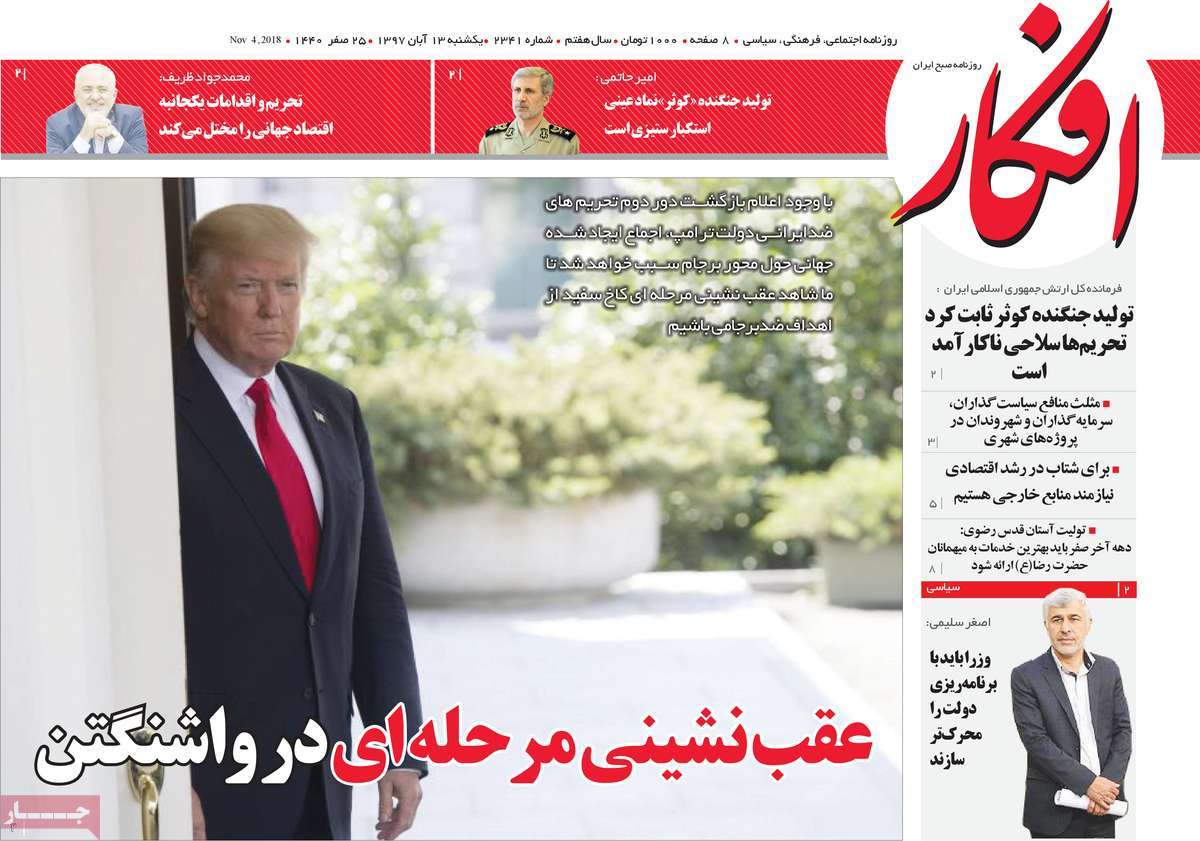
A Look at Iranian Newspaper Front Pages on November 4


Aftab-e Yazd:

1- Why Were Iranian Planes Grounded in Turkey Airport?

2- Doubts and Hopes towards Europe
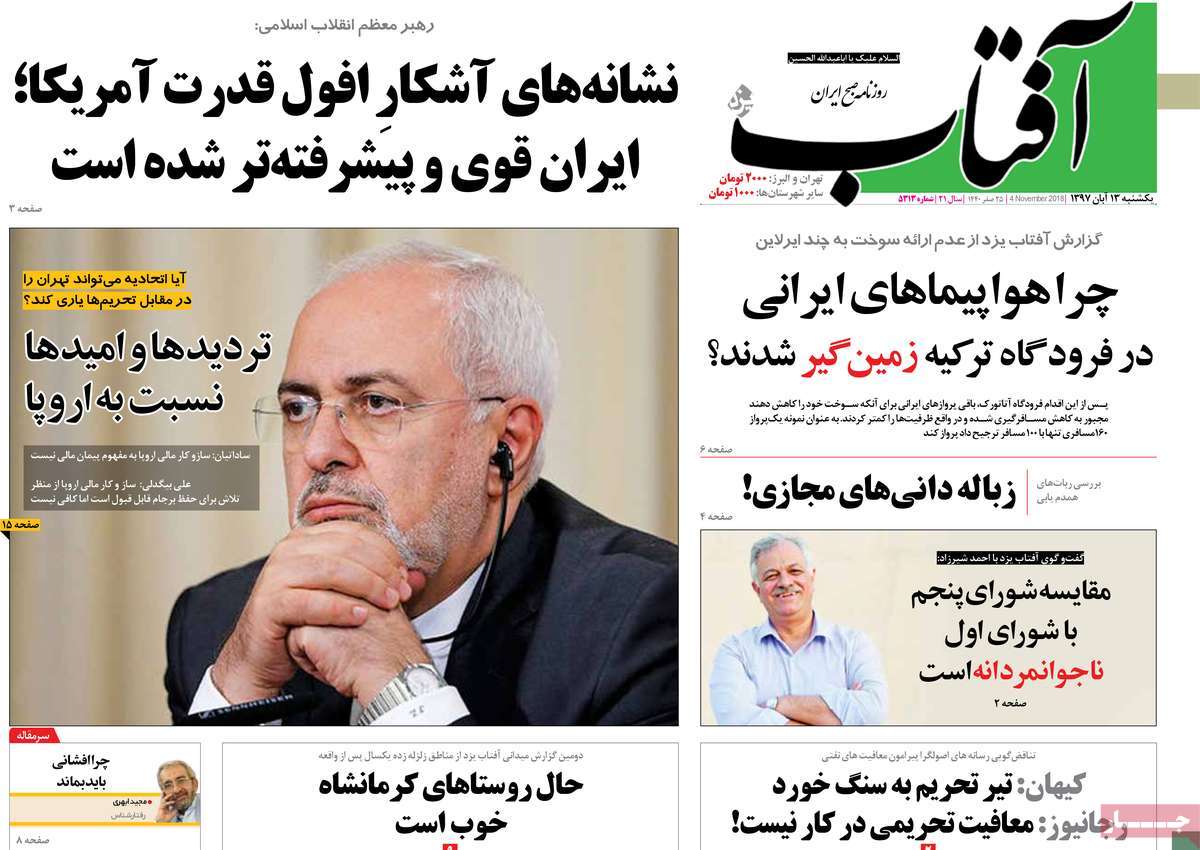
A Look at Iranian Newspaper Front Pages on November 4


Arman-e Emrooz:

1- Iran Leader: US Has Been Defeated by Islamic Republic for 40 Years

2- Iranian Cleric to Pope Francis: Don’t Remain Indifferent; Admonish Trump!
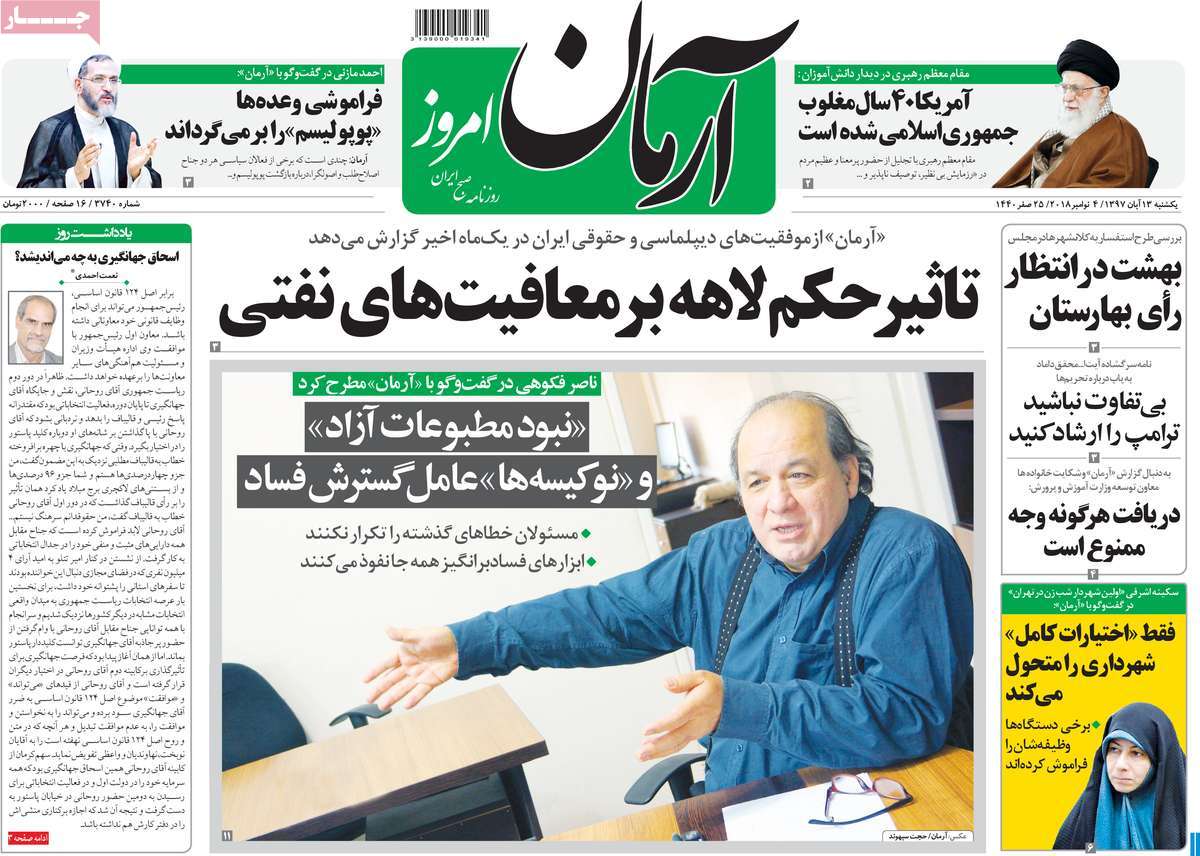
A Look at Iranian Newspaper Front Pages on November 4


Donya-ye Eqtesad:

1- Iran Leader: US’ Soft Power Lower than Ever

2- Iranian Markets Stable ahead of Nov. 4 Sanctions
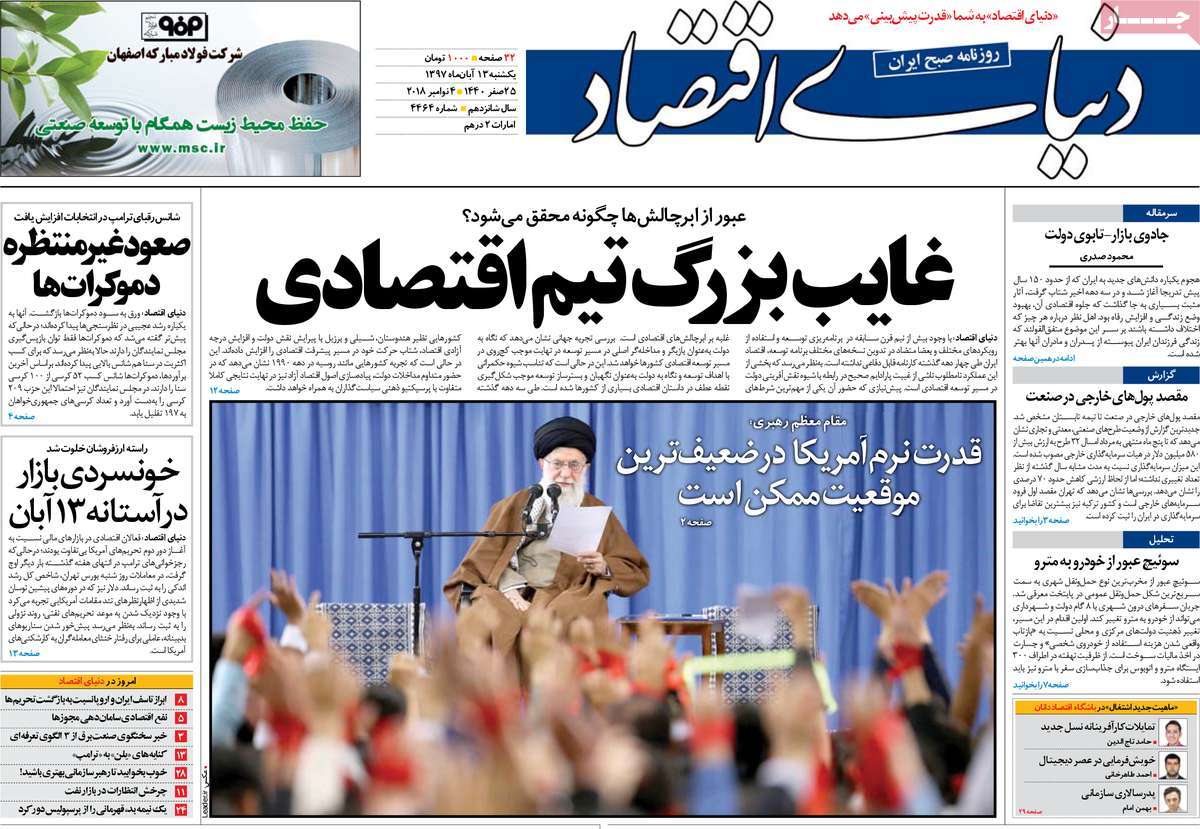
A Look at Iranian Newspaper Front Pages on November 4


Ebtekar:

1- US Alone with Its Sanctions on Iran

2- Break for Watching Football

  • When Football Becomes More Important than Work, School
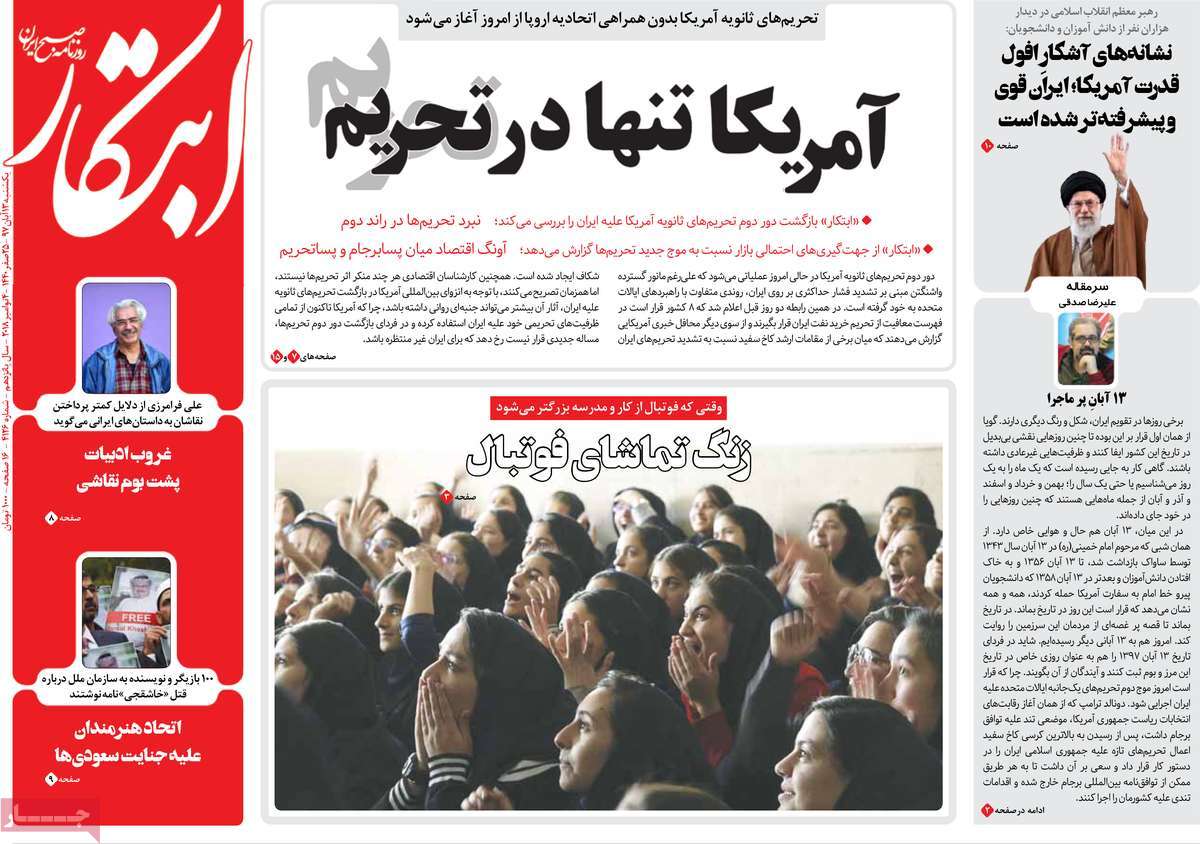
A Look at Iranian Newspaper Front Pages on November 4


Etemad:

1- Iran Leader: US Condemned to Be Purged from List of World Powers

2- National Consensus against US Sedition [Editorial]
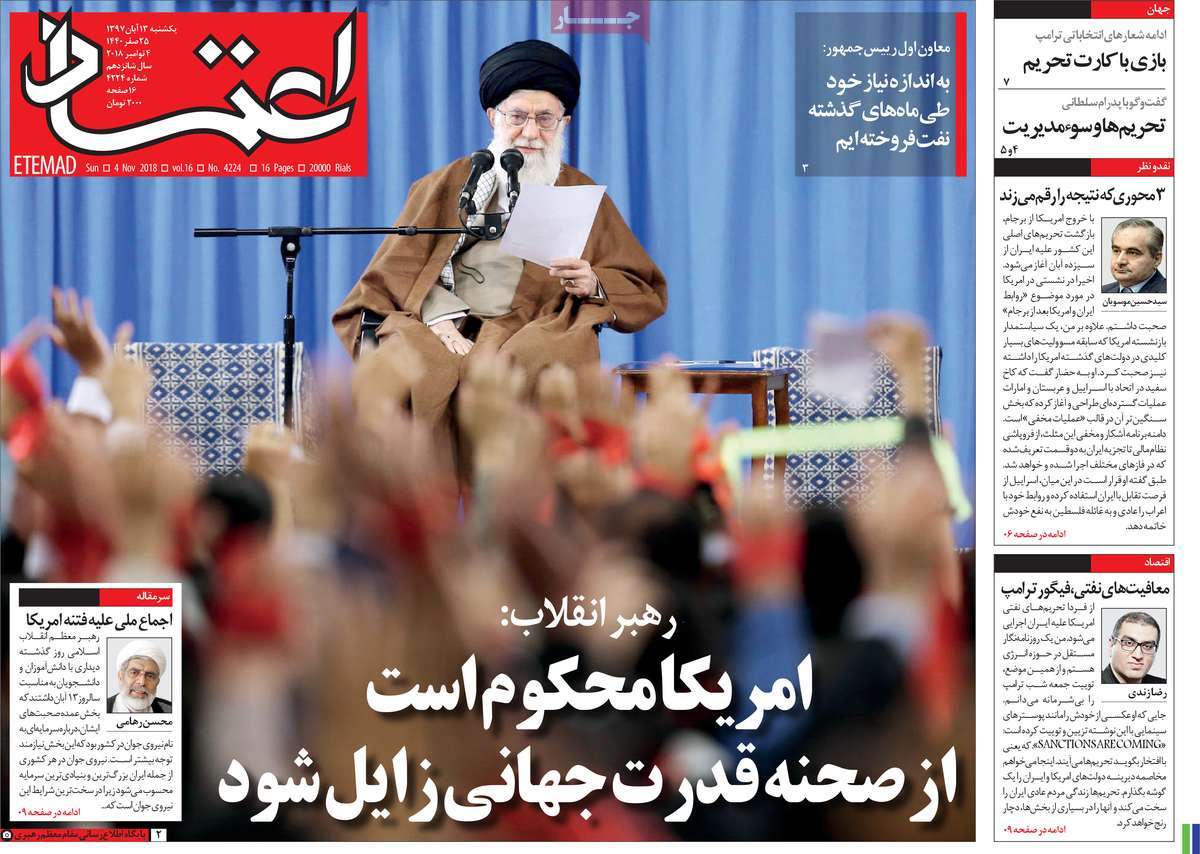
A Look at Iranian Newspaper Front Pages on November 4


Ettela’at:

1- Zarif Calls for Countering Unilateral Measures against Iran

2- Erdogan: Highest-Ranking Saudi Officials Ordered Khashoggi’s Murder
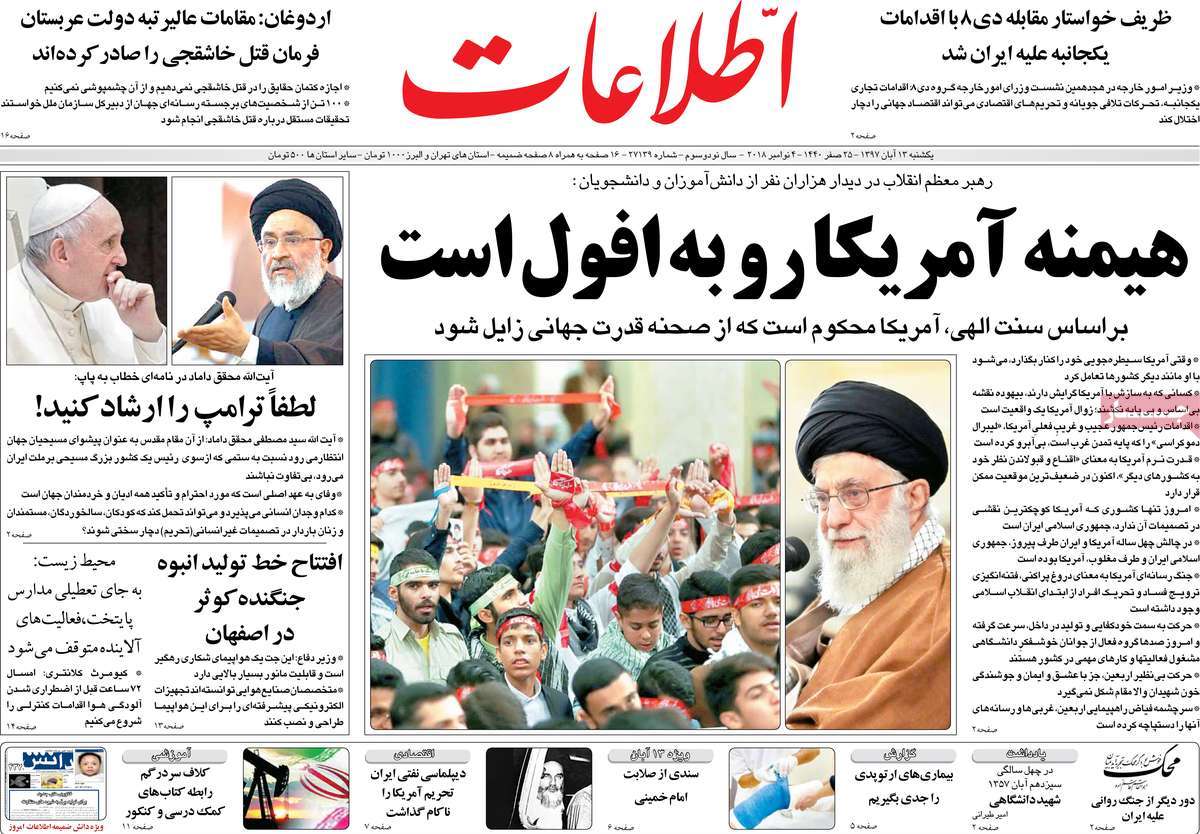
A Look at Iranian Newspaper Front Pages on November 4


Haft-e Sobh:

1- Is Trump a White Walker?

  • Links between Game of Thrones, World of Politics Still Surprising Us

2- Biggest Anti-Espionage Operation

  • CIA Admits Iran Hackers Attacked Big Espionage Network
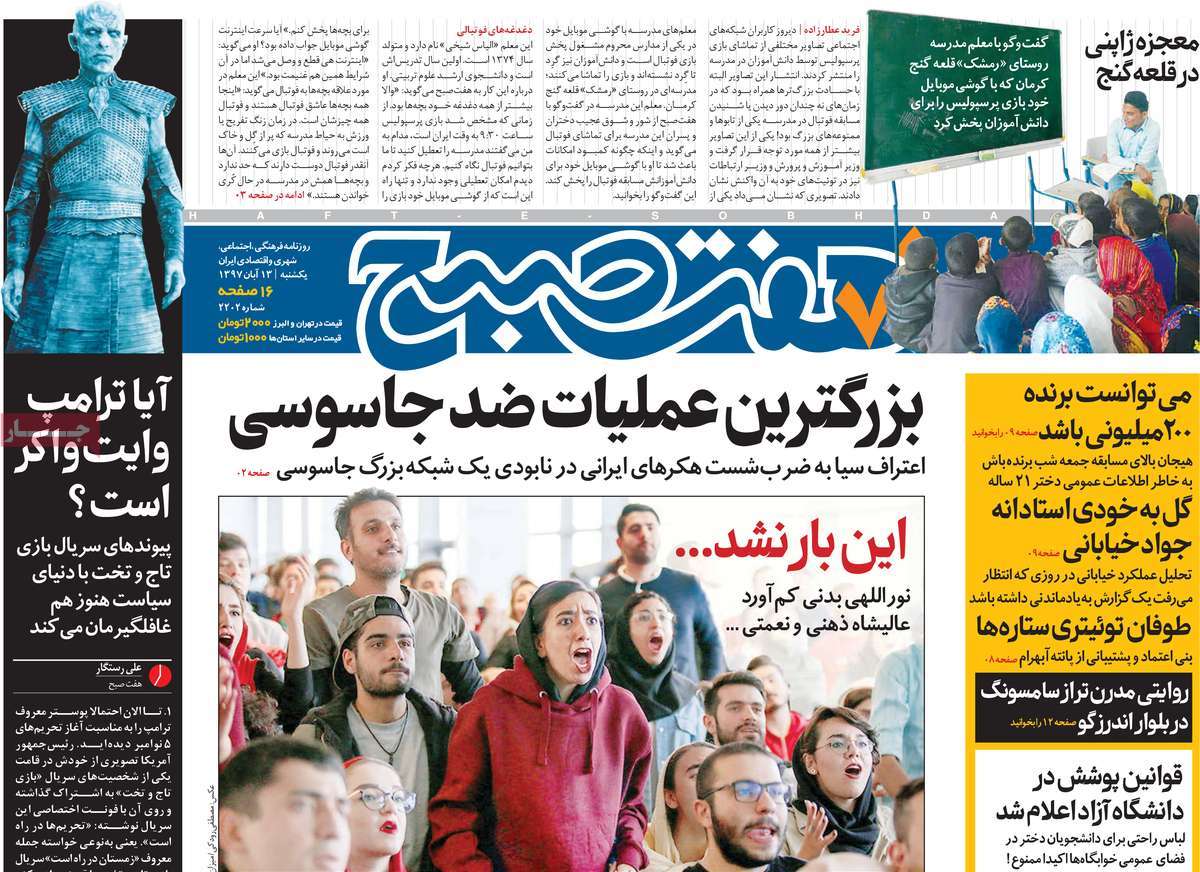
A Look at Iranian Newspaper Front Pages on November 4


Iran:

1- Practising Happiness: A Report on Watching Football at Schools

2- Europe, Russia Say Big ‘No’ to Trump’s Anti-Iran Threats
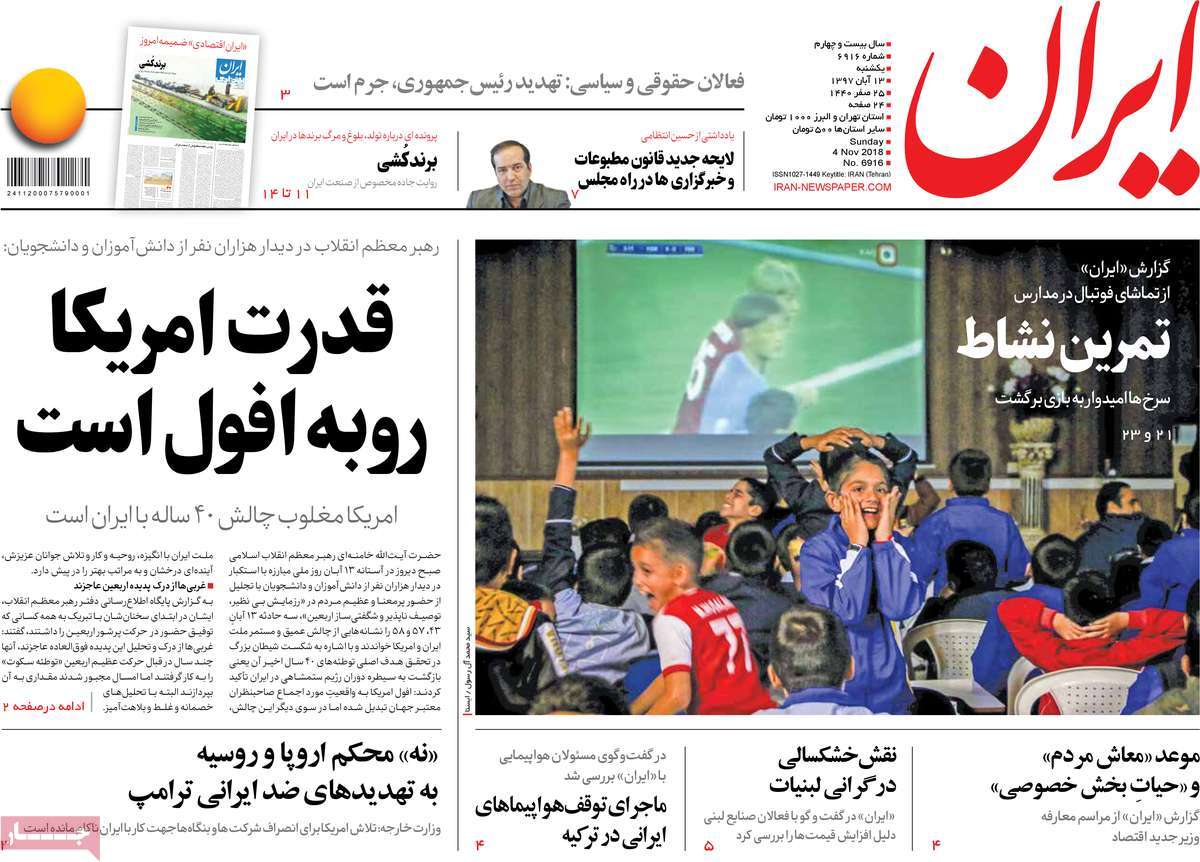
A Look at Iranian Newspaper Front Pages on November 4


Jame Jam:

1- Game of Trump! Trump’s Use of GoT Poster Mocked by Iranian Netizens
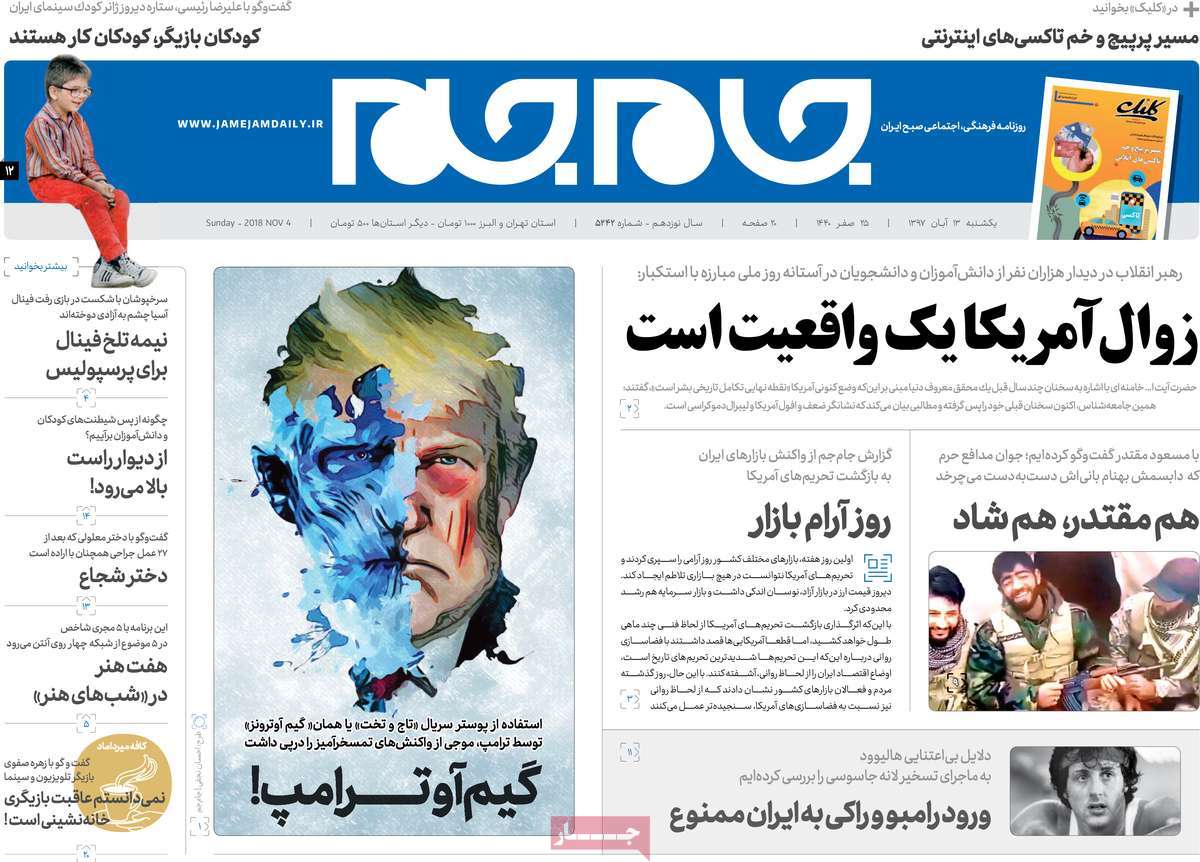
A Look at Iranian Newspaper Front Pages on November 4


Javan:

1- US Harmed by Increased Oil Prices, Trade War

2- Covert Regime Change in Saudi Arabia

  • Bin Salman’s Opponents Gradually Being Released under Pressure of Khashoggi Murder
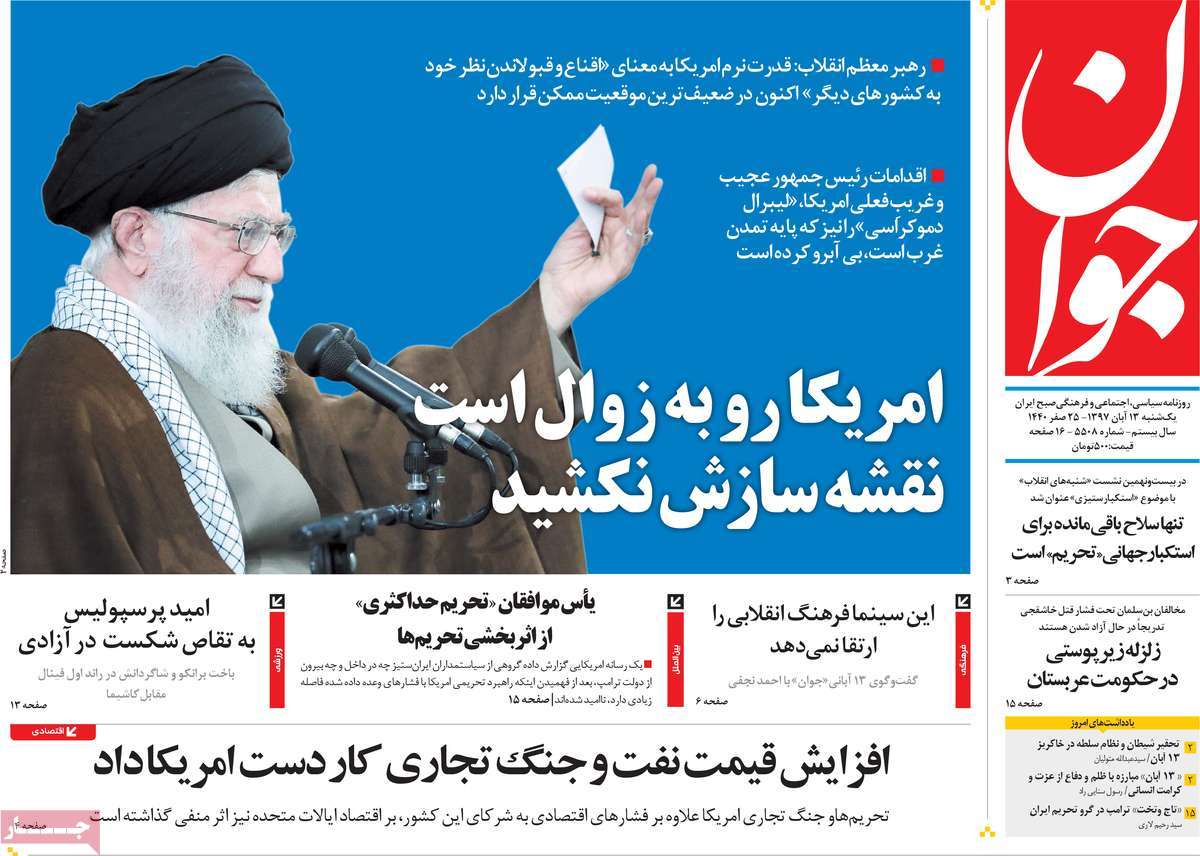
A Look at Iranian Newspaper Front Pages on November 4


Jomhouri Eslami:

1- Iran’s Silent Oil Diplomacy Thwart US’ Sanctions

2- Nationwide Anti-Arrogance Rallies on Nov. 4
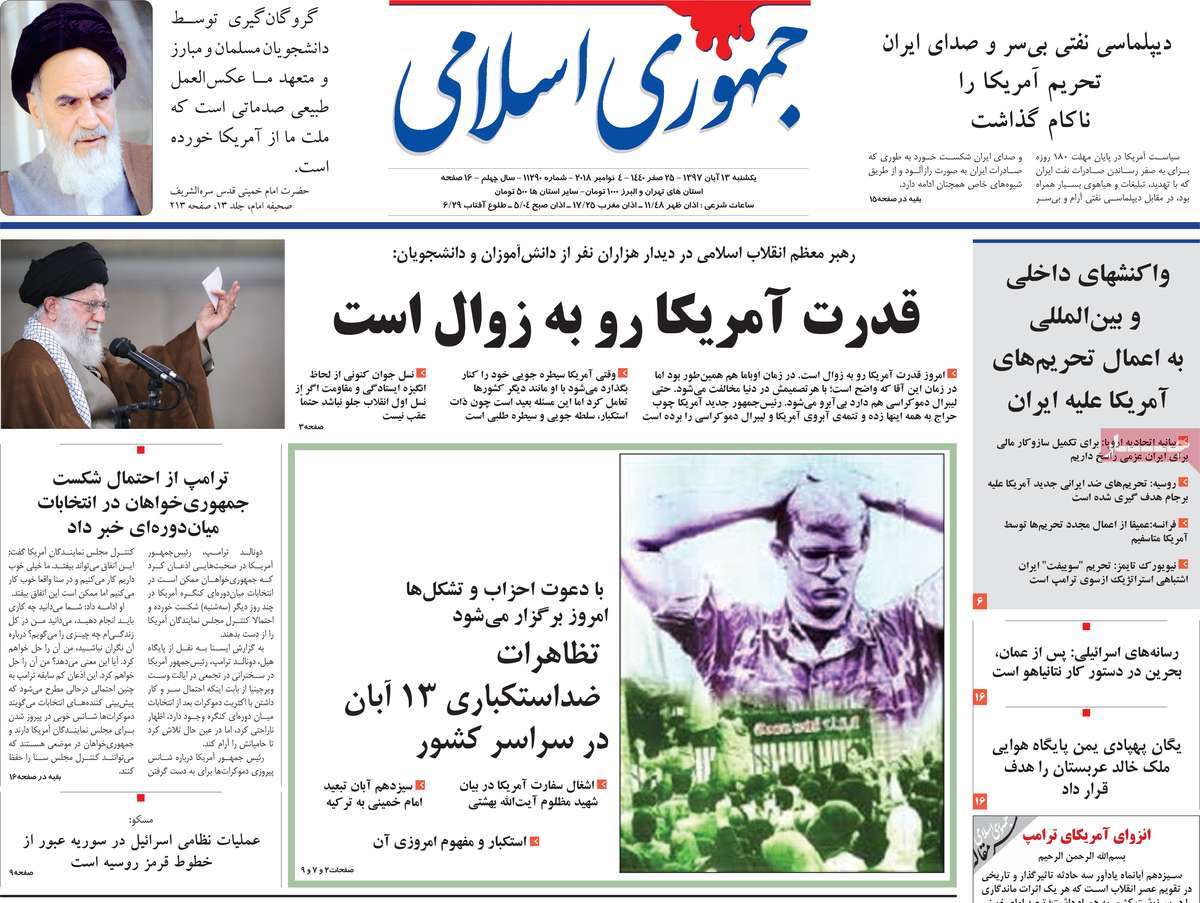
A Look at Iranian Newspaper Front Pages on November 4


Kayhan:

1- Iran Leader: Westerners Unable to Understand Miracle of Arba’een March

2- US Strategist: Trump Punishing American People through Sanctions on Iran

3- Iran’s Withdrawal from JCPOA Only Way to Activate Europe’s Financial Mechanism
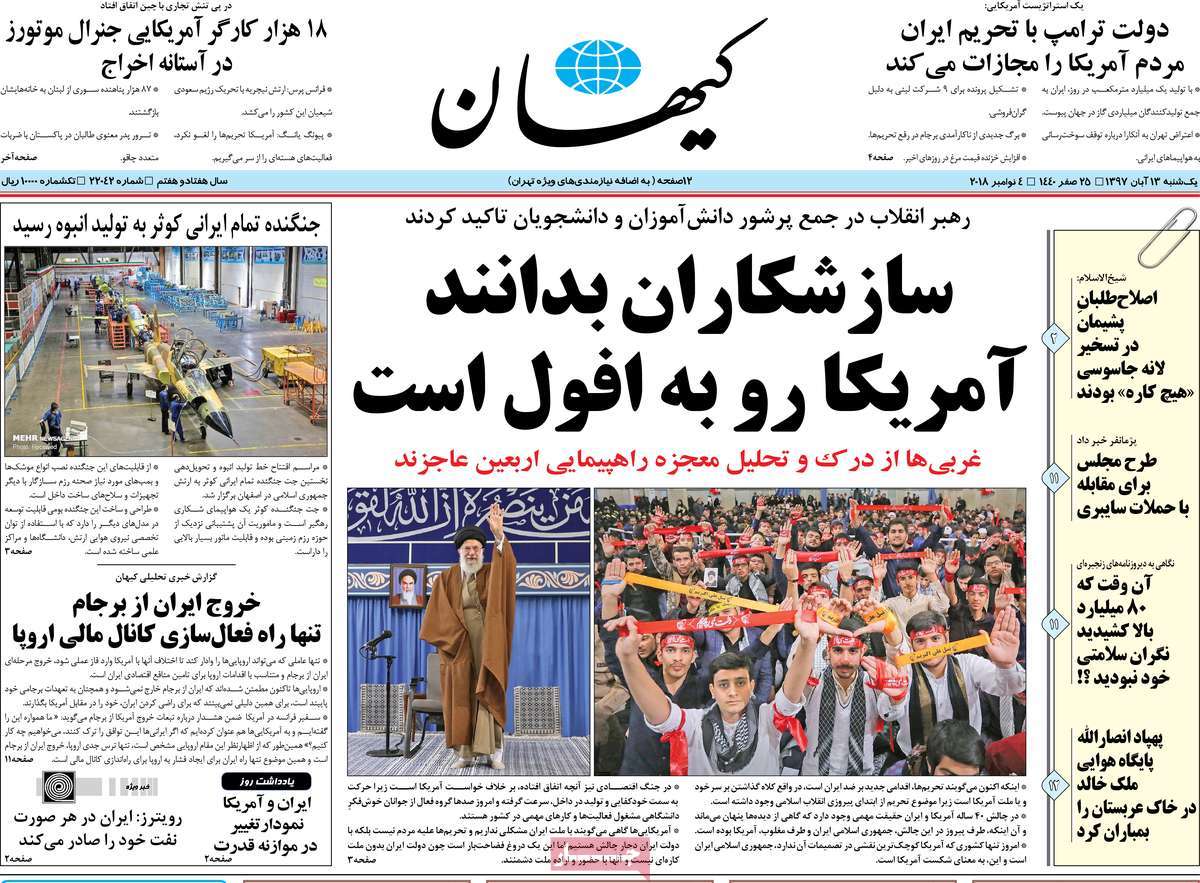
A Look at Iranian Newspaper Front Pages on November 4


Sazandegi:

1- We Won’t Return to the Past

  • A Report on Political-Economic Consequences of Re-imposed US Sanctions

2- Decline of US a Reality: Iran Leader

3- Europe’s List against US Sanctions
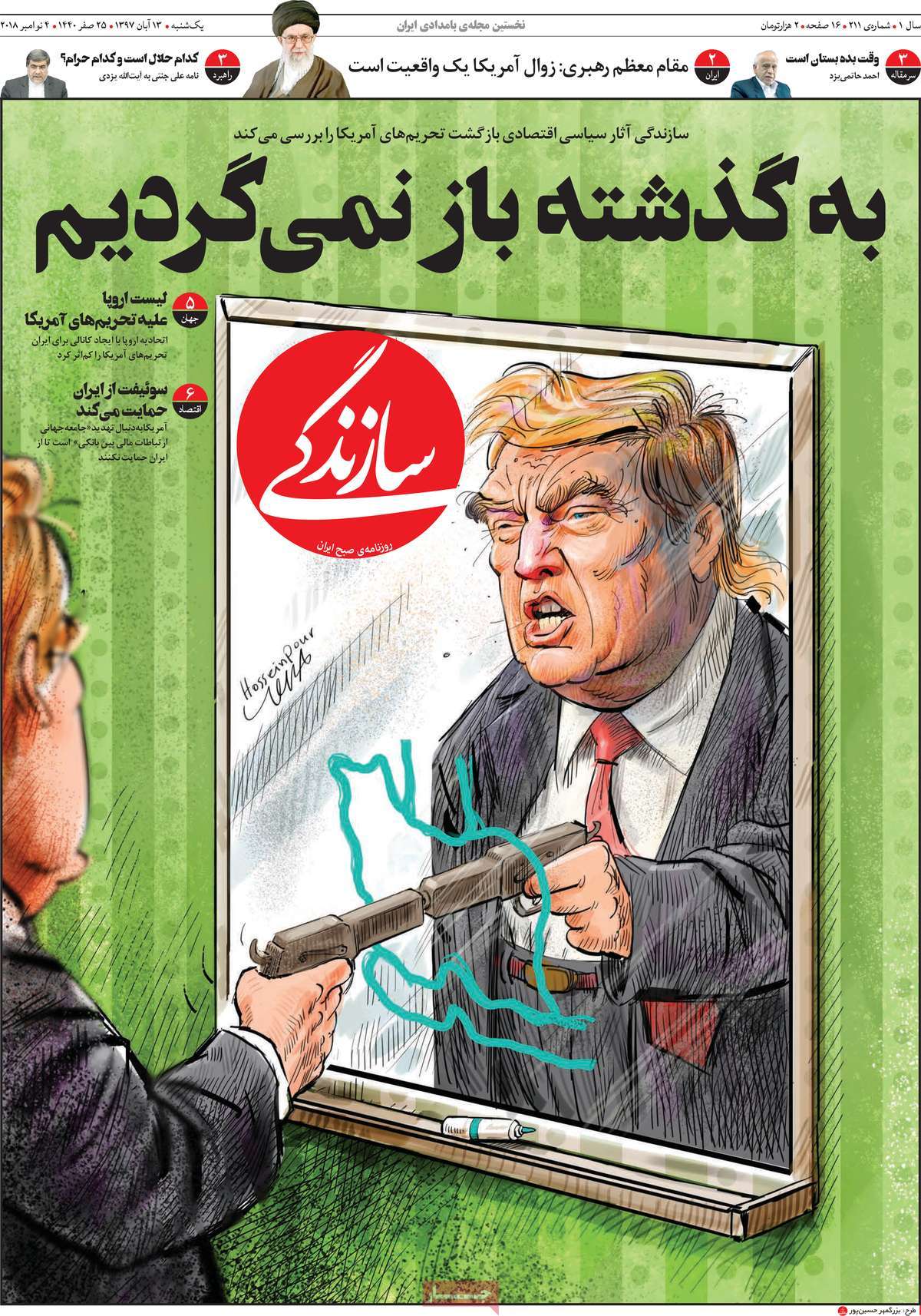
A Look at Iranian Newspaper Front Pages on November 4


Shahrvand:

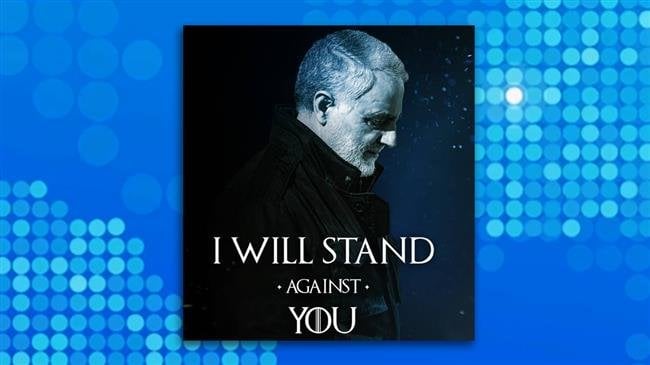
1- I Will Stand against You: General Soleimani in Reaction to Trump’s Meme

  • Iranian Social Media Users Mock Trump’s Anti-Iran Tweet
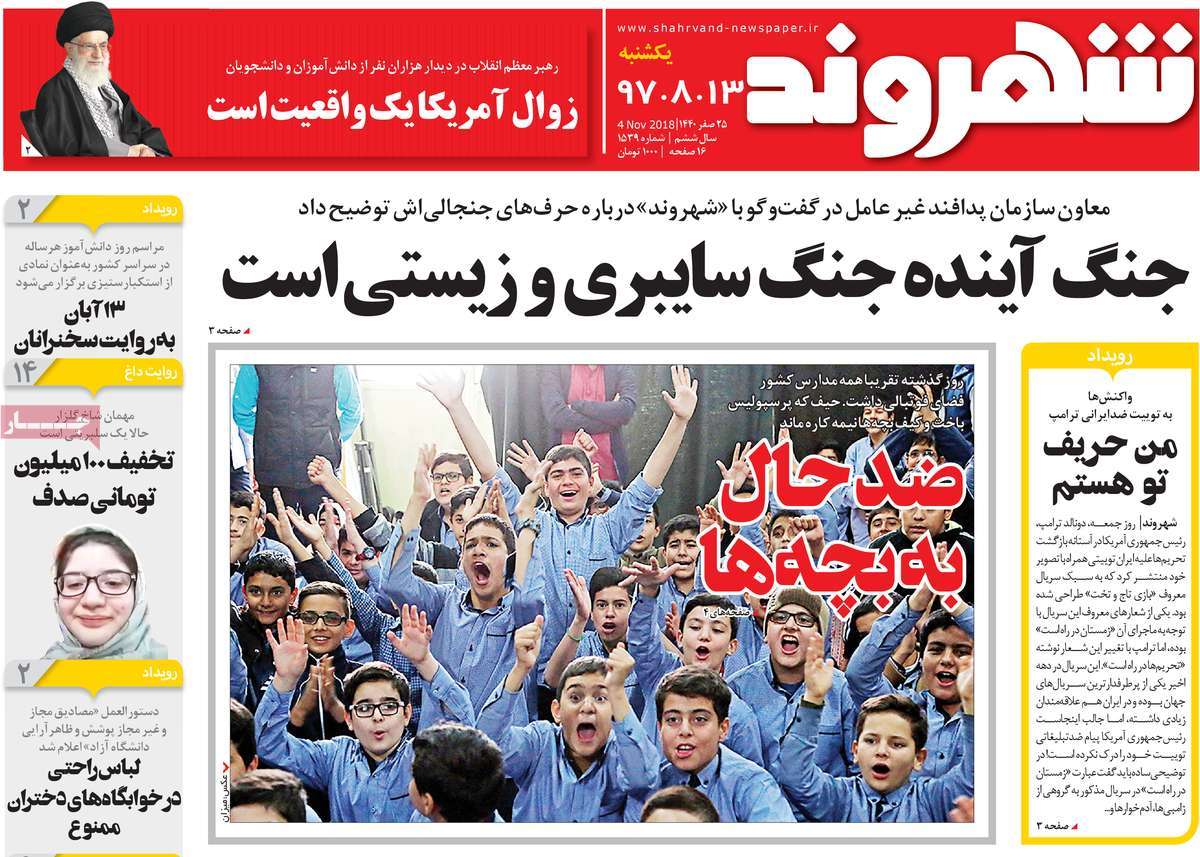
A Look at Iranian Newspaper Front Pages on November 4


Shargh:

1- Trump’s Insistence, Europe’s Resistance

2- Nov. 4 and US Sanctions [Editorial]

3- Iran Envoy to UK: Those Leaving Saudi-Funded Anti-Iran TV Channel Will Be Supported

A Look at Iranian Newspaper Front Pages on November 4

Mastermind of Iran Sanctions under Fire for Shedding Crocodile Tears

Inspired by the “Game of Thrones” TV series, US President Donald Trump recently published a picture bearing the sentence “Sanctions Are Coming”.

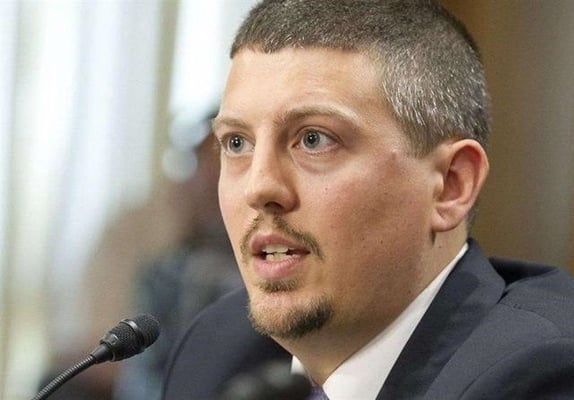
Richard Nephew, the key mastermind of Iran sanctions during the Obama administration, condemned the action by Trump as disgusting, and urged him not to express joy over the bans.

“This is frankly disgusting. I was responsible, directly, for US sanctions against Iran for a long while. I took pride in their development, design and use. But not joy. Having to do this is lamentable and will impose very real, human costs. Take this seriously, please,” Nephew wrote on his Twitter page.

His criticism of Trump, however, was slammed by social media users in Iran, who drew a parallel between him and the Trump administration.

Users not only did not take Nephew’s criticism of Trump’s new sanctions seriously, they also blasted him for inflicting suffering and hardship on Iranian people by orchestrating sanctions during the term of the Obama administration.

A Twitter user criticized him for taking pride in endangering innocent people’s lives and depriving them of basic medicines.
Another user wrote ironically that Nephew is feeling bad for a mistake he had made and now the problem is solved!

Some users accused Nephew of being narcissistic.

Most users said he was not honest in his criticism as he said he was proud of having masterminded the Iran sanctions.

A user criticized him for taking pride in paralyzing a country and directly imposing suffering and hardships on Iranians.

After leaving the Obama administration, Nephew turned to research work and now is working as a senior researcher at the Centre on Global Energy Policy at Columbia University and sometimes publishes reports on Iran.

The Trump administration is gearing up to implement phase two of sanctions against Iran as of Monday.

Iran May Use Russia’s Sukhoi to Modernise Its Air Fleet

Undated photo of a Sukhoi-100 passenger plane

Fazaneh Sharafbafi said Iran Air has a strategic plan for the next three years in the face of the US sanctions on Iran’s aviation industry, and welcomes any party that can fulfil its needs.

She noted that negotiations have been held to buy the Sukhoi Superjet 100, or planes produced by other non-European countries.

“If these companies can sell aircraft without the need to obtain a licence from the Office of Foreign Assets Control (OFAC) and be willing to negotiate, we will consider purchasing aircraft from them.”

The US withdrawal from a nuclear accord with Iran slammed shut what had been a brief opening for historic aircraft sales by Boeing and Airbus to the Islamic Republic.

In 2016, the two companies signed deals worth a combined $39 billion with various Iranian airlines to help upgrade the country’s aging fleet.

Airbus signed a $19 billion deal with Iran Air for 100 planes in late 2016. However, with Donald Trump’s unilateral decision the European company is now banned from doing business with Iran.

On the other hand, Boeing also missed out on a considerable opportunity. Boeing had signed two deals with Iranian carriers, a $17 billion contract with Iran Air and another $3 billion deal with Aseman Airlines.

With the new round of US sanctions on Iran, to take effect on November 5, all these plane manufacturers will be banned from doing business with Iran, putting millions of lives in danger given the country’s old fleet.

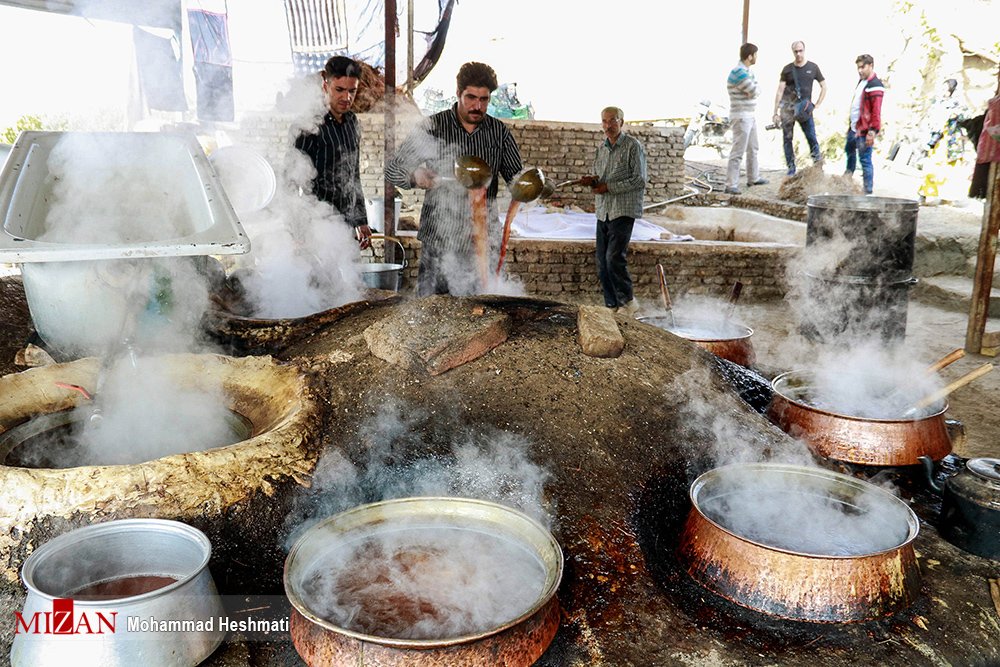
Baharestan Village Hub of Grape Syrup Production in Iran

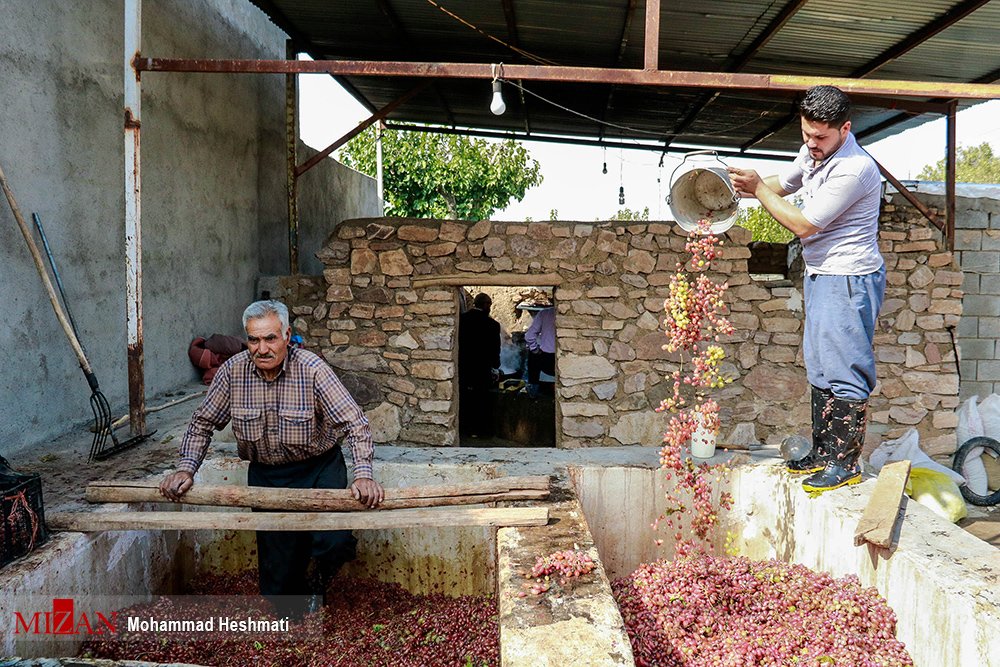
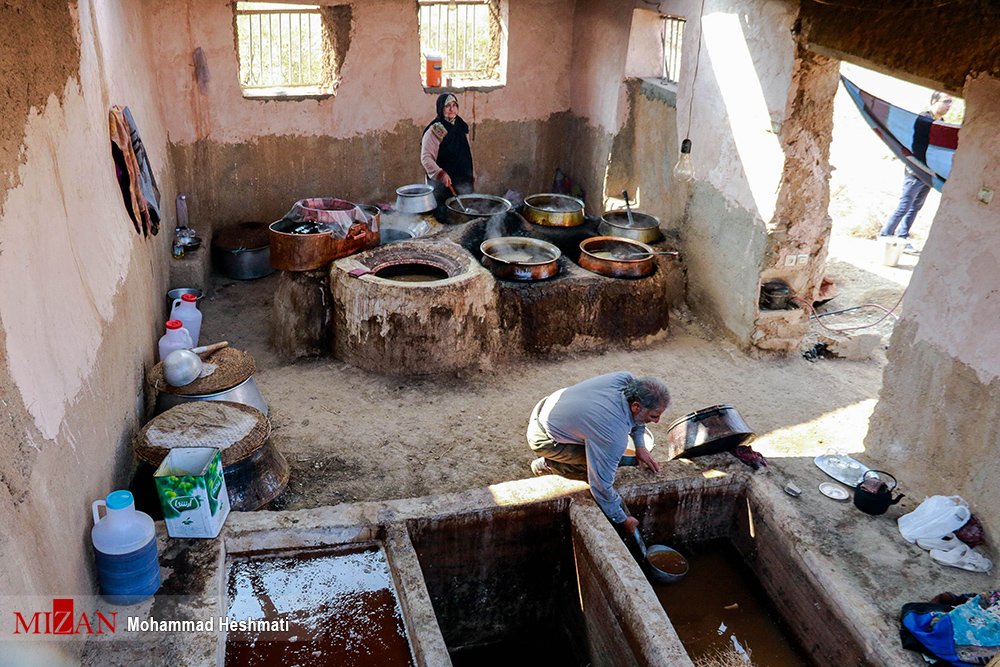
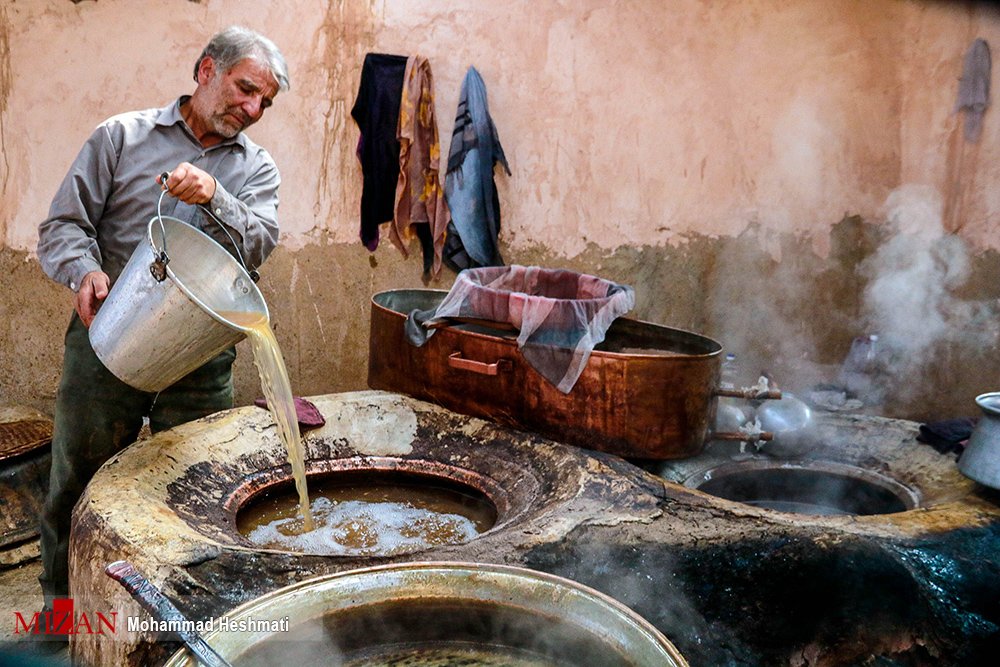
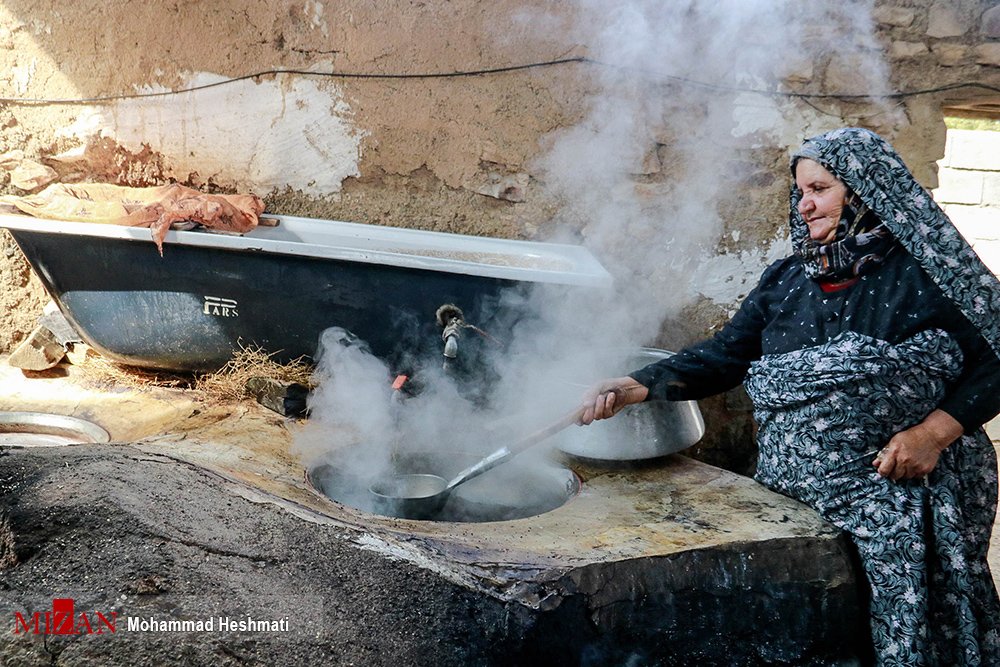
In this village there are four types of local grapes from which the syrup is made. Baharestan grapes are organic and of high quality. In the season of syrup production, the village men and women work round-the-clock.

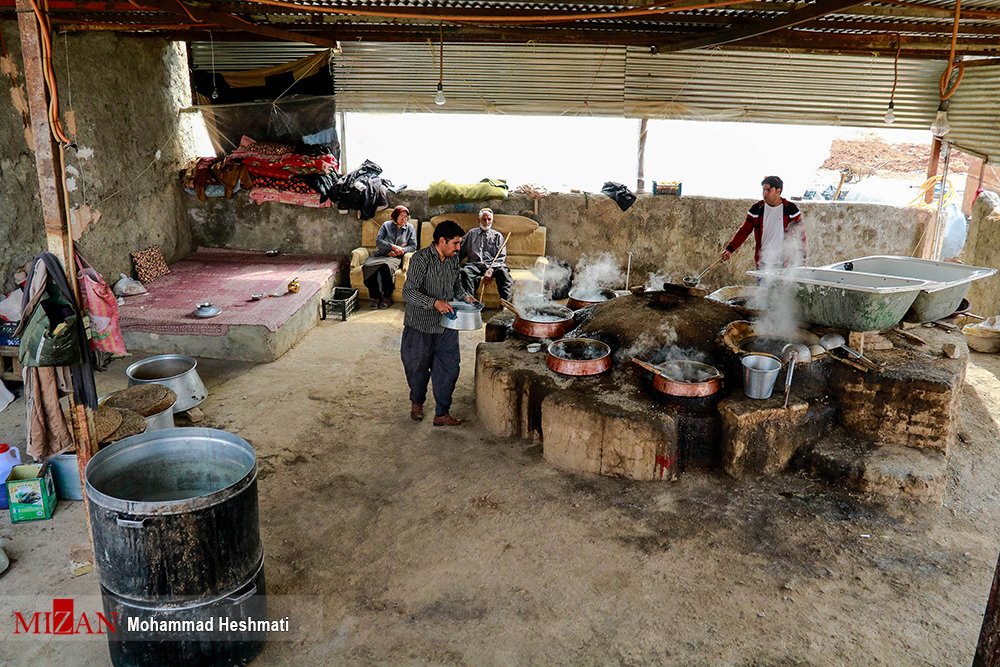
The grapes are brought to the village of Baharestan from the surrounding towns and villages, and the operations are carried out in the traditional workshops of the village before exporting the product to other cities.

The syrup is prepared in a traditional style and has many benefits. The main benefit of grape syrup is that it saves energy, which is recommended in traditional medicine in autumn and winter.

The syrup, like the grape itself, contains some amounts of vitamin A, B, and E, and it meets the body’s needs for these vitamins.

It treats jaundice and freckles, and cleanses liver and bile. Moreover, it soothes rheumatism, and makes breast milk thicker.


Directions to Produce Grape Syrup Traditionally

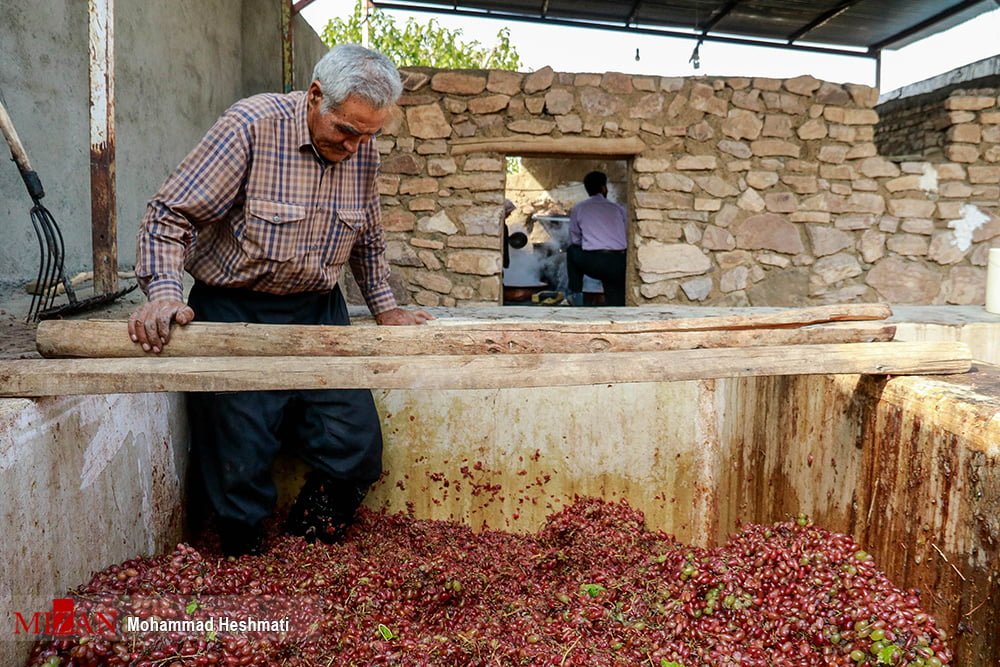
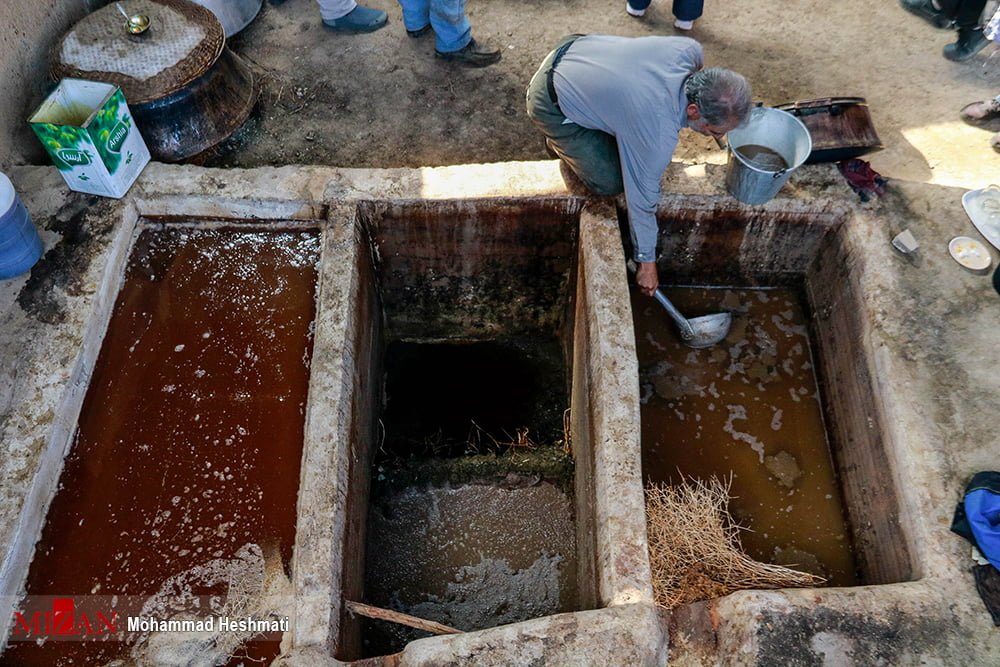
Locals in Baharestan first wash the grapes and then squeeze them. Then they add a special kind of soil to it. The soil contains high amounts of mineral salts and is sold at groceries.

The soil is usually heated in the sun or on a heater, then it is added to the grape juice. If they do not add the soil to it, the grape juice gets sour when boiled.

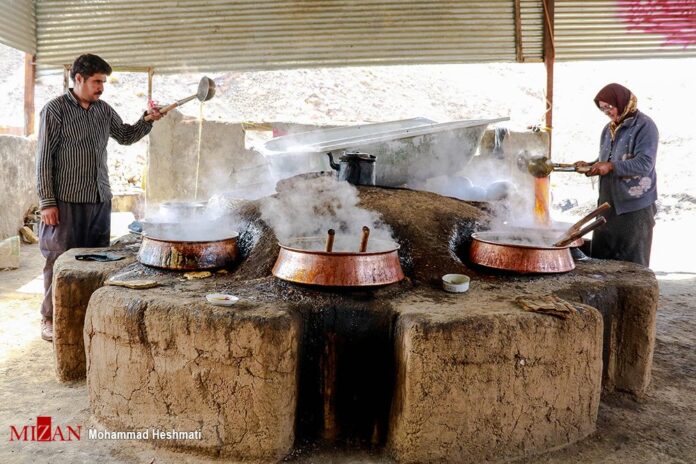
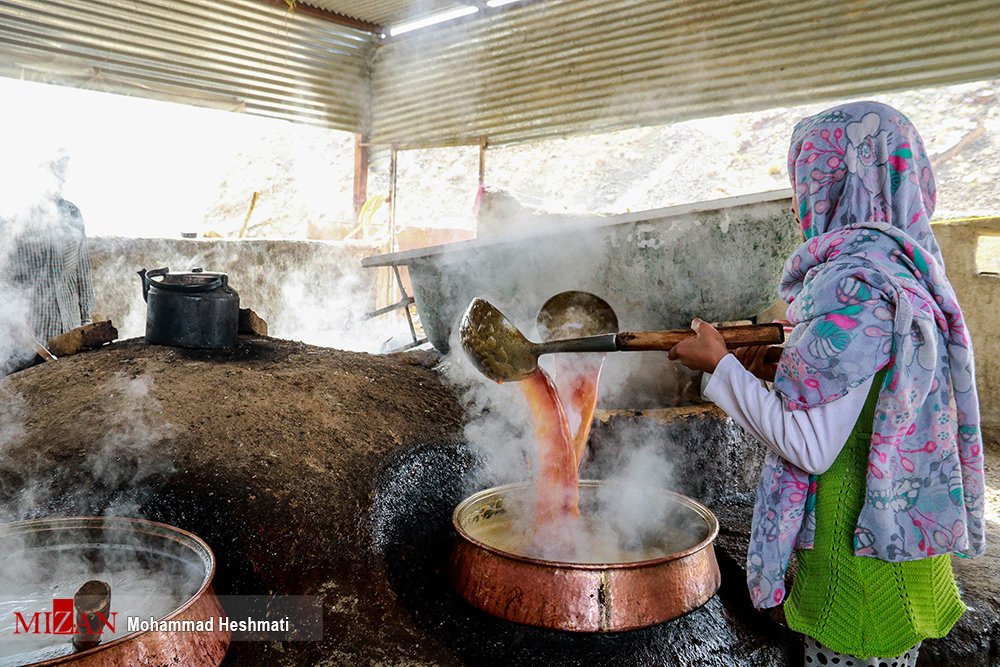
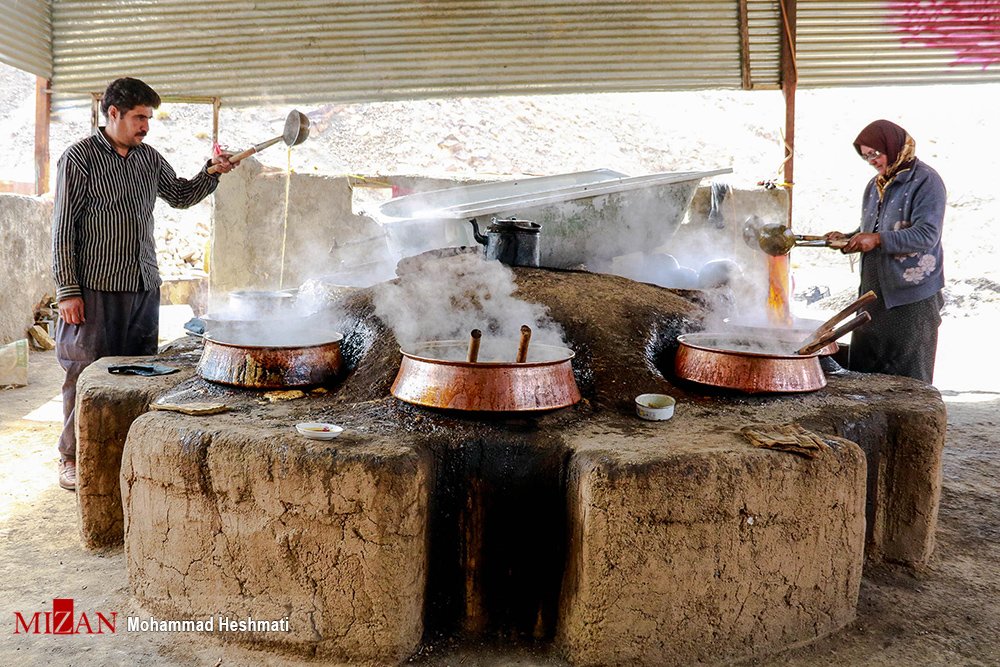
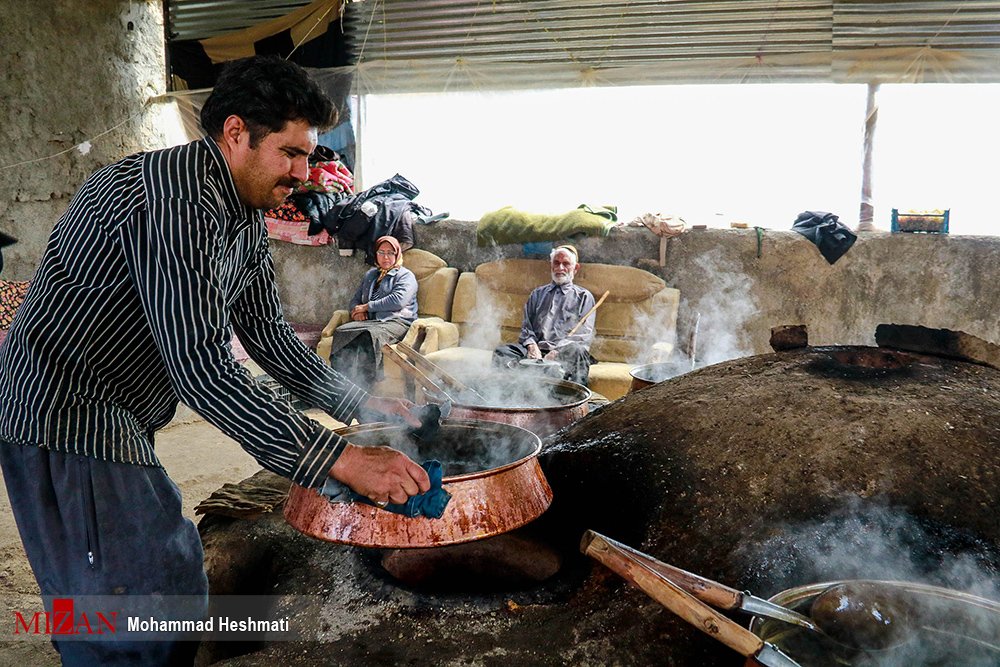
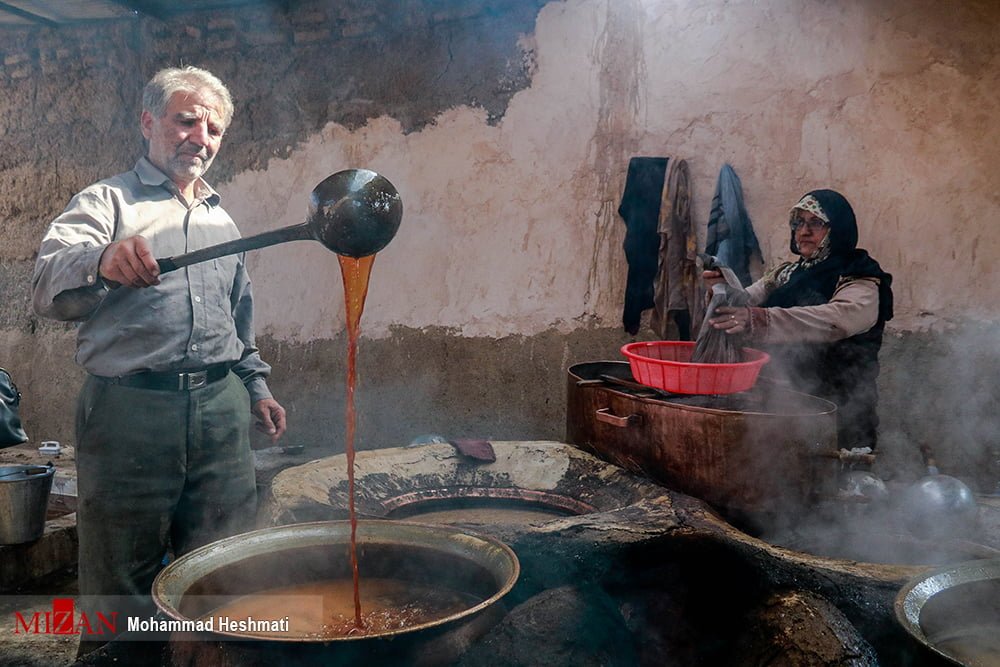
The juice is kept still overnight. Then, they sift it through special fabrics to completely separate the soil. Now it’s time to boil the juice for two hours.

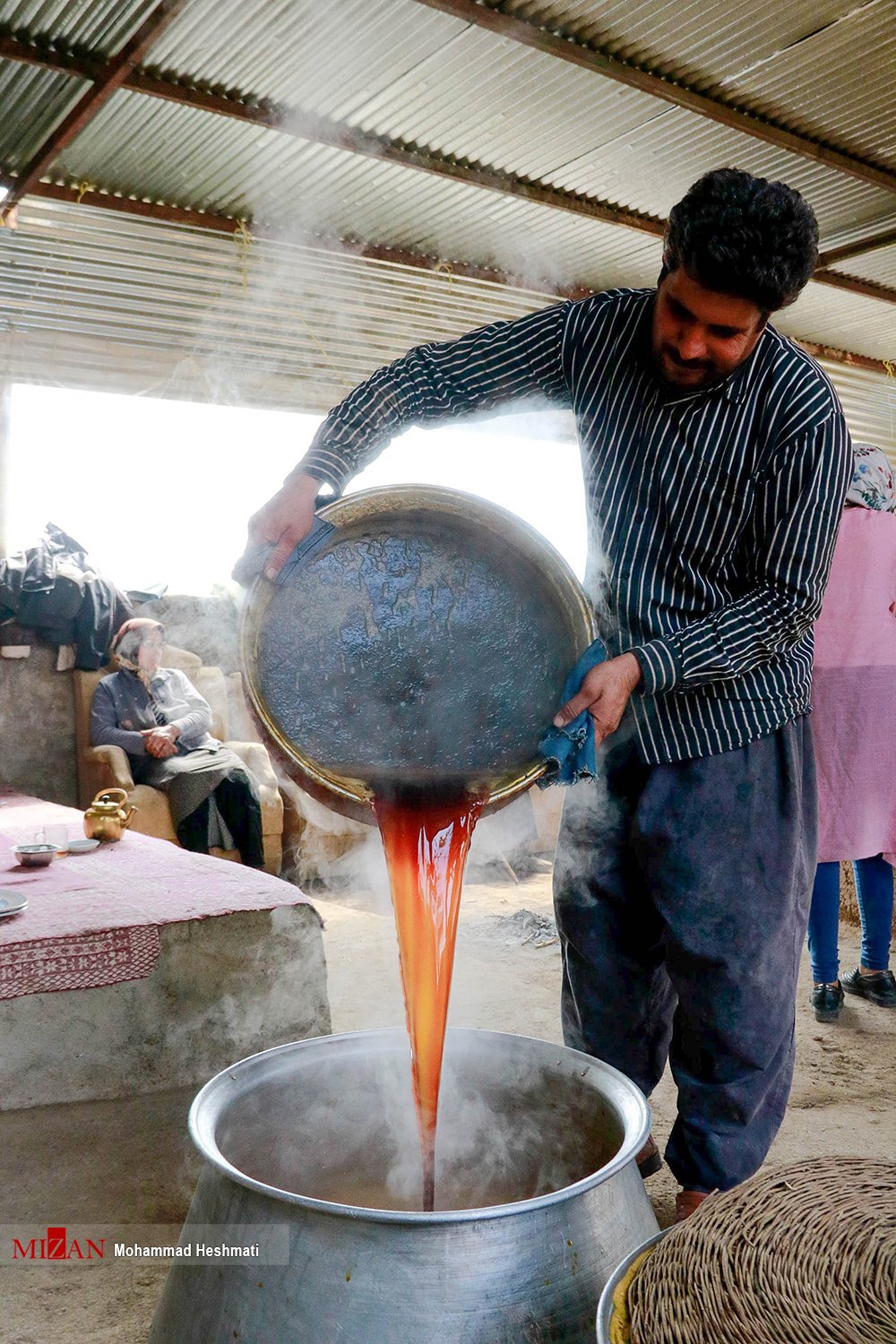
Traditional producers believe that if the juice floats and boils in large dishes, it is brewed earlier and gets a clear brown colour. However, if the juice is poured in copper dishes, it takes longer to become toughened. As a result, as it boils for a long time, it becomes darker and the final product is thicker.

About one kilogram of syrup is made out of every 5 kg of grapes. A high quality syrup is very thick and has a clear colour.

In addition to Baharestan, the grape syrup made in the city of Malayer in Hamadan province is also famous and of a great quality.

What you see here are photos of the traditional practice in Baherestan village retrieved from Mizan Online:

“US Lying Like a Rug When Saying It Wants to Help Iranians”

Iran’s DM Vows Firm Response to Enemy’s Moves

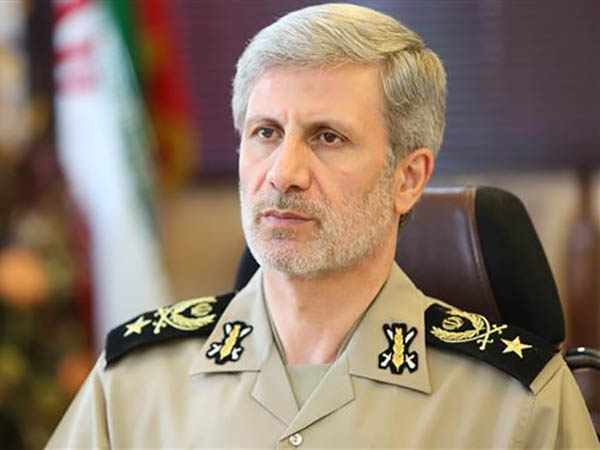
Brigadier General Amir Hatami said US President Donald Trump and Secretary of State Mike Pompeo lie like a rug when they say their actions against Iran are aimed at supporting Iranian people.

His comments came ahead of the re-imposition of US unilateral sanctions against Iran on Monday, which is mainly aimed at destroying the Iranian economy, and will mostly hurt the Iranian nation’s access to basic supplies like food and medicine.

While the US claims it has exempted the export of food and medicine to Iran, its sanctions on the country’s banking transactions with the world practically keep Iranian people from having access to foreign-made drugs and food, which will finally endanger millions of civilian lives.

General Hatami further said Iranian officials are doing whatever they can to mitigate the hardships caused by the US for Iranians.

He said the most important threat to the Middle East is foreign presence and interference in the region. The defence minister urged all countries to join hands to establish security in the regional and not to rely on foreign powers for the maintenance of security.

He further said the Defence Ministry has plans to boost the country’s missile capability.

“Iran’s missile power is an effective contributor to deterrence against threats; that is why the enemies are sensitive about this issue,” he said.

The defence chief said Iran has precise plans for its missile program because the maintenance of “our own security and that of our friends in the region” hinges on the country’s missile capability.

“Our enemies do not want to prevent us [from doing our activities] only verbally; rather, they seek to reinforce anti-missile [defences] in the region; and we will, proportionately, seek to improve the quality, precision and power of our missiles to strike the targets that threaten our security,” he added.

Iran’s Gen. Soleimani Challenges Trump’s GoT Meme

The commander of the Quds Force of Iran’s Islamic Revolution Guards Corps (IRGC) posted on Friday an Instagram photo inspired by the book series-turned-HBO hit show, which reads, “I will stand against you” in the show’s signature font, as used in Trump’s tweet earlier in the day threatening Tehran with more sanctions.

The photo was widely viewed as a direct response to the US president’s own Westeros-inspired tweet that read, “Sanctions are coming November 5.”

The post came shortly after the Trump administration announced plans to reinstate the last set of sanctions lifted on Iran under the 2015 Iran nuclear deal early next week. Trump announced in May that he was withdrawing the US from the International agreement.

The US-based cable network HBO also slammed Trump for his use of the show’s slogan – ‘Winter is coming’ – to promote his administration’s foreign policy agenda, saying it would prefer the American president not “misappropriate” their trademark.

“We were not aware of this messaging and would prefer our trademark not be misappropriated for political purposes,” said an HBO spokeswoman.

The network further took to Twitter – Trump’s favorite communication channel — and asked how to say “trademark misuse” in Dothraki, one of the show’s fictional languages.

On Saturday, Leader of the Islamic Revolution Ayatollah Seyyed Ali Khamenei responded to persisting US political and economic hostilities against Iran for the past 40 years, insisting that the United States has always been defeated in its face-off with the Islamic Republic.

Speaking in a public address a day after the Trump administration decided to re-impose all US sanctions against Iran lifted under the 2015 agreement, the Leader said, “For 40 years, the challenge between America and Iran has continued and a variety of movements have taken place from the enemy’s side – from the military and economic warfare to the media war launched by America.

“The goal of the United States in all this was to regain the domination it had in the era of the tyranny, but it could not,” the Leader added, referring to the period prior to the Islamic Revolution when the Shah of Iran was the top US ally in the region.

Iran’s foreign ministry has accused Washington of seeking to wage an extensive “psychological war” against Tehran by imposing a new round of sanctions, insisting that such US measures are not worthy of much concern.

“There is no room for any concern. We should wait and see that the US will not be able to carry out any measure against the great and brave Iranian nation,” Iran’s Foreign Ministry Spokesman Bahram Qassemi said on Friday. “It seems that the US has no more capability to put countries and global economic enterprises under pressure.”

The US plans to impose a second round of sanctions against Iran on Sunday, months after Washington scrapped the 2015 multilateral deal, officially known as the Joint Comprehensive Plan of Action (JCPOA), reached between Iran and the P5+1 group of countries.

The first round of the bans – which had been lifted under the nuclear deal — was re-imposed in August.

The Iranian general has previously reacted to other anti-Iran threats by the American president, warning Trump back in June against insulting the Iranian nation and president.

“Trump! You must not threaten our nation and must not insult our president… You must know what you are talking about; ask your predecessors and try to benefit from their experiences,” said General Soleimani on July 26.

Further pointing to Trump’s threat of waging military action against Iran, Soleimani insisted: “You know that this war would mean annihilation of all your assets. You may initiate the war, but it is us who will finish it off.”

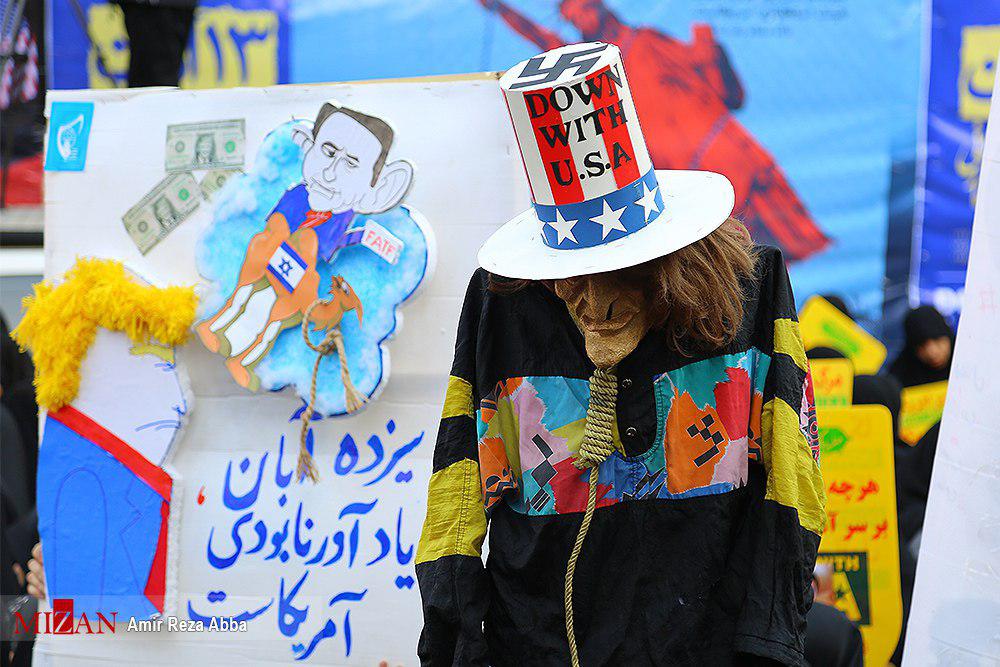
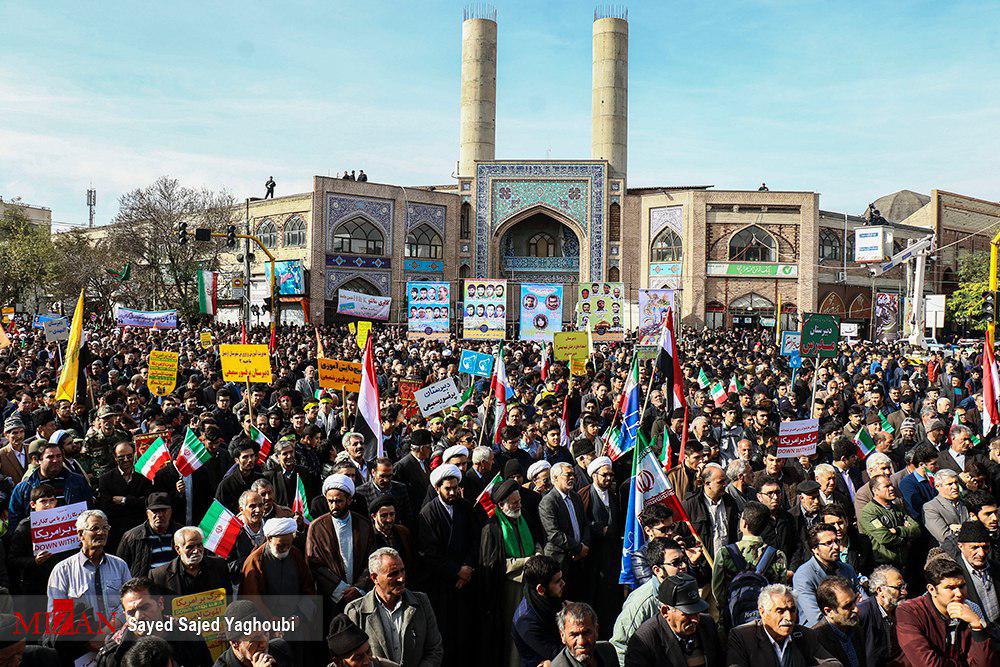
Iranians Condemn US Policies in Huge Nationwide Rallies

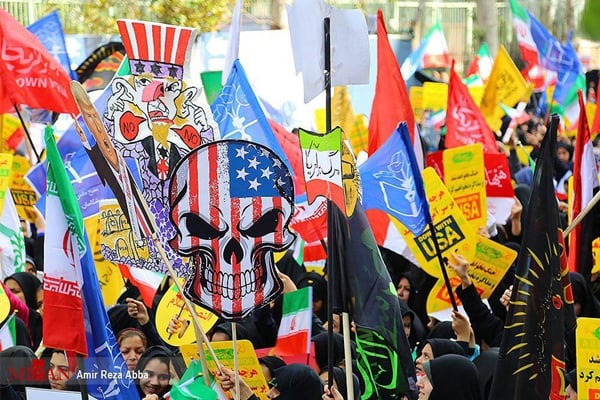
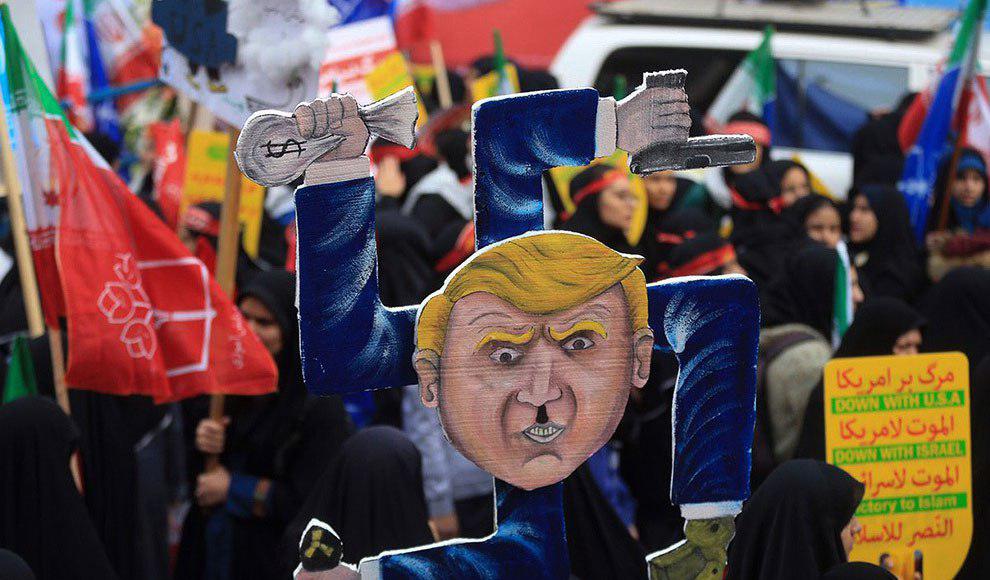
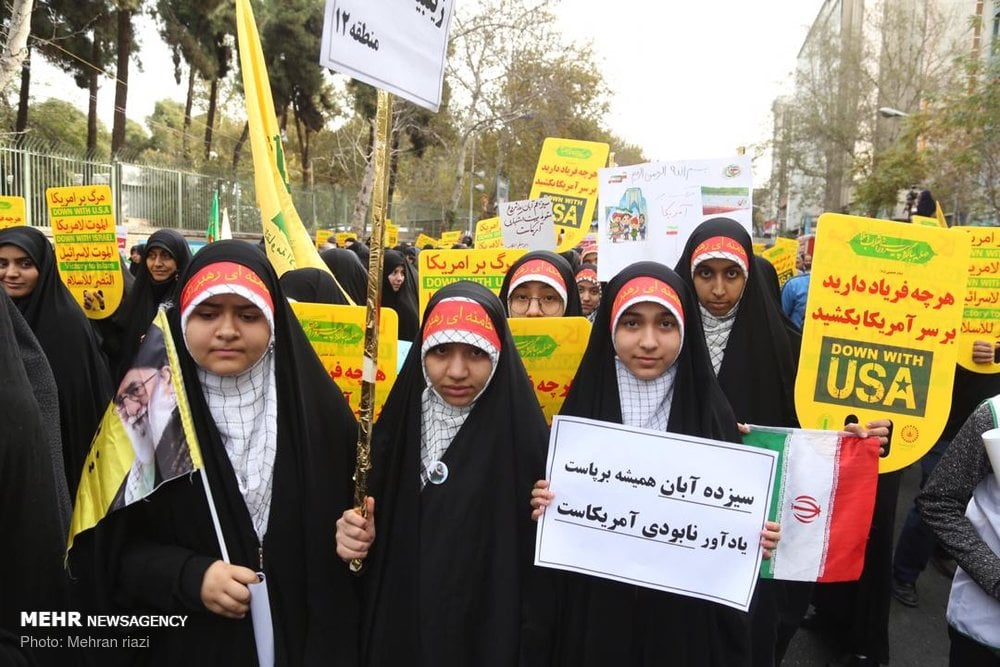
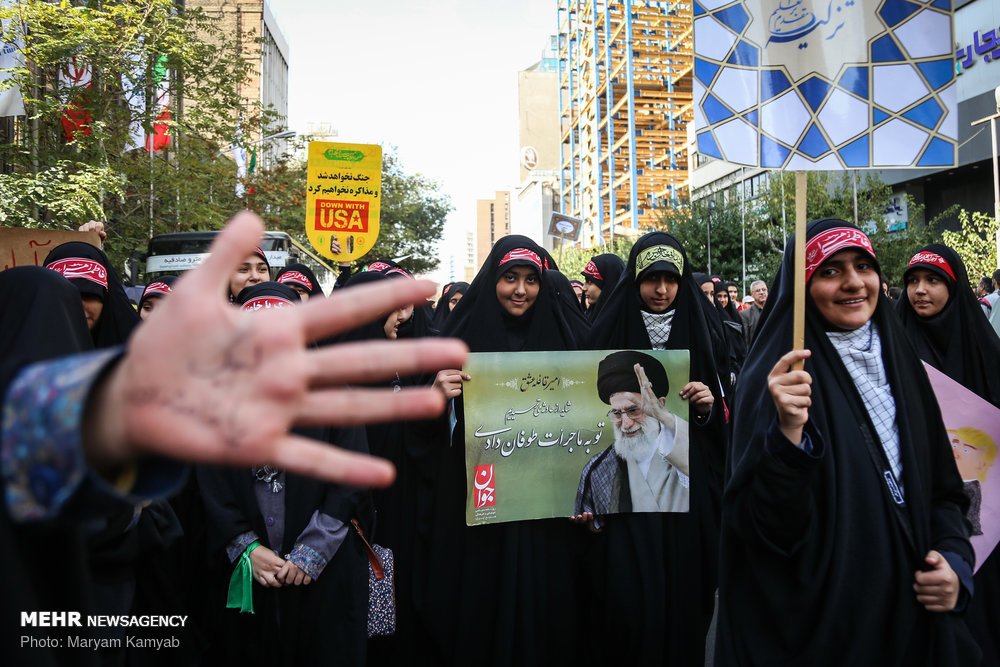
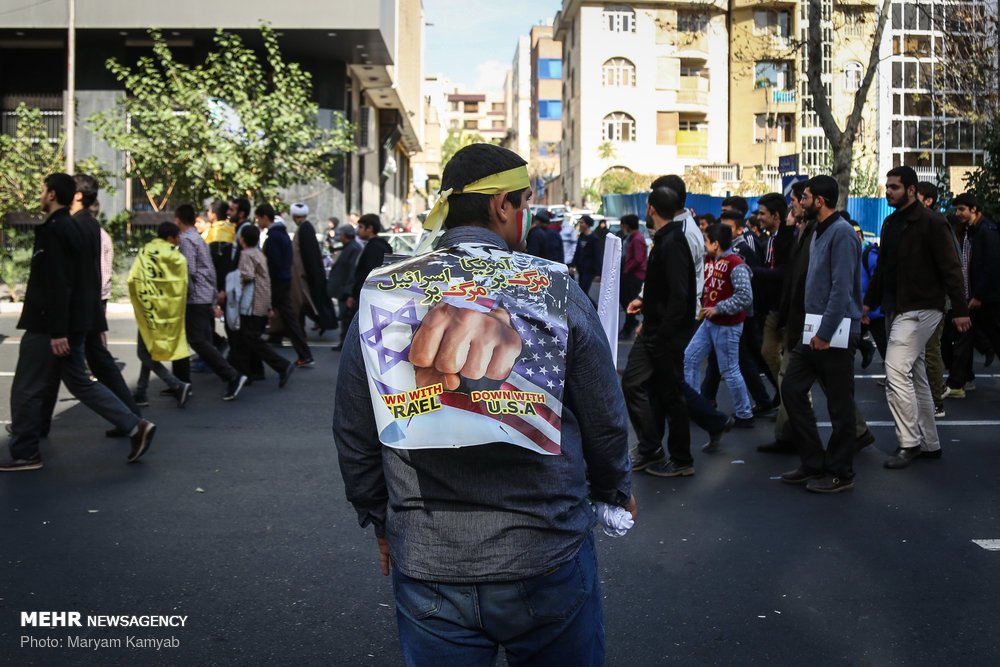
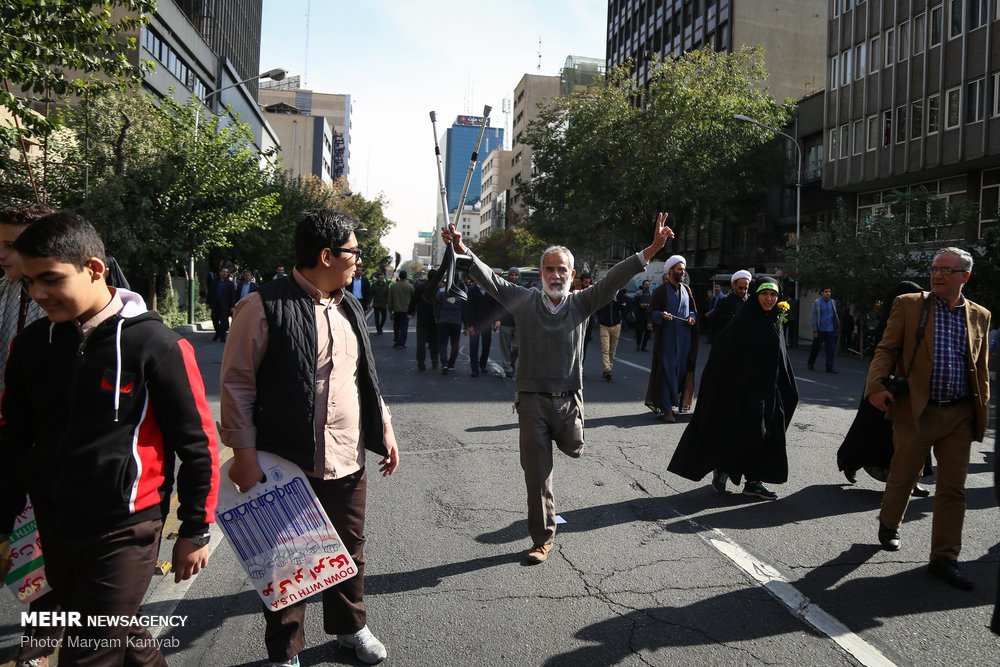
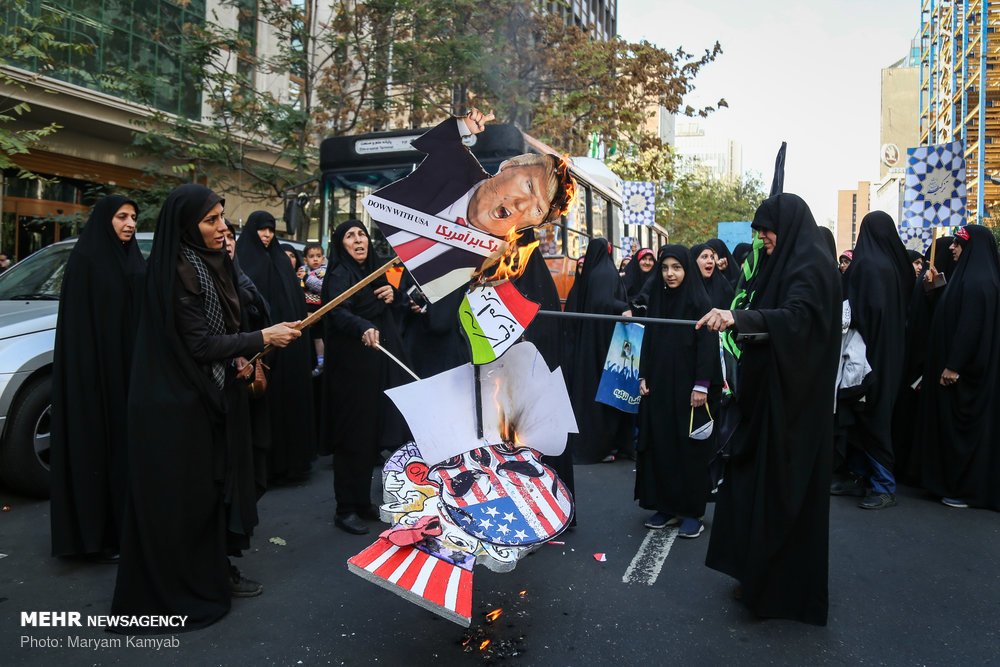
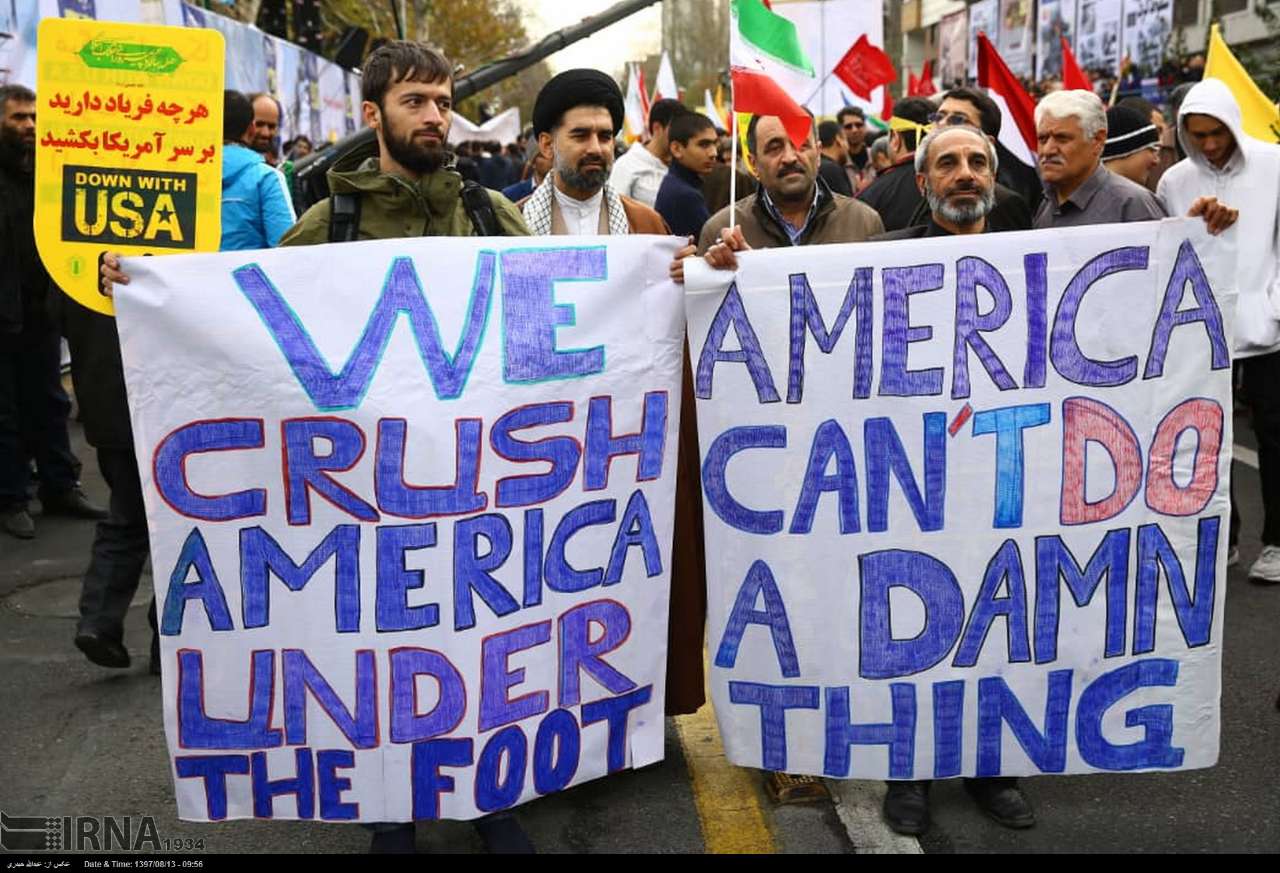
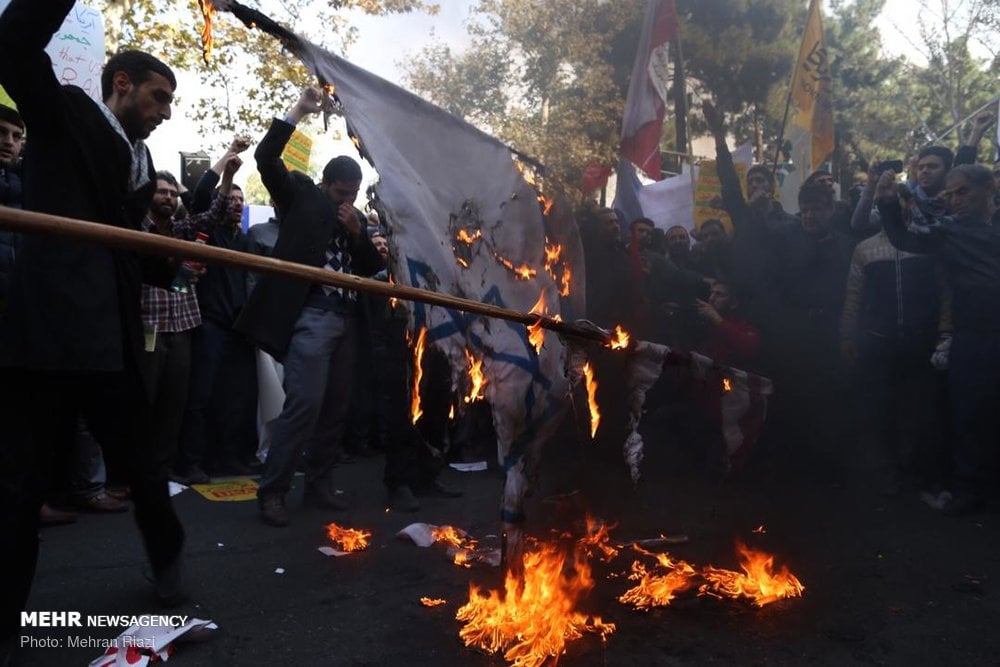
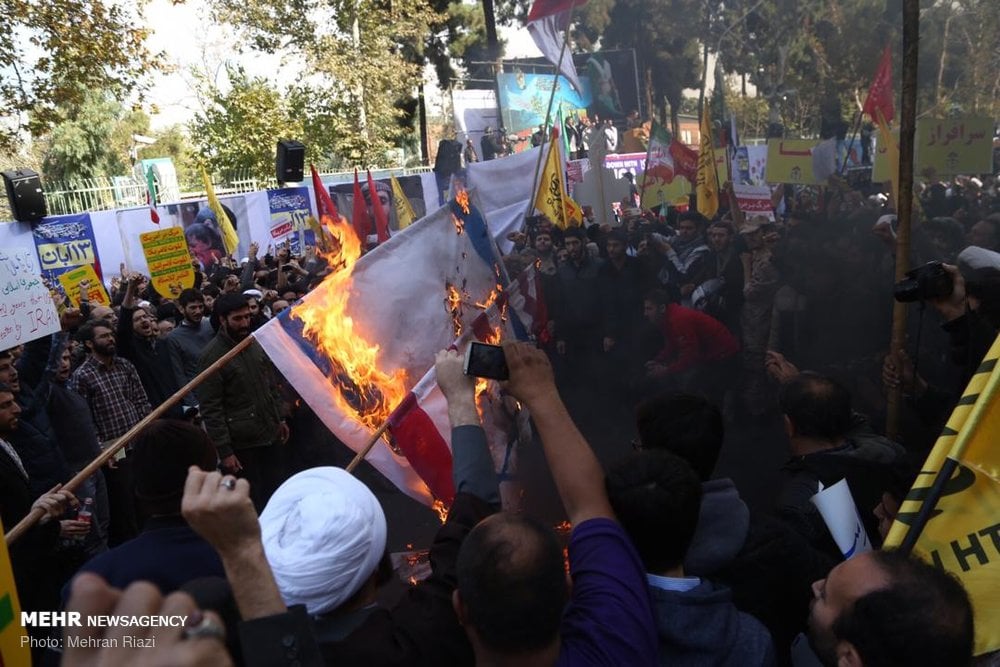
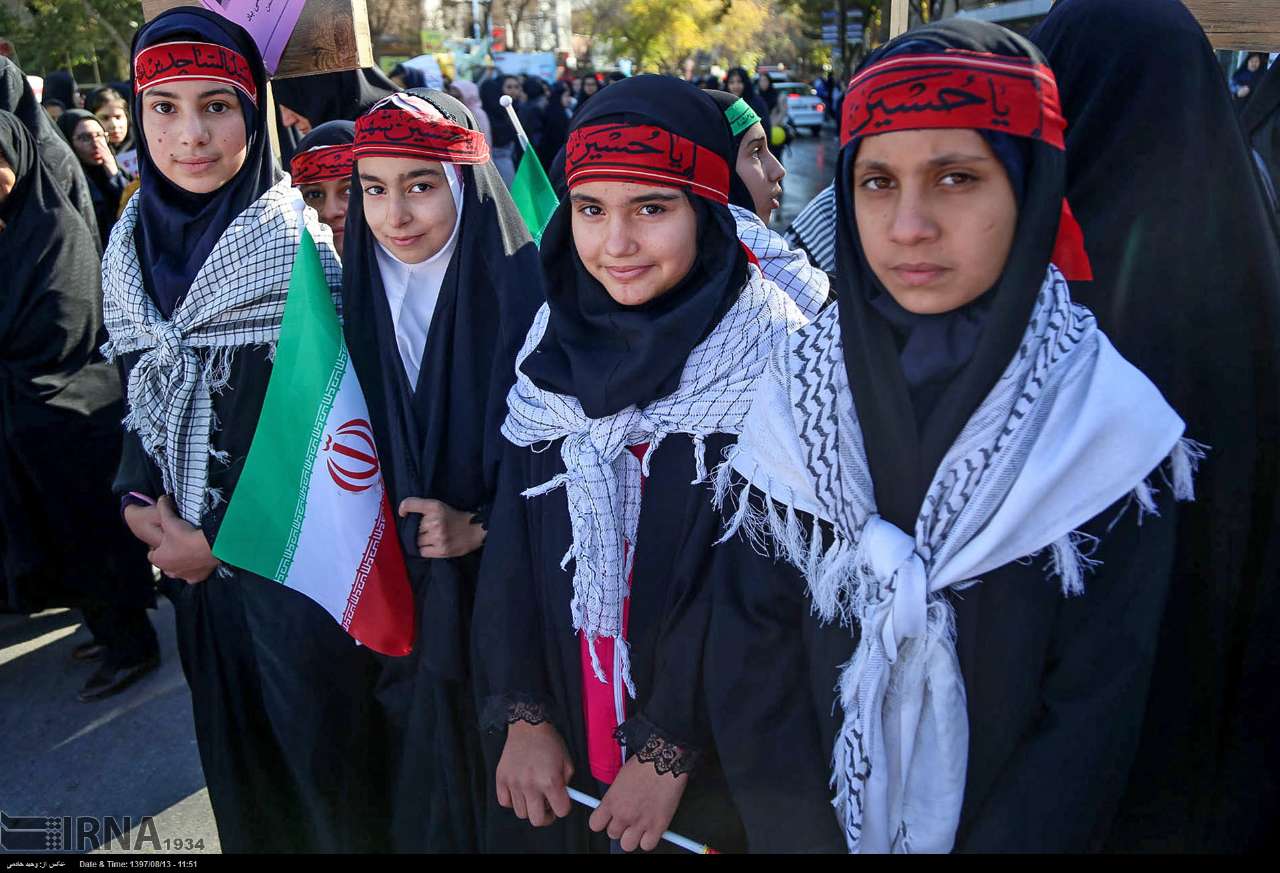
In Tehran, a large crowd of students gathered outside the former US embassy also known as the “Den of Espionage,” chanting slogans against the United States. They also held signs denouncing the US hostilities against the Iranian nation and vowed resistance against Washington’s plots.

Chief-Commander of Iran’s Islamic Revolution Guard Corps (IRGC) Major General Mohammad Ali Jafari was the keynote speaker of the demonstration.

In his remarks, the Iranian top general said US economic and psychological war against the Islamic Republic has not been successful. He also underlined that the United States’ plots to create instability in the country have failed.

The IRGC commander warned US President Donald Trump against threatening the Iranian nation, reminding him of the voices of American and British soldiers in Tabas and Persian Gulf “groaning with fear”.

He also pointed to the Iranian revolutionaries’ takeover of the US embassy back in 1979, underscoring that the move was aimed at putting an end to Washington’s espionage in the newly-established Islamic Republic.

After General Jafari’s statements, representatives of student organisations are scheduled to deliver speech.

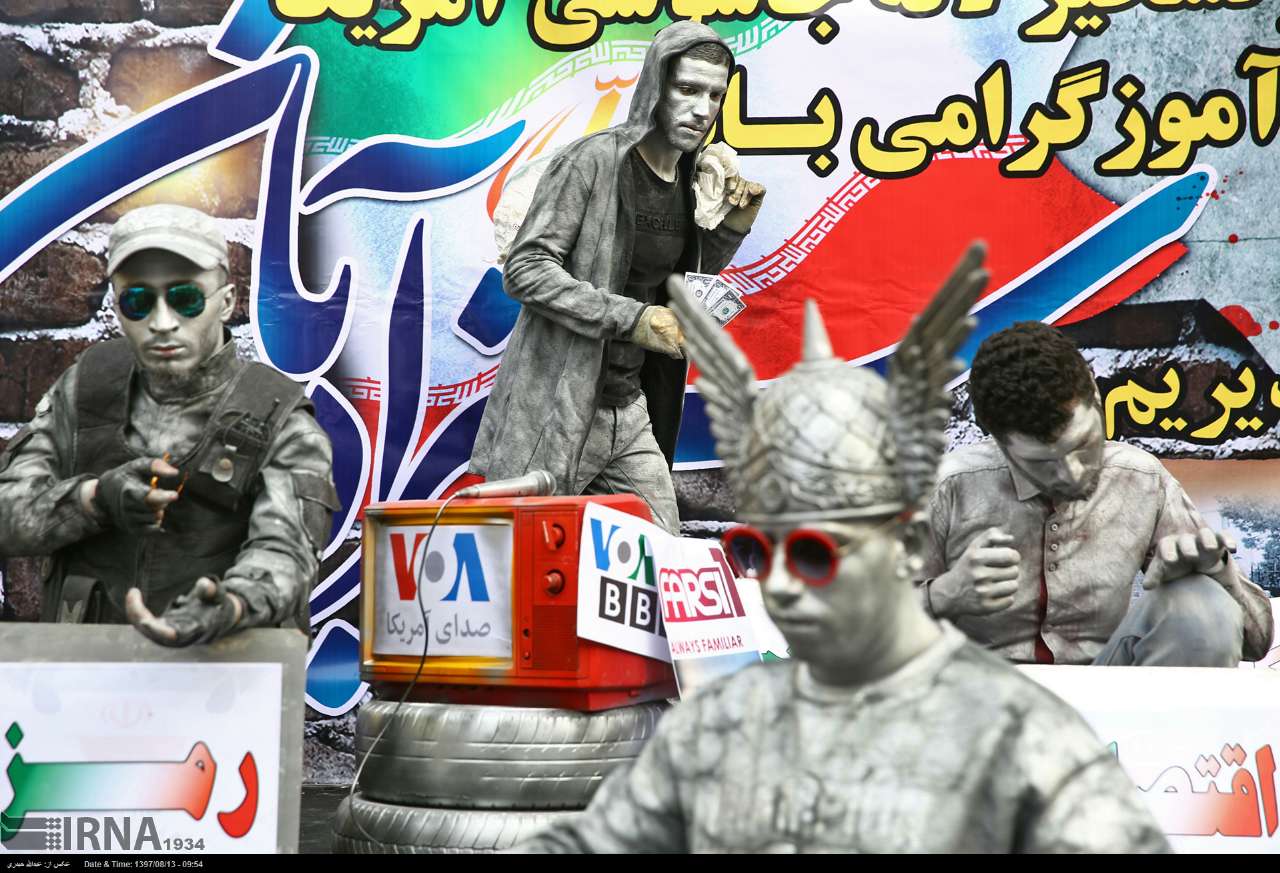
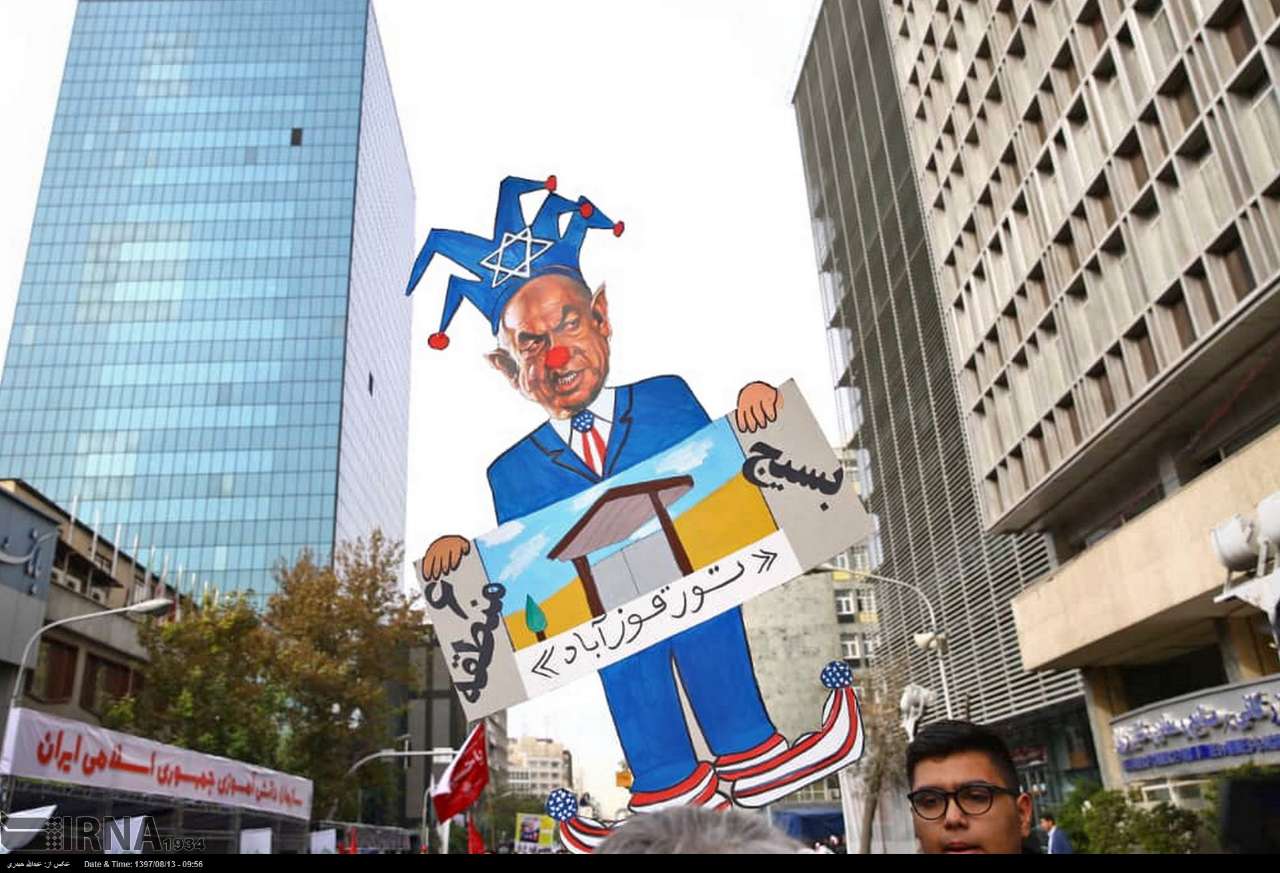
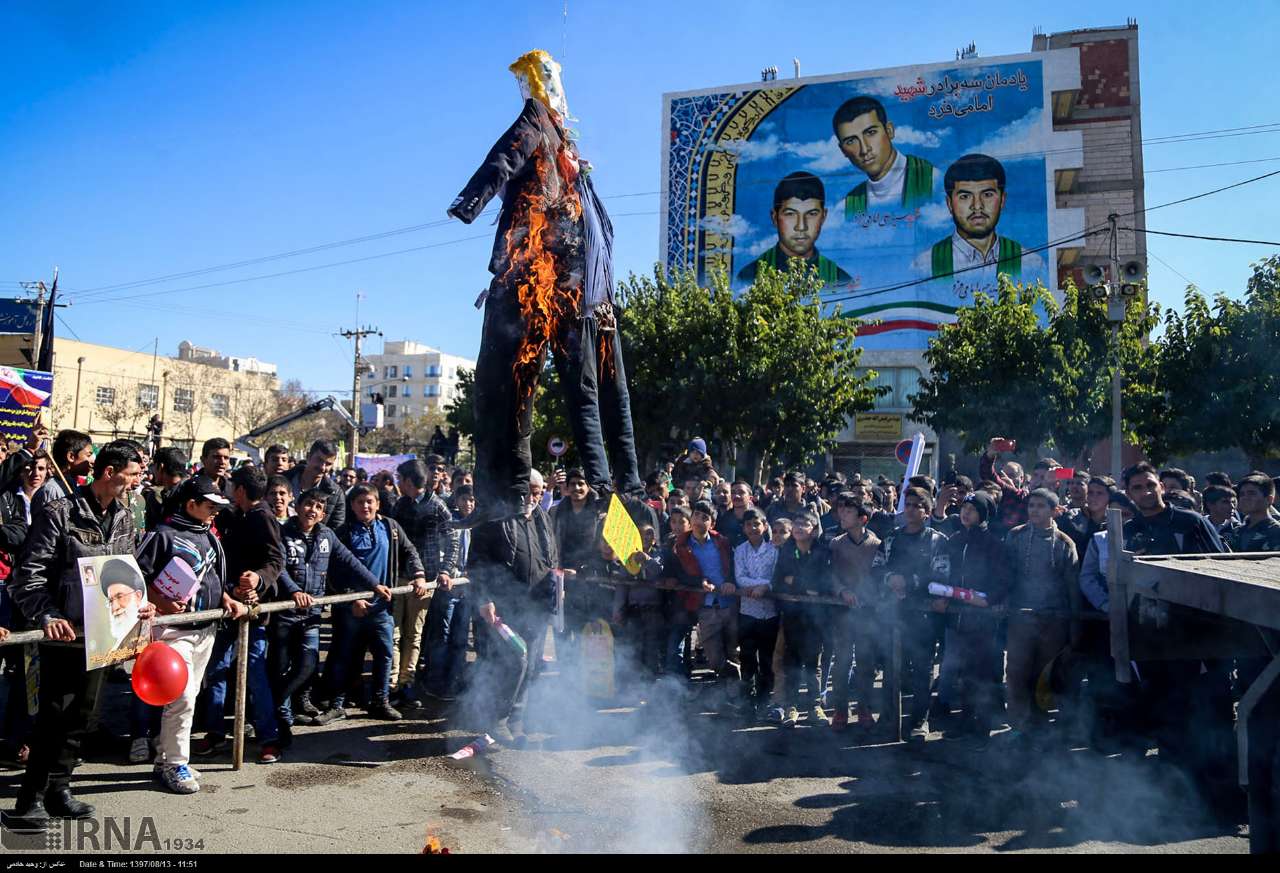
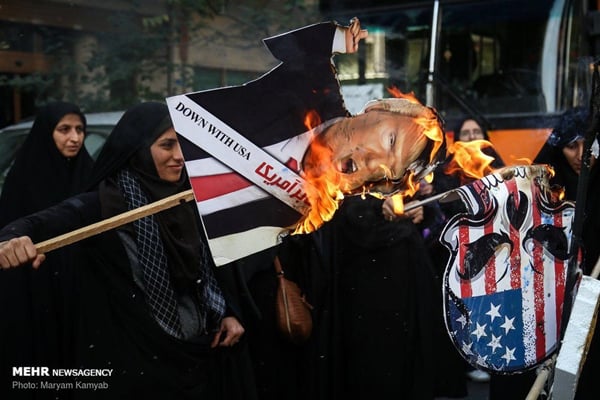
Over four thousand reporters and photographers are covering the National Day against World Arrogance. In Tehran, 120 foreign correspondents and photographers cover the event.

The demonstrations are held annually on November 4 to condemn the hegemonic policies of the US.

This year, the day has coincided with Trump’s re-imposition of US sanctions on the Islamic Republic, which will take effect on Sunday night.


Iran Ready to Help Journalists Leave Saudi-Funded UK-Based Channel

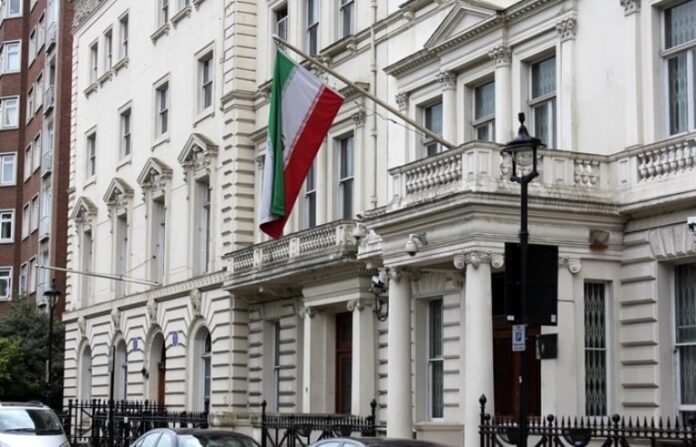
After The Guardian revealed the anti-Iran London-based TV channel Iran International is funded by Saudi Arabia, some employees have contacted the Iranian embassy in London and expressed concern about the legal consequences they face in case of terminating their contracts, Iranian ambassador Hamid Baeidinejad said in a tweet.

He said the embassy has hired experienced lawyers to assist these people and provide them with legal advice.

Baeidinejad’s comments come as the journalists work for TV channels that try to overthrow the Iranian Establishment.

The Guardian revealed Iran International TV station is being funded through a secretive offshore entity and a company whose director is a Saudi Arabian businessman with close links to Saudi Crown Prince Mohammed bin Salman.

Earlier, Iran’s ambassador to London filed a lawsuit at the UK’s communications regulator Ofcom after the news channel aired an interview with a spokesman of a separatist and extremist group that was behind the deadly terrorist attack in the southern Iranian city of Ahvaz.

Iran Legislation Watchdog Rejects CFT Bill, Returns It to Parliament

Foreign Ministry Condemns FATF’s Blacklisting of Iran

Guardian Council Spokesman Abbasali Kadkhodaei said in a Sunday tweet that the CFT bill, one of the four bills proposed by President Hassan Rouhani’s government to get Iran out of FATF blacklist, had flaws and ambiguities including violation of religious rules (Sharia) and the Constitution.

The Guardian Council has sent the bill back to the Parliament, asking it to make the revisions and submit it again.

Iranian lawmakers had passed the bill on October 7, 2018, with 143 votes in favour, 120 against and 5 abstentions.

The Guardian Council’s rejection of the CFT bill comes as the Financial Action Task Force (FATF), an international group that sets standards on fighting money laundering and financing of terrorism, announced on October 19 it once again extends the deadline for Iran to complete reforms to meet conditions for getting out of the body’s black list.

However, the FATF said it was disappointed with Tehran’s failure to implement a big part of the action plan.

The statement said Iran is expected to quickly take steps to make reforms to enhance the way it counters money laundering and financing of terrorism.

FATF had previously given Tehran until October to bring its laws against money-laundering and funding of terrorism up to its guidelines.

Back in June, 2018, members of the Iranian parliament discussed the CFT accession bill, which is one of the four bills proposed by the government on Iran’s adopting the standards of the Financial Action Task Force (FTAF), but shelved it for two months.

The Parliament earlier approved a bill on the country’s accession to the United Nations Convention against Transnational Organized Crime, also known as Palermo Convention, but the bill was rejected by the Guardian Council. Then the Parliament insisted on its decision, and the case was referred to the Expediency Council to make the final decision.

The same thing happened to an amendment to the anti-money laundering law of the Islamic Republic, which was proposed by the government, approved by the Parliament, but rejected by the Guardian Council. This one also needs the Expediency Council’s approval.

Meanwhile, the fourth bill, which was an amendment to the country’s law against financing terrorism, was approved by the Parliament and the Guardian Council, and signed into law by President Rouhani.

Iran’s accession to FATF has been the subject of heated debates in recent months.

Opponents believe FATF would limit Iran’s ability to support allies in the region, some of whom recognized as terrorist entities by the US and some of its allies.

This is while proponents of Iran joining FATF fear Iran’s inclusion on the body’s blacklist could make it impossible to salvage the 2015 nuclear deal following the US withdrawal.

European countries have in recent weeks been working to create a special mechanism to facilitate trade with Iran, ignoring US calls to hamper economic relations with Tehran.