Monday, December 22, 2025
Home Blog Page 3227

State TV Channel Chief Sacked over Program Insulting to Sunnis

Logo of the Islamic Republic of Iran Broadcasting (IRIB)

President of the Islamic Republic of Iran Broadcasting (IRIB) Abdol-Ali Ali-Askari instructed Director of the IRIB’s TV Department Morteza Mirbaqeri to dismiss the manager of Channel 5 as well as the channel’s broadcast manager.

The decision was made after a eulogist, on the birthday anniversary of second Shiite Imam, Hassan ibn Ali (PBUH), insulted three of the four Muslim caliphs and one of the wives of Prophet Muhammad (PBUH).

Ali-Askari underlined that the centrerpiece of the IRIB’s policy has always been to respect the Islamic community.

“Given the negligence with regards to the sudden (live) broadcast of these words, which hurt the feelings of Sunni brothers, sisters and scholars, the manager of the channel and its broadcast manager must be fired immediately,” the IRIB president wrote in his instruction to the Director of the IRIB’s TV Department, which oversees the activities of Channel 5, one of several channels working under the department’s supervision.

Earlier in the day, the eulogist Ahad Qadami was summoned to a court in Tehran over the insult, which the Judiciary says was “intentional”. He was later released on bail.

Leader of the Islamic Revolution Ayatollah Seyyed Ali Khamenei has, time and again, underlined that the Sunni community and individuals revered by them, including Prophet Muhammad’s wife Aisha and Sunni caliphs who were contemporaries of Prophet Muhammad, must never be disrespected.

A Look at Iranian Newspaper Front Pages on May 26

A Look at Iranian Newspaper Front Pages on November 19

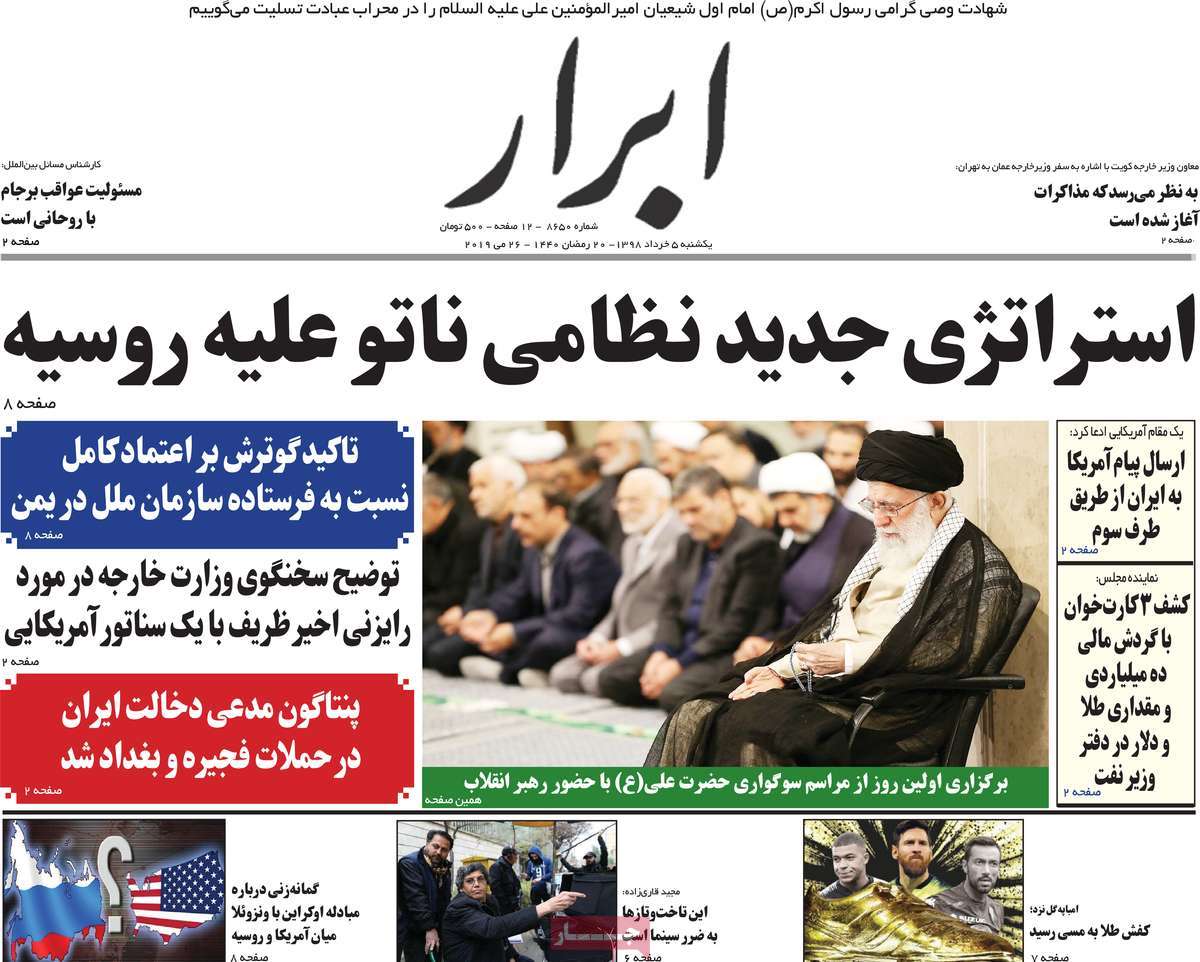
Abrar:
1- American Official: US’ Message Sent to Iran through Third Party

2- Pentagon Claims Iran Was Behind Fujairah, Baghdad Attacks

A Look at Iranian Newspaper Front Pages on May 26


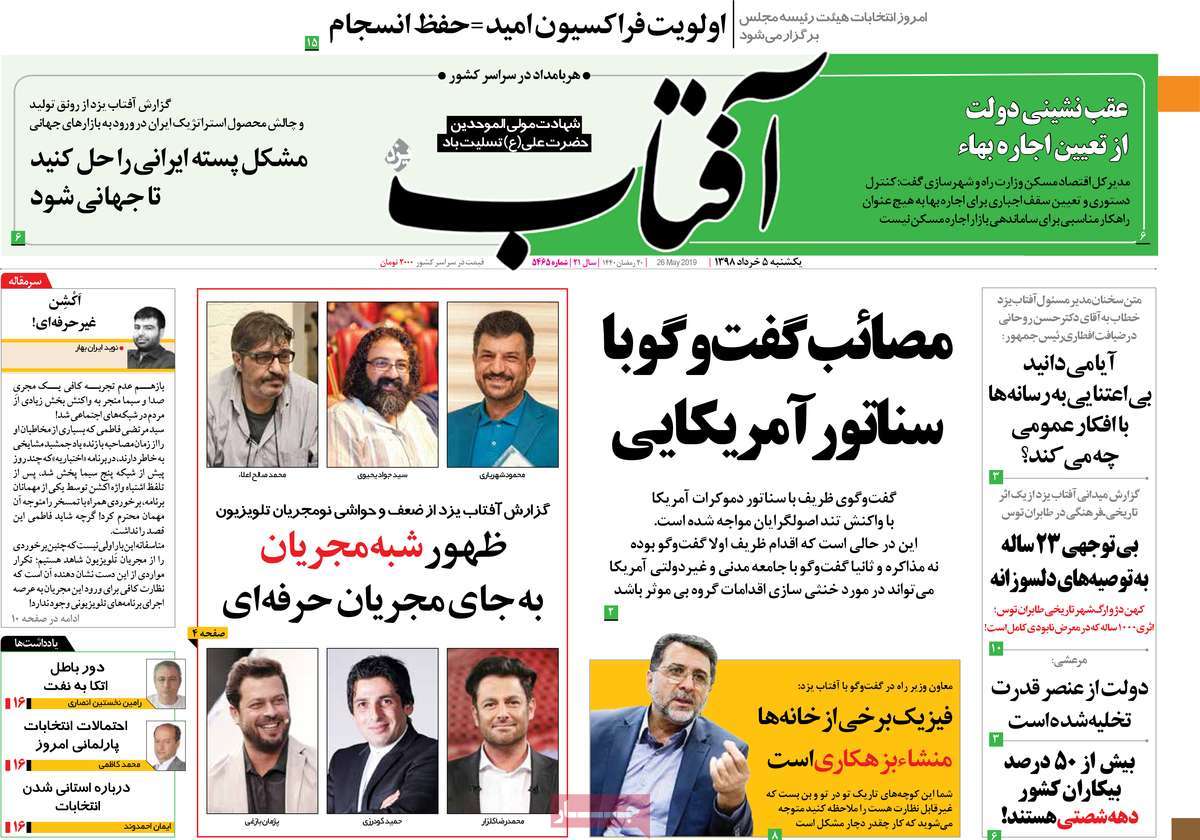
Aftab-e Yazd:

1- Troubles of Meeting with US Senator

* Conservatives Harshly React to Zarif’s Talks with Sen. Feinstein

A Look at Iranian Newspaper Front Pages on May 26


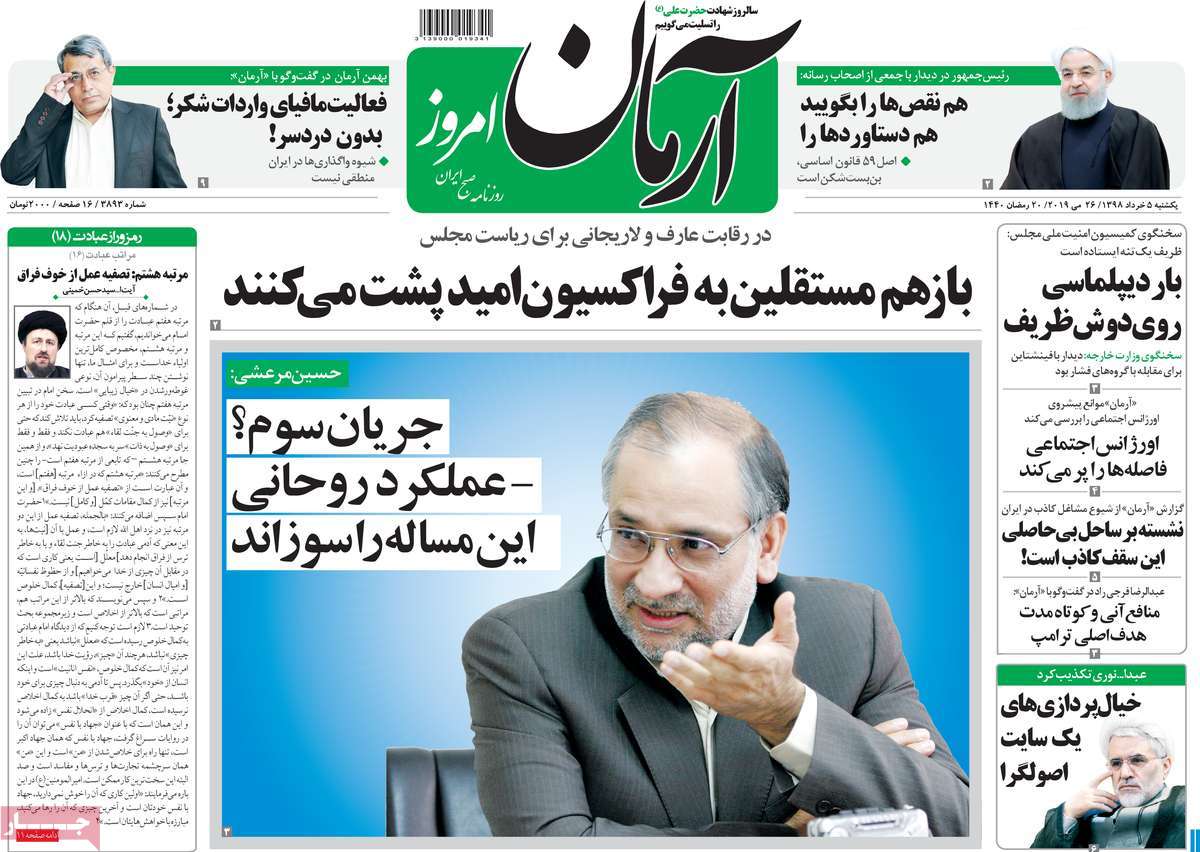
Arman-e Emrooz:

1- Burden of Diplomacy on Zarif’s Shoulders

A Look at Iranian Newspaper Front Pages on May 26


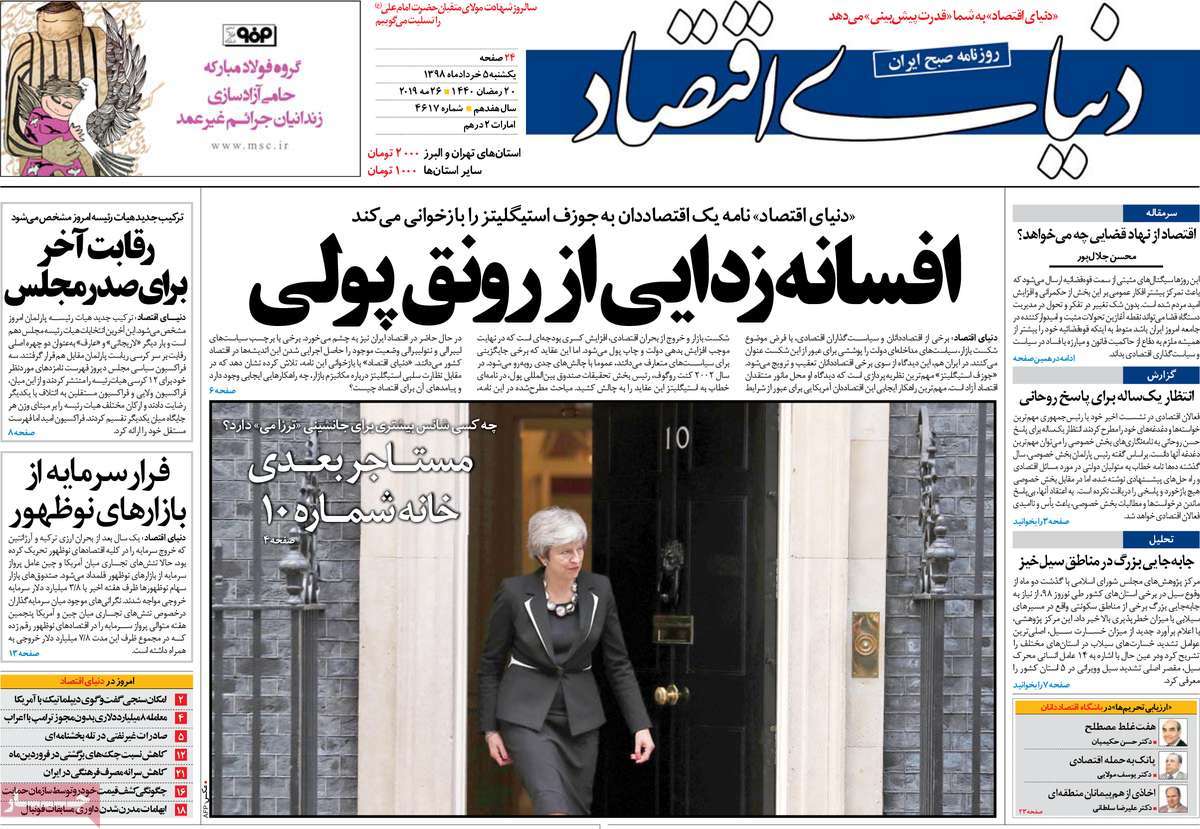
Donya-ye Eqtesad:

1- Who’s Next Tenant of House No. 10?

* Who’ll Replace Theresa May?

A Look at Iranian Newspaper Front Pages on May 26


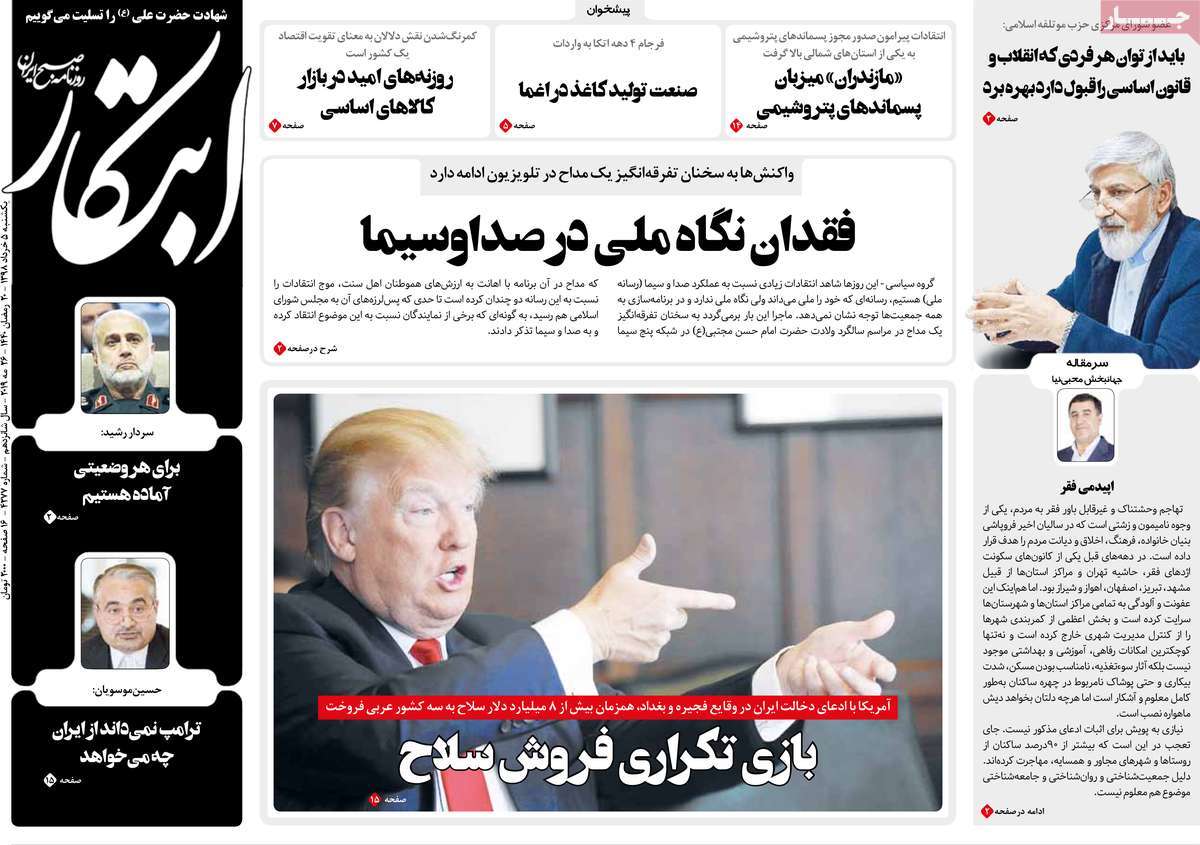
Ebtekar:

1- Worn-Out Game of Weapons Sale

* US Accuses Iran of Attacking Fujairah Vessels, Baghdad to Sell Weapons to Arabs

2- Mousavian: Trump Doesn’t Know What He Wants from Iran

A Look at Iranian Newspaper Front Pages on May 26


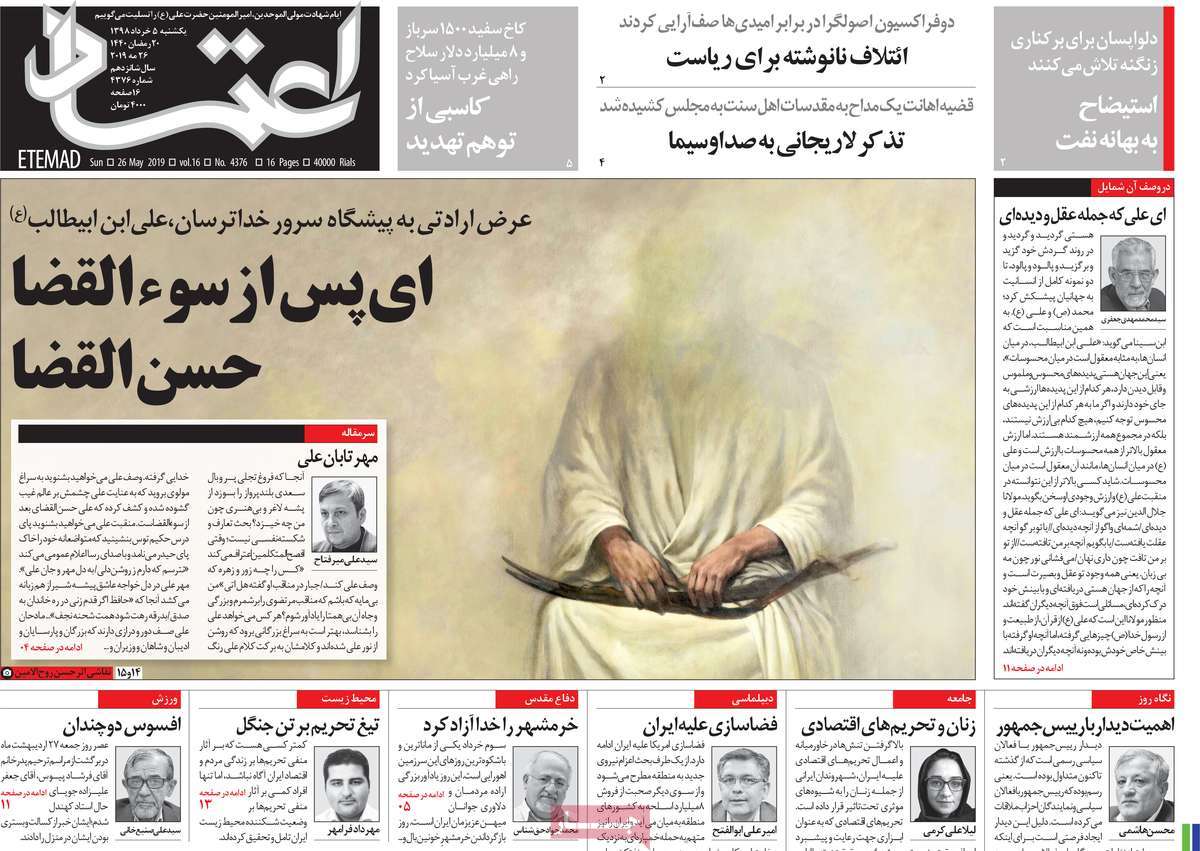
Etemad:

1- Making Money with Illusion of Threat

* White House Sends 1,500 Troops, $8 Billion to West Asia

A Look at Iranian Newspaper Front Pages on May 26


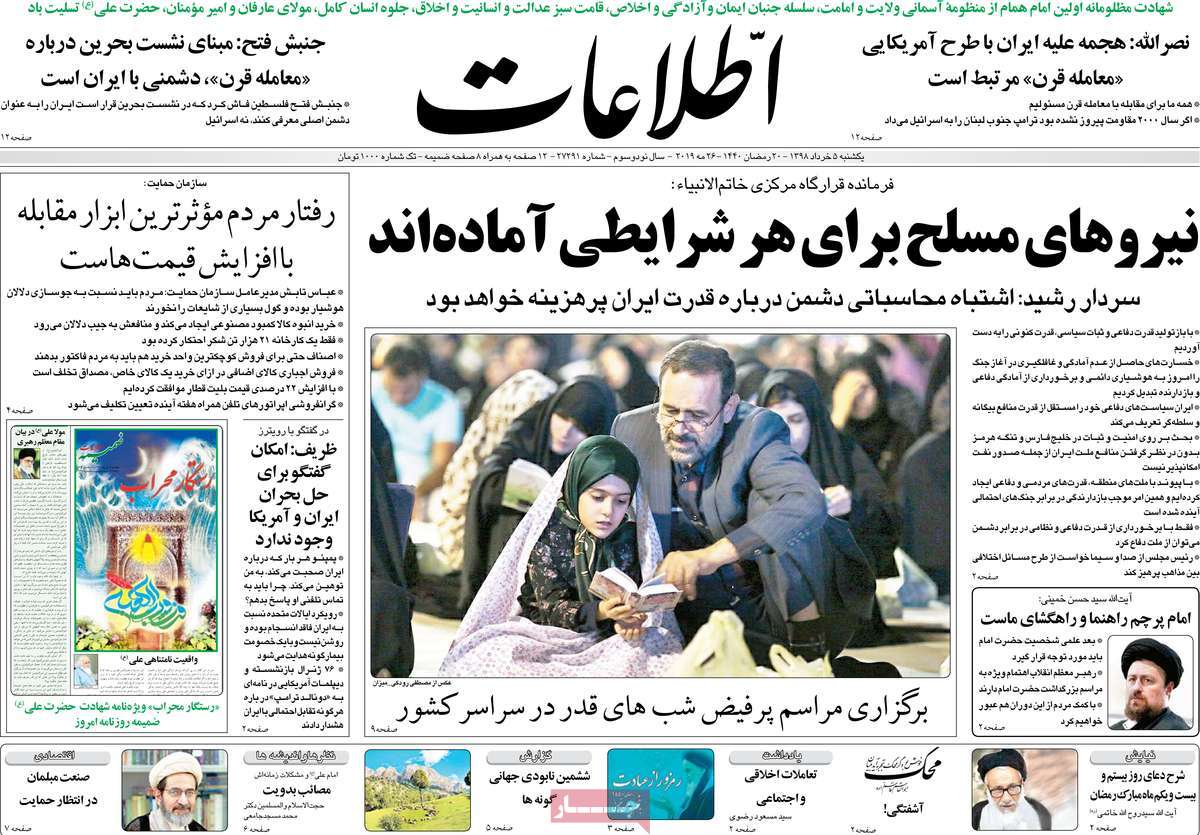
Ettela’at:

1- Khatam al-Anbiya Airbase Chief: Armed Forces Ready for Any Situation

2- Zarif to Reuters: Dialogue Not Possible for Resolving Iran-US Crisis

3- Nasrallah: Attacks on Iran Related to ‘Deal of Century’

A Look at Iranian Newspaper Front Pages on May 26


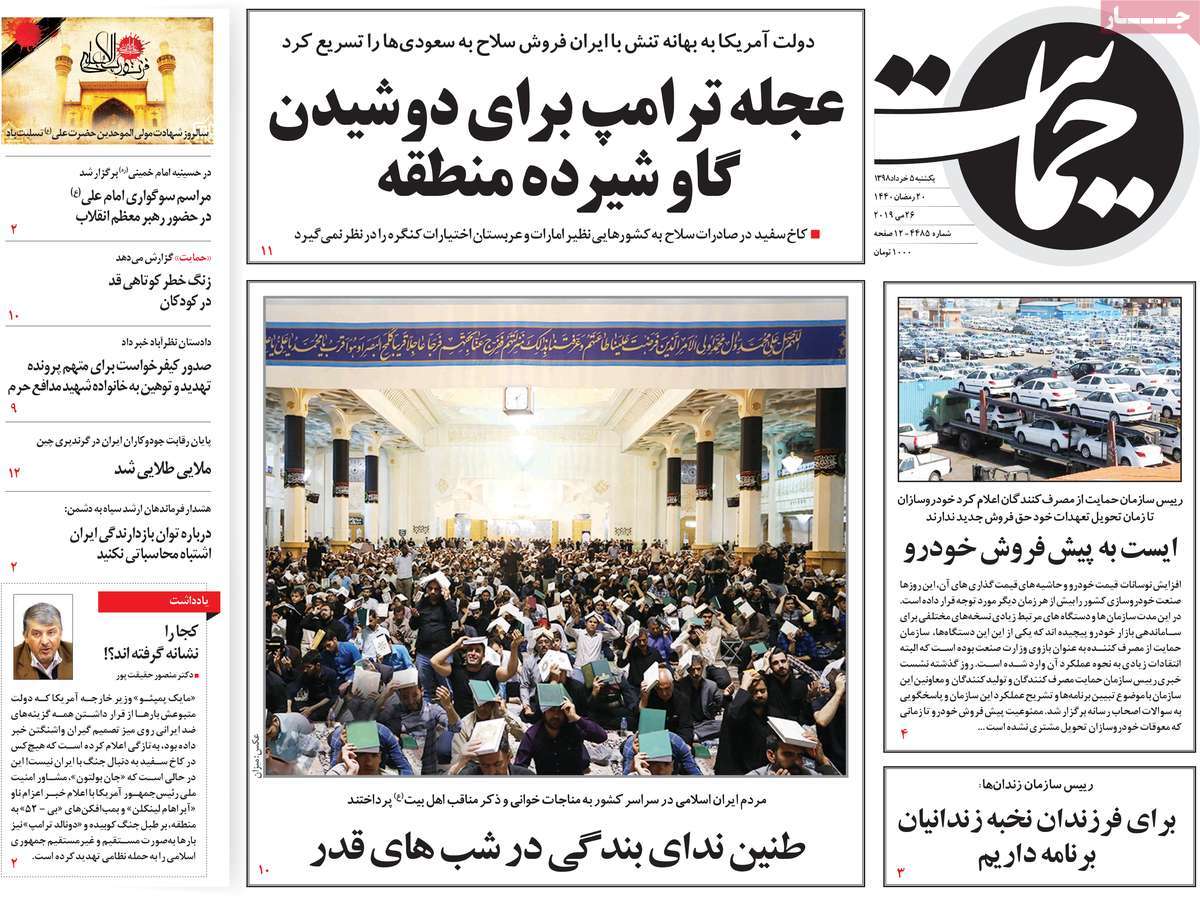
Hemayat:

1- Trump in a Hurry for Milking Region’s Milky Cow

* White House to Export Weapons to UAE, Saudi without Congress Approval

A Look at Iranian Newspaper Front Pages on May 26


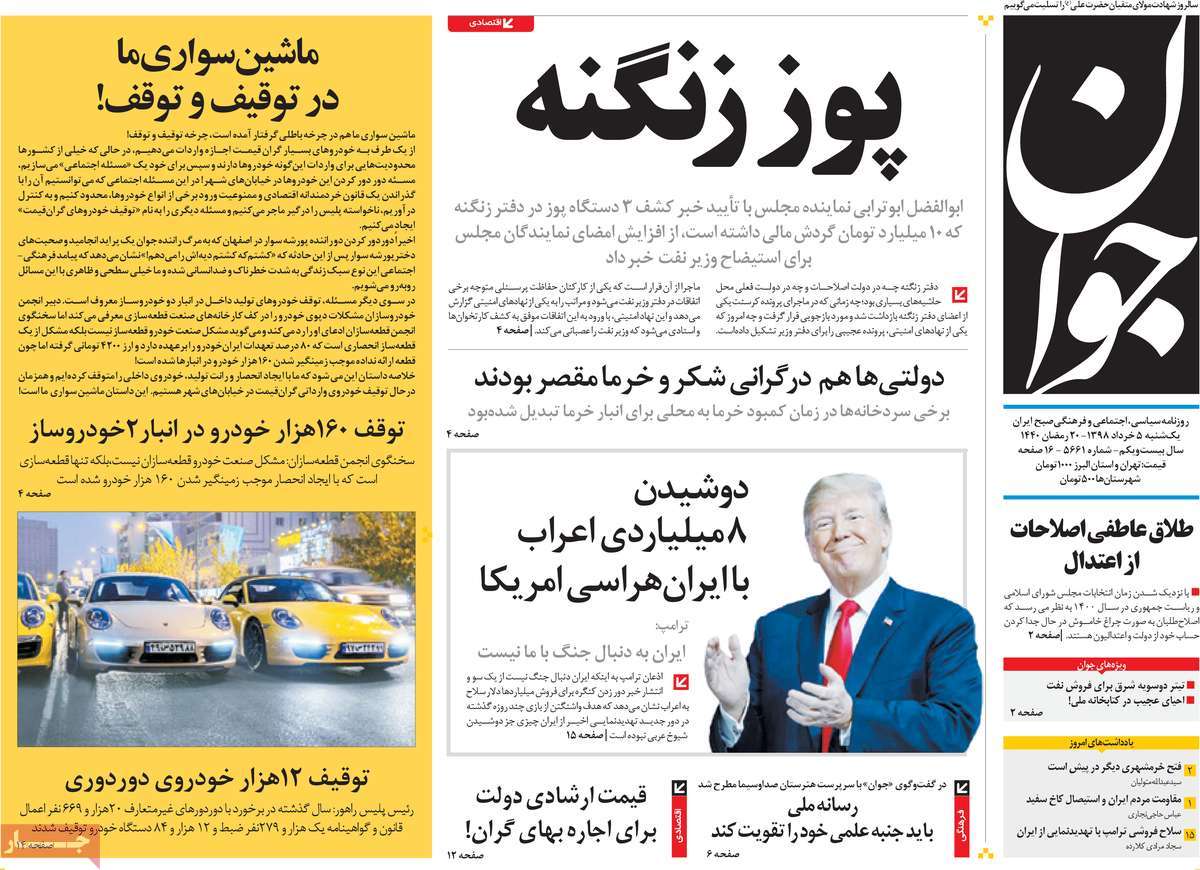
Javan:

1- Milking Arabs for as Much as $8 Billion through Iranophobia

* Trump: Iran Not after War with US

A Look at Iranian Newspaper Front Pages on May 26


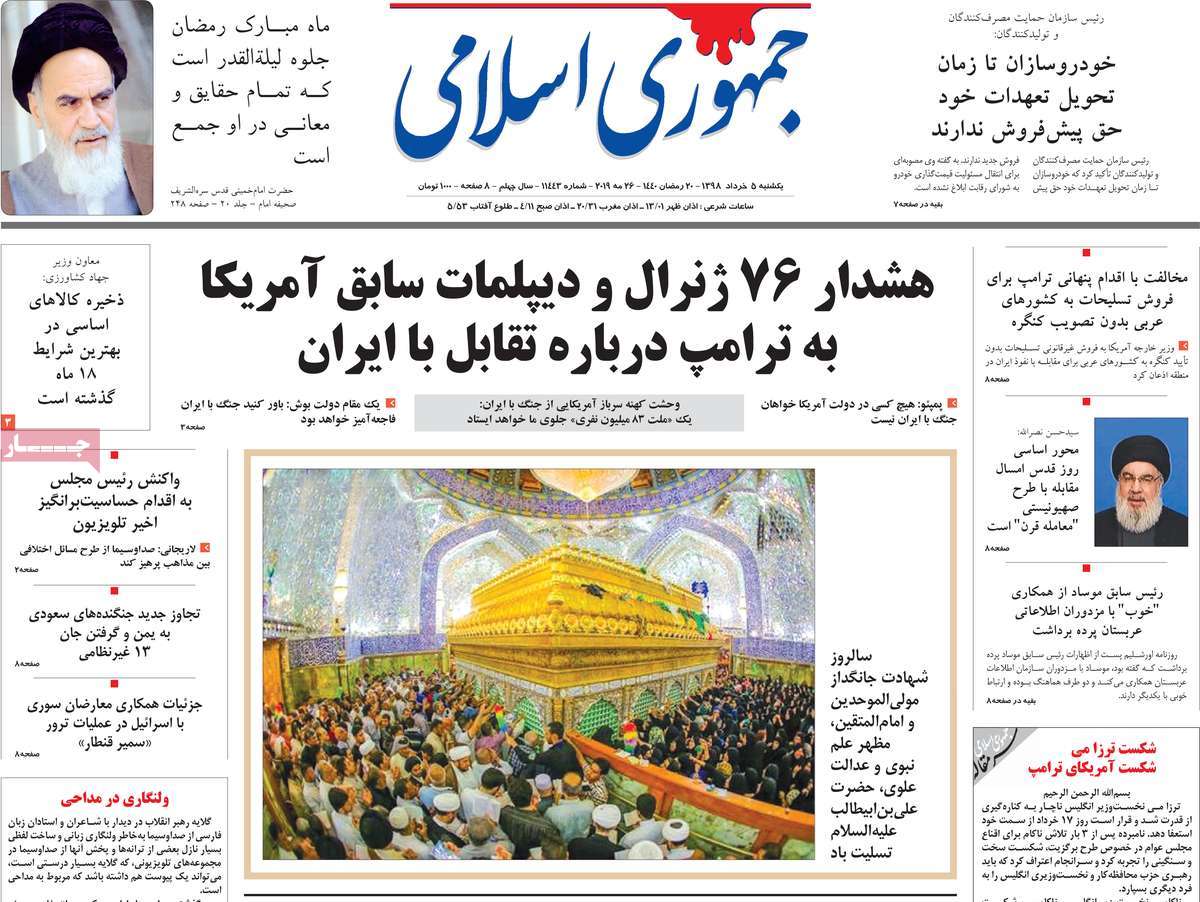
Jomhouri Eslami:

1- 76 Former US Generals, Diplomats Warns Trump against Clash with Iran

2- Failure of Theresa May, Failure of Trump’s America [Editorial]

A Look at Iranian Newspaper Front Pages on May 26


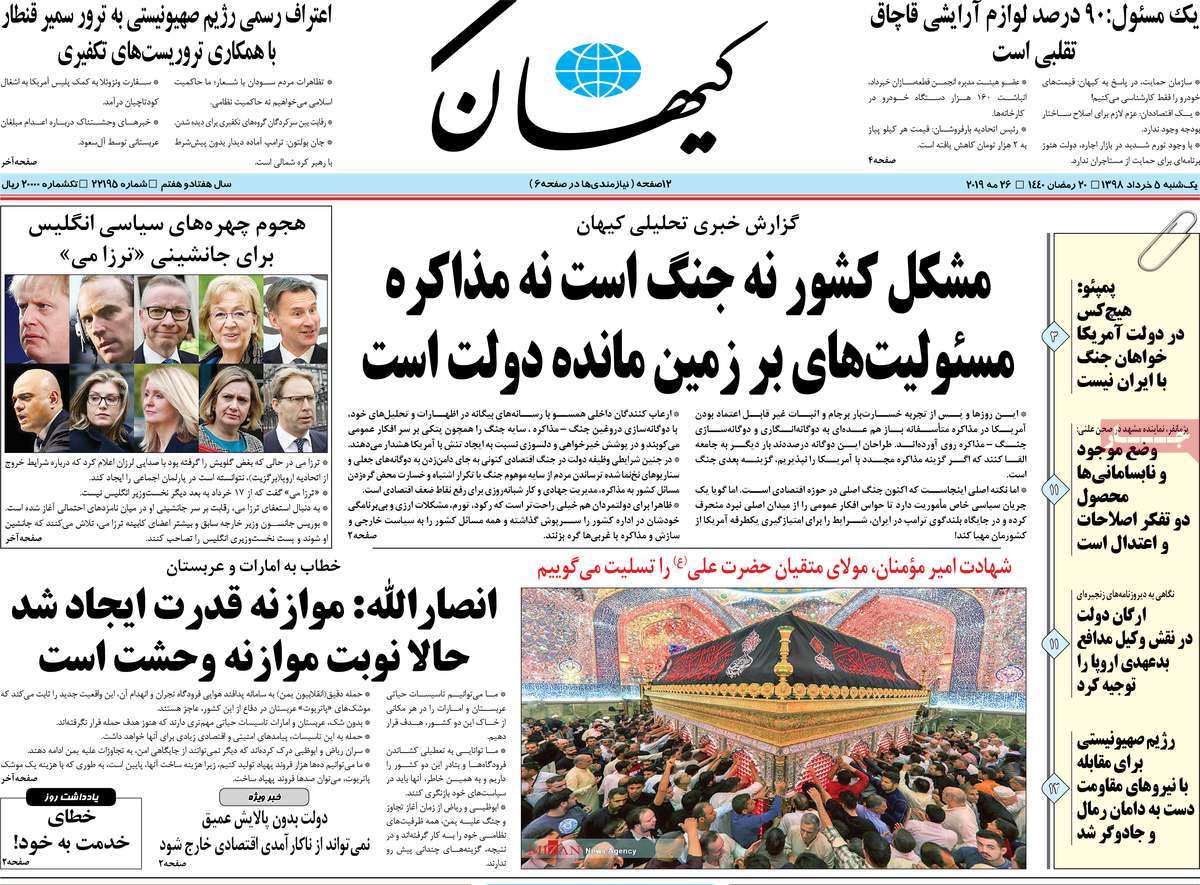
Kayhan:

1- War, Negotiation Not Iran’s Problems: Problem Is Government’s Unfinished Works

2- UK Political Figures Rush to Replace Theresa May

A Look at Iranian Newspaper Front Pages on May 26


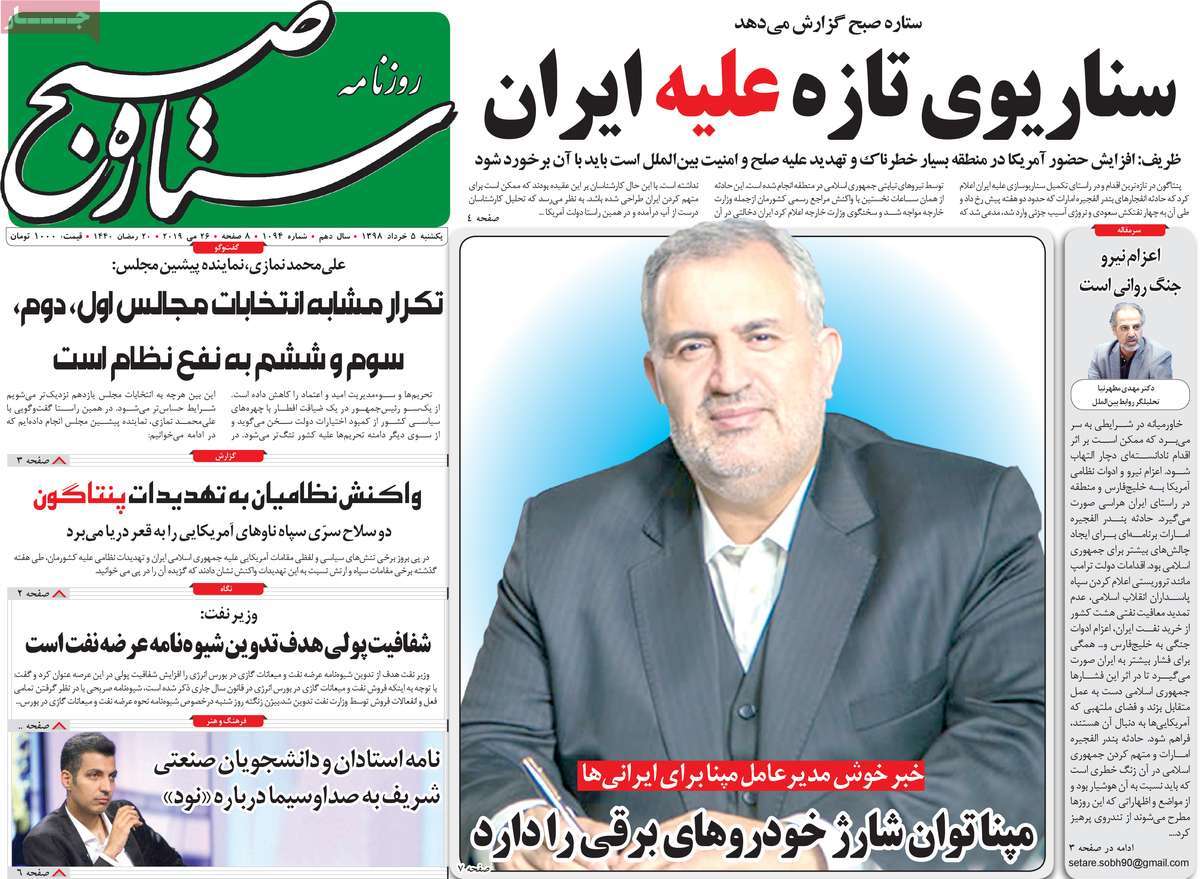
Setareh Sobh:

1- New Scenario against Iran

* Zarif: US’ Increased Presence in Region Very Dangerous

2- Iranian General: Two Top Secret IRGC Weapons to Sink US Carriers

A Look at Iranian Newspaper Front Pages on May 26


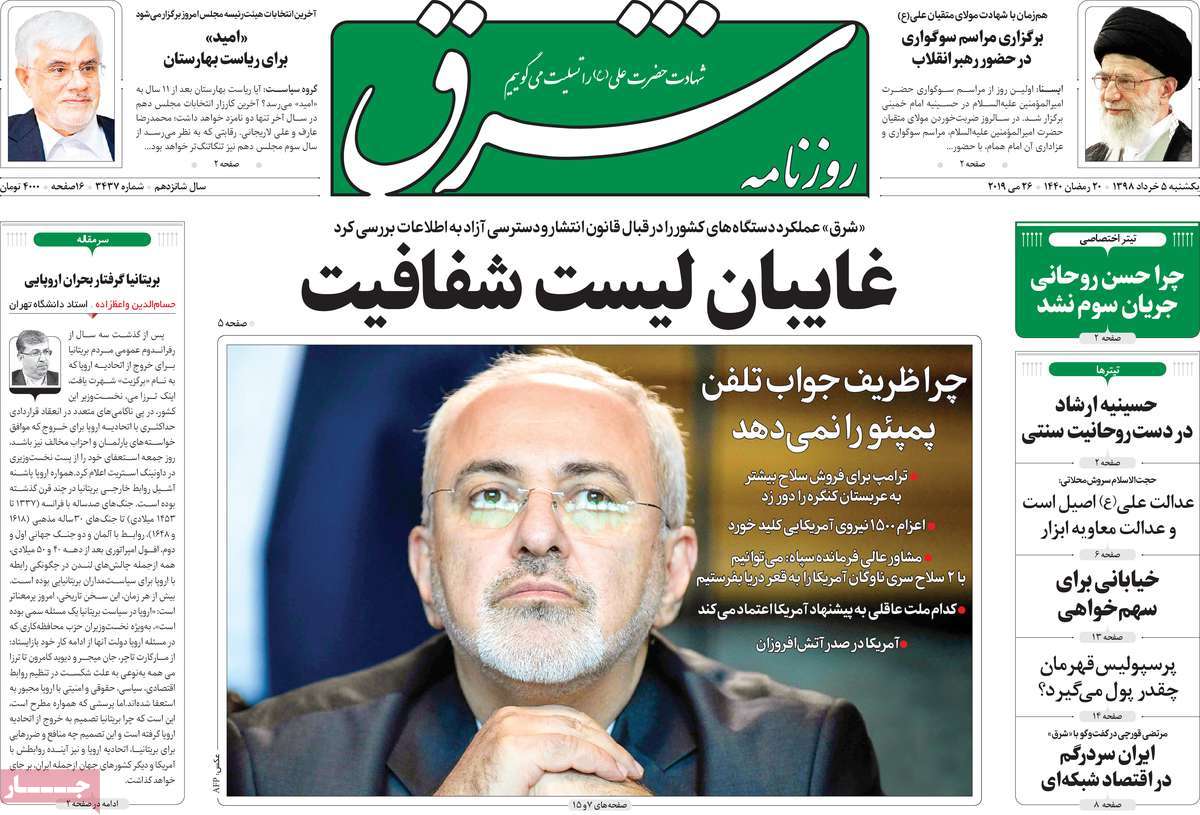
Shargh:

1- Why Zarif Does Not Answer Pompeo’s Call

2- Britain Gripped by Europe Crisis [Editorial]

A Look at Iranian Newspaper Front Pages on May 26

Iran Says Ready to Sign Non-Aggression Treaty with Regional States

Iran Says Ready to Sign Non-Aggression Treaty with Regional States

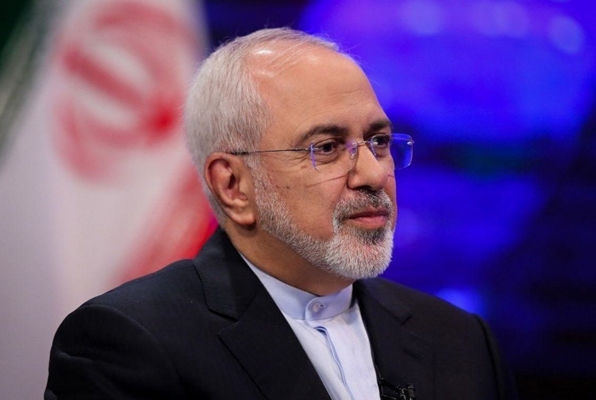
Mohammad Javad Zarif made the comment in a joint press conference with his Iraqi counterpart Mohamed al-Hakim on Sunday.

“Tehran has already put forward different proposals to sign a non-aggression agreement with all countries in the Persian Gulf region, and these proposals are still on the table,” said the visiting Iranian foreign minister in Baghdad.

He said Iran is seeking “the best relations” with countries in the Persian Gulf region, and, to that end, welcomes any proposal to hold talks and ease tensions.

However, he underlined that Iran will firmly counter any efforts to launch a military or economic war against the Iranian nation.

“While breaking laws and trampling international resolutions underfoot, the US also forces other countries to abide by its unilateral actions through bullying,” said the top Iranian diplomat.

Zarif further slammed the European countries for failing to deliver on their commitments under the Iran nuclear deal known as the Joint Comprehensive Plan of Action (JCPOA).

“We want the European countries and other signatories to the JCPOA to fulfil their obligations under the JCPOA,” said Iran’s diplomacy chief.

He said the European countries have reneged on their commitments over the past three years with regards to taking practical steps and normalizing their economic relations with Iran.

“Their failure to breach the JCPOA has intensified over the past year,” said Zarif.

He also thanked the Iraqi government and nation’s support for the Iranian government and people at a time when the United States wants to exert economic pressure on Iran. He appreciated Iraq’s efforts to help iron out problems.

Zarif also described his talks with Iraqi authorities as constructive.

The Iranian foreign minister said he and his opposite number reviewed the trend of implementing the agreements reached during trips to Iran by the Iraqi president and prime minister and during Iranian President Hassan Rouhani’s trip to Baghdad.

Zarif noted Iran has begun practical steps toward implementing the agreements which, as he added, concern a whole range of areas, namely trade, road building, dredging the Arvand Rud river and constructing railway lines.

He also underlined the need for speeding up the trend of issuing visas for pilgrims, entrepreneurs and businesspeople.

Iran Denies Closure of British-Iranian Chamber of Commerce

Iran Denies Closure of British-Iranian Chamber of Commerce

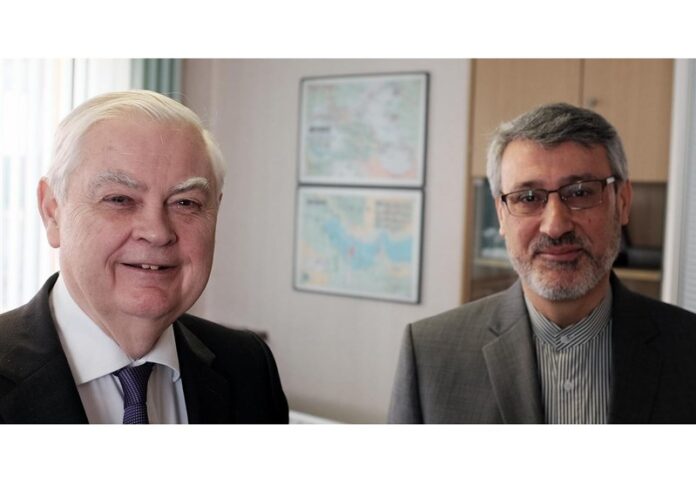
In a post on his Telegram channel, Hamid Baeedinejad quashed rumors on the closure of the British Iranian Chamber of Commerce, stressing that members of the chamber, chaired by Lord Norman Lamont, are holding their posts and doing their duties routinely.

It came after BBC claimed in a report on Saturday that the British Iranian Chamber of Commerce has closed its office in London because of a hemorrhage of members and its rising costs in the wake of US sanctions.

Baeedinejad, however, explained that the chamber had been renting an office in London for long years and holding plenary sessions, but it had to rent a new office last year after the expiry of the previous rental agreement.

The Iranian ambassador noted that a high rise in the rental fees incurred huge expenses on the chamber and made the authorities think of a logical way to reduce the costs.

Under a final plan, the officials decided to transform the physical structure of the chamber into a “virtual-digital” establishment by employing IT experts and leasing conference halls for periodic meetings, he added.

“The recent changes mean neither a closure of the chamber nor a decline in its activities, and they are only meant to use modern technology for the management of costs,” Baeedinejad concluded.

Iran, Iraq Vow to Work Together against Possible War

Iran, Iraq Vow to Work Together against Possible War

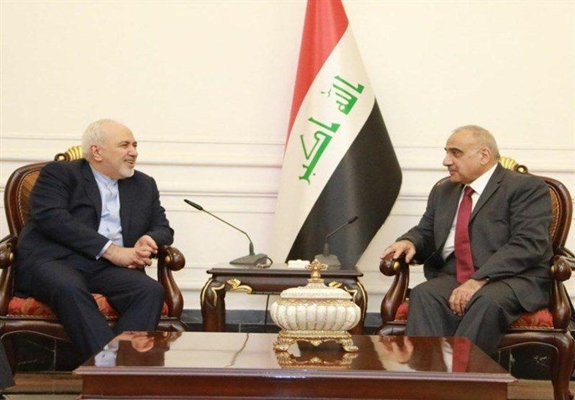
That was announced that in a meeting between Iranian Foreign Minister Mohammad Javad Zarif and Iraqi Prime Minister Adil Abdul-Mahdi in Baghdad on Saturday, May 5, 2019.

During their talks, the two officials discussed the recent regional developments, including those surrounding the Iran nuclear deal known as the Joint Comprehensive Plan of Action (JCPOA).

The two sides underscored that the international agreement should be preserved despite the United States’ unilateral withdrawal from the accord.

Abdul-Mahdi and Zarif reiterated that both Iran and Iraq have been affected by US sanctions on Tehran, which went into force following Washington’s pullout from the JCPOA last year.

He stressed that a potential military conflict between the US and Iran over the issue could have far-reaching consequences for the entire Middle East region.

Both officials stressed the need for Tehran and Baghdad to step up security cooperation to defuse the current tensions and reinforce regional stability.

Zarif’s visit to Iraq received widespread coverage in Arab media outlets amid regional and international tensions.

The Al Jazeera Network said Zarif’s trip comes against the backdrop of tensions between Iran and the United States. It said key regional challenges as well as reciprocal ties were discussed in the meeting.

The Alaraby Aljadeed website (www.alaraby.co.uk) also touched on the meeting, saying Iran-US tensions, their consequences and ways of easing those tensions are being discussed during the talks.

CNN Arabic said Zarif’s trip comes amid tensions between Tehran and Washington.

The Rusia Alyoum TV also covered the top Iranian diplomat’s visit to Iraq. It reported that Zarif has made trips to the Asian countries of Turkmenistan, India, Japan and China since May 12, 2019 in order to review ways of boosting mutual ties and exchange views on regional and international issues, particularly the JCPOA and growing tensions between Iran and the United States.

Sputnik wrote that Zarif and Abdul-Mahdi discussed ways of settling the crisis between Tehran and Washington.

Lebanon 24 also covered Zarif’s trip to Baghdad and his meetings with Iraqi authorities as well as the objectives of the visit.

Iran’s foreign minister arrived in the Iraqi capital Baghdad on a two-day official visit on Saturday, heading a high-ranking delegation.

On the first day of his trip, he held separate meetings with President Barham Salih, Prime Minister Adel Abdul-Mahdi and Parliament Speaker Salim al-Jabouri. They discussed mutual relations together with regional and international issues.

Zarif also sat down with his Iraqi counterpart Mohamed al-Hakim on Sunday.

Zarif’s third trip to Baghdad in the past few months comes at a time when Washington have been engaged in provocative moves, fueling tensions in the region and launching propaganda campaigns in some Arab countries with regards to growing threats and insecurity in Iraq.

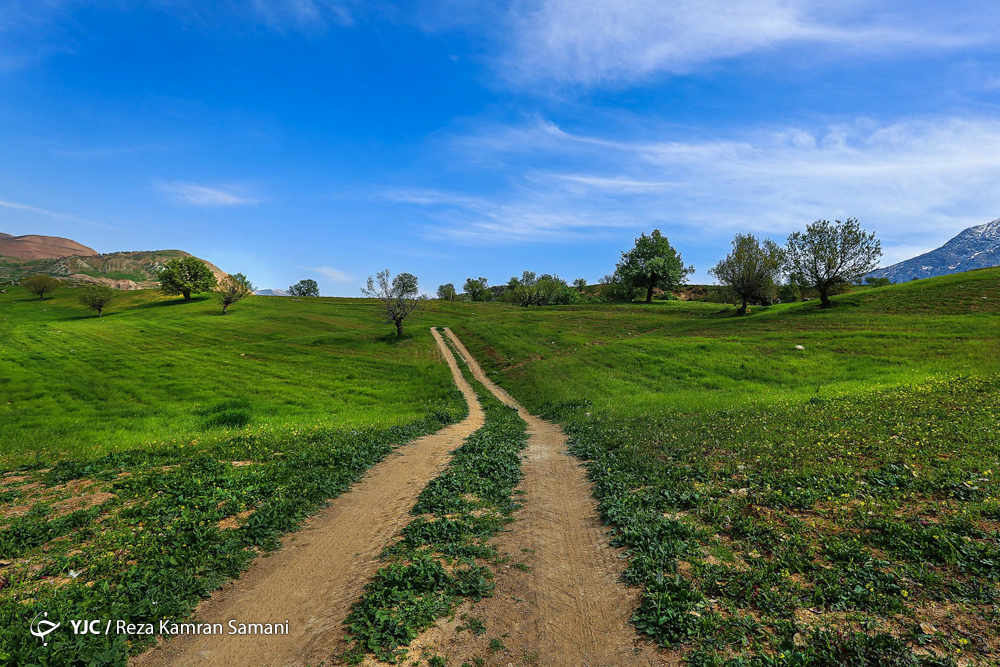
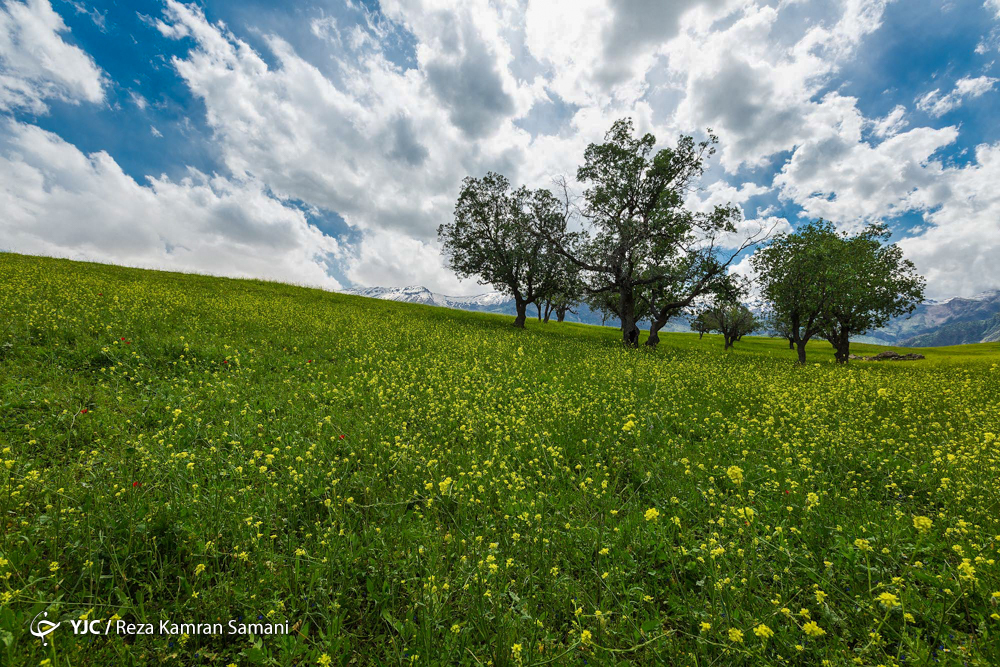
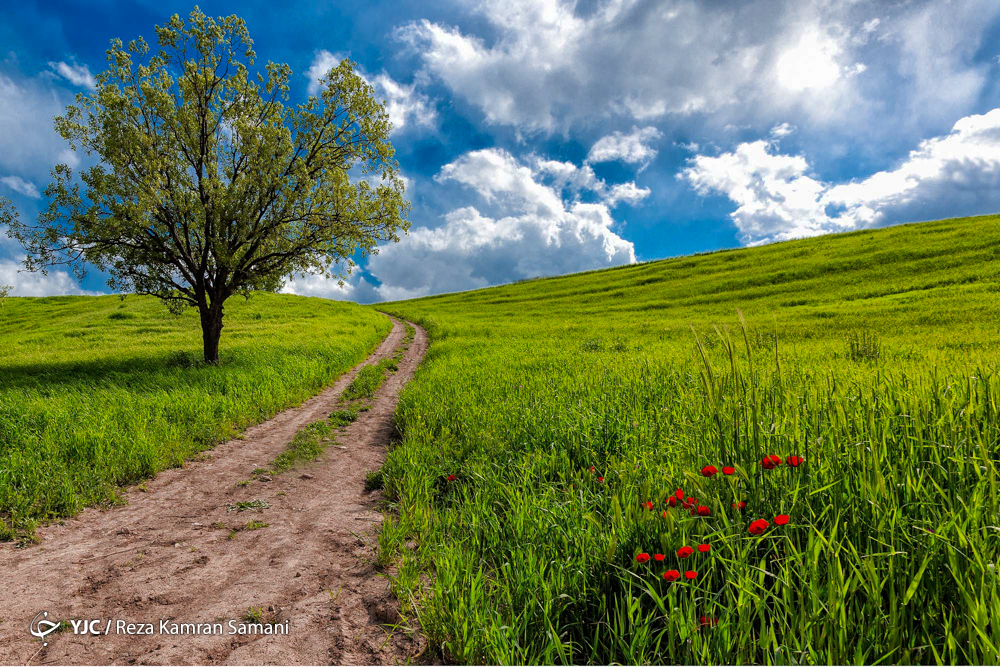
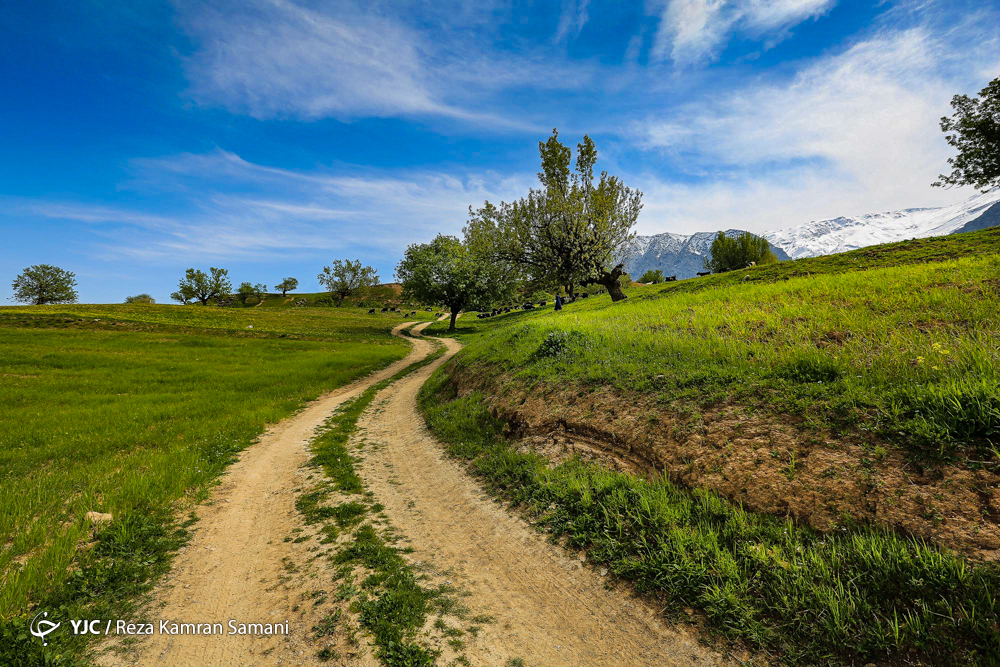
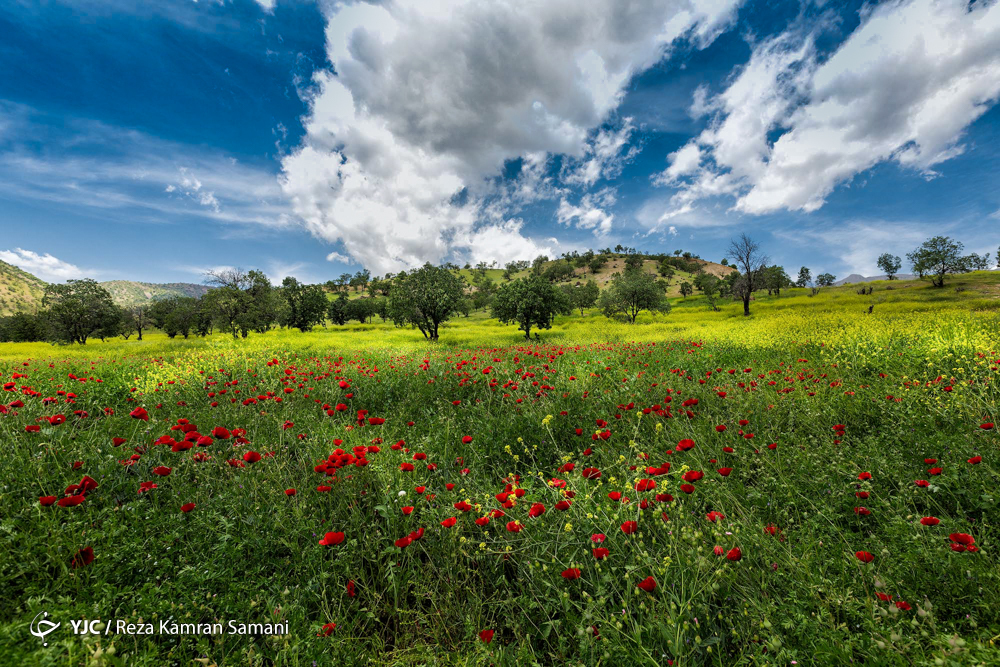
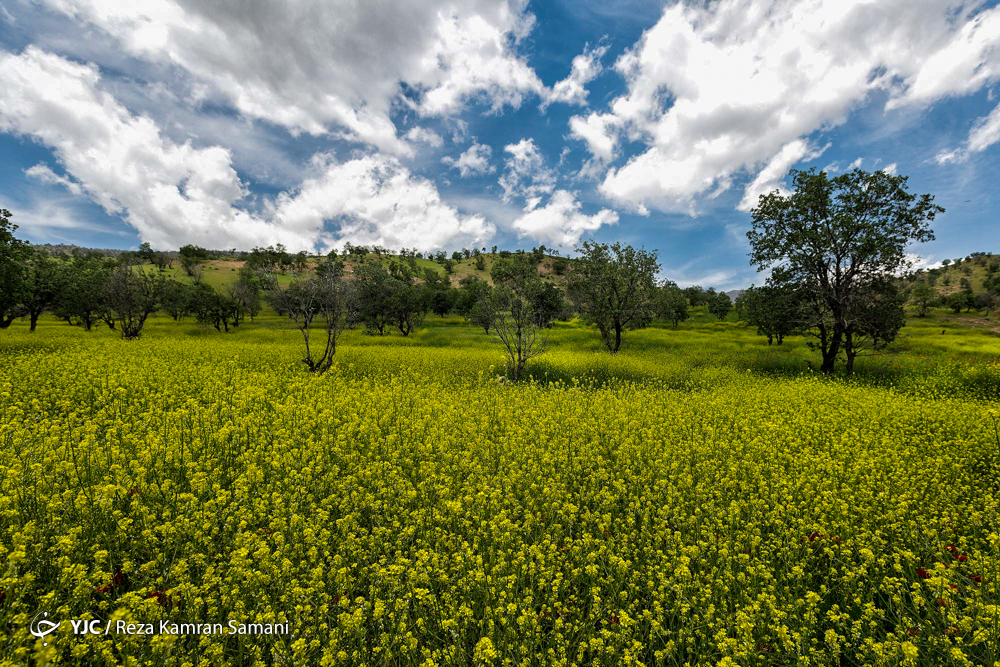
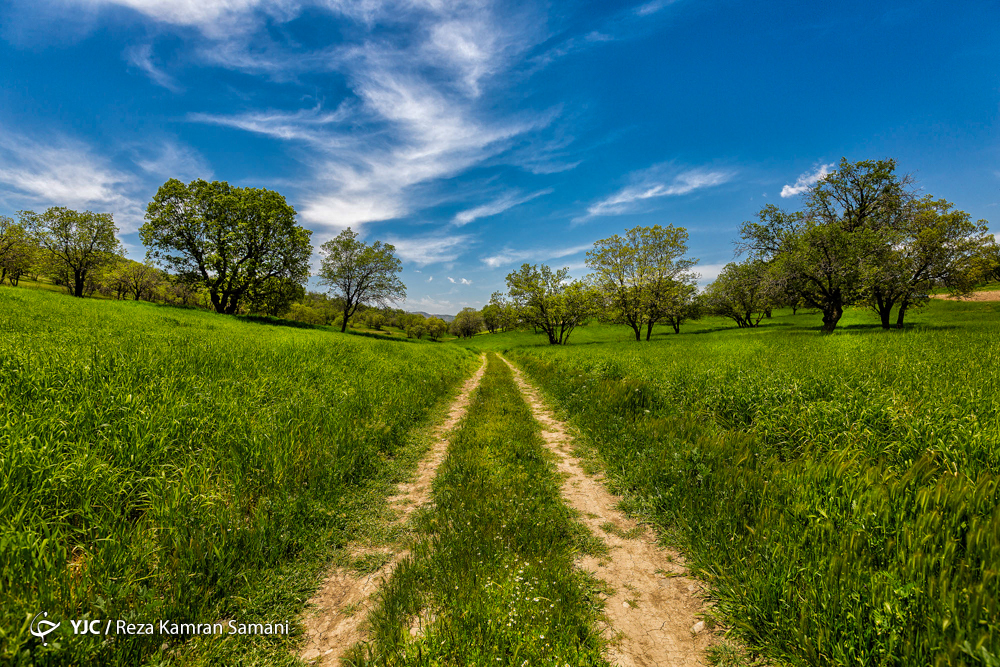
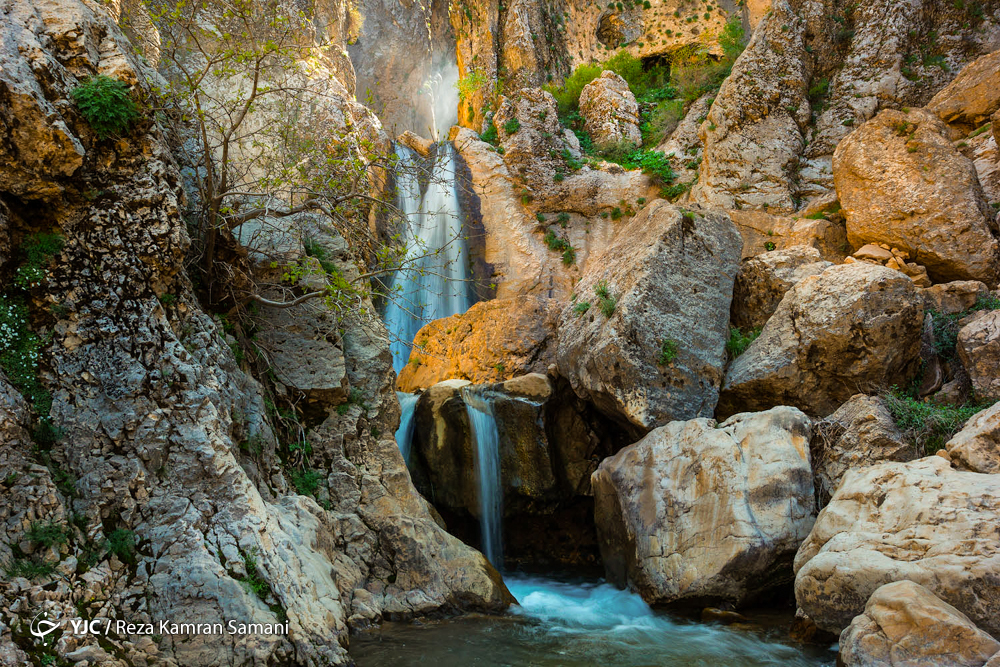
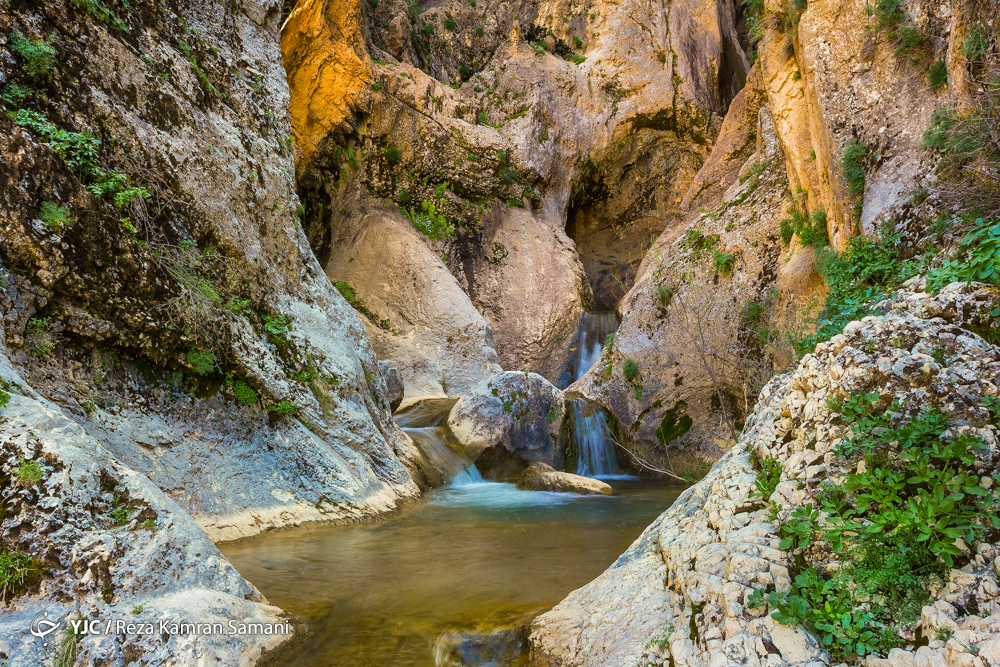
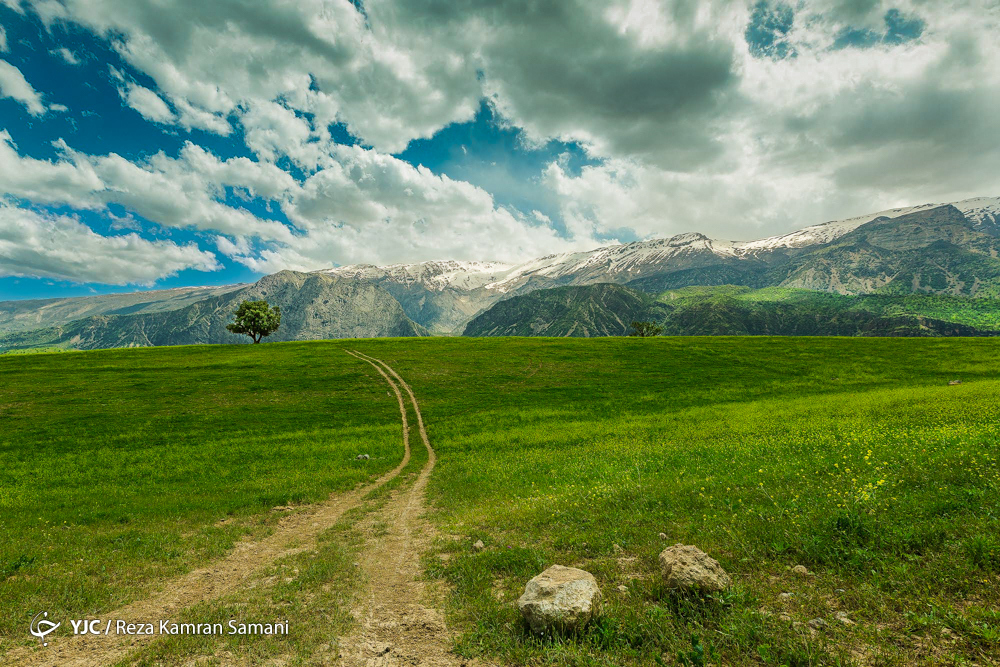
Iran’s Beauties in Photos: Heavenly Heights of Lordegan

Lordegan is located in Iran’s Chaharmahal and Bakhtiari province, on the southern slope of As-e Jam and Ab Bagh mountains.

Here you see Young Journalists Club’s photos of Lordegan:

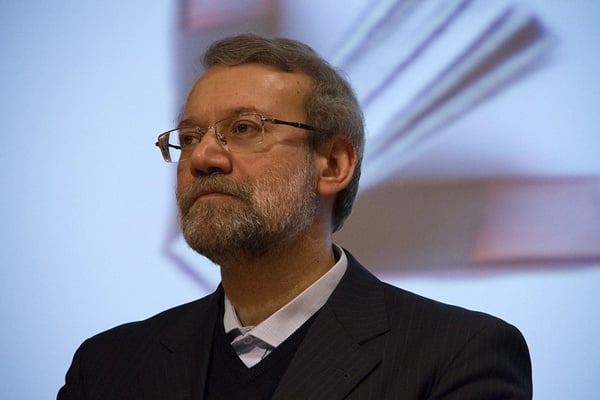
Ali Larijani Re-Elected as Iran’s Parliament Speaker

Larijani

Larijani won 155 votes out of 247 votes cast during Sunday’s parliamentary session, obtaining the speakership of the Iranian parliament.

Iranian lawmakers elected Larijani during an open session as the next parliament speaker for the fourth year of the 10th parliament, ICANA reported.

In a subsequent vote, one of his rivals, Mohammad Reza Aref did not garner more than 105 votes. Mohammad Javad Abtahi, another candidate, gained only 9 votes.

Reformist lawmaker Masoud Pezeshkian was also re-elected as the first vice-speaker of the Parliament, but the second vice-speaker, Ali Motahari, also a reformist, failed to win enough votes, and will be replaced by Abdolreza Mesri, a conservative lawmaker who served as the Labour Minister during President Mahmoud Ahmadinejad’s first term in office (2005-2009).

Ali Larijani is a moderate conservative politician who served as the Secretary of the Supreme National Security Council from 15 August 2005 to 20 October 2007. In his post, he effectively functioned as the top negotiator on issues of national security, including Iran’s nuclear program.

As per an internal guideline of Iran’s parliament, the election of the speaker in the first round is with the absolute majority of the representatives’ votes. If the election does not reach the absolute majority in the first round, the relative majority will be sufficient in the second round.

JCPOA Prevents World from Condemning Iran: Rouhani

Rouhani made the comments in a meeting with representative of the country’s media on Saturday evening.

“This is unprecedented in the Iranian history that an Iranian cargo ship is not allowed to berth at a foreign port for 10 days and fail to unload its cargo,” Rouhani noted.

“The US State Department has been in constant contact with that small country, and this has been unprecedented in the past 40 years,” he said.

In response to a question on how long Washington is going to put pressure on Iran, he noted that when the US officials realise the sanction on Iran have not worked properly, they will stop their hostile approach towards Iran.

Rouhani said “the country is paying a lot in the war against America, but we are definitely the winner of this war. For this victory some conditions must be met, and the most important one is the unity of thought and trust in each other.”

Rouhani noted that “the effect of people’s thoughts and judgment about the establishment is very important.”

He underlined that people may be having a hard time, but the important thing is that the enemy knows these people, despite economic problems, do not give up on their support for the establishment, and they trust the officials and rulers.

The United States stirred up tensions with Iran in May 2018 when US President Donald Trump pulled his country out of the nuclear agreement, officially known as the JCPOA, and re-instated cruel sanctions against the Islamic Republic in defiance of worldwide criticisms.

The tensions saw a sharp rise on the first anniversary of the US exit from the deal as Washington moved to beef up the pressure on Tehran by tightening its oil sanctions and building up its military presence in the region.

Washington has since further amplified the pressure on Iran, deploying military reinforcements, including the USS Abraham Lincoln aircraft carrier strike group, a squadron of B-52 bombers, and a battery of patriot missiles, to the Middle East.

Iranian Diplomat Due in Oman, Kuwait, Qatar for Consultations

Reviewing the fast-changing international developments in recent days, especially those in the Persian Gulf, will be high on the agenda of the Iranian diplomat’s talks.

Araqchi’s regional tour will come as Foreign Minister Mohammad Javad Zarif is currently in the Iraqi capital of Baghdad after finishing a tour of several Asian countries, including India, China, and Japan.

While in Baghdad, Zarif will hold negotiations with Iraqi authorities including president, prime minister and parliament speaker of the Arab neighbour.

The visit comes a day after the Pentagon announced 1,500 troops would be sent to the Middle East in what officials described as a “force protection” measure against alleged Iranian threats.

Tensions have escalated since the US sent an aircraft carrier and B-52 bombers to the region in response to intelligence reports suggesting an imminent attack.

Iran has dismissed the alleged intelligence as fake and slammed the deployments as a psychological warfare.

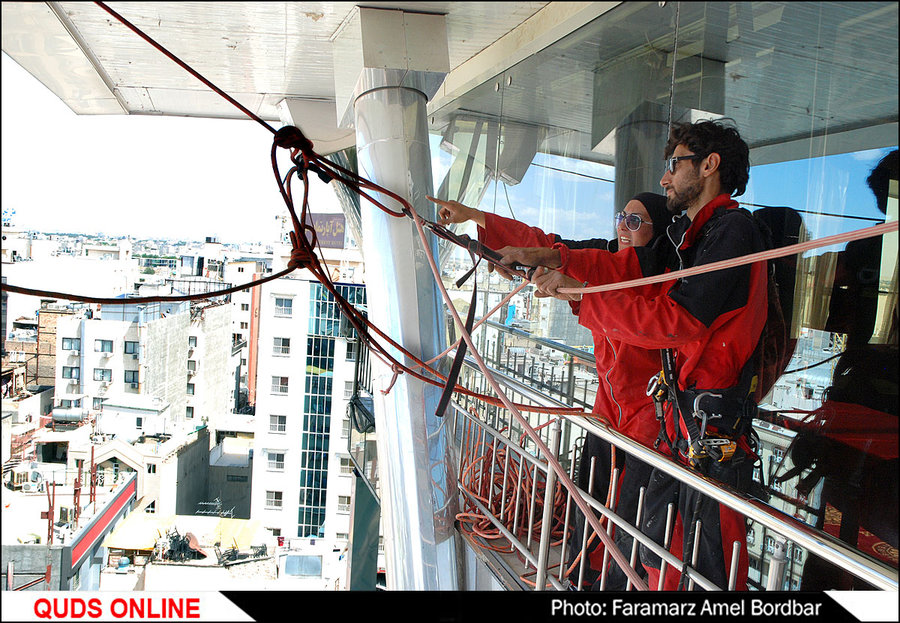
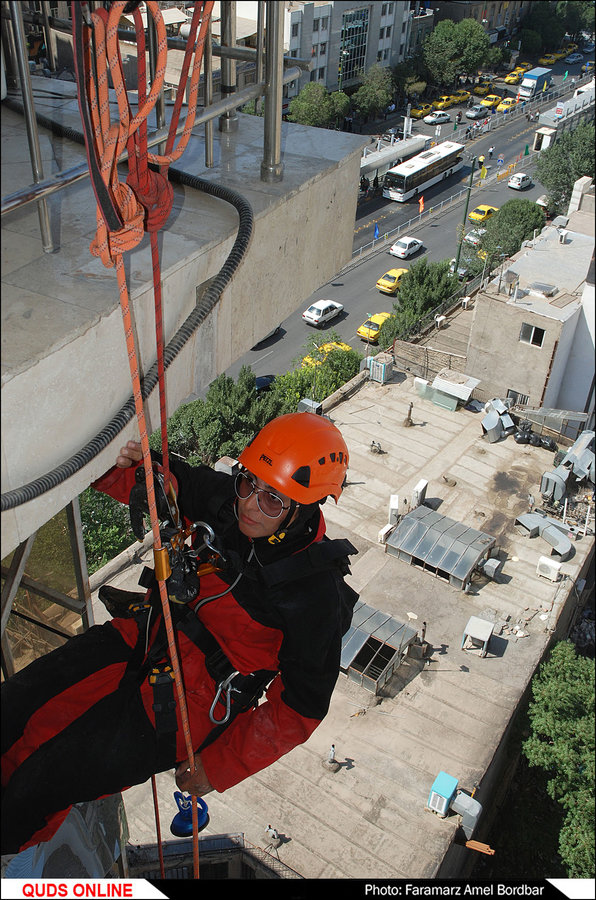
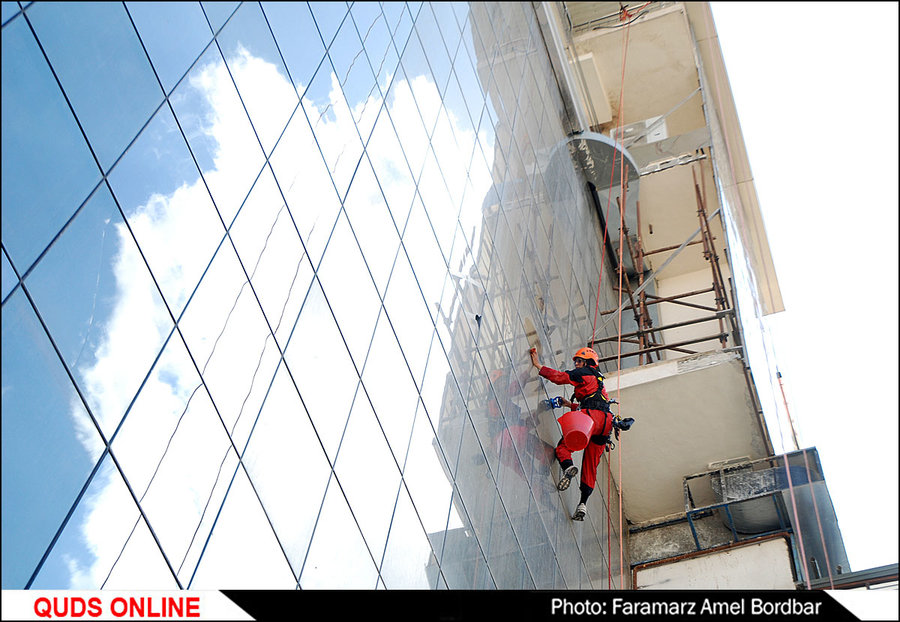
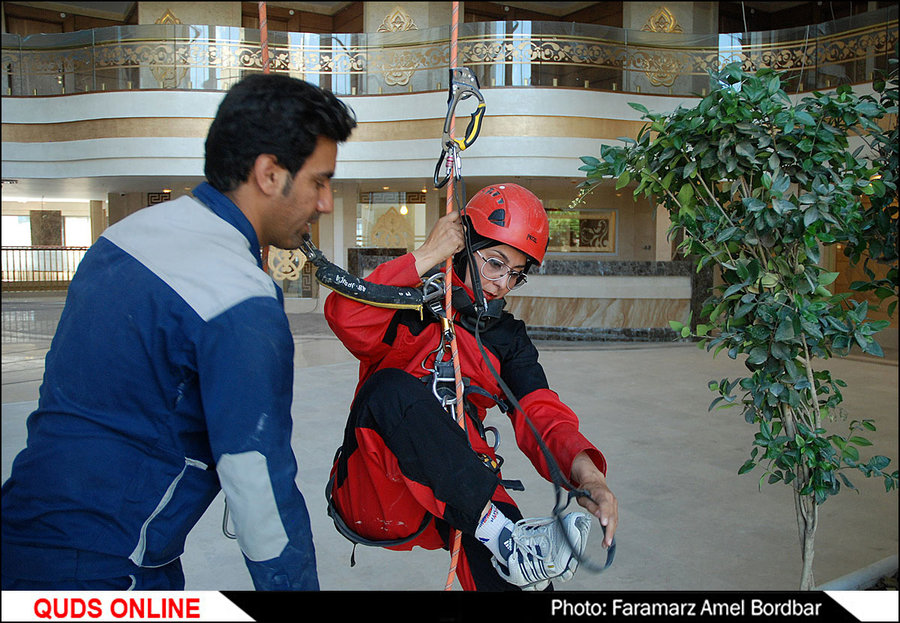
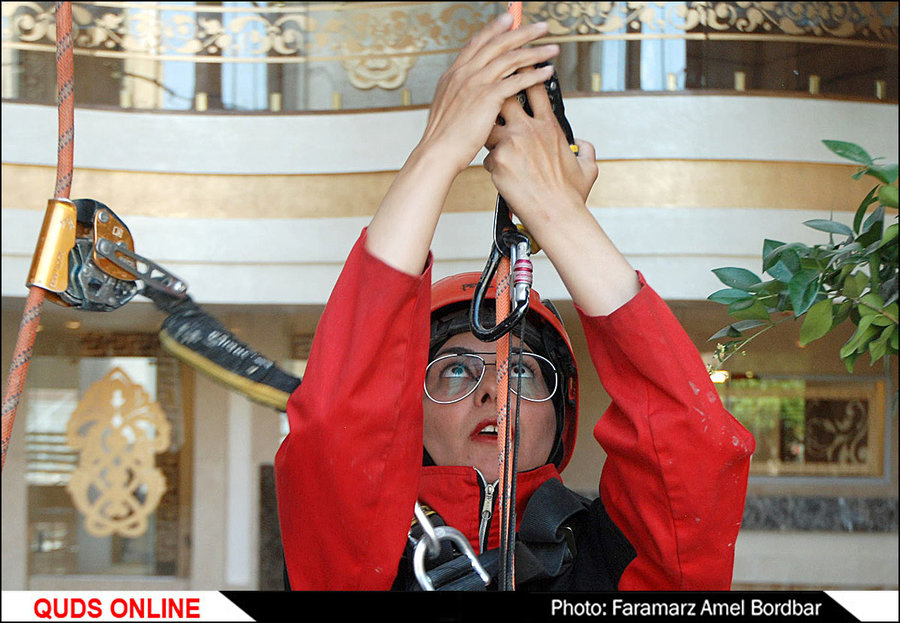
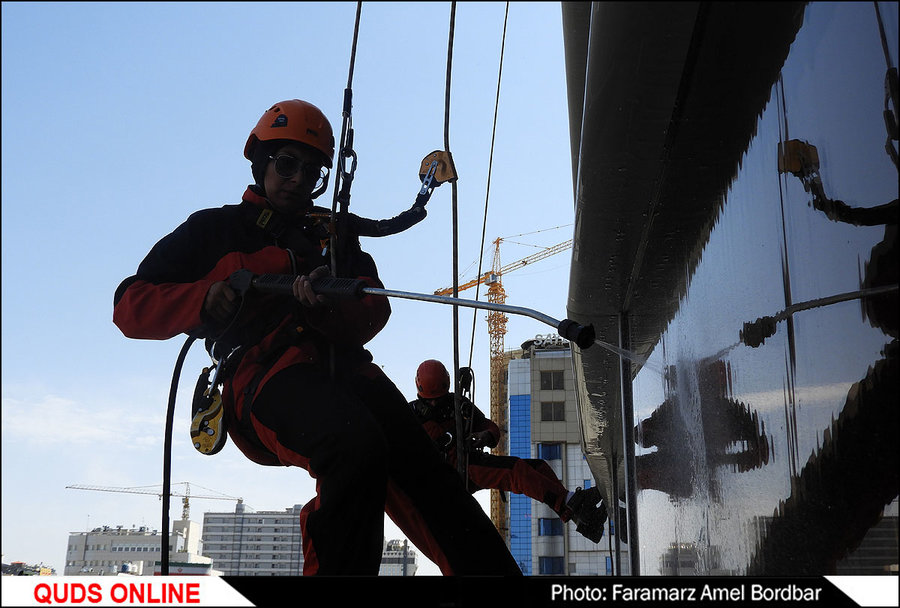
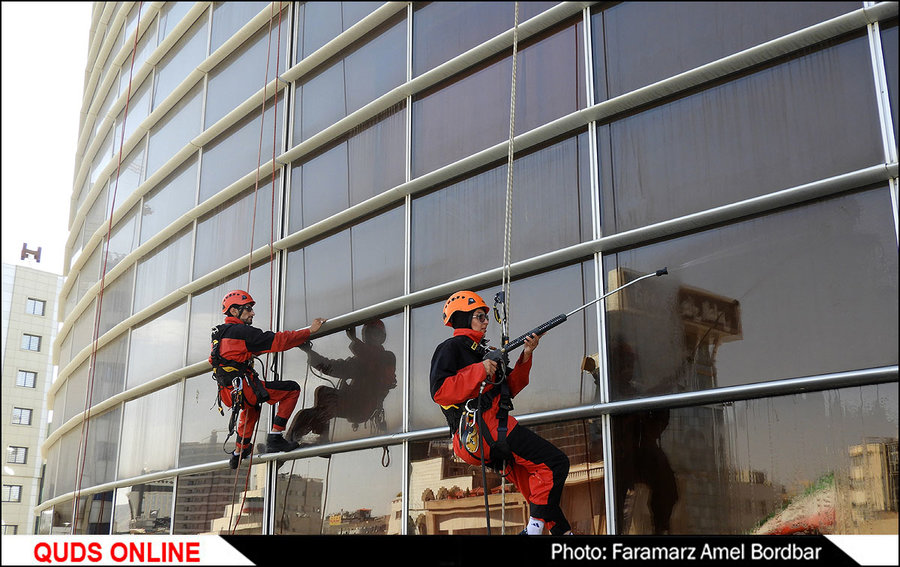
‘Spider Woman’ Says Finds Peace of Mind in Climbing Buildings

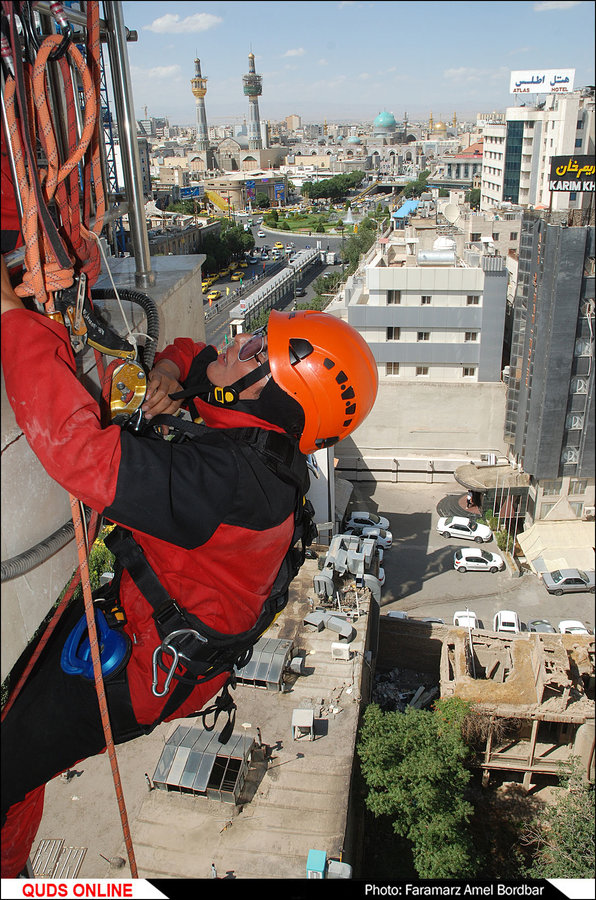
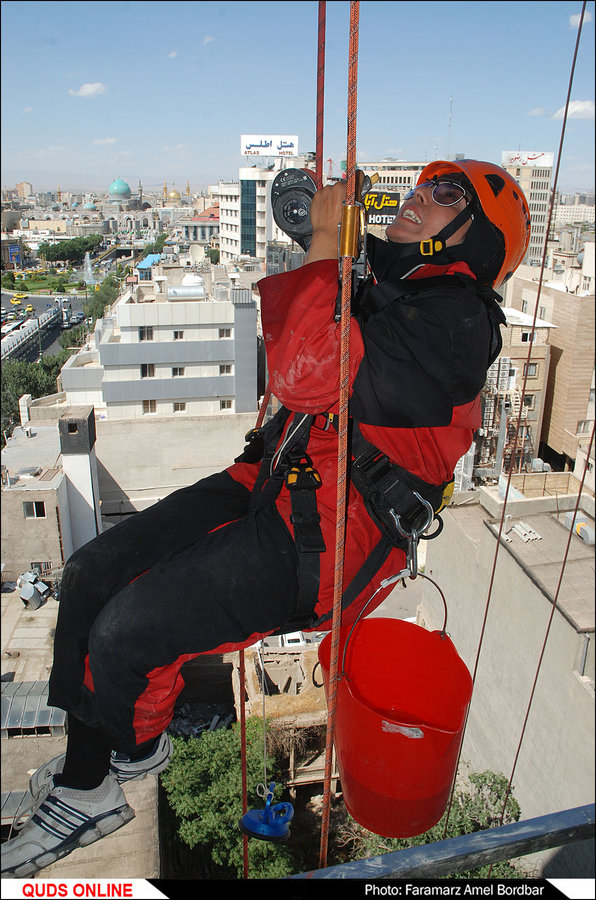
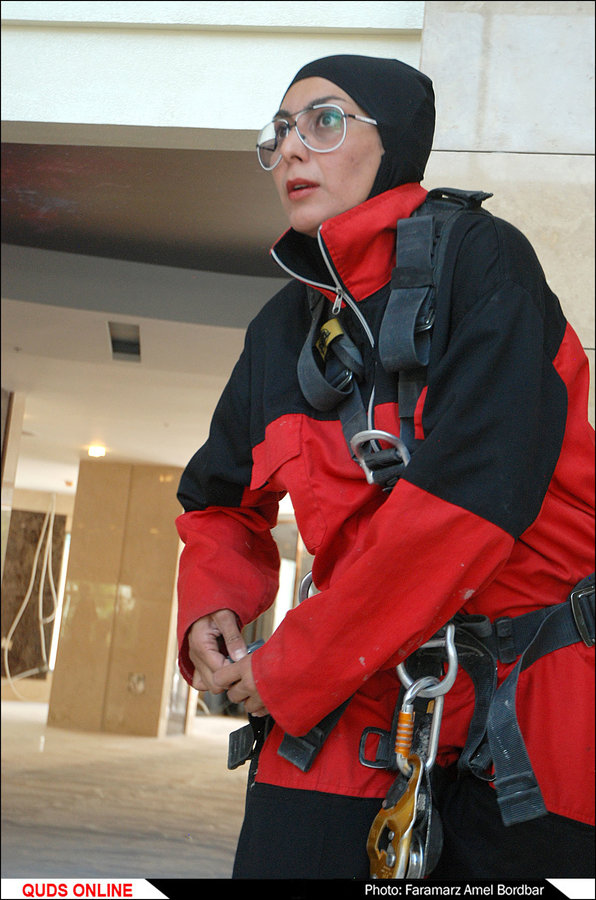
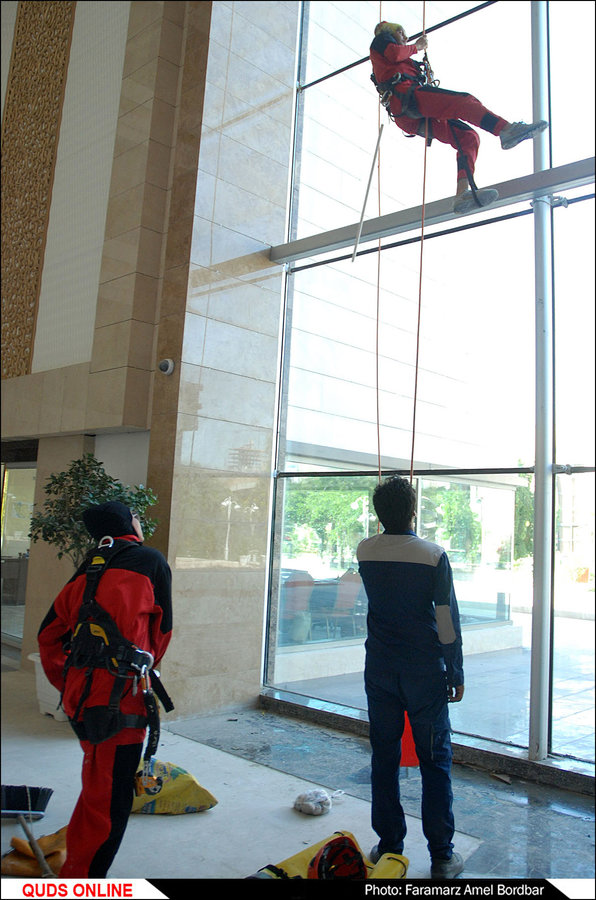
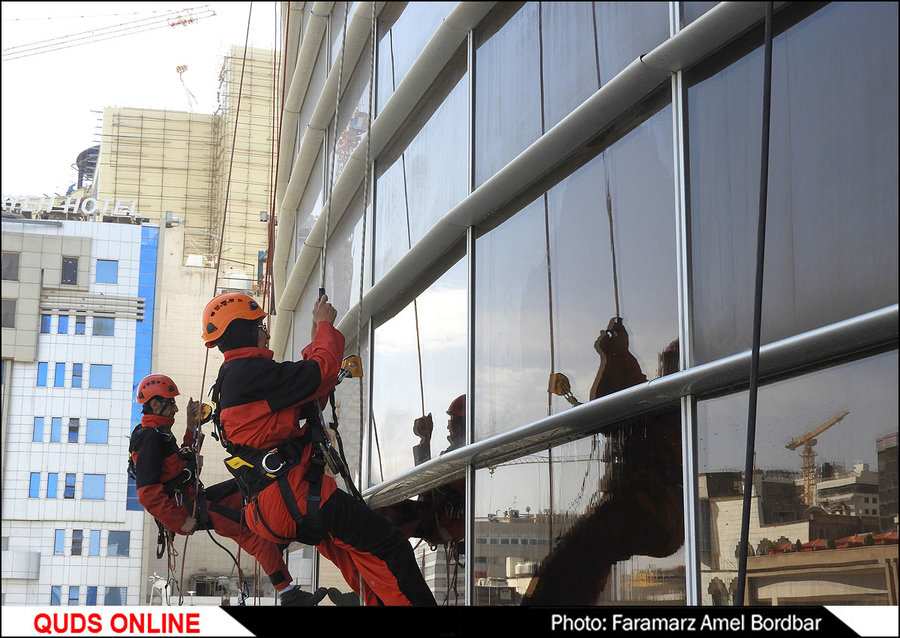
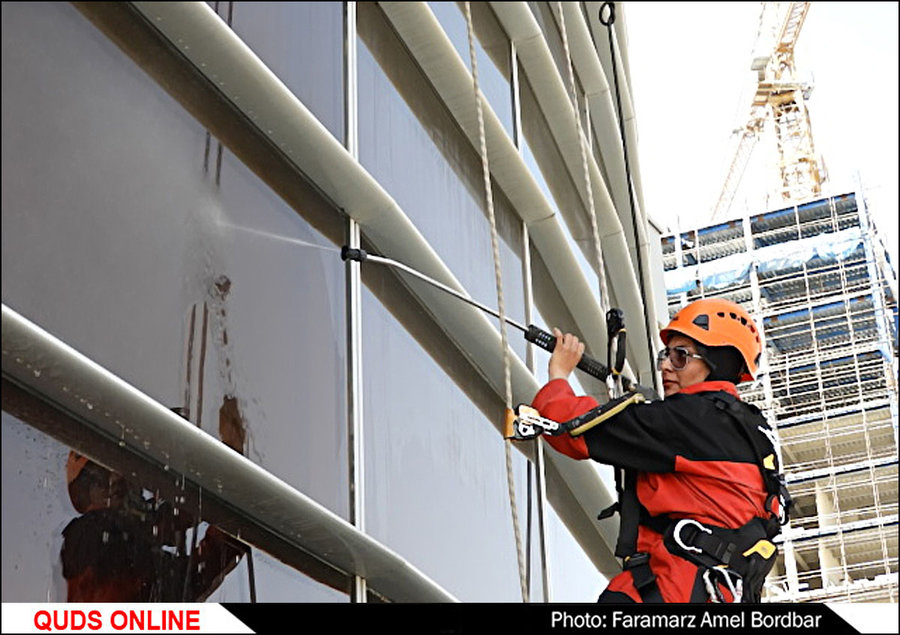
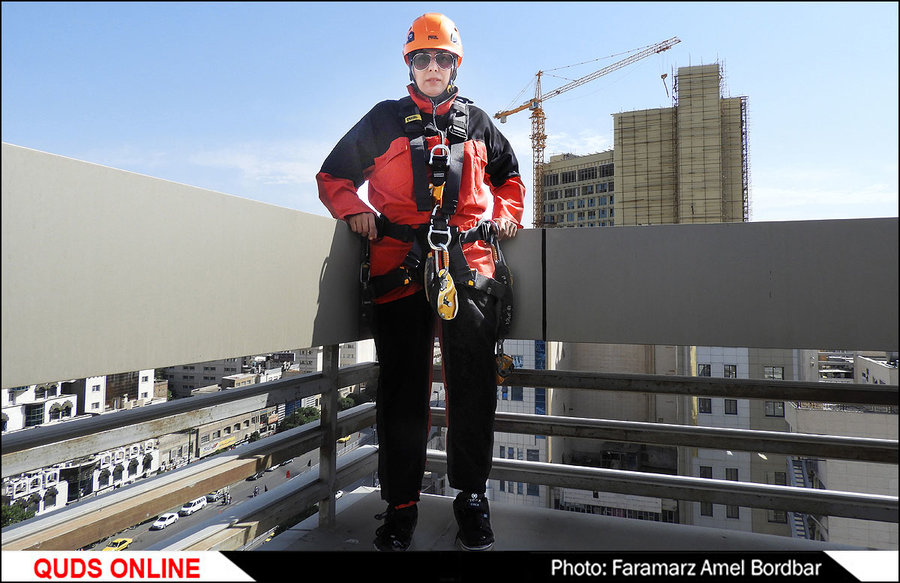
A resident of the city, Farzaneh has gone against tradition and her own family to choose the profession and prove that there is no concrete line between genders when it comes to choosing a job; especially one that is widely viewed as masculine.

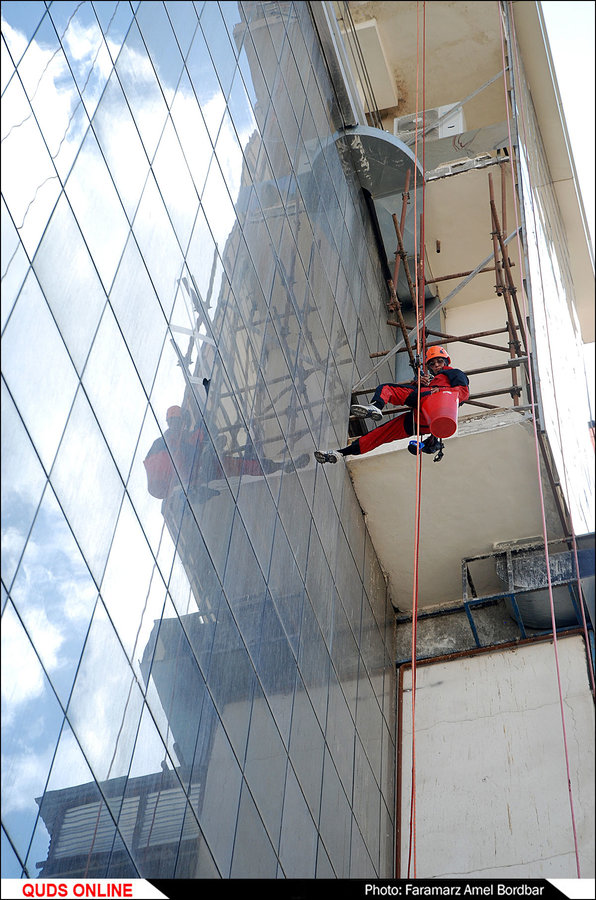
She chose the job after what was supposed to be a one-off exciting experience of working at height. The experience was so phenomenal that Farzaneh closed her clothing store in one of Mashhad’s shopping centres and became a height worker. She made the decision despite her family’s objections. Today, she carries out construction projects on Mashhad’s main skyscrapers.

Farzaneh is the only woman in Iran with an international diploma in this field.

“The profession is highly useful in the areas of construction and urban services,” she said.

To most people, working at height is restricted to washing the glasses of towers and skyscrapers. But Farzaneh says the profession has way more potential and can help firefighting and rescue operations as well.

“I think even a woman can play a key role in these operations. Parts of our profession deal with facade dowels and sealing. Sometimes, we wash and light the façade. All these operations take place at height,” she said.

In an interview with Shahrvand newspaper, Farzaneh has talked more about her profession. Below you can read an excerpt.

Q: How exciting is working at height that you are willing to put up with all these dangers? Is it for the high income or you are just so interested in what you do?

A: I had good income before choosing this profession. I changed my job because I wanted to do something to pacify my soul. Climbing up a building makes me feel better. While on the ground, I get headache. But when I’m at height, I feel good. I work on average seven to eight hours per day.

Q: How do ordinary people react to your profession?

A: Frankly, in the early days I was afraid of people’s judgments. When I put on my uniform, people used to watch me with surprise. But gradually they became accustomed to the scene and started to send positive energy. Five years on, people are used to seeing a woman who climbs a skyscraper. When I’m hanging from residential towers, the female residents come to the window and take selfies with me. They even bring tea and cookies. We talk when I’m working. Sometimes, people on the ground greet me as a man because they don’t recognize that it is a woman working at height.

Q: How do your entrepreneurs deal with you? Have you ever received any sexist reactions?

A: In the early days of my career, yes. Sometimes they had some sexist views and even made fun of me. But I insisted on my job and fought for it till I managed to prove that the career has nothing to do with the gender. Now, after five years, I launch my projects alone. Believe it or not, the largest projects in this area are carried out by me.

Q: Tell us about the difficulties you face on the job.

A: The first mistake is your last mistake. But if you check all safety measures, nothing will happen. The climate is also important for us. We can’t climb the skyscrapers in bad weather. But above all, the most difficulty I face in my job is the traditional view of the society who take it as a masculine job.

Q: How did you come up with the traditional view?

A: I’m a woman who is interested in, as some people say, a masculine job. I do my job far better and more accurate compared with others. On the other side, I haven’t lost my femininity. I do my chores at home as a housewife.

Below you can see Quds Online’s photos of Farzaneh at work: