Thursday, January 1, 2026
Home Blog Page 3068

Iran, Oman Weigh Plans for Visa-Free Travels

Iranian Minister of Cultural Heritage, Handicrafts, and Tourism Ali-Asghar Mounesan held a meeting with Oman’s Minister Responsible for Foreign Affairs Yusuf bin Alawi bin Abdullah on Wednesday.

In the meeting held in Muscat, the Iranian minister said, “You are a popular character in Iran. Our people are very interested in you. Oman has always had a constructive role in the region and the good leadership of His Excellency Sultan Qaboos has created such (close) ties between the two nations as well. We and Oman’s tourism minister are promoting tourism ties between the two countries.

I thank you for facilitating the visa issuance. We also lifted the visa requirement for Omanis with the Foreign Ministry’s efforts.”

“I am glad to see your affection for the people of Iran,” he noted, adding, “We have been friends and brothers with the neighboring state (Oman) for years, and this is a trend that the Revolution’s Supreme Leader has been insisting on.”

“The more the Americans exerted pressures on us, the stronger we got,” Mounesan added.
“Iran has diverse and many historic sites.

Considering the proximity (of Iran and Oman), it can be a good destination for the people of Oman,” the Iranian minister added, noting, “I heard that the countries (tourists destinations) must be on your medical list. You can also make arrangements to put Iran on this list. Your Health Ministry experts have apparently highlighted this issue during a visit to Iran last year.”

“Iran has also great capabilities in the field of organ transplantation, as well as heart and brain surgeries,” Mounesan noted.
“I thank God that the tourism industry between the two countries is growing. We have around eight million tourists travelling abroad, the bulk of whom travel to the regional countries. We are interested to see a large number of them visit Oman, and reciprocally, to host more Omani tourists in Iran,” he added.

“If possible, the visa fees should be eliminated to allow for the presence of more Iranian tourists. We have bilaterally lifted the visa regime with Turkey, which has attracted a large number of Iranian tourists,” Mounesan noted.

For his part, the Omani foreign minister said, “We have very age-old ties with Iran. Every time I visit Iran, I feel as if I’m in my own country, and everybody feels comfortable at their home country.

The blessings of God always exist for a country with such great leaders and nation.”

“I will pursue the issue of lifting visa for sure,” Yusuf bin Alawi bin Abdullah stressed, adding, “The most important subject is health tourism. Many Omani people travel to southern Iran, particularly to Shiraz.”

“Iran has great medical capabilities. A big revolution in the progress and development has occurred in Iran. Our people prefer to travel to Iran for treatment, particularly for eye diseases. There is special affection between the nations of the two countries, and Iranians are welcomes here with open arms,” he added.

“Iran and its nation have proved several times that they can overcome the sanctions and this in not anything new. I believe that these sanctions will eventually end,” the Omani minister noted, adding, “These are historical realities about people of Iran.”

“Our people travel to Thailand and India for treatment as well, but they prefer to go to Iran for treatment. Omanis do not have much information about kidney transplantation. A patient may even wait for months for kidney transplantation to find a donor. It is perfect that you have reached a high level of treatment,” he added.

The meeting was also attended by Iran’s ambassador to Muscat Noori Shahroodi.

Iran’s Minister of Cultural Heritage, Handicrafts, and Tourism has travelled to Oman with a 60-strong delegation from the private sector in order to promote the tourism industry.

Iran’s ‘Museum of Science & Nature’ Inscribed by ICOM

Head of the Museum of Science and Nature University of Shahid Chamran University in Ahvaz Bijan Barazandeh said that vast scientific, research and educational activities as well as innovations, inventions and observance of standards of quality control at the Museum paid off.

Established in 2001, the Museum with the aim of elevating students’ theoretical and applied knowledge tries to create educational, scientific, and artistic atmosphere, the official website of Shahid Chamran University reported.

This place can increase students’ self-confidence and keeps them in close contact with science, as well as nurturing the research spirit and prevent them from wasting their time, it added.

Iran Responds to Erdogan’s Criticism of Anti-Ankara Stances

Iran Rejects Russia's Mediation, Says Has No Plans for Direct Talks with US

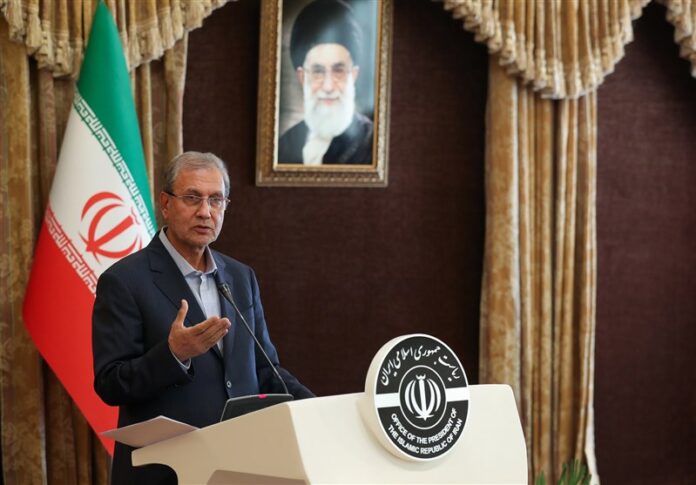
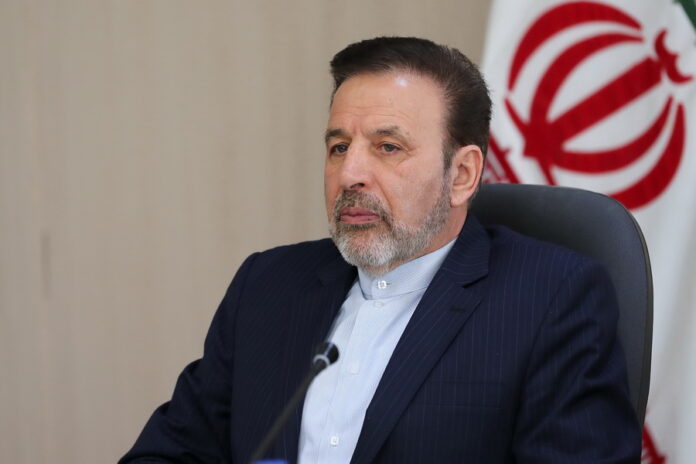
Vaezi said Recep Tayyip Erdogan’s comments are not directed at the Iranian government, but are mostly about the sporadic stances taken across the country.

He added that the Islamic Republic has good relations with Turkey and Syria, and Tehran must take a stance that does not worsen the conflicts.

Hailing the recent agreement between Russia and Turkey on northern Syria, he said Iran’s position is clear.

On the one hand, Iran understands and recognises Turkey’s security issues, but on the other hand, Syria’s territorial integrity must be preserved and these attacks must not disintegrate Syria, Vaezi said on the sidelines of a cabinet meeting on Wednesday.

“Tuesday’s deal seems to be in this line, and Iran generally welcomes that there will be no war again.

The media should also consider this issue,” he continued.

Moscow has warned Kurdish forces to quickly withdraw from the Turkey-Syria border – after an agreement between Moscow and Ankara adding that Washington had “betrayed and abandoned” the Syrian Kurds.

On Tuesday, Turkey and Russia agreed to deploy Syrian and Russian forces to northeast Syria to remove Kurdish fighters and their weapons from the border. On October 9, Turkey launched an offensive aimed at creating a “safe zone” cleared of the Kurdish-led Syrian Democratic Forces (SDF), which Ankara considers as terrorists.

Regarding the FATF, Vaezi noted that the government’s stance on the FATF is clear. Iran is not discussing FATF membership, but the important point is the four bills that have been approved and the various opinions the government received on them.

“The government has applied these ideas. The government’s point is that Iran needs these bills.

We need these bills to be transparent and to combat money laundering. In order to prevent the spread of the rumours of Iran’s support for some groups and facilitating banking relations, Tehran needs these bills to be approved. Unfortunately, some have opposed these bills and turned them into political matters. Wherever they are, they must accept responsibility for their opposition to the FATF,” reiterated Vaezi.

He went on to say that the FATF bills were discussed at the Supreme Economic Coordination Council and the outcome of these discussions has been announced to the Leader of Islamic Revolution. The government and parliament have done their job, but the body that has disrupted their approval has to explicitly announce to the public the cost of its act.

“Based on the last decision taken, the FATF has given Iran four months, and during this period, if no action is taken, no further extensions will be granted and we will be automatically blacklisted, and we actually boycott ourselves in banking relationships with the world,” concluded Vaezi.

The global anti-money-laundering watchdog is increasing pressure on Iran to meet its standards while giving the country more time to do so.

The Financial Action Task Force on Friday extended until February a deadline for Iran to implement certain measures or face further restrictions. The earlier deadline was June 2019.

Iran in recent years has passed legislation to address money-laundering and terrorist-financing issues, but bills ratifying treaties related to combating these problems haven’t come into force, the FATF said. The watchdog added that it considers only fully enacted legislation when reviewing a country’s efforts.

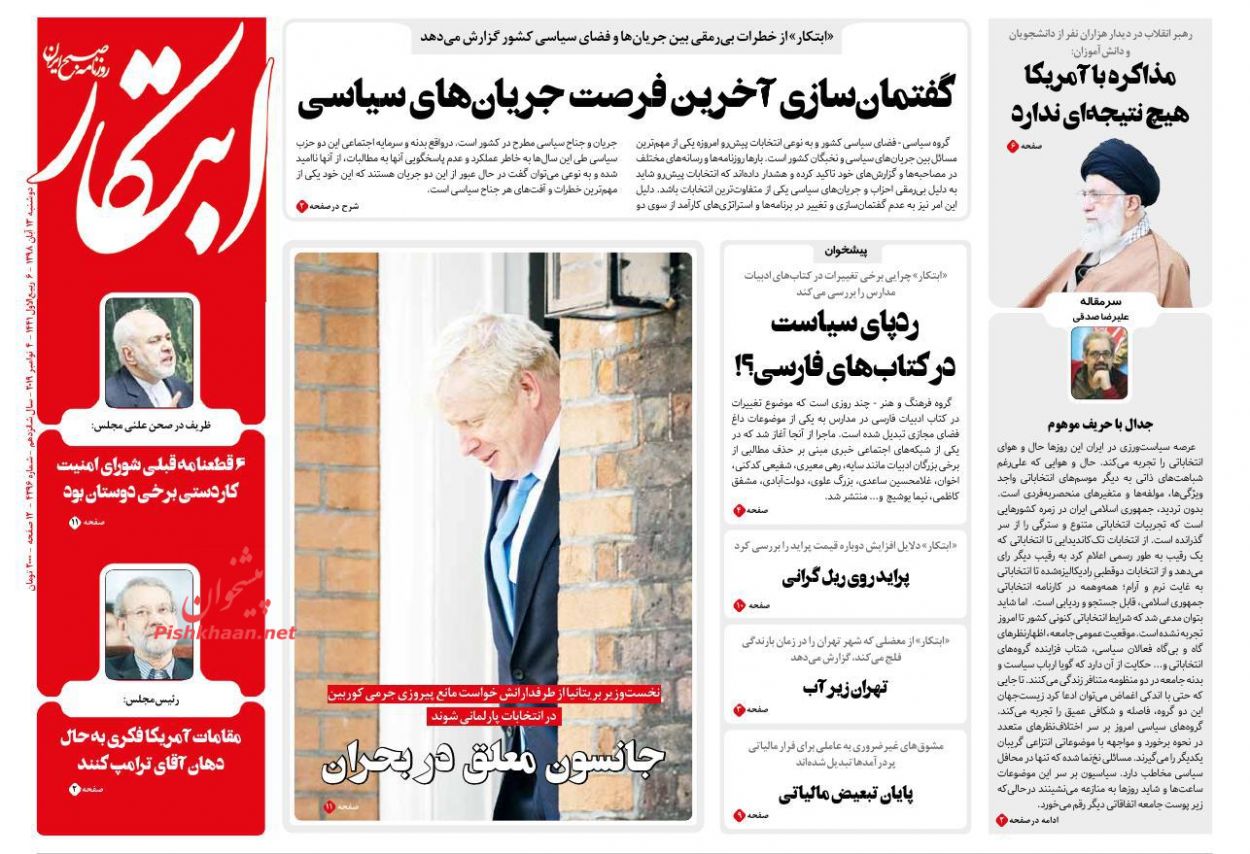
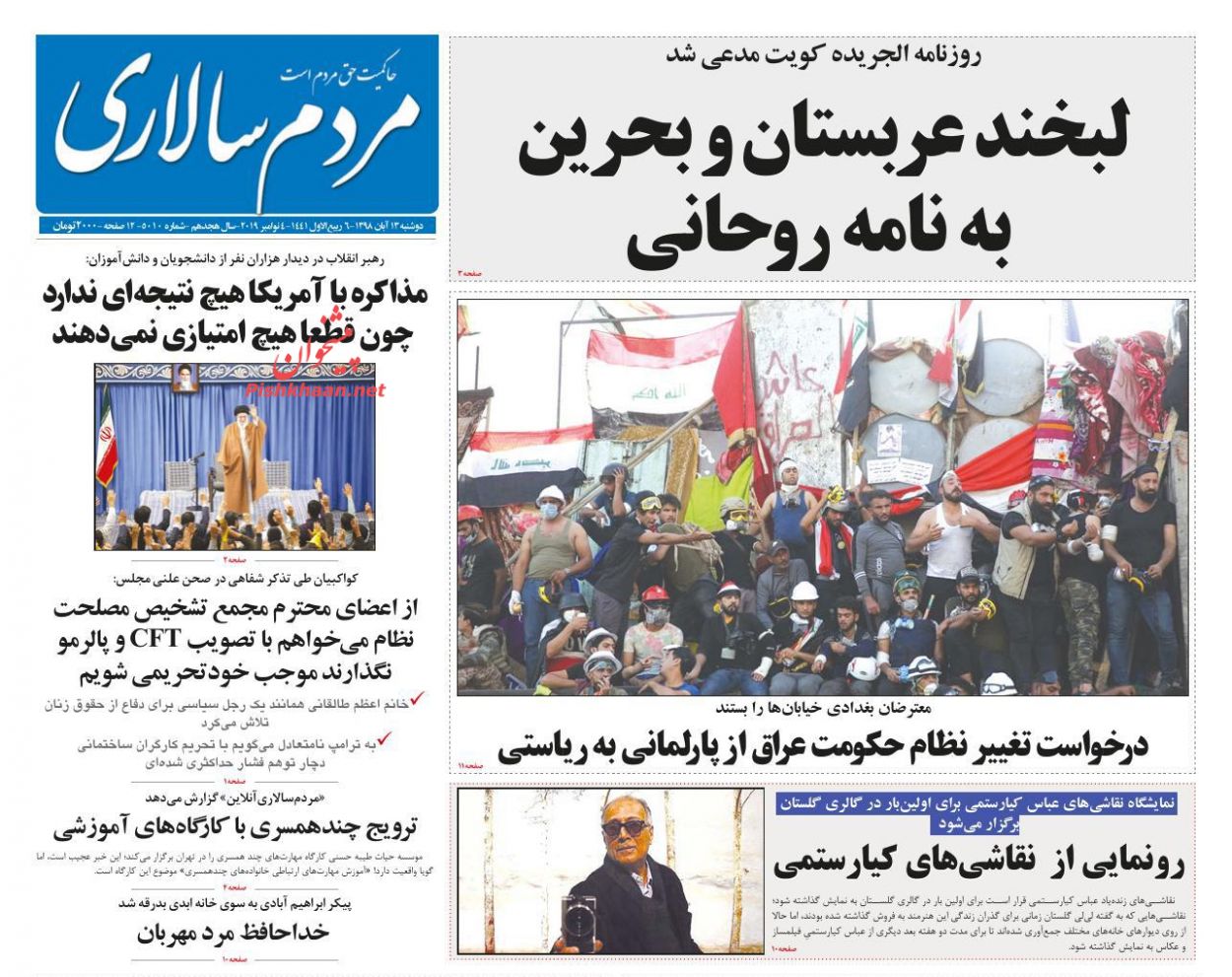
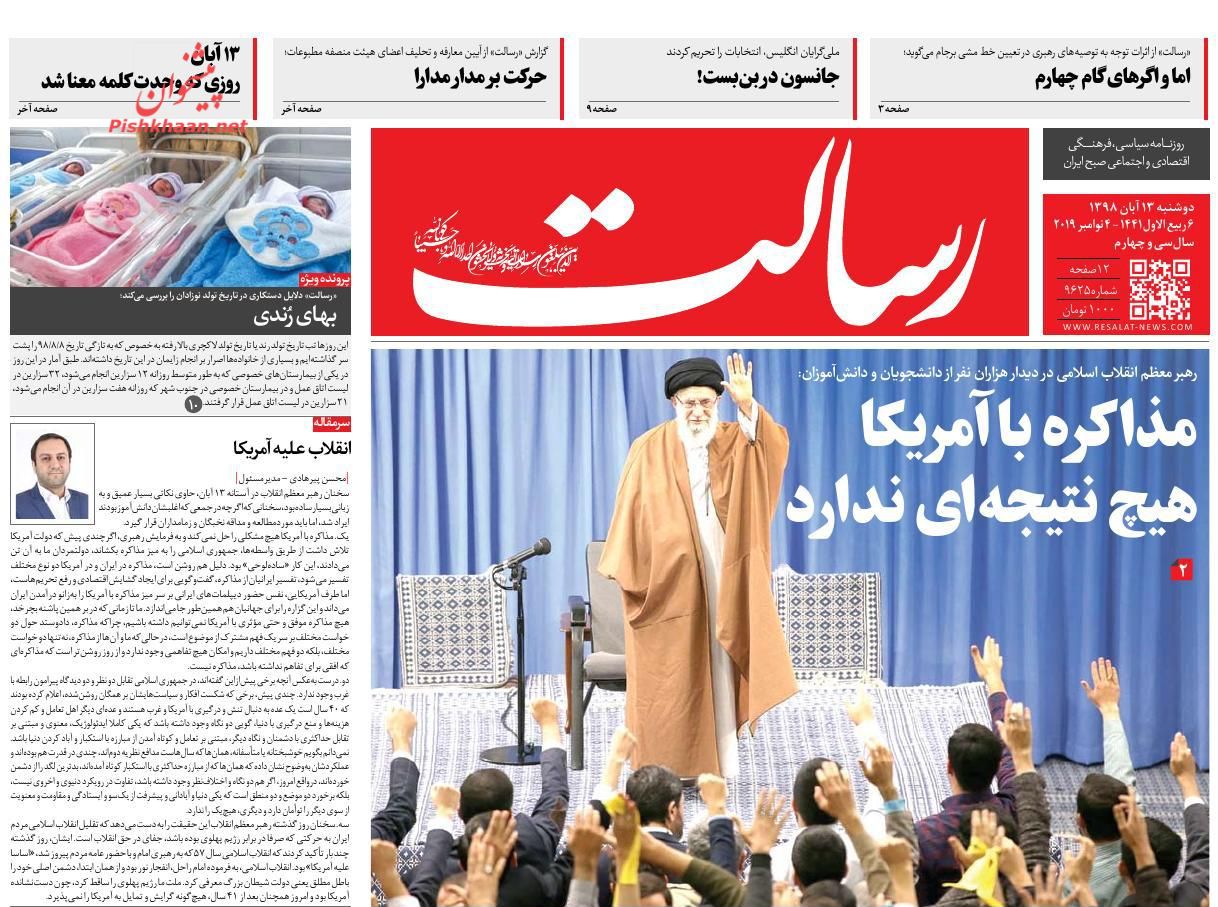
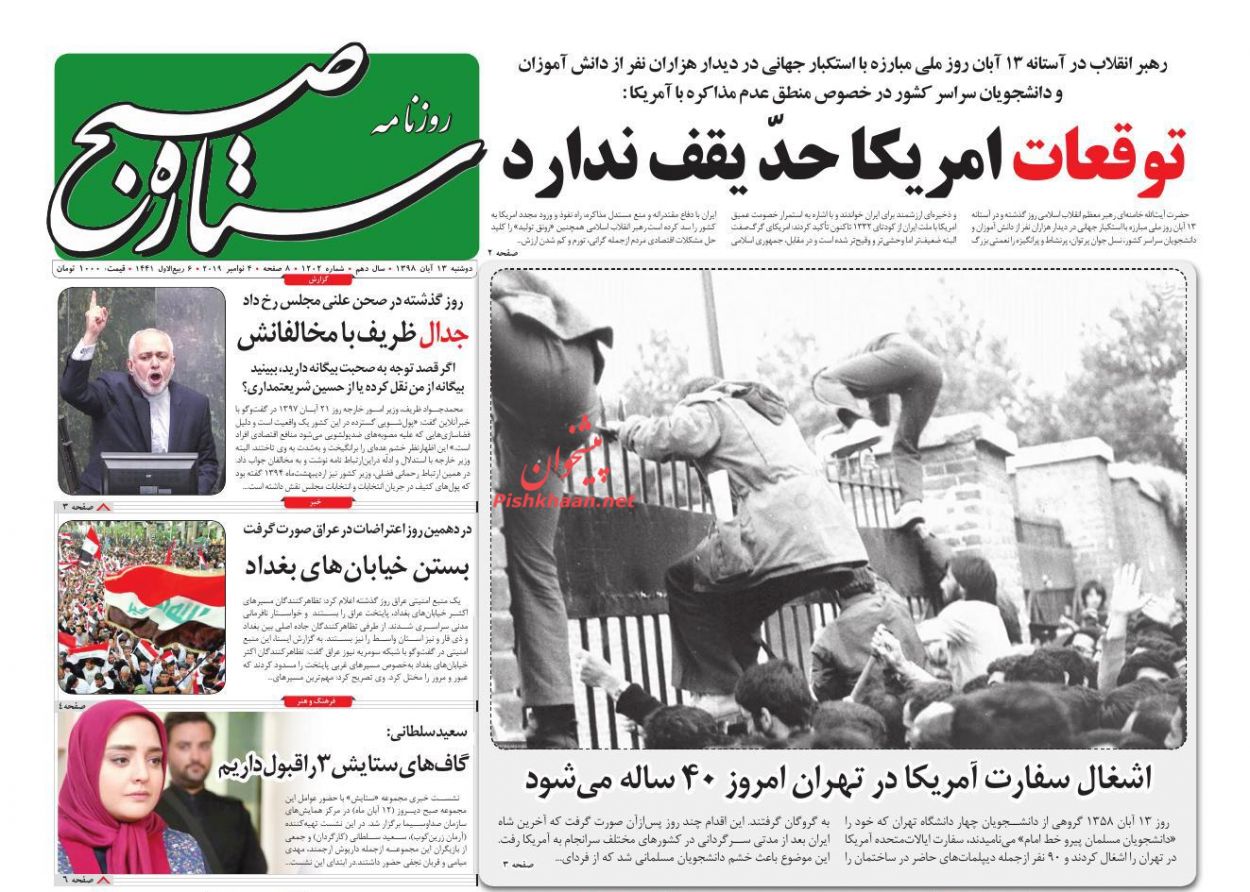
A Look at Iranian Newspaper Front Pages on October 23

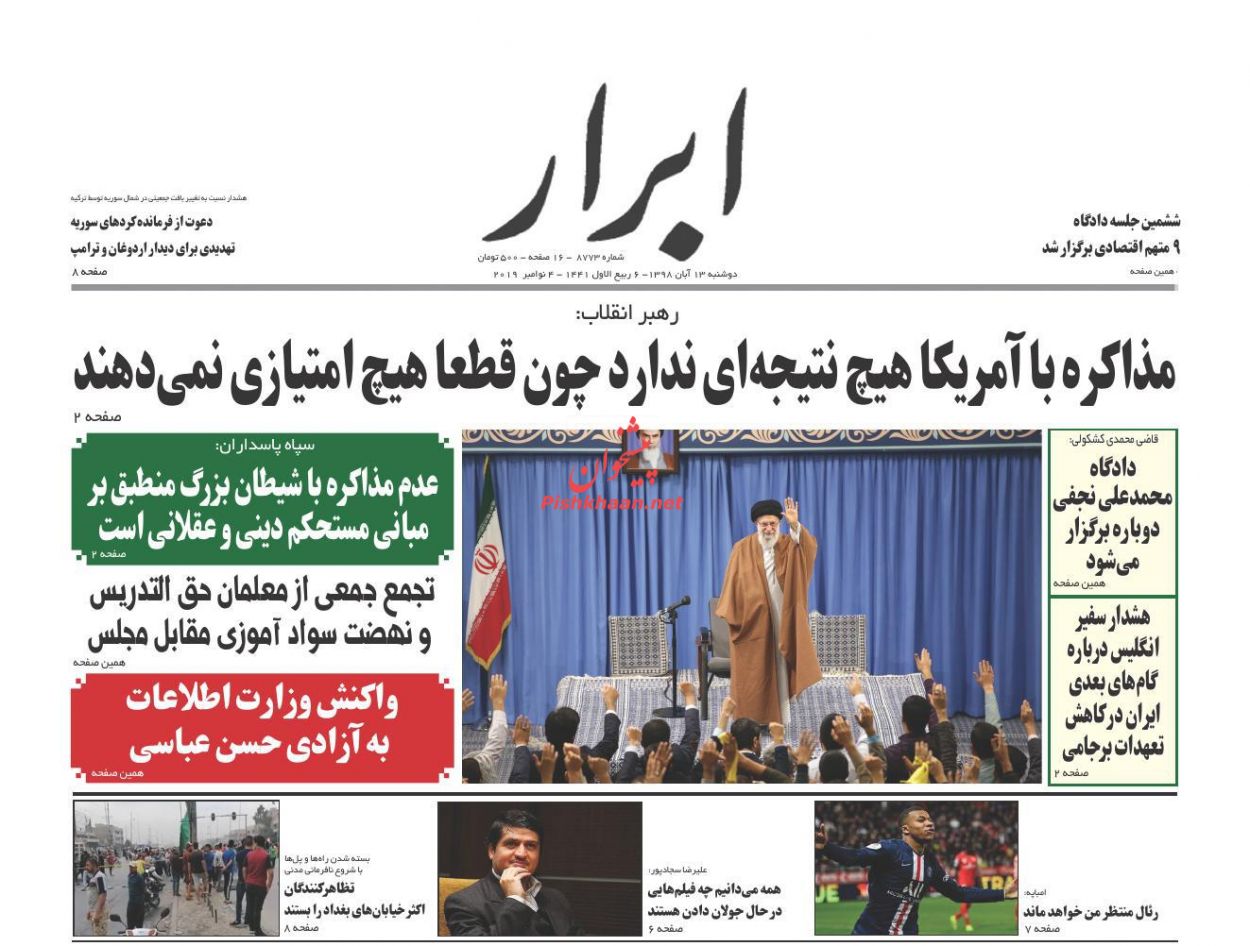
A Look at Iranian Newspaper Front Pages on November 19

Abrar:
1- If Iran Does Something, They’ll Be Hit Like They’ve Never Been Hit Before: Trump
2- Erdogan: Iran’s Anomalous Voices Bother Me
3- Pompeo: Trump ‘fully prepared’ to take military action against Turkey if needed
4- If Kurds Go, Operation Stops: Turkey’s Presidential Spokesman

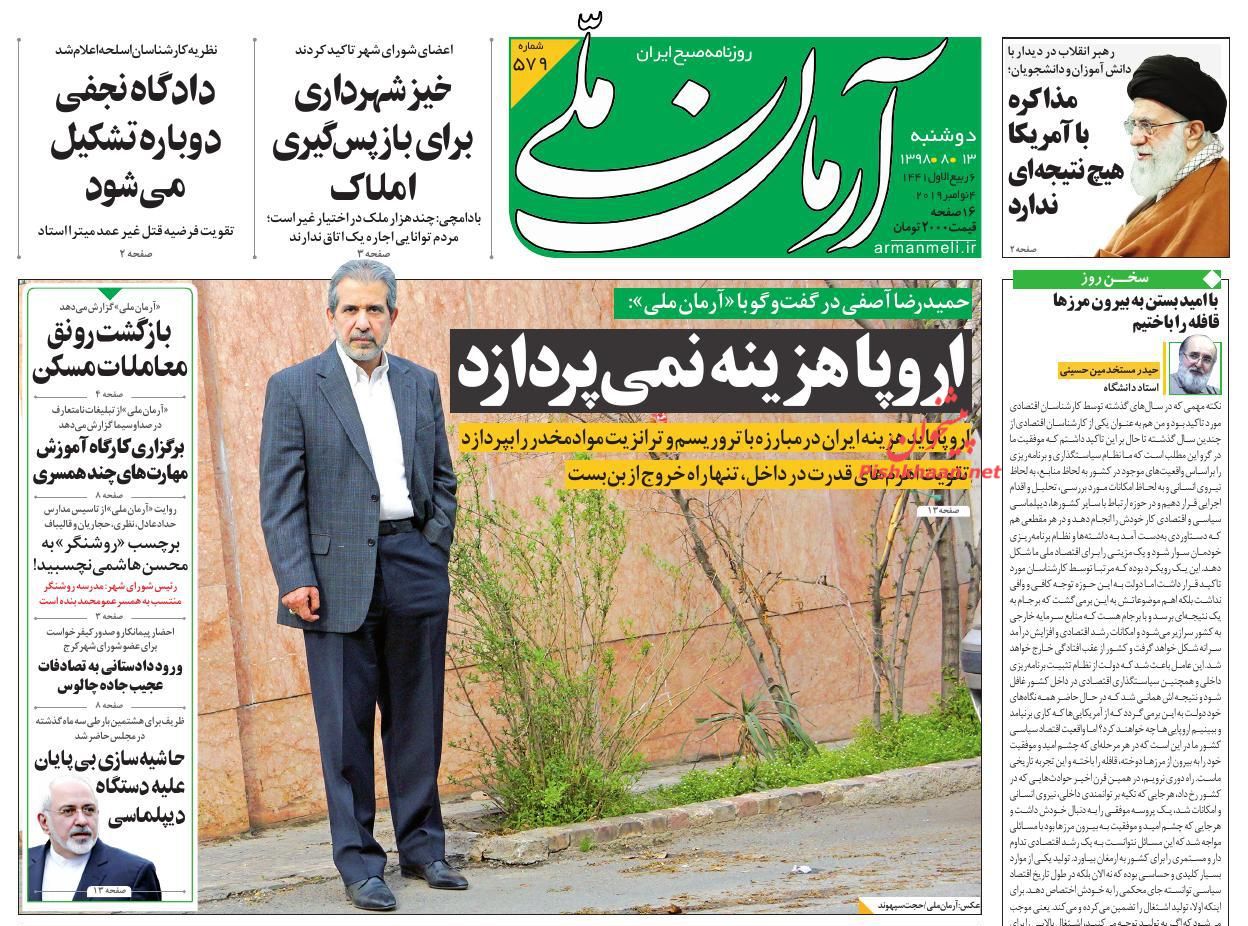
A Look at Iranian Newspaper Front Pages on October 23


Arman-e Melli:
1- Iran’s Judo Banned Permanently
2- Turn Off Voice of Peace Critics: Erdogan Asks Rouhani
3- Expediency Council Must Pass FATF Bills ASAP: VP

A Look at Iranian Newspaper Front Pages on October 23


Ebtekar:
1- We Ready for Bilateral or Multilateral Dialogue with Saudi Arabia: Foreign Ministry Spokesman
2- End of Netanyahu
• Benjamin Netanyahu Leaves Cabinet Formation to Zionist Chief

A Look at Iranian Newspaper Front Pages on October 23


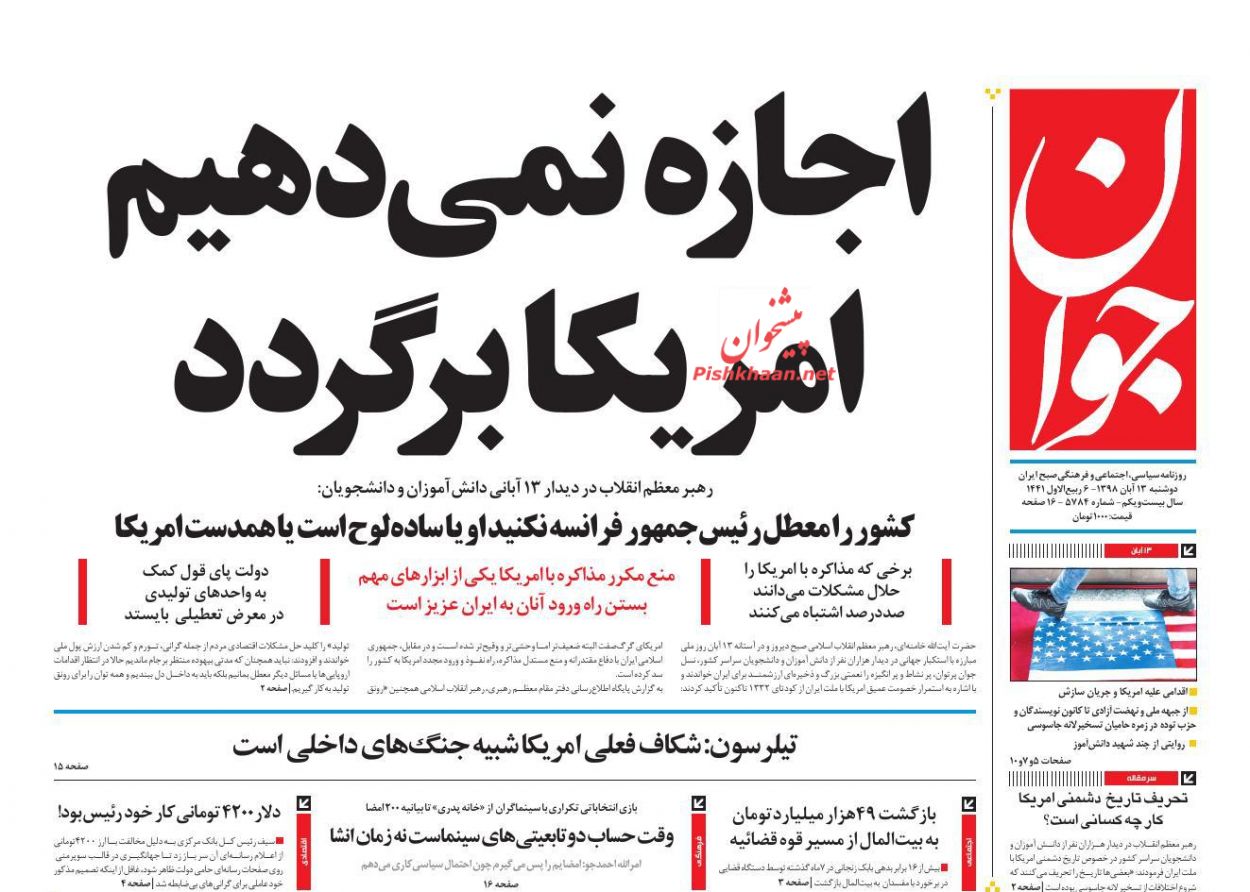
Javan:
1- Erdogan Rhetoric Similar to Trump
• The Turkish President Uses Same Words Donald Trump Used in Letter against Him
• Erdogan Calls on Iranian President to Silence Voices inside Iran against Turkish Operations

A Look at Iranian Newspaper Front Pages on October 23


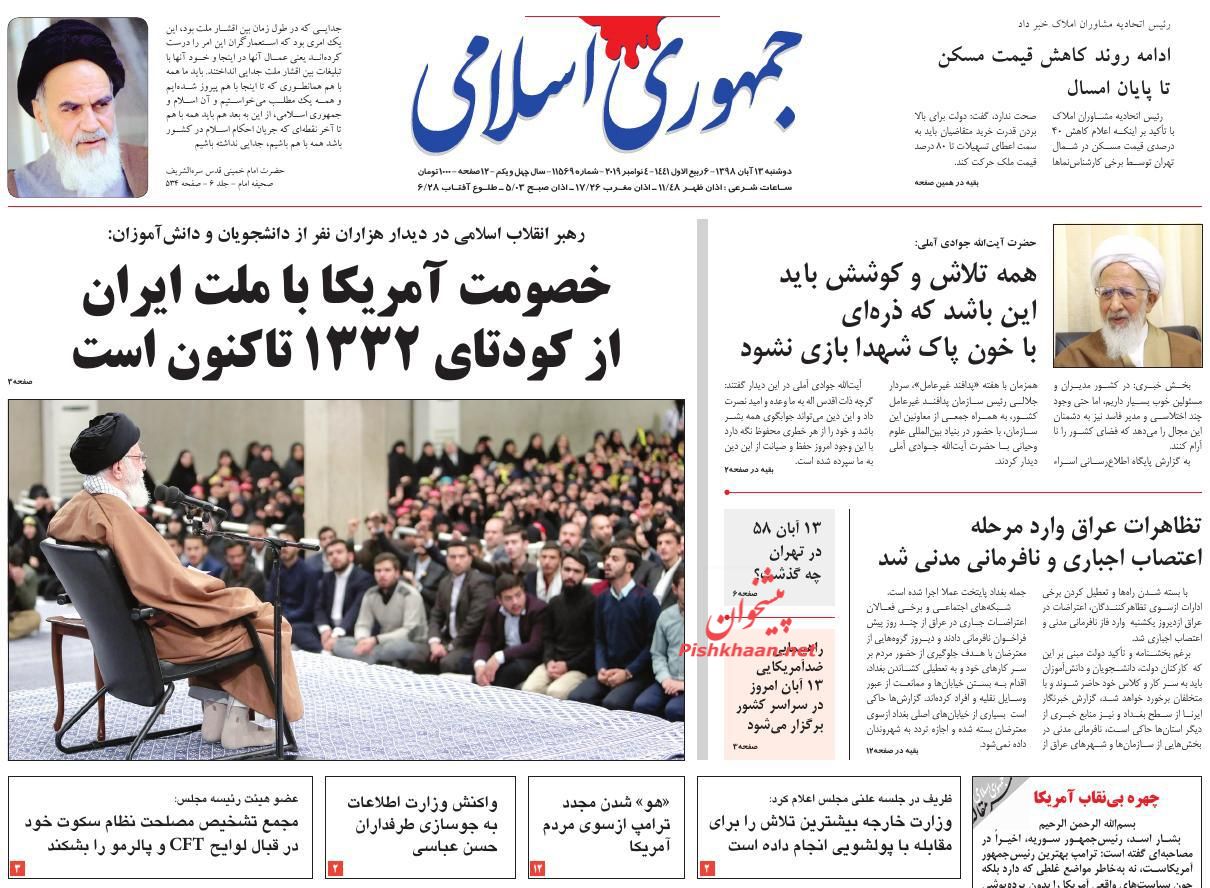
Jomhouri Eslami:
1- Erdogan Returns from Russia Empty-handed
• China, Russia Call for End of Turkish Military Operations in Syria
2- Trump: Saudis Have Nothing but Money

A Look at Iranian Newspaper Front Pages on October 23


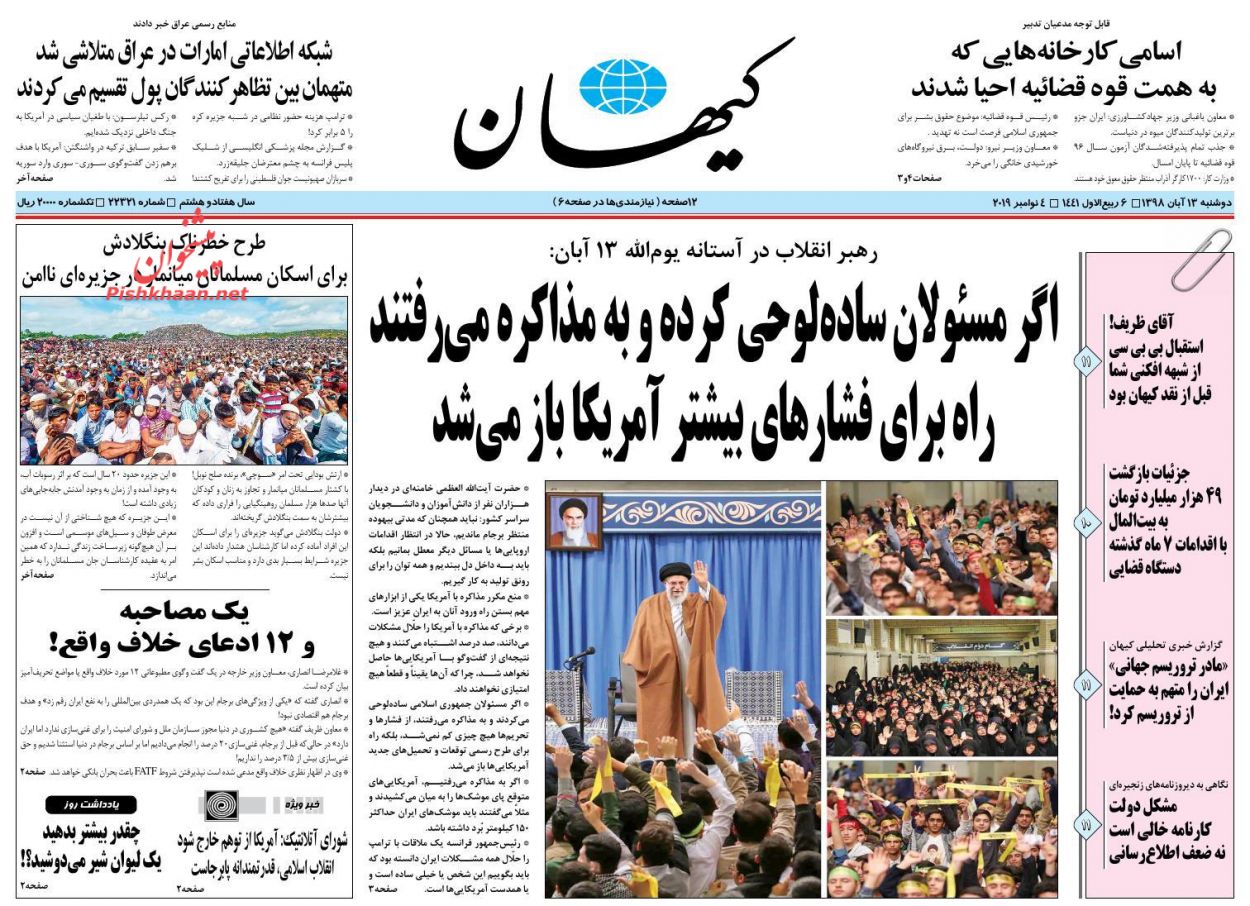
Kayhan:
1- Saudis Have Nothing but Money: Trump
• Washington Once Again Humiliates Saudis
2- Lebanese Demonstrators Set Fire to Israeli Flag Again
3- Newsweek: Trump’s Care about Iranians Means Depriving Them of Food, Medicine
4- Kim Jong-un is Gentleman; Obama Called Him 11 Times But He Didn’t Answer: Trump

A Look at Iranian Newspaper Front Pages on October 23


Mardomsalari:
1- FATF Bills Must be Approved as Soon as Possible: VP Jahangiri
2- We Are Ready for Mutual or Multilateral Talks with Saudi Arabia: Iran Spokesman
3- Countdown for Trump’s Impeachment
• US President Getting Ready to Face with Congressmen

A Look at Iranian Newspaper Front Pages on October 23


Setareh Sobh:
1- FATF Approved by Leader, Three Branches: Iran VP in Meeting with Clergymen

A Look at Iranian Newspaper Front Pages on October 23


Shargh:
1- US Fear of JCPOA in 2020
• Pompeo, Hook Warn against End of Iran’s Weapons Embargo

A Look at Iranian Newspaper Front Pages on October 23

Iran FM Meets Azerbaijani, Serbian Counterparts in Baku

Bilateral political and economic ties and regional issues were among the issues Zarif and the Azeri FM discussed and consulted on.

Zarif also held talks with his Serbian counterpart on the sidelines of the Non-Aligned Movement Foreign Ministers’ Meeting in Azerbaijani capital of Baku.

The two sides discussed bilateral ties and major regional and international issues.

Iran, Afghanistan Discuss Latest Developments

The latest developments in Afghanistan were top on the agenda.

The Azerbaijani capital is hosting a meeting of the foreign ministers of the NAM member states.

The meeting will run through October 24, and then the 18th Summit of the Heads of State and Government of the NAM countries would be held in the city.

Afghan Woman Runs Largest Hospital Clothing Workshop in Iran

There is a country in the “New World Order” that does not exist – with a population of about 71 million people of different races and ethnicities.

They speak different languages, they don’t practice the same religion, they don’t have a flag, and if they had, it might be red and black.

Every day, 37,000 people are added to the population of this country with no fixed geography; people who have less in common, but have one pain in common: displacement.

War and conflict, violence and persecution are the main cause of these displacements. Afghanistan has the second largest number of asylum seekers with 2.7 million people.

As statistics show, most Afghan asylum seekers either migrate to neighbouring Iran – or at least cross the border into other parts of the world.

At a time when many people are displaced by war and insecurity from their home and homeland, the economic activities of refugees in Iran are a good example of how effective measures by both sides can transform the lives of refugees and their hosts.

Zeinab Shaban is one of those who has taken the initiative in the battle of life. The one who was once classified as a “refugee” is now a refuge for some families. She is one of a million Afghan refugees in Iran who have fled their home country in search of security and a new life after 40 years of conflict.

The Iranian government continues to implement its policies on refugees in the fields of health, education and livelihoods, and with the assistance of the UNHCR, provides various training packages of entrepreneurship to young immigrant refugees such as Zeinab.

At the age of 19, she learned sewing skill at a technical training course and based on it, she designed a business plan.

“When I lost my husband, I realised that if I was going to make something of myself, something that I would be really proud of, now is the time,” she says.

With the support of the Office of the United Nations High Commissioner for Refugees in Shiraz, she could buy a set of sewing equipment to produce clothes at home.

She says she had started out on a small scale and received a few orders from neighbours, but after a short while the orders increased.

Zeinab recognised the potential for expansion of her job and signed contract with one of Iran’s largest hospitals in Shiraz.

“I could sign a contract to produce clothes for the largest hospital in southern Iran,” she said.

Hospital officials, impressed with the quality of her products, increased their orders, and Zeinab quickly became the main supplier of hospital’s clothing. She also visited other hospitals and signed other contracts with three medical institutions in southern Iran, as well as several medical and pharmaceutical stores.

Afghan Woman Runs Largest Hospital Clothing Workshop in IranTo meet this growing demand, Zeinab, with the support of the UNHCR, purchased 13 professional sewing machines and other stuff to equip her workshop with all the equipment to design, manufacture and distribute hospital clothing and bedding.

Obtaining a formal license and registering the workshop allowed Zeinab to create jobs for others as well.

She recruited over ten Afghan and Iranian women and gave priority to the most vulnerable ones. In addition, she has run a free training program for Iranian and Afghan women and has trained more than 200 women since 2014. She has helped them improve their skills.

Now, Zeinab’s Sewing Workshop in Shiraz has 30 full-time female workers and meets the needs of five hospitals.

Afghan Woman Runs Largest Hospital Clothing Workshop in Iran

Iranian, Iraqi Foreign Ministers Meet in Baku

During the meeting, which was held on the sidelines of the ministerial meeting of the Non-Aligned Movement (NAM), the two sides conferred on the latest developments in bilateral relations, regional issues especially in northern Syria, Lebanon, Yemen, and the Persian Gulf developments.

They also discussed the Hormuz Peace Endeavour (HOPE) initiative proposed by Iranian President Hassan Rouhani, and other issues of mutual interest.

Iran Hails Russia-Turkey Deal on Northern Syria

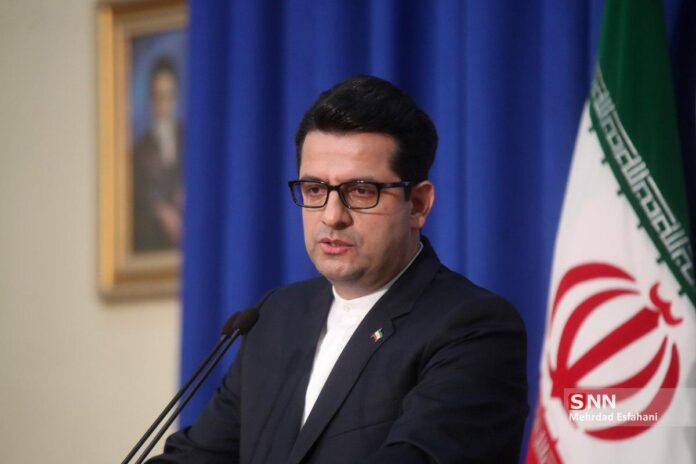
“Iran welcomes any move that would result in the maintenance of Syria’s territorial integrity, reinforcement of its national sovereignty, and return of stability and calm to the region,” Mousavi said in a Wednesday statement.

“To this end, the Islamic Republic considers the agreement reached between the Russian Federation and the Republic of Turkey to end the conflicts in northern Syria as a positive step to return stability and calm to the region,” he added.

“We hope the conclusion of this agreement would prepare the grounds for allaying Turkey’s security concerns on the one hand and maintaining Syria’s territorial integrity and reinforcing its national sovereignty on the other hand,” he added.

“The Islamic Republic of Iran has always supported dialogue and peaceful means of dispute settlement, and therefore has always encouraged the parties involved to negotiate and reach an understanding,” the spokesman said.

“To this end, Iran considers the Adana Agreement as a proper basis for allaying the concerns of Turkey and Syria, and will not spare any effort to help create dialogue and understanding between Ankara and Damascus,” he added.

Mousavi said the presence of foreign forces in northern Syria does not ensure security in the region, adding that the solution to regional problems is inside the region.

“The withdrawal of American troops from the region will result in the return of calm and security,” he noted.

“Fortunately, the effects of the Astana Process mechanism on ensuring peace and security in the region will become more tangible in the near future with the formation of the country’s Constitutional Committee, and we are confident it will be regarded as a major step to return permanent calm and stability to Syria,” the spokesman noted.

Russian President Vladimir Putin and Turkish President Recep Tayyip Erdogan met in the southern Russian resort city of Sochi on Tuesday with a shared agenda of shaping the endgame in Syria’s eight-year civil war.

The two leaders unveiled a 10-point memorandum of understanding with an unstated bottom line: The Americans do not have a place in shaping the future of Syria.

Russia and Turkey announced a wide-ranging agreement that addresses a major Turkish concern — the presence of Kurdish YPG forces near their border.

Under the deal, Russian military police and Syrian border guards will enter the Syrian side of the Syrian-Turkish border from noon Wednesday. Over the next 150 hours, they are to remove the YPG and their weapons, back to 30 km (about 18 miles) from the border. From 6 p.m. local time next Tuesday, the Russian military police and Turkish military will begin patrols along that line.

Iran President Due in Azerbaijan to Attend NAM Summit

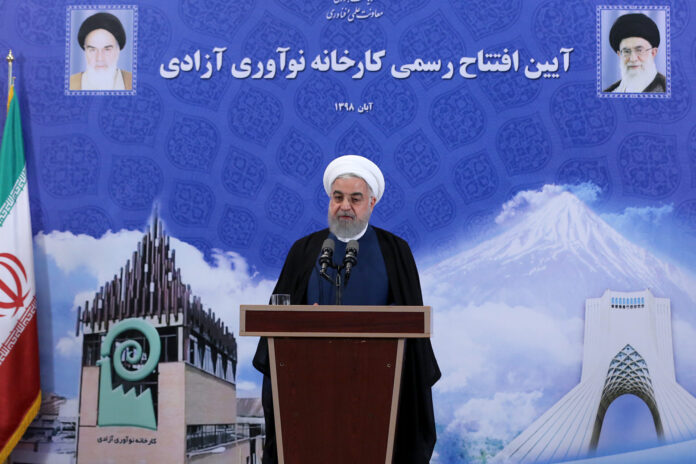
The president will travel to Baku to attend and deliver a speech at the 18th Summit of the Non-Aligned Movement (NAM), said Alireza Moezzi, the deputy head of the Iranian president’s office for communications.

“In addition to addressing the summit and elaborating on the Islamic Republic’s stances on major regional and international affairs, Rouhani will also hold bilateral meetings with the Azeri president,” he added.

“In the meeting, the two sides will review the most pressing issues in Tehran-Baku relations, and the trend of implementing agreements and joint projects,” Moezzi noted.

“On the sidelines of the NAM Leaders’ Summit, the Iranian president will also hold separate talks with some of the leaders attending the summit, during which the most important issues of mutual interest, regional and international developments will be discussed.”

President Rouhani will return to Iran on Friday night, Moezzi said.

At the Summit, the Republic of Azerbaijan will take over the presidency of the NAM for a three-year period (2019-2022).

The Non-Aligned Movement (NAM) is an international organization (group of countries) who do not want to be officially aligned (friends) with or against any major power bloc (group of countries). In 2018, the movement had 125 members and 25 observer countries, which account for 55 percent of the world’s population.