Tuesday, December 23, 2025
Home Blog Page 3063

Mideast States Believe Region Safer Place without US: Iran

Members of the US' 5th Special Forces Group (A) conduct 50. Cal Weapons training during counter ISIS operations at Al-Tanf Garrison in southern Syria, November 22, 2017. / Photo by US Defence Department

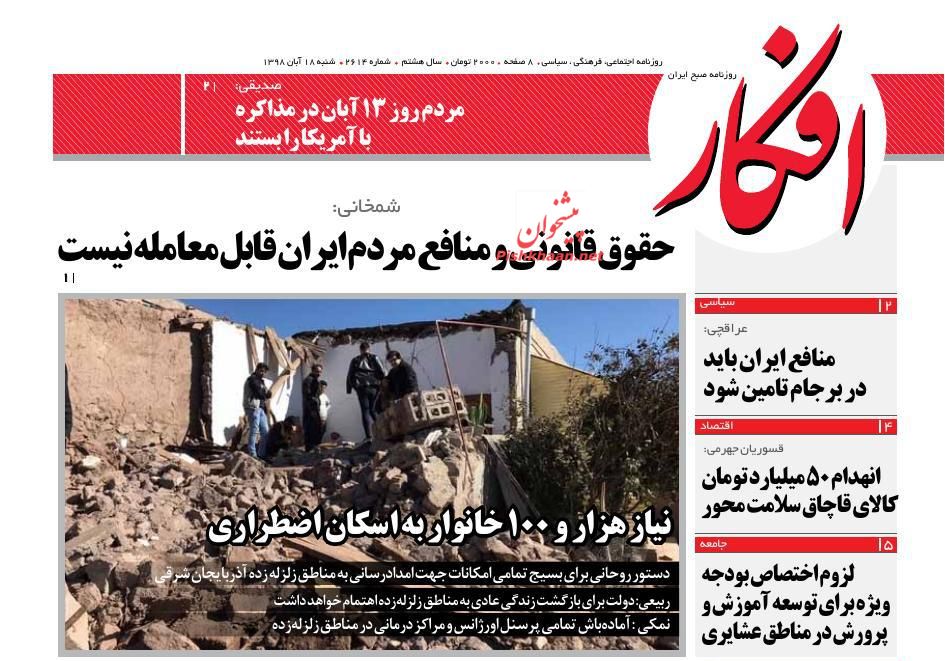
Ali Shamkhani wrote in a piece that the US administration’s bitter but instructive confession has led many West Asian nations, even the group that has hosted US troops in the region for years, to acknowledge that “the Middle East is a safer place without America.”

The senior security official said three clear statements by US officials over the past two months reveal facts that the US administration previously lacked the courage to accept and express.

“After Yemen’s Ansarullah drone attack on Aramco facilities in Saudi Arabia, and in response to pressure from the Saudi kingdom to deal with the perpetrators, the US statesmen explicitly emphasised their opposition to meet Saudi Arabia’s demand, announcing that Saudi Arabia was attacked, not the United States,” stated the SNSC secretary.

Shamkhani also maintained that in the wake of the ongoing political and military defeats in the region, the $8-billion US military presence [plan] in the region was unveiled, and it was announced that the US presence in the Middle East has borne no fruits and was a pointless act.

“Recently, after Turkey’s attack on northern Syria the US turned its back to its Kurdish allies, and the American officials confessed to waging a bloody war in Iraq by falsely claiming that there existed WMD in the Arab country. They admitted that entering the Middle East was the worst decision ever made in the US history.”

Shamkhani went on to add that the US administration seems to have come to the conclusion, through objective experience, that the equation of power and the political geometry of the world has changed, especially at its heart, the Middle East. Besides, the United States can no longer claim an absolute supremacy over the affairs of the international system, in spite of all its massive propaganda.

“Washington has come to realise that there are only two ways forward, either to bear the expense of having a hollow face of a global superpower or to embrace the present reality of the world with a realistic approach to free itself from the burden of the enormous costs of this show,” said Shamkhani.

“In other words, the US administration has realised that today it does not have the means to be a superpower for any reason, and it is impossible to go back to the topmost era. As its inability to execute strategic projects such as “Middle East Disintegration”, “Deal of the Century “, “Regime Change in Iran”, “Turning Saudi Arabia into the Region’s Gendarme”, “Yemen war”, “The Afghan Peace”, “The Syrian Crisis” etc., has been proven to everyone.”

Five ‘High Value’ ISIS Terrorists Left by US in Syria

The New York Times report on Sunday came after hundreds of ISIL allies escaped from a low-security detention camp amid Turkey’s invasion into northern Syria.

There are reportedly about 11,000 prisoners in Syria, 2,000 of whom are from 50 other nations that have not taken them back.

US Congressional Democrats have been urging President Donald Trump to reverse his decision to pull back troops from northern Syria, Senate Minority Leader Charles Schumer (D-N.Y.) said on Sunday.

“We will be putting on the floor of the Senate and the House … a joint resolution that urges the president to undo his decision to do everything he can to protect the Kurds, to do everything that we must do to prevent ISIS terrorists from escaping, and make sure that Turkey respects existing agreements related to Syria and with the United States,” Schumer said. “I’m going to work so hard to pass this resolution, this joint resolution, this bipartisan resolution to try and get the president to undo what he has done.”

Trump has been under pressure from his allies and opponents over his decision to allow Turkish forces attack US-backed Kurds in northern Syria.

Syrian Troops in Tel Tamer after Deal with Kurds

The deployment to Tabqah near Raqqah on Monday restores the state’s foothold in an area that is home to a major hydroelectric dam.

The state television, in broadcasts from Ain Issa, showed residents welcoming the entry of the army troops.

Tel Tamer is 35 km southeast of Ras al-Ain which is currently under the control of Turkish troops. It is on a strategically important highway, the M4, that runs east to west. Turkish forces said they had seized the highway on Sunday.

Syrian Kurds on Sunday struck a deal with the government in Damascus on the deployment of Syrian army forces near the northern border after US troops pulled out of the region ahead of a Turkish incursion.

The so-called Syrian Observatory for Human Rights said US warplanes had targeted a column of Syrian troops in the city of Raqqah in an apparent attempt to hinder their deployment to the north.

The US military also tried to hinder the dispatch of Syrian and Russian forces near Manbij, the London-based war monitoring group said.

Kurdish authorities said the deal “paves the way to liberate the rest of the Syrian cities occupied by the Turkish army such as Afrin” in northwest.

Ankara says the operation is meant to purge YPG militants, the backbone of the US-backed SDF militant group, which Turkey views as terrorists linked to local militants of the Kurdistan Workers’ Party (PKK).

Residents of the northern city of Qamishli on Sunday celebrated the announcement that the Syrian troop deployment.

People were seen on motorcycles and standing on vehicles, dancing and waving Syrian flags in the streets of Qamishli, AFP news agency reported.

Crowds of people also gathered in the streets of Hasakeh to celebrate the planned deployment of government troops. They waved national flags and blared horns to celebrate the army build-up.

Rami Abdel Rahman, head of the so-called Syrian Observatory for Human Rights monitoring group, said Kurdish authorities had “made compromises to Syria in order to stop the advance of the Turkish forces in the north.”

SDF chief Ferhat Abdi Sahin, also known as Mazlum Abdi, acknowledged that “there would be painful compromises” with the Syrian government in a bid to save the lives of people.

“In light of the invasion by Turkey and the existential threat its attack poses for our people, we may have to reconsider our alliances,” he said in an opinion piece published in the US Foreign Policy magazine on Sunday.

Badran Jia Kurd, a senior Kurdish official, said the Kurds felt they had no choice but to turn to Damascus in the face of the “betrayal” of Washington, noting, “This has obliged us to look for alternative options.”

Since it was launched on Wednesday, the Turkish military incursion has killed dozens of people and displaced tens of thousands of Syrians.

On Sunday, President Tayyip Erdogan said Turkey’s incursion will stretch from Kobani in the west to Hasakeh in the east, going some 30 km (19 miles) into Syrian territory.

The Observatory said earlier Sunday that Turkish troops and their militant allies had entered Suluk, some 10 km from Turkey’s border.

Addressing a news conference in Istanbul, Erdogan said Turkish forces had also besieged the Syrian border town of Tel Abyad, west of Ras al-Ain.

“We focused first on the 120-km area between Ras al-Ain and Tel Abyad. Thus we will divide the 480-km terrorist corridor down the middle,” Erdogan said.

“Then we will take control of Hasakeh on the one side and Ain al-Arab (Kobani) on the other and complete the operation,” he said, referring to towns either side of the current focus of operations.

Turkish troops have so far seized control of 109 square km territory, including 17 villages around Tel Abyad and four villages around Ras al-Ain, Erdogan said.

Law that Let Iranian Women Pass Nationality to Children Takes Effect

The ministry’s spokesman Salman Samani said the law has been communicated to the National Organization for Civil Registration as well as provincial governors.

“Under the new law, children who are the result of legitimate marriage between Iranian women and non-Iranian men, no matter whether or not they were born before or after the approval of this law, can assume Iranian nationality before they turn 18 years old at the request of their Iranian mothers [only] if they do not have any security problems and [only] at the discretion of the Intelligence Ministry and the Intelligence Organization of Iran’s Islamic Revolution Guards (IRGC),” he said.

“Response to the security inquiry must be provided within three months at the latest, and the Police is obliged to issue residence permits to non-Iranian fathers [only] if they don’t have any security problems and [only] at the discretion of the Intelligence Ministry and the Intelligence Organization of the IRGC,” he added.
“If the applicant’s father or mother are not alive or are not available, it will be up to a competent court to ascertain the [applicant’s] lineage if there is any ambiguity on the applicant’s descent,” he said.

Samani noted individuals who lack any nationality and who themselves and at least one of their parents are born in Iran can apply for Iranian citizenship after they turn 18.

“If they have no criminal record and security problems, they can acquire Iranian nationality at the discretion of the two security bodies,” he explained.
“By virtue of the president’s announcement, provincial governors and the National Organization for Civil Registration are obliged to set the stage for the proper enforcement of this law in coordination with other relevant institutions,” he added.
Iran Beats France, Italy with 9% Increase in Steel Production

Rahmani pointed out that despite sanction the country’s steel production witnessed a 9-percent increase.
The minister made the statements in a ceremony to run five industrial projects in Kermanshah province.

Iran was the world’s eighteenth-largest steel exporter in 2017. In 2018, Iran exported 9.2 million metric tonnes of steel, showing a 24 percent increase from 2017.

Iran’s exports represented about 2 percent of all steel exported globally in 2017. The volume of Iran’s 2018 steel exports was less than 14 percent of that of the world’s largest exporter, China.

In value terms, steel represented 8.7 percent of the total amount of goods Iran exported in 2018. Iran exports steel to more than 120 countries.

Iran’s top export markets by volume vary across types of steel products. The United Arab Emirates received the largest share of Iran’s exports of flat products in 2018. Iraq held the largest share of Iran’s long products, in addition to pipe and tube products and stainless products. Thailand received the largest share of Iran’s semi-finished products in 2018.

Iran Denies Saudis Responded to Its Oil Tanker’s Distress Call

The Sabiti, a tanker capable of carrying 1 million barrels of crude, was damaged on Friday near the Saudi port of Jeddah after being hit by suspected missiles.

Saudis later claimed they were ready to help the damaged oil tanker.
However, Iran’s Ports and Maritime Organisation has issued a statement on the claim:

1- On October 11, 2019 MT Sabiti was hit twice at 01:30 and 01:50 GMT on the Red Sea and 60 miles off the coast of Saudi Arabia (Port of Jeddah) in the Mediterranean Sea. As a result, two of the ship’s tanks were damaged, spilling the crude oil into the sea, while the ship was in unbalanced conditions.

2- The ship transmits distress calls for 16 times through three equipment between 05:11 and 07:20 GMT on the MF, HF, SAT-C and VHF channels.

While receiving no response from the maritime rescue centres in the region, again the vessel sends an e-mail to the Maritime Rescue Coordination Centre of Jeddah, Egypt and Sudan at 08:20 GMT to announce that it was likely attacked by two missiles and damaged. In addition, the ship diverted to the right and the cargo spilled in the sea; therefore it requested immediate assistance. Also at 05:55 GMT, Bandar Abbas Maritime Rescue Coordination Centre announces the issue via telephone to Jeddah Maritime Rescue Coordination Centre, receiving a response from Jeddah saying the National Iranian Tanker Company is exaggerating, and denies receiving distress calls, but promises to review and respond again.

3- At 07:30 GMT, the Jeddah Marine Rescue Coordination Centre again declares it has no information [regarding the incident].

4- At 10:00, two helicopters flew off a warship near the vessel, and after patrols returned to the warship at 10:10.

5- In the meantime, through various means on the ship and maritime rescue centre of Bandar Abbas, necessary information was sent in accordance with international regulations to the Jeddah Maritime Rescue Coordination Centre. But unfortunately, despite the stress of international maritime regulations and the need for urgent assistance to keep balance, no action has been taken in the region. Iran’s Ports and Maritime Organisation, as the competent maritime authority of the Islamic Republic of Iran, regards this as contrary to international custom and obligations as well as humanitarian principles.

Explosions Hit Iranian Oil Tanker near Saudi Arabia


Iran Sympathizes with Japan over Typhoon, Flood

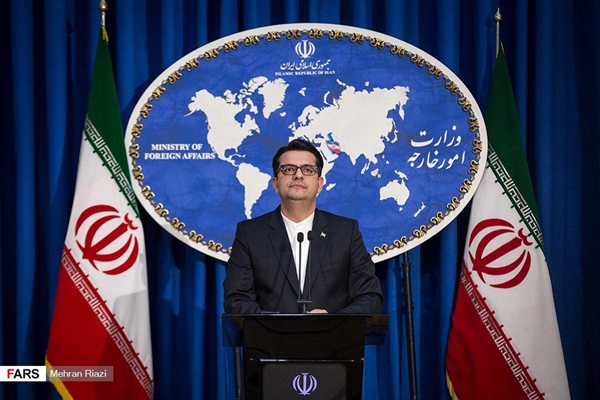
Spokesperson for the Ministry of Foreign Affairs of the Islamic Republic of Iran Seyyed Abbas Mousavi on Sunday offered deepest sympathy to the Japanese government, nation, and the affected people over a fierce storm and floods in which tens of people have been killed, several others have been injured or gone missing, and which has brought widespread destruction.

Leader: Iran Has No Motive for Being Hostile to Saudi Arabia

Speaking in a Sunday meeting with Pakistani Prime Minister Imran Khan, Ayatollah Khamenei expressed regret over the destructive role of certain countries in the region and their war on Yemen.

“We have no motive for being hostile to these countries, but they are under the will of the United States …in acting against Iran,” the Leader said.

“Ending the war in Yemen will have a positive impact on the region,” he added.

He further noted that “Iran has never initiated any war” against other countries, but “if any one starts a war on Iran, it will definitely regret it.”

The comments come as the Pakistani prime minister is in Tehran to mediate between Iran and Saudi Arabia.

Earlier in the day, Imran Khan said in a press conference with Iranian President Hassan Rouhani that “no new conflict must begin in the region” between Tehran and Riyadh.

Any kind of new conflict in the region will be to the detriment of regional nations and to the benefit of foreigners, he said, adding, “The peoples of the region, including those of Afghanistan and Syria, are still suffering from the consequences of terrorism.”

Stating that any kind of conflict between Iran and Saudi Arabia will affect the entire region, Imran Khan said, “We believe that disputes can be settled through dialogue.”

Referring to his upcoming visit to Saudi Arabia, the Pakistani PM said, “In the visit, I will offer Pakistan’s initiatives for peace and stability and ending disputes and tensions.”

Iran to Give Appropriate Response to Any Goodwill Gesture: Rouhani

“Any kind of goodwill and good speech will be responded with good, suitable speech,” Rouhani said in a joint press conference with Pakistani Prime Minister Imran Khan, who has travelled to Tehran to mediate between Iran and Saudi Arabia.

President Rouhani stressed that Tehran and Islamabad both share the view that regional issues must be resolved through political ways and dialogue.

“In our meeting, we expressed our concerns about the safety and security of oil tankers, especially what happened to the Iranian tanker on Friday in the Red Sea.”

“We also presented the leads that we have acquired on the issue and stressed that we will continue our investigations until we reach the final conclusion,” said Rouhani.

He said “if a country thinks that it can create insecurity in the region and not receive any response, it is gravely mistaken.”

“Mr Imran Khan made some points about the critical region of Persian Gulf, which we approve. The Prime Minister of Pakistan also stressed that the key to regional issues is ending the war in Yemen, immediate cease-fire and helping the Yemenis, which can be a very good start,” he said.

“Today, we also talked about bilateral relations and deepening economic cooperation between the two countries. We also discussed issues related to security in the two countries’ borders and activating border markets,” said Rouhani.

He said Iran and Pakistan enjoy profound strategic relations and both parties believe that these ties need to continue.

In this meeting, the Zionist Regime’s threats to regional security were explained to the Pakistani officials, said Rouhani.

The President went on to state that the United States’ unjust sanctions against the Iranian nation was another issue that was discussed in the meeting.

“The unjust US sanctions against the Iranian nation is economic terrorism. In this meeting, we discussed how the Joint Comprehensive Plan of Action (JCPOA), as an important agreement, can be returned to its previous states and be implemented.”

“We also highlighted the basic key fact that for the settlement of the issue, the United States has to return to the JCPOA and abandon sanctions,” he continued.

Appreciating Imran Khan for his visit to Tehran, the president said, “We welcome the Pakistani Prime Minister’s goodwill and effort for resolving regional issues so that full peace and security returns to our critical region.”

At the same press conference, Imran Khan referred to the friendly relations between the two countries and said, “The Islamic Republic of Iran has always been a friendly neighbour to Pakistan and supported us in hard times.”

He also appreciated Tehran’s stances in supporting the people of Kashmir.

Any kind of new conflict in the region will be to the detriment of regional nations and to the benefit of foreigners, he said, adding, “The peoples of the region, including those of Afghanistan and Syria, are still suffering from the consequences of terrorism, therefore, no new conflict must begin in the region.”

Stating that any kind of conflict between Iran and Saudi Arabia will affect the entire region, Imran Khan said, “We believe that disputes can be settled through dialogue.”

Referring to his upcoming visit to Saudi Arabia, the Pakistani PM said, “In the visit, I will offer Pakistan’s initiatives for peace and stability and ending disputes and tensions.”

Iran Prefers Using National Currency in Trade with Neighbours: Minister

Speaking on Saturday during his visit to Kermanshah province, Reza Rahmani said that some countries, such as Turkey and Russia, have signed agreements in this regard as using national currency will surely benefit both sides.

Rahmani added that one of the priorities this year is to export to neighbouring countries, and fortunately Iran has recently joined the Eurasian Economic Union which is a significant success under new circumstances.

Reza Rahmani mentioned enemies thought the Islamic Republic would be isolated by sanctions; however, joining the Eurasian Economic Union showed the enemy’s plan has failed.

“We trade over 500 items of commodities, mostly agricultural products and manufactured goods, with Eurasian countries. These goods are generally the ones in which we have domestic consumption surpluses,” pointed out the minister.

Rahmani said these products cover many commodities, from petrochemicals to ceramic tiles and steel products underlining that this move will certainly be to the interest of national and domestic production.

The EAEU summit was held in Yerevan, Armenia, on October 1 and the Islamic Republic attended the conference.

The union includes Armenia, Belarus, Kazakhstan, Kyrgyzstan, and Russia.

The Eurasian Economic Union has sought to expand into the ASEAN sphere to diversify against China’s growing Belt and Road Initiative.

An example of EUEA’s efforts to create a common market with ASEAN states is the Transit Potential of the Eurasian Continent initiative. The initiative will implement large-scale infrastructure projects and transportation networks that connect Central Asia, Southeast Asia and the Middle East.