The Public Relations Department of Iran’s Intelligence Ministry released a statement on Wednesday regarding this issue:
“These elements, which had been trained in various countries for a long time with funds provided by the US intelligence service had gathered information as citizen journalists. However, following the riots, it became clear that they had orders to attend protests and to report the details exactly in videos.”
Six of these people were arrested during riots while executing intelligence service orders. Two others, who attempted to collect and transfer the information abroad, were identified and arrested before leaving the country, reads the statement.
The Director General of Iranian Intelligence Ministry’s Counter-Espionage Department also touched upon the vigilance of the ministry’s staff in protecting the establishment of the Islamic Republic of Iran, stating that other people affiliated with the network are being monitored nationwide and in any event contrary to the national security of the Islamic Republic, they will be subject to judicial and security procedures.
In a Thursday statement, Mousavi expressed hatred for rioters’ storming of the consulate building, calling on the Iraqi government to deal with perpetrators of the attack responsibly, firmly and effectively.
He decried the attack and reminded Baghdad of its responsibility to protect diplomatic sites as well as diplomats.
“Iran’s strong note of protest was officially conveyed to the Iraqi ambassador to Tehran,” he said.
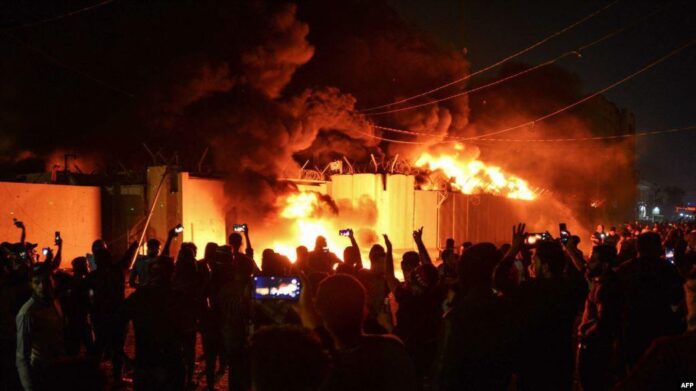
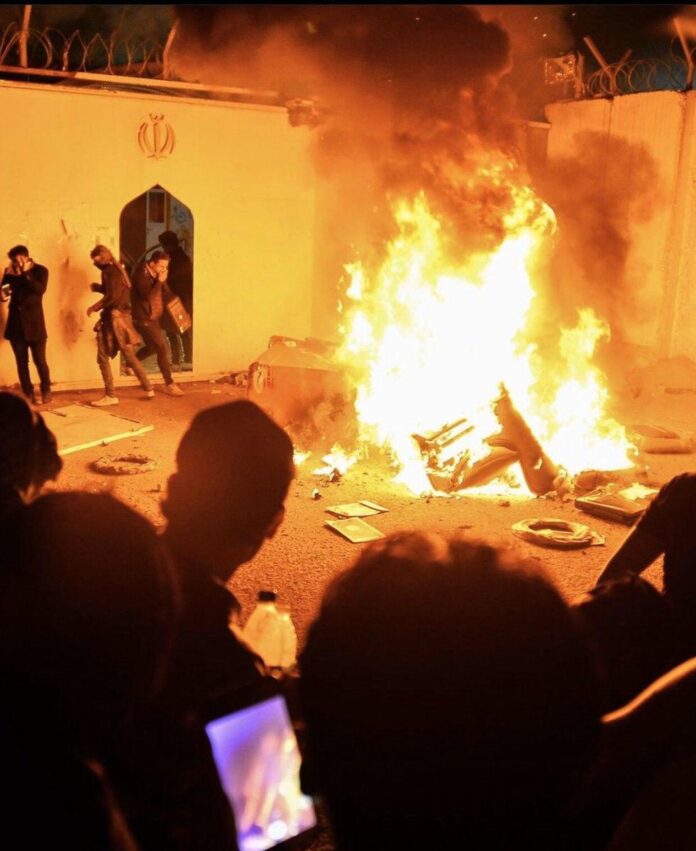
Rioters swarmed Iran’s consulate in Najaf late Wednesday. The masked assailants had also attacked Iranian consulates in the Iraqi cities of Karbala and Basra before. The incident prompted a curfew in the city and the closure of government offices there for Thursday.
The assailants who swarmed the building Wednesday evening had already attacked offices of parties and political groups as well as government institutions in Iraq.
Clashes erupted between rioters and riot police deployed to the scene to protect the Iranian Consulate, report Iraqi media.
Some reports released in recent weeks suggest the rioters had received considerable amounts of money from some Persian Gulf Arab countries. They had already attempted to attack Iranian consulates in the Iraqi cities of Karbala and Basra.
Security officials in Najaf Governorate say a curfew has been put in place in the city of Najaf until further notice. The Najaf governor has also ordered all government offices in the city to remain closed for Thursday.
The staff of the Iranian consulate had been evacuated under heavy police protection just before the incident.
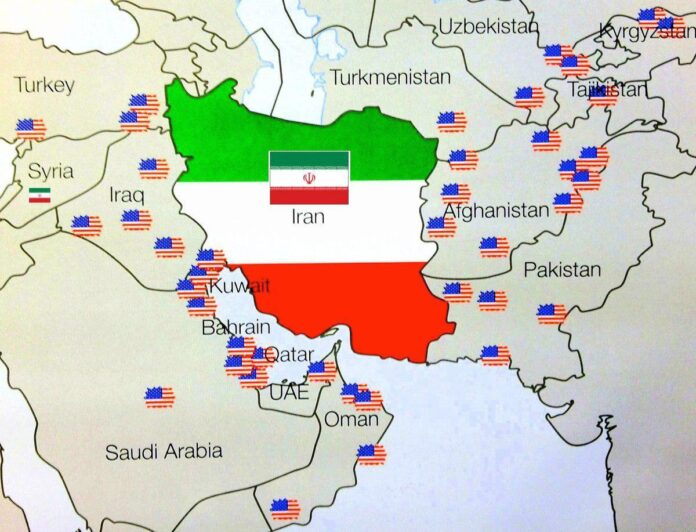
Brigadier General Amir-Ali Hajizadeh said on Wednesday among Washington’s tactics is to use fifth column elements and infiltrators to deal a blow to Iran.
“As of the beginning of this year, America’s sabre-rattling began to increase, and John Bolton spoke of a military attack and dispatching aircraft carriers to the Persian Gulf,” said General Hajizadeh, the commander of the Aerospace Division of Iran’s Islamic Revolution Guards Corps (IRGC).
“The issue of economic pressure on the [Iranian] people and the spectre of war prompted some [Iranian] officials to stress the need for talks. The Supreme Leader also said he was dismayed at authorities’ inaction in the face of back-to-back economic blows dealt to us by the enemy,” added the general.
“With the Supreme Leader’s firm decision, resistance became a cornerstone of the Establishment’s fundamental policy, and we saw that the enemy was cornered in recent months with hands up,” he said.
He noted the United States’ talk of military action against Iran was “hollow and worthless.”
Elsewhere in his remarks, he touched upon the recent unrest in the country where rioters seized the opportunity to cause chaos. The top general praised people for remaining vigilant and prudently neutralizing the “sedition.”
“When the Americans say all options are on the table, that means they would use all their potential and facilities to bear animosity towards, and deal a blow to Iran,” he said.
The top general underlined that the United States is turning to “soft war” to harm Iran, saying the enemy left no ploy unused to deal blows to Iran on political and economic fronts.
Elsewhere in his remarks, the top general said Iran is among the top countries in the region in the domain of defense, adding the military relies on domestically-developed technologies to build equipment.
He said the IRGC took heed of the advice by Leader of the Islamic Revolution Ayatollah Seyyed Ali Khamenei, who stressed the importance of high-precision missiles.
The top commander said the precision of Iran’s missiles became evident when Iran hit ISIS terrorists at a home in Iraq.
He said it would be wrong to rely on enemy to solve problems in the country, and it would be a mirage to think the US can resolve Iran’s economic problems.
The senior general also said the military option and threat of war are no longer effective, and that Iran is now well aware of Washington true intention, i.e., seeking to create insecurity in the country.
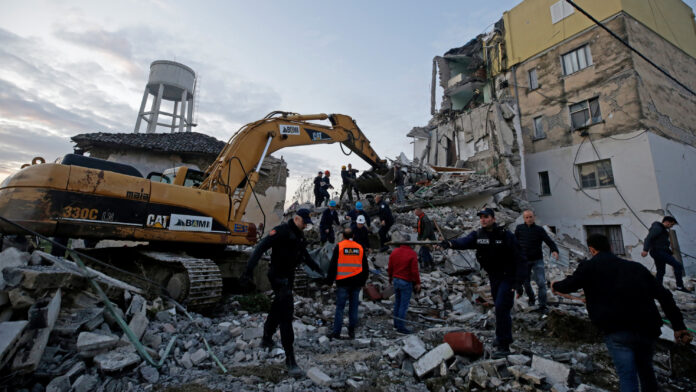
Emergency crews at a damaged building in Thumane, Albania, on Nov. 26, 2019 / Photo by Reuters
In a statement on Wednesday, Mousavi also sympathized with the Albanian nation, government, and those hurt in this tragic incident.
The magnitude-6.4 tremor struck 34km (21 miles) north-west of the Albanian capital of Tirana, as people slept in their beds during the early hours of Tuesday.
So far, the strong quake has killed 26 people and injured 650.
Most of the deaths occurred in the coastal city of Durres and the town of Thumane, close to the epicentre.
Hundreds spent the night in tents, some slept in cars, as aftershocks continue.
Some 500 shocks have been felt since the initial quake hit at 03:54 local time (02:54 GMT) on Tuesday. Search teams have arrived from a number of European countries to help find survivors.
Abrar:
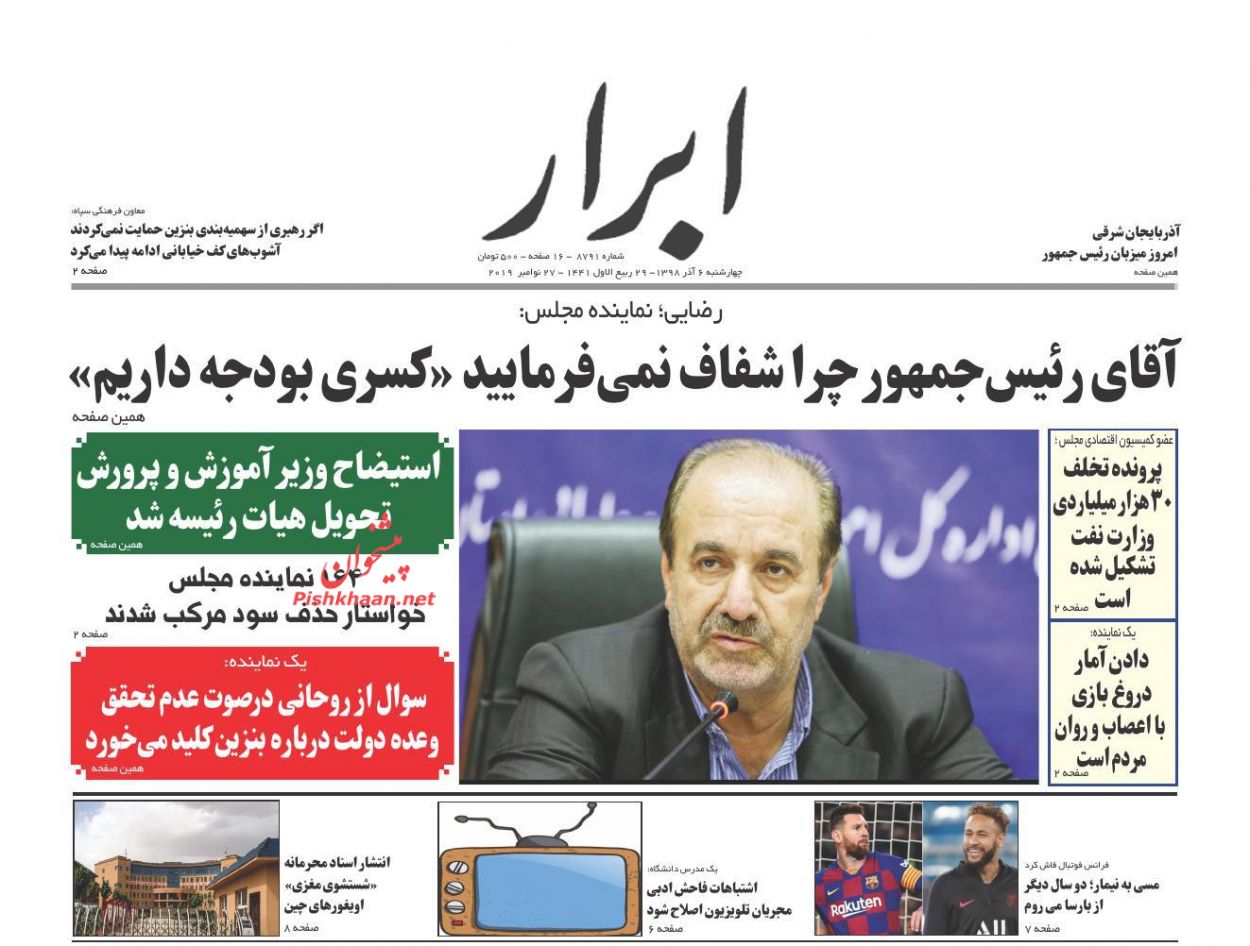
1- Rouhani to Visit East Azarbaijan Province Today
2- Parliament Due to Impeach Education Minister
Abrar-e Eqtesadi:
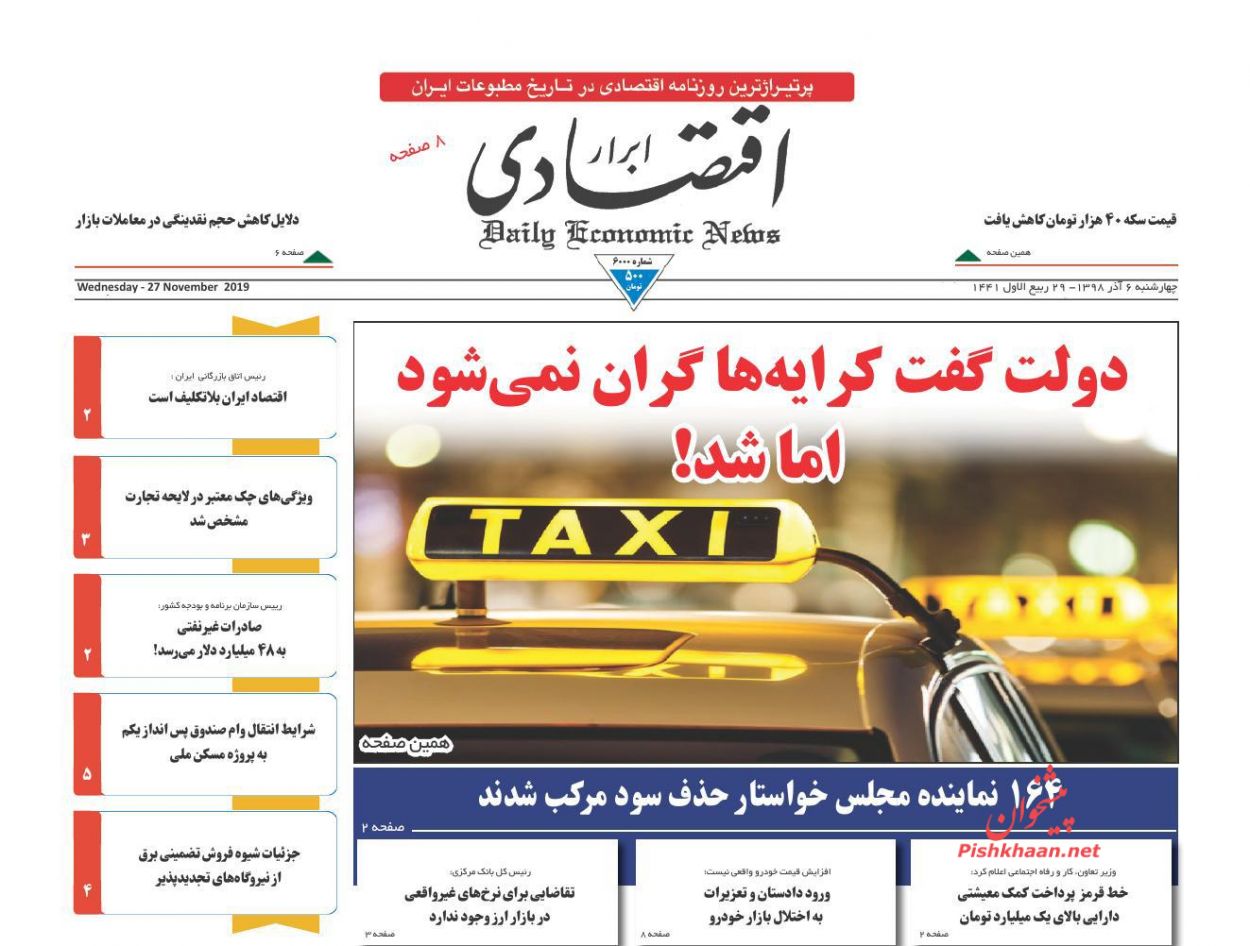
1- Iran’s Non-Oil Exports to Hit $48 Billion!
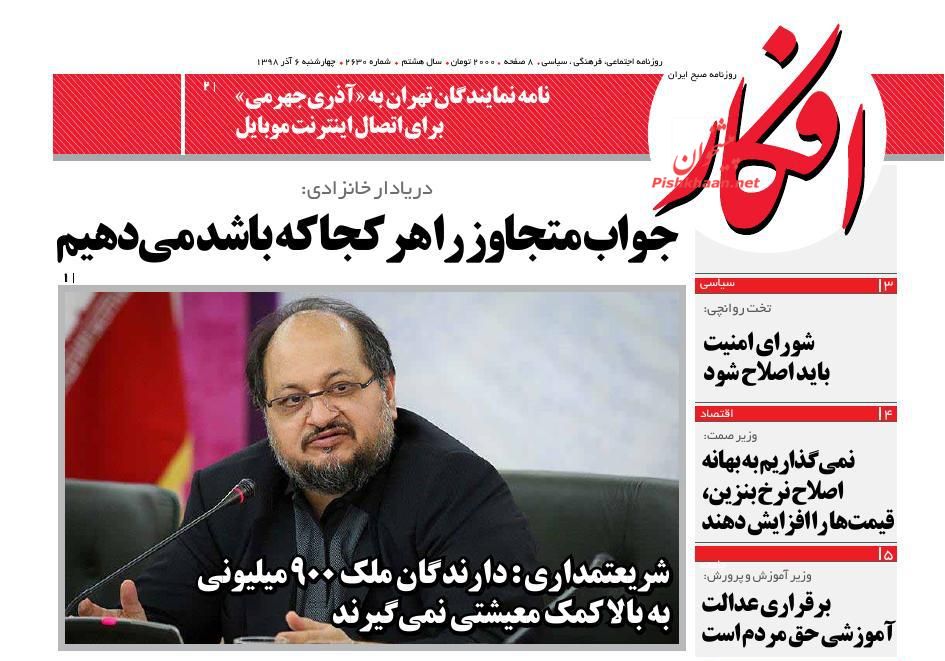
Afkar:
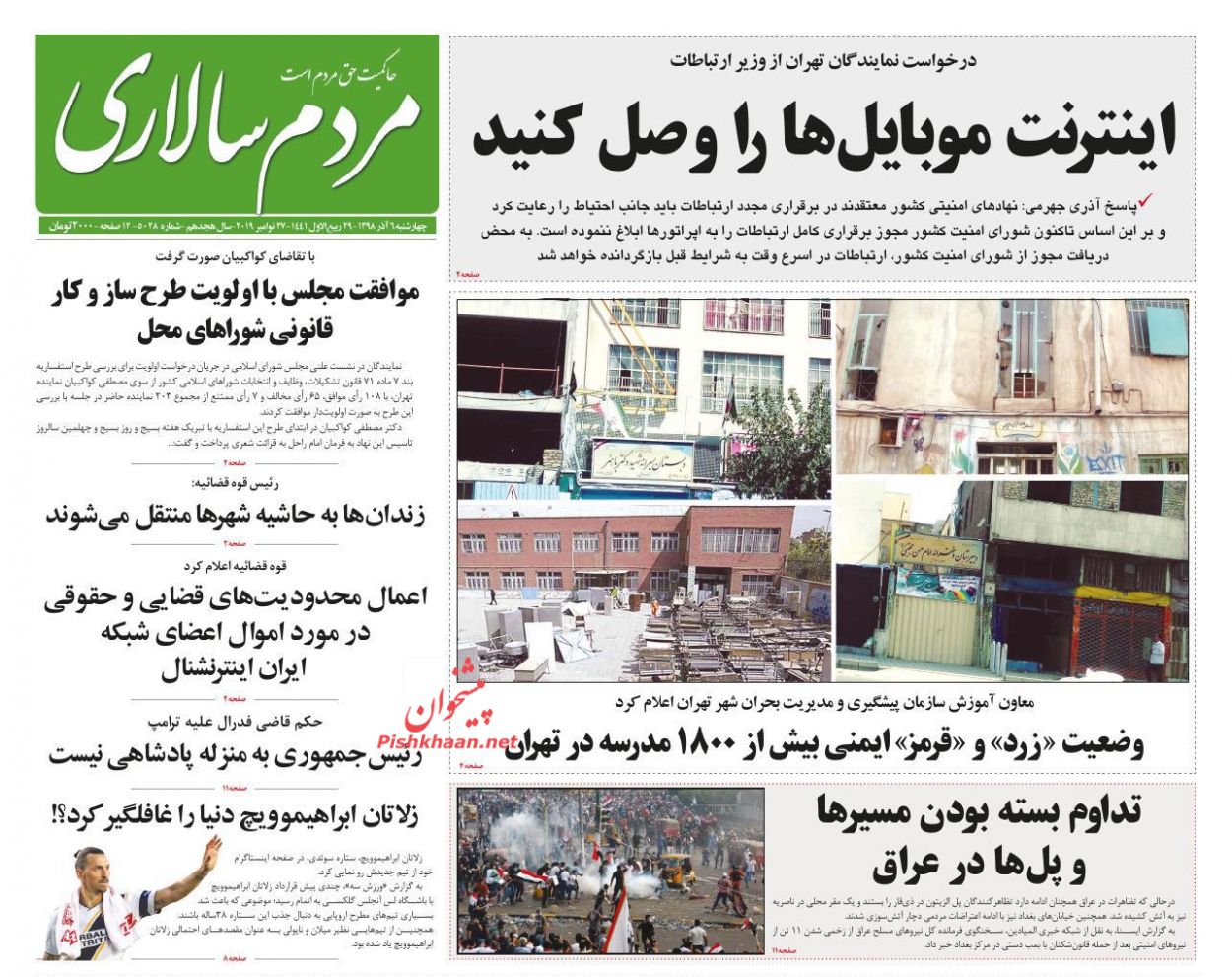
1- Tehran Lawmakers Urge ICT Minister to Reconnect Capital City’s Mobile Data
2- UN Security Council Must Be Revised: Iran Envoy
Ebtekar:
1- Divergence Crisis in NATO: A Review of US-EU Challenge on NATO
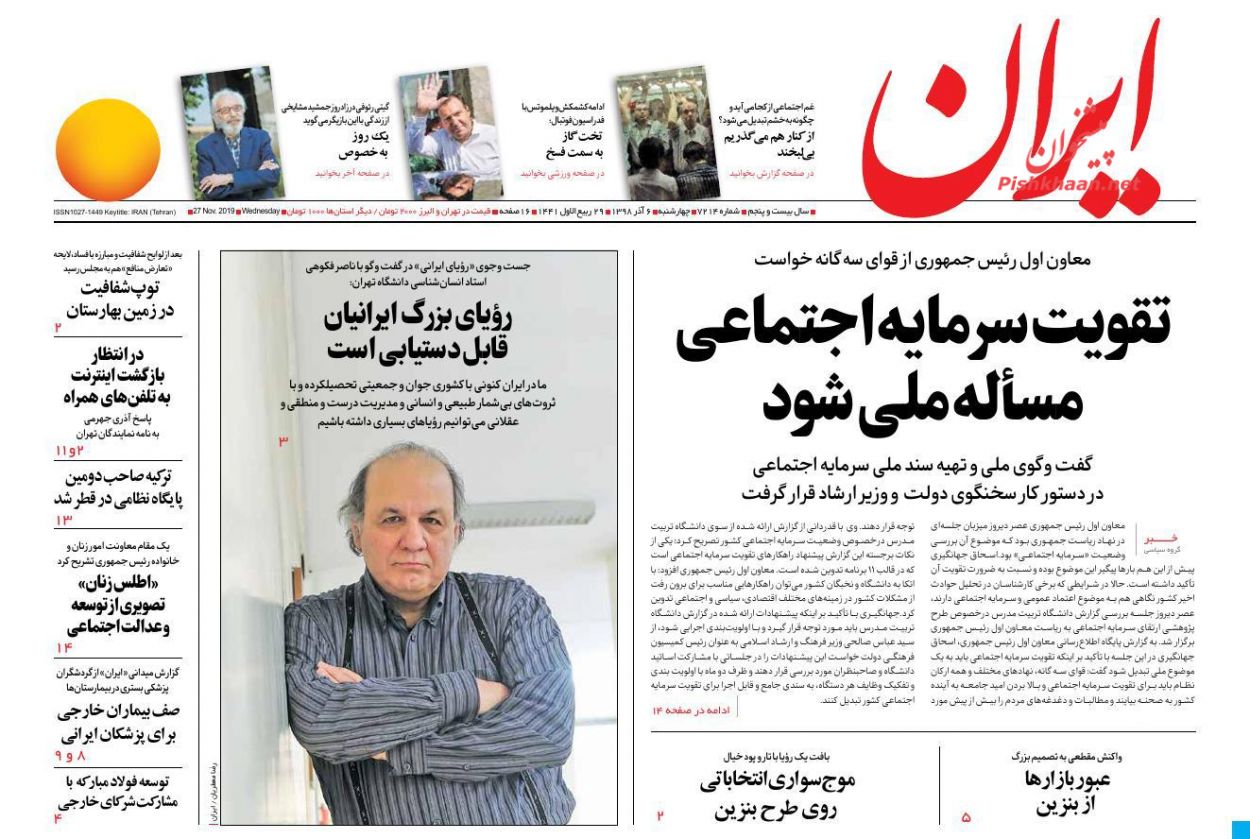
Iran:
1- Turkey Opens Second Military Base in Qatar
2- Foreign Partners to Help Iran Develop Mobarakeh Steel Factory
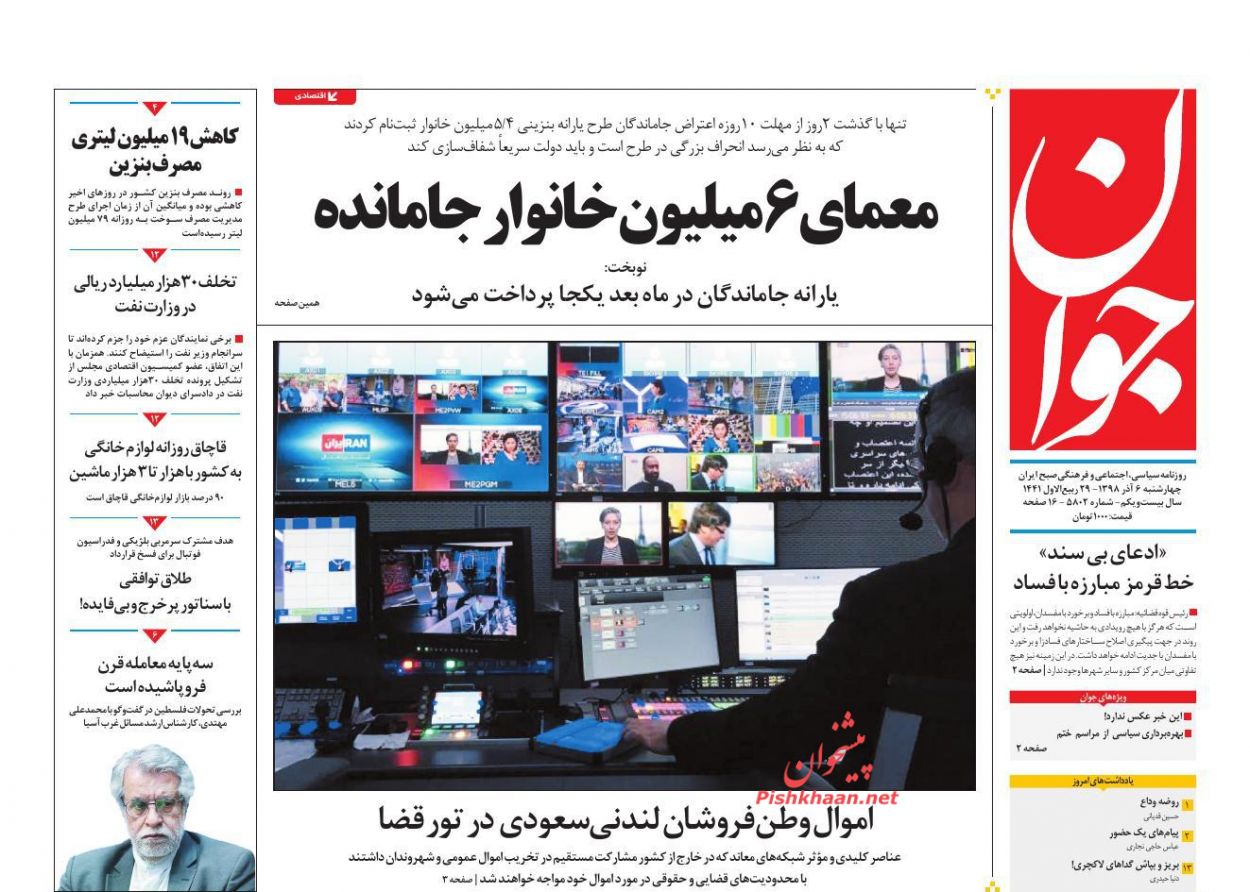
Javan:
1- Assets of London-Based Saudi-Sponsored Traitors to Be Seized by Iran Judiciary
* Key Elements in Dissident Channels Abroad Directly Involved in Iran Vandalism
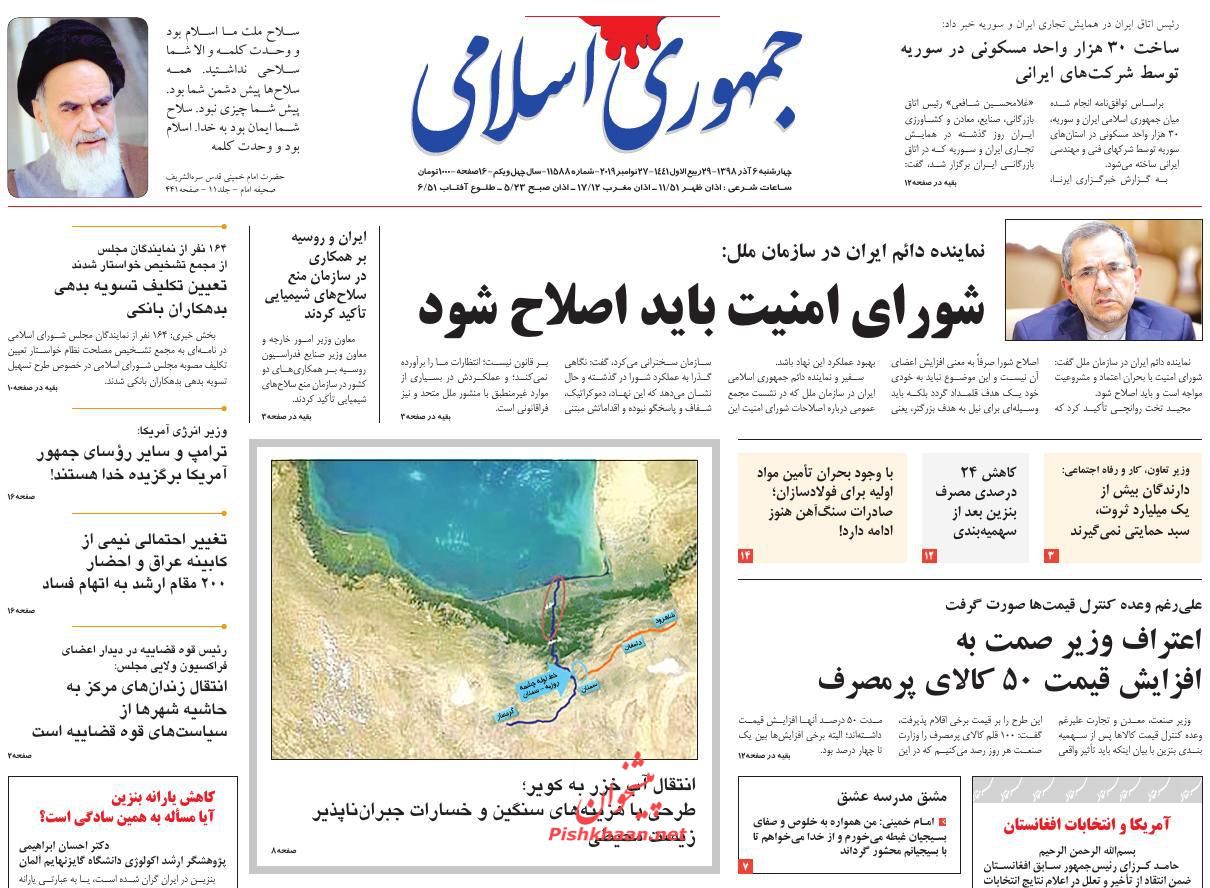
Jomhouri Eslami:
1- Iranian Firms to Build 30,000 Houses in Syria: Official
2- UN Security Council Must Be Reformed: Iran Envoy to UN
3- Trump and Other US Presidents Sent to Earth by God: US Secretary of Energy
4- Half of Iraq Cabinet Likely to Change: 200 Senior Officials Summoned over Corruption
Kayhan:
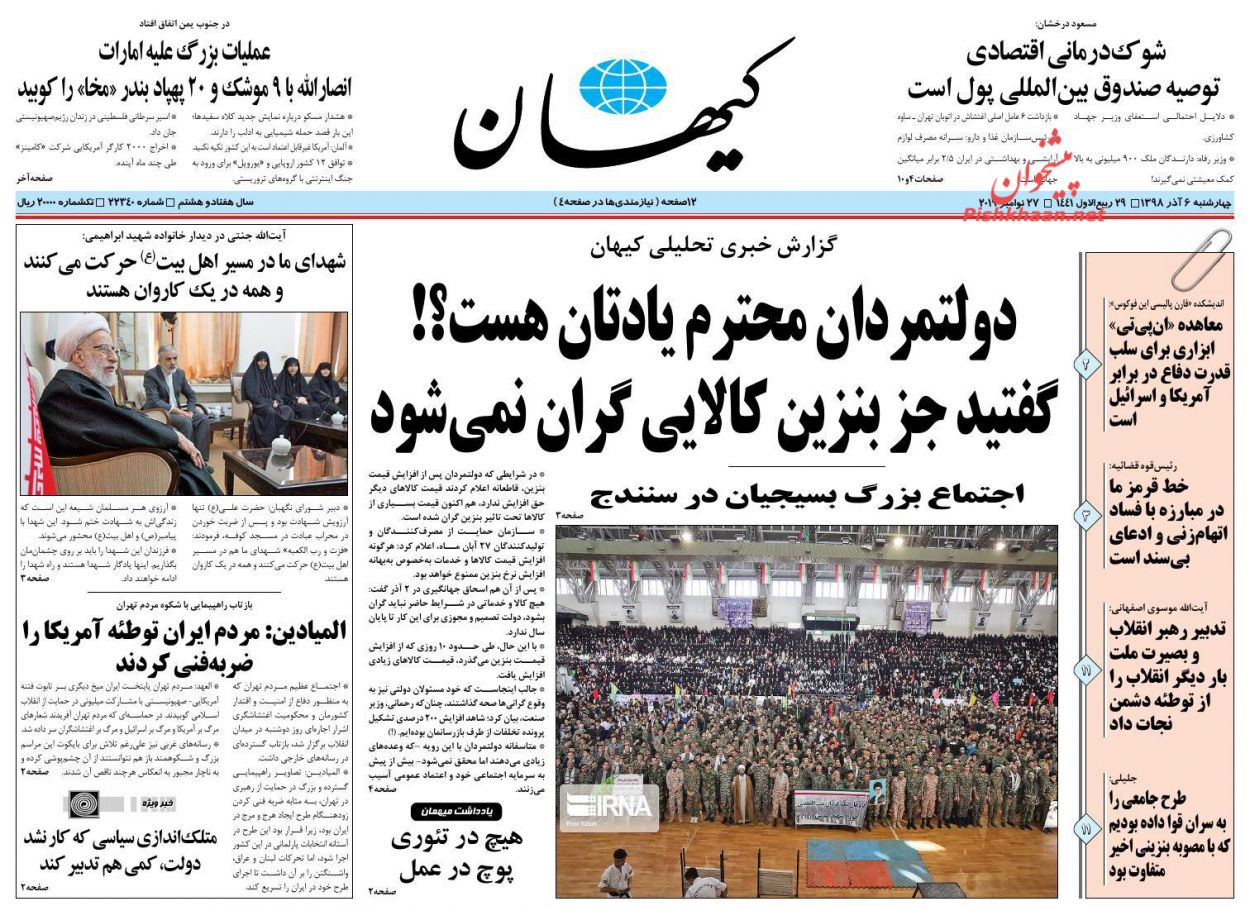
1- It’s IMF’s Recommendation to Remedy Economy Through Shock: Analyst
2- Ansarullah’s Huge Operation against UAE with 9 Rockets, 20 Drones
Mardom Salari:
1- Reconnect Mobile Data: Lawmakers Urge ICT Minister
2- Judicial, Legal Restrictions Imposed on Iran Intl. Staff
3- Roads, Bridges Still Blocked in Iraq
Shargh:
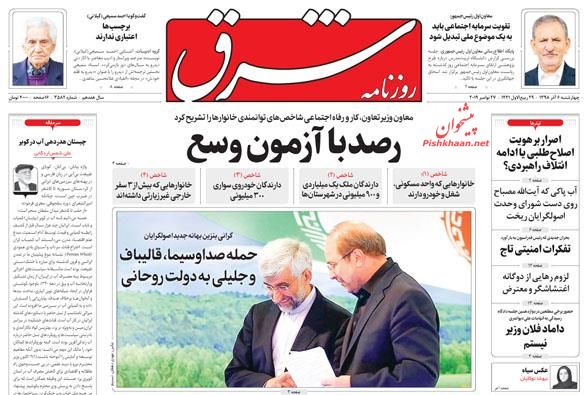
1- Reinforcement of Social Assets Must Turn into National Issue: VP
Vatan-e Emrooz:
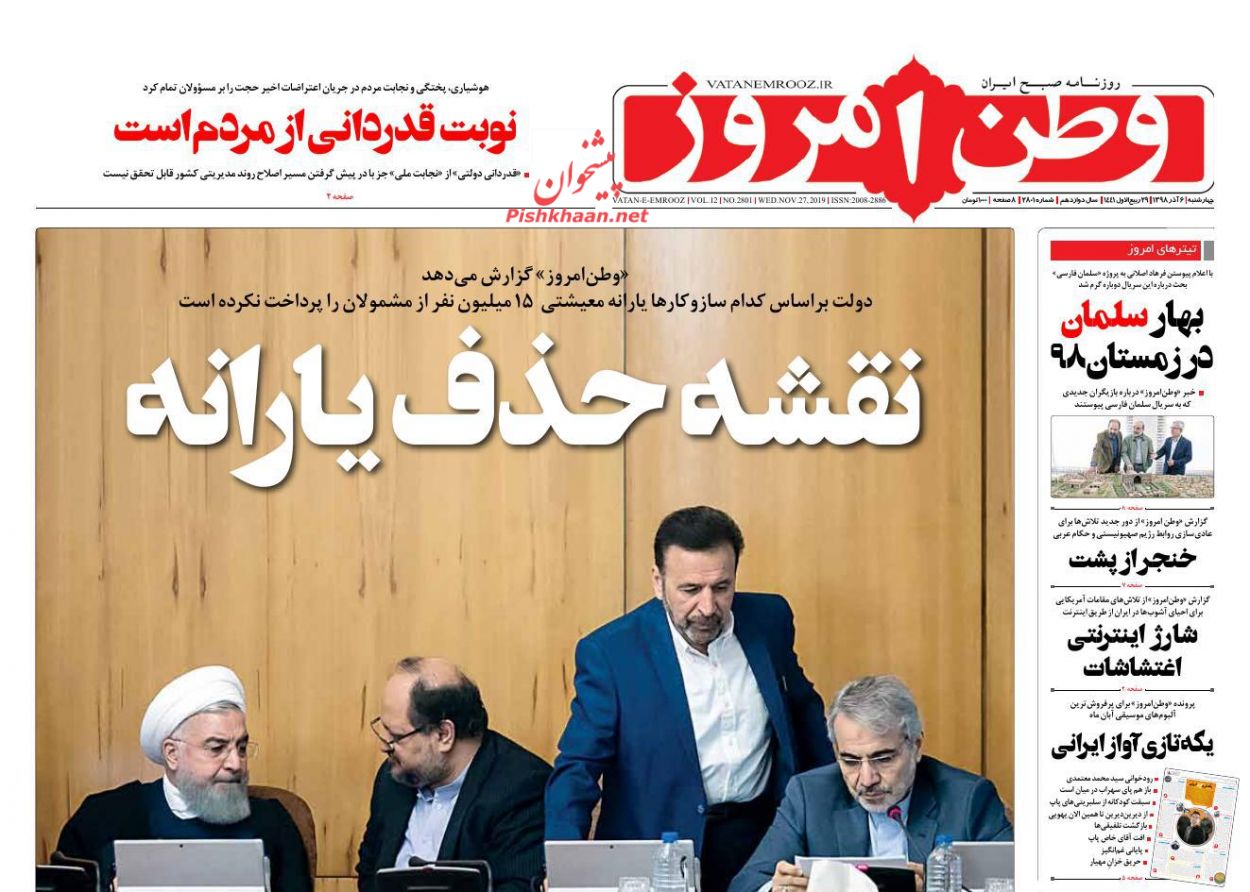
1- It’s Time to Appreciate People: Gov’t Must See People’s Mature, Noble Reaction to Protests
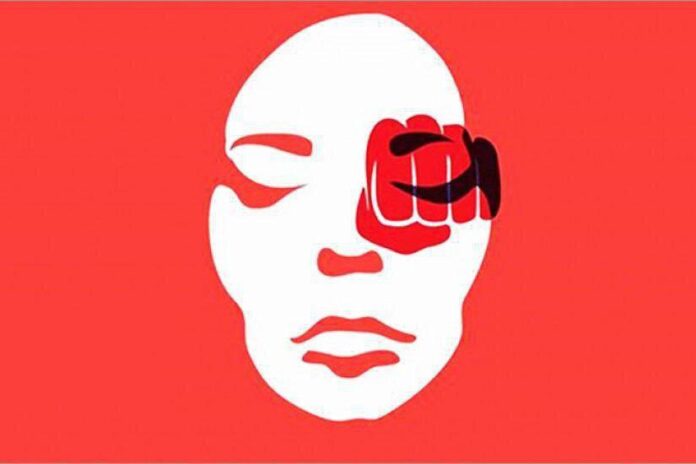
There are many things that women still do not know about national laws against domestic violence. When someone is talking about violence against women, most people refer to physical violence, while it has different dimensions and types.
For several years, Iran has also been trying to develop a law prohibiting violence against women. The bill was originally called the “Protection of Women against Violence”, and after about five years, changes were made to the billand it was finalised as “Dignity and Security of Women against Violence.”
Shima Ghousheh, a lawyer and women’s rights activist, spoke to Khabar Online to answer questions about instances of this social harm, and Iranian laws on protecting women’s rights.
“Types of violance”
What are examples of violence against women?
There are different categories when it comes to violence against women. The first category is physical violence. The second category is sexual violence; ranging from rape to sexual harassment and even sending of pornographic photos and videos to a woman. The third category is psychological violence including humiliation, insult, disrespect, slander, etc. The fourth category is economic violence; that is to take a woman’s property, for example, the money she earned through working, or forfeit the woman’s alimony. A man may not beat his wife, but it is a kind of violence when he neglects his wife.
“Current laws on the matter”
How effective are the current laws on protecting women, and what are their weaknesses?
Current laws do not specifically address the problem; in fact, there is no difference between this type of violence that’s related to female gender, and other forms of violence; the current law has no specific approach. At the moment the law is punishment-based and therefore parts of it are ineffective. If we want to work on it too much, many women may not have the proper living and economic conditions to sue their husbands. If their husband goes to jail, that woman will actually face troubles in her daily life; for this reason, many women refrain from suing their husbands.
For many years there has been much discussions about prohibiting violence against women, and this has made them more aware. At least if they get beaten up, they don’t think it’s a man’s nature and now they know its name is violence.
Both culture and law must grow together. That is to say, if we change the law, the culture will not necessarily change, or vice versa.
For example, one of the instances of violence against women is the circumcision of girls. Removing sexual organs has been considered by the legislator to be punishable, but the law has not referred directly to the circumcision of women, and there are some parts of society that are enforced for various tribal reasons to circumcise women.
The legislator says we cannot prevent this custom. In some cases there is a law, but because it is not implemented, violence against women is still practiced.
However, even having an incomplete law is better than not having a law, and it can be corrected later on.
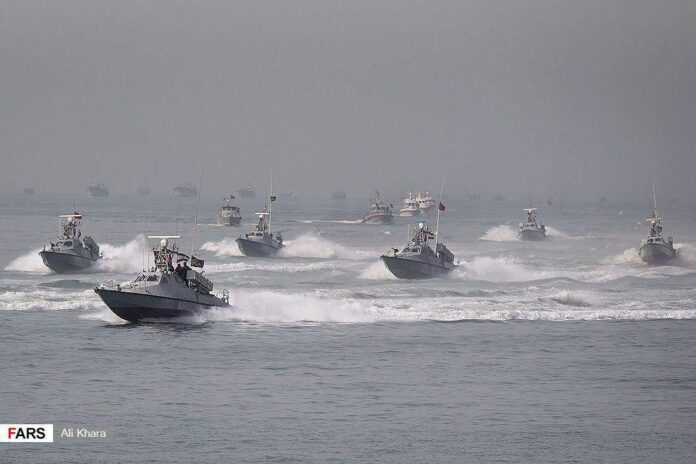
Rear Admiral Amir Rastgari said a number of vessels are also being built to be delivered to the police for marine patrol.
“In the current [Persian] year [ending March 20, 2020], the Dena destroyer will be available to us to be used for the strategic marine forces of the Army,” said Rastgari, the director general of the Marine Industries Organization of the Defence Ministry.
He said Dena is equipped with a 3D phased array, surface-to-surface and surface-to-air missiles, a safe integrated communications system, a very modern electronic warfare system and a precision defence system.
“This destroyer weighs around 1500 tonnes and measures 95 metres long and 11 metres wide. It can travel at around 30 nautical miles per hour,” he noted.
He said the destroyer has been completely developed by local experts.
Head of the local branch of Iran’s Ports and Maritime Organization (PMO) in the southwestern province of Blushehr said on Tuesday that the leak had been spotted from an oil transfer pipeline connected to the Abuzar Oil Platform located around 13 kilometers off Kharg, the island from which Iran sells much of its crude.
Siavosh Arjmandzadeh said the leak covered an area of around 24 kilometers to 100 meters, adding that it might expand if not contained soon.
“… The clean-up operation has started but because of the intensity and the possibility for expansion of contamination there is need for more equipment and reinforcement,” said Arjmandzadeh.
The official said four vessels had already been dispatched to the area to spray dispersants on the leak, adding that neither the PMO nor the Iranian Offshore Oil Company (IOOC), which owns the oil rig, would be able to fully contain the leak on their own.
He said efforts were being coordinated at regional and national levels to accelerate the clean-up operation.
There was no immediate comment from Iran’s Oil Ministry, which operates the oil installations off Kharg.
The new leak comes more than two months after local authorities and environmental NGOs contributed to a clean-up operation for an oil spill of a smaller size in the region
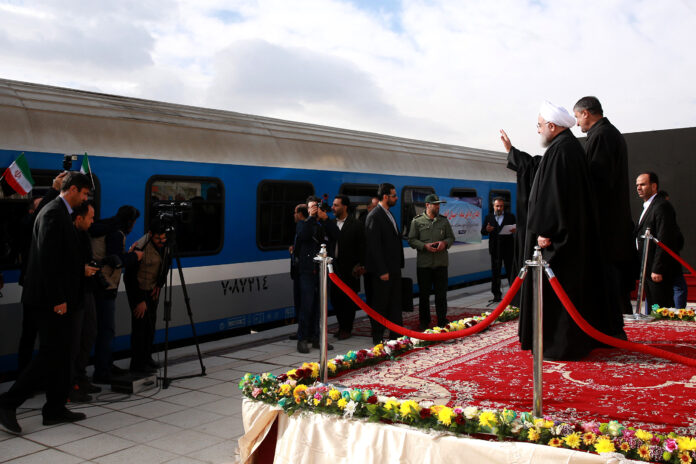
The railway is 132km long and has been constructed at a cost of 5 trillion rials beginning from Mianeh Station and running to Bostan Abad Station, passing through Torkamanchay and Tikmeh Dash towns.
The key railway opened by Rouhani is expected to significantly boost international transportation through the Iranian corridors.
The first passenger train of Bostan Abad Station departed for Mashhad with 159 passengers including the families of martyrs and war veterans of the city of Bostan Abad.
The railway is part of a longer line connecting Mianeh to Tabriz, the metropolitan capital of East Azarbaijan and a major business and industry hub in the vicinity of Turkey and the South Caucasus.
The new Mianeh-Tabriz railway would shorten the train travel between the Iranian capital Tehran and Tabriz by 114 kilometers while it would hugely facilitate transport between east and northwest of Iran.
Authorities said construction for the remaining part of the railway, a 42-kilometer line from Bostanabad to Tabriz, would conclude after March 2020.
Plans for construction of the Mianeh-Tabriz railway, dubbed the “missing link” in the Iranian rail network, began 18 year ago when the government at the time sought to drastically shorten travel time between Tehran and Tabriz, currently Iran’s sixth largest city.
Once finished, the railway would hugely boost cargo transportation from eastern Iran to Azerbaijan and Turkey and to the continental Europe.
Iran’s railway network has expanded rapidly over the past decade with four new provincial capitals in mostly mountainous regions connected to the network over the past six years.
Government authorities said recently that the average track-laying work across the country had increased from 120 kilometers a year in 2013 to more than 180 kilometers in 2017.