Thursday, April 23, 2026
Home Blog Page 3018

Iran Warns Activating Trigger Mechanism ‘Coup de Grace’ to JCPOA

Iran Warns Activating Trigger Mechanism 'Coup de Grace' to JCPOA

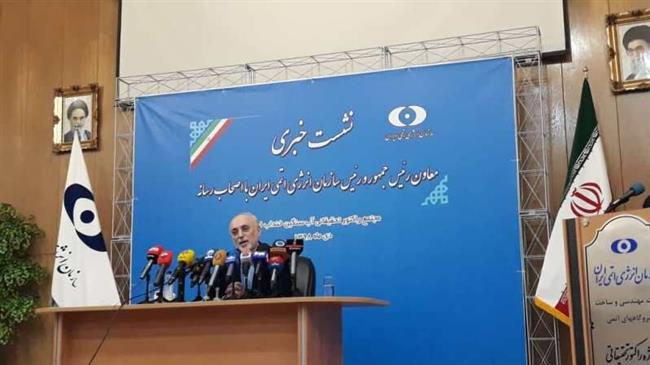
Ali Akbar Salehi made the remarks in a press conference on the sidelines of a ceremony on Monday, held to launch the second circuit of Iran’s Arak heavy water reactor, which is located near the central Iranian city of Khondab.

Under the nuclear deal, signed between Iran and the P5+1 countries (the United States, Britain, France, China, Russia and Germany), Tehran agreed to remove the core of the Arak reactor and fill it with concrete provided that the other parties to the accord redesign it for the production of medical isotopes, which they did not.

The reactor consists of two circuits, with the first one tasked with removing heat from the heart of the reactor, and the secondary circuit responsible for transferring heat from the first circuit to cooling towers and finally to the outside environment.

“Europe wants the JCPOA to survive. The JCPOA is of security importance to them, but whether this demand is commensurate with their ability [to resist US pressures] is a different issue. The ability of Europe depends on its resistance against the United States, but unfortunately they have proven that the 28 [member] states [of the European Union] are less resistant and independent than a single [US] state like California,” Iran’s nuclear chief said.

Salehi added that if European countries seek to activate the trigger mechanism, it would be against their will, adding, “If the trigger mechanism is activated, nothing will be left of the JCPOA. This is a contradiction in the Europeans’ discourse.”

Expressing hope that Europe would amend this discourse, Salehi said, “We hope that this European discourse is rectified, because this discourse will put Europe on the same level with an untrustworthy America.”

“Europe’s prestige has been tarnished before the world’s public opinion and they must not do more damage to this prestige. All parties must try to help the JCPOA survive,” Iran’s nuclear chief said.

In May 2018, US President Donald Trump unilaterally pulled his country out of the JCPOA in defiance of global criticism, and later re-imposed the sanctions that had been lifted against Tehran as part of the agreement.

European members since last month have begun raising the possibility of triggering the JCPOA’s “dispute resolution mechanism,” which is also known as the trigger mechanism, and whose activation can lead to the return of the UN sanctions on Iran.

Recent threats to activate the trigger mechanism envisaged in the JCPOA were brought up after the Iranian government took a series of steps in reducing its commitments under the deal in response to the US measures and the Europeans’ failure to keep their end of the bargain in protecting Iran’s economic benefits in the agreement.

Iran has so far rowed back on its nuclear commitments four times in compliance with Articles 26 and 36 of the JCPOA, but stressed that its retaliatory measures will be reversible as soon as the European signatories — France, Britain and Germany — find practical ways to shield mutual trade from the US sanctions.

As a first step, Iran increased its enriched uranium stockpile to beyond the 300 kilograms set by the JCPOA.

In the second step, Tehran began enriching uranium to purity rates beyond the JCPOA limit of 3.76 percent.

In the third phase, after the Europeans failed to meet a 60-day deadline to meet Iran’s demands and fulfill their commitments under the deal, Iran started up advanced centrifuges to boost the country’s stockpile of enriched uranium and activated 20 IR-4 and 20 IR-6 centrifuges for research and development purposes.

In November, Iran began injecting gas into centrifuges at the Fordow plant as part of its fourth step away from the JCPOA under the supervision of the International Atomic Energy Agency (IAEA).

Iran’s Deputy Foreign Minister for Political Affairs Abbas Araqchi said on December 9 that despite their recent threat to activate the trigger mechanism envisaged in the nuclear accord, the European signatories to the deal will not do so for the time being.

“During the recent meeting with the 4+1 group, the trigger mechanism was never brought up and all remarks to this effect have no other goal, but to create a negative atmosphere against our country,” Araqchi said.

Sending Iran to UNSC benefits no one

Elsewhere in his interview, Salehi said that a possible reporting of Iran’s nuclear case to the United Nations Security Council would not serve the interests of anyone, warning that in that case, regional and international relations would change, leading to unpredictable repercussions.

He added that if the three European parties to the JCPOA fail to fulfill their obligations under the deal, Iran will make a proportionate decision, but “we hope that the opposite side will make a decision and carry out a measure that will prevent further complication of the issue.”

Too early to talk about Iran’s 5th JCPOA step

The Iranian nuclear chief noted that it is still too early to talk about Tehran’s fifth step in scaling back its commitments under the JCPOA if the European signatories did not take practical measures to salvage it.

Iranian President Hassan Rouhani is in charge of announcing the country’s steps to reduce its JCPOA commitments, but he has made no serious remarks in this regard yet, he said, adding that the president would make the necessary decisions and order the AEOI to implement them in due time.

He said Iran may accelerate certain measures or increase production.

Secretary of Iran’s Supreme National Security Council Ali Shamkhani said on Sunday that the Islamic Republic would take the fifth step of scaling back its JCPOA commitments if the European signatories take no practical measures to save it.

“Tehran has started different steps to reduce its peaceful nuclear commitments in order to maintain and balance its commitments under the JCPOA and if the Europeans fail to fulfill their obligations, we will take the fifth step,” Shamkhani said.

Arak heavy water cold tests within next two years

In response to a question about new Khondab reactor’s cold tests, the AEOI chief said Iran has previously announced that the modeling of a new reactor would take at least five years since the conclusion of the JCPOA.

He expressed hope that all the necessary measures would be completed within the next two years.

New IAEA head not influenced by any country

Asked about the possibility of the new IAEA Director General Rafael Mariano Grossi be swayed by certain countries to take positions against Iran, Salehi said Grossi is fully aware of the agency’s matters and has vowed to be fair and not to be affected by influential countries in dealing with the Iranian nuclear case.

He added that Iran cooperates with the IAEA in line with the agency’s Safeguards Agreement, the Additional Protocol and the JCPOA, emphasizing that Tehran has no commitment outside such purview.

Speaking in an interview with Ria Novosti earlier this month, Grossi promised he would act fairly and independently towards Iran, saying he would not allow discrimination in any case and would like to rely on cooperation with Iran.

“We will not allow discrimination and bias against Iran,” he said, emphasizing that as the new IAEA head, he wants to advance his own approach towards relations with Tehran.
Iranian Women Team Claim World Alysh Title

Iranian Women Team Claim World Alysh Title

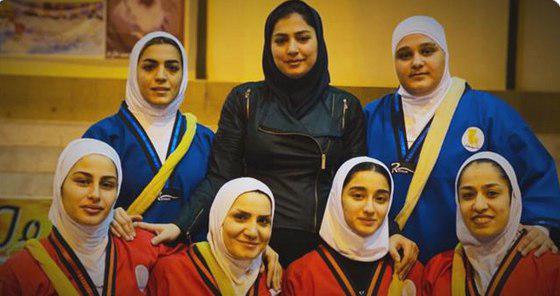
Team Iran bagged 93 points after Haniye Ashoori pocketed gold in the plus 75 Kg category, before Fatemeh Fattahi claimed silver in the 60kg, and Zahra Yazdani took bronze in the 55 Kg category.

The host nation, Kyrgyzstan stood in 2nd with 89 points while Kazakhstan finished 3rd with 69.

Meanwhile Iran’s men Alysh wrestlers finished the competition as runners-up after grabbing 2 silver medals in the 70 and the plus 100 kg categories and a bronze in the 60 kg category.

Iran earned 85 points and finished as runners-up behind Kyrgyzstan who racked-up 96 points to take the title.

FM Zarif Holds High-Level Talks in Muscat

FM Zarif Holds High-Level Talks in Muscat

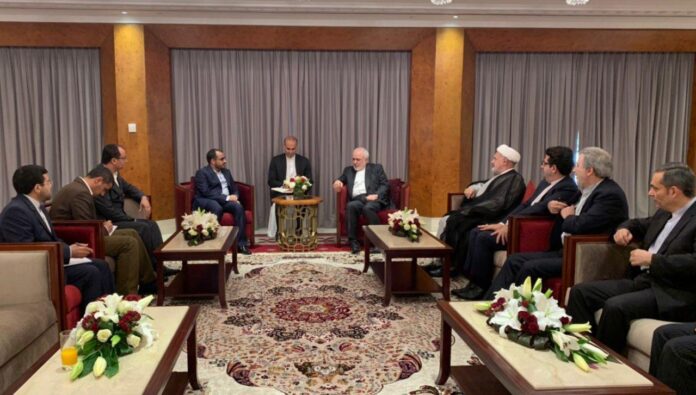
On Tuesday, Zarif met Mohammed Abdul-Salam, the spokesman of Yemen’s Ansarullah Movement.

FM Zarif Holds High-Level Talks in MuscatIn the meeting, the two sides conferred on the latest political and on-the-ground developments in Yemen.

Zarif also met the Minister of the Palace Office of the Sultanate of Oman, General Sultan bin Mohammed al Nua’mani, and discussed with him the development and deepening of bilateral and brotherly relations between the two countries.

Earlier, the Iranian top diplomat held two rounds of bilateral talks with his Omani counterpart Yusuf bin Alawi on a wide range of issues.


Riyadh Needs to Return to Normal Ties with Tehran: Official

Tehran Still Ready to Mend Ties with Riyadh Despite ‘Foolish’ Moves

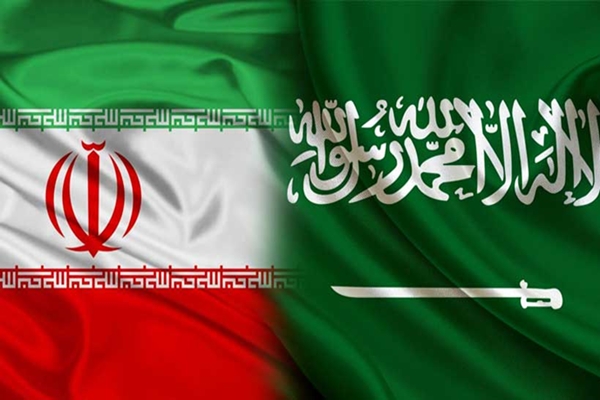
Hossein Amir-Abdollahian, a special assistant to Iran’s Parliament speaker, said Riyadh needs to change its approach.

“We always welcome constructive relations and good neighbourliness with Saudi Arabia and believe the Saudi regime has no way but to return to normal relations with Tehran,” said the official.

“However, current Saudi rulers preferred the incorrect option of war to a political solution by overtly and covertly supporting terrorists and harmed regional security,” he said.

“We hope we will see a change in the behaviour of Riyadh rulers toward regional security and stability,” he said.

Elsewhere in his remarks, Amir-Abdollahian touched upon the US sanctions on Iran.

“Of course, sanctions have negative impacts, but, first, Iran is a great country which is full of resources and has creative and hardworking people,” he said.

“Secondly, the US would be the first to be harmed by the policy of imposing sanctions on Iran because it (the US) has to spend a lot to maintain the sanctions and definitely will not be able to preserve them,” said the top official.

“The US should talk to great Iranian people with a language of respect and change its behaviour,” he noted.

Amir-Abdollahian also touched upon the United States’ interference in the region.

“The ongoing disputes in the West Asia region as well as parts of Latin America and Asia emanate from the United States’ military and political interventions in order to get its hands on massive energy and mine resources around the world,” he noted.

“Unfortunately, in the West Asia region, too, just two or three Arab countries, especially Saudi Arabia, are have aligned themselves with colonial powers’ inappropriate and secessionist policies and played a negative role in regional developments in recent years,” Amir-Abdollahian said.

The official further referred to the Zionist regime of Israel’s destructive behaviour in the region.

He highlighted the need for a democratic solution, i.e., holding a referendum, among Palestinian people.

He said Iran has had this solution registered at the UN, adding the plebiscite should bring together “all original Palestinian people, including Jews, Christians and Muslims.”

He also said the pace of regional and international developments is very fast.

“Due to this complicated and fast-paced situation, the pace of developments is several times as fast as that of political, regional and international solutions,” he said.

Iran Says Won’t Forget Friends of Its Tough Times

Iran Vows Appropriate Response to US Interception of Mahan Air Flight

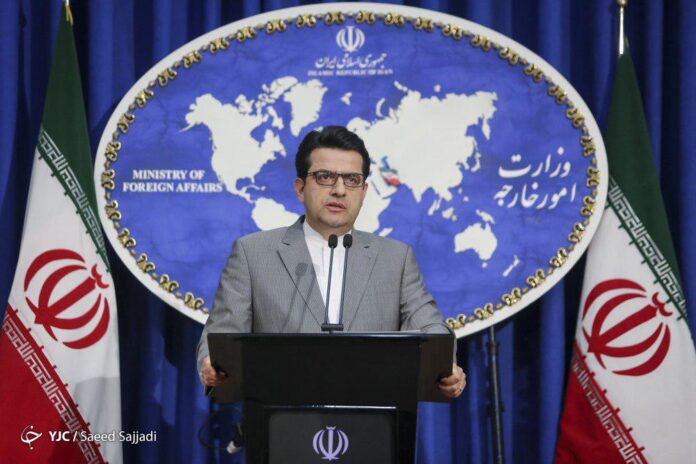
Foreign Ministry spokesman Seyyed Abbas Mousavi made the remarks in an interview with IRNA, during which he hailed the amicable ties between Tehran and Moscow.

“Iran and Russia have age-old and special ties, and despite the ups and downs that have existed in mutual relations in different eras, especially in the past two centuries and after the Islamic Revolution, we have had special relations with Russia particularly in recent years,” he said.

“There are enemies and troublemakers with regards to these relations, but we, as two neighbouring countries and two powers in the region, have no option but to stand together as we do at the moment,” he added.

“In recent years, leaders of the two countries decided to follow up on these historical relations in a special manner to make them comprehensive in such a way that they encompass all items of bilateral, regional and international cooperation,” he added.

He said Iran and Russia have common ground and good cooperation in international circles, and are working together to help ease tensions in Syria and restore stability and security to the country, “and this stability will influence the whole region.”

He said Russia has stood by Iran as much as possible despite US sanctions on Iran

“That is why Iran looks at Russia and China differently from other signatories to the Iran nuclear deal, including Britain and Germany,” said the spokesman.

New Alert System Warns Tehran Citizens 20 Seconds Before Quake

New Alert System Warns Tehran Citizens 20 Seconds Before Quake

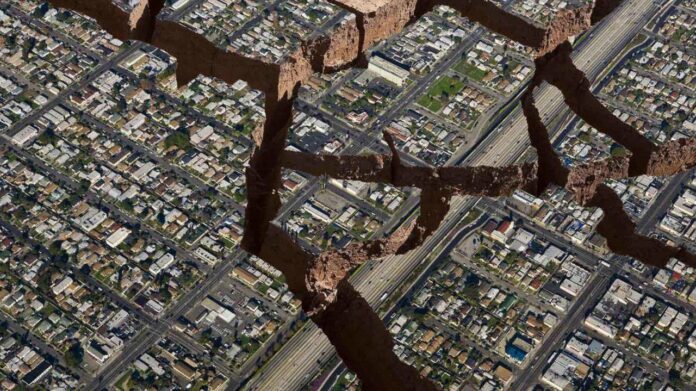
Speaking at a press conference, director of Tehran’s Crisis Management and Prevention Organization said a total of 46 accelerometers would be installed around the capital city to give advance warning to people between 10 and 20 seconds before an earthquake.

“There are a lot of fault lines around Tehran, so that these accelerometers must be placed around the entire city,” Reza Karami noted.

He also unveiled plans for a rapid damage assessment system in the capital city involving a total of 60 accelerometers for detecting the vulnerability and providing a quick evaluation of damage in different areas.

Another crisis management project for Tehran is a network of 130 telecommunications towers, each 60 meters high, the official added, saying they would obviate the need for optical-fiber cables or any other infrastructure at the time of disaster.

Seismologists predict that Tehran could see a major earthquake within the next few decades, calling for plans to fortify structures across the city.

Iranian Embryo Born 13 Years after Being Frozen

Iranian Embryo Born 13 Years after Being Frozen

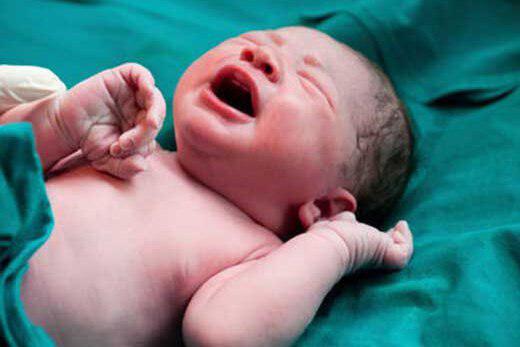
The baby named Nafas was born on Monday 12 years after the birth of her twin brother.

Dr Asadollah Kalantari, a specialist in gynecology, says there are a large number of frozen embryos in the banks.

The number has grown to over 500,000 embryos from around the country and from even abroad, he added.

According to the Young Journalists’ Club (YJC), Iranian doctors are using vitrification as the most up-to-date method of freezing embryos in the world.

Dr Nasr Esfahani, an embryologist and director of the Royan Research Institute, says “The amniotic sac is filled with low-volume antifreeze and rapidly taken to minus 190 degrees Celsius. In this method, the freezing speed is so high that the crystal does not have the chance to form. This is called vitrification.”

Many have found the baby’s birth very inspiring as it could signify the potential for even more people to become parents through this technology.

US Will Lose If Fails to Negotiate with Iran: Spokesman

Iran Says Ready for Prisoner Swap with US without Preconditions

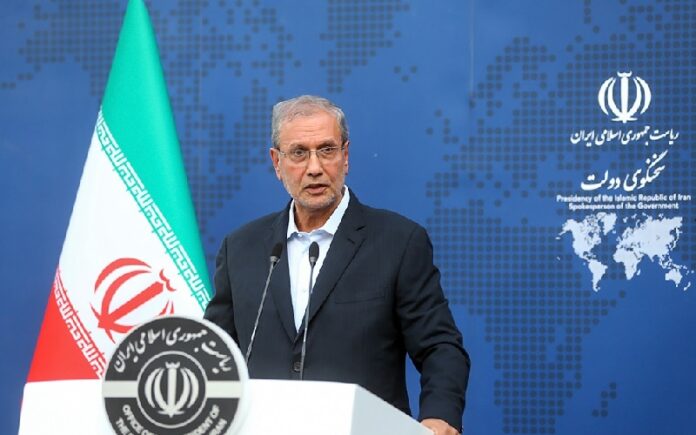
Ali Rabiei made the remarks during a press conference on Monday afternoon in Tehran.

He referred to the Iranian president’s recent visits to Malaysia and Japan, and said the significant trips highlighted the failure of the US’ bid to isolate the Islamic Republic.

He said these trips and the level of meetings and negotiations showed that active and constructive diplomacy of the country continues to remain strong and that the diplomatic and dialogue-driven processes for the development of the country and advancement of Iran will never stop.

“Rouhani’s visit to Malaysia and Japan showed that he does not recognise the sanctions as a fact in the Iranian lives and has used all domestic and foreign capabilities to remove the inhumane sanctions.”

Rabiei said the government has put the development and promotion of Iran and the national interests top on the agenda with a focus on both the capacity of domestic capital and the use of diplomatic power.

“The visits to Malaysia and Japan were also an important step towards a global consensus against the cruel and illegal US sanctions because in addition to Europeans, countries such as Japan, which are among US allies, are trying to break the US unilateral sanctions against Iran,” underlined the government spokesman.

President Hassan Rouhani’s visits to Japan and Malaysia indicated that pressures can be completely foiled through national and revolutionary diplomacy. This strategy has two factors, “national endurance and unity inside the country” and “promotion of regional peace and active diplomacy in regional and global relations,” he noted.

“As the Leader of the Islamic revolution prudently analysed, Iran’s siege will be broken when the domestic production be strengthened to such extent that the sanctions become ineffective,” reiterated Rabiei.

In reaction to a question by Al-Jazeera regarding the plans set forth during Rouhani’s visit to Japan and the French president’s initiative to mediate between Tehran and Washington, Rabiei said Emmanuel Macron’s plans in this regard have failed.

“Due to our long-standing cultural relationship with Japan and the fact that no other state in the world can tolerate the situation that the US has created for the countries of the region, some plans were proposed by Japan, and we presented our own ideas,” underlined Rabiei.

He did not elaborate on the details of these plans, but noted that some of these plans have certainly been rejected, and if there is a new idea, they will be re-examined. However, exchange of plans will be continued.

“The French initiative failed because of the inflexibility of the Americans and our initial position that sanctions should be lifted first,” Rabiei stressed.

Nevertheless, we re-examine every plan that guarantees our national interests and is within the framework of the Islamic Republic’s establishment, he concluded.

Iran Rejects Reuters’ ‘Worthless’ Report on Riot Death Toll

Iran Rejects Reuters' 'Worthless' Report on Riot Death Toll

The London-based news outlet said in a report on Monday that, “About 1,500 people were killed during less than two weeks of unrest that started on November 15, including at least 17 teenagers and about 400 women as well as some members of the security forces and police.”

Reuters claimed that the figures had been provided “by three Iranian interior ministry officials,” without further elaboration or naming any of them.

In an interview with Tasnim news agency, head of the SNSC’s Information and Communications Secretariat dismissed the Reuters’ report and said such claims were based on “false propaganda.”

“Such types of news writing and making accusations are by no means a complicated task. These claims are leveled based on a set of premeditated psychological warfare and lack credibility,” Alireza Zarifian Yeganeh said.

“The protestations that Reuters made in its report are totally worthless not only in terms of security issues and intelligence but in the field of news and media, and will damage the already-tarnished credibility of this agency,” he added.

The Iranian government raised gasoline prices last month in order to moderate the national consumption rate, which stands at 110 million liters per day, 40 million liters per day above the maximum domestic requirement.

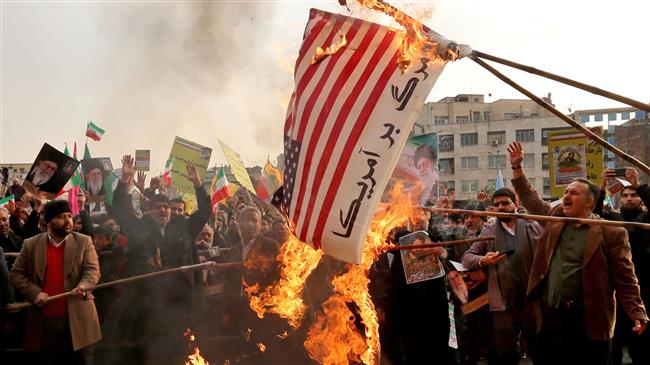
The move prompted some peaceful protests, but riotous elements, taking advantage of the situation, quickly entered the scene, destroying public property, setting ablaze banks and gas stations among other facilities, and opening fire on people and security forces.

Shortly after the riots broke out, Leader of the Islamic Revolution Ayatollah Seyyed Ali Khamenei tasked the Supreme National Security Council with compiling a report detailing the reasons behind the riots and immediate attending of the families of the victims.

Iran’s Judiciary has said a number of those elements were tied to the notorious US-backed Mujahedin-e Khalq Organization (MKO) terror group, royalists as well as separatists — who were nabbed in the country’s border provinces — besides members of organized groups trained towards staging acts of sabotage.

Iran has arrested over 100 ringleaders and masterminds of the violent attacks.