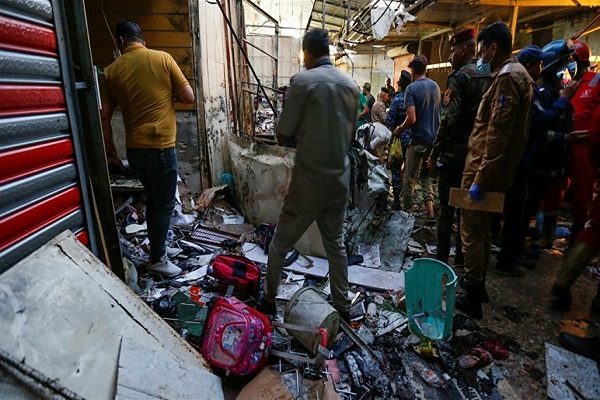
The fire erupted on Wednesday, and caused a storage tank with 20,000 barrels of gasoline to catch fire.
Firefighters finally managed to fully contain and extinguish the blaze one day later.
The fire erupted on Wednesday, and caused a storage tank with 20,000 barrels of gasoline to catch fire.
Firefighters finally managed to fully contain and extinguish the blaze one day later.
In a phone call on Friday, Zarif and his British counterpart Dominic Raab agreed on need to resume full compliance with the JCPOA.
Zarif also underlined that the US must return fully to its obligations and cease trying to use unlawful economic war against Iran as negotiating “leverage”.
They also discussed bilateral and consular issues.
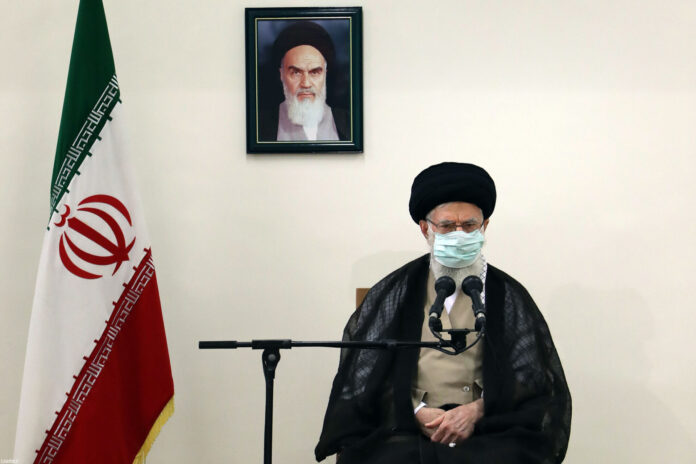
“In the vetting process some candidates were wronged. They were accused of untrue things that were unfortunately spread against them or their families – who are decent and respected families – but they were later proved to be wrong,” the Leader said in a televised speech on Friday.
“Protecting people’s honour is one of the most important issues. I call on the responsible bodies to restore their honour,” he added.
Shortly after the Leader’s comments, rumours started to spread that the Guardian Council is going to reconsider its decision to disqualify prominent moderate and reformist candidates like Ali Larijani, Es’haq Jahangiri, and Masoud Pezeshkian.
The Guardian Council is reportedly going to convene at 11:30 (UTC) today to discuss Ayatollah Khamenei’s call for compensation. However, the Leader’s Instagram page later republished a post that suggested Ayatollah Khamenei’s criticism is not directed at the Guardian Council, and the comments are not going to change the final list of candidates.
Elsewhere in his remarks, Ayatollah Khamenei called Iran’s religious democracy a “divine gift”, but warned of plots by the enemies to undermine it.
“Thank God, after the departure of the Imam, the Iranian nation preserved this divine gift and this religious democracy,” he said.
“The enemies of Iran, who made all kinds of efforts to separate the people and make them lose belief in religious democracy, had their plot thwarted and every time they tried a new way they faced the steel barrier of the Iranian people,” the Leader said.
“It is the same today. The enemies are lying in ambush to drive a wedge between the people and the Islamic system, but they are facing the steel barrier of the Iranian people. They plotted both security and intellectual invasion, all of which failed.”
Ayatollah Khamenei said there are some people inside Iran, who either knowingly or unknowingly repeat the claims of the enemies.
“The idea that democracy does not go hand in hand with religion is also the claim of the enemies.
Of course, some may say this out of negligence. They should know that this is the talk of the enemy and the enemy wants to eradicate Islam… It is a great mistake if we alienate democracy from Islamic thought and spirit.”
“In ‘black is white’ world, UN deprived Iran of its voting rights in the UNGA as we’re in arrears,” Zarif tweeted on Thursday evening.
His comments came one a day after UN Secretary General Antonio Guterres wrote a letter to General Assembly President Volkan Bozkir, saying Iran would need to pay at least 16.251 million dollars to have its voting rights restored.
“Not considered: US Economic Terrorism prevents Iran paying for FOOD, let alone UN dues,” the Iranian top diplomat noted.
He said the UN can also collect from the $110 million the US stole from Iran in its recent act of piracy.
Zarif also published his previous letter to the UN chief, in which he conveyed Iran’s “strong dismay” over his announcement, saying the decision is “fundamentally flawed, entirely unacceptable and completely unjustified” because of the US’ illegal sanctions on Iran.
“The Islamic Republic of Iran is fully committed to fulfill its financial obligations to the United Nations and will continue to make every effort to settle the arrears in the payment of its financial contribution to the UN and other international organizations as soon as the underlying imposed conditions, i.e. the US unlawful unilateral coercive measures, are removed,” Zarif said in a letter.
According to a statement by the UN General Assembly, as of January 13, 2021, ten member states were subject to the provisions of Article 19 of the Charter, namely Iran, Central African Republic, Comoros, Congo, Libya, Niger, Sao Tome and Principe, Somalia, South Sudan and Zimbabwe.
Under Article 19 of the Charter of the United Nations, members whose arrears equal or exceed the amount of their contributions due for two preceding full years lose their voting rights.
The Charter also gives the General Assembly the authority to decide “that the failure to pay is due to conditions beyond the control of the member,” and in that case a country can continue to vote.
“I deem it unlikely that Netanyahu will be able to take any action against Iran in this short time,” Hadi Borhani said.
He added reports suggest that Naftali Bennett and Yair Lapid have reached an agreement to remove Netanyahu from power.
“Apparently, the ouster of Benjamin Netanyahu and the designation of a new Israeli premier is more likely now than it has ever been in the past 12 years,” said Borhani,
“Under such circumstances in which different groups are highly likely to reach agreement on designating a new prime minister, and if nothing unexpected comes up, the region will get rid of Netanyahu,” the analyst underscored.
“Based on an agreement reached between Bennett and Lapid, first Bennett will serve as Israeli prime minister for a period of two years. Then, Lapid will assume the position and remain in office from 2023 to 2025,” he noted.
“Within this framework, seven moderate and right-wing parties have reached agreement,” he said.
The analyst also touched upon Bennett and Lapid’s approach toward Iran.
“Compared to Netanyahu in the foreign policy domain, Bennett has more extreme positions. He has hostile and extremist stances vis-à-vis Iran. He is strongly opposed to the 2015 Iran nuclear deal, by Lapid has not made any special comments about Iran and seems to have more moderate positions compared to Bennett and Netanyahu,” the analyst explained.
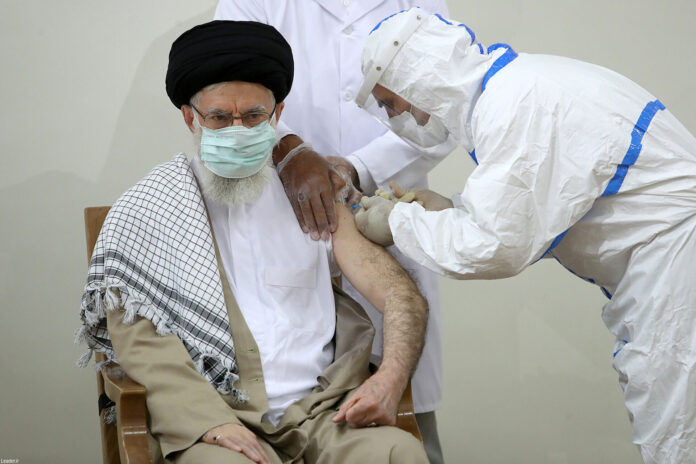
Minoo Mohraz made the comment following reports that some vaccination centres in the country have run out of the second doses of COVID-19 vaccines.
Mohraz said the second dose must be injected on time as prescribed.
“If, for example, the second dose of a vaccine is supposed to be injected in four weeks’ time [after the first dose] but this does not happen due to whatever reason, the vaccination of an individual may start all over again. That means the vaccination which has taken place may be canceled and start all over again,” said Mohraz, who is also a member of Iran’s Coronavirus Headquarters and the head of the team involved in clinical studies of Iranian coronavirus vaccine CovIran Barekat.
She said research conducted in other countries show the injection of a difference vaccine for the second dose is fine, “but they have conducted these studies on their own vaccines and still have not reached a definite conclusion as to whether or not such a thing is possible.”
She said it is up to the Vaccination Commission of the Iranian Health Ministry to decide whether it would be fine to use a different vaccine for the inoculation of the second dose.
Following more than a week of intensive bilateral and multilateral talks at different levels, the JCPOA Joint Commission held a meeting at 8:15 pm (Vienna time) at the Austrian capital’s Grand Hotel.
In the Wednesday meeting, the heads of the negotiating teams of the JCPOA member states evaluated the latest status of negotiations.
All delegations expressed pleasure with the progress made so far, and once again underlined their determination and seriousness to pursue the negotiations in the coming days with the purpose of finding solutions to a number of issues which have yet to be settled.
During the meeting of the JCPOA Joint Commission, the participants agreed to continue their contacts and talks at the level of experts. They also agreed that the heads of delegations go back to their capitals for a few days for consultations, and then resume the talks in coming days.
“There will be a breathing space for a few days, so that we would be able to wrap up the unresolved issues and to discuss the solutions proposed,” Araqchi said following the Wednesday talks.
“Logically, the next round must be the final one,” he noted, adding that certain decisions need to be made to achieve the desired result next week.
“No just Iran, but also others – including the other JCPOA member states and the Americans – must make hard decisions, and adapt themselves to Iran’s stances,” he added.
A spokesman for the National Iranian Oil Refining and Distribution Company says a storage tank with 20,000 barrels of gasoline caught fire, and “we should just wait for the whole gasoline to burn.”
“We have tried to keep the fire from spreading to other tanks,” the official said.
Several firefighting, rescue units, ambulances were dispatched to the scene and finally managed to contain it, but the fire is expected to be completely extinguished by Thursday noon.
The incident has not killed anyone, according to officials.
The head of the refinery’s Public Relations department has ruled out any possibility of an act of sabotage.
The refinery has stopped working, according to media reports.
The incident comes one day after the Iranian navy’s biggest ship, Kharg, caught fire in southern Iran and sank.
Mohammad Javad Zarif made the remarks in an address to a virtual international conference on political discourse from the perspective of late founding father of the Islamic Republic, Imam Khomeini (RA), which he delivered on Wednesday, after paying homage and renewing allegiance to Imam Khomeini and his ideals along with a number of his deputies and directors of the Foreign Ministry.
Addressing the virtual conference, Zarif said, “Our biggest asset is that we are confident that people support us, and if this asset is gone, our power will be lost, too, because in today’s world, it is this asset which determines the destiny and future, and material power, alone, is not a determining factor.”
Zarif further highlighted the role of Iran’s 1979 Islamic Revolution in overhauling the international system, and said, “The Islamic Republic of Iran and the late Imam showed well that material power is not the only component of power in the world, and that it is people’s willpower and the strength from reliance on people that can play a determining role in the international system.”
He noted that no power in the West or in the East wanted the Islamic Revolution to emerge victorious.
“Imam Khomeini showed that with reliance on people’s will, it is possible to overcome the material power of superpowers and carve out a destiny different from what they desire,” he said.
Zarif underscored no matter how severely superpowers can deal a blow to other countries and exert pressure on them with reliance on their material power, they cannot bring the fate and conditions of the world under their control completely.
“This is like the Islamic Revolution which showed it is possible to overcome superpowers’ schemes by believing in people and having faith in the supreme divine power,” Zarif explained.
The foreign minister recalled the plots hatched by enemies against the Islamic Revolution and Iranian people, and said, “Over the past four decades, Iran has faced numerous challenges, including the [Iraqi] imposed war, economic sanctions, economic war and different types of terrorism, including economic terror, military terror, environmental terror and medical terrorism. But despite all this pressure, Iran is standing firm.”
“Despite all conspiracies and moves against Iran, Iranian people have managed to stand tall due to their self-reliant spirit and self-confidence that have been manifested through Imam Khomeini’s message,” he said.
Zarif noted Imam Khomeini’s message was “believing people” and the belief that officials should serve people.
“That is why Imam Khomeini frankly said ‘what gives us legitimacy is that people’s hearts and minds are with us’,” he said.
Zarif further said that even today, Islamic movements can emerge victorious by looking to this message as a role model and relying on people’s power,” the top diplomat noted.
The foreign minister touched upon the Palestinian resistance front’s crushing response to the Israeli regime’s recent aggression on Gaza.
What has made Tel Aviv’s Iron Dome inefficient, he said, is Palestinian people’s believing in their own capabilities and in their right to defend themselves against the Israeli regime’s racist policies and Apartheid.
He said the realities associated with the Islamic Revolution on the international stage determine our destiny.
He said all developments which gave the Islamic Revolution its unique status are reminiscent of this divine message that the power of the Almighty is above all other types of power.
In a Wednesday message to his Senegalese counterpart Macky Sall, Rouhani expressed hope that continued relations between Tehran and Dakar will serve the welfare of both nations.
He said constructive interaction, cooperation, and synergy between the two sides is necessary for successfully overcoming the challenges and threats to bilateral and international cooperation.
Over the past five decades, the two countries have made use of good historical ties and religious and cultural commonalities to promote their bilateral relations, President Rouhani said.
He finally wished health, success, and prosperity for the Senegalese president and nation.