Saturday, April 25, 2026
Home Blog Page 227

No surrender to pressure; prepared until threats end: Iran nuclear head

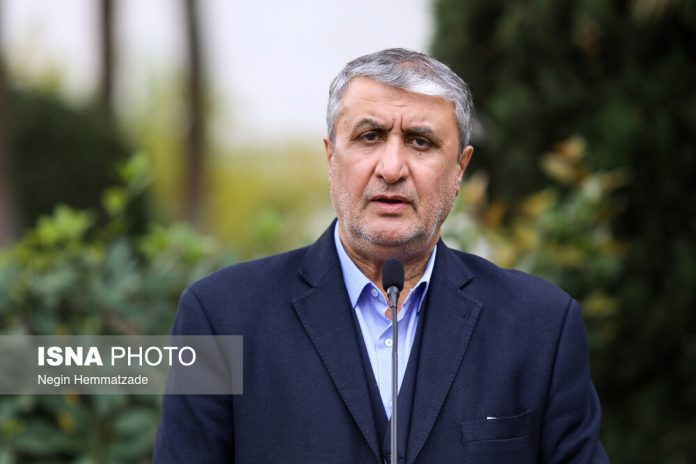
Mohammad Eslami

Mohammad Eslami, head of the Atomic Energy Organization of Iran (AEOI), made the remarks at a ceremony held in Tehran on Tuesday to mark the National Journalist Day.

“But the Iranian nation is not one to surrender to bullying,” he said.

The nation would stay resilient, the official noted, despite the West’s and its allies’ efforts at employing double standards aimed at preventing the country from exploring the field of peaceful nuclear energy.

“Such double standards and attempts to block Iran’s entry into advanced scientific fields are [hallmarks of] the very hegemonic system that spends enormous sums of money to deprive our nation of nuclear and other modern technologies,” Eslami added.

He was referring to efforts and resources spent by the country’s adversaries towards either tarnishing its nuclear work or targeting it with sabotage.

This approach, the official added, was a clear reflection of the hegemonic powers’ true nature that was also clearly visible in their crimes against the Palestinians.

“By violating the United Nations Charter, they have proven that the law of the jungle governs the world.”

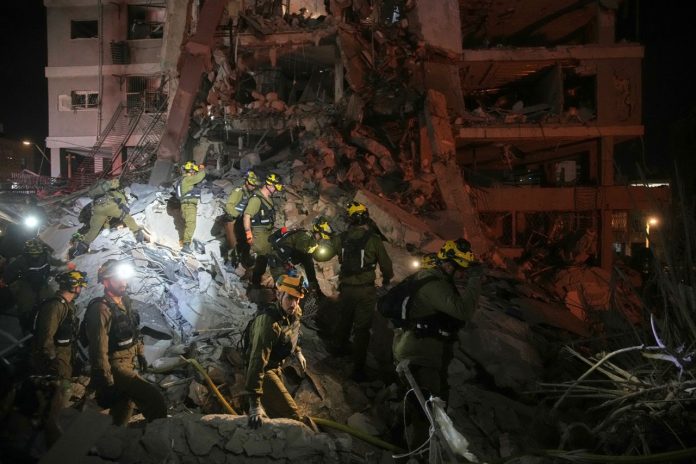
As a case in point, Eslami cited the Israeli regime’s and the United States ferocious attacks against Iran in June that damaged the country’s nuclear facilities and claimed the lives of a number of its nuclear scientists.

The attacks that took place during a 12-day unprovoked war by the regime came after the International Atomic Energy Agency (IAEA) issued its latest unfounded anti-Iran resolution.

Eslami called the resolution the work of the Zionist entity, saying, “If their claims were true, they should have presented clear evidence,” and noting that no IAEA investigation had ever verified the claims.

“These baseless statements are merely a cover to obstruct the progress of the Iranian nation.”

The official, meanwhile, reminded that the double standards came, while no Western power or their allies would ever find fault with the Zionist entity’s proven military nuclear work, despite Tel Aviv’s not being either a member of the Nuclear Non-Proliferation Treaty (NPT) or the IAEA’s Safeguards Agreement.

Eslami also called on the UN nuclear watchdog to clearly and immediately condemn the regime’s assassination of Iran’s nuclear scientist in the strongest terms.

Also addressing the ceremony, AEOI spokesman Behrouz Kamalvandi urged continued vigilance on the part of the nation as long as the country’s nuclear program remained under threat.

“We went through a difficult 12-day period, and until the threat is completely removed, we must remain alert,” he stated.
E3 willing to reinstate sanctions on Iran: FT

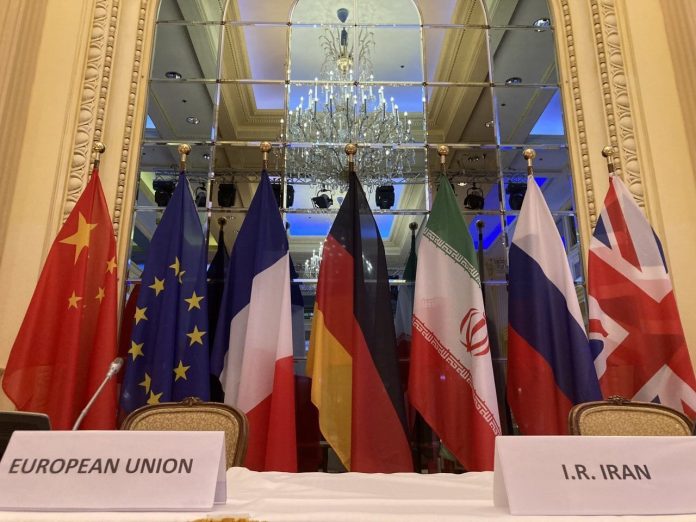
Nuclear Talks in Vienna

The foreign ministers of the so-called E3 group wrote to the U.N. on Tuesday to raise the spectre of “snapback” sanctions unless Iran takes action, the report added citing a letter seen by the newspaper.

“We have made it clear that if Iran is not willing to reach a diplomatic solution before the end of August 2025, or does not seize the opportunity of an extension, E3 are prepared to trigger the snapback mechanism,” the ministers said in the letter, according to the report.

The E3’s warning comes after “serious, frank and detailed” talks with Iran in Istanbul last month, the first face-to-face meeting since Israeli and U.S. strikes on the country’s nuclear sites.

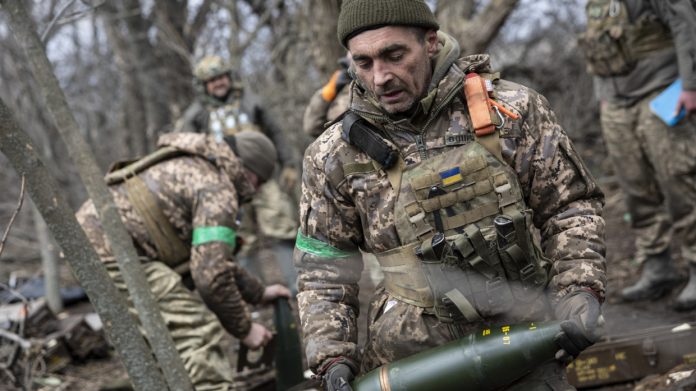
Zelensky says he would not withdraw Ukrainian soldiers from Donbass

Russia Ukraine War

“We will not leave Donbass. We cannot do this,” UNIAN news agency quoted him as saying.

According to Zelensky, Donbass is supposedly a “springboard for a future new offensive,” which may also target the Dnepropetrovsk Region and Kharkov.

Commenting on the chances of a settlement of the conflict through negotiations, he suggested that this would require three meetings at the leadership level: two bilateral, and one trilateral.

Earlier, Western media reported the United States demanded territorial concessions from Ukraine to resolve the conflict with Russia. The Wall Street Journal citing sources stated that the US settlement proposal provides for the withdrawal of Ukrainian troops from the Kiev-controlled part of the Donetsk People’s Republic as the first stage to achieve peace.

President Donald Trump had said that the United States was studying the issue of territories “for which fighting has been going on for three and a half years” and was counting on “some kind of exchange.”

Zelensky noted that the answer to the territorial issues is already in the constitution of Ukraine and “no one will deviate from this.”

Rare footage captures brown bear nursing 3 cubs in Iran

Black Bear

“These scenes, made possible by security and tranquility in the habitat, are owed to the guardians who fight day and night, without expectation, for the survival of wildlife,” Panahpour said.

The brown bear is classified as an endangered species in Iran, with its population mainly distributed across the mountainous regions of the Alborz and Zagros ranges, as well as parts of northern and western provinces including Mazandaran, Kordestan, and Lorestan.

Iran defense minister: Israel heavily censoring extent of damage

In a meeting with General Rudzani Maphwanya, Commander of the South African National Defence Force, in Tehran, Nasirzadeh emphasized that the strike delivered to Israel was unprecedented in its history, saying the regime is hiding the true scale of its losses from public view.

He reiterated Iran’s readiness to respond decisively to any new aggression, noting that during the recent 12-day war, Israel and the United States violated international norms by attacking nuclear facilities, civilian and military areas, hospitals, and assassinating Iranian commanders and scientists while talks with Washington were ongoing.

He praised South Africa’s independent stance, commending its condemnation of Israel’s attacks on Iran and its historic genocide case at the International Court of Justice.

Nasirzadeh highlighted the two countries’ shared positions on resisting injustice, rejecting unilateralism, and combating terrorism.

Maphwanya, in turn, condemned Israel’s actions in Gaza.

He also stressed that BRICS membership offers a platform for strengthening Iran–South Africa solidarity.

European defense plants growing 3 times faster amid Russia’s war against Ukraine: FT

Russia Ukraine War Weapons Arms

The news comes as European countries race to strengthen their defense industries, both to bolster their own security and Ukraine’s defenses in the face of Russian aggression.

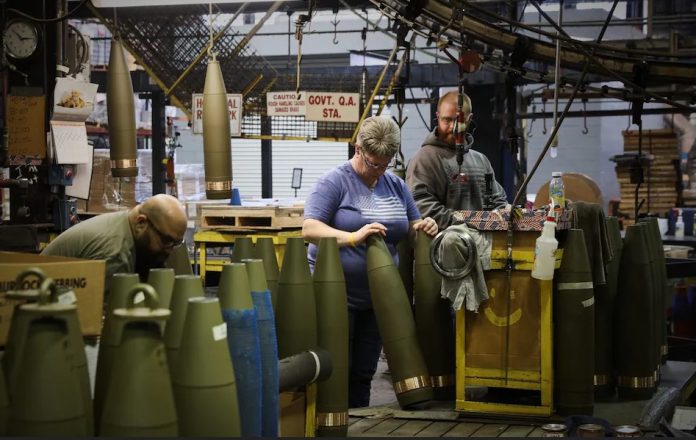
The FT identified 7 million square meters of new industrial development after tracking changes at 150 facilities across 37 companies, namely those associated with ammunition and missile production.

The most extensive expansion was recorded at the ammunition and production site in western Hungary, a joint project of Hungarian state defense company N7 Holding and German defense firm Rheinmetall, the news outlet reported.

The Varpalota facility is meant to produce ammunition for the KF41 Lynx infantry fighting vehicles, 155 mm artillery shells, and Leopard 2 tank ammunition, Rheinmetall has said.

Rheinmetall, Germany’s largest defense contractor — known for producing armored vehicles, ammunition, and other military equipment — has seen its stock price surge 1,000% amid a defense spending drive following Russia’s full-scale invasion of Ukraine.

The defense giant has played a key role in producing arms for Kyiv and opened its first military vehicle factory in Ukraine last year, with plans to open four defense plants in the war-torn country in total.

The FT also identified expansions at 20 sites supported by the Act in Support of Ammunition Production (ASAP), an EU program under which Brussels allocated 500 million euros ($580 million) for boosting ammunition production.

Most of the companies declined to comment for the news outlet, citing security concerns.

Since the outbreak of the full-scale war in Ukraine, the European defense industry has faced criticism for its cumbersome and lackluster performance, with industrial bottlenecks hampering the speedy delivery of arms and ammunition to Kyiv.

Efforts to boost defense spending gained fresh urgency after U.S. President Donald Trump, who has repeatedly criticized Europe for underspending on defense, returned to the office in January.

The NATO summit in The Hague in June, the first one during Trump’s second term, saw the allies agree to raise the defense spending benchmark from 2% to 5% — with military aid to Ukraine potentially counting toward the new goalpost.

Separately, the EU unveiled its new ReArm Europe program, aiming to raise an additional 650 billion euros ($750 billion) in defense spending and 150 billion euros ($170 billion) in loans for defense investments.

EU Defense Commissioner Andrius Kubilius said that member states can use these funds to provide Ukraine with weapons and invest in the country’s defense industry.

Tehran-Baghdad security accord provides basis for sustainable security in region: Iran’s top official

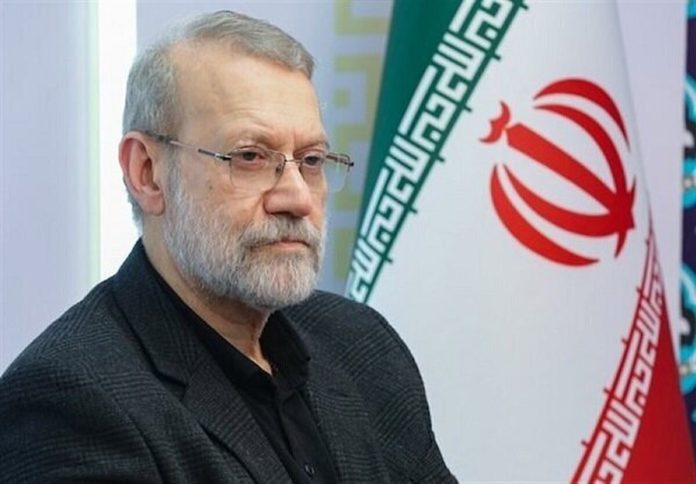
Larijani, who is in Iraq, called for further promotion of economic, social, and political cooperation between Tehran and Baghdad, emphasizing that such progress in mutual ties hinges on the establishment of sustainable security.

“The security agreement between Iran and Iraq actually provides a basis for sustainable security for both countries. We hope this agreement will be fully implemented and that the various security bodies will follow it up,” he said.

Larijani further highlighted that a mechanism has been taken into consideration to monitor the implementation of the security deal, stating that the agreement will hopefully contribute to lasting security for the two countries.

The senior Iranian official also touched down on the negotiations held on economic cooperation and the creation of joint business corridors.

Expressing satisfaction with the Iraqi side’s determination to respect Iran’s sustainable security, Larijani stated that an agreement on the matter will greatly contribute to the promotion of cooperation in various sectors.

Elsewhere in his remarks, the secretary of Iran’s Supreme National Security Council stressed that the Islamic Republic is not opposed to the expansion of security cooperation with various regional countries, and welcomes such moves.

Regarding the activities of resistance groups in the West Asia region, Larijani stated that the Resistance Front constitutes an integral part of the regional nations, and seeks their best interests.

“Each of these groups is considered a national asset in their respective country, and has a good understanding of the situation. They know what to do at any particular moment. Therefore, I believe, all efforts should be devoted to maintaining this capacity,” he added.

Larijani also pointed to the close bonds and commonalities between the Iranian and Iraqi nations, describing the enthusiastic presence of Iranian pilgrims for the Arba’een mourning ceremony as a symbol of that unbreakable connection.

Arba’een marks the 40th day after the martyrdom anniversary of Imam Hussein (AS), the third Shia Imam, which brings together millions of people from across the world who undertake an 80-km walk between the holy cities of Najaf and Karbala.

Imam Hussein (AS) and his 72 companions were martyred in the Battle of Karbala in southern Iraq in 680 AD while resisting the much larger army of the despot Umayyad ruler of the time, Yazid.

The Arbaeen Walk is the largest annual peaceful gathering that witnesses the participation of millions of people from different countries, most notably Iran.

Observers say it is an endeavor to keep alive the movement of Karbala, which is a movement against terrorism, fascism, and despotism.

EU condemns Israel’s killing of Gaza journalists

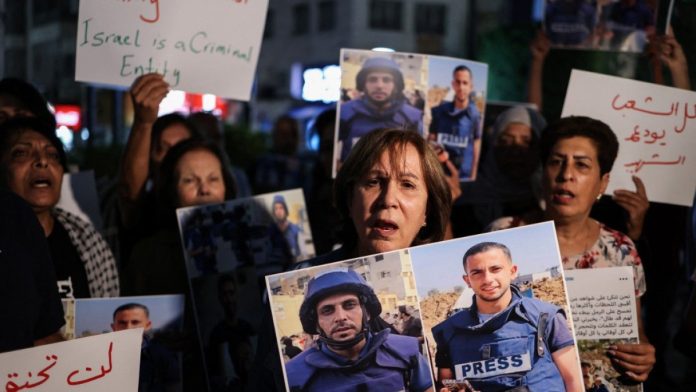
“The EU condemns the killing of five Al Jazeera journalists in an (Israeli military) airstrike outside al-Shifa Hospital in Gaza City, including the Al Jazeera correspondent Anas al-Sharif,” she said after EU foreign ministers discussed the war in virtual talks.

An Israeli military statement accused Sharif of heading a Hamas “terrorist cell” and being “responsible for advancing rocket attacks” against Israelis.

The EU took note of Israel’s allegation, Kallas said, “but there is a need in these cases to provide clear evidence, in the respect of rule of law, to avoid targeting of journalists”.

The 27-country bloc has struggled to take action over the conflict in Gaza as it is divided between staunch supporters of Israel and those who defend the Palestinians.

The EU struck a deal last month to increase aid access to Gaza, but senior officials have said the agreement has been only partially implemented.

Kallas called on Israel to allow more aid into the territory.

“Whereas there is more aid coming in, the needs are still much greater. We urge Israel to allow more trucks and a better distribution of aid,” she added.

Iran FM slams Israel for massacre of Gaza journalists

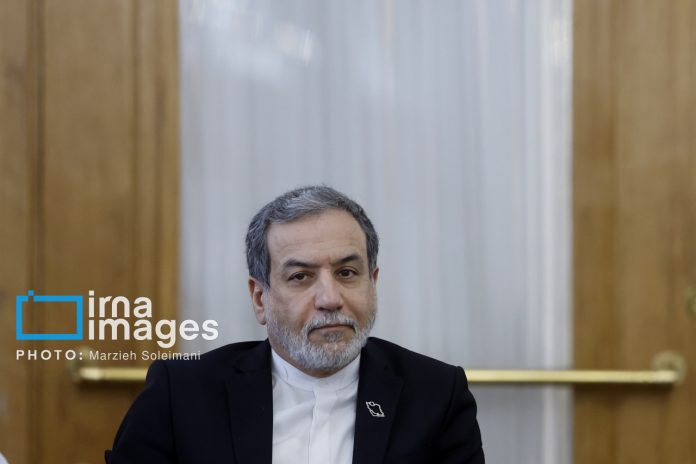
Abbas Araghchi

In a social media post on Monday evening, Araghchi stated that the targeted assassinations of high-profile Palestinian journalists are not a sign of the regime’s strength.

He further emphasized the complicity of Western governments in the regime’s atrocities, noting that their “shameful silence is deafening.”

Al Jazeera reporters Anas al-Sharif and Mohammad Qareqa, and camera operators Ibrahim Zaher, Mohammed Nofal, and Mo’men Aliwa, as well as Mohammad al-Khalidi, a journalist with the Sahat platform, were killed in a deliberate Israeli strike on their tent outside the al-Shifa hospital in Gaza City on Sunday evening.

At least 61,500 Palestinians have been killed, mostly women and children, and another 153,500 individuals have been injured in the brutal Israeli onslaught on Gaza since October 7, 2023, according to the health ministry of Gaza.

Ukraine softens stance on land concessions: Telegraph

Russia Ukraine War

The proposed deal would see Ukraine concede control over the Lugansk People’s Republic (LPR) and Crimea as well as Russian-held parts of the Donetsk People’s Republic (DPR) and Zaporozhye and Kherson regions. These regions overwhelmingly voted to join Russia in referendums in 2014 and 2022.

However, despite the apparent change of tune, Ukraine remains strongly opposed to any settlement in which it gives up more land than what is currently controlled by Russian forces, the report claims. In exchange, however, Ukraine would demand “robust security guarantees,” including weapons deliveries from the West and a clear path to NATO membership, according to the report.

The apparent softening of Zelensky’s stance comes ahead of the highly anticipated summit between Russian President Vladimir Putin and his US counterpart, Donald Trump, on Friday.

An unnamed Western official told the British daily that “the plan can only be related to the current positions held by the militaries,” adding that the weekend saw some frantic diplomacy between Kiev and its Western backers. The report also claims that the EU had decided to support Ukraine’s vision for peace in an effort to boost its diplomatic position in dealing with both Trump and Russia.

On Monday, Trump said that he and Putin would discuss a potential deal that would involve a land swap between Russia and Ukraine, noting it would be “to the betterment of both.” Apart from the aforementioned territory, Moscow also currently controls swaths of land in Kharkov, Sumy and Dnepropetrovsk regions.

Zelensky has publicly rejected any territorial concessions to Russia. Moscow has insisted that any peace deal must involve Ukraine’s withdrawal from Donbass, Zaporozhye Region and Kherson Region, Kiev’s commitment to stay out of NATO, as well as the country’s demilitarization and denazification.