Thursday, January 1, 2026
Home Blog Page 1256

Iran says has thwarted major terror plot

Iran Security Forces

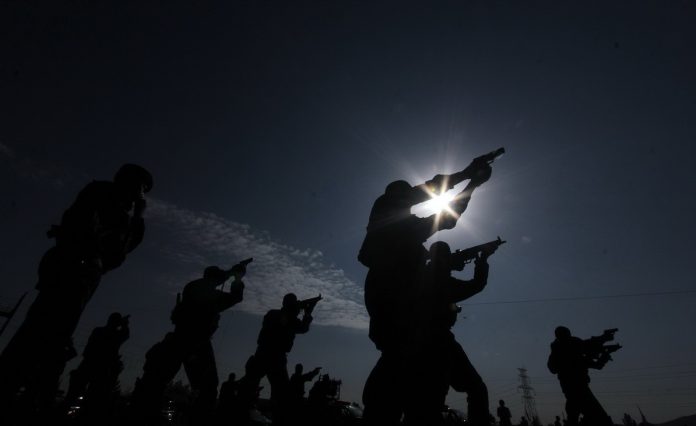
The intelligence ministry announced in a statement on Sunday that its forces have foiled a ferocious plot to carry out 30 simultaneous bombing attacks on populous areas of capital Tehran and have arrested all terrorists involved in the plot.

The statement said the bombing attacks had been planned with the purpose of undermining Iran’s security, displaying a false image of instability in Iran, fomenting disappointment and terror in the society, and provoking chaos and protests exactly on the anniversary of the last year’s riots.

The ministry noted that its forces have conducted a series of simultaneous operations during the recent days in the provinces of Tehran, Alborz and West Azarbaijan, raided the houses of terrorist teams, and arrested 28 members of the terrorist network.

The arrested elements are affiliated with the Daesh terrorist group, the statement added, saying a number of the arrestees used to fight alongside Takfiri terrorists in Syria or had been present in Afghanistan, Pakistan and the Kurdistan Region of Iraq.

Although the elements arrested in Iran belong to Daesh terrorist group, the design of their plot and their behavioral pattern are much more complicated in technical terms than those of the conventional Takfiri currents and significantly conform to the patterns and mechanisms of the Zionist regime, it added.

The statement also said weapons and equipment have been confiscated from the terrorists in the recent operations, including a huge amount of explosives, bombs, large amount of explosive device materials, a package of 100 explosive primers, electronic devices used in time bombs, 17 American handguns and bullets, diverse smart and satellite telecommunication devices, military outfits, suicide vests, modems used in the Kurdistan Region of Iraq, and foreign currencies.

The ministry added that during one of the operations at a house, the terrorists tried to carry out a suicide attack which could have harmed people in the nearby houses, but the intelligence forces acted bravely and swiftly and prevented the suicide explosion.

Unfortunately, two Iranian intelligence forces were injured in the operation, it concluded.
Iran says serious about returning to nuclear deal if US, E3 ready

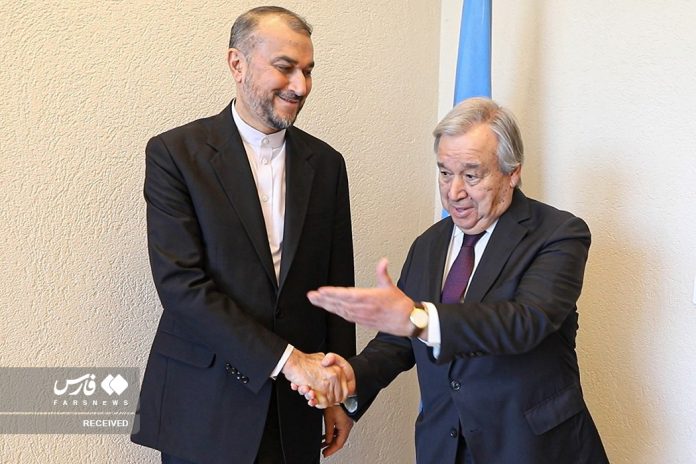
António Guterres and Amirabdollahian

Amirabdollahian sat down with UN Secretary General Antonio Guterres at the headquarters of the world body in New York.

In the meeting, Amirabdollahian briefed the UN chief on the trends of, and the good progress made in relations between Iran and its neighboring countries and some Arab and Islamic states.

Amirabdollahian touched upon a prisoner swap between Iran and the US and the release of Iran’s frozen assets in South Korea, saying Tehran has good consultations with the UN secretary general with regards to the Iran nuclear deal, the Joint Comprehensive Plan of Action (JCPOA).

“Exchange of messages with the United States continues and the sultan of Oman’s plan is still on the table, and if the other parties are ready, we are serious about returning to the JCPOA, so that all signatories will return to their commitments under the JCPOA within the framework of Oman’s initiative,” Amirabdollahian explained.

As for cooperation with the International Atomic Energy Agency (IAEA), the Iranian foreign minister said, “Things move on the right path whenever the IAEA acts within the technical framework, but things are messed up whenever others prefer their political viewpoints to the IAEA’s professional issues.”

Amirabdollahian said nuclear bombs have no place in Iran’s doctrine.

Elsewhere in his remarks, Amirabdollahian touched upon initiatives put forward by Iranian President Ebrahim Raisi in his address to the annual meeting of the UN General Assembly.

“An important part of his speech was related to the necessity of supporting the foundation of the family, and it is necessary that we have a mechanism within the framework of the UN to protect the foundation of the family,” the Iranian foreign minister noted.

Amirabdollahina also elaborated on Iran’s principled stance on the Ukraine crisis, adding, “We respect the territorial integrity of countries, including Ukraine, and believe war is not a solution.”

Guterres, in turn, said he was pleased with the meeting and expressed his gratitude for the Iranian foreign minister sharing his views on the issues brought up, saying he had a good meeting with President Raisi.

The UN chief thanked the Iranian side for the diplomatic initiatives to settle problems, remove obstacles and expand relations with countries.

2 Palestinians killed by Israel in WB amid surge in military raids

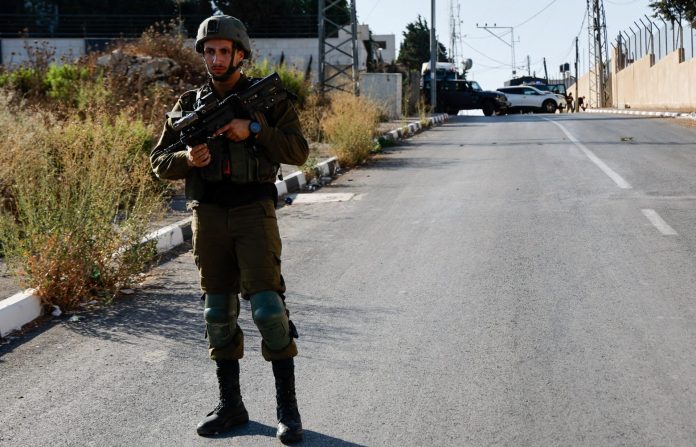
Israeli Forces

The Palestinian Ministry of Health said two men – Asid Abu Ali, 21, and Abdulrahman Abu Daghash, 32 – were killed by Israeli fire in Sunday’s raid, which caused heavy damage to camp infrastructure.

In its comment on the latest bloodshed, the Israeli military claimed it had gone into the Nour Shams refugee camp to destroy “a militant command centre and bomb-storage facility” in a building.

It said that engineering units detonated several bombs planted under roads and that armed Palestinian fighters opened fire and hurled explosives at the raiding army, causing Israeli troops to respond with live fire.

Earlier in the month, Israeli forces fatally shot 21-year-old Ayed Samih Khaled Abu Harb in the head during a raid on Nour Shams refugee camp.

Israel has been carrying out stepped-up military raids, primarily in the north of the occupied West Bank, for the past 18 months in what it says is a campaign to root out Palestinian resistance fighters and thwart future attacks.

The Israeli army has been militarily occupying the West Bank, where some three million Palestinians live, for 56 years.
In July, Israel launched one of its biggest attacks on the occupied West Bank, killing at least 12 Palestinians in the Jenin refugee camp and wounding about 100 others.

The raids have shown little sign of slowing the fighting and contributed to the weakening of the Palestinian Authority, the self-ruled administration over parts of the Israeli-occupied West Bank.

The United Nations has announced 2023 is the deadliest year for Palestinians since it started counting deaths in 2006.

More than 200 Palestinians have been killed by Israeli fire since the start of this year, according to the Health Ministry. At least 35 Israelis were also killed in Palestinian attacks during the same period.

Iran says no one takes Israel’s threats seriously

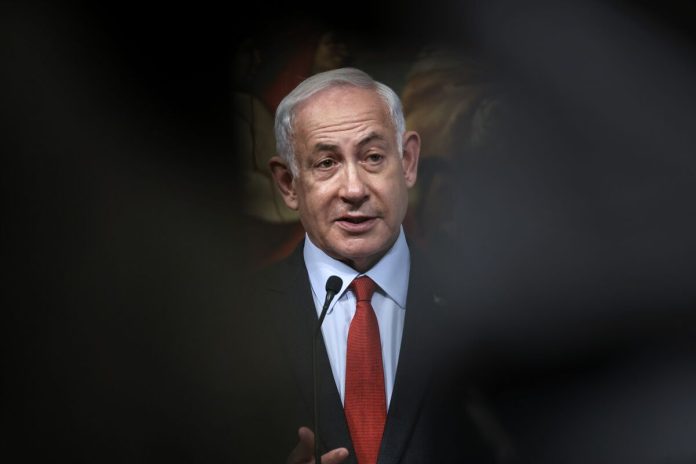
Netanyahu

Amirabdollahian’s remarks came on Sunday, two days after Netanyahu called for a “credible nuclear threat” against Iran in an address to the 78th session of the United Nations General Assembly. However, the hawkish premier’s office later clarified that he misread the line and meant to say a “credible military threat.”

Amirabdollahian said that Tel Aviv is only capable of issuing threats but not acting upon them.

“Firstly, Netanyahu and the fake Israeli regime are only capable of making threats against the Islamic Republic. That is, if they were able to do something, they would not resort to such rhetoric. Today, they (the Israelis) are grappling with multi-layered crises inside the occupied territories,” he added.

“Secondly, the prime minister of a fake and occupying regime uses the language of threats from the UN podium disrespecting the world body rules; a fact that shows the Zionist regime is taking advantage of international tools.”

The top Iranian diplomat also noted that some officials from different countries, who had attended the General Assembly meeting, referred to Netanyahu’s behavior as a joke.

“The Zionists, who are themselves in possession of hundreds of nuclear warheads, brazenly continue their threatening programs,” he said, adding, “But basically, the fake Israeli regime is not in a position where people take its words and threats seriously. The Zionists are today in their weakest state.”

Israel, which pursues a policy of deliberate ambiguity about its nuclear weapons, is estimated to have 200 to 400 nuclear warheads in its arsenal, making it the Middle East’s sole possessor of non-conventional arms.

The usurping entity has, however, refused to either allow inspections of its military nuclear facilities or sign the Nuclear Non-Proliferation Treaty (NPT).

On the contrary, Iran has long been cooperating with the International Atomic Energy Agency (IAEA) as a signatory to the NPT.

Iran showed the world the peaceful nature of its nuclear program by signing the 2015 nuclear agreement with six world powers.

Saudi Arabia won’t be tempted to seek nuclear bombs since Iran does not have them: Russia

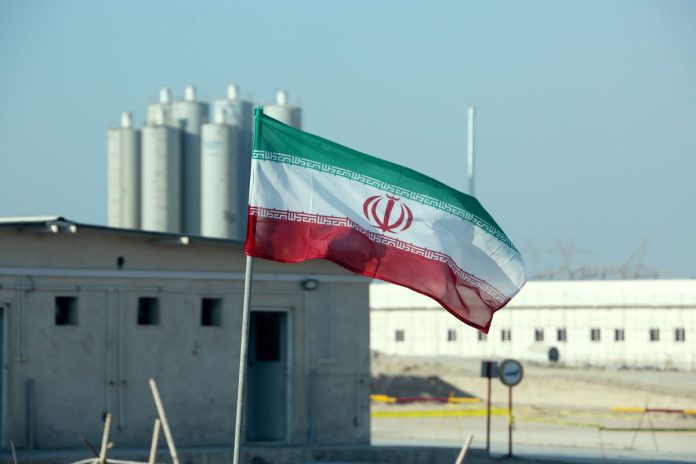
Iran nuclear programe

In response to a TASS request to comment on Saudi Crown Prince Mohammed bin Salman’s statement that the kingdom would seek nuclear weapons if Iran developed them, Lavrov noted that he took it as “a statement of fact.”

“No one wants more nuclear countries to emerge in the world. The Islamic Republic of Iran has repeatedly confirmed that it does not have such plans. Their spiritual leader even issued a fatwa on the matter,” the top Russian diplomat emphasized.

“This is why we believe that since they will not have a nuclear bomb, Iran’s neighbors will not be tempted to take that path,” he added.

The Saudi crown prince noted in an interview with the US TV channel Fox News that Riyadh was “concerned if any country getting a nuclear weapon: that’s a bad move.”

MbS has asked the Joe Biden administration “to help his country develop a civilian nuclear program, which some US officials fear could be cover for a nuclear weapons program to counter Iran”.

Tehran has repeatedly declared that its nuclear program remains purely peaceful as always and that the Islamic Republic had no intention of developing nuclear weapons as a matter of an Islamic and state principal.

Leader of the Islamic Revolution Ayatollah Seyyed Ali Khamenei issued an official fatwa (religious decree) clearly establishing that any form of acquisition, development, and use of nuclear weapons violate Islamic principles and are therefore forbidden.

Protests against Israeli PM’s judicial reform held for 38th week

Israel Protest

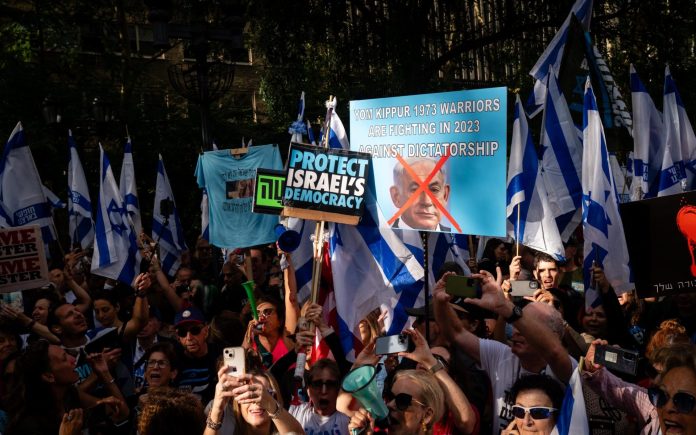
As was the case in previous weeks, the coastal city of Tel Aviv was the epicenter of Saturday protests in which demonstrators slammed the extremist policies of Prime Minister Benjamin Netanyahu’s cabinet, including the highly controversial judicial overhaul scheme.

According to organizers, demonstrations were held at approximately 150 locations across the occupied territories, including the city of Haifa.

This week’s protests came following Netanyahu’s speech at the 78th session of the United Nations General Assembly.

The protesters accused Netanyahu of fleeing to the United States to avoid a corruption cases against him as well as the mass protests that have been prompted by his so-called overhaul scheme.

In Tel Aviv, protesters wore shirts reading “Save us from Netanyahu” and held up signs reading “Crime Minister.”

“The world should know that whatever they hear from our prime minister … everything that he says is a lie. He’s trying to blind everyone else and when he comes back here, then he goes back to his try to save his skin and he’s … fighting … only for himself, and the world doesn’t know it,” a protester told AFP.

“We’re here together with tens of thousands … and we come here in the hope that we can make a difference. Each one of us being here, saying ‘we don’t approve’ … and we will be back here every week until there’s a change,” another protester said.

The protests have been a fixed weekly event since January, when Netanyahu announced the overhaul scheme, which seeks to rob the regime’s Supreme Court of the ability to invalidate the decisions made by the politicians.

The scheme has galvanized the largest protest movement the regime has faced in its history.

Despite overwhelming public pressure, including weekly protests, a wave of industrial actions, and rising opposition among the regime’s military ranks, Netanyahu’s cabinet has passed one of the scheme’s bills through the Knesset. The bill removed the Supreme Court’s power to strike down government decision’s or appointments on the basis of being “unreasonable.”

Netanyahu’s far-right cabinet has pledged to push ahead with the rest of the scheme.

Proponents of the overhaul say it helps redistribute the balance of power between the politicians and the judiciary. Its opponents, however, accuse Netanyahu of trying his hand at a power grab. They say the premier, who is on trial in three corruption cases for receiving bribe, fraud, and breach of trust, is also attempting to use the scheme to quash possible judgments against him.

The regime’s Supreme Court, for the first time in its history, convened its entire 15-judge bench earlier this month to hear an appeal against that bill, and is expected to issue its decision at a later date.

A key hearing on another portion of the overhaul, which pertains to Israeli justice minister’s refusal to convene the committee selecting the nation’s judges, is set for later this month.

The regime’s attorney general has said that Justice Minister Yariv Levin’s actions reflect an effort to politicize the judicial selection process.

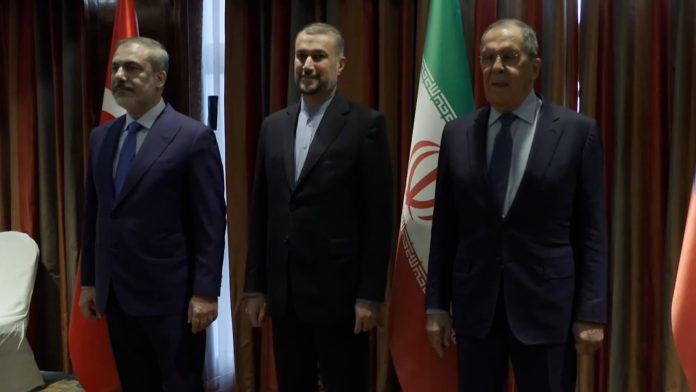
Russia, Iran, Turkey FMs to keep trying to resolve Syria situation

Sergey Lavrov, Hossein Amirabdollahian and Hakan Fidan

“The parties had a thorough exchange of views on the situation in the Syrian Arab Republic and around it with a focus on the need to ensure lasting stability in the country. In this regard, the key role of the Astana group was highlighted and the three countries’ determination was reaffirmed to continue joint efforts to contribute to resolving the situation in Syria based on strict compliance with the principles of respect for its sovereignty, unity and territorial integrity,” the Russian Foreign Ministry said in a statement.

The parties also highlighted “the need to mobilize foreign aid to Syria, particularly to ensure its post-conflict reconstruction and promote the return of Syrian refugees to their home country”, it added.

The ministry noted that the three foreign ministers had also held consultations with the UN secretary general’s Special Envoy For Syria Geir Pedersen.

“They discussed ways to promote the political process led and owned by the Syrian people with the assistance of the United Nations. The parties paid attention to the need to ensure the effective activities of the intra-Syrian Constitutional Committee, and considered issues related to the provision of humanitarian assistance to all Syrians in need in accordance with the norms and principles of international law,” the foreign ministry concluded.

Iran and Russia, as the allies of the Syrian government, as well as Turkey, which sides with the opposition, set up the Astana peace process in January 2017 intending to put an end to the Syrian conflict through the involvement of the Syrian government and the opposition.

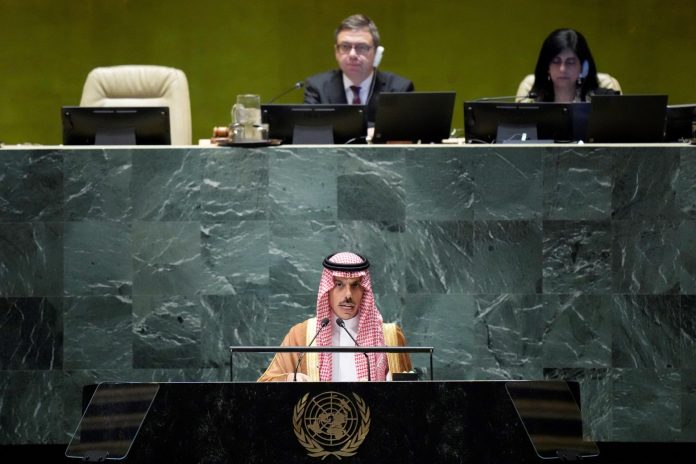
Regional security and stability hinge on Palestinian issue: Saudi Arabia

Faisal bin Farhan

“Security in the Middle East requires an acceleration in the search for a just and comprehensive solution to the Palestinian problem based on international law and the Arab peace initiative, guaranteeing the right of the Palestinian people to create an independent state within the 1967 borders,” the Saudi minister said at the United Nations General Assembly, adding that his country rejects any actions that impede the resolution of the Palestinian issue.

Bin Farhan Al Saud also noted the need for de-escalation in Sudan, called for a solution to the Syrian crisis and declared the country’s interest in security and stability in Yemen.

In addition, the minister added that Riyadh is striving to stabilize energy prices.

On Wednesday, Saudi Crown Prince Mohammed bin Salman Al Saud said that the country is “getting closer every day” to normalizing relations with Israel. On Friday, Israeli Prime Minister Benjamin Netanyahu said that Israel is on the verge of a historic peace agreement with Saudi Arabia, which will change the face of the Middle East.

Relations between Palestine and Israel have been adversarial since the latter’s founding in 1948. Palestinians seek diplomatic recognition of their independent state on the territories of the West Bank, including East Jerusalem, which is partially occupied by Israel, and the Gaza Strip. The Israeli government refuses to recognize Palestine as an independent political and diplomatic entity and continues to build settlements in the occupied areas despite objections from the United Nations.

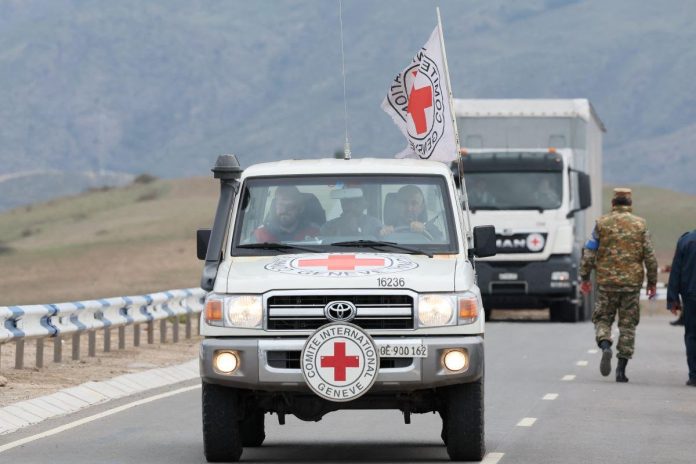
First convoy of humanitarian aid enters Nagorno-Karabakh

Convoy of humanitarian aid Nagorno-Karabakh

“We are in close cooperation with the Russian peacekeepers, conducting the demilitarisation” of the separatists, Azerbaijan Ministry of Defence spokesman Anar Eyvazov told reporters in Shusha on Saturday, a district on the edge of the rebel stronghold of Stepanakert.

“We have already seized weapons and ammunition,” Eyvazov said, adding that its soldiers along with Russian peacekeepers are working jointly to disarm separatist fighters in the Nagorno-Karabakh region – home to more than 100,000 ethnic Armenians.

Karabakh is recognised internationally as part of Azerbaijan.

Azerbaijan launched a lightning offensive on Tuesday on ethnic Armenian rebel positions in what it called an “anti-terrorist operation“. It demanded they lay down their arms and the separatist government disband.

With Armenians suffering serious shortages of food and fuel after a months-long de facto Azerbaijani blockade, an aid convoy of the International Committee of the Red Cross (ICRC) headed into Karabakh on Saturday, the first since Azerbaijan’s military operation.

The ICRC said in a later statement that the convoy had transported nearly 70 tonnes of humanitarian supplies, including wheat flour, salt and sunflower oil, along the Lachin corridor, the only highway connecting Armenia and the mountainous Nagorno-Karabakh region.

An ICRC team also carried out the medical evacuation of 17 people wounded during the fighting, it added.

Separately, Russia announced it had delivered more than 50 tonnes of food and other aid to Karabakh.

More than 20 other aid trucks, bearing Armenian number plates, have been lined up along a nearby roadside since July. Azerbaijan said at the time that this convoy amounted to a “provocation” and an attack on its territorial integrity.

The ethnic Armenian leadership said that the terms of their ceasefire with Azerbaijan were being implemented, with work proceeding on the delivery of humanitarian aid and evacuation of the wounded.

Work was under way to restore the electricity supply by September 24, it announced in a statement.

Russia’s defence ministry said that, under the terms of the ceasefire, the Armenian separatists had begun handing over their weapons to Azerbaijan, including more than 800 guns and six armoured vehicles. Moscow has 2,000 peacekeepers in the area.

Russia deployed several thousand peacekeepers to the region in the wake of a brief but brutal 2020 war in which Azerbaijan reclaimed large parts of the territory and its surroundings from the separatists.

Azerbaijan intends to integrate the long-contested region, but ethnic Armenians have said they feared they will be persecuted and have accused the world of abandoning them.

But Azerbaijan’s foreign minister in his UN General Assembly address on Saturday said his country wants to integrate ethnic Armenians as “equal citizens”.

“I wish to reiterate that Azerbaijan is determined to reintegrate ethnic Armenian residents of the Karabakh region of Azerbaijan as equal citizens,” Jeyhun Bayramov stated.

He added that Azerbaijan and Armenia have a “historic opportunity” to establish good neighbourly relations and co-exist side by side in peace. It is high time to seize this opportunity.”

Backing the ceasefire in Nagorno-Karabakh, Russia’s Foreign Minister Sergei Lavrov said that time was ripe for trust-building measures between Armenia and Azerbaijan, adding that Moscow’s troops would help that.

In his address at the UN, Lavrov accused the West of trying to force themselves as mediators between the two countries, which he said was not needed.

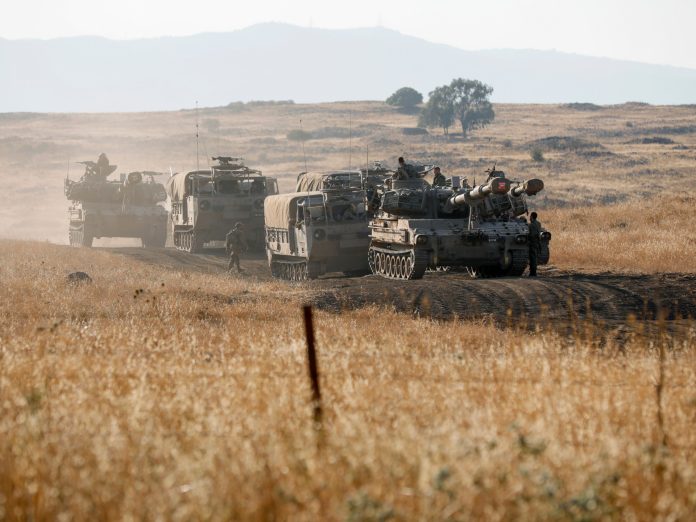
Israel, Lebanon forces fire tear gas along tense border in disputed area

Israeli Tanks

Tensions have flared along the frontier for the past several months, with rockets fired at Israel during flare-ups of Israeli-Palestinian violence and members of the heavily armed Lebanese group Hezbollah or its supporters facing off with Israeli forces.

“Elements of the Israeli enemy violated the withdrawal line and fired smoke bombs at a Lebanese army patrol that was accompanying a bulldozer removing an earthen berm erected by the Israeli enemy north of the withdrawal line, the blue line, in the Bastra area,” the Lebanese army said in a statement on Saturday.

The area where the incident occurred is in Chebaa Farms and the Kfar Chouba hills, which were captured by Israel from Syria during the 1967 Middle East war and are part of Syria’s Golan Heights that Israel annexed in 1981.

That unilateral annexation was not recognised internationally, except by the administration of former US president Donald Trump, and Syria demands the return of the territory. The Lebanese government has said the area belongs to Lebanon.

The Israeli military announced it was Lebanon that started the violence.

“A short while ago, [Israeli] soldiers spotted an engineering vehicle’s shovel crossing the Blue Line from Lebanon into Israeli territory in the area of Mount Dov,” a statement from the Israeli military said.

“In response, [Israeli] soldiers used riot dispersal means.”

“The vehicle returned to Lebanese territory,” the military added.

The Lebanon-Israel border has been relatively calm since Israel and Hezbollah fought a 34-day war in 2006. Despite that, there have been tensions.

In April, Israel launched rare air raids in southern Lebanon after fighters fired nearly three dozen rockets from Lebanon at Israel, wounding two people and causing property damage.

In July, Israeli forces shelled a southern Lebanese border village after several explosions were heard in a disputed area where the borders of Syria, Lebanon and Israel meet.