Saturday, December 27, 2025
Home Blog Page 1073

Two mothers are killed in Gaza every hour: UN

Gaza War

The Gaza crisis is impacting women and girls at unprecedented levels with loss of life and catastrophic levels of humanitarian needs, finds UN Women’s “Gender Alert: The Gendered Impact of the Crisis in Gaza”.

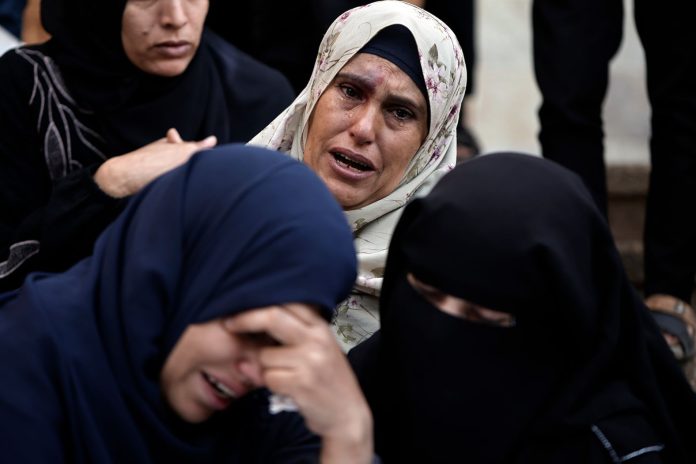
Nearly 25,000 Palestinians have been killed in Gaza, according to the Ministry of Health in Gaza. Around 70 percent of the people killed in Gaza are estimated to be women and children, including two mothers per hour killed since the beginning of the crisis.

More than 1.9 million people, or 85 percent of the total population of Gaza, are believed to have been displaced, including what UN Women estimates to be nearly 1 million women and girls. The entire population of Gaza — roughly 2.2 million people — is in crisis or worse levels of acute food insecurity, it says.

UN Women estimates that at least 3,000 women may have become widows and heads of households, and at least 10,000 children may have lost their fathers. In this context, more women fear that families will resort to desperate coping mechanisms, including early marriage.

“We have seen evidenced once more that women and children are the first victims of conflict and that our duty to seek peace is a duty to them,” stated UN Women Executive Director Sima Bahous in a statement.

In the past 15 years, two-thirds of all civilians killed in the occupied Palestinian territory were men. Less than 14 percent were women and girls. That percentage has reversed in the current crisis. Today, 70 percent of those killed are women and children, she added.

“These are people, not numbers, and we are failing them. That failure, and the generational trauma inflicted on the Palestinian people over these 100 days and counting, will haunt us all for generations to come.”

Bahous called for an end to the war in Gaza.

“However much we mourn the situation of the women and girls of Gaza today, we will mourn further tomorrow without unrestricted humanitarian assistance and an end to the destruction and killing. … I call again for an immediate humanitarian cease-fire and unhindered humanitarian access for all those in Gaza, including the provision of vital assistance and services to all women and girls,” she continued.

“This is a time for peace. We owe this to all Israeli and Palestinian women and girls. This is not their conflict. They must no longer pay its price.”

Women-led and women’s rights organizations continue to operate despite the escalation of hostilities, according to the report.

Some 83 percent of women’s organizations surveyed in the Gaza Strip are at least partially operational, mainly focusing on the emergency response. However, UN Women’s analysis of funding to the 2023 Flash Appeal reveals that only 0.09 percent of funding has directly gone to national or local women’s rights organizations.

Through a six-month response plan, UN Women in Palestine has been providing life-saving assistance to over 14,000 women-headed households, one-third of all women-headed households in Gaza; and supporting the distribution of clothing, sanitary products, and baby formula. UN Women is also partnering with women-led organizations to deliver gender-responsive services for gender-based violence; establishing women-led protection and response committees in shelters for displaced women; and convening regular consultations with women’s organizations in Palestine, according to the report.

IRGC: Four Iranian military advisors assassinated in Israeli strike on Damascus

Israel Attack Syria

The statement read, “The evil and criminal Zionist regime invaded the Syrian capital Damascus, and during the airstrike by the aggressor and usurper regime, a number of Syrian forces and four Iranian military advisers were martyred.”

According to earlier reports, an Israeli missile strike targeted a four-storey building in the al-Mezzah area in Damascus and completely demolished the building.

The strike caused a large plume of smoke to billow into the sky. The area was cordoned off with ambulances and rescue teams.

The neighborhood also houses UN headquarters, embassies and restaurants.

Iran launches Soraya satellite into orbit 750 km above earth

Iran satellite

Issa Zarepour, in a message of X social media platform, wrote, “A new record was set in the height of the launch. An hour ago, Qaem 100 satellite carrier successfully placed its cargo in 750 km orbit.”

The Soraya satellite, launched by the Islamic Revolution Guard Corp’s (IRGC) three-stage satellite carrier, raised the bar for Iran’s satellite technology which had previously reached 500 kilometers from the earth.

The sub-orbital launch of the satellite carrier was successfully carried out last year.

Defense minister: Iran uses all available means to defend nation, territorial integrity

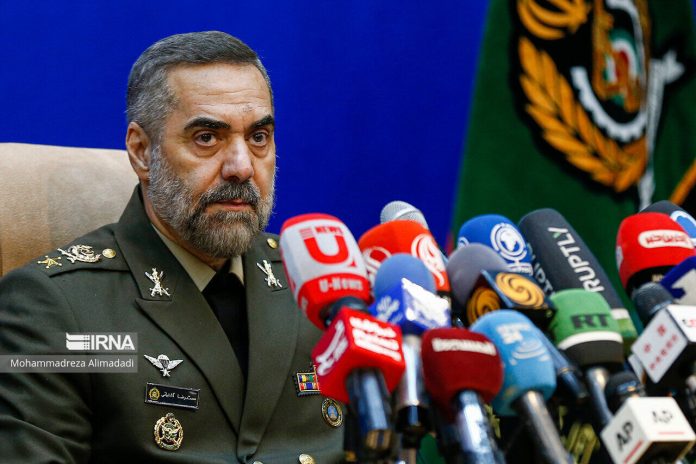
Iran's Defense Minister Brigadier General Mohammad Reza Ashtiani

Commenting on targeting anti-Iran terrorist groups in Iraq, Syria and Pakistan by the Islamic Revolution Guards Corps (IRGC) last week, Brigadier General Mohammadreza Ashtiani said on Saturday that, “The Islamic Republic uses all means to defend its territorial integrity and people.”

He dismissed accusations that Iran violated the three neighboring countries’ territorial integrity but added, “We do not accept any threats against us from the neighboring countries.”

Iran says it targeted a terrorist group’s base in Syria, and an Israeli Mossad spy agency’s espionage center in northern Iraq in response to terrorist attacks inside Iran. It also hit two bases of ‘Jaish ul-Adl’ terror outfit in Pakistan in retaliation for several attacks on Iranian soil in recent years. The move drew an angry reaction from Pakistan that reciprocated the attack, before it announced that the relations are back to normal.

Brigadier General Ashtiani said Iran’s priority is to inform the neighboring countries of the provocative moves by terror groups well in advance, adding the IRGC got militarily involved after the countries failed to take care of the threat posed against Iran.

The defense minister argued that Iran’s move was within the framework of international laws.

Egypt says holding talks with Yemen’s Houthis, Iran to reduce regional tensions

Yemen Houthis

In recent days, “intensive Egyptian security meetings have taken place with prominent leaders from the Ansar Allah group”, an anonymous Egyptian official told the news outlet, using the Houthi group’s official title.

Cairo reportedly criticised the 12 January US and UK-led strikes on Houthi targets in Yemen, as well as subsequent US raids, saying it believes the answer to ending the Houthi blockade in the Red Sea is not militaristic.

“It is better to push for a solution that accelerates the end of the main cause, which is the ongoing war in the Gaza Strip,” the Egyptian official told Al-Araby Al-Jadeed.

As part of Egypt’s efforts to calm international waters, Iran’s Foreign Minister Hossein Amir-Abdollahian is expected to visit Cairo in the coming days, the news outlet added.

The Houthis have carried out a string of drone and missile attacks on ships in the Red Sea region in recent months, following the outbreak of the war in Gaza. They have vowed to continue targeting any Israel-linked vessels until the blockade of the Palestinian enclave is lifted and the hostilities are stopped.

In response, the US has formed a military coalition against Yemeni forces in the Red Sea and endangered maritime navigation in the strategic waterway.

The increased risks faced by ships in the Red Sea have forced the world’s biggest freight firms to avoid the Suez Canal and sent insurance costs soaring. Instead of Suez – the quickest cargo route from Asia to Europe – many vessels are now diverting round the Cape of Good Hope, incurring higher expenses on fuel, maintenance and wages.

Container freight rates for key global trade routes have also surged after the US and UK launched airstrikes on targets in Yemen with the stated goal of protecting maritime commerce in the Red Sea and the Bab-el-Mandeb straits, the world’s busiest routes.

Netanyahu tells Biden he has not ruled out possibility of a Palestinian state

Biden and Netanyahu

Biden and Netanyahu discussed the possible attributes of a future Palestinian state in a “detailed” and “serious” conversation, the person said.

Biden administration officials have recently discussed the possibility of a future demilitarized Palestinian state, an idea Biden finds “intriguing”, the person added.

Netanyahu stated in a news conference that “Israel needs security control over all territory west of Jordan” in any future arrangement reached after the ongoing Israel-Hamas war.

“This clashes with the idea of (Palestinian) sovereignty. What can you do?” he asked.

Those comments were widely understood as a rejection of the idea of creating a Palestinian state — the central component of a two-state solution to the conflict, which Biden has long supported and advocated for.

National Security Council spokesperson John Kirby also told reporters Friday Biden relayed “his vision for a more durable peace and security for Israel, fully integrated within the region, and a two-state solution with Israel’s security guaranteed” during their first phone call of the year.

Biden “reiterated his strong conviction in the viability of a two-state solution — understanding of course, that we’re not going to get there tomorrow, that there’s an active conflict going on and then we want to make sure Israel has what it needs to defend itself”, Kirby told CNN.

Biden has also said that a two-state solution could still move forward while Netanyahu is still in office.

He added that there were “many” forms a two-state solution could take, and the Israeli leader wasn’t against all of them.

Kirby also said that the US continues to oppose a general ceasefire in Gaza, believing it will help Hamas, adding, “I think it’s important to remember that there was a ceasefire in place on the sixth of October.”

Prepare for war with Russia: Chair of NATO Military Committee

Russian Naval Parade

The top official made the remarks after a meeting of NATO defense chiefs in Brussels, urging the bloc to prepare for a major conflict with Moscow within the next 20 years.

“We have to realize it’s not a given that we are in peace. And that’s why we are preparing for a conflict with Russia,” Bauer stated.

“It starts there. The realization that not everything is planable and not everything is going to be hunky-dory in the next 20 years.”

The official warned that the potential conflict would require focused effort not only from the NATO militaries themselves but also from the industries and civilians of member states alike.

“You need to be able to fall back on an industrial base that is able to produce weapons and ammunition fast enough to be able to continue a conflict if you are in it,” he added.

“We need to be readier across the whole spectrum. You have to have a system in place to find more people if it comes to war, whether it does or not. Then you talk mobilization, reservists, or conscription.”

Bauer’s statements come amid a series of warnings from NATO member states of a purportedly imminent conflict between the US-led bloc and Russia. Earlier this week, for instance, Estonian Prime Minister Kaja Kallas claimed the alliance has only three to five years to get ready for the possible confrontation.

Speaking to The Times, Kallas warned that the timeframe “very much depends on how we manage our unity and keep our posture regarding Ukraine”.

“What Russia wants is a pause, and this pause is to gather its resources and strength. Weakness provokes aggressors, so weakness provokes Russia,” she asserted.

A similar take on the situation was provided by British Defense Minister Grant Shapps, who predicted a larger-scale conflict between the collective West and Russia, China, Iran, and North Korea within five years. The minister urged the allies to ramp up their defense spending, insisting the West is now facing an “existential threat” from the aforementioned countries.

British foreign secretary okayed arms sales to Israel despite legal concerns

David Cameron

The document, which has been reviewed by Middle East Eye, was filed by the government in its defence to a challenge brought by legal and human rights groups attempting to stop UK arms sales to Israel for its ongoing campaign in Gaza.

Nearly 25,000 people have been killed and 62,000 wounded, with an estimated 70 percent of the enclave’s civilian infrastructure destroyed since 7 October.

The 22-page defence lays out the findings of the Foreign, Commonwealth, and Development Office unit that assessed Israel’s commitment and capability to comply with international humanitarian law (IHL) and advised Cameron.

In multiple reports between 10 November and 8 December, the unit raised several concerns about Israel’s compliance with the law, according to the court filing.

The unit appears to have been satisfied on some counts, after Israeli officials responded to detailed questions from the Foreign Office about their conduct in a 26 November report in which, among other points, they insisted the Israeli military had incorporated IHL “into all aspects of military operations”.

But other points, including a lack of Israeli response about “the reasons for restricting the quantity of supplies of food, water, and medical supplies”, raised concerns for the unit, but were attributed to different interpretations of the law.

Israel’s position, the unit noted, was that it was “acting in accordance with what it believes to be the relevant legal obligations in relation to humanitarian assistance”, according to the filing.

“It is, therefore, possible that this is a case of disagreement about what the law requires rather than an intentional disregard of IHL,” the document says.

The revelations in the document come a week after Cameron told the parliamentary Foreign Affairs Committee that he could not “recall every bit of paper” put in front of him and it was not his job to make a “legal adjudication” when asked if government lawyers had advised him that Israel had breached the law.

However, the document shows that the final decision of whether Israel was committed to complying with the law was left to Cameron.

“While there remain incidents on which we do not have sufficient information from which to draw a conclusion on compliance… in light of the information received and other inquiries undertaken, we are satisfied that we do have sufficient information on compliance to inform our overarching view of Israel’s compliance,” the unit concluded, noting that “the assessment on commitment is subject to a ministerial decision”.

The Export Control Joint Unit – a cross-departmental body that oversees UK’s export controls and licensing for military and dual-use items – told Cameron on 8 December that he had three options when it came to advising whether export licenses for sales to Israel should be approved.

He could either not suspend them, but keep them under careful review; suspend where it was assessed items might be used to carry out Israeli military options in the conflict in Gaza; or suspend all licenses.

Cameron decided on 12 December that he was satisfied Israel was committed to complying with international humanitarian law, according to the filing.

He advised the Trade and Business Secretary Kemi Badenoch not to suspend export licenses for UK arms sales to Israel, which she followed.

Labour MP Zahra Sultana, who has proposed legistlation to suspend arms sales to any country where there is a risk they might be used in violation of international law, said it was “utterly outrageous” that the government continued to arm Israel despite “the overwhelming evidence of Israeli war crimes in Gaza”.

“These documents expose that, whilst ministers were giving public reassurances about Israel’s compliance with international humanitarian law, in private there were major concerns in the Foreign Office about Israel’s behaviour,” Sultana added.

Dearbhla Minogue, a lead lawyer with the Global Legal Action Network, one of the groups that are challenging the government at the High Court, said the UK’s response has “made it clear that they have not stood back and looked at all of the evidence objectively”.

Instead, she stated, they have “gone to the perpetrator, asked whether they are violating international law, and taken their word for it”.

According to the UK-based Campaign Against Arms Trade, the British government has licensed at least £472m worth of military exports to Israel since May 2015.

The true figure is likely much higher because it doesn’t include items sold under opaque open licences which keep the value of arms and their quantities secret.

British companies provide around 15 percent of the components of the F35 stealth combat aircraft which Israel has used to bomb Gaza in the past three months.

Houthis say US strikes on Yemen aimed at guarding Israel, not world

Yemen Houthis

Mohammed Abdulsalam, the Houthi spokesman, made the comment in an interview with Reuters.

“What the Yemeni people did, in the beginning, was to target Israeli ships heading to Israel without causing any human or even significant material losses, just preventing ships from passing as a natural right,” Abdulsalam said.

“We imposed rules of engagement in which not a single drop of blood was shed or major material losses,” he continued, adding, “It represented pressure on Israel only, it did not represent pressure on any country in the world.”

The Yemeni official said the US intervention has further escalated the situation and that the movement will continue to respond to the US attacks.

“Now, when America joined in and escalated the situation further, there is no doubt that Yemen will respond.”

“The strikes on Yemen, from our perspective, are a blatant violation of Yemen’s sovereignty and a serious aggression against the Yemeni people,” Abdulsalam stated.

Yemen, he added, does not intend to expand the attacks on shipping in and around the Red Sea beyond their stated aim of blockading Israel and retaliating against the United States and Britain for airstrikes.

“We do not want the conflict to expand in the region, and we are still working on non-escalation, but the decision is up to the Americans, as long as they continue to attack.”

The Yemeni official stated the decision to target Israeli-linked ships was a response to popular demands. “It came after great popular pressure not only in Yemen but in the region, demanding that the governments of the region and their leaders take a position towards the Palestinians facing a genocidal campaign.”

Referring to the Persian Gulf’s Arab countries, the Yemeni official said Ansarullah calls on them “to reject the militarization of the Red Sea or the presence of military forces inside the region.”

Abdulsalam added the Yemenis have made their own decisions in the conflict and do not take orders from Tehran, though they maintain a close relationship.

The Houthis have carried out a string of drone and missile attacks on ships in the Red Sea region in recent months, following the outbreak of the war in Gaza. They have vowed to continue targeting any Israel-linked vessels until the blockade of the Palestinian enclave is lifted and the hostilities are stopped.

In response, the US has formed a military coalition against Yemeni forces in the Red Sea and endangered maritime navigation in the strategic waterway.

The increased risks faced by ships in the Red Sea have forced the world’s biggest freight firms to avoid the Suez Canal and sent insurance costs soaring. Instead of Suez – the quickest cargo route from Asia to Europe – many vessels are now diverting round the Cape of Good Hope, incurring higher expenses on fuel, maintenance and wages.

Container freight rates for key global trade routes have also surged after the US and UK launched airstrikes on targets in Yemen with the stated goal of protecting maritime commerce in the Red Sea and the Bab-el-Mandeb straits, the world’s busiest routes.

‘Criminal complaints’ filed against Israeli president in Switzerland

Isaac Herzog

“The criminal complaints will be examined according to the usual procedure,” the Office of the Swiss Attorney General said on Friday, adding that it would contact the Swiss foreign ministry to examine the question of immunity of the individual concerned.

In theory, third countries do not hold criminal jurisdiction over current heads of state, heads of government and foreign ministers of other countries.

The reasons behind the complaints and who filed them were not specified.

A spokesperson for Herzog’s office did not comment on the statement by Swiss prosecutors, stating only that Herzog had been to Davos to present Israel’s position on the situation in Gaza.

The AFP news agency obtained a statement allegedly issued by the people behind the complaint, entitled “Legal Action Against Crimes Against Humanity”. It said several unnamed individuals had filed charges with federal prosecutors and with cantonal authorities in Basel, Bern and Zurich.

The statement added the plaintiffs were seeking a criminal prosecution in parallel to a case brought before the United Nations International Court of Justice (ICJ) by South Africa, which has accused Israel of genocide in its offensive in Gaza.

While it could take years for the ICJ to produce a final verdict, South Africa asked the court to instruct “provisional measures” – a temporary order for Israel to stop the war – while the case is pending.

Israel has called South Africa’s accusations “baseless” and a “blood libel”.

Days after October 7 – when Hamas fighters launched an unprecedented attack into southern Israel killing nearly 1,200 people – the Israeli president said it was not only Hamas fighters but “an entire nation” that was responsible for the violence and that Israel would fight “until we break their backbone”.

After the Hamas attack, Israel launched a ferocious bombardment of Gaza that has killed more than 24,800 people, 70 percent of whom are women and children, according to the United Nations.