
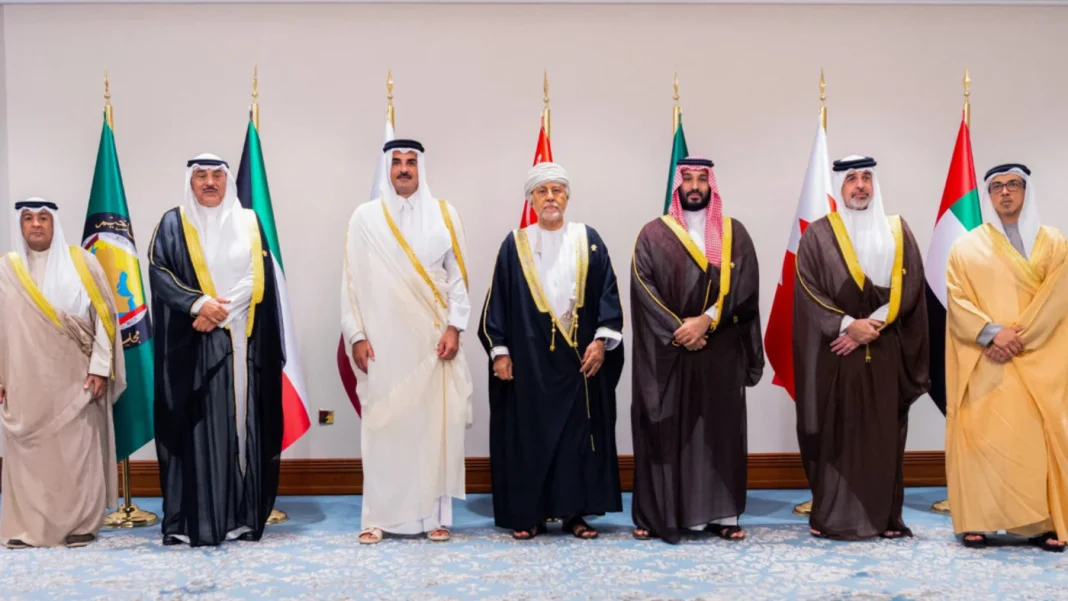
The Persian Gulf Cooperation Council (PGCC)’s pledge to “activate a joint defence mechanism” may have been the most actionable result of the summit, which was opened by Qatari Emir Sheikh Tamim bin Hamad Al Thani, who called the Israeli bombing “blatant, treacherous, and cowardly”.
The PGCC countries, Bahrain, Kuwait, Oman, Qatar, Saudi Arabia and the United Arab Emirates, have formed a defence pact to address the security concerns of the member states.
“My country’s capital was subjected to a treacherous attack targeting a residence housing the families of Hamas leaders and their negotiating delegation,” Sheikh Tamim said in his opening speech.
The Hamas leaders had been meeting to discuss the latest United States-backed proposal for a ceasefire in Gaza.
Sheikh Tamim called for “concrete steps to address the state of madness of power, arrogance, and bloodthirstiness obsession that has befallen the government of Israel, and what resulted and continues to result from it”.
The attack on mediators proved that Israel had “no genuine interest in peace” and was seeking to “thwart negotiations” to end the war in Gaza that has killed more than 64,800 Palestinians, he added.
The emergency summit was organised after fury swept the region following Israeli strikes on September 9, which killed six people.
The PGCC announced that consultations were already under way among the bloc’s military bodies to build up “Gulf deterrent capabilities”, with a meeting of the group’s Unified Military Command to take place soon in Doha, according to Majed Mohammed Al-Ansari, spokesman for Qatar’s Ministry of Foreign Affairs.
No further details were available about the new defence mechanism, which states that an attack on one member state is an attack on all.
“The joint statement obviously called for a meeting of the high command to be held here in Doha to discuss further steps to ensure that the safety and the joint security of the GCC countries is addressed,” Al-Ansari told Al Jazeera.
“The GCC stands in one line,” he added.
The Qatari emir also warned against Israel’s expansionist vision of the region, with repeated bombings of Lebanon, Syria and Yemen. Israel has also grabbed Syrian land and refused to withdraw its forces from southern Lebanon.
Israeli Prime Minister Benjamin Netanyahu is dreaming of making the Arab region “an Israeli sphere of influence”, Sheikh Tamim continued, adding that it “is a dangerous illusion”.
No immediate political or economic measures were announced against the Israeli aggression at the summit.
But Jasem Mohamed Albudaiwi, the secretary-general of the PGCC, urged US President Donald Trump to rein in Washington’s closest ally, Israel.
“We expect our strategic partners in the US to use their influence on Israel for it to stop this behaviour – we really do expect that,” Albudaiwi stated.
“They have leverage and influence over Israel, and it’s about time that this leverage and influence are used”.
Despite expectations of more forceful measures, the summit’s final communique largely consisted of condemnations and pledges of solidarity.
“We condemn in the strongest terms Israel’s cowardly and illegal attack on the State of Qatar. We respond with absolute solidarity with Qatar and support for its steps,” read the memo issued by member states of the Arab League and the Organisation of Islamic Cooperation (OIC).
The communique also praised Qatar’s response to the attacks, voiced solidarity with Doha’s mediation role alongside Egypt and the US, and rejected any justification for further aggression.
The member states also rejected “Israel’s repeated threats of the possibility of targeting Qatar again”.
When questioned about these threats, as well as Israel’s resolve to target Hamas “anywhere”, Al-Ansari said Qatar would make use of the international system to hold Israel to account.
“We will hold Israel accountable in the international community, and our tool in doing that is our belief in international law and international organisations,” he added.
“This is why we went to the [United Nations] Security Council and now, of course, to the Arab and Islamic Organisations and GCC … we are working very closely with all our partners to make sure that we deter Prime Minister Netanyahu from attacking sovereign states again.”
While the joint communique stopped short of hard measures, several Arab and Islamic leaders tabled stronger, more actionable responses to Israel.
