Sunday, December 28, 2025
Home Blog Page 78

Several Chinese refiners start shunning Russian oil after US sanctions: Bloomberg

The Trump administration imposed sanctions against Russian oil giants Lukoil and Rosneft on Oct. 22, aiming to pressure Moscow into accepting a ceasefire in Ukraine.

The measures freeze the companies’ U.S. assets and pave the way for secondary sanctions against foreign institutions that handle transactions with those on the blacklist.

After the sanctions, state-owned Chinese refiners, such as Sinopec and PetroChina Co., have canceled some Russian cargos, and smaller private refiners are also holding off on purchases, according to Bloomberg.

The situation affects approximately 400,000 barrels per day, representing around 45% of China’s oil imports from Russia, the news agency reported, citing the Rystad Energy consultancy.

China has become one of the leading buyers of Russian oil after the outbreak of the full-scale war in Ukraine, taking advantage of steep discounts as Moscow sought new markets.

While claiming neutrality in the war, Beijing is seen as crucial in keeping Russia’s economy afloat amid the invasion.

Other buyers have reportedly begun shunning Russian crude following the imposition of fresh Western sanctions. Reuters reported on Nov. 2 that Turkey’s largest oil refineries are scaling back purchases of Russian oil and turning to alternative suppliers.

Russian oil exports to India raise despite US sanctions: Reuters

Kpler estimated India’s Russian crude imports at about 1.48 million barrels per day (bpd) in October, up from 1.44 million bpd in September. OilX gave similar figures – 1.48 and 1.43 million bpd for October and September, respectively. The data exclude Kazakh-origin oil exported via Russia, the news agency added.

The US imposed sanctions on Russian oil giants Rosneft and Lukoil and their subsidiaries in late October. At about the same time, the EU then officially implemented its 19th package of sanctions against Moscow, targeting over 117 vessels from what Brussels claims is a Russian “shadow fleet,” as well as additional individuals and entities.

Earlier this year, US President Donald Trump imposed a 25% punitive tariff on India, citing New Delhi’s purchases of Russian oil as the reason. The tariff was on top of an existing 25% levy imposed as a part of ‘Liberation Day’, when the two countries failed to reach a trade agreement. The US president accused India and China of contributing to the Ukraine conflict by buying Russian crude.

New Delhi is analyzing the effects of new sanctions on Russian oil majors Rosneft and Lukoil and will act based on how the situation develops, Foreign Ministry spokesman Randhir Jaiswal said on Thursday.

India’s private refiner Reliance has bought millions of barrels from the spot markets since the US sanctions were introduced, Reuters claimed.

India, the world’s third largest oil consumer, has substantially increased its crude imports from Russia since 2022. As of September, Russia accounted for 34% of India’s total imports, based on data from Kpler.

In response to the sanctions, key Indian refiners have temporarily halted new orders and are instead seeking alternative supplies in spot markets, Reuters claimed. Other refiners such as state backed Indian Oil Corporation states they will continue purchasing oil from Russian producers that have not been sanctioned.


UN satellite assessment shows 81% of Gaza Strip structures damaged

Gaza War

Citing the Office for the Coordination of Humanitarian Affairs (OCHA), UN spokesperson Farhan Haq told a news conference: “The ongoing scale-up of the aid response is already having a positive impact on people in all areas of the strip. But much more is needed so that we can address the full scale of the needs and leave no one behind.”

Noting that renovation work “is ongoing in four schools,” Haq stated that over the past three days, “the UN and our partners have supported the reopening of five temporary learning spaces in Gaza City.”

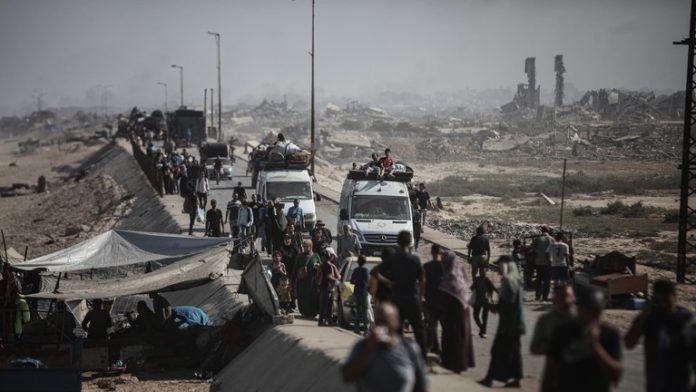
Citing the latest analysis by the UN Satellite Center, he said that “some 81% of all structures in the Gaza Strip are damaged.”

“Northern Gaza experienced the largest increases in damage since July 2025, with nearly 5,700 newly affected structures,” he continued, adding that “more than 123,000 structures across the strip have been identified as destroyed, another 50,000 are severely or moderately damaged, and 24,000 are possibly damaged.”

Israel has killed more than 68,000 people in Gaza in more than two years of attacks since October 2023.

A ceasefire between Israel and Hamas was reached on Oct. 10, based on a 20-point peace plan proposed by US President Donald Trump. Israel, however, has violated the truce multiple times.


Qatar warns to cut gas supply to Europe

The Corporate Sustainability Due Diligence Directive (CSDDD) requires large companies to fix the “adverse human rights and environmental impacts” of their supply chains worldwide.

The law was backed by a broad coalition of European politicians including the left and the greens as well as centrists, including some centre-right lawmakers.

But from the outset the rules have also been attacked as too burdensome for businesses.

“If Europe does not look at how they can water down or cancel the CSDDD, and still have a penalty of 5 percent of our total world turnover as a penalty, we will not be delivering LNG to Europe, for sure,” Qatar Energy Minister Saad Al-Kaabi stated.

Qatar is one of the world’s top LNG producers alongside the United States, Australia and Russia.

Demand has grown from European countries for the Persian Gulf state’s gas since Russia’s 2022 invasion of Ukraine threw supplies into doubt.

In recent months Qatar has inked LNG deals with France’s Total and Italy’s Eni as well as India’s Petronet and China’s Sinopec.

“All our partners and colleagues… know that, we in Qatar, have had the same policy and view on how we see the business, how we see the transition, how we see the need for oil and gas for the future, and that has not changed,” the minister told an Abu Dhabi petroleum conference.

The text of the CSDDD was proposed by the European Commission in 2022 and was adopted in April 2024 is yet to come into force.


US circulates draft UN resolution to establish international security force in Gaza: Axios

According to a copy obtained by Axios, the draft resolution, which was designated “sensitive but unclassified,” would give the US and other participating countries a broad mandate to govern Gaza.

A US official told Axios that the draft resolution will be the basis for negotiations over the coming days between Council members, with the goal of voting to establish it in the coming weeks and deploying the first troops to Gaza by January.

The official added that the International Security Force (ISF) will be an “enforcement force and not a peacekeeping force” which would involve troops from several participating countries and be established in consultation with the Gaza “Board of Peace.”

According to the draft resolution, the ISF would be tasked with securing Gaza’s borders with Israel and Egypt, protecting civilians and humanitarian corridors and training a new Palestinian police force, with which it is to partner in its mission.

The draft also calls for the Board of Peace to remain in place at least through the end of 2027, according to Axios.

The ISF would also “stabilize the security environment in Gaza by ensuring the process of demilitarizing the Gaza Strip, including the destruction and prevention of rebuilding of military, terror, and offensive infrastructure, as well as the permanent decommissioning of weapons from non-state armed groups,” the draft said.

It added the ISF will take on “additional tasks as may be necessary” in support of the Gaza agreement.

Earlier Monday, Turkish Foreign Minister Hakan Fidan stated that countries will decide on troop deployment depending on the wording of an expected UN Security Council resolution.

“What the countries we’ve spoken with have said is this: they will decide whether or not to send troops based on the content of the definition in the resolution expected from the UN Security Council,” Fidan told a news conference after hosting a meeting on Gaza in Istanbul attended by foreign ministers from Indonesia, Pakistan, Saudi Arabia and Jordan and representatives from the United Arab Emirates and Qatar.

Noting that discussions and various efforts are ongoing, Fidan added a key issue emphasized by countries is the establishment of a force whose mandate and legitimacy are defined within the framework of a Council resolution.

He stressed that in the process of defining the force’s mandate, first a general consensus must be reached on a draft, and then it must be approved by the UN Security Council without being vetoed by the council’s permanent members, adding that Türkiye and partner countries are continuing their efforts at every stage of the process.


Aramco’s third-quarter net profit declines on lower crude prices

Aramco reported a net profit of 101.02 billion riyals ($26.94 billion) in the three-month period ended September 30, down from 103.4 billion riyals last year.

OPEC+, which pumps about half of the world’s oil, has been unwinding voluntary cuts, after cutting back production for several years to support the market.

Brent and WTI in October fell more than 2% for a third consecutive month, hitting a five-month low on October 20 on fears of a supply glut and economic concerns about U.S. tariffs.

The company raised its 2030 sales gas production capacity growth target to about 80% above 2021 levels, up from its earlier goal of more than 60%.

This increase is expected to bring total gas and associated liquids production to around six million barrels of oil equivalent per day, the company announced.

“Part of that is from our unconventional gas expansion at Jafurah, which attracted significant interest from global investors,” CEO Amin Nasser stated in a statement.

Adjusted net profit came in at $28 billion during the third quarter, beating a company-provided median analyst estimate of $26.5 billion.


Iranian official says Tehran hit by driest autumn in six decades

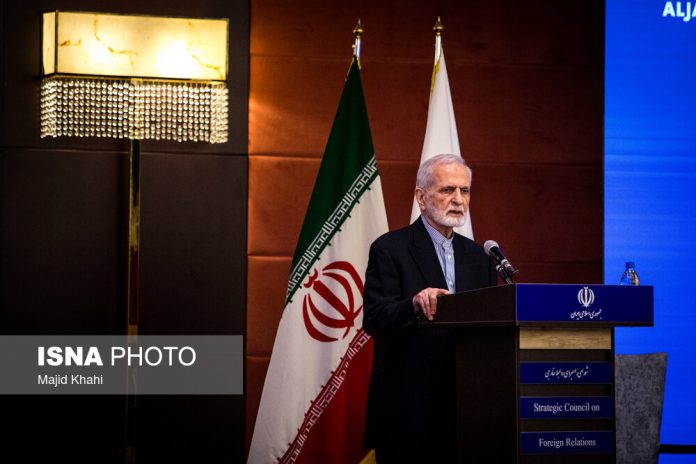
Rama Habibi, who leads production operations at Tehran Regional Water Company, said on Monday that the province of Tehran had experienced a fifth dry spell in a row in the water year that ended in September.

“In the past 60 years, we have not experienced such low autumn rainfall in Tehran, and the current situation is unprecedented,” Habibi was quoted as saying by the Tasnim news agency.

He added that the absence of rainfall in Tehran this autumn has caused the water storage in five dams supplying the city to drop to 205 million cubic meters (mcm) on November 3, down from 426 mcm reported on the same day last year.

The comments came as Iranian President Masoud Pezeshkian used a video link on Monday to inaugurate a major water transfer project, bringing water to Tehran from a dam more than 140 kilometers northwest of the city.

According to the Energy Ministry, the $80-million project will add 5 cubic meters per second to the water supply delivered to households and businesses in Tehran.

Water consumption in Tehran, a city of nearly 10 million people, reached records of nearly 4 mcm per day in late July, prompting authorities to reduce pressure in transmission pipes in several neighborhoods to manage supply.

The government also imposed restrictions on swimming pool use and declared holidays to help curb water consumption.


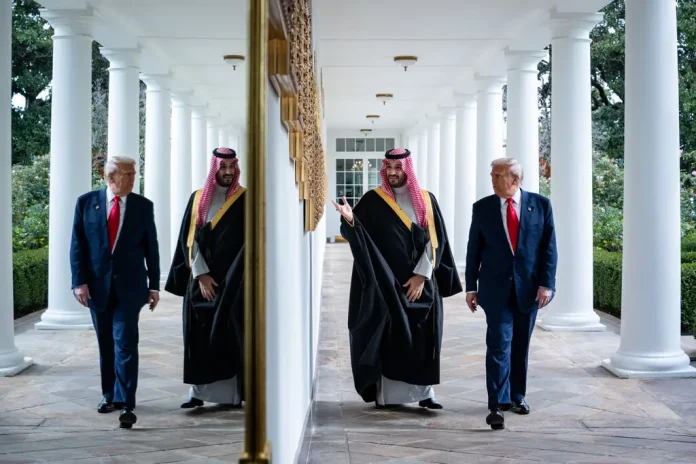
Saudi Crown Prince to meet Trump on Nov 18: White House

The visit comes as Trump pushes Saudi Arabia to join the list of nations that have joined the Abraham Accords. In 2020, Trump reached deals with United Arab Emirates, Bahrain, Sudan and Morocco to normalize relations with Israel.

The Saudis have been hesitant to join in the absence of steps toward Palestinian statehood.

Trump told CBS’ “60 Minutes” in an interview broadcast on Sunday that he believed the Saudis would ultimately join the accords.

Trump and bin Salman may also discuss a U.S.-Saudi defense deal. The Financial Times reported two weeks ago that there were hopes the two countries could sign such an agreement during bin Salman’s visit.

A senior Trump administration official told Reuters that “there are discussions about signing something when the crown prince comes, but details are in flux.”

The Saudis have sought formal U.S. guarantees to defend the kingdom as well as access to more advanced U.S. weaponry.

Saudi Arabia is one of the largest customers for U.S. arms, and the two countries have maintained strong ties for decades based on an arrangement in which the kingdom delivers oil and Washington provides security.

During Trump’s visit to Riyadh in May, the United States agreed to sell Saudi Arabia an arms package worth nearly $142 billion.


Chancellor invites Syrian president to Germany to discuss deportations

Ahmad Al Sharaa

“We will, of course, continue to deport criminals to Syria. That is the plan. We will now implement this in a very concrete manner,” Merz told reporters on Monday.

Germany also wants to help stabilise the country, he said, adding that he intends to discuss with Sharaa “how we can solve this together”.

Merz’s conservative predecessor Angela Merkel oversaw a historic open-doors policy towards refugees 10 years ago, welcoming some 1 million migrants to Germany, many of them Syrians fleeing the war.

Since then, support for the far right has surged and the conservative CDU party under Merz has pursued a far tougher line on border security and migration, pledging to speed up deportations.

“I will say it again: the civil war in Syria is over. There are now no longer any grounds for asylum in Germany,” Merz stated.

Since seizing power from former President Bashar al-Assad in December 2024, Sharaa has made a series of foreign trips as his transitional government seeks to re-establish Syria’s ties with world powers that had shunned Damascus during Assad’s rule.

He is expected to visit Washington in early November.

Britain supplies Ukraine with more long-range missiles to attack Russia: Bloomberg

London first announced the delivery of the air-launched rockets – which have a range of more than 250km (155 miles) – to Kiev in May 2023.

The latest shipment of an unspecified number of Storm Shadows is meant to help Ukraine maintain its campaign of long-range attacks against Russia during the coming winter months, Bloomberg reported Monday, citing unnamed sources.

During a meeting with Ukraine’s President Volodymyr Zelensky and NATO Secretary-General Mark Rutte last month, Prime Minister Keir Starmer said London was “accelerating our UK program to provide Ukraine with more than 5,000 lightweight missiles” to put “military pressure” on Russian President Vladimir Putin.

Also in October, Kiev claimed to have used Storm Shadow missiles, among other weapons, to strike an industrial facility deep inside Russia. The attack followed Zelensky’s earlier threat, made in late August, to launch “new deep strikes” against the neighboring country.

In April, The Times, citing anonymous Ukrainian and British military officers, reported that “UK troops were secretly sent to fit Ukraine’s aircraft with the missiles and teach troops how to use them.”

Speaking at the Future Forum-2050 in Moscow this June, Russian Foreign Minister Sergey Lavrov stated that Ukraine “would be helpless without the British,” adding that London is “100%” involved in the conflict.

Foreign Ministry spokeswoman Maria Zakharova noted in March that “the command” for the attack on the Sudzha oil pipeline infrastructure “came from London.”

Ukraine has repeatedly conducted long-range attacks inside Russia, which have often struck civilian areas and critical infrastructure.

Moscow has described the Ukraine conflict as a proxy war being waged against Russia by the West. Russian officials have noted that sophisticated systems such as Storm Shadows cannot be effectively used by Ukrainian forces without the direct involvement of Western military personnel.