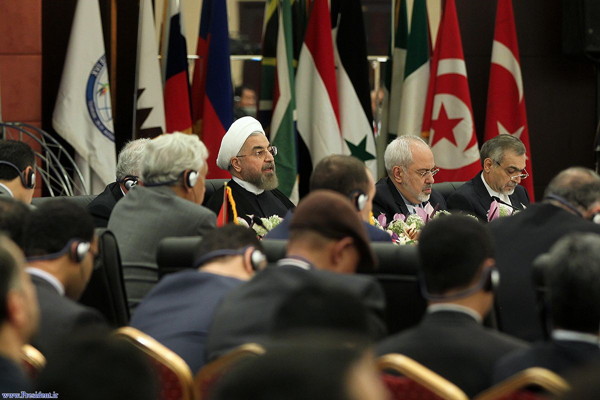
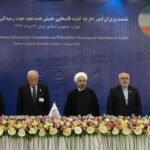
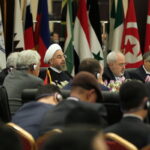
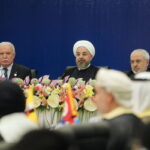
Palestine Committee of the Non-Aligned Movement (NAM) in Tehran
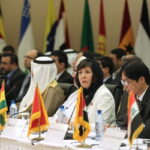
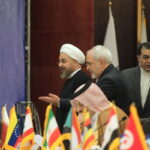
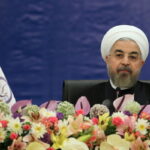
Addressing the ministerial meeting of the Palestine Committee of the Non-Aligned Movement (NAM) in Tehran on Monday, Rouhani said “the continuation of the UN Security Council’s indifference and inaction” has emboldened the Tel Aviv regime to continue its crimes against the oppressed Palestinian people in Gaza.
“The inaction and flagrant indifference of the UN Security Council toward the current catastrophe in Palestine, particularly in Gaza, is a blatant symbol of injustice in the Security Council,” said Rouhani.
He said effective measures have to be adopted to put an end to such crimes because Tel Aviv is violating human principles.
Rouhani, the rotating president of the NAM, further called on the movement to roll up its sleeves to put an end to Israeli “war crimes and genocide” in the coastal sliver.
NAM, based on its fundamental standards, should take action to stop the current trend of war crimes and genocide committed by the Zionist regime, said Rouhani.
“The Non-Aligned Movement, as an international circle with ample potential and capacities, can and should take basic and firm steps toward the realization of real peace and social justice in line with the inalienable rights of the oppressed Palestinian people,” said the Iranian president.
Rouhani further said the crisis in Gaza would not be resolved without the return of Palestinians to their homes.
Following Rouhani’s speech, Palestinian Foreign Minister Riyad al-Malki said the humanitarian situation in Gaza is at breaking point and people are experiencing unspeakable horrors.
He called for an arms embargo on Israel, which, he said, uses military equipment against defenseless Palestinians.
Over 1,820 Palestinians have so far been killed and some 9,400 others injured since the Israeli military first launched its offensive against the Gaza Strip on July 8.
The Israeli military says three Israeli civilians and 64 soldiers have been killed in the conflict, but Palestinian resistance movement Hamas puts the fatalities at more than 150.
Palestine Committee of the Non-Aligned Movement (NAM) in Tehran
Palestine Committee of the Non-Aligned Movement (NAM) in Tehran
Palestine Committee of the Non-Aligned Movement (NAM) in Tehran
Palestine Committee of the Non-Aligned Movement (NAM) in Tehran
Palestine Committee of the Non-Aligned Movement (NAM) in Tehran
Palestine Committee of the Non-Aligned Movement (NAM) in Tehran
Palestine Committee of the Non-Aligned Movement (NAM) in Tehran
Palestine Committee of the Non-Aligned Movement (NAM) in Tehran
Palestine Committee of the Non-Aligned Movement (NAM) in Tehran
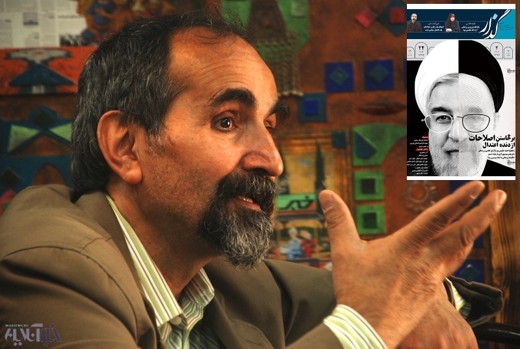
The following are excerpts from an interview with Dr. Taqi Azad Armaki, a sociologist and a member of faculty at Tehran University’s School of Social Sciences. In the introduction to the interview which was conducted by Nafiseh Zarekohan and published in the 5th issue of Gozar (Transition) Monthly, the interviewer points out, “I saw Mr. Azad Armaki on a late spring day in his office at the School of Social Sciences shortly before his class. Although he was pressed for time, he responded to my questions patiently and willingly as if an early class had been tucked into his morning schedule.”
In this interview, Mr. Armaki talked about the social reasons behind the emergence of Mohammad Khatami’s reformist government and Hassan Rouhani’s government of moderation and described what he called the “Hashemi Phenomenon” as effective in shaping both governments. In his analysis, he touched on the social and merely internal causes which saw “The Reform Movement” collapse, citing the transition from “Hashemi” and later from “Khatami” as the movement’s Achilles’ heel. He also had a warning for the moderate movement.
Unlike other Iranian political and social analysts, he did not refer to the role of any foreign factor in the “emergence and collapse” of the political movements over the last two decades. Some experts believe Mr. Ahmadinejad’s rise to power and his decision to opt for offensive tactics as the best defense against countries deemed as hostile was due to the fact that the flexibility demonstrated by the reformist government of Mohammad Khatami went unanswered and efforts by Iranian nuclear negotiators led by Hassan Rouhani – the then secretary of Supreme National Security Council – to clinch a deal acceptable to both parties were largely ignored. As a matter of fact, greed on the part of America and other Western countries ploughed the field of reformists and planted seeds of extremism. That’s why I think this key foreign factor is conspicuous by its absence on the list put forth by this famous Iranian sociologist of issues which led to the marginalization of the moderate party that advocated “interaction with the West”.
In the interview which was arranged rather hastily, the effects of the West’s extensive psychological warfare against Iran – under the pretext of suspicious nuclear activities – on the fate of the reformist government and on the emergence of an imbalanced and hard-line government which replaced it have been largely ignored. The following are the thought-provoking excerpts of the interview with Dr. Azad Armaki:
I want to seize this opportunity to analyze the origin of the moderate and the reformist governments and their interrelations. In short, what are the similarities and distinctions between them?
In my opinion, in terms of the prevailing political atmosphere, the two governments have one thing in common, and that is moving ahead in the shadow of a phenomenon by the name of “Hashemi” whose presence can be easily felt in the reformist government which succeeded his reconstruction-oriented government. Likewise, the government of moderation has been under the shadow of Hashemi’s name, and therefore this phenomenon has created some similarities in the political behavior of the two governments.
The reformist government was nurtured by Akbar Hashemi Rafsanjani [President of Iran 1989-1997]. Over his eight years in office, which is also known as the reconstruction period, he directly and indirectly trained political factions which later formed the reformist government. I must say that the reformist current has not been either for or necessarily against Hashemi’s government. In fact, the first reformist government was born under the shadow of Hashemi and carried on with its life in the same shadow.
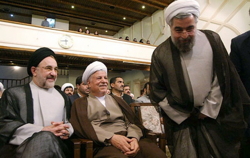
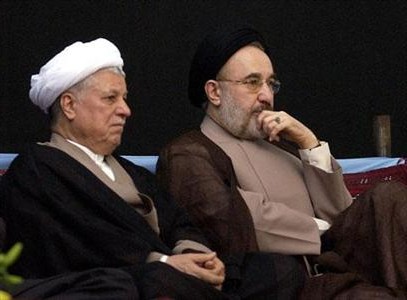
Mohammad Khatami, Hashemi Rafsanjani, Hassan Rouhani
A clash erupted when Mohammad Khatami won re-election and started to take on the policies introduced by Hashemi. Eventually, the same opposition sent his government crumbling. As a matter of fact, being under the shadow of Hashemi helped the reformist current forge ahead at first. However, after it stood up to the principles established by Hashemi, it took the movement years to put its house in order before eventually collapsing.
The government of moderation is in the same condition. When the social, political and cultural machine of Hashemi was called in, a moderate government emerged. I can say that both the reformist and the moderate governments are different versions of the “Hashemi Phenomenon”. That is particularly true about the government of moderation which has been a reflection of the phenomenon since its emergence on the political landscape. Shared beliefs, interactions, and relations between Hashemi and Rouhani are completely obvious. Hence the presence of Hashemi is a point of resemblance between the two governments. […]
What about their origins?
[…] In the post-revolution era, the social dimension [of governance] suffered a major blow which was cushioned to some extent under President Hashemi. One might think that the period of reconstruction only empowered the upper class. However, his presidency paved the way for other classes of society to be propped up too, so much so that the middle class emerged transformed and dynamic during Khatami’s presidency. The middle class, which was resuscitated, grew and found its way to universities. In fact, that social force worked in sync with the intellectual men around Khatami and brought about an unexpected new current to society.
But unfortunately, in terms of power, the higher a government goes, the harder it falls. The first thing that happened was that Hashemi ended up in the crosshairs, came under fire and eventually was left alone. Of course, it was followed by criticism of Khatami and a final transition from him too. When a society leaves Hashemi behind, it will definitely do the same when it comes to Khatami. Undoubtedly, the driving force behind such transition takes aim at other figures, for it hastily pursues progress.
Now, things in Hassan Rouhani’s government of prudence and hope are similar to those of the reformist government, though less intense, because the moderate current is not a strong current and only carries the tag of a political current, and that is only because of the present conditions. Under Hashemi, society was not hit by political or economic crises, but Rouhani’s government faced a crisis from the get-go. In spite of numerous woes, society has been going from strength to strength. Under principlist Ahmadinejad, the country actually was in a fundamental crisis from which the moderate government came into existence.
However, the reformist government showed up on the back of a reconstruction current and that’s the distinction between the two governments. For the very reason, the moderate government lacks a robust intellectual force and suffers from the lack of such a current of thoughts and a group of people who can think deeply and analyze different topics and, one way or the other, generate a ‘moderate discourse’.
So are you suggesting that unlike moderation, the reformist discourse was well-developed and deep-rooted?
In fact, the moderate government doesn’t go beyond an attitude, or a political behavior, as they call it. And that can be said to be one of the most important differences between the reformist and moderate governments. Although both governments were founded by a social force, they are strikingly different, because the social force which constructed the moderate government is crisis-hit, whereas the reformist government was formed when there was no crisis and only the social force was critical of the conditions. Since the moderate government was born in the aftermath of a crisis, the government is reeling under the present chaos, and the country is somehow ruled by oil, budget, economy and political and international conditions.
To sum up, the moderate government’s existence is influenced by the “Hashemi Phenomenon” and a crisis which is a legacy of the principlist government. What annoys the moderate government is this contradiction. Another flaw in the government is that it does not have the chance to rethink. The reformist current was a representative of religious open-mindedness. Although the moderate current is not in contrast with enlightenment, they won’t coexist. That’s why Rouhani’s government is not in tandem with it and this can be viewed as a weakness of his government.
As you mentioned, it was the middle class who established “the reformist government”, the very class took a hit under Ahmadinejad, so with regard to that, can we put down the formation of the moderate government to the determination of the middle class to get back up on its feet? Or did the very crisis you mentioned set the stage for its emergence?
One of the worst things that Ahmadinejad did, which was in his opinion the best move, was the manipulation of the class structure of society. In his estimation, he did it in order to lend importance to the needy and therefore have a special social force on his side forever. So the first step he took was to annihilate the upper class, including the middle class and entrepreneurs, the class that he labeled as thieves. Also, he later sparked off a controversy surrounding Hashemi’s children.
In fact, having dealt a heavy blow to the upper class, he started to attack the middle class, the class whose most dismal days came during Ahmadinejad’s eight years in office. It bore the full brunt to the point of total annihilation. Have you ever noticed the gloomy atmosphere that prevailed in universities over that time? Over his two terms in office, he tried to expand the lower class at the expense of the middle class in society. As a result, universities, art, the press and lots of other parts of society were marginalized. The crackdown on the middle class gave rise to an atmosphere in which more chaos and marginalization came to pass. Consequently, the middle class was plagued with daily problems of life and members of the middle class quit their jobs thanks to the unpleasant atmosphere of the time.
For instance, during the period principlists were in power, underground music grew and critical rhetoric got louder and gained momentum. As a matter of fact, under such circumstances, the middle class turned to self-run associations and non-governmental organizations. In my opinion, although the middle class went through its darkest chapter under the principlist government, it was given the best opportunity to reflect and create a new atmosphere. That’s why unlike in the past, it did not get overexcited when Rouhani emerged victorious in the vote. You have probably noticed that since his government came to power, time and again the youth have been asked to give a hand to the government. However, no considerable step has been taken by them, because they were placed under pressure for eight years in the previous government.
So, you mean that the middle class has sunken into apathy and social matters have lost their importance to this group?
No! That’s not true. From my perspective, the Iranian community has developed a relative understanding and won’t be easily fired up to step up to the plate and tap into its full potential. In my opinion, that’s a good change as far as the survival of Iran is concerned. As a result, impulsive acts that might snowball into wider disputes won’t take place. Therefore, the government should act cautiously. This reflective hesitation helps it survive. In short, the civil class in society is not dead. Rather, it is on the fringe, monitoring and acting guardedly. We should expect changes in this class of society. Fortunately, this equanimity in Iranian society is a win-win situation. Despite commotions caused by different currents on the political front, it is no longer possible to fire up and mobilize this class.
Dr. Armaki, how did the approach you talked about lead to the moderate government and its victory in the election?
[…] The Iranian community is not defined or shaped in the political arena. […] Over the past 10 to 15 years, society has grown strong; for such a society, a powerful government should be at the helm, but unfortunately, under Ahmadinejad, society wielded more power than the government. As a result, his government was boisterous in challenging rivals. His clamor exposed us to global ridicule, because his loudness revealed his weakness rather than his strength.
Hashemi Rafsanjani, Mohammad Khatami
My next question is about the missteps taken by the reformist government. In fact, I want to know about the similarity in mistakes made by the moderate and reformist governments; about those that are likely to all but land the moderate government where the reformist one ended up. If the same mistakes are remade, will the government of moderation share the same fate that befell the reformist government?
[…] The reformist government surfaced under the shadow of ‘Hashemi’ and was not opposed to him. Actually, the same matter prompted the initial logic behind the reformist government to fade away. (Earlier, I pointed out the transition from Hashemi and then from Khatami.) Consequently, all institutions which could have streamlined things were destroyed and this triggered the implosion of the reformist system. Another misstep on the part of the reformist government was that although it was intended for the middle class, it was entangled by all classes. Had it focused its attention on the whole social system, it would not have met such a fate.
Today’s criticism leveled at the reformist government basically centers on the fact that although the middle class was granted all social rights, why was the lower class excluded? Where did the needy stand on the list of the government’s priorities? Why did the sources of emulation, religious culture and things like this slide into oblivion? I am not suggesting that the reformist government was either anti-religion or anti-culture, but as a result of the policies it pursued it immersed in itself and ignored other matters such as other classes of society.
Firstly, the moderate government should take the whole social system into consideration and secondly, it should keep the middle class connected to other classes. If the government fails to do so, it will get into trouble, after all the reformist government failed to keep those bonds in place.
So if action must be taken, then how can the class you just mentioned be engaged and brought to the government’s attention?
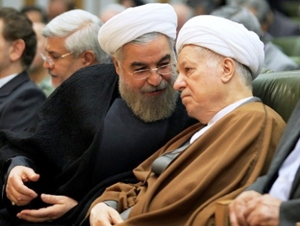
Hassan Rouhani, Hashemi Rafsanjani
[…] There should be representatives of those who have been ignored. Unfortunately, as we speak, there are not such representatives and the country is ruled by bureaucrats. At least in this government, I do not know anyone who represents the educated, artists, scientists, or those who work in the film industry. There is no will to do so, and if such indifference persists, cries of protest will get louder and those ignored will be able to make a profound difference in society. And then this class will reach out to the lower class spontaneously.
[…] Another thing is the welfare policy. In Iran, we intentionally task other institutions and bodies that mostly give rise to dissatisfaction and poverty with implementing the welfare policy.
[…] If the moderate government fails to act on my suggestion about creating a bond between the middle and the lower class, it will help a current similar to principlism emerge.
[…] The moderate current can play a key role in helping it emerge or stopping it from surfacing. It can either nip it in the bud, or act as a catalyst for it. What matters here is how other currents will exploit the emergence of a third group.
Given the analysis you made, what do you suggest the moderate government do to return to the right path and escape the fate of the reformist government? Of course, you pointed out some solutions over the course of the interview, but if you want to give us a package of solutions, what will it be?
[…] The government should return to society and deal with its real issues. The thing which happened in the moderate government, something that has been unique so far, was the transition from the period in which there was wrangling between the leader and the president. In fact, the two share common ground now. I am of the opinion that it is very intelligent of the president to maintain the relationship at this level, […] whereas Ahmadinejad made his disagreements with the leader public.
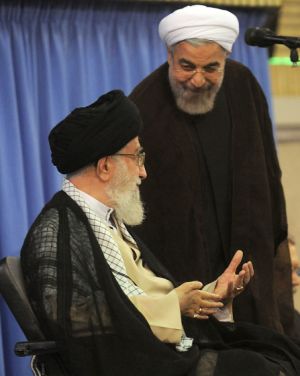
Supreme Leader, Hassan Rouhani
Anyway, common ground between the leader and Rouhani is a great opportunity for his government to turn things around. I must say that the government should take advantage of this opportunity in favor of development not as a democratic gimmick. Society must be given a chance to develop. Ahmadinejad insisted that society was not capable of developing and that in fact it opposed development. However, Rouhani must know that attention to development will revive the government and the political system. Besides, as I told you, if the government is planning to stay in power, it has to let the middle class pick up the pieces. All of today’s concerns are those of the middle class. If this class is empowered, society will be lively and move toward unity. Under such circumstances, the conflict between the middle class, the upper class, and the lower class will be settled. Actually, when the middle class is alive and well, society will grow and this growth will narrow the gap between the middle and lower class, and therefore it will boost the government and let it streamline society easily.
[…] We will get to the point when science, sociology, psychology and economy find their true meanings. It is when economists rather than bureaucrats will be important; there is no denying that for the time being, bureaucrats make decisions about the economy, social matters and so on. Unfortunately, no one now represents culture, science, and economy in the government. When the government allows such representatives to be influential, then civil action will be taken, which in turn can transform a gloomy community into a lively one, even in the presence of poverty. In conclusion, I must say that the extent of poverty in Iran is similar to that of many other countries, but the bleakness of poverty has taken root within our society. There are a lot of people in our society who are quite well-off, yet they are still sad. It’s because we haven’t taught them how to be happy and enjoy life. We must educate people on that issue.
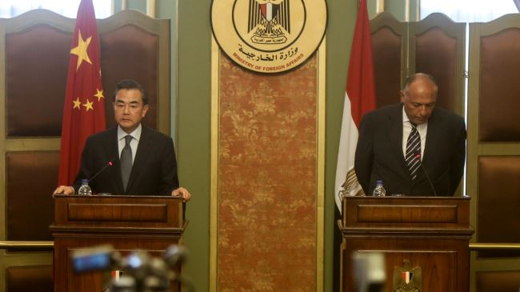
During a joint press conference with his Egyptian counterpart Sameh Shukry in Cairo on Sunday, Wang stressed that Israel “should lift its blockade on Gaza, [and] release Palestinian prisoners.”
“All actions that involve excessive use of force and that lead to civilian casualties are unacceptable,” he said.
“All movements including airstrikes, ground offensive and launches of rockets should be stopped. Any abuse of force that causes deaths of civilians is unacceptable,” Wang said.
He also offered a five-point ceasefire proposal for Gaza, saying Beijing is ready to mediate for peace between the Palestinians and Israel.
He also supported the truce initiative proposed by Egypt and other countries.
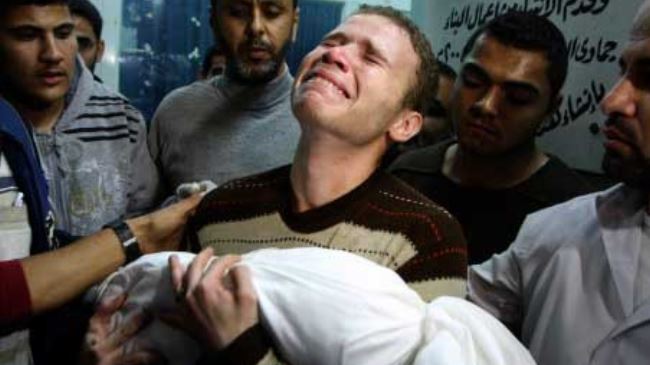
Israel has continued to pound the Gaza Strip for the 28th consecutive day, killing more than 1,822 Palestinians, including 400 children, so far.
Israel has been targeting the Gaza Strip with military attacks since July 8. Apart from the fatalities, the air, sea and land strikes by Israel have so far injured 9,400 .
Palestinian Health Ministry sources say the children were killed since the beginning of the Israeli offensive against the Palestinian coastal enclave on July 8. Children also make up one third of over 9,000 wounded Palestinians.
The developments come as Israel continues with its relentless onslaught on the Gaza Strip.
The fresh series of attacks intensified after it was reported that an Israeli soldier had been captured by Palestinian resistance fighters in Gaza.
Several Palestinians lost their lives in Israeli attacks on Khan Yunis and a camp in central Gaza.
Palestinian officials say more than 150 airstrikes have hit Gaza, including one against the Islamic University in Gaza City.
At least 1,700 Palestinians have been killed and over 9,000 injured since the beginning of the aggression nearly four weeks ago.
The Israeli army has reportedly cut off the Rafah area to conduct a search operation for the missing Second Lieutenant Hadar Goldin. British media have reported that Goldin is a cousin of Israeli Minister of Military Affairs Moshe Ya’alon.
Meanwhile, Hamas spokesman, Sami Abu Zuhri, has accused Israel of breaking the Friday UN-brokered ceasefire, saying the truce was violated by Tel Aviv.
He said Israel tried to use the ceasefire to further infiltrate into Gaza and the resistance fighters only defended their land.
The Hamas spokesman also underlined that the Israeli aggression against civilians indicates its defeat.
Abu Zuhri made a lasting truce conditional on Israel’s ending its aggression against Gaza and lifting the siege of the territory.
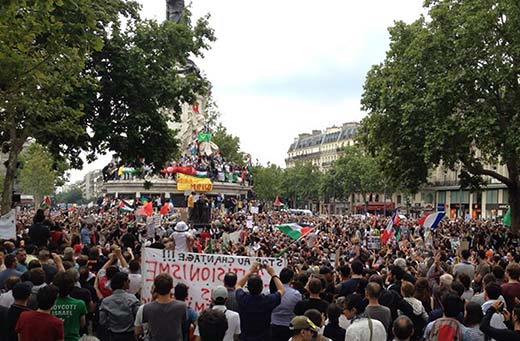
French interior minister Bernard Cazeneuve warned organizers in a television address that they would be held responsible for any clashes and could be prosecuted for ignoring a ban that was confirmed by the country’s top administrative court. TV footage showed demonstrators wearing balaclavas and traditional Arab keffiyeh headdresses throwing projectiles at riot officers after two hours of peaceful protest. By 1700 GMT (13:00 EST), most demonstrators had been evacuated from the square and order restored. Paris police said they had made about 50 arrests. French authorities have refused to permit several pro-Palestinian protests because they feared violence. Marchers clashed with riot police in and around Paris in recent weeks, with some targeting synagogues and Jewish shops. “Anti-Semitic violence exists: we must face it head on,” Cazeneuve said. Some protesters, NGOs and even ruling Socialist politicians have criticized the bans on the rallies as counter-productive. Cazeneuve noted that over the last two weeks, five marches had been banned, out of about 300 such protests across the country. “Freedom of protest was thus the rule, and bans the exception,” he said. According to the interior ministry, some 2,000 police were sent to the Place de la Republique to surround the demonstrators, which numbered about 5,000. Reuters photographers saw one police officer slightly injured, the front windows of the Crowne Plaza hotel smashed and a bus shelter wrecked. Organizers denied accusations of anti-Semitism. “Our goal is not to attack the Jews, it is to condemn the policies of a government,” Tarek Ben Hiba, a local politician and head of one of the 20 associations organizing the protest told Reuters. Protesters were seen waiving Palestinian flags, chanting “We are all Palestinians” and carrying placards reading: “Zionists, terrorists”. At least one Zionist flag was burned, a Reuters photographer said. “It’s a scandal that they’re banning protests. It’s our right. We were attacked with tear gas even though we didn’t do anything,” said 24-year old temp worker Sabrina, who declined to give her full name. In the Mediterranean port city of Marseilles, some 2,000 people marched peacefully on Saturday in an authorized demonstration. France has both the largest Jewish and Muslim populations in Europe and flare-ups in the Middle East have often in the past added to tensions between the two communities.
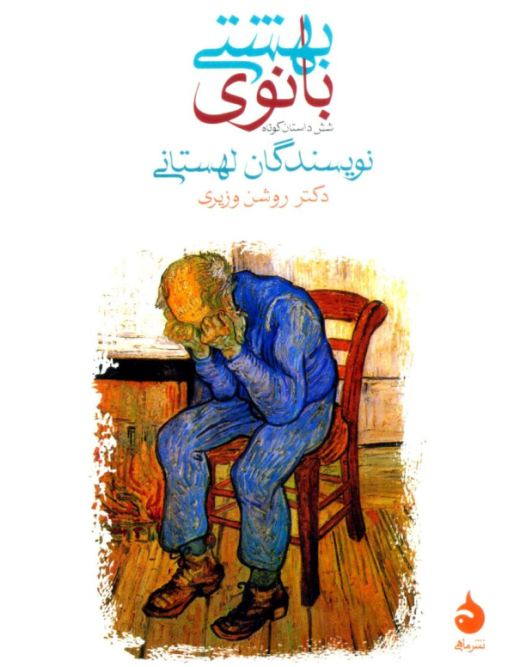
A 17th issue of Andisheh Pouya (Dynamic Thought) magazine, which came out in July 2014, featured an interview with Roshan Vaziri, the translator of The Heavenly Lady, a collection of short stories by Polish writers. The monthly magazine seized the opportunity to bring up the subject of the culture and lifestyle of the Poles and their long-rooted ties with Iranians in a chat with the translator and her husband of Polish origin. The lead to the interview and excerpt of it come below:
Roshan Vaziri studied medicine in the University of Warsaw many years ago. She married a Polish man there and then returned to Iran with her husband, Leshek Wozniak. More than five decades into his stay in Iran, Mr. Leshek views himself as an Iranian. Roshan Vaziri too has developed a liking for Poland and its people.
A one-month trip to Poland is a fixture in their annual timetable, the souvenirs of which are books written by Polish authors that Roshan Vaziri renders into Persian. The Heavenly Lady is the latest of these books, a collection of six short stories by five Polish writers, selected and translated by Roshan Vaziri.
The release of the translated version of the book was one good reason for a friendly chat with the translator. Since the interview was to touch on issues beyond the book and talk about the culture and life of the Poles, her husband of Polish origin was also on hand for the friendly heart-to-heart. […]
The final story in the book focuses on the final days of Vincent van Gogh. As a matter of fact it is not a story; it is a literary piece on the renowned Dutch painter. What motivated you to pick this piece and place it along the other five stories?
Roshan: Yes, you’re right. It is not a fiction; it is just a feature on van Gogh. I loved this piece. I do like van Gogh. I picked this item and put it beside the other five because my life centers on love. The piece in question properly features the dying moments of van Gogh and his tragic life, not to mention the fact that it is a brilliant literary work.
In a foreword to The Heavenly Lady, you have cited efforts to familiarize the Iranian readers with the Polish literature and its great literary figures as a criterion for selecting the stories of this book. The question is why you have collected only six short stories for the book, whereas the fictions are appealing enough to make the book still thicker. I think it would have been better if you had translated a few more stories for the book.
Roshan: The main reason why I found only six stories sufficient for the book is my own state of health. My eye problem didn’t let me skim through Polish stories and come up with more fictions for rendering. That I have chosen a small number of stories for the book has another reason as well. We shouldn’t forget the fact that text screening remains in place here, so one always needs to bear in mind that not all books can get a permit to go to press. […]
Four out of six stories in the book depict the sufferings and hardships a Pole goes through outside of his homeland. We can say they narrate the agony of a displaced person or an emigrant who is far from his birthplace. Why is the pain associated with emigration highlighted in Polish literature?
Roshan: Yes you got it right. Emigration plays a key role in the characterization of people in these stories. The point is that emigration has the most influence on the culture and life of the Poles. A sense of being a Pole and homesickness stays strong with Polish emigrants. For instance, about 13 million Poles and those of Polish descent live in the United States.
Leshek: Many people in Poland emigrated to other countries in the late 19th century and early 20th century due mainly to poverty and financial straits. That’s why emigration, homesickness and nostalgia have become an inseparable part of the Polish culture. Emigrants [or the Polish diaspora] who left the country prior to and after the 1980 Solidarity Movement in Poland have recently started to go back home, especially after the country’s economy began to grow.
Mr. Leshek! Are you a Polish emigrant too?
Leshek: I wasn’t, or let’s say I emigrated for the sake of love. On the other hand, I chose not to live in a Communist-ruled country. The elder members of my family had been anti-Communist from the start. It was back in the Second World War when my grandma insistently refused to use the term “the Polish government”. Instead she would say that it was the government of Russians.
One of the issues the stories as such impart to the readers is that religion has had deep roots in the culture and public beliefs of Poland. Is the role religion is said to play in Poland the direct result of the anti-faith measures taken during the Communist rule? Or has it been there untouched all through the Polish history?
Leshek: Church has always played a powerful role in Poland. The part it played during the Solidarity Movement was of great consequence. People used to go to church to display their protest at the Communist regime, even those who lacked any religious beliefs would join the churchgoers [to take part in the protest]. The church put up stiff resistance when Communists were in power. Many priests were imprisoned, but rarely did they work with the Communist government which was in office.
Roshan: In fact, the church served as the bastion of protest back then.
Did the marriage between the revolutionaries and the church continue well after the (downfall of the) Communist regime and the rise to power of the new government?
Roshan: The situation is now different from what it was in the past and the church is no longer a key cultural player in people’s lives. New issues have surfaced in people’s social life, which have pitted individuals against the church. The church still matters in regulating social ties and the personal lives of people, though. […]
In The Trumpeter of Samarkand the audience reads a narrative on the presence of Poles in Gulags [the Soviet forced labor camps] and their release which sees them head southward and into Iran. It’s a story a narrator in Tehran tells his friend about a public belief in Samarkand. Has any story been written on the time those Poles spent in Iran?
Leshek: In Iran several books have been written and compiled on these emigrants. The Poles did stay in Iran for two years. Back then, professor [Saeed] Nafisi was the first person who studied the culture of these people. The Poles who came to Iran from the Gulag Camps hailed from affluent and intellectual families that had been sent to Siberia by the Russians. They published two newspapers when they were in Iran. The Poles do love Iran very much. Thanks to the hospitality of the Iranians, the Polish refugees feel indebted to their hosts.
Roshan: Iran, Isfahan in particular, turned out to be like Heaven on Earth for the Poles, especially in the wake of the gruesome experience they had in the Gulag Camps. The Trumpeter of Samarkand makes mention of the Iranians’ hospitality and their warm welcoming of the Poles. It may be interesting for you to know that I had been learning the Polish language for two months with a Polish woman who had married an Iranian army officer and it was well before I left for Poland to pursue my studies.
The majority of the Poles stayed in Iran, got married and led a normal life here. They have now passed away. A large number of Polish men left for the battlefields right after their release from the Gulag Camps. Some Polish women and children left Iran after World War II. The memory of Isfahan, its pleasant sunshine and tasty dishes were matchless for those refugees who had come from the Gulags. The Poles did love Iran very much and for them the memories of the Iranian city have stayed.
Are you suggesting that Iran was in fact like a hotel for the Poles?
Roshan: Exactly! A number of Polish women tied the knot with Iranian men and therefore their children are of Iranian origin. When the Solidarity Movement was on the rise in Poland, some of these young people went there. It is surprising to know that Poland had traditional ties with Iran for about 54 years and the history of their mutual ties goes back to Safavid King Shah Abbas I.
Leshek: Yes! A Polish businessman has built the Armenian Church in New Julfa neighborhood in Isfahan.
Has any book written by Iranian authors been translated or published in Poland?
Roshan: Yes! Actually the number of such books has recently increased. Another interesting point is that a large number of Polish students do learn the Farsi language. Many students are learning the Persian language in Krakow and Warsaw universities. I think the moving spirit behind this is their strong interest in ancient Persian literature. When I was a medical student there, I taught Persian in the University of Warsaw for one year.
At that time the number of students who liked to learn Farsi was not high. It is also interesting that I had trying times in Poland at a young age, but the memory of that country has lived on in my mind thanks to its kind people. So that’s why my love for Poland is more than that of Leshek’s. I’ve found it necessary for myself to visit Poland once a year. I am crazy about Poland, because I have spent my young days, although it was tough, in that country. […]
From among the six short stories, which one do you like most?
Roshan: Latarnik (The Lighthouse Keeper) [by Genrik Senkevich]. It is an extraordinary, romantic story. Narrating the life of an old lighthouse keeper, the writer reveals the in-depth impact poetry leaves on the culture and viewpoints of the Poles. It may sound hard to believe, but pieces of poetry are published in all magazines and publications in Poland. Poetry is still of great significance to the Poles and substantially affects their lives.
Leshek: I do like The Lighthouse Keeper more than other stories in the book. It does not give an account of the life and fate of a Pole alone; it also explains the fate of an entire generation of the Poles.
If so, the Poles must be very romantic?
Roshan: Yes, very much so. I translated this story because I think Iranians would like it due to the fact that poetry counts much in their lives too.
Leshek: The Poles are widely said to be good poets, the ones who do know music well and outdo others in ballet, but they don’t know much about economy.
Roshan: But in practice, it has proved otherwise. Poland rose above the economic crisis of 2008. It is the only country in Europe which has posted economic growth in the aftermath of the 2008 financial crisis. It managed to escape the fate that befell Spain, Portugal and Greece. Poland is a successful model of liberal democracy. Close on the heels of the Solidarity Movement, Communist and Socialist economies were replaced by an open market economy. To tell the truth, the rulers sent shockwaves through society and the big shock saw many people sustain huge losses.
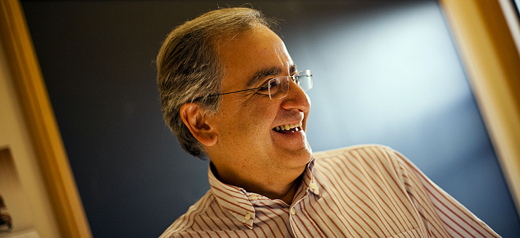
Cumrun Vafa, an Iranian physicist who teaches at Harvard University, paid a visit to Iran in late June and delivered a speech on the so-called string theory and quantum physics at the University of Tehran and later at the Iranian Physics Association. In the final hours of his stay in Tehran, he was the guest of Night Sky, a TV program on IRIB Channel Four, and answered the questions posed by the program host: Siavash Safarian. The following is an excerpt of the interview as covered by a 108th issue of Danestaniha Weekly out on July 12:
Q. You and your colleagues have been trying to unravel one of the most important mysteries of the world. Tell us about the project you’re working on.
I am working on the so-called string theory which seeks to unravel the basic mysteries of physics. There are two main issues this theory seeks to incorporate: Einstein’s theory of relativity and quantum mechanics.
Q. What is this theory all about?
If you look at tiny particles such as electrons and protons from a different angle, you can replace those particles with strings. This theory is the only one which goes beyond the bounds of gravity and quantum physics and places them in a logical framework.
Q. What is it aimed at?
It is about physics, about the origin and end of the world, about the so-called black holes, and about primary particles. It covers masses from very small to very large and constitutes a core theory for physics.
Q. Would you tell us about your decision to go abroad?
After graduating from high school I moved to the US to further my studies. Seven or eight years later, the string theory which seeks to translate geometrical quantities to physical quantities and vice versa caught my eye.
Q. Does your work leave an impact on your mentality?
Scientific equations are always on my mind, because I find it difficult to push them out. Definitely, this leaves an impact on my mentality which differs from those who have little knowledge about scientific principles.
Q. Does that make your life any easier?
It makes my life stranger. Things that might sound interesting to others are not interesting to me. That is interesting because it brings you closer to the ultimate reality. Of course, as a physicist, I know that all theories could have holes. That is interesting too, because it helps you feel different.
Q. Everyone wants to contribute to efforts to make the world a better place. How do you think we can makethat happen?
I wish I could say I am making efforts toward that end. But the driving force behind my research is the pleasure I find in conducting research.
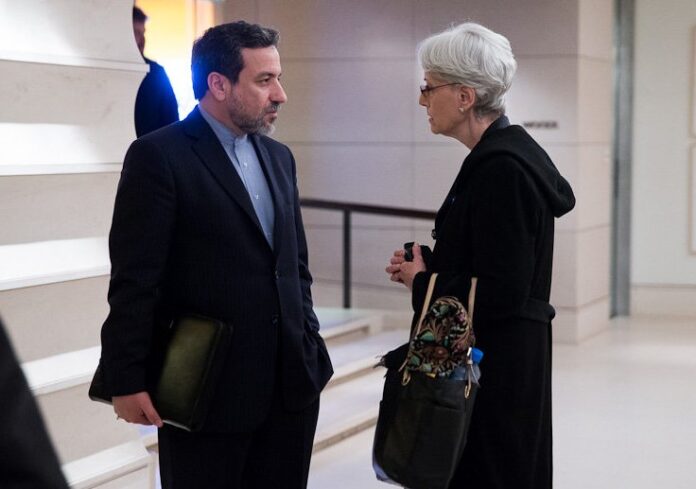
Seyed Abbas Araqchi’s was reacting to comments by US Under Secretary of State Wendy Sherman who had cited “significant and steady” progress in Iran nuclear talks.
“We’ve exchanged ideas, narrowed gaps on key issues, and identified areas where more hard work is required,” Xinhua quoted Sherman as telling senators at a hearing.
The top Iranian nuclear negotiator played down the remarks and said:
no deal has been made on any specific issue in the course of negotiations, including Arak heavy water reactor or Fordow nuclear site.
Basically, there has been no agreement on any of the topics, and differences still remain, Araqchi underlined.
“The only criterion for the Islamic Republic is the country’s needs, and during the talks, decisions are made exclusively according to the country’s needs,” Araghchi said.
On July 18, after more than two weeks of intensive diplomatic negotiations in the Austrian capital of Vienna, Iran and the Group 5+1 (also known as P5+1 or E3+3) agreed to continue talks on Tehran’s nuclear program for another four months.
The two sides decided to extend the nuclear talks until November 24 in the hope of clinching a final deal to resolve the decade-long standoff over Iran’s nuclear energy program.
Iran and the sextet on November 24, 2013, signed an interim nuclear deal in the Swiss city of Geneva.
The breakthrough agreement (the Joint Plan of Action), which came into effect on January 20, had given the parties extendable six months to draw up a comprehensive nuclear deal.
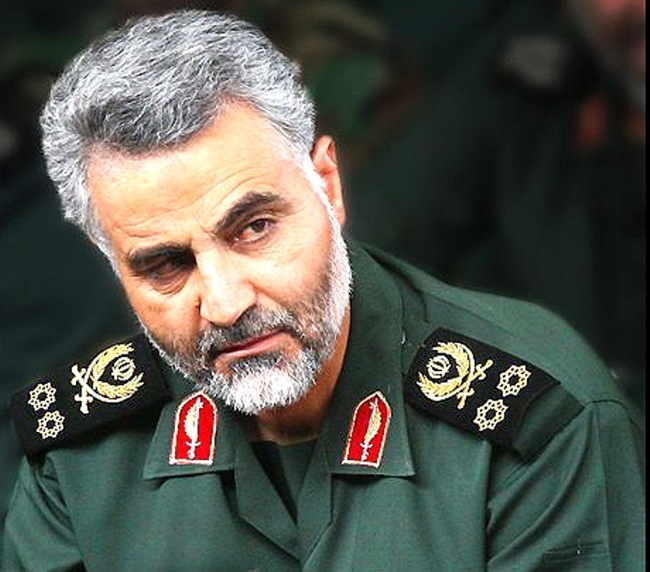
The Iranian commander underlined that confronting the Zionist enemy is a necessity, and expressed hope that the Palestinian resistance movement would turn land and sky into hell for the Zionists soon through its massive defensive operations.
He further rooted out the issue of preventing the Palestinians from receiving weapons and ammunitions, and said, “Disarmament of resistance is daydream that will only come true in the graveyard (for the Zionists).”
Earlier, Supreme Leader of the Islamic Revolution Ayatollah Seyed Ali Khamenei strongly condemned the recent Israeli attacks on the Palestinians, and underlined that Palestinians should continue their armed struggle against Tel Aviv.
“The armed resistance by the Palestinians is the only way to confront Israel,” Ayatollah Khamenei underscored.
The Iranian Supreme Leader noted that criminal acts of wolfish, child-killer Zionist regime in Gaza have revealed its true nature, and said, “Only way to solve this problem is full annihilation and destruction of the Zionist regime.
Israel has been pounding the blockaded Gaza for 24 consecutive days, killing at least 1,360 people and injuring more than 7,600 others.
Iran Desk to be set up at Italian industrial promotion agency
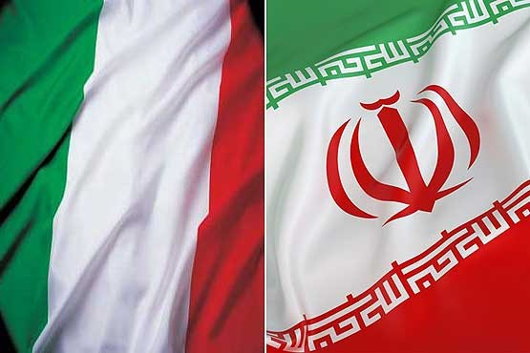
Following a thaw in relations between Iran and Europe that came in the wake of a preliminary nuclear deal between Tehran and P5+1, an Italian trade delegation visited Iran in late July to explore ways of forging closer bilateral cooperation and clear the hurdles standing in the way of more trade ties between the two nations. Here is a report Sharq Newspaper ran on the story on July 26:
The Italian delegation was led by Director General for the Country Promotion Andrea Meloni who told the director of the Iranian Trade Promotion Organization Valiollah Afkhami-Rad that Rome is interested in promotion of ties with and investment in Iran. […]
The Iranian official, for his part, said long-term tax exemptions and visa-free entries are some of the incentives on offer in the country’s free trade zones.
He further said the Iranian automotive industry is all set to receive investment by Italy, adding that after the gradual easing of sanctions, Iranian carmakers have set the stage for expansion of relations with other countries.
At the meeting, another Italian delegate said an Iran Desk is to be set up in the Italian industrial promotion agency to pursue better relations between Tehran and Rome.
In conclusion, he signaled the willingness of Italian industrialists to establish a presence in Iran and said the two sides need to join forces to respond to growing calls among Italian industrialists for such presence.