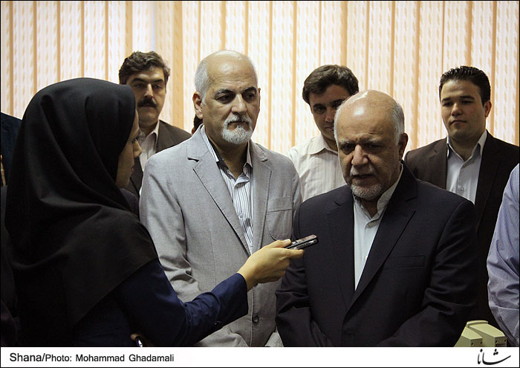
“In the negotiations for selling oil, we do not restrict ourselves to anything, but rumors about the signature of a contract with Russia for selling Iran’s oil are not true,” Zanganeh said.
He said during his meeting with Russian Energy Minister Alexander Novak, a memorandum was signed for development of economic, technical and trade ties between the two countries.
“During this trip [last week], an agreement was also signed for facilitating banking operations between Iranian and Russian banks with the objective of accelerating business operations in the two countries,” said the minister.
Zanganeh said Iran plans to raise its oil production by 700,000 b/d over the coming three years as part of the government plan to push the country out of recession.
The minister also said that Iran plans to increase production from the massive South Pars gas field by 300 mcm/d by March 2016.
He said that Iran will start developing Phase 11 of the offshore field, shared with Qatar, even if the Western governments do not lift sanctions to allow foreign companies to return to Iran.
“Chinese companies are ready to cooperate with this province in the construction of the second phase of the monorail as well as the telecommunication networks, airport and highway construction projects and they intend to sign a memorandum of understanding (MoU) in this regard,” Top Adviser of China’s Gansu Governor General Oyang Jian said in Qom today.
He pointed to the activities of Gansu province in recent years, and said, “Gansu province is the first Chinese province that has set up a trade delegation.”
The Chinese official noted that the value of Gansu-Qom export/import has exceeded $100 million, and said since Gansu and Qom are sister provinces their cooperation should further increase.
He expressed the hope that Gansu and Qom provinces would increase their cooperation in the agriculture and energy sectors.
Gansu is a province of the People’s Republic of China, located in the Northwest of the country.
Last month, Chinese officials held talks with their Iranian counterparts to finalize a deal on financing railway development projects in Iran.
“Our priority is the development of railway through attracting finance and recently we have reached an understanding with China, which is being finalized now,” Deputy Director of Construction and Development of Infrastructures Transportation Company (CDITC) Seyed Massoud Nasr Azadani told FNA after the talks.
He, meantime, said that proper conditions are also ready for the Iranian companies to invest in building railway lines in the country.
Earlier today, Iran’s Ambassador to China Mehdi Safari underlined Tehran’s resolve to utilize every possible capacity to pave the ground for widening and deepening all-out relations with China.
Addressing the Iranian China-based Businessmen Council members, Safari said senior officials, in both Tehran and Beijing, have always underlined expansion of mutual cooperation between the two friendly countries.
He went on to say that the two countries’ trade stood at $39.5bln last year, of which $25.393bln pertained to China’s imports from Iran and $14.387bln to its exports to Iran.
Describing Iran as a reliable partner to China in the region, he further noted that China is well aware of Iran’s influential role in the strategic regions of West Asia, Middle-East and the Persian Gulf.
Recalling Iran’s very suitable situation for the Chinese investors, he further noted that a group of Chinese experts will visit Iran to study the location and infrastructure of Bandar Jask on rims of the Persian Gulf for investment and establishing industrial townships.
He called on the Iranian traders and economic activists to enter China’s great market and raise non-oil exports to the country.
Iran is currently China’s third largest supplier of crude, providing Beijing with roughly 12 percent of its total annual oil consumption.
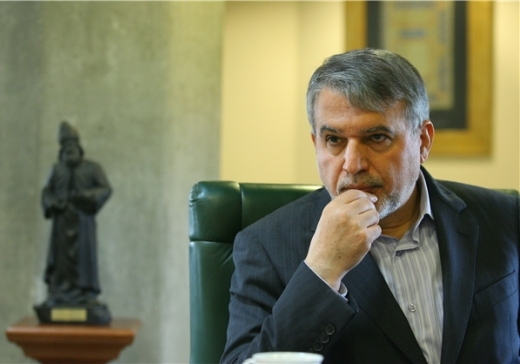
Seyyed Reza Salehi Amiri, the current director of the NLI
The status of the National Library of Iran (NLI) as a determinant of power play and of relations between the establishment and the public is gradually improving. It was almost two decades ago that Seyyed Mohammad Khatami resigned his post in the Cabinet of then President Akbar Hashemi Rafsanjani to take charge of the NLI. That decision provided him a nice respite from the pressures of an executive position as well as from political wrangling so that he could focus on theoretical foundations of the Islamic revolution as well as on religious and historical issues, the common ground of civilizations, philosophy and rules of governance. He went on to put forth the idea of “Dialogue among Civilizations and Cultures” as the least expensive means to secure détente in international relations.
Mohammad Khatami’s stint at NLI has undoubtedly played a role in the idea of “Civil Society” he presented to the nation, in his victory in the 1997 presidential elections, and in the reform discourse he championed. Two decades on, will the directorship of NLI result in new theories and discourses? What will come next from the hills overlooking the capital’s Abbasabad Neighborhood, home to the NLI?
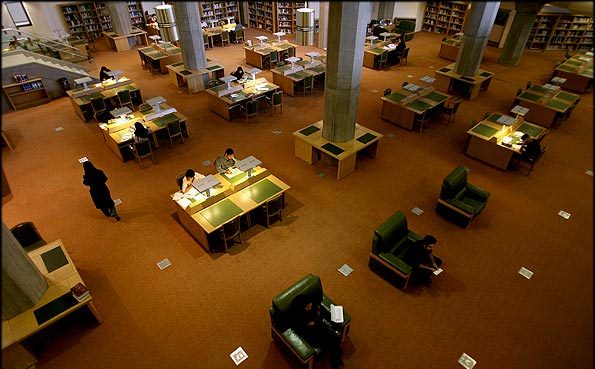
National Library of Iran
Seyyed Reza Salehi Amiri, the current director of the NLI has both similarities and differences with his predecessor: Mohammad Khatami. Salehi Amiri was only a small number of votes away from assuming a post in President Rouhani’s Cabinet. Of course, Khatami was successful in getting a vote of confidence from parliament, but gave in to pressures he could not tolerate and resigned as the minister of culture and Islamic guidance of the sixth government. One thing the two have in common is that both of them have focused on discourse – one on the discourse of reforms and the other on the discourse of moderation.
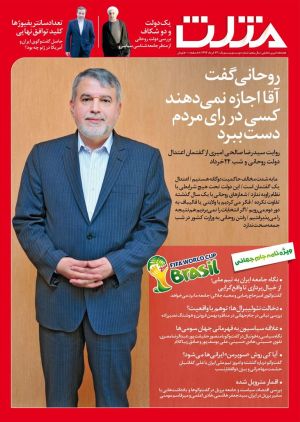
The present article features the answers the director of NLI or as a 221st issue of Mosalas Weekly would like to call “a close associate of Hassan Rouhani” has provided to questions asked by the editor of this principlist publication. The interview covers a wide range of questions including Amiri’s credentials, theoretical aspects of moderation and the coalition between reformists and moderates in elections.
The initial questions revolve around Amiri’s background and his association with Rouhani. “There are two distinct periods during which Mr. Rouhani and I worked together. In the first period that started in 2003 and ran through 2005, we were colleagues at the Supreme National Security Council, and in the second I was a member of the Center for Strategic Studies.”
In response to a question about his association with Mr. Rouhani, Salehi Amiri says: “Basically, I specialize in socio-cultural issues. At the Secretariat of the Supreme National Security Council and at the Center for Strategic Studies too, I focused on cultural and socio-cultural questions. At the university, I am in charge of the Cultural Management Department. Over the past decade, the Center for Strategic Studies has released a total of 400 research papers. The studies we conducted at the center fell into two categories. We would build on the results of the first-category research to prop up the academic atmosphere of the country, and the second category would eventually be used in policy-making as far as family, mass media and education were concerned at the State Expediency Council.”
On his academic and cultural background, he says, “The measures taken at the Center for Strategic Studies are of great importance. For example, if a government closely examined its own performance, it would be able to use the result of such assessment to develop a new discourse, either for itself or for its allies to be used in future races.”
He also talks about the theoretical aspects of moderation and their role in governance. The Q and A in question is presented in the form of an article here. The abridgment of the answers he has provided does not mean the content has been altered. In the interview which was conducted to mark the one-year anniversary of President Rouhani’s victory in election, Salehi Amiri also talks about the vote count:
“There were three of us: Hassan Rouhani, [Hesameddin] Ashna and me. Before midnight he [Mr. Rouhani] went to take some rest. We were worried, but he said he was not stressed at all because the tally would go ahead in keeping with procedure. Before he went to bed we told him about good results coming in from the provinces. He confidently told us, ‘His Excellency [the Supreme Leader] won’t let anyone rig the vote.’ Based on his familiarity with His Excellency and the latter’s sensitivity about the votes of the people, he was confident there would be no fraud. ‘There is no reason to be worried, results will be released the way they are.’’’
What the interview with Salehi Amiri reveals is that he is not tasked with developing a discourse for others – rather, he and other allies of Hassan Rouhani are trying to theorize moderation and win over some middle-of-the-road reformists and principlists in order to fare well in the upcoming parliamentary and presidential elections. The success of such efforts hinges on a number of factors, including the conclusiveness of nuclear talks and restoration of interactions with the rest of the world. Will world powers – namely P5+1 – once again ignore the moderation of Iranian statesmen which could lead to sustainable win-win interaction? If that turned out to be true, one can conclude that Salehi Amiri’s moderation discourse can only be useful in classrooms, and not in governance. The following is what he has said:
Moderation is rooted in history and dates back to the time when Imam Ali [Prophet Muhammad’s son-in-law] was the caliph of the Muslim community. His five-year caliphate is an invaluable experience as far as religion, history and governance are concerned. […] The way he would treat those who were opposed to him, his tolerance of dissent and his just treatment of non-Muslims indicate that moderation was a hallmark of Ali-style governance.
In the course of history there were individuals such as Farabi, Naser Khosro and Avicenna who are hailed as intellectuals and wise thinkers. In the contemporary history and in the post-revolution Iran, Imam [Khomeini] manifested moderation. Unlike in other revolutions, Imam put forth a new idea and talked about popular uprising rather than armed struggle. He was bitterly opposed to the use of force in overhauling the foundations of a system. Although Imam followed a revolutionary approach, such behavior was moderate and came despite the fact that armed struggle would definitely have produced a swifter outcome. He was adamant that revelation of the crimes the Pahlavi regime committed would help society feel the impact of the performance of their rulers on their lives. That was what happened. When Imam said blood prevails against the sword, he revived the memory of the uprising the grandson of the Prophet led against injustice and incorporated that uprising with the Iranian revolution.
Such a prudent approach led to the emergence of a huge social movement. When Imam returned home, Iranian society had already embraced his revolution which was partly cultural in nature. The revolutionaries did not commit acts of violence. Imam neither supported nor attached importance to the militias who were bent on carrying out armed struggle.
It should be noted that all discourses that emerged in the wake of the revolution were partly based on Imam’s line of thinking. One of these discourses which came under the spotlight during the course of the war centered on values, a discourse which was championed by Imam and embraced by the government. It was the only period in which the official discourse was the same as the unofficial discourse, one which was integrated into society and its culture.
Afterwards, development and reconstruction, which were a necessity of the post-war era, took center stage. That discourse which could be described as a historical necessity proved effective in easing the country’s problems such as poverty and poor infrastructure and put it on course to growth and development.
The third discourse revolved around reforms of which public contribution [to day-to-day administration of affairs], political development and expansion of civil institutions were an integral part. The discourse in question came in response to a second set of social demands for public contribution to state decision-making. Then came the justice discourse. I believe the problem associated with this discourse is that its various aspects remained unexplained and justice was simply used as a slogan. Besides, the discourse of justice belongs to the Supreme Leader; in fact, it is a super-discourse that covers all other discourses of society.
After the justice discourse came moderation, one which was put forth as a necessity to secure national unity. A society weary of conflict, violence, political wrangling, illogical behavior and isolation was unwilling to be dragged into more disputes. In this tense atmosphere which was fraught with vengefulness, slander, and accusations society needed respite. That was when the discourse of moderation emerged.
The moderation discourse is an evolved form of previous discourses. It is not an imitation of previous discourses; nor does it run counter to the discourses that preceded it. This discourse believes in values, attaches importance to development and reconstruction, and views reforms as a vital necessity to sustain the political life of society. It regards justice as a source of all discourses. Still it believes that a new discourse is needed in order to secure national unity and political wisdom, and that a new language should be used in dealing with the rest of the world.
The most important reason behind the need for a new discourse is the inefficiency of the country’s foreign policy over the eight years [that led to the presidency of Hassan Rouhani]. This new discourse of moderation should not be viewed as conciliatory, inactive or unable to stand up for national interests and expediency. As we all know the macro-policies of the establishment are devised at a high level and different governments use different methods to implement those macro-policies. […]
Macro-policies of the establishment are those which eventually secure the go-ahead of the Supreme Leader and governments are required to implement them, through different methods, though. The methods the previous government used did not work, but I am certain the methods the current government is using will. The impact of those methods is already evident in the country’s foreign policy because the attitudes have changed. […]
The moderation discourse has a religious and ideological foundation which has manifested itself in the governance of the Commander of the Faithful: Imam Ali (PBUH). Moderation is part of our religious principles and can be easily traced in the conduct of religious greats. Historically, wisdom has been at loggerheads with ossification. Wisdom is one of the pillars of moderation. In fact, wisdom lies at the center of every decision we make. Why do wisdom and our national interests require us to opt for moderation in our foreign policy today? Why should we choose interaction on the domestic front? The answer is that wisdom necessitates measures to steer a politics-weary society toward calm. I believe moderation is built on a theoretically strong foundation. […]
The philosophical, religious, diplomatic, economic, cultural and social foundations of moderation are all there. What we are doing now is tapping into a historical experience, the approach of the Prophet and Imam Ali, and the mentality of Imam which continued well into the post-revolution era, in order to define, not invent, the discourse of moderation. Moderation is a discourse which is already part of the country’s political system.
Some prominent individuals including sources of emulation, elites and clergymen who have no political leanings manifest moderation. In other words, moderation which respects other discourses such as principlism and reformism has made it onto the country’s political scene with a new language. In this new language, political boundaries are not demarcated. The current government is a moderate one. You cannot call it a reformist government or one which is exclusively committed to reconstruction. This government brings together all components necessary to secure national unity and development, that is why individuals with different affiliations are brought on board based on merits. […] Political approaches usually entail red lines, and the president has called extremism as the red line of his government.
Only those who do not walk down the path of wisdom, those who constantly seek to incite violence and disrupt the political atmosphere, those who are out there only to secure individual and group interests, and those whose management becomes meaningful only in a tense atmosphere cannot be part of this government. I believe the extremist line of thinking is very limited in Iran, but its limited followers are loud enough to be heard. At the same time the potential for moderation is great. In light of the fact that those who are moderate believe in wisdom and follow a strategy of unity, they are less likely to make the political atmosphere tense.
A comparative study of how things were yesterday and where they stand today reveals that society is in an ideal condition as far as stability and tranquility are concerned. Some view this calm as running counter to their interests and try their best to provoke the government into reaction and thus disturb the prevailing calm. If that is not the case, what does this great volume of misinformation, slander, character assassination and misjudgment [targeting the government] mean? For example, an Iranian correspondent [who is in Vienna to cover talks between Iran and P5+1] asks the US Under-Secretary of State [Wendy] Sherman when the parties to the negotiations are going to talk about Iranian missiles. That question is asked despite the fact that the correspondent knows well that Iran’s missiles are not on the agenda and that the Islamic Republic has no intention of talking about its missiles. Why is such a question asked from the US diplomat? The answer is that they want to pitch the idea that [Iranian] diplomats do not tell the truth and the correspondent wants to hear the truth from Mrs. Sherman. They seek to disturb the calm that exists on the foreign policy front.
But the government is too smart to be caught in this snare, and believes it has to spend the better part of its energy on the country’s development drive and on answering the needs of the public rather than countering such movements. […]
The moderation discourse seeks to promote the kind of political system that makes optimal use of the experience of the last thirty-something years to secure full-scale political, economic, social and cultural development and serve the interests of the public. In the process it is the national unity, and not political reprisal, that takes center stage. This is the central pillar of the discourse that seeks to create a national government to which everyone contributes. […]
On the religious front, attention to the viewpoints of the sources of emulation and clergymen is instrumental in the success of the government. […] The government also views compliance with the orders of the Supreme Leader as a necessity. Over the past year the government has immediately implemented all the instructions and policies communicated by the leader. This is what real compliance means. Compliance should come in action rather than in words and superficial behavior.
Another approach of the government concerns the elite, pundits, thinkers and other influential individuals that serve as a link between the public and the government. The government is in close contact with these individuals and views dialogue with the elite as a vital necessity.
At present, extremists are bent on making the public draw a line between the establishment and the executive branch, and this does injustice to both. History shows that parallel governance is costly and inefficient, and the government of moderation believes that nothing comes between it and the establishment at large. […] In the Islamic Republic of Iran, all branches of government and all institutions are part of a central framework. The use of force, threats and pressure to push some out and thus set the stage for subjecting them to criticism is unjust.
Three factors have contributed to conclusions by reformists that sticking to power is not their ideal: the eight years they were at the helm and the challenges they faced in the process, the eight years Ahmadinejad was in office, and the [post-election] incidents of 2009 which they found extremely bitter to swallow. The experience of the past years proved to reformists that there are others who can run the country and steer it in the right direction without necessarily landing on a collision course with them.
Mr. Rouhani was an independent who ranona platform of independence. Reformists do not view the rise to power of Mr. Rouhani as contradictory to their goals and views, so they regard cooperation with a government that seeks to serve the interests of the public as part of their mission. […] What Mr. Rouhani says today is in line with what he has in mind. Basically, he does not accept duality in the policies that are announced and those which are implemented. He says what he believes in. […]
His stance on the nuclear issue has remained unchanged since day one. In an interview [before being elected], he said the direction the government of Mr. Ahmadinejad was leading the country in ran counter to our national interests. In the [presidential] debates, he reaffirmed his stance and called for a change in that direction.
On the economic front, he believes in development with an emphasis on social justice so that those who are on the lower rungs of society are given a chance to benefit from the development drive. On the cultural front, he has put modern thinking with an emphasis on principles of Islam and wisdom under the spotlight. He believes what he says is based on religious and ideological principles. For instance, his warning that people should not be forced to go to Heaven [a reference to insistence by some officials that the Islamic dress code should be enforced strictly at all costs] is based on a story involving the Prophet.
He follows a similar approach when it comes to the mass media and has recently elaborated on that approach in a press conference. He has touched on his policy vis-à-vis the elite during a speech at university. His approaches in other areas are more or less similar.
For a person like me who has spent years with him, those things are nothing new. They are in fact expressive of his views. But for those who are unfamiliar with the language he uses, they sound new. You take a look at his speeches on the campaign trail and you come across concepts such as cultural pluralism, national cohesion, national unity, civic rights, privacy, compliance with political ethics, respect for national and religious identity and support for guilds, including the Media Guild and the Cinema House. He believes that the public handed him a mandate to promote these concepts and that his government should be faithful to the things the public has entrusted it with. I believe what he’s doing is in line with the promises he has made to the public. […]
And the important thing here is that Mr. Rouhani believes that political activities should set the stage for development rather than dispute. I believe his strategy is a good one. He is not trying to blow up the country’s political atmosphere – rather, he is bent on tapping into the country’s political potential to secure national unity. Let me repeat it, the 11th government uses politics for loftier purposes, not simply for political purposes. Politics should not be a source of dispute – rather, it should be used as a basis for development. This is a very important approach. In other words, the government never seeks political confrontation; what the government is after is interaction.
In a cabinet meeting on Sunday, the president ordered that all Iran-140 passenger jets be banned from flying until full investigation is conducted into the cause of the crash.
He also expressed deep sadness over the incident and expressed condolences to the families of the victims and the entire Iranian nation.
During the cabinet session, ministers of road and urban development and defense presented reports on the tragic plane crash.
The Antonov An-140 (Iran-140) aircraft belonging to a domestic airlines fatally crashed in a residential area in the west of the capital, Tehran, on Sunday morning.
It was scheduled to travel from Tehran to the northeastern city of Tabas when the incident occurred.
At least 38 passengers have been killed so far. No information is available on the cause of the crash.
The Antonov An-140 commercial passenger airplane is a twin-engine turbojet aircraft, which can accommodate up to 100 passengers
After purchasing the production license for the An-140 from Ukraine in 2000, Iran built its first Iran-140 passenger plane in 2003.
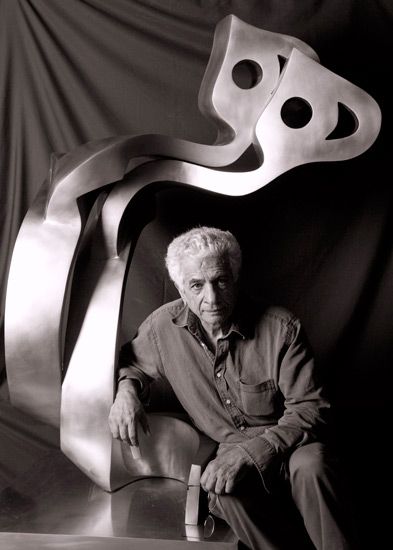
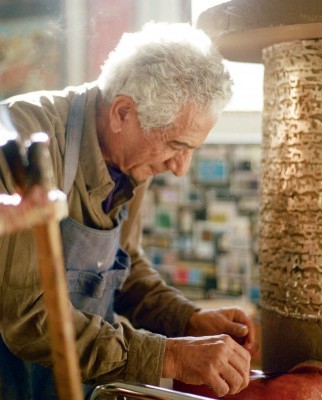
Zanan-e Emrouz (Today’s Women) Magazine has run an interview, conducted by Maryam Omrani, with Parviz Tanavoli, an internationally acclaimed sculptor, in its second issue out in July 2014. The interview looks into the development of Parviz Tanavoli’s artistic works with a focus on Saqqa Khaneh school of thought. It also focuses on his entry into jewelry and ornament production, analyzing the sociological aspects of the decorative objects. The following is an excerpt of the interview and its lead:
It is 6:00 p.m. June 5, 2014. I had an appointment with Parviz Tanavoli at his workshop located in his house in northern Tehran. I found a red-brick house with a yard awash with plants and sculptures which represent various periods of their creator’s artistic life. […]
It is stormy out there and the sculptures in the yard are covered with dust and dried leaves. A sculpture dubbed Heech (Nothing) which has sneaked its bust out of the cage in a southern corner of the garden leaning against the wall draws my attention more than other sculptures that sit far from the workshop. The master and I sit on dust-covered chairs in the workshop and continue our chat for hours thanks to his warm and good temper. […]
Tanavoli is part of Iran’s contemporary art history. He is a member of a generation of artists who tried – back in the 1960s and 1970s – to incorporate the qualities of modern art into Iranian art. Tanavoli is among the pioneers of the Saqqa Khaneh School, an artistic current he and his fellow artist masters of the time founded. They integrated the symbols of Iran’s traditional art and indigenous culture with global artistic standards of the time and created a new style; in other words, they tried their best to offer a modern definition of traditional and national aesthetics.
In addition to his main career as a sculptor, Tanavoli has always showed much interest in designing other items such as jewelry and decorative stuff. He has also brought together various collections of items from the country’s indigenous culture which merit attention from an anesthetic aspect. Drawing on the collections in question, he has put out some books, chief among them, the collections of Iran’s locks, surma holders, scales, scale weight stones, gravestones, charms and magic spells, etc.
The interview turned out to be more of a friendly chat than a specialized one-on-one meeting. It centered on feminine curiosities on the works Tanavoli has produced in the form of decorative items, among them the minimized sculptors used as pendants [hanging on bracelets]. Our chat also shifted to the history of non-traditional jewelries and decorative items and the way they were designed in Iran. He opened the conversation himself and here is what he said:
The other day when you talked to me about the link between decorative items and gender, I wondered why women like these ornaments but men don’t. Why is that women are interested in grooming themselves? Is it an internal need for them or they do so because men want them to? Anytime I thinking over this, I come to the conclusion that only men have run the affairs of societies over time and they have taken possession of everything in the world. Women too have been part of their possessions. One seems likely to decorate a thing the way they like when they have it in their possession. Perhaps, the balance would have been tipped and women would have decorated the men and bought them decorative materials if they had been in power, calling the shots and controlling the armies. Of course women’s desire to collect precious jewelry and decorative items could be somehow attributed to a lack of economic security on their part. A woman, with no business or job to earn her living, remained concerned about the uncertain future, especially if her husband had abandoned her.
Parviz Tanavoli-Iranian Sculptor
In Iran’s public culture, or in the East by and large, there is a general tendency toward ornaments and embellishments. If you look at Iran’s traditional art, you would come across many tiny and dense designs which have been made merely for decorative purposes. Traditional jewelries, hand-woven materials and other practical items designed for daily use seem to have served such a purpose. Today, people’s taste has changed to some extent.
Yes, you’re right. It is so if we talk about jewelries independently. What has remained from different treasures such as those from ancient Greece, ancient Rome, ancient Iran, China and India does share common designing qualities. In eastern societies, decoration and makeup have mattered much and are still important. The reason behind this is perhaps the fact that women did not frequently go out so in order not to feel depressed they used to both wear decorative accessories and fill the house walls with different decorations and ornaments. They would hang carpets, tableau and calligraphy items on the wall. They would apply mirrors and mirror artworks inside the house. A careful look at their household items shows that the cooking pots, carpets and fabrics they used enjoyed an aesthetic style of production. It is true that men used to build these tools but it seems that they too wanted to see their wives amused, develop interest in their lives and the interior atmosphere of the house, and thus not miss the outdoors.
Now that you are talking about the aesthetic aspects the Iranians have employed in their items I remembered your collection of surma holders the photos of which have been released in a book together with their history. Are you saying that those surma holders were feminine devices?
No. They were not devices used only by women. The fact is that surma was not applied exclusively by women. Afghan and Baluch men still wear surma. In the past, surma was said to come with medicinal effects. According to an ancient Iranian text which has survived the passage of time, Cyrus the Great would instruct his soldiers to wear surma and blacken the areas around their eyes. The application of surma slightly differs from that of makeup. The people who lived in desert areas where the sunlight was direct and intense would put on surma to handle the light.
The ornaments remaining from the ancient times, for instance from the Achaemenid and Sassanid periods or later times, show that men too used ornaments for decoration. Is there any difference between these ornaments when it comes to designing patterns?
Men used decorative items as well, but I think the kind of ornaments they used was different. Men sought to highlight their masculinity and manly power through the jewelries they wore. They used to display their muscular upper arms by a metal ring [around them], or they would tie heavy metal rings around their wrists and necks. They would use much simpler decorative items. No precious stones can be spotted in their jewelries and ornaments. Generally speaking though, except for old stones such as emerald, ruby and the like, no other precious stone can be found in the ancient jewelries or those of the following periods. Stones and their use (in ornaments) are a new phenomenon. The application of stones such as diamond goes back to one hundred years ago. Decoration of engagement and marriage rings with gemstones like brilliant was first planned and introduced by British companies, and this suddenly sent the price of valueless gems like brilliant skyrocketing. But I think stones are soulless and lifeless and they are not very much different from glass, aesthetically speaking. Think about it. For example, imagine in China which is home to over one billion people, everyone decides to have brilliants in their marriage rings. This explains why this gem went global all of a sudden, something which saw these companies reap staggering profits. […]
Taking a look at the history of jewelries, we get to realize that it has been for long an issue for traditional artists or handicraft creators and that the jewelry making art has at times been regarded as an independent artistic field. Exactly when did people interested in visual arts as well as sculptors and painters start to design jewelries?
Well, some jewelries are attributed to certain artists of the Renaissance and post-Renaissance periods. Artists in general and painters in particular had and do have the talent to design jewelries but they had never been the producers of these items. Another guild would produce the jewelry, those who had mastery and had special tools at their disposal. In Iran too jewelry producing was a separate occupation. Traditional jewelry makers would design and produce their items all by themselves. At some point in time, jewelry designing became a mix of foreign jewelry and Iranian traditions. In the Qajar era, the import of French and Belgian jewelry was on the increase in Iran where [domestic] jewelry makers copied the imported items from time to time. At times the imitations were produced so delicately and skillfully that they looked even more beautiful and attractive than the real thing. And in another period industrial jewelries made their debut on the market.
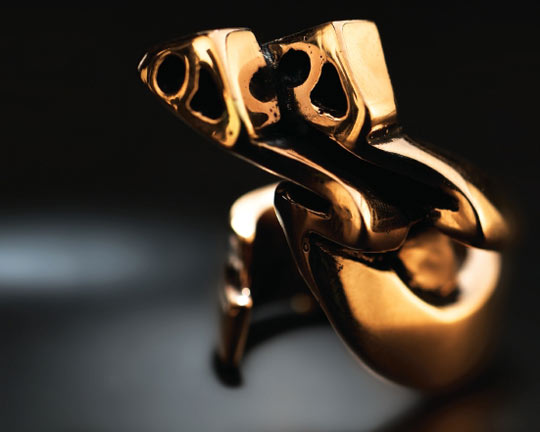
As for my designs, I have no idea whether such a name is suitable or not. In our culture, “jewelry” is referred to a mixture of valuable gemstones and gold. These handmade items are too delicate and ornately rich to match my sculpture-like bronze and silver designs, unless we take into account their dimensions and functions in the form of rings, bracelets and necklaces. I have always showed strong interest in the sculptures which were made of stone, bronze and other materials in different areas in Iran in the first millennium BC, or the very tiny stone weights, horse gear or fittings or, let’s say, the designs which were not meant to be used as jewelry but their beauty was by no means less than jewels. I didn’t want to repeat or copy the ornate richness of traditional jewelry. Maybe I wanted to produce my works in a very tiny size ….
[…] Over the last 50 years we have seen practical designing by the world’s modern and post-modern artists who have created the items not related to their main profession such as sculpting and architecture. For instance, Zaha Hadid, who is known for her architectural works, does designing for decorative items and other tools such as house stuff, clothing items as well as shoes and footwear. What about Iran? How is it in Iran?
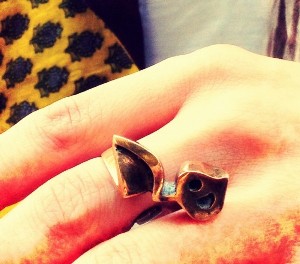
I dare to say that many people across the world who are active in visual arts are currently designing jewels as well. But I do not remember any in Iran. At first, it was only me who showed such an interest, I suppose. I started to make jewelry in the early 1960s. I don’t know of any other artists who have designed jewels on top of their main profession, for example sculpting. Back then I wanted to make the Heech sculpture in different sizes ranging from one spacious enough to accommodate one person to the size which could wrap around a wrist or a finger. Back then a woman who was a public office holder asked me to design jewelry for her. She wanted it because she had to take part in an official gathering in which ranking officials including ambassadors from foreign countries were also in attendance and she liked to have some unique jewelry on with Iranian designing, and not a Cartier design necklace or something with other European designs. The same lady gave some semi-precious gemstones to me. I did some designing and it marked the beginning of my job. I did some of those designing patterns for my wife and some other people. One of them is the very “Heech” ring which was widely welcomed. […]
Do the materials you use for making jewelry differ from those used for producing sculptures? Do you make use of more expensive metals such as gold and silver as well?
I do use bronze instead of gold. I seek to get my message across by using such primary materials. I want to say what matters is the work of the artist and not the materials he or she uses. […]
Parviz Tanavoli
Do you know anything about your customers? Do you have a special audience in mind when you work on your designs? I mean a special social group.
No. I don’t think about any special group of people while working, but instead I think about making my items in a way which everybody can easily use, for example different sizes of rings and necklaces and this does not cover a special group of people in society. I don’t have any information on the exact number of those who buy my works, but they are usually top earners or high-income groups in society. Compared with sculptures, the price of decorative items is much lower. The upside of the jewelries is that they look as if they are friends with people. They are close to us since they are on our fingers. They go from place to place with the person who carries them. They even go on trips with their owners. On the other hand, you need a vast space to hold a sculpture, whether it is placed in the garden, inside the house or in any other place. It cannot accompany you wherever you go and you cannot take it on a trip with yourself.
Now that you talked about the friendship between an individual and his or her jewelries and their attachment to human body, it crossed my mind to ask you how the jewelries affect the personal identity and help distinguish between its owner and the others. For example, a woman who wears an expensive piece of jewelry tries, in one way or the other, to show she is different from other people, or the person who has put on the Heech ring regards herself or himself somewhat distinct from other people from a cultural point of view. Both share one thing: they like to be different.
It has been the case in all societies and throughout all historical periods. Suppose, for example, the jewelry an artist like (Alexander) Calder designs is used by some. They must be distinct. Also bear in mind that their price is likely to have risen multifold since their production date. I don’t think a change of taste in using jewelries could be indicative of the change of time and a change in the spirit of those who wear them. With the modern jewelry and decorative items being received warmly, one can come to the conclusion that the mood of the Iranian women has changed from traditional conservatism to adventurism and to acceptance of the challenges of the modern world. Moreover, women display much interest in producing jewelry and decorative items. Girls and women account for 70 percent of my students in Mah Mehr Institute. The figure does not apply to jewelry courses alone. It covers other courses as well.
When did your classes resume in Iran and when did you include jewelry designing in the courses you teach?
Well, for years before the Islamic revolution I had taught in university but after my return to Iran I held a first round of classes in Mah Mehr Institute back in June 2006. If my memory serves me well, about two years later courses on modern jewelry designing were introduced. I’d like to say some words about my students, although they may not find their way to the magazine. Perhaps the magazine decides one day to publish reports on every single of them. Around 100 modern jewelry makers have been trained in my classes. They have been very much successful recently, both in holding exhibitions and in selling their works. Recently, fifteen students of mine held an exhibition in Mashhad which, to my disbelief, was widely welcomed. Incredibly these modern jewelries are widely received by people; most of them were sold out on the opening night. The same group has held exhibitions in Tehran, Kuwait and Paris. I was with them for some of those shows. I’m very happy that a modern jewelry nucleus has been born in Iran and now it is in its teens. These students have gone much beyond where we do stand now and I’m certain that their mother lode of knowledge would grow by the day. […]
Let’s come back to the question of women. Given the public culture and traditions, many Iranian artists, you included, produced some works back in the 1960s and the 1970s that are known as the Saqqa Khaneh School. Is there any trace of femininity in the works you produced back then?
You know, men are the theme of my works and I have usually placed women next to men. My sculptures mostly have a very masculine identity; in other words, a man who always has a desire for women. My works, namely Farhad Koohkan and Poet, show that these men had a desire for women. The men in my works never do without women; they have been always in love with women. Perhaps women have been given no figurative personification or representation in my works, but their traces are seen everywhere (he laughs). I don’t know what you would have done if men weren’t around, but I wouldn’t like to live if women were not in the world.
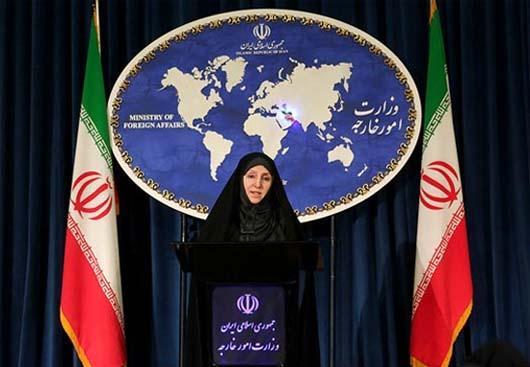
Iranian Foreign Ministry Spokeswoman Marziyeh Afkham in a statement on Sunday underlined Tehran’s support for unity and stability in Yemen, and condemned the recent terrorist attack in the country by the al-Qaeda-affiliated militia.
“Undoubtedly, consultations and partnership of all streams and parties in the political process and the Yemeni people’s vigilance will uproot this ominous phenomenon,” she added.
Fourteen soldiers were executed by al-Qaeda militants in Yemen in an apparent revenge attack after a recent army crackdown in the East of the volatile country.
The soldiers, who were travelling home to Sana’a on a public bus, were ordered off and taken to a market in Seiyoun on Friday. Their bullet-riddled bodies were found on a road near the city about three hours later.
Ansar al-Sharia, the local al-Qaeda offshoot, said its militants had killed the soldiers for taking part in military operations against the group.
The Yemeni army has recently sent extra troops to the Wadi Hadramout region in Northeastern Yemen in an attempt to stop Ansar al-Sharia declaring an Islamic emirate in Seiyoun.
One government official said the killings appeared to be an act of revenge.
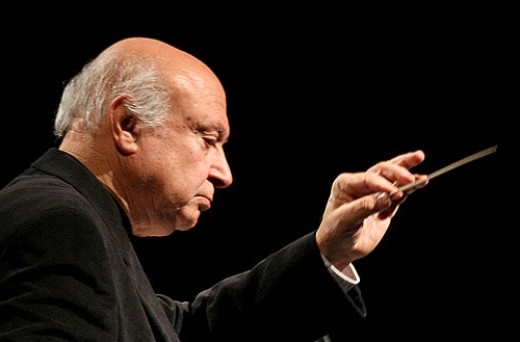
Farhad Fakhreddini is a renowned Iranian composer and conductor
Farhad Fakhreddini is a renowned Iranian composer and conductor who led Iran’s Radio and Television Orchestra (1973-1979) and went on to lead Iran’s National Orchestra (1998-2009). He has composed music for several popular TV series such as Sarbedaran, Roozi Roozegari and Imam Ali. Niusha Mazidabadi of Tajrobeh (Experience) has interviewed this prominent musician of late. The following is an excerpt of the interview published in a 30th issue of the monthly out in July 2014:
You have been a conductor both before and after the revolution and have worked with many musicians. How do you think Iranian orchestra is faring?
In the past what would worry me most was the small number of vocational schools for music in Tehran. When I was a teacher at the National Vocational School for Music, I would tell my colleagues, “I wish we had at least five such schools across Tehran so that students wouldn’t have to travel all the way from faraway neighborhoods of the capital to this school.” That wish was not granted, besides big cities such as Isfahan, Shiraz and Mashhad didn’t have music schools at all and no one seemed to be caring. After the revolution, things changed and the government cared less about music, but that didn’t stop people showing more and more interest in music. One of the reasons for growing interest in music was that parents felt it was safer to entertain their children at home, rather than let them pursue outdoor hobbies. Consequently, a large number of youngsters found their way into the world of music. […]
You think the number of musicians has increased as compared with before the revolution?
The numbers are not comparable. Before the revolution, we wished to have more youngsters signing up for music courses at vocational schools. After the revolution, private institutes cropped up. Famous musicians taught in theses institutes and many of those who took their music courses turned out to be good musicians themselves. I believe Iranian musicians are in good shape today.
Prior to the revolution, the academic aspect of music seemed to be stronger. Quality-wise, do you think musicians today are better than their pre-revolution peers?
I cannot answer that question definitively. What I can say is that the enthusiasm of today was non-existent in the past. I have also conducted orchestras elsewhere in the world, but the warm welcome concerts receive here in Iran is unique. I believe the fact that the Iranian broadcaster does not cover concerts should be credited for the warm welcome music events receive here in Iran. It should be noted that orchestral performances are far from lucrative, given that ticket prices are low and government does not lend financial support to the music industry. Up to 50 percent of what is fetched in a concert is spent on the organization of the event and on the pay of musicians. Let me assure you, in the absence of real fervor, musicians won’t achieve much. What is promising is that young musicians are still in contact with and taught by their older peers. I too belong to a generation of older musicians. I have played music in different orchestras. I don’t want to sound self-complimentary, but I belong in the ranks of musicians who have trained great students. It is an undeniable fact that some of my students have shined in different parts of the world including in Moscow, Vienna, Saint Petersburg, Toronto, etc. Anytime the Symphony Orchestra wanted to bring a new musician on board, the National Orchestra was the first place it would look at.
Let’s shift our focus back to the National Orchestra. Ever since the 11th government came to power, both [Minister of Culture and Islamic Guidance] Mr. Jannati and [his deputy Ali] Moradkhani have announced their intention to revive the National Orchestra and the Symphony Orchestra. A few months ago when you and Mr. Sahbai were officially named as leaders of the two orchestras, everyone knew something was on the horizon. But most recently, it has been announced that musicians willing to take up position in the orchestra have to take a test. Do you think the test is necessary?
They ran the test by me first. It is designed to identify talented musicians who haven’t been able to find their way into the orchestra. Under new the arrangements those who are capable will be given a chance to be admitted to the orchestra.
As a conductor you have always tried to maintain your independence. Some musicians, though, compose anything someone places an order for. How have you managed to maintain your artistic independence?
I work on things that are close to my beliefs. For instance, I composed the soundtrack of Avicenna TV series because I believed he was a great philosopher who attached importance to music. It is a great pleasure for me to have composed for such a great individual. Although someone had placed an order for the soundtrack, for me it was a labor of love.
What about the soundtrack of Imam Ali TV series?
Well the lyrics of that series were my biggest musical discovery. In my research I found out that those lyrics dated back to the time Prophet Muhammad was still alive. WhenMuawiyah asked the Prophet what made him so elated that his Abaya slipped off his shoulders onto the ground, the Prophet said, “The words conjure up the memory of a friend, and when the memory of a friend is brought up, one should get happy.” The relics date back to 14 or 15 centuries ago and I used them in the music of Imam Ali TV series. That was the result of a very long study involving ancient Iranian songs. Some might suggest that I have walked off the path of the Iranian music. That is not true.
In conclusion, if the NationalOrchestra is reinstated, do you have a repertoire to work on?
If we had enough money, we’d call up as many musicians as we can afford. In the National Orchestra players of Iranian instruments are not going to be a fixture. But if on a certain occasion, we had to play Iranian instruments, we would invite guest musicians and solo performance would be at the center of pieces involving Iranian instruments. Pieces are being composed for the orchestra. We don’t want to be singer-centered so that we can bring different instruments to the attention of the public. That said, we will introduce new singers to the artistic community. We hope to have the budgetary arrangements in place so that we can get the show on the road in a few months.
The original title of the interview which appeared in Tajrobeh Monthly was “Distance from Singer-centeredness”.
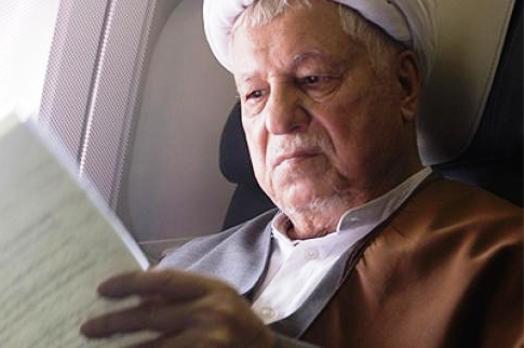
Chairman of the Expediency Council Akbar Hashemi Rafsanjani issued a statement on his website on August 5, 2014 to mark the first anniversary of the rise to power of President Hassan Rouhani’s government of Prudence and Hope. The following is the translation of Ayatollah Rafsanjani’s statement which was released one year to the day President Rouhani was confirmed in office:
Praise to God that over the past year, the government of Prudence and Hope has begun to pick up the pieces in different sectors. Revamping the foreign policy based on esteem, wisdom, and expediency has particularly seen the green shoots of hope grow.
In the history of world nations, especially in that of the honorable Iranian nation which has a brilliant civilization under its belt and has entwined it with Islamic culture as the essence of heavenly religions, there have always been ups and downs. Strengths and weaknesses as such coupled with the public opinion about them are a clear manifestation of learning from past mistakes and drawing a roadmap for the future.
At times there have been incidents the Iranians have not played a role in. For instance, in the past foreign foes have sometimes taken advantage of imprudence on the part of Iran’s rulers, and that has resulted in the invasion of the country and or occupation of the whole land or some parts of it. Unfortunately history has piles of records in connection with separation of such parts from Iran.
According to the Koran [verse 39 of An-Najm Surah] “That man can only have the fruit of what he has strived for.” Other events emanate from the collective will of the Iranian nation. If we exclude the heartfelt conversion of Iranians to Shiism in the past, the meaningful and collective presence of people in the major stage of the uprising and their standing by its religious and political leader, Ayatollah Ruhollah Khomeini, is the best example in contemporary history.
Before the revolution, foreign powers supported the former regime and tried to sabotage the popular uprising against it. Even after the revolution, some foreign advisors and lots of people who plundered Iran’s rich resources, including oil, under the pretext of economic activities did not unpack their luggage after leaving Iran and fostered the illusion that they would return before long.
However, when they saw sheer determination on the part of people and clerics to run the country efficiently, they turned to conspiracies for which there are numerous undeniable documents revealing their involvement in revolts, secession plots and assassinations. When in their think tanks they made sure how to tempt and incite Iraq’s Baath regime to invade Iran, they explicitly stated that this time around the Islamic revolution would collapse or some parts of Iran would secede. Later I saw their ominous plots in writing at the Baath army’s command centers. They were aimed at overrunning Tehran in a week, invading Khuzestan Province or at least advancing on Behbahan and Masjed Soleyman [two cities in Khuzestan Province in southwestern Iran].
In the most international of world organizations, those wielding the unjust veto power expressed open hostility toward Iran and regularly lent financial, military, propaganda, and intelligence support to the Baath regime. Still, the 8-year Sacred Defense [Iran-Iraq war 1980-1988] and its military and political achievements are a practical manifestation of the Koran [verse 7 of Mohammad Surah] which says: “If you make efforts in Allah’s way, he will help you”.
In the post-war era, Iran’s greedy enemies sough to capitalize on the destruction of five provinces, a halt to production and historical deficiencies, assuming that the Iranian people would finally beg them for help. However, the 8-year reconstruction period was confirmation of the capabilities of the Iranian youth who constructed the country’s infrastructure through development plans. It was foreign investors who financed the country’s national projects in return for economic gains, which is common practice in today’s world.
When the stage was set for political and cultural development, in the next step, the Supreme Leader drew on the Constitution to piece together the general policies of the establishment. Among other things, the most important achievements of this time were the 20-year Economic Outlook Plan and the amendment of Article 44. If they had been implemented properly, the world would have witnessed an economic revolution in Iran.
The previous government could have built on our road map and oil revenues over the eight years it was in power to take the nation toward the peaks of knowledge and technology and make it a regional best, yet unfortunately, the country resorted to populist policies. Hopelessly entangled in the daily grind, executive officials overlooked the upstream documents of the country.
To cover up their weaknesses in taking huge steps toward the country’s goals, they downplayed the development plans, and viewed them as nothing but ‘paper pulp’. After eight years, despite substantial oil revenues unprecedented since the discovery of petroleum, the country plunged into the worst inflationary recession ever and suffered a hike in unemployment. To economists these disastrous conditions are ‘wretchedness’.
Thank God that the honorable Iranian nation returned to its historical vigilance after those eight years and opted for the culture of moderation to stem the tide of going too far, and by doing so proved to the world that those eight years were unsuited for Iranian history. There is no denying that every country might have such wrong policies.
The government of prudence and hope which represents the collective will of the Iranian people is seeking to overcome the country’s shortcomings on economic, cultural, social, religious, political and even foreign policy fronts. Praise to God that over the past year, the government of Prudence and Hope has begun to pick up the pieces in different sectors. Revamping the foreign policy based on esteem, wisdom, and expediency has particularly seen the green shoots of hope grow. Hopefully the government will spot the shortcomings of the past year to improve things in the future.
We should not forget that our nation’s key to success in uprising, in victory, and in consolidation and continued existence of the revolution is ethnic, tribal, and religious unity along with territorial integrity, faith in officials and compliance with the Supreme Leader. In the past at any stage that our enemies have tried to take advantage of shortcomings in one of those areas, some divisions have surfaced. In fact, the enemies still pin their hope on such plots, and unfortunately as ever extremists are beating the drums of division.
Of course, the Iranian nation fathomed the divine enunciation stipulated in the Koran [verse 18 of Az-Zumar Surah]: “Those who listen to different speeches and preaching and follow the best, those are the ones whom Allah has guided and they are indeed men of wisdom.” Actually, the key to the immortality of a dynamic and democratic society is that everybody expresses his/her ideas and the government is the rule of people over people in the true sense of the word.
However, the extremist minority uses the positions it has to play down the voice of the majority as nothing but commotion. And like Kharijites of Nahrawan [Muslims who initially supported the authority of Imam Ali – the son-in-law of Prophet Muhammad – but later rejected his leadership, and therefore are regarded as apostates in Shiism] think of themselves as the essence of right. Those who once accused Imam Ali – the hero of the Battle of Khaybar – of inaction towards his enemies whereas during the Battle of Siffin [fought between Imam Ali and Muawiyeh] they refused to fight, citing the fact that it would amount to atheism if they took on the Muslims who had put copies of Koran on spearheads; those who abandoned their allegiance to Imam Ali and finally one of them, ibn Muljam al-Dulaim, assassinated Imam Ali in the name of protecting Islam in the Mosque of Kufa while he was performing prayer.
Anyway, I hope that after one month of worshiping God in [the fasting month of] Ramadan all Muslims, especially Iranians, have garnered individual and social refinement and made the most of this opportunity, for in this month the Devil is banned from tempting people and the gates of Hell are closed.
On Quds Day [an annual event held on the last Friday of Ramadan initiated by Ayatollah Khomeini in 1979 to express solidarity with the Palestinian people and oppose Zionism] we proved that the innocent Palestinian nation, particularly the displaced children and women of Gaza, are not alone and the Islamic Ummah is one entity.
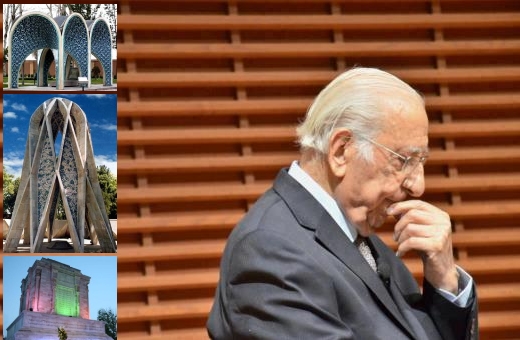
Houshang Seyhoun is a household name for people who are interested in Iran’s architecture. His artistic and architectural career which spanned over half a century is known to all Iranian culture and art lovers.
Under his belt, he has the experience of designing the Mausoleum of Omar Khayyam, and the tombs of Avicenna, Ferdowsi, Kamal ol-Molk, Nader Shah Afshar, Colonel Mohammad Taqi-Khan Pessian, and scores of immortal architectural works such as Toos Museum and Bank Sepah building in [Tehran’s] Toopkhaneh Square as well as lots of other residential buildings, paintings and Siah-Qalam works [the genre of paintings or drawings done in pen and ink].
Add to his tireless efforts years of teaching in the Faculty of Fine Arts in University of Tehran.He created a special architecture style in Iran by offering a harmonious and balanced mix of Iran’s traditional architectural styles and the modern technology-based style.
Shargh Newspaper in its July 14th issue published an interview with Seyhoun in which the interviewer, Ali Farasati, who is a faculty member at the California State University, has asked questions about the history of monumental architecture in Iran and around the world. It should be noted that Seyhoun passed away at the age of 94 on May 26, 2014 in Vancouver, Canada.
An abridged version of the multisession interview comes below.
The history of art and architecture is basically reviewed from two perspectives: pre-Islamic and post-Islamic. Do you think the two are distinguishable? If yes, what are their similarities? And if no, why is it so?
I do not see eye to eye with you on such a classification and I have some reasons for it. First of all, Iran’s architecture follows a continuous trend which has not stopped due to ideological, social and political ups and downs in the country. The preliminary documents on Iran’s architecture show a never-ending movement and a measured trend. T
hose, who seek to offer such a classification, cherish a presupposition or prejudgment which affects their judgment about artistic issues and the history of architecture. Architecture is not a phenomenon created instantaneously. We cannot say it is a chapter and what comes next is another chapter. […]
It is true that some architectural works such as mosques, religious sites, mausoleums and holy shrines serve religious purposes in society, but they are among national architecture as well. After the emergence of Islam, the Iranian architecture was the continuation of the very architectural activities Iran embraced before Islam.
Pre-Islamic Architecture in Iran
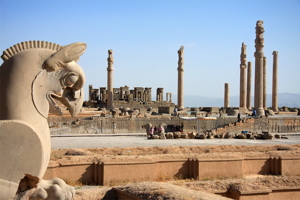
The oldest historical buildings in Iran date back 2,500 to 3,000 years. Are there any outstanding architectural buildings older than the remains of Takht-e Jamshid (Persepolis) and Pasargadae? I mean something which comes with special (hidden) architectural and artistic values. What are the standout features of these works?
Persepolis-Fars-Iran
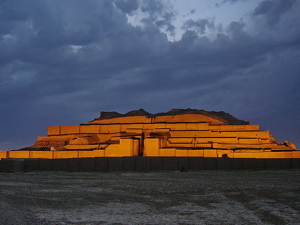
Of the oldest historical buildings in Iran, one can mention Chogha Zanbil Ziggurat, which has the form of a [terraced step] pyramid. It used to be a temple with stairs leading to a door which opened to a site designed for worshipping. Bricks are the main building materials of the site. Some cuneiform texts have been found on the site, and some other writings seem to have been added to them later on. Pasargadae and Takht-e Jamshid are the other ancient works which have survived the passage of time.
On a path in Kangavar en route to Kermanshah stands a temple constructed by the Greeks. New mountain excavations, about 20-30 years ago, unearthed a Greek Hercules. We know of some other Greek temples elsewhere in the country, for example close to Kazerun, which have been built with stones.
Pasargadae and Takht-e Jamshid were built exactly when the Greek civilization and architecture were on the rise. Do you think these structures were inspired or affected by the Greek civilization in any way?
Chogha Zanbil Ziggurat-Iran
This question is raised by many. I don’t know about the origin of the idea that the Achaemenid architecture has been under the influence of Greeks. At any given time, an invisible wave surfaces in different parts of the world and results in the formation of unplanned,still unrelated, forms and conditions which in turn give shape to forms which conform to other works.
A structure similar to Chogha Zanbil Ziggurat in Iran can be found in Maya civilization in Latin America. It comes across as surprising that these two forms are very much identical as far as their appearance is concerned. This came as the Americas had was not discovered to people in the East back then.
Or the palaces and buildings the Achaemenid kings erected at that time conjure up similar ideas about the form of the Iranian and Greek architectures. A study of Shah Mosque, which was built in the Safavid era concurrent with the Renaissance movement in Europe, reveals qualities of architecture in Italian Renaissance, although the two forms of architecture were not related. […]
What has remained of the pre-Islamic Zoroastrian fire temples? How did those buildings look and what were their symbols?
I have no idea where the idea of fire temples has come from. I have been unable to find anything on this. The fact is that a fire temple is a special venue, a four-wall structure with a dome overhead, and the fireplace is at the center and below the dome. A few ancient fire temples still stand in the country, chief among them is Niasar Fire Temple in the vicinity of Kashan.
The monument has four sections with as many bases, forming a square and having a dome overhead. Many an ancient relief shows the image of this temple. Another fire temple sits near Pasargadae. […] Borujerd too is home to a fire temple which turned into a mosque after the advent of the Islamic age. It is still up and running there.
The Effect of Islam
Was it a technical need of the time to build a dome? Or was it significant because of climatic and symbolic aspects?
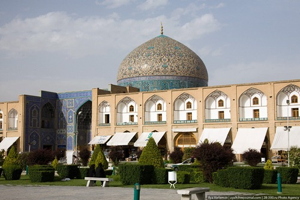
Sheykh Lotfollah mosque-Isfahan-Iran
Dome was a technical necessity. There is direct correlation between buildings and architecture, and economy and money. That the Sassanid [kings] used the technique to provide covering for their buildings should basically have an economic reason.
Their predecessors, the Achaemenid people, used columns and stones for their structures, and for sure it was much costlier. Regardless of construction materials which were in abundance, the Sassanids worked out this solution to save time and raise construction speed. Naturally, their solution, which was vaulting in the form of domes, was matched with that time’s science and technology to prove workable.
[…] As for the second part of your question, I should say that the dome assumed a symbolic form in some cases, especially after the emergence of Islam. In Islamic architecture, a sky-blue dome in a spherical form amounts to reconstruction of thought directed at the heavens […]
Perhaps a metaphysical idea lies behind it, an idea which suggests the thoughts of an individual who believes in spiritual matters should ascend to the skies and to the infinite realm. And dome is a symbol for this.
[…]
How did Islam affect the Iranian architecture after it was welcomed in the country and what changes did it bring about? Did it exclusively affect the construction of religious buildings or did it leave its mark on other forms of art and architecture?
Islam has highlighted certain matters which deserve respect. It has also rejected certain things such as sculpting and drawing images on the buildings, especially on religious buildings. You know that the use of images, whether in the form of paintings and reliefs or sculptures, was common in religious buildings outside Iran such as churches and other Christian sites before Islam […]
In post-Islam Iran, this field of art lagged behind. Although this artistic field was conspicuous by its absence in the mosques, it was later replaced by other forms of art. The Iranian artists cannot sit idly; they need to unleash and express their inner feelings one way or another.
Sculpting was banned but the Iranian artists turned to geometry, calligraphy and other forms which were mostly abstract. Much of what they did in new ways was artistic masterpiece.
What Is Iranian Architecture?
Generally, can we employ the term “Iranian architecture” for Iran which is a multiracial country with a climatic variety?
Well, since Iran sits on a limited geographic expanse of land, whatever happens within it should be named as “Iranian architecture”. The difference between Iran and other countries lies in Iran’s geographic and climatic variety. For instance, northern Iran is a green, humid area with high precipitation, whereas central and southern Iran is dry and hot, with no lush green areas.
Naturally, different climatic conditions call for varying architectural styles. This is why the architecture used in the mountainous areas distinctly differs from that in the desert; in other words, the former cannot be implemented in the desert. […]
Based on ancient works and apparent differences in style, the history of Iran’s architecture following the Sassanid era can be placed in eight distinguished periods: the Arab rule, the Sassanid, the Saljuq, Mongols, the Safavid, the Zand dynasty, the Qajar and the Pahlavi. Do you approve of this categorization? How do you define the indicators of each?
To introduce the staggered architecture history, one needs to employ the tags used for different government types. As the history of societies ran their course, each period created their own artistic works, among them architecture, under the influence of economic, social and cultural factors of the time. So such staggering cannot be opposed because they were realities which had taken place and they are out of our control and beyond what we wish.
The fact is that many things have happened during each of these periods under the influence of which architecture too has experienced some ups and downs. […] All through these periods, we have witnessed a fixed, still continuous and forward-moving trend in architecture.
This was the case until the Qajar period which saw Iran’s artistic and cultural activities wane, but toward the end of the Qajar period and the first years of the Pahlavi era the global architecture underwent drastic turbulence due to the Industrial Revolution and scientific developments in Europe. Out of such big changes the modern architecture was born.
The Effect of European Styles
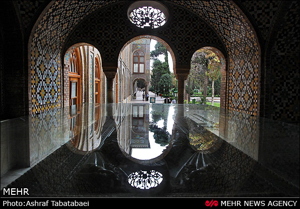
Golestan Palace-Tehran-Iran
Each period of Iran’s architectural history, especially the recent history, has been concurrent with one of the European architectural styles. Are the effects of such styles traceable in the Iranian architecture, I mean especially in the period following the Safavid kings up until now?
Yes. Iran has been affected by the European styles in many cases. It is quite evident not only in architecture but also in other cultural aspects. For example, religious ceremonies such as holding special mourning sessions and Ta’zieh Khani which are usually done today were not customary before the Safavid period which introduced such ceremonies to Iran’s religious culture.
Ta’zieh Khani reached its peak in the Qajar period because the Qajari kings established more ties with foreign countries, and religious theaters of Italy and other European nations influenced Iran’s ceremonies. Ta’zieh Khani is, in fact, a tragic opera because you can see acting, costumes, icon-making, music and singing in it. […]
Back then, the (Qajar) shah would travel to Europe quite often […] Affected by operas and ballets there, the shah brought shaliteh (short creased skirts) and tights to Iran. Women in his Haramsara started to use these items. Everything was under the influence of Europe from architecture to clothes, columns and plaster works which were in style at that time.
Plasterwork is popular again today despite all the changes it went through. The effects are usually related to those parts that were absent before. But when it comes to the Safavid architecture including Masjed Shah, Ali Qapu, Chehel Sotoun (Forty Columns), Hasht Behesht (Eight Paradises) and Isfahan bridges, they are one hundred percent Iranian.
The End of Iranian Architecture
In books on the history of world architecture, the Iranian architecture comes to an end with the Zand dynasty. Is there any remarkable work afterward, something which could be internationally presentable? Or is it true that the Iranian architecture, as historians have put it, came to a stop back then?
Firstly, the Zand dynasty was in power for a short period, thus not so many architectural works originate from that period. However, a small number of works which have remained from the period in question are architecturally remarkable and represent their own era. These works are viewed as historical monuments such as The Vakil Mosque (Masjed-e Vakil) and Quran Gate (Darvazeh Koran) in Shiraz.
The Qajar period, however, saw Iran decline. The country suffered huge backwardness. […] Certain remarkable structures have remained from this era, though. An example of this is the Great Timcheh of Qom which is related to the Qajar period and is one of Iran’s national architectural masterpieces.
If you leave Tehran for Kashan, when you drive past Qom, before the very end of the road, you will see the bazaar and Timcheh on your left. It is very beautiful. There is nothing on the outside and all is inside. The interior part has been delicately built with bricks as if it were needlework. The structure contains three domes which have been created through geometrical forms and arches and curves. Looking at it, one may think how delicately a big opening has been covered with tiles. […]
Thanks to technological and scientific developments, especially after the First World War, architecture underwent changes in the Pahlavi period. The initial years of that period, affected by a special sense of nationalism and inspired by ancient Iran, the Achaemenid and then the Sassanid, witnessed their works copied and duplicated since the Pahlavis regarded the Achaemenid as the beginning of ancient Iran.
Drawing on such a mindset, they created some works, including the Tehran Police Department, Bank Melli, the first building of Ferdowsi Tomb which I renovated, Anoushiravan Dadgar High School, the old Muze-ye Iran-e Bastan (Archaeological Museum of Iran), and the like. The construction of all these structures was affected by the architecture of ancient Iran, something I think was wrong.
On the other hand, the progress of Iran had taken on a modernist form and this question was hotly debated right then. This can be found in the poems of Aref (Qazvini), Mirzadeh Eshghi, Malek al-Shoara and Iraj Mirza. Some of the buildings which were constructed in Reza Shah Period like the railway station, schools and University of Tehran were basically made by foreigners, especially the Germans and French.
If you take a look at the ceiling of the railway station in Tehran, you would see a Swastika in which the lines have been distorted creating a new image. Some schools such as Ferdowsi, Firuzkuhi and Noorbakhsh high schools were designed and built by the French. This makes it clear that it was the Qajar dynasty which started the Westoxification movement and it was continued by the Pahlavi shahs.
A tendency toward the West which emerged rapidly in a short time span denied Iranian architects the opportunity to implement Iran’s modern architecture with the help of Western techniques. […]
Later when the Faculty of Fine Arts was built, especially when it was managed by Iranian architects, it held seminars, conferences, and tours and offered special training courses, as the Iranian architecture style was given more attention as it tried to use new techniques.
Then efforts got underway to identify Iran’s noble art and architecture, survey historical monuments, and organize trips by university students and professors to the four corners of the world and to remote villages in order to discover the hidden aspects of the culture and art of the Iranian architecture.
No Remarkable Landmarks in Tehran
Kings of different dynasties tried to build and develop areas around the capital, like the Safavid in Isfahan and the Zand in Shiraz. But no remarkable landmark is seen in Tehran which was the Qajari capital. How do you explain that?
The buildings which were built in Tehran during the Qajar period are as follows: Sepahsalar Mosque, Golestan Palace, part of the bazaar and several other mosques such as Shah (now Imam Khomeini) Mosque. Unfortunately Reza Shah took some wrong measures among them the destruction of Tehran gates. […]
As you know, Tehran became the capital of Iran in the Qajar Period. Before that Tehran was just a village on the outskirts of Shahr-e Rey. It was located between Shahr-e Rey and Shemiran Village. The Qajar kings chose Tehran as their seat of government and as it was customary back then, they dug deep ditches around the new capital because Tehran was the target of enemies.
By doing so, they wanted to defend themselves. They built 13 gates on the ditches to control entry into and departure from the city. The amazing gates stood out in the area.
Unfortunately these gates are not in Tehran any more. Similar gates are still functional in Qazvin and in Semnan. Niavaran Palace too was one of the buildings constructed in the Qajar period which was repaired and reconstructed during the rule of Mohammad Reza Shah. It also housed the offices of the shah. […]
The capital of Iran is almost as old as that of the US but the two cities differ greatly as far as the urban development, buildings and attitude toward building the capital city are concerned? What’s your take on that?
We shouldn’t compare Washington with Tehran because each has been created under special circumstances which are not similar at all. Just like Paris, the US capital is a city designed by French developers. […] Another point is that the US adopted policies in keeping with its economic and technological demands.
In Iran, Agha Mohammad Khan Qajar hailed from a nomadic tribe. He sought not to be within the striking distance of his enemies, the Zand kings, so he selected Tehran as the seat of his government on military grounds only. He wanted to remain close to his tribe in Astarabad and the high mountains nearby which could serve defensive purposes in case of a possible withdrawal.
At first Tehran was more like a military sanctuary. By and by new buildings were erected without any planning. […] If you have a bird’s-eye view of the city’s old fabric, you will see a set of small, similar houses linked by narrow, dark alleys. Contrary to Washington, there was no planning for urban development in Tehran.
In fact, Tehran was a village which had grown lengthwise and widthwise in the same manner as a village did. Over time buildings rose to lay out streets for the city’s administrative, economic and security purposes. The streets met the traffic needs of the time, but now they fail to keep up with the demand of the current population, and thus the traffic congestion.
A 121st issue of Hamshahri Mah Monthly dedicated its economy pages to a long report on the status of employment during the government of President Rouhani. The 20-page report featured the views and analyses of 10 university professors, economists and executive officials. The following is an excerpt of the viewpoints of nine of the interviewees and an abridged Q and A with Saeed Laylaz, an economic researcher and a university professor.
Hassan Taei, Deputy Minister of Cooperatives, Labor and Social Welfare: A decline in economic growth, improper foreign policy and a rise in non-productive, speculative activities are to blame for the unemployment hike in the country.
Ahmad Rousta, Shahid Beheshti University professor: The first mechanism to defuse the crisis goes through creation of a good entrepreneurial atmosphere and creation of interest among investors to put their money in productive businesses. To that end, giving professional counseling to families, steering the workforce toward fairly sustainable jobs, and paying more attention to housing and tourism can be effective. We need to have long-term management when it comes to employment.
Hossein Raghfar, Economist and Al-Zahra University professor: A lack of bright prospects when it comes to development of financial and credit institutes is one of the problems the country’s economy is wrestling with. We are in a crisis triggered by unemployment and this could have social and psychological ramifications.
Bahman Arman, Economist: Ties between our banking sector and the rest of the world are very limited. We have missed out on many opportunities and are unable to secure the inflow of foreign investment. Because of tensions, our technological interaction with industrialized countries is very limited. Concentration of focus on infrastructure by developing the railway and irrigation systems and building hospitals and dams and entrusting such projects to private local contractors can be very useful.
Jafar Nikkhahan, Head of the Social Welfare Department at the Ministry of Cooperatives, Labor and Social Welfare: As long as oil money is directly linked to government spending, employment and production won’t get the attention they deserve. But when that source of revenue is taken away from the government, it will be forced to rely on tax, a process that involves focus on production. Only then will the government become a real supporter of manufacturing.
Ali Ghanbari, University professor: What should be done is to pay more attention to social capital. Ties between the public and the government should improve so that the former could be more hopeful about the future. The government needs to stand up for our national interests and pursue a hands-off approach to economy. We need to wean our economy off oil and pave the way for more private investment in the country. In the meantime, the government needs to turn up the heat on corruption.
Kamal Athari, University professor: The policies of the previous government, especially in the housing sector, were a major contributor to unemployment in the country. Housing creates unsustainable employment. The amount of capital the housing sector draws is three to four times as much as the industry. To defuse the country’s economic crisis and ease the strain of unemployment, a knowledge-based economy should be introduced. Recognition of intellectual rights is the first requirement for the new system.
Kamran Nadri, Imam Sadegh University professor: The most important thing the government can do is to inject stability into the pricing system which has nothing to do with sanctions and is directly related to local fiscal policies.
Zahra Karimi, Mazandaran University economics professor: Sanctions have dealt a blow to business. For the economy to post growth, sanctions need to be lifted. But that is not all. Another problem has to do with inflation. In the past, inflation and unemployment used to counteract each other. A rise in one would result in a decline in the other. But our economy is suffering from inflationary recession in which high inflation is coupled with high unemployment. We should not move toward zero inflation – rather we need to incorporate anti-recessionary policies and low inflation.
Saeed Laylaz
Disruption to the country’s economic growth began in 2007. That came two years after the inflow of capital took a hit. It was in the same year (2005) that industrial investment began to nose-dive. Back then it was clear that unemployment would soon skyrocket. In other words, the country’s unemployment woes have nothing to do with sanctions and speculations that sanctions are to blame for those problems are a big lie.
And now an excerpt of the interview with Laylaz, who believes the country’s employment prospects will remain bleak at least for a couple of years and says the only way out of the unemployment crisis goes through investment in manufacturing. He blames unemployment on a decline in investment and productivity which in turn stems from wrong economic policies. He also urges the government to “increase its share of development investment in order to urge the private sector to follow suit”. This renowned researcher says suggestions that sanctions are to blame for the country’s high unemployment rate are “a big lie”. He also predicts that the economy will go through a difficult period over the course of the next two years. The following is an excerpt of the monthly publication’s interview with Laylaz:
Can we blame a decrease in the ranks of the youth for a decline in the employment rate?
Economically speaking, it doesn’t make any difference who is and who is not inside the employment cycle. What is important is that some are in the ranks of consumers but play no role in production.
How are the economic prospects of the country over the next two years?
Figures show that in the 12 months to March 21, 2013 out of an active population of 24 million 12.2 percent was unemployed. That means there were as many as 3 million jobless people in the country and the remaining 21 million provided for the entire population of less than 80 million. Those figures were worked out based on a standard which viewed one hour of work per week as employment. When an individual works only one hour a week, s/he cannot provide for himself/herself, let alone for a few people. That puts a lot of strain on the country’s wealth production system which manifests itself through a decline in investment as well as in gross fixed capital formation (GFCF). According to statistics, during the same 12-month period GFCF stood at around 161,000 billion tomans, that is 23.7 percent of the country’s GDP of 680,000 billion tomans. Three years earlier the same index stood at 26.5 percent of GDP. The declining trend started in 2005. In 2009 it was in negative territory and in the following year it stood at no more than 7 percent. In 2011 it was less than the rate of economic growth. In 2012 the economic growth and investment rates plunged to record lows, declining by 22 percent over the year before. That means the prospects of wealth production and employment are going to be bleak for at least two more years.
You talked about the problems. What do you think is slowing down economic growth and keeping unemployment high?
When economic growth and wealth production in a country are disrupted, unemployment becomes rampant. Growth is rooted in investment and productivity, two fronts we have problem with. In recent years, [annual] investment has been between $30 billion and $50 billion short of what it had to be. In other words, the capital shortage has amounted to between $350 billion and $400 billion. Unemployment is a natural end-result of such shortage. Coincidentally, if productivity had not declined at the same rate, unemployment would have been much higher. In fact, a major part of the country’s unemployment is glossed over by non-productive jobs. Considering the trend of capital formation, the unemployment rate could have been between 16 and 17 percent. By old standards, we have as many as 5 million jobless people. So if productivity and employment rates pick up, those who have stopped seeking employment will definitely return to the job market. For instance, Iranian women are both educated and motivated to have jobs, but in light of the fact that the stage is not set for their employment, they show little interest in seeking jobs. I believe a decline in investment and decreased productivity are the important factors affecting the country’s employment status.
Some view sanctions as another factor. What do you think?
That is a big lie, because disruption to the Iranian economy began in earnest in early 2008, whereas sanctions were imposed in 2012. The adverse effects of sanctions on an economy manifest themselves in a year or so. Still if we had taken appropriate measures, we could have prevented those negative effects. Disruption to the country’s economic growth began in 2007. That came two years after the inflow of capital took a hit. It was in the same year (2005) that industrial investment began to nose-dive. Back then it was clear that unemployment would soon skyrocket. In other words, the country’s unemployment woes have nothing to do with sanctions and speculations that sanctions are to blame for those problems are a big lie.
What impact do you think too much dependence on oil has had on the rise in unemployment?
I don’t see dependence on oil revenues as a major factor here. Certainly, more investment and reliance on local production rather than on imports will boost employment. But evidence suggests that the decision to turn to the services sector and imports has not been the main culprit. Investment was disrupted in 2005, but thanks to previous inflow of capital, economic growth continued into late 2007. Only afterward did the decline in indices begin to become more and more apparent.
What is to blame for the considerable decline in investment?
In 2012 current expenditures registered a 100 percent increase over 2008, whereas development spending posted no change at all. That was a choice rather than a necessity, driven by promises to bring oil money to the tables of the people. In 2004, the government’s public expenditures stood at 22,000 billion tomans. The figure soared to 90,000 billion tomans in 2012. That means during an 8-year period, current expenditures rose 5-fold, whereas development expenditures grew only 2-fold. In 2012 the volume of development expenses was lower. Under such circumstances, economic growth and employment do slow down. If they don’t, economics should be written off as a branch of science.
How do you see the performance of the government over the past year, particularly as far as employment is concerned?
Under the new government, inflation which is one of the primary factors that prompts the private sector to avoid investment has been brought under control. That political stability has made a comeback, essential items are being priced and hasty decisions are avoided has pushed the economy into positive territory since the beginning of 2014. The fact that the economy has posted growth is promising. In 2012 the government’s development expenditures stood at 15,000 billion tomans. That figure is expected to rise to 40,000 billion in 2014. That means positive developments are on the horizon.
What do you suggest the government do to speed up growth, facilitate investment, and subsequently push down unemployment?
In order to facilitate investment and secure the return of the private sector to economic activities, we need to work on infrastructure. Maybe the government should increase its share of investment in development projects to encourage the private sector to follow suit. If the government decided to increase its investment, it would have to rely on its own revenues rather than on the money it receives from the Central Bank. There are indications, including a decline in inflation, that President Rouhani is serious in not using the Central Bank money. In that case, the only way to compensate for the government’s budget deficit is to increase energy prices. Of course, that is possible. Implementation of a second phase of the targeted subsidies proved wrong those who were concerned about the consequences of a rise in energy prices. If people knew that the revenues the government secured from such price hikes were used for the right purpose, and if the government were reliable, they would definitely assist the government. So the government can secure private investment in the energy sector over the next two years.