Wednesday, December 24, 2025
Home Blog Page 5064

We can’t help but look at the past through a modern prism

Mohammad Qaed
Mohammad Qaed

Translating the comments of a veteran translator and journalist is certainly a gamble for Iran Front Page, particularly at a time when we have just hit the road. But we at IFP are more than willing to take the risk of inviting his assessment. The following is an excerpt of an interview Mohammad Ghaed has given to Iran newspaper’s Sayer Mohammadi. The interview, along with its lead, appeared in the August 24th issue of the daily, which is run by the Islamic Republic News Agency:

A Farsi translation by Mohammad Ghaed of The Guns of August, an account of World War I by American historian and author Barbara W. Tuchman, was published by Mahi Publishing House earlier in 2014. It is to be reprinted shortly. Ghaed is very good at writing articles. Apparently his journalistic background gives him an edge over fellow translators.

The appearance of his name on the cover of any book is enough to set the seal on its success. His translation of Powers of the Press: The World’s Great Newspapers by Martin Walker was reprinted several times by Markaz Publishing Co. and is now a sought-after book on the market. So are the books he has penned himself including The Diary and Oblivion, along with Injustice, Ignorance and Those in Limbo on Earth and Suffering and Healing, which have been reprinted a few times each.

[…] What is it that modern man and history-lovers can take away from books?

As Benedetto Croce has put it “All history is contemporary history.” When we contemplate the past and review what has already happened, we are actually thinking about the present. When in our thoughts we go back in time to the Qajar era, to the 19th century Tehran or to the early 20th century when the First World War was still raging, we wonder what we would have done or felt if we’d lived in those circumstances.

In the absence of contemporary history, many past things would lose their importance, either partially or totally. We lose our interest in old things because they are in the past. That we spend money on antiques is because they take us back to an atmosphere that combines the past and the present.

I believe what is important about this book, or about World War I in general, is that it amounts to a rejection of subjectivism and voluntarism that suggest humans developed thoughts which in turn gave shape to history and changed the world.

In this book the world has undergone change, but humans hold on to views which are similar to those of their ancestors. By that, I mean, similar to the thoughts of kings, rulers, prominent politicians, generals and war commanders, not ordinary people.

With the outbreak of World War I, technology took a great leap forward. Internal combustion engines, Zeppelins, machine guns and long-range guns became available on the market. The theories of the 18th century turned into industrial products, and industrialists were mass-producing them.

For instance, the inventions of Thomas Edison dating back almost 200 years were mass-produced. Things were progressing exponentially. Progress on one front translated into more rapid headway on others.

But the prevailing attitude in societies and among rulers dated back to centuries earlier. They were of the conviction that modern cannons and machine guns would do the same things elephants and muzzleloaders did in the past, so they embarked on conquests that were once unimaginable to Napoleon and Frederick the Great. Imagining the practical results of fast-paced developments and understanding their aftermath were almost impossible for individuals or even for an entire generation. They needed experience that seemed unfathomable even when it actually happened.

You sound like a person who views the Great War as an end to an era. Do you think the outbreak of the war was inevitable?

Moral inevitability is not the same as natural inevitability. When a cluster of cells grows, it may become too big for the container in which it is located. The cellular growth which is exponential is designed to help the cells survive. […] Ironically it is both simple and complicated at the same time.

That happened in the First World War and in the run-up to the downfall of the Shah [Mohammad Reza Pahlavi]. The system the [Iranian] monarch established grew bigger and bigger. In parallel, the population grew, the number of universities increased, people got more educated and urbanization took off. As a result, the political shell which was unable to accommodate all that imploded.

By the early 20th century, European societies had grown bigger and more complicated. Quality had followed in the footsteps of quantity toward change. Universities, which were a German invention, had found their way across the Atlantic to the US.

Modern-day universities can be described as a joint invention of the Germans and Americans. Bachelor’s, master’s, and Ph.D. degrees as well as dissertations were non-existent. For centuries, universities from Agora in Greece to Sorbonne and Oxford and Cambridge were seminaries. They were in fact a forum for some individuals to advise people to opt for good rather than evil, and tell them what the truth is and what is permissible. They would talk and theorize.

Barbara W. Tuchman first released The Guns of August before penning The Proud Tower, which is a sequel to the Guns of August. Why did in Iran the translation of the second book come out first?

I have been asked the same question before. You can answer that question only when you hear the viewpoints of those who have read those books in reverse order. Each book contains information that forms a chain link in the minds of readers. That information link should exist in your mind for new links to be added to it. By reading this book one can answer some of the questions that pop up in their mind. The answer to each question might pose new questions.

The emergence of Capitalism in the US is linked to global wars for domination of lands. On the other hand, it can be regarded as an independent subject. Depending on the types of questions a reader might have in mind, they could find answers by reading these books. But I don’t suggest which one the readers should go through first.

These books are not textbooks and one is not necessarily a prerequisite for the other. The author had some questions in her mind, so she embarked on field research and subsequently wrote these books.

That a historical event is presented in the form of a story makes this book more appealing. The question is how close the book is to accurate history writing.

That question is for historians and those who put forth historical theories to answer. Just like linguistics, the theories researchers put forward vary and you may forget who said what in the past and whether it still holds.

Some people consider me a historian, but I am not one. I am just a translator, and historical texts are the same to me as any other subject.

We can’t help but look at the past through a modern prism. We can’t try to ignore what we already know. In The Sleepwalker, Arthur Koestler says, “We can add to our knowledge, but we cannot subtract from it. When I try to see the Universe as a Babylonian saw it around 3000 B.C., I must grope my way back to my own childhood.”

 Koestler’s comment does not imply that Babylonians, who set up the first urban civilization, acted like children. They were wise people, but their knowledge was more limited than ours. A child’s knowledge about the world is limited, but they are mentally agile. When they learn something, they won’t forget it. Only through books and writing can humans develop an insight into abstract layers of the world and the truth.

Understanding that rotating a rectangle around one of its sides produces a cylinder is an example of abstract thinking. In order to appreciate spatial geometry, people in Babylon and Ancient Egypt and Mayans needed to be able to write.

We look at people who, let’s say, lived a century ago based on the information that is available to us. We know what has become of those people. Even without knowing what we know today, we can somewhat imagine in what conditions they lived. An abstract tightrope walking as such is only possible through texts and writing.

When the First World War was raging, people were not like us when it came to experience, habits and expectations. […] In directing movies which are set a century ago, an Iranian director knows about certain things that were customary back then, but s/he has to close their eyes to some of them to make the movie more presentable. Making judgment about the past with modern health criteria in mind is not what the director wants to do.

According to this book, in the scorching heat of the summer soldiers had to walk for long hours through the hills and woods each day. They wouldn’t get enough rest, nor were they given hot meals or proper gear including boots. In their diaries, German and French officers said stinking hungry soldiers had to walk almost half-asleep. Today nowhere in the world are soldiers treated that way. It is unimaginable.

Why do you think President John F. Kennedy gave copies of the book to his associates and suggested others go through it as well?

As far as I know President Kennedy gave copies of the book to members of his Cabinet and ordered more copies to be sent to US military bases around the world so that American officers could read it too. The book portrays individuals who wrongly assume they are in full control of things, but when they face a real emergency, they do not know what they should do.

I guess Kennedy knew that sometimes complicated things proved all too powerful for human intelligence to overcome. A military approach to a problem could have resulted in a nuclear war with the Soviets. He was worried about Communist China too.

In such a difficult situation one might make a decision that could transform the global landscape. Probably he didn’t want to be one of those politicians who had sent an entire generation of European soldiers to their deaths in the trenches 50 years earlier.

[…]


What is extremism?

Abdollah Ganji
Abdollah Ganji

In light of the fact that public perception of extremism does not cover all forms of recourse to measures beyond the norm, Dr. Abdollah Ganji, a political analyst, has defined the three main categories of extremism on Iran’s political scene after the revolution and presented criteria to distinguish between moderation and deviation from the revolutionary path. The following is a translation of his piece in Javan daily:

History has recorded a spectrum of social and political behaviors which are usually categorized as “bad-tempered”, “patient”, “ambitious”, “people-pleasing”, “aggressive”, “sullen”, “radical”, and “extremist”.

In the post-revolution Iran, approaches that prescribe going too far or those that do not require efforts to go far enough have either fallen into the category of values or anti-values.

Some are of the opinion that extremism is the same as being a revolutionary, while others think it amounts to nothing but irresponsibility and lack of wisdom. Since the revolution of 1979 in Iran, the presence of extremists has been felt in the seminary as well as in universities and political movements.

Extremism and conservatism have always had and will continue to have their own advocates. However, after President Rouhani took office and floated the notion of moderation, such an approach got a chance to present itself on the political stage.

When reformists were in power, extremism was equated to violence and reformist iconoclasts were labeled as radicals by their political opponents.

Ayatollah Hashemi and President Rouhani and some radical figures of the Reformist Front have regularly referred to the notion of “extremism” and to some extent have succeeded in internalizing it.

In other words, the government of moderation is seeking to eliminate the two extremist groups. Nonetheless, one group tries to join the ranks of Rouhani and rally behind his cause of moderation to seek protection as if their background has not been recorded in history.

To fathom the concept of extremism, it’s necessary to know what it means. Extremism can fall under three headings, whereas the public perception of it regards verbal extremism as a floor and physical violence as a ceiling. What delivers a blow to our principles, behavioral patterns, and political unity is neither the floor nor the ceiling of extremism. To get a better insight into the concept of extremism, the three categories are defined below:

1. Verbal extremists: Those who adopt an offensive tone tinged with finger-pointing. They even insult people and besmirch their reputation. They usually enter the world of politics on a whim and are likely to leave it soon. They lack political consistency in a democratic hierarchy.

2. Political-physical extremists: Those who do not follow any specific pattern in either promoting their viewpoints or in eliminating their rivals. Holding illegal rallies, committing vandalism, and raiding the gatherings and houses of their opponents are some of the things they embark on.

3. Iconoclast extremists: In my opinion, those who fall into this group display the worst form of extremism. Since public perception of extremism does not include beliefs, they hide behind an impressive mask of intellectualism to deflect public attention. They put intellectualism against superficiality and sugarcoat their ideas to follow their political goals through non-violent, intellectual means.

What is the criterion to know extremists by? Are extremists those who distance themselves from the establishment or those who are inclined to it?

Are they the ones supported by the West or those rejected by it? Undoubtedly, based on one of the instructions of the architect of the Islamic Republic Ayatollah Khomeini, – if you are hailed by a foe, second-guess yourself – it can be said that extremists are those who are defended by the West in the face of the establishment.

According to the ideology of the Islamic Revolution, extremists are those who are logical characters from a Western viewpoint, because not only do they not consider the Islamic Republic establishment Islamic, but also they seek to promote the Western lifestyle as a global trend in Iran.

From the perspective of religious figures, extremists are not those who are willing to put their lives, wealth, or reputation on the line to safeguard the revolution. Instead, to them extremists are those who are poised to trade the establishment for Western and international human rights awards and prefer a prestigious humanitarian posture to human-Islamic values.

Extremists are those who stood up to the governing model put forth by Ayatollah Khomeini, and demanded Constitutionalism, Republicanism or a combination of both, democracy and so on as a replacement and are now under the banner of moderation.

To get a better understanding of this argument, we can take a look at the shift of stance by Hamid Reza Jalaeipour, Ali Shakouri-Rad, Mohammad Reza Khatami, and some others who have become a fixture in B.B.C. and VOA talk shows and see how their “Islamic lifestyle” has shrunk to “adaptability to the environment”.

Extremists are not those who paint a bad image of their rivals to highlight their weaknesses or play down their strengths – which is a wise, though immoral, tactic in today’s politics. In fact, they are the ones who identify the principles and values of the Islamic Revolution as values of a certain political group, so that they can easily overstep them.

They are the ones who have not even once backed the general policies of the establishment in their media and have no plans to do so in the future. Have those who claim to be against extremists ever backed such policies as “transformation of the education system”, “resistance-based economy”, “the comprehensive scientific roadmap”, “macro-policies on population”, and “foreign policy”?

Can a tinge of support be traced in their media, articles, books or speeches? Without a shadow of doubt, on Iran’s political scene today, there is a clash of ideas between three groups:

One lays emphasis on the continued existence of the revolution and consolidation of its objectives [though at times it might make mistakes in terms of methods and tactics]. People in the second group are those who have plunged into doubt and inaction and hide themselves behind development and welfare. The third are the ones who think that the path to development, progress and utopia goes through unquestioning obedience to the West.

It is not very difficult to recognize and critique the first and the third group. However, the second group has some populist modern complexities. Therefore, one can say that the concept of “extremism” has undergone some transformation and shared the same fate as some other concepts like “reforms”, “cooperation”, and “Imam Khomeini’s line of thinking” which have faced a concept crisis.

There are three criteria indicating moderation in the Islamic Revolution: compliance with the general policies of the establishment, following the Supreme Leader’s instructions, and securing US disappointment with the political trend. Having said that, we should not confine extremism just to aggression or physical violence.

Although such cases are wrong, still they do not cause damage to the Islamic Revolution or the path its founder Ayatollah Khomeini presented to us; slander on the revolution is as bad as slander on people. The revolution should be respected as much as people are supposed to be respected. That’s why we should commit to our memory what happened [in the wake of the presidential elections] in 2009.


Those who favor negotiations have wrongly raised public expectations

Hamidreza Asefi
Hamidreza Asefi

Hamidreza Asefi, 61, is a retired Iranian diplomat who served as Foreign Ministry spokesman under both Mohammad Khatami and his successor Mahmoud Ahmadinejad. In an interview with Mehr News Agency he has weighed in on nuclear talks between Iran and P5+1, ties between Tehran and Washington, and regional developments. The following is the translation of an excerpt of the interview by Samira Amir-Chakhmaghi:

How have nuclear talks between Iran and world powers progressed since the government of President Rouhani took office in 2013?

Foreign relations are not like local affairs. In foreign relations there is more than one player involved. In local matters when a problem arises, there is a person who has the final say, for instance, in Iran the Supreme Leader and in other countries the president or prime minister get involved and work out a solution to the problem at hand.

In foreign relations there are several players involved. Coming to terms with the fact that not everything is under the control of a single country helps you avoid rash judgments about foreign relations.

Naturally nuclear talks between Iran and P5+1 have been tough since day one. What makes the negotiations even tougher is the fact that one party to the talks is acquisitive and lacks goodwill, and the other seeks to restore its obvious rights.

Another thing that makes the talks all the more difficult is that the two sides are working on a solution to a problem which has been in the making for 12 years. Besides, the two negotiating parties are not alone in this. Foreign players such as the Zionist regime and some Persian Gulf countries do not want the talks to succeed.

In Iran those who favored the talks and viewed them as the right thing to do made a rather hasty assessment and raised public expectations. That was a grave mistake.

On the other hand, some tried since day one to imply that the talks were doomed to failure citing the selfishness and acquisitiveness of the other side. I believe these people decided too soon that the talks would fail.

In a tough situation as such talks have made relatively good progress. Although major problems have yet to be addressed, a new attitude has been formed in the world toward Iran and our standing on the international stage has improved.

You said those who supported the talks made a hasty assessment. Are you suggesting that setting a deadline for the talks to conclude has been wrong?

The assumption that any negotiations should one day produce results is right. Talks should not be held merely for the sake of talks. […] Familiarity with the prevailing atmosphere helps those who sit at the negotiating table guess how long it will take for the talks to produce results.

That some suggested that the atmosphere was totally positive and a final solution was imminent was wrong. As I said one cannot hold talks just for the sake of holding talks.

Personally I believe a good deal that comes on the back of marathon talks is much better than a bad deal which is struck quickly. For sure, simply striking a deal is not our ultimate goal. We seek to hold on to our inalienable nuclear rights.

Do you think a deal can be reached by November?

It is difficult to predict. The negotiating team is optimistic, so is the spokesman of Catherine Ashton. Some other Europeans like the Italians are optimistic too. But experience has taught me that optimism should not serve as the basis of assessment.

I believe September is a very important month in nuclear talks. The hurdles will either be cleared or they will grow even bigger. If we manage to reach a deal in principle on some general concepts before the next round of talks in New York on September 17, one can be optimistic.

Are you saying the talks in New York are crucial?

I believe the talks with the Americans and the Europeans that are held before the gathering in New York are even more important than the New York negotiations. The stance of the Russians is almost the same as that of the Chinese.

Personally, I think it will take more than four months to reach an accord and agree on its final wording. The drafting may need longer time to complete.

You think there may be another extension of the deadline beyond November 24th to draft the agreement?

They may strike a deal in stages. The good point is that neither side wants the talks to fail. The Americans are more willing to strike a deal. They need us.

America’s global position is not good. They are grappling with economic problems and face challenges in Ukraine and Russia. The so-called Islamic State is the biggest of their problems, one which is of their own making. If they fail to take on IS in Iraq and Syria now, they will have to fight them on home turf shortly.

[…] A round of talks between Iran and the US has failed to narrow down differences between the two. Do you think there is a way for the two sides to get closer [on issues of mutual interest]?

What I just mentioned focused on the positive. As you know the Zionist lobby and the right in the United States Congress are bent on erecting hurdles in the way of the talks.

Besides, the American acquisitiveness is also a problem. Some might think that one political party in the US is better than the other. But the Gaza war proved that they are only different in their approaches not in their strategies. […]

I believe if we manage to cut a good deal on the lifting of sanctions, the number of centrifuges and the extent of peaceful nuclear activities, the other problems would be solved. Of course, the gap on those issues is still very wide.

[…] In light of recent comments by the Supreme Leader that negotiations with the Americans have showed that they won’t change, how you see the future of ties between Tehran and Washington?

Contacts between Iran and the US will remain focused on the nuclear issue. They have their own strategy and determine their approach based on that strategy. It is true that contacts and face-to-face talks could create a different atmosphere, but the nature of our relations will remain the same. […]

When Hafez al-Assad was in power in Syria, the US secretary of state visited Damascus 17 times in the space of one year. That did not thing to change the American approach to Syria – rather, the visits were designed to change the Syrian policies.

At present the Americans are talking to us to change our attitude. From their perspective, the talks are not meant to hear our logic. As the Supreme Leader has said at times we need to display heroic flexibility. Sometimes the Americans show flexibility in their policies; that does not mean they have forgotten their ultimate goal.

We have to appreciate the fact that if the American side makes compromises on one front, it seeks to notch up a win on another. Foreign relations are like a chess game. You need to guess what the next 10 moves of your opponent might be in order not to make a hasty move.

The American moves are in line with their strategy which is clear to us. If we keep that in mind, neither will a smile on their part fill us with excitement, nor their bad temper will make us angry. After all, we know what the other party is up to.

The Iranian negotiators have performed very well. They have insisted on our stance and have not agreed to sign a bad deal. They have acted honestly and I believe that is a definite plus.

In the past we had direct talks with the US on Afghanistan and Iraq, but their attitude would not change. After the talks on Afghanistan, US President George W. Bush went on to describe Iran as part of an axis of evil.     

Some analysts believe that if Iran and the US focused on other issues like Iraq, the deadlock might be broken. What’s your take on that?

Regardless of what has led to the emergence of ISIL, there is unwritten convergence between Iran and the US on the terrorist group. We both denounce the Islamic State, from two different perspectives, though.

I don’t think cooperation between the US and Iran, or any other country for that matter, is needed to defeat ISIL. Division among Iraqi officials was to blame for ISIL overrunning as much as 30 percent of Iraqi territory. […]

One should not forget the fact that Iraq had one of the mightiest armies in the Middle East, treason and failure of the Kurds and Sunnis to contribute to military efforts to quell ISIL were to blame for the defeat the army suffered. […]

In establishing ties with the US, resumption of diplomatic relations should not and could not be the ultimate goal. If such relations were meant to settle some regional problems, we’d take account of the expediency of the country and move toward that goal. We have done that before.

You think normalization of ties between the two countries is logical?

On the diplomatic front nothing is impossible. Of course, there are some exceptions to that rule. For instance, one can definitively say that establishment of relations between Iran and the Zionist regime is impossible. However, I believe resumption of ties between Iran and the US is unlikely in the short run.

What happens if an agreement is not reached by the November deadline?

Failure to strike a deal won’t bring in the end of the world. Even in case of such failure, the atmosphere won’t be as tense as it used to be. […] Politicians are good at working out new solutions. They will definitely come up with a new formula to sustain the talks. Even if they fail, they won’t publicly announce their failure and the talks will carry on, one way or another.

Recently Iranian deputy foreign minister paid a visit to Saudi Arabia. How do you see ties between the two countries?

Relations between these two countries have always been peculiar. There are rivalries between the two that date back to before Iran’s revolution. Those rivalries grew after the revolution.

Saudis are very conservative in their foreign policy and very traditionalist at the same time. They don’t update their policies. On regional issues such as Syria, Bahrain and Yemen they have performed poorly. Their failure to see the realities on the ground and act accordingly is to blame for their behavior.

The Saudis should come to terms with the fact that they no longer are the sole player in the region and that they cannot tribally solve the issues of the world of Islam in consultation with a few Arab countries. […]

And finally, tell us about developments in Iraq and your assessment of Iran’s support for the new Iraqi prime minister.  

Iran’s support for Haider al-Abadi amounted to respect for what the Iraqi people wanted. Iran would have supported any other person who had been chosen in a democratic process.

The two countries need each other. We are both members of OPEC and the Organization of the Islamic Cooperation (OIC). We can help each other on various fronts.

Iraq is currently grappling with the problem of ISIL. We need to help Baghdad solve that problem. I believe Tehran can contribute to efforts to maintain unity among Iraqi factions which will guarantee the emergence of a powerful, independent and influential Iraq.


Iran, Russia call for promotion of bilateral relations

Rouhani-Putin
Rouhani-Putin

Iranian President Hassan Rouhani and his Russian counterpart, Vladimir Putin, met Friday on the sidelines of the summit of the Shanghai Cooperation Organization (SCO) to discuss issues of mutual interest as well as regional and international developments.

During the meeting, President Rouhani said Iran is determined to expand relations with the neighboring states, adding that the political and economic relations between Tehran and Moscow have seen an upward trend over the past year.

The Iranian president stated that Iran and Russia have had good cooperation in the fields of science and technology and the process should be reinforced through further enhancement of relations in engineering and commercial fields as well as export of agricultural products.

Rouhani also called for the facilitation of commercial exchanges between the private sectors of Iran and Russia, urging the Russian side to provide more facilities for the Iranian investors.

President Putin, for his part, expressed satisfaction over the growing relations between the two neighbors and noted that Moscow will form a committee to follow up on the agreements previously achieved with Tehran.

He also pointed to some instances of Tehran-Moscow cooperation in information technology and modern sciences and underlined the need to continue bilateral ties in the energy sector and promote cultural and social interactions.

The two sides also discussed the process of nuclear negotiations between Iran and the five permanent members of the UN Security Council plus Germany, expressing support for the achievement of a comprehensive agreement in the talks.

Rouhani’s five-day tour of Kazakhstan and Tajikistan on top of a high-ranking diplomatic delegation was to end on Friday.


China seeks expansion of strategic ties with Iran: Xi

Chinese President Xi Jinping

In a Friday meeting with Iranian President Hassan Rouhani in the Tajik capital, Dushanbe, Xi underscored the Islamic Republic’s significant position in the region and the entire world, saying Beijing seeks to promote “strategic” ties with Tehran.

The Chinese leader also announced plans for an official visit to the Iranian capital, Tehran, next year.

The Iranian president, in turn, hailed Tehran-Beijing relations as “strong,” saying Iran and China must pursue the implementation of their previous agreements.

During the talks, the two sides also exchanged views on major issues of regional and international significance.

President Rouhani also held a separate meeting with Afghan President Hamid Karzai in Dushanbe, where the two senior officials discussed the developments before and after Afghanistan’s disputed presidential election in April.

The Iranian chief executive further stressed the need for the restoration of peace and stability to Afghanistan through the cooperation of all political groups in the country.

The two meetings took place on the sidelines of the summit of the Shanghai Cooperation Organization (SCO) which opened in Dushanbe on Friday.

The SCO is an intergovernmental organization that was founded in 2001 in Shanghai by the leaders of China, Kazakhstan, Kyrgyzstan, Russia, Tajikistan, and Uzbekistan. Iran, along with four other countries, holds observer status at the organization.


Iran can help develop Turkmen infrastructure: Rouhani

Rouhani-Berdimuhamedow

Iran is also ready to provide the Central Asian country with required commodities and products, Rouhani said.

The Iranian president made the remarks in a meeting with his Turkmen counterpart Gurbanguly Berdimuhamedow in the Tajik capital, Dushanbe, on Friday on the sidelines of a summit of the Shanghai Cooperation Organization (SCO).

“Iran and Turkmenistan are two neighboring and brotherly nations with common roots, and it is necessary that they utilize their untapped potential in bilateral ties,” Rouhani said.

He called for the presence of Iranian entrepreneurs and investors in Turkmenistan’s energy, development and transportation sectors.

Pointing to the soon opening of Iran-Turkmenistan-Kazakhstan railway, Rouhani said Iran would be a safe and secure route for the transit of goods through the Central Asia and the Persian Gulf region.

Rouhani also called for the development of cultural, scientific and tourism ties between the two neighboring countries.

Berdimuhamedow, for his part, highlighted Iran’s key status on regional and international scenes and welcomed further enhancement of ties between Tehran and Ashgabat to the highest level.

Rouhani is on a tour of the Central Asian states of Kazakhstan and Tajikistan.

He is scheduled to deliver a speech at the SCO summit later on Friday.

The SCO is an intergovernmental organization that was founded in 2001 in Shanghai by the leaders of China, Kazakhstan, Kyrgyzstan, Russia, Tajikistan, and Uzbekistan. Iran has an observer status at the organization.


Iran, Spain call for bigger role of private hands

Iran-spain
Iran-spain

A news bulletin of Iran’s Chamber of Commerce, Industries, Mines and Agriculture (ICCIMA) which was released on September 6, 2014 reported that Iran and Spain have held talks on expansion of mutual economic ties. The following is the translation of the short report:

Development of economic cooperation between Iran and Spain’s private sectors came up for discussion in a meeting between the International Relations Director of Spanish Confederation of Employers’ Organizations (CEOE) Jose Garcia Morales and ICCIMA deputy director for international affairs, Ali Akbar Farazi.

The two sides stressed that their private sectors should be given a bigger role to play.

At the meeting Farazi recalled good ties between Tehran and Madrid and said, “Spain maintained friendly diplomatic ties with Tehran at a time when Iran was hit by international sanctions. Currently, windows have opened for the two countries to enhance their cooperation on different fronts.”

The two nations can tap into their huge potential to forge more cooperation in economic areas such as oil, gas, petrochemistry, mining, industry, tourism, agriculture, heavy machinery, car parts, and pharmaceuticals.

Morales, for his part, said the private sector in Spain is willing to expand trade ties with Iran, adding the non-state sector in his country enjoys good experiences when it comes to agricultural machinery, urban services, car parts and infrastructure management to share with Iran.


Iran secures 2nd win in round two of FIVB Volleyball World Championships

Iran volleyball Team

“Iranian opposite Amir Ghafour wreaked havoc on the Argentine blockers as he powered his team with a 17-point performance to secure their second victory in straight sets (25-15, 25-23, 25-16) in the FIVB Volleyball Men’s World Championship on Thursday,” that is what the website of the Federation International de Volleyball said about Iran’s decisive triumph over Argentina.

The win puts Iran in third place of Group E on 11 points. Iran will line up against hosts Poland on Saturday (September 13).


Iran, Uzbekistan determined to expand relations

Karimov-Rouhani
Karimov-Rouhani

In a Thursday meeting with the Uzbek President, Islam Karimov, in Tajikistan’s capital city of Dushanbe, Iranian President Hassan Rouhani said Tehran and Tashkent should tap into their “numerous economic potentials” in an effort to broaden bilateral ties.

Rouhani added that Uzbekistan, as a friendly country, enjoys a significant position in Iran’s foreign policy, and the ground should be prepared for the expansion of bilateral cooperation in line with the interests of both countries.

The Iranian president further highlighted the Islamic Republic’s geostrategic position in the region and described the country as a safe route for transit of goods to regional states, including Uzbekistan.

Karimov, in turn, expressed his country’s preparedness to strengthen economic relations with the Islamic Republic and welcomed an invitation by the Iranian president for an official visit to Tehran.

The Uzbek leader also proposed the formation of a joint committee to pursue the implementation of previous agreements reached between Tehran and Tashkent.

President Rouhani traveled to Tajikistan for a three-day visit on Wednesday to take part in the summit of the Shanghai Cooperation Organization (SCO).

The SCO is an intergovernmental organization that was founded in 2001 in Shanghai by the leaders of China, Kazakhstan, Kyrgyzstan, Russia, Tajikistan, and Uzbekistan. Iran, along with four other countries, holds observer status in the organization.


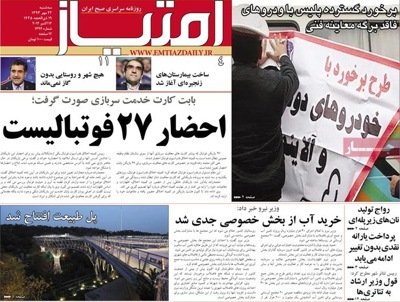
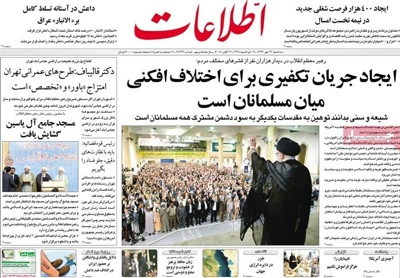
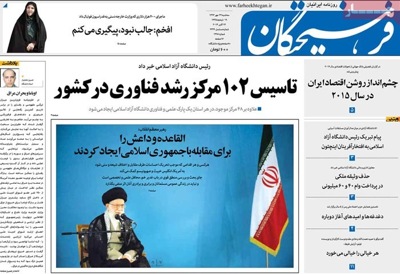
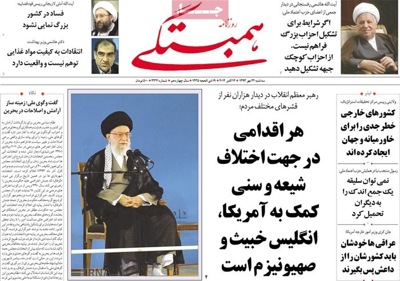
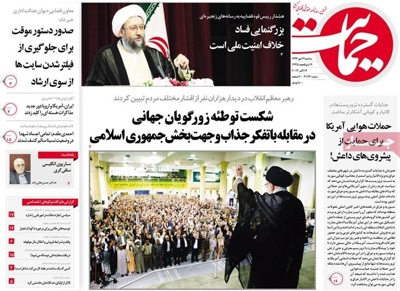
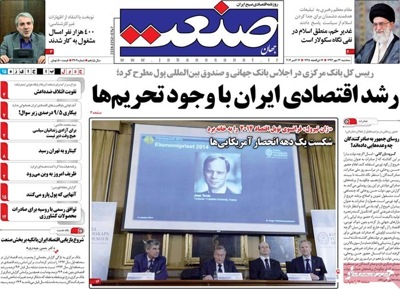
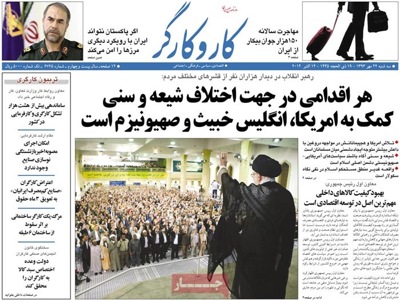
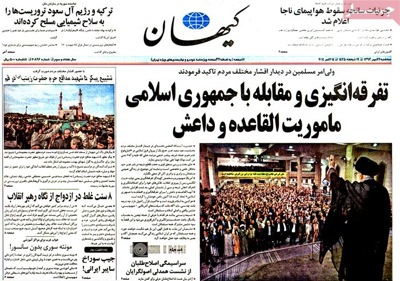
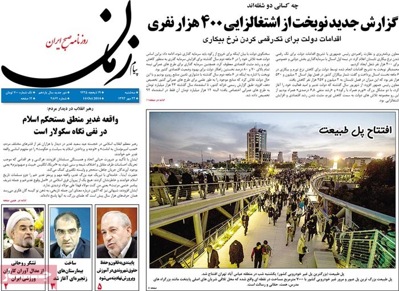
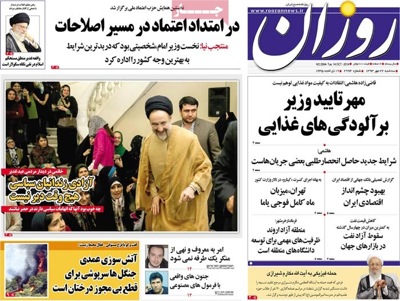
A look at Iranian newspaper headlines across the country on September 11

Iran Newspapers front pages

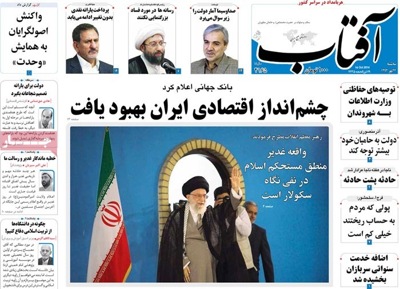
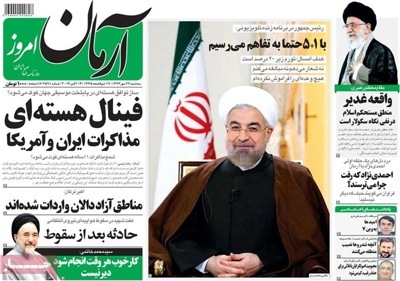
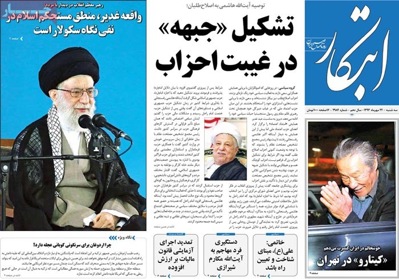
Most Iranian newspapers on Thursday (September 11) put the shock dismissal of Ali Daei, the head coach of Tehran-based Persepolis Football Club, on their front pages. News about the state visit to Tajikistan by President Hassan Rouhani and the deals the two sides signed during the visit was also splashed across the front pages of several Iranian dailies.


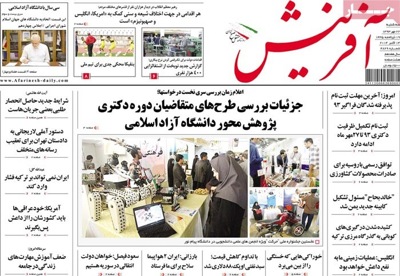
Afarinesh: “Iran and Tajikistan are trying to bolster their ties on all fronts,” visiting Iranian President Hassan Rouhani told a joint press conference with his Tajik counterpart in Dushanbe.

Afarinesh: In a letter to the director general of the UN nuclear agency, Iran has strongly denounced the violation of its airspace by an Israeli drone and calls on the international community to condemn the move.


Afarinesh-Newspaper-09-11


Aftab-e Yazd: The newly-elected chairman of Tehran City Council has expressed opposition to plans to allow residents of big towns to directly elect their mayors.


Aftab-Newspaper-09-11


Arman-e Emrooz: Seyyed Mohammad Reza Khatami, a brother of the former president who once served as deputy speaker of the Islamic Consultative Assembly, has not been allowed to leave the country.

Arman-e Emrooz: Ali Daei, the manager of Persepolis Football Club, has been sacked after his red-clad squad performed poorly on the pitch in the first eight weeks of the 2014-2015 Iranian Premier League.


Arman Newspaper-09-11


Ebtekar: The secretary general of Ansar Hizbollah has announced the launch of the group’s operations to “promote virtue and prevent vice”. It comes despite warnings by Tehran Lieutenant Governor for Sociopolitical Affairs Seyyed Shahabeddin Chavoshi that “enforcers of morality laws on motorbikes need permission to hit the streets.”


Ebtekar-Newspaper-09-11


Ettela’at: The government spokesman says imports of cars with an engine displacement of over 2,500 cc have been banned.


Ettelaat-Newspaper-09-11


Farhikhtegan: “Separation of men and women won’t render universities Islamic,” Ayatollah Javadi Amoli, a source of emulation, said.


Farhikhtegan Newspaper-09-11


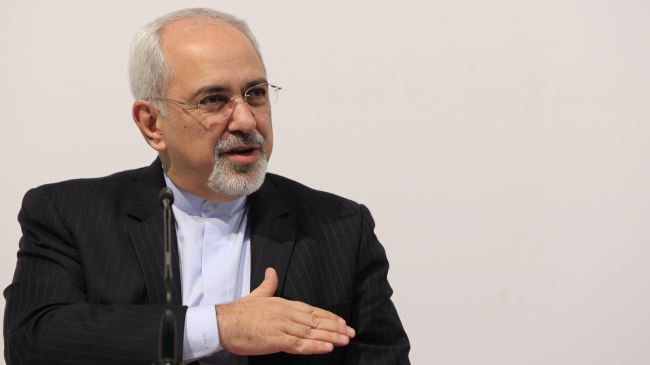
Financial Tribune: Foreign Minister Mohammad Javad Zarif sent a message to Ibrahim Jaafari to congratulate him on his appointment as Iraq’s foreign minister.


Financial tribune Newspaper-09-11


Hamshahri: Iran and Tajikistan have signed nine cooperation agreements.


Iran-Hamshahri Newspaper-09-11


Iran: National Police Chief Brigadier General Esmail Ahmadi Moghaddam defends the performance of the Interior Ministry as far as enforcement of morality laws is concerned.


Iran-Newspaper-09-11


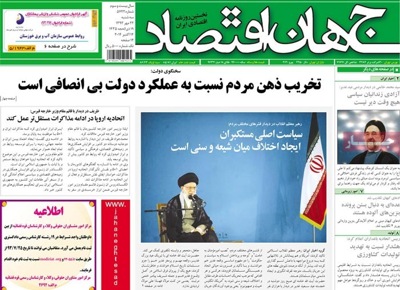
Jahan-e Sanat: “Iran and Britain will soon reopen their embassies. A new round of talks between Iran and three European countries opens Thursday.”


Jahan Sanat Newspaper-09-11


Javan: “With Saudi Arabia recalling its students from Yemen, the stage seems to be getting set for foreign contribution to Yemeni government efforts to put down protests.”


Javan Newspaper-09-11


Jamejam: The UN secretary-general has called on the Islamic Republic of Iran to play a constructive role in regional peace and stability.


Jame Jam Newspaper-09-11


Mardomsalari: “A direct sea lane is to be established between Iran and Qatar,” the Iranian deputy industry minister said.

Mardomsalari: “One cannot resort to the use of force to change the beliefs of the public,” Judiciary Chief Ayatollah Sadegh Amoli Larijani said.


Mardom SAlari Newspaper-09-11


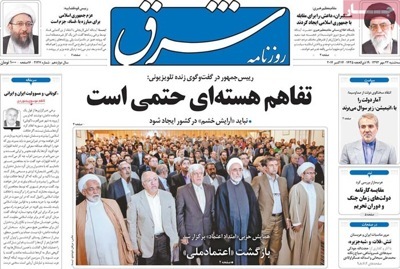
Sharq: Five people sentenced to death for committing murder have been pardoned by the families of their victims. They won’t be executed now.


Shargh Newspaper-09-11