Thursday, December 25, 2025
Home Blog Page 5057

ISIL calls for the murder of Coalition citizens

ISIS

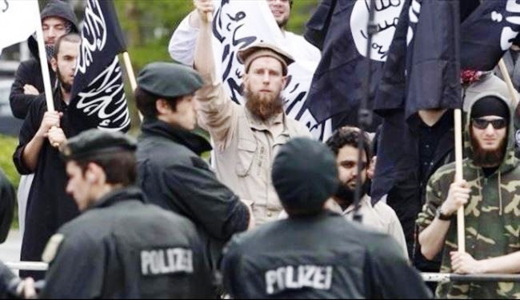
“Kill the citizens of the Coalition”. This is the horrible call by the Islamic State of Iraq and the Levant (ISIL) militants on their fellow Takfiris all over the world to kill the citizens of countries taking part in the US-led coalition against ISIL.

Abu Mohammad al-Adnani, a spokesman for the terrorist group, in an [online] audiotape which has been released in multiple languages called on all IS militants and sympathizers across the globe to kill the civilian nationals of countries which have been part of an international coalition against ISIL, Mehr News Agency quoted Al-Ahed, a Lebanese news website, as reporting.

The tape posted online stresses that ISIL militants would do what it takes to target these individuals, especially the Americans and the French.

The IFP cannot independently verify the authenticity of the audiotape.

A private meeting between top diplomats of Iran and America

Mohammad javad zarif-john kerry

Iran’s Foreign Minister Mohammad Javad Zarif and US Secretary of State John Kerry had a one-on-one meeting on September 21 that lasted more than an hour.

An official with the State Department told Entekhab [Choice] news website that initially only the two top diplomats were present in the meeting room and later their deputies – Iran’s Seyyed Abbas Araghchi and Majid Takht-Ravanchi along with American William J. Burns and Wendy Sherman – joined them.

The official went on to say that both sides sized up the present state of nuclear negotiations, and talked about the progress made so far and the measures which need to be taken in the future.

The State Department official quoted John Kerry as saying that this week offers an opportunity for a breakthrough in the negotiations and stressed that America is in pursuit of such a thing.

The official concluded that Kerry and Zarif have agreed to have another meeting this week in case it proves necessary.

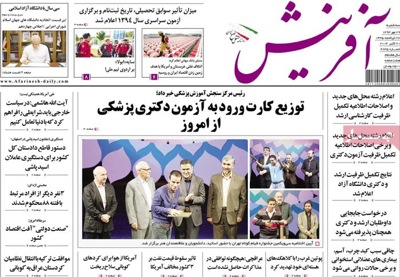
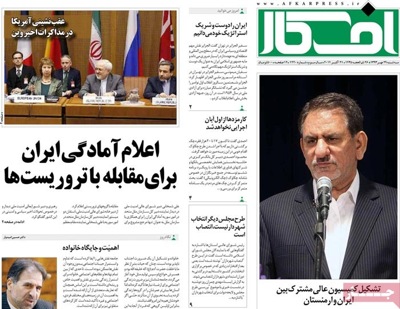
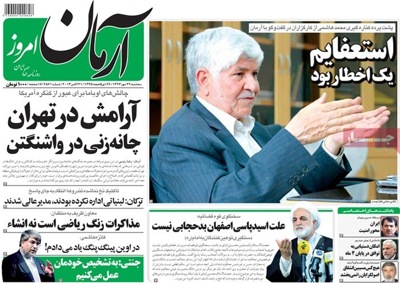
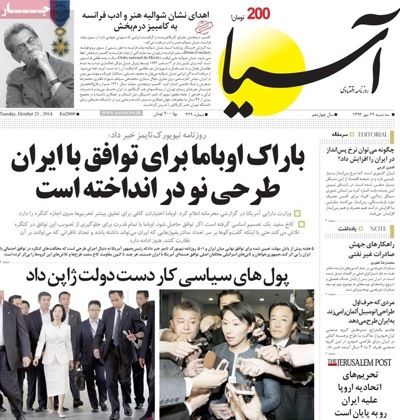
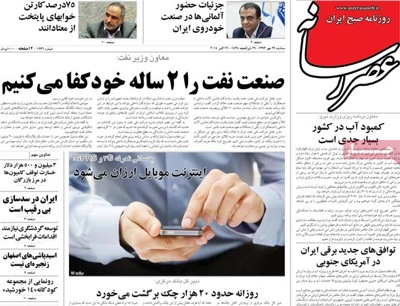
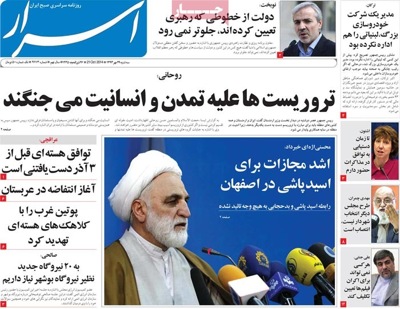
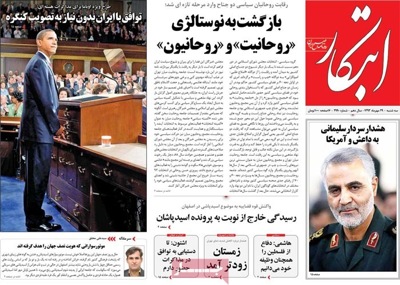
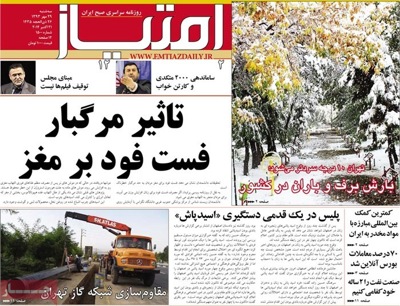
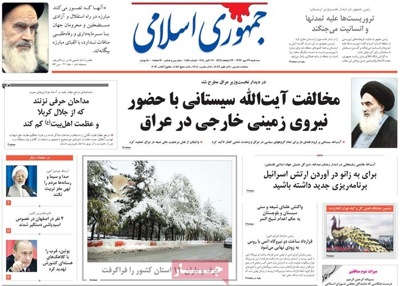
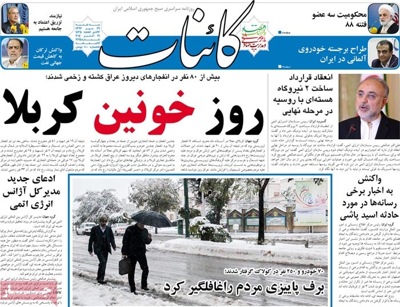
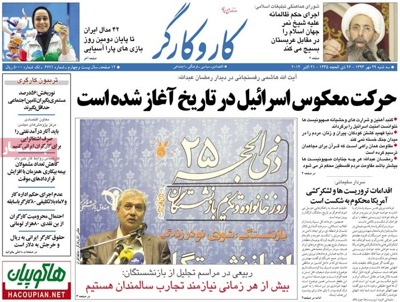
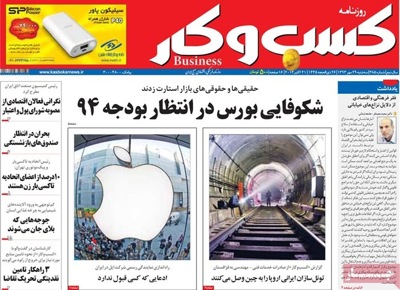
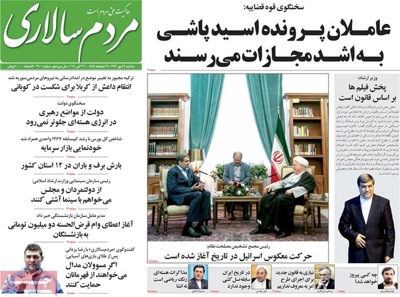
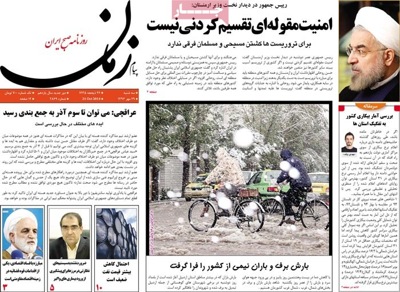
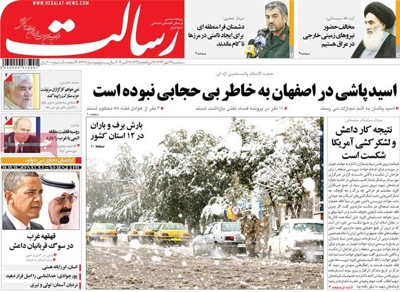
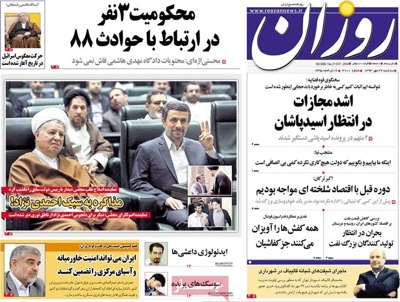
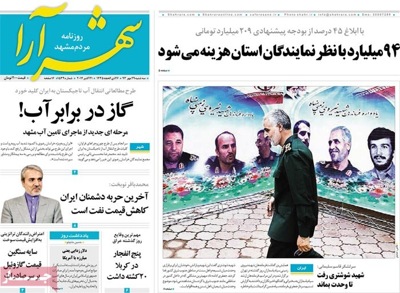
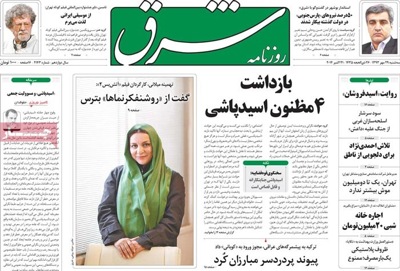
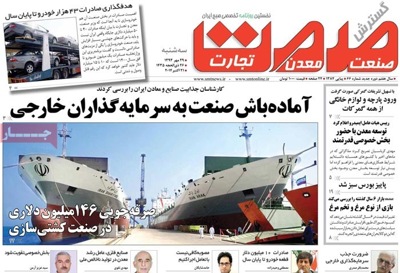
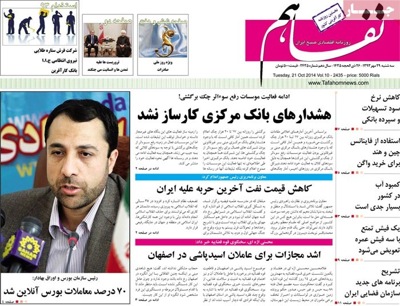
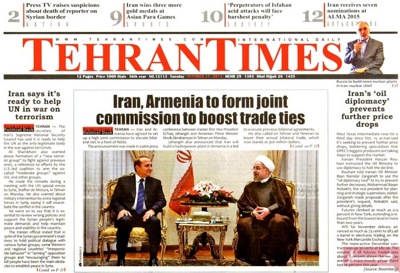
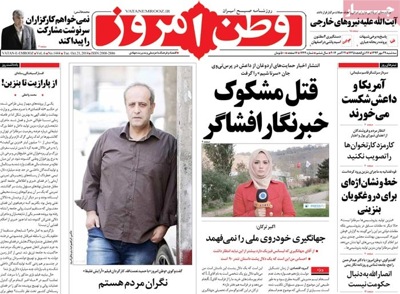
A look at Iranian newspaper front pages on Sept. 22

Iranian Newspapers headlines
Iranian Newspapers Headlines

Iranian dailies on Monday mainly gave coverage to two news stories: President Rouhani’s meeting with the Supreme Leader ahead of his departure for New York to attend the UN General Assembly and a power-sharing agreement in Afghanistan between Ashraf Ghani Ahmadzai and his rival Abdullah Abdullah. Under the deal announced by the Afghan Independent Elections Commission, Ghani is the new president of Afghanistan and his contender will act as CEO.

Abrar: “Iran has refuted claims that it asked Kuwait to mediate for its presence in the anti-terrorist coalition against ISIL.”

Abrar: “Appeals for an investigation into the Environment Protection Organization,” is the headline of a report which shows the dissatisfaction of some MPs with the performance of the organization. A petition signed by 22 deputies was given to the parliament’s Presiding Board in which the MPs expressed concerns over the poor performance of the organization to protect natural resources.


Abrar newspaper


Abrar-e Eghtesadi: “The government is yet to make a decision on whether to raise bread prices.”

Abrar-e Eghtesadi: “Iran assumes the responsibility to reconstruct Iraq’s electricity grid.”


Abrar eghtesadi newspaper


Aftab-e Yazd: “Unity between principlists is impossible” is a report that suggests as long as one segment of the faction condemns others, the prospects of staying as one would be remote. The article provides one example of disagreement within the faction and says the Islamic Revolution Stability Front thinks of itself as the main current and of others as marginal.

Aftab-e Yazd: “We did not give [Mehdi] Chamran [the chairman of Tehran City Council] a blank check,” said a principlist city councilor. He added principlists voted for Chamran, expecting him to exercise stricter supervision of Tehran Municipality.


Aftabe yazd newspaper


Arman-e Emrooz: “We cannot hold Khatam al-Anbia [an Iranian engineering firm run by the Islamic Revolution Guard Corps] accountable,” said Vice President Akbar Torkan. His comments came after the firm, one of the biggest contractors in the country, registered only a 3 percent progress in a project – which was already one year behind schedule. The contractor secured the deal on the condition of attracting foreign investment, but most recently it admitted it has failed to do so.

Arman-e Emrooz: “A new chapter in Iran-Saudi relations,” is the title of a news story about a one-hour meeting between Iran’s Foreign Minister Mohammad Javad Zarif and his Saudi counterpart Saud al-Faisal on September 21.


Arman newspaper


Asr-e Rasaneh quoted Oil Minister Bijan Namdar Zanganeh as saying, “New petrochemical projects need $70 billion in investment.”


Asre resaneh newspaper


Bani Film: “Emrooz [Today], an Iranian movie will represent Iran in the 2015 Academy Awards.”


Bani film newspaper


Ebtekar: “The report of carcinogenic gasoline on parliament speaker’s desk” refers to a debate over the quality of gas produced by Iranian refineries. After officials under Ahmadinejad refuted claims that the petrochemical gas was the main culprit in air pollution, Parliament Speaker Ali Larijani tasked the parliament’s Health Committee to carry out an investigation into the case. The results of the report indicated that the gas produced by Iranian petrochemical facilities contained benzene and other hazardous substances. The final decision is going to be made by the Judiciary.

Ebtekar: “President Rouhani paid a visit to the Supreme Leader before he leaves Tehran for New York later today.”

Ebtekar: “Advocates of Ahmadinejad preparing for 2017 presidential election campaign” is the headline that implies the former president and his supporters are steeling for the 12th presidential vote. His recent speech and comments by those close to him suggest they are getting prepared to bring him back onto the political landscape.


Ebtekar newspaper


Eghtesad-e Pooya: “Eight aircraft and helicopters have been added to Iran’s air fleet.”

Eghtesad-e Pooya quoted the commander of the Cultural Heritage Organization’s Protection Division as saying, “The largest haul of cultural heritage items has been seized in a special operation.”


Eghtesade pouya


Emtiaz: “Thirty thousand kilometers of roads across Iran will be equipped with speed cameras.”


Emtiaz newspaper


Etemad: “Foreshocks of a likely meeting” is the story that the daily leads on, featuring comments by some principlists about the probable meeting between Presidents Rouhani and Obama.


Etemad newspaper


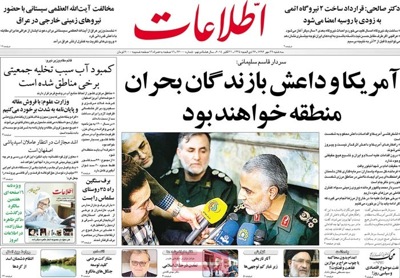
Ettela’at: “The West should not have a business-minded approach to the nuclear talks [between Iran and P5+1],” said Parliament Speaker Ali Larijani.

Ettela’at: “Iran’s super advanced submarine and destroyer will be unveiled by November 28,” said Commander of the Naval Forces of the Iranian Army Rear Admiral Habibollah Sayyari.


Etellat Newspaper


Farhikhtegan: “The looming water crisis in Tehran is serious; eastern Tehran has water supplies enough only for two weeks.”


Farhikhtegan


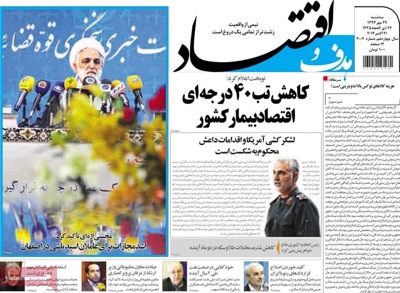
Hadaf va Eghtesad: “Iran’s defense capability won’t be influenced by sanctions,” said the Iranian deputy defense minister.

Hadaf va Eghtesad: According to a new bill approved by the Islamic Consultative Assembly, revenues from non-oil exports will be tax-exempt.


Hadafo eghtesac newspaper


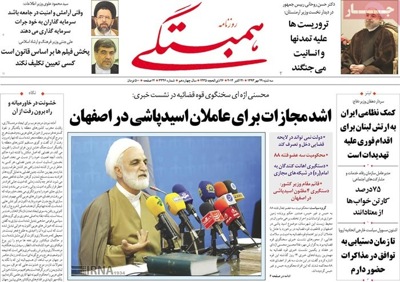
Hambastegi: “News websites which have no license to operate will be blocked,” said Minister of Culture and Islamic Guidance Ali Jannati.


Hambastegi newspaper


Hamshahri: “Central Bank of Iran gives a shock to electronic banking” is the headline the daily put on its front page after the Central Bank announced that as of October 23 shops which use debit card readers will have to pay transaction fees.


Hamshhri newspaper


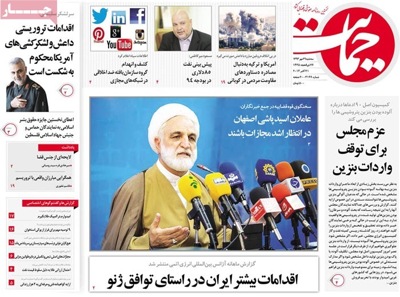
Hemayat: “The Judiciary system will take on cybercrimes in earnest,” is the headline the daily put on its front page after the judiciary spokesman issued a one-month deadline for the minister of communications to block some mobile applications, a move which was welcome by some MPs and experts.


Hemayat newspaper


Kayhan: “Momentous days; members of the Yemeni presidential guard have joined the revolutionaries.”

Kayhan: “Hundreds of ISIL terrorists were killed in a massive offensive launched by the Iraqi army.”


Kayhan newspaper


Quds: “Revenues of medical tourism is 10 times more than those of conventional tourism.” The daily also highlighted the fact that global revenues that the medical tourism fetches stand at $100 billion.


GHODS newspaper


How Iranian newspapers cover nuclear talks in New York

Iranian newspapers and nuclear talks

With the countdown for the finale of nuclear talks between Iran and P5+1 on, over the past few days Iranian newspapers opted for a measured tone in covering the parley half a world away.

The addition of President Hassan Rouhani, who appreciates the coherent strategies of the Supreme Leader of the Islamic Revolution, to the Iranian team in New York may lend special weight to the NYC chapter of the nuclear saga. It may also prompt those who put partisan interests ahead of national interests and global peace and security to take the risk of making a “hard decision”.

The crises brewing in the Middle East have probably left no place for the option of war on President Obama’s Oval Office desk. At a time when negotiations seem to be the only way forward, no more time should be wasted; after all, there are more urgent issues the world has to contend with.

The Americans and their European and regional allies should know that playing the IS card is not compatible with diplomatic standards. The truth of the matter is that even a weakened form of this pathogenic agent, read IS, cannot be used in the vaccination of the West. Westerners need to shed their illusions that such an approach could serve their interests.

Without any bias that could slam the door shut on an independent assessment of Iranian media, Iran Front Page would like to note that with the exception of a few dailies that expressed dismay over comments by Foreign Minister Zarif that “We’ll trust Obama if he makes a promise,” others kept their feelings under wraps.

No doubt, the Iranian people are waiting to see what President Obama’s promise is and how reliable it will be.

Iranian newspapers, both principlist and reformist, which represent the Iranians in what they openly say and in what appears between the lines on their pages, leave no doubt that Iranian independence and dignity are not negotiable. If you doubt the statement you just went through, turn it into a question and put it to President Rouhani, Foreign Minister Zarif and other members of the Iranian negotiating team.

They will definitely repeat what you just read. Even if their microphones remained accidentally open, they would not turn their back on their closest friends and allies. Certainly, no ally is more powerful than a nation with a stellar cultural and civilizational background.

The priority of Iranians of different ethnic backgrounds, including Kurds, Baluchis, Azeris, Turkmen and Fars, is to enrich culture and science. Enrichment of uranium has been an upshot of such a policy which is bound to carry on.

Coincidentally, right at a time when major powers were haggling with Iran over the extent of its uranium enrichment, the Supreme Leader of the Islamic Revolution released the macro-policies of the establishment in the field of science and technology. Nothing can put more emphasis on the fact that Iranian research and scientific endeavors cannot be shut down.

Ettela’at, which first appeared on newsstands almost 80 years ago, put the following on its front page: The ultimate goal is to become the scientific hub of the world. It also said under the policy guidelines of the Supreme Leader, Islamic values and ethics should prevail in the higher education system of the Islamic Republic.

In conclusion, it should be noted that Iran, which has been home to Ferdowsi, [a prominent epic poet] will not surrender in the face of bullies; and Iran, which has been called home by Sa’di and Hafiz, [two world-famous poets] won’t develop nuclear weapons. After all, Iran is the land of love and compassion.

Iran supporting ME nations in anti-terror fight: Rouhani

Rouhani-Speech
Rouhani-Speech

President Hassan Rouhani has reaffirmed Iran’s support for “oppressed” nations in the region, saying the Iranian armed forces will help crisis-hit states in their fight against terror.

Addressing a large military parade held to mark the start of Sacred Defense Week on Monday, Rouhani described Iran as the “anchor of stability” in the strategic Middle East region and said Iran will stand by the “oppressed” nations anywhere.

“Regional nations will stand up to terrorism and the Iranian government and armed forces will also assist them in this battle,” President Rouhani stated.

The Iranian chief executive also hailed the resistance of regional nations in the face of enemies and said violence-stricken Middle Eastern states will ultimately overcome terrorist groups and foil plots hatched by hegemonic powers.

Rouhani hailed the sacrifices made by Iranian people and soldiers during the 1980-1988 Iraqi-imposed war, saying enemies failed to bring the nation to its knees despite providing all-out support to Saddam’s Iraq during the eight-year war it imposed on Iran in the ’80s.

In recent years, hegemonic powers have waged a new economic war against the Iranian nation by imposing sanctions on the Islamic Republic over its civilian nuclear program, the Iranian president added.

Rouhani reaffirmed the country’s determination to pursue its right to use nuclear technology for peaceful purposes, saying the “peace-loving” nation of Iran has never sought to develop weapons of mass destruction.

The Sacred Defense Week commemorates the bravery of the Iranian soldiers who fought in the Iraqi-imposed war and defended their country against enemy aggression.

Russia sees ‘progress’ in Iran nuclear talks

Raussian-official
Raussian-official

“We note some progress, including on issues that have been the most difficult all the time,” Russian Deputy Foreign Minister Sergei Ryabkov told the ITAR-TASS news agency on Monday.

Iran and the six countries – Russia, China, the United States, Britain, France and Germany – resumed negotiations on the Iranian nuclear energy program in New York on Friday to reach a final agreement aimed at resolving the standoff over Tehran’s civilian nuclear work.

Ryabkov, who is representing his country in the talks, said that “the Russian delegation has put forward additional ideas” in the ongoing nuclear negotiations in New York.

“We are in intensive contacts with other delegations at the level of political directors as well as at the expert level,” the Russian diplomat said.

“There are no grounds for concern. But we must keep working in this mode with concentration,” he added.

Earlier on Saturday, senior Iranian nuclear negotiator Seyyed Abbas Araqchi said “a very good atmosphere prevails” in the ongoing nuclear talks between Tehran and the P5+1 group.

Araqchi said that differences on some issues exist but the two sides have expressed determination to continue the negotiations.

Last November, Iran and the six world powers signed an interim deal in Geneva, which took effect on January 20 and expired six months later.

In July, Iran and the six countries agreed to extend negotiations until November 24 this year after they failed to reach common ground on a number of key issues.


Iran, US FMs discuss key issues in New York

Zarif-Kerry
Zarif-Kerry

The issue of the Islamic Republic’s nuclear energy program was one of the main pivots of the discussion between Zarif and his American counterpart.

The meeting between the two senior officials, which was held at a hotel on Sunday, came on the third day of the latest round of negotiations between Iran and the P5+1 group.

“They [Zarif and Kerry] discussed both the progress that has been made and the work that still needs to be done,” a senior State Department official said after the meeting.

Kerry “noted that this week is an opportunity to make additional progress and stressed that it is our intention to do so,” he added.

The latest round of nuclear talks between Iran and the six countries – Russia, China, the United States, Britain, France and Germany — started at the UN headquarters in New York on Friday morning.

The Iranian delegation is headed by Zarif and the EU foreign policy chief, Catherine Ashton, leads the other party.

The two sides signed a historic interim deal in Geneva, Switzerland, last November. The agreement came into force on January 20 and expired six months later. In July, they agreed to extend the negotiations until November 24.

According to a US official, Zarif and Kerry also discussed the threat posed by the ISIL Takfiri group.

The State Department official further noted that the two high-ranking diplomats “agreed to meet further as needed while in New York.”

The Takfiri terrorists currently control parts of Syria and Iraq. They have threatened all communities, including Shias, Sunnis, Kurds, Christians, Izadi Kurds and others, as they continue their atrocities in Iraq.

The Western powers and their regional allies — especially Qatar, Saudi Arabia and Turkey — are reportedly supporting the militants operating inside Syria and Iraq.

The terrorist group has links with Saudi intelligence and is believed to be indirectly supported by the Israeli regime.


Iran’s Zarif, Saud al-Faisal hold talks in New York

Zarif-Faisal
Zarif-Faisal

The top Iranian diplomat made the comments following a Sunday meeting with Saudi Arabia’s Foreign Minister Prince Saud al-Faisal on the sidelines of the 69th session of the UN General Assembly in New York.

Zarif described his talks with Faisal as a “new page” in bilateral Tehran-Riyadh relations, expressing hope that the meeting would have a positive impact on efforts to restore peace to the region and the world, and protect the interests of all Muslim nations.

The Saudi foreign minister also said Iran and Saudi Arabia are two influential countries in the region, stressing that Tehran-Riyadh cooperation could help bolster peace and security in the region and the entire world.

Faisal also pointed to the sensitive situation in the Middle East and said mistakes of the past must be avoided, so that it would be possible to successfully end the crises plaguing the region.

Iranian President Hassan Rouhani has repeatedly underlined Tehran’s determination to improve ties with neighboring Muslim countries, including Saudi Arabia, saying cooperation between Iran and Saudi Arabia will be vital for regional security.

Iran and Saudi Arabia are divided on a number of regional issues such as the situation in Syria and Bahrain.


Iran president set to leave for NYC to attend UN meeting

Iran-Hassan-Rouhani
Iran-Hassan-Rouhani

President Rouhani will leave Tehran on Monday to attend the UN annual event, where he is scheduled to deliver a speech on September 25.

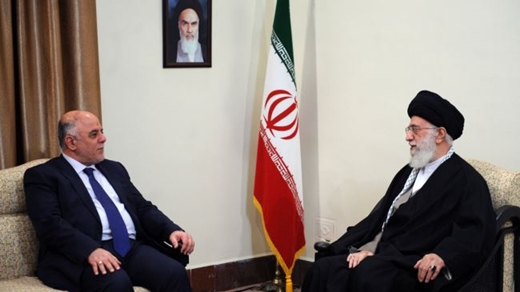
On Sunday, the Iranian president held talks with Leader of the Islamic Revolution Ayatollah Seyyed Ali Khamenei and the Leader wished President Rouhani success during his trip.

Moreover, the Iranian president is expected to hold talks with world leaders on the sidelines of the General Assembly meeting.

Iran has ruled out the possibility of a meeting with US President Barack Obama on the sidelines of the UN meeting.

On Wednesday, the Iranian administration’s spokesman, Mohammad-Baqer Nobakht, said President Rouhani has no plan to meet with Obama.

The 69th annual session of the General Assembly opened in New York on September 16 and will end on October 1.

The UN event comes as Iran and the five permanent members of the UN General Assembly – Russia, China, France, Britain and the US – plus Germany are holding a new round of negotiations on Tehran’s nuclear energy program.

On Wednesday, Iran’s Foreign Minister Mohammad Javad Zarif attended a working lunch session with EU foreign policy chief, Catherine Ashton, in New York to review the latest developments concerning the talks aimed at reaching a final accord on Tehran’s civilian nuclear work by the November 24 deadline.

Zarif leads the Iranian delegation and Ashton represents the P5+1 states in the ongoing nuclear negotiations.

In July, Iran and the P5+1 agreed to extend the negotiations until November 24 this year after they failed to reach common ground on a number of key issues.


Israel doomed to historic failure: Rafsanjani

Israel doomed to historic failure

Ayatollah Akbar Hashemi Rafsanjani made the remarks in a meeting with Palestinian Ambassador to Tehran Salah Zawawi on Sunday.

“Historic oppression by the Zionists has forced the Palestinian resistance [movement] and people to think about strengthening [their] defensive capabilities and deterrent weapons and there is currently no safe place [for the Israeli regime] in the occupied territories,” Rafsanjani added.

He noted that the global powers’ support of the Israeli regime’s crimes in the Gaza Strip is a “stain of shame” in the record of Western governments, particularly the United States.

“The self-proclaimed advocates of human rights regard crimes against defenseless people, particularly the innocent women and children in Gaza, as a kind of defense against an armed-to-the-teeth army,” Rafsanjani said.

Zawawi, for his part, appreciated Iran’s strategic policies towards the issue of Palestine and said the Palestinians take pride in their convergence with the Islamic Republic.

Israel started pounding the Gaza Strip in early July. Almost 2,140 Palestinians, mostly civilians, including women, children and elderly people, were killed in the Israeli onslaught. Around 11,000 others were injured.

Tel Aviv says 72 Israelis were killed in the conflict, but the Palestinian resistance movement, Hamas, says the number is much higher.