Saturday, December 27, 2025
Home Blog Page 5045

Interests of the establishment are all that matters to the Expediency Council

Expediency Council-Hashemi Rafsanjani

The Expediency Council can override the existing laws and religious edicts and overlook the viewpoints of the Guardian Council if it deems it expedient, Chairman of the Expediency Council Ayatollah Akbar Hashemi Rafsanjani told a gathering on the macro-policies of the establishment and how their implementation should be supervised.

The Constitution of the Islamic Republic gives supervision powers to the Supreme Leader, he said, adding, “Had the leader decided to exercise those powers, the process could have been much stricter. But the leader has decided to delegate that authority to the Expediency Council.”

Mr. Rafsanjani went on to say, “Initially, the supervision in question was simply meant to make sure parliamentary acts did not run counter to the macro-policies of the establishment, but after a while the leader floated the idea of ensuring the compatibility of the decisions of the Islamic Consultative Assembly with the country’s macro-policies. The Supreme Leader believes those policies are crucial and serve as a link between the Constitution and the Executive Power.”

The following is the translation of the speech the top councilor made at the gathering on Tuesday. The text of the speech which drew widespread attention in the Iranian newspapers was taken from the official website of Ayatollah Hashemi Rafsanjani:

“The late Imam Khomeini personally appointed members of the Expediency Council and tasked them with drafting the council’s bylaws. In order not to interfere with the operations of other institutions, we [members of the council] limited the scope of the council’s powers. But Imam Khomeini did not approve of the bylaws we had developed and said the Expediency Council had to keep an eye on all aspects [of the administration of affairs].

“When the revolution was young and the Constitution was being drafted, there was no word of the Expediency Council, and no one ever expected it to emerge. But realities on the ground prompted Imam Khomeini and then others to conclude that there was a gap to be filled in the country given that a major change had taken place.

“When a draft Constitution was debated in the Revolution Council and handed over to Imam Khomeini, some experts weighed in on the charter, but there was no talk of the Expediency Council, or the rule of the religious jurisprudence for that matter.

“When the Constitutional Assembly first met, the powers of the religious jurisprudent were discussed. Still there was no talk of any institution called the Expediency Council. Ten years after the victory of the revolution, when several problems cropped up, the absence of an institution like the Expediency Council began to be felt.

“Back then the Guardian Council and the Islamic Consultative Assembly were at odds over a series of laws. Actually adoption of those laws had hit a snag. Eventually, Imam decided that there had to be an institution to settle those problems. That decision was communicated to the heads of government branches. In a letter, we asked Imam Khomeini to make his decision operational.

“The problem that was felt after the demise of Imam Khomeini was that [in the absence of macro-policies as we know them today] there was no certain direction for different sectors, something which was to blame for some inconsistencies. So, when the Constitution was to be amended, that question was raised too.

“Today in many institutions, managers are still unfamiliar with the macro-policies of the establishment and their content. Similarly, many in society do not know much about those policies.

“When a parliamentary act is sent to the Expediency Council, because of time constraint, we cannot assess every detail of the law, so we only let the Guardian Council know about the faults we have found with the parliamentary act. The Guardian Council, accordingly, informs the chamber about the problems of the law. But the parliament can opt not to accept the fault(s) we have found, because there is no arbiter in the chamber and MPs can opt not to vote for an amended version of the law.

“When we were drafting the supervision bylaws of the Council, we had some disagreements with the heads of the three branches of government who wanted to limit the supervisory role of the Expediency Council. We, on the other hand, believed things had to be the way the council wanted them to be.

“During the presidency of Mr. Khatami, we had long meetings with his representatives, but the supervision bylaws were slightly reformed. During the presidency of Mr. Ahmadinejad we had the same problem [of government not wanting any supervision by the Expediency Council]. Ahmadinejad had openly said he did not approve of the council. He made no secret of such disapproval. As for the Outlook Plan, he implemented the parts he approved of and brushed aside the provisions he did not like.

“The Fourth Development Plan was based on the [20-year] Outlook Plan. Since Ahmadinejad did not believe in the Outlook Plan, he oversaw the implementation of only 23 percent of its provisions.

“We sent an amended supervisory bylaw of the Expediency Council to the Supreme Leader. Four years later the leader communicated a more detailed bylaw to the council. In drafting the new bylaw, the leader did not make any consultation with us, because he knew we were considerate of the powers of other institutions. The Supreme Leader believes the macro-policies of the establishment are crucial and serve as a link between the Constitution and the Executive.

“The Expediency Council does not put any pressure on executive institutions; rather we have just asked them to send us progress reports. The reports are confirmed if there are no inconsistencies in them; if not, we’ll return them to the agency that has sent it to us. In case they fail to make the necessary amendments, we’ll report the case to the Leader who makes the necessary decisions.

“What we do at the Expediency Council is preventive in nature and entails no punitive measures. We just report the cases to the leader who makes the final decision. In fact, the leader is the main supervisor and we are just acting on his behalf.

“Although new regulations are devised in institutions such as the Judiciary on a daily basis, they do not report their decisions to the council. Other agencies such as IRIB (national broadcaster) and the Armed Forces Organization are under the direct supervision of the leader too.

“The Expediency Council has received no new funding for its supervisory role and taps into its limited budget to carry on its oversight.

“We hope the new trend [in which a large number of councilors regularly attend its meetings] will continue into the future because such arrangement serves everyone’s interests.”

War combatants have not been seen: War veteran

Iran-Sacred Defense
Iran-Sacred Defense

In a special addendum to Sharq newspaper published on September 22, the daily tried to bring back the memories of forgotten soldiers who played an important role in the course of the Iran-Iraq war. The following is the translation of some parts of the addendum titled “Unsung Heroes”:

Even if you think of the value of a pawn on a chessboard, you will know that if it fights bitterly to the end, it can promote and give the queen a second chance to be on the battlefield again. If you are born a boy, everybody knows that you are supposed to do military service, either for a few months or for a few years. Coincidentally, if there is war, your service is particularly counted on. In the Iran-Iraq war, we were not short of brave heroes; in fact, there were as many as three million Iranian soldiers who have now been long forgotten. They are now remembered as war veterans.

One of those veterans of the Iraq war is Mohammad Bodaghi, who turned 18 when the war was in its 5th year. He fought in the war during his military service as an outstanding radio operator. In his opinion, the best moment for a radio operator is when the mortar is ready to be launched. After serving out his military service, he set pen to paper to write about the war, its operations, commanders, privates and so on. He believes that the epic of war has thousands of unsung heroes.

When asked about his family’s reaction when he had been en route to the frontlines, he said, “There used to be a public sentiment that I think our country will never experience again. I remember back then those who were doing their military service insisted on being sent to the frontline. Nobody was willing to stay at training camps.

We think of defending our country as our duty. Perhaps, it was the will of God that we became part of this history-making chapter of our country. Likewise, my family had the same feeling. For instance, once I wrote a letter to my family to reassure them that there was nothing to be worried about. I told them that I had been working in the kitchen.

Later, when I was back and came across the same letter, I saw that my little brother had drawn a line across “I am working in the kitchen” because my family felt ashamed of even saying that one of their own was working in the kitchen. All families were proud to say that their sons were fighting in the frontline.

The era of “Sacred Defense” is a very frank period in our country’s history. People from all walks of life worked sincerely and wholeheartedly to fulfill their commitments. People, particularly parents, gave selflessly whatever they had to soldiers who were fighting in the frontline. My two brothers and I all fought in the war. It’s true that the war came to an end and there is no longer a foxhole, no loud bangs of tank and mortar shells, but even after the Sacred Defense, we are still involved in it; I have been writing about it for the past 23 years.”

The principle in the frontline was defending our homeland.

Rostam Khoramdin is a Zoroastrian war veteran. In response to the question as to whether he was treated differently by his fellow comrades in arms, who were mostly Muslim, he said, “They never addressed me as a non-Muslim. The core principle was the fact that we were all Iranian.

My commander would tell me that he had been ordered to give religious minorities leave to attend their religious rituals. However, when I was the secretary of an army company, I wouldn’t take leave because I knew that we were undermanned. Anyway, in the frontline our obligation was to defend Iranian soil. Our priority was friendship between people there. There was no distinction between Muslims and non-Muslims. […]”

Iran rights rapporteur illegal

Larijani-Iran-rights

A senior Iranian official has questioned the legality of appointment of a UN special rapporteur on the human rights situation in Iran, calling on Ahmed Shaheed, the current rights investigator on the Islamic Republic, to resign.

“Appointing a special rapporteur on Iran requires some justification,” Secretary of Iran’s High Council for Human Rights Mohammad Javad Larijani said, asking, “Based on what justification has a rapporteur been appointed on Iran?”

“He (Shaheed) had better step down as soon as possible because he has left a bad record as a UN human rights rapporteur,” Larijani said, adding, “Assigning a rapporteur on Iran is not justifiable and as it is not justifiable, it is illegal.”

He further noted that if the reason for the appointment is “Iran’s great democracy in the region…you should take a look at other countries in the [Middle East] region” and compare the concept of democracy in those countries with that of the Islamic Republic.

“Iran’s great democracy should be recognized and it does not need a rapporteur,” Larijani added.

He also pointed to Shaheed’s biased reports against Iran, saying a UN human rights rapporteur should be “unbiased.”

He additionally questioned the “methodology” Shaheed employs to prepare his reports on the Islamic Republic, saying he bases his reports on information available on news websites and pieces them together.

In his September report, Shaheed alleged that Iran refuses to respect minorities’ rights and claimed that the Islamic Republic’s judiciary has not been fair. Tehran categorically denies the claims.

On June 17, 2011, the UN Human Rights Council, under pressure from the United States and its allies, named former Maldivian Foreign Minister Ahmed Shaheed as its human rights investigator on Iran.

Tehran insists that the appointment of a UN Special Rapporteur on Iran’s human rights is a selective, politically-motivated and unacceptable move.

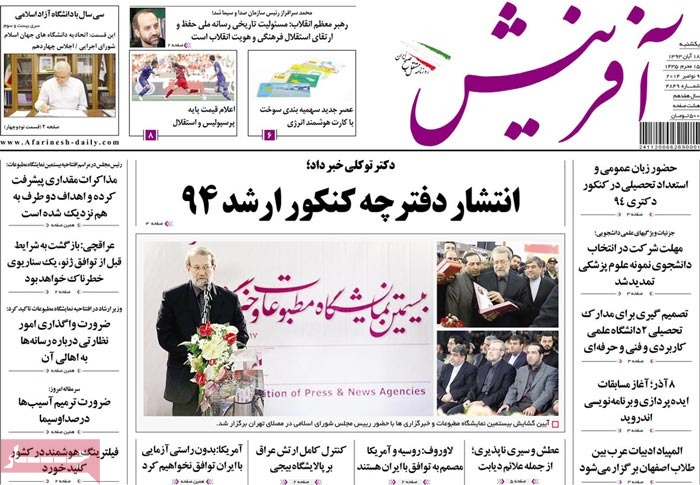
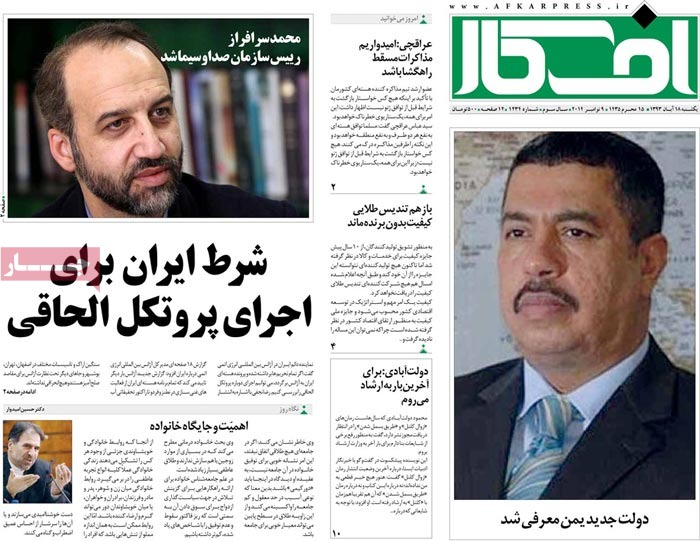
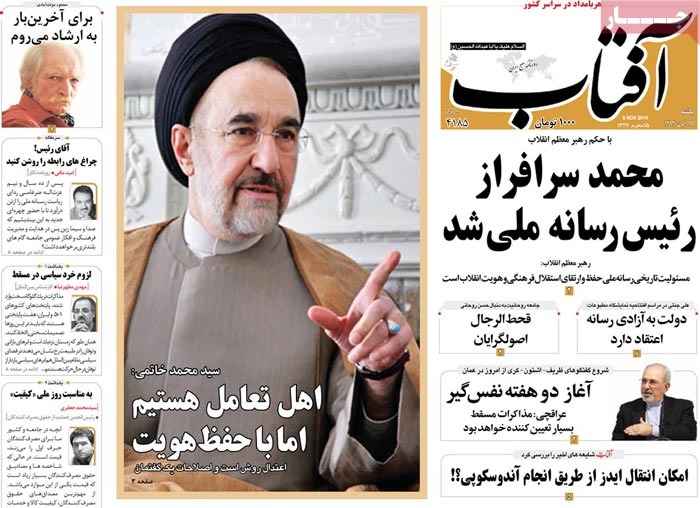
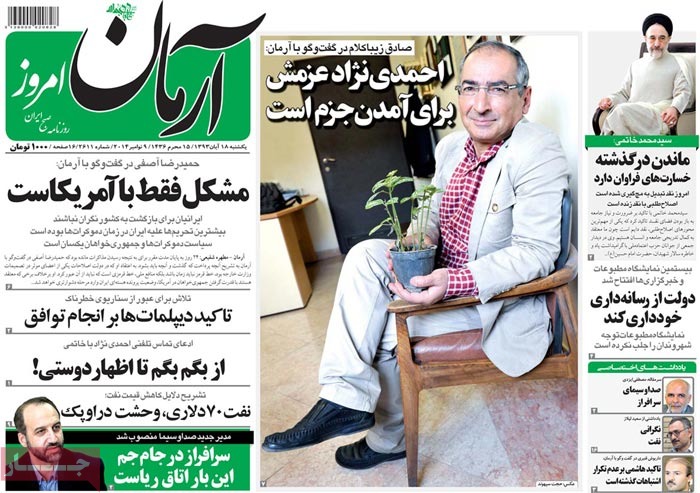
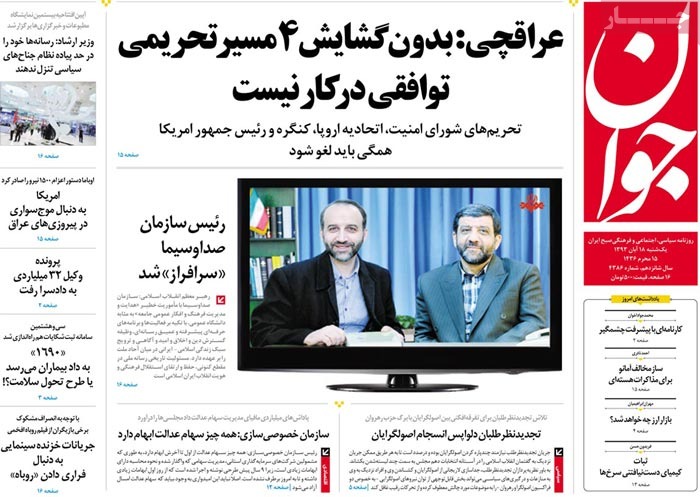
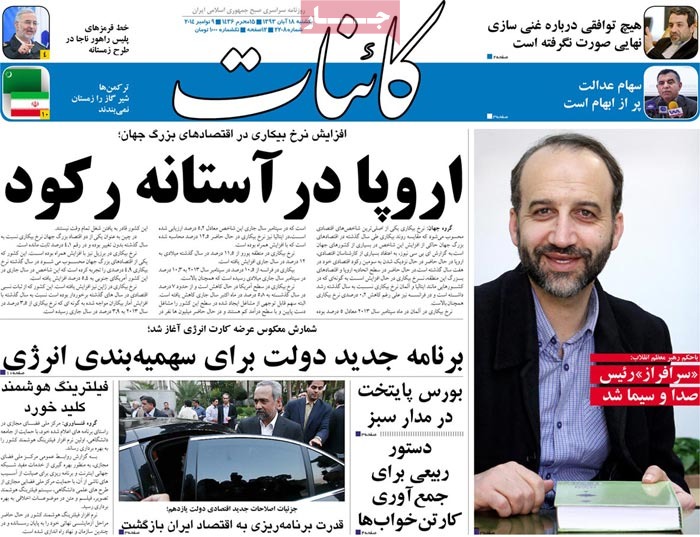
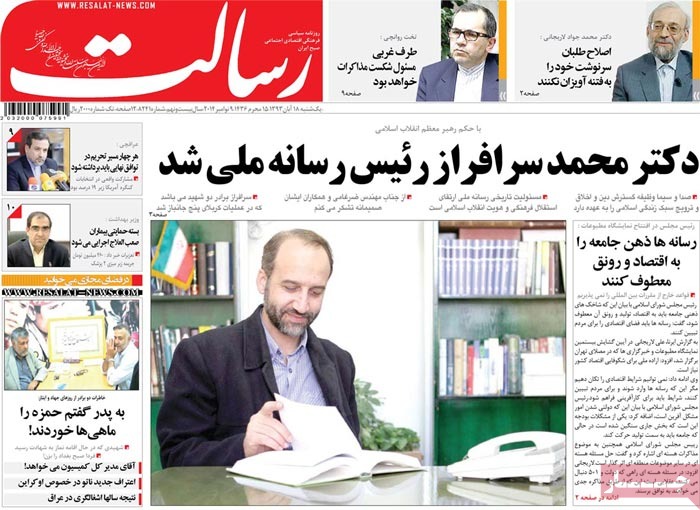
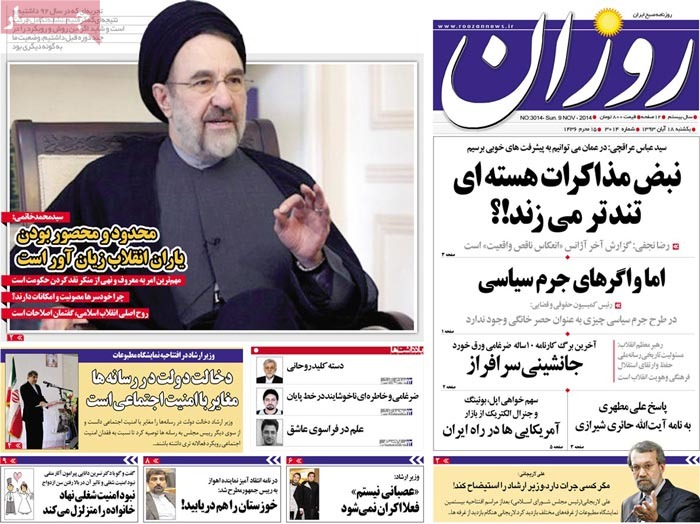
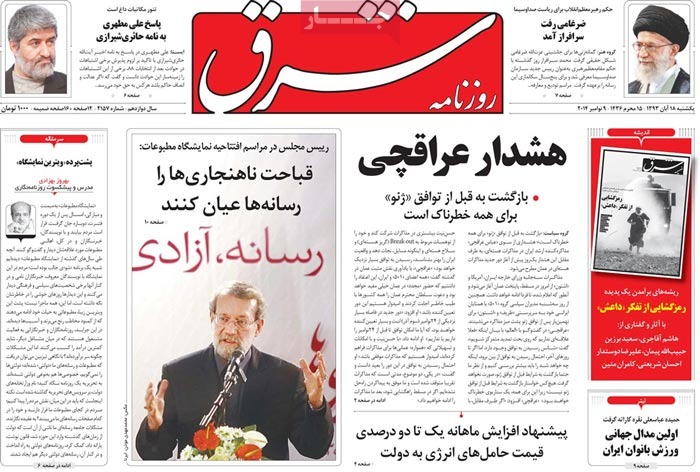
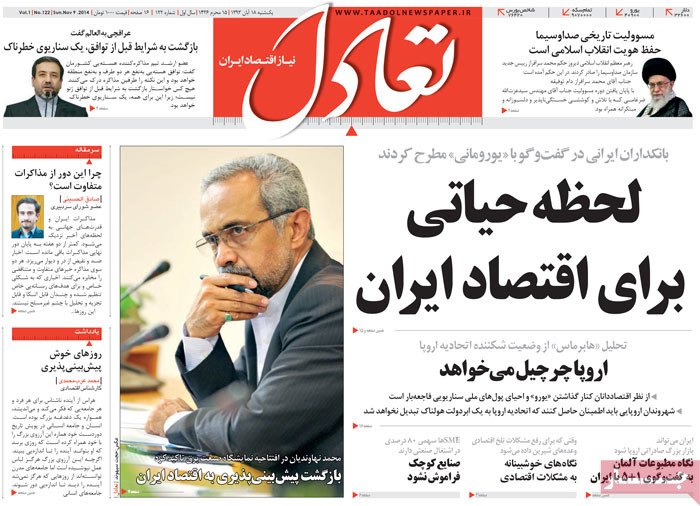
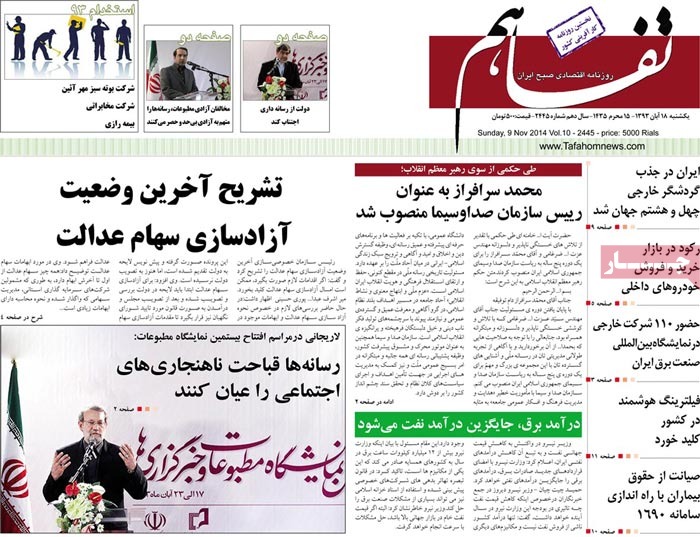
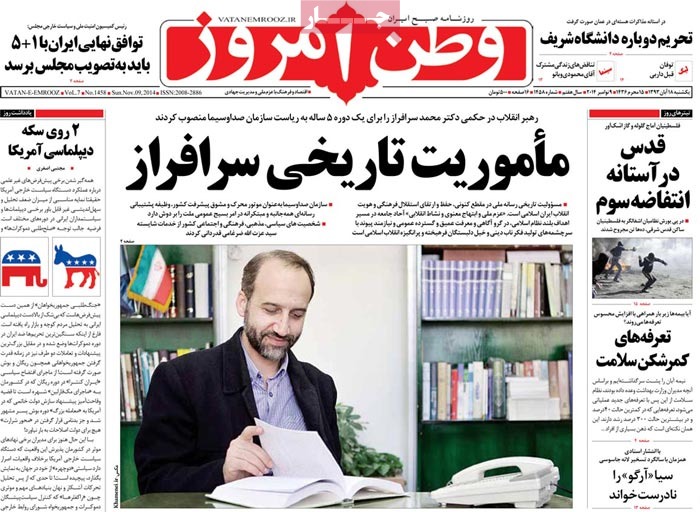
A look at Iranian newspaper front pages on Oct. 9

Iranian Newspapers Headlines

Kurdish protests across Turkey against Ankara’s handling of ISIL atrocities across the border in Syria dominated the front pages of many newspapers on Thursday. Also appearing on the front pages was news that Foreign Minister Zarif will meet US Secretary of State John Kerry and EU Foreign Policy chief Catherine Ashton in Vienna next week.


Abrar-e Eghtesadi: “Iran is the sixth most closed economy in the world.”


Abrare eghtesadi newspaper 10 - 09


Afkar: “Locally-produced gasoline is not carcinogenic,” the government spokesman said.


Afkar newspaper 10 - 09


Aftab-e Yazd: “Parliament Speaker Ali Larijani has called on key state institutions to speak with one voice as far as the nuclear issue is concerned.

Aftab-e Yazd: “A member of the committee investigating Babak Zanjani, who stands accused of massive corruption, has said former President Mahmoud Ahmadinejad had directly ordered his men to cooperate with the young billionaire.”

Aftab-e Yazd: Reformists and Moderates are likely to form a coalition in the upcoming parliamentary elections. Experts believe that [Mohammad] Khatami, representing Reformists, [Ali Akbar] Nateq-Nouri, who represents middle-of-the-road Principlists and [Hashemi] Rafsanjani, who leads the Moderate camp, will lead this coalition.

Aftab-e Yazd: “Artists hold a birthday party for former President Mohammad Khatami.”


Aftabe yazd newspaper 10 - 09


Arman-e Emrooz: “Yesterday is gone, tomorrow marks a new beginning,” says former President Khatami, who even greets his opponents with smile.


Armane emruz newspaper 10 - 09


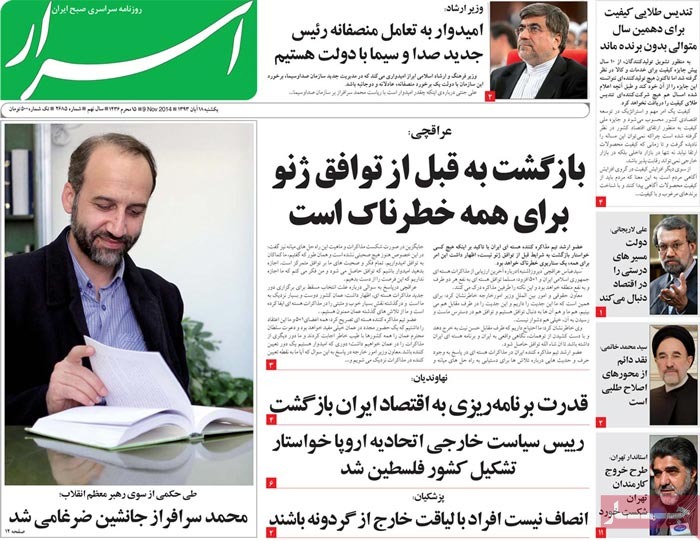
Asrar: “Britain’s move to unilaterally lift sanctions was a step forward,” said Foreign Ministry spokeswoman Marzieh Afkham.

Asrar: “The stage is set for [Iranian] cooperation with all countries in the world, except one [Israel],” Chairman of the Expediency Council Ayatollah Hashemi Rafsanjani said.


Asrar newspaper 10 - 09


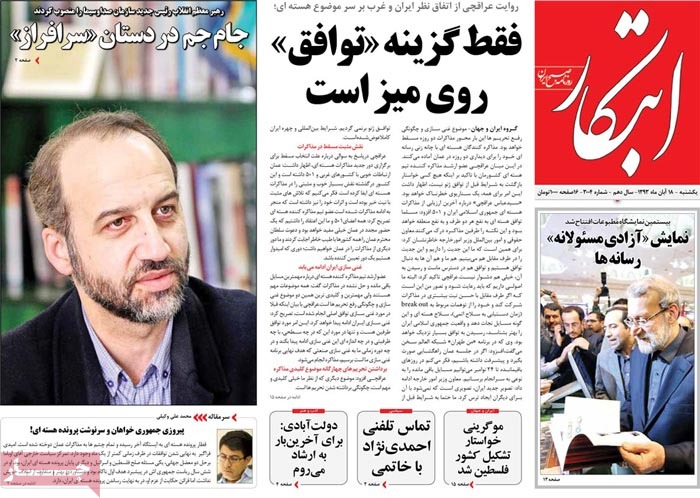
Ebtekar: “Zarif, Kerry, Ashton are to meet in Vienna next week.”

Ebtekar: Prominent Iranian singer, Shahram Nazeri, says, “I don’t want to be a national hero. I just want to remain a singer.” He has also denied rumors that he has staged a hunger strike to protest the plight of fellow Kurds in Kobani, Syria.


Ebtekar newspaper 10 - 09


Emtiaz: “Internet filtering is not a proper reaction to dealing with the virtual world”.


Emtiaz newspaper 10 - 09


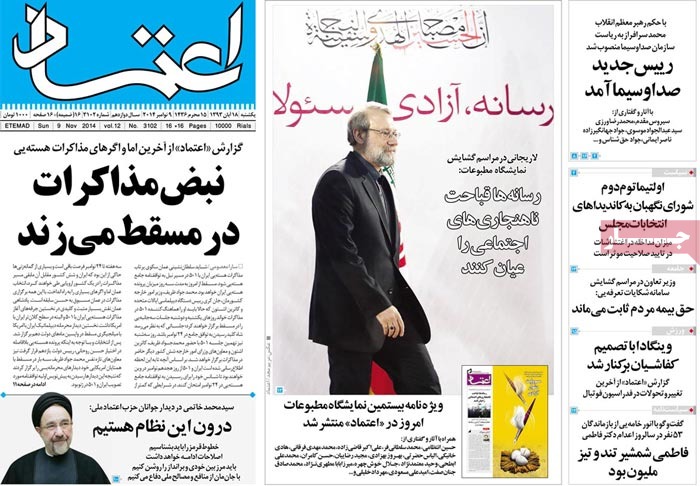
Etemad: “Despite bitter opposition by the government, parliament has taken the first step toward creating a parallel institution to enforce morality laws.”

Etemad: “President Rouhani has ordered cities to be cleansed of beggars and addicts.”


Etemad newspaper 10 - 09


Ettela’at: “Better prospects of nuclear talks are emerging,” the foreign ministry spokeswoman said.


Etellat newspaper 10 - 09


Hadaf va Eghtesad: “Iran cannot be eliminated from global equations,” said President Rouhani in a joint meeting between the Cabinet and parliament.


Hadafo eghtesad newspaper 10 - 09


Haft-e Sobh: “The Telecommunications Company of Iran (TCI) has openly complained about a drop in revenues thanks to widespread use of social networking sites.”


Hafte sobh newspaper 10 - 09


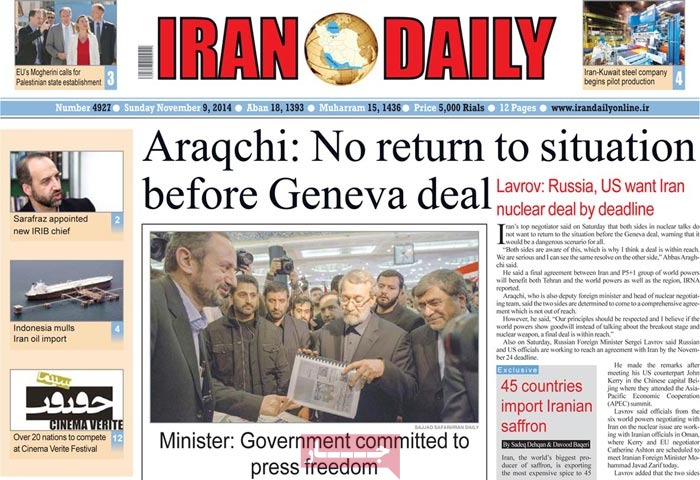
Iran Daily: “Iran will take action on Kobani if asked.”


Iran daily newspaper 10 - 09


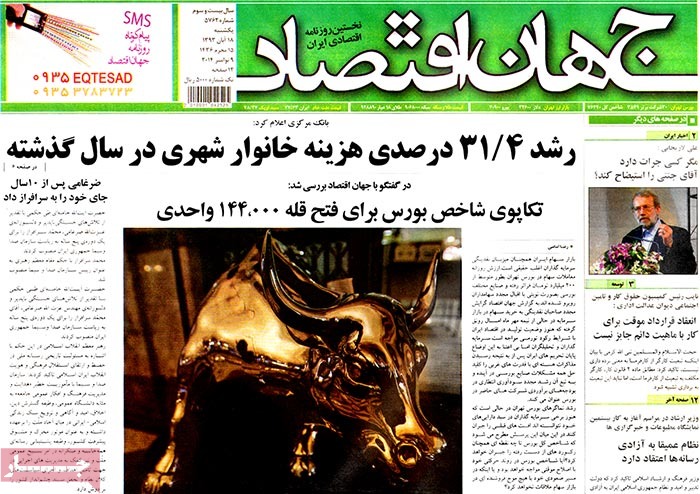
Jahan-e Eghtesad: “Up to 40 percent of the country’s businesses do not pay taxes.”


Jahane eghtesad newspaper 10 - 09


Jomhouri Islami: “Rouhani has injected hope and liveliness to Iran-US interaction,” a US diplomat said.


Jomhurie eslami newspaper 10 - 09


Khorasan: “As many as 274 new cases of cancer are diagnosed across the country on a daily basis.”

Khorasan: “A small group holds a rally outside the Turkish embassy in Tehran to protest ISIL crimes against Kurds in Syria.”


Khorasan newspaper 10 - 09


Resalat: “Iran is in no hurry to resume ties with Britain,” said the foreign ministry spokeswoman.


Resalat newspaper 10 - 09


Iran entitled to issue, deny visas to IAEA staff

Iran-Ambassador-Najafi

Iran’s ambassador to the International Atomic Energy Agency (IAEA) says it is the Islamic Republic’s sovereign right to issue visas or deny entry to the agency’s employees.

“I should say that in addition to [issuing visas to] the principal and permanent members [of the IAEA] in the past few months, Iran has also granted visas to three… new members of the agency’s team of experts,” Reza Najafi said on Wednesday.

Najafi’s remarks came after Reuters quoted the IAEA as saying that Tehran has refused to grant an entry permit to a member of an IAEA investigation team that visited the Islamic Republic on August 31.

“Under the IAEA regulations, Iran is under no obligation to grant visas to the agency’s employees,” the Iranian official said, adding, “Iran reserves the right to deny [visas to] even the appointed inspectors, and the Islamic Republic has exercised this right in the past.”

Iran’s IAEA envoy further touched on the latest round of negotiations between the agency and Iran in the Iranian capital, Tehran, saying, “Talks between delegations from Iran and the agency ended after two days.”

The high-level team, which was led by Tero Tapio Varjoranta, the IAEA deputy director general and head of the Department of Safeguards, arrived in Tehran on Monday to discuss the implementation of the remaining nuclear transparency measures agreed in May between Iran and the agency.

He said all remaining issues were discussed during the negotiations, including how two mutually-agreed-on transparency measures should be implemented.

He further noted that that the two sides will have another meeting in the near future, most probably in November.

[…]

Zarif, Ashton to hold nuclear talks in Vienna next week

Kerry-Zarif-Ashton
Kerry-Zarif-Ashton

Iran’s Foreign Minister Mohammad Javad Zarif and EU foreign policy chief, Catherine Ashton, are set to meet next week over Tehran’s nuclear energy program, Ashton’s spokesman says.

Michael Mann said on Wednesday that Ashton will first hold bilateral talks with Zarif in the Austrian capital, Vienna, on Tuesday, October 14.

“They (Ashton and Zarif) will be joined by US Secretary of State John Kerry for a trilateral meeting on Wednesday,” Mann added.

The remarks came hours after Iranian Foreign Ministry Spokeswoman Marzieh Afkham said preparations for a new round of talks between Iran and the P5+1 are underway.

Tehran’s nuclear negotiations with six world powers are making “slow progress,” but both sides have already developed an understanding that the talks must continue, she pointed out.

Afkham stated that there are still differences between the two sides and talks are continuing on the key issues.

French envoy describes Iran as most secure regional country for foreign tourists

French Ambassador to Tehran Bruno Foucher

Iran is the most secure country in the region for foreign tourists, French Ambassador to Tehran Bruno Foucher underlined after Paris put Iran’s name on the list of 40 states which are dangerous for travelling.

Foucher made the remarks in a meeting with Iranian Deputy Foreign Minister for Consular, Parliamentary and Expatriates Affairs Hassan Qashqavi in Tehran on Wednesday.

During the meeting, the senior diplomat assured Qashqavi that the French embassy has not presented any report to Paris on any insecurity in Iran, and expressed regret that his mission was not solicited by the French foreign ministry before issuing the report.

He stressed that he firmly believes Iran is the most secure and most attractive country in the region for trips by foreigners.

Foucher underscored the growing number of French tourists who visit Iran, and said, “The French embassy is fully ready to further develop the growing trend of tourism in Iran and provide any necessary assistance in this regard for its part.”

The French envoy promised Qashqavi to ask the country’s foreign ministry to strike off Iran’s name from the list of the 40 countries mentioned in the travel advisory.

He also described further expansion of cultural and tourism relations between Iran and France as one of the main goals of the French embassy in Tehran.

A thick line between “love” and “hate”

Khorasani
Omar Khalid Khorasani and Gholamali Pourataei Khorasani

Recent days have seen the simultaneity of two events: the expression by an extremist group – with links to Al-Qaeda – of support for and allegiance with Aba Yazid Qaher al-Khorasani aka “Omar Khalid Khorasani, and the passing of Gholamali Pourataei Khorasani, an Iranian folkloric musician from Khorasan. This concurrence naturally evokes one single name in the minds of people: Khorasani.

There is no denying the fact that a dividing line lies between the Khorasani who has intentions to kill people only to prevent them from practicing what he calls heresy, and the other whose love-based melodies were euphonious and whose instrument was exhilarating and life-affirming, and it also reveals a widening gap between “love” and “hate”.

Khorasan newspaper in its October 6 issue ran a report on the passing of Master Gholamali Pourataei’s whose memory lives on for good, as it was the case with his countrymen, among them big names such as Mowlana, Saadi, Ferdowsi, Khayyam, etc., who are alive in the hearts and minds of people several centuries after their demise.

The good-sounding melody of one heals the wounds and the malady of the other leaves scars on the bodies and souls of people. Standing in between are Khorasan and poor Khorasanis.

Pourataei, the veteran Mugham singer and Dotar player, passed away on Saturday October 4 [at the age of 73] after a long battle with cancer.

On Monday in a ceremony to commemorate the late Pourataei at Imam-Reza Cultural Complex in Mashhad, northeastern Iran, a message by Ali Moradkhani, the deputy culture minister for artistic affairs, was read out.

In the message Moradkhani said, “The sound of Pourataei’s Dotar has travelled beyond Iran’s national borders and has echoed around the world. It was in fact the messenger of Iran’s music in the whole world.”

An official with the Music Society in Khorasan Razavi province also said in the ceremony that today part of this land’s culture was carried in a funeral procession, adding that Pourataei embodied the voice of desert in Khorasan. He also said people across Iran are among the bereaved family of the late singer.

Then a student of the late Pourataei took the podium and said, “He was the first one who sang Ferdowsi’s Shahnameh by Dotar saying that he always shouted loud and clear [the name of] Iran with his instrument.”

Later, the body of Pourataei was transferred to his hometown, Torbat-e Jam, to be laid to rest in an all-artist cemetery.

Iran’s oil industry needs $200 b. in investment: Minister

Bijan Namdar Zangeneh

Iranian Oil Minister Bijan Namdar Zanganeh has expressed confidence about a final agreement with six major powers including the United States to resolve the impasse over Tehran’s nuclear program as well as about the lifting of sanctions by the US and European countries.

Tasnim News Agency quoted the oil chief as telling the Japanese newspaper The Yomiuri Shimbun as saying that it is important for Japanese companies to start negotiations with Iran over oil field and natural gas development projects before sanctions are lifted. “We will distinguish between the countries based on their stance — whether they discuss with us before or after a final agreement. Many foreign companies are coming [to Iran] and having discussions with us.”

Zanganeh also said Iran will hold a briefing session for foreign companies in London on February 22 and 23 to announce new arrangements regarding Iran’s oil field and natural gas development contracts.

The oil minister said the duration of contracts with foreign companies would be extended to 15 to 20 years compared to the present typical 10 years.

As for foreign investment in oil and gas development, Zanganeh said Iran needs between $150 billion and $200 billion in the next decade.

[…]

IRGC foils terrorist attack on border checkpoint

IRGC
IRGC

The Islamic Revolution Guard Corps (IRGC) said Tuesday a terrorist attack on a border checkpoint in southeastern Iran was pushed back by its forces in early September.
The IRGC Ground Force’s Quds Base announced in a statement in September that “a team of terrorists and outlaws attacked a checkpoint in Saravan border region and intended to capture it, but the IRGC Quds Base forces along with locals and Basiji troops of Sistan and Baluchestan province repelled the attack”.
In an interview with Fars News Agency on Tuesday, IRGC Ground Force Commander Brigadier General Mohammad Pakpour disclosed that during the failed attack 70 terrorists armed with 600kg of explosives and devices sought to blow up the border checkpoint.
“They rammed a vehicle laden with 600kg of explosives into the wall of the checkpoint building and a huge blast occurred and the checkpoint’s walls collapsed, but after about three and a half hours of clashes, they were forced to beat a retreat,” he added.
Noting that 70 terrorists had attacked the checkpoint, Pakpour said they had come from the Pakistani side of the border and wanted to capture the border checkpoint, but failed.
A Basij soldier present at the checkpoint was martyred. Scores of terrorists were killed in the attack.
The terrorists escaped to Pakistan after sustaining heavy casualties during the clashes, Pakpour said. […]