Thursday, December 25, 2025
Home Blog Page 4955

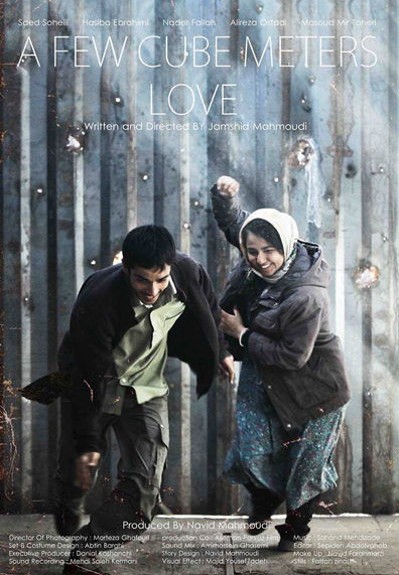
“A Few Cubic Meters of Love”, a joint Iran-Afghan film becomes a candidate for Oscars

A Few Cubic Meters- movie

A Few Cubic Meters- movieJamshid Mahmoudi, the Iranian director of “A Few Cubic Meters of Love” says his film is to be presented as an Afghan production at the 87th Academy Awards in 2015.

A September 13th issue of Arman-e Emrooz daily ran a brief report in which the director explains why such a decision has been made about the joint Iranian-Afghan production. The following is the translation of the report:

Director Mahmoudi said “A Few Cubic Meters of Love” is a joint production and officials in both countries have given it the go-ahead to be shot and screened.

A Few Cubic Meters- movie

“We have already secured the permission of appropriate authorities to screen ‘A Few Cubic Meters of Love’ in theaters across Iran in the second half of the current year [started March 21, 2014]. In light of the fact that Oscars candidates have an end-of-September deadline to hit the screen in their country of origin before becoming eligible for Oscars, we decided to have it screened in Afghanistan before the deadline and introduce it as an Afghan production in the event,” the director said.

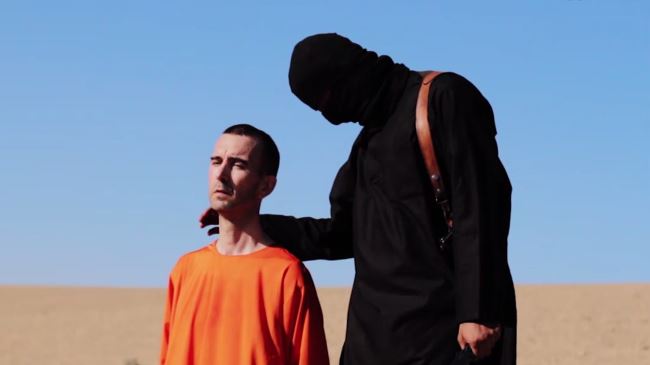
ISIL’s new video shows beheading of David Haines

ISIL-David-Haines
ISIL-David-Haines

On Saturday, the Takfiri group posted the footage consistent with the earlier ones showing the execution of two American journalists James Foley and Steven Sotloff.

A masked militant appeared in the video, entitled, “A Message to the Allies of America,” saying the execution was in response to UK Prime Minister David Cameron’s engagement in a US-led coalition against the militants.

“This British man has to pay the price for your promise, Cameron, to arm the Peshmerga (Kurdish fighters),” against the ISIL, said the man dressed in black with a British accent.

The British prime minister had earlier talked of efforts “to help make sure the Kurds have the arms they need to fight off” the terrorist group.

In the footage, Haines also accused British premiers for not having the “courage to say no to the Americans.”

“Unfortunately, it is we, the British public that will, in the end, pay the price for our Parliament’s selfish decisions,” Haines said, referring to Britain’s engagement in war on the ISIL.

The British victim, who is a 44-year-old father of two from Perth in Scotland, was reportedly captured in Iraq last year.

Another hostage, identified as Alan Henning, was shown at the end of the video, with the masked terrorist saying he would be killed if Cameron continued fighting the ISIL.

The video was shot in a desert setting similar to the two previous ones with the victim wearing an orange jumpsuit.

Cameron reacted to the video, saying, “This is a despicable and appalling murder of an innocent aid worker. It is an act of pure evil. My heart goes out to the family of David Haines who have shown extraordinary courage and fortitude throughout this ordeal.”US President Barack Obama also said that Washington would stand “shoulder to shoulder,” with the UK following “the barbaric murder” of Haines.

“We will work with the United Kingdom and a broad coalition of nations from the region and around the world to bring the perpetrators of this outrageous act to justice,” Obama said.

Iraq has been fighting the ISIL terrorists since they took control of Mosul on June 10. The takeover was followed by the fall of the city of Tikrit, located 140 kilometers (87 miles) northwest of the capital Baghdad. The control of Tikrit was later retaken by the Iraqi army.

The Takfiri terrorists currently control parts of eastern Syria and Iraq’s northern and western regions. They have threatened all communities, including Shias, Sunnis, Kurds, Christians, Izadi Kurds and others, as they continue their atrocities in Iraq.

[…]


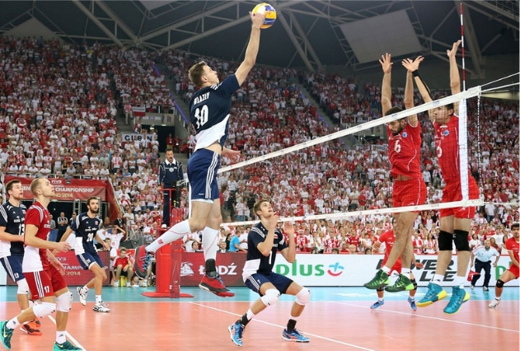
Iran volleyball team lose to hosts Poland but remain hopeful to advance

Iran Poland volleyball

In the FIVB Volleyball Men’s World Championships Iran lined up against hosts Poland Saturday and came back from two sets down only to lose the thrilling five-setter 3-2. (17-25, 16-25, 26-24, 25-19, 14-16).

The one point Iran bagged from the nail-biter means Iran are still in contention for a place in the next round of the games.

Iran will take on Serbia in their final game of the second round later on Sunday.


Azerbaijan no base for anti-Iran moves: Azeri defense min.

Hermes Drone
Hermes Drone

In a meeting with Iranian Deputy Defense Minister Brigadier General Qasem Taqizadeh in Baku on Saturday, the Azeri minister said his country will by no means allow its soil and airspace to be used against the Islamic Republic.

He said Tehran and Baku enjoy longstanding friendship, adding that Azerbaijan attaches great significance to good ties with Iran.

The Azeri official also called for the development of defense cooperation between the two neighboring countries.

The Iranian official, for his part, said the Islamic Republic is ready to further develop defense ties with Azerbaijan.

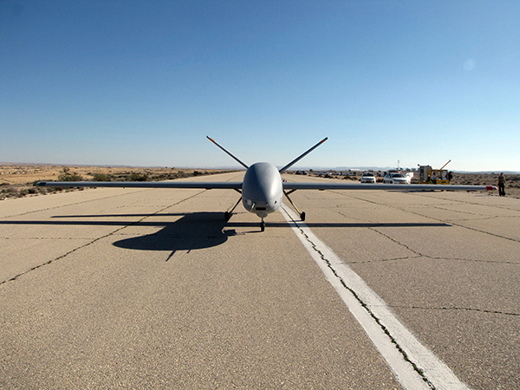
Last month, Iran’s Islamic Revolution Guards Corps (IRGC) said its forces had intercepted and shot down an Israeli spy drone with a surface-to-air missile. The Israeli-made Hermes drone was heading to Natanz nuclear facility in the central Iranian province of Isfahan.

Some media reports claimed that the drone was launched from Azerbaijan’s territory. Azeri officials have denied the reports.


A look at Iranian newspaper headlines across the country on September 13

Iranian Newspapers headlines
Iranian Newspapers Headlines

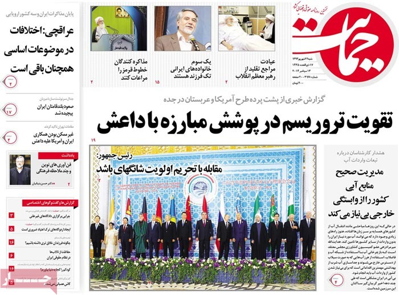
Most Iranian newspapers on Saturday (September 13) gave front-page coverage to the comments of President Rouhani at a summit of the Shanghai Cooperation Organization in Dushanbe. The meeting between Presidents Rouhani and Putin on the sidelines of the event and its potential importance in forging closer ties with Russia also drew a lot of front-page attention. News about the recovery of the Supreme Leader following his prostate surgery on Monday was also given prominence in the newspapers.

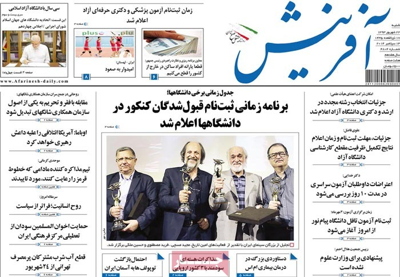
Afarinesh: The Portuguese head coach of the Iranian national football team Carlos Queiroz is due back in Tehran later in September to sign an extension to his deal.


Afarinesh Newspaper-09-13


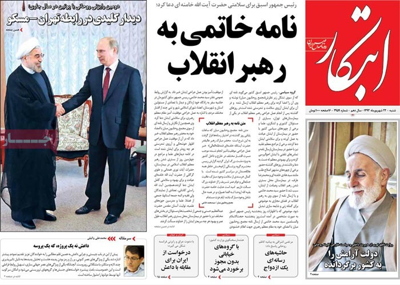
Ebtekar: “[Former President Mohammad] Khatami sends a letter to the Leader of the Revolution, wishing Ayatollah Khamenei recovery.” It came after bedside visits to the leader by prominent reformist figures such as Seyyed Hadi Khamenei and Mohammad Reza Aref.

Ebtekar: “Efforts to enhance Internet content control is a waste of money,” says Nemat Ahmadi, an Iranian lawyer. “One cannot ban the import of technology just like slapping a ban on imports of cars.”

Ebtekar: “Those who seek to hit the streets [to promote virtue and prevent vice] need to have proper permits, otherwise they will be seriously dealt with by police,” warned the spokesman of the Interior Ministry. “There are many people or groups who are critical of the way things are run in society. And sometimes they are right. But critics cannot take the law into their own hands.” The warning by Hosseinali Amiri came after Ansar Hezbollah said they’d launch motorbike patrols to counter those who flout morality laws.


Ebtekar Newspaper-09-13


Ettela’at: “Talks to export Iranian natural gas to Europe will get under way shortly.”

Ettela’at: “Veteran stars of stage and screen get together at the capital’s Vahdat Hall to celebrate the second anniversary of the foundation of the Veteran Actors Institute.”

Ettela’at: The director of the Environment Protection Organization has expressed concern over unbridled development activities in the forests of the north [near the Caspian Sea].

Ettela’at: “People should be free to speak their mind within the framework of the Constitution,” the president tells a group of Iranian expats based in Tajikistan.


Ettelaat Newspaper-09-13


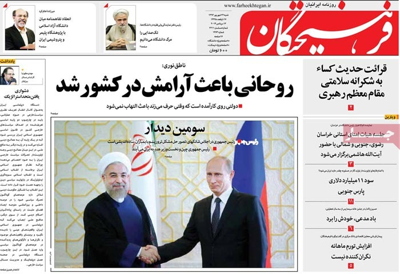
Farhikhtegan: “President Rouhani has restored calm to the country. A government whose words do not inflame tensions has come to office in the country,” said Ali Akbar Nategh Nouri, who heads the Supreme Leader’s Inspection Office.

Farhikhtegan: “Monopoly in expression of ideas in universities sounds the death knell for institutes of higher education,” the head of the Supreme Leader’s Office in Universities said.


Farhikhtegan Newspaper-09-13


Hambastegi: “Organized planning is the only way to counter extremism and terrorism,” President Rouhani said in Dushanbe.


Hambastegi Newspaper-09-13


Hemayat: “Differences remain between Iran and world powers,” Iran’s deputy foreign minister says at the close of talks with three European countries.


Hemayat Newspaper-09-13


Iran Daily: “Paris wants Tehran to help crush terrorists in Iraq.”


Iran Daily Newspaper-09-13


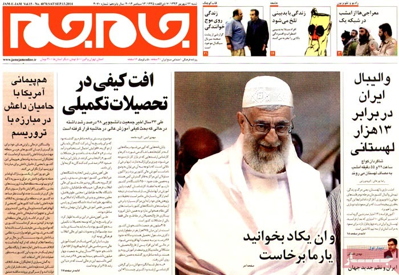
Jamejam: The Iranian volleyball squad take on Poland in a crucial encounter in the FIVB World Championships late Saturday.


JameJam Newspaper-09-13


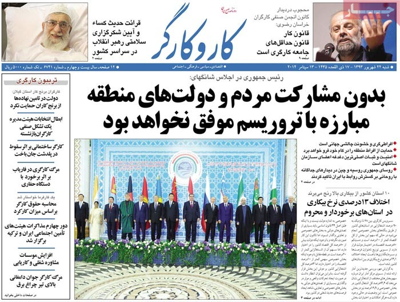
Kar va Kargar: “In the absence of contribution by regional nations and governments, the fight against terrorism won’t be successful,” President Rouhani tells a summit of the Shanghai Cooperation Organization.

Kar va Kargar: “The gap between employment figures in well-to-do and impoverished provinces is as much as 13 percent.”


Kar va Kargar Newspaper-09-13


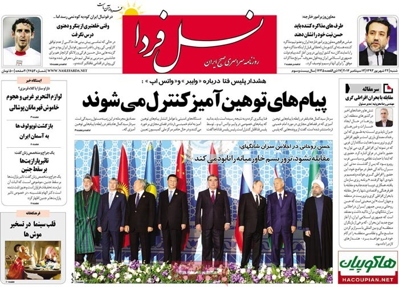
Nasl-e Farda: Will Russian-made Tupolev, which is known in Iran as the Death Bird, make a comeback to the skies over Iran?

Nasle Farda Newspaper-09-11


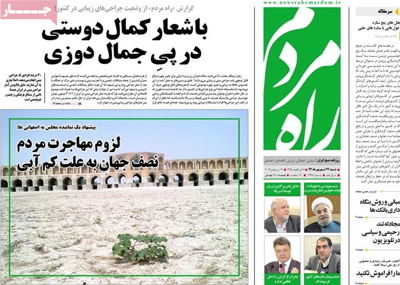
Rah-e Mardom: “Over 50 percent of the country’s hospitals are too old and need renovation,” says the Iranian health minister.


Rahe mardom Newspaper-09-13


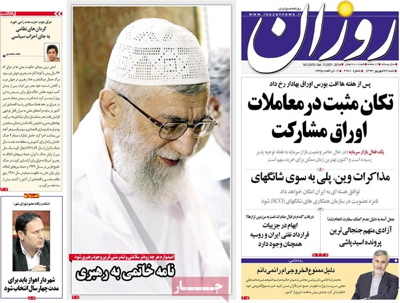
Roozan: The brother of former President Mohammad Khatami says he has no idea why he’s been banned from leaving the country. “A while ago I went to the airport to leave the country, but authorities there confiscated my passport without offering any reason for the move,” Mohammad Reza Khatami said.


Rouzan Newspaper-09-13


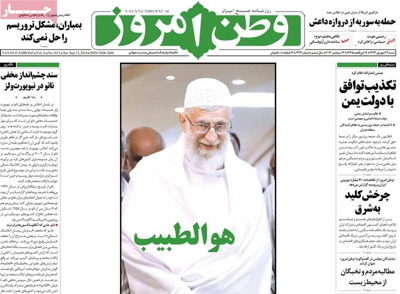
Vatan-e Emrooz: “Bombing won’t eliminate the scourge of terrorism,” the president says in a summit of the Shanghai Cooperation Organization.


Vatane Emrouz Newspaper-09-13


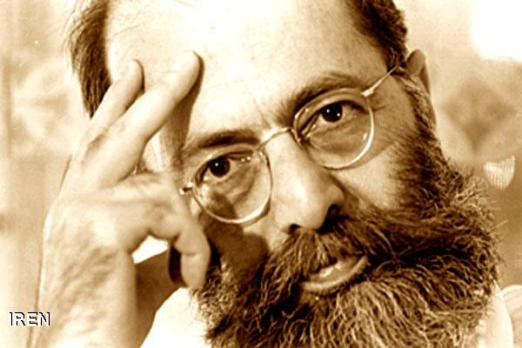
We can’t help but look at the past through a modern prism

Mohammad Qaed
Mohammad Qaed

Translating the comments of a veteran translator and journalist is certainly a gamble for Iran Front Page, particularly at a time when we have just hit the road. But we at IFP are more than willing to take the risk of inviting his assessment. The following is an excerpt of an interview Mohammad Ghaed has given to Iran newspaper’s Sayer Mohammadi. The interview, along with its lead, appeared in the August 24th issue of the daily, which is run by the Islamic Republic News Agency:

A Farsi translation by Mohammad Ghaed of The Guns of August, an account of World War I by American historian and author Barbara W. Tuchman, was published by Mahi Publishing House earlier in 2014. It is to be reprinted shortly. Ghaed is very good at writing articles. Apparently his journalistic background gives him an edge over fellow translators.

The appearance of his name on the cover of any book is enough to set the seal on its success. His translation of Powers of the Press: The World’s Great Newspapers by Martin Walker was reprinted several times by Markaz Publishing Co. and is now a sought-after book on the market. So are the books he has penned himself including The Diary and Oblivion, along with Injustice, Ignorance and Those in Limbo on Earth and Suffering and Healing, which have been reprinted a few times each.

[…] What is it that modern man and history-lovers can take away from books?

As Benedetto Croce has put it “All history is contemporary history.” When we contemplate the past and review what has already happened, we are actually thinking about the present. When in our thoughts we go back in time to the Qajar era, to the 19th century Tehran or to the early 20th century when the First World War was still raging, we wonder what we would have done or felt if we’d lived in those circumstances.

In the absence of contemporary history, many past things would lose their importance, either partially or totally. We lose our interest in old things because they are in the past. That we spend money on antiques is because they take us back to an atmosphere that combines the past and the present.

I believe what is important about this book, or about World War I in general, is that it amounts to a rejection of subjectivism and voluntarism that suggest humans developed thoughts which in turn gave shape to history and changed the world.

In this book the world has undergone change, but humans hold on to views which are similar to those of their ancestors. By that, I mean, similar to the thoughts of kings, rulers, prominent politicians, generals and war commanders, not ordinary people.

With the outbreak of World War I, technology took a great leap forward. Internal combustion engines, Zeppelins, machine guns and long-range guns became available on the market. The theories of the 18th century turned into industrial products, and industrialists were mass-producing them.

For instance, the inventions of Thomas Edison dating back almost 200 years were mass-produced. Things were progressing exponentially. Progress on one front translated into more rapid headway on others.

But the prevailing attitude in societies and among rulers dated back to centuries earlier. They were of the conviction that modern cannons and machine guns would do the same things elephants and muzzleloaders did in the past, so they embarked on conquests that were once unimaginable to Napoleon and Frederick the Great. Imagining the practical results of fast-paced developments and understanding their aftermath were almost impossible for individuals or even for an entire generation. They needed experience that seemed unfathomable even when it actually happened.

You sound like a person who views the Great War as an end to an era. Do you think the outbreak of the war was inevitable?

Moral inevitability is not the same as natural inevitability. When a cluster of cells grows, it may become too big for the container in which it is located. The cellular growth which is exponential is designed to help the cells survive. […] Ironically it is both simple and complicated at the same time.

That happened in the First World War and in the run-up to the downfall of the Shah [Mohammad Reza Pahlavi]. The system the [Iranian] monarch established grew bigger and bigger. In parallel, the population grew, the number of universities increased, people got more educated and urbanization took off. As a result, the political shell which was unable to accommodate all that imploded.

By the early 20th century, European societies had grown bigger and more complicated. Quality had followed in the footsteps of quantity toward change. Universities, which were a German invention, had found their way across the Atlantic to the US.

Modern-day universities can be described as a joint invention of the Germans and Americans. Bachelor’s, master’s, and Ph.D. degrees as well as dissertations were non-existent. For centuries, universities from Agora in Greece to Sorbonne and Oxford and Cambridge were seminaries. They were in fact a forum for some individuals to advise people to opt for good rather than evil, and tell them what the truth is and what is permissible. They would talk and theorize.

Barbara W. Tuchman first released The Guns of August before penning The Proud Tower, which is a sequel to the Guns of August. Why did in Iran the translation of the second book come out first?

I have been asked the same question before. You can answer that question only when you hear the viewpoints of those who have read those books in reverse order. Each book contains information that forms a chain link in the minds of readers. That information link should exist in your mind for new links to be added to it. By reading this book one can answer some of the questions that pop up in their mind. The answer to each question might pose new questions.

The emergence of Capitalism in the US is linked to global wars for domination of lands. On the other hand, it can be regarded as an independent subject. Depending on the types of questions a reader might have in mind, they could find answers by reading these books. But I don’t suggest which one the readers should go through first.

These books are not textbooks and one is not necessarily a prerequisite for the other. The author had some questions in her mind, so she embarked on field research and subsequently wrote these books.

That a historical event is presented in the form of a story makes this book more appealing. The question is how close the book is to accurate history writing.

That question is for historians and those who put forth historical theories to answer. Just like linguistics, the theories researchers put forward vary and you may forget who said what in the past and whether it still holds.

Some people consider me a historian, but I am not one. I am just a translator, and historical texts are the same to me as any other subject.

We can’t help but look at the past through a modern prism. We can’t try to ignore what we already know. In The Sleepwalker, Arthur Koestler says, “We can add to our knowledge, but we cannot subtract from it. When I try to see the Universe as a Babylonian saw it around 3000 B.C., I must grope my way back to my own childhood.”

 Koestler’s comment does not imply that Babylonians, who set up the first urban civilization, acted like children. They were wise people, but their knowledge was more limited than ours. A child’s knowledge about the world is limited, but they are mentally agile. When they learn something, they won’t forget it. Only through books and writing can humans develop an insight into abstract layers of the world and the truth.

Understanding that rotating a rectangle around one of its sides produces a cylinder is an example of abstract thinking. In order to appreciate spatial geometry, people in Babylon and Ancient Egypt and Mayans needed to be able to write.

We look at people who, let’s say, lived a century ago based on the information that is available to us. We know what has become of those people. Even without knowing what we know today, we can somewhat imagine in what conditions they lived. An abstract tightrope walking as such is only possible through texts and writing.

When the First World War was raging, people were not like us when it came to experience, habits and expectations. […] In directing movies which are set a century ago, an Iranian director knows about certain things that were customary back then, but s/he has to close their eyes to some of them to make the movie more presentable. Making judgment about the past with modern health criteria in mind is not what the director wants to do.

According to this book, in the scorching heat of the summer soldiers had to walk for long hours through the hills and woods each day. They wouldn’t get enough rest, nor were they given hot meals or proper gear including boots. In their diaries, German and French officers said stinking hungry soldiers had to walk almost half-asleep. Today nowhere in the world are soldiers treated that way. It is unimaginable.

Why do you think President John F. Kennedy gave copies of the book to his associates and suggested others go through it as well?

As far as I know President Kennedy gave copies of the book to members of his Cabinet and ordered more copies to be sent to US military bases around the world so that American officers could read it too. The book portrays individuals who wrongly assume they are in full control of things, but when they face a real emergency, they do not know what they should do.

I guess Kennedy knew that sometimes complicated things proved all too powerful for human intelligence to overcome. A military approach to a problem could have resulted in a nuclear war with the Soviets. He was worried about Communist China too.

In such a difficult situation one might make a decision that could transform the global landscape. Probably he didn’t want to be one of those politicians who had sent an entire generation of European soldiers to their deaths in the trenches 50 years earlier.

[…]


Those who favor negotiations have wrongly raised public expectations

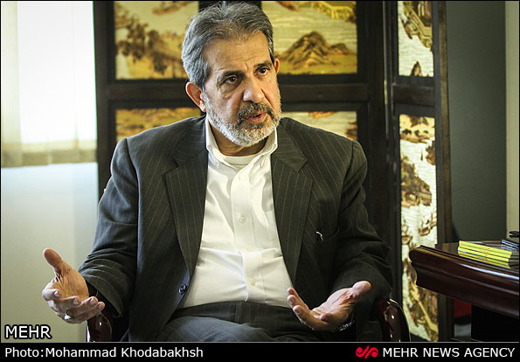
Hamidreza Asefi
Hamidreza Asefi

Hamidreza Asefi, 61, is a retired Iranian diplomat who served as Foreign Ministry spokesman under both Mohammad Khatami and his successor Mahmoud Ahmadinejad. In an interview with Mehr News Agency he has weighed in on nuclear talks between Iran and P5+1, ties between Tehran and Washington, and regional developments. The following is the translation of an excerpt of the interview by Samira Amir-Chakhmaghi:

How have nuclear talks between Iran and world powers progressed since the government of President Rouhani took office in 2013?

Foreign relations are not like local affairs. In foreign relations there is more than one player involved. In local matters when a problem arises, there is a person who has the final say, for instance, in Iran the Supreme Leader and in other countries the president or prime minister get involved and work out a solution to the problem at hand.

In foreign relations there are several players involved. Coming to terms with the fact that not everything is under the control of a single country helps you avoid rash judgments about foreign relations.

Naturally nuclear talks between Iran and P5+1 have been tough since day one. What makes the negotiations even tougher is the fact that one party to the talks is acquisitive and lacks goodwill, and the other seeks to restore its obvious rights.

Another thing that makes the talks all the more difficult is that the two sides are working on a solution to a problem which has been in the making for 12 years. Besides, the two negotiating parties are not alone in this. Foreign players such as the Zionist regime and some Persian Gulf countries do not want the talks to succeed.

In Iran those who favored the talks and viewed them as the right thing to do made a rather hasty assessment and raised public expectations. That was a grave mistake.

On the other hand, some tried since day one to imply that the talks were doomed to failure citing the selfishness and acquisitiveness of the other side. I believe these people decided too soon that the talks would fail.

In a tough situation as such talks have made relatively good progress. Although major problems have yet to be addressed, a new attitude has been formed in the world toward Iran and our standing on the international stage has improved.

You said those who supported the talks made a hasty assessment. Are you suggesting that setting a deadline for the talks to conclude has been wrong?

The assumption that any negotiations should one day produce results is right. Talks should not be held merely for the sake of talks. […] Familiarity with the prevailing atmosphere helps those who sit at the negotiating table guess how long it will take for the talks to produce results.

That some suggested that the atmosphere was totally positive and a final solution was imminent was wrong. As I said one cannot hold talks just for the sake of holding talks.

Personally I believe a good deal that comes on the back of marathon talks is much better than a bad deal which is struck quickly. For sure, simply striking a deal is not our ultimate goal. We seek to hold on to our inalienable nuclear rights.

Do you think a deal can be reached by November?

It is difficult to predict. The negotiating team is optimistic, so is the spokesman of Catherine Ashton. Some other Europeans like the Italians are optimistic too. But experience has taught me that optimism should not serve as the basis of assessment.

I believe September is a very important month in nuclear talks. The hurdles will either be cleared or they will grow even bigger. If we manage to reach a deal in principle on some general concepts before the next round of talks in New York on September 17, one can be optimistic.

Are you saying the talks in New York are crucial?

I believe the talks with the Americans and the Europeans that are held before the gathering in New York are even more important than the New York negotiations. The stance of the Russians is almost the same as that of the Chinese.

Personally, I think it will take more than four months to reach an accord and agree on its final wording. The drafting may need longer time to complete.

You think there may be another extension of the deadline beyond November 24th to draft the agreement?

They may strike a deal in stages. The good point is that neither side wants the talks to fail. The Americans are more willing to strike a deal. They need us.

America’s global position is not good. They are grappling with economic problems and face challenges in Ukraine and Russia. The so-called Islamic State is the biggest of their problems, one which is of their own making. If they fail to take on IS in Iraq and Syria now, they will have to fight them on home turf shortly.

[…] A round of talks between Iran and the US has failed to narrow down differences between the two. Do you think there is a way for the two sides to get closer [on issues of mutual interest]?

What I just mentioned focused on the positive. As you know the Zionist lobby and the right in the United States Congress are bent on erecting hurdles in the way of the talks.

Besides, the American acquisitiveness is also a problem. Some might think that one political party in the US is better than the other. But the Gaza war proved that they are only different in their approaches not in their strategies. […]

I believe if we manage to cut a good deal on the lifting of sanctions, the number of centrifuges and the extent of peaceful nuclear activities, the other problems would be solved. Of course, the gap on those issues is still very wide.

[…] In light of recent comments by the Supreme Leader that negotiations with the Americans have showed that they won’t change, how you see the future of ties between Tehran and Washington?

Contacts between Iran and the US will remain focused on the nuclear issue. They have their own strategy and determine their approach based on that strategy. It is true that contacts and face-to-face talks could create a different atmosphere, but the nature of our relations will remain the same. […]

When Hafez al-Assad was in power in Syria, the US secretary of state visited Damascus 17 times in the space of one year. That did not thing to change the American approach to Syria – rather, the visits were designed to change the Syrian policies.

At present the Americans are talking to us to change our attitude. From their perspective, the talks are not meant to hear our logic. As the Supreme Leader has said at times we need to display heroic flexibility. Sometimes the Americans show flexibility in their policies; that does not mean they have forgotten their ultimate goal.

We have to appreciate the fact that if the American side makes compromises on one front, it seeks to notch up a win on another. Foreign relations are like a chess game. You need to guess what the next 10 moves of your opponent might be in order not to make a hasty move.

The American moves are in line with their strategy which is clear to us. If we keep that in mind, neither will a smile on their part fill us with excitement, nor their bad temper will make us angry. After all, we know what the other party is up to.

The Iranian negotiators have performed very well. They have insisted on our stance and have not agreed to sign a bad deal. They have acted honestly and I believe that is a definite plus.

In the past we had direct talks with the US on Afghanistan and Iraq, but their attitude would not change. After the talks on Afghanistan, US President George W. Bush went on to describe Iran as part of an axis of evil.     

Some analysts believe that if Iran and the US focused on other issues like Iraq, the deadlock might be broken. What’s your take on that?

Regardless of what has led to the emergence of ISIL, there is unwritten convergence between Iran and the US on the terrorist group. We both denounce the Islamic State, from two different perspectives, though.

I don’t think cooperation between the US and Iran, or any other country for that matter, is needed to defeat ISIL. Division among Iraqi officials was to blame for ISIL overrunning as much as 30 percent of Iraqi territory. […]

One should not forget the fact that Iraq had one of the mightiest armies in the Middle East, treason and failure of the Kurds and Sunnis to contribute to military efforts to quell ISIL were to blame for the defeat the army suffered. […]

In establishing ties with the US, resumption of diplomatic relations should not and could not be the ultimate goal. If such relations were meant to settle some regional problems, we’d take account of the expediency of the country and move toward that goal. We have done that before.

You think normalization of ties between the two countries is logical?

On the diplomatic front nothing is impossible. Of course, there are some exceptions to that rule. For instance, one can definitively say that establishment of relations between Iran and the Zionist regime is impossible. However, I believe resumption of ties between Iran and the US is unlikely in the short run.

What happens if an agreement is not reached by the November deadline?

Failure to strike a deal won’t bring in the end of the world. Even in case of such failure, the atmosphere won’t be as tense as it used to be. […] Politicians are good at working out new solutions. They will definitely come up with a new formula to sustain the talks. Even if they fail, they won’t publicly announce their failure and the talks will carry on, one way or another.

Recently Iranian deputy foreign minister paid a visit to Saudi Arabia. How do you see ties between the two countries?

Relations between these two countries have always been peculiar. There are rivalries between the two that date back to before Iran’s revolution. Those rivalries grew after the revolution.

Saudis are very conservative in their foreign policy and very traditionalist at the same time. They don’t update their policies. On regional issues such as Syria, Bahrain and Yemen they have performed poorly. Their failure to see the realities on the ground and act accordingly is to blame for their behavior.

The Saudis should come to terms with the fact that they no longer are the sole player in the region and that they cannot tribally solve the issues of the world of Islam in consultation with a few Arab countries. […]

And finally, tell us about developments in Iraq and your assessment of Iran’s support for the new Iraqi prime minister.  

Iran’s support for Haider al-Abadi amounted to respect for what the Iraqi people wanted. Iran would have supported any other person who had been chosen in a democratic process.

The two countries need each other. We are both members of OPEC and the Organization of the Islamic Cooperation (OIC). We can help each other on various fronts.

Iraq is currently grappling with the problem of ISIL. We need to help Baghdad solve that problem. I believe Tehran can contribute to efforts to maintain unity among Iraqi factions which will guarantee the emergence of a powerful, independent and influential Iraq.

 

Iran, Russia call for promotion of bilateral relations

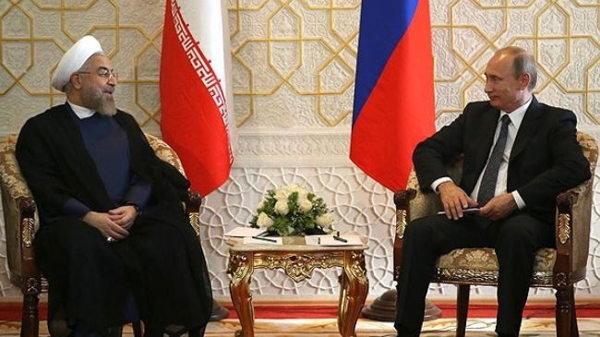
Rouhani-Putin
Rouhani-Putin

Iranian President Hassan Rouhani and his Russian counterpart, Vladimir Putin, met Friday on the sidelines of the summit of the Shanghai Cooperation Organization (SCO) to discuss issues of mutual interest as well as regional and international developments.

During the meeting, President Rouhani said Iran is determined to expand relations with the neighboring states, adding that the political and economic relations between Tehran and Moscow have seen an upward trend over the past year.

The Iranian president stated that Iran and Russia have had good cooperation in the fields of science and technology and the process should be reinforced through further enhancement of relations in engineering and commercial fields as well as export of agricultural products.

Rouhani also called for the facilitation of commercial exchanges between the private sectors of Iran and Russia, urging the Russian side to provide more facilities for the Iranian investors.

President Putin, for his part, expressed satisfaction over the growing relations between the two neighbors and noted that Moscow will form a committee to follow up on the agreements previously achieved with Tehran.

He also pointed to some instances of Tehran-Moscow cooperation in information technology and modern sciences and underlined the need to continue bilateral ties in the energy sector and promote cultural and social interactions.

The two sides also discussed the process of nuclear negotiations between Iran and the five permanent members of the UN Security Council plus Germany, expressing support for the achievement of a comprehensive agreement in the talks.

Rouhani’s five-day tour of Kazakhstan and Tajikistan on top of a high-ranking diplomatic delegation was to end on Friday.


China seeks expansion of strategic ties with Iran: Xi

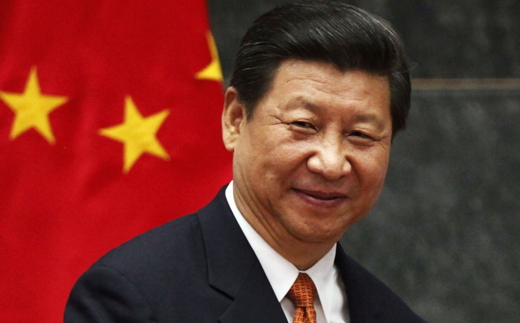
Chinese President Xi Jinping

In a Friday meeting with Iranian President Hassan Rouhani in the Tajik capital, Dushanbe, Xi underscored the Islamic Republic’s significant position in the region and the entire world, saying Beijing seeks to promote “strategic” ties with Tehran.

The Chinese leader also announced plans for an official visit to the Iranian capital, Tehran, next year.

The Iranian president, in turn, hailed Tehran-Beijing relations as “strong,” saying Iran and China must pursue the implementation of their previous agreements.

During the talks, the two sides also exchanged views on major issues of regional and international significance.

President Rouhani also held a separate meeting with Afghan President Hamid Karzai in Dushanbe, where the two senior officials discussed the developments before and after Afghanistan’s disputed presidential election in April.

The Iranian chief executive further stressed the need for the restoration of peace and stability to Afghanistan through the cooperation of all political groups in the country.

The two meetings took place on the sidelines of the summit of the Shanghai Cooperation Organization (SCO) which opened in Dushanbe on Friday.

The SCO is an intergovernmental organization that was founded in 2001 in Shanghai by the leaders of China, Kazakhstan, Kyrgyzstan, Russia, Tajikistan, and Uzbekistan. Iran, along with four other countries, holds observer status at the organization.


Iran can help develop Turkmen infrastructure: Rouhani

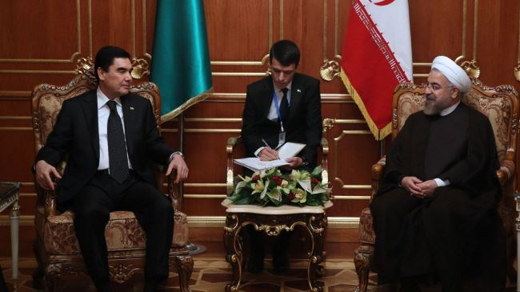
Rouhani-Berdimuhamedow

Iran is also ready to provide the Central Asian country with required commodities and products, Rouhani said.

The Iranian president made the remarks in a meeting with his Turkmen counterpart Gurbanguly Berdimuhamedow in the Tajik capital, Dushanbe, on Friday on the sidelines of a summit of the Shanghai Cooperation Organization (SCO).

“Iran and Turkmenistan are two neighboring and brotherly nations with common roots, and it is necessary that they utilize their untapped potential in bilateral ties,” Rouhani said.

He called for the presence of Iranian entrepreneurs and investors in Turkmenistan’s energy, development and transportation sectors.

Pointing to the soon opening of Iran-Turkmenistan-Kazakhstan railway, Rouhani said Iran would be a safe and secure route for the transit of goods through the Central Asia and the Persian Gulf region.

Rouhani also called for the development of cultural, scientific and tourism ties between the two neighboring countries.

Berdimuhamedow, for his part, highlighted Iran’s key status on regional and international scenes and welcomed further enhancement of ties between Tehran and Ashgabat to the highest level.

Rouhani is on a tour of the Central Asian states of Kazakhstan and Tajikistan.

He is scheduled to deliver a speech at the SCO summit later on Friday.

The SCO is an intergovernmental organization that was founded in 2001 in Shanghai by the leaders of China, Kazakhstan, Kyrgyzstan, Russia, Tajikistan, and Uzbekistan. Iran has an observer status at the organization.