Monday, December 22, 2025
Home Blog Page 4868

Failure to clinch a deal will amount to loss of an opportunity

zarif4

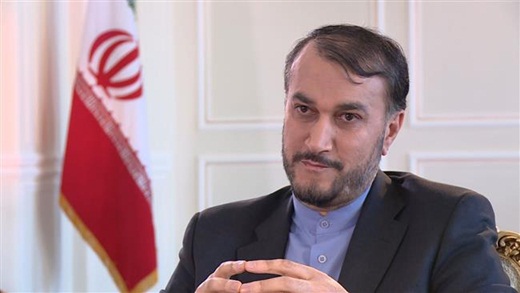
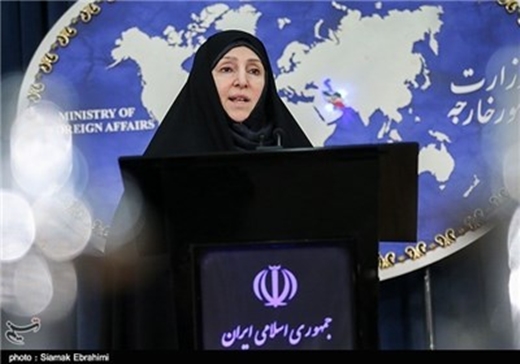
The Iranian foreign minister says a breakdown in nuclear talks between Iran and P5+1 will not amount to a catastrophe, but it will see the two sides miss out on a real chance [for solving the nuclear dispute].

Mohammad Javad Zarif made the comment in an interview with CBS’s Charlie Rose, adding two years ago nobody thought we could reach the point we are standing at now, and this happens when dialogue is favored over pressure and intimidation.

The Islamic Republic News Agency published a translated version of the foreign minister’s interview. The following is a partial translation of what he told CBS:

[…]

This [sitting down for talks with Iran] is a unique opportunity, with the reason being: the Iranian people went to the polls about one and a half years ago and elected a president who was seeking interaction, dialogue and mutual respect, said Zarif.

[…]

He went on to say that the Iranians are logical people who are sensitive to threats and intimidation, adding they show strong reaction when they are put under pressure. […]

The Iranian people have not been happy with such strong reactions. When they saw their representatives treated respectfully during this interaction [nuclear talks], they became delighted, the top diplomat said, adding if they see the [nuclear] agreement does not earn them respect and dignity, they will defy it. They prefer to reel under pressure than accept a bad deal.

[…]

He also said, “[…] If sanctions were designed to hurt the Iranian people … What the sanctions did was to create an atmosphere among the Iranian population that the United States doesn’t want to treat them well, and the United States is trying to put pressure on them, and the United States is trying to prevent them from buying medicine even with their own money from abroad. […]”.

They [Iranians] have come to this conclusion that US claims that it respects the Iranian people are baseless […], he said.

Putting pressure on the Iranian people does not indicate that sanctions have worked, Zarif said, adding if sanctions intended to fuel hatred of the US [in Iran], we can say that the US has successfully reached its goal.

Ten years ago we could have achieved the results that we have obtained today, but they [the US] refused to accept it. If the deal had been stricken ten years ago, the doors would have opened for us to do many things. The Bush administration and his envoy to the UN, John Bolton, decided to throw a wrench into the works when Iran was close to clinch a deal with European countries and now they regret their decision, the Iranian top diplomat said.

The Iranian foreign minister stressed that dialogue, not sanctions, will produce results.

President Rouhani was warmly welcomed in Shiraz (PHOTOS)

Rouhani-Shiraz0

A visit by President Rouhani to the southern city of Shiraz drew with a hearty welcome from local people.

Images of President Rouhani in Shiraz released online by iscanews on April 29:


Expo Milano 2015, a window of opportunity for Iran to present its potential

Iran-2

The Iranian ambassador to Rome has said that Iran has decided to take part in Expo Milano 2015 to present its potential and introduce to the world its culture and traditions.

Jahanbakhsh Mozaffari made the remark Wednesday, adding people from around the world can get familiar, firsthand, with Iran’s handicrafts, food products, tourism attractions as well as its historical and cultural works.

The following is a partial translation of what else the Iranian ambassador to Italy said as reported by the Islamic Republic News Agency:

[…]

He said that ties between Iran and Italy are satisfactory, especially on trade, tourism and cultural fronts, hoping the new opportunity [Expo Milano 2015] could set the stage for developing mutual cooperation and bringing the two nations closer together.

[…]

Mozaffari further said that commercial and economic rivalries among big powers can result in clashes or tensions between them, but friction can be gradually replaced by commercial and economic cooperation if international security and peace as well as respect for people and human dignity take hold [in the world].

Like in the past, the Islamic Republic of Iran is willing to tap into its abundant energy resources and huge investment potential and invite economic players from the East to West to the country where they can do business in a healthy and secure atmosphere and make profits, he said.

Expo Milano 2015 will open on May 1 and run through October 31. Iran’s Minister of Industries, Mines and Trade Mohammad Reza Nematzadeh will attend the opening of the six-month international event.

Expo Milano 2015 will bring together 145 countries together with three international organizations and will draw an estimated 20 million visitors. “Feeding the planet, energy for life” is the theme of the 2015 international exhibition in Milano.

President: Unjust UNSC resolutions against Iran to be terminated soon

rouhani

President Hassan Rouhani blasted all sanctions imposed by certain Western countries against Tehran, including the United Nations Security Council anti-Iran resolutions, as “unjust”, saying that the sanctions regime will come to an end in the near future.

“With the support of the people and the guidelines of Supreme Leader of the Islamic Revolution (Ayatollah Seyyed Ali Khamenei), we will terminate the unjust resolutions in the not-too-distant future,” President Rouhani said, addressing a large gathering of people in Iran’s southern province of Fars on Wednesday.

He hailed the performance of the Iranian team involved in the nuclear negotiations with six world powers, saying that the negotiators are properly defending the Iranian nation’s rights with the power of “logic and legal reasoning”.

The president further pointed to the positive effects of the removal of sanctions on Iran’s economy, saying that the country will continue to increase production and exports to the region and the world after sanctions are lifted.

“We should open doors to the country’s prosperity,” he noted.

His remarks came as Iran and 5+1 (Russia, China, the US, Britain, France and Germany) reached a framework nuclear agreement on April 2 in Lausanne, Switzerland, with both sides committed to push for a final deal until the end of June.

The framework provides a series of solutions to the differences that will be the basis of a comprehensive Joint Plan of Action.

According to the framework agreement, the nuclear-related sanctions imposed on Iran by the UNSC, the European Union and the US will be removed.

Planting trees to remember the dead

15

A number of Tehran residents have planted trees in memory of the loved ones they have lost.

The event, which was held on April 29 and sponsored by Amordad weekly, was designed to keep the memory of the dead alive and help with restoration of the ecosystem at the same time.

A similar event was organized by the newspaper, which represents the Zoroastrian community, last year. In that event which was held at Maryam Moghaddas [Saint Mary] Park, trees were planted at a park in a predominantly Christian neighborhood of the capital.

The idea of planting trees in memory of the dead was first developed after bereaved families or those who wanted to express condolences took very expensive wreaths which did not last long to memorial services.

During the event which was organized in cooperation with Tehran Municipality, evergreen trees were planted in some parks across the capital with the name of the deceased attached to them.

Last year’s ceremony was attended by a number of distinguished religious, cultural and art figures from the Zoroastrian community, among them, Esfandyar Ekhtiari, an MP who represents the Zoroastrian minority in parliament.


9

A dramatic turnaround beyond a nuclear deal (PART ONE)

Lausanne deal

“Nothing has happened yet” is apparently the only similarity between the official stance of high-ranking Iranian and US leaders following the release of a joint statement by Iran and P5+1 in Lausanne [in early April]. The shared stance of the two sides is a requirement of diplomatic shrewdness to keep the doors to bargaining open in the months ahead and avoid triggering backlash at home.

Donya-e Eqtesad daily on April 15 published an opinion piece by Dr. Mohammad-Mahdi Mojahedi, a professor of Comparative Political Philosophy in Germany, about the tentative nuclear agreement between Iran and P5+1 and its consequences. The following is Part One of the translation of the piece:

To understand the political consequences of the nuclear talks, one needs to dig deeper and go beyond diplomatic announcements by the parties to the talks. To apprehend these consequences, a line should be drawn between “the results of the talks” and “the consequences of the talks”.

At best, the talks will culminate in an agreement which can guarantee Iran’s nuclear rights, exorcize the specter of sanctions and assure [the other side] that Iran’s nuclear program does not have military dimensions. Such an agreement can also deny the other party the leverage by which the West exerts security pressures on Iran.

The consequences of the nuclear talks are a question which should not be mistaken for a possible agreement at the end of the talks; in other words, the statement issued in the Swiss city [of Lausanne] or a likely agreement to be inked in the future are by no means the main historic achievement of the talks.

Not only are the consequences of the nuclear talks different from the nuclear agreement, but – in some cases – the correlation between them is similar to the correlation between what Iran achieves and what it has to give up, or like the correlation between the price which is paid in the framework of a possible nuclear agreement and what will be achieved later as a result of the agreement.

The results of the talks – namely the Lausanne statement and a possible agreement [down the road] – should be viewed as the diplomatic façade and the secondary, outward principles of a “dramatic turn”. Such a turn is part of calculated consequences of a modern policy which has basically set the stage for the start and continuation of the unprecedented talks.

This twist has been overlooked by most critics of the Lausanne statement in Iran. The reason why the Zionists, Persian Gulf sheikhdoms and certain Republicans and Democrats – who have links with Arab and Israeli lobbies – are concerned is that they appreciate “the consequences of a dramatic political turn” which has helped the unique talks proceed at a high level and has pushed the talks forward despite all obstacles standing in the way.

The wickedness of Persian Gulf sheikhdoms during a previous rounds of nuclear talks in Geneva and recently in Lausanne – which manifested itself in the form of making impulsive excuses to derail the talks, forming a hasty coalition to launch attacks on Yemen, and injecting tension to the Hajj diplomacy which resulted in the use of harsh rhetoric by the preachers and media close to the House of Saud against Iran and Shiism – is part of reactions they desperately and inevitably show to this dramatic political turn.

There are other clear signs of such a dramatic turn, among them: a panicked and hasty response by Netanyahu and the Zionist lobby in the US, and the crack which has clearly divided the US and Israel over Iran and regional questions.

The fact is that for decades – prior to the collapse of the Union of Soviet Socialist Republics – the foreign policy of big powers in the Middle East revolved around two axes: energy and security. These two policies were meaningful against the backdrop of the Cold War’s geopolitical and geostrategic balance, giving shape to developments in the Middle East in a special way.

In recent decades, however, these two axes have undergone fundamental change. On the one hand, the Islamic Revolution took place in Iran, the Iraq-Iran war dragged on, the Soviet Union disintegrated and popular uprisings swept through the Arab world.

On the other hand, the world’s energy policies changed, new technologies and energy sources emerged and Russia’s Putin – who pursues acquisitive, aggressive policies – was locked in a race with Europe and the US. These factors made a turnaround in the foreign policy of big powers in the Middle East inevitable.

The Persian Gulf’s oil is no longer important for the US. The Persian Gulf sheikhdoms have entered a military phase to guarantee their partnership with the US and the role they can play in the Middle East; that’s why they have made investment in armed extremism. Any soil they set foot on – from Lebanon, Syria and Iraq to Bahrain and Afghanistan – they achieved nothing and lost control of the same terrorists they had nurtured and supported, and left nothing but growing insecurity and instability in their wake.

Attacks on Yemen are the latest example of the [sheikhdoms’] encroachments which – as the Western and Arab observers have put it – will turn Yemen into yet another quagmire of insecurity and terrorism in the Saudi backyard and at the head of the Gulf of Aden if it is not brought to a halt soon. This quagmire is likely to pull in the Saudi stability and order.

Continued partnership between the US, Europe, Russia, China and Persian Gulf sheikhdoms, especially Saudi Arabia, will largely lose its geopolitical and geostrategic value in the next three decades. Presumably, the political structure of these countries cannot digest and absorb the domestic and regional crises which are on the horizon.

Partnership with these countries – which have proven incapable of making any meaningful political reforms at home – will earn the US and its Western and Eastern partners nothing but trouble and discomfort, making them pay a price for such partnership. Not only have the Western politicians developed an understanding [of such a fact], but it is a while that the Russians and Chinese have been acting on such understanding.

This understanding has shown itself – at least twice – in meaningful remarks by the US president who said, “The problem for Sunni states in the region, many of whom are our allies, is not simply Iran. It’s not simply a Sunni-Shia issue [in the region]”, but their problems lie in their insoluble domestic issues and political structure. This structure cannot digest [people’s] dissatisfaction and a variety of domestic demands, and cannot offer the youth any better choice other than joining ISIL.

These remarks by the US president have severely enraged the Persian Gulf sheikhs and made them understandably concerned about being treated like marginal players [in the region] and about their waning days of engagement [in global affairs] thanks in large measure to the revival of geopolitical and geostrategic cooperation between Iran and world powers.

It is also clear for officials in Western countries, the US in particular, that Israel’s continued, blatant violation of UN resolutions is one main reason why threats against the Western interests are increasingly growing across the world. Israel’s insistence on building [Jewish] settlements in the occupied lands and its failure to accept a two-state solution are not simply an international and human rights issue for the Western governments; rather, they are a serious security problem.

The fact that Iran is turning into a weighty partner in its cooperation with world powers is a key factor Westerners hope can make Israel rethink its Palestine policy.

Mohammad-Mahdi Mojahedi is the Royal Netherlands Academy of Arts and Sciences (KNAW) Visiting Professor of Comparative Political Theories, with a focus on Iranian and Islamic studies, human rights and methodology at Leiden University and a Visiting Professor of Political Science at Freie Universitat Berlin.

Supreme Leader: Domestic production key to solving economic woes

leader

Leader of the Islamic Revolution Ayatollah Seyyed Ali Khamenei says domestic production holds the key to ironing out economic woes.

“The key to solving economic problems is not in Lausanne, Geneva and New York,” said the Leader in a meeting with a large number of laborers.

“If economic problems are to be solved, attention should be focused on domestic production,” the Leader noted.

Ayatollah Khamenei underlined that the equipment needed by government organs must not be procured from abroad, urging the government to meet its needs through local suppliers if the appliances in demand are produced domestically.

The Leader then stressed the need to walk the walk, and not merely talk the talk, when it comes to countering corruption.

“We need to take action and stop corruption in the true sense of the word,” Ayatollah Khamenei underlined.

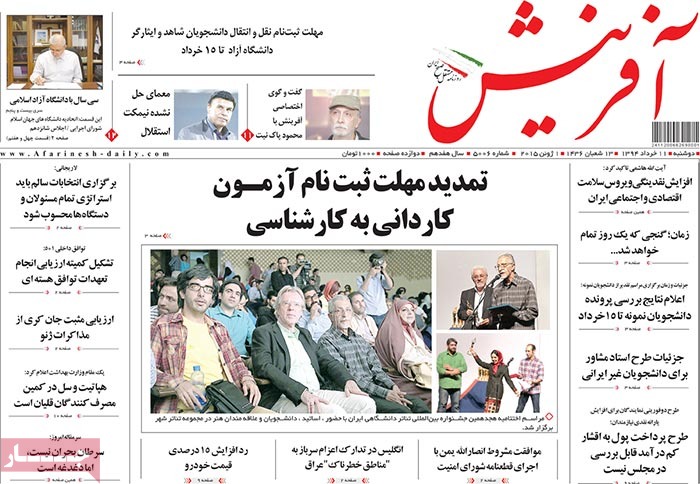
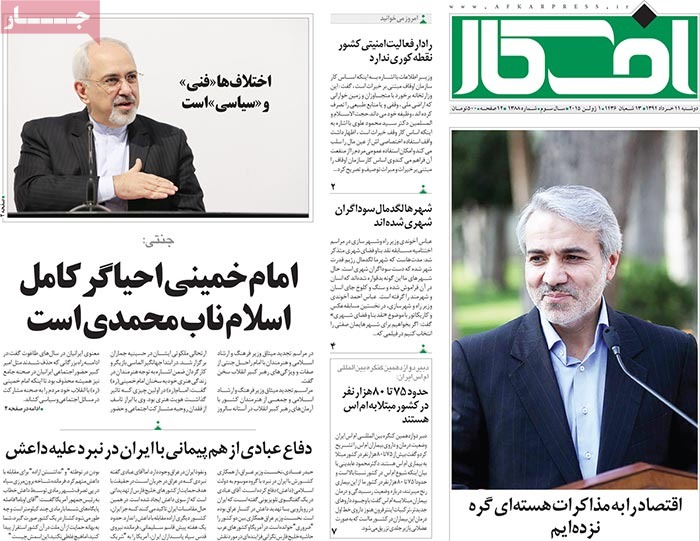
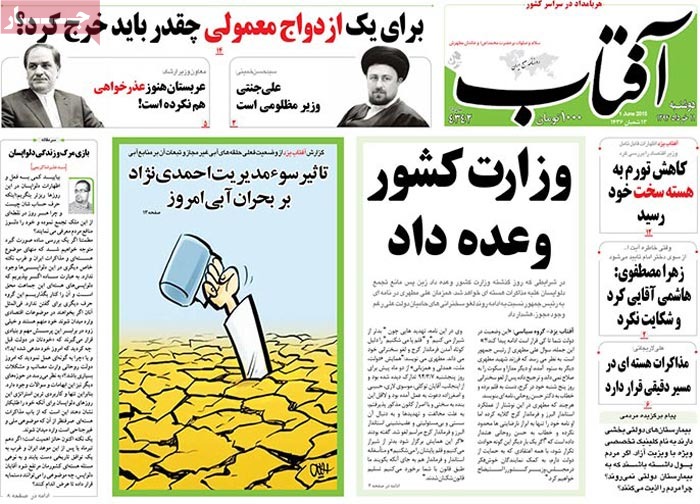
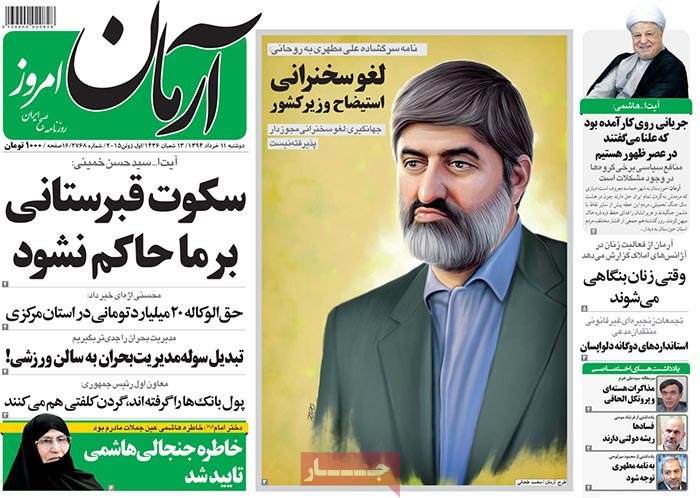
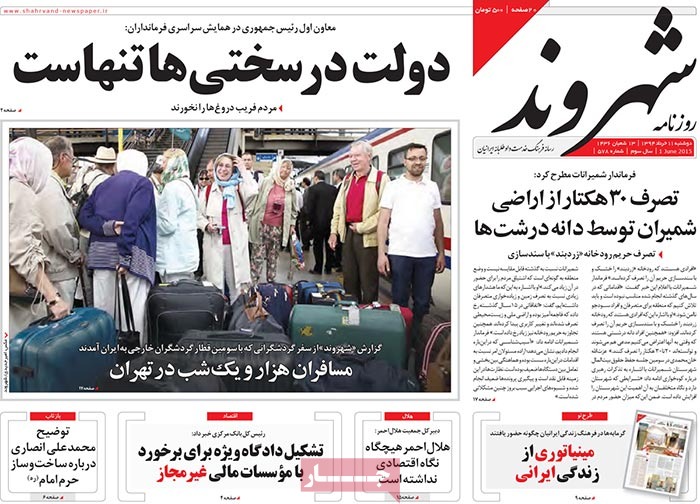
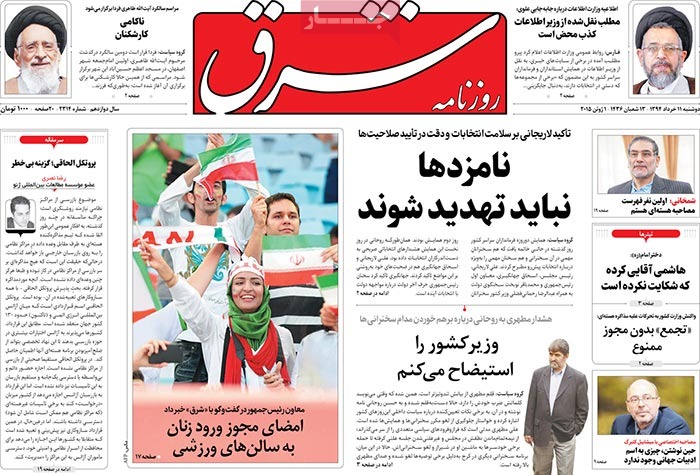
A look at Iranian newspaper front pages on April 29

Iranian Newspapers Headlines

President Rouhani’s comment that “the sanctions regime is crumbling” dominated the front pages of Iranian newspapers on Wednesday. A meeting between Iranian and US top diplomats at the residence of Tehran’s UN envoy, considered Iranian soil, also appeared on the covers of dailies.


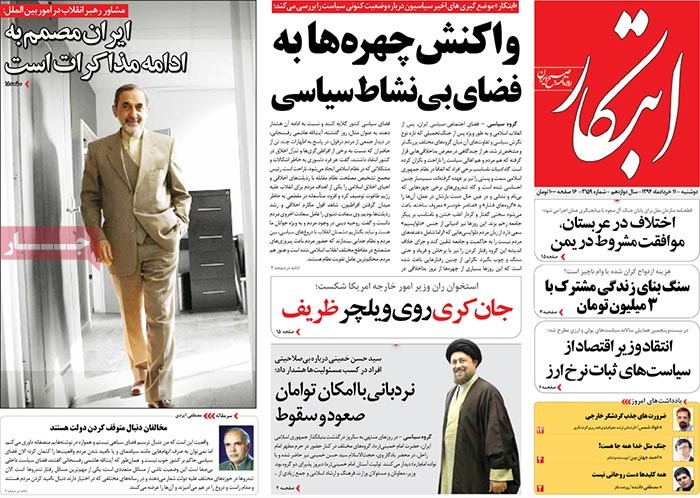
Abrar: “The drafting of a final nuclear deal gets under way as of today,” said Foreign Minister Mohammad Javad Zarif.


A look at Iranian newspaper front pages on April 29


Afkar: Baltimore has turned into a war zone.

Afkar: “Releasing a fact sheet is no longer useful,” said Secretary of the Supreme National Security Council Ali Shamkhani.


A look at Iranian newspaper front pages on April 29


Aftab-e Yazd: John Kerry on Iranian soil in New York

Foreign Minister Zarif, who is in New York for an NPT Review Conference, met with his US counterpart at the residence of Iran’s UN ambassador.


A look at Iranian newspaper front pages on April 29


Arman-e Emrooz: “[Senior officials of] two banks are to be tried for charging interest rates higher than those sanctioned by the Central Bank of Iran.”

[The comment was made by the secretary general of the CBI.]

Arman-e Emrooz: Sixty-six teachers who are serving prison terms for monetary misdemeanors are to be freed.

The move comes a few days ahead of Teacher’s Day.


A look at Iranian newspaper front pages on April 29


Ebtekar: “Those who financially benefit from sanctions should start looking for new jobs,” said President Hassan Rouhani.

The president made the comment at an event to appreciate the services of workers.

Ebtekar: MPs have voted for a motion that allows present deputies to avoid being vetted again if they seek re-election in the future.


A look at Iranian newspaper front pages on April 29


Ettela’at: “A nuclear deal will be the jumping-off point for settling the major problems [of the country],” said President Hassan Rouhani.

Ettela’at: Services of Iranian social science heavyweights have been praised at a ceremony in Tehran.


A look at Iranian newspaper front pages on April 29


Hemayat: “Economic problems should not be tied to the nuclear case,” said the secretary of the Supreme National Security Council.


A look at Iranian newspaper front pages on April 29


Javan: Interest rates will definitely go down by two percent.


A look at Iranian newspaper front pages on April 29


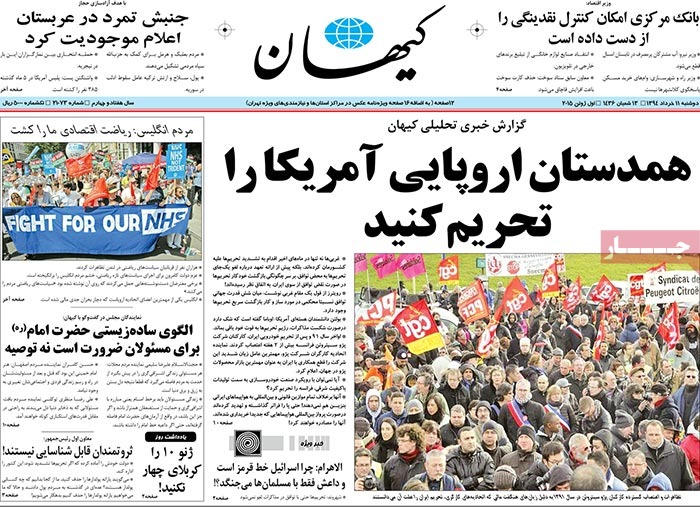
Kayhan: “Current talks are not exclusively designed to settle the nuclear dispute,” said President Rouhani.

[The daily has taken a jab at the president and described his comment as “worth pondering”.]


A look at Iranian newspaper front pages on April 29


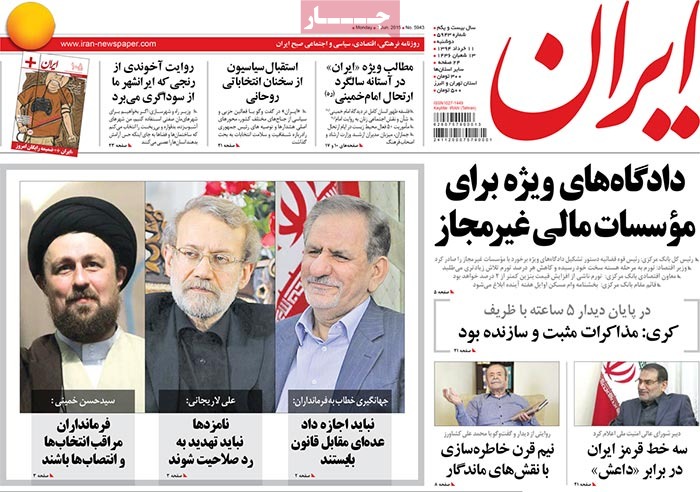
Mardomsalari: “The problems of the people won’t be solved even if monthly cash subsidies are tripled,” said Parliament Speaker Ali Larijani.
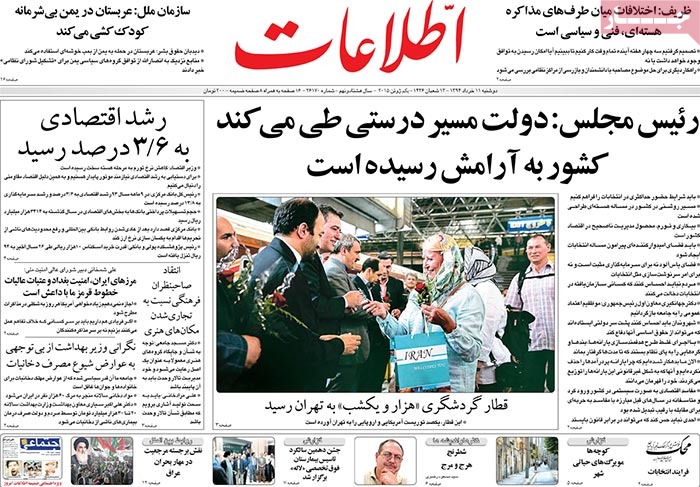
 

A look at Iranian newspaper front pages on April 29


Qods: “I have not moved overseas; I am still based in Iran,” said famous actor Akbar Abdi.


A look at Iranian newspaper front pages on April 29


Rah-e Mardom: “The sanctions regime is crumbling,” said President Rouhani.


A look at Iranian newspaper front pages on April 29


Sharq: FM Zarif and Secretary Kerry have held a 100-minute meeting in New York.


A look at Iranian newspaper front pages on April 29


Takfiris fighting proxy war for US, Israel: Iran defense minster

33

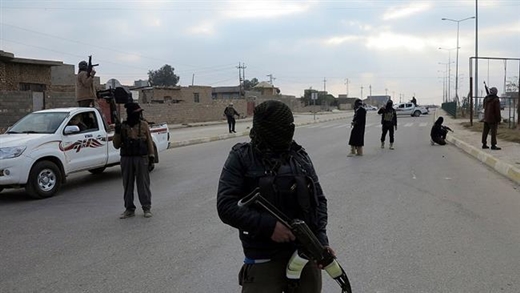
Takfiri terrorist groups in the region are fighting a “proxy war” on behalf of the United States and Israel, Iran’s defense minister says.

Brigadier General Hossein Dehghan made the remarks during a meeting with Syrian Defense Minister Fahd Jassem al-Freij in Tehran on Tuesday.

Dehghan said that “providing permanent security for the Zionist regime, weakening and disintegrating Muslim countries, altering the Middle East’s map, countering the wave of Islamic awakening, and ultimately complete domination over this Islamic region” are the main objectives of this war.

He also reiterated Iran’s full support for Syria in its battle against terrorism, saying that dialog is the only solution to the crisis in the Arab country.

“The people and government of Syria, with their unparalleled resistance made bullies understand that by exporting terrorists, arming and supporting them, and launching military attacks, they cannot force the region’s Muslim nations to surrender,” he added.

Dehghan went on to say that Saudi Arabia’s war on Yemen also runs parallel with the joint strategies of Israel and the United States, adding, “Undoubtedly the designers and executors of this sinister scenario… will not reach their ominous goals.”

Syria has been grappling with a deadly crisis since March 2011. The violence fueled by Takfiri groups has so far claimed the lives of over 222,000 people, according to UK-based Syrian Observatory for Human Rights.

The ISIL militants, with members from several Western countries, control parts of Syria and Iraq, and have been carrying out horrific acts of violence such as public decapitations and crucifixions against all ethnic and religious communities.

Since Saudi Arabia started its aggression against Yemen on March 26, the regime’s warplanes have repeatedly targeted residential areas in cities including Aden and Ta’izz.

On April 21, Riyadh announced the end of the first phase of its military aggression, which has claimed the lives of nearly 1,000 people so far, but airstrikes have continued with Saudi bombers targeting different areas across the country in a new phase.

Iranian scientists reduce cancer drug side effects with nanotechnology

11

Iranian scientists have successfully reduced the side effects of a cancer drug by infusing it with nanotechnology.

Researchers at the Tabriz University of Medical Sciences discovered that the side effects of the drug Mitoxantrone could be reduced when the chemotherapeutic agent is infused with liposomic nanocarriers, which are created with cholesterol derivatives, IRNA reported on Tuesday.

Mitoxantrone is a cancer drug that disrupts DNA synthesis and DNA repair in both healthy cells and cancer cells, and is used to treat certain types of cancer such as metastatic breast cancer, acute myeloid leukemia, and non-Hodgkin’s lymphoma.

The produced “nanoliposomes,” apart from being stable to pH changes in blood plasma, have proven to be more poisonous to cancer cells than to normal cells, which would reduce the required dosage and side effects, said head of the research team Dr. Saeed Qanbarzadeh.

The most common side effects of Mitoxantrone, which hinder its wider spread use, are nausea, vomiting, hair loss, heart damage, and immunosuppression.