Thursday, January 1, 2026
Home Blog Page 4686

FM Zarif: I did not accept John Kerry’s mediation

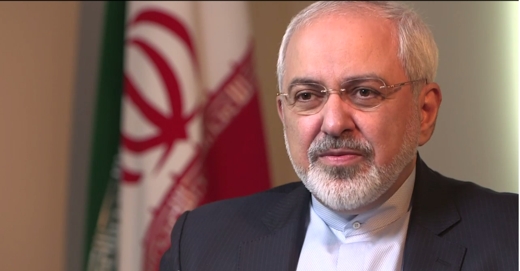
Iranian Foreign Minister Mohammad Javad Zarif speaks at the New York University (NYU) Center on International Cooperation in New York

The foreign minister has said that Iran and Saudi Arabia do not need mediation to handle their ties, reiterating that Iran views the security of Saudi Arabia as its own security.

c73dfe6cOn its first issue on November 24, Vaghaye-e Etefaghiyeh, a new reformist-leaning Iranian newspaper, published an interview with Mohammad Javad Zarif on the Syrian crisis and the not-so-friendly attitude of Saudi Arabia toward the Islamic Republic of Iran. The following is the translation of the interview in its entirety:

Q: In recent talks in Vienna over the Syrian crisis, there were plenty of opportunities for Iran and Saudi Arabia to hold talks. Mr. John Kerry repeatedly sought to broker such talks, but you turned it down.

A: We are living in the Middle East region. We need to establish contacts with Muslim nations in this region. Therefore, we have always said that establishment of ties with neighbors based on mutual respect takes top priority in Iran’s foreign policy.

Q: Why didn’t you accept the US mediation between Iran and Saudi Arabia?

A: Because we do not need mediation. In round two of the Vienna talks over Syria, I told Saudi Foreign Minister Mr. Adel al-Jubeir that Tehran views the security of Saudi Arabia as its own.

Q: But the behavior of Saudi officials shows that Riyadh has no trust in Iran. The Saudi support for Israel’s foreign policy reveals their attitude toward Iran. Where do you stand on that?

A: I think the current behavior of Saudi Arabia is short-lived. Saudi officials have become unsettled thanks to sudden developments in Iran-West ties. In other words, they had got accustomed to a fixed situation [in which] they blamed Iran for all their problems and tried to sell the idea that Iran is a barrier to peace and calm in the Middle East. They used to promote [their own] interpretation [of Iran’s role in the region], but they can no longer claim that regional developments, ISIS and the internal issues of Arab states have something to do solely with Iran.

As a matter of fact, Saudi Arabia is struggling to maintain its past position in regional equations. Naturally this struggle comes with some sort of hot-temperedness. We need to understand the Saudi behavior. As a big country, Iran can see that the Saudi hot-temperedness is a sign of its concerns about the shifting political and economic equations in the region.

Let me put it this way: the Saudis are worried that their game plan has changed. What we need to do is to develop an understanding of the behavior of our neighbors and provide them with the opportunity to change. We need to help allay the concerns of Saudi Arabia.

The Saudis need to feel that Iran is not seeking to delete them from regional equations. As I’ve already said the current behavior Saudi Arabia is showing will not stay long, because the realities on the ground will convince Saudi Arabia and its allies to accept the new Iran.

Q: You are talking about must-haves. How will they become a reality?

A: We can change the Saudi attitude through changing our own words and deeds and foiling attempts by those who are seeking to maintain a climate of Iranophobia at any cost.

Q: The problems Iran is grappling with in the Middle East region are not blamed on the less than active performance of our diplomats, are they?

A: No, quite the reverse! Our diplomats are fully active in the region. The involvement of different bodies in the country’s foreign policy – if their general principles are coordinated – does not signify disorderliness or abnormality. All over the world, not one [government] body alone gets involved in the countries’ foreign policy. What the foreign policy needs in order to succeed is a coherent, coordinated framework.

As it was evident in the [discussions over] the Joint Comprehensive Plan of Action (JCPOA), there are differences of opinion in the country, but it does not mean that different institutions adopt different policies on foreign policy.

The general policies Iran is pursuing in the region are: outsiders should not interfere in the crises in the Middle East, and people in crisis-hit countries should decide their own future. In line with its general policies, Iran opposes meddling in the internal affairs of the countries. Iran believes that referendums should be held in Middle Eastern countries so that calm can take hold [in the region].

Q: How do you see the future of Syria?

A: Syria needs a political solution. I think Syria will either work out a political solution based on participation of all Syrian people or teeter on the brink of collapse. I’m concerned that certain regional countries may opt for military options thanks to the stockpiles of military hardware they have at their disposal.

I still hope that they have taken a lesson from the example of Yemen which has caused massacres in the region with no military achievements.

Q: When we look at the images of Vienna-II talks over Syria, we see that you and Mr. Adel al-Jubeir sat away from each other at the table. How come at the negotiating table you were seated away from the Saudi top diplomat? Was it a preplanned move?

A: In diplomatic talks, there are [proper diplomatic] protocols the seating plans which should be observed for diplomats. The seating plan for multi-lateral talks is arranged either in alphabetical order or according to the seniority of the diplomats.

A position of seniority is not of great importance; an individual may have been foreign minister for 20 years and another might have been in office only for two months. The one who’s been on the job for 20 years definitely has seniority over the other.

So is the case with diplomatic missions. If you represent your country at the United Nations for five years, you will be certainly given a better seat. [In Vienna talks] If [Prince] Saud al-Faisal had been the Saudi foreign minister, he would have been given a higher position, for sure, like in the case of Oman whose top diplomat Yusuf bin Alawi had been seated in a higher position.

In that session [Vienna talks over Syria], my seniority was at the seventh or eighth level and Mr. Adel al-Jubeir, who’s served as his country’s top diplomat only for a few months, had been seated at a lower level [than me]. These points should not be highlighted and other diplomats should not be disrespected on this ground.

Q: Some Saudi officials claim that Iran interferes in the internal affairs of Arab nations, saying that Iran should change its behavior so that a solution can be worked out to the Syrian crisis.

A: I think these claims are nothing but sloganeering. Our friends [Saudi authorities] know well that these claims are far from correct. What needs to change is the mentality of the Saudi officials who think the Syrian crisis can be settled through military means.

The sooner they come to this conclusion [that they have to change their mentality], the lesser threat they will pose to themselves and the entire region. A solution which relies on people’s vote will be sustainable. The Syrian crisis needs a diplomatic solution to be defused.

Unfortunately, in the Vienna talks I had a serious concern. I learnt that some of our neighbors had yet to realize that ISIS poses a grave threat to them. They think that ISIS is their leverage for talks or a pawn [in the power struggle]. They have failed to understand that this pawn is in fact a snake with which nobody can play. This snake has set its sights – more than anything else – on Arab nations, especially the Hijaz region. That’s why I think Saudi Arabia should change its attitude, something I think has yet to happen.

President Rouhani welcomes participants in GECF summit (PHOTOS)

GECF21

Tehran played host to a summit of the Gas Exporting Countries Forum on Monday.

The following images of President Rouhani welcoming foreign guests have been released by different news agencies:

US must not be allowed to talk of Iraq disintegration: Leader

Leader-Fuad-Masum

Ayatollah Khamenei made the remark in a meeting with Iraqi President Fuad Masum in the Iranian capital, Tehran, on Tuesday.

“The people of Iraq, including Shias, Sunnis, Kurds and Arabs, have been co-existing without a problem for centuries; but, unfortunately, certain regional countries as well as foreigners seek to exaggerate disagreements,” the Leader said.

Ayatollah Khamenei said such attempts should be countered and any action that would prompt discord should be avoided.

The Leader said disagreements and their publicization would pave the way for meddling by outsiders, noting that the situation should not take such a turn as to allow Americans to dare openly speak of Iraq’s disintegration.

“Why should such a country as Iraq – a large, prosperous country with a thousand-year history – be disintegrated and divided into smaller parts, and thereby always be exposed to disagreement and confrontation?” Ayatollah Khamenei said.

The Leader expressed confidence that Iraqi officials will adjust their country’s relations with other states, including the US, with due regard for the interests of the Iraqi people, but emphasized that the Americans should not be allowed to act as if Iraq is their “personal property.”

Ayatollah Khamenei said Iraqi youths have undergone awakening and are now aware of their capabilities, describing the Popular Mobilization forces in Iraq as the manifestation of the Iraqi people’s awakening.

President Masum said the Leader’s advice on the necessity of maintaining unity and avoiding discord in Iraq “will certainly be effective.”

The northern and western parts of Iraq have been plagued by violence since June 2014, when Takfiri Daesh terrorist began an offensive through Iraqi territory. The Iraqi army and Popular Mobilization units are jointly battling the terrorists to take back militant-held regions.

The Iraqi president also thanked Iran for its assistance, particularly at a time when Iraq is facing the violent offensive by Takfiri Daesh terrorists.

He also called for the further development of relations between Baghdad and Tehran.


Leader-Algerian


The Leader separately met with Algerian Prime Minister Abdelmalek Sellal.

During the latter meeting, Ayatollah Khamenei said Daesh and the terrorist groups falsely operating in the name of Islam have been created by and are receiving support from certain entities.

“The Islamic countries that care and share more common understanding can reach a practical way of fighting terrorists through dialog and cooperation,” the Leader said.

The Leader pointed to the resistance front that had been established by Algeria, Iran, Syria and several other countries at the time of the victory of the 1979 Islamic Revolution, and said certain countries that blindly follow the US prevented the continuation of the activities of that formation of countries.

“If such a formation is established [again], these Islamic countries can have impacts in important issues in the Muslim world and take practical measures for [tackling] regional problems and fighting terrorists,” Ayatollah Khamenei emphasized.

Ayatollah Khamenei said the level of cooperation between Tehran and Algiers as “very low,” and expressed hope that the ties would soon expand.

The Leader also wished Algerian President Abdelaziz Bouteflika a quick recovery.

Sellal said the viewpoints of Algeria and Iran regarding political issues, especially on the fight against Daesh and other terrorists, are very similar, and hoped that economic relations between the two countries also reach an acceptable level.

Iraqi President Masum and Algerian Prime Minister Sellal both traveled to the Iranian capital to participate in the third summit of the Gas Exporting Countries Forum (GECF).

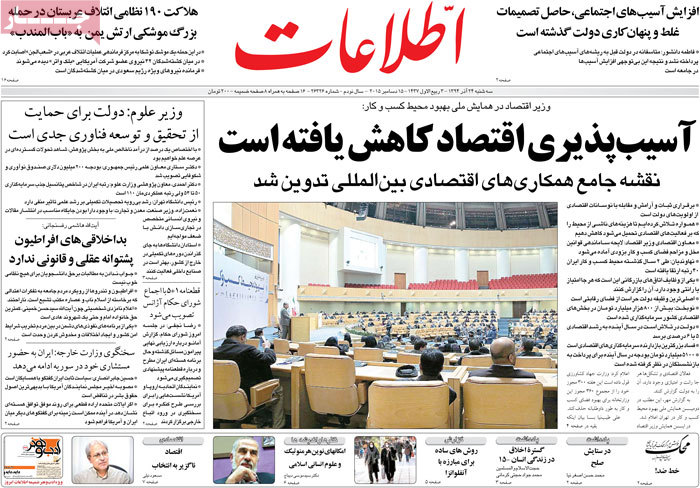
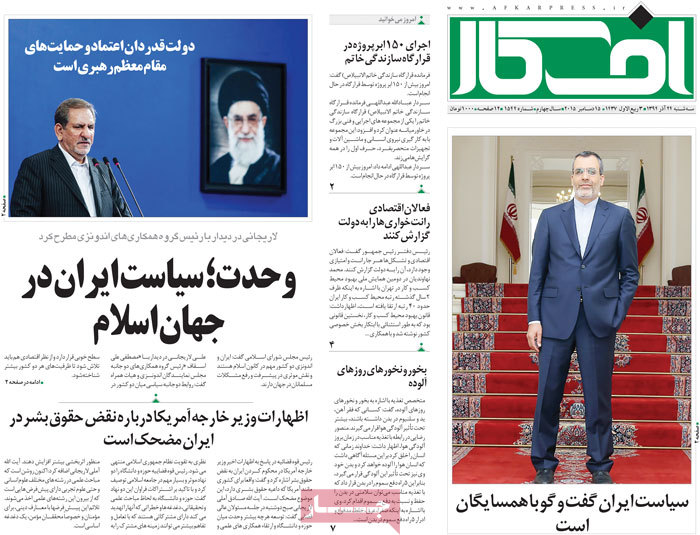
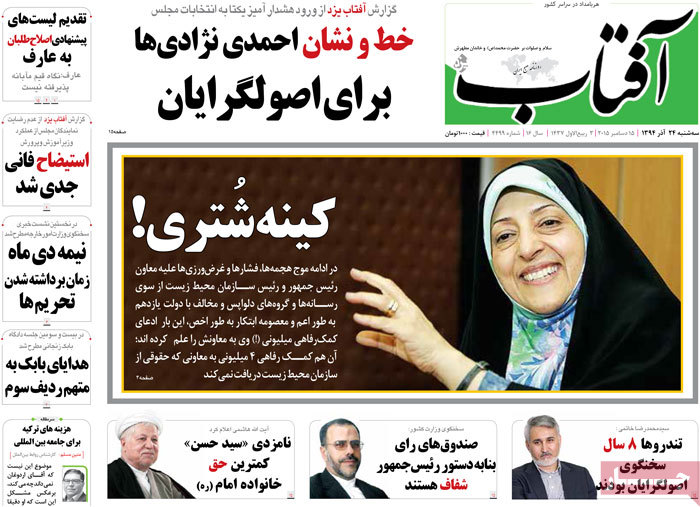
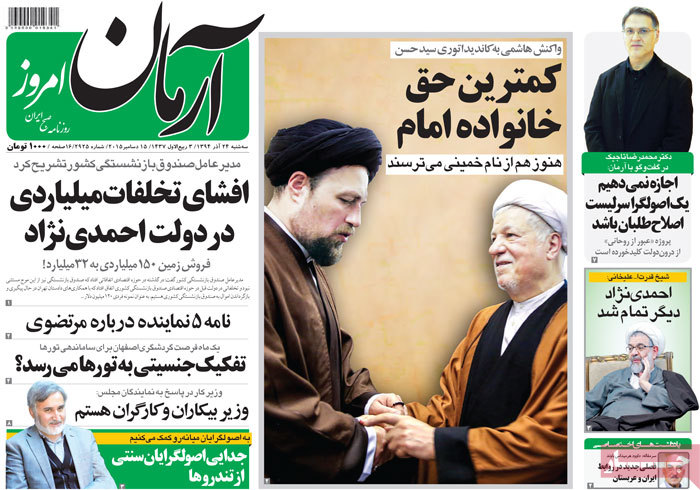
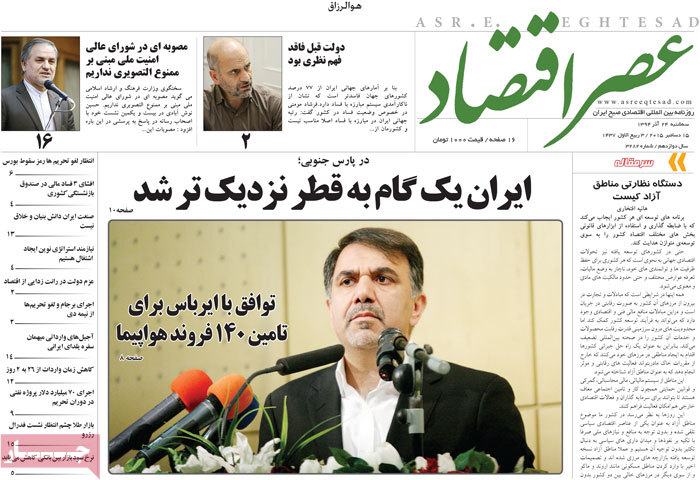
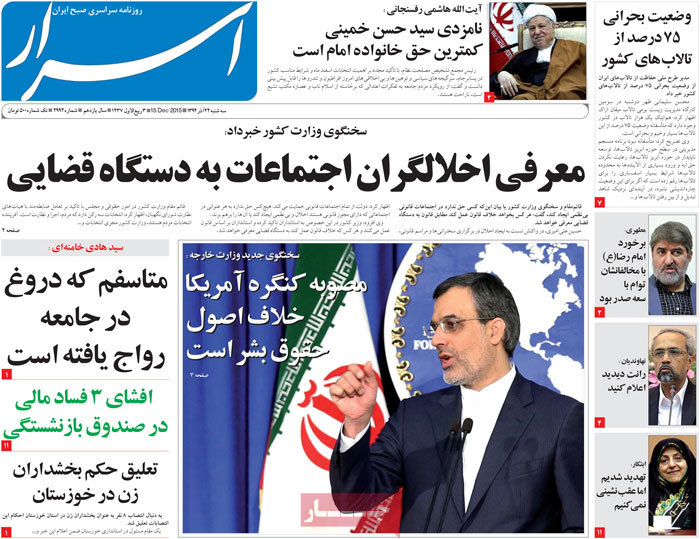
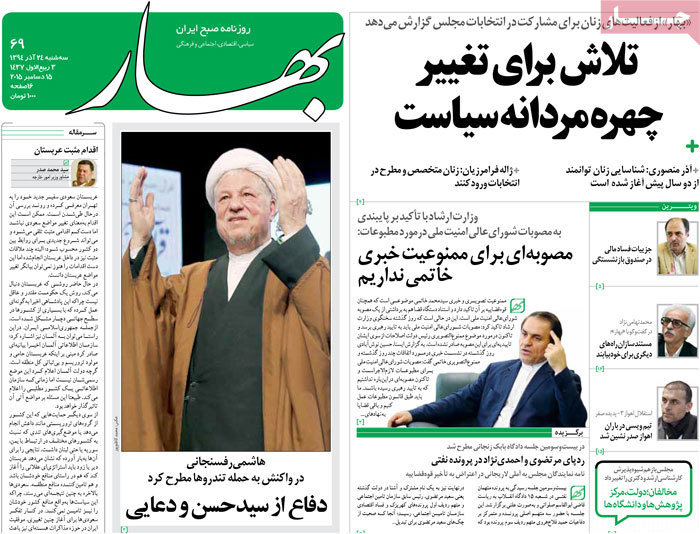
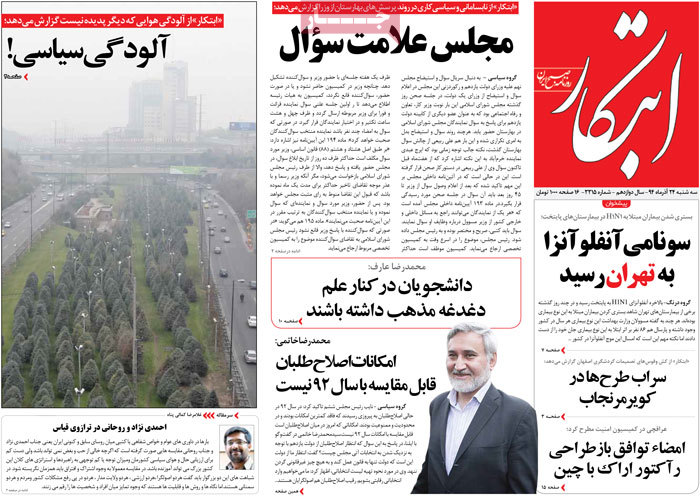
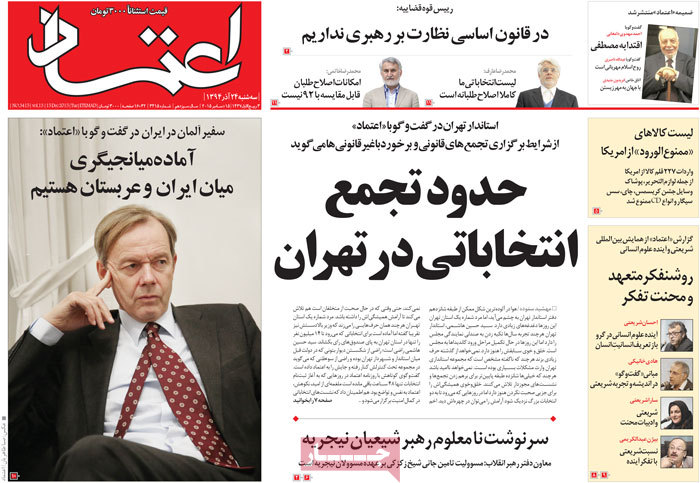
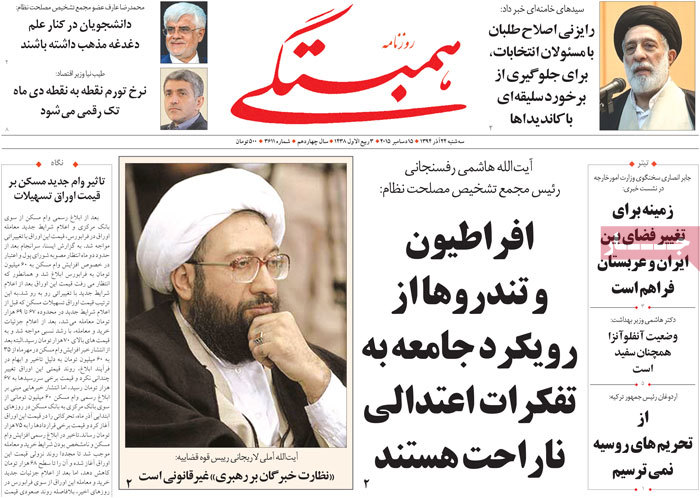
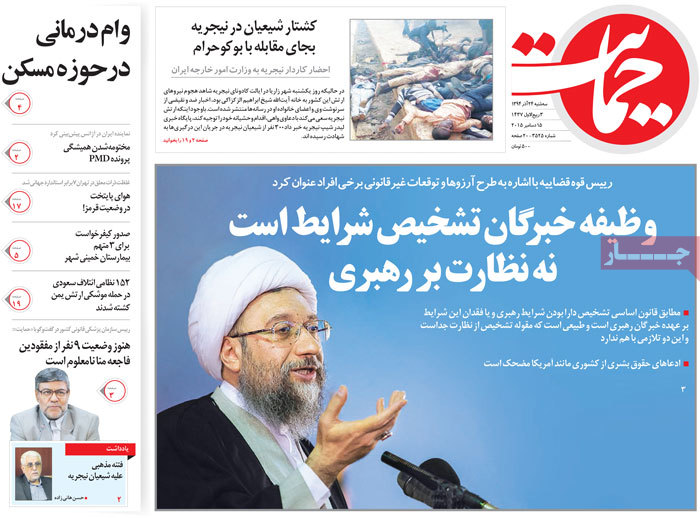
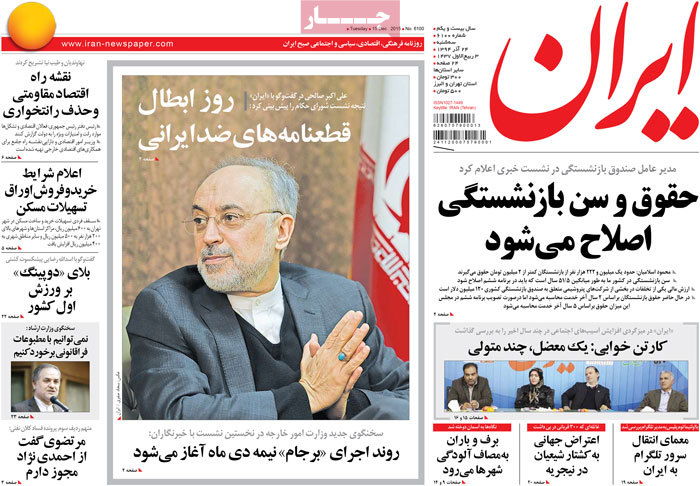
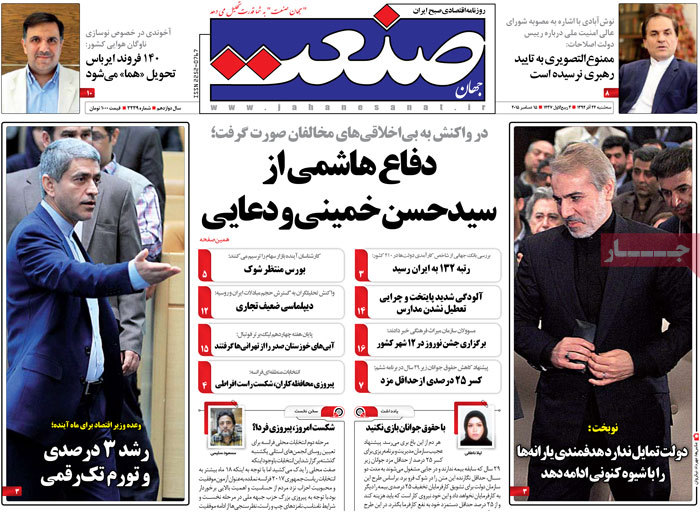
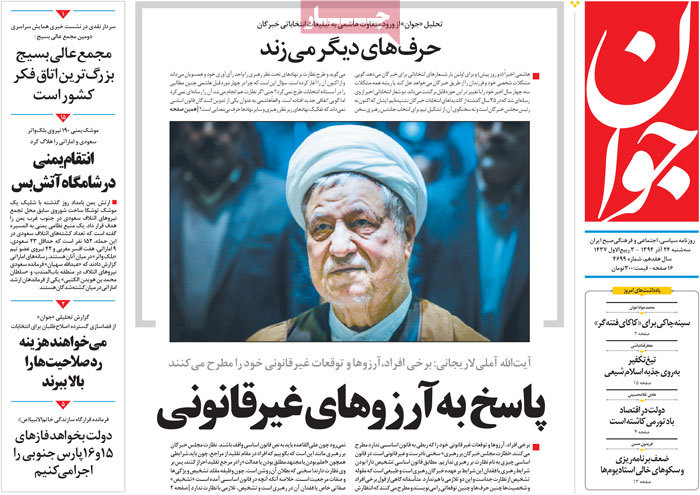
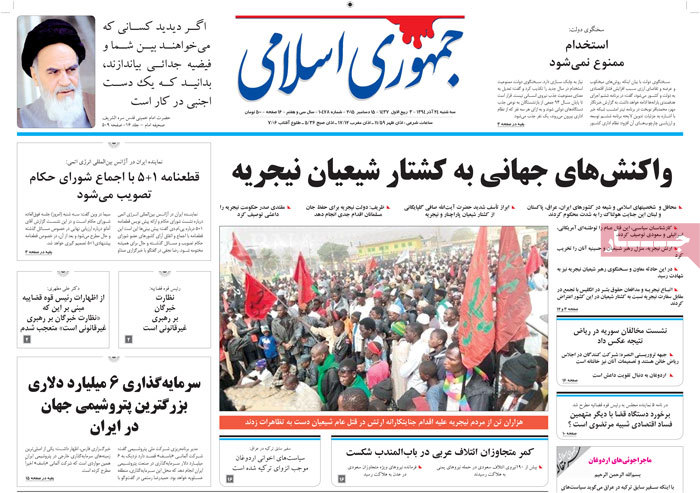
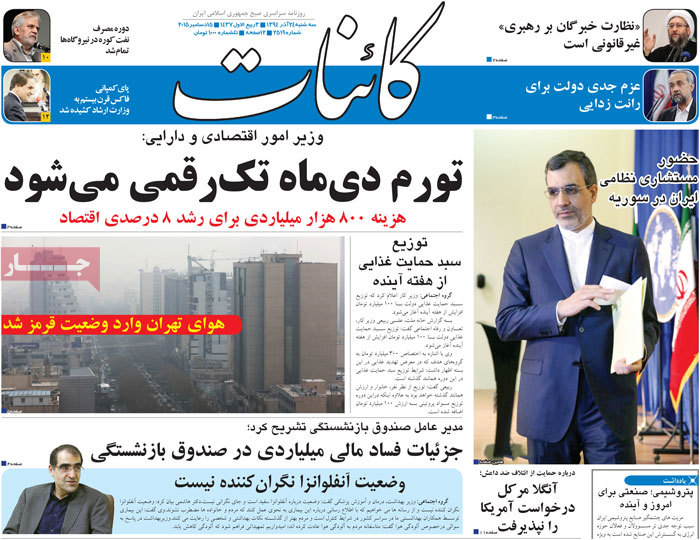
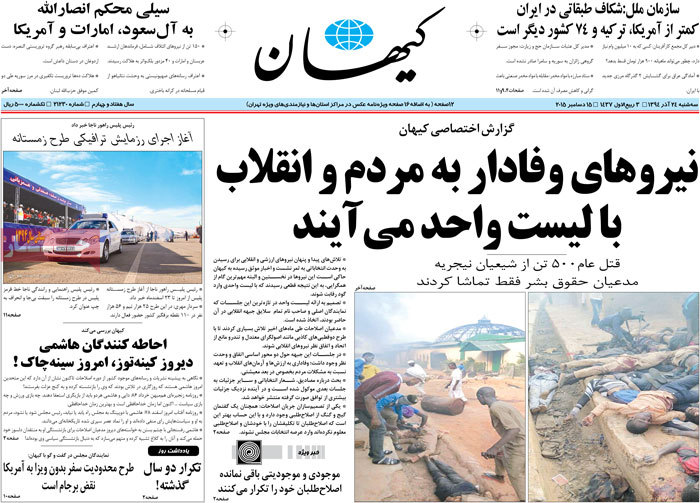
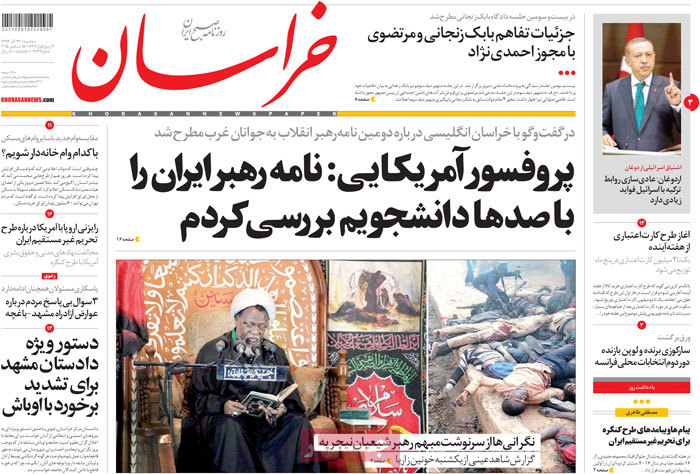
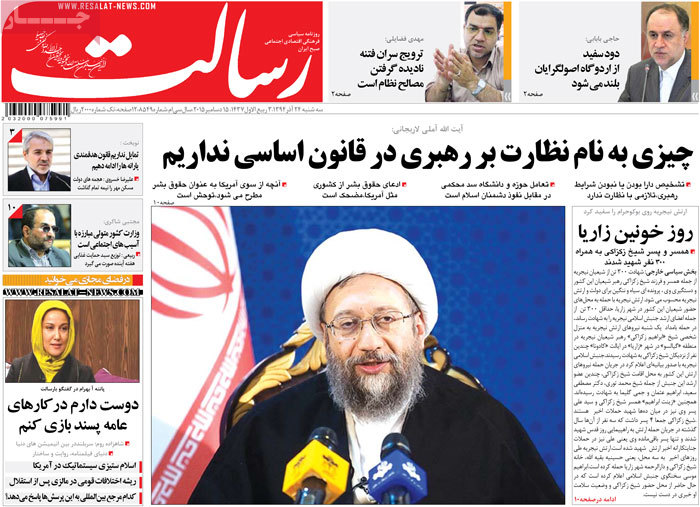
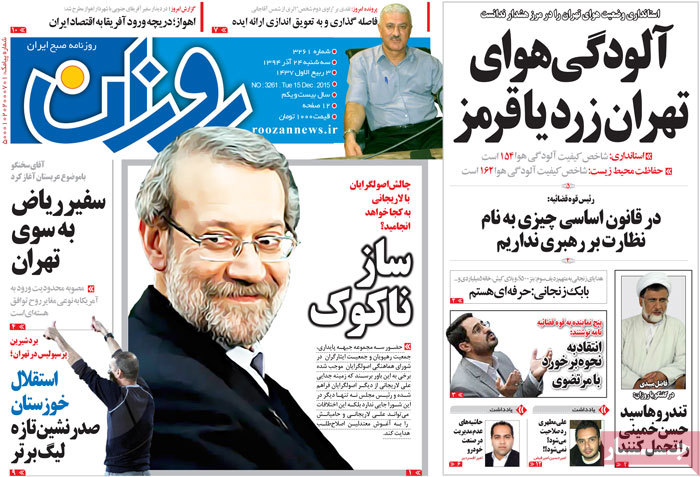
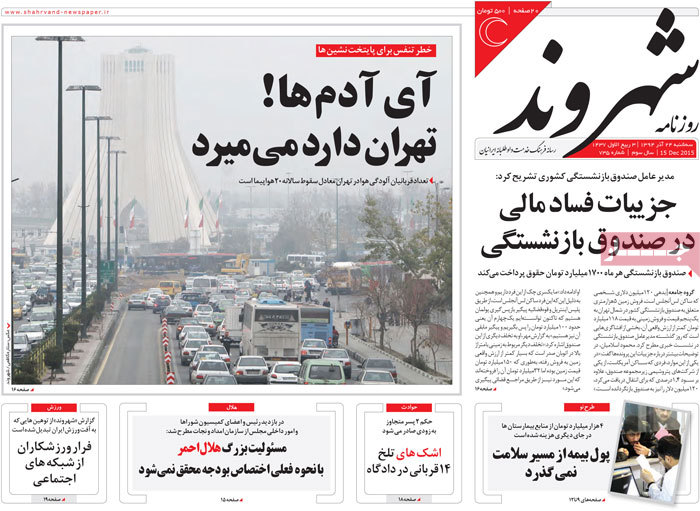
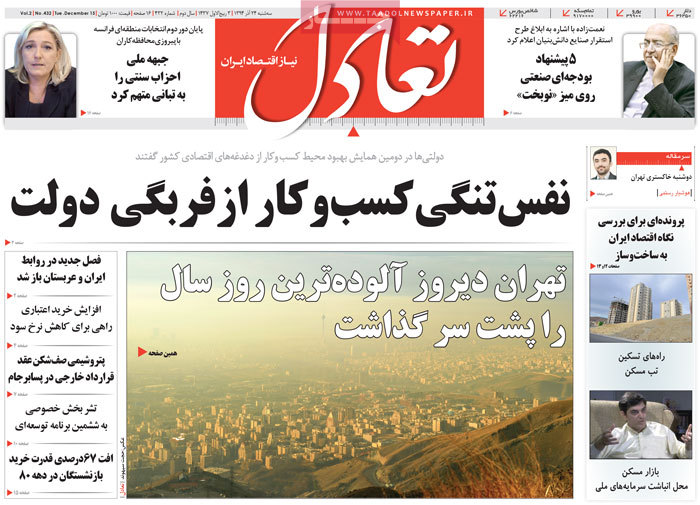
A look at Iranian newspaper front pages on Nov. 24

Iranian Newspapers Headlines

The gathering of the leaders of gas-producing countries in Tehran for a GECF summit and the meeting between the Supreme Leader and the visiting Russian president dominated the front pages of Iranian newspapers on Tuesday.


Ettela’at: The US has long-term plans to dominate West Asia, said the Supreme Leader at a meeting with Russian President Vladimir Putin.

Ayatollah Khamenei praised the “effective presence” of Moscow in regional issues, especially Syria.


Abrar: Reconfiguration of Arak Reactor will take almost five years to complete, said Behrouz Kamalvandi [a spokesman for the Atomic Energy Organization of Iran].

Abrar: A delegation of Russian businessmen will arrive in Iran within a month to hold talks over $21 billion in exports.


A look at Iranian newspaper front pages on Nov. 24


Arman-e Emrooz: A cholera advisory has been issued for Iranian pilgrims who are about to cross the border into Iraq [to take part in ceremonies marking Arba’een].

The Iranian pilgrims have also been warned that traveling to Iraq without a valid passport may land them in prison for six months.


A look at Iranian newspaper front pages on Nov. 24


Asr-e Iranian: Russian President Vladimir Putin: Iran is a reliable ally in the region and the world.


A look at Iranian newspaper front pages on Nov. 24


Asr-e Rasaneh: The Dutch are ready to invest in Iran.

The announcement came at a meeting between the Iranian economy minister and his Dutch counterpart in Tehran.


A look at Iranian newspaper front pages on Nov. 24


Asrar: A spokesman for the Interior Ministry has said that there will be no more replacements of provincial governors.


A look at Iranian newspaper front pages on Nov. 24


Bahar: Parliament has given a lukewarm welcome to plans to make elections transparent.

As many as 58 MPs voted against the double-urgency status of a bill that will eventually render electoral campaign financing transparent.


A look at Iranian newspaper front pages on Nov. 24


Ebtekar: Tehran became the gas capital of the world when it hosted a summit of the Gas Exporting Countries Forum on Monday.


A look at Iranian newspaper front pages on Nov. 24


Etemad: President Putin has presented a handwritten Koran to the Supreme Leader.


A look at Iranian newspaper front pages on Nov. 24


Hambastegi: Iran can turn into a regional gas hub, said Oil Minister Bijan Namdar Zanganeh.


A look at Iranian newspaper front pages on Nov. 24


Hemayat: The United Nations supports countries that do others injustice, said the Judiciary chief as he recalled anti-Iran and anti-Syria resolutions recently adopted by the UN.


A look at Iranian newspaper front pages on Nov. 24


Javan: In a two-hour meeting with President Putin, the Supreme Leader has urged interaction between Iran and Russia to “foil American plots”.


A look at Iranian newspaper front pages on Nov. 24


Jomhouri Islami: The Research Center of the Islamic Consultative Assembly opposes plans to cut interest rates.

Jomhouri Islami: The Gas Exporting Countries Forum has underlined joint investment and measures to boost cooperation.


A look at Iranian newspaper front pages on Nov. 24


Kayhan: Iran’s natural gas output will have hit 1,000 million cubic meters in two years, said President Rouhani at a summit of the Gas Exporting Countries Forum.


A look at Iranian newspaper front pages on Nov. 24


Mardomsalari: No one can limit the understanding of the public, said Chairman of the Expediency Council Ayatollah Akbar Hashemi Rafsanjani.


A look at Iranian newspaper front pages on Nov. 24


Payam-e Zaman: The economy minister has said that inflation will slip into single digits in less than a month.


A look at Iranian newspaper front pages on Nov. 24


Resalat: The presiding board of the National Security and Foreign Policy Committee of the Islamic Consultative Assembly has been tasked with supervising the implementation of the Joint Comprehensive Plan of Action, said the chairman of the parliamentary committee.


A look at Iranian newspaper front pages on Nov. 24


Roozan: The judge presiding over the corruption trial of Babak Zanjani [the so-called oil billionaire] has advised the defendant to pay back his debts [to state institutions] before a verdict is issued in the case.


A look at Iranian newspaper front pages on Nov. 24


Setareh Sobh: Mehdi Koochakzadeh shouted, tendered his resignation and walked out of an open session of the Islamic Consultative Assembly on Monday.

[The principlist MP was protesting the alleged dumping of 1,700 tons of potatoes to prevent a drop in prices.]


A look at Iranian newspaper front pages on Nov. 24


Shahrvand: Leaders of gas-producing countries have united to improve gas prices.


A look at Iranian newspaper front pages on Nov. 24


Highlights of Ettela’at newspaper on Nov. 24

ettelaat24

 The US has long-term plans to dominate West Asia, said the Supreme Leader at a meeting with Russian President Vladimir Putin.

Ayatollah Khamenei praised the “effective presence” of Moscow in regional issues, especially Syria.

 A law that levies tax on houses which remain unoccupied will be implemented as of next year.

To prevent a rise in rents, Tehran houses which are no bigger than 150 square meters will be tax-exempt. In other cities, houses which are up to 200 square meters in area will be exempt.

 Seventy-two Taliban militants have been killed in Helmand, Afghanistan.

It came after 13 Afghan police officers were killed in a militant attack on a border police outpost in Khashin.

 The president has called on the Gas-Exporting Countries Forum to invest in Iran.

President Rouhani said excessive use of fossil fuels has left a negative impact on the environment. “The world is now facing a grave problem: Striking a balance between energy consumption to secure economic development and preservation of the environment.”

 The health minister has called on all appropriate agencies to contribute to efforts to counter diabetes.

Dr. Hassan Hashemi said 4.5 million Iranians are suffering from diabetes with as many as 2 million of them being unaware of the condition.

 With the humanities growing, we’ll be able to make progress on all fronts, said the president of Allameh Tabatabai University.

He further said to be able to critique modernism one needs to know its core principles first.

Objects of historical interest seized in Tehran (PHOTOS)

Objects of historical00

As many as 278 historical objects and 10 fake antiques have been seized from smugglers, the director general of Tehran provincial Cultural Heritage, Handicrafts and Tourism Department said.

The objects, including gold jewelry, silver coins, a seal that dates back to the Sassanid era, and figurines, were seized in three sting operations which led to the arrest of six smugglers.  

After laboratory examination, the items will be sent to museums to be put on display, the official said.  

The following images of the seized items have been released by the Iranian Labour News Agency:  


GECF urges cooperation over market issues

GEFC

A landmark summit of the Gas Exporting Countries Forum (GECF) wrapped up in Iran’s capital on Monday evening.

The GECF member states at the end of the summit issued a declaration that underscored the need to facilitate stronger cooperation over a series of industry issues including the transfer of expertise and pricing mechanisms.

The declaration also highlighted the need for member states to work together over the security of natural gas supplies to the markets worldwide.

It further echoed the objection of the member states against the application of extraterritorial laws and regulations and economic sanctions in gas trade and against the GECF states.

The full text of the Tehran Summit Declaration is as follows:

Tehran Summit Declaration of the Heads of State and Government of GECF Member Countries

23 November, 2015

Tehran, Islamic Republic of Iran

Natural Gas: A fuel of choice for sustainable development

We, the Heads of State and Government of the Gas Exporting Countries Forum (GECF) gathered in Tehran, Islamic Republic of Iran on November 23, 2015, upon the invitation extended by HE Dr. Hassan Rouhani, President of the Islamic Republic of Iran, to meet for our Third GECF Summit in the spirit of solidarity and cooperation:

(i) Reaffirming the absolute and permanent sovereignty of GECF member countries over their natural gas resources and their commitment to the principles and objectives of the statues of the Forum;

(ii) Recalling the declarations of the First Summit in Doha on November 15, 2011, and the Second Summit held in Moscow on July 1, 2013;

(iii) Cognizant of the member countries abilities, as reliable exporters of natural gas, to plan and manage effectively the development of their natural gas resources and to contribute to enhancing the security of natural gas supply;

(iv) Acknowledging the importance of gas energy and financial market stability in ensuring sufficient investments in current and future natural gas projects;

(v) Highlighting the importance of cooperation and coordination among member countries through exchange of information on gas industry and sharing of best practices as well as collaborative actions in promoting the use of natural gas worldwide;

(vi) Emphasizing the benefits of natural gas as a clean and abundant energy source and its potential contribution to global sustainable development;

(vii)  Stressing the importance of a fair and reasonable value for natural gas resources in a level playing field environment in the face of challenges posed by economic and political uncertainties as well as environmental concerns;

(viii)  Recognizing that the rising demand for natural gas driven by population growth, economic growth and environmental considerations calls for a greeted focus on the security of demand and supply and the application of stable, reliable and transparent market mechanisms free of politically motivated restrictions and unilateral decisions and interventions;

(ix)  Underscoring the need to support a collaborative approach and mechanism of policy coordination and strategy alignment on the world gas markets to enhance the prosperity and welfare of the member nations.

Declare our common determination to:

1.  Support the common interests of GECF member countries by implementing coordinated policies and strategies at the international level to enhance the overall socio-economic benefits of their natural gas resources,

2.  Promote natural gas consumption as the cleanest fossil fuel with a vital role in the global energy mix aiming to archived Sustainable Development Goals (SDG) for a clear, reliable and efficient source of energy, [to be convened and integrated international deliberations of COP 21],

3.  Enhance efforts in joint investments among member countries with the aim of providing efficient and reliable natural gas supply to world markets,

4.  Emphasize the fundamental role of long-term gas contracts in financing large-scale gas projects along the value chain, and develop contractual frameworks, taking into account the extensive efforts, investments, commitments and risks undertaken by member countries,

5.  Promote an open and constructive dialogue with natural gas importers through international and regional energy organizations on the issues including the demand for natural gas and necessary cross-border gas infrastructure development with the purpose of sharing risks equitably between suppliers and consumers of natural gas through the implementation of predictable and noon-discriminatory fiscal, trade, energy, and environmental policies.

6.  Enhance and strengthen, [through the creation of the GECF Gas Research Institute to be based in Algeria], cooperation, coordination and exchange of views among member countries and all stakeholders in the industry to achieve the GECF objectives, particularly in the fields of technology, logistics, management and development of human resources in order to promote efficiency, innovation, technology transfer and international best practices.

7.  Acknowledge the need to take a risk sharing approach to the issue of price formation and pricing mechanism with the linkage to crude oil and its products for natural gas in long-term contracts to ensure timely investment in the gas chain and recognize the need to reach a fair and reasonable price for natural gas by taking into account the nature of natural gas as a non-renewable and exhaustible resource as well as its advantages in terms of energy efficiency and environmental premiums.

8.  [Reiterate our firm objection to the application of extraterritorial laws and regulations and economic sanctions in gas trade and against GECF member countries].

9.  Strengthen the role of the GECF, as a platform for defining and advancing the member countries’ position on challenges in the global energy scene.

10.  Urge the GECF to develop new and effective dialogue between member countries, consuming countries and gas industry stakeholders to promote market transparency, stability and to facilitate transfer of technology in the interests of member countries.

The GECF member states at the end of their declaration thanked Iran’s President Hassan Rouhani for his “excellent leadership of the Third GECF Summit”.

Commander: No Iranian Basij, IRGC forces in Iraq, Syria

Naqdi

Commander of Iran’s Basij (volunteer) Force Brigadier General Mohammad Reza Naghdi underlined Tehran’s military advisory role in Iraq and Syria, and said no Iranian Basij or IRGC forces have been sent to the two Arab states.

“As it was said before, Basij and the Islamic Revolution Guards Corps (IRGC) play an advisory role on the resistance fronts and they are transferring their experiences to the fighters and this need is felt more in Syria and less in Iraq,” Naghdi said in an interview with Iran’s state-run TV on Sunday night.

“We help the two countries at the request of their armies and we are just transferring our experience, but haven’t sent any forces to these states,” he reiterated.

Naghdi, meantime, said that there are many Basiji and IRGC forces who have demanded to be deployed in Iraq and Syria to defend the Shiites’ holy shrines and the Iraqi and Syrian people against the terrorists, but they have not been dispatched to these countries.

Rouhani: Coordination among GECF members main goal of Tehran summit

Rouhani

Iran’s President Hassan Rouhani underlined that leaders of gas-producing countries tried to boost coordination in different areas during the GECF summit in Tehran.

“In today’s Summit, the main focus was on strengthening collaboration and coordination between the countries in areas such as consumer market and the needed technology,” Rouhani said at a press conference at the end of a third summit of GECF on Monday evening.

Stressing the significance of GECF Summit, Rouhani stated, “Virtually 70 percent of the world’s gas reserves belong to the member states of the summit and these countries can have effects on important international issues, especially on energy-related issues.”

“The presence of 9 heads of states in the Tehran summit shows that these collaborations should continue and develop” said Rouhani, adding that Iran will continue along this path for fostering cooperation with gas-producing countries.

“The Islamic Republic of Iran will take significant steps in gas production and export in the coming years and this will be beneficial to all nations and humanity’s health, as well as saving the environment.”

The Iranian government is trying to boost natural gas production to 1bn CBM compared to the current 600mn.

Thanking the participants in the summit, President said, “Participation of nine heads of state shows that all countries are seeking to establish more communication with the region and the whole world, especially Iran.”

“Twelve member states and six observer states participated in this summit and it was decided that the Republic of Azerbaijan be added to the list of observer states,” Rouhani reiterated. “It was also agreed that the next summit be held in Bolivia.”

Iranian, Russian Presidents Ink 7 Cooperation Agreements

Rouhani-Putin

Iranian President Hassan Rouhani and his Russian counterpart Vladimir Putin inked seven agreements and MoUs to boost mutual cooperation.

The documents are aimed at deepening and strengthening the existing cooperation and ties between the two countries.

The deals were signed by the two countries’ high ranking officials in the presence of the two presidents on the sidelines of the 3rd Gas Exporting Countries Forum on Monday.

In one agreement between the governments of the Islamic Republic of Iran and the Russian Federation, the two countries’ foreign ministers agreed to facilitate mutual travel conditions for the citizens of the two countries.

The Iranian Minister of Health and Medical Education signed a memorandum of understanding with the Russian Minister of Health. The electrification of railways between Garmsar and Inchebroon (in Iran) was agreed in another MoU between the Iranian Deputy Minister of Roads and Urban Development and the Manager of the Russian International Railway Company.

Two other MoUs have been inked between the deputy governor of the Central Bank of Iran and the Presidents of the Russian state-owned Vonesh Economic Bank and the Russian Export Credit Insurance Agency (Akzir), as well.

Iranian Deputy Minister of Energy and the President of the Russian Energy Agency in this ceremony signed another Memorandum of Understanding to assimilate the two countries’ power transmission networks.

Two other MoUs have also been inked between the two countries for the exploration and evaluation of deep groundwater reserves and for the construction of a power plant in Bandar Abbas.