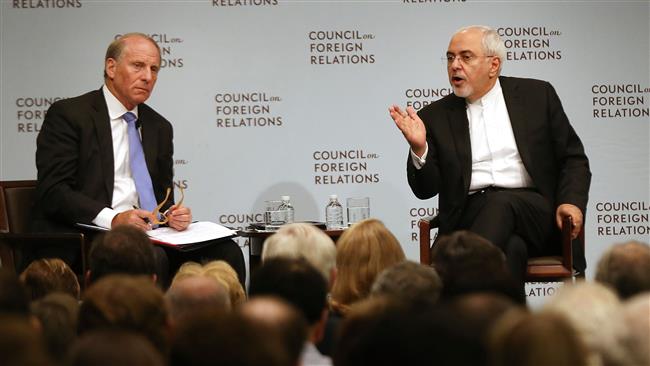
Here is the full text of the statements made by the Iranian top diplomat during a Monday press conference held in New York with President of the CFR Richard Haass:
Well I think it is befitting when you want to talk about such a difficult subject to start as we always do, In the name of God who is the compassionate and the merciful. Because it’s important, when we talk about our part of the world, to remind ourselves that the God the people are killing in his name is considered in our religious doctrine as a being that is compassionate to all and merciful. And his compassion doesn’t recognize any boundaries of religion, race, sex or whatever. And it is in fact, the irony of history that people kill in his name and commit all these acts of atrocity.
Role of Foreign Interference in Mideast Instability
I believe there are many reasons for this situation. You can look inside, inward, in the region and it’s always easy to blame the outsiders. We’ve had foreign intervention and occupation which obviously amount to much in terms of creating disenchantment, anger and leading to extremism. I don’t want to boast, but in February of 2003, a month before the United States invaded Iraq, I had a statement as the ambassador of Iran at the Security Council and I said a lot of what may happen after a US invasion at that time – and the invasion was imminent – is in question, we don’t know what will happen. We don’t know a crystal ball. But one outcome is very clear and that is extremism is going to be on the rise. As a consequence of that invasion. So, that’s one way of looking at our region.
Problems inside Mideast Leading to Extremism
Our region has been the scene of many foreign interventions […], but looking internally, I believe, and here I do not want to be rude to any of our neighbours, but there has been a failure of the state system in the Middle East. Expectations have not been met. People believe that the state and now I don’t mean just the society of Arab states, but primarily the Arab states have been incapable of addressing the most important basic needs of the population. And that has given rise to anger, to resentment, to disenfranchisement. You do not have any other opportunity to vent out frustration.
Iranians Can Express Frustration by Voting
People stood in lines for ten hours in Iran two months ago to vote. Ten hours in lines simply to vote! That gives them an opportunity to express themselves. Iranians stood four hours in line in Los Angeles to vote. That gives them an avenue of expressing their whether satisfaction, dissatisfaction with the government. That is totally absent in the rest of our region.
So frustration with the lack of the possibility for the state providing for the most basic needs including dignity; that’s one thing. Then this anger is directed at governments in the region – the governments of their own countries – but unfortunately they try to misdirect or divert this anger to some sort of an enemy that they depict.
Iran, ‘Enemy of Choice’ for Regional Governments
And now we happened to be the enemy that they want to choose. Enemy of choice. Because it not only works for them it works with you. It is very appealing for somebody to come and tell the United States that ‘oh! Iran is the enemy. Iran is the source of all of our problems.’ And because of that you see a concerted effort to create this external enemy in order to divert that very fundamental existential threat.
Domestic Woes Not Solved by Blaming Superficial Enemies
But I believe helping these extremist forces, even by diverting their anger towards a superficial enemy, would not resolve the problem because the problem at the end of the day for these extremist forces, for these terrorist forces, the focus of their anger is their own government. And even if they can divert that anger to another enemy for some time, at the end of the day it will come back home.
Saudi-Backed Terrorists Attack Iran’s Parliament
[Asked about the recent remarks by Saudi Crown Prince Mohammad bin Salman about bringing the battle into Iran’s territory] It meant threat. And a threat that they had been trying to make real for some time by helping terrorist organizations. You saw them participating in person in the rallies of terrorist organizations in Paris, with all chanting outside this hall too.
They’re there. They support various organizations who are operating from Pakistan and finally they were able to bring some of them to our parliament, the place they hate the most because that reflects something we have and they don’t.
That is a type of democracy. It may not be similar to yours, although there are many similarities. If you had just watched our debate, if you knew Persian and simply had watched our debate and then compared it to yours. They are very similar, I’m not trying to be sarcastic. They’re similar debates. But [that] doesn’t happen there.
Iran Serious Partner for States Fighting Terrorism
So they brought it there. They brought terrorism to Iran. But I believe again they are looking at the wrong address. Iran is a serious partner for all these countries in fighting our common enemy because we believe at the end of the day these Takfiri forces, these extremist forces, are as much as threat against us, but even more a threat against them.
Hope for Cooperation with Riyadh on Ending Mideast Crises
[Asked about the possibility of a direct conformation between Iran and Saudi Arabia or any other party on opposite sides in Yemen] Well we certainly hope not and we certainly hope that we can… if we don’t agree with each other about the situation in Yemen or about the situation in Syria we can still work with each other in order to bring those situations to an end. We believe nobody is gaining from the continuation of the conflict in Yemen.
I put a proposal four years ago for a resolution in Syria. Four points: ceasefire, national unity government, constitutional reform, election. On Yemen, immediately after the war in a meeting with President Erdogan of Turkey, President Rouhani presented another four-point plan: ceasefire, immediate humanitarian assistance – because Yemen is probably the worst humanitarian nightmare that you can think of. 300,000 cases of cholera. That’s really serious. – So ceasefire, humanitarian assistance, intra-Yemeni dialogue, national unity government. I believe this can be the basis for cooperative arrangements between Iran and Saudi Arabia.
Iran, Saudi Arabia Can’t Exclude Each Other from Mideast
We don’t have to fight. We don’t need to fight. We don’t need to try to exclude each other from the scene in the middle east because at the end of the day, neither Iran nor Saudi Arabia will be able to exclude the other and the minute our neighbours on the other side of the Persian Gulf come to the realization that they cannot exclude Iran, I believe the most important giant step would have been taken by them in order to resolve the issue.
Iran Opposed to Use of Chemical Weapons by Anyone
[Asked about Iran’s support for Syrian government, which the West claims is using chemical weapons] First of all, we do not believe that any country has a red line on the use of chemical weapons except for Iran. Because when we were the victims of chemical weapons, nobody cared. Everybody actually supported the other side.
I used to be a very young – I’m still young – but a very young diplomat in 1985, going to the president of the Security Council, telling him that chemical weapons were being used in the Iran-Iraq war, and the president of the Security Council told me flatly, I’m not going to listen to you.
Now, I would not accept anybody telling me that chemical weapons is a red line for them because I remember that personally, but it is a red line for us, and that is why we have said from the very beginning, that Iran opposes the use of chemical weapons by anybody against anybody. That’s period; I mean, no ifs and butts. However, we believe that allegations of the use of chemical weapons need to be investigated, and there are mechanisms for investigating.
Probe Needed to Verify Syria’s Alleged Chemical Use
We have serious doubts that the recent allegations by the United States about the use of chemical weapons against Khan Sheikhun can be verified, and we suggested that they should send an investigative team to the region. We said that if chemical weapons had been used, there are traces. You can find where they were used, how they were used, from which locality they were used, and it would have been easy. It would have been easy for a team to go to Khan Sheikhun, and it would have been easy for a team to go to Shayrat Airbase. Because if they said they loaded the planes with chemical weapons at the Shayrat Airbase, traces would remain; nobody would be able to remove those traces. You know, we went through six or seven US investigative teams. When we were alleging that Iraq had used chemical weapons, they came to the region, they even went to the warfront, and they were able to determine time and again that Iraq had used chemical weapons against Iran. It’s not that difficult.
OPCW Refusing to Investigate Chemical Use in Syria
But the OPCW, the Organization for Prohibition of Chemical Weapons, refused to go to Shayrat. And I asked the executive director of the organization a few weeks ago when he was in Iran, and he said we were not supposed to attribute responsibility; we were supposed to only check whether chemical weapons have been used. So, from our perspective, it is unacceptable for anybody to use chemical weapons, but we do not accept people to be the judge, the prosecutor, the executioner, the investigator, the jury, everything in one person who may need, for a lot of other reasons, to use this as a way to escape a lot of other circumstances that he had found himself in at that time.
Iran’s Compliance with JCPOA Verified for Several Times
[Asked about his assessment of the commitments of parties to the nuclear deal between Tehran and world powers on its second anniversary] I think our compliance is rather straightforward because it’s not forgetting whether we have complied or not. We have given the mandate to the IAEA, actually the agreement has given the mandate to the IAEA to verify our compliance, and it has verified every time that Iran has complied. So that’s very clear in black and white in the reports of the IAEA, which is hardly a sympathizer of Iran. So you don’t need to ask me whether we have complied.
US Refuses to Help Those Interested in Doing Business with Iran
As far as the United States is concerned, we believe that for the United States, it has been, even during the Obama administration, more important to maintain the sanctions that remained rather than remove the sanctions that were lifted. So the Office of Foreign Assets Control, OFAC, has been reluctant to provide straightforward answers to those who wanted to do business with Iran because it was worried that a straightforward answer would undermine the sanctions that we had not debated and discussed or agreed to be lifted, sanctions dealing with other issues. We believe that they are not justified. But for OFAC, those were sacrosanct and those were more important than the sanctions that were being lifted.
It’s important and interesting that Iran is under human rights sanctions and countries who have never heard of elections and behead innocent individuals are your allies and never receive any sanctions, human rights or otherwise. But be that as it may, yeah, I’m referring to those sanctions.
Iran Survives Regime Change as It Relies on Its People
[In response to a question about US officials’ remarks about the need for a ‘regime change’ in Iran] Well, the impact is that the United States doesn’t learn from history. The US conducted regime change in Iran in 1953 and look what it has produced for the United States. The US has been following a regime change policy since the revolution. Officially, it was stopped during the Obama administration. We don’t believe that it was actually stopped, but it was officially stopped.
You see, the difference between Iran and American allies in the region is that we derive our legitimacy and our authority and our power from our people. The fact is that we’ve been under pressure, Richard, for 38 years. You look around us in the region, everybody has some sort of a foreign umbrella, either NATO or direct US support; Iran doesn’t. How have we survived? How have we survived without any support from outside? It’s because we rely on our own people. It’s because we rely on our own people that we’ve been able to survive regime change, we’ve been able to survive a war.
Everybody supported Saddam Hussein. People want to forget that. For eight years we were subjected to a war where everybody supported the other side, from the Soviet Union to the United States to every other permanent member of the Security Council. People spent billions upon billions of dollars. You remember a few weeks ago Saudi Arabia spent $110 billion buying arms for themselves. They purchased $70 billion worth of arms for Iraq during its war against Iran.
But we survived. We survived the war. We survived sanctions. We survived Hillary Clinton’s crippling sanctions, the worst types of sanctions ever had been imposed on Iran for many years. We survived that.
Regime Change Not Working in Iran
Why do we survive that? It’s because we can rely on our people, the same people who stand in line for 10 hours to vote for their president, because – General Mattis the other day said that Iranians don’t have a choice, that the Ayatollah chooses the president, and he made a reference that it is as if President Trump would choose the next president of the United States. Come on! People stand in line for 10 hours to vote for a president that had been pre-chosen?
Now maybe people in Iran have been brainwashed. People in Los Angeles would stand in line for four hours to choose a president that was predetermined? Come on. Don’t kid yourselves.
Look at the realities. Regime change doesn’t work in Iran, because it’s not a country that is dependent on the United States for its legitimacy, for its survival. We have lived–I mean, not necessarily out of choice, but we have lived in spite of the United States.
Saudi Arabia, UAE Reaping Fruits of Their Wrong Choices
[Asked about Iran’s growing influence in Iran] We believe that we need to have inclusive governments throughout the region. That is why we have come to the aid of the Iraqi Sunnis, Iraqi Kurds, as well as Iraqi Shias when they confronted ISIS.
Our policy has been consistent, Richard. We fought extremism in Afghanistan. We fought extremism in Iraq. We fought extremism in Syria.
US allies supported extremism in Afghanistan. You remember, the only three countries that recognized the Taliban as government were Pakistan, a neighbour; Saudi Arabia; and the UAE. These are the same countries that support terrorism and extremism in Syria, same countries that support terrorism and extremism in Iraq. They have been consistent in supporting terrorism and extremism. We have been consistent in objecting to that. They made the wrong choices, and now they’re complaining. Why are they reaping the fruits of their own wrong choices? It’s not our fault that we made the right choice.
Regional Influence Shouldn’t Be at Expense of Excluding Others
But that article in The New York Times, I believe – I have a lot of respect for The New York Times, but they didn’t do a fact check, because if you read that article, it is so one-sided that it even tries to attribute the use of chemical weapons on Iran – I mean, not in such a direct way, but it – just read the sentence, please. Read the sentence against a background that seven United Nations reports, one after another, proved that Iraq had used chemical weapons and rejected Iraqi allegations that Iran had used chemical weapons, rejected Iraqi allegations, supported by the United States. Remember the Halabja incident, where a CIA document now shows that the United States sent cables to all its embassies asking them to go and lobby that Iran had used chemical weapons here? I mean, these are facts. These are not even WikiLeaks. They came before Assange.
So, I mean, these are realities. We have influence in Iraq. We have influence in the region. But we do not believe that influence in this region should be at the expense of excluding others. We believe that everybody should be engaged in the region.
[Asked about the presence of American forces in Iraq] We believe that foreign forces are inherently destabilizing, Richard. We do not object to the choice of our neighbours. We do not interfere in the choice of our neighbours.
Iran Not after Military Presence Anywhere in Mideast
We do not have forces [in Iraq and Syria]. As you know, we have military advisers. And as I said, we do not object to the choices of our neighbours, but we believe that foreign forces are inherently destabilizing. We do not want to have a military presence anywhere in the region. We want to be able – we had – we went there as requested by – we went there – to Erbil. You see, you like to simply point out to the fact that we have military advisers in Syria. Why don’t you remember when ISIS was just about to take over Erbil, President Barzani called three countries: Iran – probably last – Turkey, and United States.
We were there in two hours with five planeloads of weapons, and military advisers to assist the Kurds in fighting ISIS. The US took 24 hours to go and do some aerial bombardments. And our friends didn’t go at all.
So this is the reality on the ground. If we are there, we are on the invitation of the governments that are recognized by the United Nations. But at the end of the day, we believe that the job of establishing security for countries in the region is their own. Each country, their citizens, their military forces must establish security. Foreigners should assist. Anything beyond that would be destabilizing.
Kurdistan Referendum to Cause Security Disaster in Iraq
[Asked about the rumours of an independence referendum in Iraqi Kurdistan] Well, we believe that the referendum is not the right choice. We believe that it would bring about centrifugal tendencies in Iraq that would be disastrous for the country, and it would not be limited to the Kurdish population. And I believe the impact on Iraqi security would be disastrous and the impact on regional security would be disastrous.
So we have advised our friends in Iraqi Kurdistan – and all of them are our friends, from Mr. Barzani to others in Iraq – we have advised all of them that this is the wrong choice and they should not make this choice. I believe this is the common view of every country in the region, and in my discussions in Europe and elsewhere, I’ve heard that this is – I mean, they shared this concern that we have. And here, I do not talk to officials, but talking to think tanks, I believe the same tendency exists here in the United States. So I do not think that’s the right choice. But I believe that policies in our region – as much as we insist on national unity and territorial integrity of every country in the region, we believe that anti-Kurdish policies anywhere in the region would backfire.
[On Turkey’s anti-Kurdish policies] Well, I do not interfere in the internal affairs of other countries. I am just an analyst making an analytical point.
Relying on Foreign Forces Not to Restore Peace to Afghanistan
We have shared the view with the Afghanistan government that we do not believe that reliance on foreign forces will enable them to bring about a peaceful resolution. We support the peace process in Afghanistan. We are prepared to do whatever we can and by whatever we have in our capability to support that process. We have our view, but we respect the decisions of our neighbours. We always have. And the government of Afghanistan is a sovereign government. And if it makes a decision, we respect that decision. But we would disagree with them on the merits of that decision.
Gov’t Has No Control over Judiciary’s Decisions
We have – and I’m sure everybody knows today – an independent judiciary. And we in the government do not have any control over the decisions of the judiciary. That is solidly written in the Constitution, practiced on the ground in Iran.
As a foreign minister, I’ve always tried, on humanitarian grounds, to help people who are in custody, who may not have – I mean, we do not recognize dual citizenship, so for us Iranian-Americans are considered to be Iranians and subjected to our own laws. But we have followed their cases, and we hope that an acceptable resolution can be found.
I have to mention that while a lot of publicity has been around the Iranian-Americans or others who have been detained in Iran – and some even say that Iranian-Americans don’t feel safe to come to Iran. There are a million Iranian-Americans, at least, and hundreds and thousands of them come to Iran on a regular basis. I mean, every plane flying to Iran– mostly bringing Iranian expatriates – from the United States is full.
So they come. Only a handful of them have been detained on charges. And I’m not in a position to comment on the charges, because, as I said, the judiciary is independent.
US Detaining Iranians on Charges Not Applicable Today
However, there are Iranians who are being detained by the United States, either in the United States or even abroad, on charges of technical violations of sanctions that are not applicable today but were applicable 10 years ago.
An Iranian woman, two months pregnant, was arrested a couple of weeks ago in Australia. She had immigrated to Australia, left the country, arrested two months ago in Australia, on the request of the United States, for having translated in a transaction that involved a technical violation of sanctions.
Another Iranian was arrested in Spain two weeks ago, again, on the same charges. Another Iranian was arrested in Frankfurt, Germany three weeks ago on the same charges. Iranians are being arrested in the United States on bogus charges – bogus. I know a case in New York – bogus allegations, purely political allegations.
So I’m not saying that it’s tit for tat, but I’m saying that we need to address this humanitarian problem from a humanitarian perspective and not from a political perspective. And I’m certainly ready to do all it takes on my side to help reside this humanitarian problem.
Iran, US Need to Look Forward
There is bad history [in Iran-US relations]. Certainly, Iranians did not believe that the activities in 1979 were benign. And the 1953 [US-backed coup] incident was very much fresh in the minds of Iranians when the events of 1979-1980 [hostage crisis] took place. What needs to be done is to look forward. We have after years of disagreement been able to reach an agreement that is the result of a multilateral process in which Iran and the United States played a most significant part, but which the deal is not an Iran-US deal. It’s a multilateral deal. And we said that when we signed the nuclear agreement, we said that this was the foundation and not the ceiling.
Iran, in our view and in the view of the IAEA, built trust by implementing its end of the bargain. Unfortunately, as I said in answering the previous question, the United States didn’t. So it creates the impression in Iran that the United States’ hostility towards Iran will never end. And I think that can be remedied, while history is history, and we cannot do much about history.
Iran Receiving Contradictory Signals from US
[Asked about the signals received from Trump’s administration] We received the same signals as you see in the press, the tweets, the others. (Laughter.) That – I’m talking as somebody who created tweet diplomacy. If you watched – and Kerry – we did – I did tweets on an almost daily basis during the nuclear negotiation. And I believe tweeting is a good way of doing diplomacy, as I did it myself.
But the point is, we received contradictory signals. So we don’t want – we don’t know which one to interpret in what way. But it’s very clear that Iran is serious about the nuclear deal. And we believe that the nuclear deal can lay the foundations, not the ceiling.
Communication with Tillerson on JCPOA Possible
In today’s globalized world, you can – you can get your message across even sitting in your home. But I had an opportunity to come for a UN session. And I’m taking that opportunity to also have – to see some old friends, as I’m doing right now, and meet some new friends. But it is important to have a better understanding, because I see a lot of misinformation and disinformation that is being – I mean, you know that a lot of money is being spent. Millions upon millions of dollars of money is being spent on PR. And this PR doesn’t want to promote the truth, at least – I mean, I’m not talking about fake news, but the PR is trying to promote a version that is acceptable to certain groups of people.
And I believe there is a need under these circumstances, when people are bombarded with this type of less than truth, that – or more than truth in cases – like our total control over Iraq – to hear the different side of the story. But there are no communications between myself and Secretary Tillerson. It doesn’t mean that it can’t – they can’t be, because the possibilities for engagement with regard to the nuclear deal has always been open. My colleagues have regular contact with US colleagues on the implementation of the nuclear deal. Later this week they’ll meet in Vienna, in joint commission, whose agenda is to look at our complaints about US failures to comply fully with its obligations under the nuclear deal, JCPOA. So possibilities for interaction are there, and I think we take advantage of these possibilities. But certainly, I mean, it’s not like the situation with the previous administration where probably Secretary Kerry and I spent more time with each other than we spent with anybody else.
Ban on Nuclear Weapons Right Path to Go
Iran is committed not to produce nuclear weapons. That never expires. Iran is committed to enable the IAEA to have the most stringent control mechanism that is available. That is the additional protocol. That never expires. These are provisions that are built in the nuclear deal that have no sunset.
There are some temporary confidence-building measures that Iran agreed to adopt. Those are temporary in nature. After those temporary limitations expire, Iran will resume producing enriched uranium for fuel purposes. And the IAEA is there with the additional protocol in order to verify it. And Iran’s commitment never to produce nuclear weapons is also there.
We two weeks ago, as you know, we voted for a resolution to legally ban nuclear weapons for all. Unfortunately, the United States and other nuclear-weapon states did not even participate in the deliberations in the United Nations.
So I believe that’s the route to go. I think that’s the way to rid the world of these weapons of mass nightmare. And I think six US – six previous US secretaries of state are on the record in The Wall Street Journal that that is the right path to go. But that was some time ago. But now the possibility is there on the ground with this total ban on nuclear weapons, and I think we should take it. We should all take it.
Nuclear Weapons Not to Augment Anybody’s Security
We believe that nuclear weapons do not augment anybody’s security. Our objection to nuclear weapons does not recognize friend or foe. We simply believe that nuclear weapons are unacceptable, and in our view illegal because of the consequences. I argued for 90 minutes in 1996 before the ICJ that any use of nuclear weapons would be illegal because it violates the most basic principles of international humanitarian law.
And that is our position. Our position is that nuclear weapons are unacceptable ideologically from our ideological point of view, that nuclear weapons are not acceptable strategically, that nuclear weapons do not augment anybody’s security, that nuclear deterrence is baloney.
Iran Pays Compensation for Saudis’ 9/11 Attack
Judges are parts of judiciary. They’re not selected by anybody. They go through a process that is in the judiciary to be admitted as judges. In our case, we don’t have elected judges. In many countries, you don’t elect the judges, but they go through a process. It’s not an arbitrary policy. It’s a legal framework within which judges are appointed, are selected.
The due process of a case going to a certain judge is also determined by law. It’s not an arbitrary process. Security cases in many countries are held in-camera, including in the United States. I can give you a case right now in New York, the lawyer of the defendant doesn’t have access to the charges against him because they say charges are classified. The defendant himself doesn’t have access to the charges against him because they say charges are classified. You call these dark forces in Iran, you should call them dark forces in the United States. So, I mean, these are realities.
As I said, our judiciary is independent, and I’m not here to defend another branch of Iranian government because it’s none of my business. They are an independent branch of the Iranian government, they carry their own decisions, but it is based on rules of procedure that are enshrined in law, not arbitrary. You may not agree with the law. I certainly do not agree with the law.
A court in New York gave $11 billion to victims of 9/11, accusing Iran of being the culprit, while every evidence in the book says that Saudi Arabia and your allies were the real culprits. A court in New York – I mean, this is so “dark forces” – let me be serious about dark forces.
So let’s look at the realities. I mean, our money is being confiscated for roles that we played in September 11th. This is long before JASTA. The judiciary has evidence, according to them, to prove that this gentleman was involved in espionage. Now you may have a different interpretation of espionage than they do, and I respect that. But we cannot simply say that this was an arbitrary decision. Having said this as foreign minister, it’s my job to make sure that anybody, any foreign national in Iran – even if they are in prison – would receive the necessary amount of legal protection, receive consular visit, and if possible, their case is resolved through humanitarian means. And I’m saying I’ll do my best in order to be of assistance there.
Iran Receives $1.7bn of Its Own Money from US
We have cases in The Hague. It’s called the Iran-US Claims Tribunal. During the [reign of] Shah, we put a lot of money into funds to buy weapons. And after the Revolution, […] we didn’t know how much it was, because, I mean, there were a lot of stuff. I mean, the beautiful military equipment that you’re now selling to Saudi Arabia, you used to sell to us. So for those beautiful military equipment, we used to pay a lot of money. Estimates are that when the Shah left, there were about $400 million worth of money left in that fund without military equipment that had been sold to Iran. And then we had some equipment that we had sent to the United States to be repaired or whatever, overhauled.
So we have a case in The Hague, in the Iran-US Claims Tribunal which has two parts. One part, with the fund that was not returned to Iran. And the other part, dealing with the parts and the stuff that was sent to the United States for repair or overhaul. We decided in the course of the nuclear negotiations to settle that case, to settle the case of the money not the parts. And that amounted, with interest, to something close to $1.8, $1.7 billion.
So that was our money. It had lingered in the Tribunal for 35 years, waited for resolution. And finally, the lawyers had the guts to – I mean, no, really it requires guts because everybody was accused. I mean, our people accused, why did you settle for $1.7 billion, because some believe that interest should be compounded. Some believe that it should be simple interest. So they reached an agreement based on previous decisions of the Tribunal on other cases that it would be simple interest, it will be at something between 8 and 10 percent, and they just settled it and we got our money. It was our money. Nobody gave us anything. We never asked for anybody’s money.
US Should Reconsider Approach to Sanctions
We will make decision [about new US Congress sanctions] when time comes. Whether it’s a violation? Of course it’s a violation. I mean, let me tell you something. The United States should reconsider its approach to sanctions. Sanctions have never been an asset for the United States. Sanctions are a liability. You see, when the US government started to impose nuclear sanctions against Iran, we only had 200 centrifuges. When they started negotiating with us in order to remove those sanctions, we had 20,000 centrifuges. So if you want to see the results of sanctions, just 19,800 centrifuges is the net result of sanctions.
So sanctions do not produce outcome. I think people in Washington should get it in their minds: Sanctions are a liability not an asset. But unfortunately for the United States, these sanctions are an asset and they continue to creating more and more of them. And any day that the United States decides to change its policy, there is such a spider web of sanctions that the United States itself will be a prisoner of its own sanctions.
I don’t support the use of sanctions, period. I believe use of sanctions are counterproductive. They hurt the wrong segment of the population. They never produce the results that you want. So as somebody who wrote his master’s thesis on sanctions in 1982, I can tell you that sanctions don’t work.
Too Late to Inspect Chemical Use in Syria
We requested a team to be sent to Shayrat because the United States claimed that these weapons were based on these airplanes at Shayrat Airbase. That’s why they hit Shayrat with those Tomahawks. So we asked them, send an investigative team to Shayrat, and they couldn’t say that it wasn’t secure because Shayrat was controlled by the government and the government would guarantee security. They didn’t.
Now, if they go now and visit Shayrat and find no traces, what would be the conclusion, that traces have vanished or that the allegation from the beginning was bogus? We’ll see. We’ll see. I mean, I was told by the secretary-general that JIM is going – that is going to start the investigation. We believe it’s way too late, but we believe it’s necessary to do the investigation in a serious way.
It’s too late. It’s too late. They wasted a lot of time in order to do something that was necessary a long time ago. Don’t predict what will happen. Let’s go about it and see where it gets.
Palestinians’ Fundamental Rights Being Violated
[Asked about Israel’s territorial integrity] Well, I’m talking about the immediate neighbourhood, and that’s where our concerns are, and that’s where our policy is directed. You see, people are looking for scapegoats in dealing with crimes that are being committed on a daily basis. This smokescreen won’t resolve the Palestinian problem, and Iran is not in the neighbourhood.
What is the cause of the continuation of that crisis? It is the violations of the most fundamental rights of the Palestinian people – mass punishment, human rights violations, denial of every inalienable right of the Palestinian people. And there is global consensus about that.
Instead of trying to look for a scapegoat, clever or not, try to address the real cause of the problem and then see if anybody can intervene from outside. It’s the Palestinians who have been deprived, who have been suppressed, repressed for now three generations. If that is addressed, I think you won’t need to look for scapegoats.
Iran Uses Missiles Only for Self-Defence
We made it clear – in the nuclear deal, we had a very long negotiation, and at the end of the day we reached an agreement on avoiding the missiles that are designed to be capable of carrying nuclear warheads. And we don’t have nuclear warheads, so we don’t design anything to carry something that we don’t have. So that’s the end of that story.
Missiles are our defence. Missiles are the means of our defence. We do not buy $110 billion worth of beautiful military equipment. We produce them ourselves, beautiful or otherwise. And I hope a day will come that nobody will have to produce or buy these weapons. And we are prepared. I mean, as the country that spends the least in the region on military equipment, we are prepared to engage with anybody on reduction of military expenditures. Our missiles are means of our defence. We will never use them, except in self-defence – never. And that is a commitment we make. And we hope that others can make the same commitment, that they will not use those beautiful military equipment on anything other than self-defence. That’s a challenge. That’s a challenge.
Are they using those beautiful military equipment in self-defence in Yemen against defenceless, innocent people, who have been bombarded out of existence for the past two years? I think these are the questions that need to be asked, instead of focusing on Iran’s means of defence. You see, we went through a war. Eight years. Our cities were showered with missiles, some carrying chemical weapons. And nobody – believe me – nobody gave a damn. I can tell you, I was a witness to that because I was representing Iran at the United Nations. I brought people who were attacked with chemical weapons – I brought them to New York, took them to hospitals so that I could wake up some people’s conscious that this thing was being used. Nobody cared.
And now people are asking us to give up our means of defence. Why should we? Have we ever used these weapons against anybody? Just bring one case in history. We can make a statement categorical: We have never used these weapons except in self-defence. We will never use these weapons except in self-defence. We hit the same base from which terrorist operations were designed and carried out against Iran in Deir Ez-Zor. We hit them with precision missiles.
You know, one reason we need to test our missiles is that we want – I mean, missiles that carry nonconventional warheads do not need to be precise, because you put a nuclear warhead on top of a missile, they can hit anywhere; it’s enough. You put a chemical warhead on top of a missile, doesn’t need to be precise. But if you want to put conventional warhead on top of a missile, in order to be able to have some impact, it has to be precise. And we have been able to make precise missiles so that we won’t hit civilians as collateral damage.
And that’s what happened in Deir Ez-Zor. We fired missiles, and our intelligence indicate that all of them hit the targets that they had been intended for. You didn’t hear our missile attacks on Deir Ez-Zor. Nobody even alleged that a single civilian bystander was killed by our missiles. So this is why we need to develop our missiles. We need them for our protection. We need them for the protection of our civilians. We need them so that another Saddam Hussein around the corner – and, believe me, there are quite a few of them in our region; we need them make sure that another Saddam Hussein around the corner would not come and hit us again, with the international community going through a deafening silence.

 Zaki also praised the IKRF for its humanitarian efforts in the capital Kabul and other provinces of