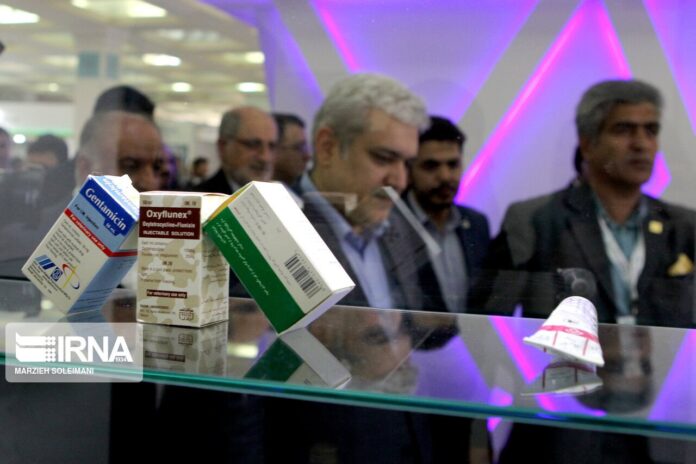
Iran’s Vice President for Science and Technology Sorena Sattari said on Tuesday that the local knowledge-based businesses and start-ups have made such great advances in the biopharmaceuticals and recombinant pharmaceuticals industry that have obviated the need for the import of many strategic products.
Addressing the opening of Iran Pharma exhibition in Tehran, Sattari said the domestic knowledge-based companies and start-ups have begun producing the pharmaceutical products that have been subject to foreign sanctions.
The vice president also noted that 27 biological medicines, 50 chemical drugs, and 58 drug precursors whose imports would cost the country around $570 million are going to be “made in Iran.”
Sattari said the pharmaceutical products made by the domestic knowledge-based companies and start-ups are worth $1.2 billion.
He also stated that more than half of the total exports of pharmaceuticals were the technological items produced by Iranian knowledge-based firms.
In remarks earlier this month, secretary of Biotechnology Development Headquarter at the Iranian Vice-Presidency for Science and Technology said the Islamic Republic was exporting biopharmaceuticals to major customers like Russia, Iraq, Syria, Pakistan, Malaysia, and Turkey, adding that plans were underway to transfer the Iranian biopharmaceuticals technology to Argentina.
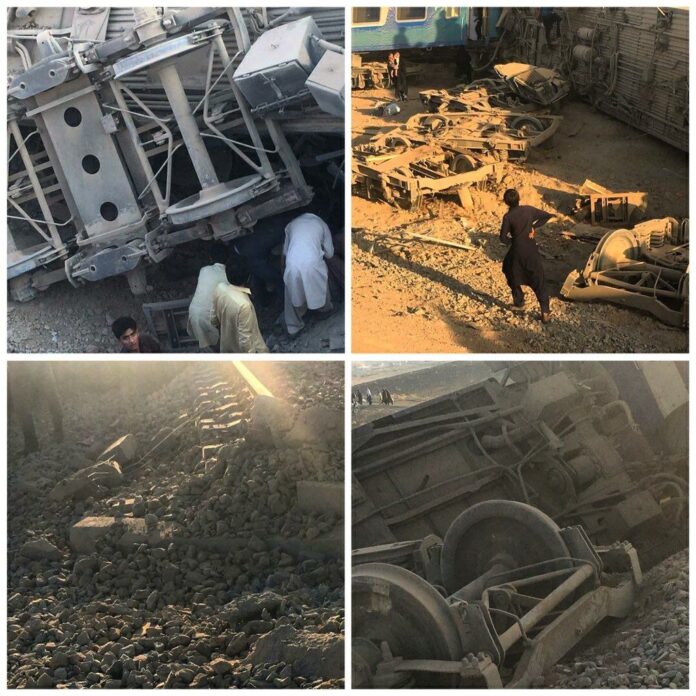
Director of the Crisis Management Office in the province has told Tasnim that five people have been killed as of Wednesday evening in the train accident.
Officials say at least 35 others have been wounded when the train derailed near Zahedan, capital of the border province.
The train was traveling between Tehran and Zahedan when one of its cars was overturned.
A local official says the accident happened due to sandstorms.
The large, underprivileged province of Sistan and Baluchestan borders Pakistan and Afghanistan, and has a long coastline by the Sea of Oman. The desert province grapples with water shortage, particle pollution, underdeveloped infrastructure and transit of illicit drugs.
Last week, Iranian First Vice-President Eshaq Jahangiri said Leader of Iran’s Revolution Ayatollah Seyyed Ali Khamenei has given permission for withdrawing $300 million from the National Development Fund of Iran to construct a railroad line between Zahedan and Chabahar port.
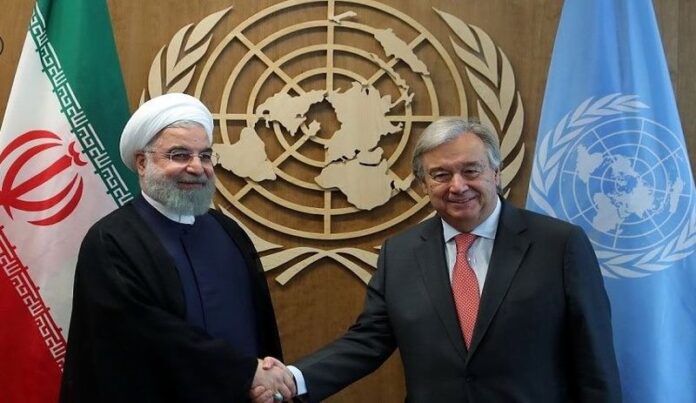
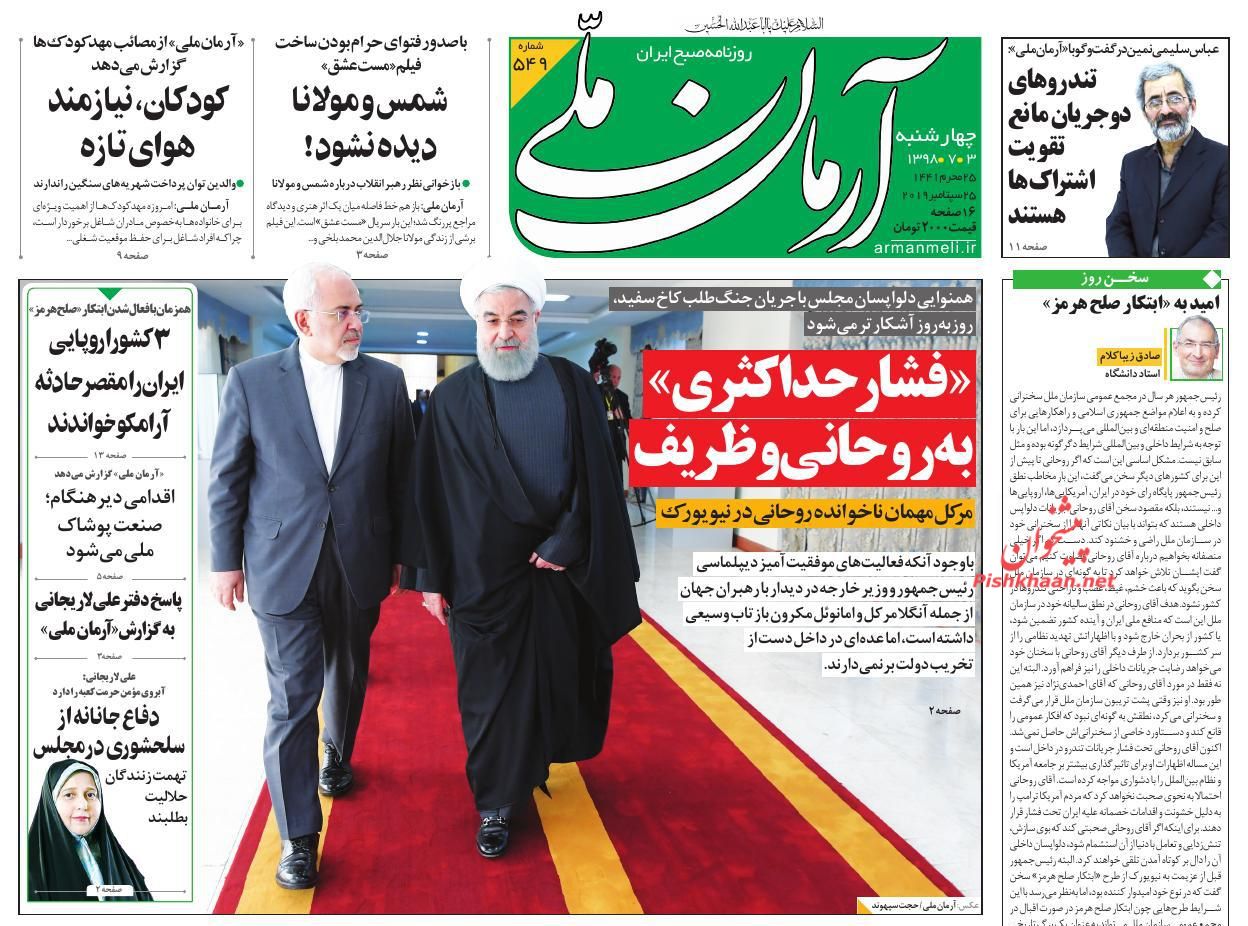
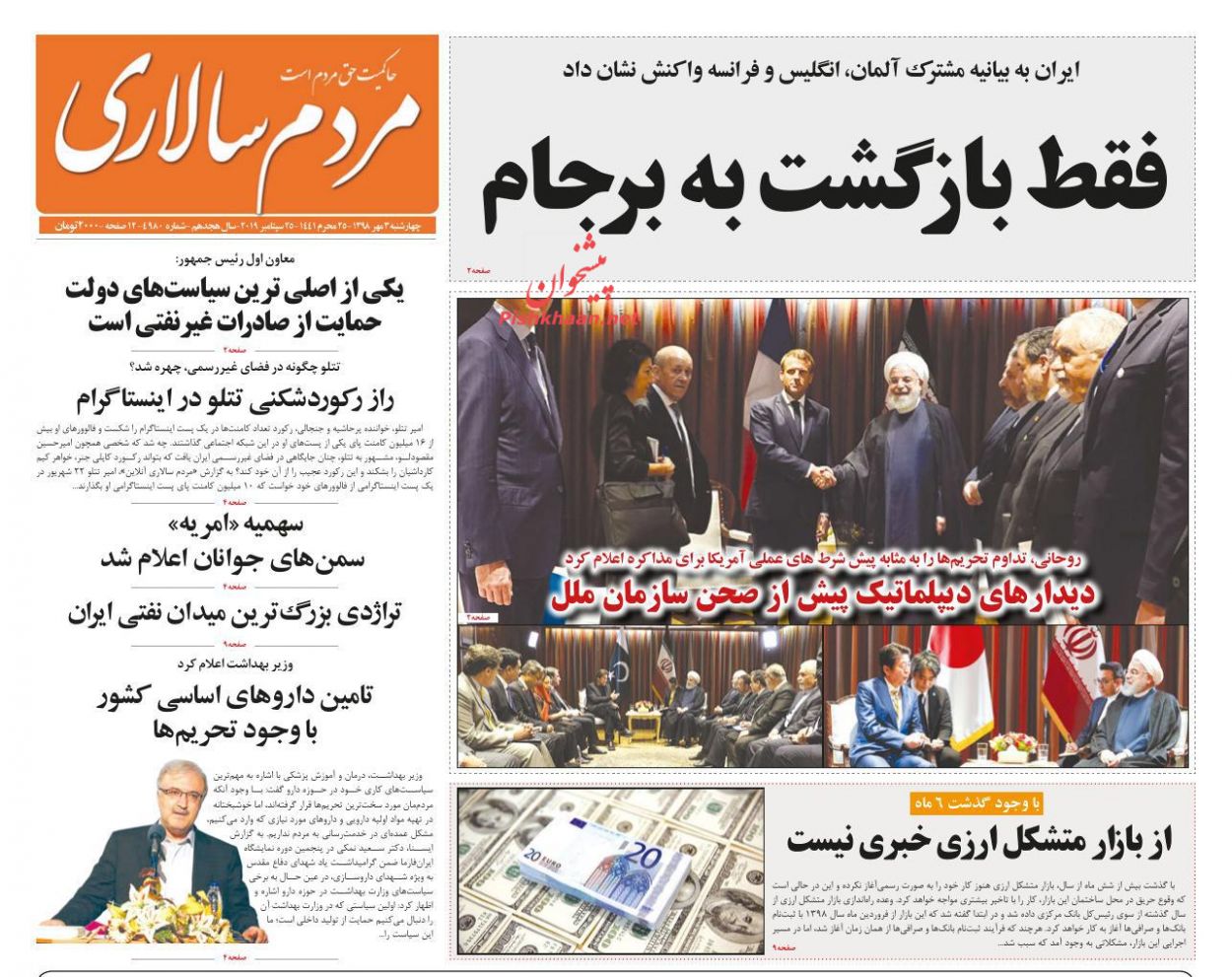
The Iranian president held the meeting with Guterres on Wednesday after an address to the 74th annual session of the UN General Assembly.
During the meeting, President Rouhani described his peace initiative, called Hormuz Peace Endeavour (HOPE), as a serious ground for UN’s cooperation in regional security building.
Rouhani slammed the United Nations’ silence and inaction over the US administration’s economic terrorism against the people of Iran and the Israeli regime’s crimes in the region.
“The Iranian nation will overcome these problems one way or another, but the stigma of the UN’s silence vis-à-vis an aggressive government committing all these crimes against a nation using economic terrorism will be remembered in history.”
The president pointed to the fragile conditions of the region, and said, “Today, Palestine is going through tough times and the Zionist Regime is committing acts of aggression against Palestine, Syria, Lebanon and Iraq on a daily basis, and the United Nations is silent towards these crimes.”
“This approach needs to be changed and this important international organisation must carry out its responsibilities,” he added.
For his part, Guterres acknowledged Iran’s constructive stances and effective assistance to his special envoy for Syria, Geir O. Pedersen, for forming Syria’s Constitutional Committee and helping with the Astana Process, saying that good developments have been made in Yemen as well.
He expressed the UN’s full support for the Joint Comprehensive Plan of Action (JCPOA), and said, “The JCPOA is something more than a simple agreement, because it is part of a UN Security Council resolution.”
Guterres also appreciated Iran’s efforts to resolve the Syrian and Yemeni issues, and stressed that cooperation between the UN and Iran should develop.
The UN chief also welcomed President Rouhani’s Hormuz Peace Endeavour (HOPE) initiative.
In the meeting, President Rouhani was accompanied by Iranian Foreign Minister Mohammad Javad Zarif and Chief of Staff Mahmoud Vaezi.
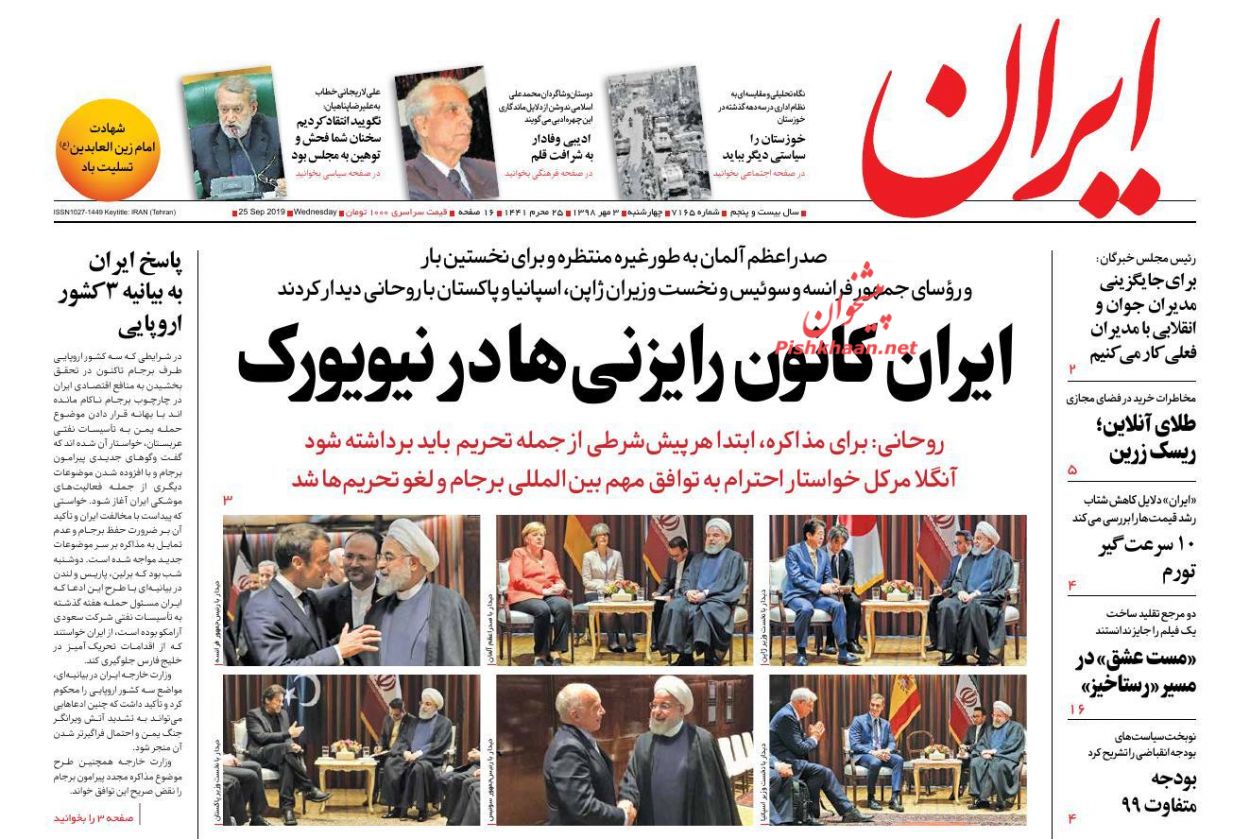
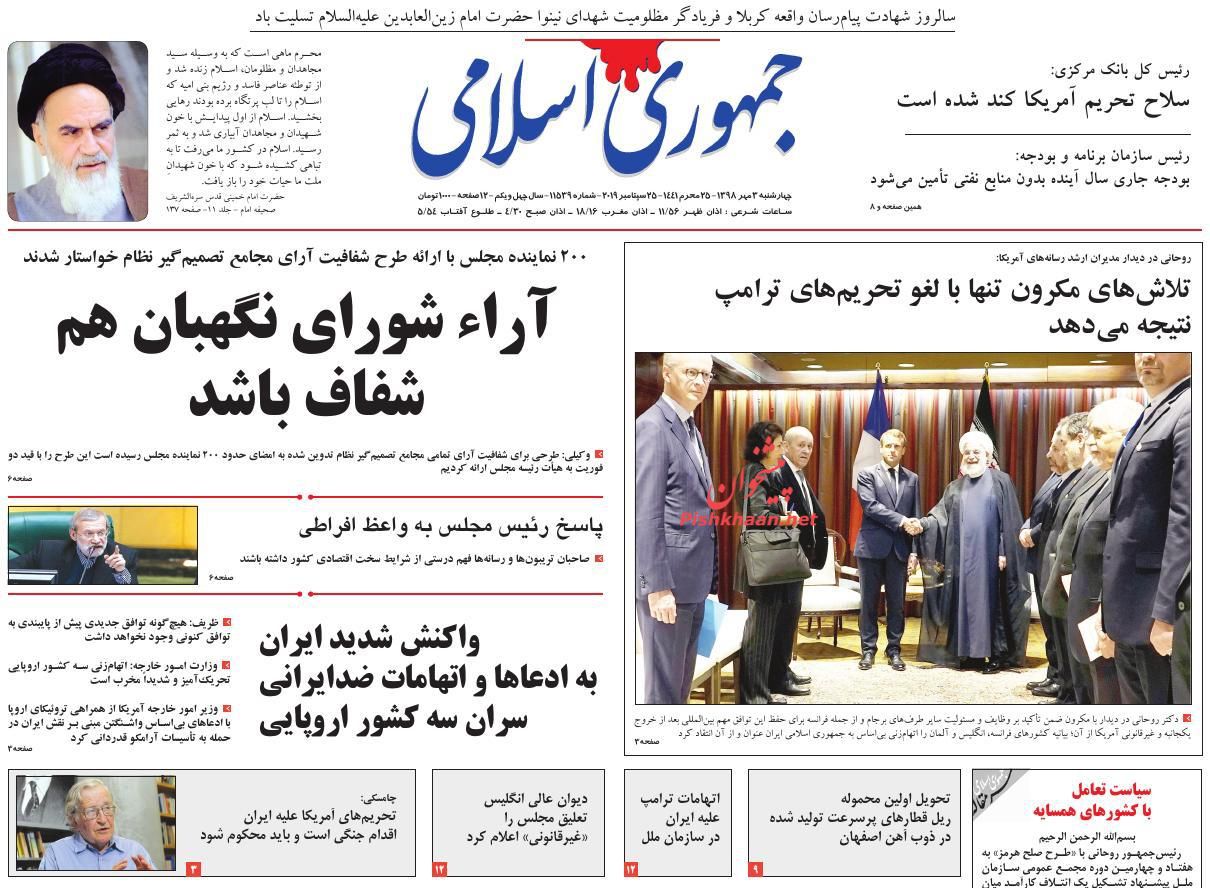
Rouhani has already met several world leaders on the sidelines of the international gathering in New York.
He said that Iran has kept to its commitments under the 2015 nuclear deal, adding that “Iran’s patience has a limit”.
Rouhani criticized the American approach toward negotiations by saying that “they are inviting us to negotiations, but they escaping from the treaty”.
“Our response to the negotiations under sanctions is ‘no’”, said Iranian president.
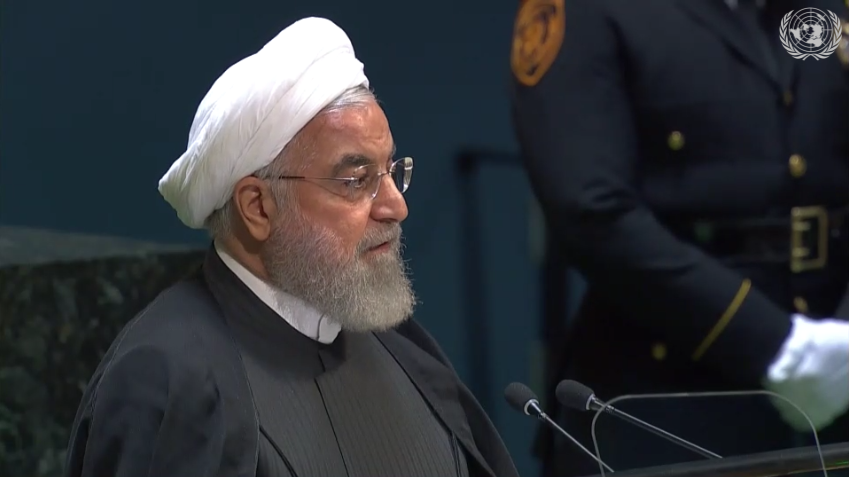
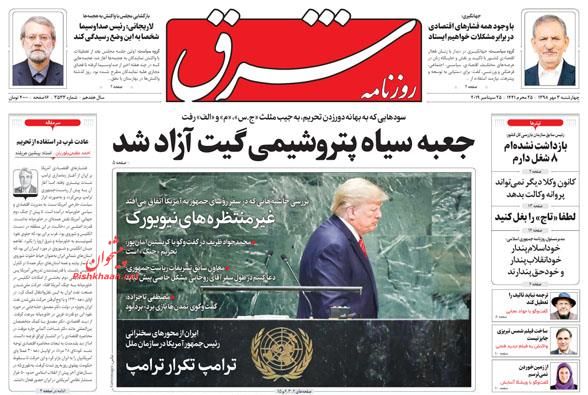
The full text of Iranian president Hassan Rouhani’s speech to the United Nations General Assembly (UNGA 2019) is as in the following:
In the name of God, the Most Compassionate, the Most Merciful
Mr. President
I would like to congratulate your deserved election as the president of the seventy-fourth General Assembly of the United Nations and wish success and good luck for Your Excellency and the honorable Secretary General.
At the outset, I should like to commemorate the freedom-seeking movement of Hossein (PBUH) and pay homage to all the freedom-seekers of the world who do not bow to oppression and aggression and tolerate all the hardship of the struggle for rights, as well as to the spirits of all the oppressed martyrs of terrorist strikes and bombardment in Yemen, Syria, Occupied Palestine, Afghanistan and other countries of the world.
Ladies and Gentlemen
The Middle East is burning in the flames of war, bloodshed, aggression, occupation and religious and sectarian fanaticism and extremism; and under such circumstances, the suppressed people of Palestine are the biggest victim. Discrimination, appropriation of lands, settlement expansions and killings continue to be practiced against the Palestinians.
The US and Zionist imposed plans such as the deal of century, recognizing Beit-ul Moqaddas as the capital of the Zionist regime and the accession of the Syrian Golan to other occupied territories are doomed.
As against the US destructive plans, the Islamic Republic of Iran’s regional and international assistance and cooperation on security and counter-terrorism have been so much decisive. The clear example of such an approach is our cooperation with Russia and Turkey within the Astana format on the Syrian crisis and our peace proposal for Yemen in view of our active cooperation with the special envoys of the Secretary General of the United Nations as well as our efforts to facilitate reconciliation talks among the Yemen parties which resulted in the conclusion of the Stockholm peace accord on Hodayda Port.
Distinguished Participants
I hail from a country that has resisted the most merciless economic terrorism, and has defended its right to independence and science and technology development. The US government, while imposing extraterritorial sanctions and threats against other nations, has made a lot of efforts to deprive Iran from the advantages of participating in the global economy, and has resorted to international piracy by misusing the international banking system.
We Iranians have been the pioneer of freedom-seeking movements in the region, while seeking peace and progress for our nation as well as neighbors; and we have never surrendered to foreign aggression and imposition. We cannot believe the invitation to negotiation of people who claim to have applied the harshest sanctions of history against the dignity and prosperity of our nation. How someone can believe that the silent killing of a great nation and pressure on the life of 83 million Iranians especially women and children are welcomed by the American government officials who pride themselves on such pressures and exploit sanctions in an addictive manner against a spectrum of countries such as Iran, Venezuela, Cuba, China and Russia. The Iranian nation will never ever forget and forgive these crimes and criminals.
Iranian president Hassan Rouhani’s speech to the United Nations General Assembly (UNGA 2019)
Ladies and Gentlemen
The attitude of the incumbent US government towards the nuclear deal or the JCPOA not only violates the provisions of the UN Security Council Resolution 2231, but also constitutes a breach of the sovereignty and political and economic independence of all the world countries.
In spite of the American withdrawal from the JCPOA, and for one year, Iran remained fully faithful to all its nuclear commitments in accordance with the JCPOA. Out of respect for the Security Council resolution, we provided Europe with the opportunity to fulfill its 11 commitments made to compensate the US withdrawal. However, unfortunately, we only heard beautiful words while witnessing no effective measure.
It has now become clear for all that the United States turns back to its commitments and Europe is unable and incapable of fulfilling its commitments. We even adopted a step-by-step approach in implementing paragraphs 26 and 36 of the JCPOA. And we remain committed to our promises in the deal. However, our patience has a limit; When the US does not respect the United Nations Security Council, and when Europe displays inability, the only way shall be to rely on national dignity, pride and strength. They call us to negotiation while they run away from treaties and deals. We negotiated with the incumbent US government on the 5+1 negotiating table; however, they failed to honor the commitment made by their predecessor.
On behalf of my nation and state, I would like to announce that our response to any negotiation under sanctions is negative. The government and people of Iran have remained steadfast against the harshest sanctions in the past one and a half years ago and will never negotiate with an enemy that seeks to make Iran surrender with the weapon of poverty, pressure and sanction.
If you require a positive answer, and as declared by the leader of the Islamic Revolution, the only way for talks to begin is return to commitments and compliance.
If you are sensitive to the name of the JCPOA, well, then you can return to its framework and abide by the UN Security Council Resolution 2231. Stop the sanctions so as to open the way for the start of negotiations.
I would like to make it crystal clear: If you are satisfied with the minimums, we will also convince ourselves with the minimums; either for you or for us. However, if you require more, you should also pay more.
If you stand on your word that you only have one demand for Iran i.e. non-production and non-utilization of nuclear weapons, then it could easily be attained in view of the IAEA supervision and more importantly, with the fatwa of the Iranian leader. Instead of show of negotiation, you shall return to the reality of negotiation. Memorial photo is the last station of negotiation not the first one.
We in Iran, despite all the obstructions created by the US government, are keeping on the path of economic and social growth and prosperity. Iran’s economy in 2017, registered the highest economic growth rate in the world. And today, despite fluctuations emanating from foreign interference in the past one and a half years, we have returned to the track of growth and stability. Iran’s gross domestic product minus oil has become positive again in recent months. And the trade balance of the country remains positive.
Distinguished Participants
The security doctrine of the Islamic Republic of Iran is based on the maintenance of peace and stability in the Persian Gulf and providing freedom of navigation and safety of movement in the Strait of Hurmoz. Recent incidents have seriously endangered such security. Security and peace in the Persian Gulf, Sea of Oman and the Strait of Hormuz could be provided with the participation of the countries of the region and the free flow of oil and other energy resources could be guaranteed provided that we consider security as an umbrella in all areas for all the countries.
Upon the historical responsibility of my country in maintaining security, peace, stability and progress in the Persian Gulf region and Strait of Hormuz, I should like to invite all the countries directly affected by the developments in the Persian Gulf and the Strait of Hormuz to the Coalition for Hope meaning Hormuz Peace Endeavor.
The goal of the Coalition for Hope is to promote peace, stability, progress and welfare for all the residents of the Strait of Hormuz region and enhance mutual understanding and peaceful and friendly relations amongst them.
This initiative includes various venues for cooperation such as the collective supply of energy security, freedom of navigation and free transfer of oil and other resources to and from the Strait of Hormuz and beyond.
The Coalition for Hope is based on important principles such as compliance with the goals and principles of the United Nations, mutual respect, equal footing, dialog and understanding, respect to territorial integrity and sovereignty, inviolability of international borders, peaceful settlement of all differences, and more importantly two fundamental principles of non-aggression and non-interference in the domestic affairs of each other. The presence of the United Nations seems necessary for the creation of an international umbrella in support of the Coalition for Hope.
The Minister of Foreign Affairs of the Islamic Republic of Iran shall provide more details of the Coalition for Hope to the beneficiary states.
Ladies and Gentlemen
The formation of any security coalition and initiative under any title in the region with the centrality and command of foreign forces is a clear example of interference in the affairs of the region. The securitization of navigation is in contravention of the right to free navigation and the right to development and would escalate tension, and more complication of conditions and increase of mistrust in the region while jeopardizing regional peace, security and stability.
The security of the region shall be provided when American troops pull out. Security shall not be supplied with American weapons and intervention. The United States, after 18 years, has failed to reduce acts of terrorism; However, the Islamic Republic of Iran, managed to terminate the scourge of Daesh with the assistance of neighboring nations and governments. The ultimate way towards peace and security in the Middle East passes through inward democracy and outward diplomacy. Security cannot be purchased or supplied by foreign governments.
The peace, security and independence of our neighbors are the peace, security and independence of us. America is not our neighbor. This is the Islamic Republic of Iran which neighbors you and we have been long taught that: Neighbor comes first, then comes the house. In the event of an incident, you and we shall remain alone. We are neighbors with each other and not with the United States.
The United States is located here, not in the Middle East. The United States is not the advocate of any nation; neither is it the guardian of any state. In fact, states do not delegate power of attorney to other states and do not give custodianship to others. If the flames of the fire of Yemen have spread today to Hijaz, the warmonger should be searched and punished; rather than leveling allegations and grudge against the innocence. The security of Saudi Arabia shall be guaranteed with the termination of aggression to Yemen rather than by inviting foreigners. We are ready to spend our national strength and regional credibility and international authority.
The solution for peace in the Arabian Peninsula, security in the Persian Gulf and stability in the Middle East should be sought inside the region rather than outside of it. The issues of the region are bigger and more important than the United States is able to resolve them. The United States has failed to resolve the issue in Afghanistan, Iraq and Syria, and has been the supporter of extremism, Talibanism and Daeshism. Such a government is clearly unable to resolve more sophisticated issues.
Distinguished Colleagues
Our region is on the edge of collapse, as a single blunder can fuel a big fire. We shall not tolerate the provocative intervention of foreigners. We shall respond decisively and strongly to any sort of transgression to and violation of our security and territorial integrity. However, the alternative and proper solution for us is to strengthen consolidation among all the nations with common interests in the Persian Gulf and the Hormuz region.
This is the message of the Iranian nation:
Let’s invest on hope towards a better future rather than in war and violence. Let’s return to justice; to peace; to law, commitment and promise and the negotiating table.
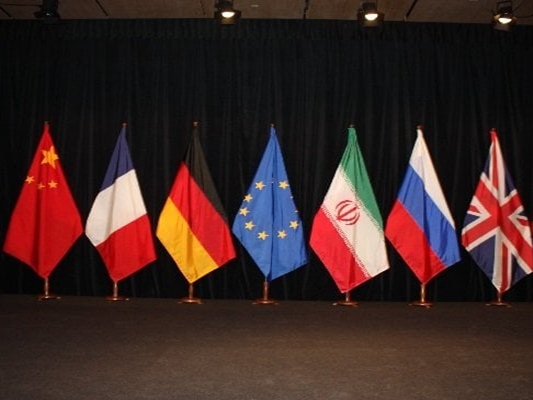
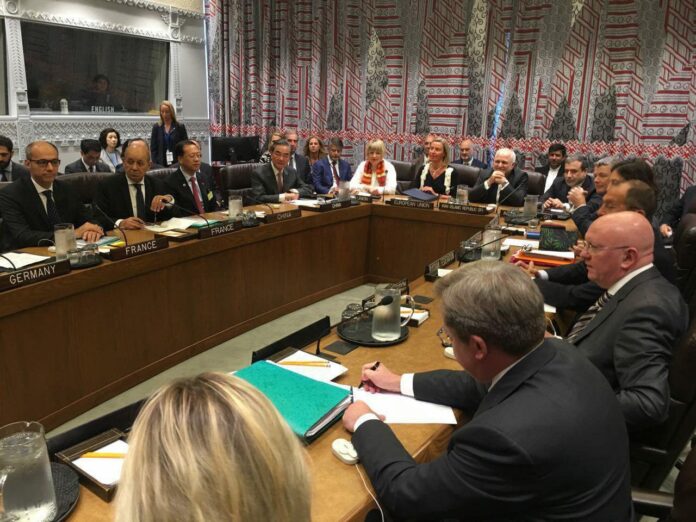
The meeting was chaired by EU Foreign Policy Chief Federica Mogherini and attended by the Foreign Ministers of China, France, Germany, Russia, by the Minister of State of the United Kingdom and the Foreign Minister of Iran.
In a joint statement issued after the talks, participants of the meeting underlined the importance of full compliance with the Joint Comprehensive Plan of Action (JCPOA) signed in 2015.
The full text of the joint statement is as in the following:
Implementation of the Joint Comprehensive Plan of Action: Joint Ministerial statement
1. A Ministerial meeting of the E3/EU+2 (China, France, Germany, the Russian Federation, the United Kingdom) and Iran, took place on 25 September 2019 in New York to discuss the implementation of the Joint Comprehensive Plan of Action (JCPOA). The meeting was chaired by EU High Representative Federica Mogherini, on behalf of the EU.
2. Participants recalled that the JCPOA, as endorsed by UN Security Council resolution 2231(2015), remains a key element of the global nuclear non-proliferation architecture and a significant achievement of multilateral diplomacy. They underlined the importance of the full and effective implementation of the JCPOA by all sides and confirmed their determination to continue all efforts to preserve the agreement, which is in the interests of all.
The meeting was chaired by EU Foreign Policy Chief Federica Mogherini and attended by the Foreign Ministers of China, France, Germany, Russia, by the Minister of State of the United Kingdom and the Foreign Minister of Iran.
Ministers discussed ways to ensure the full and effective implementation of the JCPOA in all its aspects, said Maja Kocijancic, the spokesperson for Foreign Affairs and Security Policy/European Neighbourhood Policy and Enlargement Negotiations.
Speaking after the meeting, Mogherini said all parties agreed to continue efforts to preserve the Iran deal.
Also in a joint statement issued after the talks, participants of the meeting underlined the importance of full compliance with the Joint Comprehensive Plan of Action (JCPOA) signed in 2015.
Before the talks, Zarif had told reporters that he was hopeful about diplomacy. “That’s the only way we have.”
“The conditions and issues we earlier raised are definitely still in place. Basically, the removal of sanctions and return to the terms of the deal are not conditions at all,” Ali Rabiei told reporters on Wednesday.
“What we say is that return to where you were. If they stop all the sanctions, and go back to the terms of the deal, then talks and dialogue would be possible,” he added.
“Even for building more trust and breaking the deadlock, the respected president has offered to make small changes to the JCPOA itself, so that the deadlock would be broken.”
“The president will make the offer there, but all of this hinges on their return to where they were. I once again emphasize: the sanctions are broken, stopped, and all parties return to the JCPOA,” he concluded.
Shortly after his speech, his office clarified that Iran’s ratification of the Additional Protocol as a small change to the JCPOA hinges on the US Congress’ ratification of the removal of all Iran sanctions and the nuclear deal.
Reuters on Tuesday quoted Rouhani as saying he is open to discuss small changes, additions or amendments to the 2015 nuclear deal between Tehran and six major powers if the United States lifted sanctions imposed on the Islamic Republic.
Later in the day, Parviz Esmaeili, the deputy chief of staff of the Iranian president, tweeted that what Reuters reported about Iran’s readiness for changes in the JCPOA was “not correct.”
“What is correct is (Iran’s) readiness to shorten the length of implementation of the JCPOA,” he tweeted.
Esmaeili explained that Iran was ready for the final stage of the JCPOA, namely the commitments planned for 2023, as already mentioned by Foreign Minister Mohammad Javad Zarif.
The presidential official noted that the ratification of the Additional Protocol by the Iranian Parliament could take place simultaneously with the ultimate lifting of sanctions by the US Congress, which would allow for negotiations within the framework of the Group 5+1 (Russia, China, the UK, France, Germany, and the US).
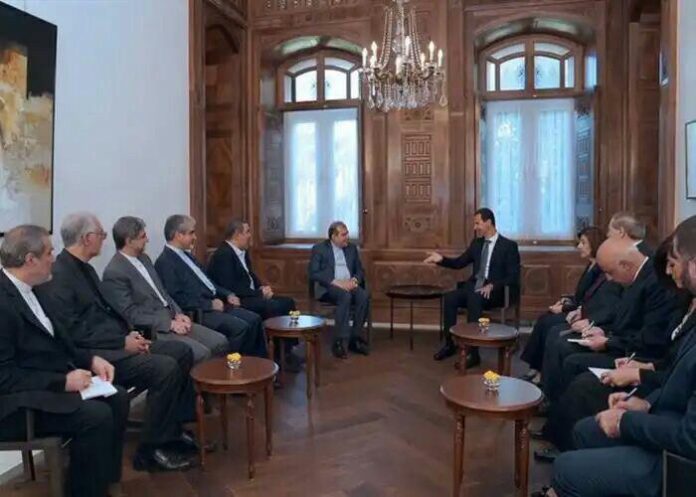
“The Constitutional Committee of Syria was formed despite all the problems created by the sponsors of terrorism, and that indicates our cooperation was successful,” he said.
He made the comments in a Tuesday meeting with Ali-Asghar Khaji, a senior assistant to Iran’s foreign minister in special political affairs, in Damascus.
In turn, Khaji highlighted the efforts made by the three guarantor states of the Astana Process – Iran, Turkey, and Russia – for the formation of the Syrian Constitutional Committee, and congratulated the Syrian nation and government on its finalization.
He presented explanations about the fifth meeting of the Iranian, Turkish, and Russian leaders in Ankara, and once again underlined the Islamic Republic of Iran’s resolve to help settle the Syria crisis through political solutions.
During his visit to Damascus, the Iranian diplomat also held talks with Syrian Foreign Minister Walid al-Muallem and some other high-ranking Syrian officials.
In the meetings, the Iranian and Syrian parties underlined the need for continued consultations between the two countries for full settlement of the Syria crisis.
UN Secretary-General Antonio Guterres on Monday announced the creation of Syria’s constitutional committee that could pave the way for a political solution to the country’s eight-year conflict.
Guterres told reporters that the committee, which includes representatives from the government and opposition, would convene in the coming weeks. “It will be facilitated by the United Nations in Geneva.”
The announcement came after a trilateral summit between the presidents of Iran, Russia, and Turkey, the three guarantor states of the Astana Process, in Ankara on September 16.
The Astana Process is an initiative launched in 2017 by the three countries to help settle the six-year crisis in Syria.
In his Wednesday statement, Mousavi expressed regret over the incident and offered the Islamic Republic of Iran’s condolences to the nation and government of Pakistan as well as the bereaved families of the natural incident’s victims.
He also wished divine mercy for the victims and patience and speedy recovery for those wounded in the earthquake.
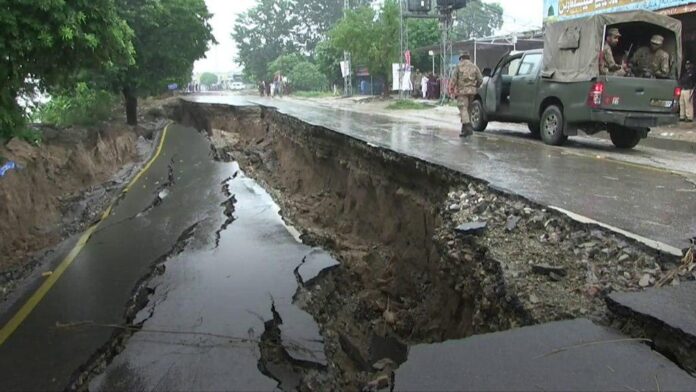
A 5.8 magnitude earthquake struck northeastern Pakistan, killing at least 19 people and injuring more than 300, local officials say.
The quake’s epicentre was close to the city of Mirpur, in Pakistan-administered Kashmir.
Photos circulating on social media show a huge crack on a main road in the area, and partially destroyed houses.
The full extent of the damage is not yet known. Thousands of people died in a powerful quake in the area in 2005.
“The quake was 10km (six miles) deep… the worst hit was Mirpur,” Pakistan’s chief meteorologist, Muhammad Riaz, told the AFP news agency.