Friday, January 2, 2026
Home Blog Page 3055

Turkey Walking on Tightrope Held by US and Russia

Seyyed Ali Qaem-Maqami says Russia and the US do not want to lose Turkey or move the country completely towards another trail.  

Qaem-Maqami has stated in an interview with Khabar Online that the clashes in northeast Syria have been decreased in recent days due to the fact that Syrian Kurdish forces have withdrawn from the region under the agreement between Russia and Turkey. 

“However, they are still looking for help from the Americans. They do not know what Washington agreed upon with Erdoğan behind closed doors. The US, as it seems, has preferred the Syrian oil to supporting the Kurds. Putin, meanwhile, has taken his share from Erdoğan. Meanwhile, the central government still is not allowed to enter these areas!”

Qaem-Maqami believes that in the current situation, Syria has actually disintegrated.

Q: Turkish officials have not announced whether they intend to strike again after the ceasefire. The latest news comes from the Turkish ambassador to Syria, who said that Ankara has no plans to launch a new offensive in northeast Syria. What does Erdoğan want in Syria in general, and what would be the result?

A: Turkish President Recep Tayyip Erdoğan has backed terrorist groups since the beginning of the terrorists’ war against the Ba’athist government in Syria. The Salafi Takfiri terrorist groups have now been renamed to “Syrian National Army” under the command of the Turkish army and intelligence. The Istanbul-based “National Coalition for Syrian Revolution and Opposition Forces” has announced Abdurrahman Mustafa as the Prime Minister of interim government of Syria. The Syrian National Army or Jaish al-Watani is also considered as the interim government’s army.

Erdoğan considers Syrian President Bashar al-Assad and the Syrian Armed Forces illegitimate. He is trying to occupy all the areas of northern Syria and leave their control to Jaish al-Watani to prevent the Syrian Armed Forces from entering these areas. He would then relocate about two million Syrian refugees residing in Turkey to the region. 

Erdoğan has even threatened to confront the Syrian Armed Forces if they enter northern Syria, including the east of Euphrates, especially Afrin, Idlib and Jarabulus. Erdoğan also said that Manbij and Ayn al-Arab should be under the control of the Turkish army and Jaish al-Watani.

Based on the 13-point agreement with the US, Turkey launched Operation Peace Spring and entered the area between Tal Abyad and Ras al-Ain at a depth of 32 kilometres and a length of 120 kilometres. Turkey fought with the Syrian Democratic Forces and the People’s Defense Units affiliated with the “Kurdistan Communities Union under Abdullah Ocalan” using US intelligence, military and weapons supports.

About 800 people from the Syrian Democratic Forces and the People’s Defense Units are said to be killed. According to Erdoğan, more than thirty civilians and Turkish nationals and 130 Syrian nationals of Jaish al-Watani were killed in Operation Peace Spring. According to the agreement between Turkey and the US, the Syrian Democratic Forces were supposed to withdraw from the M-4 highway near the Operation Springs area.

Meanwhile, the United States has announced that the forces have withdrawn from the M-4 highway. However, the Turkish Foreign and Defense Ministry insisted that the claim must be confirmed by the Turkish military and intelligence, and if the forces of the People’s Defense Units are seen beyond the highways, the Turkish army will destroy them. One of the sections of the US-Turkey agreement was that the US must not announce new sanctions against Turkey during the ceasefire in the area of Operation Peace Spring, and remove the previous sanctions after the withdrawal of Turkish forces and ending the operation. However, the US Congress approved two bills of recognising “Armenian genocide” and “new sanctions against Turkey.”

Q: What was the agreement between Erdoğan and Putin? Has the president of Turkey been able to keep Putin agreed with the continuation of the operation?

A: Turkish President Recep Tayyip Erdoğan and his Russian counterpart Vladimir Putin signed a 10-point agreement in Sochi. According to the agreement, the Syrian Democratic Forces and People’s Defense Units based in the areas between Tal Abyad and Jarabulus in the west of the Operational Area of Peace Spring must withdraw. They must also withdraw from Ras al-Ain to the Iraqi borders in the east of the Operational Area of Peace Spring in a depth of 32 kilometres. Russia also announced that 34,000 troops of the People’s Defense Units with three thousand heavy weapons had withdrawn below the safe zone line.

Erdoğan has said that Turkey should control 444 km of eastern Euphrates, but the United States and Russia are blocking the Turkish army and Jaish al-Watani militia from entering the area.

The withdrawal of the Syrian Democratic Forces and People’s Defense Units below the 32-km depth line has brought the eastern Syrian areas under the control of the Syrian Democratic Forces that are affiliated with the US army.

The areas of the eastern Euphrates have rich sources of mines, oil and gas, water and dams, agriculture and animal husbandry. The United States and Turkey are working together to deprive the Syrian government and army of these economic and energy resources.

Erdoğan claims he is not eyeing Syrian lands, but his practical policy proves the contrary. Erdoğan and Mevlüt Çavuşoğlu claim the Turkish military has the right to enter Syria on the basis of the Adana Agreement on Combating Terrorism, and is entitled to defend itself and preserve the survival of the Turkish government. However, he has also threatened to back Jaish al-Watani’s battle with the Syrian Armed Forces under Bashar al-Assad’s command.

However, we see that despite Erdoğan’s threats, a new Syrian constitution committee was formed. The committee brought together representatives of Syrian opposition groups under the protection of Turkey, representatives of Bashar al-Assad’s government under the auspices of the Islamic Republic of Iran and Russia, as well as representatives of the Syrian people groups sponsored by the United Nations.

Q: Considering the Putin-Erdoğan agreement, what is going on between the US and Russia? And what is the danger for Iran in particular?

A: The United States directly and Russia indirectly have protected Syrian Democratic Forces and People’s Defense Units. The 10-point agreement between Turkey and Russia has allowed part of the Syrian Arab Armed Forces under the command of Bashar al-Assad to enter the areas of Manbij, Ayn al-Arab, Hasakah, Qamishli, Cizre and Kamaliyah. As a result, Erdoğan’s plan to occupy northeast Euphrates has failed.

The US will remain in Syria to maintain the security and illegitimate aggressive interests of the racist Israeli regime. The US goal is to disrupt or threaten the process of establishing and expanding Iran-Iraq relations with Syria. The United States will occupy areas of western Iraq and eastern Syria. As Donald Trump, Centcom and the Pentagon claim, they will prevent the killing of Kurds and will not allow the security of Syria and Iraq’s oil and energy resources to be compromised. 

Recep Tayyip Erdoğan is pursuing a policy of balancing power between the United States and Russia in Syria and moving on a path that is controlled by Washington and Moscow. This political expert also believes that Russia and the US do not want to lose Turkey or move the country completely towards another path.  In the current situation, Syria has actually disintegrated.

Q: In your opinion, why does Erdoğan pursue this policy? Has he become politically motivated at home or has the coup time removals had a negative impact on his image?

A: Recep Tayyip Erdoğan has removed all the leadership and founders of the AKP. There is intense conflict within the party. A number of AKP leaders and MPs have been ousted or forced to resign at the behest of Erdoğan.

Dissatisfaction with the presidential system has increased. The AKP’s internal opposition insists that individual dominion has been created and that the AKP has distanced from its principles. The rent and nepotism is established in the Turkish parties and government. At least half of Turkey’s political and social community wants a return to a democratic parliamentary government. Erdogan’s presidency has packed down and disenfranchised parliament and the judiciary.

According to opposition parties, particularly the National Salvation Party run by the late Necmettin Erbakan, Erdogan’s policy towards Syria has resulted in the destruction and killing of the Syrian people and has served the interests of Zionist. Erdoğan sees his position is being weakened in domestic politics. Therefore, he is trying to silence and control all dissidents through outbound operations and incite a sense of nationalism and militarism. This as the opposition parties in Turkish parliament have been forced to extend Turkish military overseas operations license in Iraq and Syria for another year on October 31. Otherwise, Erdoğan would accuse them of being traitor and supporters of terrorism.

Recep Tayyip Erdoğan claims he is fighting infidels in Syria, but the US and NATO are Turkey’s strategic allies in this fight. 

Q: Given Erdoğan’s position inside Turkey, is it in his interest to continue this role? What role does Turkey exactly play in the Middle East?

A: Erdoğan considers Syrian President Bashar al-Assad and the Syrian Armed Forces under Assad illegitimate. Following the US occupation of Iraq in 2003, new political and strategic developments in the Middle East began, and the regional countries of the two blocs got involved in fierce confrontation and intense competition. On one hand, there was an anti-Zionist resistance front consisted of Iran, Syria, Lebanon’s Hezbollah, the Palestinian people, Hamas and the Palestinian Islamic Jihad movement. On the other hand, the Zionist anti-resistance front consisted of the United States, Britain, Israel and the reactionary regimes of the Persian Gulf was organised and got united.

Syria has signed a strategic partnership agreement with Iran and Russia to save itself from isolation. Iran turned into Syria’s biggest political and economic patron. That’s because Iran, Syria, Palestine and Hamas were and are still facing dangerous enemies and occupiers such as the US and Israel. The United States has tried to divide the Muslim and Arab world into two blocks, the “Shiite Crescent” and the “Sunni Axis”, and to portray the so-called Iranian-led Shiite Crescent as a threat to the Sunni and Arab world.

The United States and the Israeli regime mobilised the regimes of Al Saud, the United Arab Emirates, Qatar, Turkey and Egypt. One of the goals of the imperialist and Zionist axis was to occupy, destroy, and dismantle Syria as the link between the anti-Zionist resistance movements. This role was assigned to the AKP led by Recep Tayyip Erdoğan. 

Turkish government must cooperate sincerely with anti-Zionist resistance and assist the front to expel the US from Syria. It must cooperate with the government of Bashar al-Assad and the Syrian Armed Forces, and withdraw from Syria and hand over the entire Syrian state to the Syrian government and army. Otherwise, the claim to support the territorial integrity and political and national unity of Syria is meaningless.

Iran Unveils Four Domestically-Made Probiotic Products

One of these probiotic products is made with domestised technical knowledge in order to prevent gastric ulcer. It is also used in prolonged prevention and reduction of Helicobacter pylori in Iran.

It is being used in more than 38 countries, and the export of each kilogram of this product will bring over 1,500 euros to the country. The product has been funded by the Iran Biotech Fund.

“Lactogem” is another product that is developed to inhibit tooth decay bacteria and prevent gum inflammation.

The company has also presented two daily basic probiotics for the elderly as well as teens and adults.

This knowledge-based company has introduced 40 products to the market, all of which are made using native technology for the first time in the country.

Probiotics, dietary supplements and nutritional supplements are among the company’s most important knowledge-based achievements.

Iran Condemns Attack on Its Consulate in Iraq’s Karbala

He said the Islamic Republic of Iran has expressed concern over the issue and emphasised the necessity of maintaining the security of Iran’s diplomatic and consular sites within the framework of international regulations and conventions to the Iraqi government.

“Tehran has also called for necessary measures and increased arrangements to protect our country’s diplomatic sites in Iraq,” added Mousavi on Tuesday.

On Monday, Iran’s foreign ministry announced that the diplomatic missions are the government’s red line. On Sunday night, a group of protesters attacked Iran’s consulate in the holy city of Karbala with stones and burned tires around the building.

Security forces reached the area afterwards and dispersed the crowd. Reports say four people were killed in the unrest.

The recent anti-government demonstrations in Iraq soon turned into acts of violence and vandalism.

Iraqi authorities blame remnants of the former Ba’ath regime and other infiltrators for committing such actions across the country.

President Inaugurates Innovation Factory in Iran

President Rouhani formally inaugurated the Azadi Innovation Factory in western Tehran on Tuesday.
In a speech at the event, the president praised the knowledge-based companies for creating 300,000 jobs in Iran.

“The knowledge-based companies generate science, income, power, welfare and dignity,” he noted, calling for closer links between the investors and the start-ups.

President Rouhani also extolled the benefits of the innovation factory, saying it provides opportunities for the start-ups and young innovators to work together with the help of accelerators and get rid of bureaucracies.

Known as the first branch of the Pardis Technology Park, the innovation factory covers an area of 18,500 square meters and provides employment for 3,500 university graduates and young entrepreneurs.

The Azadi Innovation Factory includes 10 separate sections and a central building providing opportunities for Iranian start-ups in a broad range of fields, such as tourism, architecture and urban life, nanopharmaceuticals, artificial intelligence, biotechnology, insurance and financial innovations, content creation, and cyber security.

The factory has been set up to facilitate entrepreneurial teams’ access to the necessary infrastructure and facilities, create synergy among the start-ups, and encourage innovation and creativity in a dynamic atmosphere.

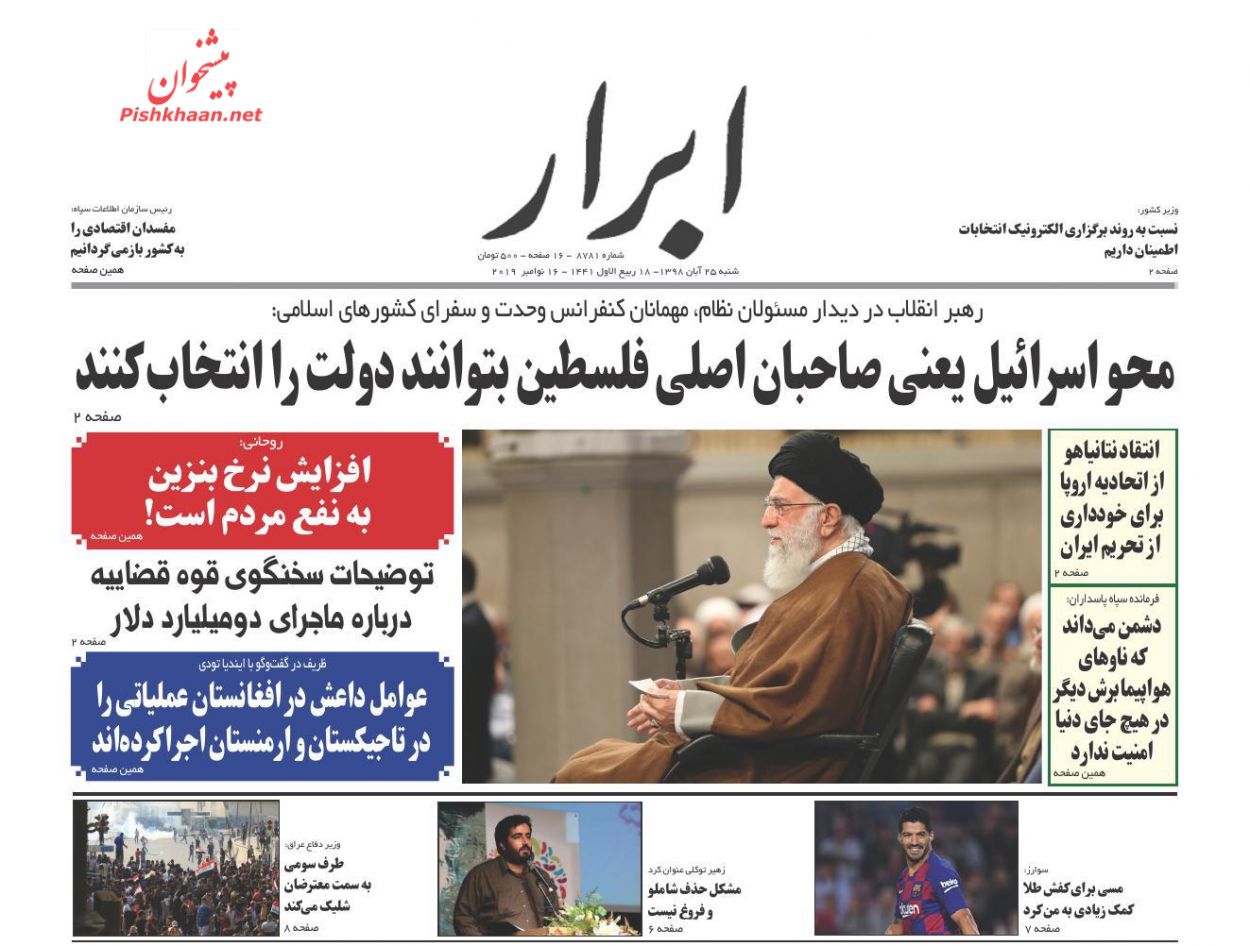
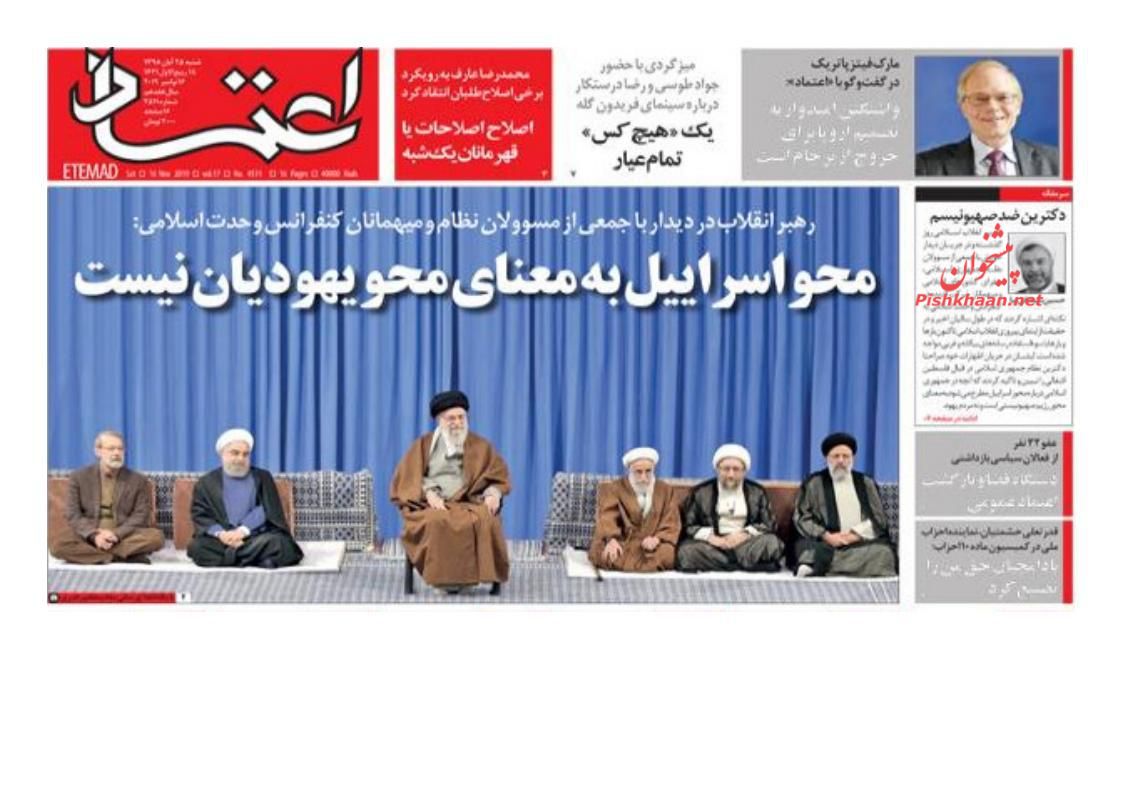
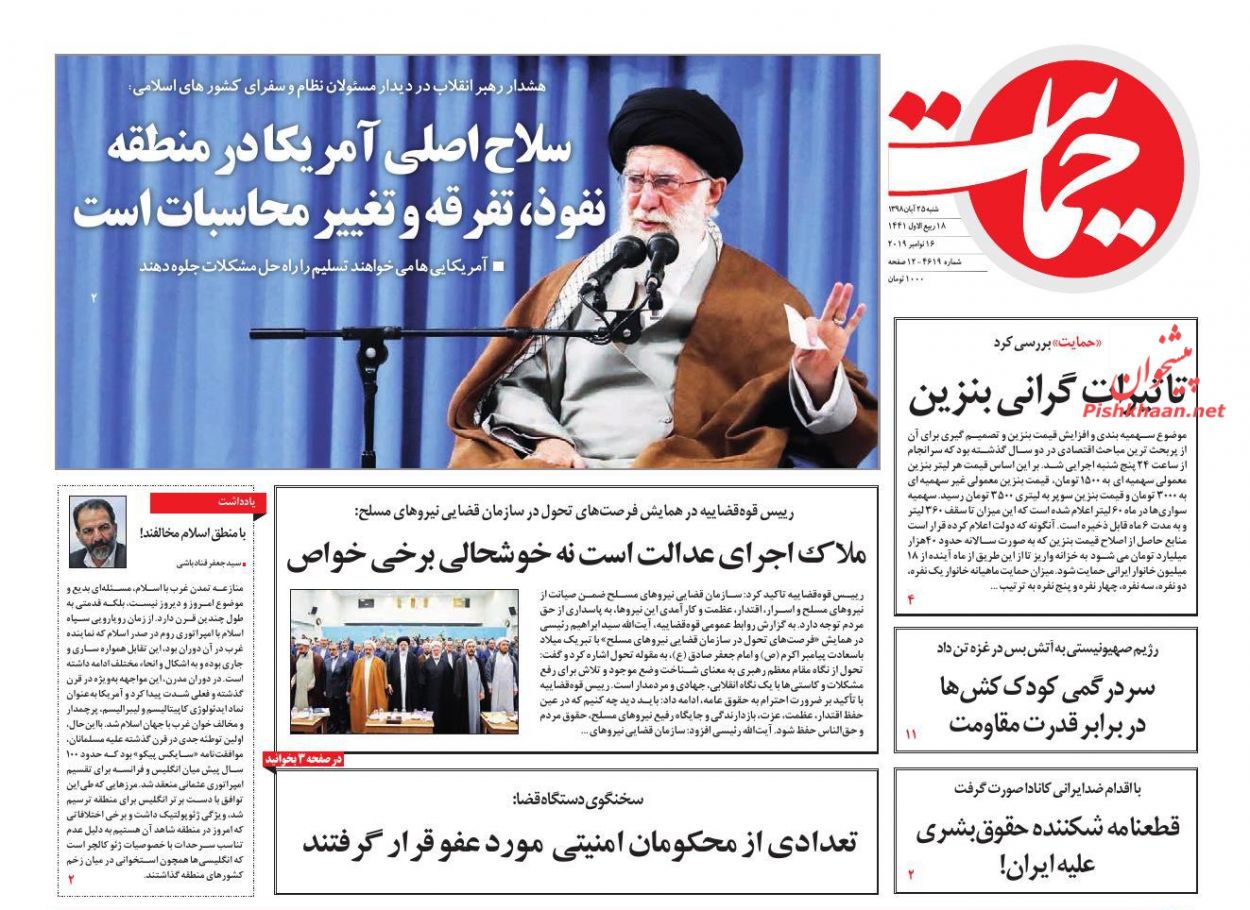
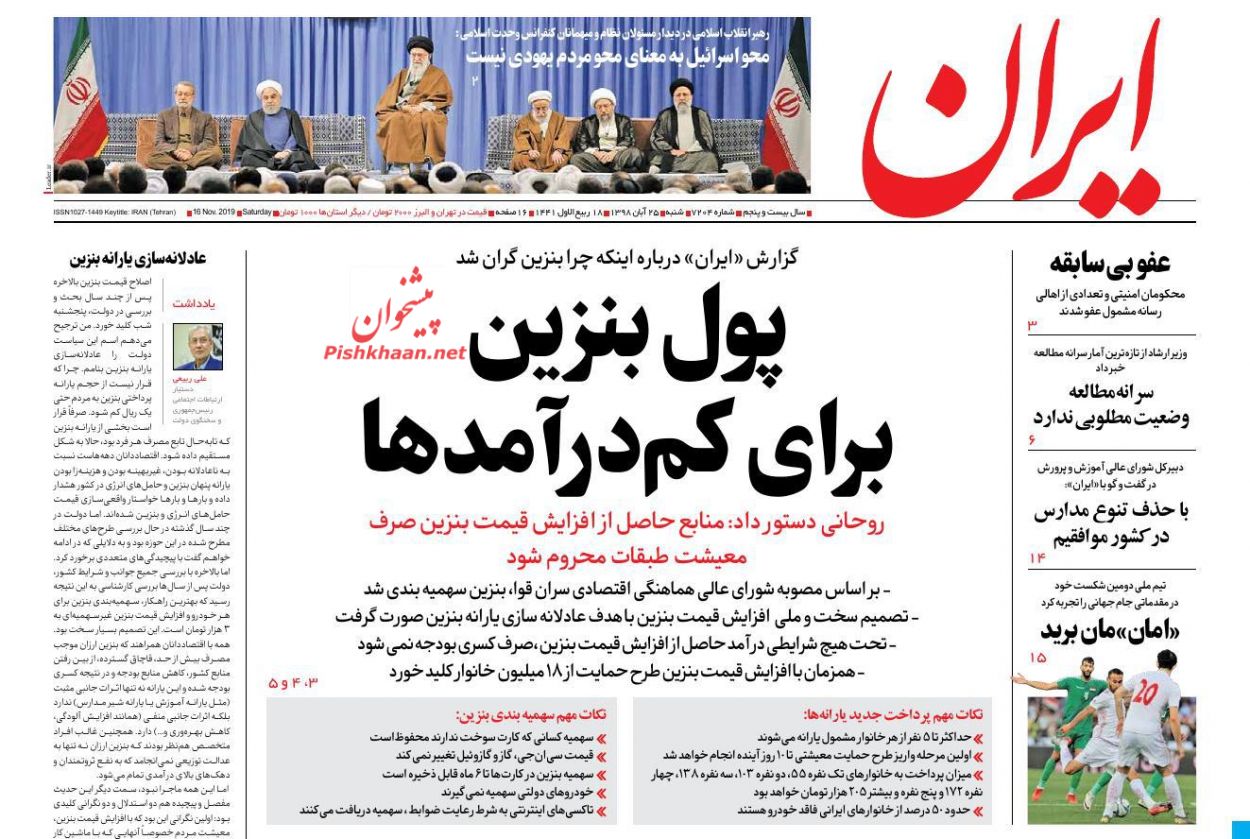
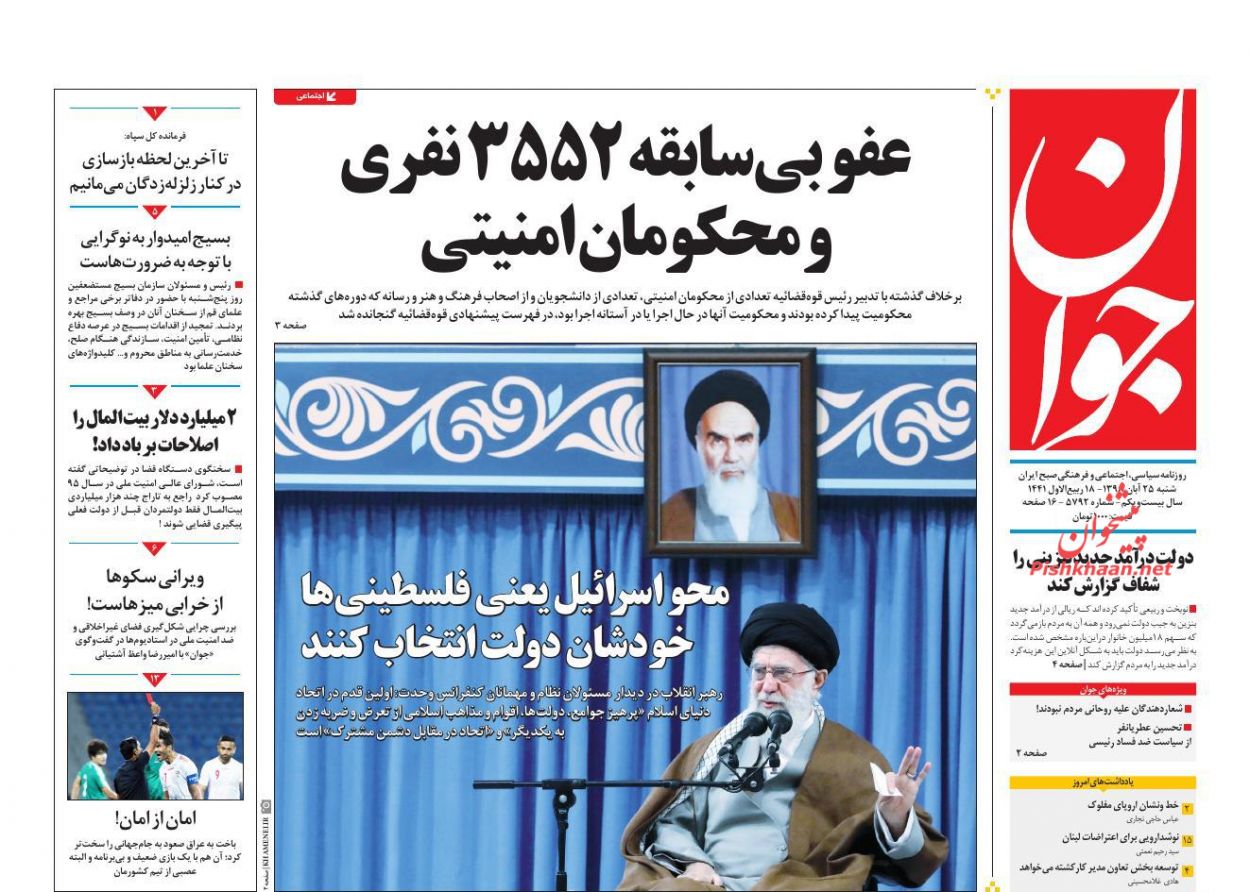
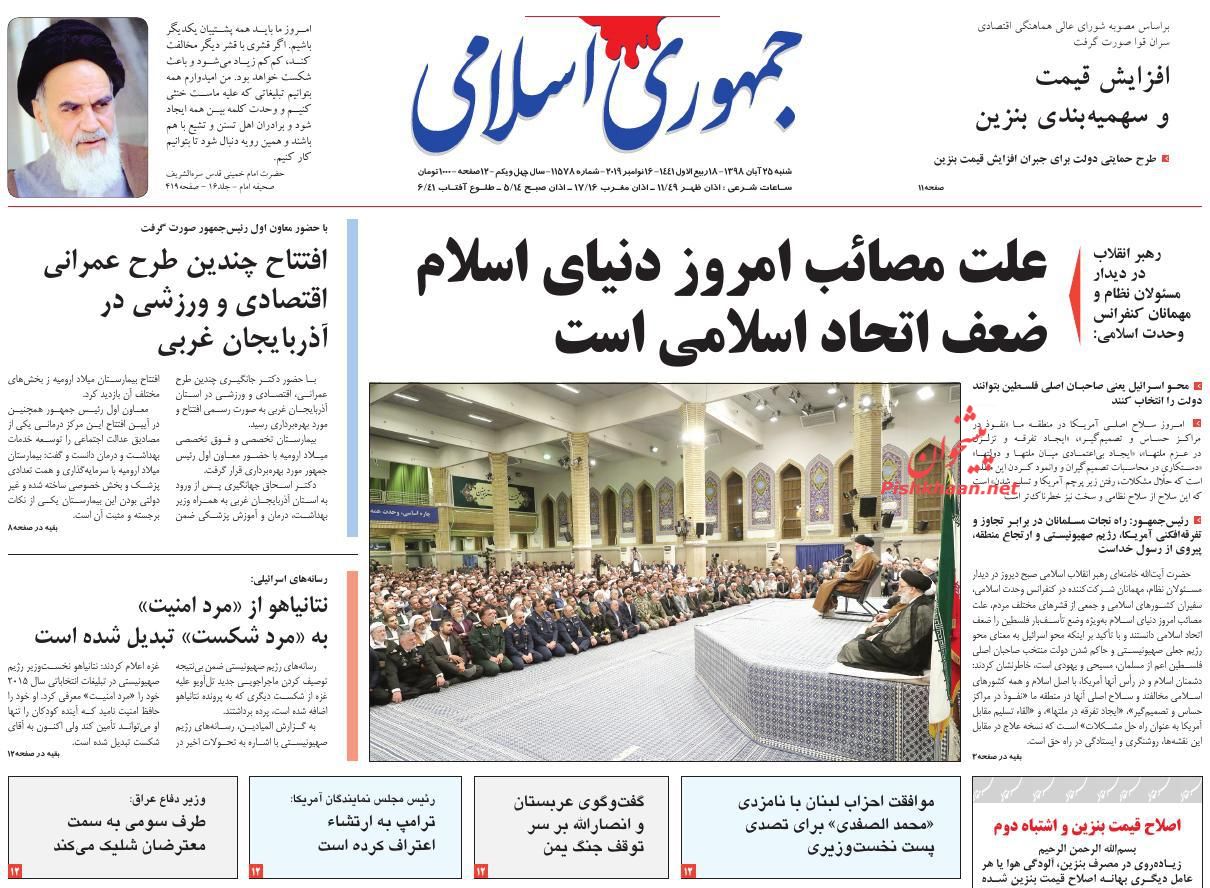
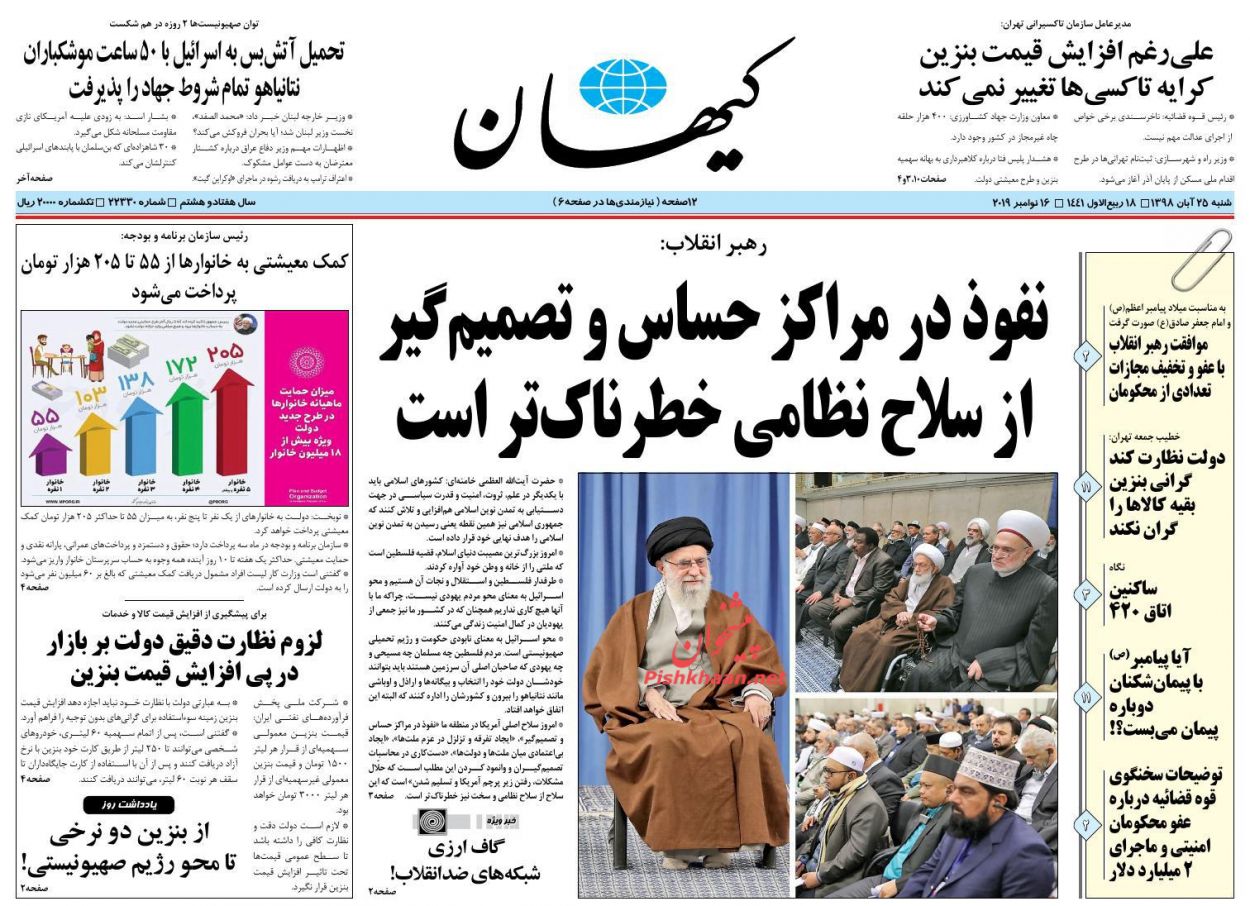
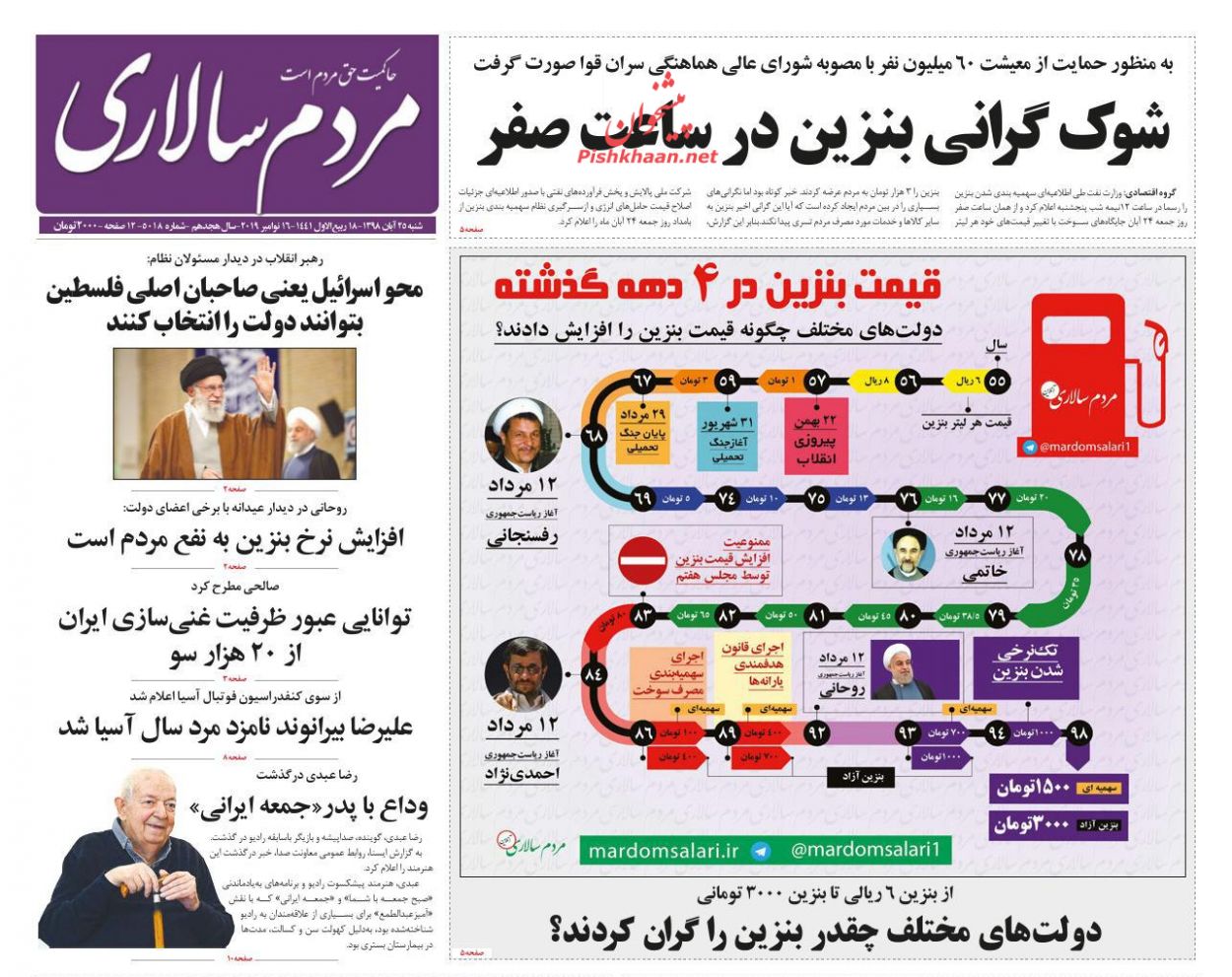
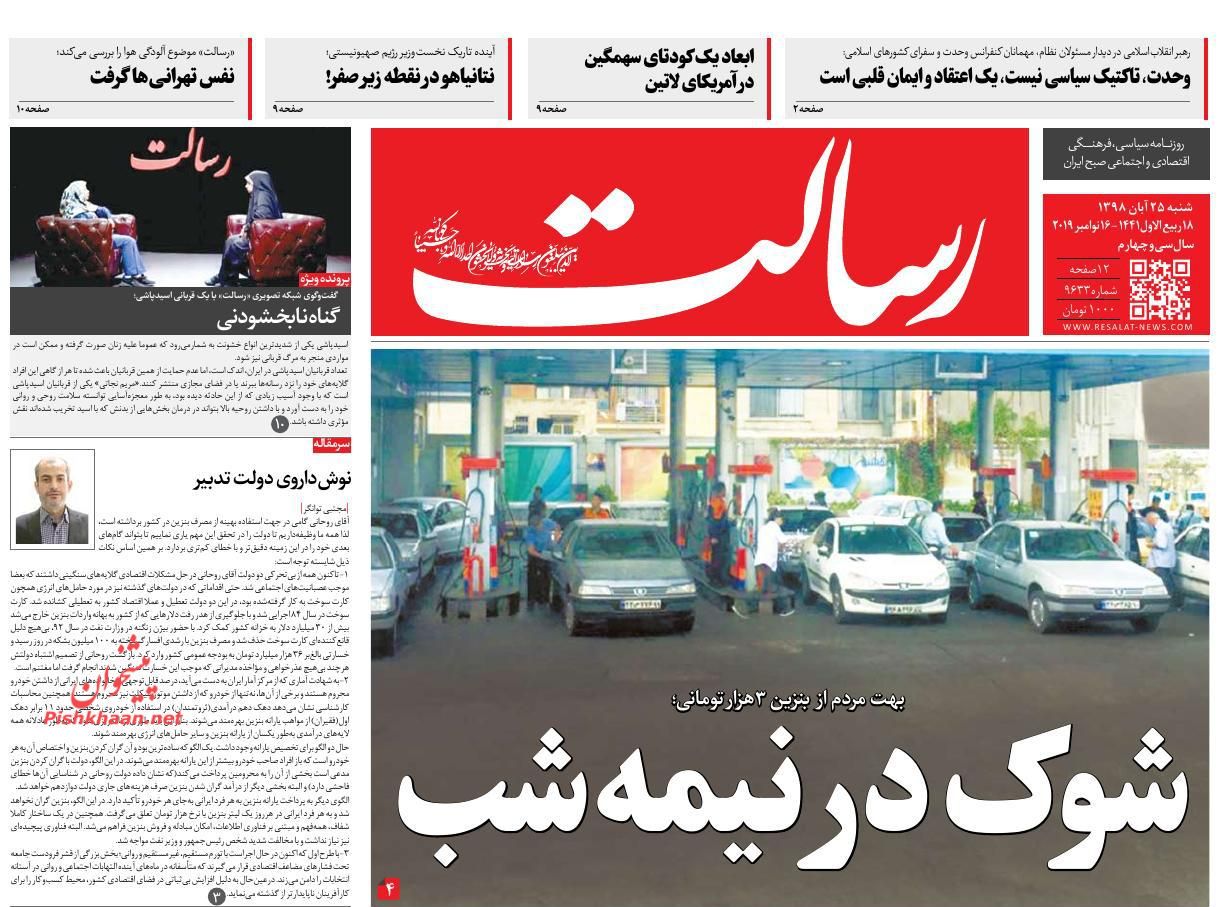
A Look at Iranian Newspaper Front Pages on November 5

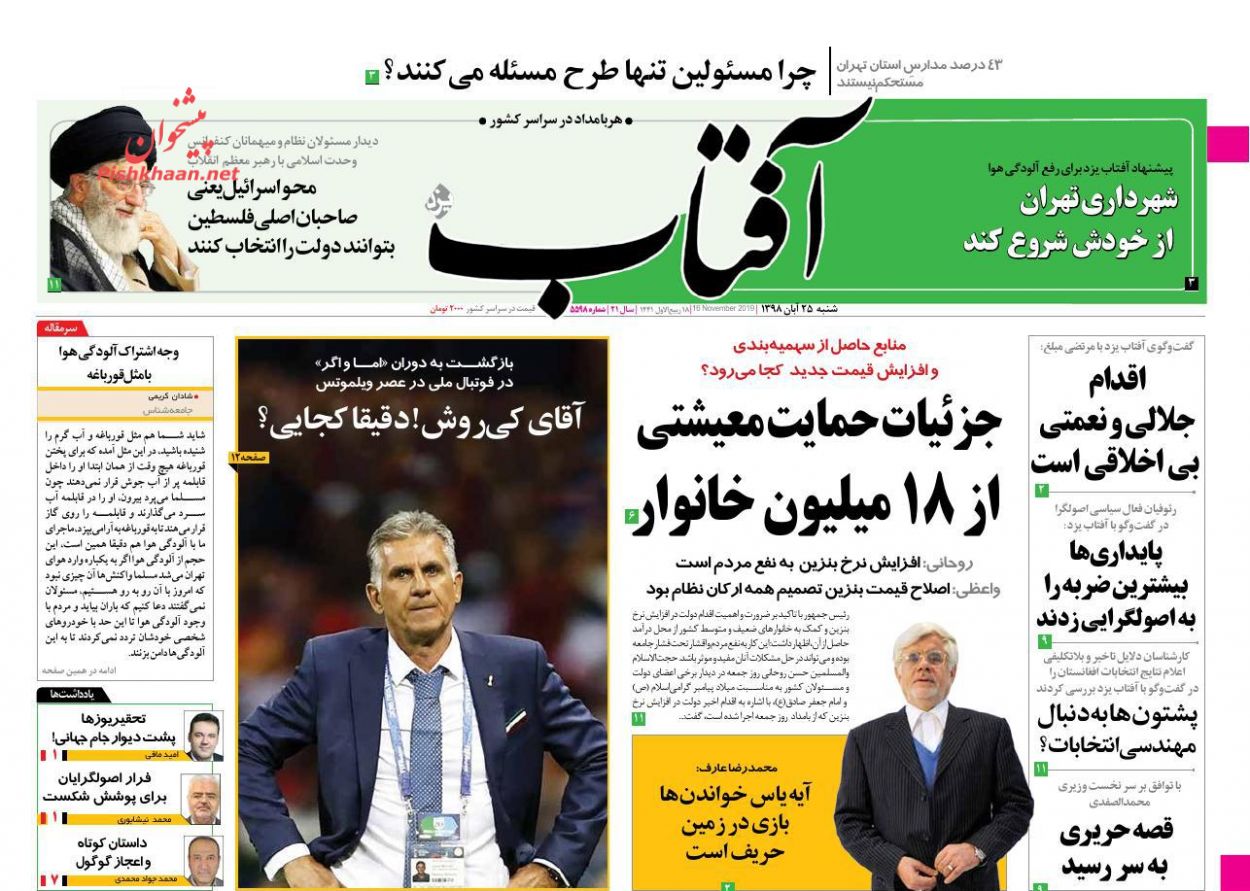
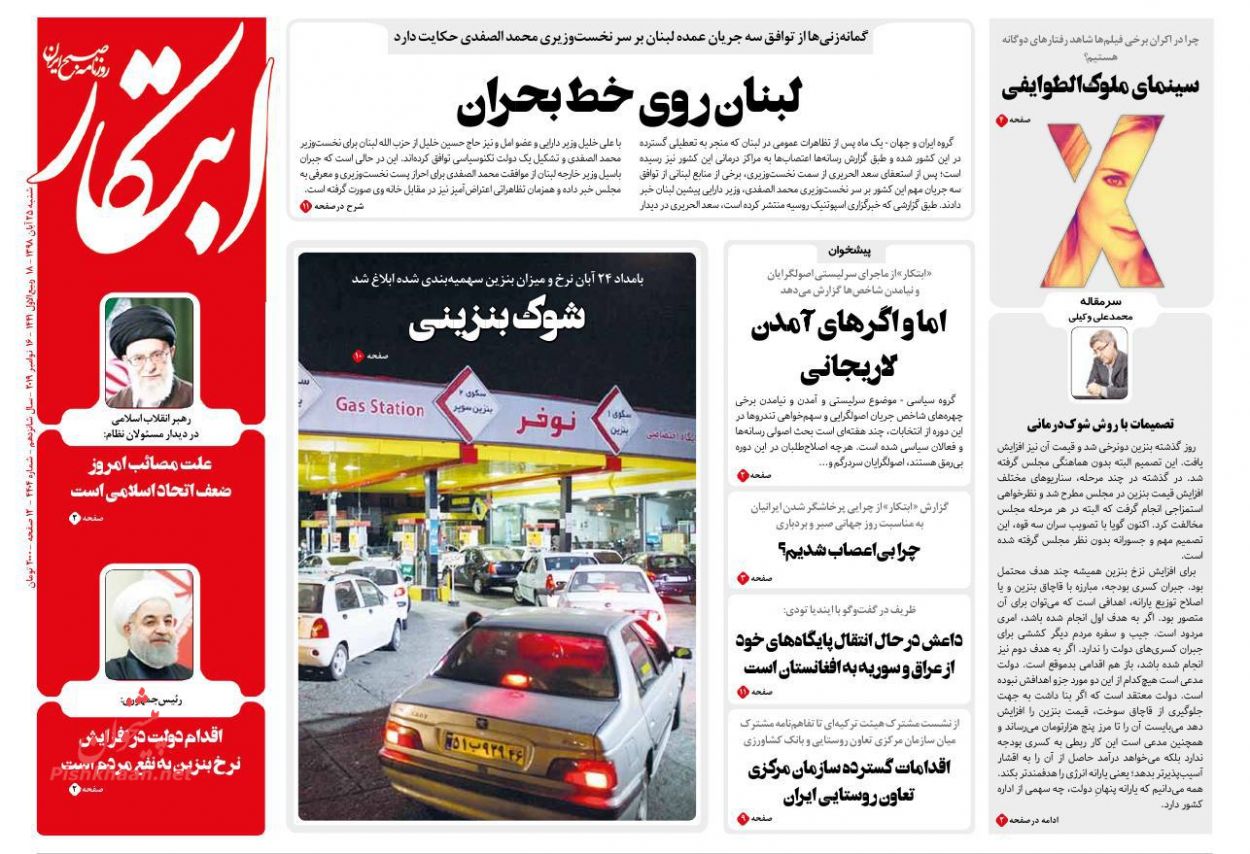
A Look at Iranian Newspaper Front Pages on November 19

Aftab-e Yazd:
1- Unclear Fate of Iran’s Adoption of FATF Standards
* Official: Neither Rejecting It, Nor Accepting It Is in Iran’s Interest

A Look at Iranian Newspaper Front Pages on November 5


Donya-ye Eqtesad:
1- Trump’s Hollow Dream for US Dollar
* US Monetary Changes Not Favourable to President

A Look at Iranian Newspaper Front Pages on November 5


Ebtekar:
1- Iran Starts Injecting Gas into Advanced IR-6 Centrifuges

A Look at Iranian Newspaper Front Pages on November 5


Etemad:
1- Look What We Were Before JCPOA and What We Are Now: Nuclear Chief
2- Gov’t Seeking Peace, Stability in Region
* Spokesman in Reaction to Rouhani’s Letters to Saudi, Bahraini Kings

A Look at Iranian Newspaper Front Pages on November 5


Ettela’at:
1- Iraq Protests Climax as US, Israel Support Protesters

A Look at Iranian Newspaper Front Pages on November 5


Hemayat:
1- World Without US: People Said NO to Talks with US in Massive Rallies
2- US Plot to Disintegrate Iraq

A Look at Iranian Newspaper Front Pages on November 5


Iran:
1- Rouhani’s Message to Saudi King
2- IR-6 Centrifuges Launched in Natanz
3- Iranians Attend Anti-US Rallies Across Country

A Look at Iranian Newspaper Front Pages on November 5


Jame Jam:
1- Four Minutes Until 20% Enrichment
2- 24-Year-Old Iranian vs Boris Johnson
* Ali Milani Rival of Incumbent UK PM

A Look at Iranian Newspaper Front Pages on November 5


Javan:
1- Fourth Generation of Fighting Arrogance
2- Trump’s Brouhaha to Escape Impeachment
3- Attack on Aramco Costs Saudi 500 Billion Pounds

A Look at Iranian Newspaper Front Pages on November 5


Jomhouri Eslami:
1- Government Spokesman: Details of Reducing JCPOA Commitments to Be Released in Due Time
2- Trump’s Rival in US Elections: He’s Oil Thief

A Look at Iranian Newspaper Front Pages on November 5


Kayhan:
1- Nov. 4 Epic More Glorious than Ever Across Iran
2- Fourth Phase of Reducing JCPOA Commitments: Will It Be Trivial or Deterrent?

A Look at Iranian Newspaper Front Pages on November 5


Rooyesh-e Mellat:
1- Army Chief: Kneeling Down Before Enemies Has Had No Achievement for People
2- Iran’s Military Advice Resulted in US Defeat in Syria: Top Aide to Leader

A Look at Iranian Newspaper Front Pages on November 5


Tejarat:
1- Oil Minister: Sale of Oil Products in Stock Exchange Market Successful
2- Revolutionary People Roar by Saying No to Negotiation

A Look at Iranian Newspaper Front Pages on November 5

Where Is the World’s Hottest Place?

Hottest Place in the World

The hottest place in the world is somewhere in the middle of Iran. It is actually in the center of Lut Desert.

According to data from NASA’s satellite, the Lut Desert is home to the hottest recorded spot on the earth’s surface.

However, there are some doubts about this idea, so let’s take a deeper look into this matter.

Where Is the World's Hottest Place?The Lut Desert

The “desert” is a large salt desert. Lut is actually the world’s 27th-largest desert with an area of 51,800 square kilometers (20,000 square miles). In Farsi ‘Lut’ literally means bare land without water and devoid of vegetation.

Lut desert is situated in the south-east of the country. The eastern part of the desert displays a low plateau covered with salt flats, while the center displays a series of parallel ridges and furrows. Strong winds sweep this arid area From June to October.

The main attraction areas of Lut desert, include Gandom Berian, Shahdad Kalut, and Rig Yellen. In addition, the desert is home to diverse animal life, including insects, reptiles, and desert foxes.

Iran UNESCO’s World Heritage List inscribed the Lut Desert in 2016.

If you are planning to travel to Iran and would like to book your Iran Tour Packages in advance or submit your Iran Visa application through an Iranian travel agency, feel free to contact us at your convenience.

Where Is the World's Hottest Place?Where was the previous hottest spot in the world?

In 1913, scientists in Death Valley, California measured a temperature of 134°F (56.7°C) and declared it the hottest temperature ever recorded. In 1922, a weather station in Libya recorded a temperature of 136.4°F (58.0°C).

The World Meteorological Organization (WMO) recognized this observation as the hottest temperature recorded on Earth for some time.

However, according to another research by the University of Montana, using data from the U.S. Geological Survey’s Landsat satellites, neither is the world’s hottest place.

In a statement by NASA from a team member, “Most of the places that call themselves the hottest on Earth are not even serious contenders”.

Is Lut Desert actually home to the world’s hottest place?

To find a proper answer to this question, we have to look at the scientific evidence.

Running and his colleagues examined infrared data from the Landsat satellites during seven years. They found that the winner in five of those years — 2004, 2005, 2006, 2007 and 2009 — was actually the Lut Desert in Iran.

A temperature of 159.3°F (70.7°C) was measured in 2005- the highest temperature ever officially confirmed for a location on Earth.

However, the Lut Desert did not encounter the highest temperature every year.

So why didn’t the Lut Desert previously named as the world hottest spot? Because “the Earth’s hot deserts — such as the Sahara desert, the Gobi, the Sonoran, and the Lut — are climatically harsh and so remote that access for routine measurements and maintenance of a weather station is impractical,” said team member David Mildrexler.

Queensland, Australia had the highest temperature in 2003, with the record of 156.7°F (69.3°C), and in 2008, Turpan Basin in China had the highest temperature on the earth with the temperature of 152.2°F (66.8°C).

It is worth knowing that the Turpan Basin is covered with dark red sandstone that heats up the extreme temperature, especially in the afternoon sun.

A number of factors influence the land surface temperature (LST). For instance: changes in solar radiation, changes in land cover and changes in atmospheric conditions. Therefore, dry, rocky and dark-colored lands absorb heat well, while lighter sand will tend to reflect more sunlight.

However, some scientists argue that the “hottest place” on the earth should be framed in terms of land temperature, not air temperature.

And years of analysis have revealed that parts of Iran and Australia are particularly hot from an LST perspective.

Where Is the World's Hottest Place?What is the best time to travel to the deserts of Iran?

Have you ever imagined yourself trekking, or walking in a silent desert? Do you enjoy watching the stars at night without annoying city lights? Do you want to visit the world’s hottest spot?

If your answer is yes, maybe you want to visit Lut Desert. If you would like to visit deserts of Iran, especially the Lut Desert, and step on the golden sands of this amazing place with breathtaking nature, it’s the time!

From October, till the end of February, it is the best time to visit the deserts of Iran.

We have a piece of good news for you! If you would like to travel to Iran since the first of December, till the end of February, you will get a 20% discount on all of our Iran tour packages.

Don’t miss this opportunity and your chance of visiting Iran with this amazing offer.

Iran Bans Cooperation with British Council

The ministry’s Public Relations Office said Tuesday that “the UK — which has a long history of infiltration, creating networks and generating propaganda in various countries — was planning to implement a project for cultural networking purposes” in cahoots with the British Council in Iran.

With timely action, it said, the country’s intelligence forces prevented Britain from “implementing [the project] and achieving its goal” of infiltrating into Iran’s educational sphere.

The British Council describes itself as the United Kingdom’s “international organization for cultural relations and educational opportunities.”

But to many in the international community, the British Council is merely viewed as a tool of British foreign policy.

According to its website, the British Council is not “physically present” in Iran, but one of its employees has been convicted and jailed in Iran for espionage.

It has long been suspected that British Council facilities and programs abroad are used as talent spotting and recruitment tools for the Secret Intelligence Service, better known as MI6.

The British Council’s roots can be traced roots to the “British Committee for Relations with Other Countries,” which was formed in 1934.

This foundational role has only intensified in recent years as the Council has established deep roots in over 100 countries, where it ostensibly undertakes a wide range of “cultural” and “educational” activities.

Founded as a charity governed by Royal Charter, the British Council is extensively supported by the Foreign and Commonwealth Office (FCO), a connection that it has never tried to hide.

The Council admits that 15 percent of its budget is provided by the FCO, whilst 85 percent of its turnover comes from “teaching,” “exams,” “tendered contracts” and “partnerships.”

Due to the nature of its work, and specifically its proximity to the FCO and by extension to MI6, the British Council has run into difficulties with host governments.

The most publicized case of the Council’s troubles was in Russia where it was ordered to close down its offices in December 2007.

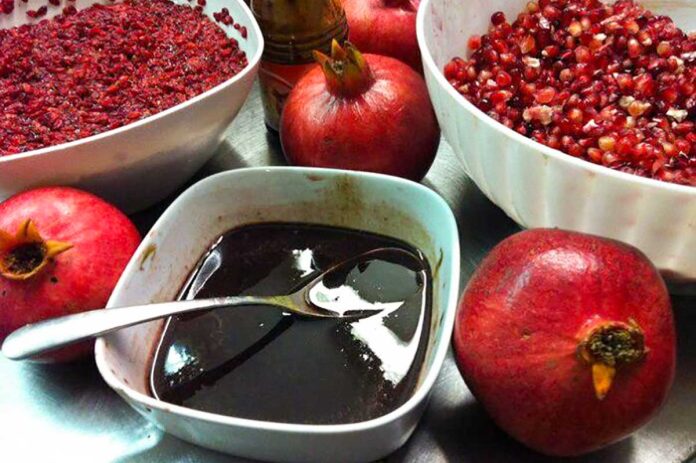
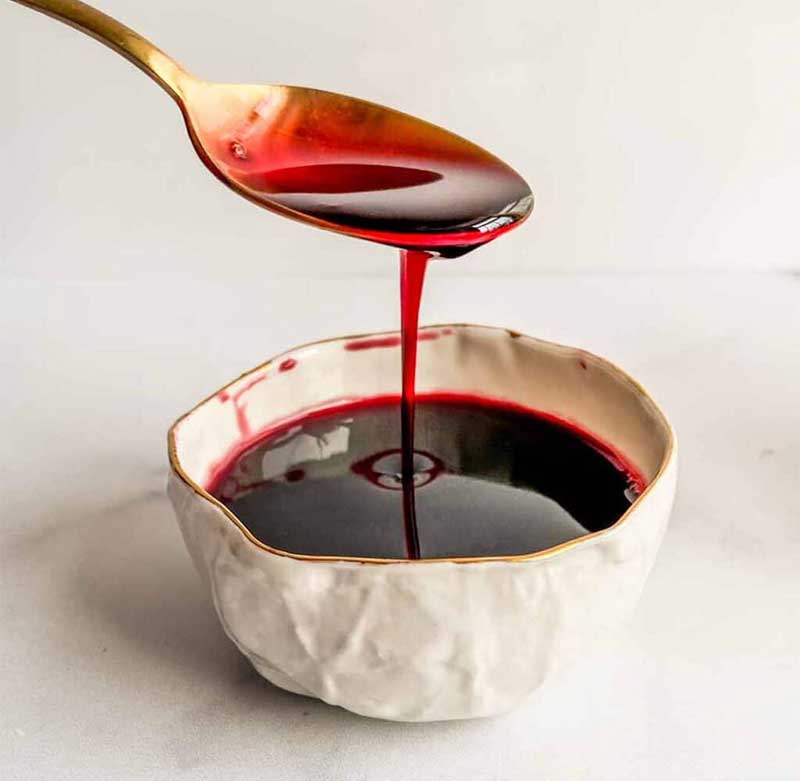
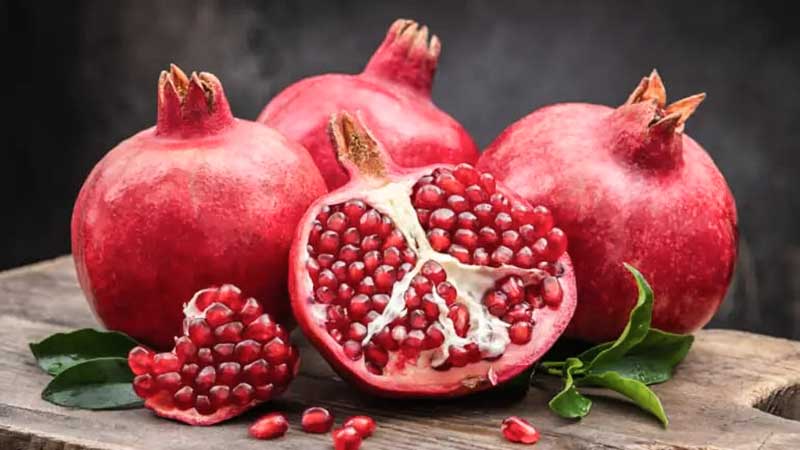
Farmers in Shahreza Start Harvesting Pomegranate

Over 19,000 tonnes of pomegranate are annually produced in the town of Shahreza, which bring the locals some $5 million in revenues.

What follows are photos of the harvest retrieved from the Young Journalists Club (YJC):

Iranian Delegate Attending China Imports Exhibit in Shanghai

Iranian Delegate Attending China Imports Exhibit in Shanghai

The event opened on November 5, 2019, with a speech by Chinese President Xi Jinping. The ceremony was also attended by Iranian Minister of Industry, Mine and Trade Reza Rahmani, who heads the Iranian delegation at the exhibit.

The event brings together delegations and companies from 150 countries, which are displaying their products at the exhibition.

The international exhibit has three sections, namely countries, companies and the Hongqiao International Economic Forum. A total of 64 countries as well as three international organizations have taken part in the exhibitions section in order to put on show their achievements in the field of trade and investment.

Over three thousand companies from 150 countries are also attending the company section. The exhibitors are displaying items such as state-of-the-art day-to-day appliances, automobiles, equipment, medical devices, medicines, agricultural produce, etc.

The more than 250 firms taking part in the exhibition are either among the top 500 companies in the world or among the best companies in their own business.

China is projected to import $30 trillion worth of goods and $10 trillion worth of services in the coming 15 years.

How Can Iranian Businesses Best Localize Content to Open New Global Markets?

How can Iranian companies “up their game” by translation and localization so that they can earn their fair share of income from new markets? We’ll look at several options: working with professional language service agencies, engaging freelance translators, and doing it themselves with neural machine translation. We’ll consider best practices, tips and tricks as well as the pitfalls in the process to be avoided.

A Global Strategy Starts with Doing Your Homework

If you have a small business and hope to expand your markets, you’ve thought about going beyond Iran’s borders. If you have products and services that can be marketed and sold via the Internet, that expansion does not need to break your budget. We will consider choices that startups and online businesses confront in pursuit of new audiences and increased revenues from abroad.

The first thing to develop is a strategy. Creating a global business is a strategic challenge, so you should map it out with research and expert assistance. If you want to get more insights on how to develop a global marketing strategy, check out this article about international marketing strategy. It’s going to be a lot of work but you will be getting the help you need from your professional translation agency through professional translation and localization services.

Going Global: A Translation and Localization Guide

Now that you’ve done your homework, and begun developing a strategy, here are some points to guide development of your go-to-market plan.

  1. Get your current content and campaigns in order. You probably have basic marketing material and a website with Farsi content. Do an inventory of what is the minimum collection of content and marketing material that tells your story and generates leads for your products and services. Then clean up your act
  2. Select your next languages to open new markets. English may be the default choice as the language of international business, and the default “second language” spoken by many, will nearly a billion speakers. So it’s a safe bet to choose English in your initial translation and localization plans. With 422 million speakers and regional proximity, Arabic may be a logical candidate. But don’t neglect the 1.1 billion Mandarin Chinese speakers. Consider, too, 527 million Spanish speakers, not just in Spain but Latin America. And 267 million Russian speakers should not be neglected either.
  3. Consider costs vs. benefits of additional language. The cost of adding additional languages grows, of course, in absolute terms. But the incremental cost goes down. But – as the Americans say: “In for a dime, in for a dollar.” So if your first localization costs x, the second one may cost x/2, the third x/3 and so on.
  4. Against these cost expectations, consider revenue projections. Which markets are realistically reachable, and where can you expect the highest conversion rates. This calculation should shape your marketing and localization efforts.
  5. Develop a country-by-country marketing and launch strategy. No two countries or language markets are alike, so you need to do your strategic homework to determine how best to adapt and deploy your “local” marketing campaign.

Don’t Go It Alone: The Pros and Cons of Professional Localization Agencies

Don’t be overwhelmed by the many things you need to do to market to a foreign language market. In most cases, the money you pay an international localization company or a provider of localization services is well worth it, saving you and your marketing team valuable time and avoiding costly mistakes.  Anyone knows how to translate a page, but a deep understanding of a language or culture is an expert skill that you can’t learn on the Internet.

Search for and obtain referrals for a top localization agency – this means more than just a language translator or a website translator.  A professional translation accounts for cultural factors so that your language and collateral come across in an appropriate way. Marketing translation services vary in quality, but professional agencies have access to localization experts. This is especially true for software or app developers: localization is a well-developed science for this use and you really need to rely on experts for this.

Typically, with professional language services agencies you work directly with an account manager, who in turn manages an external translation team. This serves as a diplomatic buffer preventing disagreements or unpleasantness with the translator(s). However, it can also prevent direct communications and result in information being “lost in translation” as it passes from one person to another. A tip to avoid this is always to communicate comments and feedback in writing, not orally.

The Freelance Option: How to Save Money without Sacrificing Quality

The other disadvantage of agencies is that you will pay a premium for the additional resources and overhead that localization companies assign to your account. It is tempting to seek out professional translation services from freelancers. In the best case, their rates may be 50-60% lower than those of an agency, but let the buyer beware: you will need to invest more of your personal and staff time to manage each freelance resource.

You can reduce the risk by working through one of the many online freelance marketplaces, like Freelancer, Upwork, or Fiverr. There you can view a translator’s profile, CV, ratings and reviews. You also have the platform as a “middleman” to hold funds in escrow till you approve the work. But still you are working with individuals, who get sick, who take trips, and other things that could interfere with meeting your deadline and hitting your budget. To further reduce risk, hire an additional freelancer in the same language to serve as auditor, and editor of the first, and to be available in case the “primary” translator disappoints.

Welcome to the Machine: Uses and Abuses of NMT

The improvement of neural machine translation (NMT) services like Google Translate has given rise to “cheating” by translators who use these as a shortcut to doing “manual” translation. Make clear contractually that use of NMT is unacceptable and check their work against an NMT or two before accepting their delivery. If you need more context, take a look at this informative post on why AI hasn’t yet mastered language translation.

The last piece of advice is to use NMT yourself. These services are fantastic to give you access to foreign language resources, and you can use them successfully to do research and even first drafts of internal documents, especially if the language is formalistic and structured. But it’s always a good idea to hire a translator to audit and edit machine-translated documents to avoid potential embarrassment.

The Bottom line on Localization for Iranian Entrepreneurs

To go global with confidence, work with top localization agencies if you have the budget, or, if not, make the effort to select a pair of excellent translators per language. Be wary of machine translation, but these services are free – so use them with care.