Mohammad Javad said Thursday making “foolish claims” by US authorities is not something new.
“There is every likelihood that those (in the Trump administration) who urge people to eat disinfectants to get clean and prevent coronavirus infection would say they are still members of a resolution (UNSC Resolution 2231) from which they officially withdrew,” said the top diplomat.
He said all US allies have dismissed Hook’s claim as unacceptable.
“Mr. Brian Hook has said that nothing is left of the JCPOA. It is none of his business, either. What is important is [what has remained] between Iran and the remaining JCPOA signatories,” Zarif said.
“We have taken our actions within the framework of the JCPOA, and the remaining parties to the agreement can rectify their behaviour; then we will return to the full implementation of the deal,” he said.
“The Americans will realize in the future that the actions they have taken will be to their own detriment,” he added.
“Thank God, the Islamic Republic of Iran has made considerable progress in the nuclear domain, and the JCPOA has, by no means, been a hurdle to our development,” he noted.
Addressing US Democratic presidential contender Joe Biden, Hook had said that nothing is left of the JCPOA for Biden to be able to return the US to the deal.
In a statement marking the establishment anniversary of the Israeli regime (known as Nakba Day among Palestinians), the Iranian Ministry of Foreign Affairs called on the international community to take effective action to support Palestinian struggles to liberate their land.
The full text of the statement follows:
On May 14, 1948, the Palestinian land witnessed one of the most agonizing incidents in the history of Islam and the world, which has made calm and tranquility virtually nonexistent for its people ever since.
The same day 72 years ago, Zionist migrants, by resorting to deviant and racist ideas and thoughts as an excuse, killed the people of Palestine, including women and men, young and old, as well as innocent children, or forced them to leave their homes. Afterwards, Nakba (the Arabic word for “catastrophe”) prevailed in Palestinian land and gripped the West Asia region.
During more than seven decades of its occupation [of the Palestinian land], the Zionist regime [of Israel] has committed occupation, aggression and crimes against the true owners of this land, and kept pursuing this policy by constructing and expanding Zionist settlement units and making most Palestinians homeless, desecrating the al-Aqsa mosque, Judaizing Quds and the West Bank, maintaining its blockade of the Gaza Strip, illegally annexing the occupied Golan and seeking to annex larger parts of the West Bank.
The Islamic Republic of Iran expresses full solidarity with the cause of Palestinian people and pays tribute to martyrs and those losing their lives on the path to freedom and [pays homage to] the first Qibla of Muslims and rejects reconciliation and humiliating plans such as the “Deal of the Century” deal, and once again emphasizes the key responsibility of international organizations, especially the United Nations, in ending the organized occupation of the Palestinian land and the holy Quds in order to set the stage for the return of Palestinian refugees to their homeland and for a referendum to be held with the participation of the real owners of this land, be it Muslims, Christians or Jews, in order to allow them to exercise their right to self-determination and to help establish an independent Palestinian state with Bait-ul-Muqaddas as its capital.
The Ministry of Foreign Affairs underscores the Islamic Republic of Iran’s unchanging policy of supporting Palestinian people’s freedom-seeking struggles, and regards the issue of Palestine as the top-priority issue of the Muslim world despite all plots to consign it to oblivion, and wants the Organization of Islamic Cooperation as well as Muslim governments and nations along with other freedom-seeking nations to adopt effective measures to back Palestinian people until their land is liberated.
Mohammad Naserifard says he has compared the ancient paintings of caves and mountains in Iran and the Americas, and has come to the conclusion that there are some similarities in appearance and often themes of the ancient inscriptions.
One of these similarities is the resemblance of the ancient human remains in the caves and mountains of Iran with the works of the American continent.
“French archaeologists had previously noted that the paintings in a cave show a special type of leopard horse that lived only in Europe, while women living in Iran’s Baluchestan domesticated this horse 11,000 years ago and their images have been found in Baluchestan.”
Naserifar went on to say that the Indian dream horse, Appaloosa, is the same leopard horse that was taken by immigrants from ancient Iran to the Americas.
Studies on Iranian lithographs, especially near the city of Khomein in central Iran, show that thousands of years ago, the inhabitants of the Iranian plateau have migrated to the Americas, he claims.
Marcel Ot, a former professor of history at the University of Liege in Belgium, has stated in his study of 40,000-year-old cave paintings that Europeans had Asian roots, Naserifar added.
“The image of a hunter on horseback has been found among the figures on the mountains around Khomein. Like the American Indians, these people have blades full of birds’ feathers on their backs. This kind of clothing and hunting can be seen in documents and photographs of the Indians living in different parts of the Americas.”
“Such images can also be seen among the carvings of Iran, which show cultural ties and common roots of the inhabitants of Iran and Americas.”
As evidenced by carvings, these images can be a proof of the migration of the inhabitants of the Iranian plateau to the Americas over the millennia, added Naserifar.
The right image portrays petroglyphs in Teymareh mountains near the Iranian city of Khomein, discovered in spring 2006 by Mohammad Naserifard. The image in the left shows similar petroglyphs in Moab alongside Colorado River in southwest of the United States.
* The article has been updated by adding caption to the combo photo above.
The best btc gambling on 1xBit.com is now available to all customers. It is enough to register an account on the presented platform in order to start making predictions for the confrontations that are really interesting to you and receive a generous reward for them.
The main feature of the office is the fact that its main currency used for all transactions is Bitcoin. You can bet using the most popular cryptocurrency, as well as request a withdrawal of winnings. Moreover, if at first you have no digital assets, there’s no need to worry. The company is ready to help you carry out the conversion of your funds.
Other than that, you will find yourself on the well-thought-out betting platform, the advantages of which include:
Extensive and well-developed line of sporting events.
High coefficients for all groups of events. Due to the low margin level, it is easy to earn here not only in prematch but also in live mode.
A variety of markets for any event. You are able to make a prediction exactly on the outcome that you think is right.
Already today, the best btc gambling on the reliable platform 1xBit is available to customers in full. It is enough to register in the company and place the first deposit in order to start increasing your cryptocurrency assets. This office created ideal conditions for this, as you can easily make sure of yourself.
Advantages of the bitcoin casino of the company
Making money with the trusted betting office is easy not only in the sports betting section. The line of the company is not limited to this type of events. Bitcoin casino is also available to users here. You can open it at any time of the day. It is located in the special separate section, which greatly facilitates the process of finding exciting entertainments.
Here you will find not only a wide range of games but also generous rewards for successfully made forecasts. All payments are made on time. Most importantly, they are credited in cryptocurrencies. Today, with just a couple of clicks, you will able to get at the virtual gaming table and start making money. Thanks to the well-thought-out interface of the bitcoin casino, it is easy to find interesting options for increasing your assets.
It is enough to undergo the registration procedure to start cooperating with market leaders who offer the most effective ways to earn money.
US President Donald Trump prepares to leave a note at the Western Wall in Jerusalem al-Quds on May 22, 2017. /Photo by Reuters
Born in 1953, Masjed-Jamei is a religion scholar and researcher, with a special focus on Christianity. A former ambassador of the Islamic Republic of Iran to Vatican and Morocco, Masjed-Jamei has authored several books including “Christians and the New Era”, which deals with the geopolitics of modern Christianity in the contemporary era.
Iranian scholar Mohammad Masjed-Jamei
A PhD graduate in geopolitics from the University of Pisa in Italy, Masjed-Jamei has taught at the University of Religions and Denominations of Qom as well as the Iranian Foreign Ministry’s School of International Relations.
In a detailed interview with Iranian news website Khabar Online, Masjed-Jamei has weighed on the impact of evangelical Christianity on the US politics and the country’s foreign policy, especially since President Donald Trump assumed office.
An English version of the interview, originally conducted in Persian, is published by IFP News in several parts.
What follows is the second part of the interview, which mainly concerns the US government’s use of religion to prop up its regional ally Israel:
Trump himself is not that evangelical, i.e., his religious beliefs are not much deep-rooted compared to those of Mike Pompeo, Mike Pence and the like. However, his associates are deeply evangelical; most importantly, Trump has pinned his hopes on these evangelicals in order to boost his popularity among Americans, especially for the upcoming elections. So, the issue of evangelicals is very important and even vital to him. The key reason why he picked Pence as Vice President was to attract evangelicals.
I should also add that the United States’ current policy, regardless of us and our region, especially toward Latin America, has a religious side to it. That means – as was the case at the time of Reagan – they are trying hard to turn Latin America into their own favourite churches, i.e., evangelical churches. Of course, that does not mean that they only promote evangelicalism there; rather, they try to elevate evangelical groups to better political, social and economic positions. An example of that is Brazil whose presidents usually had socialist-democratic tendencies following the rule of juntas. This is the first time that a right-leaning person like Jair Bolsonaro comes to power. He is a devout evangelical, too and he emerged victorious with the help of the US while his rival, Haddad, was in a better position. You see the same trend in Guatemala whose president Jimmy Morales came to power with Washington’s help as well.
But Bolsonaro is a Catholic!
I know, but he is a “born-again” Catholic and an “evangelicalized” one. His supporters are evangelical, too. Even Trump’s Secretary of State Mike Pompeo is a Catholic, but one who is aligned with evangelicals, not with the Catholic Church in Rome. Their Catholicism is a strange combination. US Vice President Mike Pence is like that, too.
Anyway, irrespective of our region and Iran, the United States’ foreign policy vis-à-vis the whole world is an amalgamation of nationalism and US-style rightist extremism. And when it comes to Latin America, the element of religion is somehow added to it. However, the issue of religion is not that determining with regard to a country like China which, the US feels, is a tough rival and is becoming all the more powerful; rather, the nationalistic and rightist dimensions of the policy have the most influence.
And as for our region, especially the occupied territories, i.e., Israel, this policy is a completely religion-driven one. That means the Americans want to use religious motives to serve the interests of Israel and not only strengthen the Tel Aviv regime, but also meet its various needs. This tendency has two reasons: first, based on the religious book, they believe they will be successful and have welfare and be masters only if they serve Israel. In their viewpoint, the United States’ prosperity and grandeur and dignity is subject to honestly serving Israel. They really have such a picture in mind.
Recently, I watched a video where an American shepherd, while blindfolded and standing in front of the crowd at the church apparently worshipping the Lord, was asking God to protect the United States against the coronavirus because the US had treated Israel well.
Yes, that’s the case. On the other hand, they believe world Jews having assembled at the so-called “Israeli land” and the construction of the Jewish “Third Temple” are preludes to the reappearance of Jesus Christ. At the moment, a key feature of the evangelical ideology is the issue of the apocalypse and the re-emergence of Jesus Christ. To them, this is not a simple belief, but a fundamental one which is very provocative and promising.
US Ambassador to Israel David Friedman, who happens to be a Jew, is such an ardent supporter of Israel that one cannot tell whether he is really the “US ambassador” to Israel or the “Israeli ambassador” to the United States. A few days after the opening of the US Embassy in Beit-ul-Muqaddas in 2018, he was seen in a picture which showed him standing in one of occupied Palestinian cities. That picture had been photoshopped to replace Temple Mount with the “Third Temple.” As you know, he is not an ordinary person to be authorized to do such things; he is a political authority.
Religion-wise, they are generally very sensitive about that land and Jews, and that’s why the religious dimension of their foreign policy plays the main role when dealing with Iran. Their policy toward Israel, and toward the entire Middle East for that matter, is that Israel should be prominent in the region, and that relations within the region should take shape in such a way that Israel’s interests are served. They are seriously pursuing these objectives and try to manage the Middle East as well as political and economic relations and energy routes within the region in such a way that Israel will benefit most from it. Even their policy vis-à-vis North Africa is such that it would serve Israel’s interests as much as possible. Well, I’m not going to give examples here.
The third part of the interview will be released in coming days.
In comments on Wednesday, President Rouhani said the ruling elite in the White House are the evilest ever.
“The worst ever US government is now in power; the most wicked US government ever is in power now,” said the president.
“I can’t remember White House authorities have ever, in the US history, been as anti-human, ruthless, merciless and weak as they are now,” he said.
“There is a group of people who don’t know much. You see, it looks like the US regime’s secretary of state is unfamiliar with the ABC’s of politics. I can’t remember any US government ever like this,” he noted.
He once again lashed out at the Trump administration for refusing to lift sanctions on sales of medicines and medical equipment to Iran.
“The Iranian nation and government are facing a unique tough test. It is right that this virus outbreak has gripped other nations as well, but no nation [except Iran] has been gripped by coronavirus while being lashed by the harsh blows of sanctions and blockades for two years. If you know of a single case, please let us know,” said the president.
He then expressed gratitude to all Iranians for contributing heavily to the campaign against coronavirus since three months ago when the virus began to spread.
The president said the COVID-19 pandemic was a major test for Iranians.
“Here, I’m going to tell our dear people, God Almighty has decided that we deserve such a tough and difficult test; not everybody and every government and every nation and every group is subjected to hard and tough tests,” he said.
The historic work has been built in the third and fourth centuries AH at the time of the Samanid dynasty in one of the historical sites of Nishapur in Khorasan Razavi province, northeastern Iran.
According to ISNA, the dark brown clay bowl is now kept in the Islamic Era section of the National Museum of Iran.
The clay bowl is made of red mud. Its base is like a concave ring, and the body is stretched while the edge is smooth. The decoration inside and outside the bowl has a white floral cover. Its diameter is 34 cm and the height is 11.5 cm.
The interior decoration of this bowl includes five Kufic words with the theme of a hadith by the Holy Prophet (PBUH). Its translation is as follows:
The person who eats and thanks is like a tolerant fasting person.
Pottery with dark brown inscriptions on white or milky background with glazed floral coverings and decorative Kufic script was one of the most famous types of pottery in the third and fourth centuries AH, especially in Greater Khorasan and Nishapur.
Such works can be considered as works of Iranian pottery during the golden era of Islamic art and civilisation. They were decorated with Kufic script and patterns such as flowers, leaves, and birds.
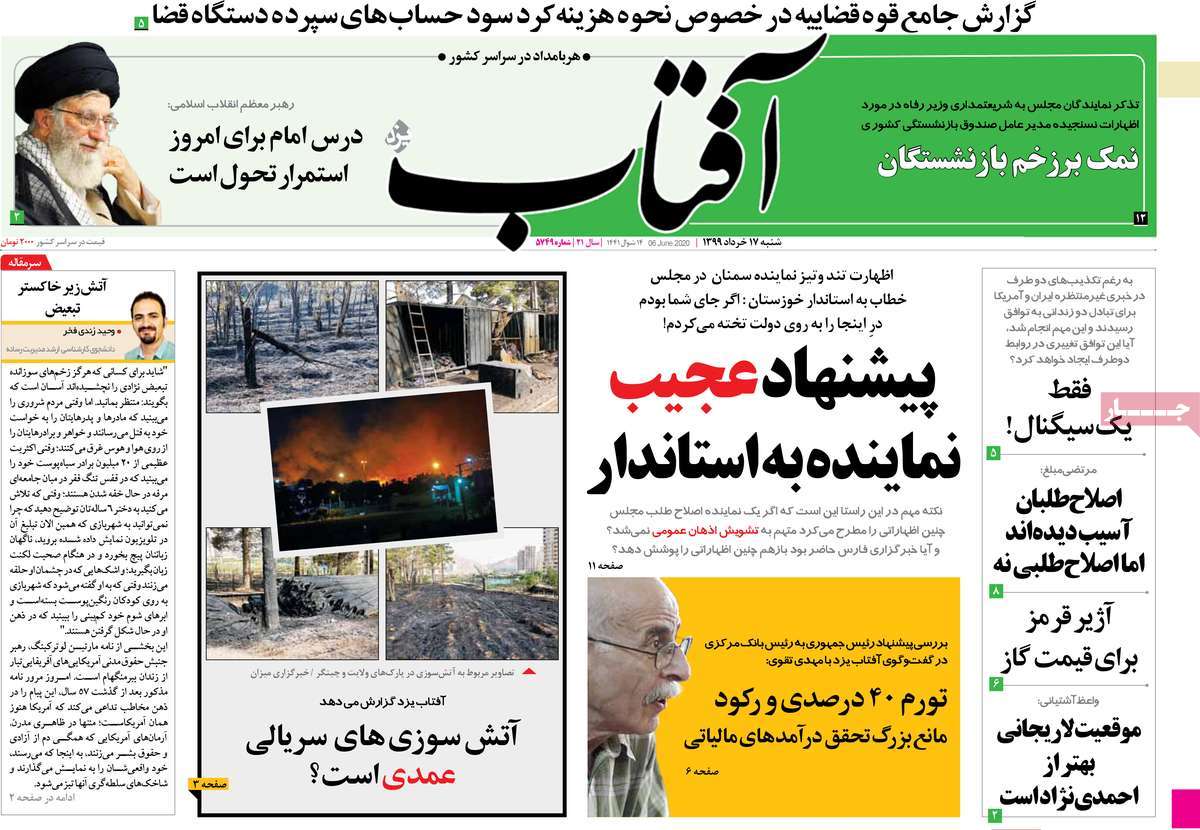
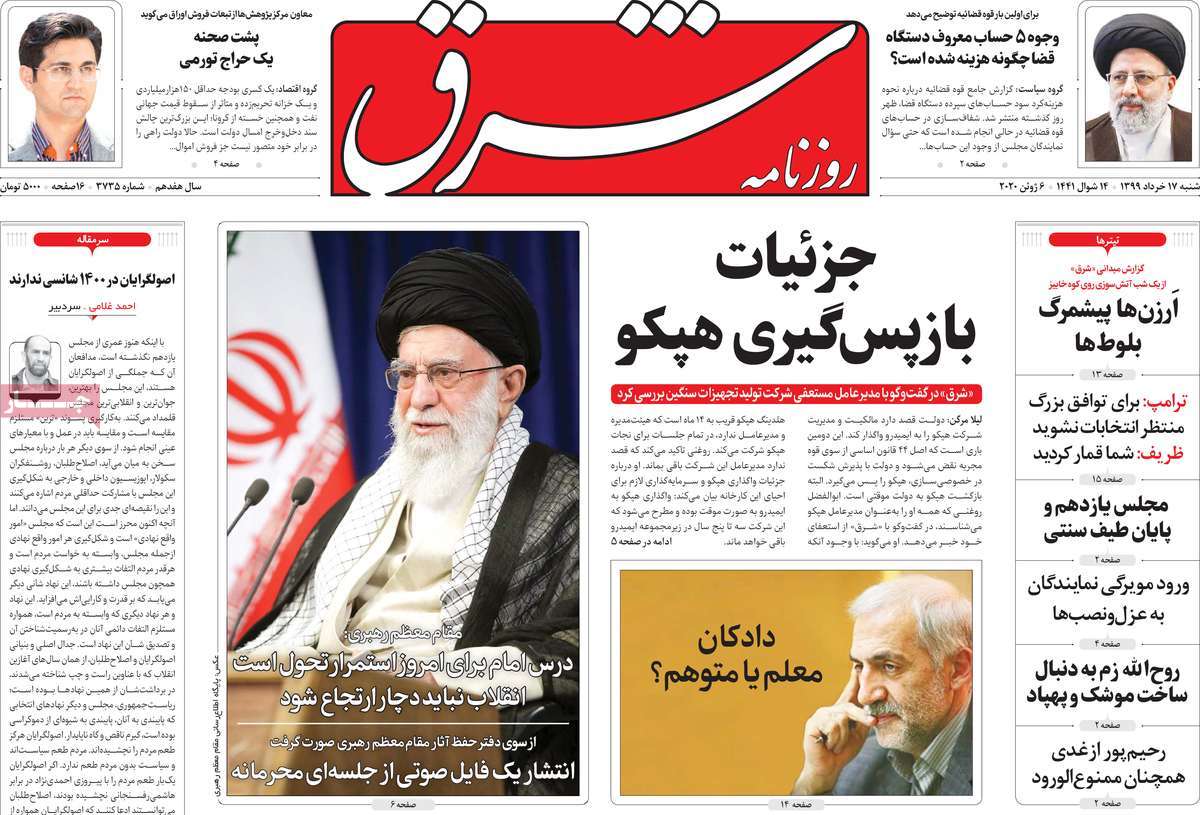
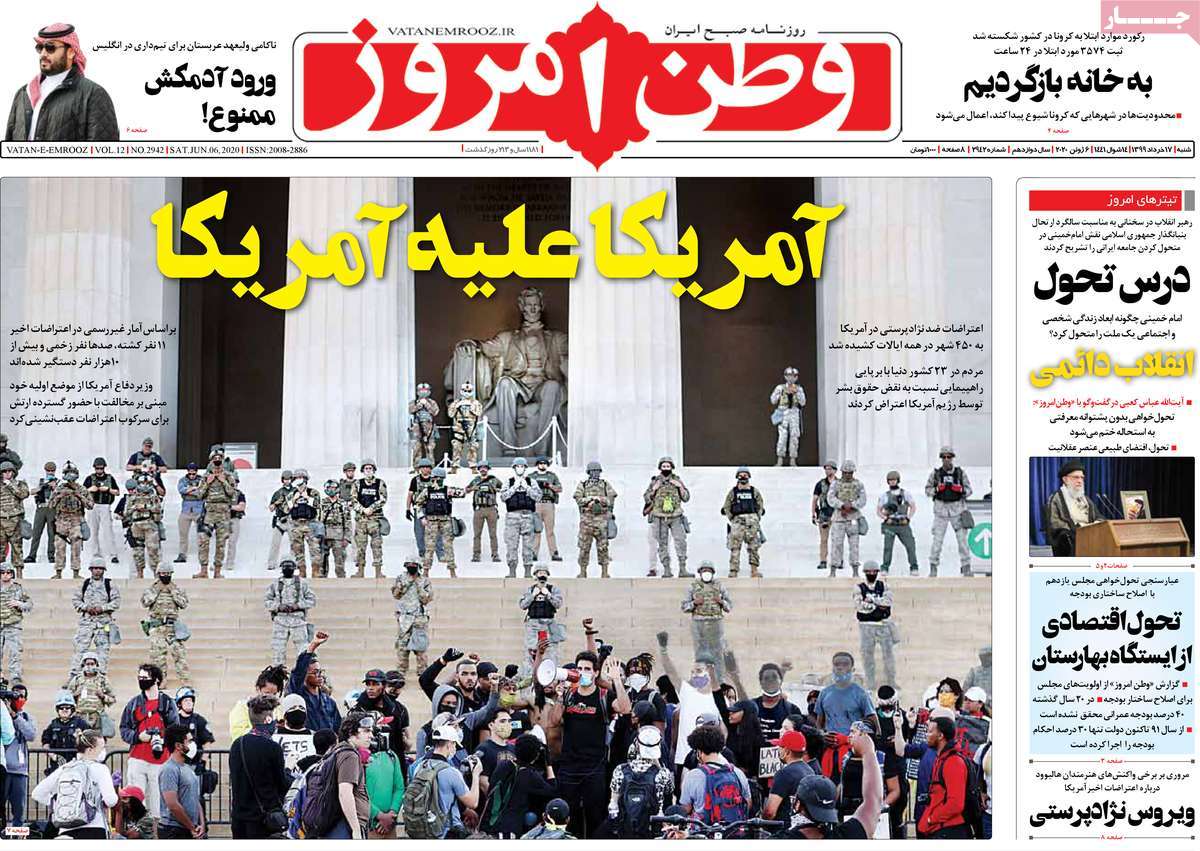
1- People Won’t Afford Buying New Cars Even If Prices Return to Previous Level
2- Paying Compensation to UK over Embassy Damages Not Negotiable: Analyst
Arman-e Melli Newspaper:
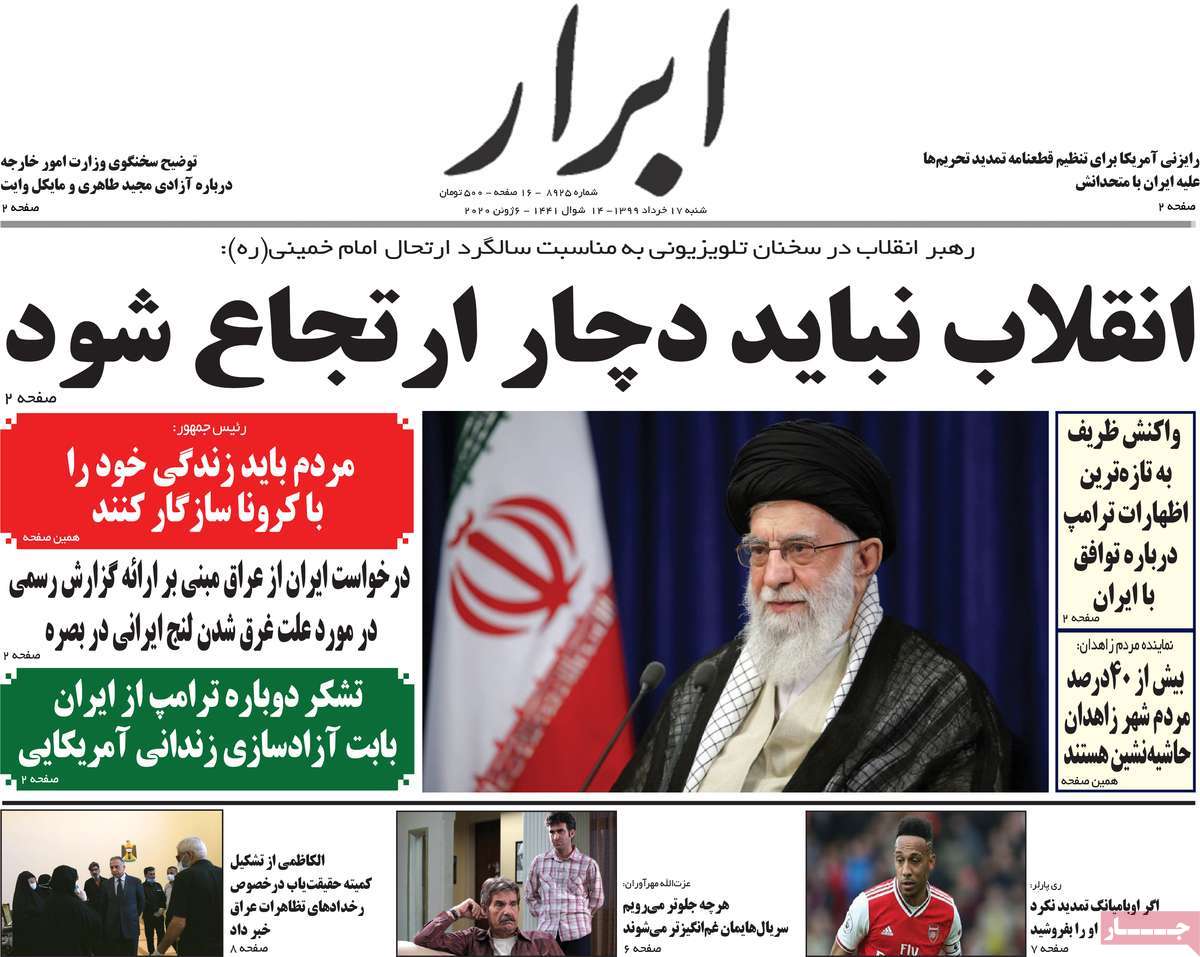
1- Iran Leader: It’s a Heavy Sorrow to Lose Hard-Working Young Men
2- Transmitters of Death Wandering in Cities: Concerns about COVID-19 Outbreak
Donya-ye Eqtesad:
1- Gov’t to Sell Bonds in Order to Provide Its Budget
Ebtekar Newspaper:
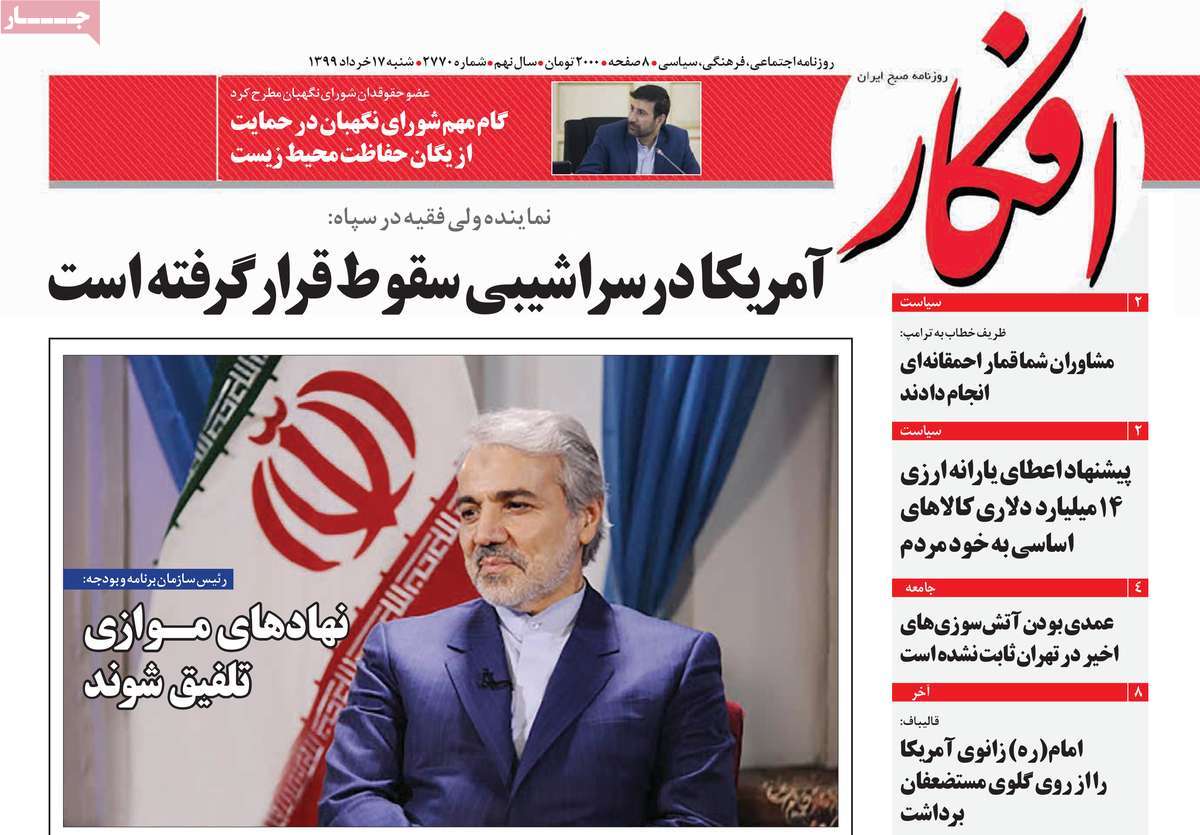
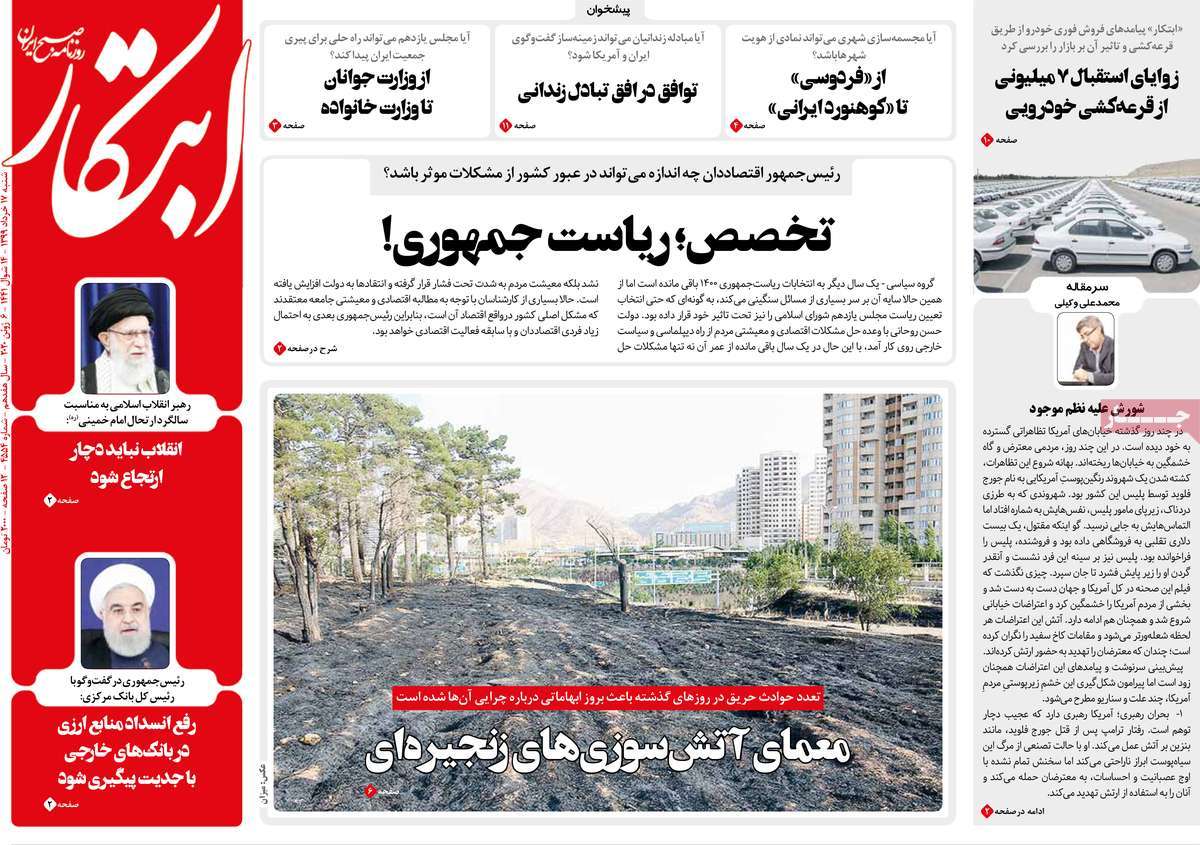
1- Living with Mask: From Dust Pollution to Corona; New Wave of Disease in Khuzestan
2- Glorious Funeral Held for Martyrs of Konarak Vessel Incident
Ettela’at Newspaper:
1- Iran Leader Offers Condolences on Martyrdom of Navy Officers
2- Rouhani: Iran’s Fight against COVID-19 Neutralized Many Anti-Iran Judgements
Iran Newspaper:
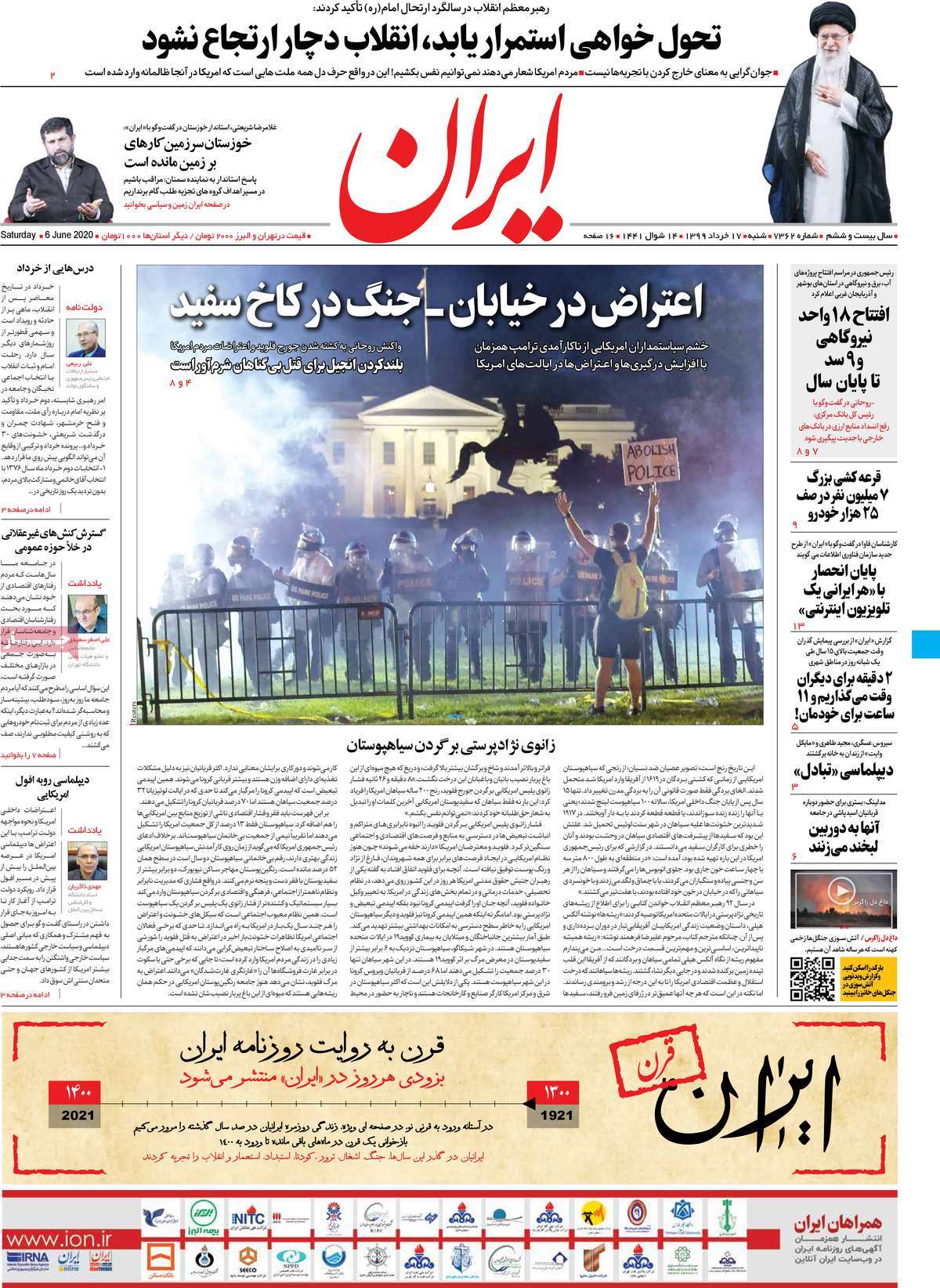
1- Farewell to Children of Sea
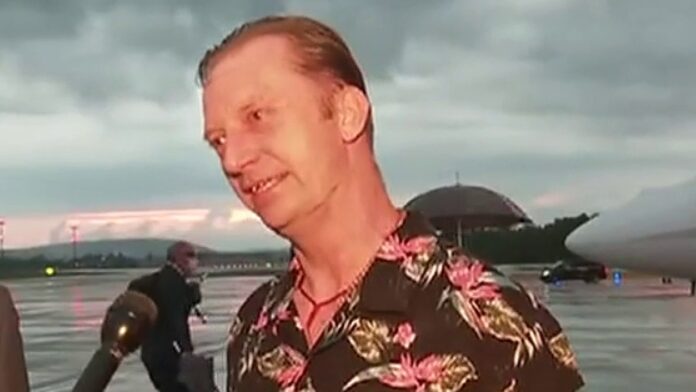
2- Iran Ready for Exchange of Prisoners, but Not for Negotiation
* Zarif Holds Talks with Swiss Counterpart on Prisoner Swap with US
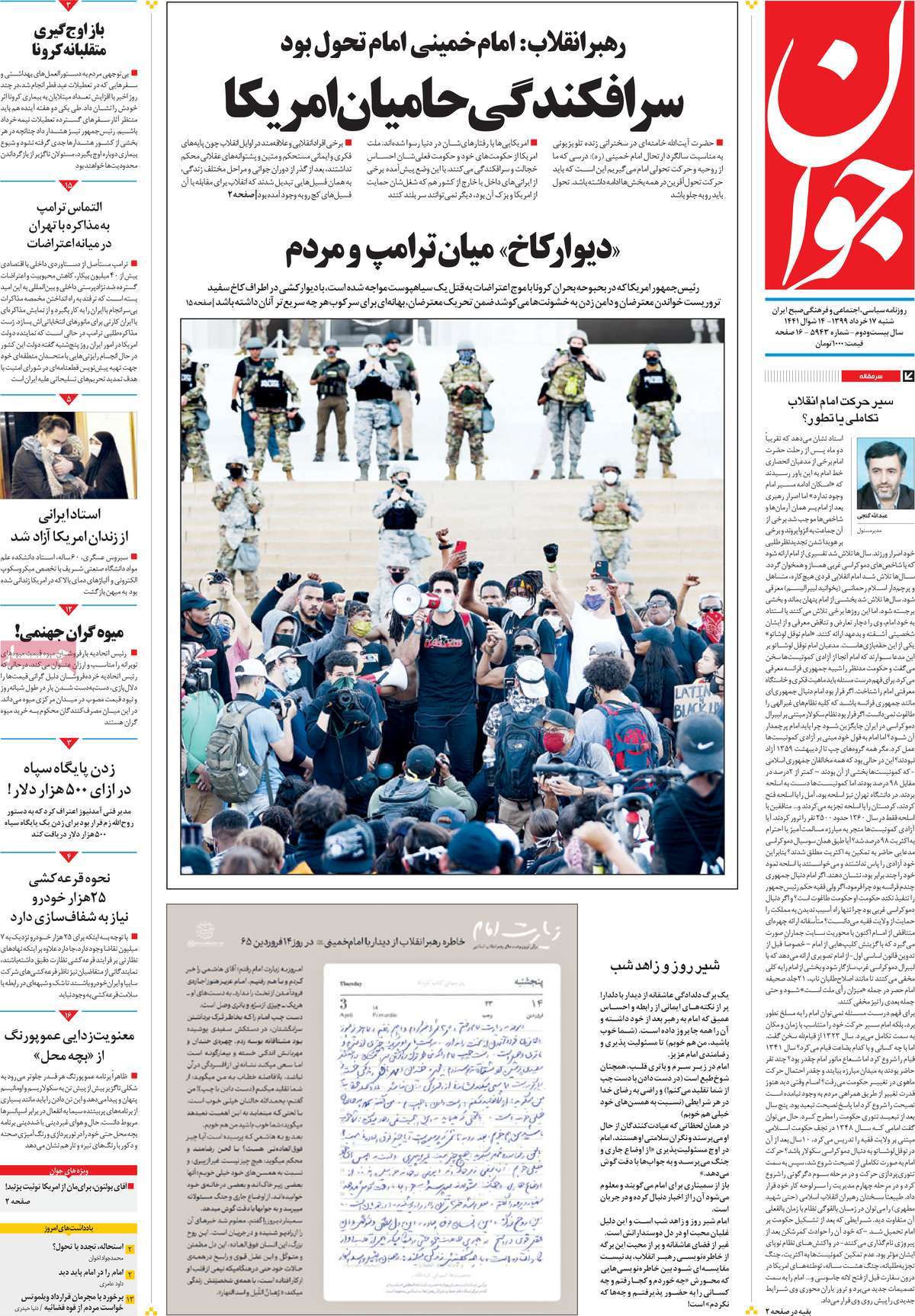
Javan Newspaper:
1- Parliament’s Double-Urgency Motion to Counter Israel’s Measures
2- Iran Now at Control, Containment Phase of Fight against Corona
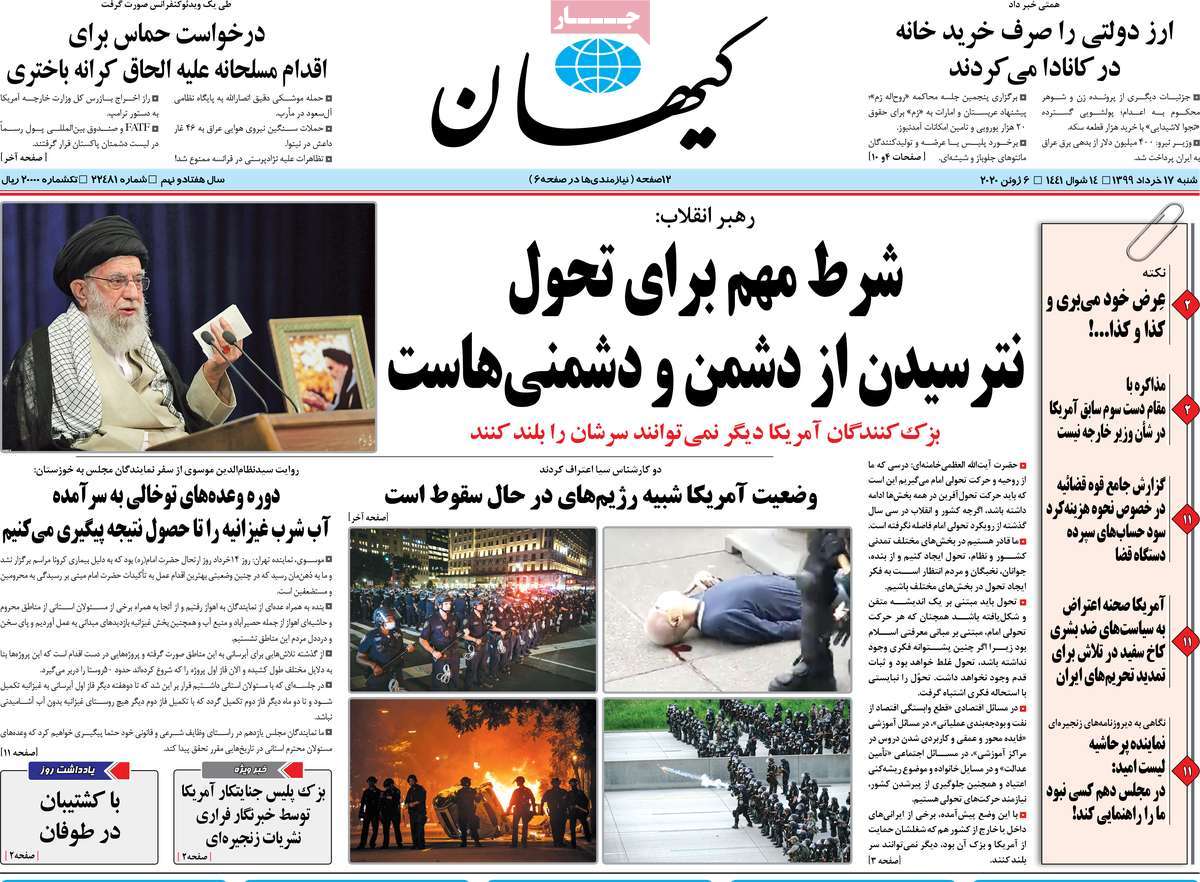
Kayhan Newspaper:
1- Incumbent Parliament Good Lesson for Incoming Lawmakers
2- US, UK Giving Economic Promises to Al-Kadhimi to Increase Their Influence
3- Industry Minister Sacked Not Because of Car Price Hikes
Khorasan Newspaper:
1- Shocking Account of Smuggling Commodities into Iran
2- Coronavirus Spreading in Banks
Mardom Salari Newspaper:
1- Call for Accurate Information on Konarak Tragedy
2- Corona’s Deadly Trouble for Putin
3- Corona, Heat Going Together Well: COVID-19 Spreading in Hot Days of Khuzestan
Shargh Newspaper:
1- Another Minister Sacked from Rouhani’s Cabinet
2- Iran Denies Role in Afghan Border Incident, Respectfully Raises Complaints
3- Nine Cities of Khuzestan in Red Condition
In remarks on Wednesday, Hossein Modarres Khiabani unveiled new initiatives for supporting domestic production and encouraging local industries.
In order to support the domestic producers, the Ministry of Industry, Mine and Trade is refusing permission for the import of the medical items and supplies which are available inside the country, he added.
The caretaker minister also noted that another permission has been given for the unlimited export of homegrown N95 masks, hospital gowns and serology coronavirus test kits in an effort to support the domestic producers and meet the demands of the foreign countries struggling with COVID-19 epidemic.
Modarres Khiabani said the supply of those three items in Iran is outstripping domestic demand, adding, “The situation of production of health items and coronavirus-related medical equipment in the country is such that Iran has become a hub of export of coronavirus-related medical and health products.”
The Ministry of Industry, Mine and Trade, the Ministry of Health and Medical Education, and the Food and Drug Administration of Iran have coordinated a plan that gives approval to the export of 50 percent of the medical ventilators, electronic vital signs monitors, and home oxygen concentrators manufactured inside the country, he added.
The caretaker minister finally expressed hope that the unrestricted export of homegrown medical supplies and emergence of new markets for the Iranian products would pave the way for a surge in domestic production.
In April, President Hassan Rouhani said Iran has begun to export the health supplies necessary for the fight against COVID-19 after meeting the domestic demand.
Last week, a consignment of 40,000 coronavirus diagnostic test kits manufactured by an Iranian knowledge-based company was shipped to Germany.