Friday, April 24, 2026
Home Blog Page 2746

US Sanctions on Iran’s Aviation Industry Killing Civilians

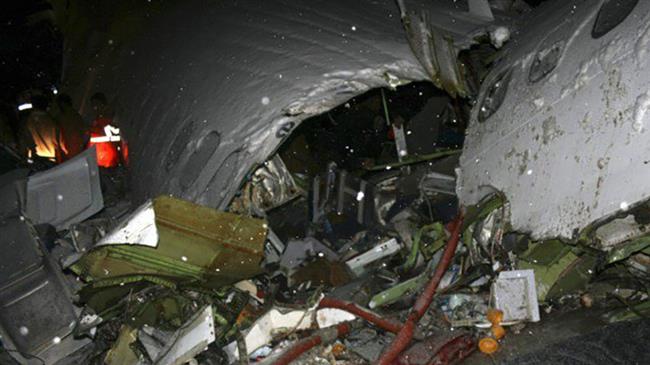
The wreckage of the Iranian Boeing 727 airplane is pictured after it crashed near cit of Urmia in the northwestern Iranian province of West Azarbaijan on January 9, 2011. (Photo by Reuters)

Experts believe that US administration’s staunch opposition to the sale of new planes to Iran is the main factor to blame for dilapidation of Iranian air fleet, which has so far led to bloody incidents, taking a high toll on Iranian civilians.

The US opposition comes in stark contradiction to the text of the landmark nuclear agreement, officially known as the Joint Comprehensive Plan of Action (JCPOA), signed between Iran and the P5+1 group of countries in 2015.

Iran and the five permanent members of the United Nations Security Council – the US, France, Britain, Russia and China – plus Germany signed the nuclear agreement on July 14, 2015 and started implementing it on January 16, 2016. Under the JCPOA, Iran undertook to put limits on its nuclear program in exchange for the removal of nuclear-related sanctions imposed against Tehran, including its civil aviation industry.

US President Donald Trump has repeatedly described the JCPOA, which was negotiated under his predecessor, Barack Obama, as “the worst and most one-sided transaction Washington has ever entered into,” a characterization he often used during his presidential campaign, and threatened to tear it up.

The American head of state has repeatedly claimed that Iran’s missile program is in violation of Security Council Resolution 2231, which endorses the JCPOA. Trump has also complained that the JCPOA-related restrictions have an expiration date and that underscores the need to toughen the “embarrassing” deal.

In September 2016, the United States Treasury Department removed a final hurdle for Western aircraft manufacturers to sell planes to Iran as it granted the aviation giants Airbus and Boeing licenses to deliver planes to Tehran.

In January 2017, Iran received the first plane purchased from the European giant aircraft maker, Airbus, following the implementation of the JCPOA.

US Sanctions on Iran's Aviation Industry Killing Civilians

PressTV-Iran receives 1st Airbus plane after JCPOA

Iran takes delivery of the first Airbus plane following a deal that lifts nuclear-related sanctions on the country.

The 189-seat A321 plane, painted in Iran Air’s livery, was the first of 100 planes purchased under a December deal worth $18 billion.

Iran received its second passenger plane from Airbus in March 2017 under the deal agreed with the French aircraft manufacturer.

In June 2016, Boeing signed a memorandum of agreement with Iran Air to sell a total of 80 aircraft and lease a further 29 to the company in a potential deal worth about $25 billion.
Iranian Naft Airlines, a homebound charter airline providing passenger and cargo services to Iran’s Ministry of Petroleum, received the first Boeing jet in September 2016.

However, The Wall Street Journal in December 2017 cited US officials as saying that Trump’s administration was considering blocking planned sales of hundreds of passenger planes by Boeing and Airbus to Iranian airlines.

It reported that Trump’s team was expected to present him with options that included banning sales, imposing stringent conditions that could halt any aircraft deliveries, or slow-walking approvals.

The US House of Representatives in September 2017 voted in favor of new measures that block sales of commercial aircraft to Iran, ignoring some lawmakers’ warnings that the hostile move would undermine the JCPOA.

The new measures would specifically prevent the Office of Foreign Assets Control (OFAC) from clearing licenses to allow aircraft sales while also prohibit the use of funds to authorize the required financial transactions.

Senior Iranian lawmakers called for action after the US House approved new measures that block the sales of commercial aircraft to the Islamic Republic.

Chairman of the Iranian Parliament’s National Security and Foreign Policy Committee Alaeddin Boroujerdi called the move a “clear violation of the JCPOA.”

Republican US senators in February 2017 introduced legislation to impose fresh sanctions on Iran’s aviation sector, accusing Tehran of using civilian aircraft to support terrorism.

Senators Marco Rubio, John Cornyn, Ben Sasse and David Perdue introduced the “Iran Terror-Free Skies Act,” legislation that would “counter Iran’s use of commercial aircraft in support of international terrorism and state sponsors of terrorism, or for other illicit military purposes,” according to a press release published on Rubio’s website.

An author and peace activist told Press TV in an interview that accusations without evidence were all the United States needs to act, adding that these sanctions have everything to do with the Israel lobby rather than reality.

“The US is notorious for this. Accusations never need any evidence. All they need is to accuse and they act on the accusations. There is absolutely no reason to impose any kind of sanctions on commercial airliners from Iran and there is no evidence that such aircraft are being used for terrorism,” Ryan Dawson told Press TV.

Another analyst believed that the United States’ sanctions against Iran have been aimed at creating chaos, adding that the administration of President Trump was using the economy as a “weapon” to destabilize the country.

“The sanctions that have been imposed on Iran for the past God knows how long have been so draconian and the aim of all sanctions is to create some kind of a chaos within the country from certain sectors and then they are going to manipulate that into some kind of a political issue and that is essentially the goal of all coercive unilateral sanctions,” Alexander Azadgan told PressTV in an interview.

American media reported in May 2017 that a new legislation was circulating through US Senate that would require the government to crack down on an Iranian airline company.

Mahan Air was the target of the measure which would require the Trump administration to provide Congress with a list of all airports where the commercial carrier has landed, the reports said.

Here is a chronology of major Iranian plane crashes in recent years. (Source: AFP)

– 2018

An Iranian passenger plane on a domestic flight crashed on Sunday, February 18, into the country’s Zagros mountains, killing all 66 people on board.

– 2014

On August 10, an Antonov An-140 run by Sepahan Airlines carrying 40 passengers and eight crew crashed moments after it took off from Tehran. Thirty-nine people were killed and nine others severely injured. The pilot narrowly missed buildings and a busy market before crashing into a concrete wall. Iranian authorities said the cause of the accident was engine failure and faulty alarm signal.

– 2011

On January 9, an Iran Air Boeing 727 shattered on impact while attempting an emergency landing in a snowstorm in the country’s northwest, killing 77 people and injuring 27. The aircraft had taken off from Tehran with more than an hour’s delay due to bad weather and two previous flights had already been cancelled.

– 2009

On July 15, a Tupolev 154 jetliner operated by Caspian Airlines en route from Tehran to Yerevan in Armenia caught fire shortly after takeoff and crashed into a field in the northern region of Qazvin, killing all 168 passengers on board including 15 crew. Authorities said a technical problem was the cause of the crash.

– 2006

On November 26, an Iranian military plane crashed in Tehran, killing 39 people of which 30 were members of the Islamic Revolution Guards Corps (IRGC). The plane had been destined for Shiraz in the south but crashed on takeoff at Tehran’s Mehrabad airport.

In January the same year eight senior officers of the ground forces of the IRGC and three crew members were killed when a military plane crashed in the northwest of the country.

On September 1, 29 people were killed when a Tupolev 154 crashed and burst into flames in Mashhad in the northeast after a tire blew up. The aircraft run by Iran Airtours skidded off the runway and crashed into fencing.

– 2005

On December 6, a military transport craft Lockheed C130 crashed at the foot of a 10-story apartment building in a residential area of southern Tehran, killing 108 people including 68 journalists and photographers, and injuring more than 90. Among the victims, 14 people were killed on the ground. The plane had experienced engine trouble just after takeoff from Mehrabad.

– 2003

On February 19, an Ilyushin Il-76 belonging to the air force of the IRGC crashed near Kerman in the southeast, killing all 275 people on board. The craft had disappeared from radar monitors an hour after takeoff from Zahedan Airport and following contact from the pilot to airport control in Kerman to warn them he wanted to land due to bad weather.

Iran Says New Regional Alliance Needed to Replace GCC

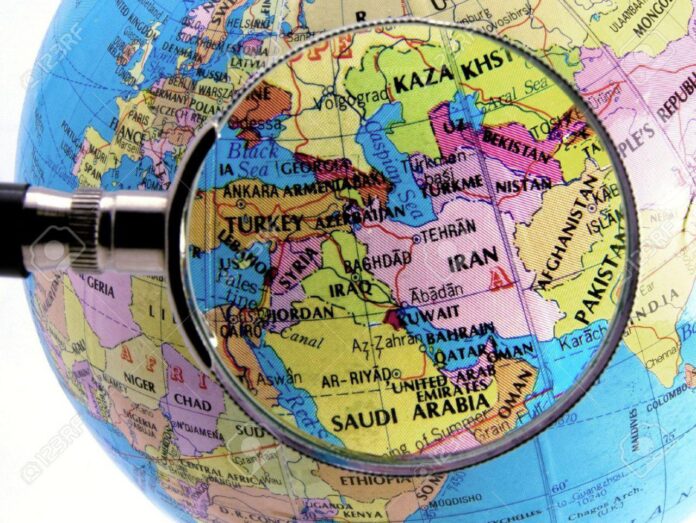
Seyyed Hossein Naqavi Hosseini, the spokesman for the Iranian Parliament’s National Security and Foreign Policy Commission, referred to the latest remarks by Qatari Emir on the diplomatic crisis among (P)GCC member states and said the council has reached a deadlock in resolving regional problems.

In a Farsi interview with ICANA, he added, “It should be admitted that the PGCC is not efficient anymore. The council has been named after Persian Gulf but Iran as a country with the biggest share of northern Persian Gulf and Oman Sea is absent from the council. This consequently means that the council is incapable of coping with the current crises in the region.”

Naqavi Hosseini then referred to the Qatari Emir’s initiative to establish a security treaty in the Middle East similar to the one in Europe and said there should be a new order for the Middle East and “the Islamic Republic of Iran wants all regional states to be included in the new order.”

He emphasized that dialogue is the only solution to all disputes and added no foreign power is allowed to meddle in the Middle East and turn it into an arms depot.

The lawmaker then said each state can play its role in restoring stability to the region.
“Some states in the (P)GCC deem themselves as much more important than others and take others as their colonies but these states should come to the sense that such approaches will end up in failure,” he concluded.

Iran Condemns Terrorist Attack on Dagestan Church

Bahram Qassemi

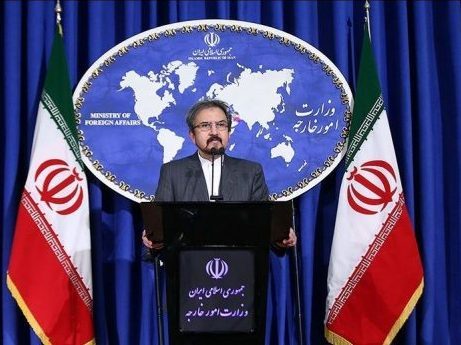
In a statement on Sunday, Qassemi offered sympathy to the nation and government of Dagestan Republic and the bereaved families of the victims of the attack, which killed and wounded several people.

“The slaughter of innocent people in sacred religious sites and hostility towards religions are among the defining characteristics of groups who go beyond religious and ethical borders for their scaremongering and hate-mongering,” he noted.

Qassemi added that such groups would commit any type of crime to achieve their evil goals.

Five people have been killed and several others injured in a gun attack on a crowd of churchgoers in Dagestan in southern Russia, local police confirmed. The shooter was killed by security forces.
The shooting happened in the city of Kizlyar, a provincial capital in the Republic of Dagestan. The gunman opened fire with a hunting rifle at a group of people leaving a church ceremony dedicated to the end of the Russian folk festival of Maslenitsa, which marks the start of Lent for Russian Orthodox Christians.
The attacker shouted “Allahu Akbar” [God is great] as he opened fire on worshippers, father Pavel, the church’s senior priest, told Russian RBC news portal.

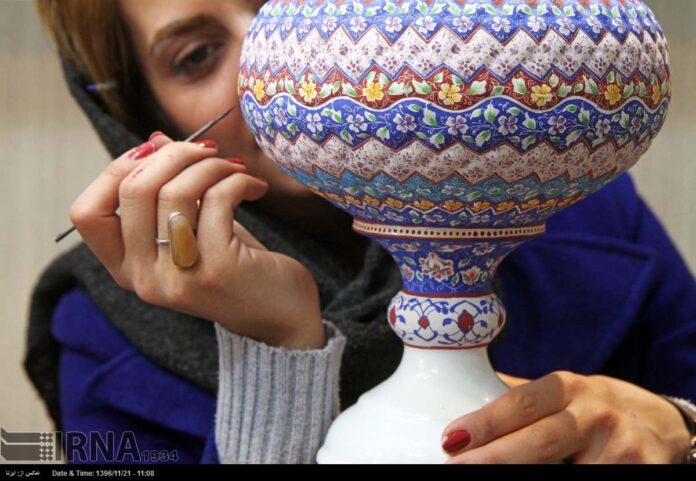
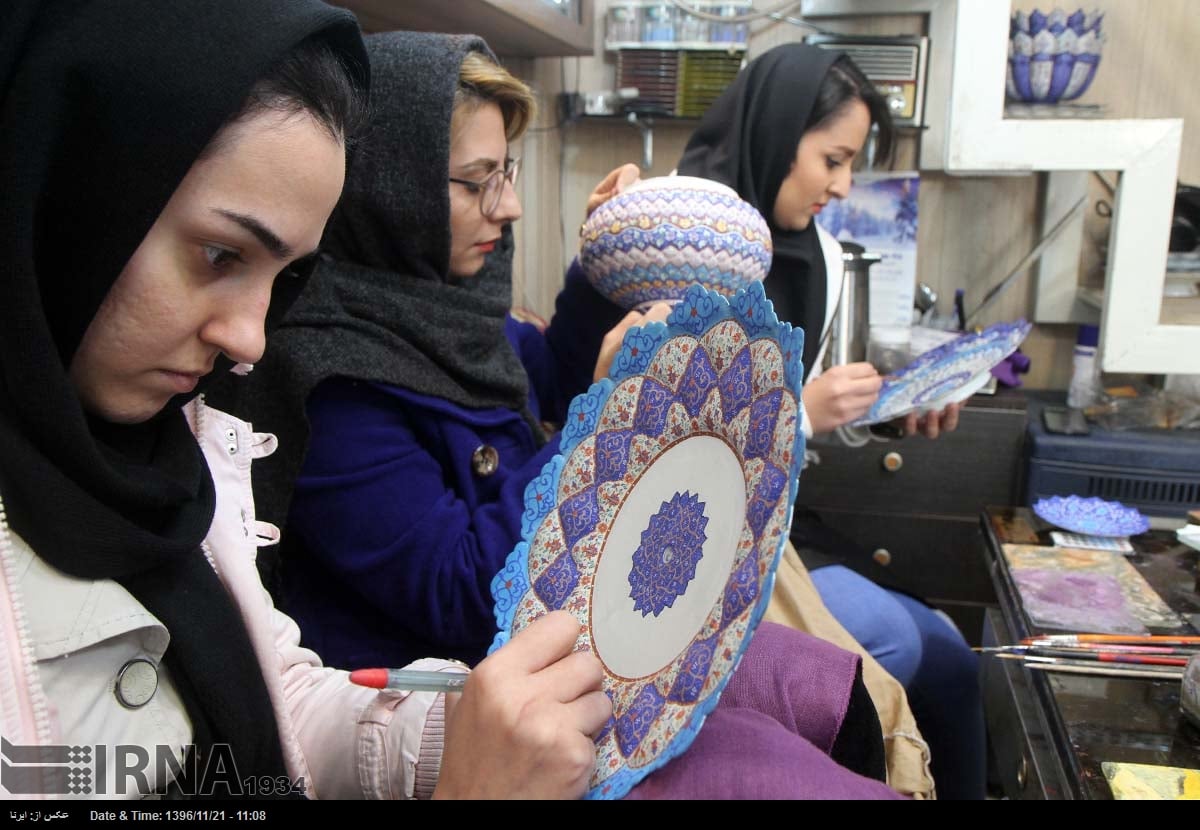
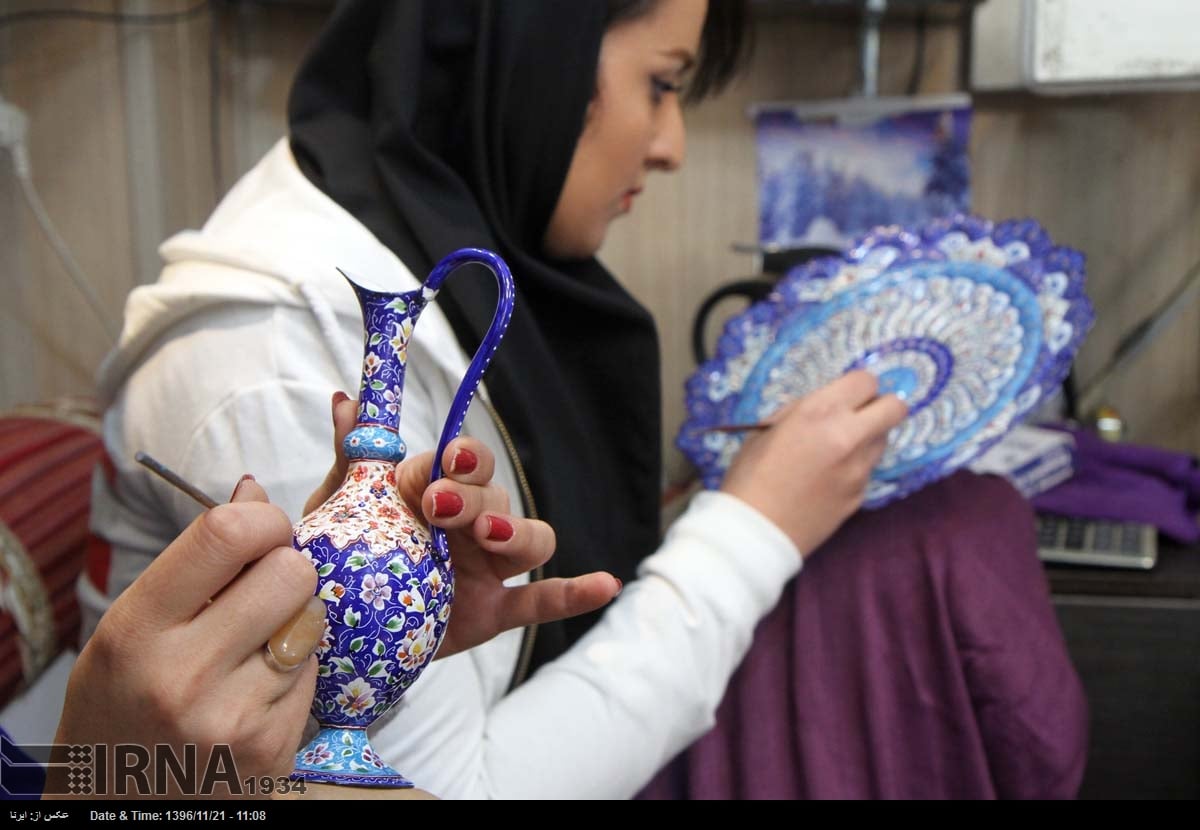
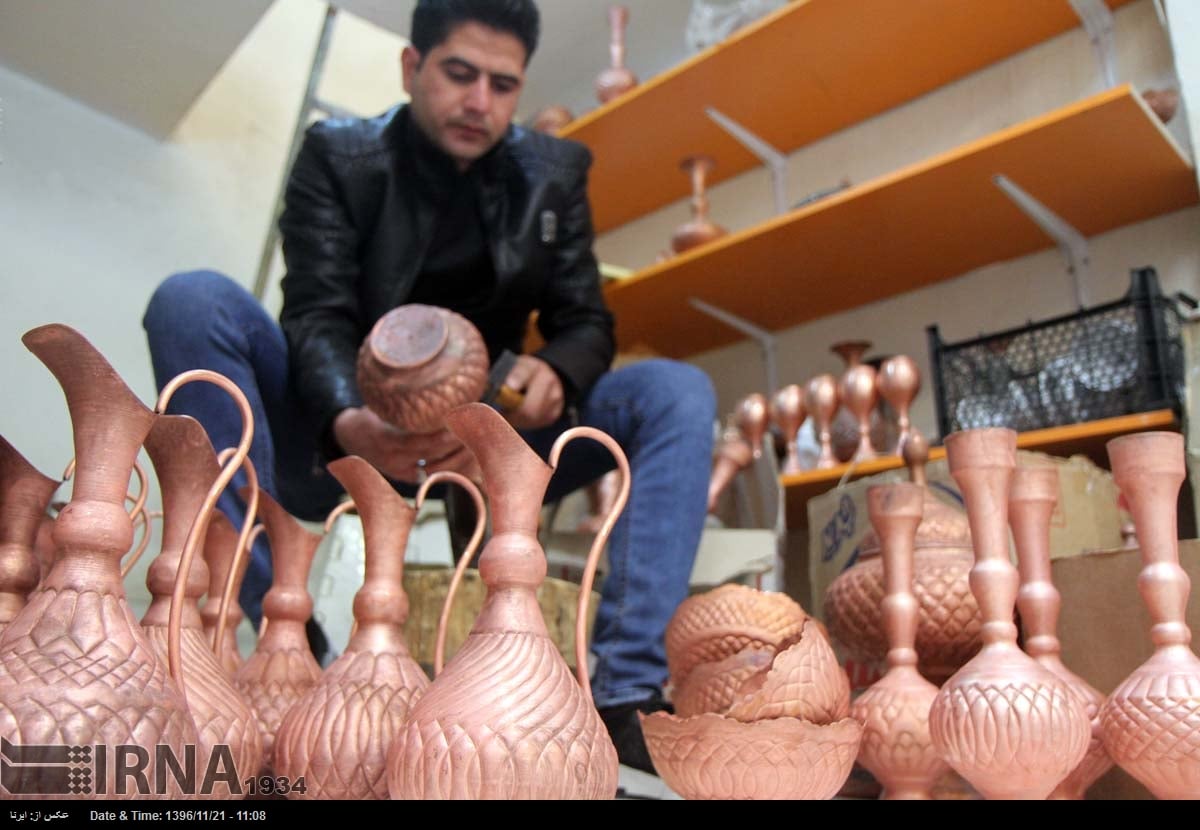
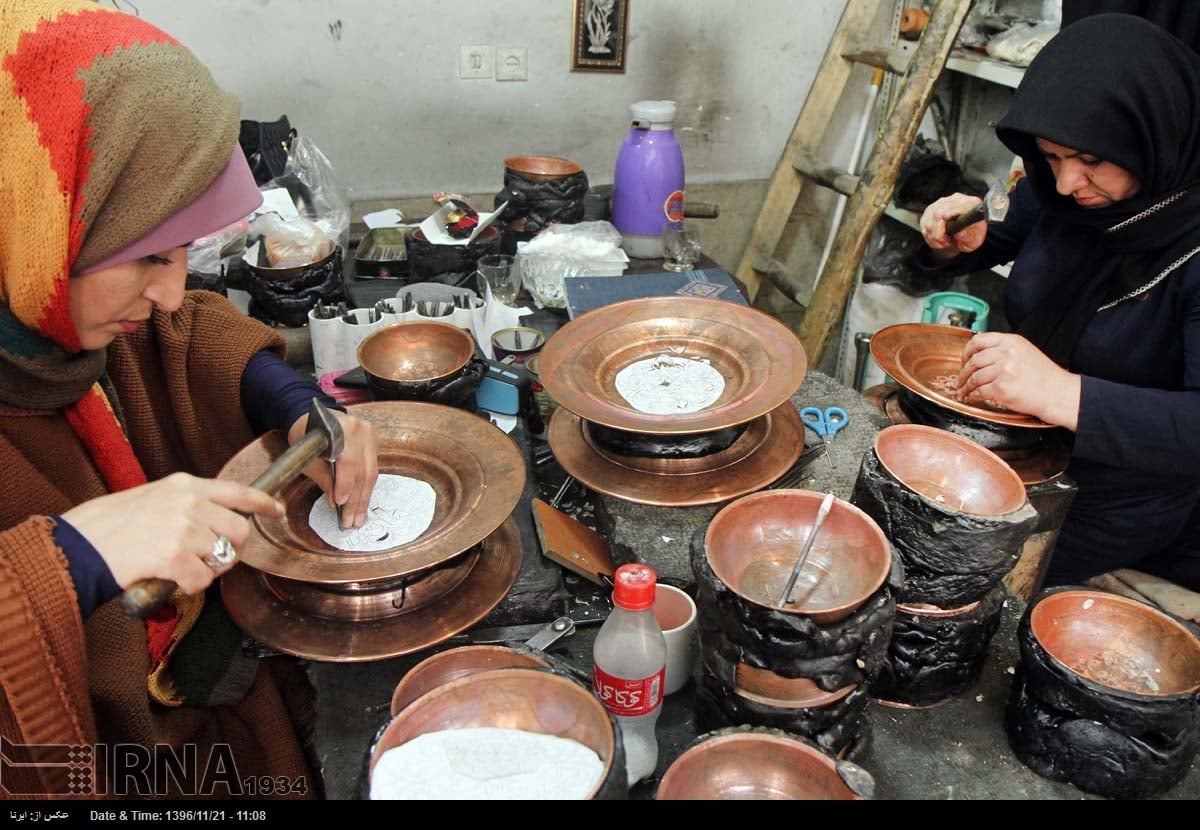
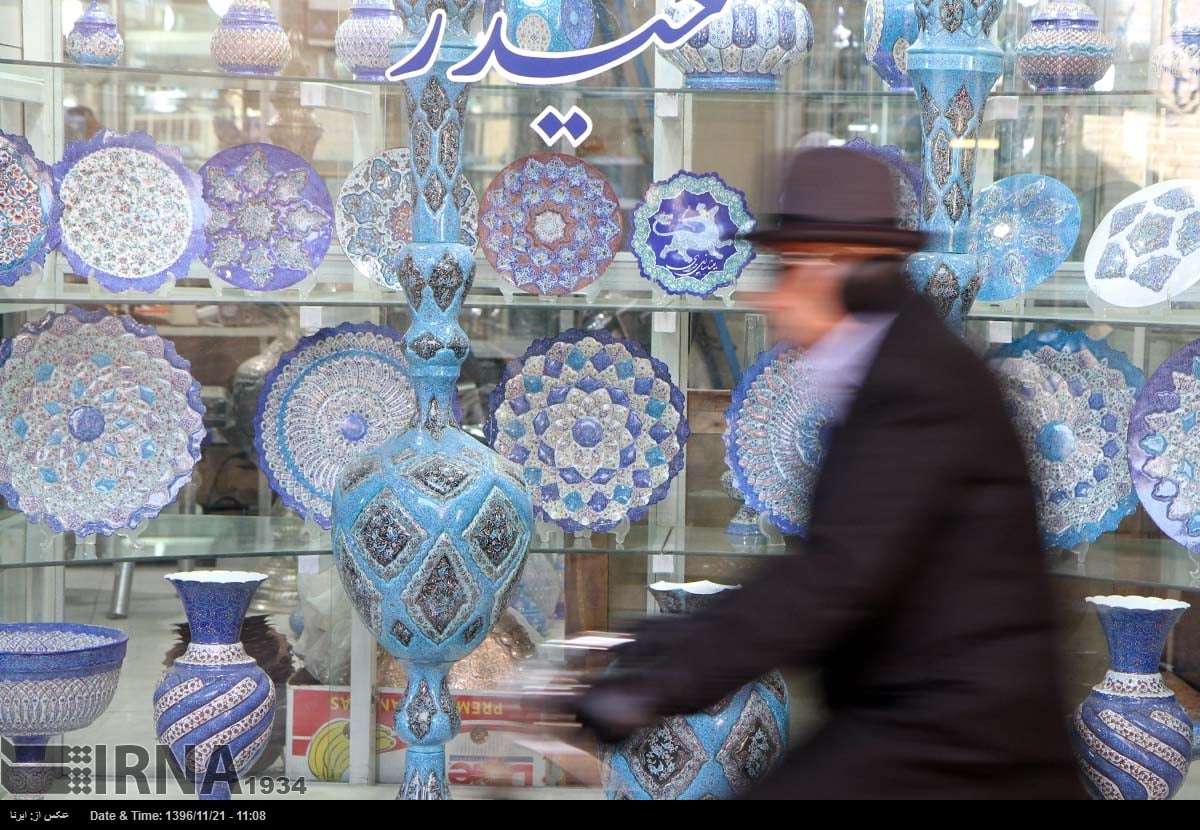
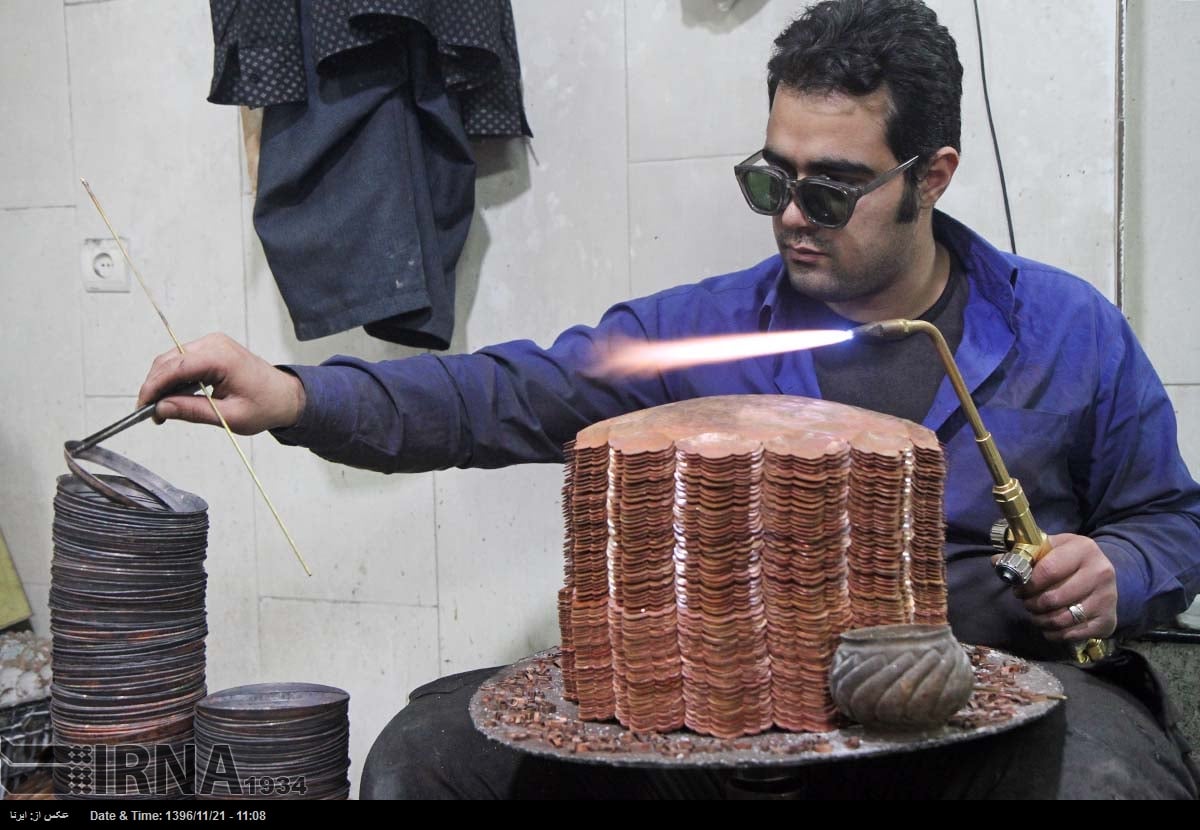
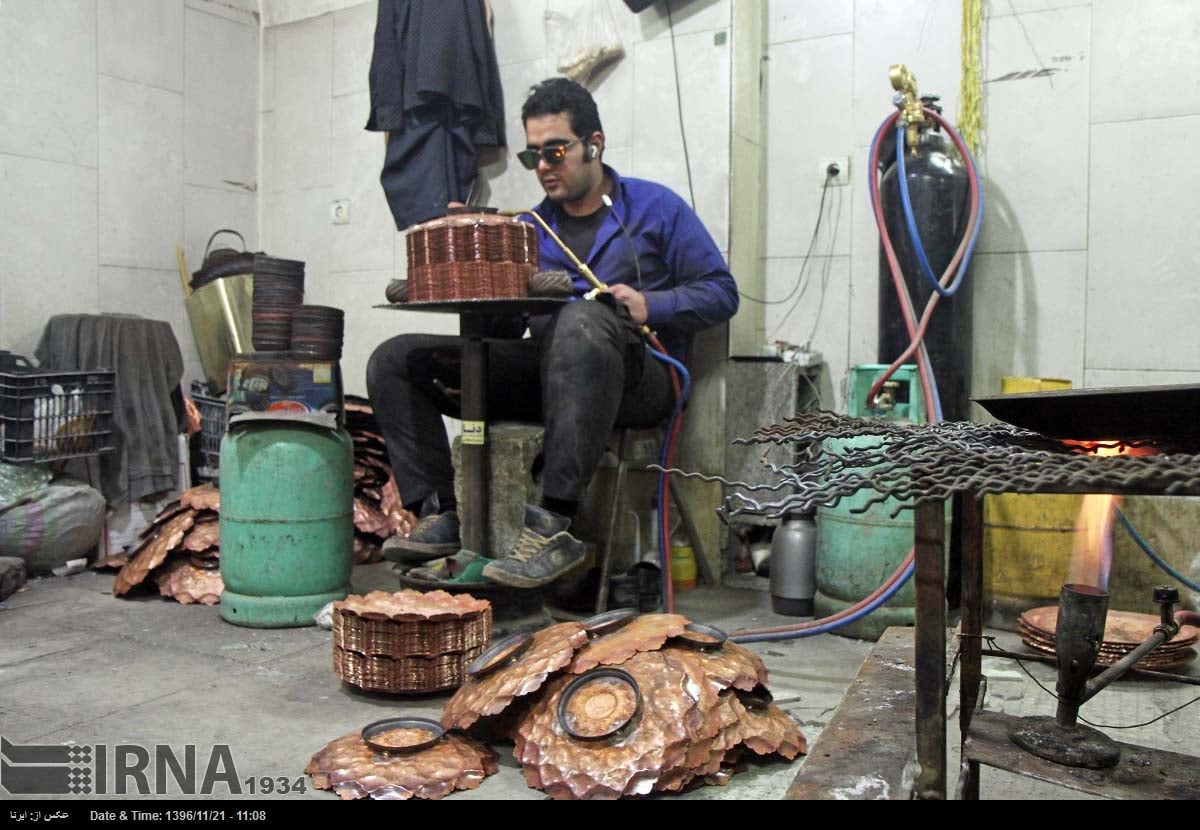
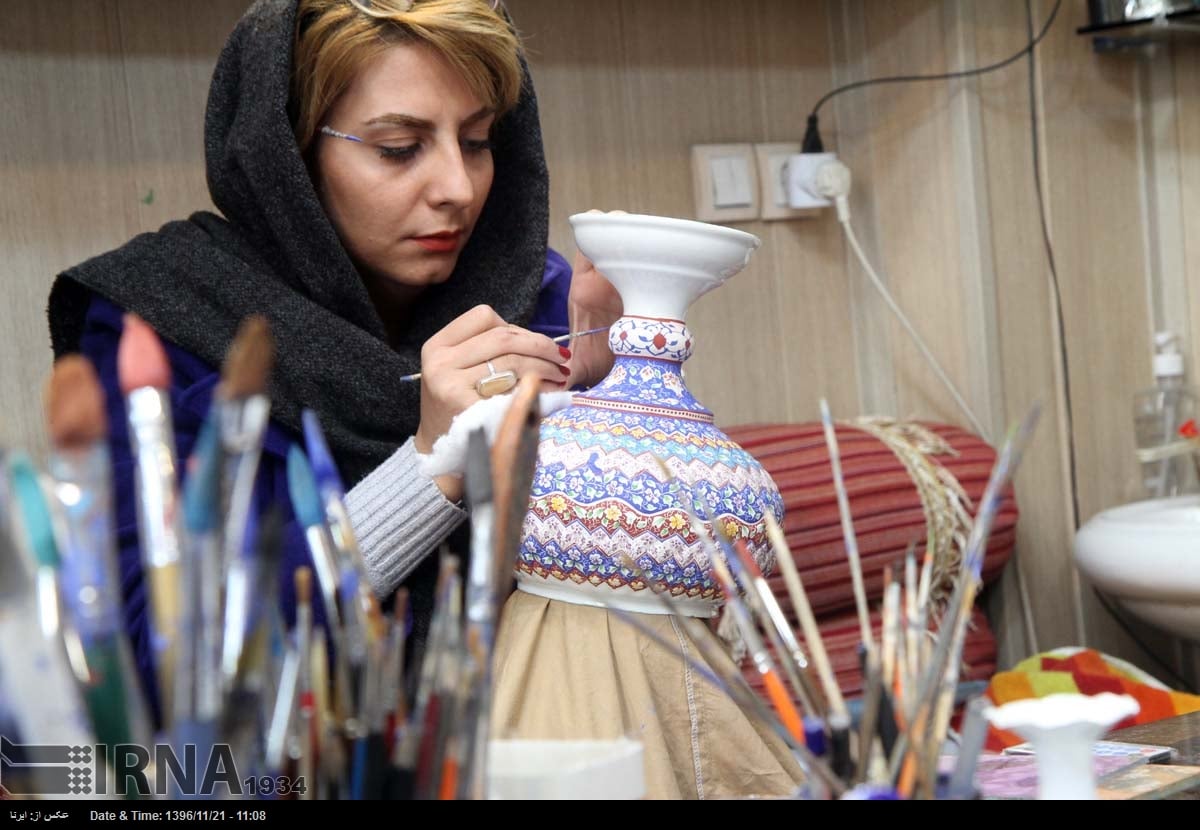
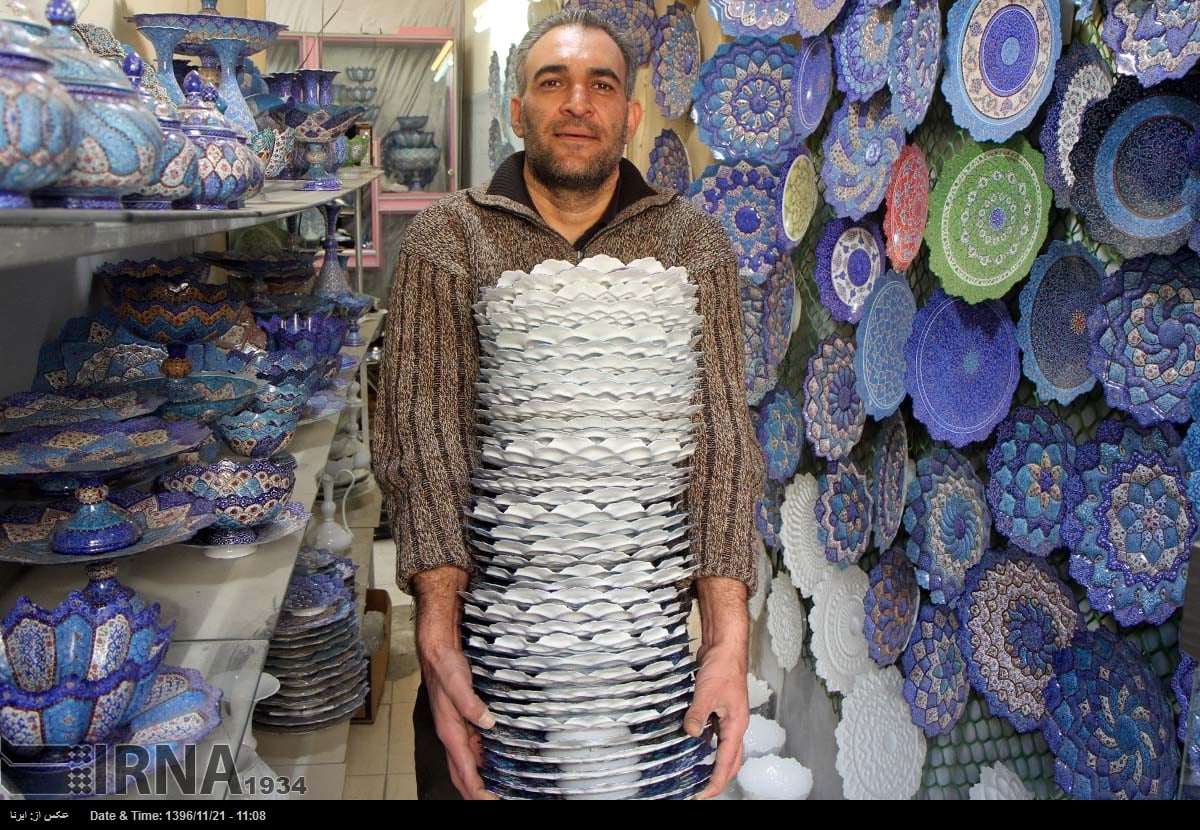
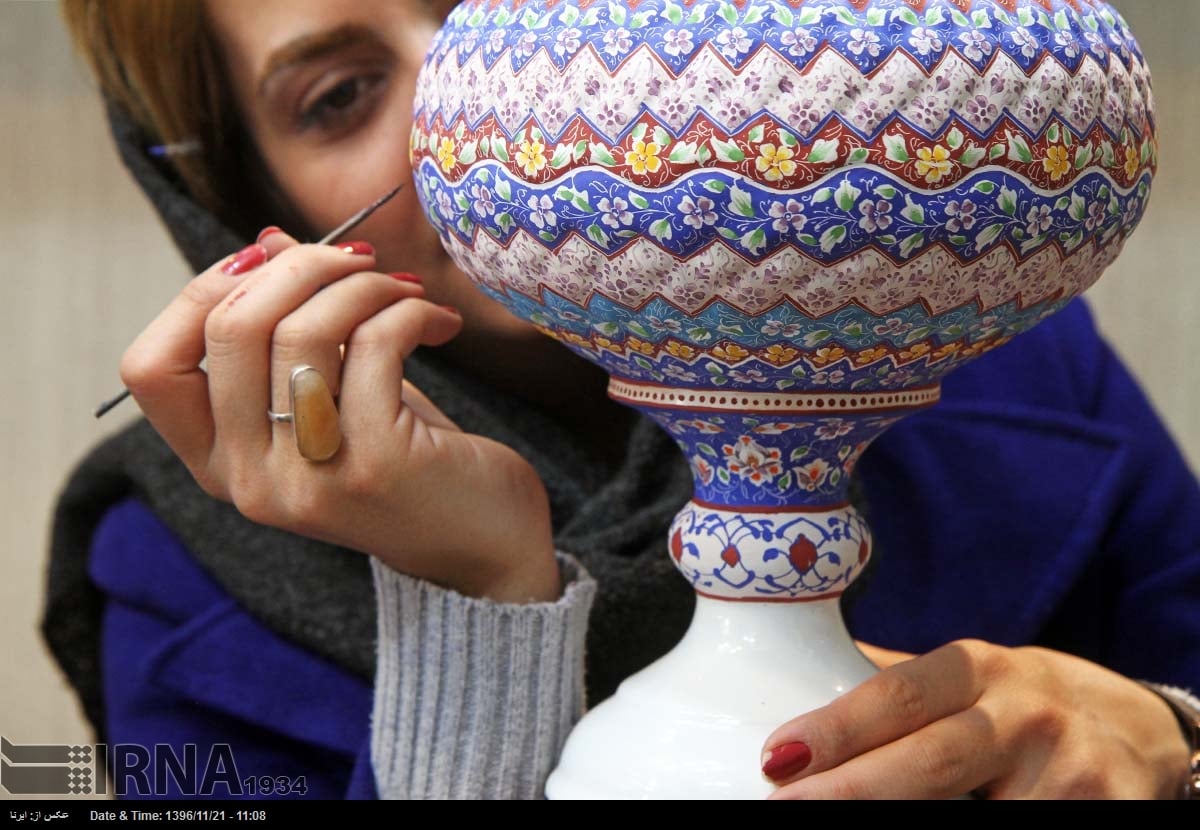
Enamelling; Unique, Ancient Art of Iran’s Isfahan

Enamelling; Unique, Ancient Art of Iran's Isfahan

Meena is the feminine form of Minoo in Persian, meaning heaven. Meena refers to the Azure colour of heaven. The Iranian craftsmen of Sasanied era invented Meenakari art; and Mongols spread it to India and other countries.

Enamel is usually used to design vase, jewelry and candleholder in addition to doors and chandeliers of holy shrines. The central city of Isfahan is the most important Iranian hub of enamelling.

Enamelling and decorating metals with colourful and baked coats is one of the distinguished courses of art in Isfahan.

Meena is defined as some sort of glasslike coloured coat; which can be stabilized by heat on different metals particularly copper. Meenakari is of abundant use industrially for producing metal and hygienic dishes; but it has also been used by painters, goldsmiths and metal engravers since long times ago.

The Meenakars- enamelling artists- engrave the surface of the metal with intricate designs using a metal stylus which is then filled in with colours.

The Meena is then placed in a furnace where the colours are fused and hardened to become one with the surface. The enamelled piece is then gently rubbed with a file, cleaned with a mixture of lemon, and tamarind that helps highlight the lustre of each colour.

Following you can find photos of Meenakari in Isfahan retrieved from IRNA:

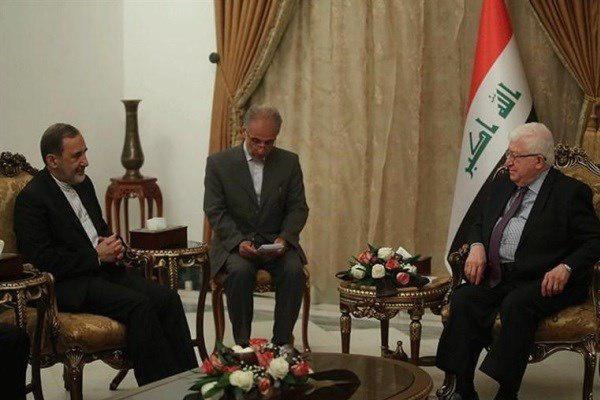
“Iran Prepared to Mend Ties between Baghdad, Erbil”

Velayati

In a Sunday meeting with Iraqi President Fuad Masum in Baghdad, Ali Akbar Velayati said “the Islamic Republic of Iran will do whatever in its power to remove grudges between Iraq’s central government and the KRG and to improve their ties.”

According to a Farsi report by IRIB, Velayati then praised the late Kurdish politician and former Iraqi President, Jalal Talabani, for his “key role in the Iraqi nation’s war for independence.”

The top aide to Iran’s Leader also noted that Iraqi Kurds have always played a critical role in the preservation of Iraq’s territorial integrity and said, “Iran’s relations with the Iraqi Kurds are deep-rooted.”

Describing Iran-Iraq ties as “strategic,” Valayati said the fates of Iran and Iraq are inseparable, adding Iran has always stood by the Iraqi government and nation during the war and reconstruction eras.

For his part, the Iraqi president said Iran-Iraq relations are not “tactical” but expressed hope that the relations would remain alive and forward-looking.

He also called on the Islamic Republic of Iran to play its constructive role in strengthening of national unity among Iraqi groups particularly between Baghdad and Erbil.

During the meeting, the two officials also discussed latest regional developments and exchanged views on ways for expanding bilateral relations between Iran and Iraq.

Iran’s Health Minister Appointed as WHO Commissioner

Hashemi

Deputy Health Minister Mohsen Asadi Lari confirmed the news on Saturday, saying that non-communicable diseases are the main cause of 75 percent of deaths in Iran.

“The WHO attaches great significance to the prevention and control of non-communicable diseases,” he was quoted as saying in a Farsi report by IRIB News Agency.

“To this effect, the WHO has formed a high commission consisting of delegations from 22 member states,” he said.

According to Asadi Lari, the commission, headed by four presidents and ministers, is expected to lead joint projects to prevent and control non-communicable diseases in the world.

He noted as a pioneering country in prevention and control of non-communicable diseases, Iran has signed a leading document aimed at eradicating the diseases.

The deputy minister then said the WHO has repeatedly cited Iran as one of the leading and successful countries that have managed to significantly prevent and control non-communicable diseases.

“A report on Iran’s achievements in this field is expected to be presented to the United Nations’ General Assembly in 2018,” he concluded.

Iran Urges UN to Appoint Rapporteur on US Human Rights Violations

Iran Urges UN to Appoint Rapporteur on US Human Rights Violations

In a Sunday statement, the council warned against contemporary forms of racism and discriminations in the US and said the UN’s Human Rights Council should step into the fray and appoint a special rapporteur to investigate dire situation of human rights violations in the US.

“Though murder and violence are a chronic disease in the US (and to some extent, in other western societies), the latest mass shooting in a school in Florida reveals that a new form of terrorism has been created in the US which draws on racism and bullying,” the Farsi statement reads.

Iran’s High Council for Human Rights also said “the new form of terrorism, like many others backed or ordered by the US, knows no limitation when it comes to violence.”

The statement also held the US president and his political team accountable for the “new dangerous and nasty phenomenon,” and noted the UN cannot remain passive amid such conditions.

“So, the UN is seriously expected to build on the current international treaties and mechanisms and adopt a firm stance towards the US by holding it accountable to the international community over the human rights violations.”

The Iranian body also strongly urged the UN Human Rights Council to appoint a special rapporteur to probe into the dire human rights conditions in the US and provide a report to the UN General Assembly on the US racism and discrimination.
Resistance Front Won’t Allow NATO to Build Base in Mideast: Iran

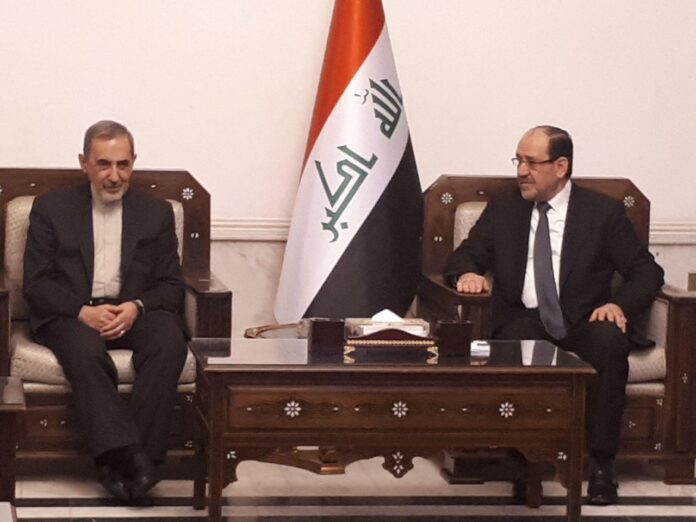
Ali Akbar Velayati, an advisor to Iran's Leader, meeting Iraqi Vice-President Nouri al-Maliki on Saturday, February 17, 2018 / Photo retrieved from IRIB

In a meeting with Iraqi Vice-President Nouri al-Maliki, Velayati emphasized that after the defeat of ISIS by the resistance movement, “we must be more watchful than before about the situation in the region.”

Referring to the separatist and divisive plots of Washington in the region, he noted that the resistance movement should prevent the gradual deployment of the US forces in eastern Euphrates, according to a Farsi report by IRIB News Agency.

The Islamic Republic of Iran stands alongside the Iraqi people and government, he said, expressing hope that the upcoming Iraqi elections would create security and stability in the country with all political groups playing an active role.

In turn, al-Maliki also presented an analysis of the future strategies of the resistance movement in the region underlining that Washington is trying to regain its foothold in Iraq.

He argued that due to Iraq’s rich Islamic culture and the presence of Islamic Marja’, the US cannot have a military presence in this country as it has in Japan and Korea.

“Although the Iraqi people live in a poor condition, they will not allow anyone to hurt their independence and sovereignty.”

He highlighted that the establishment of US military bases in Syria would create a new wave of terrorism and strengthen the Takfiri movements whose main goal is to weaken the resistance front, especially the Islamic Republic of Iran.
In the course of this meeting, the two sides also discussed the development of bilateral ties as well as the latest regional developments.
The US tends to maintain an open-ended military presence in Syria under the pretext of full defeat of ISIS claiming that it wants to help end the civil war in the Arab country.

Earlier, US Secretary of State Rex Tillerson said Donald Trump does not want to “make the same mistakes” that were made in 2011, when US forces left Iraq.

Erbil Developing New Protocol to Promote Ties with Tehran: PM

Erbil Developing New Protocol to Promote Ties with Tehran: PM

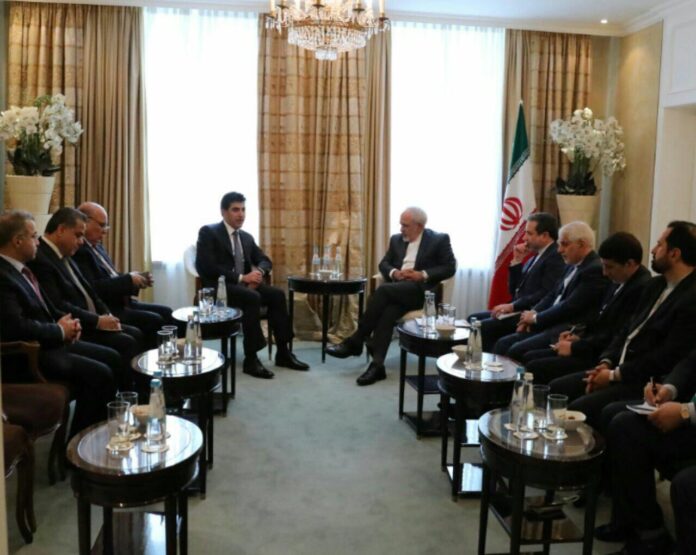
In a Sunday meeting with Iranian Foreign Minister Mohammad Javad Zarif in Munich, PM Barzani sincerely thanked the Islamic Republic for its support for the Iraqi Kurds.

He also noted that Erbil is developing a new protocol with the aim of expanding its relations and cooperation with Iran.

Zarif, for his part, called on the KRG officials to put harder efforts into resolving the problems that Iranian companies working in the region are struggling with and provide them with further facilities.

During the meeting held on the sidelines of the Munich Security Conference, the two sides also conferred on a number of issues including expansion of bilateral relations, especially in economic field.

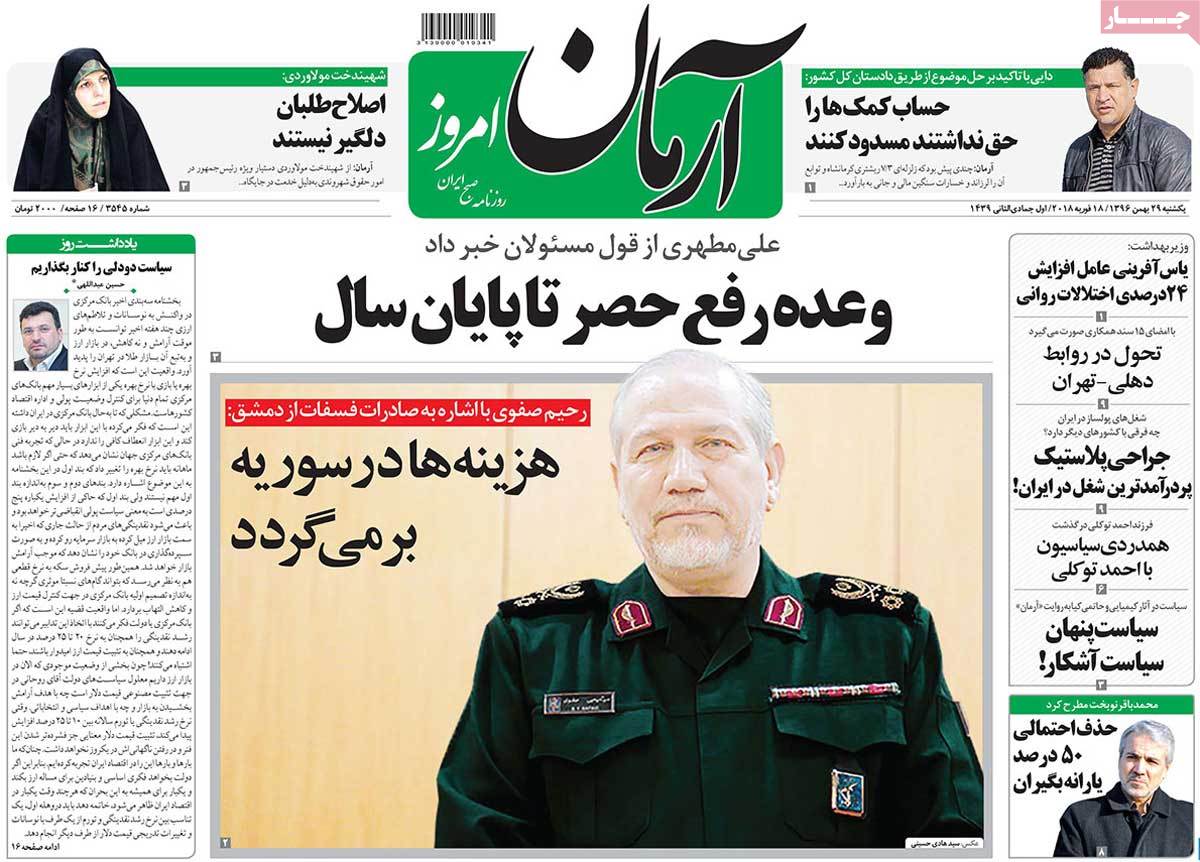
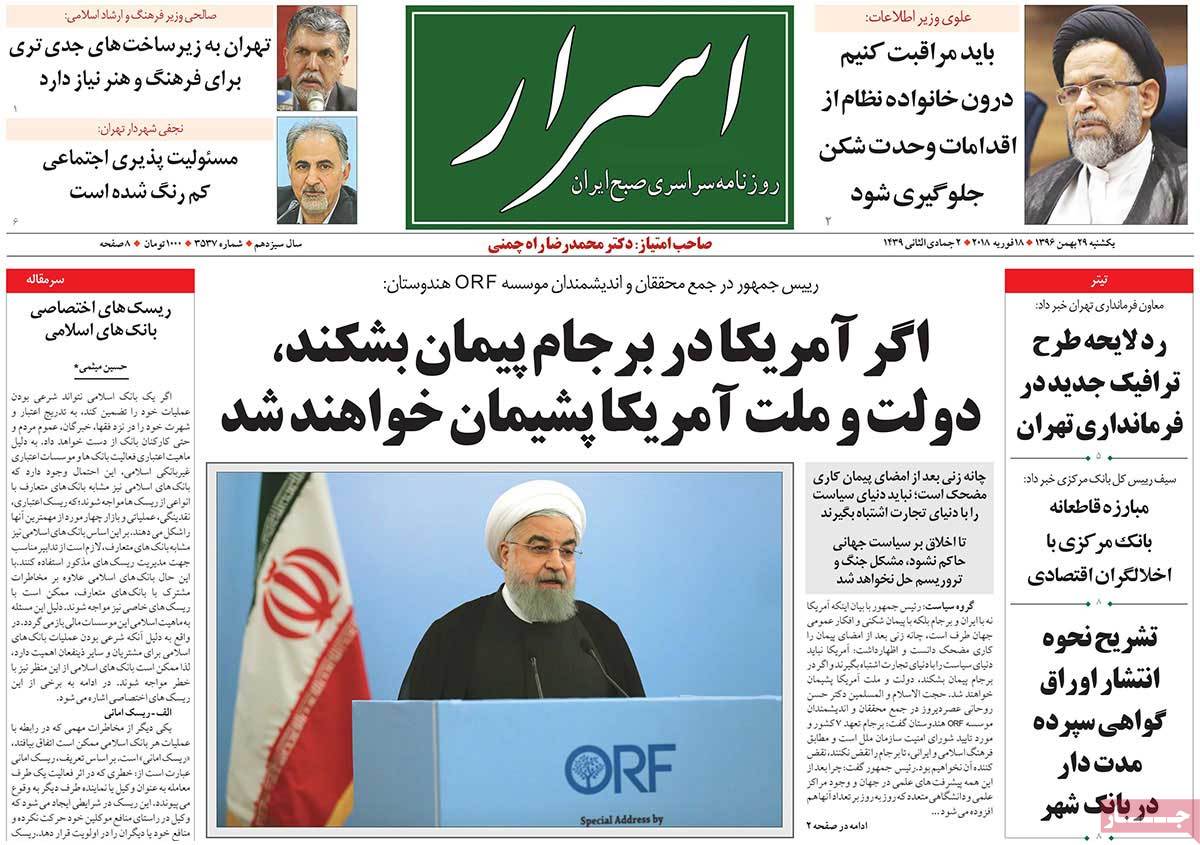
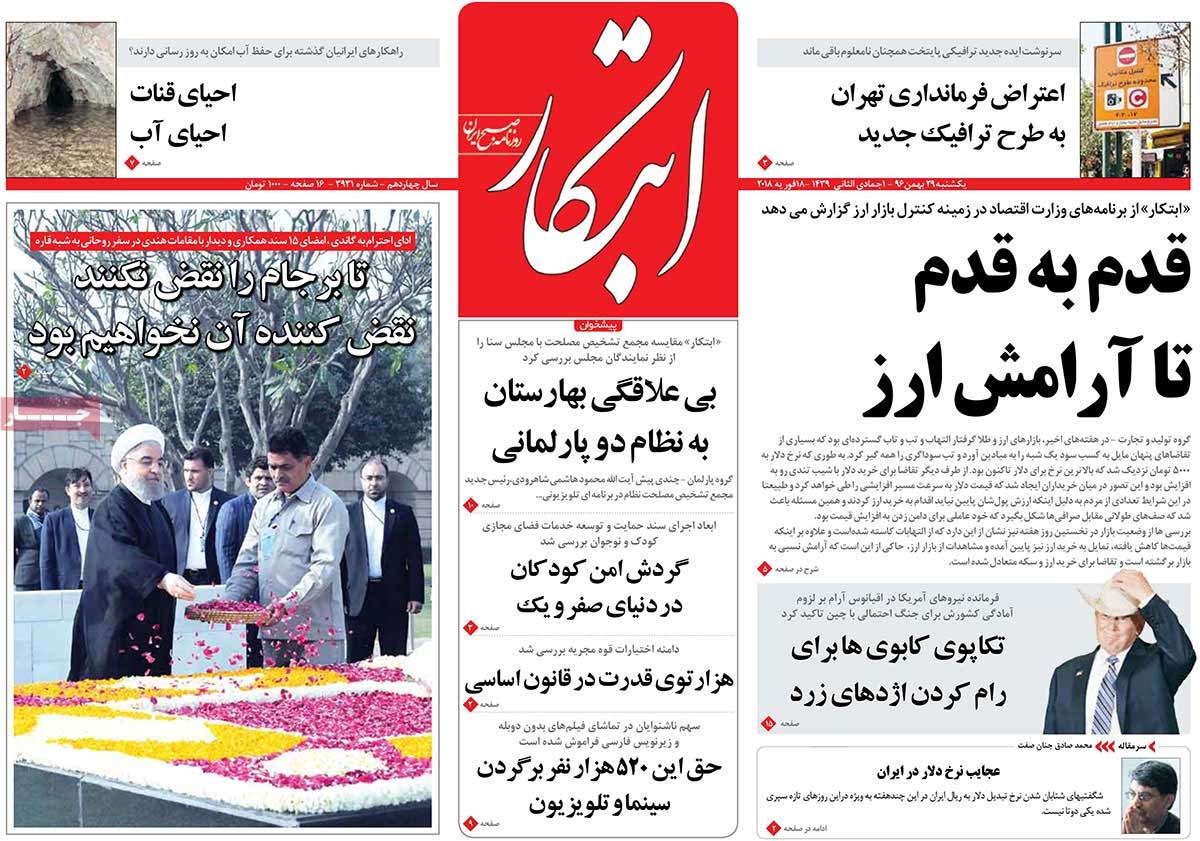
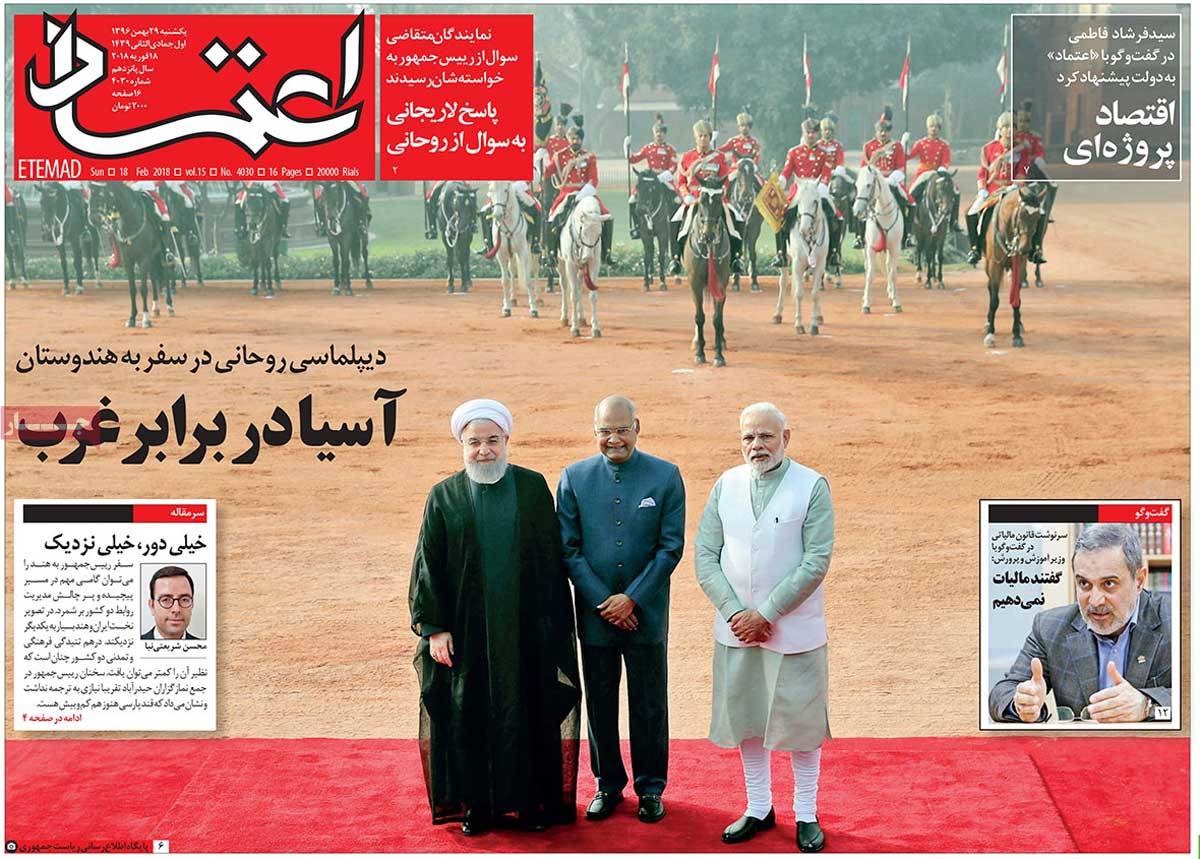
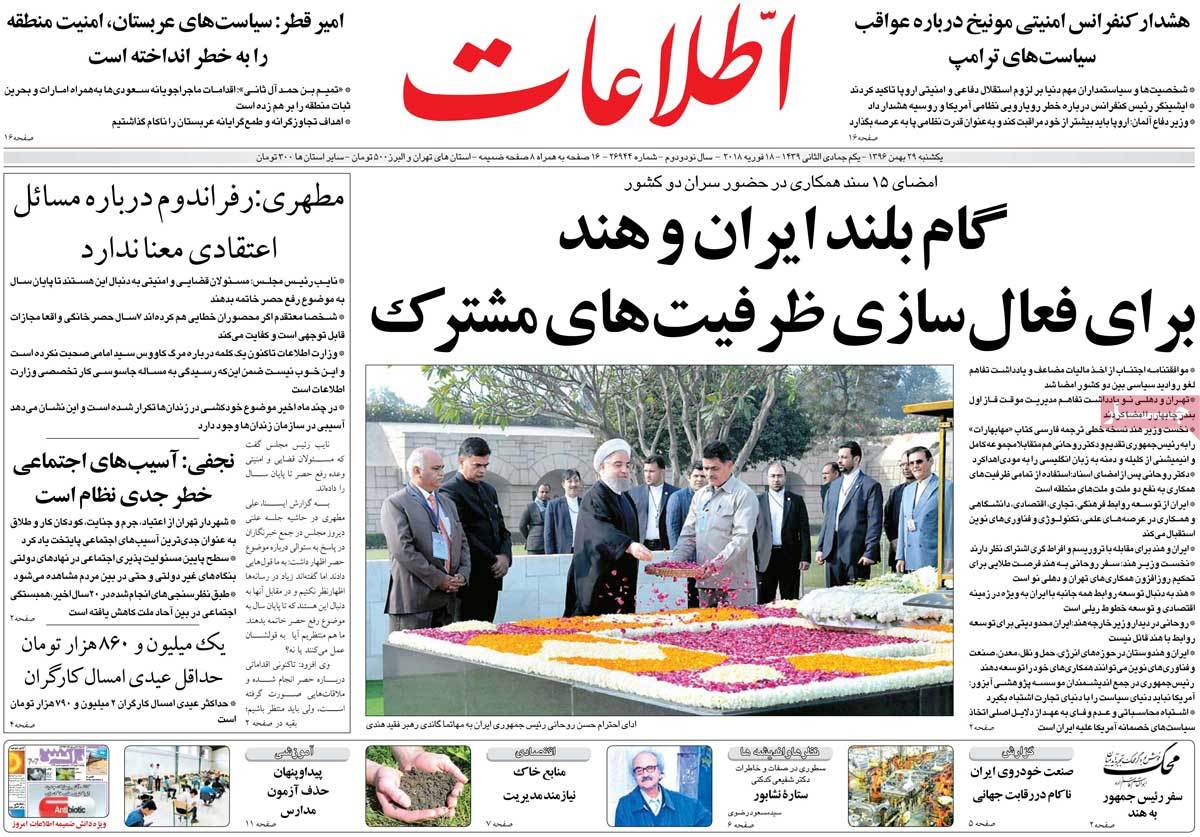
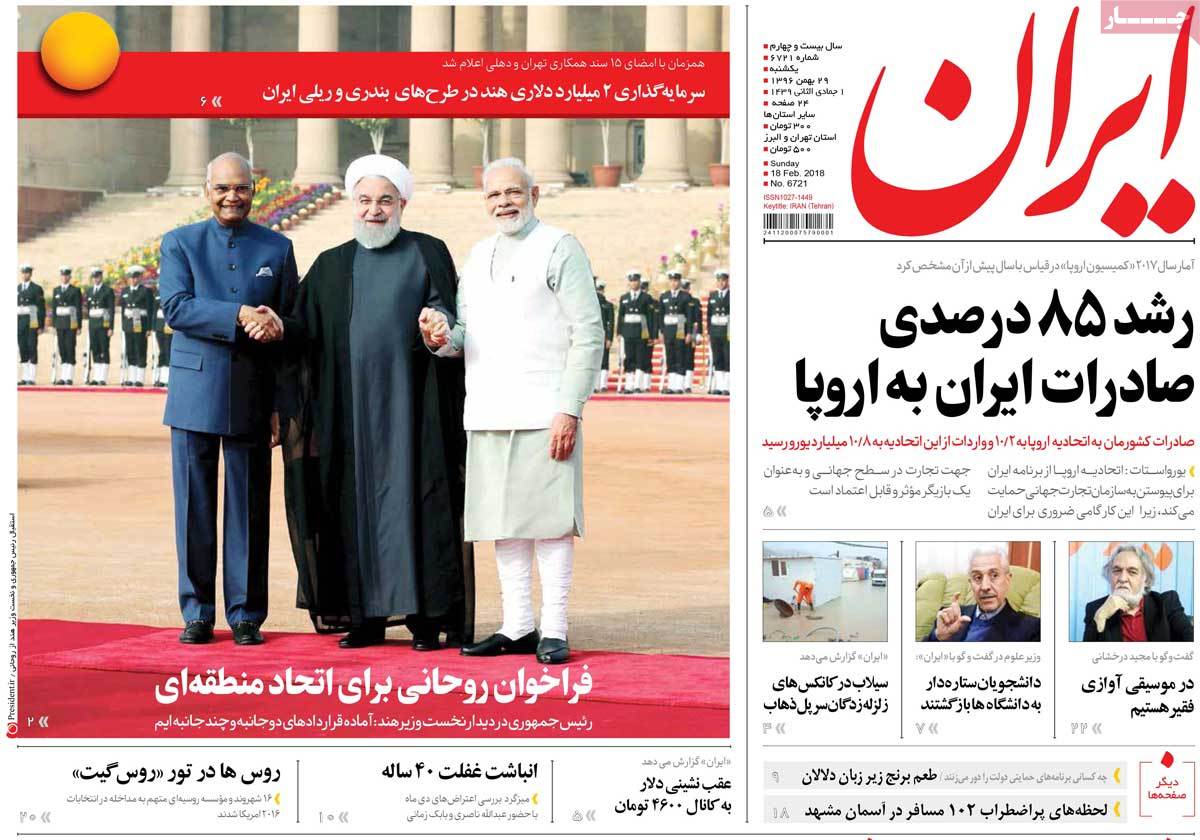
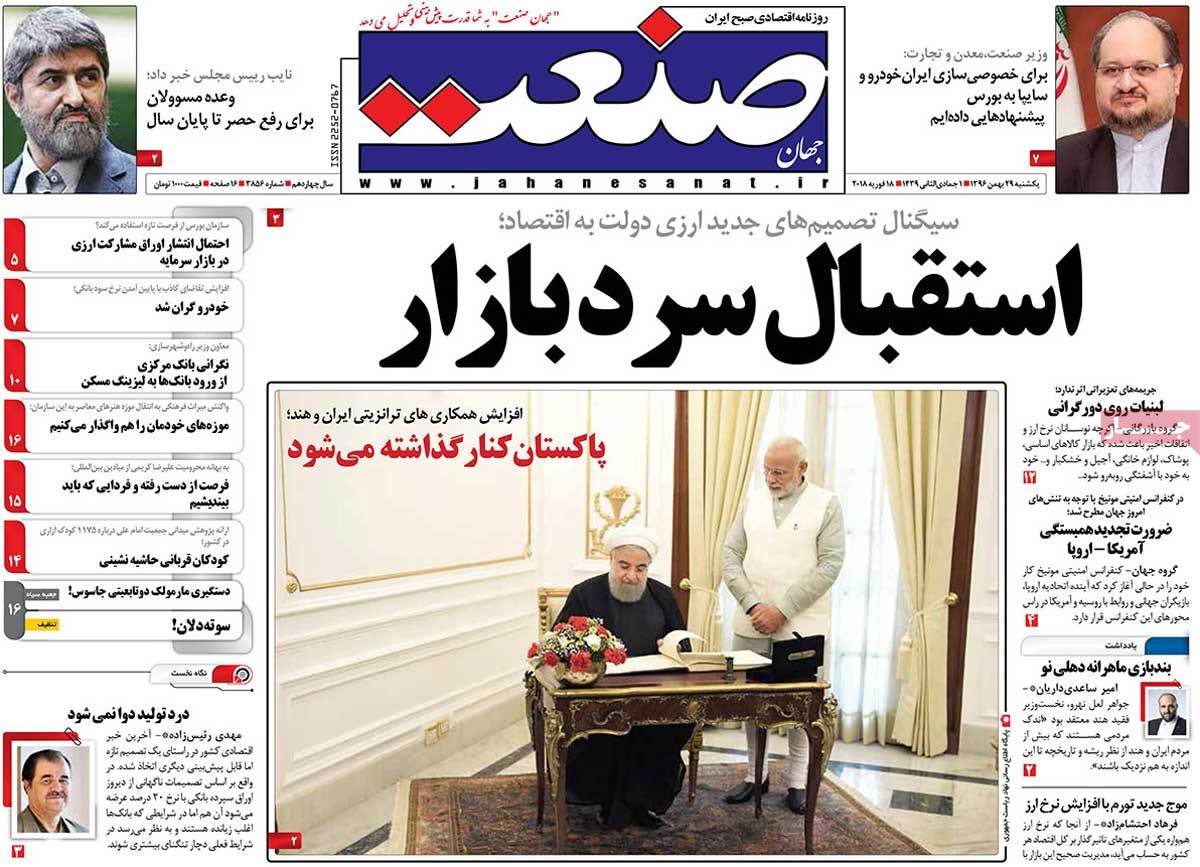
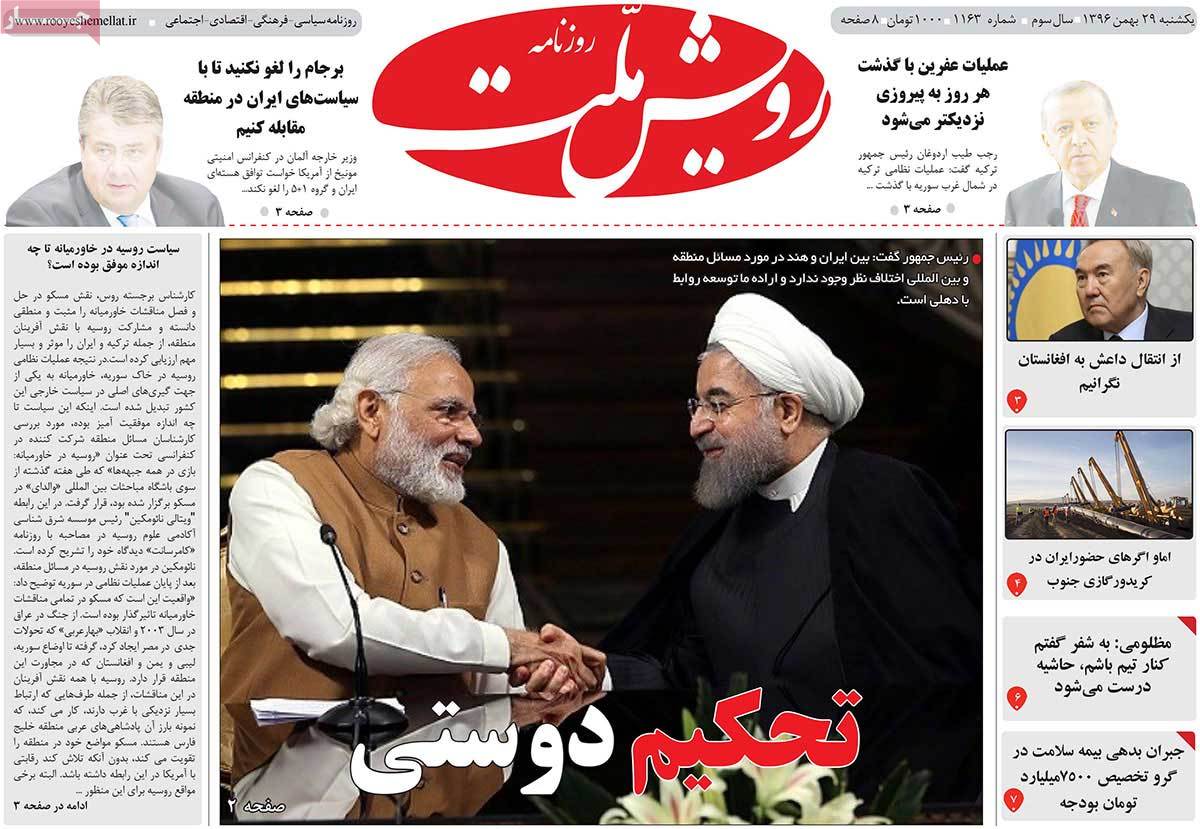
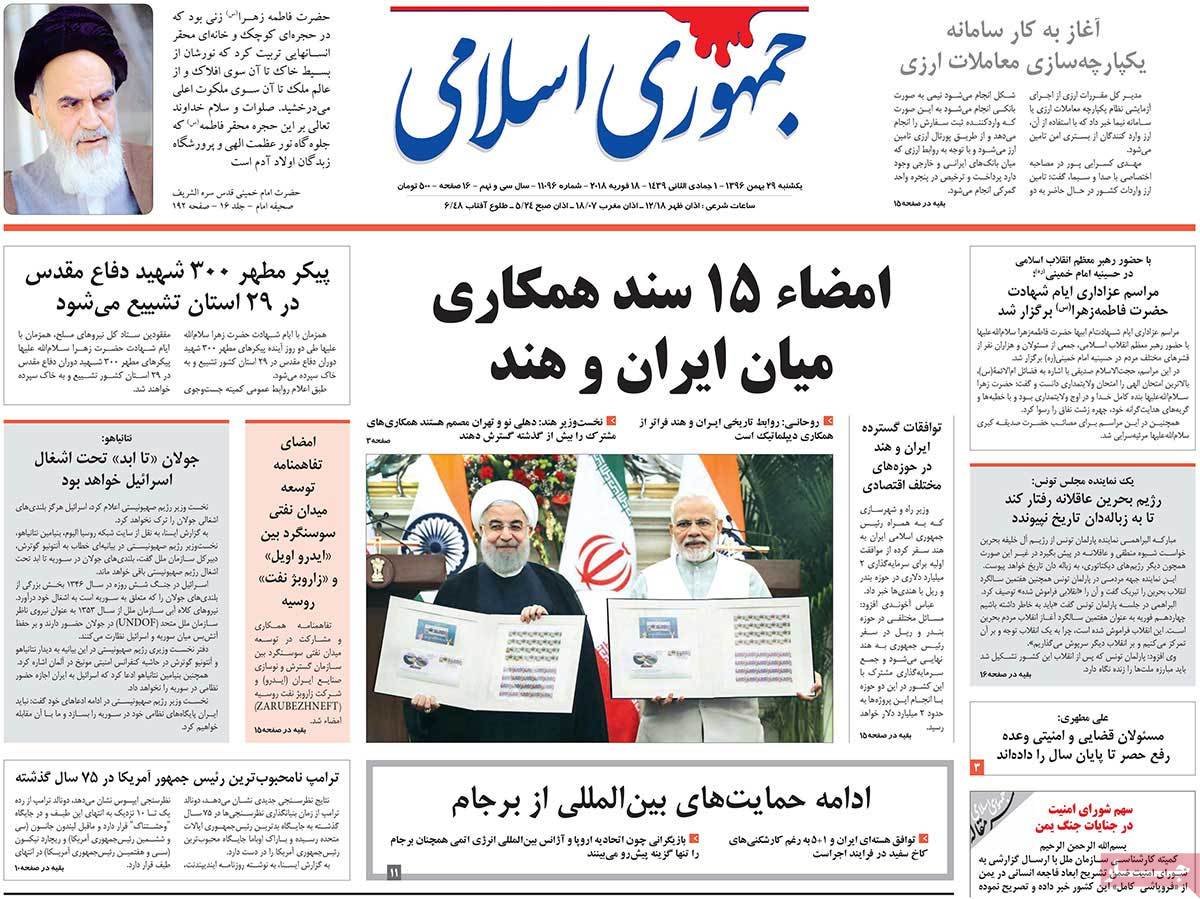
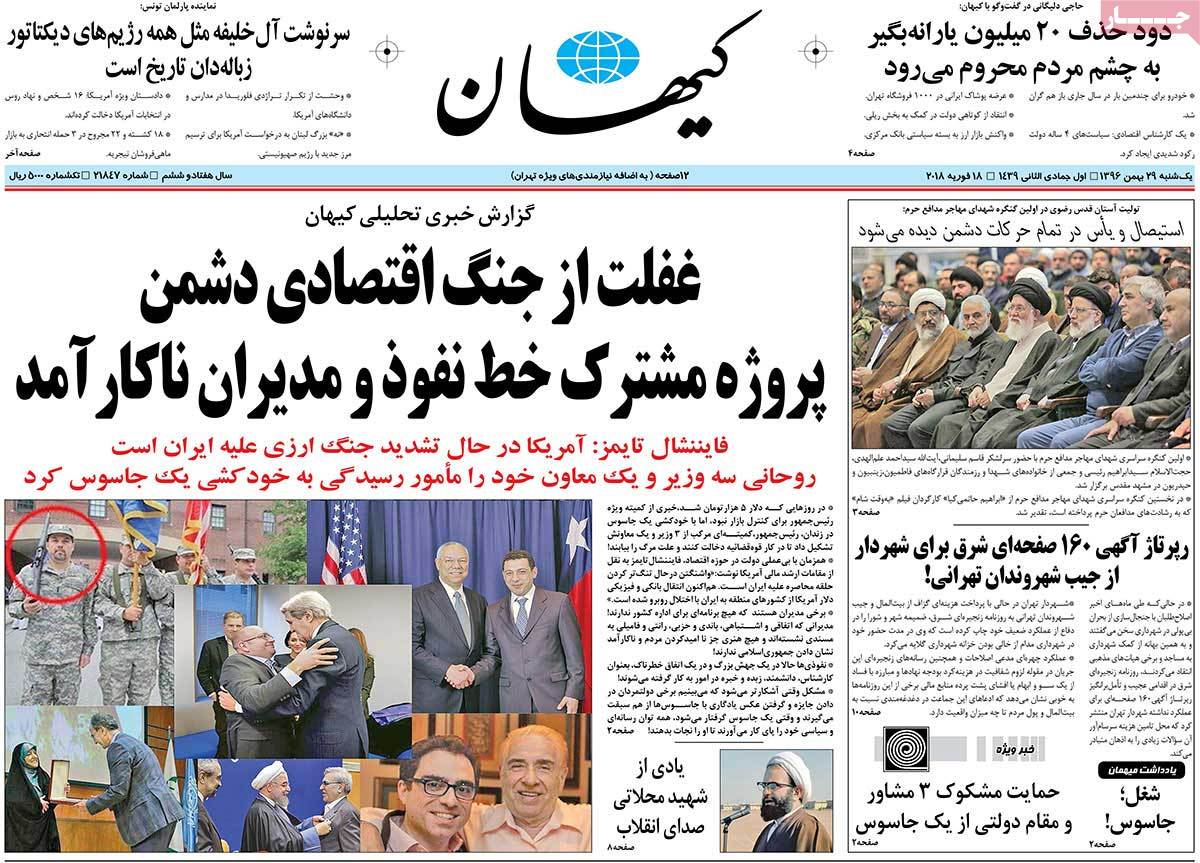
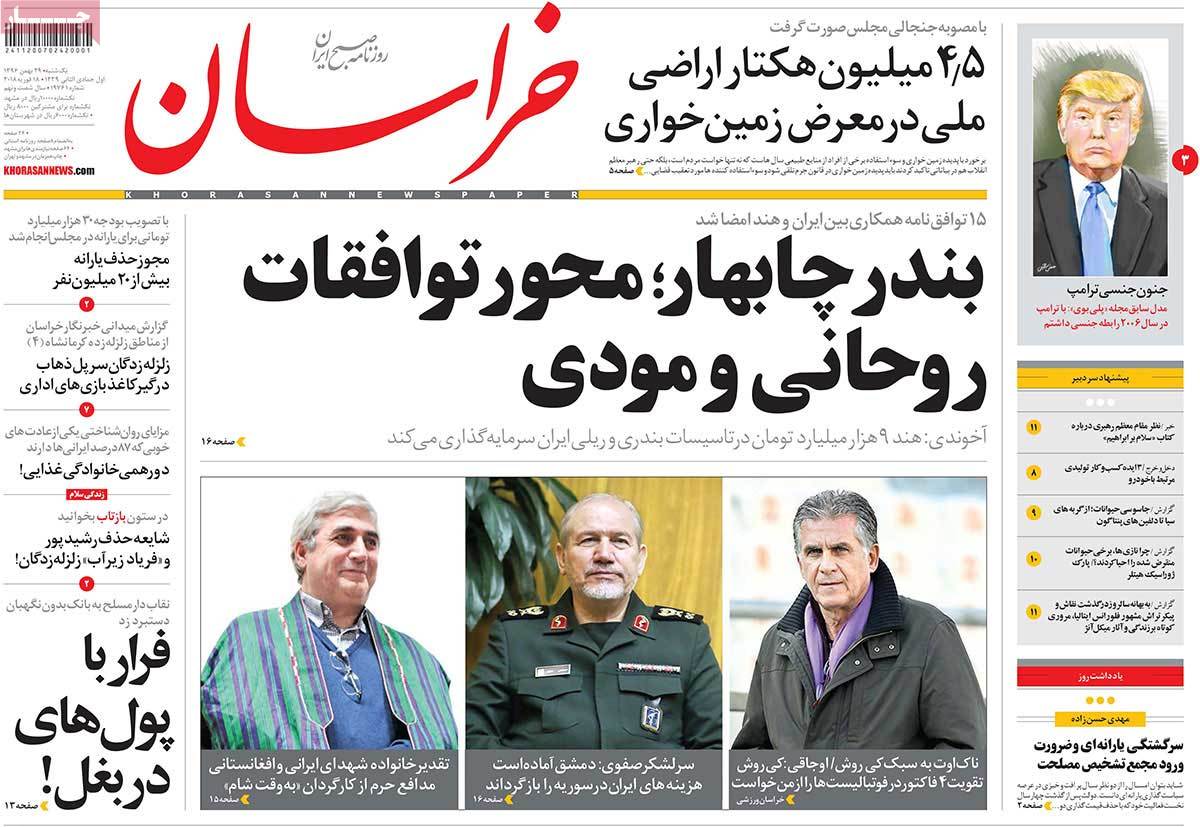
A Look at Iranian Newspaper Front Pages on February 18

A Look at Iranian Newspaper Front Pages on November 18

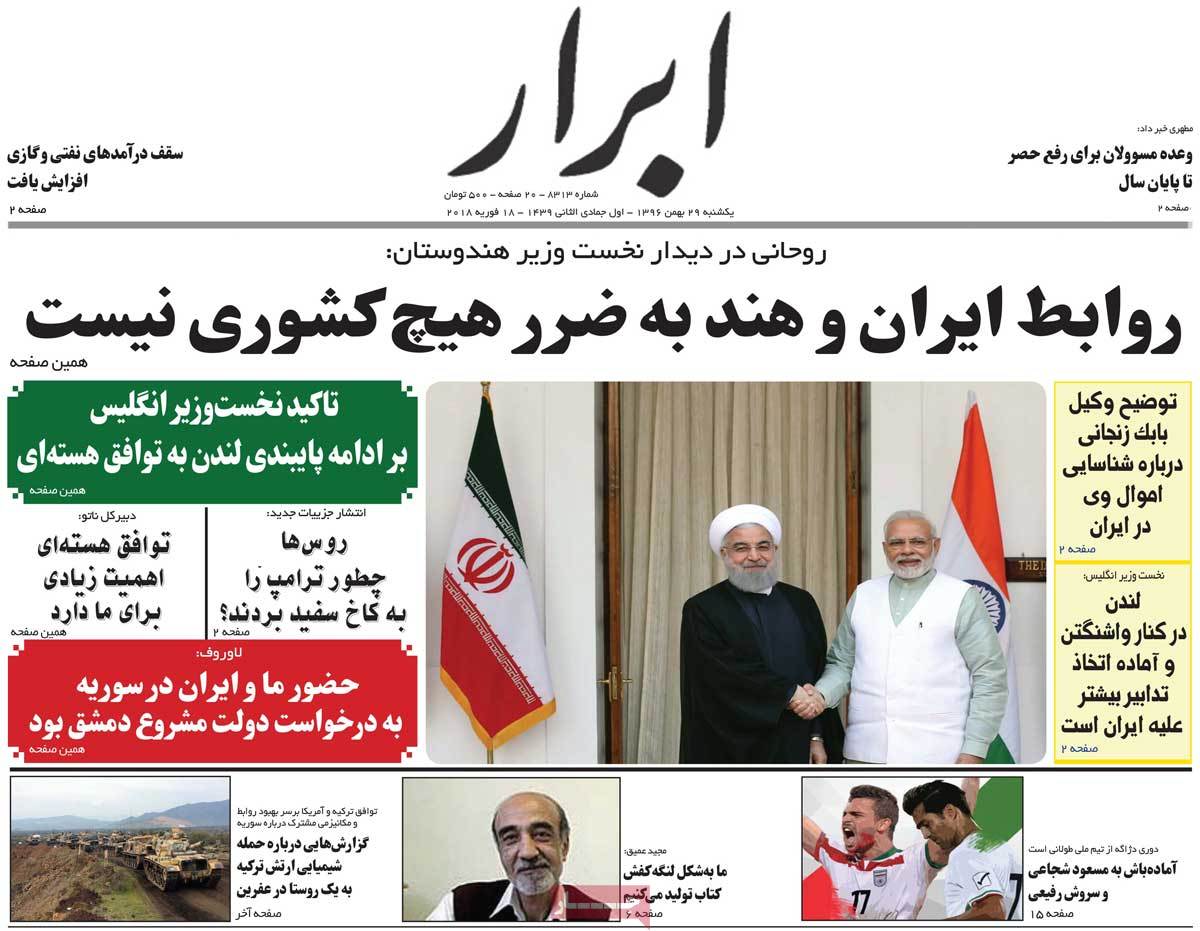
The top story in all papers today was the three-day visit of President Hassan Rouhani to India, and the agreements signed between the two sides.

The ongoing Munich Security Conference and the anti-Iran remarks made by its keynote speakers also received great coverage.

Also a top story was the remarks made by former IRGC chief-commander Major General Yahya Rahim-Safavi about the return of the money Iran spent for Syria through the economic gains Tehran will make in the future.

The above issues, as well as many more, are highlighted in the following headlines and top stories:


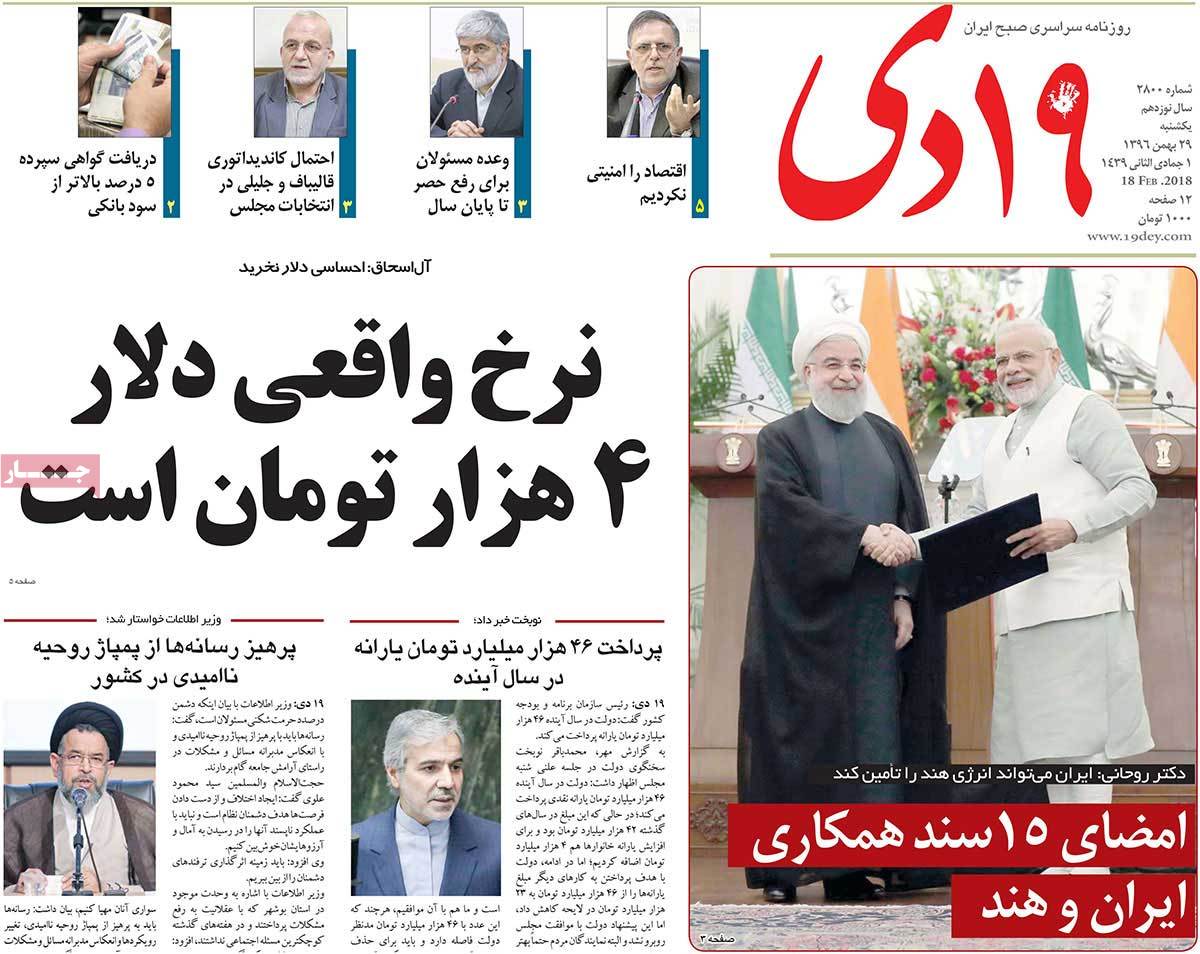
19 Dey:

1- Rouhani: Iran Can Meet India’s Energy Needs

  • 15 MoUs Signed between Iran and India

A Look at Iranian Newspaper Front Pages on February 18


Abrar:

1- Rouhani: Iran-India Ties Not Detrimental to Any Country

2- British PM Underlines London’s Continued Commitment to Iran Nuclear Deal

3- Lavrov: Presence of Russia, Iran in Syria at Request of Damascus’ Legitimate Gov’t

A Look at Iranian Newspaper Front Pages on February 18


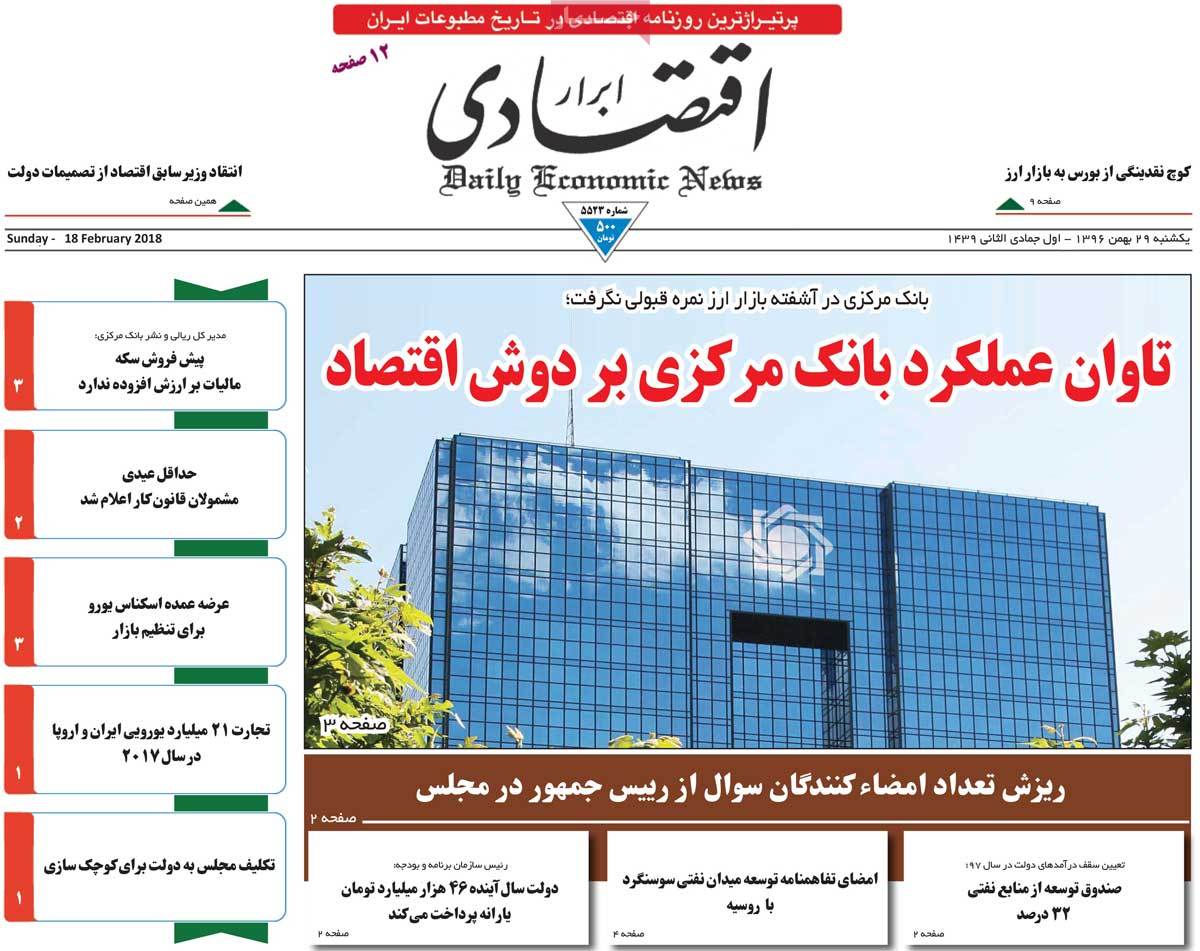
Abrar-e Eqtesadi:

1- Iran’s Economy Suffering from Central Bank’s Poor Performance

A Look at Iranian Newspaper Front Pages on February 18


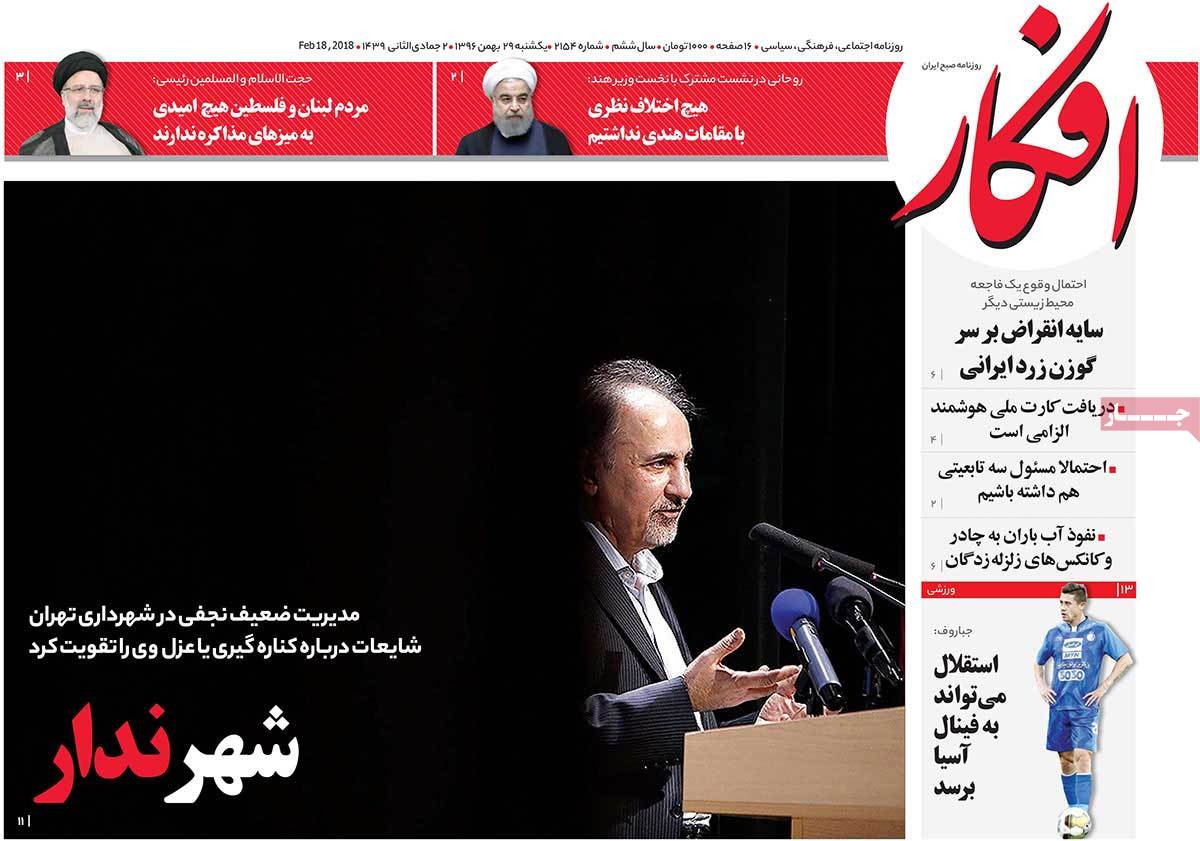
Afkar:

1- Iran’s Yellow Dear on Verge of Extinction

A Look at Iranian Newspaper Front Pages on February 18


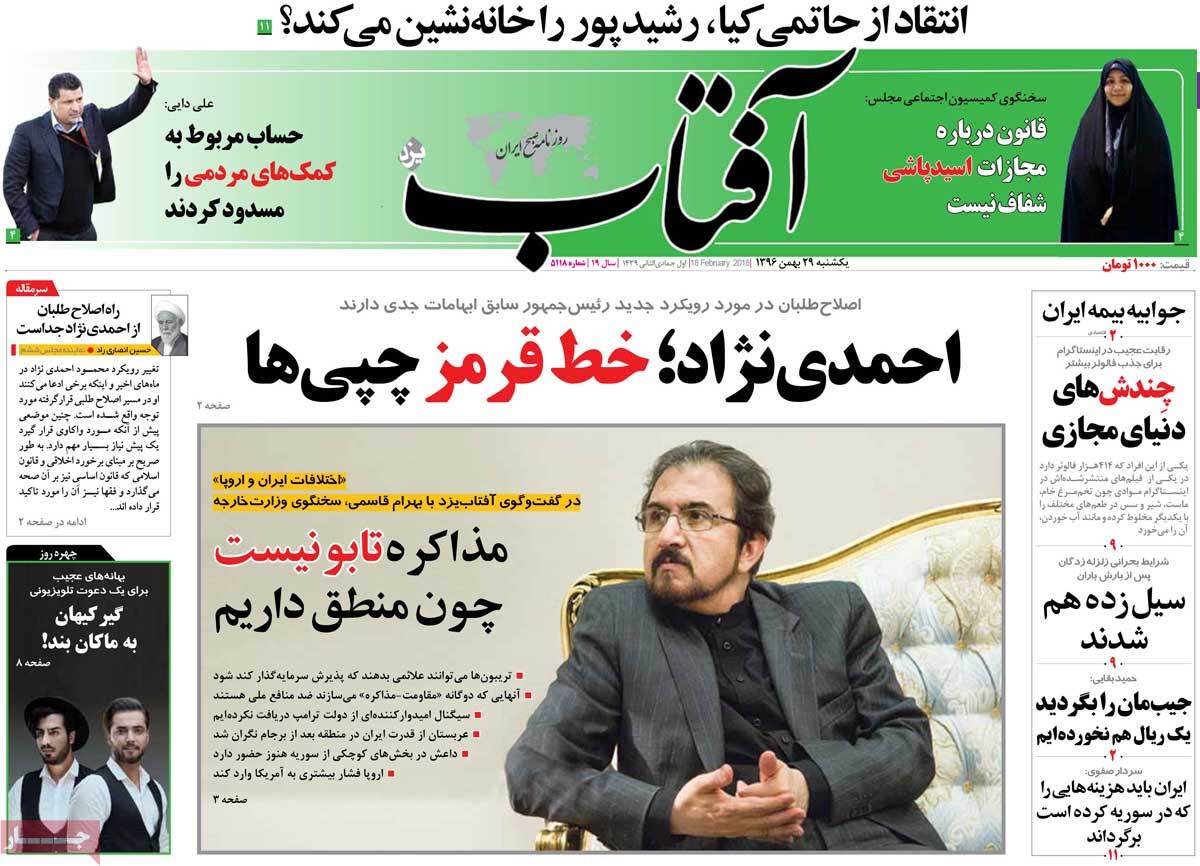
Aftab-e Yazd:

1- Iran Foreign Ministry Spokesman: Negotiation Not a Taboo as We Are Logical

  • Qassemi Discusses Iran-EU Differences in Exclusive Interview

2- IRGC General: All the Money We Spent on Syria Must Be Returned

A Look at Iranian Newspaper Front Pages on February 18


Arman-e Emrooz:

1- Top MP: Officials Have Promised to End House Arrest of Opposition Leaders by April

2- IRGC General: Money Spent in Syria to Be Returned

  • Iran Exporting Phosphate from Damascus

3- Plastic Surgeons Earn Highest Income in Iran!

A Look at Iranian Newspaper Front Pages on February 18


Asrar:

1- Rouhani: US Nation, Gov’t to Regret If Washington Breaks JCPOA Promises

A Look at Iranian Newspaper Front Pages on February 18


Ebtekar:

1- Rouhani: Iran Not to Be First One to Violate Iran Nuclear Deal

A Look at Iranian Newspaper Front Pages on February 18


Etemad:

1- Asia vs. West: Rouhani’s Diplomacy in Trip to India

A Look at Iranian Newspaper Front Pages on February 18


Ettela’at:

1- Big Step of Iran and India for Tapping into Joint Capacities

2- Qatar’s Emir: Saudi Policies Endanger Regional Security

3- Munich Security Conference’s Warning about Repercussions of Trump’s Policies

A Look at Iranian Newspaper Front Pages on February 18


Iran:

1- India’s $2 Billion Investment in Iran’s Port, Railway Projects

2- 85% Increase in Iran’s Exports to Europe: European Commission’s 2017 Report

A Look at Iranian Newspaper Front Pages on February 18


Jahan-e San’at:

1- Increased Transit Cooperation between Iran, India

  • Pakistan to Be Put Aside

A Look at Iranian Newspaper Front Pages on February 18


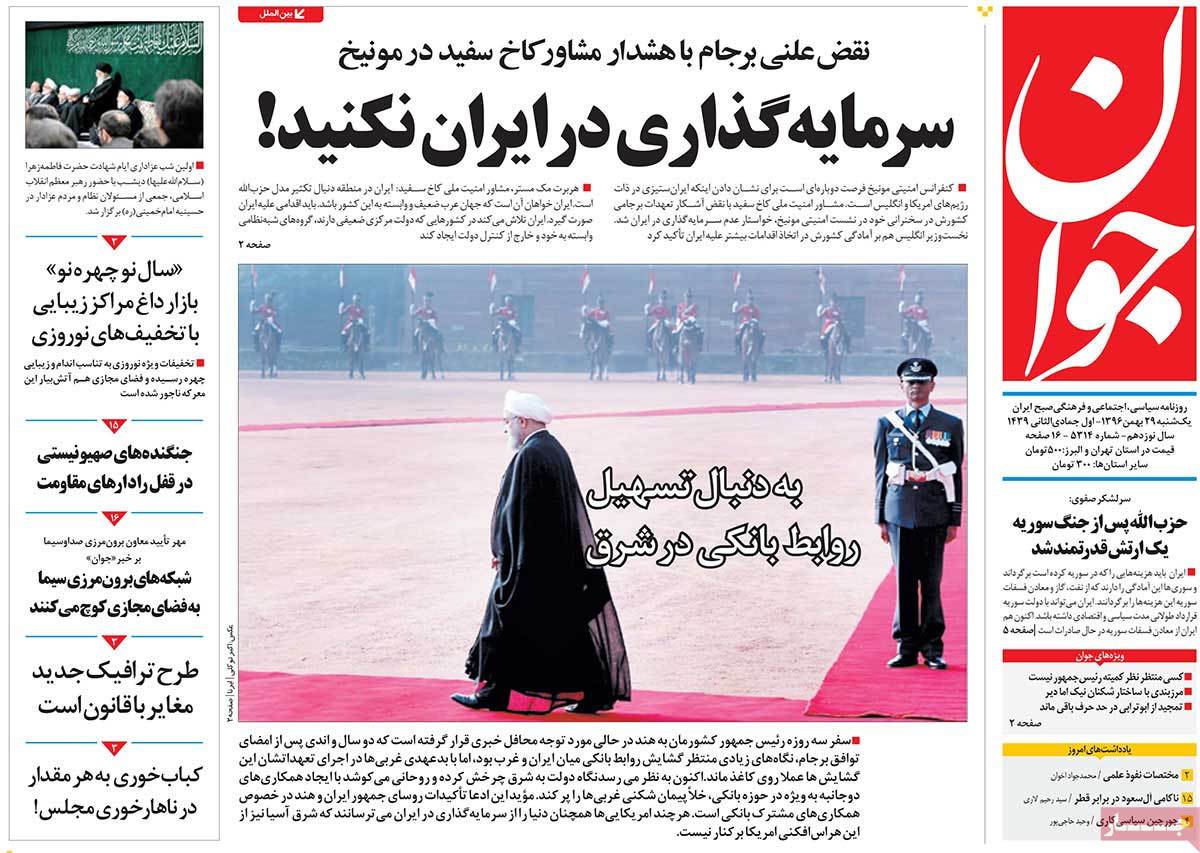
Javan:

1- US National Security Advisor’s Blatant Violation of Iran Nuclear Deal

  • Don’t Make Investment in Iran

2- Iran President’s Three-Day Visit to India: Looking for Facilitation of Banking Ties

3- IRGC General: Hezbollah Turned into Powerful Army after Syria War

A Look at Iranian Newspaper Front Pages on February 18


Jomhouri Eslami:

1- Continued International Support for Iran Nuclear Deal

2- Netanyahu: Golan to Be Occupied by Israel Forever

A Look at Iranian Newspaper Front Pages on February 18


Kayhan:

1- Negligence from Enemy’s Economic War: Joint Project by Infiltrators, Incompetent Managers

  • FT: US Exacerbating Forex War on Iran
  • Rouhani Tasks 3 Ministers, One Deputy with Pursuing Suicide of a Spy

2- Tunisian MP: Al Khalifa to End up in History’s Trash Bin Like All Other Authoritarian Regimes

A Look at Iranian Newspaper Front Pages on February 18


Khorasan:

1- Chabahar Port, Focus of Rouhani-Modi Agreements

A Look at Iranian Newspaper Front Pages on February 18


Rooyesh-e Mellat:

1- German FM: We’ll Counter Iran’s Regional Policies If You Don’t Annul Iran Nuclear Deal

A Look at Iranian Newspaper Front Pages on February 18


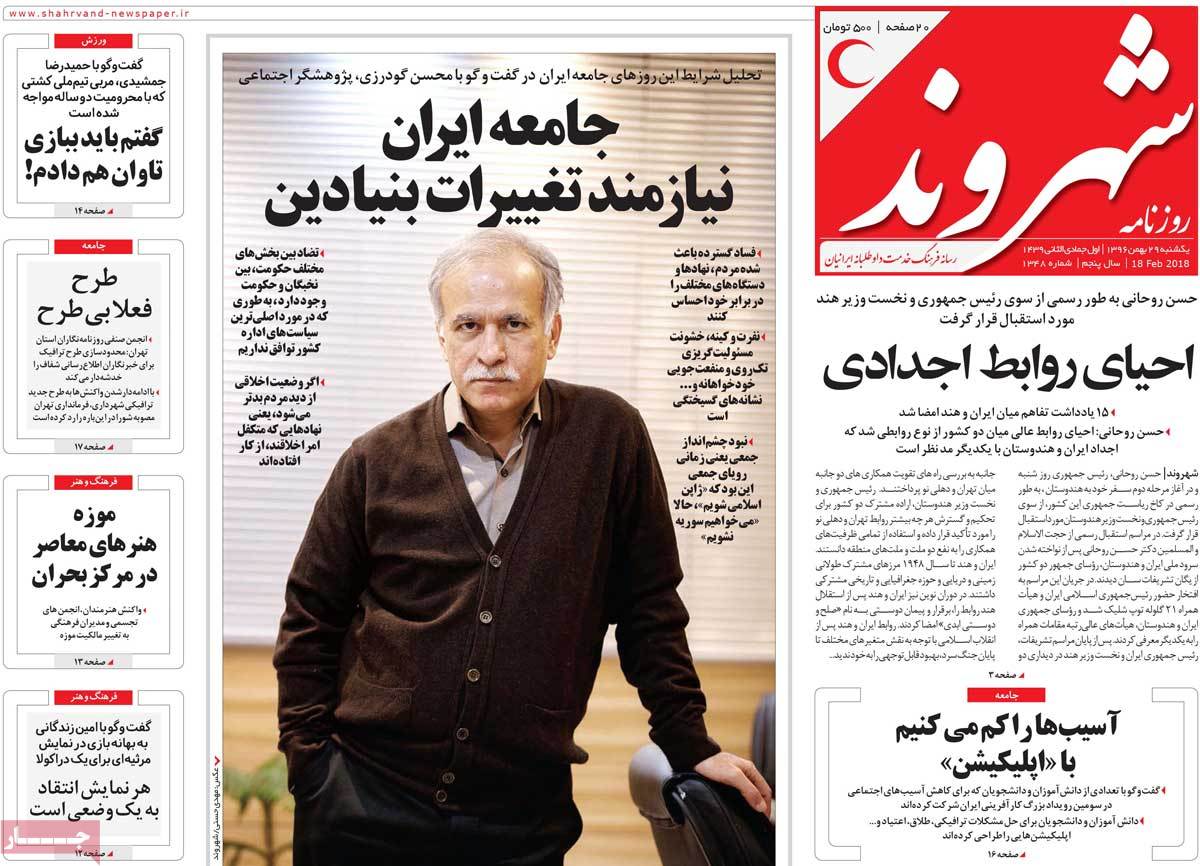
Shahrvand:

1- Iranian Society Needs Fundamental Changes: Analyst

A Look at Iranian Newspaper Front Pages on February 18


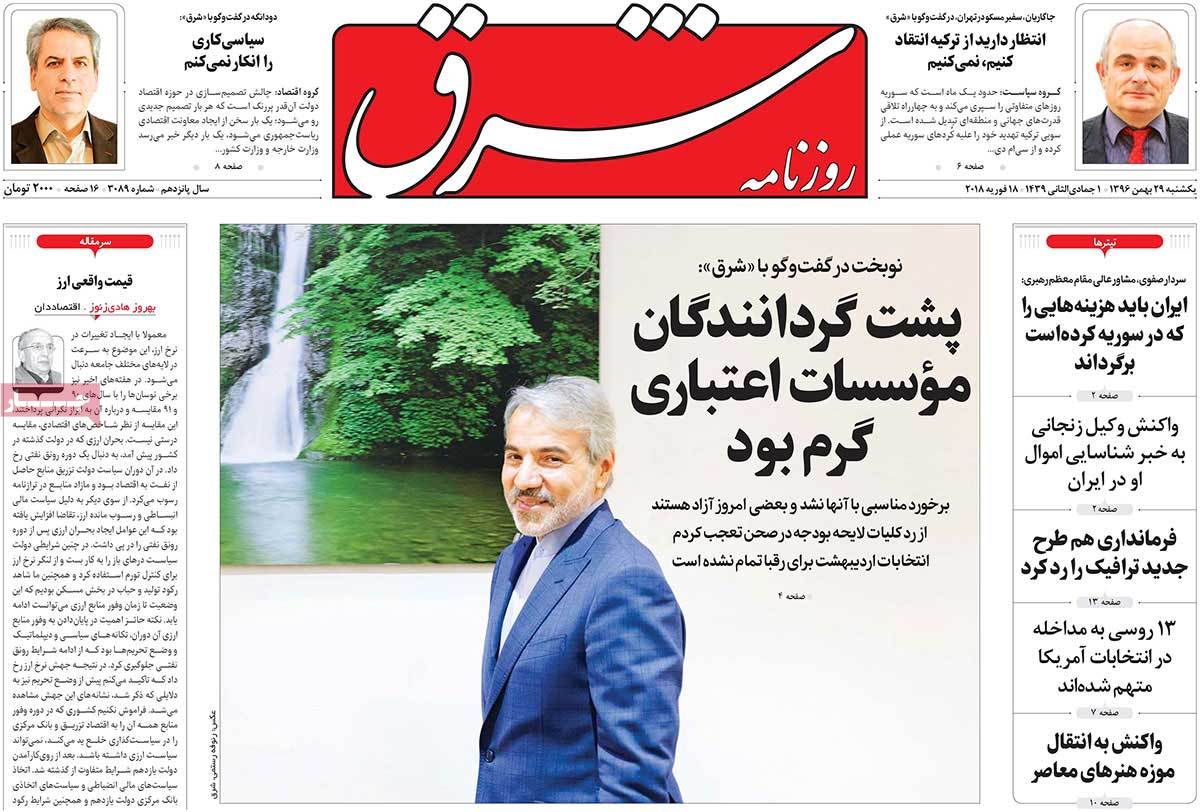
Shargh:

1- Russian Ambassador to Tehran: You Expect Us to Criticize Turkey, But We Don’t!

2- 13 Russians Accused of Interfering in US Elections

A Look at Iranian Newspaper Front Pages on February 18


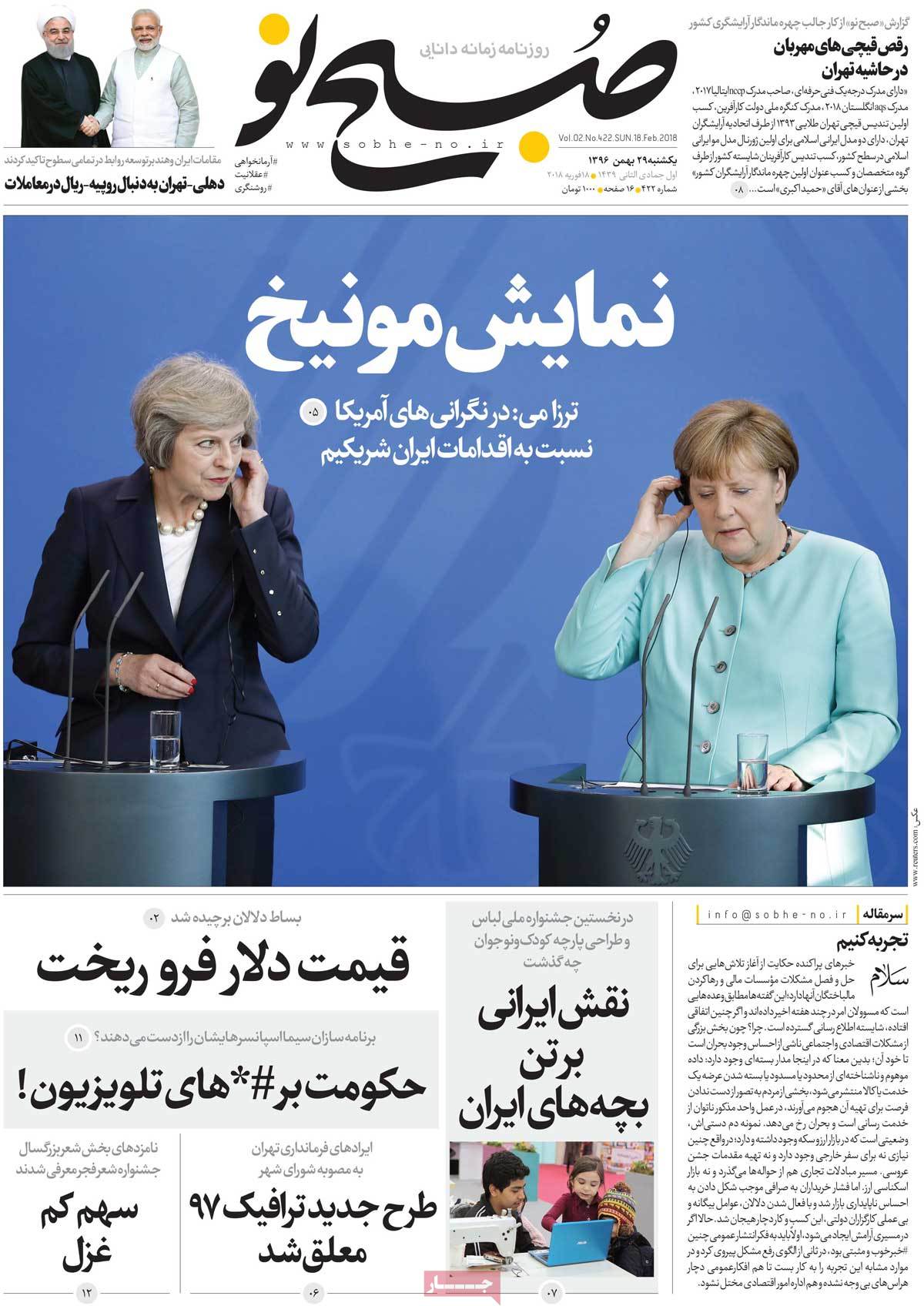
Sobh-e Now:

1- Munich Theatre

  • May: We Share US Concerns about Iran’s Measures

A Look at Iranian Newspaper Front Pages on February 18


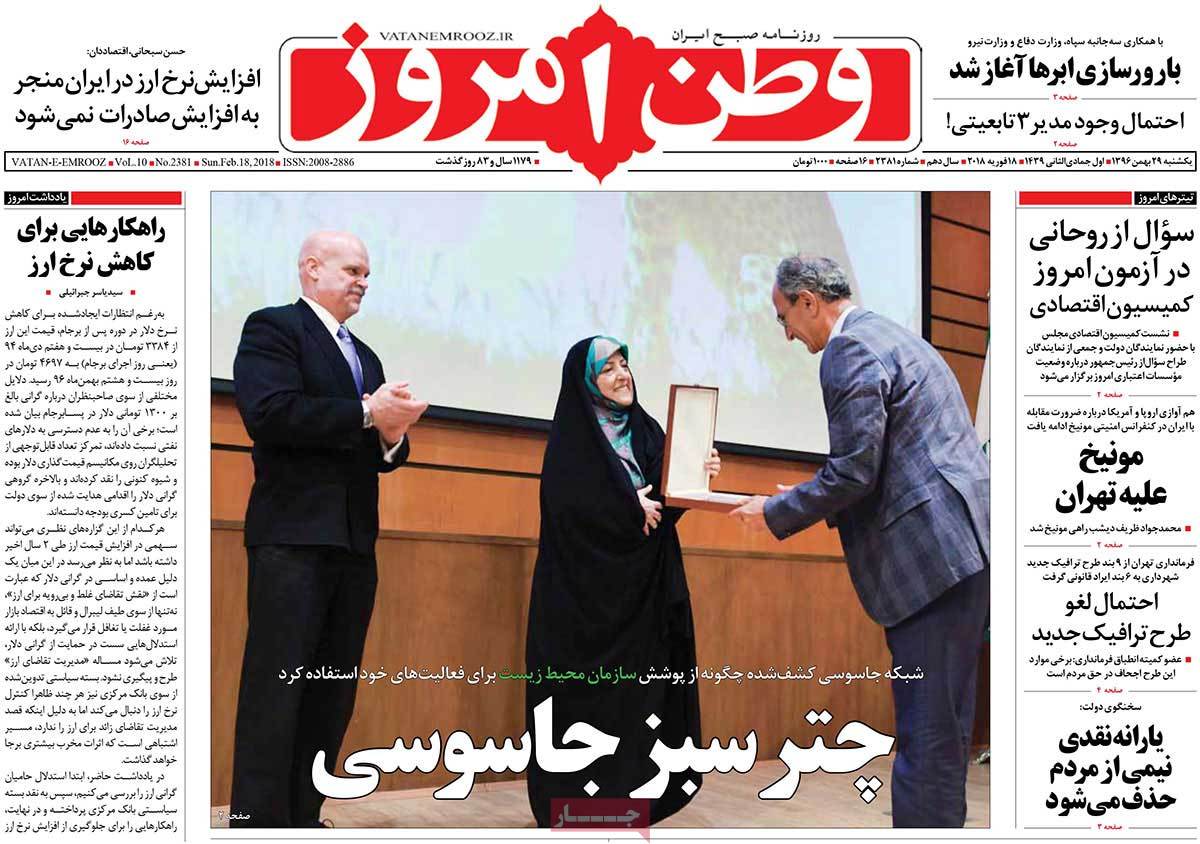
Vatan-e Emrooz:

1- IRGC, Energy Ministry, Defence Ministry Start Seed Clouding in Joint Project

2- Munich against Tehran

A Look at Iranian Newspaper Front Pages on February 18