Monday, April 20, 2026
Home Blog Page 2618

‘Bitter Satire’ Europeans Asking Iran Not to Implement Law Passed by MPs

Speaking in a press conference on Monday, Saeed Khatibzadeh said the government will abide by any legislation signed into law.

“With regards to the Iranian Parliament’s legislation, it is ridiculous and bitter satire that some representatives of Western democracies want us not to abide by democratic frameworks,” he noted. 

“We are definitely obliged to comply with legislation which has become law based on executive bylaws, and no one can make such a request. It is a strange request,” he underlined.

Iranian Vice President Es’haq Jahangiri on December 28, 2020 communicated the law to relevant bodies for implementation.

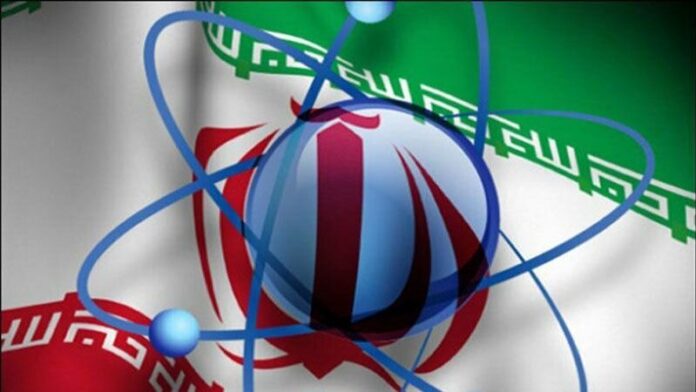
Iranian lawmakers recently approved legislation aimed at tackling sanctions imposed on the country. The law prevents international inspectors from accessing the country’s nuclear facilities in case the international sanctions are not lifted in two months.

The law instructs the Atomic Energy Organization of Iran (AEOI) to produce at least 120 kilogrammes of 20%-enriched uranium annually and stockpile it in the country and use it for peaceful purposes as needed.

Under the law, the government also has a duty to meet, fully and without delay, domestic industries’ need for uranium enriched up to a purity level of 20 percent and above for peaceful purposes.

The government also has a duty to raise the country’s uranium enrichment and production to realize the enrichment capacity of 190 thousand separative work units (SWU).

Based on the law, the government is duty-bound, too, to make use of advanced centrifuges, including IR6 and IR2M types.

Iran’s Gov’t Bodies Officially Instructed to Implement Sanctions Legislation

The legislation is also aimed at ensuring the full implementation of the 2015 Iran nuclear deal, officially known as the Joint Comprehensive Plan of Action (JCPOA).

The bylaw had been ratified by the Cabinet on December 20, 2020 at the suggestion of the Ministry of Foreign Affairs, the Atomic Energy Organization of Iran (AEOI), the Budget and Planning Organization and the Legal Department of the Presidential Office in line with the implementation of the legislation.

Under the bylaw, the AEOI will prepare a comprehensive report on the status quo as well as on cases in which 20%-enriched uranium is needed, and present the report to the government within two months of the date the legislation became binding in law.

After the necessary funds and technical requirements have been provided, the AEOI will take the necessary measures to enrich uranium for peaceful purposes in such a way that at least 120kg of the material is stockpiled in a year’s time.

Furthermore, in order to create the capacity to produce 500kg of low-enriched uranium, the AEOI will, after the necessary funds have been appropriated, install and put into service one thousand IR2M and as many IR-6 centrifuges in three months’ and one year’s time respectively.

Moreover, the Atomic Energy Organization of Iran will complete work to put into service the metal uranium production factory in the central city of Isfahan, so that the facility will be operational at the end of the set period of time.

The AEOI is also duty-bound to present to the government separate reports on the measures already adopted and measures which remain to be taken as well as on items and finances required to put into service and retrofit the Khandab reactor. The organization is also obliged to present the relevant timetable to the government to be sent to Parliament accordingly.

Also, relevant government bodies, including the ministries of oil, foreign affairs, economic affairs and finance, and industry, mines and trade, as well as the AEOI, the Central Bank and the Legal Department of the Presidential Office, with the coordination of the Ministry of Foreign Affairs, are obliged to present relevant reports on the fulfilment of commitments by signatories to the JCPOA and measures adopted to remove the relevant obstacles.

The above-said reports will be collected by the Ministry of Foreign Affairs and handed over to the government, which will make the appropriate decision accordingly in the remaining time based on the reports it has received in accordance with the directives of the Supreme National Security Council, the objectives of the legislation and national interests.

Moreover, the ministries of defense, justice, oil, foreign affairs, economic affairs and finance, industry, mines and trade, along with the AEOI, the Central Bank and the Legal Department of the Presidential Office will report to the government on the JCPOA parties’ compliance with their commitments to effectively lift sanctions and make it possible for Iran to enjoy its rights and reap the economic and political benefits of the JCPOA.

The reports will be handed over within specified timeframes after the legislation on lifting sanctions goes into effect, so that the government will make decisions accordingly.

The Budget and Planning Organization will earmark the necessary funds for the enforcement of the legislation in annual budget bills.

 

Iranian Health Ministry’s Updates on COVID-19 – December 28

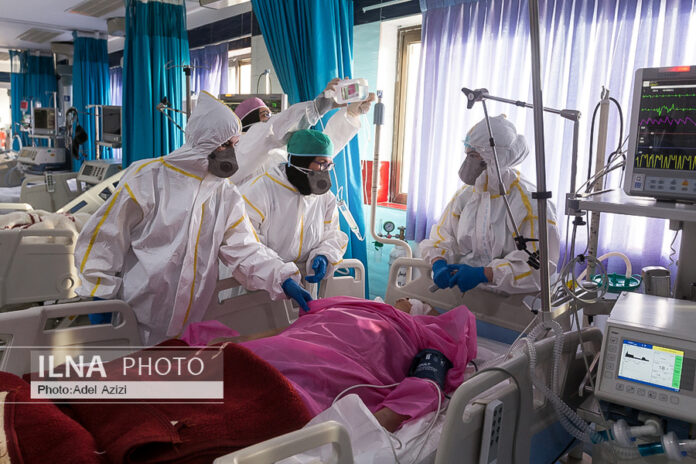
In a press briefing on Monday, Health Ministry spokeswoman Sima-Sadat Lari reported 5,908 new cases of COVID-19 infection, raising the total number of cases to 1,206,373.

So far, Lari added, 960,751 patients have recovered from the disease or been discharged from the hospital.

Lari said 5,174 patients are also in critical conditions caused by more severe infection.

The spokeswoman noted that 7,460,422 COVID-19 tests have been taken across the country so far.

She said currently 108 cities are in the “orange zone”, and 340 in the “yellow zone” in terms of coronavirus outbreak.

Europe, US Both Breached Iran Nuclear Deal: Spokesman

Saeed Khatibzadeh told a weekly press briefing Europe is directly responsible for its failure to make good on its obligations under the deal.

“ … Europe along with the US has violated the JCPOA. The United Sates shoulders special responsibilities for the destructive measures it has adopted, but Europe, too, has been an accomplice to the breach of the JCPOA, which can be proven by figures and data,” he said.

“If you consider the volume of Iran-Europe trade before the JCPOA was signed, during the time it was being implemented and after Europe failed to make good on its obligations, it is evident that Europe is directly responsible for its failure to deliver on its commitments under the JCPOA,” the spokesman added.

“Of course, it was said that this is the last chance for Europe. If the Europeans preserve the JCPOA, it will serve their strategic interests,” Khatibzadeh said.

He made it clear that Iran will return to its obligations under the deal as soon as Europe does so.

“We have already said, and we also said it at the [unofficial] meeting [of Europe’s foreign ministers], that whenever the other signatories to the JCPOA live up to their commitments effectively, the Islamic Republic of Iran will roll back all the reversible measures it has adopted, i.e., those five steps that Iran has taken to scale down its commitments, and will stop those measures,” the spokesman underscored.

Khatibzadeh also referred to an unofficial meeting of foreign ministers of countries which are signatories to the JCPOA.
“A decision was made to hold an unofficial meeting of foreign ministers of the remaining state parties to the JCPOA after the regular meeting of the joint commission,” he said.

“As it was an unofficial meeting, the participants mostly reviewed the different developments related to the JCPOA, whether those in Washington or others. They were all developments associated with the JCPOA,” he explained.

“Some of the remaining signatories to the JCPOA expressed their views. Iranian Foreign Minister [Mohammad Javad] Zarif clearly mentioned his points in a tweet, too,” he added.

Iran FM Holds Talks with Senegalese, Ghanaian Diplomats

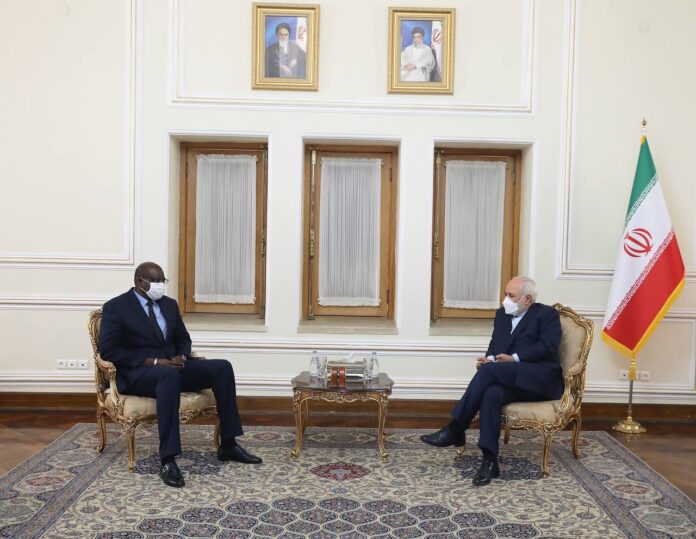
In the Tuesday meeting with Eric Owusu-Boateng, the new Ghanaian ambassador to Tehran, Zarif received a copy of the African envoy’s credentials at the beginning of his mission in the Iranian capital.

Senegal’s outgoing ambassador to Tehran Amadou Sow also bid farewell to Foreign Minister Zarif at the end of his diplomatic mission in Tehran.

Iran FM Holds Talks with Senegalese, Ghanaian Diplomats

A Look at Iranian Newspaper Front Pages on December 28

Iranian Newspapers

Aftab-e Yazd Newspaper:

1- Gov’t to Tax People’s Banking Transactions: Intervention in People’s Personal Financial Exchanges

A Look at Iranian Newspaper Front Pages on December 28


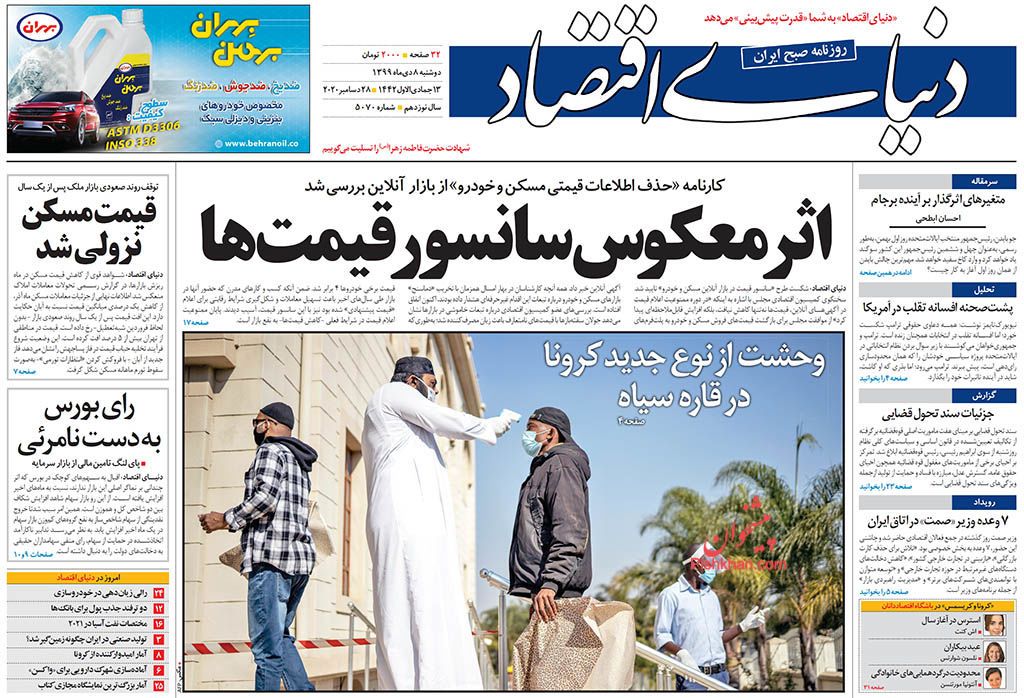
Donya-ye Eqtesad Newspaper:

1- Fear of New Coronavirus Strain in Africa

A Look at Iranian Newspaper Front Pages on December 28


Ebtekar Newspaper:

1- Decline of US-Saudi Relations: Ties Dependent on Trump’s Presidency

2- Rouhani: Budget Bill’s Approval to Show Determination for Solving People’s Problems

3- FATF Issue Complicated; The Fuss Made about It Won’t Work: Expediency Council

4- Health Minister: We’ll Prove Iranian Vaccine Outperforms Foreign Ones

A Look at Iranian Newspaper Front Pages on December 28


Etemad Newspaper:

1- 40 Days until COVID-19 Vaccination in Iran

2- Power Developments in Region and Iran’s Rational Reaction

3- Three Similar Conservatives to Run for President

* Ahmadinejad, Qalibaf, Zarghami Take One Step Closer to 2021 Elections

A Look at Iranian Newspaper Front Pages on December 28


Ettela’at Newspaper:

1- COVID-19 Deaths, Infections near Zero in Many Provinces

A Look at Iranian Newspaper Front Pages on December 28


Hamshahri Newspaper:

1- Farewell to Victims of Mountain

A Look at Iranian Newspaper Front Pages on December 28


Iran Newspaper:

1- Iran Seeks to Interact with the World on Human Rights: Deputy FM

A Look at Iranian Newspaper Front Pages on December 28


Javan Newspaper:

1- Unbridled Coronavirus in Europe Now Contained in Iran

2- Iran Ready to Commemorate Hero of Muslim Society

A Look at Iranian Newspaper Front Pages on December 28


Kayhan Newspaper:

1- 48 Terrorists on List of Those behind Hajj Qassem’s Assassination

2- We’ll Hit Targets Belonging to Israel and Its Allies in Red Sea

3- Yemeni Foreign Ministry: Iraqis, Syrians Hold Ceremonies to Mark Martyrdom Anniv. of Gen. Soleimani, Abu Mahdi

A Look at Iranian Newspaper Front Pages on December 28


Mardom Salari Newspaper:

1- Iran Has Always Been Active Player in History

2- Hawkish Senators Trying to Sabotage JCPOA Revival

A Look at Iranian Newspaper Front Pages on December 28


Shahrvand Newspaper:

1- FATF to Be Discussed Irrespective of the Fuss

2- Everything You Need to Know about Horrible British Coronavirus

A Look at Iranian Newspaper Front Pages on December 28


Shargh Newspaper:

1- Same 2017 Candidates to Run in 2021?

* 2021 to Be More Difficult for Qalibaf than 2017, 2013

2- Interview that Ignored Parts of Reality: A Look at Tolo News’ Interview with Zarif

3- Increased Poverty, Inequality in Coronavirus-Hit Iran [Editorial]

A Look at Iranian Newspaper Front Pages on December 28

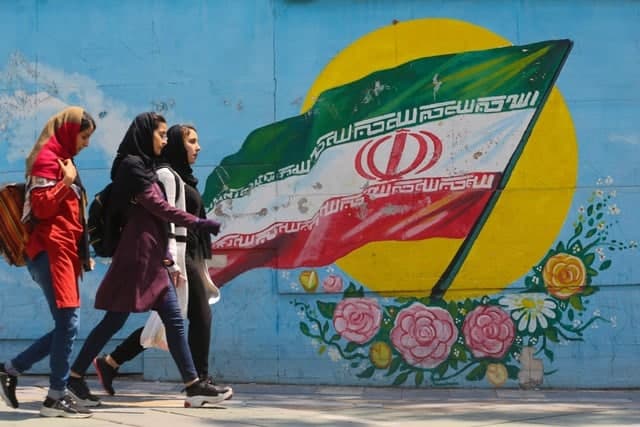
Iranian Women Making Their Presence Felt on World Stage: VP

Vice President for Women and Family Affairs Masoumeh Ebtekar described women as a key ingredient of the country’s social assets.

“The Islamic Revolution set the stage for the presence of women in different social arenas unlike what certain people thought that the Islamic Republic of Iran would restrict or isolate women, something that never happened,” she noted.

The vice president underlined Iranian women both handled their duties at home as mothers and wives and at the same time made their presence felt in different social arenas.

“Forty-one years on since the Islamic Revolution, we are seeing women making progress fast on the scientific front,” she added.

Ebtekar said these achievements could be due to proper planning by the Iranian government; nevertheless, she stressed, Iranian women’s perseverance and hope for future have definitely contributed to their progress.

Tehran, Ankara to Set up Permanent Centres for Technological Exchanges

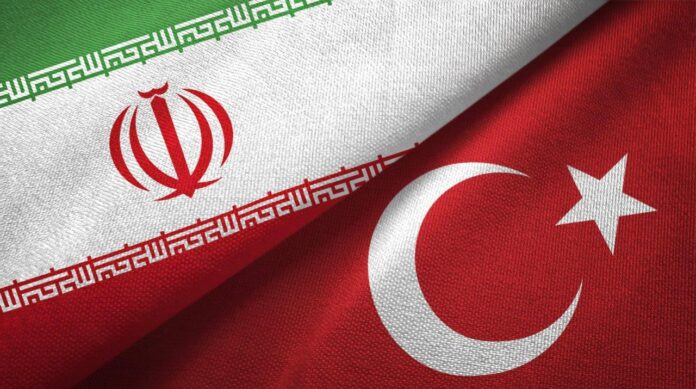
Iran, Turkey Convene Transportation Commission

In the virtual meeting, participants discussed an action plan on a cooperation agreement signed between the two sides aimed at boosting economic and trade cooperation and increasing competition between small and medium-sized enterprises of the two countries on world markets.

Under the action plan, the two sides agreed to work together on technological exchanges, the establishment of a permanent centre for technological exchanges between Iran and Turkey, sharing experience in the domain of business clusters, financing small and medium-sized enterprises, cooperation among both sides’ guarantee funds, holding meetings on attracting investment, holding face to face (B2B) meetings between Iranian and Turkish sides, and holding counsellor training courses, among other things.

The two sides will also hold training workshops, seminars, conferences, etc., share technology and run joint projects for small and medium-sized enterprises.

Iran, India to Hold Virtual B2B Meetings to Boost Mutual Trade

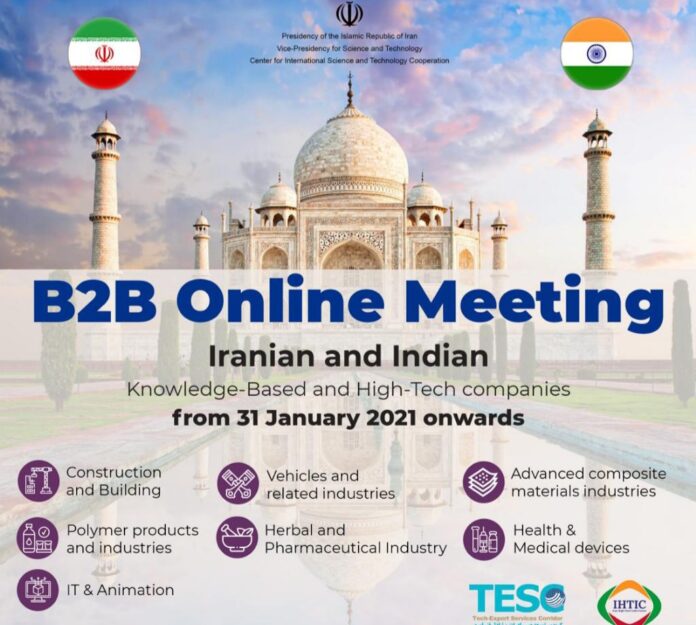
The online B2B meetings will be held between Iranian and Indian technological firms under the auspices of the Centre for International Interactions on Science and Technology of the Iranian Presidential Office’s Science and Technology Department.

Iranian and Indian knowledge-based and technological firms working in the fields of civil engineering and construction, automobile and related industries, composite and advanced materials industries, polymer industries and products, herbal and industrial medicines industries, health and medical equipment, information technology and animation can take part in the event.

The meetings aim to promote Iran-India trade and technological transactions.

The event kicks off on January 31, 2021, and the companies interested have until January 11 to register.

For more information, you may visit the following website: www.tesc.ir

Tehran, Yerevan Discuss Natural Gas-Electricity Barter Deal

Iran, Iraq Agree on Two Electricity Contracts

The heads of the Iranian and Armenian delegations that exchanged views on these issues described their discussions as constructive.

“In their meeting today, the two Iranian and Armenian delegations discussed the expansion of long-term relations in the domain of energy and reached agreement on key issues,” said Amir-Hossein Zamaninia, Iran’s deputy oil minister for international and commercial affairs, who led the Iranian delegation.

“The two sides decided to put off until a future time discussions on certain technical issues pertaining to the export of gas along with the gas-electricity barter deal,” said the Iranian official.

“After those issues are finalized, a long-term agreement will be signed in that regard,” he added following his meeting with the Armenian delegation.

Head of the Armenian delegation Hakob Vardanyan, in turn, said his country had been discussing gas exports and the extension of a gas barter deal with Iran for one and a half years, describing his talks with the Iranian delegation as very constructive.

He said the two sides reached agreement on some of the fundamental issues.

Back in 2004, Tehran and Yerevan signed a natural gas and electricity barter agreement under which Iran’s exported gas would be used as fuel for power stations in Armenia and, in return, Iran would import electricity from Armenia.

Armenia began importing natural gas form Iran in mid-2009.