Israeli air strikes hit UN-run school in Jabalia camp
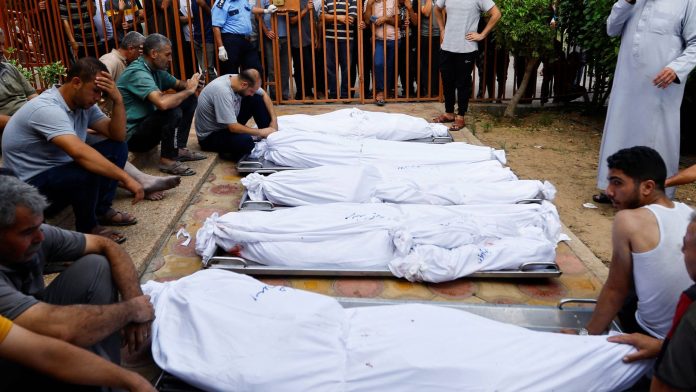
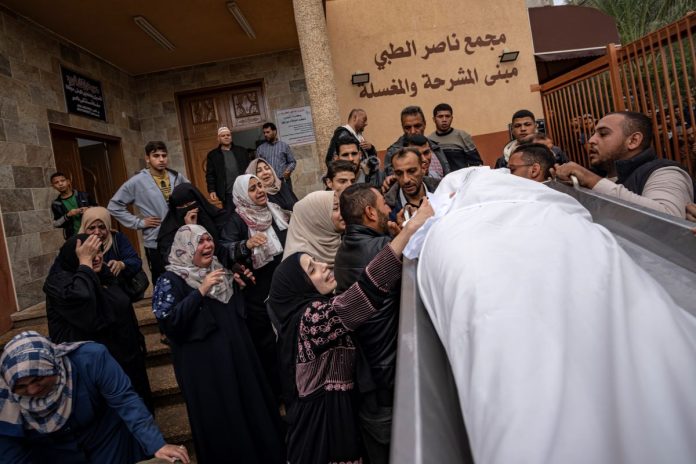
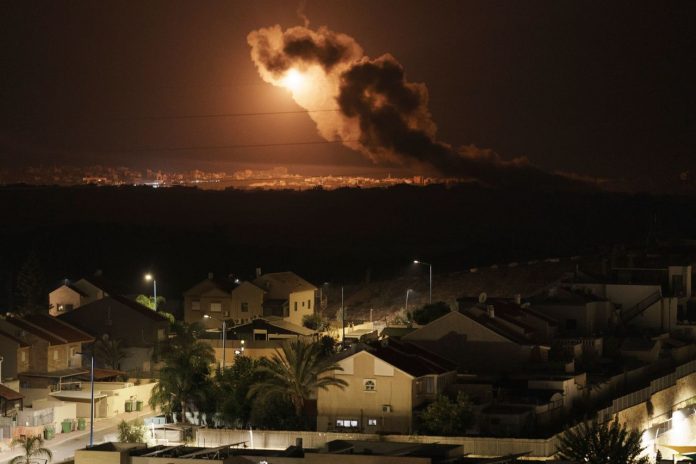
Israeli air raids have killed dozens people at the al-Fakhoora School, run by the United Nations agency for Palestinian refugees (UNRWA), in Jabalia refugee camp in northern Gaza.
At least 50 people have been killed in the bombing, the Palestinian Ministry of Health confirmed on Saturday.
Many hundreds of people are believed to have taken shelter there, fleeing the non-stop Israeli attacks.
Tamara Alrifai, a spokesperson for UNRWA, told Al Jazeera that she has seen the “devastating” footage coming out of Jabalia in the aftermath of the bombing, but has not been able to directly contact her colleagues on the ground.
“I’m still waiting from reports directly from my colleagues in Gaza but what we’re seeing is another one of these horrific incidents, where civilans, people who sought shelter in a protected UN building are paying the price,” she said.
Alrifai stated over half of the Gaza Strip’s 2.3 million population has been forced on an “exodus” south after an Israeli order to evacuate to make room for its ground operations, something that is reminicent of previous forced displacements.
“Many people who stayed in the north stayed in the UNRWA school because they thought that they would have a bit of safety there, but nowhere is safe in Gaza, not even our schools,” she continued, adding, “Unfortunately, people flee into our buildings with the blue flag looking for protection, but 70 of our buildings have been hit, so we ourselves are not protected.”
Alrifai stated excluding the strike on Saturday, 66 people have been confirmed to be killed while taking shelter in UN-run facilities.
The school had already been bombed days ago, and was previously targeted by Israeli forces during escalations of violence in 2009 and 2014.
The Jabalia refugee camp has been a target for Israeli strikes for weeks
Israel will expand operations in Gaza: Palestinian minister
Israel’s war in Gaza will expand and not be limited to any one area, Ammar Hijazi, assistant minister for multilateral affairs for the Palestinian Ministry of Foreign Affairs, has said.
“We think that they are doing it in stages. The north is just the beginning,” he stated.
“They are going to make sure that Gaza, especially the northern and eastern parts, are unlivable and squeeze the population into a very limited geographical area, pushing them to leave and be forcibly displaced from Palestine,” Hijazi added.
When asked about if the Palestinian Authority (PA) would be willing to rule Gaza after the fighting ceases, he responded by saying that the priority was to end the war.
“The nature of things is that we should have only one government that rules over the occupied Palestinian territories. And that government should be according to what people choose,” he said.
“And the legitimate representative of the Palestinian people is the Palestinian Liberation Oganization … thus the Palestinian government can be determined as such,” Hijazi continued, adding, “But now is not the time to discuss these things.”
Wounded Palestinians forced to flee al-Shifa ‘are going to die’
Some of the patients forced out of al-Shifa hospital won’t make it to another medical facility, a spokesperson for the Palestinian media office in Gaza said.
“All are going to die simply because they require swift medical attention,” Ismail al-Thawabta told Al Jazeera.
He added that people inside the hospital were forced to leave at gunpoint, and described it as “another war crime”.
Al-Shifa now ‘deserted’: Hospital director
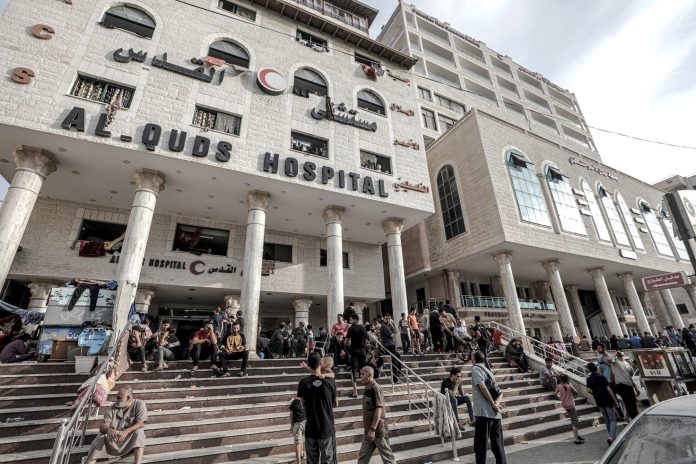
Speaking to Al Jazeera from al-Shifa, Director Mohammed Abu Salmiya said only he and a few others, including staff and patients, were left at Gaza’s largest hospital.
“The hospital is completely deserted. Some of the remaining patients and victims are lying in the corridor,” he stated.
“The centre of the hospital is surrounded by Israeli soldiers. They are in total control. Even we, the very few medical staff that remain, cannot move freely.”
“Many of those in critical conditions, including newborns and kidney patients, will die imminently if they are not evacuated,” he continued, adding, “Food at the hospitals is also running out.”
EU foreign policy chief: Only Palestinian Authority can run post-war Gaza
Josep Borrell has asserted that “Hamas cannot be in control of Gaza any longer”.
“So who will be in control of Gaza? I think only one could do that – the Palestinian Authority,” he stated, speaking at the Manama Dialogue, an annual conference on foreign and security policy in Bahrain.
Palestinian health ministry says Israel removed over 100 bodies from al-Shifa
In an interview with Al Jazeera Arabic, the general manager for the Palestinian Ministry of Health, Munir al-Barsh, said that Israeli forces removed more than 100 bodies from al-Shifa Hospital in northern Gaza.
Barsh told Al Jazeera that Israeli forces removed 15 bodies from a mass grave, with a total of around 130 bodies taken from the hospital. He did not say where the bodies were taken to or provide further details.
Israeli military spokesperson Daniel Hagari was asked about this claim by a reporter, but dodged the question.
“We are working in Shifa Hospital for 48 hours. It’s a complex operation. It’s a large complex,” Hagari added.
Al Jazeera also reported that Israeli forces have given doctors, patients and displaced people at al-Shifa Hospital one hour to evacuate the medical compound located in the northern Gaza Strip.
At least 63 Palestinians dead on arrival at Indonesian Hospital
Sixty-three Palestinians were dead on arrival at the Indonesian Hospital in northern Gaza at dawn on Saturday, a medical source told Al-Jazeera.
It follows a series of deadly attacks carried out by the Israeli military in the north of the enclave, including in Beit Lahia, Beit Hanoun, Gaza City and Jabalia refugee camp.
At least 28 Palestinians killed in Israeli air strike in Khan Younis
At least 26 Palestinians were killed in an Israeli air raid on Khan Younis during the early hours of Saturday morning, according to Al Jazeera Arabic.
The attack hit a residential neighbourhood in Khan Younis, located in southern Gaza, and among those killed were children.
Internet and phone services partially restored in some parts of Gaza: Telecommunications company
Internet and phone services have been partially restored in some parts of the Gaza Strip, Palestinian telecommunication company PalTel announced on Friday.
“This comes after a limited quantity of fuel was provided through UNRWA to operate our main generators,” the company said, referring to the United Nations Relief and Works Agency for Palestine Refugees in the Near East.
Two fuel tankers entered Gaza through the Rafah crossing on Friday to be used by UN agencies.
PalTel added it would need to receive a regular supply of fuel to avoid more disruption.
NetBlocks, a London-based internet monitoring firm, confirmed that internet connectivity had been partially restored in Gaza.
“Metrics show that internet connectivity is being partially restored in the Gaza Strip as operators report a donation of fuel; service was lost on Thursday as telecom sector generators and backups shut down; service remains significantly below pre-conflict levels,” the firm said in a post on X, the platform formerly known as Twitter.
5 countries ask International Criminal Court to investigate situation in Palestinian territories
Five countries submitted a referral to the International Criminal Court (ICC) to investigate whether crimes may have been committed in Palestinian territories, ICC prosecutor Karim Khan announced.
South Africa, Bangladesh, Bolivia, Comoros and Djibouti submitted the referral of the situation in the region, Khan stated.
“In accordance with the Rome Statute of the International Criminal Court, a State Party may refer to the Prosecutor a situation in which one or more crimes within the jurisdiction of the Court appear to have been committed requesting the Prosecutor to investigate the situation for the purpose of determining whether one or more specific persons should be charged with the commission of such crimes,” Khan said in a statement.
He noted that his office is already conducting an investigation on the situation in the Palestinian territories – which began on March 3, 2021 – over possible crimes that may have been committed since June 2014 in Gaza and the West Bank.
“It is ongoing and extends to the escalation of hostilities and violence since the attacks that took place on 7 October 2023,” Khan continued, adding, “In accordance with the Rome Statute, my Office has jurisdiction over crimes committed on the territory of a State Party and with respect to the nationals of States Parties.”
Israeli army says it will advance “anywhere Hamas is found”, including southern Gaza Strip
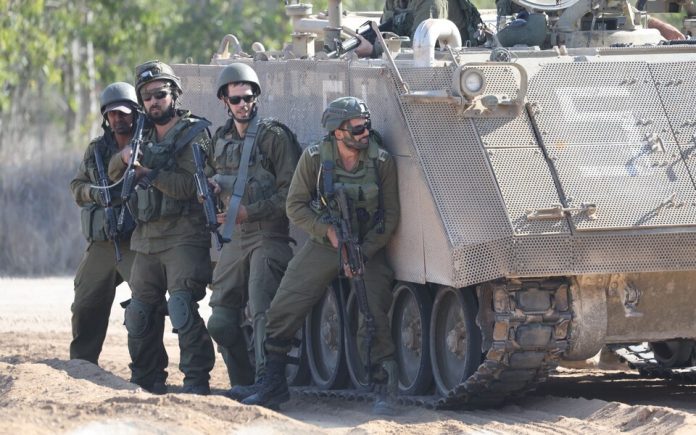
Israeli troops will advance to anywhere Hamas is found, including the southern part of the Gaza Strip, an Israeli army spokesperson said.
“This will happen where and when would be convenient for the IDF and when conditions are optimal,” Israel Defence Forces spokesperson Rear Adm. Daniel Hagari stated.
At least 372 IDF soldiers have been killed since October 7, Hagari added. The death toll did not change from Thursday.
In recent days, there are growing indications that a ground offensive into the southern part of the strip could be imminent. Israeli leaders have declared the northern part of Gaza, including Gaza City, is now under Israel’s control.
A leaflet dropped Wednesday on communities to the east of Khan Younis, the largest city in the southern part of Gaza, warning people living there to move and “head toward known shelters.”
Earlier this week, Israel’s Defense Minister Yoav Gallant said Israel’s ground operations “will last for many months — and will include both the north and the south (of the Gaza Strip). We will dismantle Hamas wherever it is.”
Fuel tankers enter Gaza after Israeli government approves regular deliveries
Two fuel tankers entered Gaza through the Rafah crossing Friday, after Israel’s war cabinet approved a measure to allow for regular deliveries to the besieged enclave.
The tankers were carrying 60,000 liters of diesel fuel between them, according to Israel’s Coordinator of Government Activities in the Territories, an agency that liaises with Palestinians on civilian affairs.
“This fuel entered in a limited manner for the use of international organizations, for UNRWA,” Israeli military spokesperson Rear Adm. Daniel Hagari said at a news briefing, referring to the United Nations aid agency operating in Gaza.
“There are desalination facilities that should provide water to the southern strip, so the fuel is used just for these two needs. We monitor this issue, to ensure it’s used for these two needs only. This (process) is led by the US and Egypt.”
Israel’s war cabinet approved a measure on Friday allowing two fuel tankers a day to enter Gaza for water and sewage system support, according to Israel’s national security adviser.
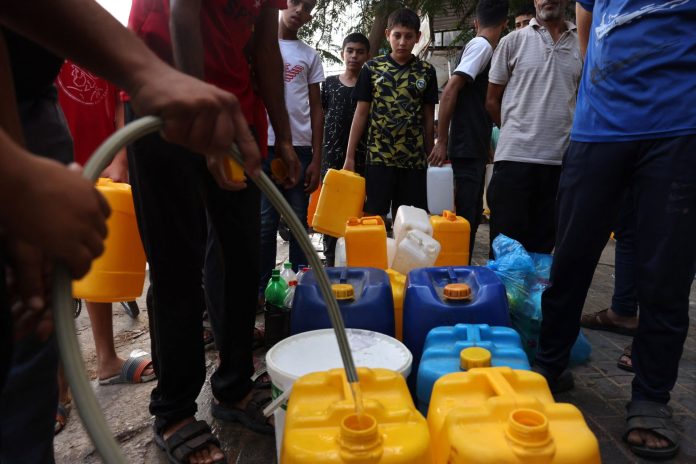
Those systems are “on the verge of collapsing, considering the lack of electricity and ability to operate the sewage and water systems”, the official, Tzachi Hanegbi, said in a Friday briefing.
The deliveries will amount to 140,000 liters of fuel entering Gaza every 48 hours, a US State Department official has confirmed.
UN emergency relief chief: “International humanitarian law appears to have been turned on its head”
The United Nations’ Under-Secretary-General for Humanitarian Affairs and Emergency Relief Coordinator Martin Griffiths outlined what support is needed — including a ceasefire and continuous aid — to respond to the humanitarian crisis in Gaza.
“In many respects, international humanitarian law appears to have been turned on its head. … It is without doubt a humanitarian crisis that, by any measure, is intolerable and cannot continue,” Griffiths said as he addressed the General Assembly on Friday.
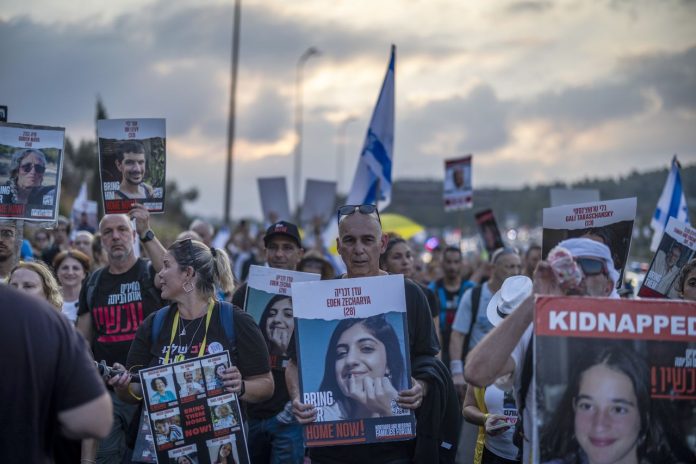
“Call it what you will, but the requirement, from a humanitarian point of view, is simple. Stop the fighting to allow civilians to move safely. Do it for as long as possible, to facilitate an unimpeded humanitarian response. Give the people of Gaza a breather from the terrible, terrible things that have been put on them these last few weeks. And, without condition, release all the hostages,” he added.
Griffiths also spoke about the number of hospitals which have ceased operations since the beginning of the conflict on October 7, and how fuel and a “continuous flow of aid” is needed to help as many people as possible in Gaza.
“There is little to no medical care available in northern Gaza,” Griffiths told the General Assembly.
“Eighteen hospitals have shut down and evacuated since the start of hostilities. Another five hospitals, including (Al-Shifa), are providing extremely limited services to patients who have already been admitted. These hospitals are not reliably accessible because of insecurity, do not have electricity or essential supplies, and are not admitting new patients.”
The humanitarian chief also requested that there also be “more crossing points into Gaza,” along with an increase in humanitarian aid and resources to help expand shelters and “establish relief distribution hubs.”
“We are not asking for the moon. We are asking for the basic measures required to meet the essential needs of the civilian population and stem the course of this crisis,” Griffiths continued, adding, “We need the full leverage of the UN membership to achieve these objectives.”
UN human rights chief says access to Gaza is needed to investigate claims on Al-Shifa Hospital
The United Nations human rights chief has called on Israel to grant his team access to Gaza to investigate competing claims about the Al-Shifa Hospital.
“We need to look into this by having access. We cannot rely on one or the other party when it comes to this,” Volker Türk, the UN High Commissioner for Human Rights, told CNN’s Becky Anderson when asked about allegations by the Israeli military that Hamas was hiding weapons at the hospital.
He said the situation needs an “independent international investigation, because we have different narratives.”
Israel is under growing international pressure to uncover proof of what it has described as a Hamas command and control center under the Al-Shifa Hospital, as Israeli forces launched a raid at the facility early Wednesday. The Hamas-run government media office denied it was using the hospital as a command and control center — calling the Israeli claims “baseless lies.”
Türk stated hospitals had special protection at all times under humanitarian law.
“You cannot use civilian, especially hospitals, for any military purposes. But you also cannot attack a hospital in the absence of clear evidence,” Türk added.
Türk said investigators could not go to Gaza “while the bombs are falling or while military operations are taking place”, and so his team was monitoring the situation from afar for now. He added he previously asked the Israeli government for access to Gaza and the occupied West Bank but was “still waiting for the answer.”
The actions of both Israel and Hamas since the group’s massacre of an estimated 1,200 people on October 7 must be investigated, Türk said.
Since Hamas launched its brazen October 7 attacks and Israel responded with intensive air strikes and a ground offensive, both sides have been accused of committing war crimes.
“We have seen … grave breaches of international humanitarian law,” Türk said, speaking broadly of the actions from both sides.
“What Hamas did — the horrific killing of civilians, the fact that they took hostages — are clear violations of the law. The fact that we have seen a collective punishment by Israel of Gaza, by cutting off supplies, of medical necessities, of food, of electricity, of water is also [a] very serious matter under international humanitarian law,” Türk added.
“In fact, we consider it a crime, [just] as Hamas was acting criminally by taking hostages and killing civilians. So, indeed, there are issues that we all have to look into because they are very serious. And they require answers. And they require accountability,” Türk continued.