
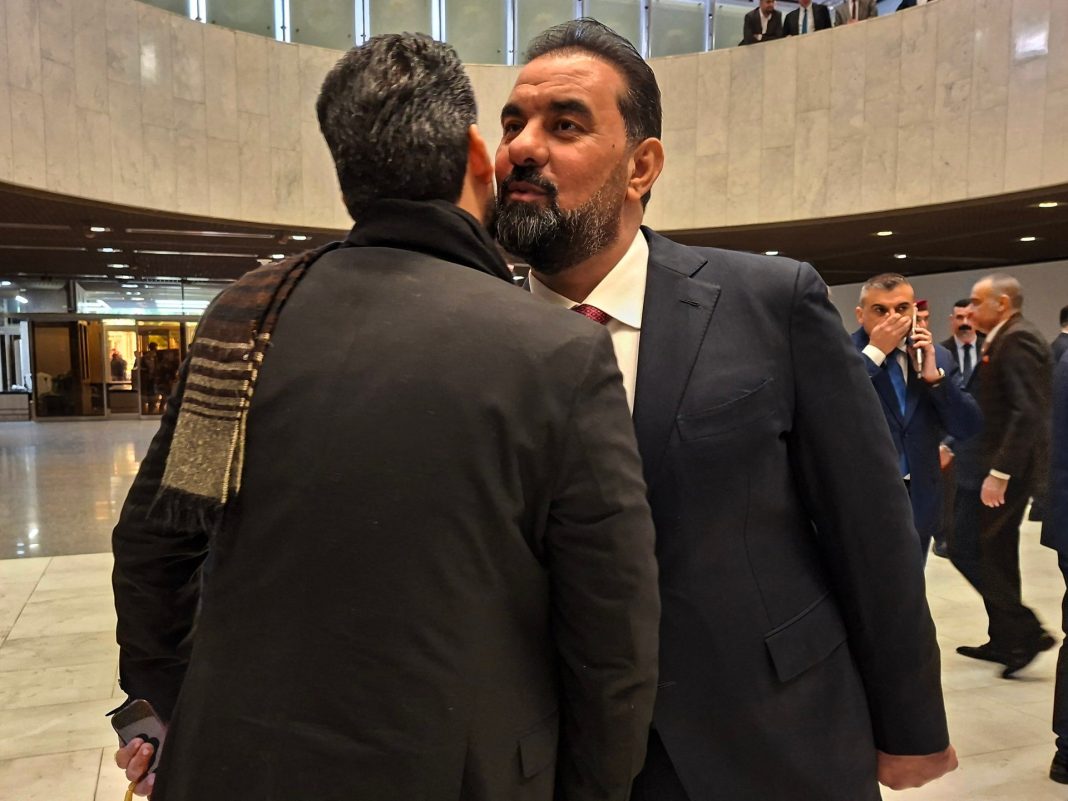
Iraqi media reported on Monday, citing parliament’s media office, that al-Halbousi, from the Taqaddum (Progress) Party, had received 208 votes, in a clear victory over two rival contenders with 66 and nine votes, respectively.
Al-Halbousi’s party draws its support largely from Sunni heartlands in the west and north of the country.
Iraqis have been eagerly awaiting the first sitting of parliament, called the Council of Representatives of Iraq, as they look for certainty over the leadership of the country following the November 11 vote, which left a complicated outlook for the formation of the new government.
Under Iraq’s customary muhasasa system, in place since the first government under the post-2003 constitution, parliament is to elect a speaker – a consensus Sunni candidate – along with two deputies during its first session.
Following that is the vote for the presidency, a Kurdish candidate, according to muhasasa. The president then nominates the candidate of the largest Shia bloc – the Shia Coordination Framework (SCF) – to be named prime minister.
Before the election, Supreme Judicial Council President Faiq Zaidan urged lawmakers to stick to the constitutional timeline for government formation – a maximum of 90 days – and the Federal Supreme Court (FSC) ratified the results faster than usual.
But few are expecting a swift result. The process typically takes months – in 2021, it took more than 300 days – and there are questions over who the SCF will choose as the right candidate for prime minister.
Incumbent Prime Minister Mohammed Shia al-Sudani had been nominated by the SCF four years ago, but had tried to break free from the alliance, running an independent electoral list that won big with about 46 out of 329 seats for his Reconstruction and Development Coalition (RDC).
But an FSC decision last month sent him back to the SCF and its leadership, many of whom do not hold parliamentary seats but operate as external power brokers.
The SCF now faces the question of whether it backs al-Sudani or an alternative candidate as prime minister, while it grapples with how to respond to the growing parliamentary presence of lawmakers linked to Shia parties with pro-Iran, anti-West armed wings.
Of the SCF’s 180-odd lawmakers, 80 to 90 belong to groups and armed factions close to Iran – most of them under United States sanctions. In 2021, such groups held only 17 seats.
Their growing presence in parliament potentially presents a problem not only for Iraq’s relations with foreign powers, but for Iraqi Shias who resent Tehran’s powerful influence in the country.
