Sunday, December 28, 2025
Home Blog Page 3830

PM Abadi’s Leadership Prevented Disintegration of Iraq: Iran

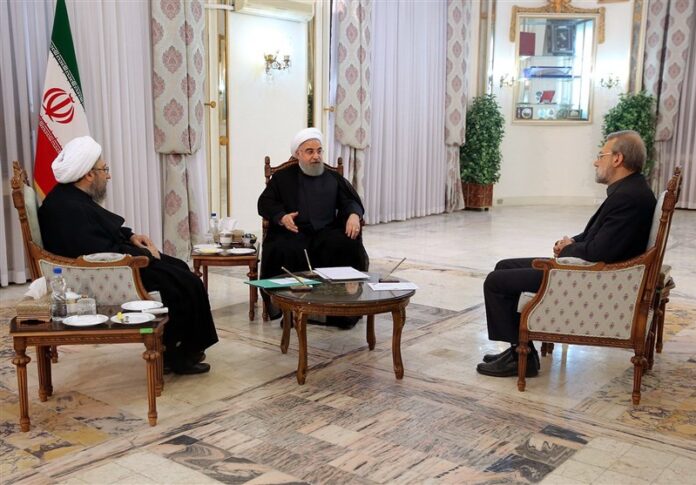
Iran’s Parliament speaker Ali Larijani has congratulated Iraqi Prime Minister al-Abadi on the achievements of the Baghdad government on different fronts.

“During your tenure, Iraq secured three important accomplishments which will go down in history,” Larijani told the Iraqi premier in a meeting in Tehran.

Larijani said the first achievement was that Baghdad rid Iraq of terrorists.

“Although there are some movements [by terrorists] in some areas, these regions will soon be purged of militants thanks to your measures,” Larijani further told the visiting Iraqi prime minister.

The second achievement was that “you managed to prevent the disintegration of Iraq with prudence and [by taking] the necessary measures,” the parliament speaker further told Abadi.

“The third accomplishment is Iraq’s military power, which relies on people, and it is important to safeguard it in order to protect Iraq,” said Larijani.

“Although the presence of terrorists has inflicted costs on you, this problem gave rise to a powerful Iraq, and now it’s time for you to lay the groundwork for the reconstruction and economic development of Iraq,” Larijani further told Abadi.


Iran’s Backing for Iraqi Nation, Govt.

Larijani then expressed Tehran’s backing for the Iraqi people and government.

“I’m confident that there is great willingness in Iran to enhance political and economic relations with Iraq, and it is necessary to remove some obstacles to ease the establishment and promotion of mutual ties,”Larijani said.

“Iraq is playing a good role in the region, but it should develop a proper understanding of the other sides, so that they, too, will move within the desired framework and will not seek to make new trouble in Iraq and in the region,” the Iranian parliament speaker underlined.


Many Wouldn’t Like Iraq to be Independent

Larijani then said many countries and entities do not like Iraq to be recognized as an independent and democratic country in the region “because Iraq has resources which makes them worried.”

The top parliamentarian then touched upon efforts by Washington and Tel Aviv to secure their interests in Iraq and in the whole region.

“They are pursuing objectives the most important of which would be to prevent the presence of popular forces. This way, they intend to deal a blow to Muslims’ power. A clear example of such measures is the sanctions they recently approved against the popular forces of Hezbollah,” said Larijani.
“The second point is the breach of commitments under the Iran nuclear deal. We will remain committed to our obligations as long as they keep their side of the bargain,” he said.

“We should seek to promote relations between the two countries, so that the enemies won’t be able to tilt the situation in their own favor,” Larijani highlighted.

Iraqi People’s Unity Key to Baghdad’s Triumph

For his part, the visiting Iraqi premier thanked Iran for supporting his country in tough times.
Abadisaid what made Iraq victorious was unity among Iraqi people. He said even the issue of the Kurdistan region and the referendum on its secession from Iraq could not affect national unity.

He said Peshmerga forces wanted to stand up to the Iraqi army, but Baghdad, in a message, told them that they should ensure security in Iraq, and they took heed of that accordingly.

Under the Iraqi Constitution, said Abadi, the central government is responsible for ensuring security along the borders and inside the country.

“Iraq is a single and integrated country,” he stressed.

The Iraqi premier underscored that Baghdad is trying to restore stability to the region to set the stage for the displaced to return to their homes.

Root Causes of Terrorism

He then touched upon the root causes of terrorism in the region.

Abadi said the ISIS terrorist group was born when some problems began to emerge in Syria. According to Abadi, the militants, which enjoyed the financial and arms support of certain countries, began to occupy territories.

He added Iraq tries to bring development to the region in order to serve its own as well other countries’ interests.

Conflicts Behind Region’s Underdevelopment

Abadi said war and conflicts have, for years, caused backwardness in the region and stopped its development. Hence, he added, every effort should be made to ensure security.

Persepolis Beats Arch-Rival Esteghlal in Tehran Derby

In the match held in Tehran’s 80,000-seat Azadi Stadium, Alipour netted a penalty kick in the 22nd minute after he was fouled by Esteghlal defender Rouzbeh Cheshmi in penalty area.

Esteghlal and Persepolis, as the most popular football team in Iran, showed a lackluster performance.

The match also ended in controversy after the fans threw sound missiles onto the field at the end of the 123movies.

Persepolis is second with 20 points in Iran Professional League (IPL) and Esteghlal stayed 13th in the table with just nine point from 10 games.

Pars Jonoubi leads the table with 22 points.

Persepolis Beats Arch-Rival Esteghlal in Tehran DerbyPersepolis Beats Arch-Rival Esteghlal in Tehran DerbyPersepolis Beats Arch-Rival Esteghlal in Tehran DerbyPersepolis Beats Arch-Rival Esteghlal in Tehran Derby

Iran Offers Sympathy to Indonesia over Deadly Blast

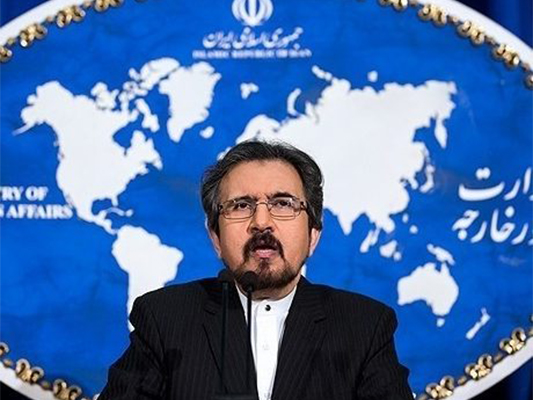
In a statement on Friday, Foreign Ministry Spokesman Bahram Qassemi sympathized with the Indonesian nation and government and the bereaved families of the blast’s victims.

Two explosions tore through a fireworks factory on the outskirts of Indonesia’s capital on Thursday, killing at least 47 people and injuring dozens.

It was one of Indonesia’s worst industrial disasters and is likely to cast a new spotlight on lax safety standards in the Southeast Asian country, where rules are often ignored or weakly enforced.

Workers had no time to escape from the plant in Tangerang, an industrial and manufacturing hub to the west of Jakarta, after the explosions that one neighbor described as a “roar” that could be heard miles away.

Dandeh Kebab; Delicious Iranian Grilled Meat

Dandeh Kebab; Delicious Iranian Grilled Meat

Preparing this very delicious Iranian Kebab needs a special expertise. Here is one of the ways to make it:

Ingredients:

  • Lamb Ribs
  • Kebab Skewers
  • Tomato Paste
  • Lemon Juice
  • Salt and Pepper
  • Oil
  • Saffron

Recipe:

First, cut a large piece of around one kilogram of lamb ribs as wide and long as shown in the photo. Then, put three to four skewers vertically through the meat to bear both the weight and the shape of it. Then hit the meat repeatedly with a sharp knife and put the meat in the refrigerator for a few hours.

Now the meat is ready to grill. Heat some oil in a container and then add tomato paste and sauté it. By adding salt, pepper, lemon juice, and saffron make a thick sauce.

When grilling, place the lamb ribs on a medium-heat coal, and at the same time rub the thick sauce on both sides continuously until the Kebab is ready.

Add some more sauce to Dandeh Kebab and leave it on a piece of bread and garnish it with onions, lemon or bitter orange.

Dandeh Kebab is very yummy and popular. Hope when you visit Kermanshah, try this Iranian specialty and enjoy the hospitality of the people of Kermanshah.

Notes:

  • Grilling the calf’s ribs takes 2 minutes longer than those of sheep.
  • To get a better Kebab, you can create small cuts with a knife on the meaty parts of the ribs.
  • There is no need to turn the skewers very much on the heat, but be careful not to let the meat burn.
  • For your convenience, you can use grilling nets instead.
  • Put the rib pieces from one direction through the skewers for a steady grill.
  • It is better to keep the ribs in the fridge for a week to make it drier. It reduces the grilling time.
  • There is one layer of fat on the ribs. Do not remove it to get a better Kebab.
  • It is better to put the skewers or the net at least 8 centimetres above the heat and occasionally circulate the air.

Iran Dismisses UN Rapporteur’s Human Rights Report as “Biased”

In reaction to the Thursday report of Asma Jahangir to the Third Committee of the UN, Qassemi said that the stance of the Islamic Republic of Iran about the United Nations Special Rapporteur and the reports she submits to the General Assembly and the UN Human Rights Council is a principled one.

Qassemi went on to say that appointment of a Special Rapporteur on human rights in Iran is of a politicized and unfair nature.

“So, we believe that the reports of the Special Rapporteur are the consequences of an unjust and unfair resolution which is based on political and malevolent intentions of a few specific and prejudiced countries; therefore, they lack legitimacy and credibility,” the spokesman added.

The Islamic Republic believes that the use of political and unfair approaches and double standardsby a limited number of countries in the field of human rights is nothing more than a weakening of the status of human rights around the world, he noted.

“This will bring more shame for those who claim to be advocates of human right sand their allies while all of whom have a dark record regarding human rights.”

“Our official response to the report has been submitted to the General Assembly and registered as a document. In addition,Iran’s envoy to the UNHRChas read Iran’s statement on this report at the Third Committee of the United Nations.”

The UN special rapporteur on human rights claimed in her latest report that there had been little change in the situation in Iran over the past year, alleging that the journalists are harassed in the country and that progress on women’s rights was extremely slow.

Iranian FM, Niger’s PM Discuss Bilateral Ties

Iran’s Foreign Minister Mohammad Javad Zarif has held talks with Brigi Rafini, the prime minister of Niger, in the African state’s capital of Niamey.During the Thursday meeting, the two sides conferred on the expansion of bilateral relations between Iran and Niger, particularly in the economic field.

Zarif and Rafini also exchanged views on regional and international issues.

‘US Efforts to Divide Iranian People Futile’

In a Thursday statement, Qassemi said Tillerson’s remarks once again depicted the true face of the United States to the Iranian people.”

“US statesmen, who staged a coup against the legitimate government of Iran in 1953, with the full support of the dictatorial regime of Shah were helping him to commit crimes”

“Behind the mask of supporting Iranian people, they (US statesmen) have committed many crimes against the people of our country since the Islamic Revolution,” added the foreign ministry spokesperson.

“Provoking unrest and creating chaos inside the country, attempts to stage a coup, next to military, economic, political, logistical and intelligence support for the dictatorial and criminal regime of Saddam Hussein in his aggressive war against Iran, besides the imposition of unlawful sanctions against the great nation of Iran are just a small part of Washington’s interventionist approaches over the past nearly 40 years.”

Qassemi went on to say that the totalitarian and arrogant leaders of the United States must realize that theirs attempts to sow the seeds of discord between the Iranian people and the political and military authorities are futile effort.

“The only result (of such policy) is boosting the national unity (in Iran) and causing more hatred towards the policies of the uninformed US statesmen,” he noted.

Iraq’s Role in Washington’s Anti-Iran Strategy

The Persian-language Fararu website has, in an analytical piece, discussed Washington’s scheme to chip away at Iran’s leverage in the region. The highlights of the article follow.

There have been different analyses of the strategy of “reducing Iran’s influence in the region” pushed by Washington in recent days following US Secretary of State Rex Tillerson’s  visit  to Saudi Arabia. Many experts have warned Iranian diplomatic and military officials against the current situation in Iraq as well as Washington and Riyadh’s activities in that domain. There is also concern that Iraq will turn toward the United States and Saudi Arabia in a calculated process.

Amid Tillerson’s visit to Saudi Arabia and his meeting with Iraqi Prime Minister Haider al-Abadi, Riyadh expressed its willingness to enhance economic relations with Baghdad. Therefore, economic means has been used along with political and diplomatic measures to advance the US’ strategy.


Scheme To Divide Iran, Iraq

During his trip to Saudi Arabia, Tillerson called on forces of the Iran-backed Popular Mobilization Units to return to their homes. However, the Iraqi premier’s office, in a statement, rejected Tillerson’s demand and strongly criticized his remarks.

But other developments are unfolding against the same backdrop. Movements by influential Iraqi Shiite leader Muqtada Sadr are among those developments.

After several high-profile meetings with leaders of the regional countries in recent months, Sadr sat down with Jordan’s King Abdullah last Monday.

Jordan announced in a statement that the centerpiece of the talks during the Jordanian king’s meeting with Sadr was the necessity of boosting trade and economic ties between Amman and Baghdad.

Still, the Associated Press has described the meeting as a step toward efforts to contain Iran’s influence in the Middle East.

Jordan is an ally of Saudi Arabia and has misgivings, like Riyadh, over Iran’s influence in the region.

Muqtada Sadr’s meeting with the king of Jordan took place hours after King Abdullah met Iraqi Prime Minister Haider al-Abadi, and no further details have been released on that.

Sadr had already travelled to Saudi Arabia, the United Arab Emirates and Egypt in mid-summer as well. All these three countries are critical of Iran’s behaviour in the region.

After meeting the Saudi crown prince, Sadr stressed that he has the same viewpoints as Mohammed bin Salman. He described Saudi Arabia as a “powerful father of Arab nations” which tries to establish peace in the region.

Muqtada Sadr is also opposed to the activities of the Popular Mobilization Units. He had earlier stressed the need to dismantle the group, saying the existence of such troops outside the framework of the government will lead to major problems and negative consequences.

Muqtada Sadr’s Change of Heart

Now, the question is, “What role do Muqtada Sadr and Haider al-Abadi play in the US strategy?”

University professor Ali Bigdeli has weighed in on the issue in an interview with Fararu.

“The US and Saudi Arabia are seeking to decrease Iran’s political and military influence in the region and somehow clip Iran’s wings. To that end, they have even made efforts to decrease Iran’s influence on Hamas,” said the analyst.

“Two and a half months ago, Haider al-Abadi announced in his first trip to Saudi Arabia that ‘I’m an Arab before being a Shiite, and I won’t repeat the mistake that Hafez Assad made in
Syria,  and [won’t set foot in] the path his son treaded whereby he left the Arab world’. But Abadi underlined that under the current circumstances, he cannot leave the situation he is in,” said Bigdeli.

“On the other hand, during Abadi’s recent trip to Saudi Arabia, US Secretary of State Tillerson announced that the Popular Mobilization Units (Shiite forces close to Iran) must return to their homes. In my idea, he wouldn’t make such remarks without Abadi’s green light. A strategy must have been worked out based on which Tillerson makes such comments before the Iraqi premier rejects them,” the analyst noted.

“The US strategy, in the first place, is to turn the Iran issue into an international phenomenon, so that the world public opinion would be prepared to counter Iran. The US has always adopted this strategy. It did the same thing regarding the nuclear crisis. The behaviour of the US and diplomatic trips to the US and even the meetings and conferences held in the country all suggest that the public have been galvanized into bothering Iran from inside, and promote Iranophobia outside Iran,” he added.

“This means the US has defined its international strategy as ‘Iranophobia’ and its strategy for inside Iran as ‘bothering Iran.’ The initiative has just gotten off the ground, and Iranian politicians should not take it lightly. This strategy is very serious. They want to see Iran not have even one friendly country around it. A look at Iran-Afghanistan relations shows efforts are underway to fuel enmity between the two countries,” he noted.

As a first step to create an enemy, says Bigdeli, they have turned to Iraq.

“They will not be able to take Iraq out of Iran’s influence any time soon, but they are making the preliminary arrangements for it. One of the United States’ concerns is that the Popular Mobilization Units may turn into a powerful military institution in the country. If that happens, the US will not be able to do anything. This will be dangerous for Saudi Arabia, too. So, They want to stop the activities of the PMU before it becomes a stable, powerful entity, and as Tillerson puts it, its forces should go back to their homes,” says the commentator.

On Muqtada Sadr’s role in this scenario, the analyst said, “Muqtada Sadr’s influence in Iraq is fading due to Iran’s power. Large numbers of  Muqtada Sadr’s supporters have joined the Popular Mobilization Units, and Muqtada Sadr’s status and dignity are on the wane. Maybe that is one of the reasons behind his leaning toward Saudi Arabia. On the other hand, he is among the people who would like to see the Popular Mobilization Units decrease their activities in Iraq,” he says.

“The same goes for some other figures and groups in Iraq. Even some members of the Islamic Dawa Party are distancing themselves from Iran.”

“The Popular Mobilization Units has what it takes to become even stronger than the Lebanese Hezbollah movement,” he says.

Bigdeli believes Abadi is a very skillful player and will turn toward Washington in Iraq’s future developments. He will also seek to reinforce the Iraqi army to contain further influence by the Popular Mobilization Units.

“Abadi is very close to the US … and has very close relations with Washington. He is very much different from Nouri Maliki and is able to continue on his current path.’

“Abadi is a smart politician. He knows he should move step by step. He cannot put the Popular Mobilization Units aside all of a sudden. What is important is that the message [to do so] has been sent by Tillerson,”

Baghdad Rejects Kurdistan’s Offer, Urges Annulment of Referendum Results

“We will accept nothing but the annulment of the referendum and respect for the constitution,” Abadi’s office in Baghdad said in a Thursday statement.

The Kurdistan Regional Government (KRG) announced on Tuesday that it will freeze the results of the September 25 referendum and called for an immediate ceasefire and a cessation to all military operations in the northern region.

Baghdad Rejects Kurdistan's Offer, Urges Annulment of Referendum Results

The KRG also proposed open dialog with Baghdad based on the Iraqi constitution.

The announcement came shortly after the parliament in the autonomous Iraqi region of Kurdistan announced that legislative and presidential elections that were delayed due to the ongoing political stand-off with Baghdad would be held in eight months.

The development comes after weeks of simmering tensions between Baghdad and the Kurdistan Regional Government over the referendum which was held in defiance of the central government in Baghdad.

Much of the international community, particularly Iran and Turkey, opposed the vote, warning that the referendum would further complicate the security situation in Iraq that has been grappling with Daesh militancy in its north and west for the past three years.

Following the vote, the central government in Baghdad shut down flights in and out of the region and ordered a halt to its independent crude oil sales.

The Kurdish region further slipped into political uncertainty after Iraqi forces captured the disputed city of Kirkuk last week. The city and its surroundings, rich in oil and populated by Kurds, Arabs and Christians, have been at the heart of a long-running row between Erbil and Baghdad.

Gorran, the main opposition party to KRG President Masoud Barzani, issued a statement on Sunday, calling for the resignation of the Kurdish leader, who has held the region’s presidency since 2005. The opposition party said Barzani was responsible for the turmoil that followed the referendum.

Last week, Iraq’s judiciary also issued arrest warrants for three senior Kurdish officials, who were allegedly behind the contentious plebiscite. Iraqi Supreme Court has already ruled the referendum unconstitutional.

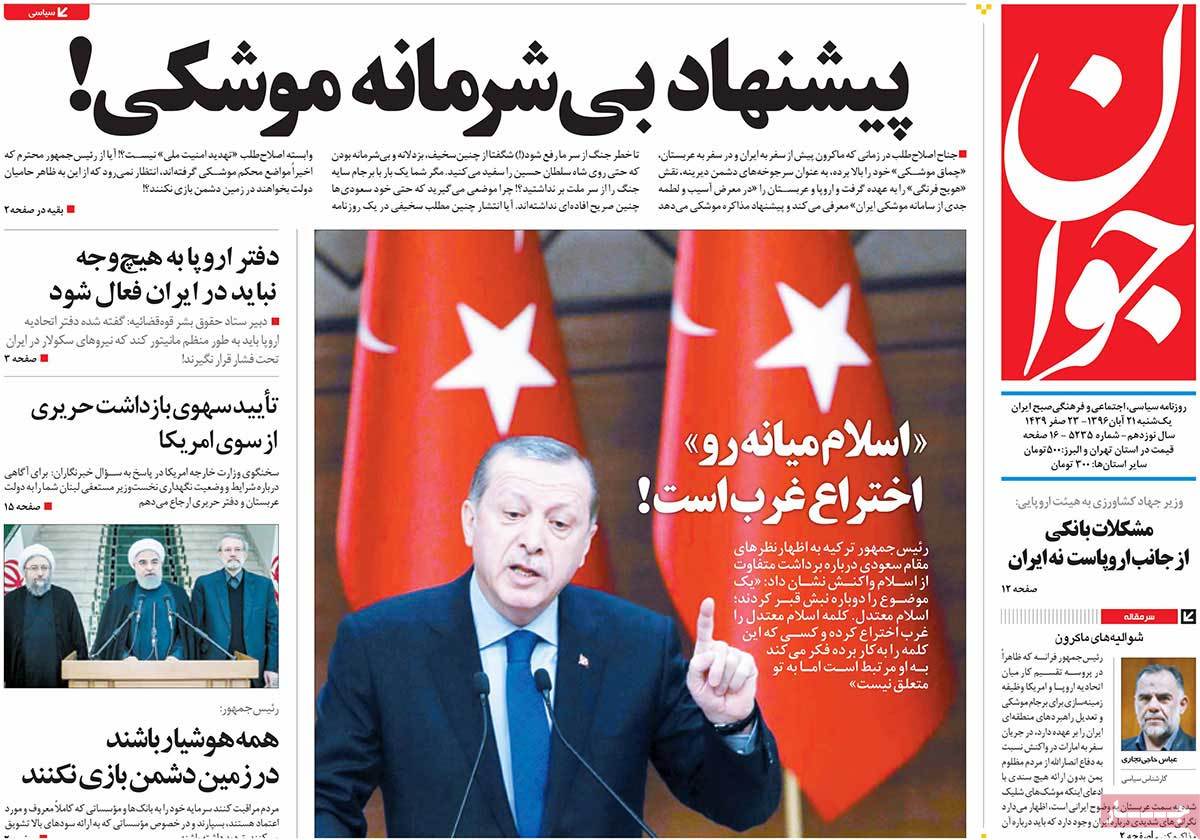
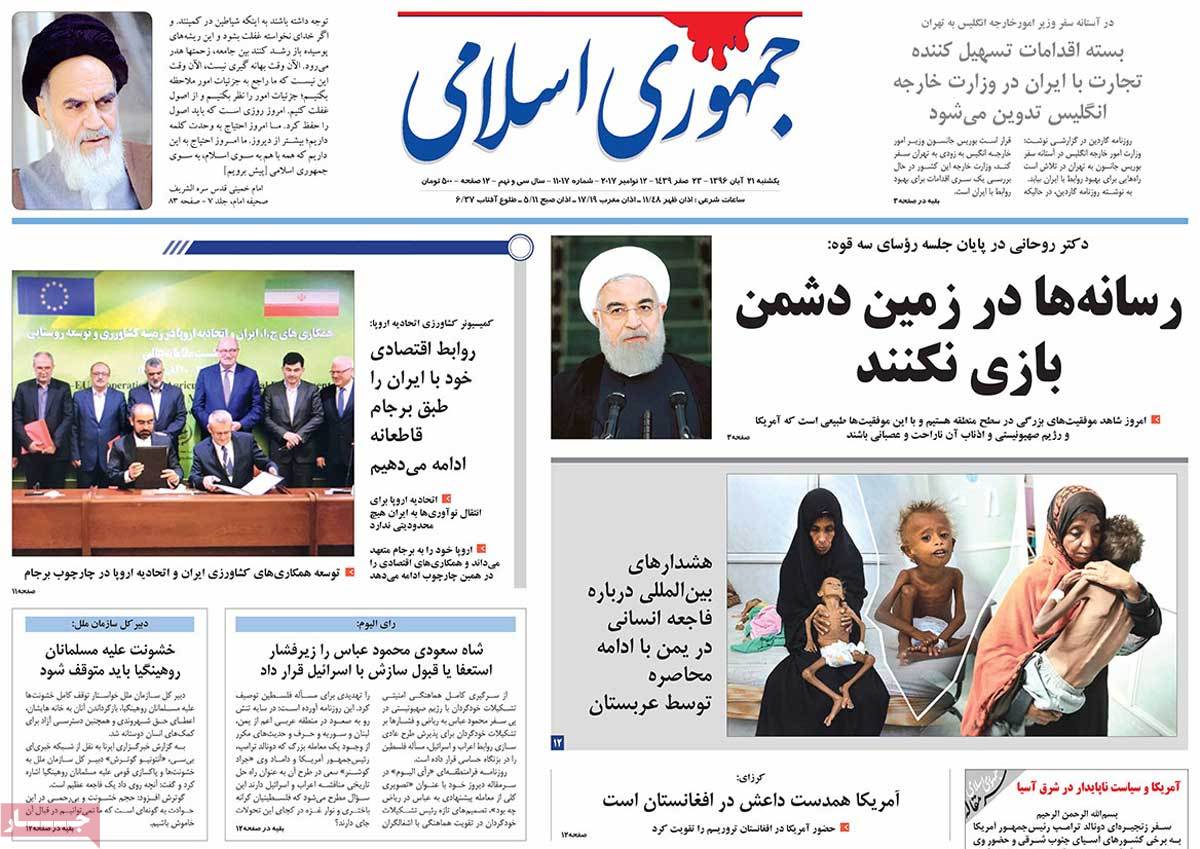
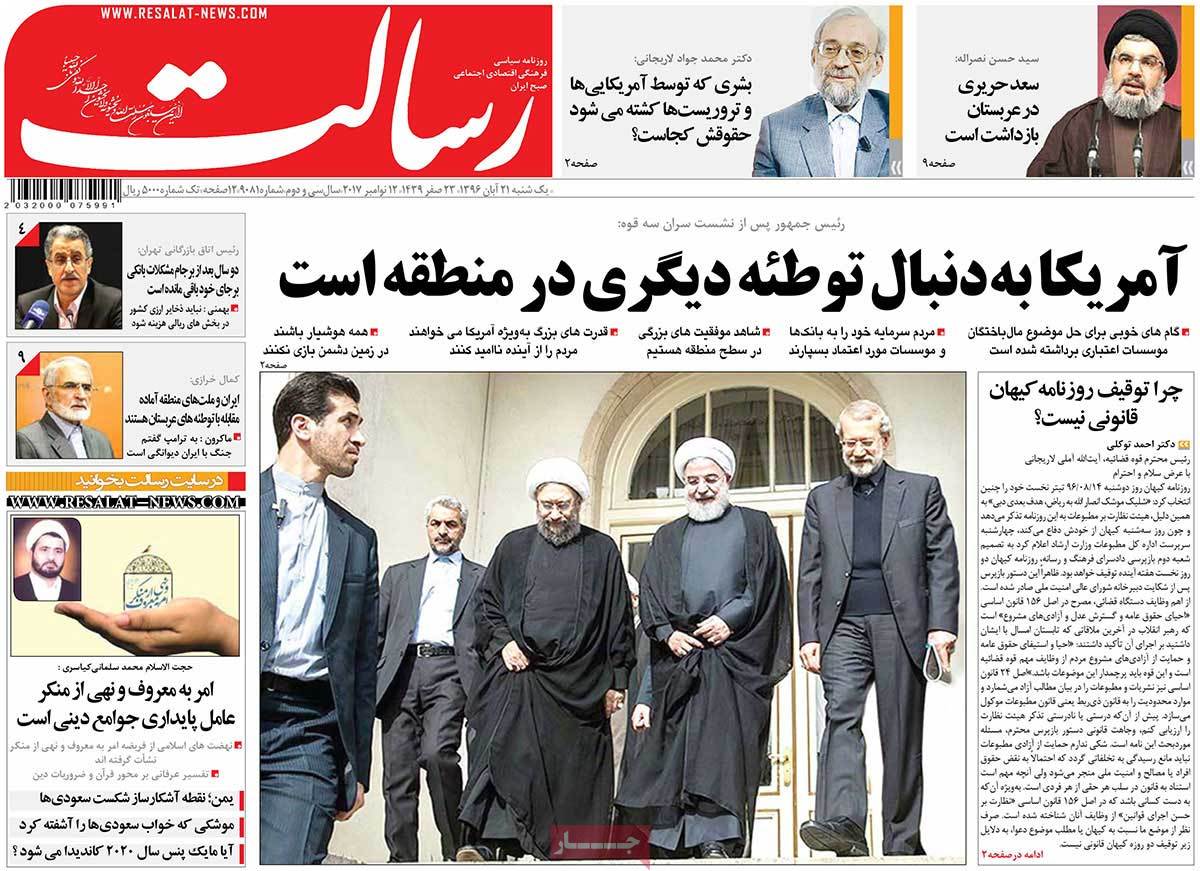
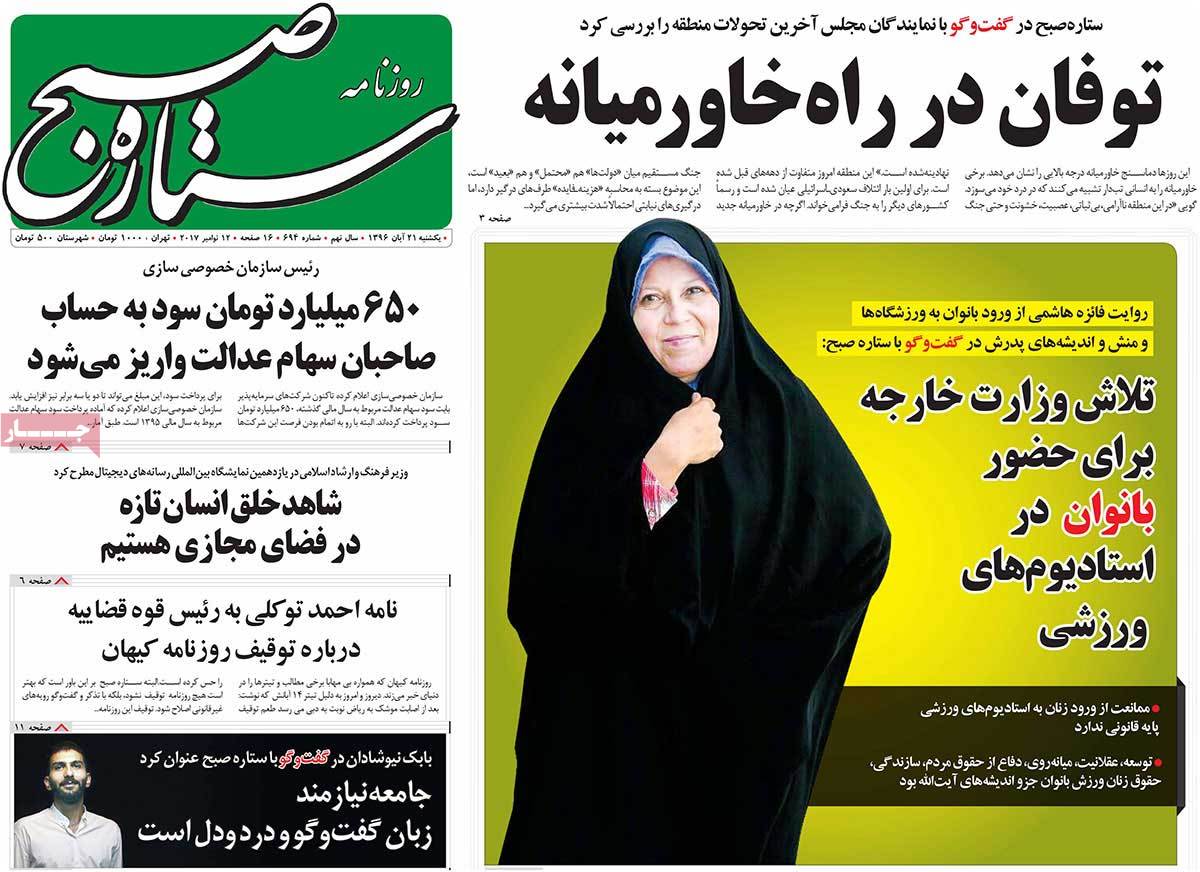
A Look at Iranian Newspaper Front Pages on October 26

Newspapers today widely covered the remarks made by the Leader of Iran’s Islamic Revolution Ayatollah Seyyed Ali Khamenei who once again stressed the country’s defensive power is not open to negotiation or bargaining.

The visit of Iraqi Prime Minister Haider al-Abadi to Tehran and the latest developments surrounding the Iraqi Kurdistan region, particularly its offer to suspend the results of its independence referendum, also received great coverage.

Several papers also highlighted the 85th Tehran derby between Iranian football giants Persepolis and Esteghlal, which will be held on Thursday afternoon.

The above issues, as well as many more, are highlighted in the following headlines and top stories:

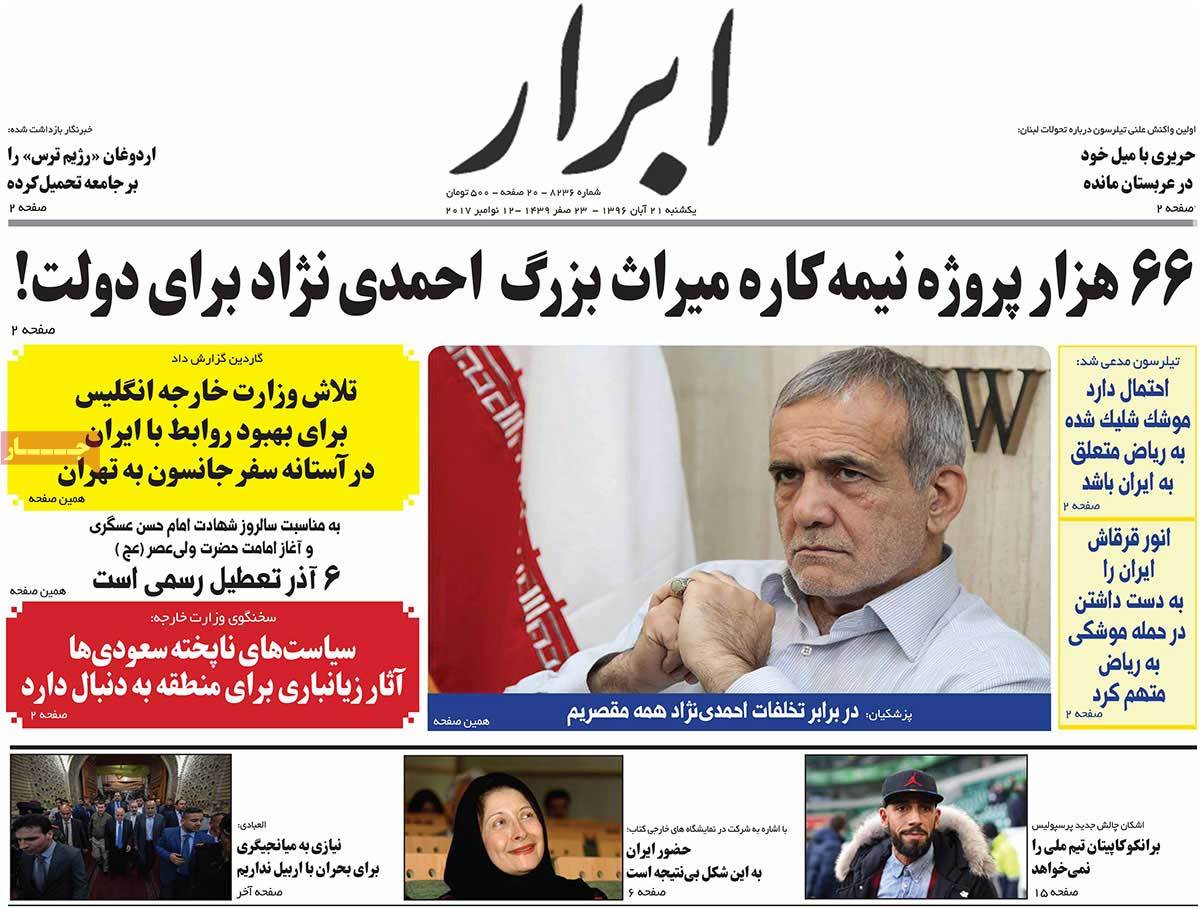
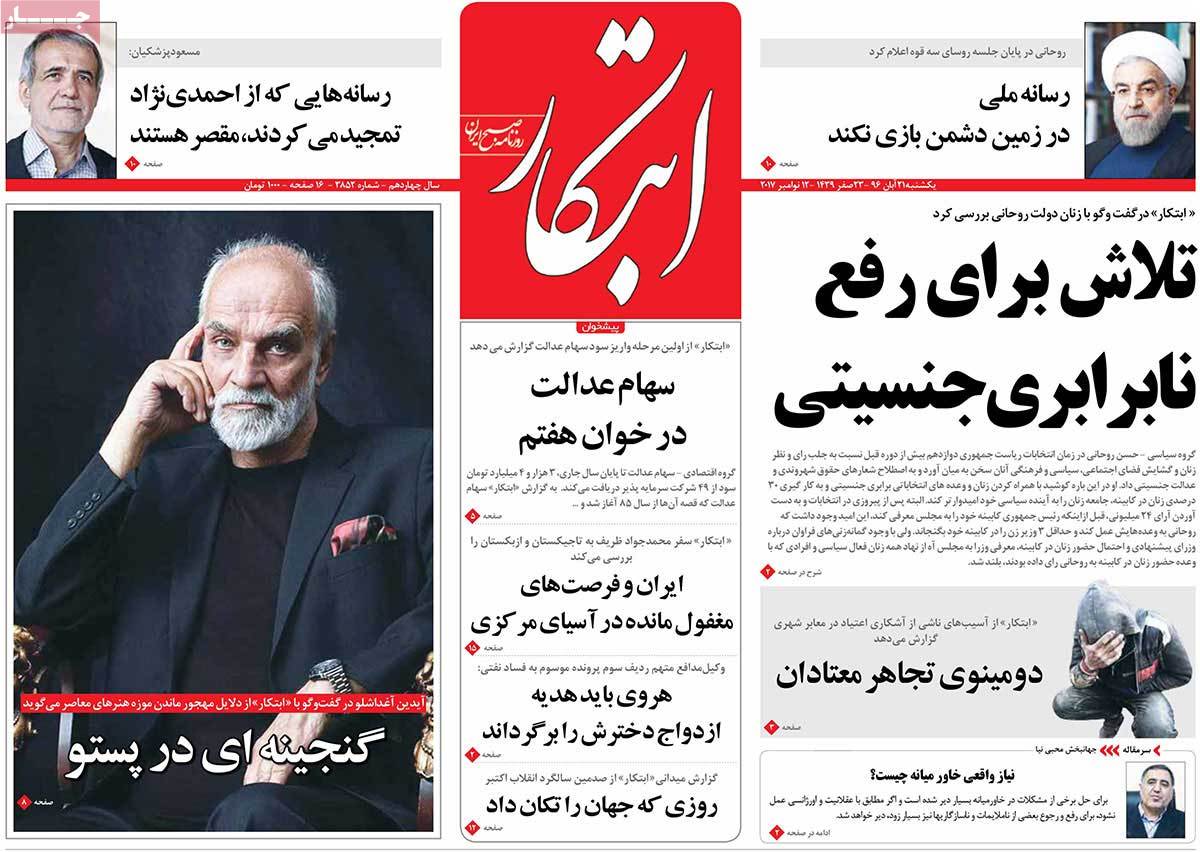
Abrar:

1- Trump-Corker’s War of Words Escalates

2- Erdogan Changes His Bedroom Every Night Out of Fear

3- US Senate’s New Plan to Make JCPOA Implementation More Difficult

4- Baghdad’s First Reaction to Suspension of Iraqi Kurdistan’s Referendum

  • We Want Annulment, Not Suspension, of Results

A Look at Iranian Newspaper Front Pages on October 26


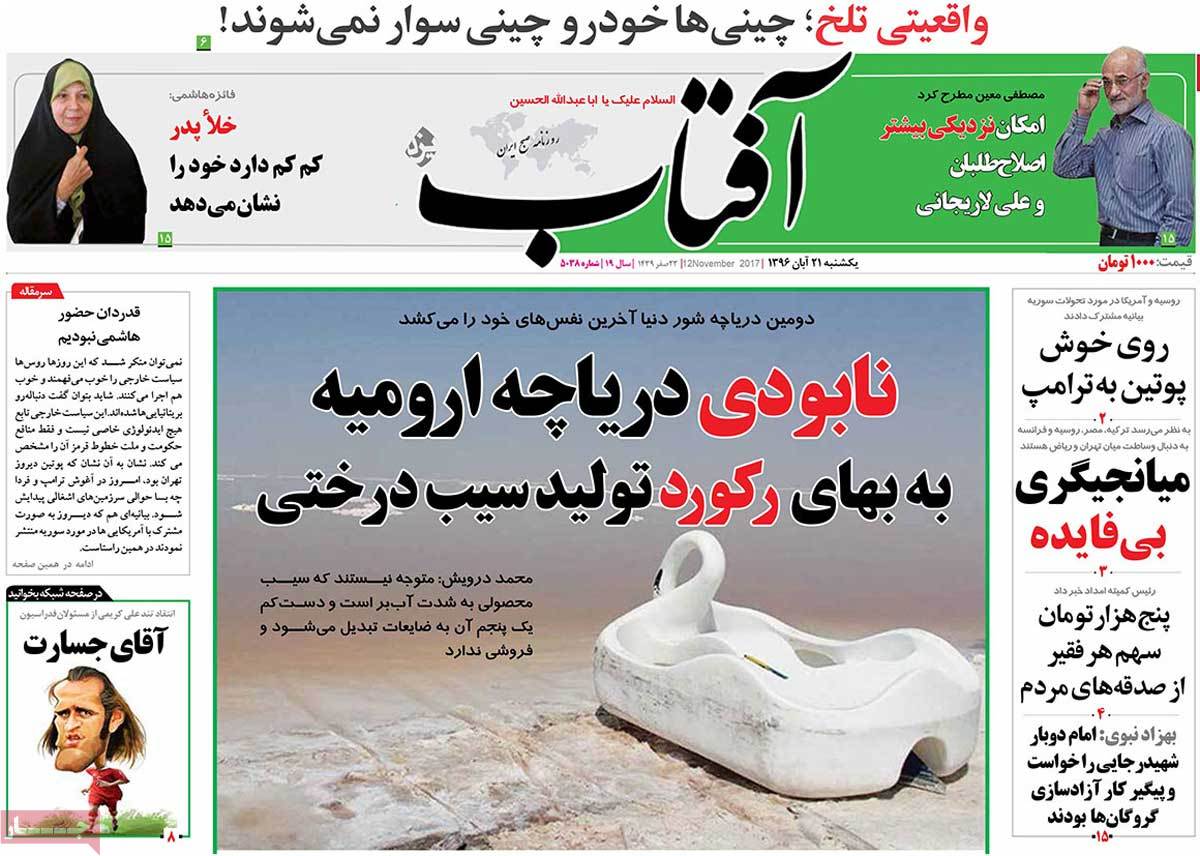
Aftab-e Yazd:

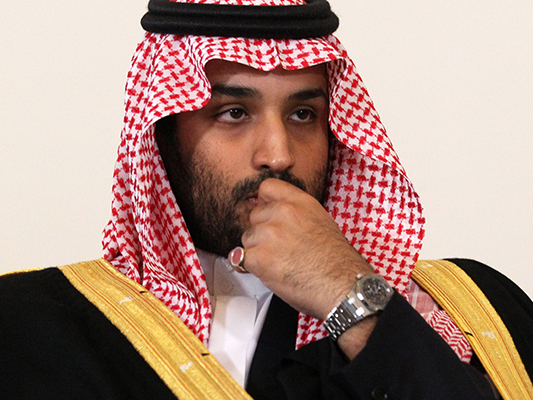
1- Saudi Crown Prince: I’ll Return Saudi Arabia to Moderate Islam

A Look at Iranian Newspaper Front Pages on October 26


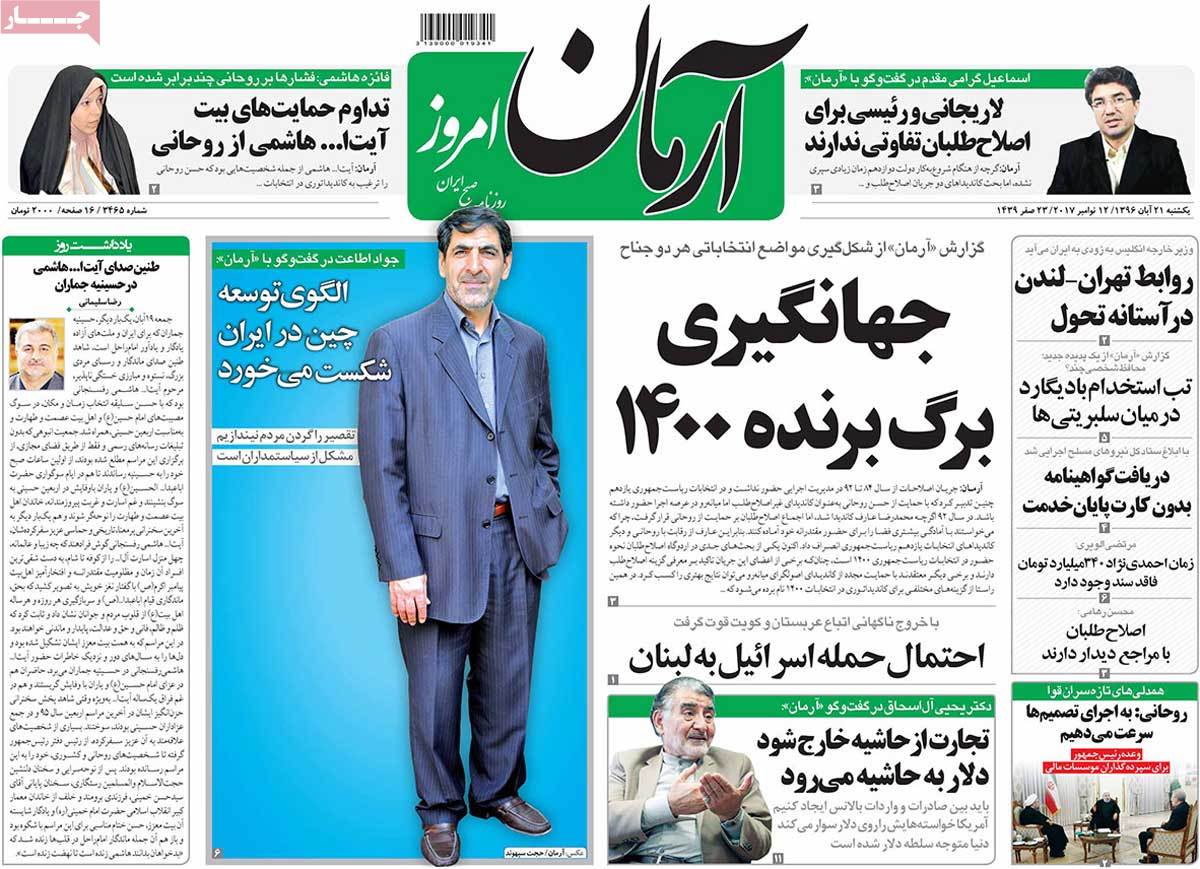
Arman-e Emrooz:

1- Analyst: Rouhani Not Popular among Universities

2- Switzerland to Represent Iran’s Interests in Saudi Arabia

A Look at Iranian Newspaper Front Pages on October 26


Ebtekar:

1- Duel of European Coaches in Tehran: Persepolis, Esteghlal to Play Derby 85

2- Iraqi Kurdistan Officials Suspend Referendum Results

  • Two Fateful Days for Iraqi Kurdistan Region

A Look at Iranian Newspaper Front Pages on October 26


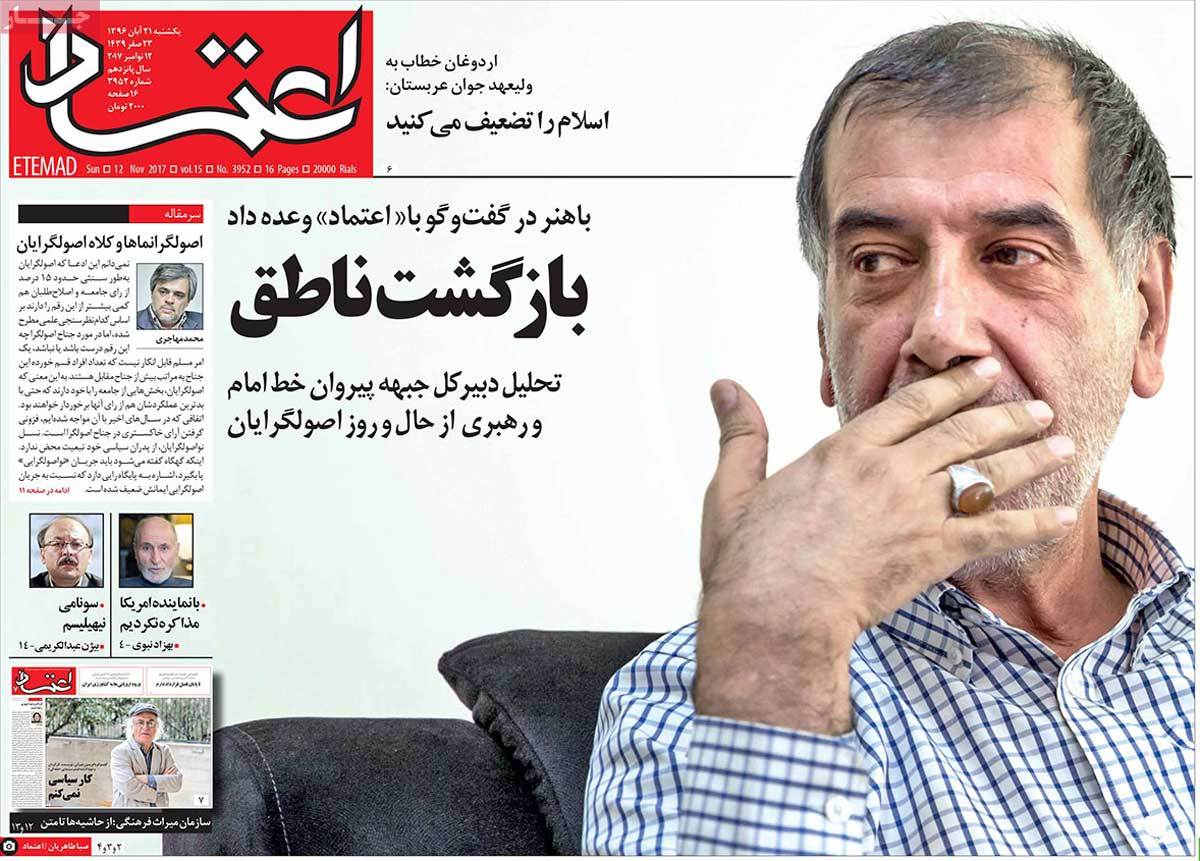
Etemad:

1- Iran Leader: Oil-Dependent Economy Is Insecure

2- MP: SNSC Responsible for House Arrest of Opposition Leaders

3- Masoud Barzani Backs Off

A Look at Iranian Newspaper Front Pages on October 26


Ettela’at:

1-Iran Ambassador to London: US Cannot Oppose Continuation of JCPOA

2- Iran Inaugurates Muslim World’s Second Largest Project in Iraq’s Najaf

3- Import, Production, Distribution of Cold Weapons Prohibited

A Look at Iranian Newspaper Front Pages on October 26


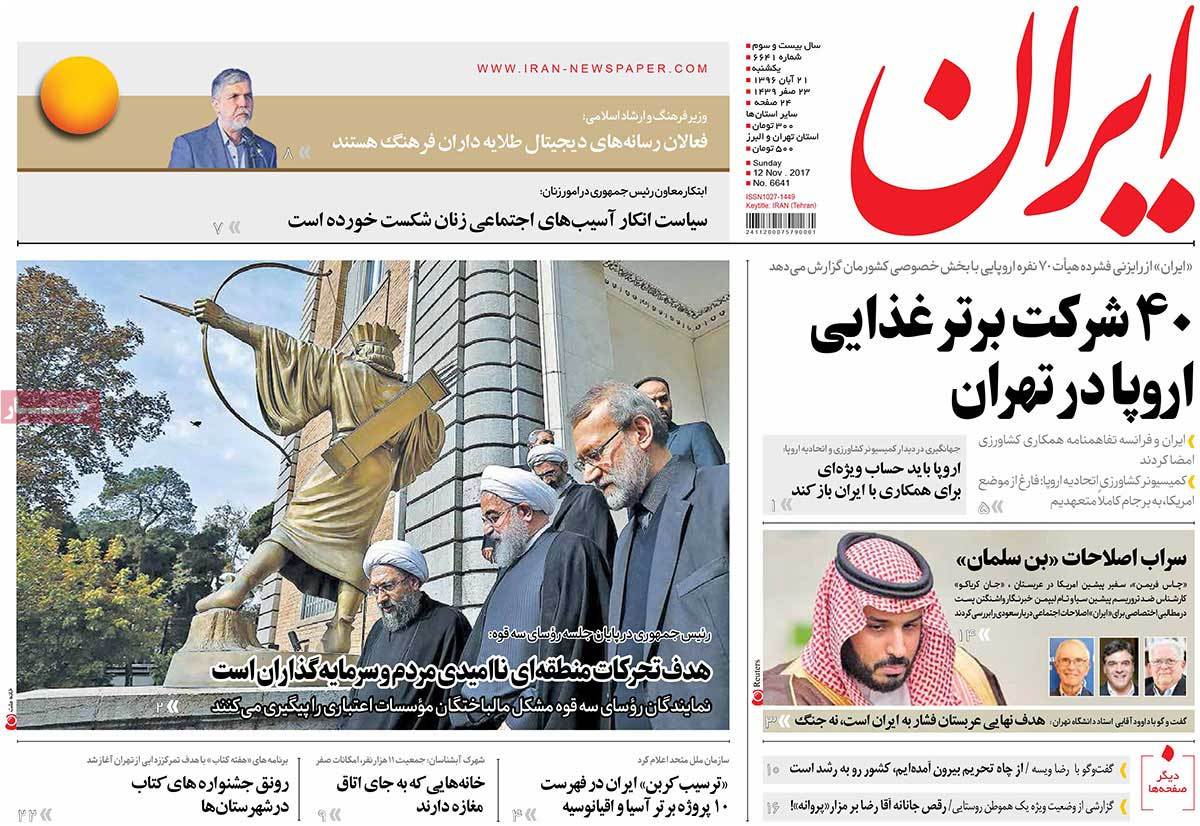
Iran:

1- All Eyes on Azadi Stadium: 85th Tehran Derby to Be Held Today

2- Iran Leader: Defensive Power Not Negotiable

A Look at Iranian Newspaper Front Pages on October 26


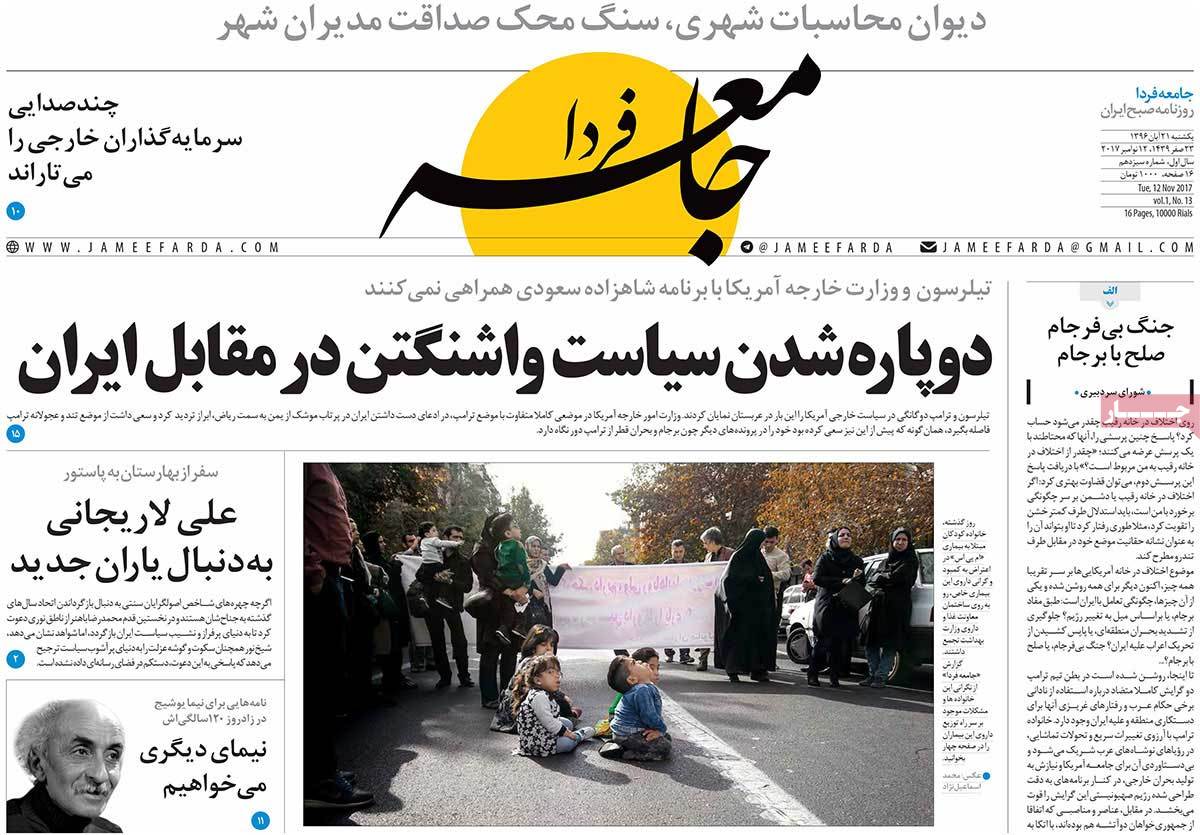
Jame Jam:

1- Leader: Iran’s Defensive Power Not Open to Negotiation

2- Iran Parliament Bans Carrying Cold Weapons

A Look at Iranian Newspaper Front Pages on October 26


Javan:

1-Goodbye RouhaniCare

2- Barzani’s Independence Suspended

A Look at Iranian Newspaper Front Pages on October 26


Jomhouri Eslami:

1- Inflation Rate Stands at 8.2% in Last Month

A Look at Iranian Newspaper Front Pages on October 26


Kayhan:

1- Iran’s Defensive Power Not Open to Bargaining: Ayatollah Khamenei

2- Trump’s Recent Remarks Show US Baffled by Iran’s Power

A Look at Iranian Newspaper Front Pages on October 26


Mardom Salari:

1- Reza Zarrab’s Case to Deteriorate Ankara-Washington Ties

2- Former US Commander Advises US Congress against Withdrawing from JCPOA

A Look at Iranian Newspaper Front Pages on October 26


Resalat:

1- Ayatollah Makarem Shirazi: Enemy Threatens Us, We Should Be United

2- Iran Human Rights Chief: Sanctions Totally against Human Rights Laws

3- Iran’s Strong Message to Amano: IAEA Not Allowed to Inspect Iran’s Military Sites

A Look at Iranian Newspaper Front Pages on October 26