Sunday, December 28, 2025
Home Blog Page 3825

Iran to Increase Precision, Accuracy of Missiles: Top General

Iran to Increase Precision, Accuracy of Missiles: Top General

Chairman of the General Staff of the Iranian Armed Forces Major General Mohammad Baqeri says Iran’s missile capability is merely geared to deterrence.

“The Islamic Republic of Iran’s missile power is completely defensive and [Iran] has no intention of launching aggression against any country, but when it comes to defending the country and national interests, if an aggressor makes a strategic mistake and intends to encroach upon our interests, the Islamic Republic of Iran will have no reservations about using its missile power,” he said.

According to a Farsi report by ILNA, he then touched upon Iran’s missile capabilities from a quantitative, tactical and technical point of view.

“The Commander-in-Chief of the Armed Forces [Ayatollah Seyyed Ali Khamenei] has authorized us to produce missiles with a range of up to 2,000 kilometers, and our scientists have managed to produce these missiles with [high] quality and in quantities needed by the country.”

He said Iran’s missiles have been deployed in “safe areas and underground missile towns.”

He said Iran pays much attention to the “precision” and “pin-point accuracy” in designing and producing its missiles.

“In the world, missiles are usually produced to carry nuclear warheads, and this does not need accuracy as they (attacks) cover large areas. But the Islamic Republic of Iran regards the possession, production and use of nuclear warheads as religiously forbidden; so, our scientists have designed precision-guided missiles with more accuracy,” said the top general.

He said the deterrence power of Iran’s missiles is based on the latest technologies.

“No matter how much our enemies, namely the criminal United States and human-and-child-killing Zionists, increase their missile defense capabilities, they won’t be able to overcome our missile power,” the general underlined.

He also stressed that Washington’s sanctions will not affect the Islamic Republic’s missile program.

“The laws and regulations of the US Congress and circles regarding the imposition of sanctions will have no bearing on the Iranian nation’s will and missile power,” said the top general.

‘General Soleimani Had Warned Erbil of Referendum Consequences’

‘General Soleimani Had Warned Erbil of Referendum Consequences’

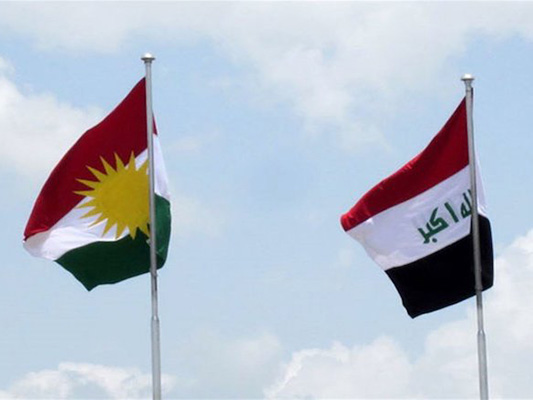
Nazim Dabagh, the representative of the Iraqi Kurdistan Regional Government (KRG) in Tehran, recently disclosed that General Soleimani headed meetings with local delegations in Iraqi Kurdistan region ahead of the Kurdish referendum.

“General Soleimani also had several private meetings with Masoud Barzani, the president, and Nechirvan Barzani, the prime minister of the Iraqi Kurdistan region and the leaders of other parties, including Change (Goran) party,” Dabagh said on Sunday.

He added that the Iranian side had warned the Kurds not to hold an independence referendum because all powers will stand united against the Iraqi Kurdistan region, Fars reported.

According to Dabagh, the Iranian side also told the KRG officials and Kurdish groups that Tehran wants the Iraqi Kurds’ achievements to be maintained within the framework of the Iraqi constitution.

He lauded General Soleimani and other Iranian officials’ efforts to help the Kurds, and said, “We always need relations and friendship of Iran.”

Iran Begins Construction of Two New Nuclear Power Plants

Iran Begins Construction of Two New Nuclear Power Plants

In an agreement between the senior officials of the Atomic Energy Organization of Iran (AEOI) and Rosatom, phases two and three of Iran’s Bushehr nuclear power plant will begin supplying electricity to Iran’s power grid in 10 years.

According to the general director of the Rosatom, Iran and Russia will jointly build the two plants on the northern coast of the Persian Gulf.

“Twenty percent of the entire phase two and eighty percent of its building construction will be done by the Iranian side. We have signed an agreement to build eight power plant blocks and these blocks could be built in other parts of Iran,” said Rosatom Director General Alexey Likhachev at a Tuesday press conference with the AEOI chief Ali Akbar Salehi in Bushehr.

Salehi also expressed hope that the second phase of the project will finish in seven years and the third two years later.

The AEOI chief also elaborated on the benefits of the project for Iran, saying, “The first phase of Bushehr nuclear power plant is now operational and as a result, some 11 million barrels of crude oil is saved annually. The production of electricity by a 1,000-megawatt plant will also help diminish up to seven million tons of gas emissions every year.”

Iran Begins Construction of Two New Nuclear Power Plants

Salehi underlined Iran and Russia’s resolve to maintain and strengthen their nuclear cooperation, adding, “The Bushehr nuclear power plant is a symbol of strategic cooperation between Iran and Russia.”

He pointed to Iran’s plan to produce 20,000 megawatts of nuclear-generated electricity and said, “Since the cost of constructing a 1000-megawatt nuclear power plant is $5,000 billion, we need to invest $100,000 billion to build nuclear power plants with a capacity to generate 20,000 megawatts of electricity.”

The ceremony to inaugurate the project came a few days after International Atomic Energy Agency (IAEA) Secretary General Yukiya Amano visited Iran, and once again confirmed Tehran’s compliance with the agency’s charter and the 2015 nuclear deal with six world powers.

Iran says that the project will be conducted within the framework of the Safeguards Agreement with the IAEA and the Non-Proliferation Treaty (NPT).

Salehi said the implementation of Iran’s nuclear deal, known as the Joint Comprehensive Plan of Action (JCPOA), has played a positive role in making the project come to life.

Each of the two new phases will produce 1,057 megawatts of electricity. Combined with phase one, Iran will produce some 3,300 megawatts of nuclear-generated electricity in a decade.

Iranian Media Should Not Be Mouthpiece of US Baloney: Larijani

media

In an address to a group of media staff in the northern province of Khorasan Razavi on Tuesday, Larijani said the US is seeking to dissuade western investors from investing in Iran.

Therefore, he added, the Iranian media should not turn into a mouthpiece of the US officials’ rubbish.

According to a Farsi report by ICANA, the parliament speaker also said Iranian economy enjoys limited capacities for growth, noting “the enemies have been seeking to launch a psychological war against our people.”

Larijani said the US officials have been trying to hamper Iran’s economy through their anti-Iran rhetoric.

“They want to dissuade possible investors and that’s why we need to pay serious attention to our economy, and consider it our first priority. This means that economy rather than politics should grab our daily attentions.”

He referred to the Joint Comprehensive Plan of Action (JCPOA) and said the US government is reneging on the agreement but “the media should not highlight the US officials’ statements to make the society worried. They should instead reveal the deceitful nature of the US.”

“For example when a US official makes a statement about Iran, we should not cover his statements because the statements are not of any significance. Such coverage only creates worries. So, it’s better to be after unity and cover the news of the JCPOA in a way which can lead to fruitful reforms in our own economy,” he noted.

Elsewhere in his address, the Iranian lawmaker said the media are obliged to criticize parliament and hold government responsible for its economic policies.

Azerbaijan President Arrives in Tehran

Ilham Aliyev

Aliyev was welcomed in Mehrabad Airport by Iranian Economy Minister Masoud Karbasian.

The Azeri president will first hold a meeting with his Iranian counterpart Hassan Rouhani, and then meet with the Leader of Iran’s Islamic Revolution Ayatollah Seyyed Ali Khamenei.

He will finally take part in a trilateral meeting with Rouhani and Russian President Vladimir Putin, who is expected to arrive in Tehran on Wednesday noon.

The three presidents will hold the second trilateral meeting between leaders of Iran, Azerbaijan Republic, and Russia. The first meeting was held in Baku.

Iran, Russia, Turkey Discuss Future of Syria Peace Talks

During the Tuesday meeting, the Kazakh President referred to his country’s efforts to advance Astana Talks on Syria, and expressed his views on the future of the process.

Then, Iran’s Jaberi Ansari, Russia’s Alexander Lavrentievand Turkey’s Sedat Önal, as well as representatives from the United Nations, Jordan and the United States as the observer states, expressed their views on the Astana Process and its future.

Jaberi Ansari appreciated the positive role of Kazakhstan in hosting the negotiations, and emphasized that the Astana Talks, with the collaboration of the three guarantor states, have produced positive results in creation of de-escalation zones, and stabilizing the process of effective confrontation with terrorism.

The Iranian diplomat also added that the continuation of this success requires simultaneous attention to all three military, security-political and humanitarian dimensions of the Syrian crisis.

At the end of the 7th round of talks, the three guarantor states issued a joint statement whose full text follows:

Joint statement by Iran, Russia and Turkey

on the International Meeting on Syria in Astana

30-31October 2017

The Islamic Republic of Iran, the Russian Federation and the Republic of Turkey as guarantors of the observance of the ceasefire regime in the Syrian Arab Republic:

  • welcoming progress in the implementation of the Memorandum on the creation of de-escalation areas in the Syrian Arab Republic of 4 May 2017 during the past six months;
  • reaffirming their strong commitment to the sovereignty, independence, unity and territorial integrity of the Syrian Arab Republic;
  • emphasizing the significant reduction of violence on the ground in Syria as a result of measures taken to strengthen and maintain the ceasefire regime, including launching the de-escalation areas and creating the security zones:
  1. Emphasize progress in the fight against terrorism and elimination of DAESH/ISIL, Nusra Front and all other individuals, groups, undertakings and entities associated with Al-Qaeda or DAESH/ISIL as a result of the launch of the de-escalation areas and reaffirm their determination to take all necessary measures to continue the fight against them within and outside the de-escalation areas.
  2. Underline that the Syrian crisis has no military solution and should be solved only through the political process on the basis of the implementation of UNSC resolution 2254 (2015) and call upon the conflicting parties to benefit from the emerging favorable conditions on the ground with a view to stepping up efforts to advance the political process underway in Geneva.
  3. Agree to discuss in consistence with the UN-led Geneva process the Russian Federation`s proposal to convene a Congress of the national dialogue about which the Russian side shared information with the guarantors.
  4. Emphasize the need for the conflicting parties to take confidence‑building measures, including the release of detainees/abductees and the handover of the bodies as well as identification of missing persons, to create better conditions for political process and lasting ceasefire.
  5. Underline the necessity to further increase the international humanitarian aid to Syria, to provide rapid, safe and unhindered humanitarian access to all those in need and in this regard remind of the relevant provisions of the Memorandum of 4 of May 2017.
  6. Reaffirm their determination to continue implementing the provisions of the Memorandum of 4 May 2017 and other decisions adopted earlier within the framework of the Astana process.
  7. Express their sincere gratitude to the President of the Republic of Kazakhstan, His Excellency Nursultan Nazarbayev and the Kazakh authorities for hosting in Astana the 7th high-level International Meeting on Syria.
  8. Decide to hold the next high-level International Meeting on Syria in Astana in the second half of December 2017.

CAATSA Not to Stop Iran from Boosting Defensive Power: Shamkhani

Speaking to reporters on the sidelines of his Tuesday visit to Tehran Press Exhibition, Shamkhani referred to the US extension of the Countering America’s Adversaries Through Sanctions Act (CAATSA), also known as the “Mother of All Sanctions.”

“The US Congress wants to extend CAATSA today. Once the US produced the Mother of All Bombs. Since then, Iran has developed and turned into a powerful country. All these show these Mothers (Mother of All Bombs and Mother of All Sanctions) have been ineffective and will have no bearing on the Iranian nation’s fundamental moves to defend their national and territorial identity,” said Shamkhani.

He further noted that the country’s defence issues, including the missile program, are non-negotiable, according to a Farsi report by Alef news website.

Shamkhani went on to say that Iran’s defence power is based on its domestic potentialities.

He also underlined that Tehran will not negotiate on any of the provisions of the Iran nuclear deal.

The top official then touched upon reports that the Russian defence minister has, in a meeting with Israeli officials, announced that Iran and the Lebanese resistance movement Hezbollah must leave southern Syria.

“I haven’t heard any such thing so far. [The forces of] Iran and Hezbollah are not only present in southern Syria; rather, their troops are present in all parts of Syria. The Russian government hasn’t confirmed these reports, either; this must have been published by Israeli media,” said the top official.

He also touched upon Iraqi Kurdistan region’s President Masoud Barzani’s backing down from its position regarding the region’s secession from Iraq.

He said the people of the Kurdistan region are “our historical and religious friends and our brothers.”

He said Barzani had already been told that the holding of a referendum would not be in the interest of the Kurdish people and Barzani himself.

“But he didn’t listen and caused rifts among the people, and now he has no choice but to hand over the leadership of the Kurdistan region,” Shamkhani said.

Iran Can Increase Range of Missile beyond 2,000 km: IRGC Commander

Iran Can Increase Range of Missile beyond 2,000 km: IRGC Commander

Speaking to reporters on the sidelines of a conference in Tehran on Tuesday, Major General Jafari said the 2,000-km range for Iran’s missiles is deemed to be sufficient because “most of American interests and forces” lie within this range.

Describing the country’s defense and missile capabilities as an asset, the top general warned the enemies of the high costs of infuriating the Iranian nation.

Last week, Leader of the Islamic Revolution Ayatollah Seyed Ali Khamenei said in a gathering of new Army officers that vigorous efforts to boost Iran’s power is a non-negotiable issue, warning that the enemies attempt to counter Iran’s national might, because they see this as a nuisance.

The adversaries are opposed to the enhancement of the Islamic Republic of Iran’s power in the region and beyond, because such power constitutes the “strategic depth of the Islamic Establishment,” Ayatollah Khamenei said.

Iran Test-Fires Smart Bombs in Military Drills

Iran Test-Fires Smart Bombs in Military Drills

F-7 warplanes fired smart bombs, long-range bombs with pinpoint accuracy, and homegrown rockets during the aerial exercises on Tuesday, General Massoud Roozkhosh, the spokesman for the war game said.

According to the general, F-5 fighter jets and homegrown Saeqeh (Lightning) jets also dropped 500-pound bombs on various targets in the operation zone.

Codenamed Aerial Power of Fadaeeyan-e Harim-e Velayat 7 (Devotees of Velayat Airspace 7), the drills involve all air bases of the IRIAF, and will last for two days.

Dozens of bomber airplanes, fighter jets, military transport aircraft, communication and reconnaissance planes, tanker aircraft and Unmanned Aerial Vehicles (UAVs) have taken part in the war game.

During the first day, the Air Force’s electronic warfare units exercised various tactics and C-130 Hercules transport planes also exercised tactical unloading practices with aerial support from F-14 jets.

Iran’s Air Force holds annual war games in a bid to boost capabilities to defend the country’s airspace.

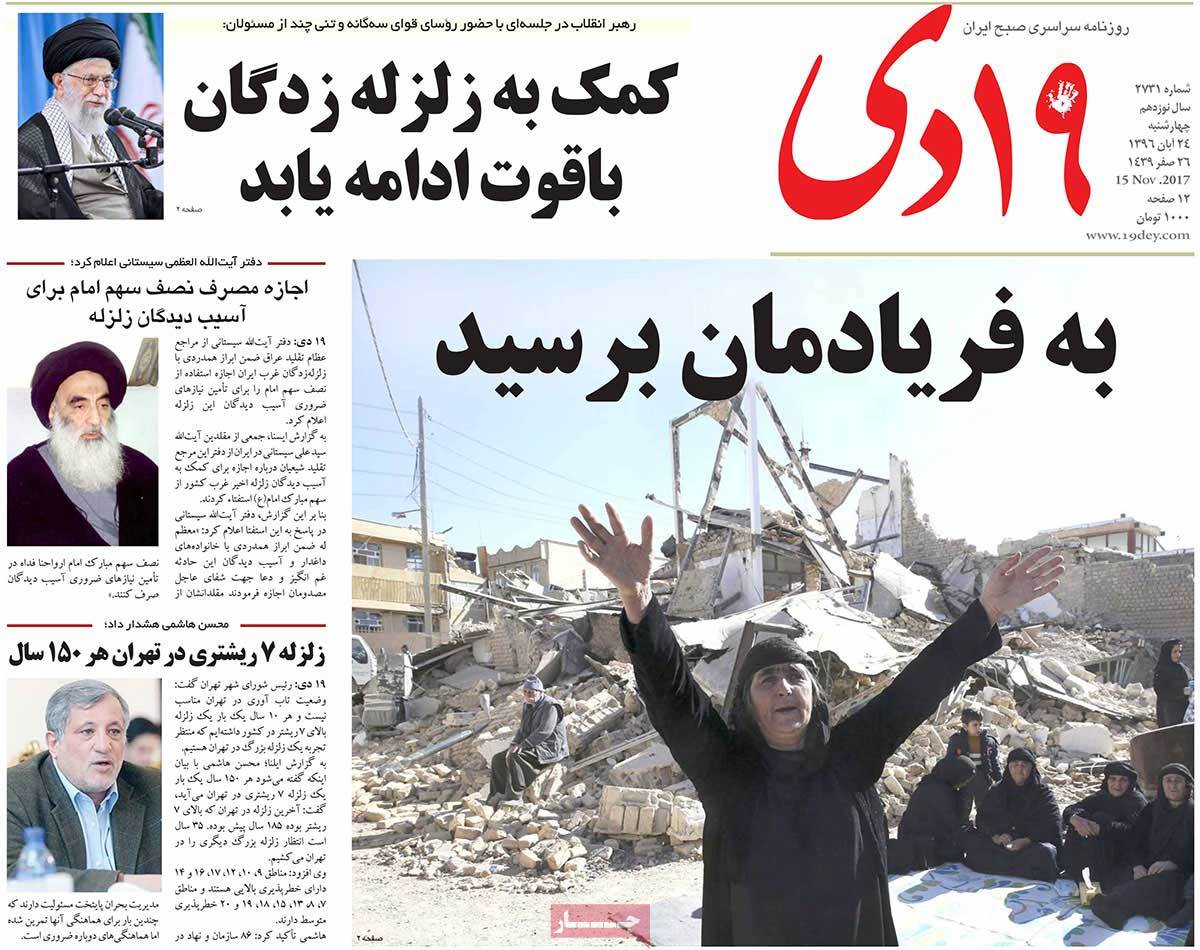
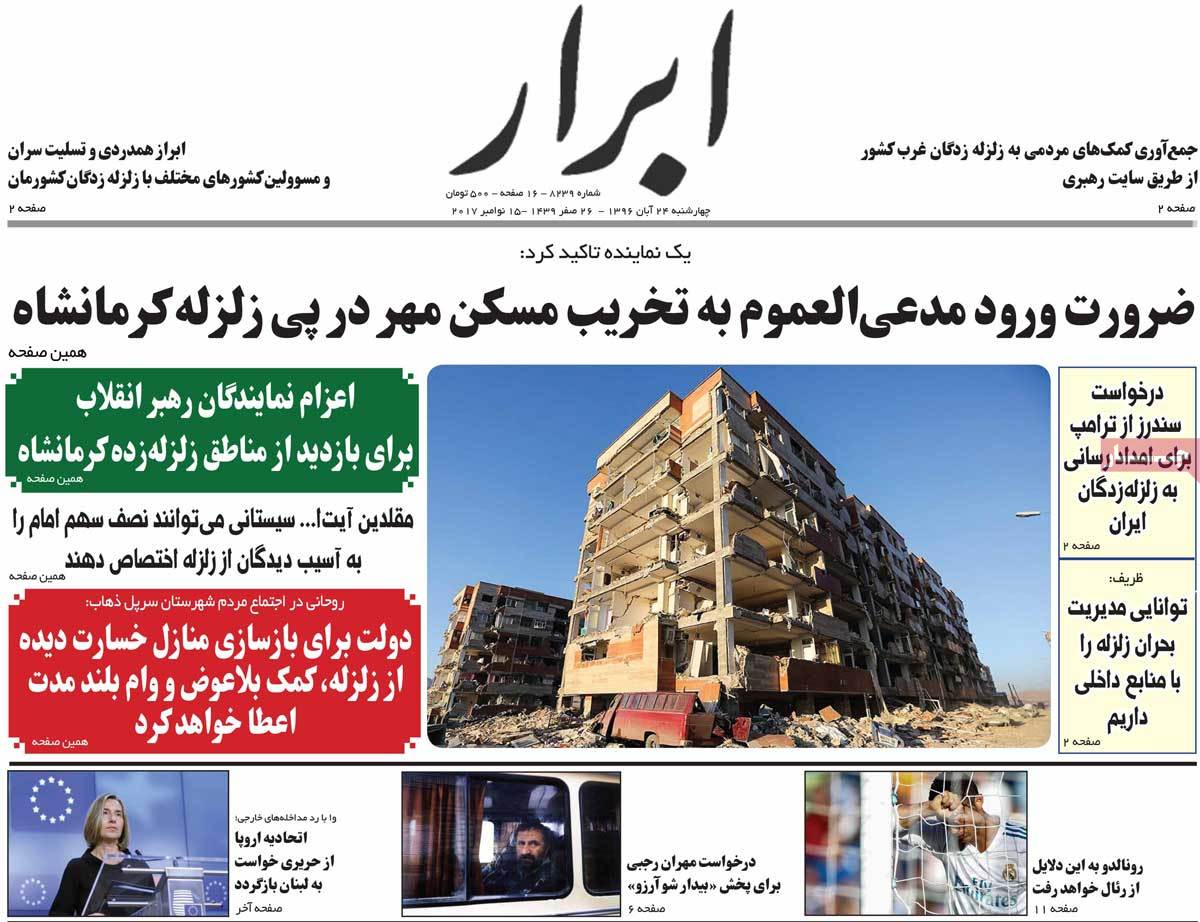
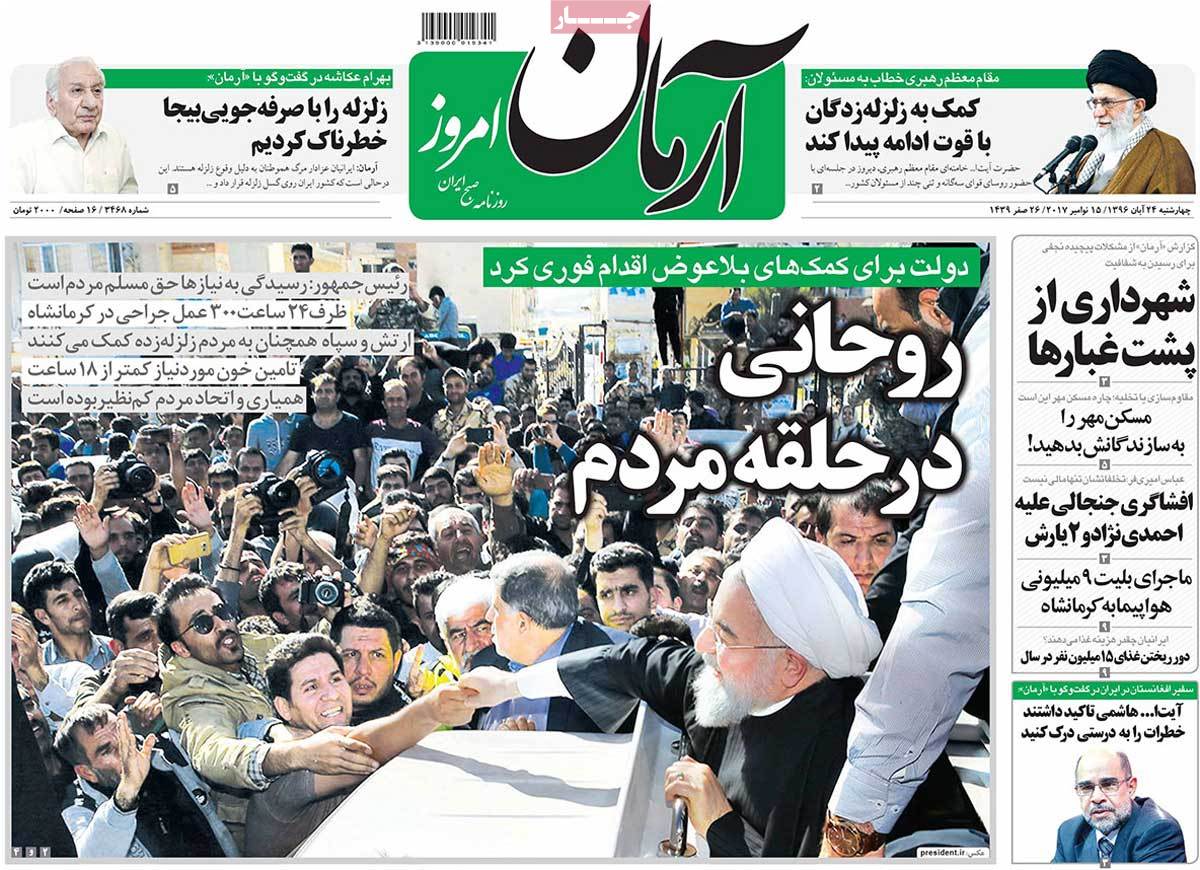
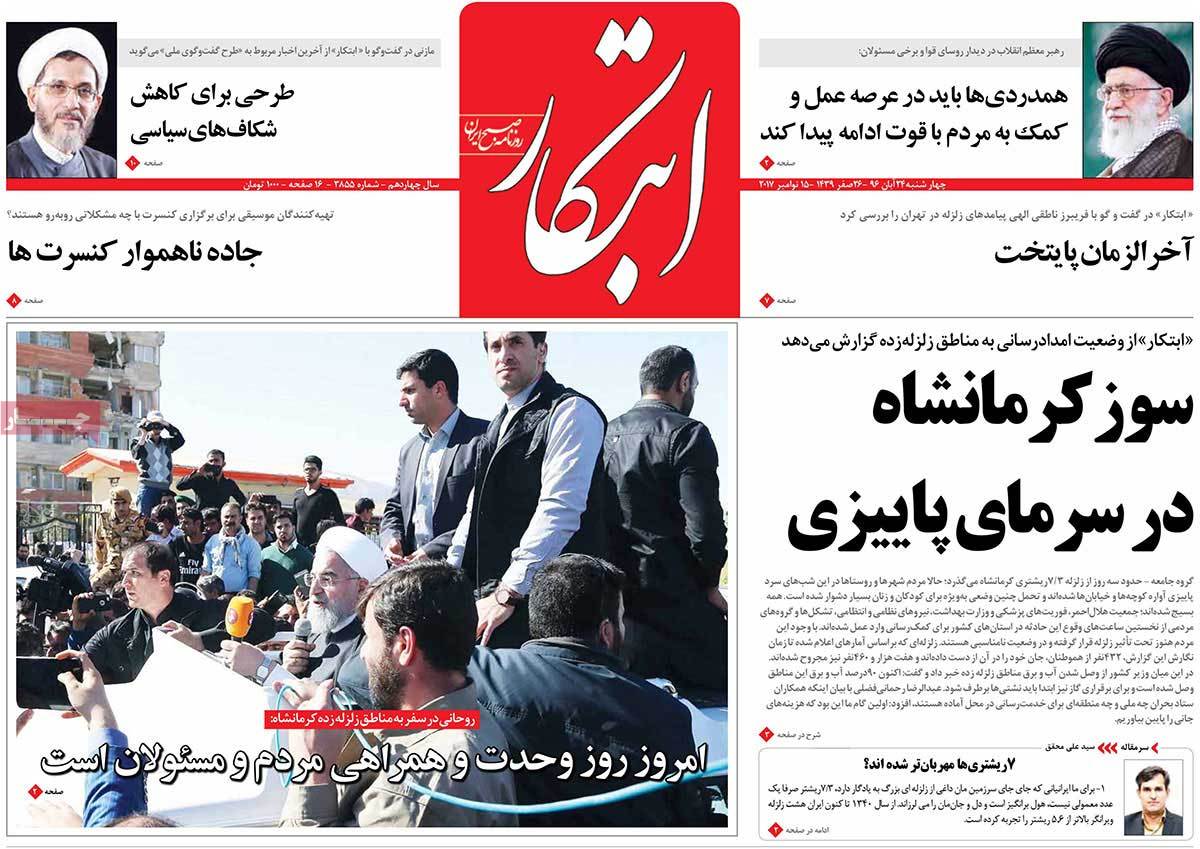
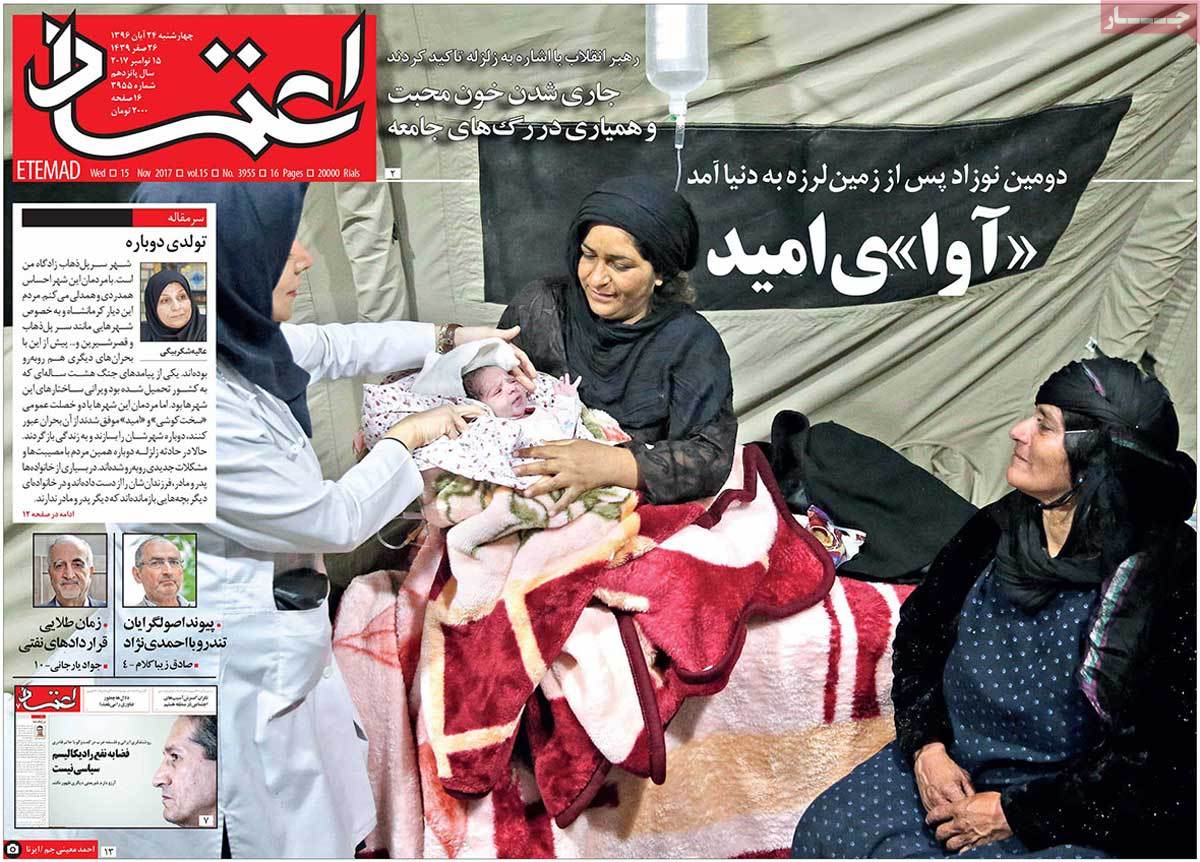
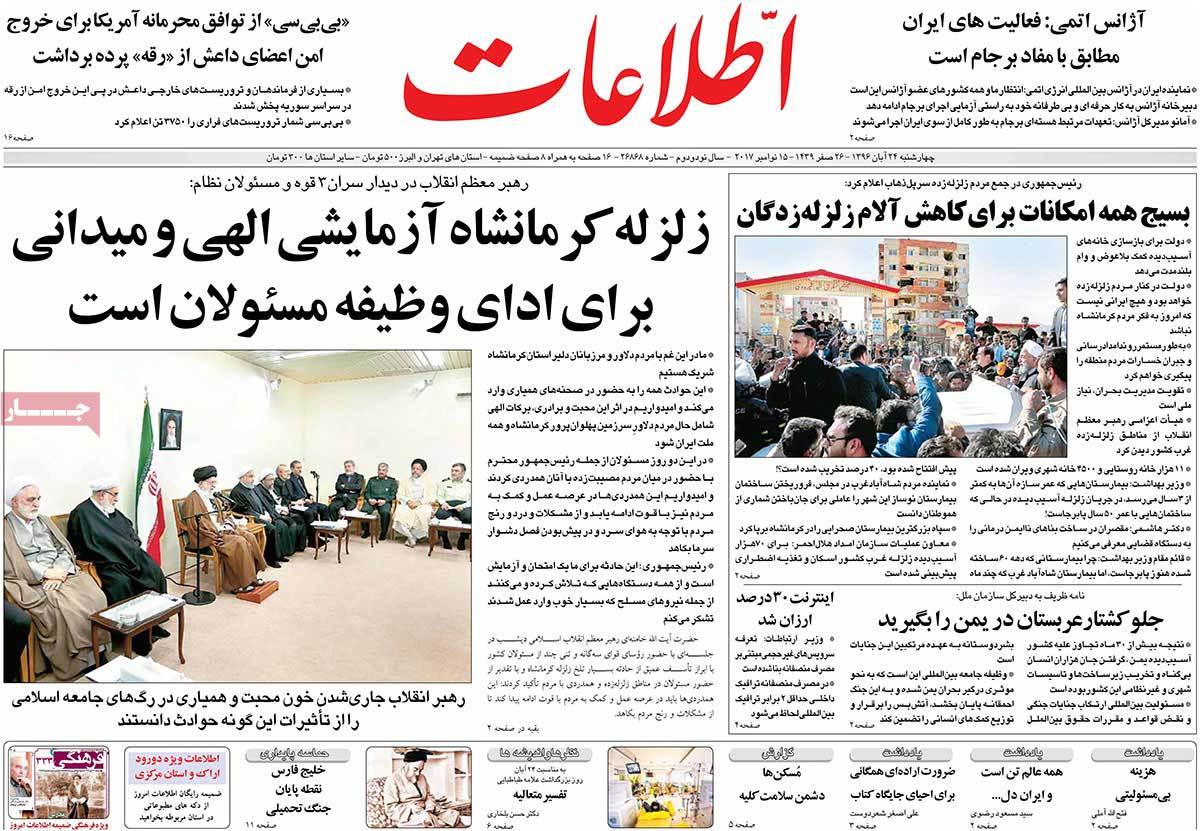
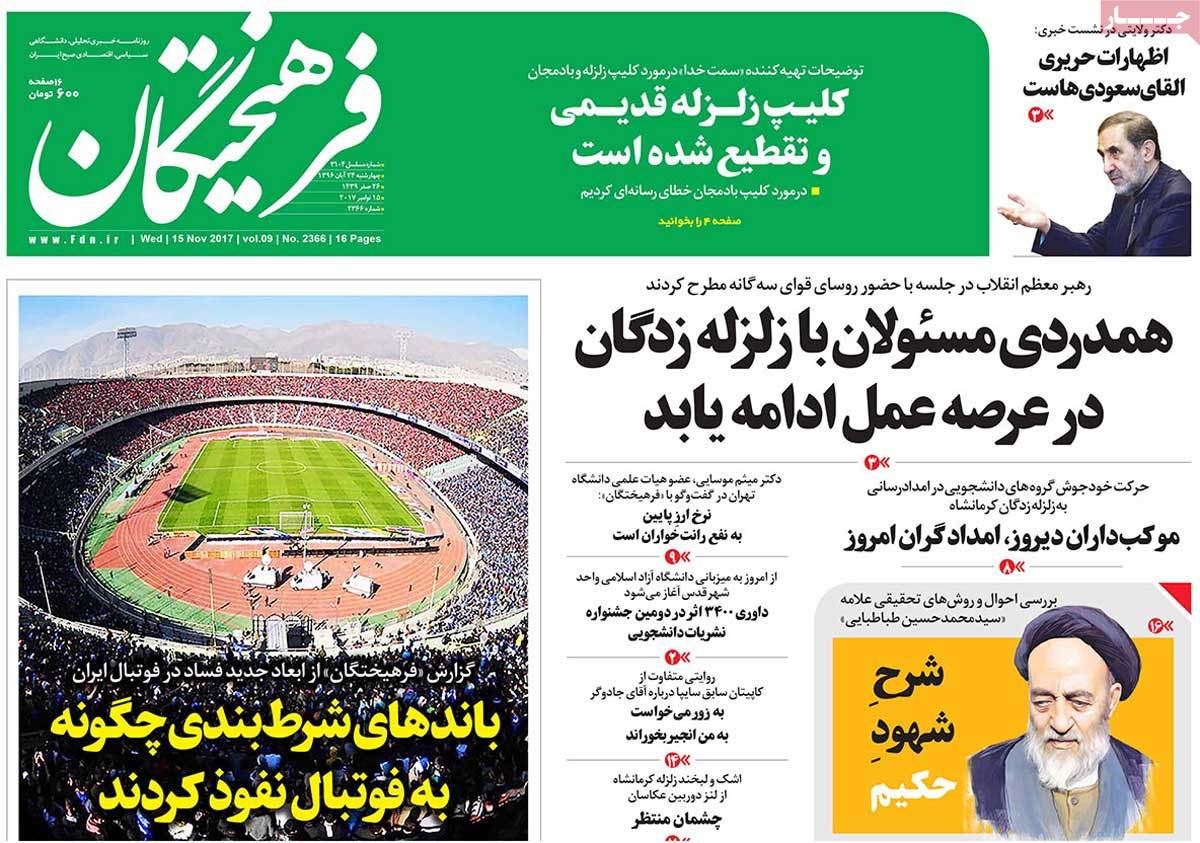
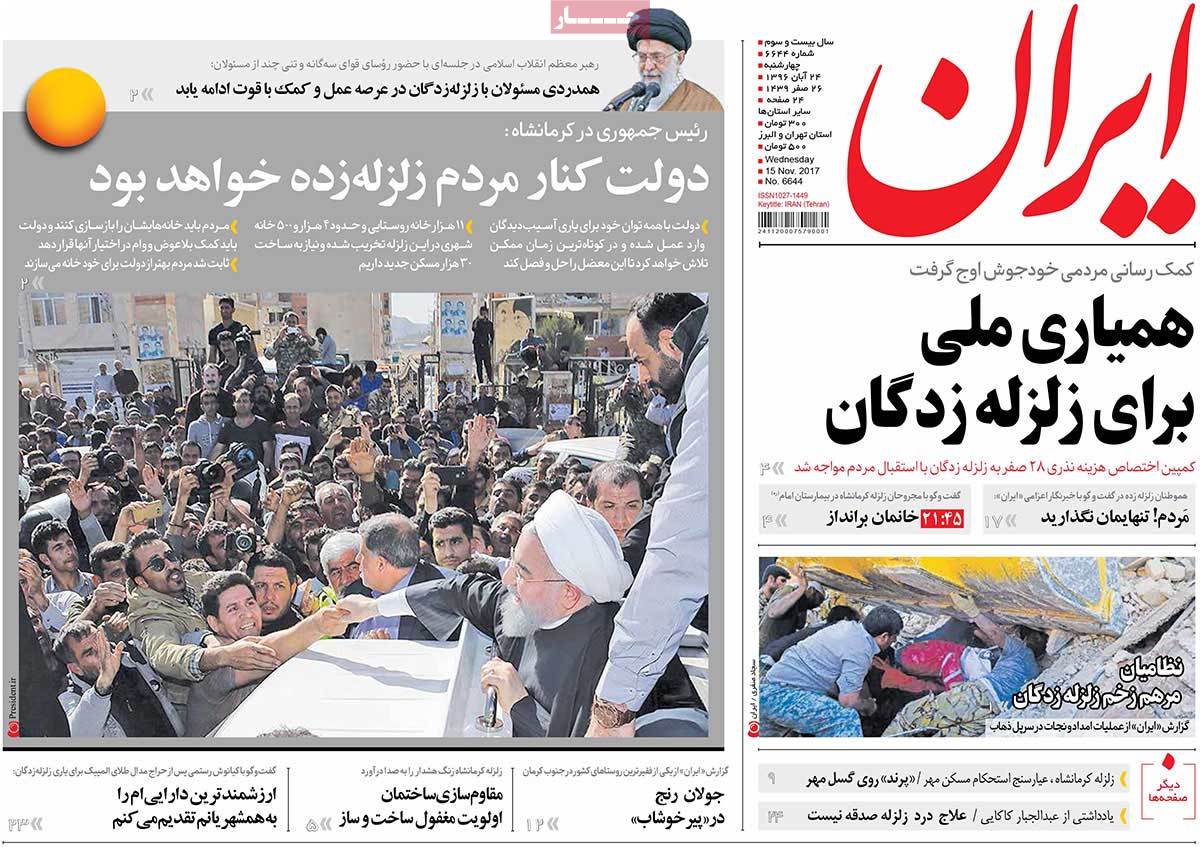
A Look at Iranian Newspaper Front Pages on October 31

The top story in today’s newspapers was a trilateral meeting between Iranian President Hassan Rouhani, Parliament Speaker Ali Larijani, and Judiciary Chief Ayatollah Sadeq Amoli Larijani. During the meeting, the three officials discussed various domestic and international issues including the US plots and the ways to attract more investment.

Several papers also highlighted the remarks made by the Chief of Staff of the Iranian Armed Forces Major General Mohammad Baqeri about Tehran’s withdrawal from the nuclear deal in case the anti-Iran sanctions are restored.

Masoud Barzani’s resignation from presidency of Kurdistan Regional Government and the latest developments in the Iraqi region also received great coverage.

The above issues, as well as many more, are highlighted in the following headlines and top stories:


Abrar:

1- Iran Top General: Remaining in JCPOA Meaningless If Sanctions Re-imposed

2- Nechirvan Barzani to Seize Power in Kurdistan Region

A Look at Iranian Newspaper Front Pages on October 31


Aftab-e Yazd:

1- MP: Iran Still Paying Prices of Ahmadinejad’s Presidency


A Look at Iranian Newspaper Front Pages on October 31


Arman-e Emrooz:

1- Shocking Information about Offences of Ahmadinejad’s VP Baqaei

2- Analyst: Trump Golden Opportunity for Rivals


A Look at Iranian Newspaper Front Pages on October 31


Asman-e Abi:

1- 23rd Press Exhibition Underway in Tehran: The Present, Absent News Outlets


A Look at Iranian Newspaper Front Pages on October 31


Ebtekar:

1- Rouhani: We Have Plans for Different Scenarios

2- Foreign Ministry Spokesman: We Have No Problem for Resolving Woes with Saudi Arabia

3- Increased Fragility in Baghdad-Erbil Ties


A Look at Iranian Newspaper Front Pages on October 31


Etemad:

1- Rouhani: Required Mechanisms Devised for Attracting Foreign Investment

A Look at Iranian Newspaper Front Pages on October 31


Ettela’at:

1- National Super-Projects on Water Implemented in 12 Provinces with $6.2bn Budget

2- Syrian Dissidents: No One Wants Assad’s Withdrawal from Power Anymore

3- Heads of Iran, Russia, Azerbaijan Republic to Meet in Tehran

A Look at Iranian Newspaper Front Pages on October 31


Hamshahri:

1- Steps for Globalization of Iranian Cities; Interview with UN Official in Tehran

A Look at Iranian Newspaper Front Pages on October 31


Iran:

1- Rouhani: All Branches of Power in Iran Resolved to Reinforce Security for Investment

2- Head of Trump’s Electoral Campaign Arrested

3- Erbil’s Hard Days after Referendum


A Look at Iranian Newspaper Front Pages on October 31


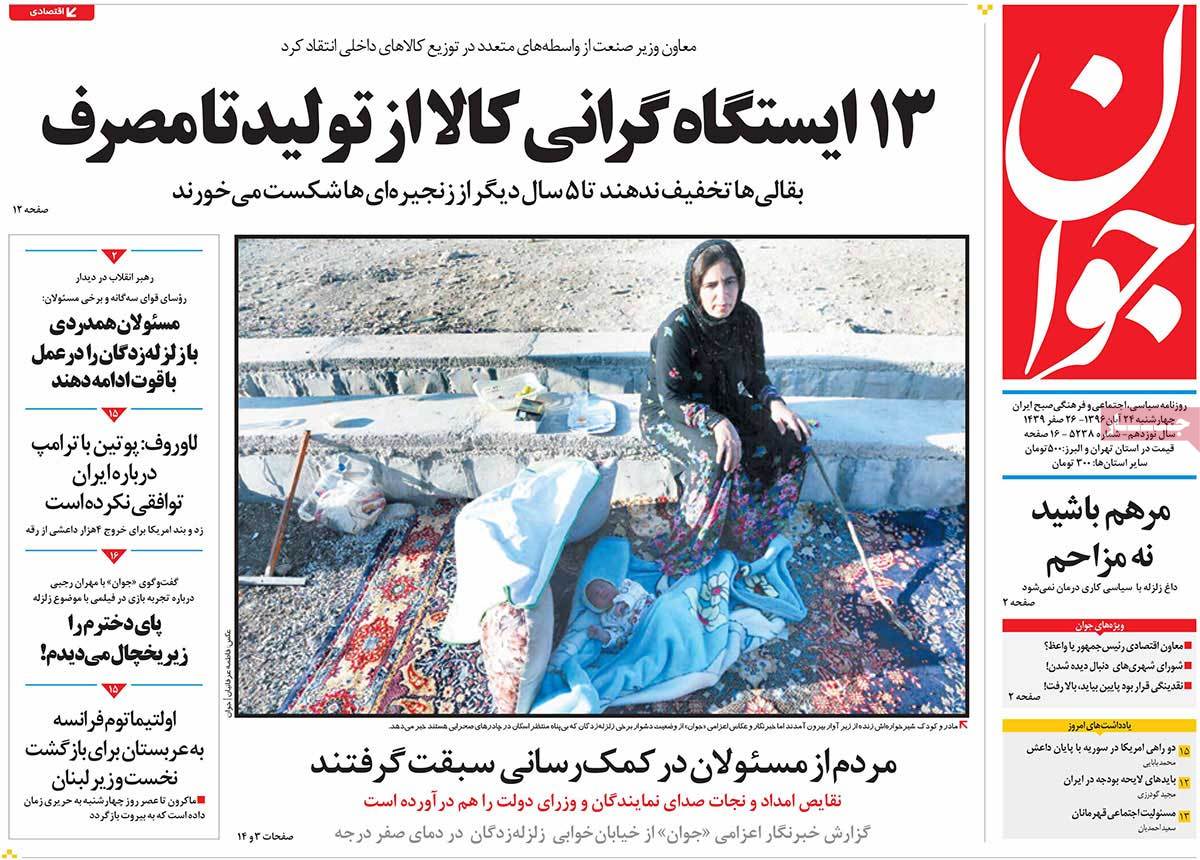
Javan:

1- Female Staff of European Parliament Harassed by Politicians

  • British PM: Harassments in European Parliament Intolerable

2- Barzani’s Supporters Create Chaos after His Resignation


A Look at Iranian Newspaper Front Pages on October 31


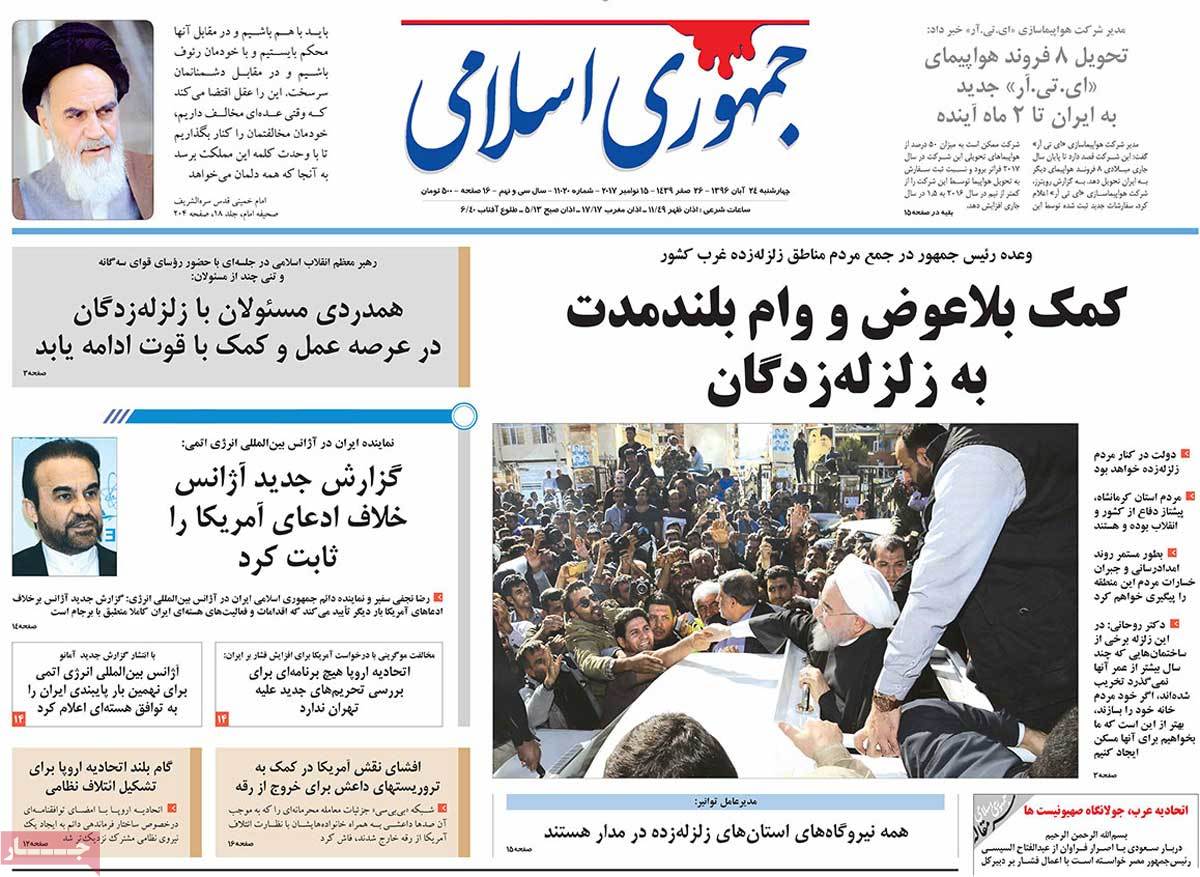
Jomhouri Eslami:

1- Tehran Mayor: Citizens Want Municipality to Resolve Traffic Jam, Air Pollution

2- Unprecedented Hatred of American People towards Trump

3- Putin to Visit Tehran Tomorrow

A Look at Iranian Newspaper Front Pages on October 31


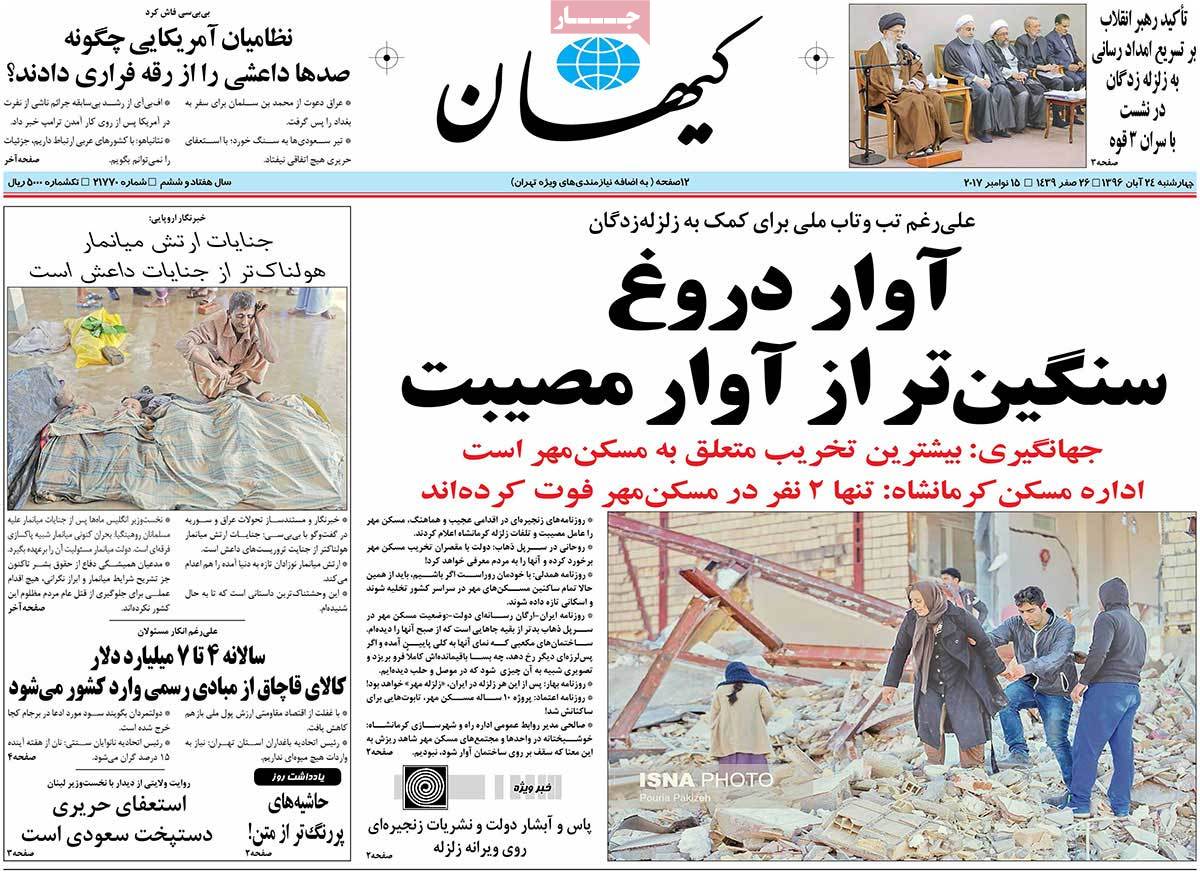
Kayhan:

1- Mother of Sanctions Is Here: Those Who Embellished US Now Hiding Themselves

2- Barzani, Latest Victim of Trusting US, Zionist Regime

3- Al Saud to Let Women Go to Stadiums in Order to Cover Slaughter of Muslim Women, Kids

4- Economic Gains of Nuclear Deal for Europe, Unemployment and Recession for Us


A Look at Iranian Newspaper Front Pages on October 31


Seda-ye Eslahat:

1- Moderate Gov’t Getting Too Much Rightist

  • Consequences of Increased Role for Vaezi, Decreased One for Jahangiri

2- Backing Off, Only Thing We See in Rouhani: MP


A Look at Iranian Newspaper Front Pages on October 31


Shargh:

1- Heads of Trio Branches of Iran Gov’t Discuss Issue of Zoroastrian Councilor’s Disqualification

2- Academic Zibakalam Writes to Rouhani: Don’t Forget People’s Demands


A Look at Iranian Newspaper Front Pages on October 31


Siasat-e Rooz:

1- Iraqi Kurdistan’s People Celebrate after Barzani’s Resignation


A Look at Iranian Newspaper Front Pages on October 31


SMT:

1- Those Who Have Lost Their Money Hold Protest Gathering in Press Exhibition


A Look at Iranian Newspaper Front Pages on October 31


Vatan-e Emrooz:

1- English Moral Decay, from BBC to West Minister

  • A Report on Series of Sexual Scandals in Britain

A Look at Iranian Newspaper Front Pages on October 31