Thursday, December 25, 2025
Home Blog Page 3569

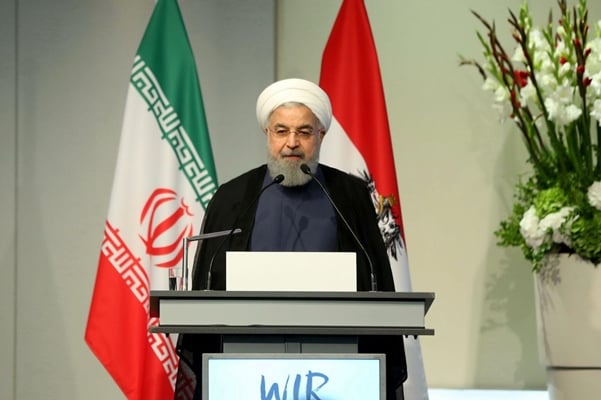
Iran President Sends Congratulatory Messages to Italian, Spanish PMs

In a Tuesday message to Sanchez, Rouhani said constructive interaction and development of relations with the friendly country of Spain, as an important country in the European Union, based on mutual respect and interests has been a priority for the Islamic Republic of Iran over the past several decades.

He also expressed the hope that through common efforts, Tehran and Madrid would witness the deepening of their friendly bonds and further development of relations in all fields of mutual interest and promotion of international cooperation.

Also in a letter to Conte, the Iranian president said expansion of bilateral relations with Rome is a priority for Tehran, and under this policy of constructive interaction, the relations between the two countries have fortunately had a positive trend in recent years.

He also expressed the hope that the “political will and serious resolve” of the two countries’ officials would contribute to the enhancement of Tehran-Rome bilateral, regional and international cooperation during Conte’s term.

Rouhani further highlighted the need for the implementation of the previously signed agreements and documents between the two countries, particularly the credit line agreement.

On June 2, socialist Pedro Sanchez was sworn in as Spain’s seventh head of government since its return to democracy in the late 1970s, taking over from veteran conservative Mariano Rajoy who was ousted over a corruption scandal.

Giuseppe Conte, a law professor who has never held political office, was also sworn in as Italy‘s new prime minister on June 1.

It’s Not Possible to Remain in JCPOA If Iran Deprived of Benefits, Rouhani Tells Macron

“If Iran cannot benefit from the privileges of this agreement, remaining in it will not be practically possible,” Rouhani told Emmanuel Macron about the 2015 Iran nuclear deal on Tuesday.

Pointing to the time limit for offering practical solutions to save the JCPOA, the Iranian president added, “We must not let this very great achievement of diplomacy be destroyed by others’ unilateral measures and breach of commitments.”

He also expressed satisfaction with the stances adopted by Europe, particularly by France, on maintaining the nuclear deal, but emphasized that the words and statements should be accompanied by practical and tangible measures, according to the president’s official website.

As regards the situation in Syria, Rouhani reiterated that Iranian military advisers, unlike the “illegitimate presence of military forces of certain countries in Syria”, are in the Arab country at the official request of the Damascus government for the fight against terrorism.

Hoping for an immediate defeat of terrorism in Syria with joint efforts by the pro-government forces and the Syrian people, he hailed the good progress in drafting the new constitution of Syria, and welcomed continuation of consultation between Iran and France on establishing stability and peace in the Arab country.

For his part, Macron reiterated his country’s commitment to the JCPOA, stating that a series of measures and practical solutions would be taken to ensure Iran’s benefits from the deal.

Macron also stressed that all parties to the nuclear agreement must try to keep it and not make an even tiny mistake giving a golden opportunity to those who want to destroy the accord.

Elsewhere in the telephone conversation, the two presidents emphasized the need for continuation of consultations between Tehran and Paris on bilateral and regional issues.

On May 8, the US president pulled his country out of the JCPOA, which was achieved in Vienna in 2015 after years of negotiations among Iran and the Group 5+1 (Russia, China, the US, Britain, France and Germany).

Following the US exit, Iran and the remaining parties launched talks to save the accord.

Meanwhile, Leader of the Islamic Revolution Ayatollah Seyed Ali Khamenei has underlined that any decision to keep the JCPOA running without the US should be conditional on “practical guarantees” from the Europeans.

Iran’s Beauties in Photos: Chehel Sotoun Edifice

The edifice was built in the 16th century in Qazvin, which was Iran’s capital at the time.

The building was once fully repaired in the Qajar era.

Chehel Sotoun edifice was registered in the list of Iran’s national heritage in 1956. In 1970s, it was restored to its former glory.

The building, located near the central square of the old city, has served as a calligraphy museum since 2001.

What follows are ISNA’s photos of the edifice:

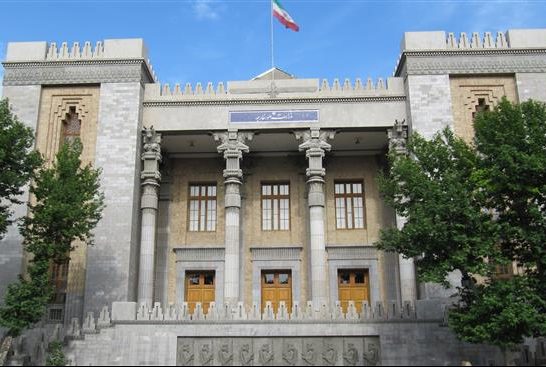
“Iran Ready to Help Paris over Hostage Taking Incident”

Qassemi made the remark in reaction to news circulating on the incident and the claim that the hostage-taker had demanded to contact the Iranian embassy.

“Given the importance of humans’ lives and the humanitarian aspects of the issue, and if the French government and police deem it necessary and make a request, the Islamic Republic of Iran’s embassy in Paris is prepared to help and cooperate with the French government,” said Qassemi.

A gunman who had taken two people hostage in central Paris was arrested and his victims freed.

The four-hour long standoff began around 4.00pm (1400 GMT) on Tuesday as the hostage-taker entered the offices of a start-up company on the Rue des Petites Ecuries, a gritty area in the 10th arrondissement of Paris.

“Two hostages including one who had petrol poured on them have been freed,” police said.

At least one other man was lightly injured while fighting the hostage-taker and escaping before police arrived on the scene. One of the hostages was a pregnant woman.

Police said the motive for the attack was not clear, but there was no indication that the hostage-taker, who was described as unstable, had terrorism motives although authorities would not elaborate.

“Based on our initial investigations it could be a mentally unstable person whose motivations are still unclear,” a police source said.

Some reports said the Moroccan man, who was believed to be armed, claimed that he had a bomb in his possession and “wanted to send message to the Iranian embassy.”

France is still on high alert after a string of attacks claimed the lives of more than 245 people around the country over the past three years.

Authorities have lifted a state of emergency that had been in place just after the Paris attacks in November 2015, but soldiers continue to patrol major tourist sites and transport hubs on an anti-terror mission.

Child Cancer Project Threatened by Trump’s Iran Sanctions

Dr Trish Scanlan was in unfamiliar surroundings when she broke down and cried some weeks ago.

Sitting with the chief of paediatric oncology in the Mahak hospital in Tehran, the capital of Iran, she became overwhelmed when she found what she had spent more than a decade travelling the world in search of.

Scanlan works with children suffering from cancer in Dar es Salaam, Tanzania. In her 11 years there, she has failed to save a single child suffering from a particularly aggressive form of cancer called acute myeloid leukemia (AML), which affects the blood and bone marrow.

Dozens of children are diagnosed with the condition each year, and the treatment is both toxic and expensive. The hospitals in Tanzania are simply not equipped for the job.

“We don’t have enough blood products, platelets and other support care to get the children through the treatment because it’s basically like hitting them over the head with a sledgehammer, and doing that at least four times,” Scanlan says, as reported by The Irish Times.

“We get through one, two or even sometimes three of these courses, and they usually die of fever, sepsis, or want of blood. We’ve never managed to cure a child. They all died, which is really sad because Crumlin for example would probably save about 60 per cent.”

“I’ve tried to get help. I’ve had help from all over the world for all the things I do, but to treat a child with AML costs $50,000.

Loads of countries and hospitals help us but it was beyond their ability to provide support for 30-40 children. It’s a lot of cash,” she added.

“I had tried and tried and tried. I had been all over Europe, America, South Africa and India, but I had never been able to access a hospital that was willing and able to support these kids.”

On edge
A few weeks ago, Scanlan flew to Tehran. As she landed, she was on edge. “When you arrive in somewhere like Iran – the ‘axis of evil’ – you wonder what people going to be like,” she says. “I thought I was going to a closed, suspicious sort of place.”

But, as she made her way through the airport, queuing for visas and collecting baggage, she found “entirely the opposite” was the case.

“People were offering me cakes and tea,” she says. “I’ve never been to a place where the people were doing everything in their power to make each situation as pleasurable and friendly as possible.”

During her stay, Scanlan visited Mahak hospital, an independent organisation supporting children with cancer, funded entirely through charitable donations. The idea was to go and see how they do things, and hopefully learn something to take back to Tanzania.

“Everywhere we went people knew about Mahak,” she says. “It provides all the cancer services for Iran. They will pay for children’s cancer care in any hospital in the country. You send them the bill and they pay it. If the children survive, they pay for all of their schooling up to and including university. I can’t tell you how unbelievable they are.”

Following her tour of the hospital and meetings with department heads, Scanlan asked whether she could give a presentation of her work in Tanzania. They agreed, and she told them all about the children suffering and dying from AML.

“When I’d finished, we all sat down and they asked what they could do to help,” she says. “I asked was there any way they could take the AML kids, and they just said: ‘Sure. No problem. No charge.’

“They asked could we afford to transport them and I said we’d find a way. If we could get the kids to the door of the hospital, they would take care of them after that. I started to cry. I’ve been looking for an answer to this for 10 years, so it was pretty insane.”

Sanctions
The very next day though, everything changed. US president Donald Trump withdrew from the Iran nuclear deal, re-imposing sanctions on the Persian Gulf state. “The price of things – simple commodities – went up overnight by as much as 50 per cent,” says Scanlan.

“A run on the banks had closed foreign exchange. Naively I thought the sanctions wouldn’t affect the hospital or the work of the charity where they don’t apply, but they do apply to the money it uses to pay for everything.”

“From one day to the next after that, people were glued to the television screen or radio. They were waiting for the next announcement. It wasn’t a small deal what happened. They were holding their breath, waiting for how it was going to affect them.”

The following night, Scanlan had dinner with the two women who set up Mahak. “These were jolly, fun, really dynamic women,” she says. “Both of them were like: ‘We think war is coming.’ These were not histrionic, dramatic women.”

“Both of them had set this up 27 years ago in the middle of sanctions. These weren’t women to flip. They said the offer was still there but that we needed to think very carefully about bringing children to a potential warzone.”

Despite the change in the landscape, Scanlan is determined to press on. “We’re going forward with the idea, but we’re on tenterhooks because we certainly don’t want a child to go and be at risk,” she says.

“It’s mind-blowing what’s happened.”

“I don’t know what the future holds. But I know that in recent weeks, a hospital in Iran, funded by ordinary Iranians, offered to help children with cancer in Tanzania. In times full of threats, this was a promise of humanity.”

Women in Iran Can Finally Go to Stadiums, but to Watch Matches on JumboTron!

Azadi Sports Complex in Western Tehran will host football fans who would have the chance to watch the games along with their families on a 1,200 square-metre screen to be installed in the field.

According to Nasser Mahmoudifard, the director of the stadium, all the grounds have been prepared to host the football fans, and the doors will be opened as of Friday if other bodies okay the plan.

It is anticipated that at the first stage around 10,000 tickets would be sold.

The move is expected to be a great first step to allow women to go to stadiums in the Islamic Republic, as repeatedly promised by President Hassan Rouhani.

The FIFA World Cup 2018 will kick off on Thursday, June 14, in Russia.

Iran National Football team, known as Team Melli, is scheduled to play against Morocco in its first match on Friday.

The group consists of Portugal, Spain, Morocco, and Iran.

Women in Iran Can Finally Go to Stadiums, but to Watch Matches on JumboTron!

IRGC’s Construction Base Ready to Work with Foreign Investors

General Ebadollah Abdollahi made the remarks on Tuesday, highlighting the great capacities available in Iran for foreign investment.

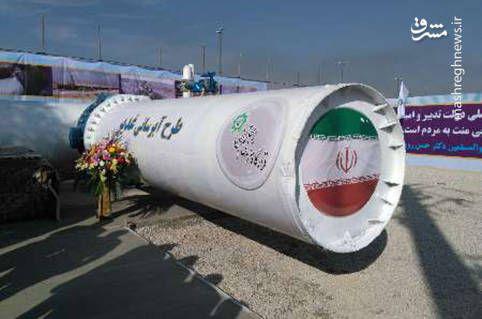
Speaking to reporters on the sidelines of a meeting on “Resistance Economy”, he further noted that a mega project to supply water to the western parts of the country will be operational by the end of the current Iranian year (March 20, 2019).

“The country’s biggest water project named ‘Runoff Waters of the West’ will come on stream by the year end,” he added.

The project has been conducted in an area with a length of 1460 kilometres, covering 17 dams, 150 km of tunnels and 700 km of transmission lines, he stated, as reported by Tasnim.

The Khatam al-Anbia Construction Base has already completed other large water supply projects, the commander said, adding that from a total of 45 billion cubic metres of reservoirs built in the country, 25 billion cubic meters have been built by the construction base.

“Iranians to Become World’s Largest Cultural Lobby in 10-20 Years”

Beheshti, the head of the Iranian Research Centre for Cultural Heritage and Tourism, has predicted that “Iranians will be the world’s largest lobby within the next one or two decades.”

“They will not need any wheeling and dealing as the Zionists do,” he said, as quoted by IRNA.

“The Iranian diaspora plays a key role in getting Iran out of global isolation on the cultural front regardless of political and economic issues,” said the official while addressing an expert meeting titled “Where is Iran? Where is the Iranian?”

“Although this community (Iranian expatriates abroad) has an independent existence, it is attached to its motherland as well, and is not indifferent and can turn into a bridge to restore global interactions,” he said.


Long History of Living in Iran

He said the length of time that humans have lived in Iran is almost as long as the history of man’s life as a whole.

“Iran is marked by the most ancient eras of life, and this land ranks first or second in terms of many of the turning points in man’s life such as domesticating animals and plants, getting settled down in one place, formation of villages, discovery of metal, emergence of cities, the invention of clay, etc.,” he said.

He then said Iran is not too large or too small compared to many territories.

“The size of Iran leads to Iranians having a common fate while preserving their unified existence,” he said.


Where is Iran?

He referred to the Persian language and Nowruz rituals as signs of cultural unity.

“Wherever Nowruz is celebrated, either Shahnameh (the Book of Kings, the magnum opus of renowned Iranian poet Ferdowsi) is highly respected, or Persian poems are written and recited. Such a place is Iran (including Iran itself or areas influenced by the Iranian culture)” he said.


12,000 Poets in Bosnia Writing Poems in Persian

Beheshti said there are 12,000 poets in Bosnia who write poems in the Persian language, which shows how influential the Iranian culture is in that country.


Iran’s Cultural Influence in Russia during Seljuk Era

He then quoted two Iranologists as saying that Iran had a strong cultural presence in Russia in the past.

“A document has been discovered in Russia which dates back to 1,000 years ago (the Seljuk era). It shows a number of Russian tribal chiefs pledging to cooperate with one another. What is interesting is that a large number of these people have names mentioned in Shahnameh, which indicates Iran’s cultural influence,” he noted.


Iran Home to 70,000 Dialects

While explaining Iran’s cultural influence, Beheshti also touched upon the cultural diversity inside the country. He said there are between 20 and 60 languages and 70,000 dialects in Iran, which bear witness to cultural diversity in the country.


Iran’s Cultural Diversity Rooted Inside

He said cultural diversity in Iran is rooted inside the country.

“In the United States and Canada, cultural diversity comes in from outside as people of other lands enter the two countries. This is while Kurds and Azeris in Iran became Kurds and Azeris inside the country,” he said.

He said Kurds and Azeris have a common origin.

“The origin of both these ethnic groups is the Medes. In fact, the Medes who resided in plains became Azeris, and the ones living in mountains became Kurds,” he said.

He underlined that the two ethnic groups have different features because of their different situations.


Iran or Land of Persia

In the West, he said, there is a pattern which seeks to create a nation-state and establish unity as well as an official identity. However, he adds, “these are all artificial because there is no such country as ‘Canada’ in reality; rather, this country is created on paper and based on an agreement among a few. The same goes for Belgium and many other countries,” he said.


Reza Shah Limited Iranian Culture

He underlined that the above-mentioned Western pattern was used in Iran at the time of Reza Shah (a former despotic Iranian ruler) and caused some disorder in this land.

“Before that time, this land was never named ‘Iran’ and was known as ‘Persia’.”

“Iran is, in fact, a large cultural territory in Shahnameh, and is something equal to Europe. So, naming this land ‘Iran’ is like giving the name ‘Europe’ to ‘Belgium’ and regard all European things such as the Renaissance, the philosophy of Ancient Greece, etc. as belonging to Belgium,” he noted.


Rumi Born in Balkh, Died in Konya, Wrote Poems in Persian

He then touched upon the registration of historical sites and cultural items on the World Heritage List as well as the controversy over which monument or item belongs to which country. As a case in point, he cited the prominent poet Rumi, who was born in modern Afghanistan’s Balkh, died in Konya in modern Turkey, and wrote his magnum opus Masnavi (a collection of poems), in Persian. Today, all the above-named countries say Rumi belongs to them.


Iranian Expats Not to Lose Sense of Belonging to Motherland

The official then drew a comparison between Iranian emigrants and those of other countries.

“The Iranian society is one which does not easily lose its features and sense of belonging to its motherland. An example of this is the Parsi community in India. They are people who still belong to their mother land after a thousand years,” he said.


Iranian Expats Always Seeking Major Achievement in Host Countries

He touched upon the emigration of members of the Iranian society throughout history. He said Iranians have always aimed for high levels of accomplishment in the countries they are living in, and that is why “we are witnessing the third generation of the Iranian community securing top levels of achievement in different areas.”

Researchers Use Cinnamon to Develop Antibacterial Nanocomposites

The nano-materials produced will not only remove waste pollutants, but can also be used as antibiotics in treatment programs.

Researchers at the knowledge-based company which has developed the nano-products say the project was aimed at developing a simple and green method to synthesize silver nanoparticles and its nano-ingredients with anti-bacterial and magnetism-absorbing properties.

For a brief review of Iran’s achievements in various fields of science and technology, check the book “Science and Technology in Iran: A Brief Review

To that end, researchers used cinnamon, which has anti-bacterial properties, ISNA reported.

Given that cinnamon is produced on a large scale, it is easily accessible and economical.

On the whole, the product developed by the researchers can be used as a new strategy to kill resistant bacteria.

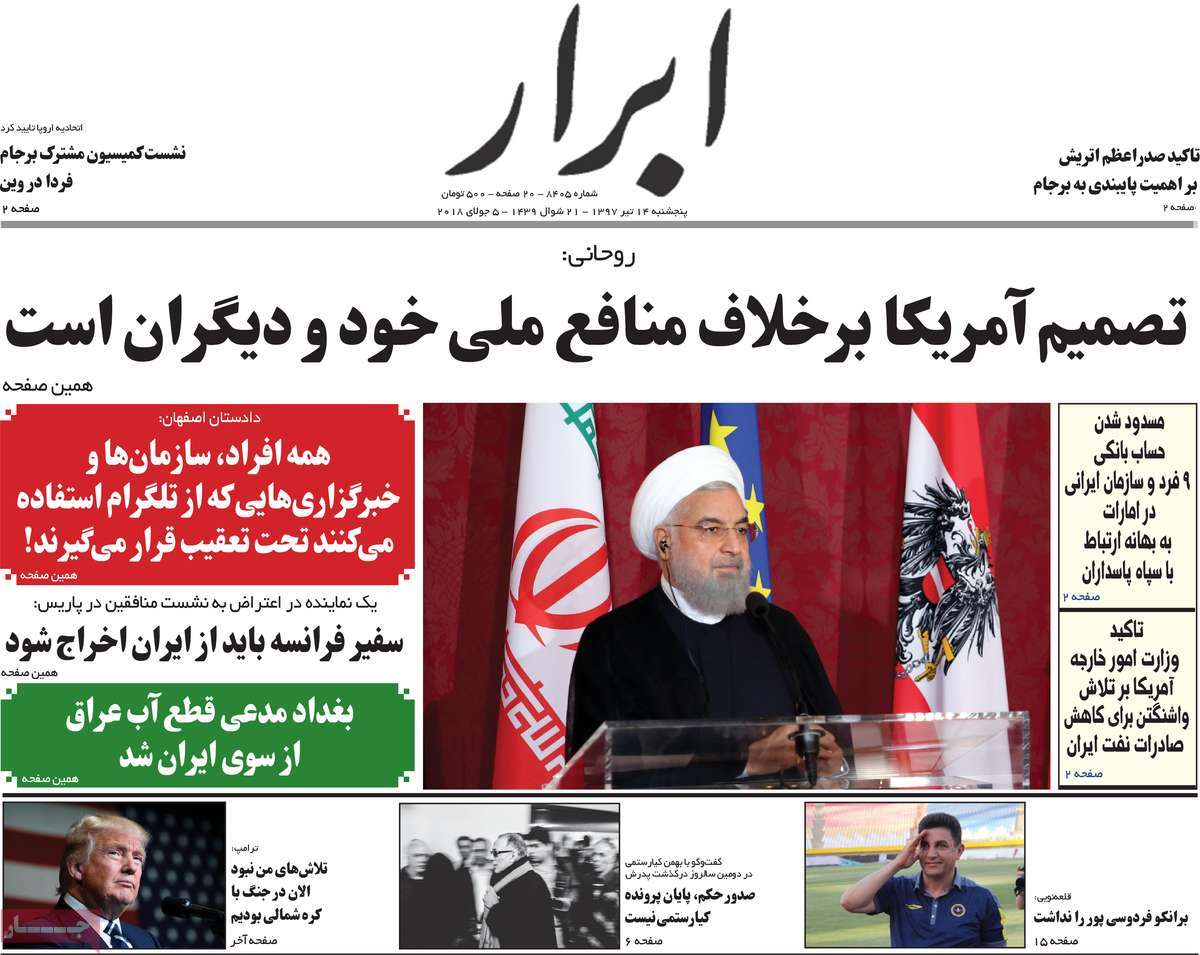
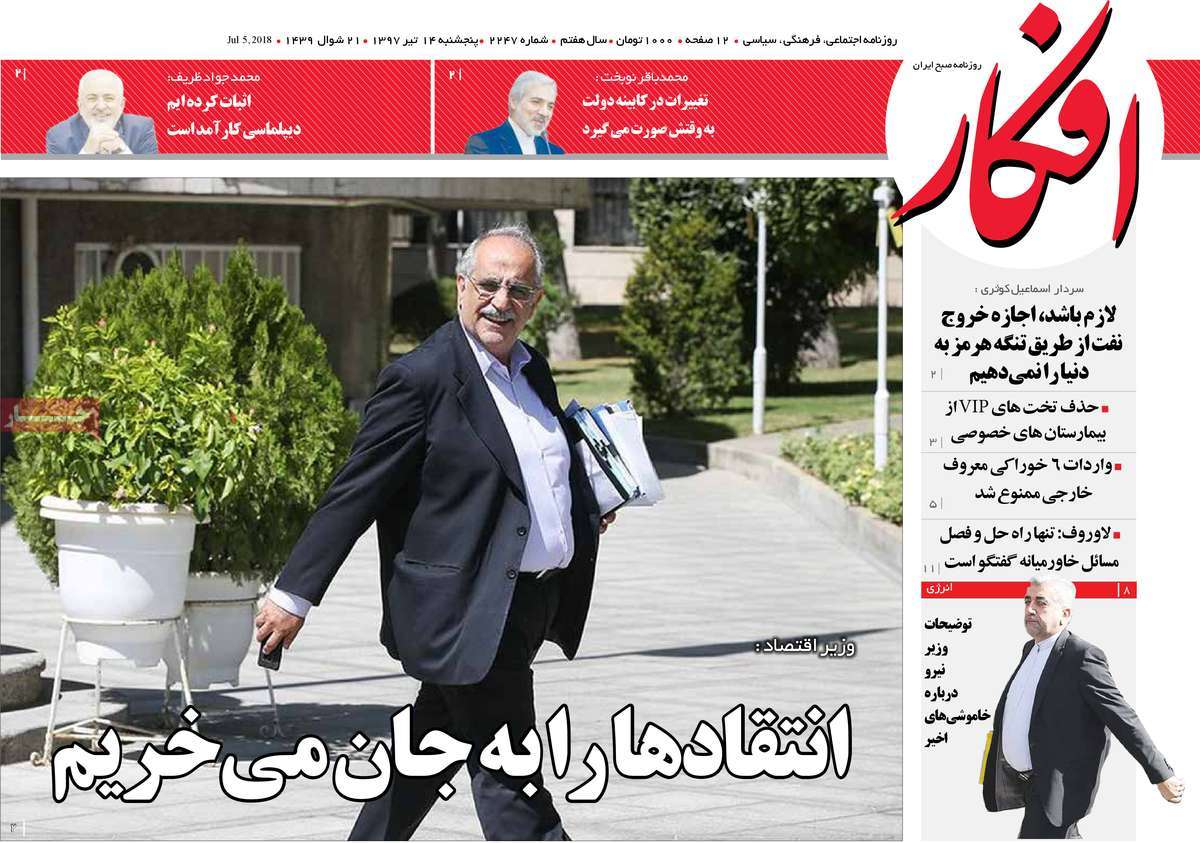
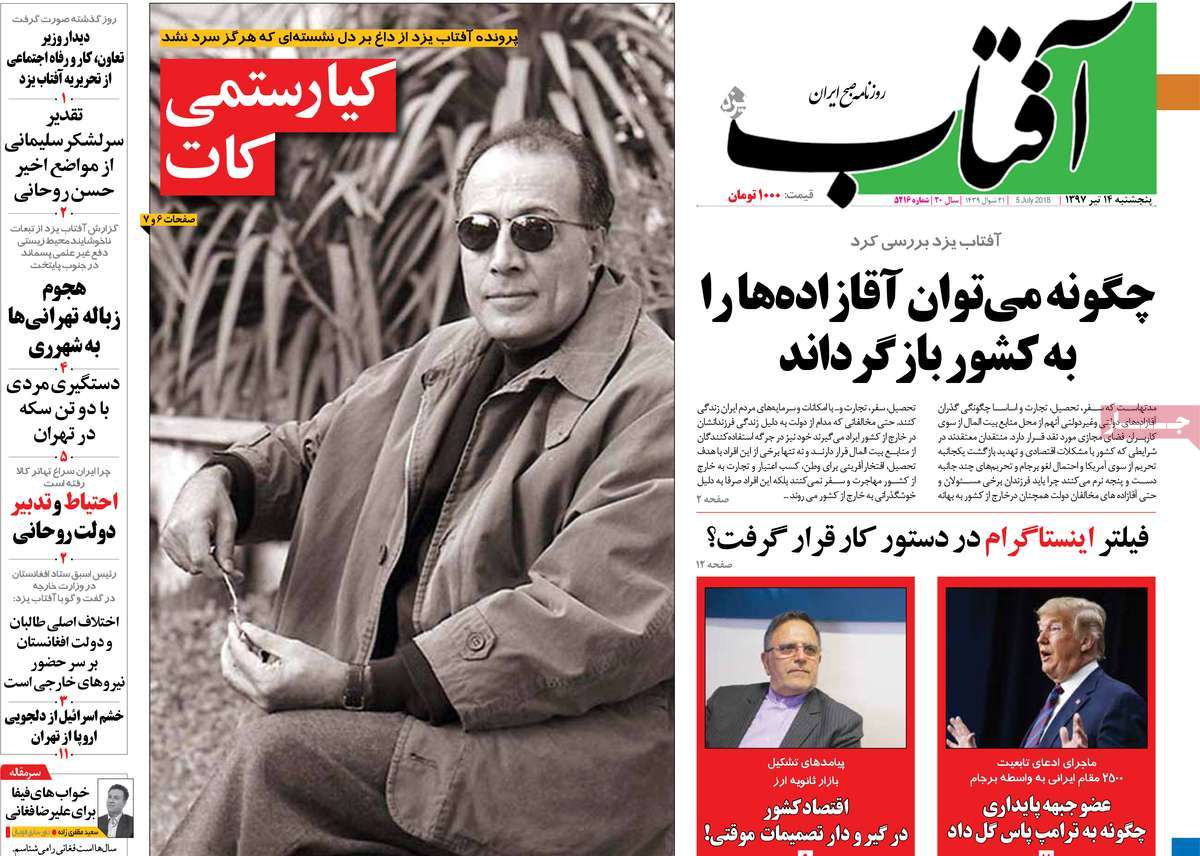
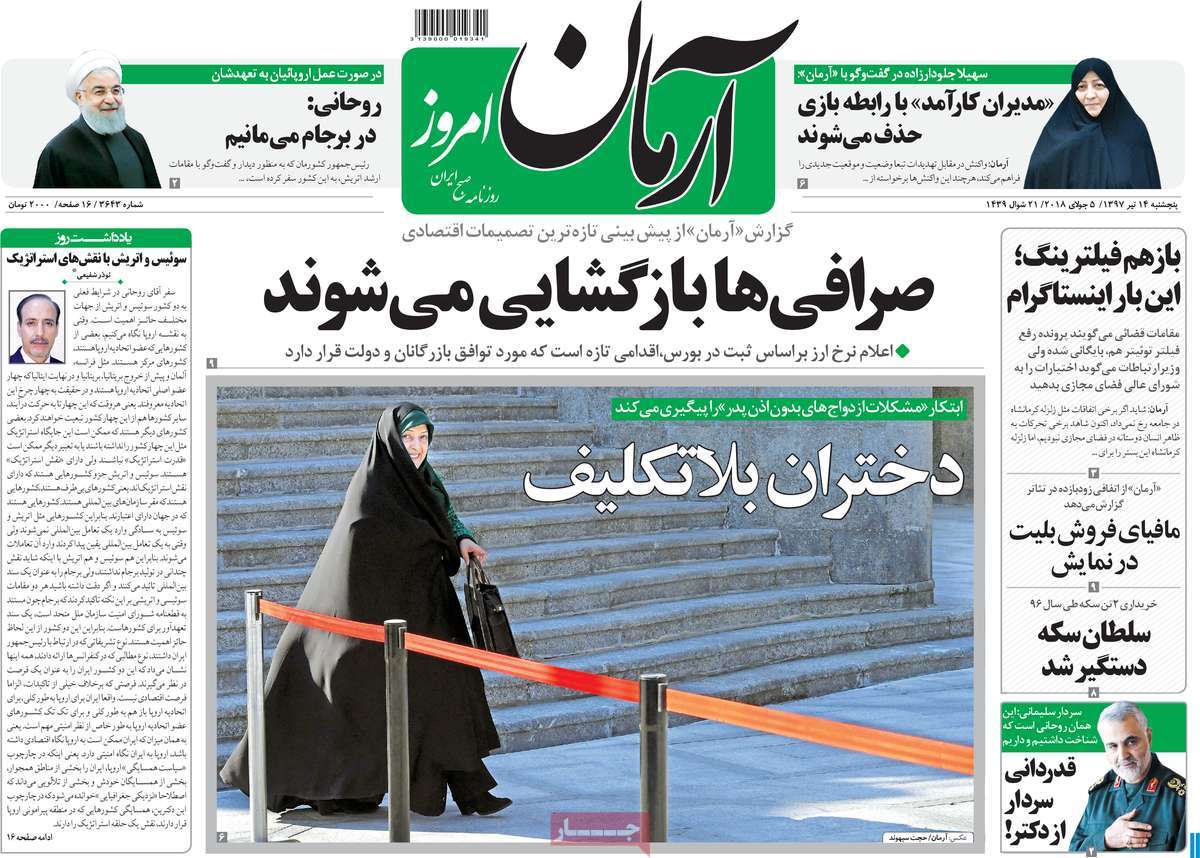
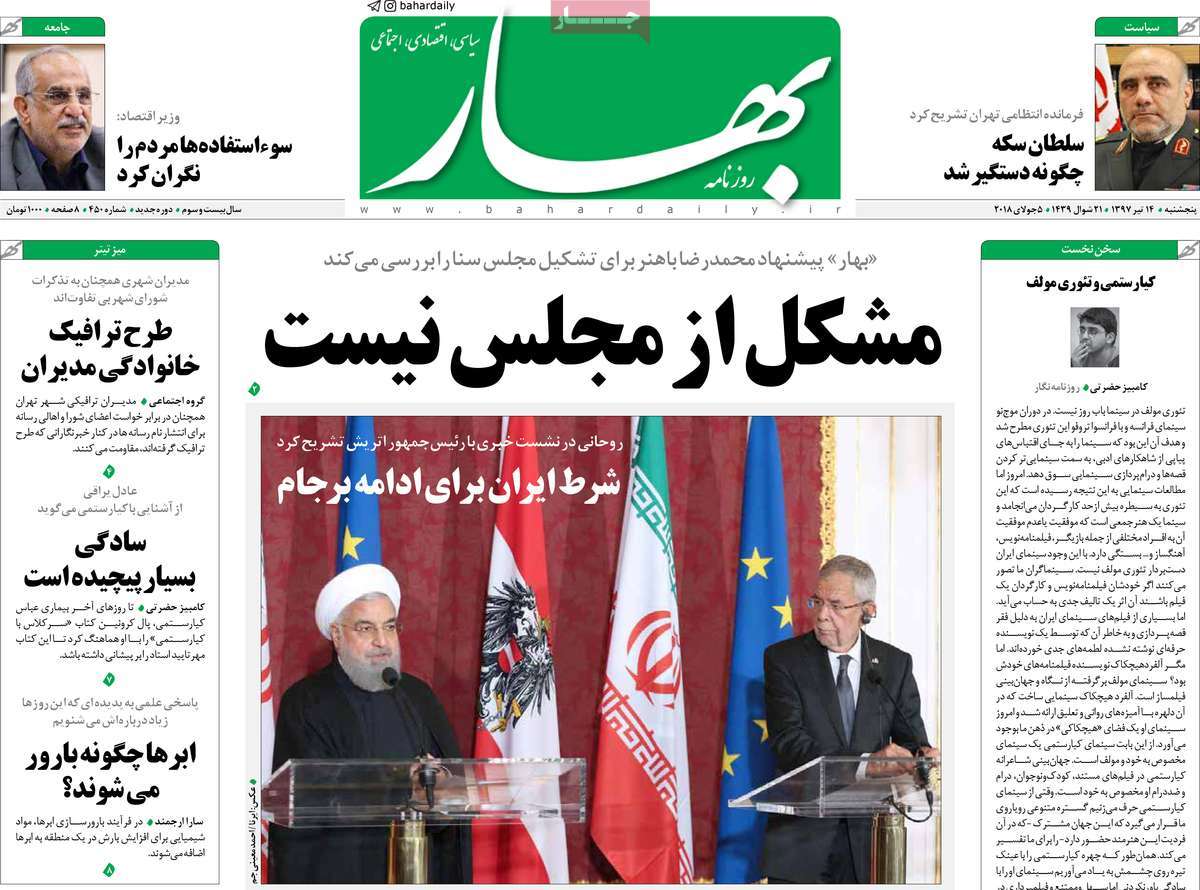
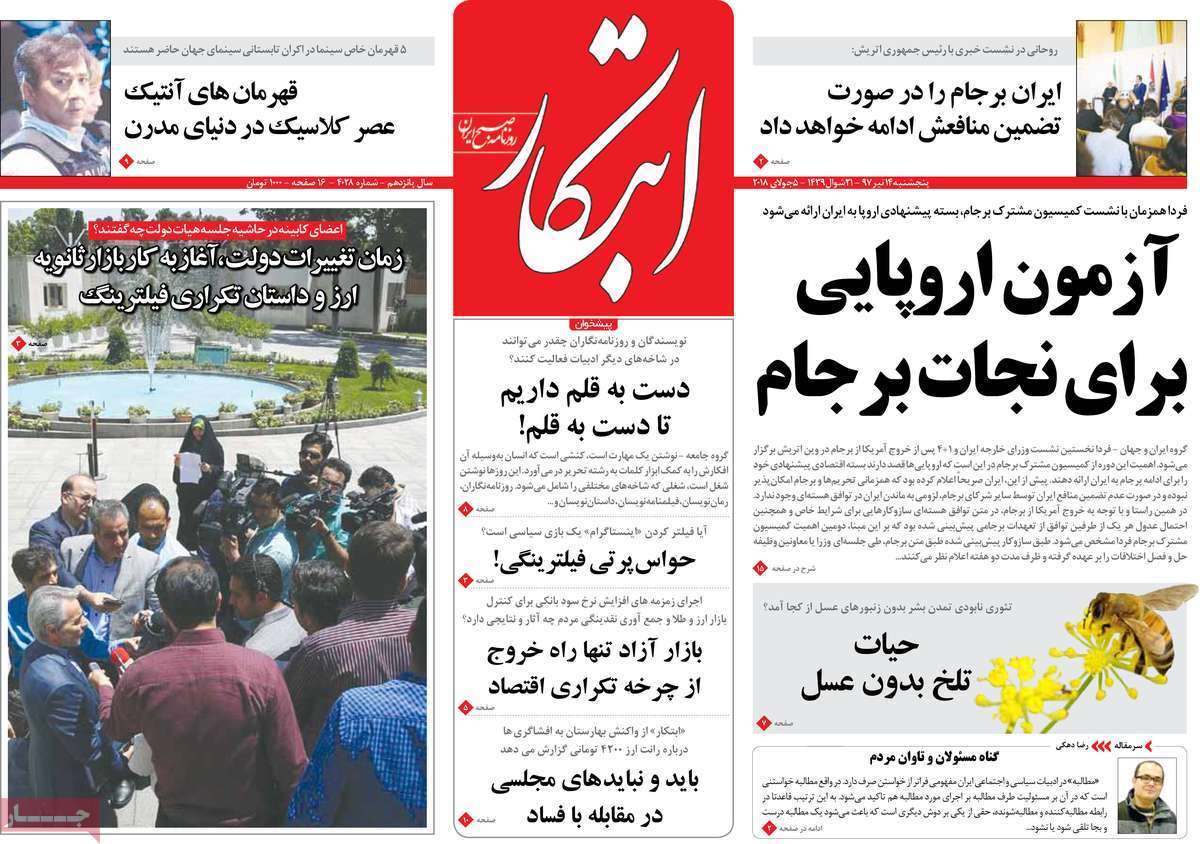
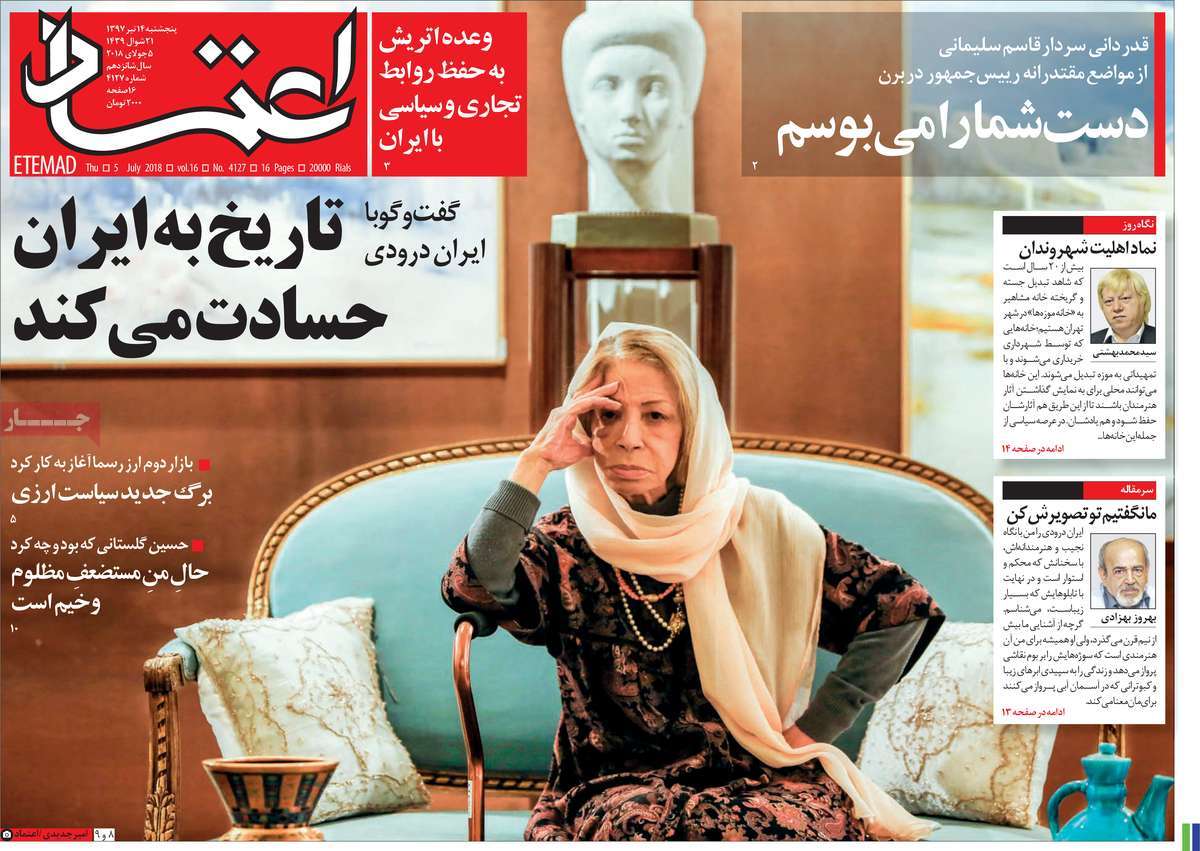
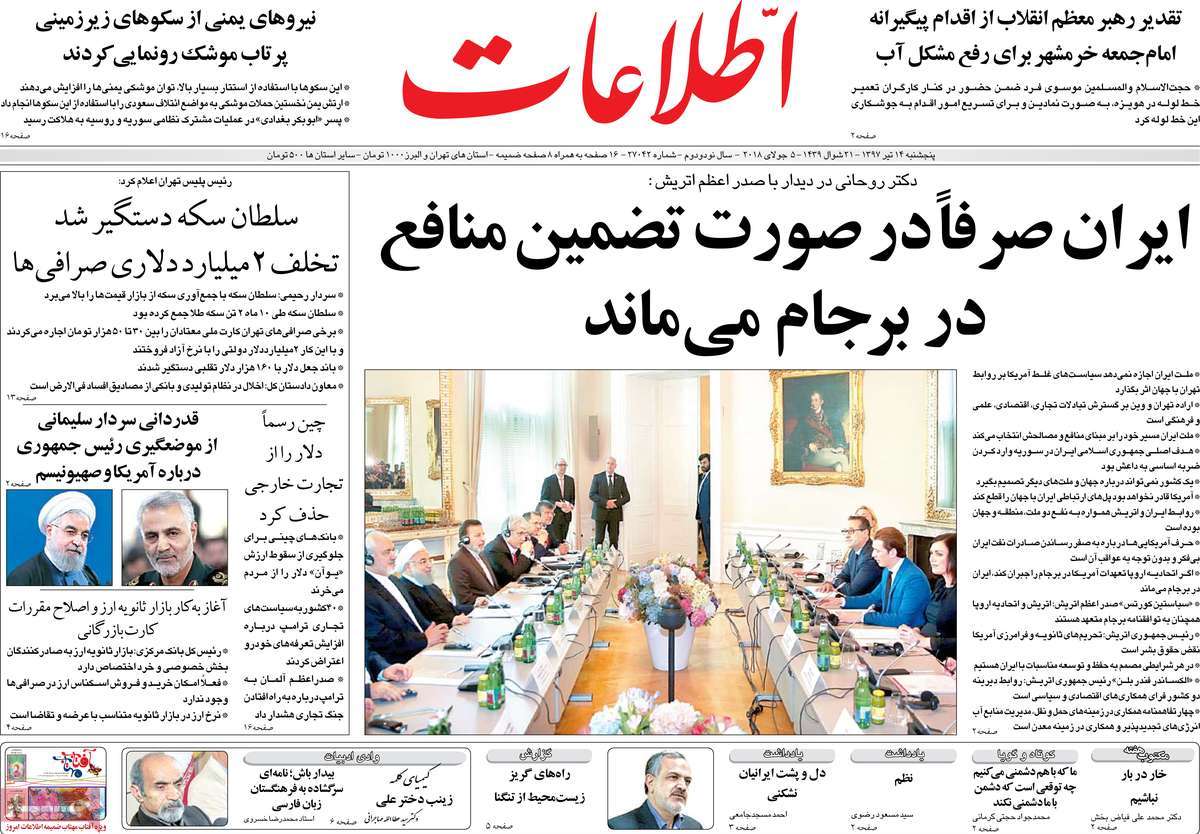
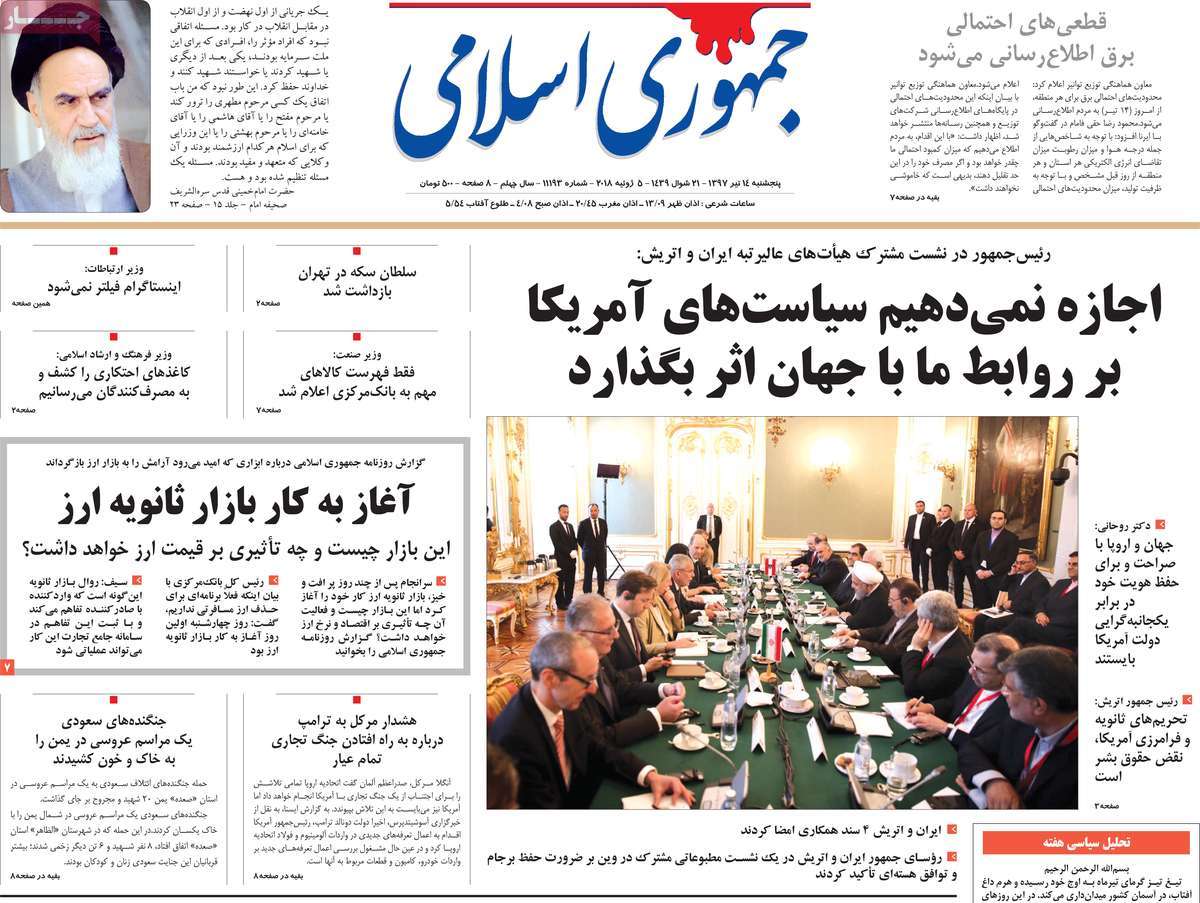
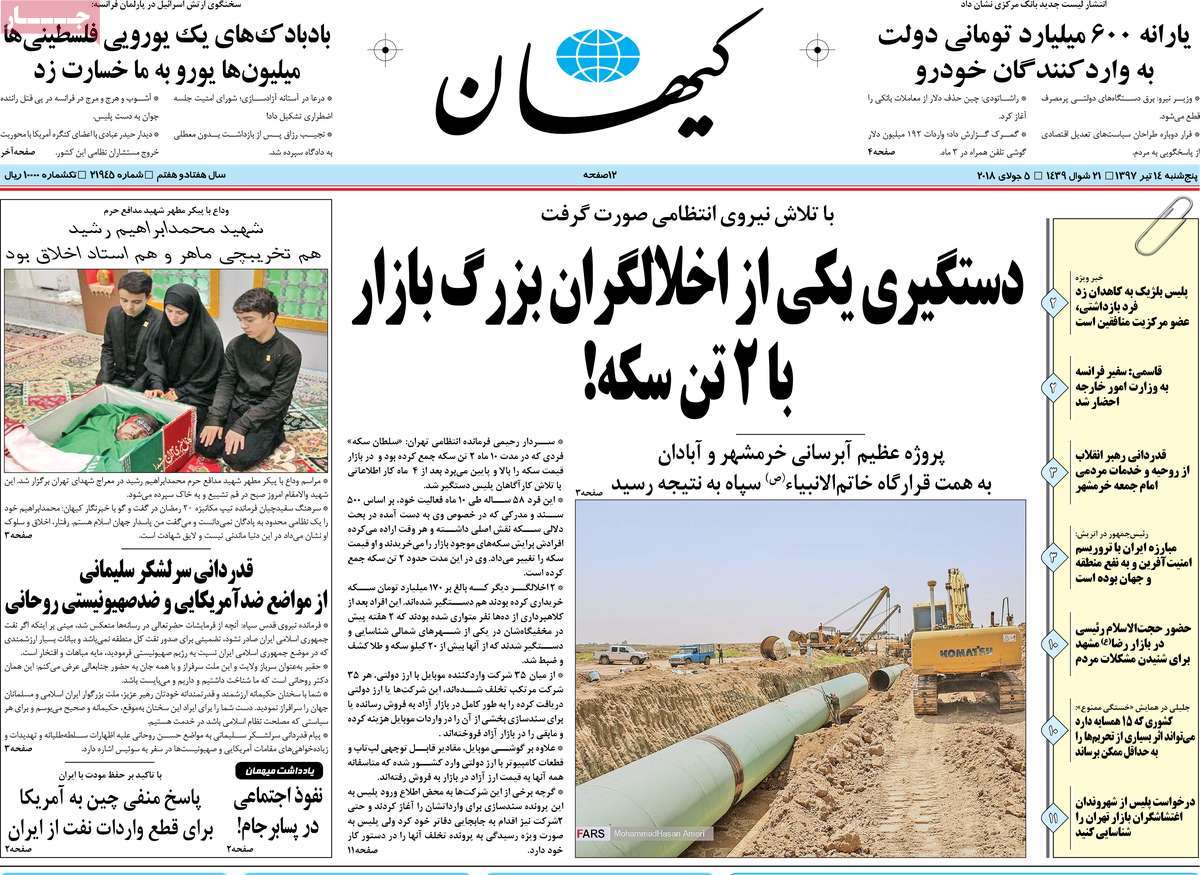
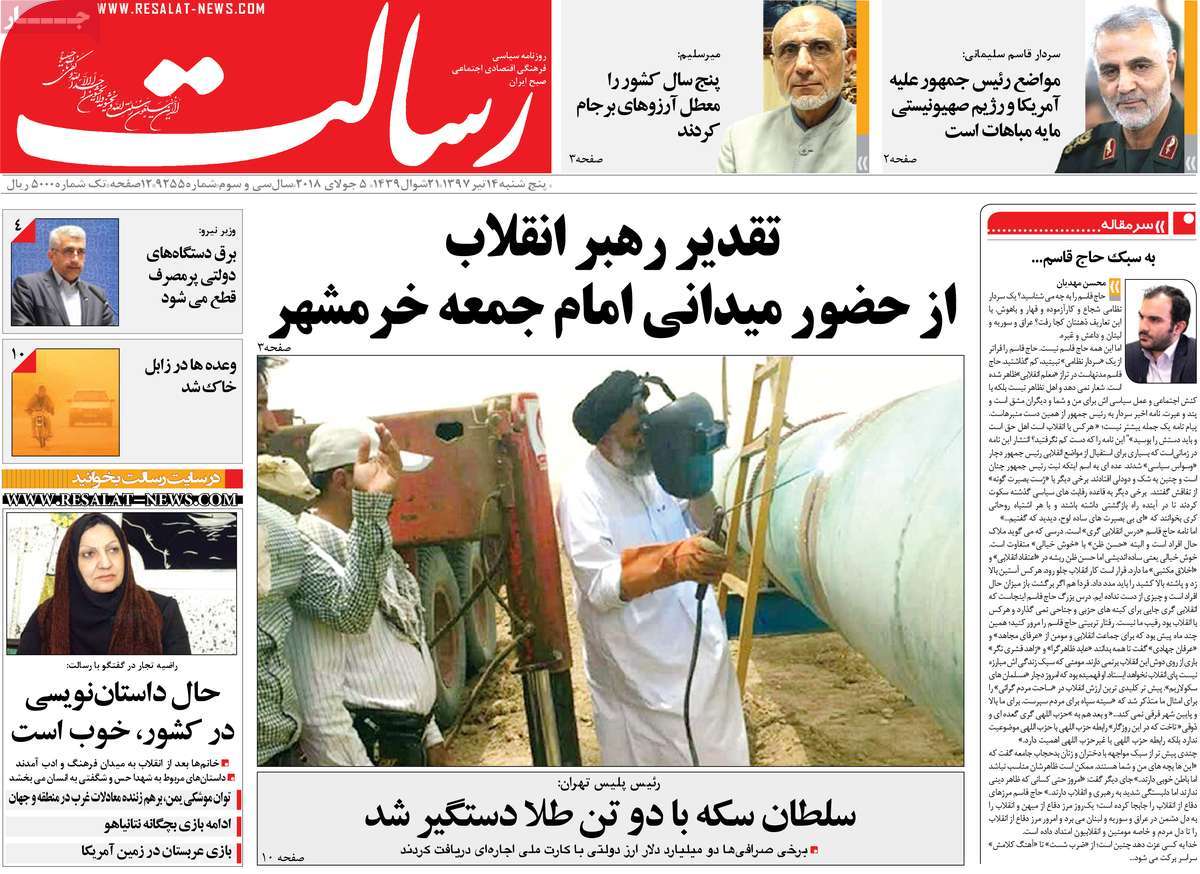
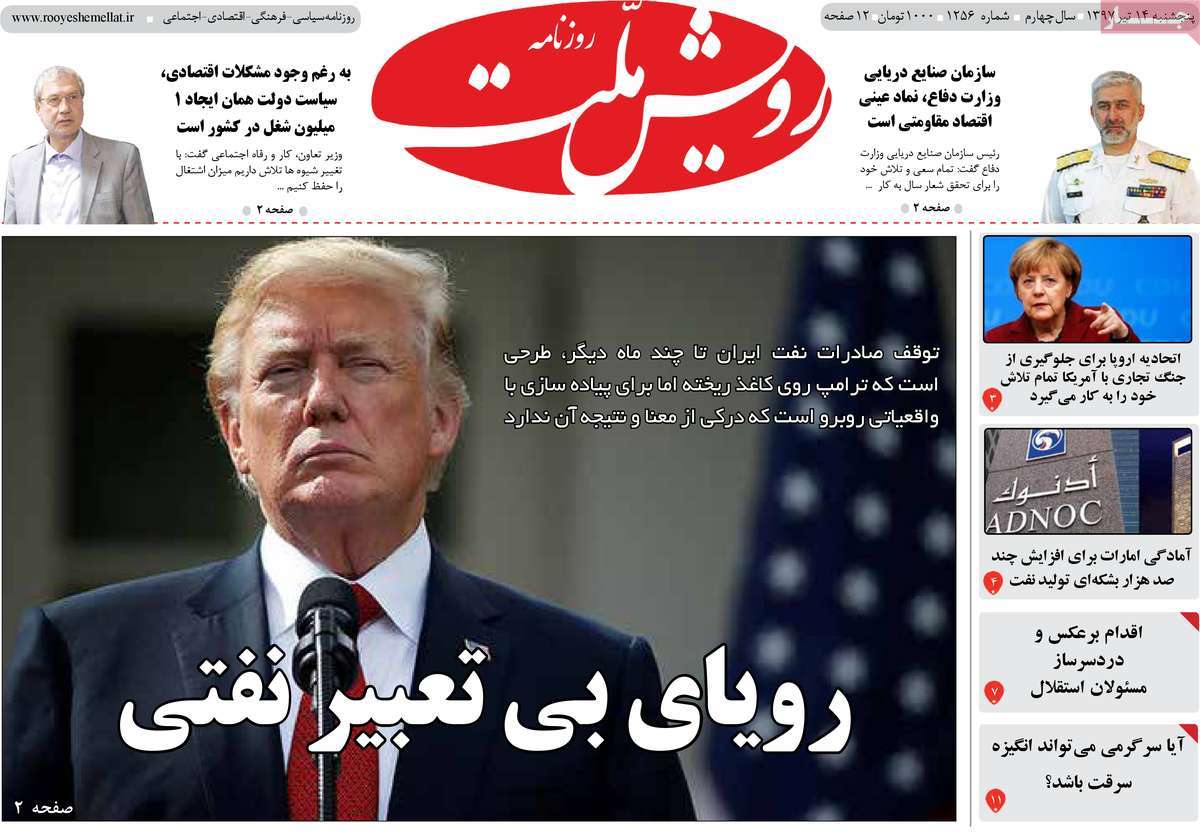
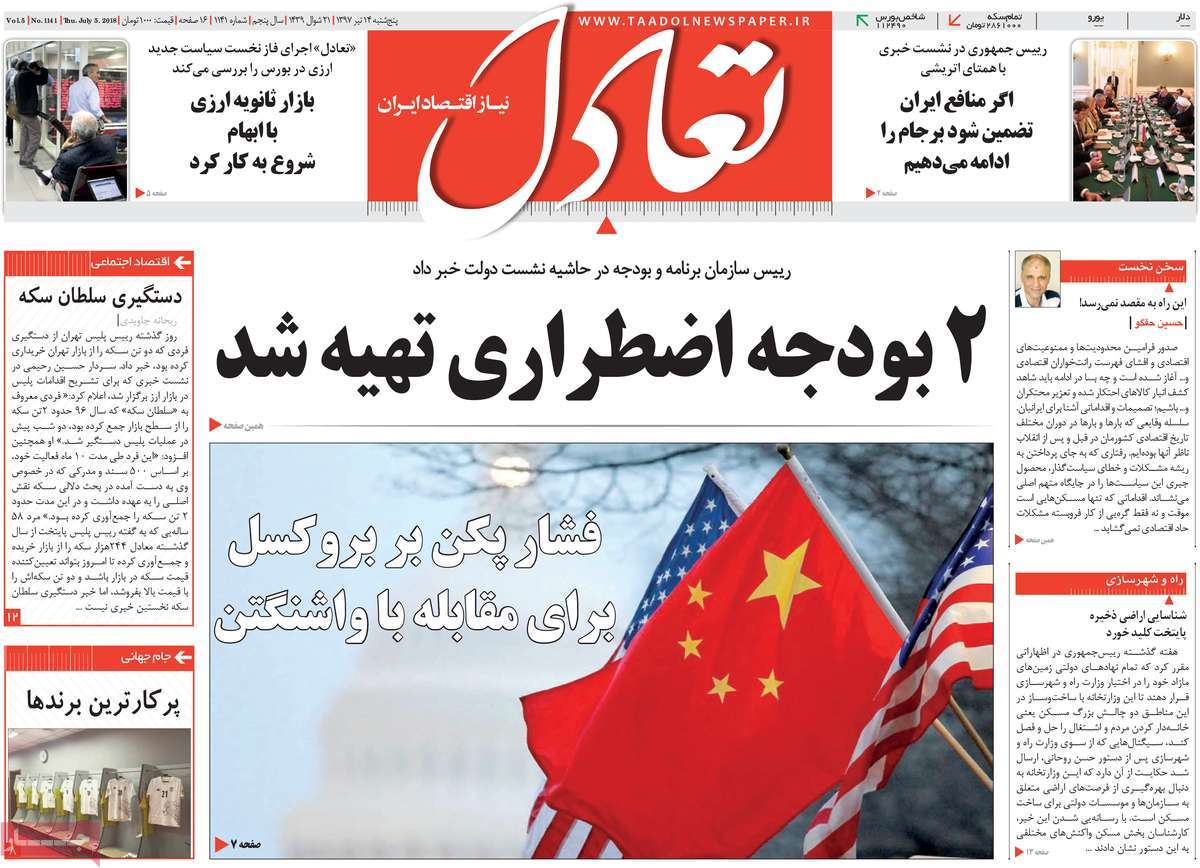
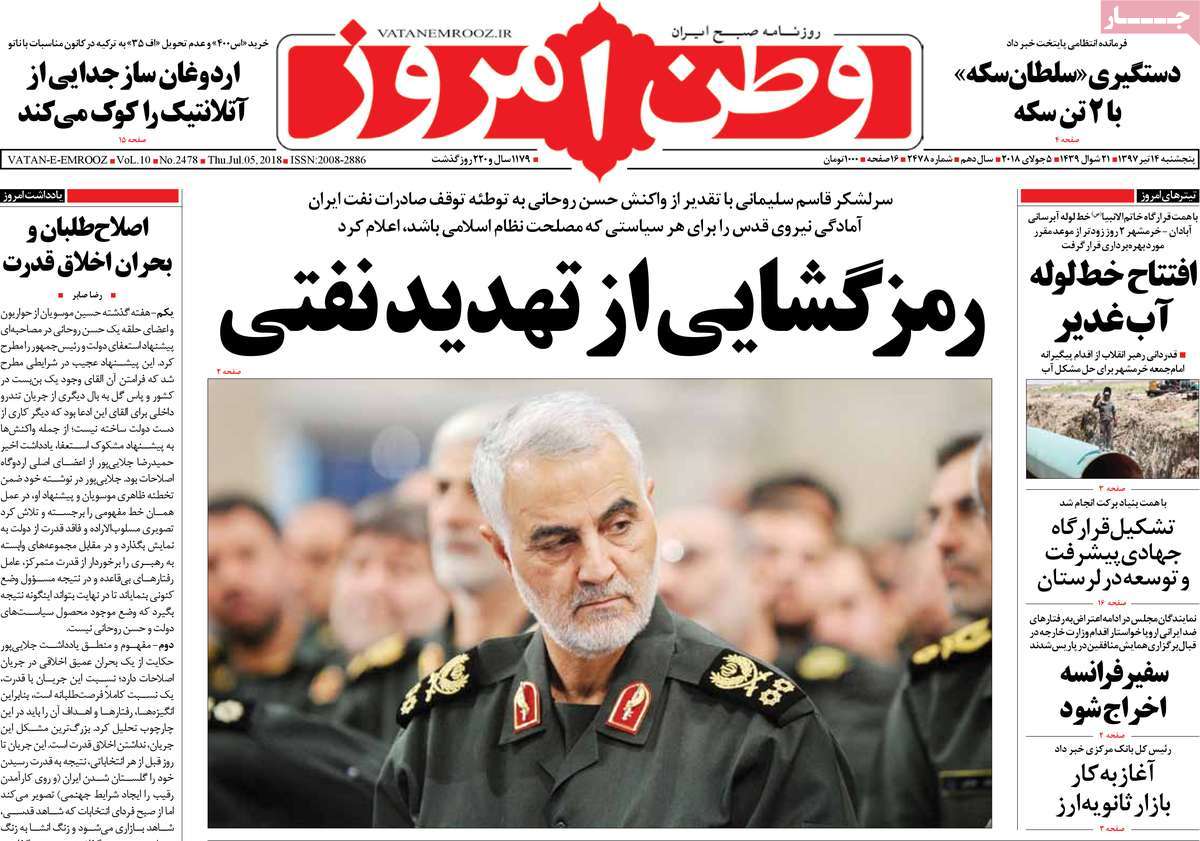
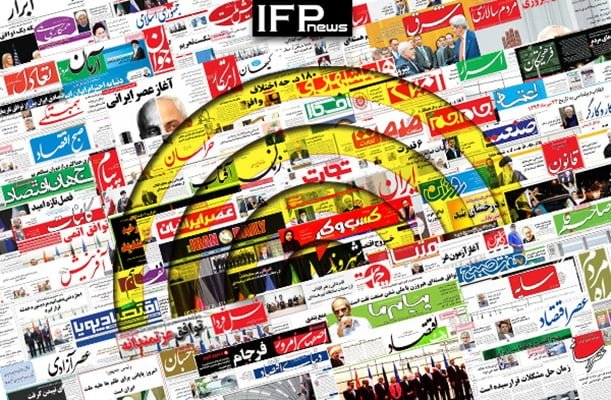
A Look at Iranian Newspaper Front Pages on June 12

A Look at Iranian Newspaper Front Pages on November 19

Newspapers today widely covered the historic meeting between US President Donald Trump and North Korean Leader Kim Jong-un on Tuesday, which was to be held in an island in Singapore.

Also a top story was the remarks by IRGC Quds Force Commander Major General Qassem Soleimani about Saudi Arabia’s interference in the Lebanese elections.

Also a top story was the new crisis emerging in Iraq after calls for recounting of votes and a fire in a warehouse where ballot boxes were kept.

The above issues, as well as many more, are highlighted in the following headlines and top stories:


19 Dey:

1- Gen. Soleimani Calls Recent Lebanon Elections a Referendum

A Look at Iranian Newspaper Front Pages on June 12


Abrar:

1- Zarif: Shanghai Cooperation Organisation Underlines All-Out Support for JCPOA

2- Muqtada al-Sadr: Iraq in Danger

A Look at Iranian Newspaper Front Pages on June 12


Aftab-e Yazd:

1- Russian Mischief: Certain Russian Media Depict Iranians as Angry, Grumpy People

2- Europe’s New Steps to Protect Iran against Sanctions

A Look at Iranian Newspaper Front Pages on June 12


Arman-e Emrooz:

1- General Soleimani’s Account of Saudi Petrodollars Used on Lebanon Elections

A Look at Iranian Newspaper Front Pages on June 12


Donya-ye Eqtesad:

1- Bin Salman’s Disturbed Dream for Saudi Arabia in 2030

  • World Bank Evaluates Saudi Vision 2030

A Look at Iranian Newspaper Front Pages on June 12


Ebtekar:

1- Iraq on Verge of New Crisis

2- Why Arab Countries’ Alliance against Qatar Wasn’t Successful

A Look at Iranian Newspaper Front Pages on June 12


Etemad:

1- Immigrants Wandering in Mediterranean Sea: Italy Refuses to Accept Refugees’ Ship

2- Turn to Unity: A Review of Conservatives’ Stances towards Rouhani’s Gov’t

A Look at Iranian Newspaper Front Pages on June 12


Ettela’at:

1- Iran First VP: We’ll Overcome Sanctions

2- West Bank Rises to Help Gaza Strip

3- Qassemi: We’re Not Optimistic about Trump-Kim Talks

A Look at Iranian Newspaper Front Pages on June 12


Iran:

1- Displaced People of Karachi in Tehran’s Shahr-e Rey

  • A Report on Hard Days of Pakistani Immigrants in Iran

A Look at Iranian Newspaper Front Pages on June 12


Javan:

1- Gen. Soleimani: Saudi Arabia Spent $200 Million in Lebanon, but Failed

2- Tehran Warns Pyongyang: Be Careful Not to Repeat Fate of Iran Nuclear Deal

A Look at Iranian Newspaper Front Pages on June 12


Ka’enat:

1- Is US Looking for Deal with North Korea Because of Iran?

A Look at Iranian Newspaper Front Pages on June 12


Kayhan:

1- Government’s Duty Is to Resolve People’s Problems, Not to Allocate Place to Protests!

2- Can Europe Get Rid of US Domination?

A Look at Iranian Newspaper Front Pages on June 12


Resalat:

1- Gen. Soleimani: Hezbollah Has Turned from Resistance Party into Resistance Gov’t of Lebanon

2- Europe Gives US Economic Warning

A Look at Iranian Newspaper Front Pages on June 12


Roozan:

1- Storm of Diplomacy in Sentosa Island: US, North Korean Leaders to Hold Historic Meeting

A Look at Iranian Newspaper Front Pages on June 12


Sazandegi:

1- Iraqi Democracy on Fire: Warehouse Where Ballot Boxes Were Kept Burns

A Look at Iranian Newspaper Front Pages on June 12


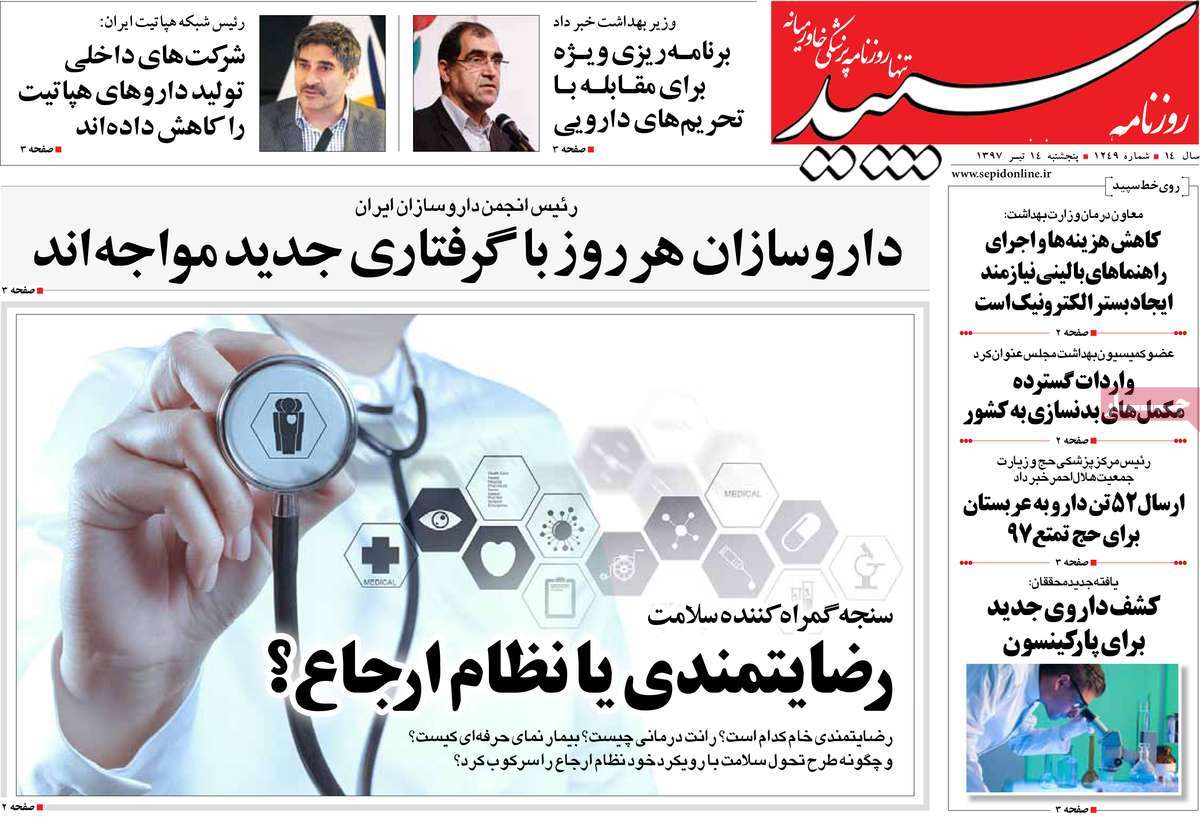
Sepid:

1- Drug Precursors Produced for Six Recombinant Medicine Used in Curing Cancer, MS

A Look at Iranian Newspaper Front Pages on June 12


Setareh Sobh:

1- Iran’s Oil Clients Refuse to Obey Sanctions

2- $15-Million Meeting in Sentosa Hotel

A Look at Iranian Newspaper Front Pages on June 12


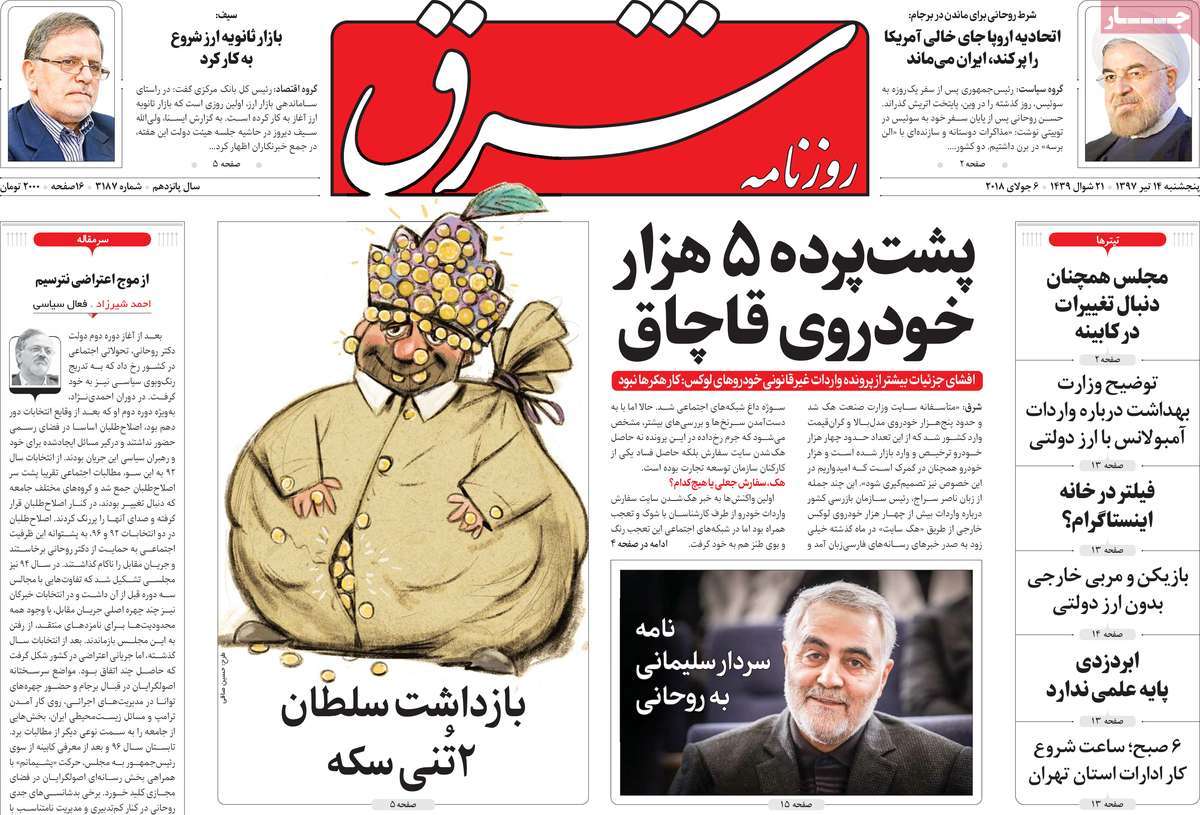
Shargh:

1- Iranian Hyde Parks: Gov’t Dedicates Places to Protest Gatherings

A Look at Iranian Newspaper Front Pages on June 12


Sobh-e Now:

1- Zionist Thieves of Iran’s Waters: A Report on Israel’s Role in Death of Iranian Qanats

A Look at Iranian Newspaper Front Pages on June 12