Friday, April 24, 2026
Home Blog Page 4939

Damavand destroyer joins Iran naval fleet

Damavand destroyer

Iran’s domestically-made destroyer, dubbed Damavand, officially joined the Navy’s northern fleet in the Caspian Sea on Monday.

The homegrown vessel, an advanced destroyer, was officially delivered to the naval forces stationed in fourth naval zone, north of the country.

A number of ranking officials, including Secretary of Iran’s Supreme National Security Council (SNSC) Ali Shamkhani, Defense Minister Brigadier General Hossein Dehghan and Navy Commander Rear Admiral Habibollah Sayyari attended the ceremony in the port city of Bandar-e-Anzali.

More than 700 industrial, research and academic Iranian centers have cooperated in designing and producing the military vessel, which is also a training warship.

Experts at Iran’s Defense Ministry have installed 25 homegrown electronics and communication systems on Damavand, including advanced naval radars and systems for communication, detection and interception.

Damavand is a Jamaran-class destroyer with unique features to meet the demands of the Iranian naval forces in the country’s northern waters.

The advanced destroyer is capable of tracking the aerial, surface and sub-surface targets simultaneously.

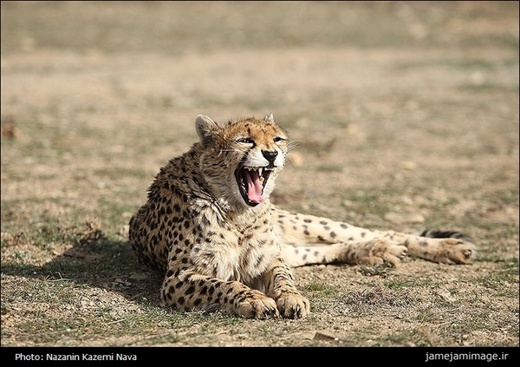
Delbar, an Asiatic cheetah, might be expecting

Iranian cheetah-Delbar

Kooshki, a 7-year-old male, and Delbar, a 3-year-old female, are two Asiatic cheetahs who have been in captivity in Mian Dasht Wildlife Sanctuary in North Khorasan Province and in Khar Turan National Park in Semnan Province respectively. In December, the two big cats were transferred to a research site in Tehran where they first met.

What follows is the translation of a report the website of Iran Environment and Wildlife Watch posted on March 5 about how the two cheetahs are doing:

Acting on the expert advice of Sean McKeown, a foreign consultant of the Conservation of Asiatic Cheetah Project, Delbar and Kooshki spend three days together every 12 days.

The pair has established a very close relationship. The male cheetah seems to be enjoying the new company more than the female feline.

They are likely to have mated and there are speculations that Delbar is expecting. But, because the mating season has not finished yet, further tests and even a sonogram will be run in the presence of the foreign consultant in late March to determine whether she is pregnant.


Fabius has resumed throwing a wrench in the works

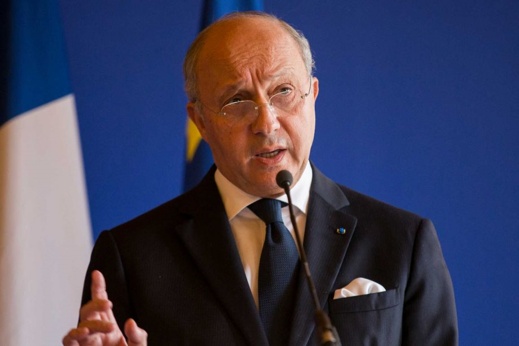
Laurent Fabius

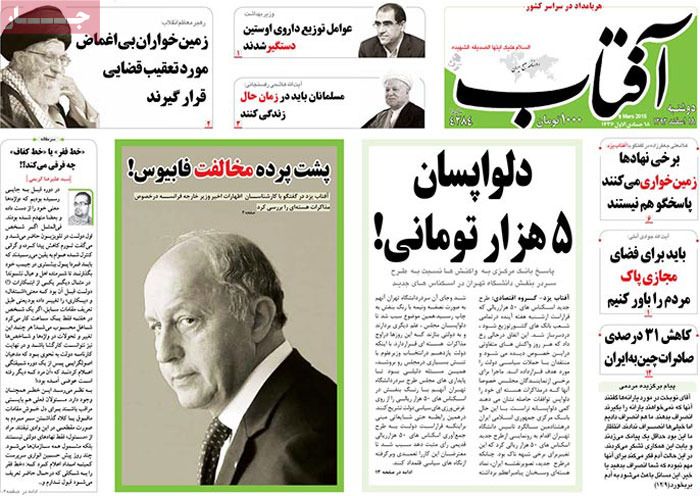
aftab-yazd-daily-newspaper-09-163Iran’s nuclear dossier took center stage in Paris one more time on March 7. Foreign ministers of P5+1 attended the meeting; but Iran’s top diplomat was not in the French capital for the meeting which seemed to be primarily aimed at playing up the role of Paris in talks than finding a solution to the nuclear case.

Paris seems interested in the repeat of what happened in preliminary negotiations between Iran and P5+1. The following is the translation of a report about the role of France in nuclear talks Aftab-e Yazd daily published on March 8:

French Foreign Minister Laurent Fabius said Friday, “There is still work to be done.”

He went on to say commitments offered by Iran in the nuclear talks with six world powers do not go far enough and more work needed to be done, notably on what he called “volume, checks and duration”.

His comments came as EU foreign policy chief Federica Mogherini, in two separate interviews, expressed optimism over conclusion of an agreement, saying that a good deal between Iran and the six world powers is at hand.

Those contradictory comments by two senior European diplomats suggest negotiations for a comprehensive deal are likely to result in the repeat of what happened in preliminary talks.

In the Geneva talks aimed at securing a preliminary deal, when all eyes were riveted to the negotiations between Iran and the US and there were growing speculations that an accord between them would guarantee a deal, it was France which hampered a deal.

A report released by Agence France-Presse (AFP) highlighted [deep] distrust between the two transatlantic allies and said there is a diplomatic fencing match behind the scenes between Paris and Washington over nuclear negotiations with Iran.

“Privately, American officials say there has been concern in Washington over the French position of publicly playing hardball, but then not backing up their words in the negotiations,” the report further said.

Measures by Paris are more of hindrance than help, because the difference in stances adopted by France and other members of P5+1 could put some of the achievements of the past two rounds of talks between Iran and the US – in Geneva and Montreux – at stake.

[On March 9, the daily filed a follow-up report featuring the comments of two experts on why the French foreign minister said what he said. In the report Ali Bigdeli, an international affairs expert, and Heshmatollah Falahatpisheh, a former MP, weighed in on the comments of Fabius. The following is the translation of part of what they said:]

Bigdeli:

In the buildup to the deal in November 24, 2013 similar remarks were made. Back then, Fabius and President Hollande paid a visit to Israel.

These two French officials are Jewish and under pressure from Tel Aviv and Jews in France. One should not forget the fact that France is home to the largest number of Jews in Europe.

Besides, because the French public deems the performance of Hollande as poor, by turning to such remarks, Fabius sought to display a muscle-flexing show, a gesture aimed at Jews in France and in Israel, as well as regional Arab countries. After America, France is the second largest provider of arms to Arab nations.

Therefore, his comments were merely a show of power and are not going to have any impact on nuclear talks which will carry on.

By making these remarks, Fabius sought to put across this message to the French that Paris does not comply with US policies, because the French are sensitive about America.

On the other hand, John Kerry has a very realistic approach to the talks and has made efforts to get the negotiations to this stage.

He consults with other countries because he seeks to maintain America’s friendship with them over other matters and avoids a go-it-alone approach.

The Americans are trying to turn Iran’s case into an international issue and thus have to consult with European countries; in doing so, they even have to visit Arab countries in the region to win them over.

Falahatpisheh:

What he said is not a show of might; rather, it is more a public diplomacy move.

The stances adopted by players such as France, Germany and Britain are among those taken in the line with public diplomacy. Official diplomacy is going on between Iran and America.

Video by Iranian Cheetah Society nominated for top prize in WLT competition

A few months ago an image of an Asiatic cheetah in Naybandan Wildlife Refuge, in Iran’s Yazd Province, became the overall winner of the research categories and rare species winner in the 2014 BBC Wildlife Camera-trap competition.

Now footage shot by camera traps of the Iranian Cheetah Society has drawn worldwide attention.

The video shot by a camera trap installed in Mian Dasht Wildlife Sanctuary has been nominated for top prize in the World Land Trust (WLT) International Trail Camera Competition in Britain.

The video shows two cheetahs and a camel coming to a water hole at the same time and the interesting behavior of one of the cheetahs in reaction to the camel.

“There was no need for discussion; at first glance, we were all unanimous about the film,” said a member of the jury.

The following is the footage the Iranian Cheetah Society (wildlife.ir) has released:

Strong presence in nuclear talks a national honor for Iran

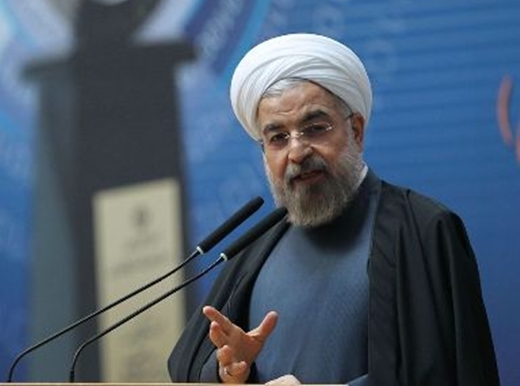
Rouahni-Iran President

President Hassan Rouhani has said that Iran’s strong presence in nuclear talks with six world powers is a source of pride for the nation.

He made the remark Monday in an address to the opening of a gathering to pay tribute to the sublime status of martyrs.

He said such a presence is indeed an honor for the country as the leaders of Iran’s diplomacy are now engaged in a Jihadi war to defend the country.

As the country’s great commanders led the war against the enemies some years ago, now the Iranian diplomats are doing the same to defend the nation, the President stressed.

He went on to pay homage to the sublime position of martyrs and said that Iranians are proud of their leaders, namely the founder of the Islamic Republic the Late Imam Khomeini and the Supreme Leader of the Islamic Revolution Ayatollah Seyyed Ali Khamenei.

The President also noted that Iran’s engagement in the war (against the Iraq’s Saddam regime) was to defend the country, not to attack other nations or usurp other lands and countries.

He said that a nation which pursues the culture of Ashura and looks at Imam Hossein (PBUH) as a role model would never submit to oppressors or give up its ideals.

President Rouhani further said that Iran was not after invading any country or attacking any nation; rather, it sought to defend its own people, dignity and independence.

He said today’s resistance of the Iranian nation against the big world powers could not be possible without the sacrifices and resistance of the martyrs.

Iran’s light crude price rises by $9

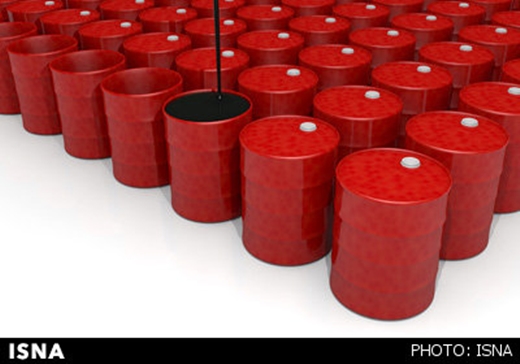
Oil

Iran’s light crude prices rose by 9 percent reaching $54.33 per barrel in February, said the National Iranian Oil Company (NIOC).

Iranian heavy crude prices rose by $10 in February compared to the month before, reaching $52.22 per barrel.

On January 18, Iranian Economy Minister Ali Tayyebnia said Iran’s economy is powerful enough to win the battle against falling crude prices.

“The government’s plan is that it envisages different scenarios with regard to oil prices and prepares itself for any rate,” Tayyebnia said.

He said that there has never been any clear forecast of oil prices since the government started drafting its annual budget.

In December, Iranian Parliament Speaker Ali Larijani said exports of crude are just one of Iran’s sources of revenue and the country can live on without oil sales and through exports of its rich mineral resources as well as through reliance on modern industries and its talented people.

“We have different methods and scenarios to run the country under different circumstances and we will not forget which countries are conspiring to reduce oil prices,” Larijani said.

He said that the same countries conspired against Iran in the 1980s when Iran was at war with Iraq.

“It would be a mistake if they (certain governments) imagine that they can change the strategic situation of the (Middle East) through oil (prices),” said Larijani.

[…]

Iran ready to cooperate with Britain on reopening embassies: envoy

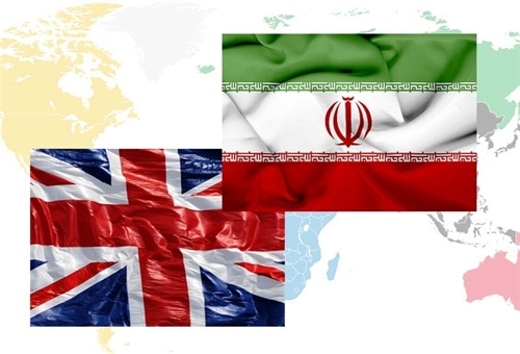
Iran-England

Iran’s non-resident chargé d’affaires to London said Sunday that Iran is ready to cooperate with Britain on reopening embassies.

Speaking to IRNA, Mohammad Hassan Habibbolahzadeh said, “We’ve had negotiations in this regard, but there are still issues that have to be resolved.”

Iran and Britain have decided to restore diplomatic relations and are determined to do so, Habibollahzadeh said.

“We have told our British side that we are ready to cooperate with them to solve the issues within the framework of the regulations of the Islamic Republic of Iran and conventions governing diplomatic relations,” he added.

However, he noted that relations with Britain are not an exception and are like diplomatic ties with other countries.

A symphony of hatred on Republican stage

Netanyahu speech congress-1

No, it’s not late. The handclaps are still being heard. The same hands are still at work, among other places, in Tikrit, Daraa, Aleppo, Sana’a, Tripoli, Kabul. The handclaps – which sound like of a slap across the face of the Middle East – will continue to be heard as long as the policies and decisions of the applauders remain unchanged and as long as the shrieks of Middle Eastern children, men and women are heard from this corner of the world.

No, it’s not late. There is still something to write about. The ceremony has yet to come to an end. It’s not going to end as long as the applauders straighten up and go out of their way to get engaged in combat; the show must go on. The handclaps will also drown out the voice of approval confirming a nuclear deal, if one is ever signed.

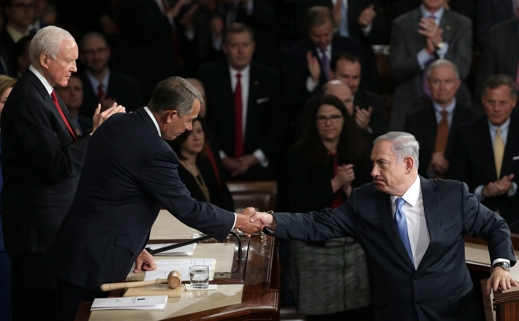
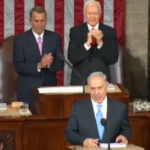
On March 3, Benjamin Netanyahu appeared before the US Congress and was given rounds of applause by members of the House of Representatives and the Senate. The claps of Republicans, who insulted the dignity and intelligence of world nations and those of their own constituents, are the only thing which will stay in mind and go down in history as “black comedy”.

Can the sounds of bomb blasts and artillery fire in crisis-hit flashpoints in the Middle East or the incessant roars of Israeli bulldozers in the occupied lands – which destroy Palestinian houses and have once even crushed an American journalist to death – be drowned out by the prolonged deafening rounds of applause by some impertinent US politicians?

Never! The orchestra which performed on Capitol Hill, conducted by the Israeli prime minister and organized by John Boehner, was playing a symphony of hatred – a prelude to beating the drums of a third world war.

Ladies and gentlemen! You’d better represent your people. They [Americans] are not at odds with each other. You are the ones who want to see peoples disintegrated and in tatters; you are the ones who want to erect walls between nations. Instead of representing your own people, you are walking down a path in which nations take on each other in proxy wars you wage.

Instead of soldiers and marines [boots on the ground], you can send your people as tourists to the Middle East and wish them a good trip. Instead of allowing their bodies to speak in history, let them recall their memories and share with you the delight of living with the noble and emotional people of the East.

People like Netanyahu will lay waste to the world of which Israel is only a tiny part. So it would make sense if I asked: Why is it that Israel is always afraid of being destroyed? How is it that Israel makes this threat more believable by accepting the likelihood of the [existential] threat coming true?

Over the course of history, there have been governments whose existence has been a bone of contention. Basically, threats by enemies to topple a regime are nothing new. But in today’s world, existing international mechanisms (despite downsides and the reforms they need) make it impossible to annihilate a country. But Israel seems to have accepted that it is destroyable. If that destruction ever comes true, it would be the echo of these rounds of applause and handclaps.

Here I would like to offer a piece of advice to Speaker of the US House of Representatives John Boehner.

Your Excellency! Mr. Boehner!

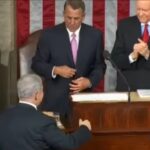
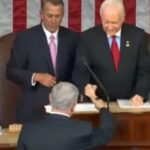
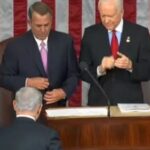
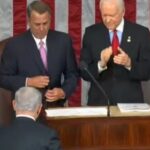
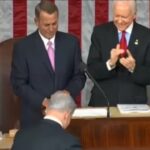
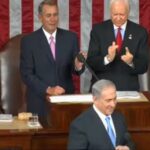
After your friend and special guest, Benjamin Netanyahu, joined you and your colleagues in the chamber – amid tumultuous applause – and shook hands with members of the audience, he approached the podium where you sit. It was now your turn to welcome him and offer a piece of advice to demonstrate the depth of your cordiality, not just to your dear guest, but to the American electorate. Right then something unfolded which may have captured the attention of very few people. I found what you did strange for a number of reasons.

Watch the video of the speech and review what happened there. In one scene, just like a best man you whispered into the Israeli premier’s ear, “Fix your necktie; be careful about your outfit!” I did not read lips, but what took place in a split second was truly a short and meaningful pantomime. Benjamin immediately retracted his hand and fixed his tie.

Your Excellency! Please care about global issues, for the Gordian knots in the way of international peace and calm – for part of which your constituents pay a heavy price – as much as you care about your dear friend’s necktie. The outfit you have made the world put on through arrogance and bullying is ill-fitting. It is bad-looking and unshapely. It deserves more subtle attention than Netanyahu’s suit. Such attention might help order return to the world.


It would be a good idea for war hawks to learn – before it is too late – that a fire has been smoldering under the ashes of war and bloodshed in the Middle East, from Iraq and Syria to Afghanistan to Yemen, a fire which will engulf the world –of which Israel is only a tiny part – and whatever therein.

It’s a good idea if the world’s war hawks and extremists – among them the Republicans, European skinheads, Arab sheikhs and their pawns including Alqaeda, ISIL, the al-Nusra Front, and Zionist Conservatives as well as unorthodox Shiites and Sunnis in Islamic societies who beat the drum of war and have been caught in the crossfire of civil war – know that the Middle East is still the source of energy.

This time around, the energy, which will be released someday, is not underground; it has found its way onto the surface. Unlike oil it is already on the surface! This energy is simmering in the men, women and children who have felt strangulated following years of oppression at the hands of unbridled Capitalists in the world and the greedy local tyrants.

Their patience is running thin and they are on the verge of eruption. Now they know who has smoothed the way for the miserable life they live; those small groups of people who will learn shortly that ISIL and others are only the attendants of a train which take tens, hundreds and/or thousands of them to a destination of death any moment, each day and month. They know the [train] engineers and have learned about the division of labor among the strangers and insiders.

Your Excellency! Pause for a moment and think about it. There comes a day when the energy of the oppressednations in the Middle East will not rev up the engine of factories and industries and will instead destroy the possessions and savings of the human civilization.

All world nations, including Islamic states which have suffered scars and injuries, have exercised restraint and are still ready to cooperate and live peacefully with major powers, decision-makers and leader of the international community. Do not miss out on this opportunity simply by applauding a war criminal.

Two things that cause a breakdown in talks

Hamidreza Asefi
Hamidreza Asefi

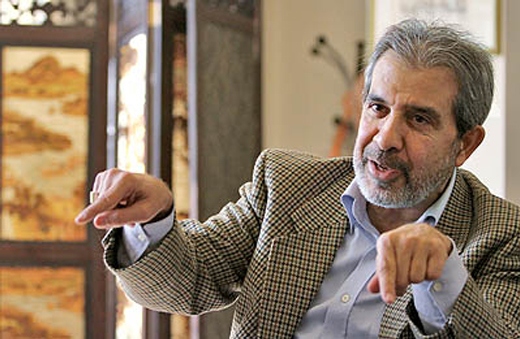
A former Iranian diplomat says that everyone should be ready for prolonged talks as long as sanctions remain in place and the US fails to drop its acquisitiveness.

Hamidreza Asefi, a former Foreign Ministry spokesman, says that parties to the talks know that negotiations would be of no use unless they agree on a modality to lift the sanctions.

That futility remains the case as long as the US thinks that sanctions can bring Iran to its knees. Furthermore, there are multiple beneficiaries each of which can impact the [ongoing] talks.

Parsine, a news website, on March 7 ran an interview with Asefi, asking him about the likelihood of a nuclear deal between Iran and P5+1. The following is a partial translation of what he had to say:

[…]

When do you think the talks will end conclusively?

Excessive demands by the US are [one of] the reasons why talks are dragging on. As long as the White House wrongly believes that Iran badly needs a nuclear deal, conclusiveness of the talks remains a remote possibility. Unfortunately the simple-minded approaches of certain media outlets and [political] groups at home give rise to such misconception.

What you are saying now has been raised for ten years. So what kind of progress have we made in the talks?

Unlike in the past, the two sides are interested in having a deal and need such a deal. The two sides share a will to agree on areas of difference. However, we should not forget that a ten-year nuclear crisis will not be settled in a matter of a few months. Multiple individuals or groups – among them regional rivals, Israel and other countries – are beneficiaries in Iran’s nuclear case. These beneficiaries will impede the talks unless their interests are served.

Does it mean that Israel and regional Arab countries are the main obstacles standing in the way of a deal?

All these factors come into play, but the main hurdle to an agreement is on American soil. As long as they think that Iran can be forced to submission under the pressure of sanctions, conclusion of a deal would be a remote possibility.

The US Congress too is an important factor contributing – so far – to failure to clinch a deal. Unfortunately, Iran’s nuclear case has turned into the bone of contention in partisan bickering between two rivals in the US. And domestic issues in America come at the expense of Iran’s nuclear case.

Some believe that the White House is seeking to arrive at an agreement, but Congress throws a wrench into the works? What’s your take on that?

I’ve heard about than notion. It’s too simplistic. The White House’s acquisitive stances should not be ignored. If we fail to take these stances into account, we will make miscalculations.

The White House thinks Iran will be destroyed without a nuclear deal, but it is a misconception on the American part. A nuclear deal will not be inked any time soon as long as Washington sticks to such mentality.

If the US appreciates the realities, conclusion of a deal by July, or even before that, is not a distant possibility. I think a deal could be within reach if the two sides act realistically.

Netanyahu comments have no impact on nuclear talks: MP

Mansour Haghighat Pour

“Iran’s negotiating team will do its best to clinch a deal, and parliament overwhelmingly supports them,” said Mansour Haghighatpour, a member of parliament’s National Security and Foreign Policy Committee, adding Iran’s demands are all legal and America should demonstrate more flexibility and abide by the law.

What comes below is the translation of the remarks of the MP as reported by the Iranian Labor News Agency (ILNA) on March 8:

Gaps still exist and on no account will comments of Netanyahu have an impact on the process leading to the conclusiveness of nuclear talks [between Iran and P5+1] at this stage.

The [Iranian] nation knows that Zionists want the talks to be inconclusive and do not want a deal to be struck. In case of an accord, their weaknesses will be exposed more than ever.

Given the guidelines of the Supreme Leader about support for our negotiating team, members of parliament back the Iranian diplomats and as long as the Leader calls for such support, the team has the solid backing of the entire nation.

The negotiating team is taking determined steps toward preservation of Iran’s nuclear interests. The world is optimistic about conclusion of an agreement, because it sees Iran as a regional security hub. A more secure Iran can contribute more to development of all regional countries.

It’s obvious that Islamophobia is at a home stretch. The negotiating team has intense negotiations ahead, because it has to address a number of other problems that have found their way into the talks.

As for the meeting between US Secretary of State John Kerry and the Saudi foreign minister, I think the American top diplomat went to Riyadh to offer explanations to the Saudis. This move can help ease opposition to the agreement.

An accord will be both to the disadvantage of Riyadh and Tel-Aviv, so it’s natural that they are opposed to it. We understand that they are under considerable pressure.

Our efforts are aimed at striking a deal by the deadline set, but it depends on the flexibility that the Americans will show. Because our demands are all legal; America should meet them to cut a deal.