Friday, December 26, 2025
Home Blog Page 4350

Iran Can Consider BBC World’s Request for Opening Office in Tehran: Official

BBC World News

In the past two months, there have been rumours that BBC is going to resume its activities in Iran.

In an interview with Sobh-e Now newspaper, as translated by IFP, Nooshabadi said that if BBC World makes a request for opening its office, it will be considered.

However, he added, they have yet to make an official request for opening their office in Iran.

“If they send their request, it will be studied by a three-member council comprised of the Intelligence Ministry, the Interior Ministry, and the Culture Ministry,” Nooshabadi went on to say.

Culture Minister Ali Jannati has also made comments about the issue. He recently told Mehr that giving permission to BBC Persian is totally off the table.

However, Jannati said, issuing licence for BBC World is possible, because their behaviour towards Iran is totally different, and the type of their job differs from that of BBC Persian.


Secret Meeting between BBC Officials and Iran’s Envoy to London

In its Monday report, Sobh-e Now claims that Iran’s Chargé d’affaires in London Mohammad Hassan Habibollahzadeh had held a meeting with BBC officials in the TV channel’s office in 2014.

During the meeting, a deputy head of BBC News has reportedly voiced the BBC chief’s willingness to visit Iran, but the Iranian official said such a visit would be fruitless without a considerable agenda.

He has recommended that they would use the ‘reopening of BBC office’ as a pretext for Tony Hall, the Director-General of BBC, to visit Iran. However, BBC officials convince Habibollahzadeh that Iranian authorities should give the green light for such a visit.

Sobh-e Now further claimed that BBC had certain conditions: the DG’s meeting with Iranian officials, issuance of visa for visits of BBC reporters, and the presence of a residing correspondent in Tehran were among the requests made by BBC.

We should wait and see whether the British news channel would be able to restart its operation in Iran or not.

Iran, Russia Diplomats Discuss Syria, Other Regional Issues

Hossein Jaberi Ansari (L), the Iranian deputy foreign minister for Arab and African Affairs, shakes hand with Russian Deputy FM Mikhail Bogdanov before bilateral talks in Tehran, August 15, 2016.

Hossein Jaberi Ansari, the Iranian deputy foreign minister for Arab and African Affairs, met with visiting Russian Deputy FM Mikhail Bogdanov in Tehran on Monday, discussing with him the advancement of Tehran-Moscow cooperation in the fight against international terrorism besides the ongoing Syrian conflict.

Iran and Russia have both been assisting the government in Damascus in its fight against a foreign-backed militancy. Iran has been offering advisory military help, and Russia has been conducting an aerial campaign against militant positions in the Arab country.

Syria has been gripped by foreign-backed militancy since March 2011. The United Nations (UN)’s Special Envoy for Syria Staffan de Mistura estimates that over 400,000 people have been killed in the conflict.

Jaberi Ansari and Bogdanov, who is the Russian presidential envoy on the Middle East and Africa, also discussed the promotion of bilateral ties and regional cooperation plus the implementation of a nuclear deal between Iran and six other countries, including Russia.

The deal, called the Joint Comprehensive Plan of Action (JCPOA), was struck in July 2015 and started being implemented in January 2016.

Iran is in contact with its international partners — which, besides Russia, also include the United States, France, the UK, China, and Germany — to oversee the due implementation of the JCPOA.

Iran’s Zarif Congratulates Lebanon on 33-Day War Victory

In two separate letters sent to Lebanese Foreign Minister Gebran Bassil and Hezbollah Secretary General Seyyed Hassan Nasrallah on Sunday, Zarif congratulated them as well as the Lebanese people and government on the 10th anniversary of Lebanon’s victory in the 33-day war.

“The victory was the result of sacrifices and self-devotions made by resistance fighters from various religious and ethnic groups,” Zarif wrote in his letter to Bassil. “It was the outcome of the unity and solidarity of freedom-loving and justice-seeking political parties and movements.”

Speaking in a televised address on Sunday evening, Nasrallah said Hezbollah entered the war with Israel to safeguard the very principles of resistance. He said the Israeli military was shaken after the 2006 war.

About 1,200 Lebanese, most of them civilians, lost their lives during the 33-day war on Lebanon.

According to the 629-page Winograd Report by the Israeli regime itself, Hezbollah fighters involved in defending Lebanon against the Israeli war defeated the enemy and Tel Aviv was compelled to withdraw without having achieved any of its objectives.

UN Security Council Resolution 1701, which brokered a ceasefire in the 2006 war, calls on Israel to respect Lebanon’s sovereignty and territorial integrity.

Iran Should Brace for Huge Sanctions, Official Warns

In an exclusive interview with the Tasnim News Agency, Chief of the Iranian Judiciary’s Human Rights Council Mohammad Javad Larijani highlighted the serious flaws in the process of diplomatic negotiations that led to the Joint Comprehensive Plan of Action (JCPOA), the July 2015 nuclear deal between Tehran and the Group 5+1 (Russia, China, the US, Britain, France and Germany).

The primary mistake that Iranian negotiators made in the process of the nuclear talks was not opting for the ‘confidence building’ technique to get suitable results, Larijani, also a theoretician and political expert, stressed.

What Iran undertook to do under the JCPOA is quite well-defined and explicit, while the other side’s obligations cannot be clearly defined at all, he deplored.

The vague idea that the ‘nuclear-related’ sanctions against Iran would be lifted was not robust enough, because many non-nuclear sanctions are somehow linked with the nuclear-related ones, Larijani argued, adding, “Above all, we have made no mention of the structure of the sanctions in the deal.”

“The US has completely retained the structure of the sanctions, and is not intending to lift them in the near future,” he noted.

The flawed documentation and ill-definition of commitments in the JCPOA and the subsequent UN Security Council Resolution 2231 enable Washington to make very little concessions to Iran, Larijani explained, adding that having control over how to interpret the deal has given US politicians the power to impose what they want.

Sustaining the structure of the sanctions also allows the US to apply the model of nuclear negotiations to other areas, Iran’s military and missile capabilities, he pointed out, saying many nuclear-related sanctions can be linked to Iran’s missile program only with a “different tag.”


In the eyes of the US, the sanctions forced Iran to negotiate, he went on to say, adding that certain signs of frustration from inside Iran led the US to the conclusion that Iran resists force, unless that force is too strong.

According to Larijani, putting restrictions on Iran’s nuclear program was at the bottom of the list of US demands, predicting that Iran should now expect “a very huge set of sanctions.”

Iran and the six countries on July 14, 2015, reached a conclusion over the text of the JCPOA after some two years of diplomatic talks.

The 159-page accord took effect in January 2016 and was supposed to terminate the nuclear-related sanctions against Iran all at once, but its implementation has been hampered mainly due to US policies.

In October 2015, Leader of the Islamic Revolution Ayatollah Seyed Ali Khamenei sent a letter to President Hassan Rouhani and highlighted nine main points that the administration needs to take note of regarding the course of JCPOA implementation.

The Leader has also repeatedly warned of the US failure to honor commitments under the deal.

“The duty of the other side was removing the sanctions, but it has not fulfilled that duty, meaning that it has lifted part of the sanctions in some way, but the sanctions have not been lifted practically,” Imam Khamenei said on June 15.

The Leader also lashed out at the US for fully keeping the primary sanctions in place, which has in turn affected the secondary sanctions that were to be lifted.

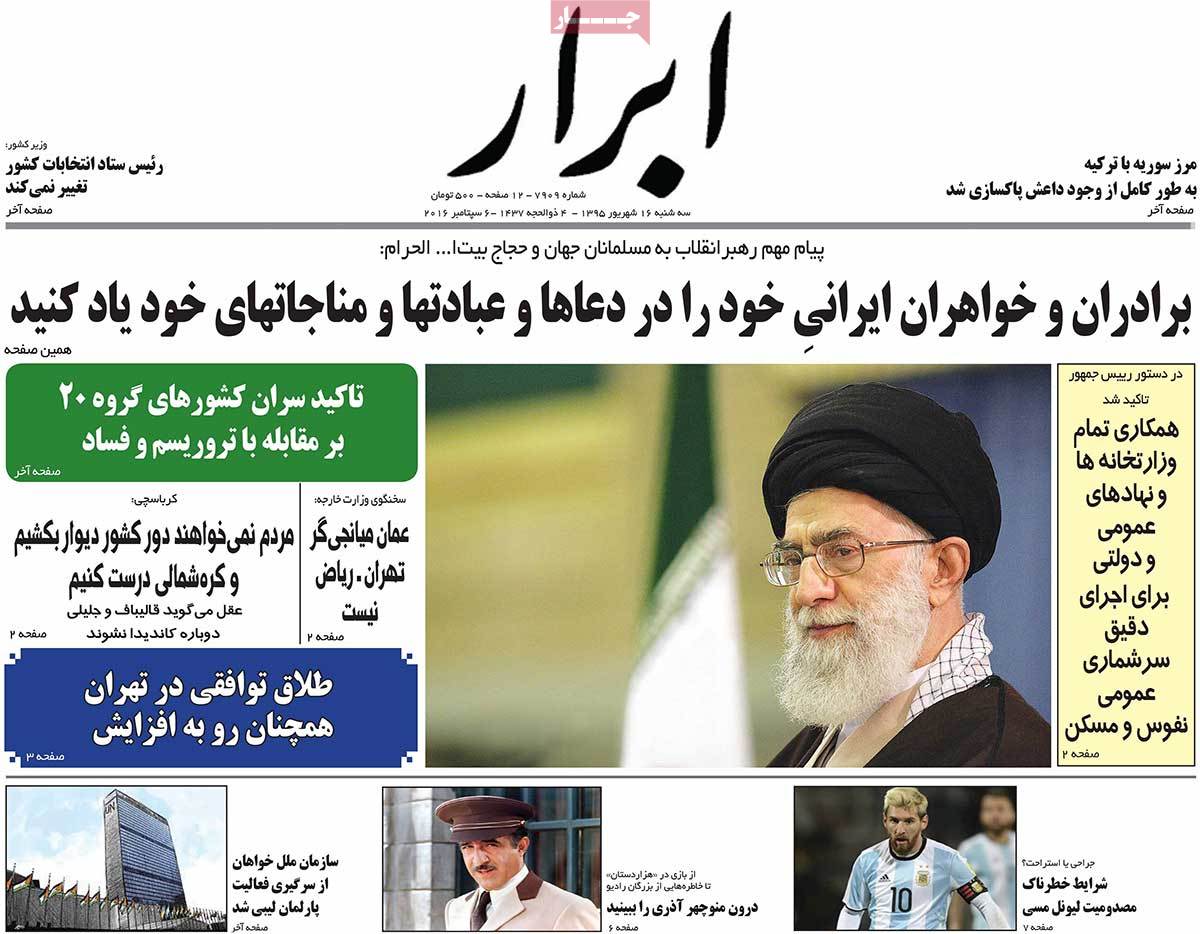
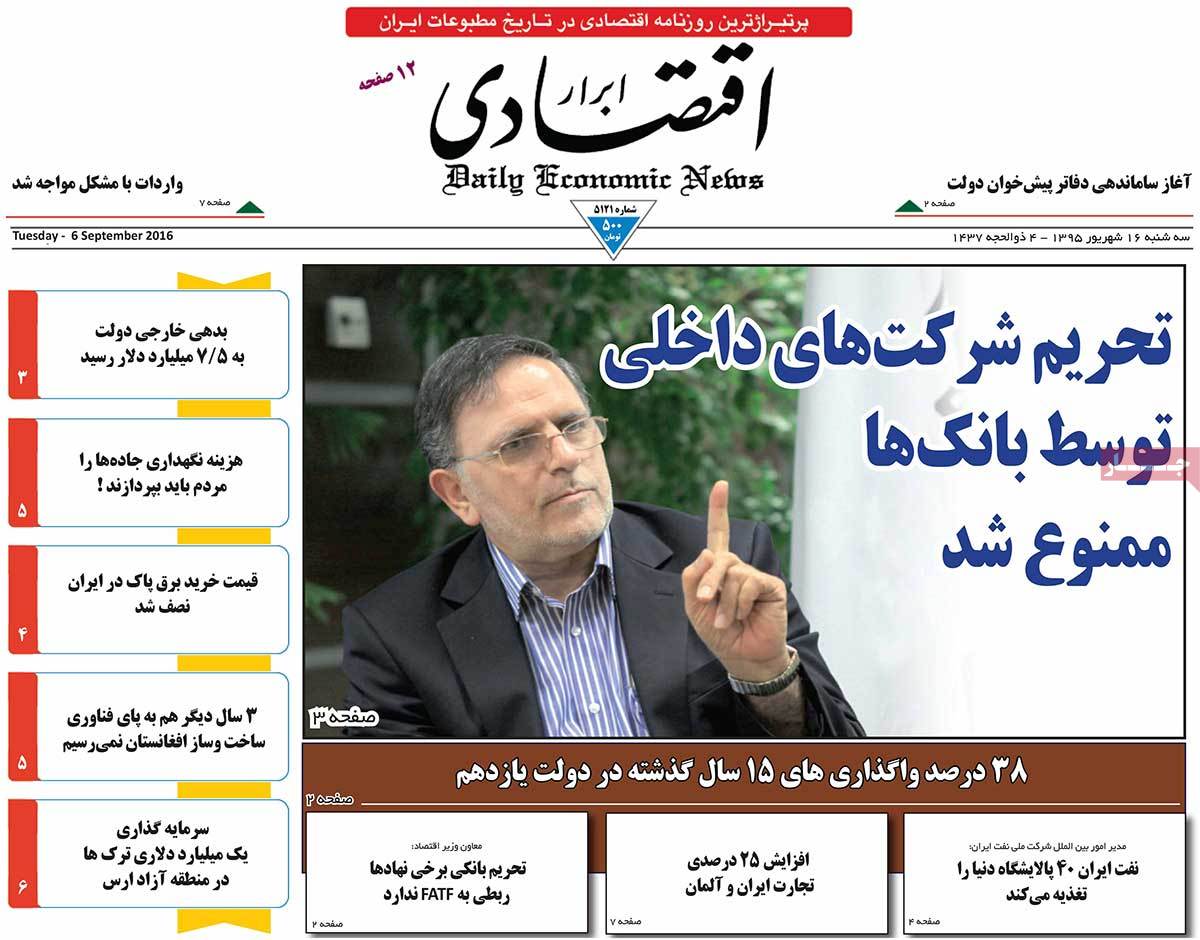
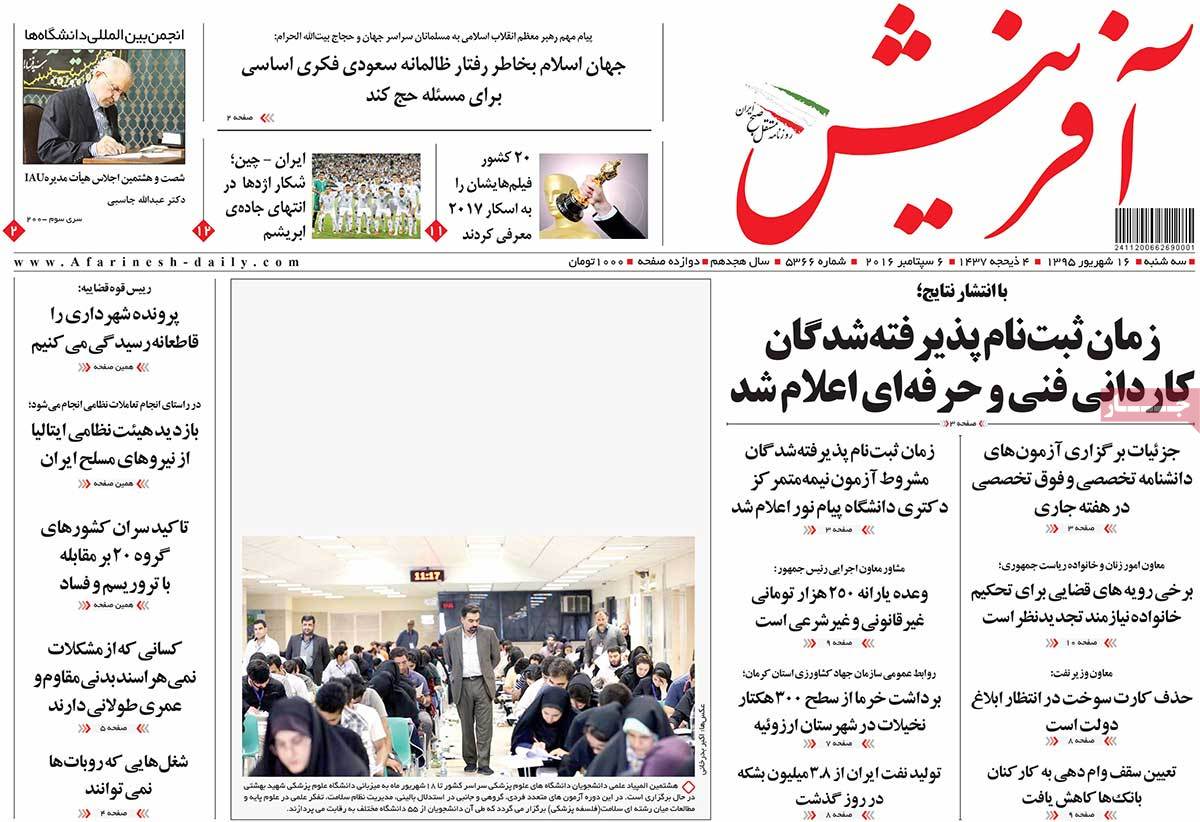
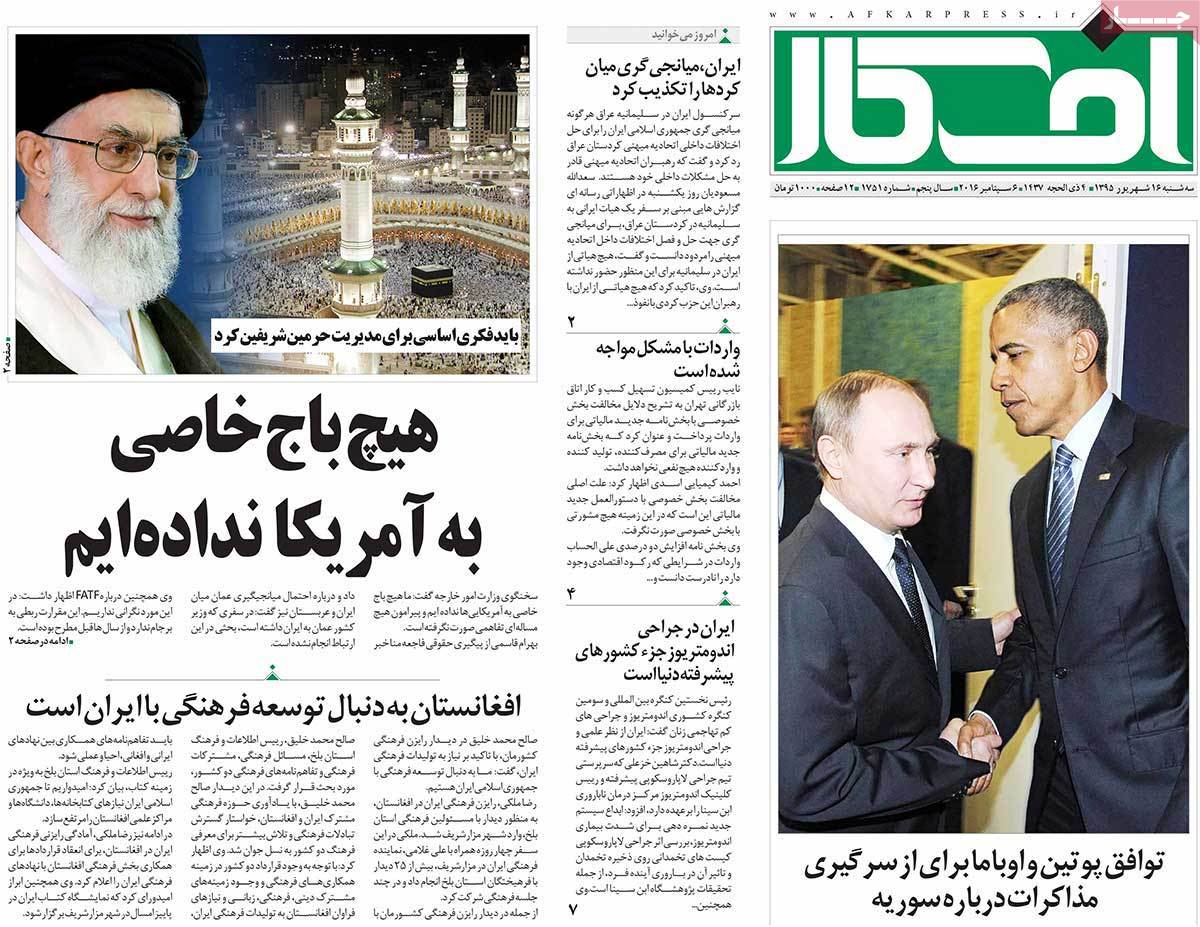
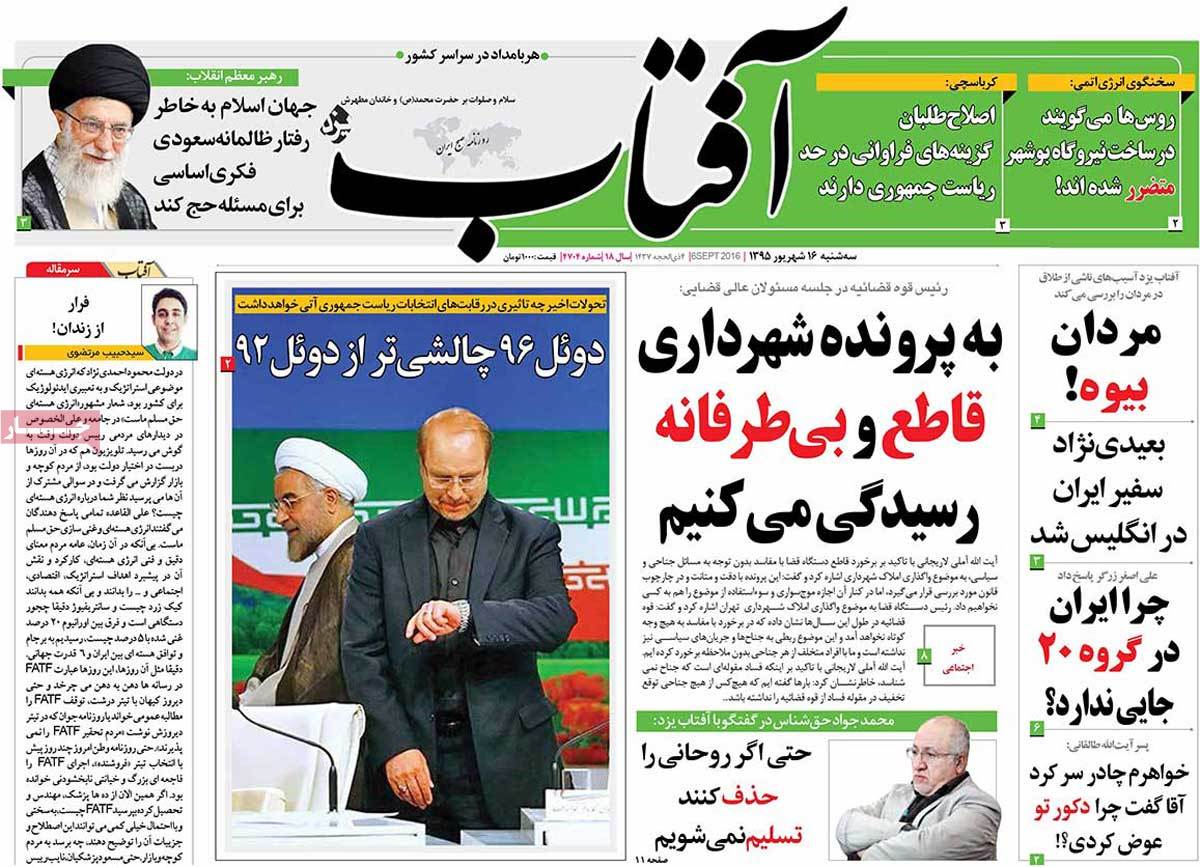
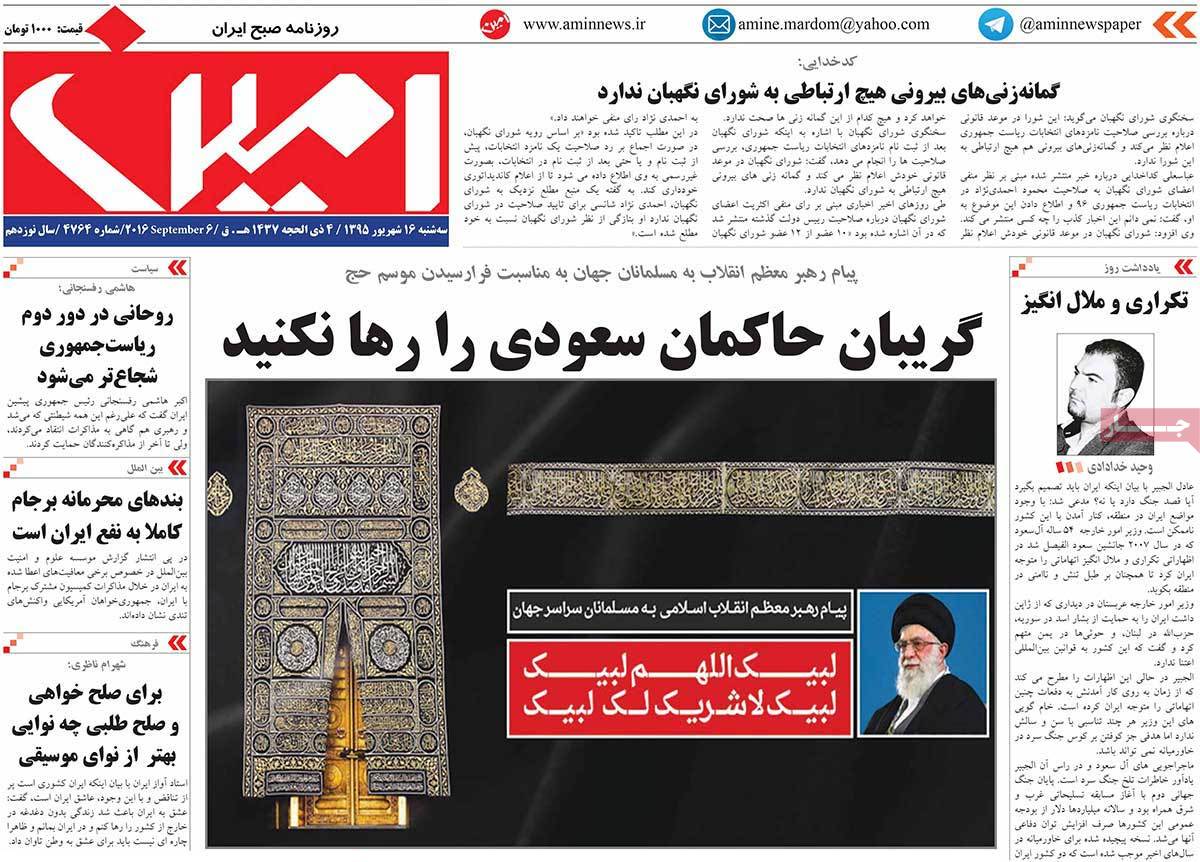
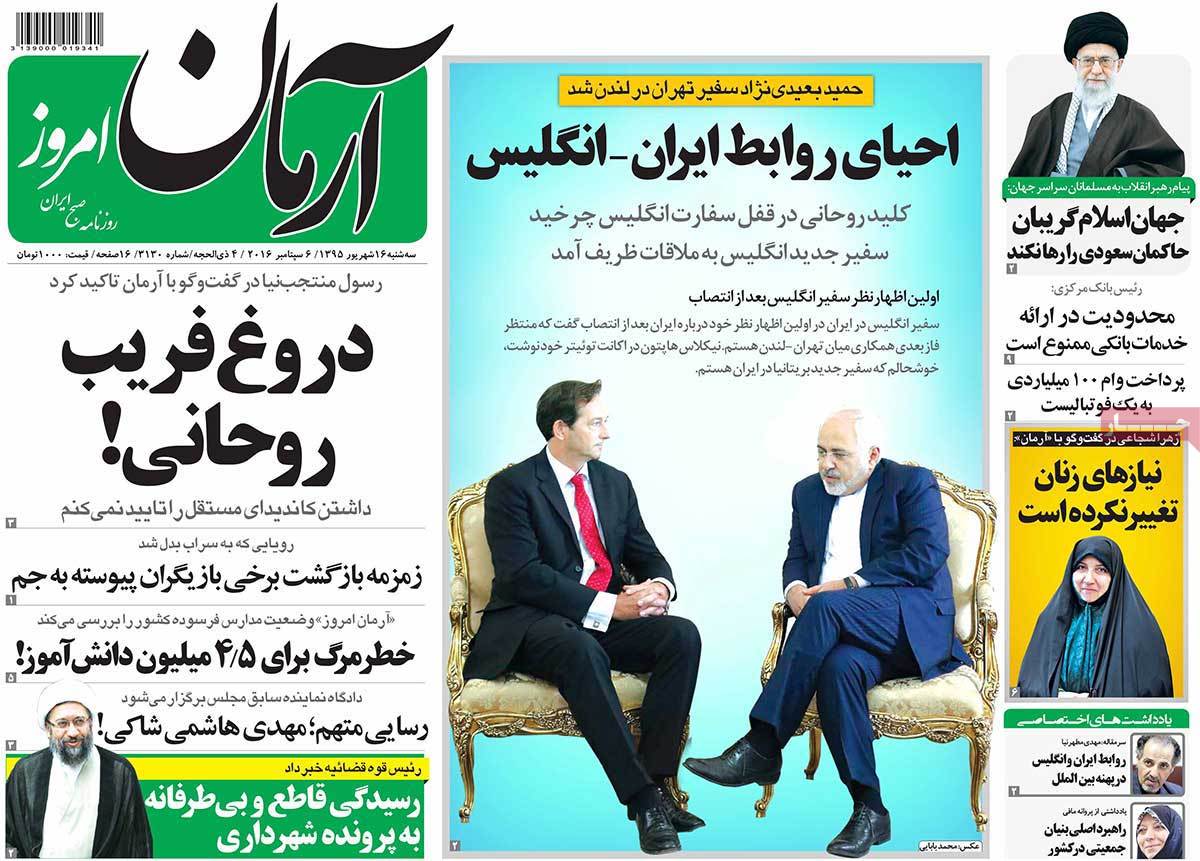
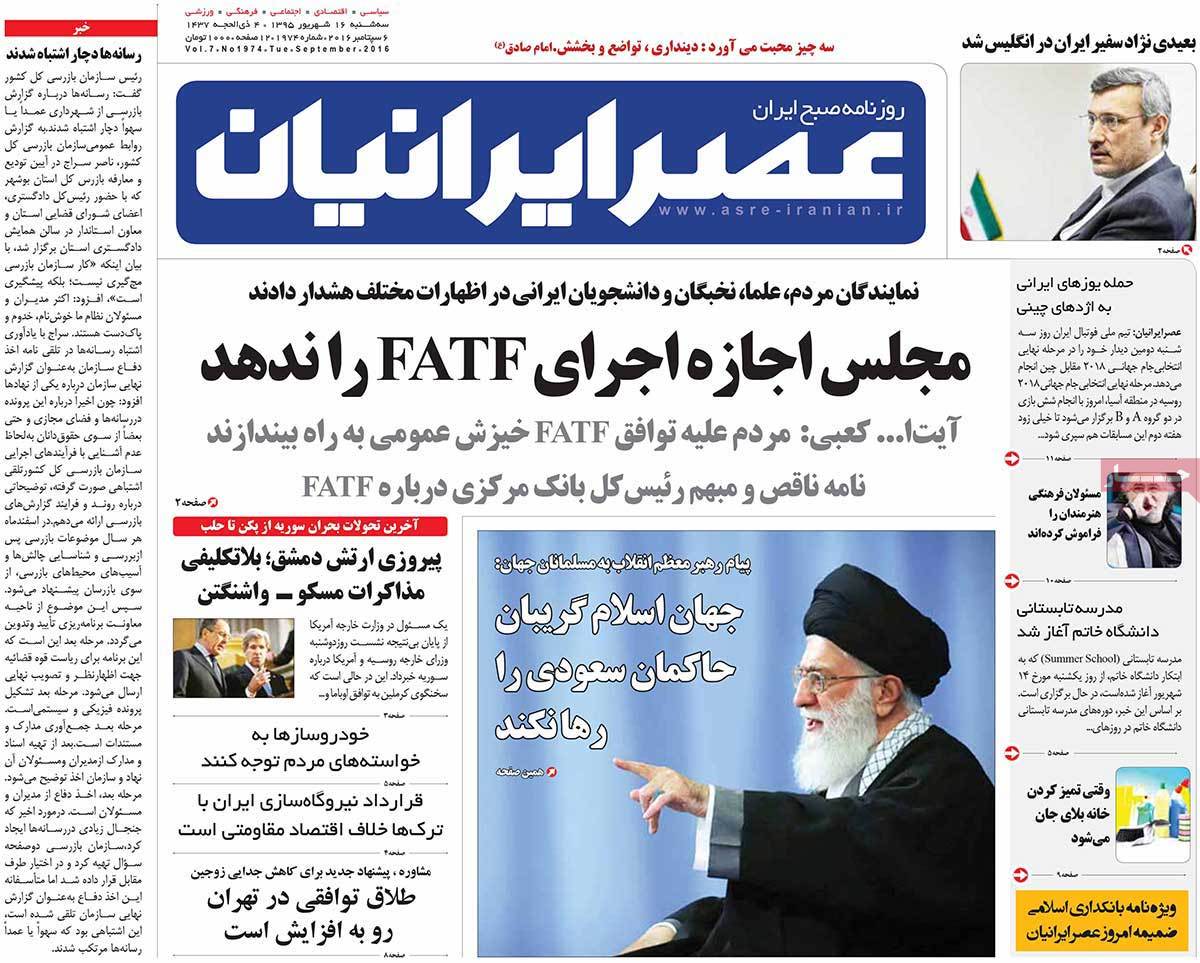
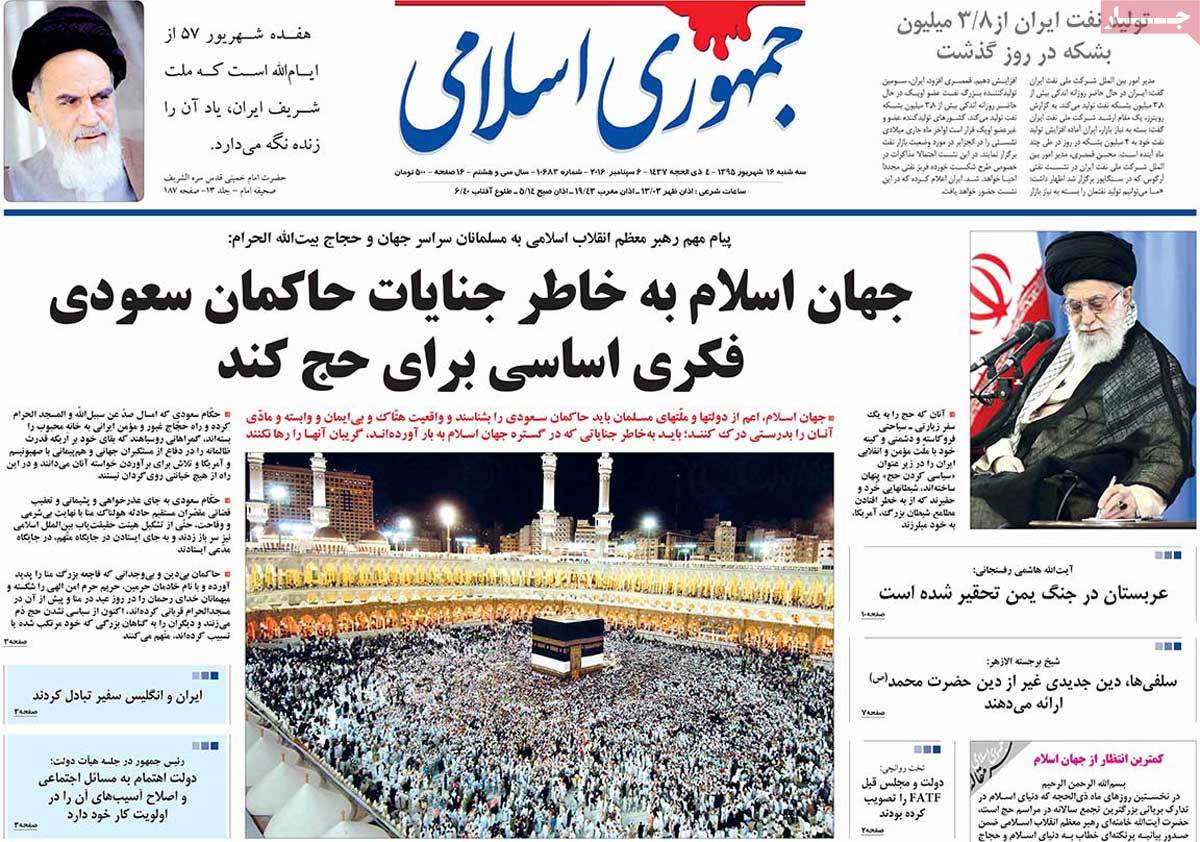
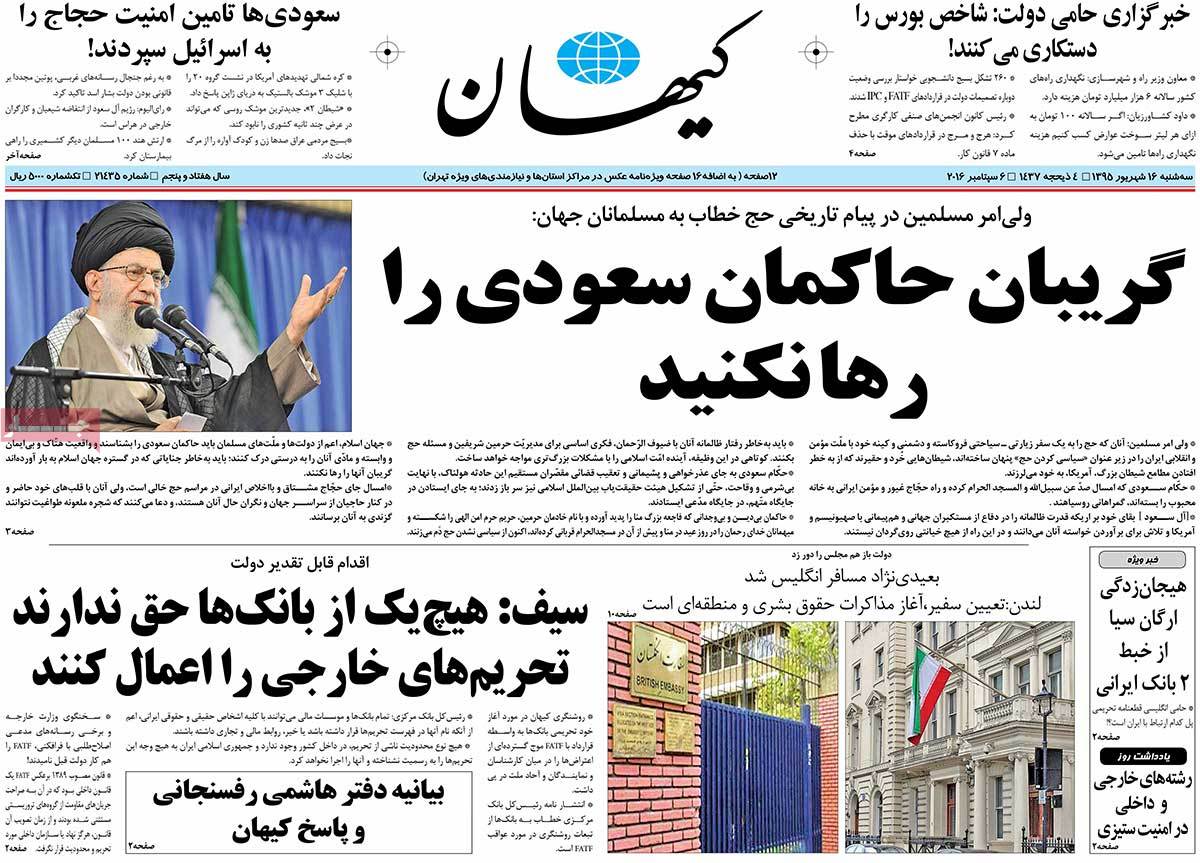
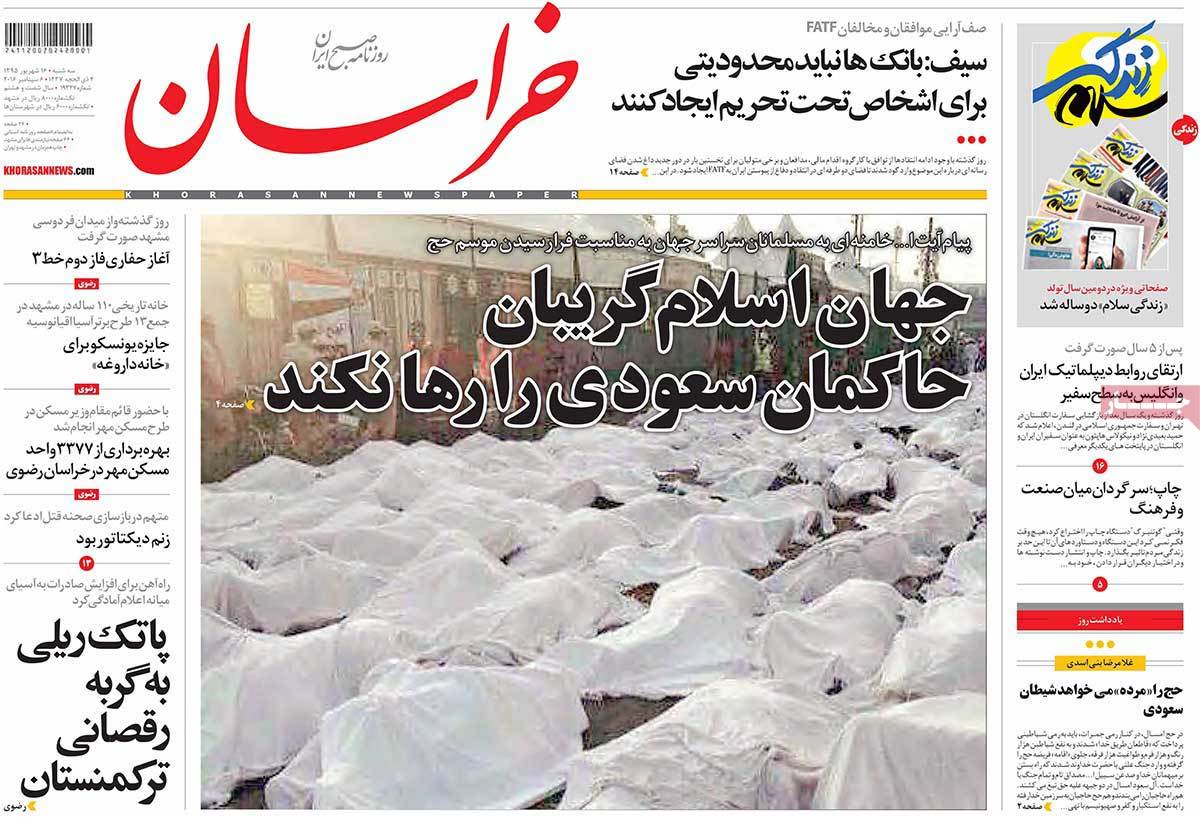
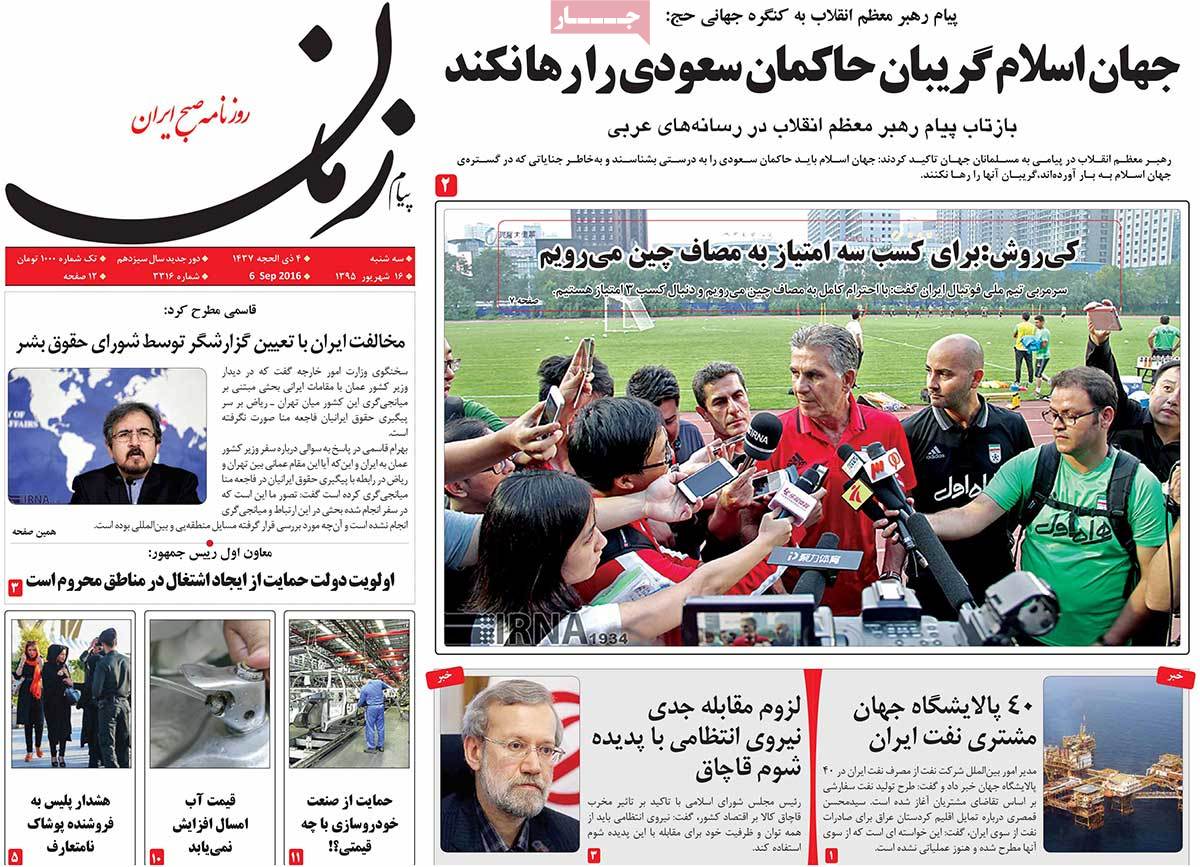
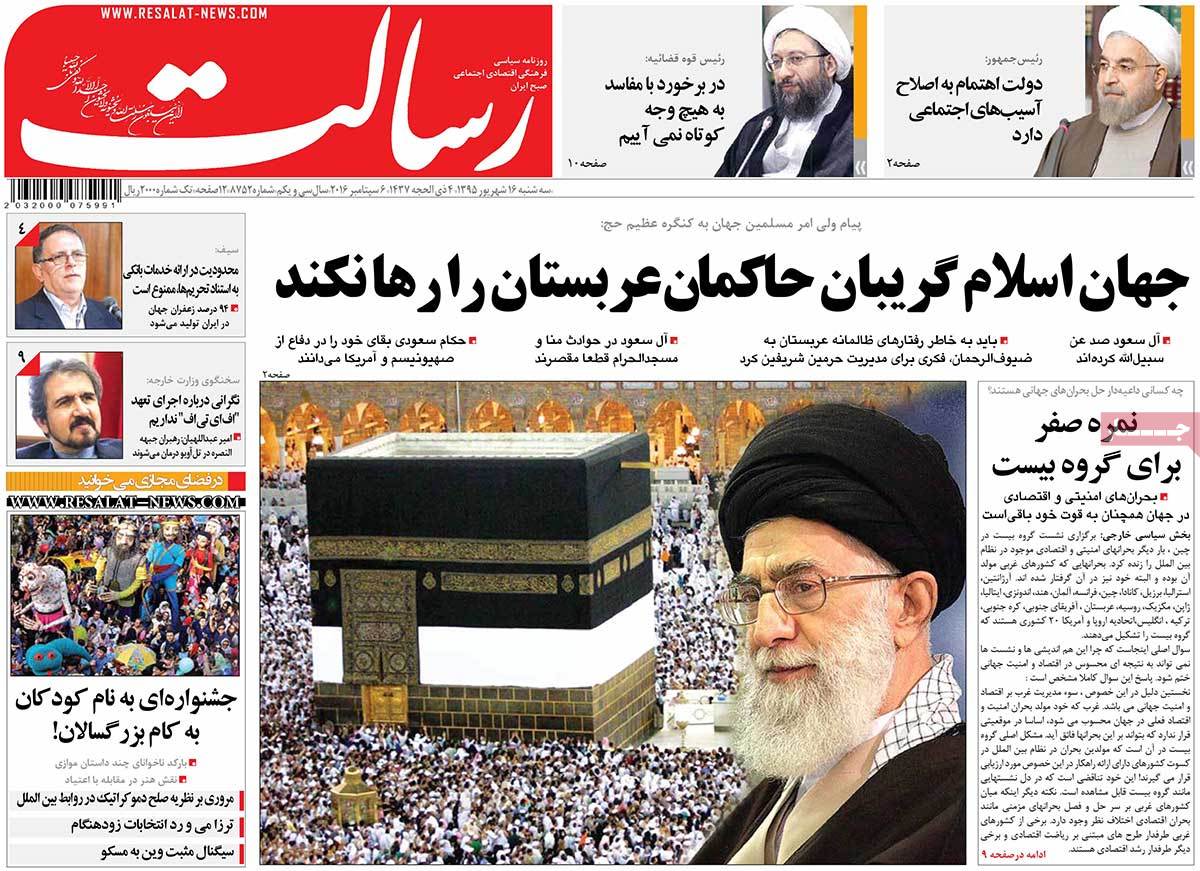
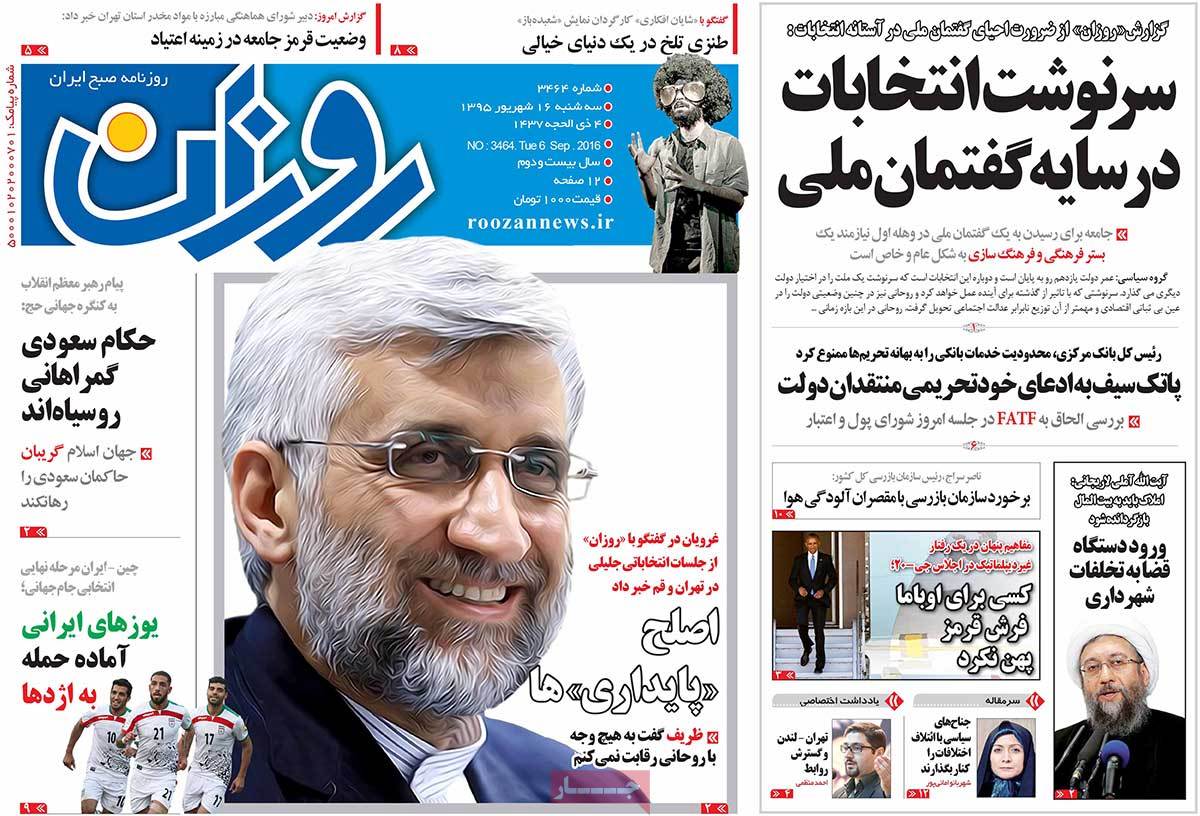
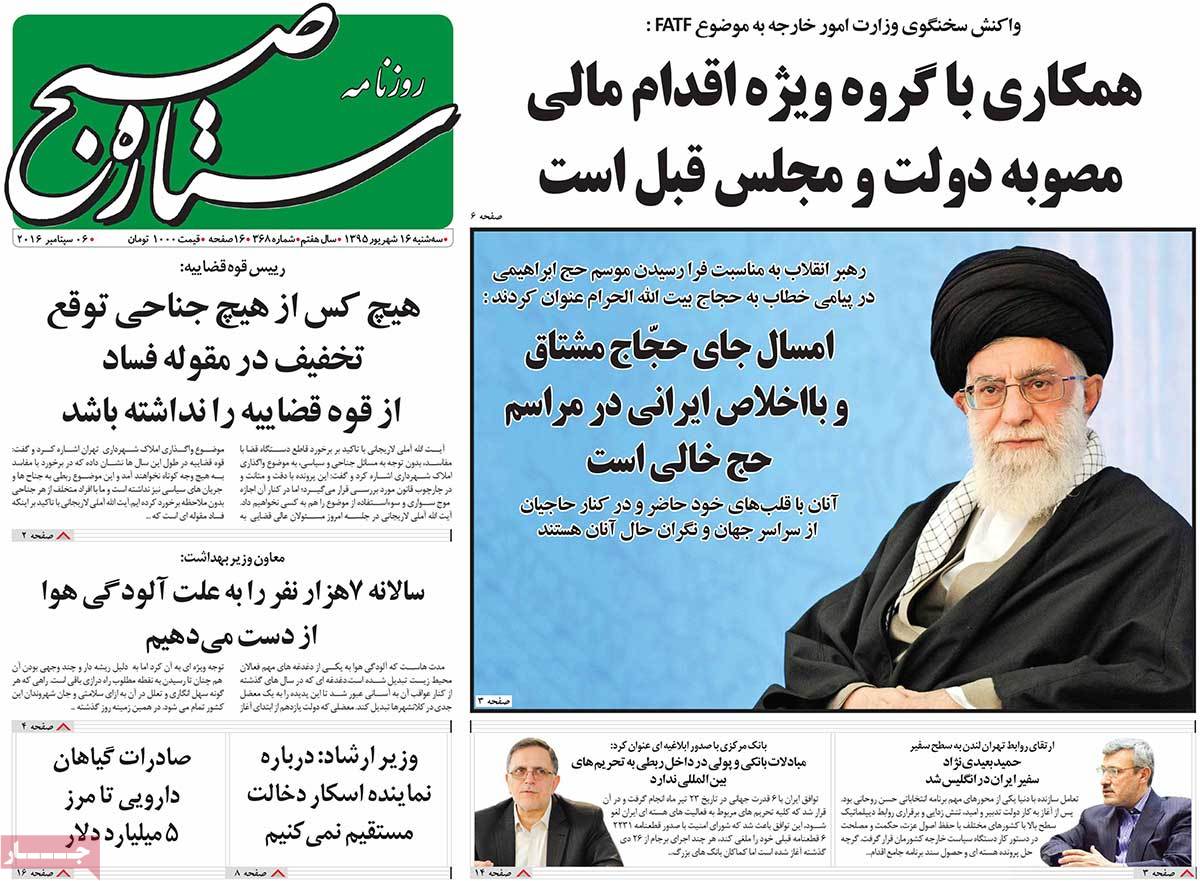
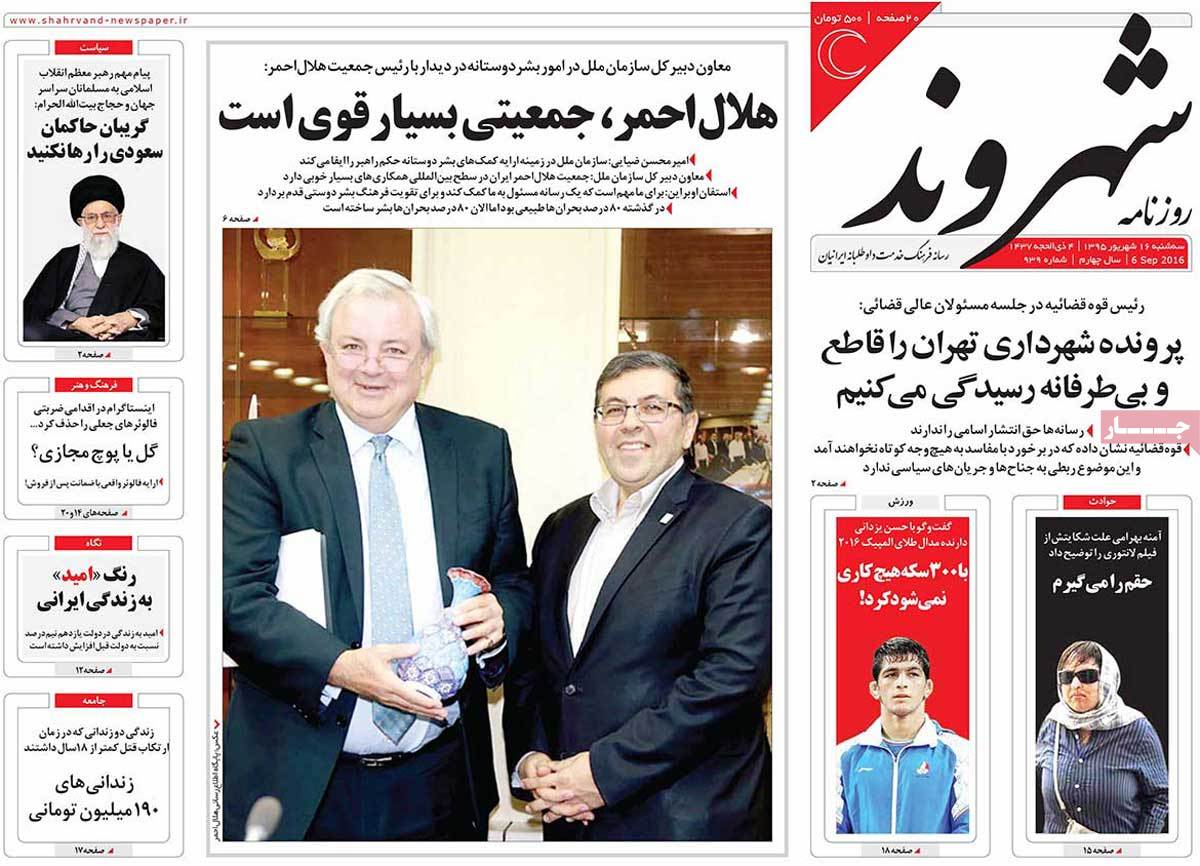
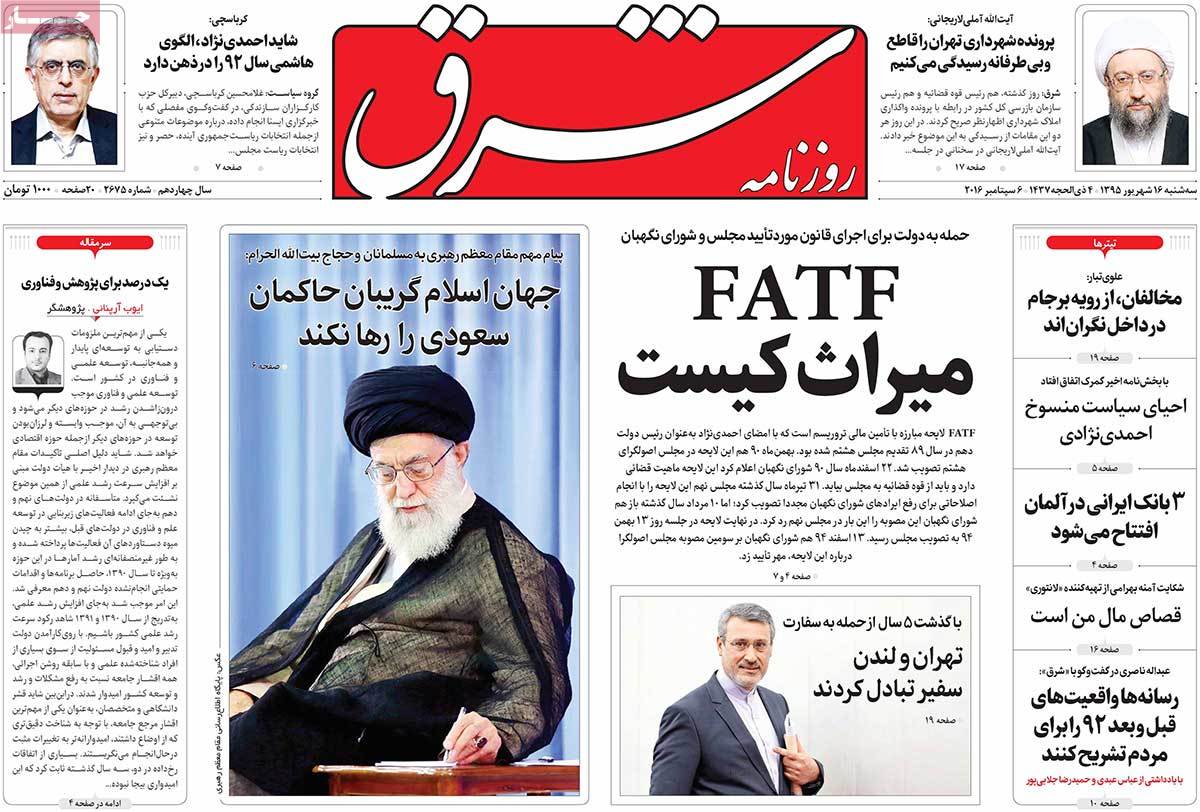
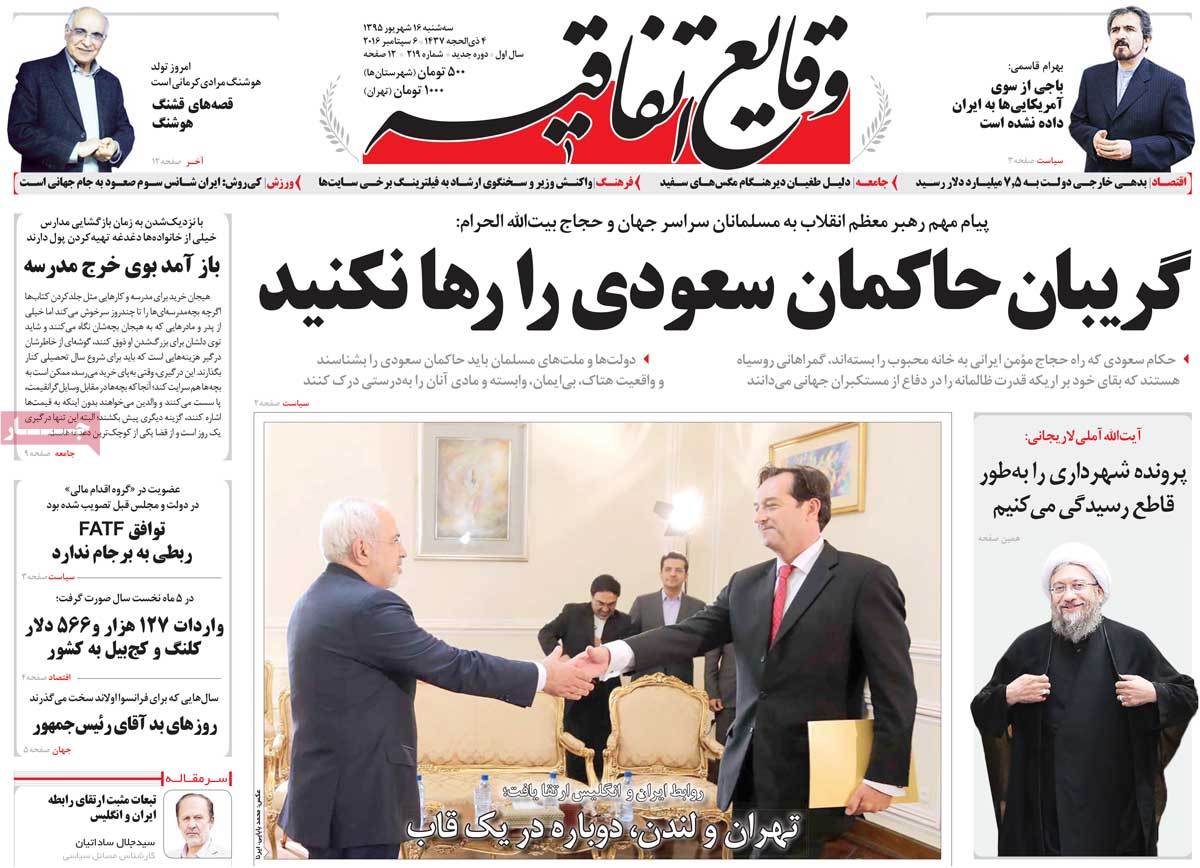
A Look at Iranian Newspaper Front Pages on August 15

Iran Newspaper front pages

Newspapers on Monday covered the remarks made by President Hassan Rouhani in an address to Iranian people in the southwestern city of Yasuj. President Rouhani announced that the country’s economic growth rate has increased to 4.4%, and also voiced his scepticism towards the US.

A Parliamentary statement against the insults to President Rouhani was also widely covered. The lawmakers urged the Judiciary to prosecute the insulters.

A popular TV show, “Dorehami”, and its famous host , the popular comedian Mehran Modiri, also appeared on newspaper front pages after an alleged insult by Modiri to two respected Sunni figures during a Saturday night episode. Several MPs have urged the IRIB to apologize and prosecute the perpetrators.

The above issues as well as many more are highlighted in the following headlines:


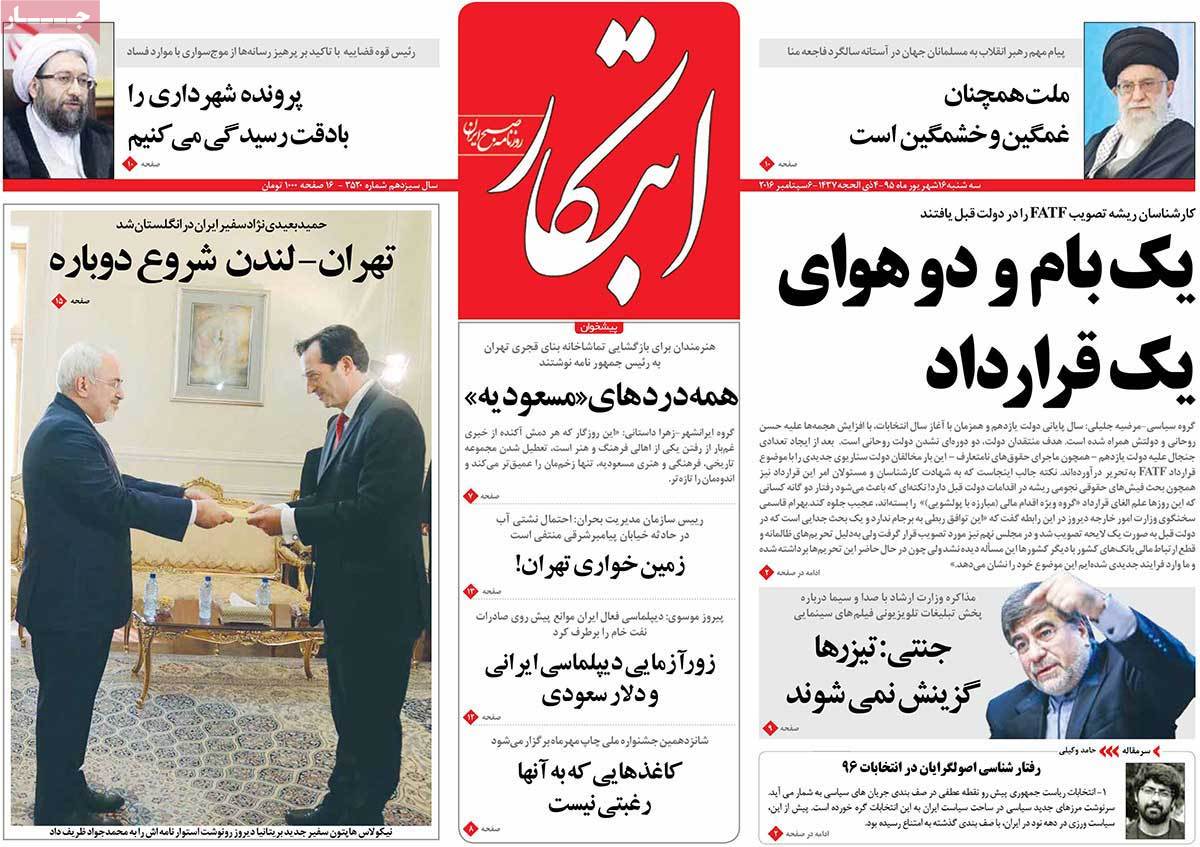
Abrar:

1- 20 Sunni MPs Call for Serious Action against Producers of Popular TV Show [in which the TV star Mehran Modiri has reportedly insulted two respected Sunni figures]

2- Vice-Speaker Urges IRIB to Apologize over Insults to Sunnis

3- Increase in Number of Prisoners Is Worrying: Official

A Look at Iranian Newspaper Front Pages on August 15


Abrar-e Eqtesadi:

1- Parliament to Review Import of Chinese Car Parts in New Peugeot Contract

2- Iran’s Oil Price Dropped to $37 per Barrel

A Look at Iranian Newspaper Front Pages on August 15


Aftab-e Yazd:

1- Alternative to Rouhani: Yes or No?

2- Drones Taking Photos of Houses to Find Tax Evaders in Spain

3- Boys Who Use Cosmetics: Analysis of a Strange Behaviour

4- Iran’s Questionable Trust in Russia: Why Tehran Withdraws from Suing Moscow over S-300 Delivery?

A Look at Iranian Newspaper Front Pages on August 15


Arman-e Emrooz:

1- Man’s Self-Immolation in Front of Tehran’s City Council

2- Some Candidates Were Mistakenly Put in List of Hope [Reformists’ list in parliamentary elections]: Rafsanjani’s Daughter

3- Foreign Ministry to Spend Its Own Budget on Buying Prison Terms of Iranian Inmates in Foreign Countries

4- Qom Seminary and Iranian Police File Lawsuit against Hafez [Cinema] Awards

A Look at Iranian Newspaper Front Pages on August 15


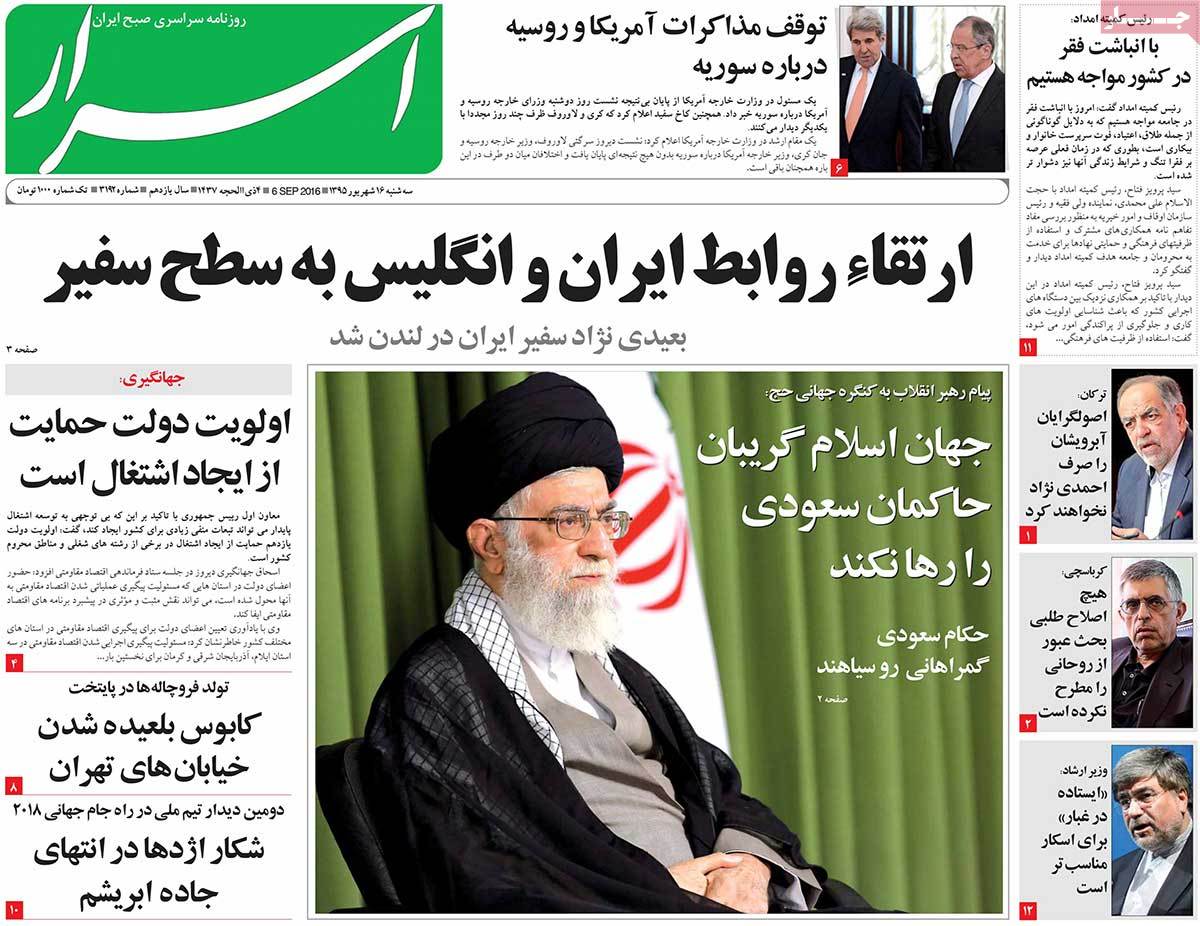
Asrar:

1- Parliament Warns Those Who Insult President

2- Iranian ‘Retired’ Weightlifter Moradi Wins Gold Medal in Rio Olympics

3- Security along Borders Is Iran’s Redline: Shamkhani

4- Zarif: Cooperation for Peace to Be Increased

5- Civil Rights Is Not a Political Issue: President’s Aide

6- It’s Questionable that Some Are Trying to Target People’s Belief in Imam Khomeini: Gradson

7- Iran’s Railway System to Be Renovated: Minister

A Look at Iranian Newspaper Front Pages on August 15


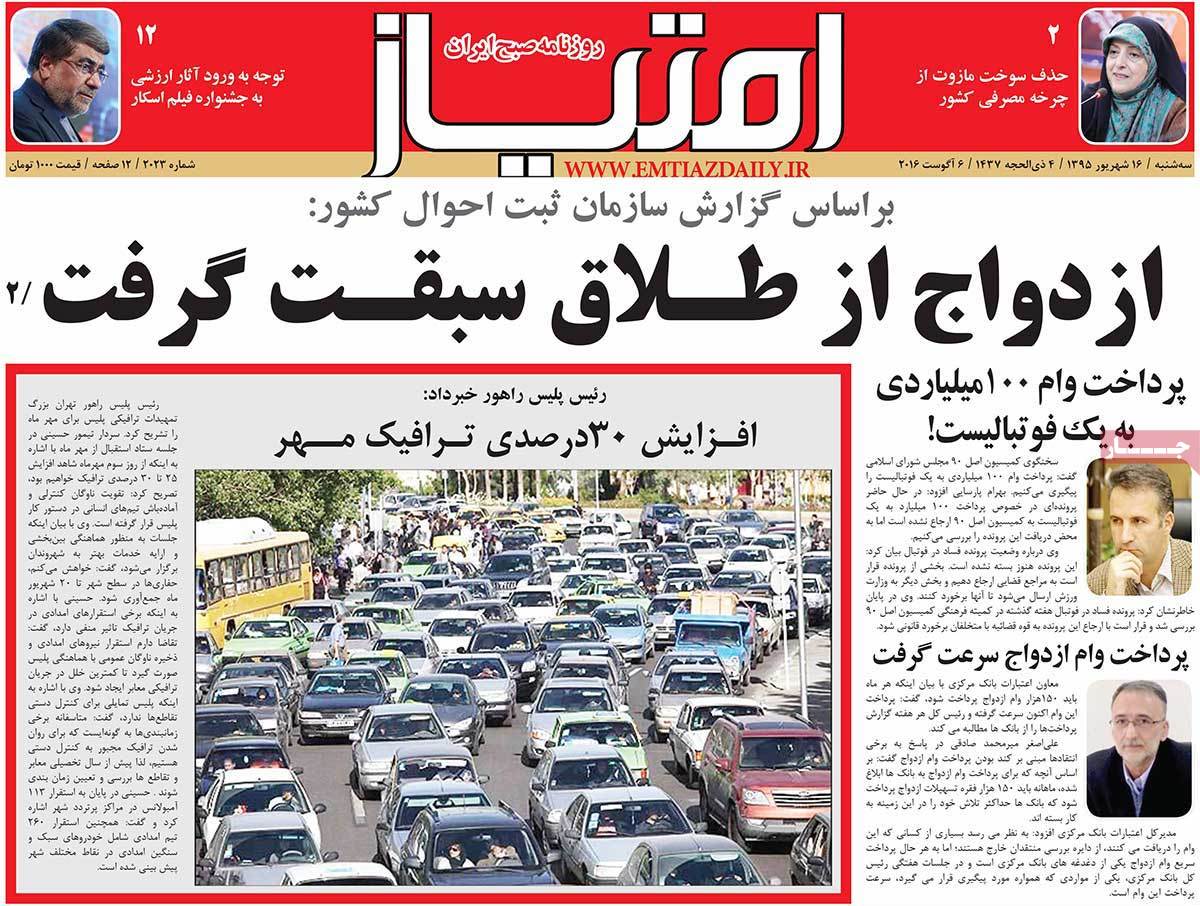
Emtiaz:

1- Increase in Fertility Rate in Iran: Official

2- 8 Tons of Various Illicit Drugs Seized in 4 Months

3- Iran Stops Import of Petrol from Turkmenistan

4- Iranian Men Who Win Medals in Olympics, and Son of Paralympics Medal Winners to Be Exempted from Military Service

A Look at Iranian Newspaper Front Pages on August 15


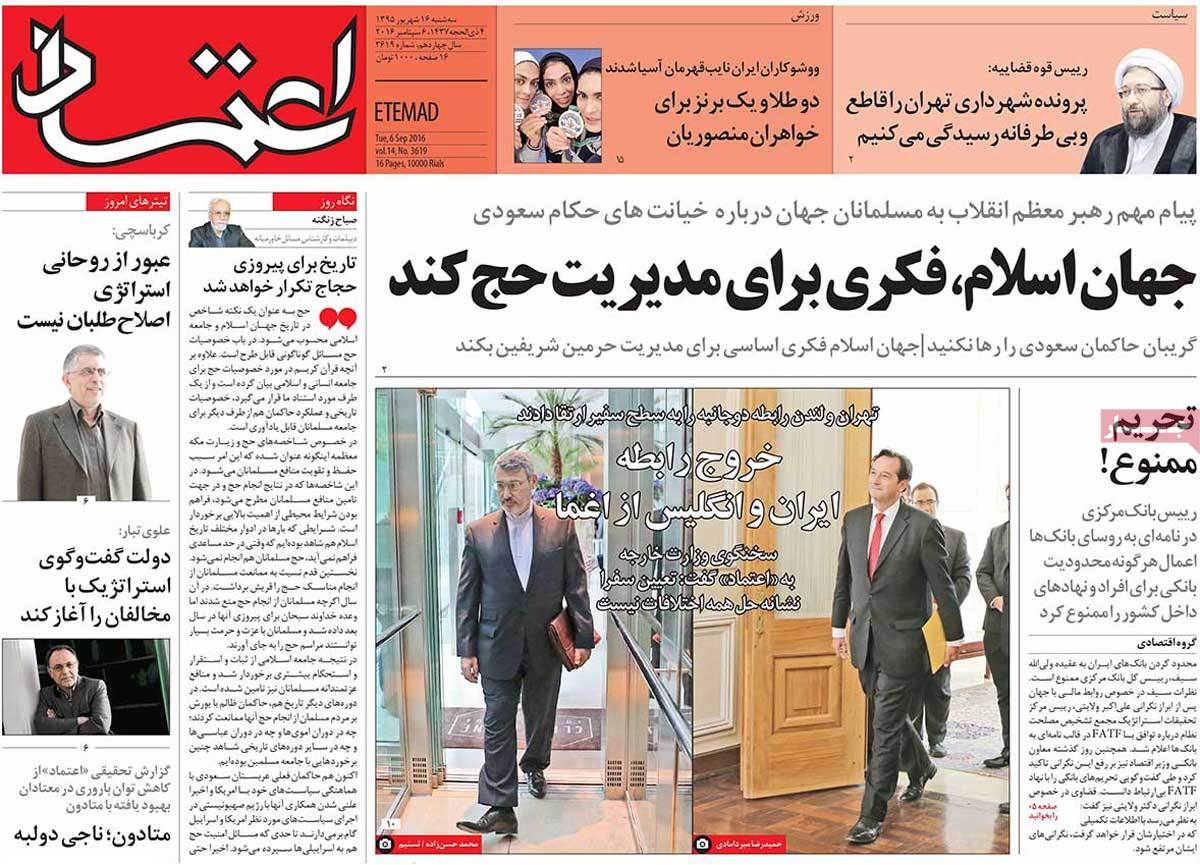
Etemad:

1- My Father Won’t Abandon Rouhani [in next year’s presidential elections]: Rafsanjani’s Daughter

2- Interior Ministry Warns Ahmadinejad against Early Beginning of His Campaign for Presidential Elections

A Look at Iranian Newspaper Front Pages on August 15


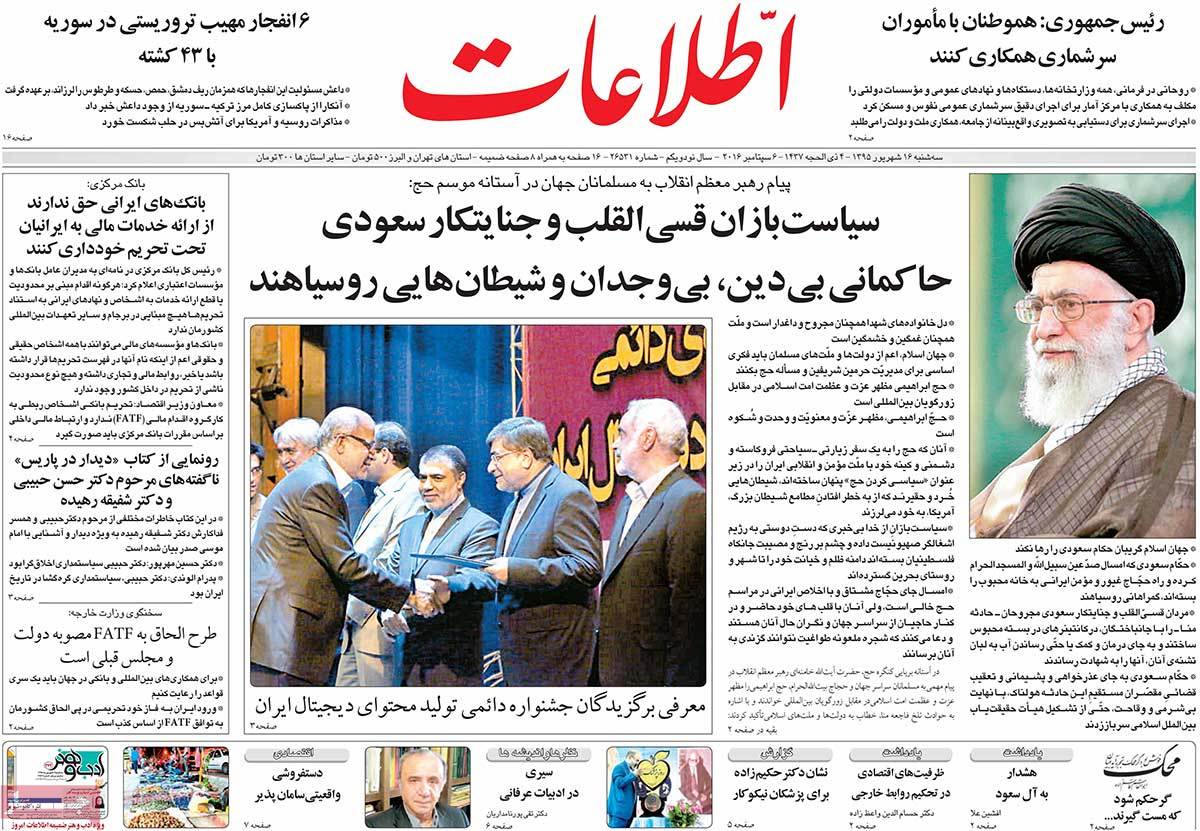
Ettela’at:

1- Economic Growth of Spring Was 4.4%

2- Russia Urges Saudi Arabia to Stop Attacking Yemeni Civilians

3- Iran’s Weightlifting Team Wins another Gold Medal in Rio 2016 Olympics

A Look at Iranian Newspaper Front Pages on August 15


Haft-e Sobh:

1- Tragic Death of 2 Teenage Girls: They Took Selfie and Then Jumped out of Window While Taking Each Other’s Hands

2- 4 Million Dollars of Smuggled Benz and Porsche to Be Crushed This Week: What’s the Reason for Such a Weird Decision?

3- Grief over Greco-Roman Wrestling Team’s Defeats Breaks Hearts of Iranians

A Look at Iranian Newspaper Front Pages on August 15


Hamshahri:

1- Oil Accounts for 1.5% of the 4.4% Economic Growth

A Look at Iranian Newspaper Front Pages on August 15


Hemayat:

1- Iran to Become One of the 10 Cleanest Countries in World: Anti-Corruption Official

2- New Documents Show Obama and Clinton’s Roles in Creation of ISIS

A Look at Iranian Newspaper Front Pages on August 15


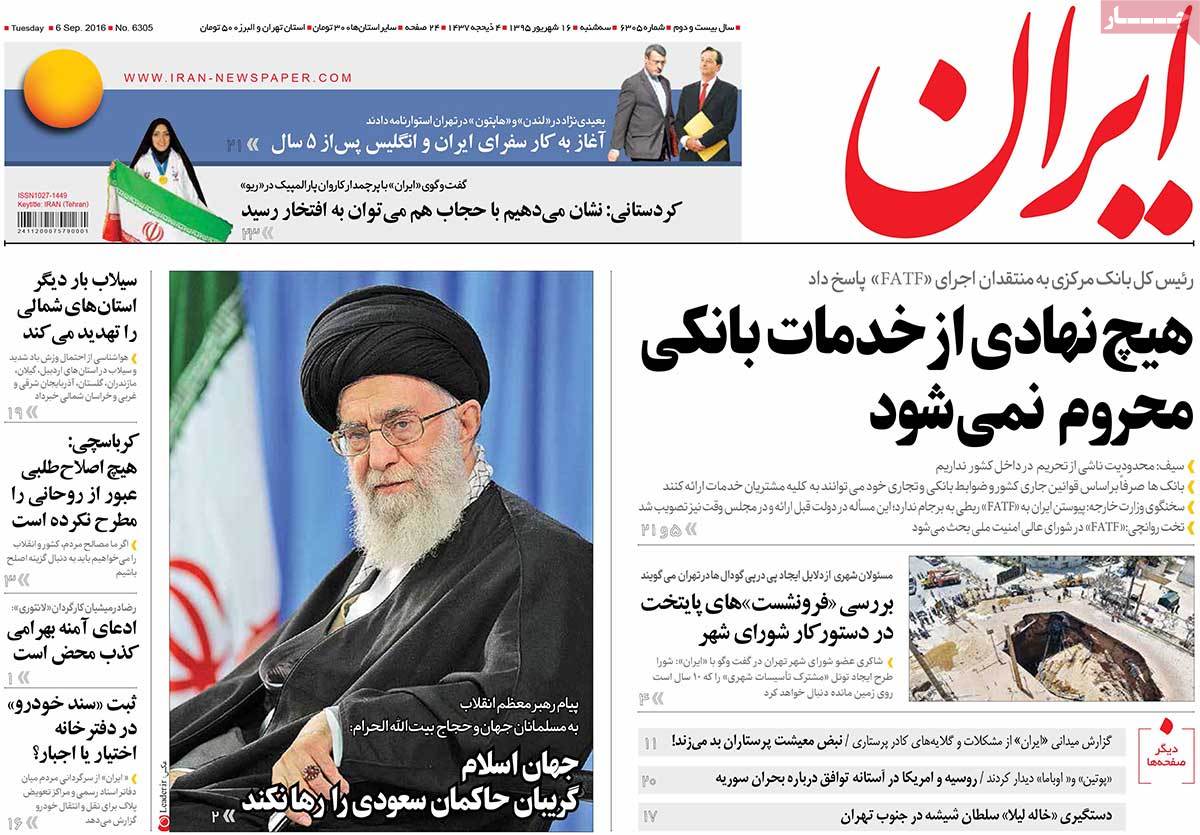
Iran:

1- Details about Biggest Post-JCPOA Investment in Iran: Turkey to Make $4.2bn Investment in Iran’s Power Industry

2- Imam Khomeini’s Grandson Criticizes Attempts to Undermine National Unity by Attacking the Late Imam

3- It’s Now Possible to Provide MasterCard Services in Iran: Minister

A Look at Iranian Newspaper Front Pages on August 15


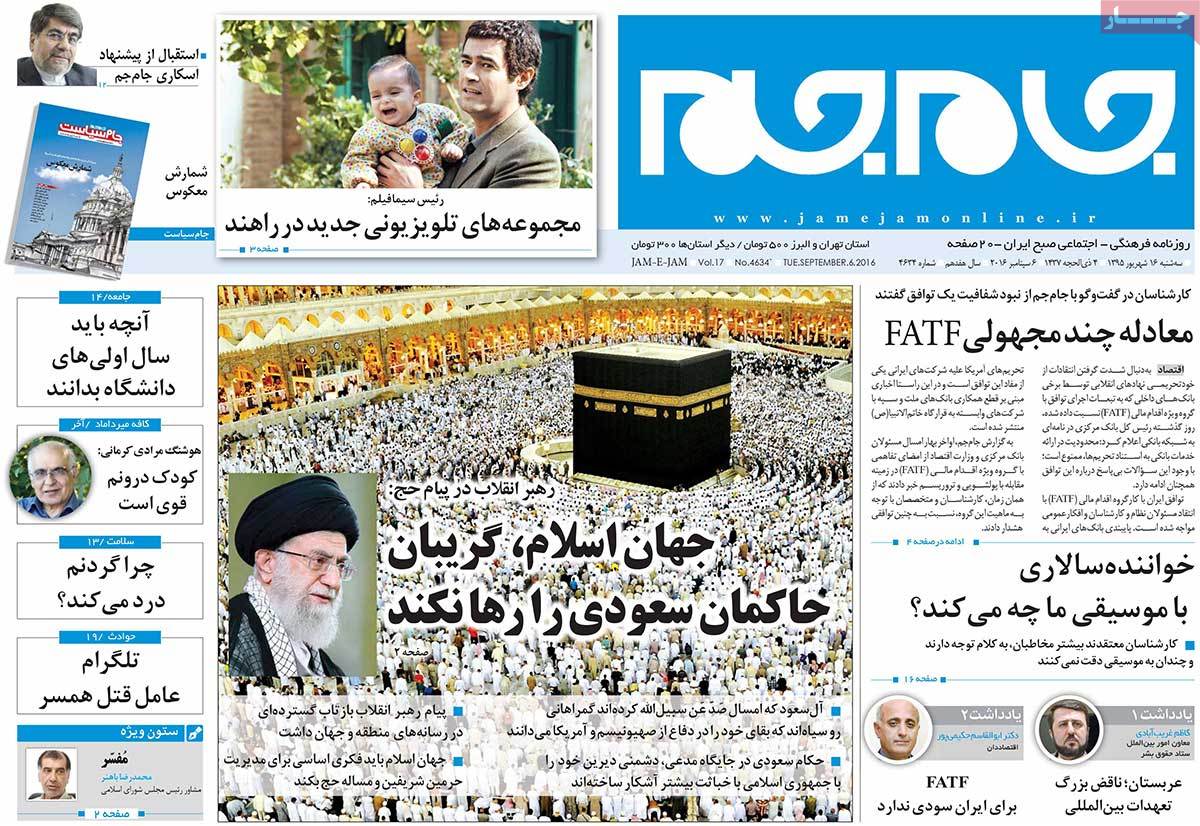
Jame Jam:

1- A Report on How Other Countries Have Countered Smuggling

2- Smoke Trade in Cyberspace: Growing Trend of Selling Tobacco Products in Social Media

3- President Rouhani: We’re Sceptic of the US

A Look at Iranian Newspaper Front Pages on August 15


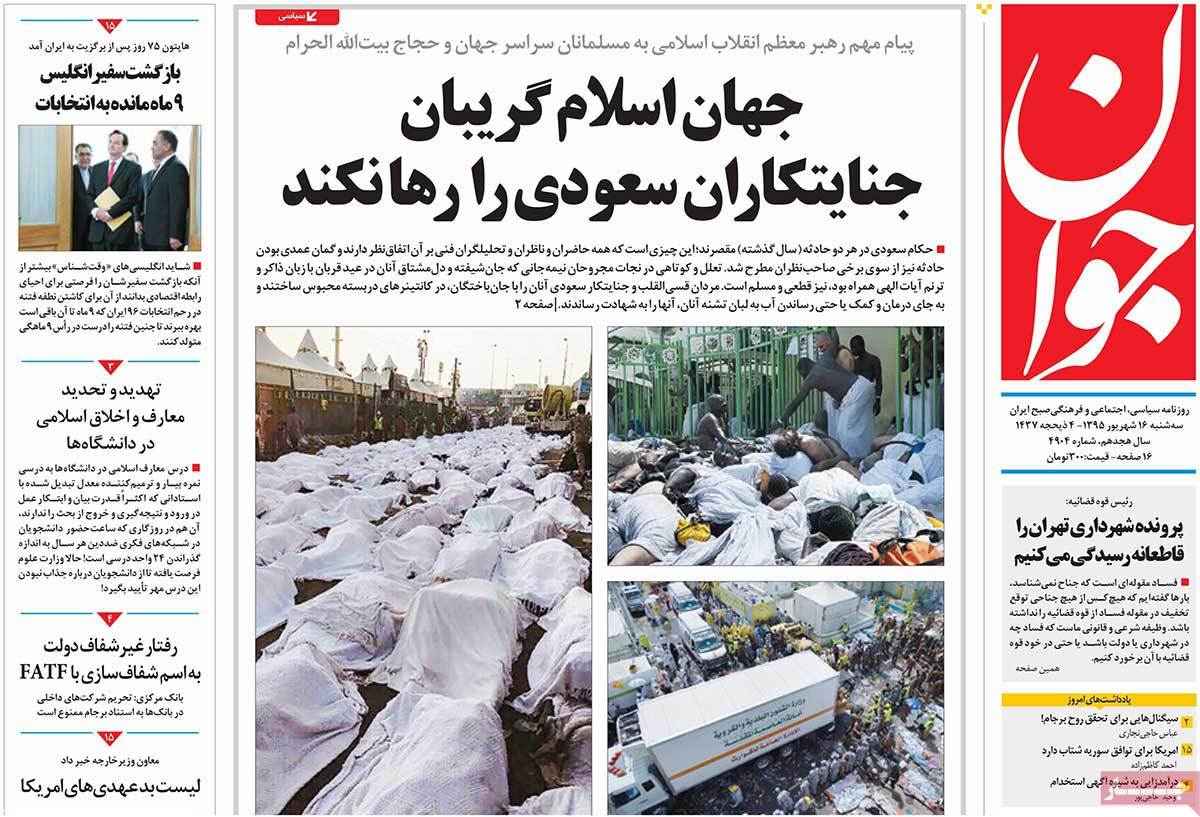
Javan:

1- Yemeni Children Do Homework in Blood: Saudis Claim the Children Slaughtered by Saudi Airstrikes Were Houthi Hirelings

2- Continued Decline in Power of Iran’s Passport under Rouhani’s Gov’t: Iranian Passport Down by 13 Ranks over Past 3 Years

3- Putin’s Representative in Iran: Tehran-Moscow Ties Rearranged after Erdogan’s Turnaround

A Look at Iranian Newspaper Front Pages on August 15


Jomhouri Eslami:

1- ISIS, the Infantry Regiment of Western-Hebrew-Arab Axis of Evil [Editorial]

2- Trump Is a Threat to the World: Former Secretary General of NATO

3- Yemeni People Show Strong Support for MPs’ Decision to Convene Parliament

4- End of ISIS Is Near: Iraqi PM

A Look at Iranian Newspaper Front Pages on August 15


Kayhan:

1- President Rouhani Declares Economic Downturn in Kermanshah, and 5% Economic Growth in Yasuj!

2- Average Use of Agricultural Pesticides in Iran Is One-Sixth of Europe’s

3- Syrian Jet Fighters, Assisted by Russia, Bomb Terrorists’ Positions for 60 Times

4- Both Democrats and Republicans Plan to Increase Pressure on Iran: US Institute

A Look at Iranian Newspaper Front Pages on August 15


Khorasan:

1- Positive Growth Rate Thanks to Oil Doping

2- 1.1m Annually Added to Iran’s Population

3- Saudis Checkmated after Yemenis Convene Parliament

A Look at Iranian Newspaper Front Pages on August 15


Resalat:

1- We Buried the Legend of Israel’s Invincibility: Nasrallah

2- Democracy in British Style: Why London Doesn’t Recognize People’s Vote?

A Look at Iranian Newspaper Front Pages on August 15


Sepid:

1- The Lesson US Health System Should Learn from Iran: Iran Is Only Country in World to Resolve the Issue of Kidney Shortage through Donation Compensation System

2- Iran the Superpower of Health Diplomacy in Region

3- Iranian MasterCard with Credit Limit of $10,000

A Look at Iranian Newspaper Front Pages on August 15


Shahrvand:

1- No One Is Allowed to Give Iranian People Frustration: Rouhani

2- It’s Time to Harvest Fruits of JCPOA: Deputy FM

3- Bloody Clash in Second War over Water in Charmahal and Bakhtiari Province

4- Iran Goes 20 Ranks Up in Entrepreneurship Index

5- Chilean Embassy Reopened in Iran after 35 Years

A Look at Iranian Newspaper Front Pages on August 15


Shargh:

1- Political Changes in IRIB Management

2- Aref: We Hope to See End of House Arrest [of opposition leaders Mousavi and Karroubi]

3- Iranian Sailors Captured by Kuwait’s Coast Guard

4- MPs Warn: Why Prosecutor-General Is Silent over Insults to President?

A Look at Iranian Newspaper Front Pages on August 15


Sobh-e Now:

1- Diplomatic Efforts to Bring Back BBC to Iran: Details of a Meeting between Iranian Attaché in London with BBC Officials

A Look at Iranian Newspaper Front Pages on August 15

Belarusian, Romanian Envoys Meet Iranian FM

Zarif

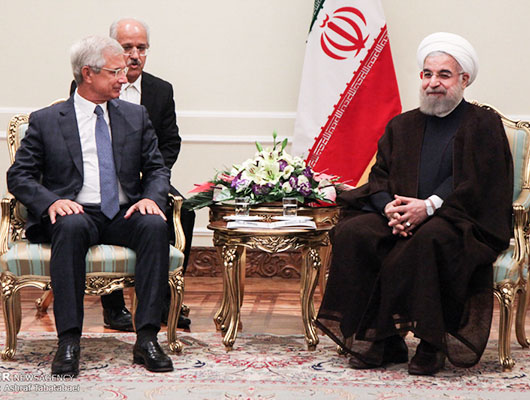
In a Sunday meeting with newly-appointed Belarusian Ambassador to Iran Yuri Ivanovic Lazarcic, Zarif hailed Tehran-Minsk relations as close and called for further efforts to enhance ties between the two countries in various spheres.

The Iranian top diplomat further pointed the removal of anti-Iran sanctions, saying that the new conditions have paved the way for development of banking and trade cooperation between Iran and Belarus.

The Belarusian envoy, for his part, emphasized that during his tenure, he will make efforts to promote economic relations between his country and the Islamic Republic.

During the meeting, Ivanovic Lazarcic submitted a copy of his credentials to the Iranian foreign minister.

In a separate meeting with another European diplomat in Tehran on Sunday, Zarif and the outgoing ambassador of Romania to Tehran, Cristian Teodorescu, explored avenues for closer Tehran-Bucharest relations in various areas, economy in particular.

The meetings come against the backdrop of a new wave of interest in ties with Iran after Tehran and the Group 5+1 (Russia, China, the US, Britain, France and Germany) on July 14, 2015 reached a conclusion over the text of a comprehensive 159-page deal on Tehran’s nuclear program and started implementing it on January 16, 2016.

The comprehensive nuclear deal, known as Joint Comprehensive Plan of Action (JCPOA), terminated all nuclear-related sanctions imposed on Iran.

Iran Lauds Yemeni MPs’ Decision to Convene Parliament

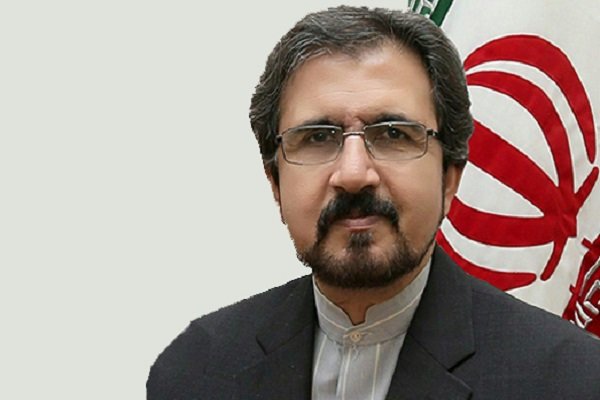
Qassemi

Iran’s Foreign Ministry hailed as wise a recent decision in Yemen to resume parliamentary activities, saying it will help fill the political and legal vacuums amid the international community’s inaction on an ongoing foreign aggression against the Arab country.

 In the current delicate situation in Yemen, the elected representatives of the Yemeni people have acted responsibly and wisely to resume parliamentary activities in order to fill the legal and political vacuums, Iran’s Foreign Ministry Spokesman Bahram Qassemi said Sunday.

He added that the elected parliamentarians have made a rational decision to take a stronger role in Yemen’s critical developments while a foreign military campaign has been massacring Yemen’s people and destroying its infrastructures.

Deploring the lack of an effective move by the international community to stop crimes against Yemeni civilians, Qassemi referred to national unity and reliance on elected institutions as the best option for forcing the aggressors to give in to the Yemeni nation’s will and settle the conflicts through peaceful solutions.

He further reiterated Tehran’s call for dialogue and respect for the Yemeni nation’s demands to put an end to the war.

On Saturday, Yemeni representatives convened the country’s parliament in capital Sana’a for the first time in close to two years.

Since March 2015, Saudi Arabia and some of its Arab allies have been launching deadly airstrikes against the Houthi Ansarullah movement in an attempt to restore power to the fugitive former President Abd Rabbuh Mansour Hadi, a close ally of Riyadh.

According to media reports, more than 8,000 Yemenis, most of them civilians, have been killed in the Saudi-led aggression so far.

Italian Desert Explorer to Run in Support of Iran’s Lut Desert and Asiatic Cheetah

2152151


2152158According to a report by ISNA, as translated by IFP, Reza Shajie, the head of the Environment and Sustainable Development Office at the Ministry of Youth Affairs and Sports, said Max Calderan, who is a Muslim Italian desert explorer, is supposed to run in the Lut Desert in the first half of September 2016 to show support for the Asiatic (or Iranian) Cheetah.

“Calderan will not be accompanied by any team since he is going to run nonstop all the 450km route of the desert, except for meagre 10-minute breaks at 2-hour intervals,” Shajie noted.

Calderan is an incomparable runner who will meet this formidable challenge without eating or drinking anything but water, he went on to say.

2152155He referred to the registration of Lut Desert in UNESCO as an inspiration that encouraged them to start the project and added, “To this end, with collaboration of Fars Green Centre, we invited Calderan to Iran and fortunately he showed enthusiasm.”

“The first session of the project’s policymaking meeting was held with the participation of officials from the Ministry of Youth and Sports, the Football Federation, the Department of Environment, the Cultural Heritage, Handicrafts and Tourism Organization, Fars Green Centre and financial sponsors,” Shajie said.

The main objectives behind the Lut and Cheetah project are to introduce Iranian Cheetah and Lut Desert to the world and issue an advanced warning about the threats they are facing.

Calderan will first try to cross the Lut desert in December, covering around 400km, north to south, following what has been called an impossible line.
“It is believed that it is impossible to cross this desert on foot because of the tangled and confused mass of sand dunes which are 450 metres high.”
It is in these areas where the last Asiatic cheetahs can be found. Around 70 are believed to still exist.
2152160
“This is an opportunity for the cheetahs and other desert animals to be saved by drawing attention to their endangered situation,” Mr Calderan said.
The trip is in aid of the United Nations Development Programme’s Conservation of Asiatic Cheetah Project to save the endangered animal. Mr Calderan is the project’s ambassador.
“Much of what the UN does to support this emblematic species has been done on a daily basis for the past 10 years. So, while it is true that the pressures of modernisation, the encroachment of humans, roads and settlements, plus shooting by poachers of both the Asiatic Cheetah and their prey have all caused the number of these emblematic creatures to dwindle to fewer than 100. It is really never too late.”

Iran to Introduce MasterCards: Minister

Mastercard

Credit and debit cards, accepted in more than 210 countries where MasterCard is valid, will be distributed at financial branches of the Iran Post company from August 23, which coincides with the beginning of the Government Week, he said.

It follows an agreement signed between a representative of MasterCard and Iran Post, allowing Iranians to make payment transactions during travel abroad, buy articles from foreign publications or attend international conferences, Press TV quoted Vaezi as saying.

Payment transactions of up to $10,000 are possible with each card which is rechargeable, the minister said in remarks published by the Mehr news agency on Sunday.

MasterCard made its first inroads into the Iranian market back in December when the Tasnim news agency said the global payment operator had launched a channel in instant messaging app Telegram through which it sent posts in Persian “to attract Iranian users to its services.”

MasterCard also advertised on its channel a 24-hour voicemail which responded to Iranian customers in Persian, it added.

An important service which was being advertised in MasterCard’s channel for Iranians in Telegram concerned dollar-based payments, Tasnim said then.

Under US sanctions, Iran cannot use the American banking system and dollar-denominated transactions are prohibited for the country.

This has significantly complicated not only individual foreign-bound payments by Iranians but also business transactions between Iranians and foreigners.

Vaezi also said two private postal companies will receive operation licenses after the Government Week, but did not identify them.


Mahmoud Vaezi
Communications Minister Mahmoud Vaezi addresses the inauguration of Iran’s first data center for cloud computing in Tehran, Aug. 14, 2016.

In July, Chief Executive of Iran Post Hossein Mehri said the company had signed an MoU for cooperation with Germany’s logistics firm DHL and Dutch package delivery firm TNT Express.

Under the agreement, Iran Post would collect local parcels on behalf of the foreign companies and deliver them to those firms in order to reduce the forwarding time, Mehri said.

DHL is owned by German mail and logistics group Deutsche Post, providing express courier delivery, freight forwarding and supply chain services.

TNT Express is a Dutch express delivery company which collects, transports, and delivers documents, parcels and freight across the world.

Sustainable Security along Borders, Iran Redline: Shamkhani

In a meeting with the Interior Minister of Kurdistan Regional Government (KRG), Karim Sanjari, in Tehran on Sunday, August 14, Shamkhani expressed concern over the increasing moves against the Islamic Republic along the border between Iran and Iraq’s Kurdistan region carried out with the support of intelligence services of regional and extra-regional countries.

“Sustainable security along the borders is a redline for the Islamic Republic and the country’s police and security forces will strongly counter any move threatening the country’s borders,” the SNSC secretary said, as reported by Press TV.

He added that a common stance among different Kurdish groups based on unity and convergence within the framework of a united Iraq would guarantee the improvement of the political and economic structure of the Kurdistan region.

The Iranian official noted that the Takfiri terrorism is a common threat to all ethnic groups and followers of all divine religions in Iraq, adding that establishment of sustainable security would be possible only through the reinforcement of an integrated and united Iraq.

The senior Iranian official emphasized that ill-wishers and enemies of Iraq, through overt and covert support for terrorism, are seeking to thwart efforts made to restore Baghdad’s political, security and economic role as a regional power while engaging the country’s financial and human resources in the so-called fight against terrorism.

Shamkhani praised the great victories of the Iraqi government and nation against terrorists, saying that the triumphs show the country’s high potential to thwart security threats.

The northern and western parts of Iraq have been plagued by gruesome violence ever since Daesh terrorists mounted an offensive in the country in June 2014.

Iraqi government forces, backed by fighters from allied Popular Mobilization Units, have been pushing the militants out of the country’s territory.


We Won’t Allow Any Malicious Act against Iran: Sanjari

The Iraqi official, for his part, thanked Iran’s security, political and economic support for the Iraqi Kurdistan Region and said the continuation of cordial relations with Tehran is an unchangeable priority for the KRG.

Ali ShamkhaniThe KRG would not allow any group to carry out malevolent acts against Iran in border areas, Sanjari added.

He emphasized that a firm fight against Takfiri terrorism is the most important priority for the KRG, saying that Iran has played a leading role in this campaign.